




Abstract
Australia’s National Disability Insurance Scheme (NDIS) is a substantial policy reform aiming to radically transform the design and delivery of disability services. Choice and control are key tenets of the scheme, however challenges and limitations exist with respect to inequities and difficulties posed by boundaries between the NDIS and mainstream services. People with disability who have been incarcerated are particularly at risk of experiencing these limitations. However there has been little academic exploration of these issues for this group. This paper explores whether NDIS services are readily accessible for people with disability who were formerly incarcerated, outlining some of the challenges this group encounters. The research is based on interviews with 28 stakeholders from government and non-government organisations that interact with and provide support or services to people with disability within the criminal justice system. Our findings confirm the importance of a functioning NDIS plan to help prevent some individuals encountering the criminal justice system, outlining several challenges that formerly incarcerated people with disability experience with the scheme. We conclude that ideas of choice and control are inhibited for some formerly incarcerated people with disability and highlight actions that can be taken regarding specialist support coordination, advocacy services and market stewardship to address these issues.
Introduction
Australia’s National Disability Insurance Scheme (NDIS) is a substantial policy reform aiming to radically transform the design and delivery of disability services. Through personalised planning and individualised funding, the NDIS aims to enhance ‘choice and control’ and ultimately foster the participation of people with disability in community, social and economic life. For some, the NDIS has been transformative, providing appropriate supports to achieve their articulated goals. However, there are some challenges and limitations of the scheme, including the potential to entrench or enhance inequities (Carey et al., 2017) and the difficulties posed by boundaries between the NDIS and mainstream services, such as health and education (Dickinson and Carey, 2017; Yates and Dickinson, 2021).
One group that is most at risk of experiencing these types of challenges is people with disability who are, or have been, incarcerated. Formerly incarcerated people experience health, mental health and substance use issues at higher rates than the general population (Nosrati et al., 2018; Fazel et al., 2017; Binswanger et al., 2007) and are less likely to secure employment (Looney and Turner, 2018; Doyle et al., 2021). This means that formerly incarcerated people require services from a broad array of public agencies and experience a range of socio-economic inequities that are likely to be compounded for those with disability. For formerly incarcerated people with disability, it is crucial that the NDIS works effectively with correctional services and yet there has been limited academic research exploring this intersection (see Young et al., 2017). Recent research suggests that both people with disability who are incarcerated and professionals working at the intersection of disability and criminal justice are uncertain about which services people in prison can access through the NDIS, leading to inconsistent practice (Yates et al., 2022, forthcoming).
This paper explores whether NDIS services are readily accessible for people with disability who were formerly incarcerated, outlining some of the challenges this group encounters. The research is based on interviews with 28 stakeholders from government and non-government organisations that interact with and provide support or services to people with disability within the criminal justice system across three Australian jurisdictions (New South Wales (NSW), Victoria, and the Australian Capital Territory (ACT)).
Our findings confirm that a functioning NDIS plan is important not just for the support it provides to individuals, but also because provision of support can help prevent some people encountering the criminal justice system. Yet, formerly incarcerated people experience several issues in accessing the scheme, navigating its complex processes, and using their plans, all challenges that need to be addressed through policy and administration of the scheme. Despite the promises of the NDIS providing choice and control, some formerly incarcerated people with disability find this curtailed. This work has implications for the availability of specialist support coordination and advocacy services and the role of market stewardship in the scheme.
In setting out this argument the paper is structured as follows. To begin, we provide an overview of the NDIS as an example of a growing number of schemes internationally that adopt an individualised funding approach. We argue there have been challenges with these schemes, particularly relating to equity, access and their boundaries with other government funded services, explaining why this could pose issues for formerly incarcerated people with disability. We then summarise the methods adopted in this research, before moving to our findings. Firstly, we reflect on the importance of a functioning NDIS plan for formerly incarcerated individuals, before exploring three themes that relate to issues about the demand and supply side of the scheme: difficulties in accessing the scheme, challenges in advocating for a plan, and challenges in using a plan. In the discussion we set out several implications of these findings for the NDIS and individualised funding schemes more broadly.
Background
Disability policy has become increasingly internationalised, not least through commitments such as the 2007 United Nations Convention on the Rights of Persons with Disabilities, which sets a powerful imperative to support people with disability to live active and meaningful lives in their communities. In recent years, we have seen similar articulations take hold in different nations, broadly tied to a personalisation agenda (Needham and Dickinson, 2018). Variants of individual funding schemes, primarily for personal and social care, can be found in many liberal democracies such as the United States, the United Kingdom, Canada, New Zealand, France, and Germany (Dickinson, 2017). Australia is following this trend and has embarked on significant reform of disability services through the NDIS. A key component of this system is self-directed care, based on the idea that giving eligible people with disability control of a budget to purchase services from a privatised market allows individuals to tailor their care to meet specific needs. It is argued these systems of care should empower individuals and their families by expanding choice and control over services, enhancing inclusion within societies, and enabling greater realization of their rights (Lakhani et al., 2018).
The NDIS was launched in 2013 and since 2017 has been implemented across Australia. Today, more than half a million Australians with significant and permanent disability have individualised funding packages (NDIS, 2021), representing just over 12% of Australians with disability. Once accepted to the scheme, participants work with planners to develop a plan that includes life goals and a budget allocation to support their achievement. The NDIS is not intended to replicate services that are already provided by other systems such as health, transport, education and justice, as set out in the Council of Australian Governments (COAG) principles that determine the nature of the NDIS interaction with mainstream services (COAG, 2015). However, the success of the NDIS depends on its effective interface with mainstream services (Wallace, 2018), which requires coordination and modification of existing services to ensure they work better together (Scott and Bardach, 2019). Without sufficient coordination, there is a risk that neither system provides the required service and a person’s disability needs go unmet. Unfortunately, the line between what supports come under a mainstream service’s universal service obligation or reasonable adjustments required under law, and what is the responsibility of the NDIS, has often been unclear - resulting in significant service gaps (Cowden and Mccullagh, 2021; Yates et al., 2021b; Foster et al., 2021). This mirrors international experience regarding individualised funding schemes, where there have been difficulties in determining where the boundaries lie between different service types (Dickinson and Carey, 2017). For example, Glendinning et al. (2011) found boundary issues between what was considered a health expense and what was considered a social care expense in their research on individual budgets for social care in England. In contexts where interfacing systems are insufficiently resourced to meet basic and disability-related needs, people experience more disabling circumstances (Hopper, 2007).
Scholars and activists have also raised concerns regarding the potential of individualised funding schemes to entrench or increase inequities. Individualised funding systems such as the NDIS operate in broader societal contexts where people with disability continue to experience discrimination, systemic inequalities and unmet need across numerous life domains (Malbon et al., 2019). These inequities are well established in the literature. People with disability are more likely to be overweight or obese, smoke, be physically inactive or have poor diets (Australian institute of health and welfare, 2019). They also have higher rates of health service use and chronic conditions like diabetes, heart disease, and are less likely to use preventative health care (Llewellyn et al., 2011; Chen et al., 2009). Additionally, Australians with disability have a weekly median income less than half of those without disability (Australian Bureau of Statistics, 2016).
Similarly, formerly incarcerated people are more likely to have mental health and substance use disorders (Fazel et al., 2017). Incarceration can be health depleting (Binswanger et al., 2007) and impacts life expectancy disproportionately across the social gradient (Nosrati et al., 2018). This is particularly problematic given the challenges in securing employment post-incarceration (Looney and Turner, 2018; Doyle et al., 2021). People with disability, especially cognitive or intellectual disability, are overrepresented in Australia’s prison system (e.g. Trofimovs et al., 2021). Indeed, many are criminalised as a direct result of their impairment (Sotiri and Russell, 2020).
Given the many issues that formerly incarcerated people with disability face it is crucial that the NDIS operates effectively for this group. Submissions to government inquiries and reports from advocacy groups (e.g., Sotiri and Russell, 2020; Joint Standing Committee on the National Disability Insurance Scheme, 2020) suggest the existence of interface issues with the NDIS and the criminal justice system. However, this issue has not yet been widely explored in academic literature (see Young et al., 2017). This paper addresses this gap by exploring this interface and whether it poses challenges for formerly incarcerated people with disability in accessing NDIS services.
Methods
This paper draws on data from a broader project that explored what works well and where challenges arise in the interface of NDIS and correctional services. It focuses specifically on the post-release component of the system. The project was afforded ethical clearance from [University of New South Wales] HREC [HC210578]. We adopted a qualitative approach, using semi-structured interviews (Low, 2013) with participants who have knowledge or experience working with people with disability involved in the criminal justice system. Semi-structured interviews are typically used to gain a detailed picture of a respondent’s beliefs or perceptions of a particular topic (Smith, 1995). Questions covered the work of their organisations, their current role, and relevant professional history. Depending on the interviewee and their organisational type, we asked about their processes for identifying people with disability and views on the adequacy of services for this group as they navigated the criminal justice system, both during incarceration and afterward.
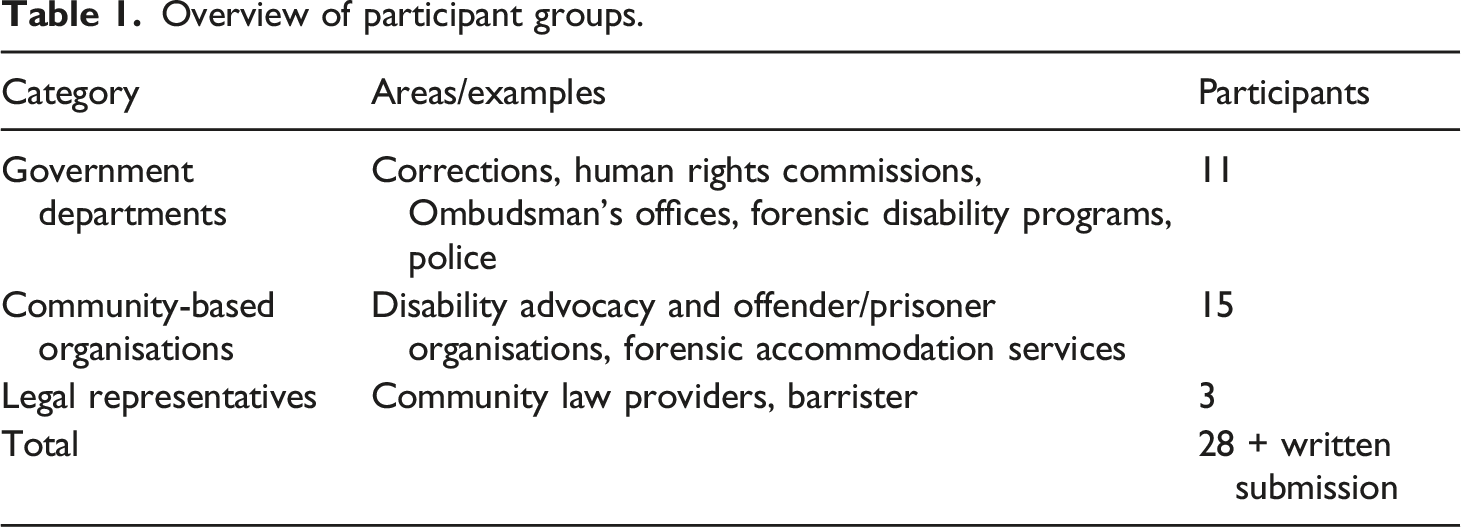
We adopted a purposive sampling approach (Palinkas et al., 2015). Participants represented three broad groups of stakeholders: (1) criminal justice or disability advocacy services; (2) corrections agencies; and (3) disability service providers. This was to ensure we captured perspectives from a variety of stakeholders from different parts of the system, and views from both inside and outside government. All were from organisations that interacted with and provided support or services to people with disability in the criminal justice system. For this exploratory study, we targeted people from three of the eight Australian states and territories: NSW, Victoria, and the ACT. Drawing on the research team’s existing contacts and information sourced through the public domain (e.g., organisational websites), we emailed organisations and departments who fell within the broad stakeholder categories. We asked the recipient to forward our email to individuals who met our three-prong inclusion criteria of: (1) being based in NSW, Victoria or the ACT; (2) working, or having previously worked, in corrections or with an organisation which provided disability or criminal justice services or advocacy support; and (3) having professional insight into the intersection between the criminal justice system and disability. Potential interviewees were asked to contact the research team if they wished to participate. In addition to the purposive sampling strategy, we also employed snowball sampling procedure (Parker et al., 2019), asking interviewees if they knew of others who might meet the inclusion criteria and be interested in participating.
Overview of participant groups.
Our analysis draws on the verbatim transcripts of the interviews and written submission. These documents were imported into NVivo. We conducted a thematic analysis by organising the data into explicit codes or themes (Boyatzis, 1998) that represented patterned responses of meaning within the dataset (Braun and Clarke, 2006). These themes were identified through a “careful reading and re-reading of the data” (Rice and Ezzy, 1999: p. 258) and became the categories for analysis (Fereday and Muir-cochrane, 2006). We adopted an inductive, data-driven approach, rather than coding according to a pre-determined theoretical frame (Braun and Clarke, 2006). Identified themes from the interview data included, for example, the masking of disability within correctional settings and other constraints to identification; the availability of support for people in prison with disability; and the suitability of prison programs for people with disability. Specific to the re-entry process themes included pre-release planning and assistance provided to people with disability; issues encountered in attempting to secure appropriate and supported post-release accommodation; and individuals' understanding of the terms and conditions attached to their parole order.
This study was limited by the fact that we were informed only by the perspectives of individuals who work at the intersection of the criminal justice system and disability. As an exploratory project, the aim was to understand system-level issues, with the intention of informing future work with formerly incarcerated people with disability. While these findings provide a valuable contribution to knowledge in this area, future research must incorporate the lived experience of people with disability as they navigate the criminal justice system. As Gormley (2022) argues, there is currently limited academic research that centres the voices of people with disability, thereby leading to misconceptions about their experiences within the justice system.
Further, while we invited corrective services from our selected jurisdictions to contribute to this study, we received only a brief written submission from a corrections representative in one jurisdiction. Future research would benefit from their perspective on the steps taken to identify and accommodate people with disability, particularly with assisting transition to the community as individuals near the end of sentences. Finally, our sample size may also have been impacted due to the COVID-19 pandemic, with some community-based organisations or service providers unable to contribute.
Findings
Here, we describe our findings and present interview quotes to illustrate the meaning of the patterns identified through our analysis. Firstly, we reflect on a message from several respondents– that a functioning NDIS plan is important not just for the support it provides to individuals, but because providing people with adequate support helps to prevent people going back to prison. This is important both for individuals and to align with the NDIS principle of social investment as an intervention to reduce future state liabilities (Dickinson, 2017). We then discuss three more issues related to the demand and supply sides of the scheme: difficulties in accessing the scheme, challenges in advocating for a suitable plan, and challenges in using a plan. For interviews with more than one person, we used a lettering system to attribute the quotation to the specific interviewee (e.g., P11b). To help contextualise their quotes, we also provide a brief description of the interviewee’s role.
A functioning NDIS plan is important
Several respondents commented that some people with disability would not have interacted with the justice system in the first place if their disability needs had been met. They felt that when individuals do not have appropriate supports in place it can lead to them acting in ways that bring them into contact with the criminal justice system: So, most of the time, the reason that they’re in custody is because they’ve not had the supports that they’ve needed, so they’ve resorted to whatever means is necessary, which is generally illegal activity (P07 - Manager - Disability Support Agency).
As another interviewee explained: ‘…a big portion of our clients would not offend if their disability support needs were met and their other needs were met earlier’ (P20 - Project Leader - Forensic Residential Services).
A service provider commented that people who do not have support to navigate the NDIS planning system ‘end up with these tiny plans, then they end up in the criminal justice system' (P09 - Senior Practitioner, Government Forensic Disability Program). Similarly, P04 (a barrister) felt that: ‘The NDIS [is] not supporting people who should have support, and it being an incredibly difficult process to navigate, results in people being incarcerated as a backup plan'.
It was common for interviewees to have experience of people with disability who cycle in and out of incarceration over their life. In some cases, they believed this resulted from a lack of support in the community through services such as those attainable through the NDIS: The people that we have come through our service are long-term people who go in and out all the time, who mostly have some sort of a mental health or some sort of an intellectual disability or something that means that they keep reoffending. Because [there is] no support in the community…I find that a lot of people go to jail because of their disability, because they’re not understood… They get angry because they’re frustrated by the way that they’re being treated…and then they get in trouble because …they get used by other people in the community (P08 - Program Coordinator - Disability Organisation).
Some interviewees reported being aware of people who were released from incarceration due to the presence of a NDIS plan, because the plan was considered a protective factor supporting their successful re-entry. For example, one respondent told us that a judge had made this a condition of release: [Name’s] very lucky, he's got this 24-hour, seven day a week support service. He doesn't want it, by the way, but [laughs] that was one of the conditions that the judge changed his order. So that would not have been possible without the NDIS. Without getting those two specialist support coordinators involved I don’t know whether I would have got as far, and particularly with [name]. That was just a godsend. They worked really hard to get…a good package for him (P13 - Manager, Disability Advocacy Organisation).
As this respondent also suggests, getting the plan was not without challenges and was only possible because of specialist support coordinators (we cover challenges in accessing the scheme and using plans in more detail below).
A final point for this theme is the service landscape has changed, so that those who are not on the NDIS have fewer support options than may have been available prior to the scheme’s implementation. As one participant explained, ‘But these days, the way funding is, you need an NDIS plan in order to get support because the person comes with the money’ (P01 - Manager, Advocacy Service). Since the establishment of the NDIS, states and territories have defunded some supports, resulting in no safety net to catch participants who may fall between the cracks in NDIS services: Because of the change in funding, you don't have those local areas that pick up the people who don't meet those criteria anymore, because all their funding got redirected into the NDIS. You don't have that kind of catch service anymore. I'm watching people slip through where I go, 'yeah, we could have done something for you a lot earlier'. But it's not necessarily police. … it's a lack of community services in different areas, because police are not the ones who can do that (P18 - Police Liaison Officer).
Difficulties accessing the scheme
Several interviewees told us that the NDIS is difficult to access, which is driven by several factors. Firstly, some people may not know that they have a disability. It is clear there were significant underestimates in the initial modelling for the NDIS regarding how many people had autism and some forms of intellectual disability. Far more people have entered the scheme with these diagnoses than was initially projected (Taylor Fry, 2021). It is therefore likely that there are individuals who do not know that they have a disability and whose behaviours are instead explained as criminogenic characteristics (i.e. attributes that are associated with criminal offending, and therefore considered the jurisdiction of justice agencies). If you do not know you have a disability then you would not know you are eligible for the NDIS, as one interviewee explained: People can’t get into the NDIS without a functional assessment, and sometimes an IQ test. Frequently people, especially people who are in the prison system who have just skated through as the naughty kid who left school early … and there’s trauma, and so no one really identifies disabilities…Because once they’ve left the school system, then no one’s assessing or testing that stuff (P23 - Senior Government Disability Advisor).
Secondly, even if people do know that they have an impairment that meets the NDIS eligibility requirements, forms need to be completed by individuals (and their supporters) and by a range of professionals to evidence this. The administrative burden of the NDIS application process has been extensively documented (Brown et al., 2021; Yates et al., 2021a). This often involves the requirement to attend appointments with multiple clinicians. However, not all clinicians are available through the public health system, requiring a person to access private health systems, which can be an expensive and emotionally taxing process: I mean, going through the processes to be able to get NDIS support is traumatic for people … you've got to go to this doctor and then this doctor and then this doctor and the government doctor (P02 - Manager, Prisoners' Organisation).
Thus, without the support of clinicians and specialists, individuals may not know they have a condition that makes them eligible for the NDIS. Once they become aware, a lack of support for the application process can make it difficult to demonstrate their eligibility.
Challenges advocating for a suitable plan
Once an individual is deemed eligible for the NDIS, they develop a plan with a planner. This involves capturing the outcomes a person aspires to and identifying the supports they require to achieve these goals. Several interviewees explained that formerly incarcerated people often struggled with this process, as it involves identifying their strengths and limitations and where they need supports. P09 emphasised that clients may not understand or be able to communicate their capabilities and support needs without sensitive probing from planners or advocates: I always find it amazing when you go into a planning meeting and the planner … just honestly read[s] from a computer and just tick[s] a box … like, I’ve heard them, 'can you catch public transport?' The client’s like, 'yes'. I’m kind of sitting there going, 'no you can’t'. So, then I would ask a follow up question, so 'okay, well if I was to tell you that you needed to get on such-and-such train at such-and-such time on such-and-such platform, would you be able to do that independently?' They’re like 'oh, no, well I can’t tell the time'. Well, there’s your answer. You can’t actually catch public transport independently if you can’t tell the time (P09 - Senior Practitioner, Government Forensic Disability Program).
Interviewees reported that not being able to articulate their support needs or access advocacy meant people often did not get adequate plans: If there’s two participants with exactly the same functional support needs, exactly the same diagnosis, who have two different groups of people supporting them through the NDIA [National Disability Insurance Agency] application process … they will get two very different outcomes…it is very contingent on how well somebody communicates that person’s functional support needs (P23 - Senior Government Disability Advisor).
Many NDIS participants take a support person to help them articulate their needs. However, if that individual does not have systemic knowledge, then this is not necessarily helpful: We do have clients come to us, often through the courts and they will sometimes come with an NDIS plan. So, we get a copy of their plan, and they’ll have very, very minimal funding…which doesn’t meet any of their disability needs at all. Then when you speak to the client and say, 'well who attended the planning meeting with you?' They’ll often say they just went on their own or mum went with them (P09 - Senior Practitioner, Government Forensic Disability Program).
NDIS participants can engage a support coordinator, a professional who will support an individual to help them secure an effective plan. In addition to this, some people had encountered specialist support coordinators who were experienced with this population group: So, it’s first of all getting that agreement to be involved in the NDIS, and then really it’s working hard. What I’ve found is that you’ve got to really get a specialist support coordinator, rather than just the support coordinator (P13 - Manager, Disability Advocacy Organisation).
However, these specialist coordinators are not widely available: ‘I honestly find the NDIS, it just depends on the person that you’re taking to on a particular day. There is zero consistency’ (P09 - Senior Practitioner, Government Forensic Disability Program). Moreover, it is often the case that individuals do not actually know that they need a support coordinator, let alone a specialist support coordinator. Lack of specialist knowledge and expertise from NDIS actors can lead to difficulties with planning, as mainstream planners and coordinators may not understand what the ‘forensic overlay’ permits or restricts: We've had examples where a client has been at a planning meeting to plan for their supports … and they're talking about wanting to go to the beach and they're wanting to go to the parks and they're wanting to go to Dreamworld. …These are sex offenders. They're never going to be able to do that kind of stuff. The planner is going 'yeah, we can put that in your plan'. We're like 'no, you can't'. So that's where it becomes challenging because then we've become the bad guys. …I mean they're very clear examples of where that forensic overlay is just not understood, or risk, from planners or support coordinators (P22 - Manager, Forensic Residential Services).
A further challenge in planning processes relates to the boundaries between mainstream and disability services. The NDIS will not include services in a plan that should be funded from a mainstream service – in this case behaviours associated with criminal offending. However, the distinction is often unclear, as one interviewee explained: You also have the NDIA messaging now saying we’re not funding services to stop people from reoffending. That’s justice’s responsibility. The message we’re seeing a lot more of, which is more about those participants who’ve transitioned back into the community, there’s significant risks associated with that. Plus, support services trying to increase staffing ratios to manage that, and the NDIA’s messaging is, no, no, this is about their offending behaviours. It’s not about their disability, not recognising that one impacts the other (P24 - Manager, Primary Healthcare Organisation).
In some cases, and as discussed above, individuals demonstrate behaviours of concern that lead to them becoming engaged with the criminal justice system, when appropriate disability supports may have prevented them from offending and/or reaching the criminal justice system. But if the need is seen as a justice need and not a disability need, they are unable to get these services as part of their NDIS plan. P22, a forensic residential service provider, told us that they prefer ‘to work from a holistic position’, but ‘the NDIS system is really forcing us to try and have this siloed vision of the client which is really difficult'.
Similarly, one interviewee reported they have been successful with supporting formerly incarcerated people through NDIS planning processes because they carefully consider framing their needs as being related to their impairment and not their offending: We definitely are extremely strong advocates and have been able to get some incredible things through the NDIS plans but I think that’s because of our knowledge and experience in the space and being able to articulate exactly what a person needs. We really try hard with the NDIS not to talk about somebody’s forensic needs (P09 -Senior Practitioner, Government Forensic Disability Program).
As this quote demonstrates, with specialist expertise and insight it is possible for individuals to have their needs articulated and appropriate funding to be gained. But the onus in the system is on individuals identifying that they need these supports and then being able to find and secure them. These challenges are magnified where individuals have a lack of family support, insecure housing or impairments that impact their executive functioning. As one interviewee explained: Basically, unless you have a really great advocate or really strong family support, then the more complexities or the greater the number of issues …you have, the greater your chances of ending up in the criminal justice system (P04 - Barrister).
Challenges in using a plan
Once an individual secures a plan there is often significant work required to enact it and secure the services and supports outlined in the plan. As one interviewee described: ‘you can’t send them off with an NDIS package and think they’re going to be okay. Because most of the time they’re not’ (P08 - Program Coordinator, Disability Organisation). Participants claimed that many NDIS clients do not know how to use their plans, with one reporting: It's not uncommon for people to have a plan, but they don’t know how to use it…people get plans and they didn't know how to spend the money, so the next time their plan came up, well, you don’t need that money because you didn’t spend it (P01 - Manager, Advocacy Service).
As this quote illustrates, the implications of not using plans are significant. If someone does not spend their care budget, at plan review planners may take this as an indication that these services and supports are not needed, meaning subsequent plans might be reduced.
The NDIS is contingent on the individual (or their supporter) driving the navigation process and securing providers. This is not a process that everyone has experience in or has the capacity to undertake. It is challenging for many people, but can be magnified for formerly incarcerated people as they are not always as accustomed to making choices and decisions. As one interviewee described: …most of these guys have no idea about the NDIS … Most of my experience with the people that are involved with it- because it’s so much about choice and control, and being in and out of corrections you're told when you eat, when you sleep and basically, everything is told to you (P07 - Manager, Disability Support Agency).
Choice and control can also be inhibited in the other direction because providers have choice and control over their clients. For example: ‘A lot of services won’t work with people who are homeless' (P08 - Program Coordinator, Disability Organisation). Behaviours of concern can also be a barrier, as one interviewee explained: …some people have got supports approved in their plan but there’s no provider that will take them because of the level of difficulty engaging with services. So, for instance, if someone has violent tendencies that result from a psychosocial disability, it will often be the case that no provider will take them on, and there’s no provider of last resort (P04 - Barrister).
This observation was echoed by another interviewee, who explained: I mean we spent three and a half years in the pilot site with the NDIS talking to the other services - I won’t even name them all - around how they were going to cope with supporting this particular client group. It became really clear that they weren’t. They weren’t going to, they couldn’t afford to because our clients-you ask our clients to do something that they don’t want to and they go, fuck off [laughs]. Yeah, we had quite a few people that had charges of child sexual assault and [providers] would say, I can’t wait till the NDIS (P05 - CEO, Criminal Justice Organisation).
In this case the providers had wanted to see the NDIS come into operation as the market-based system would mean they could choose not to work with particular clients. P05 also explained: Most people don’t like a client group that tell you to get fucked, and funding doesn’t really enable a holistic model of support for the client group. It’s compartmentalised and it’s because NDIS funding is supposed to be in additional to. It’s supposed to be building on something that already exists in the community that they can enhance your standard of living. Well, there’s nothing in the community to build on.
Others reported they had been able to secure providers, but had found them unwilling to continue providing services: As soon as behaviours of concern start to emerge, they drop them like hot cakes. So I can't tell you how many changes of staff our clients have got … I think there's …providers [who] don’t want to work with our client group. Or if they do, they go 'oh well, there's a good package here, we'll work with this client. Good money'. They'll start to work with the client and then it's really tough and it's really challenging so we're out of here. Not worth the bucks (P22 - Manager, Forensic Residential Services). …[provider] were refusing to work with them. Then we ended up having participants exiting custody and going straight into acute mental health units and sitting in there for months, because there’s no other option for them… some of these participants are sitting in that sort of million-dollar-plus cohort from the point of view of funding (P24 - Manager, Primary Healthcare Organisation).
Several interviewees raised concerns around some providers and their motivation for taking on some participants, particularly those with larger package sizes. As P24 continued: … [the system is] doing either two of things. It’s either attracting providers that probably shouldn’t be working in this space, because they see the dollars and they go, 'woo, we can do this', and then we find out very quickly that they can’t. Or it’s other providers are looking at it going, 'yeah no, we’re not going to pick it up, because we don’t want to hold that extra risk at this point in time'.
Discussion
Our findings confirm that formerly incarcerated people with disability often do not have access to adequate disability supports, and this has implications for their continuing involvement with the criminal justice system. Moreover, if some individuals were provided with appropriate supports prior to being incarcerated it is probable they would have been prevented from encountering the criminal justice system at all.
While the demarcation in policy between what is a disability and what is a criminogenic need may seem clear, the operationalisation of this in practice is more challenging. In what are still the relatively early days of the NDIS this may be more of a pressing issue given that Australian disability services have traditionally been under-funded and inconsistent (Australian Government Productivity Commission, 2011), meaning there may be a large amount of unmet need with respect to disability diagnosis in the community and many people with disability that have gone undetected to date. As our findings also outline, some individuals have been supported to overcome these difficulties and successfully apply for the NDIS. Yet these supports are not being made available or accessed by all. Assuring more consistent access might prevent widening inequities for some formerly incarcerated people with disability.
It is well established that the NDIS can be challenging to navigate (Carey et al., 2021; Yates et al., 2021a), with issues evident at many different parts of the care planning process and in securing appropriate supports (Sotiri and Russell, 2020). While the ethos that individuals should have choice and control over their services is theoretically compelling, as our findings demonstrate, people with disability need significant support to make a reality of this. Despite the 2019 decision to introduce NDIA Justice Liaison Officers (Joint Standing Committee on the National Disability Insurance Scheme, 2020), there is clearly a gap in the existing system of specialist support to encourage and help individuals to demonstrate their eligibility for the NDIS and then to secure an appropriate plan and navigate the system to arrange necessary supports. In some of the jurisdictions encompassed in this research, the establishment of the NDIS has led to states and territories divesting themselves of advocacy services (Joint Standing Committee on the National Disability Insurance Scheme, 2018). In the absence of these services, individuals may not know they are eligible for supports or may be reluctant to try and secure supports without assistance. Research has shown that formerly incarcerated people and people with disability can be distrustful of government systems and therefore reluctant to engage (Maguire and Nolan, 2007; Johns, 2017). This points to a gap in the system with respect to specialist advocacy services that sit within not-for-profit organisations and have in-depth knowledge and experience of this group and the types of issues that they face. In the absence of this, for some we see a cycle where behaviours linked to their impairments lead them to encounter the criminal justice system again and again.
Even where individuals can navigate a planning process and secure funding for suitable supports, there are many challenges in securing these supports. It is well established that there are gaps (or as P08 called it, a ‘chasm’) in provision of disability services and in many areas significant delays are encountered in trying to secure appropriate supports (Sotiri and Russell, 2020). There is a general lack of specialist services targeted at individuals who have previously spent time in the criminal justice system. Further, the ethos of choice and control exists not only for NDIS participants, but also for service providers. There may be little incentive for providers to take on individuals who have behaviours of concern. Given the challenges and complexities of the lives of some formerly incarcerated people with disability, if services can choose not to engage and there is no provider of last resort, they may find it difficult to secure provision of supports, or service arrangements can be short lived. This means that even if funding is secured the appropriate supports may not be provided. In these cases, clients who cannot secure supports may also risk losing funding if it goes unused before their plan is reviewed.
These issues highlight the need for market stewardship, which refers to the government intervention necessary to ensure that public service markets are operating effectively, including engaging with users and providers to understand needs and enablers, setting and adjusting the ‘rules of the game’, and monitoring market developments that occur as users and providers respond to these (Gash et al., 2012, p. 6). In the context of the NDIS, effective market stewardship requires that “governments actively monitor the market for inequities and not just protect citizens from worst case scenarios (i.e. fraudulent providers) but steer and manage the market to ensure it is benefiting all citizens” (emphasis added) (Carey et al., 2018: p.399–400). While market stewardship is needed to ensure services for all those accessing the scheme, certain groups will likely experience additional challenges (e.g. those living in remote areas, Indigenous Australians, people from culturally and linguistically diverse backgrounds) and it is important that these areas are proactively addressed rather than left to the market. In the context of this paper, inequities are evident with formerly incarcerated people with disability, who face considerable impediments to accessing supports through the NDIS and, when plans are developed, truly exercising choice and control to ensure support needs are met. Therefore, effective market stewardship is needed to identify gaps in the current system and to work to encourage the development of appropriate services to meet these needs. For example, it is unlikely that we will see the suggested specialist support coordination functions emerge within the market on a widespread basis without stewardship actions, and there may be a role for the NDIA to help support the creation of these and advocacy roles to ensure that they are available. Issues over market stewardship in the NDIS are not new (Carey et al., 2018), and it is becoming increasingly apparent that these gaps in the market have the potential to exacerbate inequities.
Conclusion
Formerly incarcerated people with disability often experience socio-economic factors that serve to produce poorer outcomes across a range of domains. The NDIS is a scheme that should provide support to all eligible individuals, promising to deliver choice and control for those who access it. In this paper we reported on interviews with 28 participants from a range of stakeholder groups across three Australian jurisdictions, seeking to explore what works well and where challenges arise in the interface of NDIS and correctional services. We found that appropriate and functional NDIS plans are crucial to support formerly incarcerated people and can serve to prevent future engagement with the criminal justice system. Interviewees confirmed that some clients in this group do receive significant and transformative supports, and that the situation may be improving overall. Yet this cohort still experiences significant challenges in accessing the NDIS, securing appropriate plans and operationalising these plans. The complexity of the scheme combined with a lack of specialist support coordination and a paucity of advocacy means that formerly incarcerated people struggle to gain appropriate plans, putting them at risk of existing inequities being exacerbated. Further, the market-based model means that choice and control applies to providers as well as NDIS participants, which means that some formerly incarcerated people experience gaps in service provision, as providers exercise choice not to provide services to clients deemed difficult or not financially rewarding. Effective market stewardship could play an important role in identifying and addressing service gaps.
Footnotes
Declaration of conflicting interests
The author(s) declared no potential conflicts of interest with respect to the research, authorship, and/or publication of this article.
Funding
The author(s) received no financial support for the research, authorship, and/or publication of this article.
