




Abstract
This article addresses the relation between the design of regulatory agencies and efficiency, arguing that authority concentrated to a single individual outperforms more collegial decision-making when the regulated firms’ interests are aligned. The tentative explanation is that concentrated leadership reduces the risk for capture. This argument is developed from an empirical case on the markets for mobile and fixed broadband. In the mobile market, the regulated firms are similarly positioned, whereas in the fixed broadband market, the firms typically have adversarial positions, with an incumbent being challenged by entrants. A statistical analysis of regulatory agencies in 33 European countries lends support to the argument that regulation of mobile broadband benefits from having a single decision-maker whereas a bureaucratic regulation with more collegiality functions as well for the fixed broadband.
Introduction
The regulatory agency is a rather newly established but increasingly important institution that concerns, for example, competition law, food regulation, and infrastructure (Majone, 1994; Glaeser and Shleifer, 2003). The regulatory agencies steer some markets that in Europe used to be managed through state ownership, such as telecommunication, and some markets that did not previously have political regulation, such as medical drugs. The political-economic hybrid character of the regulatory authority implies that its tasks exhibit logics that are usually associated with democracy (such as equity) as well as markets (efficiency and technical progress). Although the phenomenon is examined in some previous research (Wassum and De Francesco, 2020; Koop and Hanretty, 2018; Gilardi, 2008), some key regulatory-design aspects appear to be missing in the discussion of which steering strategies are the most successful in this context. This article scrutinizes the regulatory authority from an institutional-design point of view and conjecture that the relative merits of concentrated directional leadership, on the one hand, and collegiality, on the other, depend on the specific structure of the regulated market.
The argument in this article is that a forceful regulator, underpinned by decision-making concentrated to an individual, is particularly beneficial in markets where the regulated firms’ interests are aligned, i.e. where the firms are similarly positioned so that the information provided to the regulator tends to be biased in a direction that serves the purpose of the firms. In a market where the regulated firms have opposing interests and hence more adversarial positions, a richer set of facts and arguments will be presented to the regulator and the need for the authority to engage in fact-finding is reduced. Instead, diversity of standpoints from multiple board members may afford the regulator a more complete view of the situation. The regulatory agencies will therefore be able to achieve outcomes that benefit the public even though the regulator itself acts less forcefully than would an assertive single decision-maker. In contrast, in markets with more convergent interests, this kind of consultation will be less revealing, and the advantage of being able to take strong directional action is more crucial to limit the influence of special interests.
We use empirical evidence, including some exclusive data, from a relatively new public service, retail broadband, to substantiate our conjecture. The broadband market is relevant since it has two main segments, for fixed and mobile broadband, respectively, and since a key difference between the two segments is the extent to which the dominant firms have aligned interests. Mobile broadband is a market with rivalry between a small set of firms, whose interests, at least vis-à-vis the regulator, are largely aligned. Each operator is expected to build its own infrastructure for mobile broadband, or to share it on commercial terms with a rival. In contrast, the market for fixed broadband in Europe is underpinned by the principle that the dominant firm has to offer rival operators access to its proprietary infrastructure at regulated prices. This creates a situation where the dominant and its rivals have opposite interests when it comes to access pricing.
We use data on decision-making regime that comes from a survey sent to regulatory authorities in Europe. The relationship between board structure and broadband penetration (fraction of all households) is estimated separately for fixed and mobile broadband. Multiple regression analysis applied to the data supports the argument that Director General decision-making is associated with greater mobile broadband penetration, under control for the nature of the judicial system and socio-economic factors. In contrast, no such effect can be established for fixed broadband markets. Our analysis thus emphasizes the relationship between the market structure and decision-making in the public administration or, more generally, between the strategic context in which the authority operates and the allocation of decision-making power.
Different models of bureaucratic decision-making
The organization of bureaucracy is often researched from a broad perspective, emphasizing the complexity of the state, the boundaries between market and government and strategies politicians use to control the bureaucracy and the bureaucracy’s strategies to achieve and retain a degree of independence. 1 This large literature on New Public Management (e.g. Bouckaert and Verhoest, 1999; Pollitt et al., 2001; Verhoest and Bouckaert, 2007; Jacobsson et al., 2015), generally focuses on how governance can be organized at large, or how behavioral patterns influence policy-making (Leong and Howlett, 2020). Another line of research, becoming more popular in recent years, studies the relationship between culture, country-specific traditions and the quality of government (e.g. Porcher, 2021; Bouckaert et al., 2020).
Still, while some previous studies have touched on related aspects of the organization of the administration, the internal workings of the top management of the bureaucracy is a key – but so far largely neglected – aspect of the efficiency of the bureaucracy. Some focus on the institutional arrangements, and the potentials of these to provide better outcomes (e.g. Rothstein, 2011), but the variation between different types of agencies is rarely taken into account. There are a few exceptions. Andrews et al. (2009) survey the literature on (the effects of) internal hierarchy and participation in bureaucracies. In their own empirical study of 53 UK public-service organization, they find that centralization is associated with better performance for authorities that have a “prospector strategy”, i.e. that aim for innovation and development, and that decentralized and participatory management is associated with better performance for authorities that have a “defender strategy”, aiming for continuity and stability. In their words, high performance is more likely for “organizations that match their decision-making structure with their strategic stance”. The present study develops a similar perspective, by examining a real case and discussing the real-life prerequisites for decision-making in a political area close to market logics.
In line with Gavetti et al. (2007), we argue that a decision-centered research agenda that draws on the behavioral and social sciences more broadly can at least provide a useful complementary perspective on bureaucratic organizations. We seek to follow this advice by studying the decision-making structure in regulatory agencies and by relating to research from economics, psychology and political science on decision-making by individuals and by groups.
The psychological literature leans toward the single-person decision-making style, and emphasizes risks that extreme views, or views that are given voice by an authority, may get disproportional support in a group (Janis, 1972; Davis, 1992; Witte, 2007; Forsyth, 2014). 2 For example, members of a group may support a decision because of group pressure independently of whether they believe it to be good or bad (Janis, 1972; Davis, 1992). In situations where the “objective” truth is contested, these types of mechanisms could be more prevalent.
Scholars have come to similar conclusions from a historical perspective. Fukuyama (2014) argues that the creation of a modern civil service in Britain during the second half of the 19th century required a cohesive group of reformers with strong support from the middle class. This was possible because the British political system had few checks and balances and that this allowed the institutional-change process to pick up speed. In the US, with its strong separation of power, reforms moved forward during periods when political leadership was strong over an extended period (i.e. when power was more concentrated than usual). During this period, “the Forest Service became the nation’s premier bureaucracy,” under the strong leadership of Giffort Pinchot. 3 We interpret this as support for the proposition that dispersed decision-making power may delay necessary change. A parallel finding comes from a recent study of decision-making in government, indicating that strong powers of PMs relative to other ministers of government tend to prevent corruption (Bäck et al., 2019).
In contrast, the economics literature leans more toward the collegial decision-making perspective, arguing that multiple voices often outperform single ones, provided that mutual rewards strengthen the incentives to work as a team and to combine cognitive skills (Cooper and Kagel, 2005; Charness and Sutter, 2012; Laffont and Martimort, 1999). If there is an “objective” truth, groups tend to perform better than individuals, also according to research on judicial decision-making (Van Dijk et al., 2014). Moreover, recent work by Tetlock and co-authors (e.g. Mellers et al., 2014; Horowitz et al., 2019) suggests that well-structured teams regularly outperform individuals, also when the latter are drawn from the same pool as the team members.
In reality, the division between single decision-making and group decision-making is often not a sharp one. When actual authority is concentrated to a single individual, the decision-maker will typically rely heavily on teams for information gathering, in contrast to the stark dichotomy in experimental studies. It is only when the final and formal decision is taken that even the autocratic decisions-maker unilaterally takes decisions.
Besides exaggerating the dichotomy between individual and collective decision-making, much of the experimental literature on decision-making by groups or individuals referred to above has been based on simple decisions and tasks, often versions of “Heureka problems,” i.e. problems, the solution of which are obvious, once they are pointed out. This article is an attempt to contribute to the existing literature by examining a real case and discussing the real-life prerequisites for decision-making in a political area close to market logics.
Decision-making in regulatory agencies
Regulatory authorities, for example for food safety, telecom or competition law and policy, constitute an important type of bureaucracy; one that has gained in prominence in recent decades (Majone, 1994; Glaeser and Shleifer, 2003; Gilardi, 2008). These authorities have an important function in permitting or restricting actors and actions in the markets they regulate. For example, regulatory authorities grant licenses to telecom operators. The character of such institutions is based on ideals of securing property rights and enforcing contracts, but otherwise a modest role for the government in the market. However, the raison d’être for the regulatory authority is the need for stronger intervention, for example to balance the power of corporations that can dominate markets (Glaeser and Shleifer, 2003).
Regulatory authorities with these types of functions have existed in the US since the late 19th and early 20th century but arouse more recently in Europe. In general, these bureaus rule under government ministries and are headed by a Director General and, in some cases, governed by a multimember board with decision-making functions that may be wide-ranging. In some cases, the board has voting rights in either strategic or individual case decisions, or both, thus having more power.
Recent research suggests that mechanisms of accountability that involve the parliament and the government do not improve the quality of decision making in regulatory agencies (Koop and Hanretty, 2018). 4 This is supported by earlier work in the public-choice tradition, which emphasized the pressure that interest groups, e.g. the regulated firms, could bring to bear on the regulator (Stigler, 1971; Peltzman, 1976; Becker, 1983).
Sometimes the interests are closely aligned among the group of regulated firms, but possibly conflicting with the interest of the public, and then the regulator needs to be forceful to achieve good outcomes. However, since short-run effects (e.g. lower prices) may conflict with long-run effects (e.g. investment incentives), the regulator must have deep insights into relevant facts, mechanisms and trade-offs. Oftentimes the regulated firms have opposing interests, with the public interest coinciding with neither of the two, as would be the case when an incumbent faces one or more entrants that relies on access to the incumbent’s legacy infrastructure. In other settings, the firms have a common interest in high prices for consumers or in preventing entry into the market, e.g. by foreign rivals.
A strand of the literature emphasizes how the use of “advocates” (Dewatripont and Tirole, 1999) or “biased experts” (Bhattacharya et al., 2018) can be effective for eliciting information needed for decision-making, in settings where agents can acquire information at a cost but can also pursue their own agendas. Such mechanisms are more likely to be effective when each of the two sides has strong incentives to provide the regulator with relevant facts. When, in contrast, the firms’ interests are aligned, they will provide less but more biased information and then the regulator needs to be more forceful.
The conjecture
The focus of this article is the relative performance of a single decision-maker (the Director General) and a multi-member board with significant decision-making powers. The superiority of one type of institutional design over the other, this article argues, depends on the structure of the market or, more generally, on the decision-making situation.
If a former monopoly provider is under obligation to share its infrastructure with a few strong rivals, the agency’s decision-making may have a different function than in a market where all firms’ interests are aligned, as would be the case if the regulator sets consumer prices. In the former case, the situation is adversarial in the sense that the owner of infrastructure wants to charge high access prices, while the rivals want to pay little. Hence, the two sides will have strong incentives to uncover and disclose relevant facts. In the latter case, in contrast, the firms’ incentives are aligned – they all want higher prices – and a weak regulatory authority will be inefficient due to its lack of information and will be at risk to be captured. Then, there is a stronger need for the regulator itself to seek relevant information and for active decision-making.
The argument thus concerns the structure of the market (or public service) that the agency regulates. When the regulated firms are strong, have similar interests and, therefore, have the potential to capture the regulator, it is preferable with a single decision-maker. This is likely to be more relevant in markets, such as that for mobile telephony, where the parties are similarly positioned. The proposition starts from the following arguments: 1. A single decision-maker can act faster due to less need for internal deliberation and consensus-seeking. 2. A single decision-maker is not plagued by free-riding problems between multiple decision makers. 3. A single decision-maker will tend to dominate the bureaucracy and can better summon resources for fact-finding and analysis. 4. A single decision-maker is more likely to pursue a consistent policy, whereas the outcome in a multi-person board can alternate due to shifting majorities. 5. A single decision-maker can more easily be held accountable for his or her decisions, through reputational effects or outright oversight.
In short, a single decision-maker can be more directional, in much the same way as a government dominated by its PM.
While regulatory agencies share some characteristics with courts and some with the core functions of the executive branch of government, we argue that the pros-and-cons discussions may be provided outside of the board of directors: among the authority’s staff, by academics and other experts, and, most importantly, by the regulated firms and their rivals.
However, the more aligned the interests of the firms in the regulated market, the higher the risk that the regulator will fall prey to pressure from the regulated companies and the more it requires active decision-making in order to excel. This leads to the first hypothesis:
H1. A single decision-maker is more beneficial when the interests of the subjects over whom it has authority are aligned
When the regulated firms have opposing interests but when their strengths otherwise are relatively well balanced, however, multi-person decision-making is more favorable. Similar to what may play out in a court of law, a board with its multiple views is then better positioned to play a constructive role. This leads to the second hypothesis:
H2. A multi-person decision-maker is relatively more beneficial when it exercises authority over subjects with opposed interests.
In the empirical application, the interests of the firms providing mobile broadband are relatively symmetric and their interests are well aligned, while the firms that provide fixed broadband have adversarial positions, typically with entrants set against an incumbent.
Case and Data
Case: Telecom Market Regulation
The fixed telecom (and later broadband) market was, at least in Europe, traditionally dominated by one state provider. The regulatory strategy was to mandate new entrants’ access to the legacy infrastructure at relatively low prices. Initially the entrants were weak but, as time passed, they gained in strength and, by the time we study, had achieved a position that could balance that of the incumbents. In 2008, for example, the average incumbent market share for international telephony had fallen below two thirds in the EU. 5 That situation oftentimes resulted in conflicts between the regulator and the incumbent fixed-broadband provider which, in turn, needed stable and profitable conditions in order to invest in network rollout (Grajek and Röller, 2012).
The mobile telecom/broadband market, in comparison, has been more open to competition from the start and does not, in most cases, have a single dominant incumbent provider. The mobile technology was new and each operator had to build its own infrastructure from the start. Although some sharing was allowed, the operators’ positions were balanced and they had a joint interest in regulation that did not trigger intense competition, but rather allowed them to charge high prices to consumers. Therefore, the firms’ interests are more likely to be aligned in the latter market.
Data and analysis: Survey questionnaire studied by linear regression
The analysis’ focus is on testing the hypothesis concerning the impact of single-person decision-making versus multimember boards on mobile and fixed broadband services. In order to operationalize a measure of regulatory quality, we use broadband subscriptions per 100 inhabitants at a fixed point in time, using data from 2014 to be proximate to the responses from the questionnaire on how the board was organized (see below). Since the broadband market is relatively newly established, and the structure of the regulatory agencies was generally established before we measure the outcome (subscriptions), the main causal direction is likely to be from agency structure, and their decision-making processes, to outcome, i.e. broadband subscriptions.
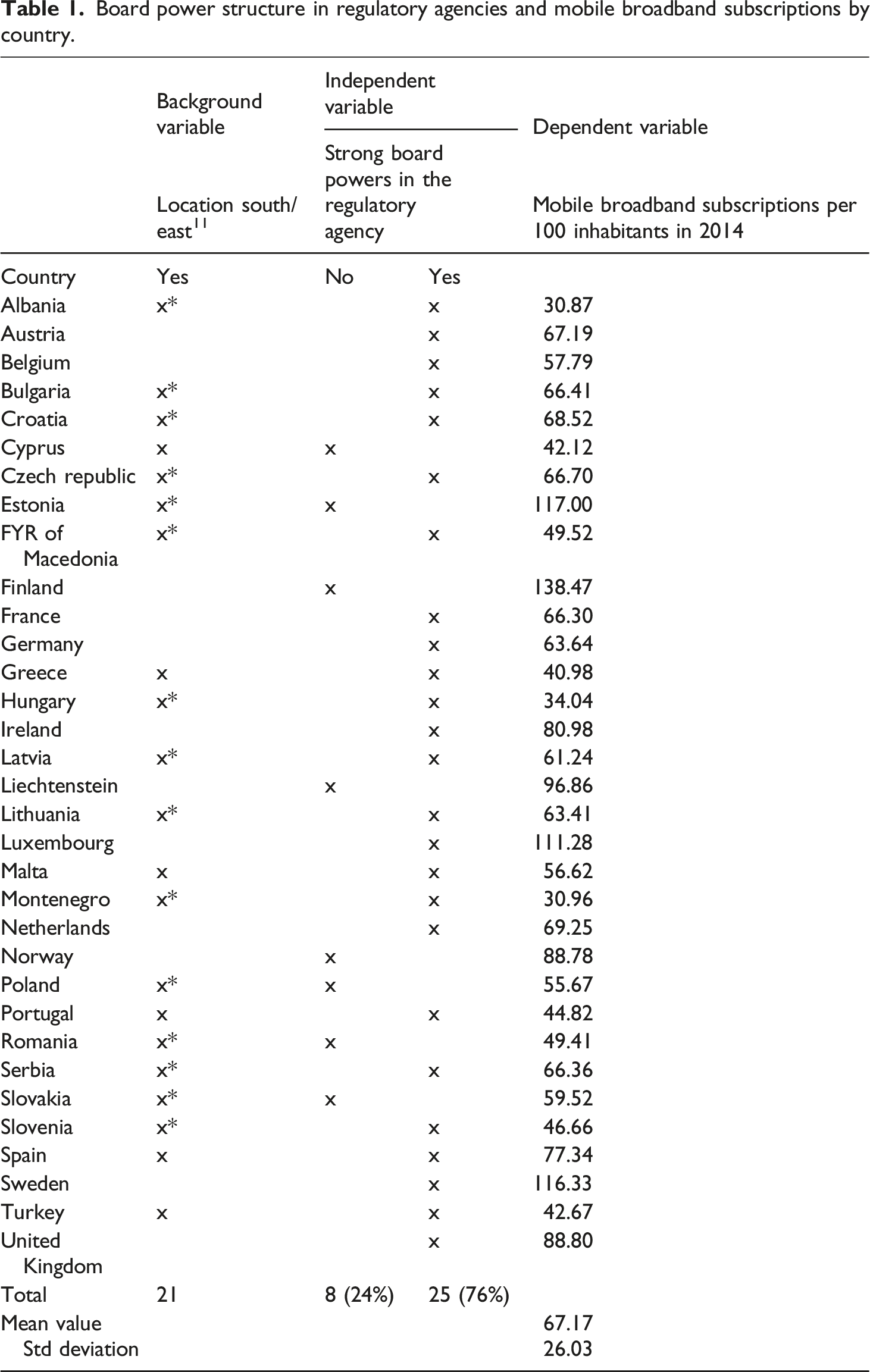
Board power structure in regulatory agencies and mobile broadband subscriptions by country.
The data is limited to the 33 European countries that answered the survey. A sample size of at least 25 observations is generally considered to provide accurate inferences, which is why this sample should be indicative of systematic patterns. 6 However, the relatively low number of cases implies a low degree of freedom and limits the number of explanatory factors that can be included in the model. Therefore, we have to be selective in the choice of independent variables and interpret potential interaction effects with caution. A full analysis of the complex chains of causality and interdependency between variables that influence regulation is beyond the scope of this study, as discussed further in the concluding section.
The central explanatory variable in our analysis is the degree of power-sharing between the DG and the board, which is measured on a scale from 0 to 5: from the board having influence on strategy as well as in regular cases (0), via having only strategic influence, to having only an advisory role or having no board at all (5). In the forthcoming, the key distinction is between boards that have real decision-making powers and those that have not.
In addition, measures of bureaucratic and political control are included, since previous studies indicate that these relationships can affect outcomes and the quality of decisions (Cf. Blais and Dion, 1990: Fukuyama, 2014; Koop and Hanretty, 2018; Wassum and De Francesco, 2020). The first indicator of this type is government budget control, which is a variable that signals whether or not the authority is funded by the government. This captures the extent to which the government steers the regulatory authority through funds. Some research suggests a positive effect of government controls on public services in general (Strom et al., 2003). Other studies, in the research on independent regulators, points in the other direction (e.g. Koop and Hanretty, 2018; Edwards and Waverman, 2006). A priori, the effect of government funding is indeterminate. 7
The next control measure is to what extent the agency is controlled by the judiciary. Here, the main distinction is between routine judicial involvement in decision-making (a “judicial model”) and procedures that allow the bureaucracy to take legally binding decisions itself (an “administrative model”). This is operationalized by the following survey item: “Are the fining decisions binding on the firms (the administrative model) or does the authority have the right to seek fines in a court process or, alternatively, hand the case over to a prosecutor that can seek fines (the judicial model)?” If the fining system is judicial or mixed, the variable is coded 0 (judicial model). If the system is administrative, it is coded 1. 8
In addition, the authority’s budget size (computed as its natural logarithm in order to reduce skewness), since bigger authorities have more resources to develop and pursue forceful policies, which is also supported by some empirical evidence (Koop and Hanretty, 2018).
A number of control variables are included in order to reduce country-specific effects. The first is the country’s geographical location in South-Eastern or North-Western Europe, since the countries located in the south east, in general, developed mobile infrastructure at a later point in time (see Table 1 below for countries coded as South-East- and North-West, respectively). Moreover, Eastern and Southern Europe has a history of higher levels of corruption and less developed infrastructure and is oftentimes characterized as more “collectivistic” than the countries in the north-west, which are more “individualistic” (Porcher, 2021). (In the present article, the level of corruption is not included in the model since this variable correlates strongly with our outcome variable, broadband subscriptions. For analyses of the relationship between regulatory agencies and corruption, see Mai, 2017.) In order to measure the general level of the country’s economic development, we include GDP per capita.
As mentioned, our outcome measure of efficiency, the spread of mobile and fixed broadband, is the number of subscriptions per 100 inhabitants in the year 2014 for each of the two services. 9 For example, the value 117 subscriptions/100 inhabitants (Estonia), indicates that on average, an Estonian citizen had close to 1.2 mobile broadband subscriptions at the time. The indicator of quality is thus a measure of the extent to which citizens have access to mobile broadband; this, in turn, we interpret as a measure of quality and efficiency, in line with recent EU policy documents on accessibility as a core value and the approach in some previous studies on regulatory agencies (EU, 2016; Edwards and Waverman, 2006). Moreover, the focus is on a specific market, the agency that regulates that market and a specific aspect of the agencies’ structure, which should increase the possibilities to make inferences. Furthermore, the aim is to estimate how the institutional setting affects fixed and mobile broadband spread respectively.
The setup of the empirical analysis can be summarized with the following ordinary least squares regression equation:
Empirical findings
Descriptives
The main variable of interest in the analysis is how the authority to take decisions is allocated between a single decision-maker, the Director General (DG), and a multimember board with substantive decision-making tasks. This authority is measured by the index described above, measuring the emphasis on single-person decision-making, from weaker to stronger power for the DG. Figure 1 shows the distribution of the index variable among 33 telecom regulatory agencies in Europe. The minimum value 0 (to the left) represents strong decision-making power for a multimember board, whereas the maximum value 5 (to the right) represents no board power and thus strong power for the Director General. For a substantive share of the investigated regulatory authorities, the board has relatively strong powers (39%), whereas a substantive minority (24%) has no board at all and, consequently, the decision-making is concentrated to a single decision-maker (Figure 1).
10
In line with expectations and traditions from coalition governments and the judiciary, the most common type of design is the collegial type of board. Distribution of telecom regulatory agencies’ board structures in Europe (33 countries) from strong board powers and multi-person decision-making (0) to strong single-person decision-making (5).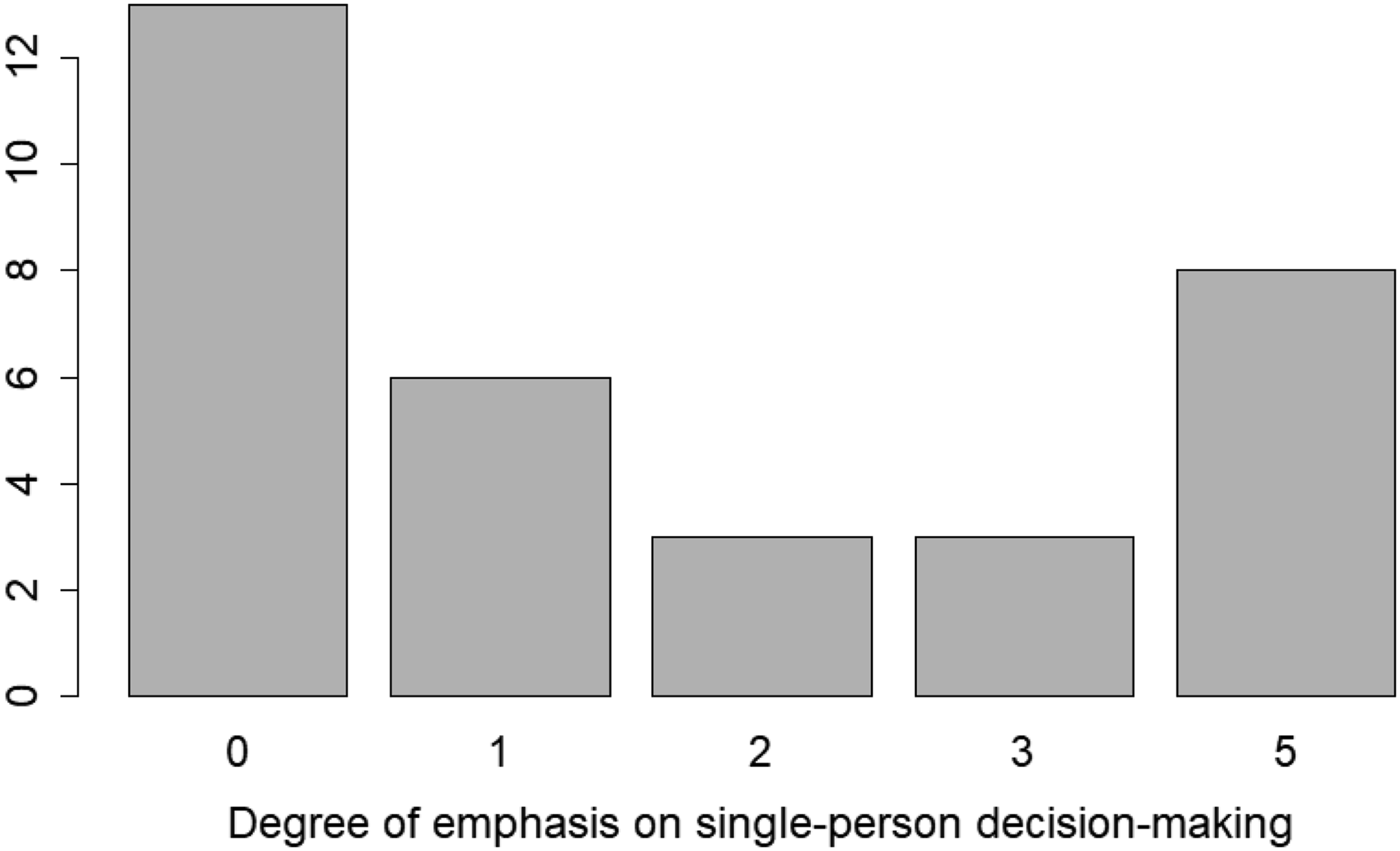
The organization of the telecom regulatory authorities does not follow the patterns in higher levels of government. For example, Sweden and Norway have similar proportional representation electoral systems and a tendency toward coalition governments (Allern and Aylott, 2009). However, in the telecom regulatory authority Norway employs single-person decision making, whereas Sweden has a collegial board. Table 1 overviews the regulatory design and the level of mobile broadband subscriptions in the included countries.
In the following analyses, authorities with no advisory board and strong emphasis on single-person decision-making (value 5) are separated from authorities whose boards are bestowed with strong such powers (values 0–3). That is, the index variable is transformed into a dichotomous measure. 12
The outcome measure mobile broadband penetration ranges from a low value of 30.9 subscriptions/100 inhabitants (Albania) to 138.5 subscriptions/100 inhabitants (Finland) (mean 67.17, std dev 26.03). According to our operationalization, Finland thus has the most successful implementation of mobile telecom regulation. For comparison, the range is somewhat narrower for fixed broadband, from a low 6.57 subscriptions/100 inhabitants (Albania) to a high 42.0 subscriptions/100 inhabitants (Lichtenstein) (mean 27.17, standard deviation 8.77).
Multivariate results
Power-sharing in regulatory authorities and efficiency
Power sharing and broadband subscriptions per 100 inhabitants (OLS regression).
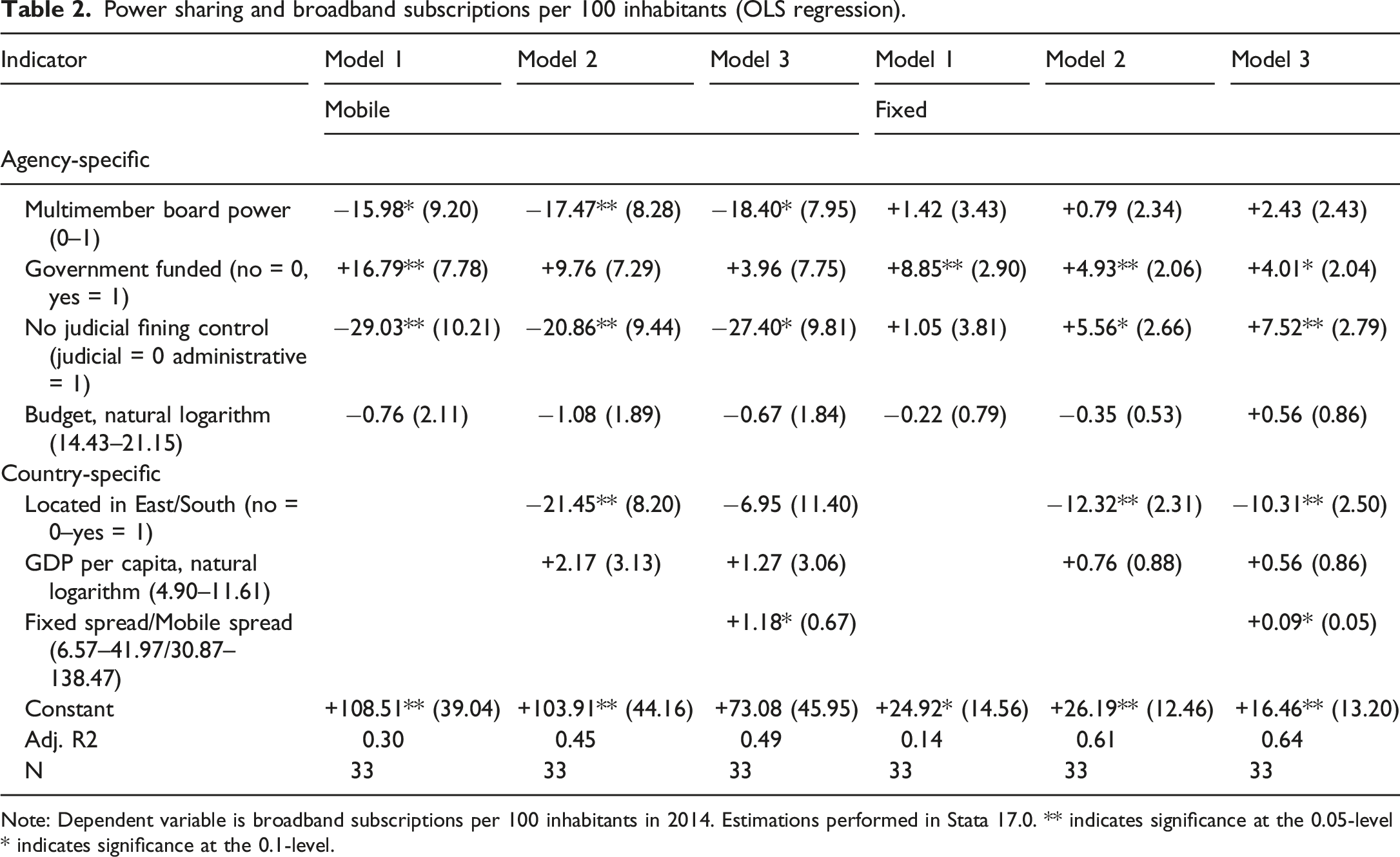
Note: Dependent variable is broadband subscriptions per 100 inhabitants in 2014. Estimations performed in Stata 17.0. ** indicates significance at the 0.05-level * indicates significance at the 0.1-level.
Oher aspects of institutional design are included as well, as explained above. The first model includes all political steering-related variables (board power, funding source, and judicial control over fines). In line with Hypothesis 1, this model indicates that decision-making primarily made by a director general is associated with higher mobile broadband subscription rates (the coefficient takes a negative value since the variable is coded 1 for stronger board powers, 0 otherwise). In addition, a comparison of the adjusted R-squared values indicates that the decision-making structure and agency-specific variables have better explanatory power for mobile broadband subscriptions, than for the fixed net. Consistent with our hypotheses, the regulatory agency’s decision-making structure – its orientation toward a single decision-maker – appears to be more important for the mobile broadband services, where the subjects’ interests are more aligned, than for the fixed broadband, where their interests are more adversarial.
In Model 2, two country-specific variables are added to the analysis: a measure of the country’s general development level (GDP per capita) and its location in South-Eastern or North-Western Europe (compare Table 1). Under control for the agency´s location in Europe and the country’s GDP per capita, the relationship between decision-making structure and mobile broadband subscriptions remains statistically significant. 13 Looking at the magnitude of the effects, the relationship between decision-making structure and mobile broadband subscriptions is almost as strong as the relationship between judicial control and mobile broadband subscriptions. In addition, the adjusted R-squared-value increases substantively for fixed broadband when the geographic variables are included, and less so for the mobile broadband net. This suggests that the traditional geo-political factors have better explanatory powers for the service dominated by a former monopoly state-owned provider where subjects with opposed interests characterize the market (Hypothesis 2). In contrast, success in the newer public service market – mobile broadband services, where the subjects’ interests are aligned– is better explained by the choice between single or multimember board (Hypothesis 1).
In Model 3, we control for the level of mobile broadband subscriptions for the outcome of fixed broadband, and vice versa. These controls do not alter the main findings. The only change is that the geographic location variable is more strongly related to the subscription rate for fixed broadband than to that for mobile broadband. 14
One interpretation is in line with the proposition that the regulatory-agency-design variable – single versus multi-person decision-making – matters relatively more for the newer market (mobile broadband) than for the adversarial market (fixed broadband) where there is a legacy of ties to the states. Conversely, region (South-Eastern or North-Western) and GDP per capita have a relatively greater impact on the model fit for fixed broadband. These findings give tentative support to the argument that mobile broadband diffusion, where the providers have similar interests, benefits from regulation by one, rather than many, decision-makers (Hypothesis 1). In contrast, the structure of the regulatory agency is not significantly related to the fixed broadband subscription rate. Hence, the findings are consistent with the hypotheses that concentrating decision-making power to a single individual is more beneficial for the mobile broadband market, while no such effect is found for the fixed broadband market. Thus, we find support also for Hypothesis 2.
These relationships can be further validated by directly comparing matched pairs of countries, i.e. countries with similar socio-economic characteristics, but with different types of telecom regulatory agency decision-making structures. A direct comparison between similar countries generally supports the finding that single decision-makers are preferable to multimember boards in this market (see Table 1.) For example, Estonia with a single decision-maker has greater mobile broadband usage than its neighbors Latvia and Lithuania, with a similar communist legacy and geographic location. Furthermore, Hungary with strong board powers has fever subscriptions per capita than neighboring and nearby Romania, Slovakia and Poland. All four countries share the communist legacy but the three latter have telecom agencies with weak board power.
In addition, we ran robustness checks where we successively excluded each of the eight countries that have single-person decision-making from the regression analysis. These analyses support the overall hypothesis: board structure has a significant relationship to mobile broadband spread, whereas the relationship between board structure and fixed broadband is insignificant. Deleting Estonia or Finland, i.e. the countries with the highest subscription rates, from the analysis affects the statistical model the most. The sign of the estimated key parameter remains negative but its magnitude decreases. To check the robustness of the findings further, we substituted the mobile broadband spread variable with its natural logarithm, to reduce the potential influence of cases with high subscription rates. Again, the overall results are similar. Thus, the general tendency that single-person decision-making matters more for the spread of mobile broadband than for fixed broadband seems to hold.
In sum, the results indicate that independently of the agency´s location in Europe – in the South-East or the North-West – more power delegated to the DG (and less to the board) is associated with mobile broadband networks reaching a larger share of the population. These results support the overarching argument, speaking in favor of single decision-making for agencies regulating markets where the firms’ interests are aligned, while more dispersed decision-making powers appears to be equally efficient in markets where the firms have an adversarial relation.
Concluding remarks
The starting point for this article was the potential implication of power-sharing within institutions, government and, specifically, within regulatory agencies. We focused on power-sharing within the top echelons of the bureaucracy – between the board of directors and the director general – rather than on power-sharing between the bureaucracy and the political level (e.g. Koop and Hanretty, 2018) or within the bureaucratic hierarchy, from street-level bureaucrats and up (e.g. Andrews et al., 2009), as we believe the first-mentioned aspect has attracted far less attention.
The argument that was developed was mostly in favor of single-person decision-making over multi-member board powers, although the conclusion is context specific. In the literature, it has been suggested that, due to group think and free-riding, teams may perform worse than individuals, while some empirical evidence indicates that well-structured teams easily outperform individuals, as the former can draw on a wider set of information, skills and perspectives.
In contrast to previous artificial settings, where the focus is information gathering and analysis of materials, this study contributes with an application in a real-life context, where the decision-making structure can have a direct impact on the provision of a public service and where the decision-maker can delegate information gathering and analysis to teams of specialists.
The argument was exemplified using a unique survey questionnaire on how decision-making powers were structured in telecom regulatory agencies in 33 countries in Europe. In line with our hypothesis, single-person decision-making is associated with higher mobile broadband subscription rates. These results hold true under control for geo-political variables, which would suggest that the agencies themselves have an important steering function in the regulation of mobile broadband markets, rather than these results being due to confounding effects of geographic locations and socio-economic structures.
In the economics literature, it has been suggested that power sharing is a mechanism that can be used to curb corruption in the bureaucracy, while other scholars have come to an almost opposite conclusion: that it takes concentrated power to rein in corruption that has taken hold of governmental institutions. In the case at hand, neither of these propositions can explain all of the pattern we uncover, as the same authorities deal with both mobile and fixed broadband operators – and as a large share of the firms active in one of these markets will also be active in the other. 15 Rather, what appears to matter is whether the parties that the regulator deals with have adversarial or aligned interests. When their interests are aligned, as they arguably are in the mobile broadband market, it appears that a single decision-maker is more beneficial. This can be either due to the regulator being able to elicit more information from the parties or from other sources, due to a better ability to withstand attempts to capture or corrupt the authority, or due to some other reason.
When the interests of the parties are adversarial, as they are in the fixed broadband market (as well as in the archetypical court dispute), the results suggest that a multi-person decision-making body performs equally well.
One interpretation is that two agents (or experts or advocates) with objectives that are, in some sense, each other’s opposites, will each have strong incentives to uncover relevant facts (Dewatripont and Tirole, 1999). In contrast to the early literature on interest groups and regulation, it is held that relevant facts, once uncovered, cannot be misrepresented, although their effects can be cancelled by additional facts with implications pointing in the other direction. Intense competition between actors, such as for example between two fixed broadband firms with different market positions and incentives, provides the decision-maker with more information than a non-adversarial setting.
An implication of our reasoning is, further, that regulatory agencies have more in common with the steering of companies, than with the political bargaining that is often associated with democratic-bureaucratic decision-making. Important values in democratic decision-making are transparency and decision-making by democratically elected representatives. Some recent research suggests that for regulatory agencies too much emphasis on these values may come at a cost (Koop and Hanretty, 2018). In addition, regulatory agencies can encounter pressure from the regulated firms – especially if their interests are aligned – and therefore need to be more independent.
In forthcoming studies, it would be interesting to further test the impact of individual versus collective decision-making, either when the decision is taken in a context with two equally resourceful adversaries, whose interest must be balanced – or when the decision is taken in a context where the decision affects a group with well-aligned interests. Recent studies in the public administration tradition place focus on the cultural dimension of quality of government (e.g. Porcher, 2021), while the present study shows that institutional arrangements play a significant role in the case of regulatory agencies. To what degree cultural aspects, such as the degree of collectivistic and individualistic tendencies, moderate the impact that different board structures have is a path for future research.
We are aware of the limitations of our study when it comes to isolating causal mechanisms and interdependencies. There exists complex interdependencies between culture, legal tradition and the level of corruption, which in turn may directly influence such performance measures as we have used, while also affecting the governance structure of the bureaucracy. Cross-country studies of the relation between governance structure and performance may suffer from undercontrol as well as overcontrol. 16 In order to advance the field further, we suggest case studies of countries that have recently reformed their board structure, as well as experiments, that can examine causal mechanisms more in-depth.
Footnotes
Declaration of conflicting interests
The authors declared no potential conflicts of interest with respect to the research, authorship, and/or publication of this article.
Funding
The authors disclosed receipt of the following financial support for the research, authorship, and/or publication of this article: This work was supported by the Foundation for Baltic and East European Studies.
