




Abstract
Public organizations are compound bodies characterized by competing endogenous dynamics of governance. This study makes two main contributions. First, it contributes to an organizational approach to studies of public policy and administration by conceptualizing compound agency governance. Second, by determining how variation in agency governance reflects endogenous organizational factors. Based on a study of the Norwegian Radiation and Nuclear Safety Authority (DSA), two observations are highlighted: Firstly, DSA staff are torn between two competing behavioural logics: A governmental and a transnational logic. Moreover, portfolios of core state powers are more closely monitored by parent ministries than portfolios that relate to non-core state powers. Secondly, the study suggests that organizational factors are vital determents in balancing behavioral logics in agency governance.
Keywords
Introduction
Formulating and implementing public policy is a prerogative for national governments and administrations. Moreover, the capacity of the regulatory state to govern has largely been determined by ‘the [administrative] capacity of the state to effectively achieve the chosen policy outcomes’ (Matthews, 2012: 281). This study makes two wider contributions. First, it contributes to an organizational approach to studies of public policy and administration by conceptualizing compound agency governance. Second, by determining how variation in agency governance reflects endogenous organizational factors. The study suggests how endogenous tensions of agency governance between a ‘governmental model’ and a ‘transnational model’ is organizationally contingent and how transnational agency governance is prevalent even in portfolios of core state powers. Agency governance is thus shown to be compound. The key to understanding compound bureaucracy is that governing institutions are likely to mobilize a multidimensional set of conflicting roles and identities that actors may attend to and act upon (Marcussen and Trondal, 2011).
Examining governance dynamics within one selected regulatory agency, this study makes contributions to three sets of literature. First, it contributes to studies of regulation. Majone (1994) suggests that administrative regulation – regulation by agencies operating at arm’s length from direct regulatory oversight by the government - is a frontier in our understanding of public policy and administration. Reliance on regulation will thus characterise the regulatory state, suggesting that the regulatory role of the state is more important than other state functions (Majone, 1994; Majone, 1996b: 55; Majone, 2001). This is highlighted by the growth of governmental rule-making and regulatory agencies (Levi-Faur, 2011: 12; Majone, 1994; Vibert, 2014: 14). Consequently, the regulatory state suggests a transformation of the nation-state and the way states control and influence the activities of regulatory actors. Studies have been particularly interested in understanding the relationship between the scope of state authority and the role of regulatory bodies (Levi-Faur, 2011: 3 and 5). Empirical data also suggests an intimate relationship between regulation and the role of government agencies (Bach et al., 2014; Koop and Lodge, 2017; Levi-Faur, 2011: 5; Majone, 1996a: 9). Furthermore, scholars have argued that the regulatory state is increasingly embedded in complex webs of non-state actors and that their modus operandi is difficult to disentangle from other relevant actors (Djelic and Sahlin-Andersson, 2006: 9). Our study contributes to studies of the regulatory state by showing how endogenous tensions of agency governance is organizationally contingent and how expertise-based transnational agency governance is prevalent even in portfolios of core state powers.
Secondly, this paper contributes to an organizational turn in studies of public policy and administration both by conceptualizing the compound nature of agency governance and illuminating how it reflects endogenous institutional factors (Egeberg and Trondal, 2018). The organizational ‘school’ argues that institutions play a partly autonomous role in political life. Institutions are markers of a polity’s character, visions and history and it makes a difference how they are organized (Egeberg and Trondal, 2018; Olsen, 2007: 3). An organizational approach aspires to understand politics as a consequence of both competing and shared rules and roles in administrative systems (Marcussen and Trondal, 2011). This approach has furthermore become key to studies of public administration and public governance in organized democracies (Egeberg and Trondal, 2009; Olsen, 2006; Trondal et al., 2010). This study shows how organizational factors contribute to make regulatory agencies compound institutions and thus far more than merely technical-neutral tools for efficient governance.
Third, this study contributes to literatures on multilevel administrative governance (MLA) in the European Union (EU). Studies of MLA suggests that agencies in the EU have become multi-hatted by playing important roles not only for national governments but also for the European Commission, EU agencies, and regulatory networks (Egeberg and Trondal, 2017; Martinsen et al., 2019) where institutions at different levels of government are linked together in the performance of tasks (Trondal and Bauer, 2017). This study contributes to this literature by focusing on variation in endogenous governance patterns inside regulatory agencies. Focusing on intra-agency variation makes it possible to capture detailed variations in patterns of agency governance that remain invisible if agencies are treated as coherent wholes. In particular, this paper is interested in understanding how agency governance is affected by portfolio variation. In order to test the effect of portfolio, this study compare agency sub-units (sections) that are engaged in dossiers related to ‘core state’ and ‘non-core state’ dossiers (Genschel and Jachtenfuchs, 2014).
Examining the interior of regulatory agencies, this study offers a micro-level lens by mapping variation in behavioural dynamics among agency staff inside one agency: the Norwegian Radiation and Nuclear Safety Authority (DSA). The DSA is the governmental authority and expert organisation in dossiers concerning radiation protection, nuclear safety, security, and safeguards, and they have international tasks related to the promotion of radiation protection, nuclear security, nuclear safety, disarmament, and non-proliferation. The DSA is thus part of the nuclear safety sector, including issues of safety, security, and safeguards, 1 and the agency serves as a least likely case of multilevel governance by offering a most-difficult test (Gerring, 2007: 115, 2017: 103): As partly a ‘core state’ portfolio, agency governance is likely to be biased towards a governmental model in which the agency serves as a ministerial toolkit.
In literatures on the regulation of nuclear power, the role of the regulator has been a core theme, often sparked by crises. Important examples are the Three Mile Island Accident and the Fukushima accident, where regulators were criticised for having dual roles and lacking autonomy toward governments and the industry. Moreover, critics argue that reforms undertaken may have had little impact on the quality of decision-making and on the safety of the nuclear reactors (Funabashi and Kitazawa, 2012; Kemeny, 1979; Temples, 1982; Wang and Chen, 2012; Wang et al., 2013). Scholars have also discussed the role of experts in the nuclear energy policy system, highlighting the importance of their independence while also showing their dual loyalties (Gilinsky, 1992; Massey, 1986). In the case of Norway, history shows that discussions about building nuclear power plants during the 1970s, never materialized due to the Parliament’s decision to expand and pursue hydropower. However, Norway proved to be a forerunner by building a research reactor as early as 1951, and the total number of research reactors in the country has remained four (Hofstad, 2019).
The paper proceeds as follows. The next section outlines a theoretical framework in two steps: First, three conceptual models are presented to map variation in agency governance. Second, independent variables that might account for such variation are outlined. The following section briefly introduce Methodology and data, and the section ‘Complementary dynamics of agency governance’ present empirical findings in three steps that relate to three ideal typical models. Finally, the concluding section summarizes key findings and implications to the literature.
A two-step theoretical framework
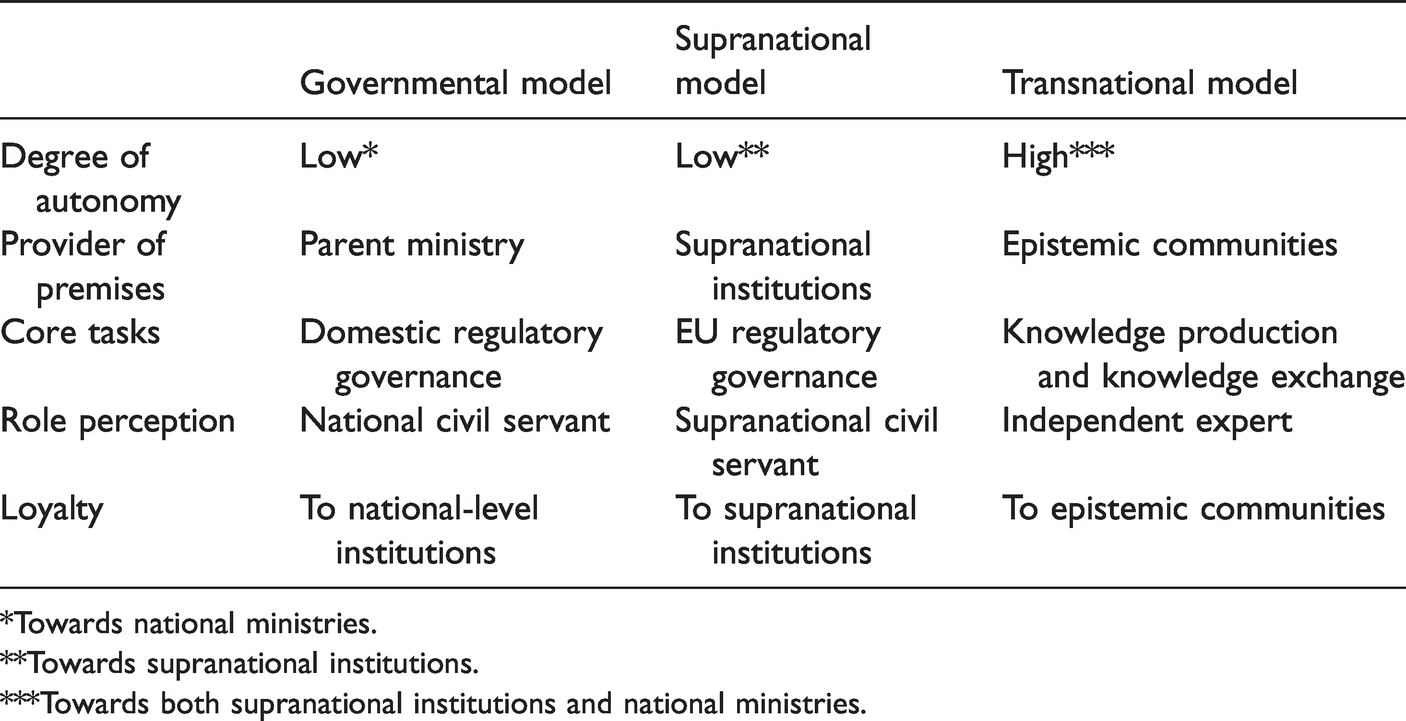
The theoretical framework is presented in two parts. Part one draws on the above observation and outlines a conceptual map of three ideal-typical conceptual governance dynamics (Table 1): A governmental, a supranational, and a transnational dynamic. Agencies are thus pictured as compound institutions with inbuild behavioural inconsistencies. Part two presents an organizational approach and derives a set of independent variables that are likely to bias agency governance towards either of the conceptual dynamics.
A conceptual map of compound agency governance.
*Towards national ministries.
**Towards supranational institutions.
***Towards both supranational institutions and national ministries.
Conceptual maps
The classic literature on state-building has demonstrated how the extortion of administrative capacities of the state involves delicate balancing acts between creating action capacities for the standardization and the penetration of the territory and concerns for local autonomy (Rokkan, 1999). Centralising core state power through capacity building is seen as one vital ingredient of state-formation, also in nascent federal states (Bartolini, 2005). Quite similarly, contemporary studies of expert bodies suggest that public organizations harbour competing dynamics and multiple tensions, e.g. between de-politization and politization (Kirck and Holst, 2019). This section outlines three models of agency governance. These dynamics derives from contemporary studies of international public administration (IPA) and are conceptualized as complementary dynamics (Marcussen and Trondal, 2011; Trondal, 2016; Trondal et al., 2010). In effect, different dynamics of agency governance might be prevalent in different agency departments and sections, albeit under different conditions.
A governmental model characterizes government agencies as subordinated to parent ministries. Tasks, responsibilities, and resources are allocated from the parent ministry and are likely to bias regulatory behaviour among agencies (Egeberg and Trondal, 2017). Agencies are seen as regulatory bodies that monitor compliance with rules, conduct inspections, audit and evaluate (Christensen and Lægreid, 2007; Kjaer and Vetterlein, 2018; Lægreid et al., 2008). Subsequently, agency officials are likely to enjoy limited autonomy in their daily work (Lægreid et al., 2008) and engage frequently with their parent ministry. Accordingly, steering signals and mandates that originate from national parent ministries are vital to the agency, there will be liaisons and revolving doors in personnel between the two as well as duplication of tasks. Consequently, role perceptions and loyalties among agency personnel are likely to be directed towards the governmental-level institutions generally and the parent ministry in particular.
A supranational model characterises government agencies as being closely aligned to supranational institutions and relatively loosely coupled to national parent ministries. Agency autonomy is thus low vis-à-vis supranational institutions. Agencies are seen as ‘instruments of centralization’ of regulatory functions at the international level and for uniform implementation at the national level (Egeberg and Trondal, 2017). Consequently, one might expect domestic agencies to evoke tasks beyond the international exchange of best practices and information, and embrace tasks related to EU regulatory governance, policy making and implementation. We might also expect that the employees’ role-perceptions and loyalties are geared toward supranational rather than national institutions. This model is thus likely to favour steering signals originating from supranational institutions.
Finally, a transnational model assumes that agencies are loosely coupled to parent ministries and supranational institutions. Agencies enjoy large degrees of discretion based on their expertise and skills, and they are not mere instruments in the hands of the political leadership. Hence, they “are ‘floating in‐between’ levels of governance”, making steering and accountability arrangements towards any particular level of governance ambiguous (Egeberg and Trondal, 2017). Agencies are strongly connected to transnational epistemic communities consisting of networks of professionals with recognized expertise and policy-relevant knowledge in a domain (Haas, 1992: 3; Cross and Davis, 2013). Agency governance is thus biased by internal and external professional reference groups. The agency is assumed to argue and negotiate based on their professional competences and to legitimate their authority on scientific competences. Hence, the agency legitimacy builds on technocratic values and the prominence of particular expertise. Their behaviour is guided by considerations of scientific and professional correctness (Trondal et al., 2010: 14). Their role perceptions and loyalties are primarily directed towards their expertise and educational background, as well as toward epistemic communities. The assumption is that the agency is characterized by ‘best practices’ and information exchange, rather than regulatory governance (Egeberg and Trondal, 2017). Table 1 summarizes the three conceptual models and suggests proxies for empirical analysis.
An organizational approach
According to the institutionalist school in the social sciences, institutional factors might intervene and bias governance processes. The basic building blocks of institutions are rules, and rules are linked together and sustained through identities, senses of membership in groups and recognitions of roles (March and Olsen, 2006: 8). Scholars of the institutional logics’ perspective underscore that to understand individual and organizational behaviour, focus should be on how social contexts both enables and constrains behaviour (Thornton and Ocasio, 2008: 101–102). This perspective thus speaks to questions of how individual and organizational actors are influenced by their contexts in multiple social locations in institutional systems, and it highlights that different institutional orders of the inter-institutional system distinguishes unique organizing principles and practices that may influence individual and organizational behaviour (Thornton et al., 2012: 2). Consequently, actors’ behaviour is nested within organizations and institutions, and dominant institutional logics become taken for granted by the establishment of core principles for organizing activities and channelling resources and attention (Thornton et al. 2012: 76–77). Furthermore, members of an organization tend to become permeated not only with their identities as belonging to the organization but also with the various identities associated with various roles in the organization (March and Olsen, 2006: 9).
However, whereas all institutions are organizations, not all organizations are institutions. Organizations consist of those sets of codified rules and routines that may guide the behaviour of actors (Egeberg and Trondal, 2018). This paper derives testable hypotheses from this narrower organizational approach. One reason, as highlighted below, is that the organizational approach might be applied practically as a design approach in public policy and administration. Organizations temporarily settle issues about ‘tasks, authority, power, and accountability’ (Olsen, 2010: 37), and organization structure specifies who is expected to do what, and how they are to do it. Different dimensions of the organizational structure enable varied insights into how structure affect individual behaviour (Egeberg and Trondal, 2018: 6–7). Organizational structure is thus a powerful design instrument for approaching public governance because organizational factors are expected to create biases in governance processes, making some choices more likely than others (Egeberg and Trondal, 2018: 1–4). Formal rules are likely to systematically bias the decision-making behaviour of civil servants, ultimately biasing the formulation and execution of public policy (Barnett and Finnemore, 2004: 3). The following outlines three structural variables: Size, horizontal specialization, and vertical specialization:
The size (#1) of an agency indicates the capacity to initiate policies, develop alternatives, implement decisions, and monitor compliance. Studies show that the number of ministerial staff available for monitoring and steering agency activities influence the extent to which agency personnel allocate attention to political signals from their respective ministries (Egeberg and Trondal, 2018: 86). A proposition related to size is thus that large organizations, in terms of staff size, are more able than smaller organizations to influence subordinated organizations, such as government agencies, and small organizations must, to a greater degree than bigger organizations, build capacity through collaboration and networking. In addition to staff size, budgetary size also supply capacity for organizations to act. Studies suggest that if an agency largely depends on the government for its funding, its capacity for autonomy is constrained (Van Thiel and Yesilkagit, 2014; Verhoest et al., 2004). The proposition is therefore that government agencies that are largely dependent on their parent ministries for funding are likely to be closely monitored by the ministry. The general proposition is thus that agency size is positively associated with the governmental model.
Horizontal specialization (#2) of agencies is likely to influence the division of labour and subsequent coordination between agency sub-units, making coordination across departmental sub-units more challenging than coordination within them. Studies show that horizontal specialization by purpose (sector) bias decision-making behaviour toward a logic where preferences, contact patterns, loyalties and roles are directed towards policy sub-systems and portfolios (Egeberg and Trondal, 2018: 59–60). The proposition is thus that behavioural patterns follow departmental lines within agencies. Horizontal specialization is moreover likely to influence the division of portfolios inside agencies. Moreover, the portfolio of the DSA may be further sub-divided into two conceptual sub-frames: A first frame disaggregates the DSA into core state portfolios vs. non-core portfolios. ‘Core state powers’ is defined by their ‘institutional significance for state-building’ which include foreign and defence policy, public finances, public administration, and the maintenance of law and order (Genschel and Jachtenfuchs, 2014: 1). Core state powers in the DSA involve portfolios connected to foreign and defence policy like nuclear security, safeguards, and the direct involvement in other countries. The proposition is thus that the ‘governmental model’ is likely to dominate in core state portfolios, whereas the supranational and transnational models are likely to take primacy in non-core portfolios. A second frame disaggregates the DSA into three policy sub-systems or portfolios: safety, including both nuclear safety, radiation protection, and emergency preparedness, nuclear security, and safeguards. Different parts of the DSA are likely to relate to different institutions conditioned on their portfolio, making it difficult to single out one actor as the most important. The portfolios also demand specific expertise, and a general prediction is thus that agency staff is biased toward epistemic communities. Hence, the proposition is that the DSA is connected to a diverse set of actors that correspond to their own policy sub-system or portfolio.
Vertical specialization (#3) refers to the division of labour between different hierarchical levels within or between organizations. It has been demonstrated that leaders generally identify with larger parts of the organization than staff at lower levels, they interact more frequently across organizational sub-units and they are exposed to broader streams of information than their subordinates (Egeberg and Trondal, 2018: 10). Studies also show that vertical inter-organizational specialization leads to agency officials paying significantly less attention to signals from executive politicians than their counterparts in the ministries. Political steering does not disappear, however, but studies suggest that agency officials in general allocate more attention to the interest of stakeholders, focus on handling of individual cases, experience longer time horizons, and they take expert-concerns seriously – in sum, creating more autonomy for expert-based decision-making (Egeberg and Trondal, 2018: 10, 86; Gornitzka and Holst, 2015). The proposition is thus that vertical specialization favours agency autonomy vis-à-vis the parent ministry, creating leeway for expert-concerns as well as supranational concerns, while making the governmental model less likely. Similarly, personnel in lower ranked positions are more likely to emphasize their role as experts and/or supranational actors, whereas personnel in higher ranked positions are more likely to emphasize their governmental role.
Methodology and data
A case study must aim at shedding light on a larger population of cases, and it is also recognized by having a generalizable element to it (Gerring, 2017). In this study, the DSA serves as a least likely case of supranational and transnational behavioural dynamics since the ‘core state’ portfolio of the agency favour the governmental model. The generalizable element to the study relates to both the least likely design and the theoretically derived propositions.
The study benefits from an original dataset based on qualitative research methods. Qualitative methods encompass rich and detailed data which may provide deep understanding of an agency. Interviews provide a path into the perceptions of the interviewees, and also into experiences and underlying processes, enabling a better understanding of complex social realities (Smith and Elger, 2014: 119; Buchana et al., 2018). Consequently, with an ambition to examine compound agency governance, qualitative interviews are prioritized, not least because it enables reasonable levels of validity (Wockelberg, 2014). The interview data constitute the main source of data and consist of 22 semi-structured expert interviews with DSA officials conducted in 2018 and 2019. The interviewees are all highly educated professionals within the fields of physics, biology, chemistry, law, and radiotherapy. They were selected based on their involvement with the agencies’ core portfolios as described in the DSA strategy and vision, and all interviewees were selected from the agency management and main departments. The interview questions targeted aspects of their employment, internal and external contact patterns, relationship with the parent ministry, role perceptions, and experiences with international cooperation and relevant EU institutions. Most interviews were conducted face-to-face, except three interviews conducted via the software Lifesize. All interviews were taped, transcribed, and analyzed with the qualitative data analysis software NVivo. To preserve their anonymity, each interviewee was assigned an interview code. The data collected was done in accordance with the requirements of the Norwegian Centre for Research Data (NSD).
Interview data are supplemented with policy documents, notably ‘The Instruction for the Norwegian Radiation and Nuclear Safety Authority’ (hereafter ‘The Instruction’). It provides important insight into the formal relationship between relevant ministries and the DSA. Letters of appropriation from 2014-2019 are also used, providing insights into annual goals, priorities and assignments allocated from the ministries to DSA.
Complementary dynamics of agency governance
This section is presented in two parts. Part one describes DSA and its task environment. Part two presents core findings according to the conceptual model outlined above.
Part I: The Norwegian radiation and nuclear safety authority
DSA is part of the Norwegian political-administrative order which has a long history of ministerial delegation to subordinate agencies (Bach, 2014; Lægreid et al., 2012: 236). The system is thus characterized by extensive agency autonomy as well as high levels of trust between ministries and agencies (Christensen et al., 2018). The DSA is structurally separated from the ministries, carrying out public tasks for the nation, staffed by public servants, financed by the state budget, and subject to public accountability measures (Christensen and Lægreid, 2006: 12). Agency autonomy, however, is not limited to the formal legal status of the agency (Christensen and Lægreid, 2006: 13; Van Thiel and Yesilkagit, 2014); agencies are also characterized by high levels of perceived autonomy vis-à-vis ministerial departments (Lægreid et al., 2012: 239). The DSA is subordinated to three parent ministries and thus enjoy the complexity of multiple principals. These are the Ministry of Health and Care Services (MHCS), the Ministry of Foreign Affairs (MFA), and the Ministry of Climate and Environment (MCE). The MHCS serves as the “home-ministry”, and the two other ministries allocate specific tasks and responsibilities to the DSA through the Instruction and the annual letters of appropriation. Furthermore, the MFA and the MCE have the right to directly instruct DSA on relevant issues, and through ministerial instruction the DSA is obliged to participate in relevant international forums.
Norwegian agencies have a diverse blend of tasks, including administrative tasks, regulatory and control tasks, service provision, and producing individual goods (Lægreid et al., 2008), but most agencies have regulatory and control tasks as their primary portfolio (Christensen et al., 2018: 43). DSA also enjoys a broad spectrum of tasks: regulation and control of three legal acts, service provisions like measurement services, and providing policy advice to the ministries in a wide range of issues. The latter highlight the DSA as both a governmental authority and an expert body (Christensen et al., 2018: 41). Moreover, studies show that both ministries and agencies emphasize signals both from the government and political leadership as well as expert concerns (Christensen et al., 2018: 72–74). In addition, an important part of the DSA portfolio relates its involvement in the Norwegian Governments’ Action Plan for Nuclear Security (the Action Plan) financed and administered by the MFA. Through the Action Plan, the DSA is directly involved with countries like Russia and Ukraine on issues of nuclear safety and security. In sum, the DSA enjoys a compound task profile that does not privilege any of the agency models outlined above. However, its role as expert body seems paramount which suggests that the transnational model is primary to the agency.
Moreover, the DSA is embedded in an EU third-country that is tightly integrated without enjoying formal EU membership. Norway has signed approximately 100 agreements with the EU, rendering it a de facto associated EU member (Kühn and Trondal, 2019). Norwegian civil servants are granted privileged access to EU-related policy-making and are involved in the handling of everyday relationships with EU institutions in agenda setting processes, and particularly in the implementation and practising of EU law (Kühn and Trondal, 2019). In the case of DSA, portfolios are not directly linked to the EEA agreement or Schengen, and the data shows few observations of the DSA participating in ‘up-stream’ processes toward EU institutions. As will be illustrated bellow, however, the DSA is involved in ‘down-stream’ practicing of EU legislative acts. There are also EU agencies under the Euratom Treaty, however, Norway is not part of Euratom and the DSA is not noticeably involved in Euratom agencies.
DSA staff are also associated to several international and regional organizations such as the International Atomic Energy Agency (IAEA), the World Health Organization (WHO), and the Heads of the European Radiological Protection Competent Authorities (HERCA). In addition, cooperation with sister agencies in the Nordic countries is important. The IAEA and the EU makes regulatory frameworks and standards of relevance for the DSA, and they also serve as hubs for collaboration, professional networking, and knowledge exchange. Collaboration between the DSA and international, European, and Nordic institutions is important for making joint statements, the exchange of best-practices, and developing common norms and drafts to regulatory frameworks.
Part II: Observations of agency governance
Governmental dynamics in the DSA
One general finding suggests that governance in the DSA fits the governmental model well, yet in a compound fashion. The agency receives funding from ministries, they are involved in national regulatory affairs, and their tasks and responsibilities are allocated from the ministry. The agency is subordinated to three parent ministries and we thus observe major differences in how ministries and the DSA mutually interact. These differences are particularly evident toward MHCS and MFA, in which the relationships between DSA and MFA is far more frequent and extensive compared to the relationship between DSA and MHCS. Both observations reflect variation in ministerial capacities (#1) and agency portfolios (#2) (see below).
DSA personnel report behavioural autonomy vis-à-vis their parent ministries. Yet, our data displays two different governmental dynamics between DSA and different ministries. First, a governmental dynamic is noticeable between DSA and both MHCS and MCE. One finding suggests that DSA is relatively detached from the MHCS, manifested in infrequent attention from the ministry and little staff overlap, which in turn offers leeway for DSA to focus on its role as expert body. Moreover, communication and contact between DSA and MHCS reflect rank (#3): DSA staff at lower ranks tend to communicate through the section head, which in turn informs the head of department. By contrast, DSA staff at the highest levels tend to interact directly with the ministry (MHCS). Moreover, DSA officials at lower ranks tend to assign more weight to the interest of stakeholders, the handling of individual cases, and expert concerns. They report that it is difficult to get the attention of MHCS and that DSA is largely overlooked by the ministry (MHCS): “I have very limited contact with the ministry; the contact is done through the hierarchical line. And on my field the ministry is more detached, and I guess they trust us as professionals. But on the other hand; If they had given us more attention, the interest and ownership of the Ministry had been greater. So, with closer monitoring from the ministry we would have an improved sense of being a priority” (Interviewee W).
Distribution of ministerial personnel and subordinated agencies.
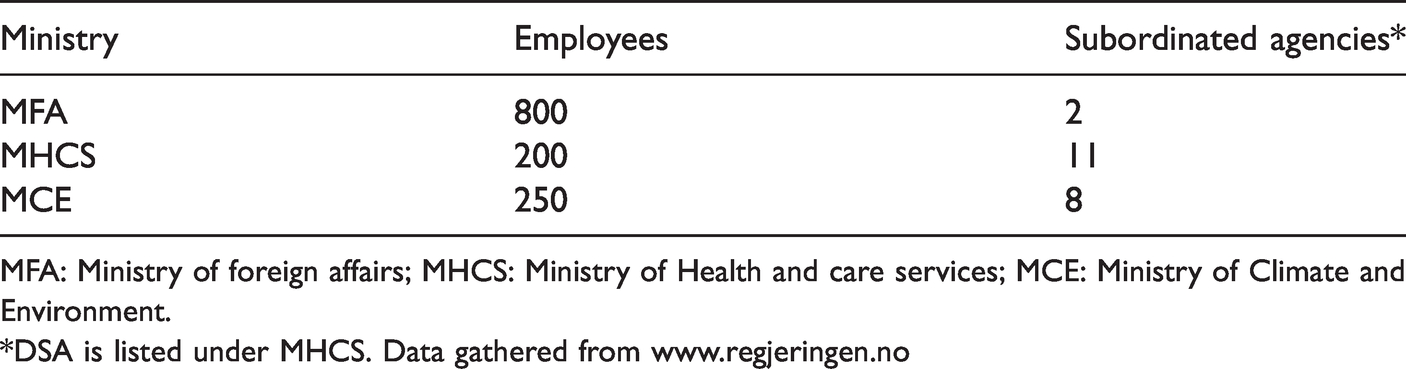
MFA: Ministry of foreign affairs; MHCS: Ministry of Health and care services; MCE: Ministry of Climate and Environment.*DSA is listed under MHCS. Data gathered from www.regjeringen.no
In contrast, the relationship between DSA and MFA is pictured as far more extensive. The assignments from MFA are targeted to sections in the department of Nuclear Safety and Environmental Protection, and particularly toward the section of International Nuclear Safety and Security. The DSA-MFA relationship manifests itself in daily contacts between this particular section and the MFA. It is not only the head of the section that enjoys frequent contact towards MFA. Interviewees report that they regularly have meetings with representatives from MFA and consider themselves to function like liaisons. Furthermore, DSA receives a substantial part of its budget from MFA, which is distributed to the sections assigned with MFA-relevant portfolios. Interviewee Y describe the relationship as follows: “Yes, I think we are closely monitored. Surely not in all cases and situations, I wouldn’t know, but my impression is that the MFA is very attentive all the time”. These findings reflect ministerial capacity (#1) and matching portfolios between ministries and agency (#2).
Table 2 illustrates the distribution of relative ministerial capacity vis-a-vis subordinated agencies, suggesting that MFA have far greater general capacity to interact with and steer subordinated agencies than the two other ministries. However, the MFA generally lacks relevant technical expertise to monitor the DSA (Neumann, 2012: 68). According to the interviewees, personnel turnover is fairly high in the MFA, and studies show that approximately 50 to 60% of ministry personnel only have 0-3 years seniority in their current work position (Christensen et al., 2018: 60). This may reduce ministry capacity to steer subordinated agencies (#1).
Next, interviewees report the ‘Instruction’ and the annual letters of appropriation as the most important steering tools for the ministries vis-à-vis DSA. The Instruction specifies the role of MHCS as the home-ministry and that MHCS steers through the Instruction, delegation, annual letters of appropriation, and at least two management meetings per year. Formally, MHCS is the most important ministry for DSA, while the two other ministries assign specific tasks to the DSA. The annual letter of appropriation outlines the economic framework for the agency, and operationalizes priorities, goals, and requirements. Studies on ministry-agency relationships also substantiate the influence of ministerial letters of appropriation (Askim et al., 2019). Our observations confirm the influence of the Instruction and the annual letter of appropriation as important ministerial steering documents that provides crucial premises to DSA: “The ministries are very important to us because they provide the funding. And clearly, they give us guidelines and directions, and what we do must be grounded in the annual letter of appropriation and the Instruction the DSA has received” (Interviewee H). “Yes, there are internal struggles over resources. Some resources are allocated directly to some tasks, and the rest is more like a big pot. So, the distribution of resources is a challenge, and you definitely notice this struggle between the departments. So, returning to the fact that there can be general cuts in the big pot, you suddenly have colleagues who say: “we need to save”, but then there are others thinking: “but my project has lots of funding…”. And those resources can't necessarily be used for anything else”. (Interviewee S)
Enjoying a mixed portfolio, we observe variation in which tasks that attract the attention of DSA staff. The data also reveals a multifaceted role-set among personnel. One interviewee (G) reflected on the borderlines between different roles as follows: ”There is an awareness that one represents not only oneself, but I do find that I have both trust and autonomy. On arenas focused on research and technical issues, it is fairly uncomplicated, but when we participate on arenas with more explicit political implications, then it is very important to stay focused on your role, and then you need to represent Norwegian policies no matter what you believe to be important yourself. And actually, many of these committees are called “specialist committees”, but they have their political implications nonetheless, for all formulations in such professional committees are also something that has consequences upward”. (Interviewee G)
Supranational dynamics in the DSA
The general finding suggests that governance in the DSA only marginally fit the supranational model: Direct interaction between DSA staff and EU-level institutions is rare, and EU institutions are not deemed important in everyday work at the DSA. Consequently, the perceived autonomy toward the EU is considered high. In sum, DSA personnel do not profoundly act as representatives for supranational institutions.
Interviewees at DSA describe the EU as important but not as a key player in their everyday work. The DSA is pictured as an outsider to EU institutions and few observations point to DSA being integrated into EU-level processes. Nevertheless, a stated ambition for DSA and the parent ministries is to be on par with EU regulations, and DSA employees are involved in implementing EU legislative acts: “But that’s the most important thing perhaps; we strive to be at the very height of the EU directive” (Interviewee E). “The Euratom Treaty is not part of the EEA agreement, but still, we implement to be on par, but there are some requirements that are at the level of government that we cannot impose. So, then we make the Ministry aware of this and that, and then it's up to them if they want to implement”. (Interviewee K)
The relationship between the EU and the DSA manifests most clearly in the implementation of EU regulations. The EU is essential as a provider of regulatory frameworks, and they may be understood as an important provider of de jure premises for the DSA. The EU is also important as a hub for knowledge exchange and expert cooperation. DSA staff participate in Commission expert committees, EU programmes, EU-funded projects, and the European Community Urgent Radiological Information Exchange (ECURIE). Yet, DSA staff do not seem to shift their role perception and loyalties toward the EU-level.
In summary, the relationship between DSA and the EU is pictured as a passive and unilateral adaptation to EU legal acts without significant interaction between DSA and EU-level institutions. The EU is important as the provider of regulatory frameworks and DSA staff are involved in the transposition of EU regulations. However, the EU plays a secondary role in everyday affairs at the DSA and does not affecting deep-seated role perceptions and loyalties among the staff. These findings may indicate a lack of capacity (#1) of EU-level institutions to bypass ministry departments and profoundly influence domestic agency governance in the nuclear safety sector.
Transnational dynamics in the DSA
The overall findings fit the transnational model well. Compatible with transnational behavioural patterns, interviewees report enjoying considerable behavioural autonomy vis-à-vis both parent ministries and EU institutions. DSA staff are involved in research activities and the exchange of best practices, they perceive themselves to be independent experts, and their loyalty is to a large degree directed toward scientific and professional considerations and concerns. Furthermore, the agency interacts with a wide range of institutions to fulfil their mission, which in turn fuels a knowledge asymmetry vis-à-vis the ministries. In sum, important behavioural premises for the DSA originate from epistemic communities and international professional networks.
First, DSA personnel enjoy autonomy partly due to a need for expertise within their policy field, and partly due to the scarcity of competent personnel at the ministerial level (#1). Contact with epistemic communities and experts is fundamental for the functioning of the agency:
The need to maintain and improve expertise in DSA moreover fuels a knowledge asymmetry toward parent ministries, which in turn safeguards agency autonomy. This observation illustrates that the scarcity of competent personnel in DSA drives agency employees to ask for inputs from colleagues outside DSA. Vertical specialization (#3) enables leeway in DSA for focusing on expert concerns, and the technical portfolio of DSA demand specialized expertise and skills (#2), which reinforces a focus on maintaining and increasing agency expertise: “In general, I would say that DSA has a lot of international work, and I also think it is important for us because we are a small country where the right expertise is scarce. So, cooperation across Europe and internationally is important, and this cooperation is quite necessary to ensure that we have enough technical competence to do our job. Thus, we need to benefit from international actors like the IAEA for example” (Interviewee Y). “We are governed by annual letters of appropriation, the instructions, and also the strategy, but all of these guidelines are quite broad, so there is ample room for solving tasks in different ways” (Interviewee W). “The letters of appropriation are more like a framework, and we may influence how we work inside this framework. So, I guess our goal is to do what we have been asked to do, but preferably also what we ourselves want to do. But as I said, it usually fits together pretty well”. (Interviewee Ø) “It is really our suggestion for what we will be doing, which carries through. Formally, it is the ministries joint letter of appropriation to us which sets our agenda, and formally it is grounded in the State Budget. However, in the State Budget, there are two pages about what DSA is supposed to do. And it's not like it's a surprise to us. It's like someone at the office said, “It’s our text in its entirety; we've written it from wall to wall”. So, we are the agenda setter ourselves, and that gives us a huge responsibility toward the society”. (Interviewee D)
“But a great deal of the most important input we get originates from international arenas like international conferences and organizations. So, we take home what is necessary, and it provide vital premises for our further work”. (Interviewee J)
DSA personnel regularly attend conferences, courses, committees, and projects. Consequently, DSA staff regularly meet peer experts in transnational forums. Moreover, international network-overlap among experts allow them to build professional networks over time (#2). Due to a high demand for exclusive and scarce expertise (#1) at the national level, international professional networks focus the attention of DSA officials toward professional concerns and transnational epistemic communities, which in turn make them less attentive to signals from parent ministries and more to scientific and professional concerns (#3), which in turn fuels agency autonomy. “The reason why this is important to us, is that the professional communities are small, and there are very few people working on every single issue—sometimes just one person. So, it’s very vulnerable, and to have colleagues, you must go outside your country. So, I guess that’s what I’m passionate about: professional cooperation. Professional networking and collaboration are important”. (Interviewee G)
Consistent with a transnational model, both the Instruction and the interviewees describe the DSA as a national expert authority. Interviewees moreover suggest that DSA is involved in tasks like research and the exchange of best-practices, and collecting, analysing, disseminating, and storing of information. Furthermore, DSA employee’s role perceptions are geared toward being experts. Their tasks and transnational cooperation (#2) underscore their expert role. One example of the importance of the expert role is found in the relationship between DSA and the parent ministries. DSA staff working on ‘core-state’-related portfolios of relevance to the MFA were expected to report less autonomy vis-à-vis the ministry and to act like government representatives. Our findings, however, suggest that DSA personnel acts as experts regardless of which parent ministry and portfolio they relate to. Interviewees report that it is imperative that safety and security decisions are not challenged or overruled by ministerial departments.
Furthermore, DSA staff experience leeway to structure their own workday and have opportunities to work on self-initiated projects. A majority of DSA staff report significant leeway to influence both what to do and how to do it, and moreover, their perceived autonomy does not vary according to portfolio and parent ministry. “People have their own tasks and it's quite individual what you are working on. I have projects and activities that I manage myself, and professionally speaking, I am the expert within my field, so, there is nobody else who has much to object or to say”. (Interviewee S)
In sum, this section suggests that agency staff act as independent experts and enjoy autonomy as professional experts, reflecting organizational size (#1), horizontal specialization (#2), and vertical specialization (#3). Contrary to Genschel and Jachtenfuchs (2014), however, this section also reports that the transnational agency model is evident also in agency portfolios of core state powers.
Conclusions
This study unveils the compound nature of agency governance and suggests organizational conditions thereof. The paper outlined a conceptual map of compound agency governance and offered an empirical illustration of contending agency dynamics in the case of DSA. Two main contributions are highlighted: Firstly, endogenous variation in behavioural logics among agency staff suggest that the DSA is internally torn between two main governance dynamics: Those sections in the agency that work on portfolios of ‘core state powers’ tend to mobilize the governmental dynamic, while other sections of the agency are biased towards the transnational dynamic. Agency personnel across the agency strongly emphasized their role as experts rather independently of their portfolio and relevant parent ministry. This finding suggests that the DSA is generally biased toward a transnational model with a focus on expertise and the competency of the personnel. Secondly, the study demonstrates that endogenous organizational characteristics are vital determents in balancing behavioral logics inside DSA. Our observations particularly reflect variation in ministerial and agency capacity (#1), the technical portfolio of the agency (#2), and the vertical specialization of the DSA vis-à-vis three parent ministries that facilitate leeway for expert concerns throughout the agency (#3).
The nuclear safety sector serves as a least likely case of multilevel administrative governance in which the portfolio of ‘core state’ is likely to bias agencies toward the governmental model. Our findings confirm that agency staff engaged in portfolios of core state powers are more closely monitored by their parent ministry than officials whose portfolios relates to non-core state powers. Consequently, non-core portfolios are potentially more influenced by EU-level institutions. Yet, the study shows how this brute policy dichotomy breaks down when zooming into the agency. EU institutions are not deemed more important within non-core state portfolios than in core-state portfolios, leaving the supranational model least relevant. In sum, the study shows how endogenous tensions of agency governance between the ‘governmental model’ and the ‘transnational model’ is organizationally contingent, as well as how transnational agency governance is prevalent even in portfolios of core state powers.
We envisage four avenues for future research on agency governance. Theoretically, the organizational approach outlined has a profound design potential to it. Thus, theoretically oriented empirical studies of agency governance should connect causal findings of agency governance to potential design possibilities, thus linking science and craft in systematic ways (see Egeberg and Trondal, 2018). Secondly, we would propose a more systematic focus on the study of micro-level aspects of agencies, enabling more fine-grained understanding of agency-life. Such studies, however, should also aim to theoretically trace links from micro-level changes (e.g. loyalty shifts or behavioural patterns) to macro-level changes (e.g. the transformation of political order). Third, we would suggest that the agency governance literature investing in longitudinal studies that introduces datasets over time, enabling dynamic studies of agency governance in multilevel systems. This might enable, for example, to study continuity and change in loyalties of agency personal. Finally, we would suggest that the literature on European agencies that are embedded in multilevel governance architectures also go beyond Europe and examine their broader roles in transnational agency networks (see Stone and Moloney, 2019).
Footnotes
Acknowledgements
The authors acknowledge insightful comments and suggestions from the participants on the Political systems and Public governance course at the University of Agder in 2019 and also participants on the Norwegian Political Science Conference in 2020. The authors also express deep gratitude for the invaluable contributions from the interviewees.
Declaration of conflicting interests
The author(s) declared no potential conflicts of interest with respect to the research, authorship, and/or publication of this article.
Funding
The author(s) received no financial support for the research, authorship, and/or publication of this article.
