



Abstract
The extracellular matrix can be replicated by 3D scaffolds, providing a favorable environment for cell growth, proliferation, and differentiation. Despite their biocompatibility, biodegradability, and bioactivity, the poor mechanical strength of 3D scaffolds limits their use for heavy loads. This creates a bottleneck in the supply of scaffolds with enhanced mechanical strength and all the previously mentioned characteristics. Conjugated polymers have emerged as a promising option for 3D scaffold construction due to their electrical conductivity, adjustable surface qualities, and ability to transfer bioactive molecules. Moreover, metal-organic frameworks (MOFs) are a rapidly emerging class of nanomaterials due to their uniform porosity, excellent surface-to-volume ratio, variable and diverse configurations, as well as tunable chemical structures. While both conjugated polymer-based and MOF-based 3D scaffolds suffer from drawbacks such as low mechanical stability and possible toxicity, their combination is an imperative strategy to construct desirable 3D scaffolds for biomedical applications. Specific examples of investigated conjugated polymer-MOF 3D scaffolds are provided in each area, along with an explanation of their synthesis, fabrication method, and the physicochemical and mechanical properties. Finally, the biomedical applications of conjugated polymers/MOF 3D scaffolds in tissue engineering and cancer theragnostic are reviewed, along with current challenges and potential future directions are discussed.
This is a visual representation of the abstract.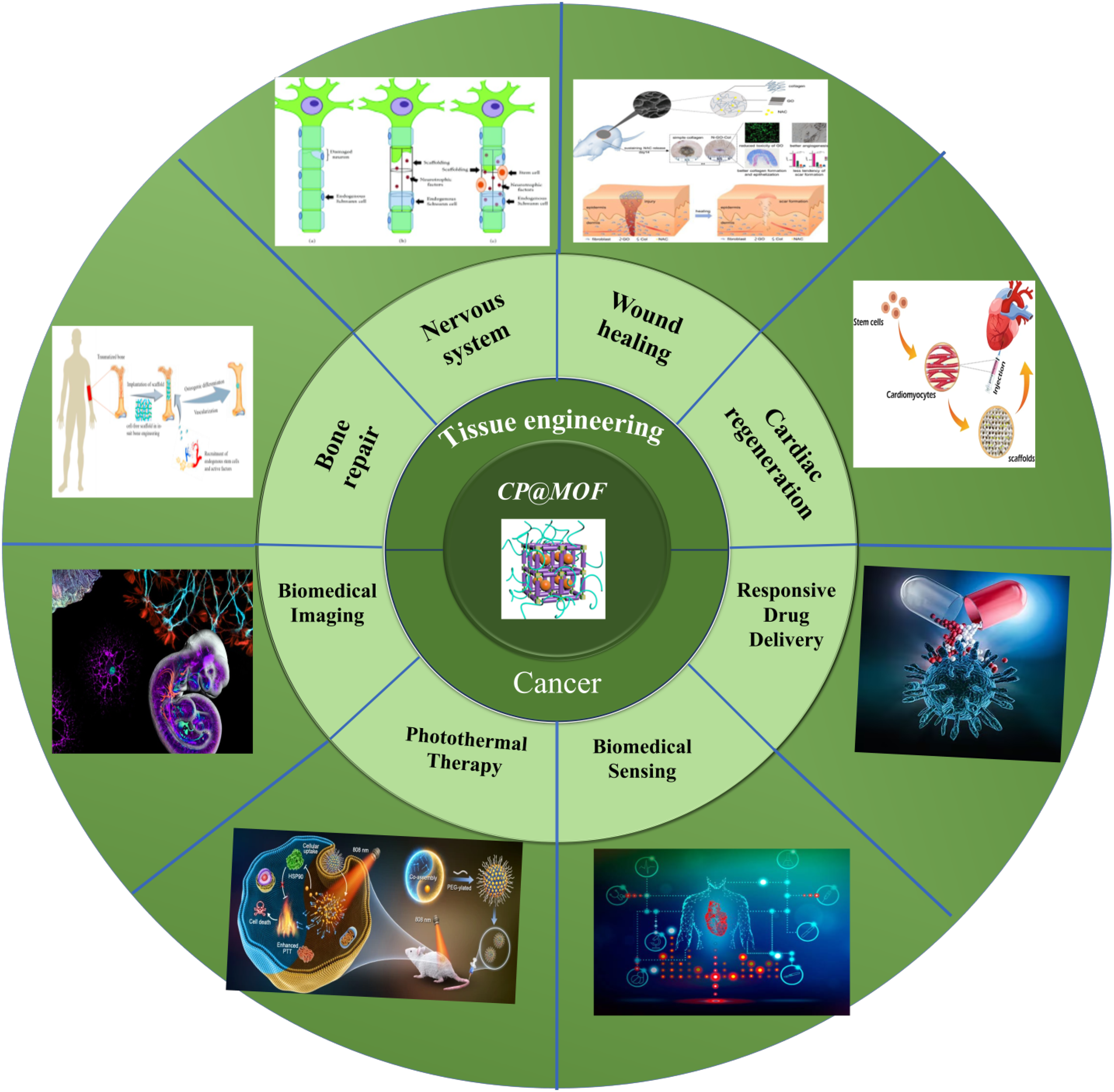
Get full access to this article
View all access options for this article.