




Abstract
University–industry collaboration is widely regarded as a critical driver of innovation in fast-evolving fields like information and communication technologies (ICT). Patent filings offer a valuable window into this innovation landscape, as they capture codified technological outputs and knowledge transfer activities. In this study, we focus on the Netherlands as a case study, given its strong academic research base and active ICT sector, to examine the gap between university and industry contributions to ICT-related patents. We adopt a dual-theory framework of Absorptive Capacity and Optimal Distinctiveness to interpret collaboration dynamics. Absorptive Capacity theory highlights the ability of firms to assimilate and exploit external knowledge, while Optimal Distinctiveness theory addresses the need for organizations (like universities and firms) to balance conformity and uniqueness in collaborations. We assembled a dataset of 2022 ICT-related patents (2014–2024) from the Lens database, classified by CPC technology categories. The results reveal significant collaboration gaps. Universities in the Netherlands exhibit substantial innovative activity in certain ICT domains (e.g., artificial intelligence and computer vision), yet lag behind industry in others (e.g., hardware technologies), indicating a misalignment in focus. Co-applicant university–industry patents are relatively scarce, suggesting that academic and corporate inventors often work in parallel rather than jointly. These findings underscore a persistent collaboration gap in the Dutch ICT patent landscape. By applying Absorptive Capacity and Optimal Distinctiveness as lenses, we argue that this gap reflects both limited knowledge absorption between sectors and challenges in balancing academic distinctiveness with industrial relevance. The study highlights the need for strategies to enhance knowledge exchange and bridge university–industry divides in technology innovation.
Keywords
Introduction
Collaborative innovation between universities and industry is widely recognized as a cornerstone of technological progress in the knowledge economy (Ghorbani and Blankesteijn, 2026; Striukova and Rayna, 2015). Universities contribute cutting-edge scientific research and a skilled talent pool, while industry provides practical engineering expertise, development resources, and pathways to market (Reichert, 2019). Particularly in information and communication technology (ICT)—a sector characterized by rapid evolution and convergence of multiple knowledge fields—close collaboration between academia and industry is considered essential for translating research breakthroughs into commercial applications and driving economic growth (Bellin et al., 2019). Prior studies have shown that robust university–industry linkages can enhance regional innovation outcomes and even national competitiveness by combining the exploratory research capacity of universities with the exploitative innovation capabilities of firms (Reichert, 2019). For instance, Mueller (2006) found that stronger university–industry relationships significantly drive economic growth by facilitating the flow of knowledge and entrepreneurial opportunities. Similarly, the “Triple Helix” model (Etzkowitz and Leydesdorff, 2000) posits that dynamic interactions among academia, industry, and government create an ecosystem conducive to innovation, particularly in high-tech sectors like ICT.
Despite this recognized importance, gaps often persist in collaboration between universities and firms (Rossi et al., 2024), and these gaps are often visible in patent activity. Patents are a tangible output of R&D and an indicator of innovation that can reveal the extent of university versus industry contributions (Azagra Caro et al., 2003). Most patents in technology domains are filed by firms, with universities contributing a smaller share—often via technology transfer offices or spin-offs. Co-patenting (joint patent ownership between university and industry) is relatively rare in many countries (Burg et al., 2021). In the United States, for example, industry co-ownership of university patents is below 5%, suggesting that while universities and firms may collaborate in research, these collaborations do not often lead to jointly owned intellectual property (Kneller et al., 2014). Instead, the prevalent model—particularly in the U.S.—has been one in which universities patent inventions and license them to industry, rather than co-inventing and co-owning patents (Caviggioli et al., 2020). Although co-patenting rates in Europe are slightly higher, they still represent a minority of total filings (Wolszczak-Derlacz, 2025). As such, the co-patent gap reflects a broader challenge in turning academic–industry collaboration into shared innovation outcomes.
In ICT, these collaboration gaps may be especially consequential. ICT includes diverse domains such as software, telecommunications, artificial intelligence, and digital networks—areas that often require the integration of fundamental research with applied engineering (Haefner et al., 2023). Historically, academic research has driven major ICT advances (e.g., early internet protocols and programming languages), while industry has played a pivotal role in scaling and commercialization. Without close collaboration, promising academic innovations may remain underexploited, while industrial development may miss the latest scientific insights (Rossoni et al., 2024). This disconnect is particularly relevant in rapidly evolving fields like AI and data science, where academic researchers often lead algorithmic breakthroughs, yet firms hold the data and deployment infrastructure necessary for real-world application (Fu and Ji, 2024). Collaboration is essential to bridge that divide. Conversely, the absence of collaboration may also reflect the dominance of industry-led innovation in some ICT subfields, where academic engagement is minimal.
In the context of the Netherlands—a country with a strong knowledge infrastructure and a policy environment that encourages innovation—university–industry collaboration in ICT carries strategic importance. The Dutch government and EU initiatives have long emphasized public–private partnerships, particularly in technology-intensive sectors (Koppenjan and Jong, 2018). Dutch universities perform well in computer science, electrical engineering, and AI, and the Netherlands hosts major multinational firms and R&D centers. At first glance, this ecosystem appears conducive to collaboration. Yet, despite these strengths, there are signs of misalignment. From 2000 to 2020, academic patents accounted for only 5.5% of EPO filings by Dutch applicants—roughly half the European average (EPO, 2024). Furthermore, two-thirds of patents based on Dutch university research are ultimately filed by firms. While this suggests active interaction between academia and industry, it also raises questions about the balance of ownership and the extent of collaborative development.
This study aims to systematically investigate the nature and extent of university–industry collaboration in the Dutch ICT patent landscape. It should be noted that University–industry collaboration can take multiple forms, including joint research projects, contract research, licensing, consulting, training, and personnel mobility (Ghorbani and Blankesteijn, 2025). In this study, we focus specifically on patenting as a formal and observable indicator of joint innovation output. While co-patenting does not capture all forms of collaboration, it reflects a high level of institutional integration and shared ownership of inventive activity. Therefore, we analyze patent data from 2014 to 2024, focusing on ICT subdomains, patent applicants, and co-ownership patterns. Our goal is to identify where universities and industry are active, where they overlap, and where collaboration is lacking. By classifying patents by technology (using CPC codes) and applicant type, we provide a quantitative map of innovation activity and collaboration across ICT domains. In particular, we examine the prevalence and distribution of co-patents—jointly filed patents by university and industry actors—as a key indicator of collaboration.
To interpret the empirical findings, we apply two theoretical lenses: Absorptive Capacity and Optimal Distinctiveness. Absorptive Capacity theory helps explain structural constraints—such as capability mismatches and knowledge transfer barriers—that limit collaboration (Cohen and Levinthal, 1990). Optimal Distinctiveness theory offers insight into strategic and identity-driven factors that influence how universities and firms engage (or choose not to engage) with one another (Zhao and Glynn, 2022). Together, these perspectives provide a robust framework for analyzing why collaboration may be sparse in certain domains, even when both parties are present and active. By integrating patent data analysis with theory, this study contributes both empirical insight and conceptual clarity to the discourse on university–industry collaboration. It offers evidence-based findings that can inform policy, institutional strategy, and future research aimed at fostering more integrated innovation ecosystems in ICT.
Literature review
University–industry collaboration has been studied from various theoretical angles. This study focuses on two complementary frameworks: Absorptive Capacity (AC) and Optimal Distinctiveness (OD). Absorptive Capacity explains collaboration as a function of an organization’s ability to identify, assimilate, and apply external knowledge for innovation. In contrast, Optimal Distinctiveness focuses on identity management, proposing that organizations navigate a tension between fitting in and standing out. This section reviews both perspectives and their application to the university.
Absorptive capacity: The imperative to learn and collaborate
Introduced by Cohen and Levinthal (1990), absorptive capacity refers to an organization’s ability to recognize, assimilate, and apply external knowledge. Firms with high AC are more likely to benefit from collaborations, especially with universities, because they can convert academic knowledge into commercial outcomes. Zahra and George (2002) later refined the concept into two parts: potential AC (knowledge acquisition and assimilation) and realized AC (transformation and exploitation). These components explain why some firms succeed in collaborations—because they’re equipped to integrate what they learn—while others do not.
In the context of university–industry partnerships, AC plays a crucial role. Firms with substantial R&D, skilled personnel, and experience in relevant domains are better able to absorb academic research. Fabrizio (2009) showed that firms engaged in science-based activities, such as hiring PhDs, are more successful in converting university research into patents. Petruzzelli and Murgia (2020) found that collaborations in biotech yielded more internationally cited patents when universities had specialized expertise, enhancing firms’ absorptive capacity.
Repeated collaborations and networks further build AC. Bruneel et al. (2010) emphasized that firms with prior university partnerships are better at navigating both cultural and transactional barriers. Their research found that trust and experience reduce knowledge transfer friction. Similarly, Zhou et al. (2024) showed that Chinese universities with strong patenting records created more expansive transfer networks, particularly when both absorptive and desorptive capacity (the university’s ability to share knowledge) were high.
The AC lens frames university–industry partnerships as strategic learning opportunities. Collaborations are most productive when both parties have enough prior knowledge to make knowledge exchange efficient. A firm with existing AI capabilities, for instance, is more likely to benefit from and seek partnerships with AI researchers. Conversely, where firms lack the capability to interpret academic work—such as emerging fields like quantum computing—they may avoid collaboration due to high transfer costs. Thus, gaps in co-patenting may reflect differences in AC, with collaboration more likely where the capacity to absorb knowledge is already in place.
Optimal distinctiveness: Balancing conformity and differentiation
While AC emphasizes the benefits of collaboration, Optimal Distinctiveness (OD) explains why organizations may avoid it. Rooted in social identity theory (Brewer, 1991) and extended to organizations by Deephouse (1999), OD posits that firms strive for a balance between similarity (legitimacy) and difference (competitive advantage). Collaborating with universities can enhance legitimacy and access to novel knowledge but may also blur organizational boundaries or expose proprietary knowledge.
This tension can lead to selective engagement. A firm known for its expertise in semiconductor design might avoid co-patenting in that core area to maintain control and distinctiveness. However, it may collaborate more freely in less central or more exploratory fields like AI, where the risks to identity are lower and legitimacy gains are higher. Pan et al. (2019) illustrated this trade-off in a study on technology diversification, showing that moderate deviation from core competencies yields the best performance—supporting the idea of a strategic balance. Similarly, O’Kane et al. (2015) explored how university TTOs manage their dual identities between academia and business, showing that even intermediary organizations navigate OD pressures. Universities, too, may avoid collaboration when it conflicts with their academic identity. Lam (2011) identified traditional and hybrid academic roles, finding that faculty with strong traditional identities often avoid industry collaborations to preserve scholarly credibility. Thus, even when collaboration opportunities exist and AC is high, identity concerns can deter joint innovation.
In patenting terms, OD predicts that firms and universities may prefer to operate in distinct domains. Firms might avoid co-patenting to protect IP and competitive advantage, while universities may license technology instead of co-developing it to maintain institutional autonomy. These preferences can result in low co-patent rates, not because collaboration doesn’t occur, but because both parties opt for looser, less entangled forms of knowledge exchange.
Synthesis and integration of Absorptive capacity and optimal distinctiveness
Absorptive Capacity and Optimal Distinctiveness offer distinct but complementary explanations for university–industry collaboration. AC predicts that collaboration occurs where knowledge exchange is efficient and capabilities are aligned. It assumes that, given the right conditions—such as strong R&D or experience—collaboration will naturally emerge. OD, by contrast, highlights restraint: even when collaboration is feasible, organizations may avoid it to protect identity or control. These frameworks can also interact. For instance, a firm with high AC might still avoid collaboration if it threatens its unique positioning. As Teece (1986) noted, firms choose between integration and licensing based on strategic concerns. Co-patenting, being a deeply integrative act, may conflict with OD preferences even if it aligns with AC logic.
A useful way to reconcile the two perspectives is to distinguish between capability conditions and strategic boundary-setting. Absorptive Capacity specifies the conditions under which university–industry collaboration is technically and organizationally possible: actors must recognize the value of external knowledge, be able to assimilate it, and have routines to exploit it (Cohen and Levinthal, 1990; Zahra and George, 2002). Optimal Distinctiveness adds a second layer by explaining how actors set boundaries around collaboration once feasibility is established. In this view, collaboration is not simply a function of capability alignment, but also of whether joint activity allows organizations to remain sufficiently distinct in identity, reputation, and control over critical assets (Deephouse, 1999; Zhao and Glynn, 2022). Co-patenting is therefore an especially informative empirical indicator, because it requires not only knowledge complementarity (AC) but also willingness to share ownership and visibility in inventive outcomes (OD).
This synthesis implies that collaboration outcomes can differ systematically across domains depending on whether constraints are primarily capability-based or identity/appropriation-based. Where collaboration is low because of capability barriers (e.g., high infrastructure demands, limited translational capacity, or weak interface routines), AC provides the dominant explanation, and co-patenting is unlikely even in the absence of strong identity concerns (Cohen and Levinthal, 1990; Zahra and George, 2002). Where collaboration is feasible but strategic concerns dominate (e.g., appropriation risks, reputational positioning, or desire to retain unilateral control), OD becomes the primary explanation, and firms may prefer alternative governance modes such as contract research, licensing, or arm’s-length exchanges rather than co-ownership (Deephouse, 1999; Zhao and Glynn, 2022). In domains where both capability alignment and strategic incentives support joint activity, co-patenting becomes more plausible because it simultaneously satisfies absorptive requirements and distinctiveness considerations.
These theories help explain sectoral and domain-level variations in patenting behavior. For example, in fields like “Semiconductors & Storage,” low university involvement may stem from both low AC (due to infrastructure demands) and strong OD concerns (firms guarding core IP). In contrast, “Artificial Intelligence” may offer conditions favorable to both theories: universities and firms share knowledge bases (high AC) and see strategic value in collaboration (enhancing legitimacy or distinctiveness), leading to more balanced contributions.
Methodology
This study uses a structured quantitative approach to analyze patent data and map ICT innovation patterns in the Netherlands. It focuses on the roles of universities and industry, identifies specialization trends, and assesses collaboration levels. The methodology covers data collection, classification (by CPC and applicant type), and three levels of analysis: institutional, geographic, and collaborative.
Data collection
We obtained patent records from Lens.org, a comprehensive patent database, focusing on patents filed from 2014 to 2024 (inclusive) that are relevant to ICT (information and communication technology) and have a connection to the Netherlands. The dataset was filtered such that all patents included have publication or application in the Netherlands (for example, European patents designating NL or filings in the Dutch national office) to center the analysis on the Dutch innovation context. We included both Dutch domestic and foreign applicants in these patents, given that the presence of international players is a significant aspect of the Dutch ICT innovation ecosystem. Each patent record in the raw data contained the following relevant fields: Applicant names, Applicant country (origin), and CPC (Cooperative Patent Classification) codes assigned to the patent. We also leveraged Lens.org’s metadata or additional cross-references to classify applicant types (more on this below). We limited the timeframe to 2014–2024 to capture recent trends over roughly a decade, including the latest available data, and to observe any inflection around the early 2020s (for instance, a surge in certain technologies or international filings).
The initial dataset consists of 2022 ICT-related patent families associated with the Netherlands. We removed duplicate patent families (to avoid double-counting the same invention in multiple jurisdictions). After data cleaning, 2009 patent families could be assigned to identifiable applicant types (industry, university, or mixed), while 129 patent families were filed by individual applicants. For analyses that require country-level attribution, only patent families with traceable applicant countries were retained, resulting in a subset of 1881 patent families. We also standardized applicant names to ensure, for example, “TU Delft” and “Delft University of Technology” are recognized as the same entity (university). For applicant type classification, where possible we relied on Lens metadata or external sources: many patents explicitly list the applicant type (e.g., “(NL) Universiteit Utrecht” clearly is a university, whereas “Philips N.V.” is a firm). We supplemented this by matching applicant names against known lists (such as the names of Dutch universities, common industry suffixes like Ltd., B.V., N.V., etc.). Each patent’s applicants were then labeled as one of: Industry, University, Individual, Government, or combinations thereof if multiple applicants exist. Following OECD and WIPO practice, “Industry” refers to private sector firms (including large firms and SMEs), “University” refers to higher education or academic research institutions, “Government” refers to public research organizations or governmental entities (if any appeared), and “Individual” refers to independent inventors not affiliated with an organization.
ICT patent classification (CPC-based)
A crucial step was to determine which patents are “ICT-related” and to categorize them into meaningful technology domains. We developed a CPC classification methodology tailored to identify ICT patents and group them by subfields, drawing on official concordances and expert knowledge. Following WIPO (2019) and OECD (2017) approaches to classifying emerging technologies, we built a concordance table mapping specific CPC codes to ICT categories. This concordance was informed by WIPO’s technology field definitions and prior academic studies that have categorized CPC codes for ICT. We included both broad 4-character CPC classes and more granular 6-character CPC subclasses in the mapping to improve accuracy. For example, CPC codes starting with “G06F” (which relate to electrical digital data processing) were mapped to a category we termed “Computer Hardware & Architecture”, whereas “G06N” (computing systems based on specific computational models, like neural networks) was mapped to “Artificial Intelligence & Neural Networks”. The following provides a snippet of the concordance logic: • G06F -> Computer Hardware & Architecture • G06N -> Artificial Intelligence & Neural Networks • H04L -> Telecommunications & Networking • H01L -> Semiconductors & Storage • A61B (with ICT context) -> Medical ICT
Each patent in the dataset often had multiple CPC codes (indeed, ICT inventions can span multiple areas). We parsed the CPC classifications field, splitting on the delimiter (in Lens data, CPC codes were separated by “;” in a single field). We extracted both the first 4 characters and first 6 characters of each CPC to match against our concordance categories. The classification logic was hierarchical: first, check if the 6-character CPC appears in our concordance mapping; if not, fall back to the 4-character CPC prefix. If neither was mapped (which could happen for some miscellaneous codes), the patent was classified into an “Other ICT Fields” category. This step ensured that we could group patents into a finite set of ICT subdomains for analysis. The final set of ICT categories we used (16 in total) included: Artificial Intelligence & Neural Networks, Computer Hardware & Architecture, Computer Vision, Image & Video Processing, Image/Data Recognition & Processing, Business Methods & Data Processing, Telecommunications & Networking, Telecommunications & Mobile, Wireless Communication, Multimedia & Broadcasting, Semiconductors & Storage, Sensors & Control Systems, Transmission Systems, Multiplex Communication, Broadcast Communication, and Medical ICT, plus the catch-all Other ICT Fields. These categories capture both traditional ICT (like telecom, hardware) and emerging digital areas (like AI, vision) as well as ICT applications (medical ICT).
Since patents can belong to multiple categories (through multiple CPCs), we adopted a multiple-counting (or “exploded” view) approach for aggregation purposes. That is, if a single patent had CPCs that mapped to say AI and to Medical ICT, it was counted once in each of those category counts for analyses by technology domain. This gives a fuller picture of activity in each domain but means sums over categories will exceed the number of distinct patents (because of double counting). We mitigated potential misinterpretation by focusing comparative analyses either within each category or by using share indices like RTA (which handle proportional comparisons). This CPC-based aggregation is used exclusively in analyses that examine technological domains and specialization patterns.
Levels of analysis
We conducted analysis at three levels as outlined by our research objective:
By applicant type (institutional level)
We compared patenting activity by industry versus university applicants. This included patents filed solely by industry, solely by universities, and co-owned patents. We quantified each group’s specialization by ICT domain and introduced a “Collaboration Opportunity” marker. A domain was flagged as a collaboration opportunity if both sectors had ≥50 patents over the decade. If only one sector was active, the domain was marked as a collaboration gap. For example, “Telecommunications & Mobile” had 146 industry patents and none from universities, indicating structural asymmetry. Institutional analyses examine specialization patterns across ICT domains and employ CPC-based technology classifications.
By country (geographical level)
Patents were also grouped by country of origin, emphasizing the Netherlands, China, and the United States—the three dominant contributors in the dataset. If a patent had applicants from multiple countries, each was credited for country-level counts. We computed the Revealed Technological Advantage (RTA) index to assess specialization. The formula:

An RTA > 1 indicates specialization above the global average. This metric normalizes for size differences and highlights whether the Netherlands, for instance, is over- or under-specialized in fields like AI or semiconductors relative to global patterns. We also examined how many patents involving Dutch applicants were co-owned with foreign versus domestic partners to explore international collaboration trends. Analyses at the country level focus on technological activity across ICT domains and therefore rely on CPC-based classifications.
By collaboration (co-patenting level)
Finally, we identified patents co-owned by both a university and an industry partner. These university–industry co-patents were counted, categorized by domain, and broken down by national combinations (e.g., Dutch university + Dutch firm, or cross-country pairs). We also noted other forms of co-patenting (e.g., university–university or industry–industry). This level of analysis highlights collaboration intensity and gaps—especially in high-activity domains where joint ownership might be expected but is missing. Collaboration analyses focus on joint patenting activity and are therefore based on counts of distinct patent families rather than CPC-based domain mappings.
Findings
In this section, we present the results of our analysis on the ICT patent landscape in the Netherlands, focusing on the volume and patterns of patenting by universities versus industry, the technological specialization of different actors (domestic and international), and the extent of direct collaboration (co-patenting) between universities and firms. Five key figures are embedded to illustrate these findings, each accompanied by a detailed interpretation. We then synthesize these observations, highlighting the differences between Dutch, Chinese, and American applicants, and identifying where the university–industry collaboration gaps are most pronounced.
Patent application trends and technology domain map
Between 2014 and 2024, patent filings in the Dutch ICT sector initially showed a balance between domestic and international applicants. In the mid-2010s, Dutch entities played a substantial role, with national filings even outpacing foreign ones in 2017. However, after 2018, this balance shifted significantly. Foreign filings surged—particularly from China and the U.S.—peaking at nearly 290 in 2023, while domestic filings plateaued and remained modest. By 2023, international actors clearly dominated the ICT patent landscape in the Netherlands. (see Figure 1). Patent application trends in ICT patents in the Netherlands (2014–2024) (Based on counts of distinct patent families).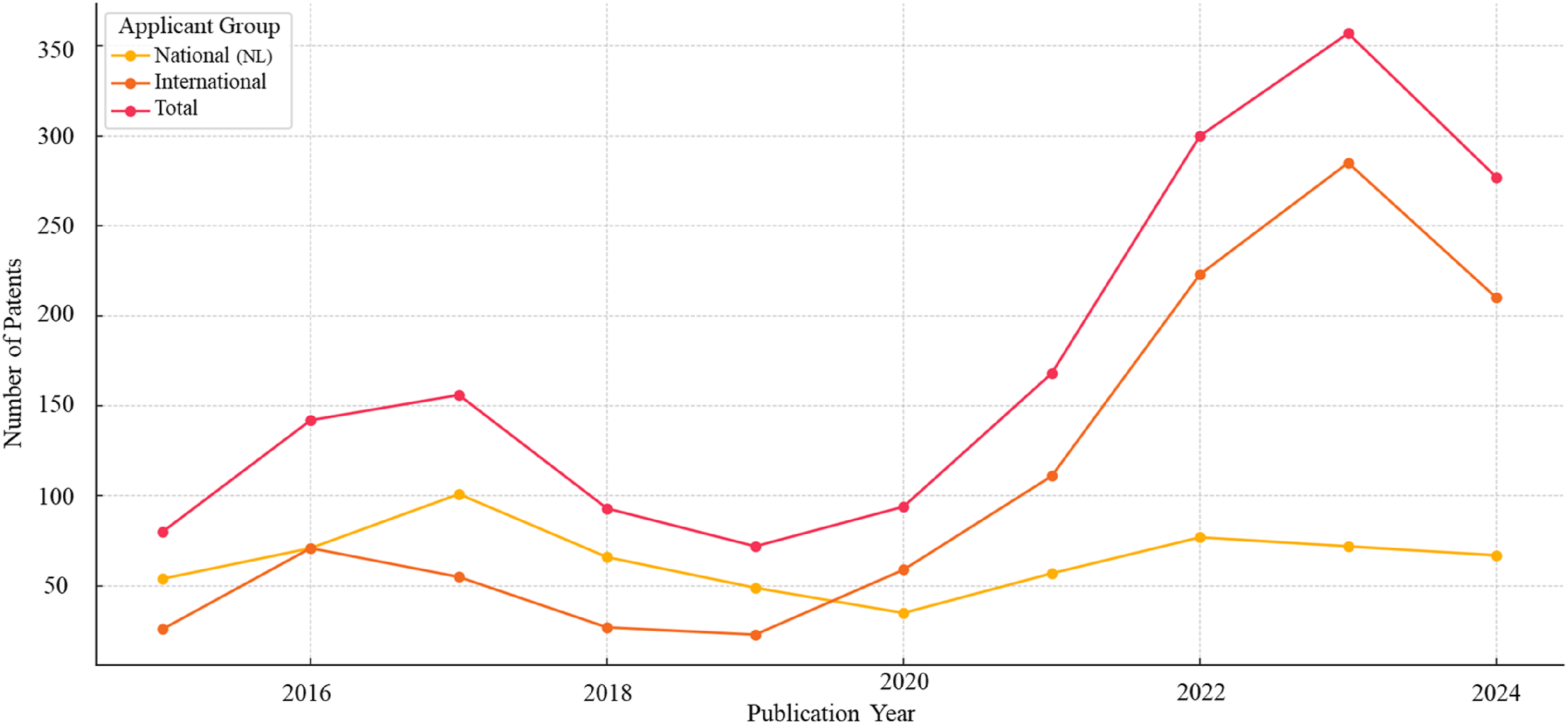
This growing gap reflects the internationalization of the Dutch patent system, where global firms appear to use the Netherlands strategically for securing European IP rights. Meanwhile, Dutch applicants have not mirrored this growth, pointing to either limited commercialization of R&D or a cautious patenting strategy. The data also suggests that foreign and domestic innovation activities are largely disconnected, with minimal evidence of co-patenting or joint innovation. This divergence raises concerns about missed opportunities for collaboration and integration between local institutions and foreign innovators.
China and the United States lead in patenting within the Computer Hardware & Architecture domain in the Netherlands, with Dutch applicants trailing behind (see Figure 2). This illustrates a strategic push by Chinese institutions to secure intellectual property in what they perceive as a high-priority technology area. Their active presence in the Dutch patent landscape—despite being foreign actors—reflects China’s broader international IP strategy, where Europe, and particularly the Netherlands, serves as a valuable entry point. U.S. applicants also show consistent strength, likely tied to large tech corporations expanding their global patent portfolios. Meanwhile, the Netherlands contributes meaningfully but remains in a secondary position, indicating either limited domestic capacity or a more selective approach to patenting in this domain. Technology domain map of ICT patents in the Netherlands (2014–2024) (Based on CPC-based technology-domain classifications; patents may appear in multiple domains).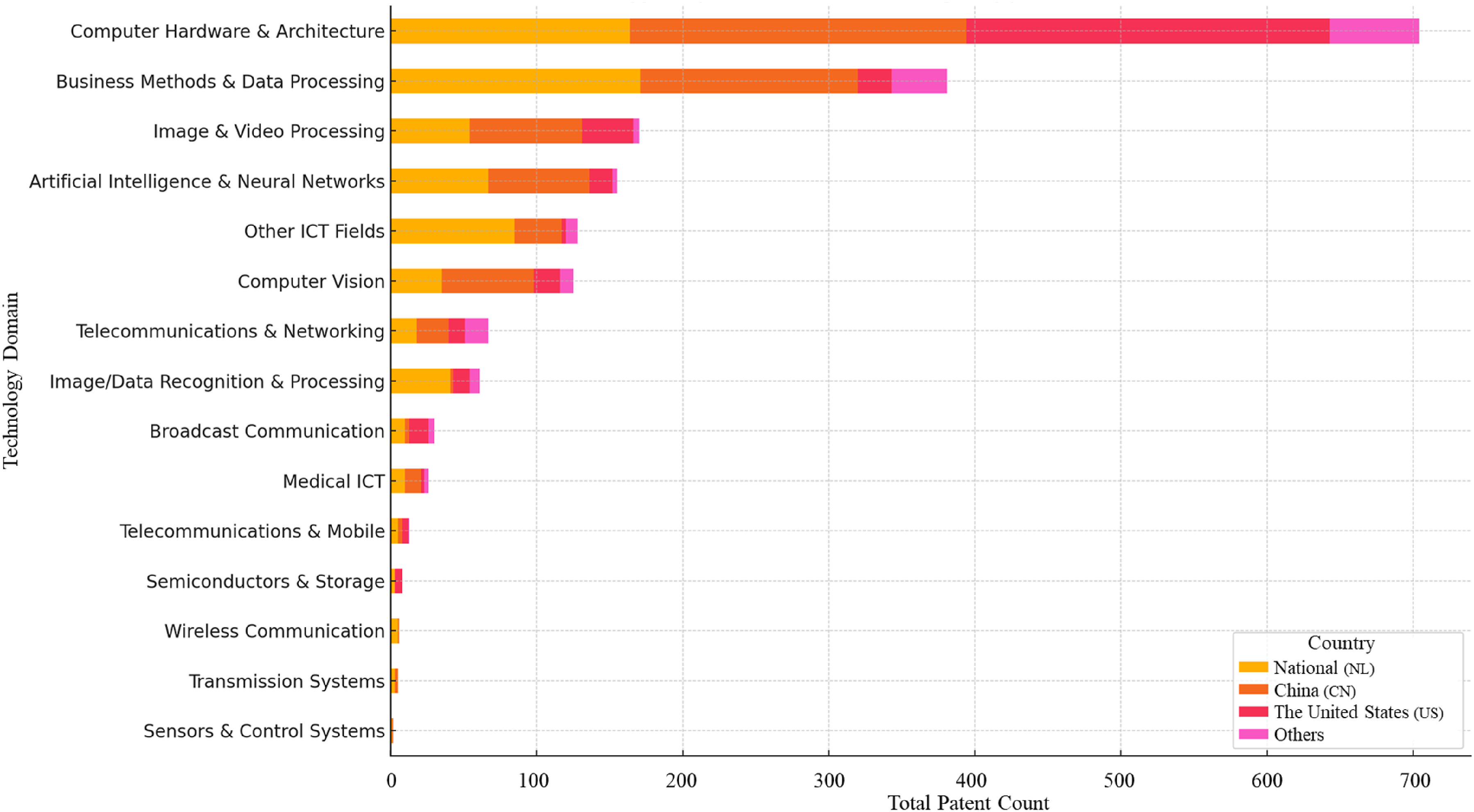
The overall distribution suggests that China and the U.S. are particularly aggressive in filing patents in core digital and data-driven technologies such as Artificial Intelligence, Image & Video Processing, and Business Methods, while Dutch applicants focus more narrowly on domains like Medical ICT and Image/Data Recognition & Processing, where they either lead or are competitive. These patterns suggest that Dutch innovation is more concentrated in high-tech health and imaging niches, possibly reflecting national research priorities or stronger university–industry ties in those fields. The gap in core hardware and semiconductor fields could pose a challenge for technological sovereignty, unless Dutch institutions can form stronger collaborative ties or build complementary capabilities with these dominant foreign players.
Institutional specialization: Industry versus university activity by domain
Institutional contributions to ICT patenting in the Netherlands reveal clear specialization patterns when examined by organization type and nationality. “Computer Hardware & Architecture” is now the most patent-intensive domain, led by international industry (338 patents), followed by national industry (165) and international universities (156). Other major areas like “Image & Video Processing” and “Business Methods & Data Processing” also show strong international participation across sectors. Dutch universities, by contrast, remain marginal in these high-volume domains, often contributing fewer than 10 patents per category—indicating a limited presence in commercially dominant ICT sectors (see Figure 3). Institutional specialization heatmap for ICT patents in the Netherlands (2014–2024) (Based on CPC-based technology-domain classifications; patents may appear in multiple domains).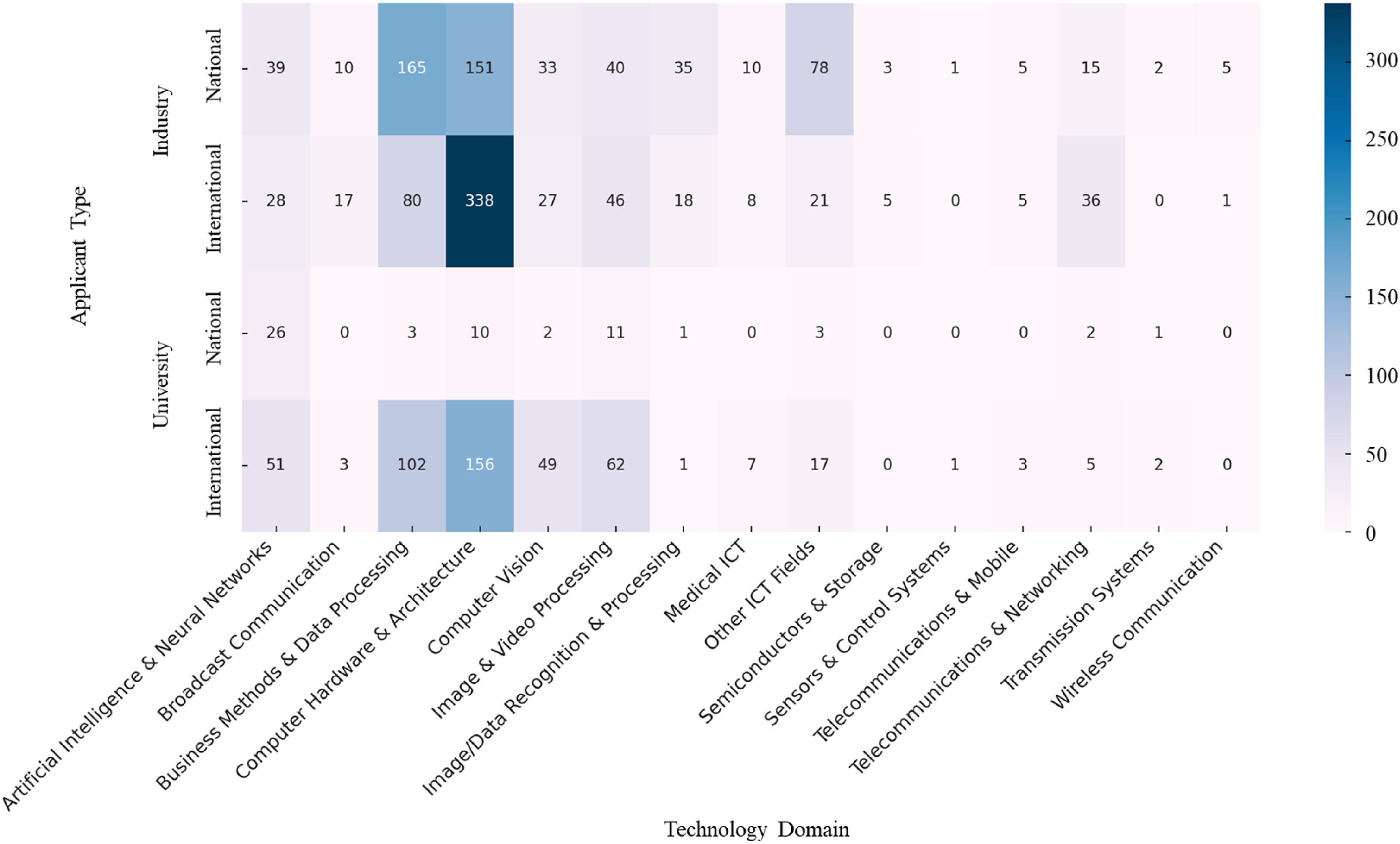
Dutch universities are relatively more active in computational fields such as “Artificial Intelligence & Neural Networks,” “Computer Hardware & Architecture,” and “Business Methods,” which align with typical academic strengths in software and algorithmic research. However, their near absence in hardware-heavy domains like “Semiconductors” and “Telecommunications” highlights a structural gap that requires targeted support or collaboration. International universities—likely from China and the U.S.—outpace Dutch institutions across nearly every domain, especially in applied and commercial fields like “Image & Video Processing” and “Medical ICT.”
This heatmap not only reveals capability imbalances but also points to missed opportunities. In fields where both Dutch universities and industry are active, like AI and computer vision, collaboration potential exists but is rarely realized. To strengthen the national innovation system, Dutch policy efforts may need to promote co-development initiatives and bolster university involvement in capital-intensive or commercially strategic ICT domains.
University–industry collaboration levels: Co-patenting in the Netherlands
University–industry co-patenting in the Dutch ICT sector remains exceptionally low. Out of all co-applicant patents with Dutch involvement between 2014 and 2024, only 2 were jointly filed by a university and an industry partner, while 5 were co-owned by two firms and 4 by two universities. This highlights a limited culture of cross-sector patent collaboration, especially between academia and industry. In contrast, China stands out with 93 co-applicant patents: 44 between universities and industry, 34 between universities, and 15 between firms. This suggests a more integrated innovation system, where formal partnerships translate into shared intellectual property.
The U.S. and other countries also show low levels of co-patenting, particularly between universities and industry. The U.S. had just 2 university–industry co-patents, aligning with its preference for knowledge transfer via licensing rather than joint IP ownership. Other countries show similarly small numbers. Overall, Figure 4 makes clear that the Netherlands, despite policy emphasis on collaboration, has not seen significant co-patenting activity—especially compared to China—highlighting a structural gap in how academic and industrial sectors engage in joint innovation. Number of ICT Co-patents by university and industry (2014–2024) (Based on counts of distinct co-patented patent families).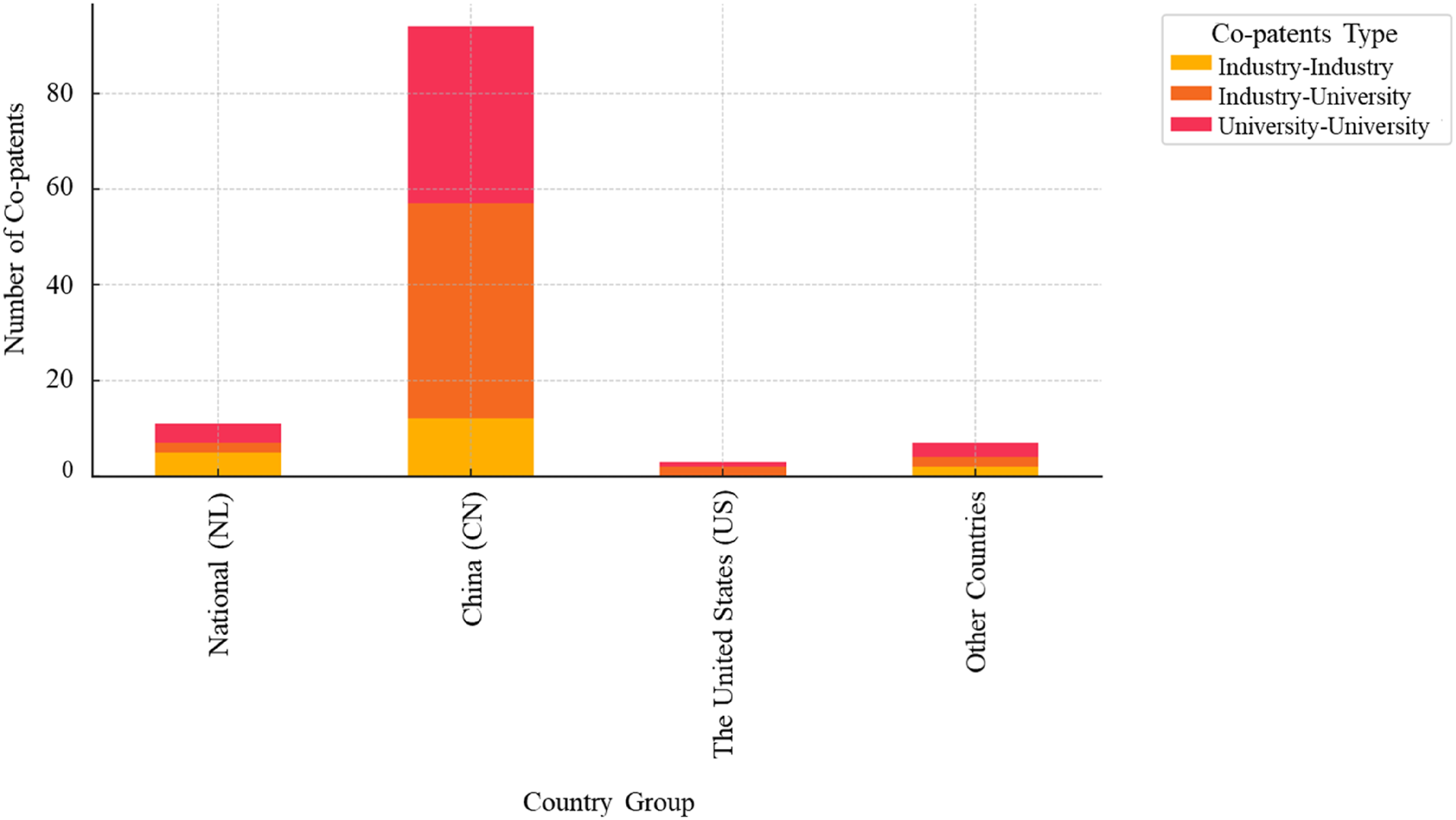
Perhaps firms in the Netherlands prefer to keep patent development in-house or license from universities rather than invest in truly joint projects. If firms feel they can assimilate academic knowledge without co-inventing (through hiring graduates, reading papers, or funding research and then doing internal development), they might avoid the complexities of co-owned IP. Conversely, maybe universities lack the resources or culture to engage deeply in development to the point of co-inventing with firms, preferring to focus on fundamental research and let tech transfer offices handle IP via licenses. The near-zero co-patent rate indicates that knowledge flow is happening via channels other than shared patents (if at all).
There may be reluctance on both sides to share credit and ownership. Firms might worry about encumbering IP with university partners (who might demand certain rights or publications), and universities might worry about compromising academic freedom or appearing too commercial by entangling in patents with firms. The result is a structural separation: universities patent individually (often then licensing out—recall the Innovation Origins note that 2/3 of university inventions are filed by firms, implying the chain is: university invents -> hands to firm to patent). That suggests firms prefer to own the patents outright, even if the underlying research was collaborative, which would avoid a co-patent.
Discussion
Our analysis reveals a fragmented landscape of ICT innovation in the Netherlands, marked by significant foreign presence and minimal university–industry co-patenting. Chinese and U.S. actors dominate many technology domains, while Dutch universities and industries operate largely in parallel rather than in partnership. This section interprets these patterns through the dual lenses of Absorptive Capacity (AC) and Optimal Distinctiveness (OD), providing theoretical insight into the observed collaboration gaps and specialization trends.
Collaboration gaps: Absorptive capacity and knowledge transfer barriers
The near absence of university–industry co-patents in the Netherlands—only 2 out of 672 Dutch-affiliated ICT patents—signals a structural gap in formal collaboration. Even in domains where both sectors are active, such as Artificial Intelligence (AI), Computer Vision, and Sensors, co-invention is rare. Absorptive Capacity theory helps explain this pattern. From an AC perspective, Dutch firms may lack the incentives or capabilities to absorb academic knowledge in real-time innovation processes (Camisón and Forés, 2010). Instead of engaging in joint patent development, firms appear to adopt a sequential model: they wait for academic outputs (e.g., publications or independent patents), then selectively license or hire. This strategy minimizes transaction costs and avoids the complexities of joint intellectual property. However, it also limits the synergistic potential of joint problem-solving during R&D (Sun, 2023).
This behavior reflects moderate absorptive capacities—firms can identify valuable knowledge but may lack mechanisms to co-create it. The fact that two-thirds of Dutch university inventions are eventually patented by firms supports this sequential transfer model. Firms benefit from academic insights, but not through deep collaboration. Domain-specific trends reinforce this interpretation. In AI and Computer Vision, Dutch universities are active (528 and 189 patents, respectively), but co-patents with industry are nonexistent. This suggests either a lack of R&D-intensive firms in these areas or limited industry capacity to collaborate at the research frontier. Foreign tech giants likely absorb Dutch academic knowledge via hiring or open science engagement, patenting under U.S. entities.
Conversely, in hardware-intensive fields like Semiconductors & Storage (384 Dutch patents) and Telecommunications (266 patents), firms lead, and universities contribute little. These sectors require costly infrastructure and proprietary know-how, which universities may lack. This reflects a reverse absorptive challenge—universities lack the translational capacity (“desorptive capacity”) to engage in applied industrial innovation. Cultural and incentive structures may further dampen collaboration. Academic promotion in the Netherlands prioritizes publications over patents (Dongen et al., 2014). Without strong structural incentives, universities may not push for co-development, especially if industry partners are passive. This also explains the absence of international university–industry co-patents: while Dutch academia might collaborate internationally, these partnerships rarely translate into shared IP.
In contrast, China shows higher co-patenting activity (45 university–industry co-patents), reflecting state-driven strategies that encourage patenting and cross-sector collaboration. Over two-thirds of Chinese-affiliated patents were university-owned, indicating stronger institutional alignment between academia and industry. Government funding, joint labs, and co-invention incentives likely boost China’s absorptive capacity system-wide. The Dutch example in Medical ICT (78 patents) offers a rare success story. Here, historical collaboration between Philips and academic hospitals (e.g., TU/e, Erasmus MC) likely supports innovation (Calvo Camacho, 2016). However, even in this domain, co-patents are rare, suggesting that collaboration takes the form of informal partnerships, licensing, or sequential development—again bypassing joint IP ownership.
Specialization patterns: Optimal distinctiveness and institutional identity
The observed domain specialization—Dutch focus on Medical ICT and Sensors, U.S. strength in Computer Hardware, Chinese dominance in AI—aligns with Optimal Distinctiveness theory. OD explains how organizations and systems seek to balance conformity (to gain legitimacy) with differentiation (to preserve identity and competitive advantage). The Netherlands’ niche in Medical ICT and Sensors reflects a strategic positioning that builds on national strengths: a robust healthcare system, world-class academic hospitals, and legacy firms like Philips. These domains allow the Dutch innovation system to be both legitimate (aligned with global health tech trends) and distinct (avoiding direct competition with global semiconductor or AI leaders). Firms like ASML exemplify this strategy—deep specialization in lithography technology grants global relevance and identity protection.
Yet OD also helps explain the limited cross-sector collaboration. Universities may avoid deep industry involvement to preserve their academic identity. In the European context, aggressive commercialization is sometimes viewed as compromising scholarly autonomy (Geuna and Muscio, 2009). Thus, even when universities patent, they often do so independently. This cautious stance is rational: co-patenting may risk perceived dilution of scientific integrity or institutional legitimacy. Firms, too, protect identity through proprietary boundaries. In sectors like Semiconductors or Business Methods, patents are core strategic assets. Firms may resist joint ownership to maintain control, avoid IP conflicts, and signal technological independence (Athreye et al., 2023). Shared patents with universities could be seen as compromising competitive identity or exposing trade secrets.
This identity logic reinforces structural separation: universities produce upstream knowledge, and firms’ downstream value. Each sector maintains optimal distinctiveness by sticking to its strengths. In AI, for example, firms may integrate academic ideas via open-source engagement or personnel recruitment rather than co-patenting—allowing firms to innovate while preserving IP boundaries. Interestingly, Chinese co-patenting trends suggest a different OD equilibrium. For emerging firms in China, collaboration with top universities can enhance legitimacy. Co-patents signal prestige, policy alignment, and technical credibility. Thus, Chinese firms might co-invent not just for innovation but also for symbolic alignment—conforming to state narratives around university–industry synergy. In the Netherlands, similar pressures are weaker. Although there is rhetorical support for collaboration, institutional logics in both sectors reward autonomy. Industry remains proprietary; academia remains publication-driven. This equilibrium may feel “safe” but comes at the cost of deeper integration.
Domain-level analysis further supports this view: In Semiconductors & Storage and Telecommunications, Dutch and foreign firms dominate while universities are nearly absent—suggesting firms protect core domains. In AI and Neural Networks, universities are prolific, but firms are cautious—likely preferring trade secrecy or international patenting. In Medical ICT, loose complementarities exist, but without formal co-patenting—each sector plays its distinct role in a parallel rather than integrated fashion. Lam’s (2011) work on identity conflicts in academic entrepreneurship is relevant here. Dutch academics may fear reputational risks or mission drift when engaging too closely with industry. Thus, they prefer indirect engagement (consulting, licensing), avoiding the messiness of joint IP. This mirrors Ponds et al.’s (2010) “extended network” model: knowledge flows through social channels and informal ties, not necessarily through co-owned IP.
Integration: Knowledge barriers and identity choices
Bringing together AC and OD perspectives, the Dutch ICT patent landscape reflects both capability constraints and strategic choices. Absorptive Capacity accounts for can’t collaborate (due to lack of incentives, knowledge, or infrastructure), while Optimal Distinctiveness accounts for won’t collaborate (due to identity protection and institutional norms). For instance: In AI & Neural Networks (528 university patents, 429 industry), both sides are active but entirely separate—reflecting OD preferences for autonomy and AC limits in collaboration mechanisms. In Semiconductors & Storage, firms dominate (384 patents), universities are absent—suggesting both knowledge barriers (desorptive capacity) and strategic IP protection. In Medical ICT, moderate balance exists (78 patents total), with loose partnerships but no co-patenting—perhaps an OD-informed equilibrium that maintains identity while enabling some synergy.
Cross-national comparisons strengthen these points. China’s relatively higher co-patent count (45) signals stronger AC development and OD models that encourage visible collaboration. U.S. firms, like Dutch ones, favor internal R&D and clear IP boundaries—resulting in only 2 U.S. co-patents in our dataset. Ultimately, both theories explain why university–industry interaction in the Netherlands takes place in adjacent lanes rather than shared spaces. Collaboration exists, but often via informal channels, licensing, or sequential handoffs. Co-patenting—a proxy for deep integration—remains rare.
For policy and practice, this implies that fostering innovation synergies will require tackling both types of barriers: Investing in translational infrastructure (joint labs, embedded researchers) to build AC on both sides. Reforming incentive systems to reward joint invention and align identity goals. Facilitating trust-building platforms that reduce the transaction costs and reputational risks of co-invention. The Dutch innovation system has strong ingredients—excellent universities, global firms, and niche specializations—but greater integration could unlock deeper innovation potential. Recognizing and addressing both knowledge barriers and identity frictions is key to closing the collaboration gap in ICT.
International competition and state-driven collaboration in the Dutch ICT patent landscape
A striking pattern emerging from the analysis is the strong presence of Chinese and USA applicants across multiple ICT domains in the Dutch patent landscape. As shown in the technology-domain distribution, Chinese patenting activity is particularly pronounced in areas such as Computer Hardware & Architecture, Business Methods & Data Processing, Image & Video Processing, and Artificial Intelligence & Neural Networks. Together with the United States, China accounts for a substantial share of foreign ICT patents filed in the Netherlands, underscoring the role of the Dutch patent system as a strategic entry point within broader global competition in ICT. Rather than reflecting local collaboration dynamics alone, these patterns point to the Netherlands’ position within an international innovation arena shaped by geopolitical and technological rivalry, particularly between China, the United States, and Europe (WIPO, 2019).
From an absorptive capacity perspective, the high volume of Chinese ICT patents can be interpreted as the outcome of sustained investments in R&D capabilities, talent development, and institutional infrastructures that support large-scale knowledge production and codification (OECD, 2017). State-supported programs, joint laboratories, and incentives for patenting have strengthened the ability of Chinese universities and firms to generate and formalize technological outputs, including in international jurisdictions (Fu and Ji, 2024). In this context, patenting abroad—such as in the Netherlands—represents not only market-oriented behavior but also a mechanism for leveraging accumulated absorptive capacity on a global scale (Petruzzelli and Murgia, 2020). The relative intensity of Chinese co-patenting observed in the data further suggests that absorptive capacity in this system is often built through structured university–industry linkages that facilitate joint invention rather than sequential knowledge transfer.
Optimal Distinctiveness provides a complementary explanation for why these collaboration patterns differ markedly from those observed in the Netherlands. In the Chinese context, co-patenting between universities and industry can enhance organizational legitimacy, signal alignment with national innovation priorities, and strengthen access to state resources (Zhao and Glynn, 2022). Under such conditions, joint patent ownership does not necessarily threaten organizational identity but may instead reinforce it. In contrast, Dutch and U.S. actors appear to operate under institutional logics that place greater emphasis on autonomy, proprietary control, and clear organizational boundaries (Bruneel et al., 2010; Zhao and Glynn, 2022). As a result, even when absorptive capacity is present, universities and firms in these systems may prefer looser or sequential forms of interaction—such as licensing or contract research—over co-ownership of intellectual property.
Taken together, the contrast between Chinese and Dutch co-patenting patterns highlights how global ICT competition interacts with national institutional configurations. The Dutch ICT innovation system is embedded in an international landscape where foreign actors—particularly from China and the United States—play a dominant role in patenting activity, while domestic university–industry collaboration remains limited in its most formalized form. This comparison reinforces the central argument of the study: gaps in co-patenting cannot be explained by capability constraints or identity considerations alone, but emerge from the interaction between absorptive capacity, optimal distinctiveness, and the broader institutional and geopolitical context in which innovation takes place.
Conclusion
This study examined the university–industry divide in the Netherlands’ ICT patent landscape from 2014 to 2024, using patent data to classify innovation across subdomains, applicant types, and countries. Our analysis highlights four key findings: (1) Dutch ICT patenting is increasingly dominated by foreign actors—particularly China and the US. (2) There is a marked divergence in specialization: universities are more active in research-driven domains like AI, while industry dominates practical fields like semiconductors and telecom. (3) Co-patenting is exceptionally rare—just about 10 Dutch ICT patents are jointly filed by universities and industry—signaling a major collaboration gap. In contrast, China shows a much higher co-patenting, while the US aligns more with the Dutch pattern. (4) The imbalance is domain-specific: areas like semiconductors and multimedia are led almost entirely by industry, with minimal academic presence, whereas university activity is stronger in AI and vision—but still without significant joint invention. Overall, the data suggests an innovation system where academia and industry operate in parallel, with limited synergy and a growing presence of foreign IP that both fills and accentuates local gaps.
Theoretical contributions
First, this study contributes conceptually by showing how both absorptive capacity (Cohen and Levinthal, 1990) and optimal distinctiveness (Zhao and Glynn, 2022) help explain persistent gaps in university–industry collaboration. AC clarifies technical and capability mismatches—where firms may lack the means to utilize academic breakthroughs, or universities may struggle to develop industrially relevant applications. OD, by contrast, explains strategic and cultural separation—firms may avoid co-patents to guard proprietary knowledge, while universities preserve academic legitimacy by maintaining independence. The interplay of “can’t” and “won’t” factors provide a richer lens for understanding the structural fragmentation in Dutch ICT innovation.
Second, our findings highlight that collaboration gaps are not uniform. Some fields (like AI) see both academic and industrial activity but lack joint IP, whereas others (e.g., semiconductors) lack academic involvement altogether. This supports prior theories (e.g., Meyer-Krahmer and Schmoch, 1998) that the nature of a domain—science-based versus engineering-based—shapes collaboration patterns. We extend this into the ICT context of the 2010s/2020s, offering empirical detail to support more nuanced theorizing on field-specific engagement dynamics.
Third, by comparing the Netherlands with China and the US, we contribute to the literature on national innovation systems. Chinese institutions exhibit a higher rate of co-patenting, consistent with state-driven efforts to foster academia–industry linkages. In contrast, the Netherlands and the US reflect a “licensed transfer” model, where collaboration often occurs outside of formal IP co-ownership. Our data reinforce that simply boosting university patent activity does not equate to collaborative innovation—systemic differences in structure, culture, and incentives matter.
Fourth, the study empirically supports the barriers outlined by Bruneel et al. (2010)—notably, orientation and transaction barriers remain relevant in high-tech domains. Even when both sectors are active in the same field, co-ownership of patents is rare. This suggests a need to update our understanding of innovation capabilities—what might be termed “collaborative absorptive capacity,” encompassing not just the ability to absorb external knowledge, but to co-create it.
Fifth, we also contribute to theory by revealing how foreign innovation shapes local ecosystems. The Netherlands hosts a high volume of foreign patents, making it an open but externally shaped innovation system. Absorptive capacity should thus be rethought at the national level: how well do domestic institutions learn from or collaborate with foreign knowledge sources? This extends theories of global R&D by showing the asymmetric integration of local and global innovation flows.
Practical implications
Dutch universities may need to evolve from isolated innovation to more integrated collaboration. Although academic patenting is high in certain fields, it often occurs without industry involvement. Universities could foster earlier and more structured partnerships through joint labs, embedded researchers, or co-funding models—with clear IP frameworks to reduce friction. Reward structures may also need revision: academic engagement with industry (even if not yielding university-owned IP) should be valued. Facilitating applied projects with firm partners—and providing translation mechanisms to align research with industry needs—could help overcome both AC and OD barriers.
Firms in the Netherlands should consider leveraging local academic talent more strategically, especially in fast-moving areas like AI. This requires building internal capacity to interact with academic partners—through sponsorships, researcher exchanges, or prototype development. Shifting from a “license-and-go” to a co-creation mindset may offer earlier access to innovations and allow firms to help shape emerging research. Revisiting rigid IP policies could also unlock collaboration opportunities. Moreover, firms may find value in engaging with foreign university innovators already active in the Dutch ecosystem—particularly those in dominant fields like AI—potentially converting competitive pressures into collaborative gains.
Dutch and EU policymakers should take note of structural gaps and explore targeted interventions. Funding programs could require shared IP or demonstrators from university–industry teams. Innovation campuses and consortia—particularly in high-priority fields like photonics or AI—could co-locate researchers to build trust and familiarity. Mobility programs (e.g., postdoc industry secondments) can seed long-term collaboration capacity. Legal or regulatory reforms—such as simplified co-patent agreements or IP templates—may reduce transaction costs.
Importantly, the government may need to respond to high foreign patenting in key domains. This could mean investing in domestic alternatives (e.g., semiconductor R&D), negotiating access to critical technologies, or promoting hybrid roles like entrepreneurial professors to bridge identity gaps. Finally, Europe’s position in global R&D competition could benefit from smart alliances—leveraging foreign innovations while retaining local control and fostering domestic absorptive capacity.
In essence, a more collaborative ecosystem must be intentionally designed—culturally and institutionally—so that co-invention becomes a norm rather than an anomaly. Measurable success might include more co-owned patents, or at least tighter coupling of academic and industrial R&D pipelines, leading to greater national competitiveness.
Limitations and suggestion for further research
While this study provides a detailed snapshot of Dutch ICT innovation, it has several limitations. First, patent data captures only a subset of collaborative innovation. Many partnerships yield publications, software, or prototypes without resulting in co-owned IP. Our analysis may thus undercount real-world collaboration—particularly in areas like open-source AI or software development. Future research could use interviews, surveys, or case studies to explore less formalized forms of collaboration and their dynamics.
Second, we did not analyze inventor networks or citation flows. These could offer insight into informal knowledge transfer—e.g., if industry patents cite academic ones, or if inventors move between sectors. Such network analysis could provide a fuller picture of interaction, even in the absence of co-patenting. Comparative studies would also be valuable. Examining university–industry co-patenting in peer economies like Sweden, Finland, or South Korea—particularly in ICT—could contextualize the Dutch situation. Are low collaboration rates a Western norm, or do some systems perform better due to structural or cultural differences?
Lastly, our definition of ICT was based on CPC codes, which may miss relevant innovations outside formal labels. Emerging fields like autonomous systems may cross categories (e.g., automotive and AI), and machine learning-based innovations might be classified under multiple domains. Future studies could use natural language processing to identify ICT-related patents more comprehensively, or expand the timeframe beyond 2024 to capture the effects of recent policy and market changes.
Footnotes

Author contributions
Funding
The authors received no financial support for the research, authorship, and/or publication of this article.
Declaration of conflicting interests
The authors declared no potential conflicts of interest with respect to the research, authorship, and/or publication of this article.
Data Availability Statement
All data necessary to replicate the study results are provided within the article. For requests for further data, contact the corresponding author.
Declaration on the use of generative AI
During the preparation of this manuscript, the authors used generative AI to improve the quality of the writing, after which they reviewed and further edited the content as needed.