




Abstract
Although industry placements are widely used across UK higher education, their potential as strategic platforms for university-industry (UI) collaboration remains insufficiently explored. Conventionally conceptualised as mechanisms for enhancing student employability, placements are rarely framed as foundational vehicles for knowledge exchange and long-term relationship-building between universities and businesses. This paper reconceptualises industry placements as an organic model of UI engagement, situated within a triadic relationship between students, universities, and industry partners. Drawing on qualitative evidence from multiple placement programmes, we identify organisational, communicative, and structural dynamics that either constrain or enable the transformation of placements into broader strategic partnerships. Key barriers include misaligned institutional priorities and limited stakeholder involvement, whereas enablers include geographical proximity, mutual trust, and proactive academic engagement. We conclude by proposing a framework for embedding placements as integral components of the innovation-employability ecosystem, offering actionable recommendations for universities and industry stakeholders.
Keywords
Introduction
Current trends in higher education have intensified the imperative for universities to cultivate meaningful relationships with industry. These partnerships are valued not only for their contributions to innovation and economic development but also for enhancing graduate outcomes and workforce readiness, a core policy and institutional priority in many national higher education systems (De Silva et al., 2021; Perkmann et al., 2013). Within this context, industry placements are widely utilized as a mechanism for preparing students for the workforce, offering hands-on experience and bridging the gap between academic study and professional practice (Pham and Jackson, 2020; Gault et al., 2010).
Despite their prevalence and alignment with employability goals, placements are rarely recognized or leveraged as sites for strategic university-industry (UI) collaboration. Dominant narratives in both the literature and institutional policy tend to frame placements as individual student development opportunities rather than as vehicles for building long-term, mutually beneficial partnerships between universities and industry. This narrow focus overlooks the structured, triadic nature of placements, bringing together student, university, and employer, and the potential for seeding broader forms of engagement, such as knowledge exchange, co-innovation, and curriculum co-design.
This paper argues for a reframing of industry placements beyond their traditional role in employability discourse. We propose that placements can be reconceptualized as strategic entry points for organic, sustainable UI partnerships. Using empirical research into two longstanding placement programmes, we explore both the barriers that inhibit this potential and the enablers that can help realize it. This study is situated within the broader theoretical lens of the innovation ecosystem, emphasizing the need to embed placement practice within institutional strategies for knowledge transfer and engagement.
This paper is structured as follows. The next section outlines the relevant theoretical frameworks and literature on university–industry engagement and placement practice. We then describe our methodological approach and present findings from a qualitative case study of a UK and Australian university placement programme. These findings are organized around key themes related to relationship barriers and enablers. In the discussion, we interpret these findings in light of broader conceptual debates and propose a model for repositioning placements as strategic relational assets. Finally, the paper concludes with implications for higher education institutions and industry stakeholders.
Literature review
To understand the role of placements in the context of UI relationships, we review two streams of literature. First, the university-industry relationship and collaboration literature focussing on the benefits, challenges, or barriers, to relationship development as well as the enablers. Second, the placements literature focussing on benefits and conditions for success. These reviews have a particular focus on identifying enablers or initiators for the development of broader UI relationship development.
University–industry collaboration: Benefits, structures, and tensions
The benefits of UI relationships are mutual and well documented (Davey et al., 2018). For Universities they can include income from consultancy contracts with industry (Perkmann et al., 2013), collaboration on research and creation of research impact (Magazinik et al., 2019), the transfer of critical knowledge (de Wit-de Vries et al., 2019), and impact on teaching through enriched course content, real-world examples and application of knowledge (Suleman and Suleman, 2024; Wang et al., 2016). For industry, benefits include knowledge transfer from the university (Bellini et al., 2019) with associated development of technological capabilities (Wang and Zhou, 2013) and strengthening of innovative performance (Maietta, 2015).
However, despite their widely recognised benefits, these relationships are difficult to establish and maintain. At organisational level, challenges arise as a result of unclear University strategy and a misalignment of the objectives between academics and industry (Ankrah et al., 2013; Muscio and Vallanti, 2014). At individual level, a lack of motivation, communication skills and business experience of academics significantly limits relationship building (Frasquet et al., 2012; Lopes and Lussuamo, 2021; Littleton et al., 2023).
To overcome the barriers to relationship development a number of frameworks have been developed (see for example Awasthy et al., 2018, 2020; Galan-Muros and Davey, 2019; Plewa et al., 2013; Zunda et al., 2020). These frameworks, and other studies focusing on specific aspects of relationship development, highlight organisational factors that support or enable university-industry relationship development. For example, previous experience in collaborating with industry facilitates continued relationship building (Bellini et al., 2019). Awasthy et al. (2020) emphasise the need for a proactive approach to relationship development by the university. The geographical proximity between the parties facilitates relationship building since it reduces the level of uncertainty (Lopes and Lussuamo, 2021; Muscio, 2012; Salimi and Rezaei, 2018). Cognitive distance or knowledge asymmetry between the parties creates an important need for relationship building (Nooteboom et al., 2007). Afterall, industry must have a knowledge gap for universities to fill. Finally, given the multitude of different relationships between universities and industry, leveraging such existing relationship networks further enable relationship development (Awasthy et al., 2020; Galan-Muros and Davey, 2019; Prigge and Torraco, 2006; Salimi and Rezaei, 2018).
Industry placement benefits and design criteria
Driven by the many benefits and the large number of students involved, placements, and their related programmes such as internships and work-integrated learning (WIL), have also received increasing attention in the literature. Traditionally the focus of many studies has been on the benefits for students to apply theory to practice, the impact on students’ employability prospects, university outcomes, and building a talent pipeline for employers (Gault et al., 2000; Marlin-Bennett, 2002; Knouse and Fontenot, 2008; Gault et al., 2010; Hurst et al., 2012). In the past decade or so, the focus has shifted to student motivations and barriers to enrolling on courses with a placement (Balta et al., 2012), the importance of local placement opportunities (Fowlie and Forder, 2019), the strategy, design and actor requirements of workplace experience programmes (Burdett and Barker, 2017; Feldmann, 2016; Fleming et al., 2018) and the transition from university to workplace (Nasiri Hamrah et al., 2023). Whilst our review highlights several benefits for the student, university and industry as well as more recent trends, the role of the industry placement programmes in UI relationship building is largely ignored. We suggest that this is as a result of the employability discourse being a dominant factor in the design of such programmes. Afterall, a key driver for students undertaking placements is to improve their employability prospects. However, we acknowledge that students’ motivations and outcomes are heterogeneous and are not deductible to a single employability logic (Donald and Hughes, 2023). In a neoliberal audit culture, destination metrics (e.g. first-job outcomes) shape institutional behaviours, yet they capture only a narrow aspect of the value and mask the broader value-creation opportunities (Ogba et al., 2022).
The “missing middle”: Under-theorization of placement relationships
Whilst Salimi and Rezaei (2018) and Galan-Muros and Davey (2019) state that students can provide support, the role of placements and the placement student in enabling relationship development between universities and industry is largely unexplored in the literature. This is surprising given that placements are conceptualised as an early-stage relationship between a university and industry (Frasquet et al., 2012; Rampersad, 2015) and service as a bridge between the university and the university (Rogers, 2017). Further studies have provided examples of how a relationship between university and industry can support placements (Ishengoma and Vaaland, 2016; Lubbe et al., 2021). However, the role of placements in supporting, initiating and developing UI relationships, is largely unexplored and presents a significant gap in our understanding. We suggest that this is the result of an exclusive focus on the placement programme itself rather than the macro view needed to recognise the potential for relationship development. This lack of understanding is surprising given that industry placements are a common feature of many undergraduate courses. In the United Kingdom alone over 37,000 went on a placement in industry during the academic year 2022/23 (HESA, 2024).
Given the challenges that both universities and industry face, there is a need to improve our understanding of the role of placements in UI relationship development and to address this gap in the literature. To this end, the following research questions were adopted:
what is the role of placements in developing UIR?
who are the key university and industry placement actors and what are their roles?
what are the placement-specific university and industry relationship development barriers and enablers?
Methodology
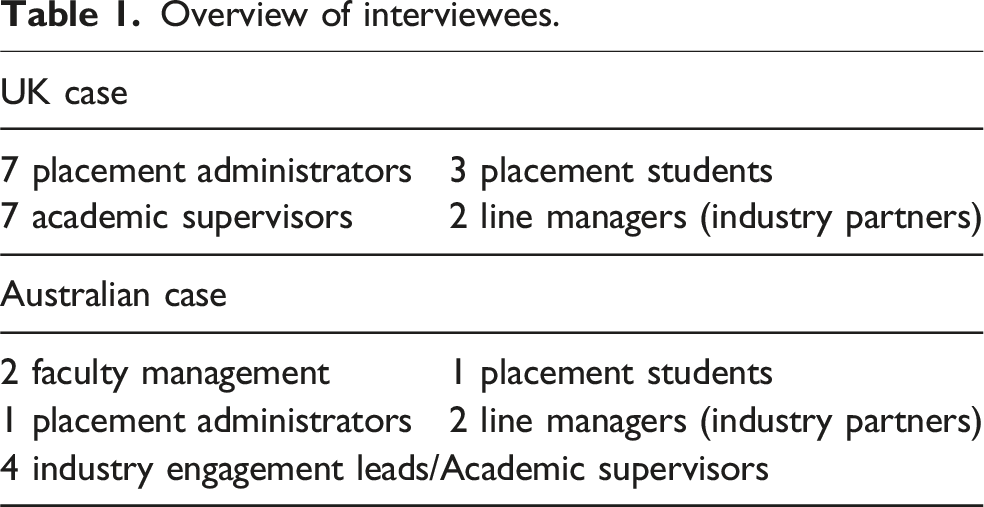
This research draws on data from two empirical case studies. The first examines a placement programme at a UK university, while the second focuses on a placement programme at an Australian university. An inductive case study approach was adopted to capture the dynamics of real-world settings within clearly defined boundaries (Yin, 2018). In the UK case, over the past decade more than 90 undergraduate students have undertaken placements each academic year, collaborating with hundreds of industry partners since the programme’s inception. Academic supervision is provided by a pool of over 300 faculty members across Accounting & Finance, Economics, Management, and Strategy & Marketing. The programme is also supported by professional services staff within the university’s central careers and employability department. The Australian case involves a well-established placement programme open to students at undergraduate, postgraduate, and doctoral levels. This programme similarly engages a wide range of industry partners, with academic supervisors drawn from a pool of 40 academic staff within the school. As with the UK case, the programme is supported by professional services staff embedded within the faculty.
Data collection
Overview of interviewees.
Data analysis
For the UK case, all interviews were recorded and transcribed. The transcriptions were loaded into NVivo 12 Plus and coded using In Vivo Coding (Miles et al., 2014) clustered by the topics of the interview question. Utilising the Gioia technique to build a data structure (Gioia et al., 2013), granular concepts were first identified, utilising open and axial coding. This process was repeated for every interview and through an iterative process for each topic and interview question. Subsequently, themes and higher order dimensions were developed for the university and industry partner. The process of coding, clustering and developing higher order themes and dimensions was complicated because of the dyadic relationship structure, the different organisational levels and the variety of actors from representing views from the university and industry. For the Australian case, all interviews were recorded and answers were analysed by key question, recording significant responses and relevant quotes.
Findings
Findings are grouped by three themes. First, we present the views of the interviewees on the type of relationship that prevails placements. Second, we present their views on the barriers to developing a deeper UI relationship from an original placement relationship. Third, we present their views on the relationship development enablers and the potential for developing a deeper UI relationship.
Placement as transaction vs. relationship
Interviewees from both the university and the industry partners shared that on a day-to-day basis the focus is on the operational, compliance-based requirements and smooth running of the placement. University interviewees confirmed that, bar a very small number of exceptions, there was limited contact with industry partners beyond that for agreeing the contract or if there was a problem. Furthermore, they believed that knowledge about the relationship between the university and industry partners was limited and superficial, often just a summary in a CRM system. Views from the industry partners was similar, citing limited and intermitted contact with the university as illustrated by the following comment from Industry Partner E2: “I think I had probably a couple of touch points in all from a [company name]-university perspective, so definitely quite minimal would be my answer”.
Furthermore, industry actors cited fluctuations in the relationship and generally a focus on the project the student is working on. Placement students believed that the industry partner was focussed on the contribution they made and had little awareness of the placement requirements from the university: “I think that they completely detached myself from university, and to them I was completely an employee instead of anything to do with my degree”. (Placement Student ST3)
In the few cases where the relationship had grown from an initial placement engagement, interviewees from both the university and industry partner cited longer-term perspectives with multiple people involved in collaborative projects. However, often such relationships had developed through the efforts of one individual who had a particular interest, confirming a lack of an organisational priority for relationship development.
Barriers to relationship development
At the university, relationship development failed because of a lack of an overarching strategy with resultant implications for inadequate resources and poor communication between the placement actors. This also resulted in a lack of clear roles and responsibilities for relationship development. Our investigation also found a lack of relationship building skills and expertise amongst academic supervisors. We found that very little thought is given to this when they are appointed. This lack of relationship building experience was also mentioned by employers who experienced an academic supervisor approaching the discussion about relationship development as one-sided and without any pre-warning or preparation: “Not making it feel like it’s an open, collaborative conversation, sometimes I feel like I’m being cornered a little bit, I feel like the attention should be on the student and the student’s development, and all of a sudden there’s a conversation that stems from having a longer university relationship and I’m a bit like ‘whoa ok, are we here to talk about [student], or are we here to talk about something bigger’ because they are two different conversations. I think it’s about establishing the context of the meeting or the chat that is going to happen, and then making sure that you are putting the right people in the room, and you set out clear expectations almost”. (Industry Partner E2)
Furthermore, our study also found that academic supervisors were appointed who were not positive about placements in the first place further reducing the potential for exploring opportunities for collaboration with the industry partner. Amongst employers, high staff turnover and significant organisational changes, such as being acquired, had a negative impact on the priority given to relationship building with a university: “I think the time that [name] kind of joined the organisation was a very tricky time for us at [company name], so probably at that time, there weren’t a lot of opportunities for collaboration because we were going through a massive re-organisational design, we had just been acquired by a new parent company, so we got sold from [company name] to [company name], and with that acquisition came a lot of internal changes, as you can imagine”. Industry Partner E2
Data also suggests that the placement programme lacked adequate resources to pursue relationship development. Placement Administrators confirmed that there were simply not enough people in the team to engage with industry partners in a meaningful way to discuss potential opportunities for relationship development. Poor communication between Placement Administrators and Supervisors contributed to a lack of trust as illustrated by this comment from Placement Administrator A1: “I don’t think anyone would want to unpick any of the work that is done with the Business School. Though I think that sometimes it is perceived in that way, there’s a kind of hostile and we’re trying to take stuff over … and I don’t want people [in the Business School] to be scared of us, in terms of our service, like ‘careers are going to yank it all off us”.
Furthermore, the lack of communication also contributed to not knowing what the different actors were doing. This in turn led to a situation where the appropriate people to discuss opportunities for collaboration were not meeting each other. With larger organisations there are additional communication challenges with being more departmentalised and hierarchical creating environments in which it is difficult to find the right people for exploring opportunities: “It’s very difficult to get in because… they’re such a large-scale company, they’ll have an Early Career Recruitment section within their HR department who’s complete removed from the R&D section or from the Accounting department- they may be not located in the same building, they may not even know who each other are. So it’s very difficult to connect”. (Placement Administrator A5)
Proximity also played a part, with both Placement Administrators and Supervisors agreeing that the greater the distance between the University and industry partner the more difficult it was to establish and maintain communication. However, some interviewees felt that geographical distance was no longer a significant barrier given the widespread use of video-meeting technology. The lack of awareness of the business school research and knowledge exchange capabilities amongst industry partners made it difficult to get the attention from the appropriate people at the placement partner. Placement Administrators also noted that smaller and less established organisations, whilst potentially quicker in decision making, lacked the required human and financial resources to develop deeper relationships, or simply believed they had no need for it. Industry partners also believed that the relationship need was asymmetrical with the need for the university higher than their own. Finally, Placement Administrators confirmed that if a placement student was not successful in meeting the expectations of the employer, it would be very difficult to approach that Industry Partner for a potential collaboration. A situation succinctly summarised by Faculty Manager FM2: “you can’t stuff up your placements”.
In summary, the data indicates that there are a significant number of barriers on both the university and industry partner side that prevent broader relationships being developed following an initial placement relationship. We now provide the findings in respect of the relationships that did develop.
Enablers of strategic engagement
Our analysis found that support and endorsement from senior management is important. We found that relationships develop when academic supervisors and placement administrators are engaged and feel supported. In these scenarios placement administrators and supervisors understood the need for a more strategic and structured approach to relationship building: ...you have to identify mutual interest. That’s why I’m saying I don’t think we are clear sometimes on what our interests are, what things do we care about that we might like to achieve in a relationship with an employer. Also, we are not clear on what their interests are to the extent that you can find overlapping interests, then you can work together towards achieving that mutual interest that helps establish the relationship. (Academic Supervisor SU2)
We also found that the Academic supervisor being motivated and better prepared, such as having awareness over the organisational challenges the industry partner faced, increases the likelihood of developing a relationship. Industry Partner E2 echoes this and confirms that the university should be proactive and try to understand the organisational requirements: “I think first of all, it’s about understanding the organisational requirements, so really coming forward and sitting down with the right people at [company] and trying to understand which stage the organisation is at, what the immediate short-term and longer term needs are”
Furthermore, appointing supervisors with industry and relationship building experience generated more opportunities for collaboration than with those who lacked this experience. From the employer perspective, having a line manager who is curious about what a university might be able to offer helped with exploring opportunities for collaboration.
Creating networks of relationships involving people from different part of the university and industry partners facilitated the efforts of relationship building. One Employer had introduced colleagues from other departments in the business to academics at the university and they themselves were introduced to academics in other schools by a Placement Administrator. This helped with establishing multiple lines of contact and getting the right people around the table to discuss opportunities for collaboration. Relationships also developed when an academic supervisor and line manager had regular contact. Having these connections facilitated trust-building and enables them to scope a project for collaboration when there is a need. I think it’s just about those conversations and constantly keeping in touch to be able to develop [the relationship], because I can tell you for sure that [company], things can be just super quick, or they can take a really long time- there’s never really a happy medium. I think it’s about finding that balance and building that relationship because you may not get something immediately out of the relationship but, you know, having those connections might bring something up in the future. (Industry Partner E2)
If there was an existing relationship as a result of a prior engagement it helped with restarting that relationship for a new collaboration. Similarly, having an alumni working at the industry partner facilitate the relationship development efforts because of the organisational knowledge they have of both the university and industry partner. However, keeping track of alumni is challenging because they often forget to update the university when they change company. Where it concerns the industry partner specifically, their knowledge of the strengths and research expertise of the university and academics helped with making contact with the appropriate person, such as academics being invited to give keynote talks at the employer. Furthermore, we found that external agencies, given their knowledge of university and industry needs, could help to facilitate identifying opportunities for collaboration. Our study also found that placement administrators can be brought in to provide basic training for relationship development to academic supervisors giving them more confidence when handling an opportunity. Lastly, our investigations also highlighted that an adequate CRM system in which relationship discussions and opportunities for collaboration are more easily tracked by all university stakeholders was essential.
Interviewees from both the university and the industry partner were asked about the potential for developing a deeper relationship via placements. Whilst most interviewees lacked detailed knowledge of the relationships between the university and industry partners, nor which relationships had developed and which not, all interviewees responded positively about its potential: industry collaborations and engagement is an important part of the brand. (Engagement Lead AL1) placements as a ‘fertiliser’, having that ticking along in the background helps the relationship. (Industry Partner E3)
Discussion
Our findings indicate that a narrow, student-centric focus has constrained the potential of placements to serve as platforms for broader university–industry (UI) collaboration. When placements are framed purely as tools for enhancing student employability, opportunities for strategic relationship-building across organisations are overlooked. In contrast, adopting a higher-level perspective that recognises placements as a shared space for knowledge exchange and engagement enables universities and industry partners to identify and develop more sustainable forms of collaboration. Furthermore, a diachronic lens suggests placements supports building cumulative relationship capital. Rather than treating them as transactional one-off exchanges, our findings imply feedback cycles in which student reflections, supervisor sense-making, and industry partner evaluations inform subsequent scoping and project design. This reframes success metrics towards trajectories including repeat engagements and broadening of contact networks (Ankrah and AL-Tabbaa, 2015; Perkmann et al., 2013).
The UI literature provides insight into the roles of key actors, their networks, barriers and enablers for traditional university-industry relationship development (see for example Ankrah et al., 2013; Galan-Muros and Davey, 2019; Karlsdottir et al., 2023; Littleton et al., 2023). However, as we have discussed, the role the placement programme within this context has largely been unexplored. Our findings demonstrate that there is potential for developing a broader UI relationship via placements. Driven by the interest of some actors, when the potential of a relationship is recognised, time is made available to understand the needs of the other party and introductions to other colleagues made if deemed helpful. Our findings also demonstrate that relationships did not develop due to a lack of organisational strategic intent, an important requirement as confirmed by Plewa and Quester (2007). They further point to a lack of leadership, an additional important factor in the relational mechanism (Rast et al., 2015). A lack of appropriate communication between the key organisational and individual actors within the university and with the industry partner further complicated relationship building. Frasquet et al., 2012 confirm that communication is directly linked to relationship factors trust, satisfaction and managing functional conflict. Furthermore, inadequate communication has a negative impact on commitment and collaboration (Frasquet et al., 2012; Galan-Muros and Davey, 2019; Lopes and Lussuamo, 2021) and is an important part of UI collaboration supporting mechanisms. Appointment of academic supervisors without relationship development expertise or interest provided further obstacles. The alignment of their motivations for relationship development is essential (Orazbayeva and Plewa, 2022; Littleton et al., 2023). As a result, many opportunities for relationship development have been left to chance or have simply not been pursued. We propose that the lack of a strategy for UI relationship development via placements is a result of a lack of legitimacy of the placement programme itself as well as the design focus of the placement programme itself.
The traditional placement actors are limited to the student, academic supervisor, administrators, line manager and HR department. For effective relationship development the list of actors should grow to include colleagues of the academic supervisor within the school and wider university and colleagues of the line manger within their business unit and wider business of the industry partner. Their role is to extend the network of contacts and contribute specific operant resources for meeting the needs of the industry or university partner. The role of the placement student also needs to be reviewed. Their agency in relationship development is contested because of the traditional and narrow approach to the placement programme, lacking priority for UI relationship development. Their relationship is unique since they remain a student of the university with obligations for the successful completion of their placement and degree programme whilst also being an employee for the duration of the placement with associated expectations and pay from the industry partner. This role should be reinterpreted as a transitory intermediary with ties to both the university and industry partner. Our findings suggest that they can facilitate the initial discussions between the line manager and the academic supervisor to explore opportunities for collaboration.
Building on the role of the placement student, the academic supervisor and industry partner line manager are the next important actors for relationship development. In addition to their responsibilities to the placement student, they are well placed to explore any opportunities for collaboration. However, based our findings we recommend that their appointment should not just be based on availability of time but also their experience, skill and interest in relationship development. Zunda et al. (2020) state that universities should appoint people with knowledge of communication and marketing in order to formulate attractive offers for collaboration and convey them professionally. In line with Prigge and Torraco (2006) who state the need for frequent communication between the stakeholders during relationship building, additional placement meetings would aid the exploration of opportunities and allow the parties to share information on their needs and expertise.
In this wider network of relationship actors, we suggest that placement administrators have an important role to play. Our study found that whilst their official role is focussed on placement programme compliance and student wellbeing, in practice they can be a resource for relationship building expertise and facilitate introductions to academics within and across other schools, further extending the relationship network. Similarly, HR departments, given their central role within an organisation and with strategic knowledge of organisational requirements, are positioned as important conduits for the introducing the academic supervisor and their colleagues when relevant to colleagues within a business unit or other departments within the industry partner. Finally, both the university and industry partner should take responsibility for providing a strategic framework that recognises the opportunity for UI relationship development via placements and enables all organisational and individual actors of this wider network to pursue opportunities for mutual benefit.
Based on our findings and the recommendations for the role of organisational and individual actors, we suggest that at the heart lies the triadic relationship between the placement student, the academic supervisor and the line manager. They each play an important role in facilitating initial exploratory discussions and spotting opportunities for potential collaboration that go beyond the original purpose of the placement. Furthermore, the Academic supervisor and line manger can draw on other colleagues in their respective organisations should they be required. This network of actors is illustrated in Figure 1 below. Key actors in a bigger network for UI relationship development via placements.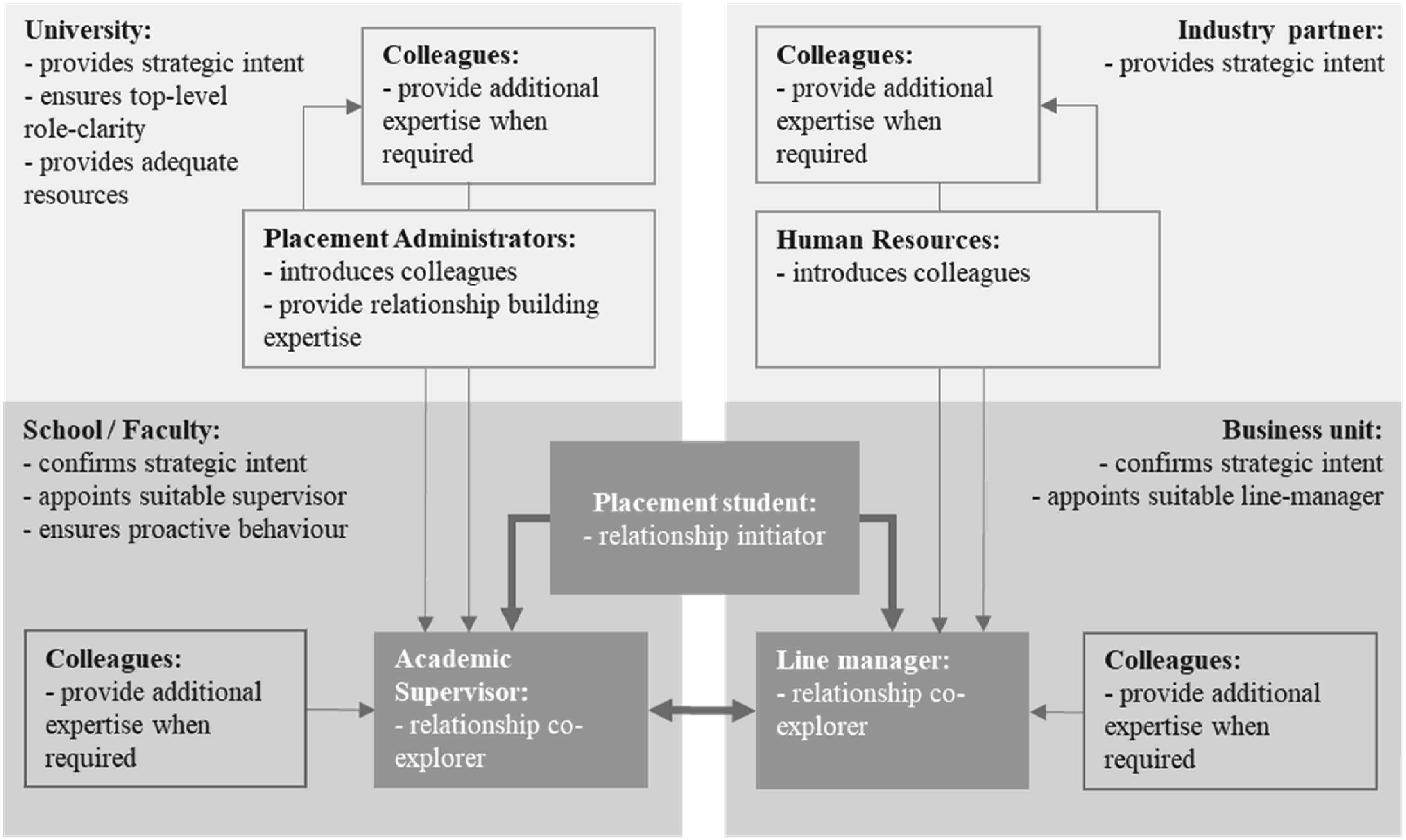
An additional finding of the study is the existence of conditions or prerequisites and accelerators for UI relationship development via placements. A key relationship prerequisite to check for the academic supervisor is whether the industry partner is undergoing any strategically significant organisational changes such as mergers, acquisitions or redundancy programmes since such changes lead to a reduced priority to pursue opportunities for collaboration. Similarly, the academic supervisor should check early on whether the industry partner has preferred relationships with incumbent universities, since that would significantly increase the barrier for relationship building.
Another finding is the presence of accelerators which speed up the initial stages of relationship development, or hamper if absent. For the industry partner, we find that less mature organisations lacked the required resources for hosting a placement student or financial resources to engage an academic for consultancy. Also, it is easier to find the appropriate person to connect with in smaller and lesser hierarchical organisations. Sharing of knowledge on the relationship and opportunities with industry partners between the key university actors facilitates a coordinated approach and trust between placement administrators and academic supervisors, and therefore accelerates relationship building efforts. Lastly, for the university, we recommend that resources are applied to pursue a high level of awareness with potential industry partners for their research output and their senior academics – or ‘superstar’ academics. In these cases the reputation of academics may be more important than the reputation of their institution (Collier et al., 2011). Such awareness supports relationship building given the resultant conferred credibility on the approach by the university actors such as the academic supervisor. Lastly, we suggest that industry partners who have employed alumni should be prioritised for relationship building given their knowledge of the university and ability to connect the right people for collaboration. The university maintaining good and continued relationships with alumni can contribute to industry engagement (Awasthy et al., 2020).
Implications
For universities, the findings highlight the importance of repositioning placements as mechanisms for relationship building, extending beyond their traditional focus on student employability. Viewing placements through a more strategic lens can open opportunities for deeper and more sustainable university-industry (UI) collaborations. Tracking longitudinal KPIs such as repeat placements, post-placements collaborations and alumni re-engagement in addition to student first-destination outcomes, support such strategic reframing and development of a holistic view. Academic supervisors play a pivotal role in this process, as their ability to build relationships, identify collaboration opportunities, and engage effectively with industry partners is crucial. Universities should therefore consider supervisors’ prior industry experience and communication skills when making such appointments. Placement administrators, too, should be positioned as strategic partners to academic supervisors, contributing to the development of networks that support knowledge exchange and transfer. Systematically capturing of industry partner feedback in a CRM system accessible to all relationship actors minimises duplication and facilitates opportunities are pursued. Institutional investment in brand awareness and visibility of expertise can further enhance trust and engagement with industry. Maintaining consistent dialogue, through additional placement meetings or by inviting industry partners to speak at events or within courses, helps to strengthen relationships over time. Considering factors such as geographical proximity and partner capacity ensures that collaborative projects are both feasible and well-supported.
For industry partners, placements should similarly be viewed as relationship-building opportunities rather than being confined to their traditional purpose of supplementing workforce capacity or developing talent pipelines. A broader and more strategic approach encourages organisations to deploy resources toward engagement strategies that foster collaboration with universities. Appointing a line manager who is both positive about placements and willing to explore new opportunities in collaboration with academic supervisors is essential for building trust and open communication. This role involves leveraging internal networks to ensure that multiple points of contact and expertise are available to support collaboration. Sustaining engagement, such as by inviting academics to contribute as keynote speakers at events, can further consolidate these relationships and promote ongoing dialogue.
Conclusion
This study has highlighted the underutilised potential of industry placements as strategic platforms for developing university-industry (UI) relationships. While placements are widely recognised for their contribution to student employability, our findings demonstrate that when viewed through a broader relational and institutional lens, placements can serve as vital mechanisms for initiating and sustaining deeper, mutually beneficial partnerships. The triadic interaction between placement students, academic supervisors, and industry line managers provides a unique, underexplored conduit for engagement, knowledge exchange, and collaborative innovation.
The barriers to transforming placements into relational assets are both structural and cultural. Challenges include the absence of institutional strategies, limited communication across placement actors, and a narrow focus on student outcomes. However, our research also identifies clear enablers that support relational development: proactive academic supervision, organisational endorsement, alumni engagement, and shared understandings of mutual benefit. When supported by relationship-building expertise and effective knowledge-sharing systems, placements can catalyse sustained interaction between universities and industry, creating wider networks of trust and collaboration.
Recognising placements as strategic engagement tools has important implications for higher education policy and practice. Universities and industry partners alike must move beyond transactional models and cultivate placement ecosystems that embed relational intent. This reframing requires investment in institutional structures, training for placement actors, and renewed attention to alumni and knowledge mobilisation pathways. By transforming the overlooked infrastructure of placements into purposeful engagement strategies, institutions can unlock new frontiers of innovation, strengthen their civic and economic missions, and secure more resilient and integrated university-industry ecosystems.
Footnotes

Ethical considerations
The original UK study the ethical approval was provided by the University of Portsmouth (BAL/2019/33/MOOLENAAR) and for the follow up Australian study ethical approval was provided by the University of Sussex (ER/WJM23/1).
Consent to participate
Consent was obtained in writing from all participants in both studies.
Funding
The authors received no financial support for the research, authorship, and/or publication of this article.
Declaration of conflicting interests
The authors declared no potential conflicts of interest with respect to the research, authorship, and/or publication of this article.