




Abstract
Advanced education may facilitate more university-industry collaborative research, if some individuals move to industry after graduation. This article examines the underexplored phenomenon of industry collaborators in collaborative research as one form of academic engagement with industry; we focus on industry collaborators’ academic work experience, in terms of PhD education and university affiliations, and its contribution to knowledge networks. We propose that stronger connections to academia indicate competence and experience, thereby facilitating more meaningful partnerships. Through an examination of the Signals and Control Engineering group at Chalmers University of Technology in Sweden, we analyze co-authorship between academic and industry collaborators, resulting in a typology of various types of industry collaborators. Our results indicate that a majority of collaborations involve co-authors affiliated with firms, with PhD graduates and firm-employed PhD students emerging as main types of collaborators. Particularly notable are collaborations involving ‘dual affiliated researchers’ – individuals employed by both a firm and the university simultaneously – who are associated with the establishment of dense and long-term knowledge networks. These findings add to the literature on academic engagement with industry by underscoring the importance of individuals with dual affiliations in academia and industry, including graduate students, for promoting academic engagement and impact.
Keywords
Introduction
Firms and universities play different roles in the production and use of technological knowledge, yet also collaborate, which is an important phenomenon for promoting technological development. Due to increased specialization and complexity of technological development, collaboration across individuals and organization is becoming the standard in knowledge production (Jones, 2009; Wuchty et al., 2007), including in scientific publications (Adams et al., 2005; Lee et al., 2015). This article is positioned within the academic engagement literature, which analyses the antecedents, outcomes, and impacts of knowledge-related interactions between university researchers and external organizations (Perkmann et al., 2021). From the existing literature, we know that individual academic collaborators have different motives for and returns from academic engagement (Atta-Owusu and Fitjar, 2023; D’Este and Perkmann, 2011), and that their social interactions and work experiences affect their collaboration with industry (Gulbrandsen and Thune, 2017; Santos and Thune, 2022; Tartari et al., 2012; also see Perkmann et al., 2021). To date we, however, know little about what characterizes industry collaborators, and how different types of collaborators contribute differently to the formation of longer-term collaboration. The purpose of this article is to characterize industry collaborators and to analyze the knowledge networks that develops through the collaboration. We contribute with increased understanding about who the industry collaborators are, which provides important insights relevant to understanding the firm side antecedents of academic engagement.
In their recent review article, Perkmann et al. point out the need to account for different types of external collaborators, such as firms, government agencies, etc., since they ‘may also condition somewhat different categories of academic engagement, involving different motivations and consequences’ (2021: 10). For the same reason, we also need to account for different types of external individual collaborators – that is those individuals within for example firms that academic researchers engage with. We expect that different types of individual collaborators contribute differently to academic engagement; more specifically, we expect that certain types of external individuals contribute more than others towards establishing longer term collaborations and development of knowledge networks. The first step towards such an account is to establish what different types of external individuals that academics collaborate with, that is to establish what characterizes individual external collaborators.
In this article, we explore what characterizes individual industry collaborators, and derive a typology, based on two dimensions of their academic work experience. The first dimension is the level of education, in terms of the industry collaborator holding (or not holding) a PhD degree. Having a PhD degree indicates that the collaborator have relevant experience, knowledge, and skills for conducting academic research in general, signaling their ability to fruitfully contribute to a research collaboration. The second dimension that we focus on is whether the industry collaborator have a prior or current affiliation to the collaborating university department. Such affiliations indicate that they are familiar with similar types of research problems and methods as those employed in the collaboration. Moreover, an affiliation also suggests some type of direct or indirect existing relationship between the academic and industry collaborators, which can facilitate and support the collaboration (cf. Ponomariov and Boardman, 2016). For these reasons, we expect individual collaborators with stronger connections to academia –in terms of having a PhD degree and/or affiliation to the collaborating department – to be more relevant, and therefore more frequent, collaboration partners for academics, not the least for collaborations resulting in scientific publications.
Based on these two dimensions, we empirically derive a typology of individual industry collaborators, since we aim to better understand how the previous experience and advanced education of individual industry collaborators contribute to academic engagement. In particularly, we explore which types of individuals that establish longer term patterns of academic engagement, which over time lead to the development of knowledge networks (cf. Phelps et al., 2012).
Many forms of academic engagement have been identified, ranging from ad hoc advice and interactions to formal research collaboration (Abreu et al., 2009; D’Este and Patel, 2007). The form we focus upon is research collaboration, which here involves an industry collaborator (at a firm) and an academic collaborator (at a university, research institute, or similar). Collaborations can include co-authorship amongst collaborators – including between academic researchers and industry collaborators (e.g. Bikard et al., 2019) – where the involved individuals may have a shared history and pre-existing relationship (Ponomariov and Boardman, 2016). We view publications as representing one, definable outcome of research collaboration (Laudel, 2002), which can be seen as an instantiation of a knowledge network of individuals with different organizational affiliations.
We conduct our analysis at two levels, the individual level – in terms of academic work experience and affiliation to the collaborating university – and the knowledge network level. In exploring these issues, we are interested in the variety of patterns across different industry collaborators and firms, including issues of repeatability of interactions in order to capture the temporal dimension. Two research questions are investigated: (1) What characterizes industry collaborators, in terms of their academic work experience, and how are such individual-level characteristics related to the frequency of collaboration? (2) What are the patterns of knowledge networks, in terms of frequency and how do they vary at the firm organizational level?
To address these questions, we collect and analyze data about academic collaborators and their industry collaborators, at one university environment within engineering research. We identify industry collaborators based on them being co-authors of at least one publication together with a defined group of academic collaborators. We collected and analyzed all scientific publications written by the permanently employed university researchers at the chosen research environment together with firm co-authors, between 2009 and 2018. Our empirical setting is the research environment of signals and control, within the Electrical engineering department at Chalmers University of Technology, a prominent university for engineering research in Sweden. We chose this field of engineering because research and diffusion are closely aligned, and industrial applications range widely, from autonomous vehicles to medical technology to paper and pulp. Similarly, we find that different types of firms are listed as the affiliation of industry collaborators, ranging from multinational enterprises in for example the automotive sector to knowledge-intensive entrepreneurial firms in for example food technology. We investigate a range of different types of affiliations, related to education and academic work, between these industry collaborators and the research environment at the university, to address our research questions.
Conceptual framework
Our conceptual framework for empirically studying this form of academic engagement consists of three elements derived from relevant literature. First, we view scientific publications with co-authors who are non-academic collaborators as providing useful empirical traces of previous academic engagement, useful for analyzing knowledge networks. We view such scientific publications as representing a narrow but identifiable outcome from academic engagement, as we assume that publications arise from previous research collaboration among the authors. We acknowledge the criticism that publications, per se, only capture one dimension of collaboration, and of possible outcomes (Katz and Martin, 1997; Melin and Persson, 1996). While defining the co-authors and their contributions is an ongoing debate, resulting for example in the influential Vancouver convention, existing literature often uses scientific publications as representing outcomes of research collaborations (Laudel, 2002; Ponomariov and Boardman, 2016). Co-authorship in scientific publications is accordingly used as a proxy to study university-industry collaboration and identify industry collaborators (e.g. Abramo et al., 2009; Bikard et al., 2019). Hence, we consider that a publication with co-authorship represents a scientific outcome, which is indicative of previous collaborative research activities between these individuals and their respective organizations.
Going a step further, we also view co-authorship in scientific publications as useful information to visualize knowledge networks, which we conceptualize in turn may underlie repeated, longer-term academic engagement. Phelps et al. define a knowledge network as ‘a set of nodes—individuals or higher level collectives that serve as heterogeneously distributed repositories of knowledge and agents that search for, transmit, and create knowledge—interconnected by social relationships that enable and constrain nodes’ efforts to acquire, transfer, and create knowledge’ (2012: 1117). The boundary-spanning literature recognizes individuals’ attributes and capabilities as important for building and maintaining knowledge networks crossing organizational boundaries (Jesiek et al., 2018). Given that individuals’ attributes and capabilities may contribute to building such knowledge networks, we focus on characterizing industry collaborators in terms of their education and academic work experience at the focal university department.
Second, we argue that the frequency of co-authorship in these knowledge networks can be studied in terms of repeatability and patterns, because these indicate whether the individuals (and their organizations) tend to only occasionally collaborate, or whether they tend to build denser, and possibly longer-term, knowledge networks between the firm and the university department. Currently, these topics are insufficiently addressed in the literature.
At the level of individual industry collaborators, this is interesting to investigate empirically, because a publication with co-authors signals that they have resolved possible differences of incentives and goals at organizational and institutional levels (Perkmann et al., 2019). Contemporary literature and science policy stress that university research should bridge the two organization to make more impact on society. However, we know little about whether the same industry collaborators have a high or low frequency of solving these tensions, hence the repeatability of collaborations is worth to investigate empirically.
Similarly, the issue of variety of patterns of knowledge networks should be explored for different types of firms, which have different conditions and capabilities for university collaborations and absorption of scientific research. At the organizational level, innovation studies literature consistently finds that large size and high R&D intensity are important antecedents of firms collaborating with universities (Fontana et al., 2006; Laursen and Salter, 2004). Another type of firm collaborating with universities are knowledge-intensive innovative and entrepreneurial firms (Gifford et al., 2022; Malerba and McKelvey, 2020), where for example industry collaborators with PhD degrees continue to co-publish with their previous university research environment in biotechnology (McKelvey et al., 2003). Therefore, we use these two types to categorize the firms, to which the industry collaborators are affiliated.
Third, we have developed a preliminary typology to characterize industry collaborators, based on our reading of the literature. Much research has examined the university side, in terms of how, and why, to change the university to increase its impact on society (see Bengoa et al., 2021). One stream focuses upon how and why universities need entrepreneurial individuals, and new structures, to facilitate direct commercialization of research through patents and start-up companies (e.g. Rothaermel et al., 2007; Thursby et al., 2009), as well as impacting technological pathways for regional development (e.g. Garcia-Alvarez-Coque et al., 2021). Moreover, the specific stream of literature on academic engagement examines more individual attributes and a wider range of linkages between firms and universities (Perkmann et al., 2021). This literature finds that the scientific performance and prior industry work experience of academic researchers are important antecedents for collaborating with external actors, such as firms (D’Este et al., 2019; Gulbrandsen and Thune, 2017; Tartari et al., 2012, 2014). Recent findings suggest that gender differences in academic engagement indicate that a ‘participation gap’ for female scientists (Lawson and Salter, 2023; Ramos-Vielba and D’Este, 2023), suggesting individual characteristics affect participation. Finally, some literature indicates that certain types of individuals may play important roles in bridging the organizations, specifically university lecturers with dual appointment contracts being employed also by an external organization (Cattaneo et al., 2019), as well as doctoral students at the university (Plantec et al., 2023; Thune, 2009). Much is known about academic collaborators, so while they are important individuals for academic engagement, analyzing them is not in focus here. Still, this literature does provide some insights into our questions about industry collaborators.
When investigating these issues from the firm side, the literature, on the organizational level, tends to broadly discuss spillovers to the firm (which we do not address). Industry collaborators have been studied to a lesser extent, at the individual level, and when studied it tends to narrow the focus to those individuals with a PhD degree (e.g. McKelvey et al., 2003). Previous research suggests that individuals with PhD degrees taking employment in industry and continuing to publish have a ‘taste for science’ (Roach and Sauermann, 2010). This suggests that having a PhD degree may help explain why industry collaborators continue to publish after starting to work at a firm, due to individual incentives. To explain the possible links to the focal university department (although not focused specifically on industry collaborators) – and thereby to some extent capture the relational component underlying collaboration (cf. Ponomariov and Boardman, 2016; Santos and Thune, 2022) – some research has identified the individuals who move between the organizations (see e.g. Sjöö and Hellström, 2019). One type of individual is those with ‘hybrid careers’ between firms and universities, ‘comprising periods of public and private sector employment’ (Tartari et al., 2012: 659), that is those individuals with experience form working in both academia and industry. Another type is those individuals previously mentioned having a dual appointment contract (Cattaneo et al., 2019), working simultaneously at a firm and at a university department. Finally, there are in the Swedish context firm-employed PhD students, who are simultaneously employees of the firm and enrolled in a PhD education program at the university (Berg, 2022; Berg and McKelvey, 2024).
Preliminary typology of industry collaborators.

The preliminary typology specifies the dimensions and types of industry collaborators. The empirical study will provide insights useful to propose a more nuanced typology to characterize industry collaborators. Moreover, we also use this typology to identify whether, and how often, different types of industry collaborators are more or less involved in co-publications, and knowledge networks.
Research design, data and method
Overview of data collection and analysis.
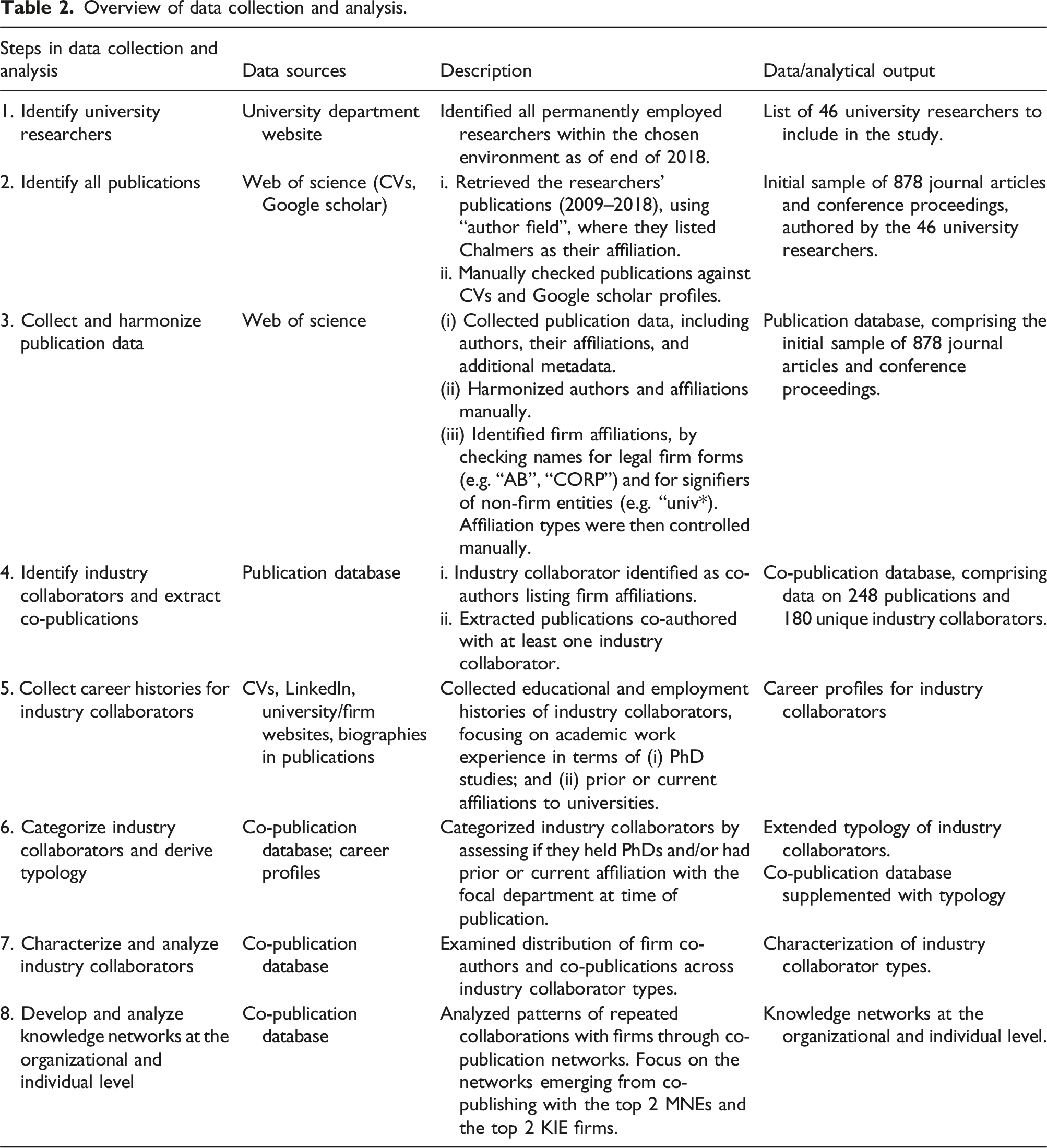
Table 2 presents an overview of the steps taken to collect and analyze the data, including the different data sources we draw on. The first step in our data collection was to identify all the university researchers who were permanently employed 1 – at the end of 2018 – within our chosen research environment, based upon the university department website. Thereafter, we identified all publications that these individuals had published between 2009 and 2018, where they listed Chalmers as their affiliation. We identified publications through Web of Science, by using the author field and manually checking each publication against the researcher’s CV and Google Scholar profile; we included both journal articles and conference proceedings, since the latter is a common publication outlet in engineering fields, including in electrical engineering (Lisée et al., 2008; Michels and Fu, 2014). From an initial sample of 878 publications, we extracted the 248 publications co-authored by the university researcher together with at least one industry collaborator; industry collaborators were identified as co-authors that listed firms as their affiliation on the publications.
Thereafter, we focused upon the 180 unique individuals identified as industry collaborators, in line with our research questions. We collected data on the education and employment histories of these firm co-authors, to identify any current and prior affiliations to the focal university department; this included data on where and when the authors conducted PhD studies (if at all) as well as university and firm employment during the years 2009 to 2018. We manually collected this data from a combination of sources including CVs, university/firm websites, and LinkedIn, until a saturation of career history was established.
To address our first research question at the individual level, our aim was to establish whether the firm co-authors at the time of publication had a PhD degree or not, as well as whether they were, or had previously been, affiliated to the focal university department. This exploratory approach allowed us to extend the preliminary typology (see Table 1), so that we could further interpret the boundaries of categories emerging from our analysis, rather than being strictly defined ex-ante. In doing so, the results we found indicate a range of different types of affiliations and linkages, as further discussed in the results section.
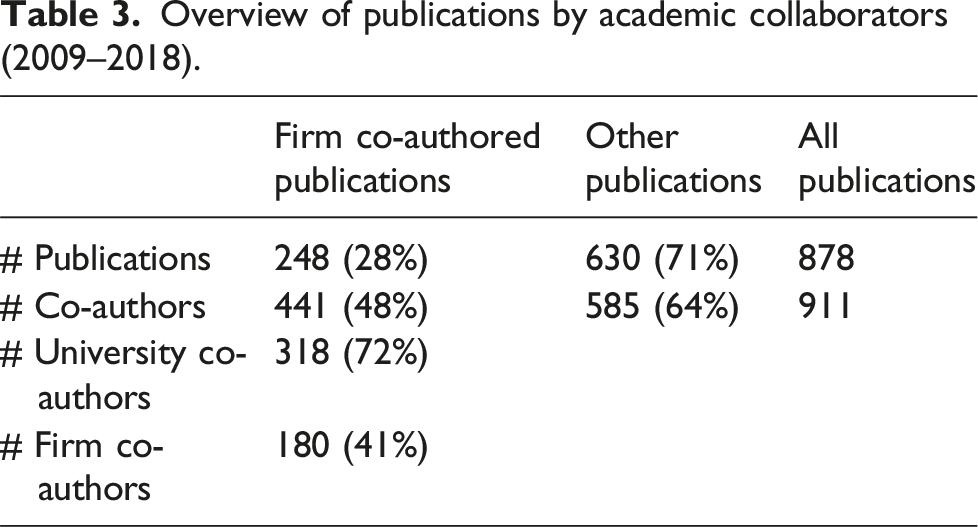
Note that we include each firm co-author only in the main category that they belong to at the time of being a co-author on a given publication. This means that each unique individual over time, may – and some do – change their affiliation to the focal department, thus occupying different categories at different points in time. This means that we need to differentiate between the individual author and the author-category, meaning the current type of affiliation at the time of publication. While our sample includes 180 unique individuals as firm co-authors, we analyze 191 unique author-category instances.
To address our second research question at the knowledge network level, we first examine the focal university’s organizational-level network with respect to which firms the sampled university researchers have co-authored publications with. As introduced above, we conceptualize co-authorship as representing the outcome of research collaboration between different individuals. Together, these collaborations form a co-authorship network, which we refer to as a knowledge network for academic engagement, where the authors are the actors (i.e., the nodes) and the co-publications are the connections (i.e., the edges) between those authors. Using co-authorship to analyze the patterns of scientific collaboration is a well-established approach in social network research (e.g. Barabási et al., 2002; Newman, 2004). We thereafter shift our attention to the individual level and analyze the networks of four selected firms that have co-authored publications with the sampled university researchers, focusing both on all co-authorships as well as all repeated co-authorships. We selected the two multinational enterprises (MNEs) and the two knowledge-intensive entrepreneurial (KIE) firms that published the most with the sampled university researchers during the studied period. Whereas the organizational-level network gives us a good overview of the knowledge network, the individual-level networks allow us to extract more fine-tuned insights. 2
Finally, the single setting of our study allowed us to reduce heterogeneity and to manually gather the data needed to capture the educational background and academic work experiences of firm co-authors for our analysis. The setting also provided the opportunity to gather qualitative insights about research, firm collaborations, co-authoring in the field, etc., from expert interviews with one engineering professor, being one of the focal university researchers. 3 The insights gathered this way ranged from whom to include in the sample at the focal department to ensure closeness to the chosen field of signal processing and control to feedbacking and validating the analysis.
Results
Overview of publications by academic collaborators (2009–2018).
Top 10 firms with the most co-authored publications (2009–2018).
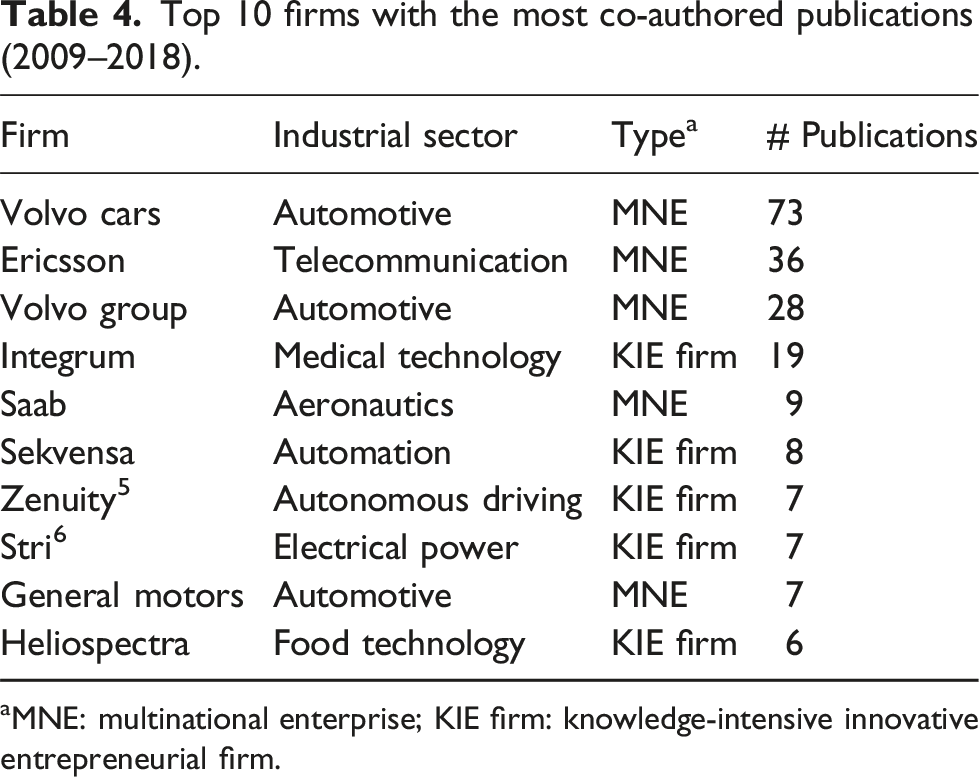
aMNE: multinational enterprise; KIE firm: knowledge-intensive innovative entrepreneurial firm.
Individual level: Characterizing industry collaborators
Extended typology of industry collaborators.
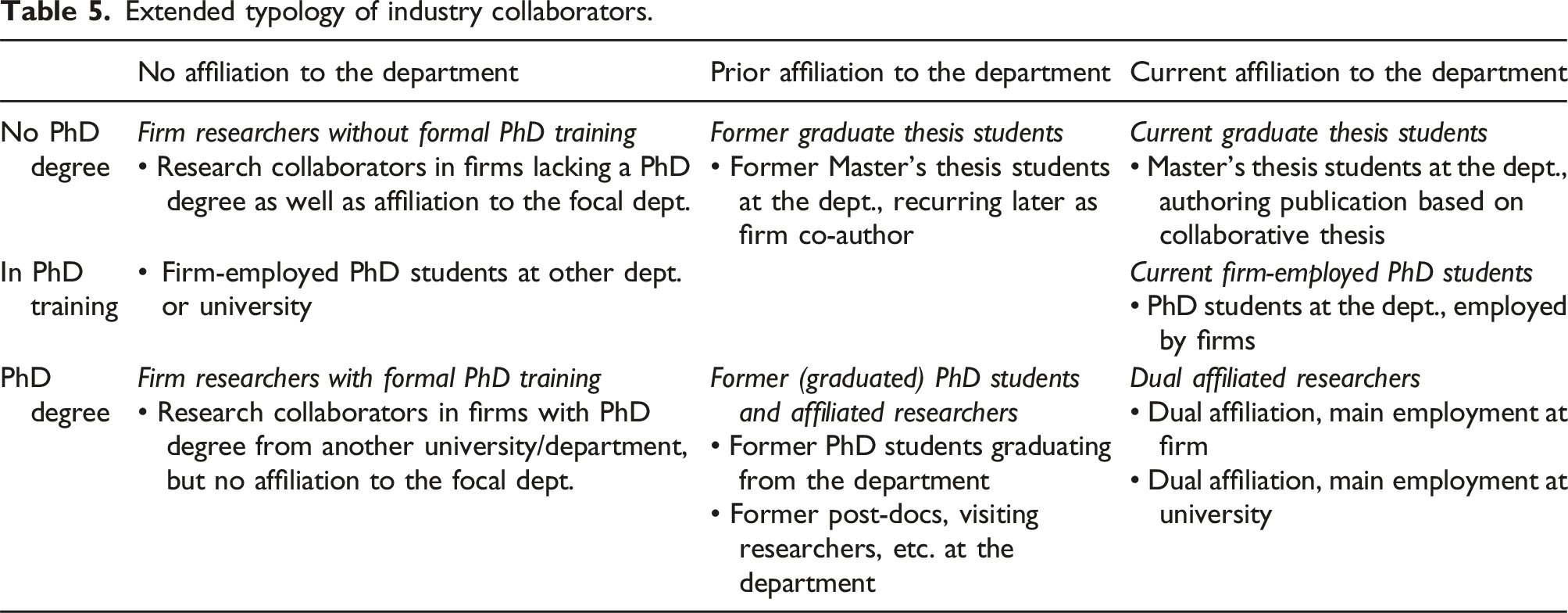
The first quadrant – Firm researchers without formal PhD training – refers to collaborators with no PhD degree and no affiliation to the department. We identified 21% of firm co-authors in this quadrant, present on 19% of publications. This is a heterogeneous type comprising individuals with various backgrounds, including firm employees without any academic work experience; but it also includes firm-employed PhD students in training, not employed at the focal department but affiliated to other departments at Chalmers or to other universities.
The lower left quadrant – Firm researchers with formal PhD training (‘a taste for science’ in Table 1) – refers to individuals with a PhD degree but no affiliation to the focal department, that is they studied for and received their PhD degree elsewhere. We found 35% of firm co-authors in this quadrant, present on 32% of publications. We have moreover indications of links to the focal department beyond those formed by affiliation; some of the unaffiliated firm co-authors were identified as the industry supervisor for a firm-employed PhD student at the department, based on the acknowledgements of PhD dissertations.
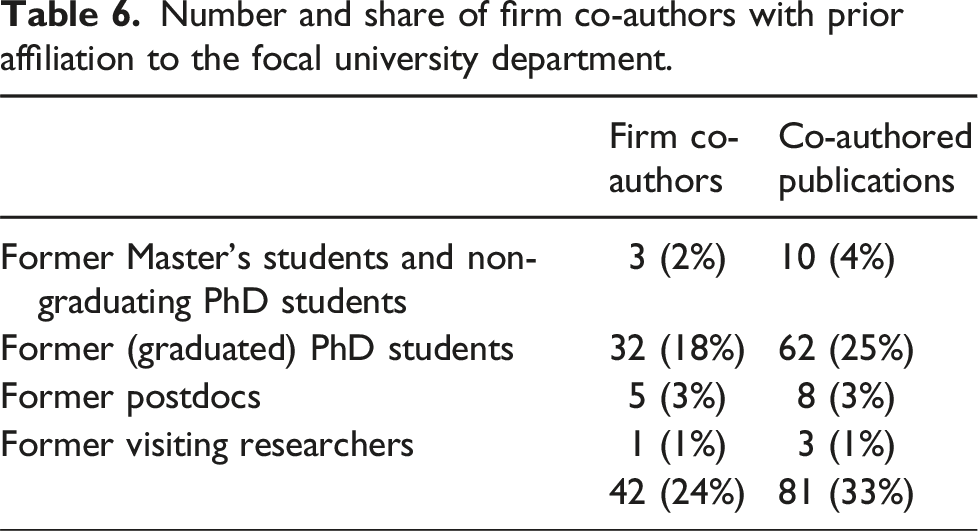
Number and share of firm co-authors with prior affiliation to the focal university department.
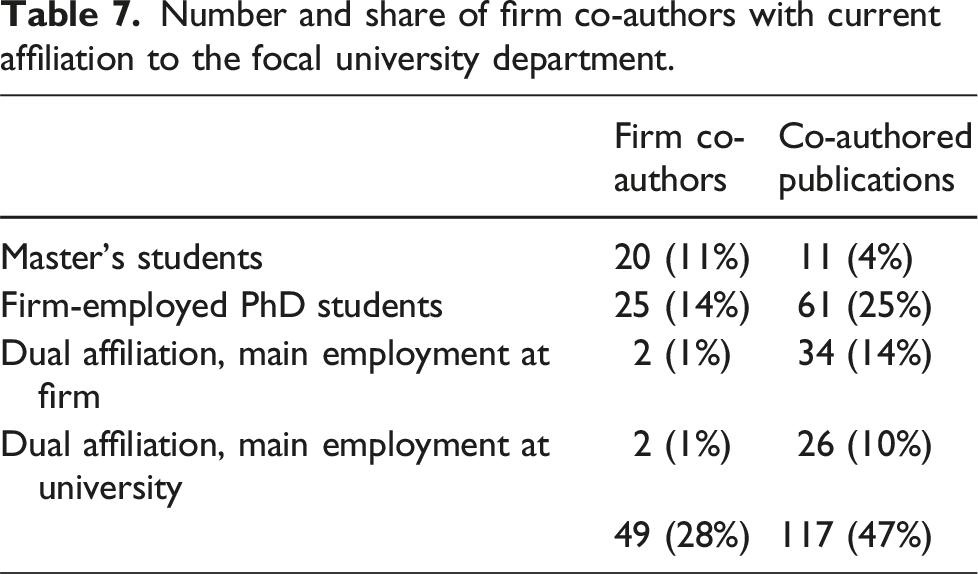
Number and share of firm co-authors with current affiliation to the focal university department.
In total, 24% of firm co-authors belong to one of four more fine-grained types of industry collaborators having prior affiliation to the department, co-authoring 33% of publications (see Table 6). We found two main types of firm co-authors having a prior affiliation, differentiating between those without a PhD degree and those with a PhD degree. The first concerns Former Master’s students and non-graduating PhD students, comprising a few co-authors, being former students at the focal department, with few publications. Second, there is the type Former (graduated) PhD students and affiliated researchers, being made up of three subtypes. The first subtype is former PhD students, that is individuals that earned their PhD degree from the focal department, but left for employment in industry after graduation (and having no current affiliation); this is the most common type of firm co-author having any affiliation (18% of firm co-authors), being present on 25% of co-publications. The second subtype concerns former affiliated researchers, that is Former postdocs and Former visiting researchers at the department, which in our data is a marginal phenomenon.
In total, 28% of firm co-authors belong to one of four more fine-grained types of industry collaborators having current affiliation to the department, co-authoring 47% of publications (see Table 7). One type, without a PhD degree, is Master’s students; these are master’s level students at the department who wrote their final thesis with – or for – a firm, which was turned into a firm co-authored scientific publication, on which the student appear as a firm co-author.
Moreover, we have added a new category between PhD degree and no PhD degree, namely In PhD training, to accurately represent Firm-employed PhD students. In our sample, this is the most common type of industry collaborator with current affiliation, both in terms of the share of co-authors (14%) and co-publications (25%).
Based on both the preliminary typology and our analysis, we identified what we call dual affiliated researchers, which is made up of two subtypes. We choose a new terminology as compared to in the preliminary typology, as these represent a broader category than the ‘dual appointment contracts’ type in the preliminary typology. These are authors who have a PhD degree and at the time of publication also have dual affiliations, as listed on the publications and triangulated with CVs and similar documents. One subtype has main employment at the firm but is also formally employed at the university part-time as a lecturer and/or researcher. A second subtype has main employment at the university, but is also formally affiliated with a firm, in these cases knowledge-intensive entrepreneurial firms. These two subtypes include only two co-authors each, but together co-author 24% of co-publications.
Knowledge networks: Patterns of repeated collaboration with firms
During the period 2009 to 2018, the studied academic collaborators published with industry collaborators in 65 different companies. Figure 1 presents an organizational-level network, where the size of the nodes reflects repeated activities in terms of the number of co-publications at the organizational level. Conceptually, we view repeated collaboration as indicative of stronger knowledge networks in academic engagement. The representation in Figure 1 indicates that many industry collaborators are involved in one-off interactions, and that only a few firms are involved in more repeated collaborations that build a stronger base for academic engagement. Organizational-level network graph depicting all co-publications between the sampled university researchers and firms (excluding other organization types).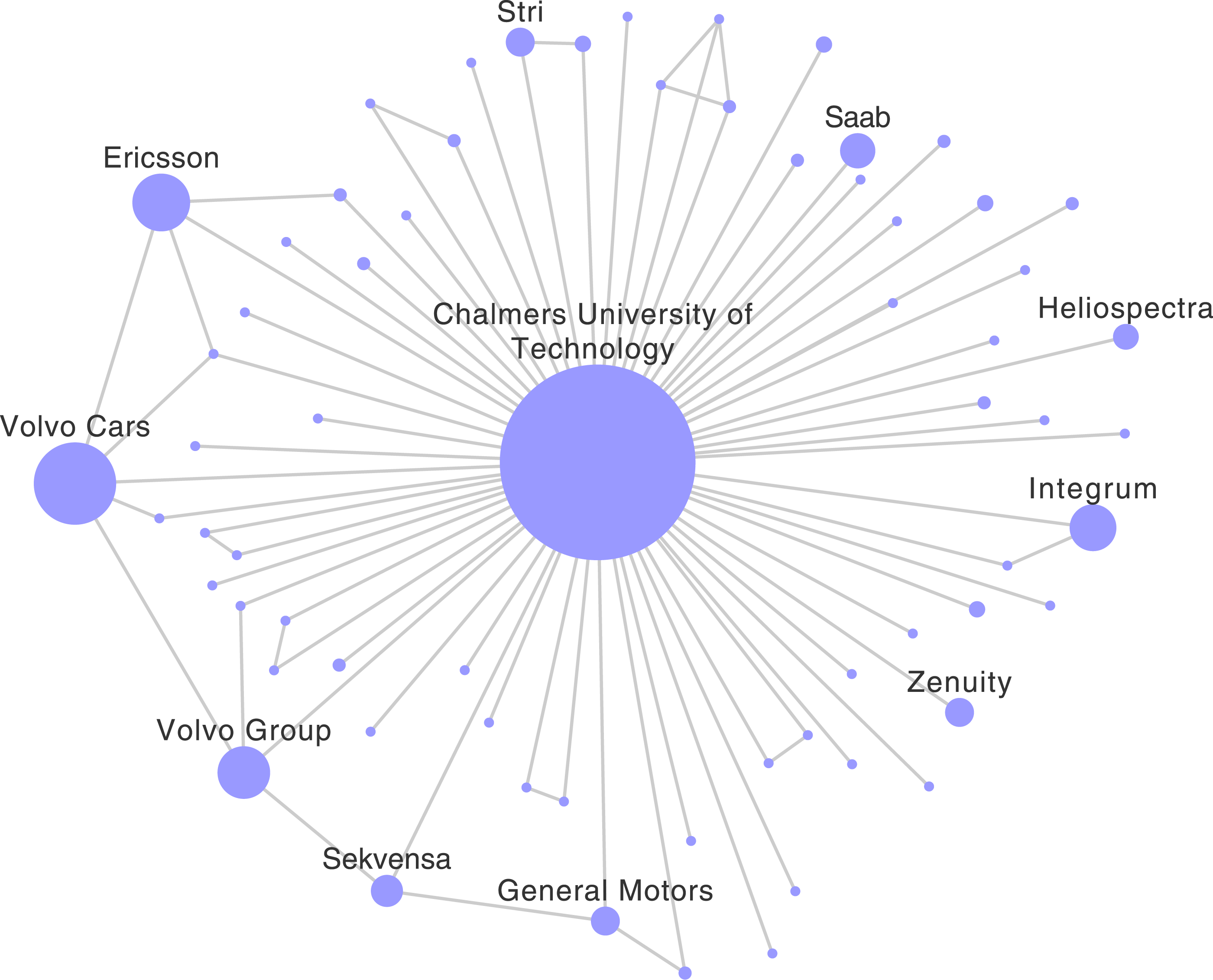
The focal university department co-authors with a wide variety of firms. To focus upon repeatability, and better understand the characteristics of such industry collaborators, we analyze collaborations involving four of the firms with the most co-publications in our sample (see Figures 2–4). Due to expected differences, we have chosen to analyze the top two multinational enterprises (Volvo Cars and Ericsson) and the top two knowledge-intensive entrepreneurial firms (Integrum and Sekvensa). Individual-level network graph depicting all co-publications between the sampled university researchers and the co-authors employed at the selected four firms. Individual-level network graph depicting all repeated co-publications between the sampled university researchers and the co-authors employed at the selected four firms. Individual-level network graph depicting all 2× repeated co-publications between the sampled university researchers and co-authors employed at the selected four firms (i.e., all co-publications that have been repeated at least two times).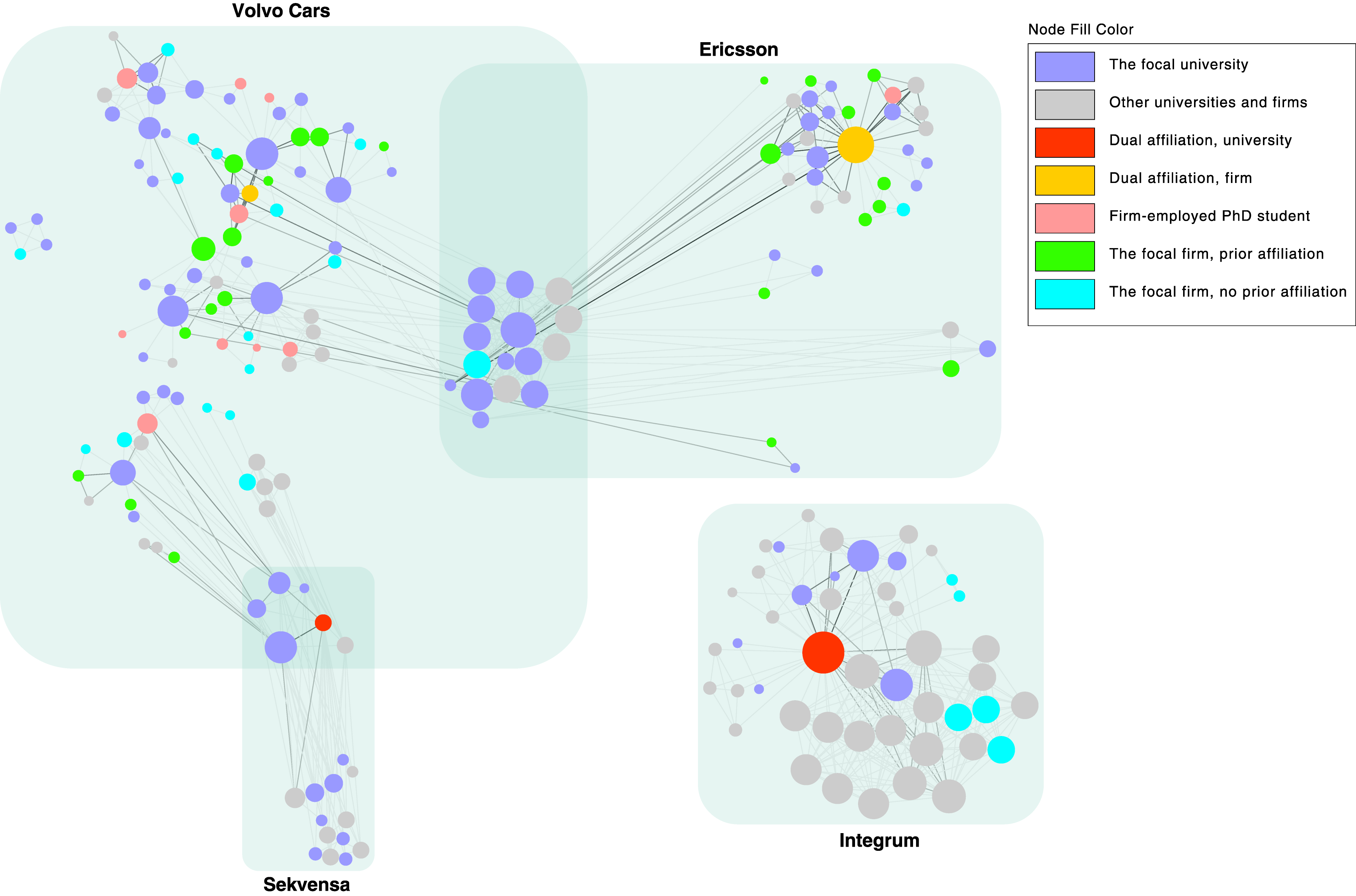
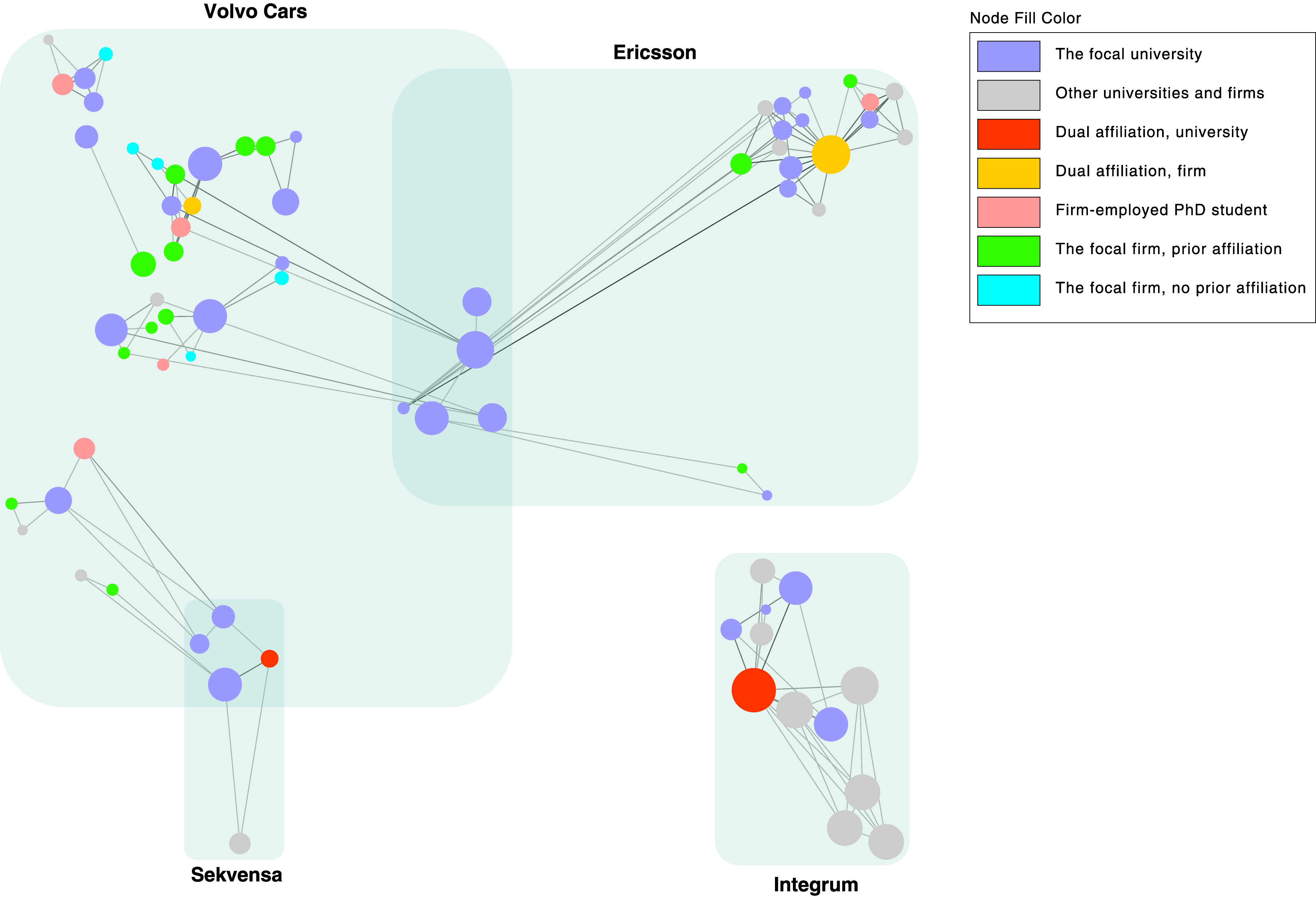
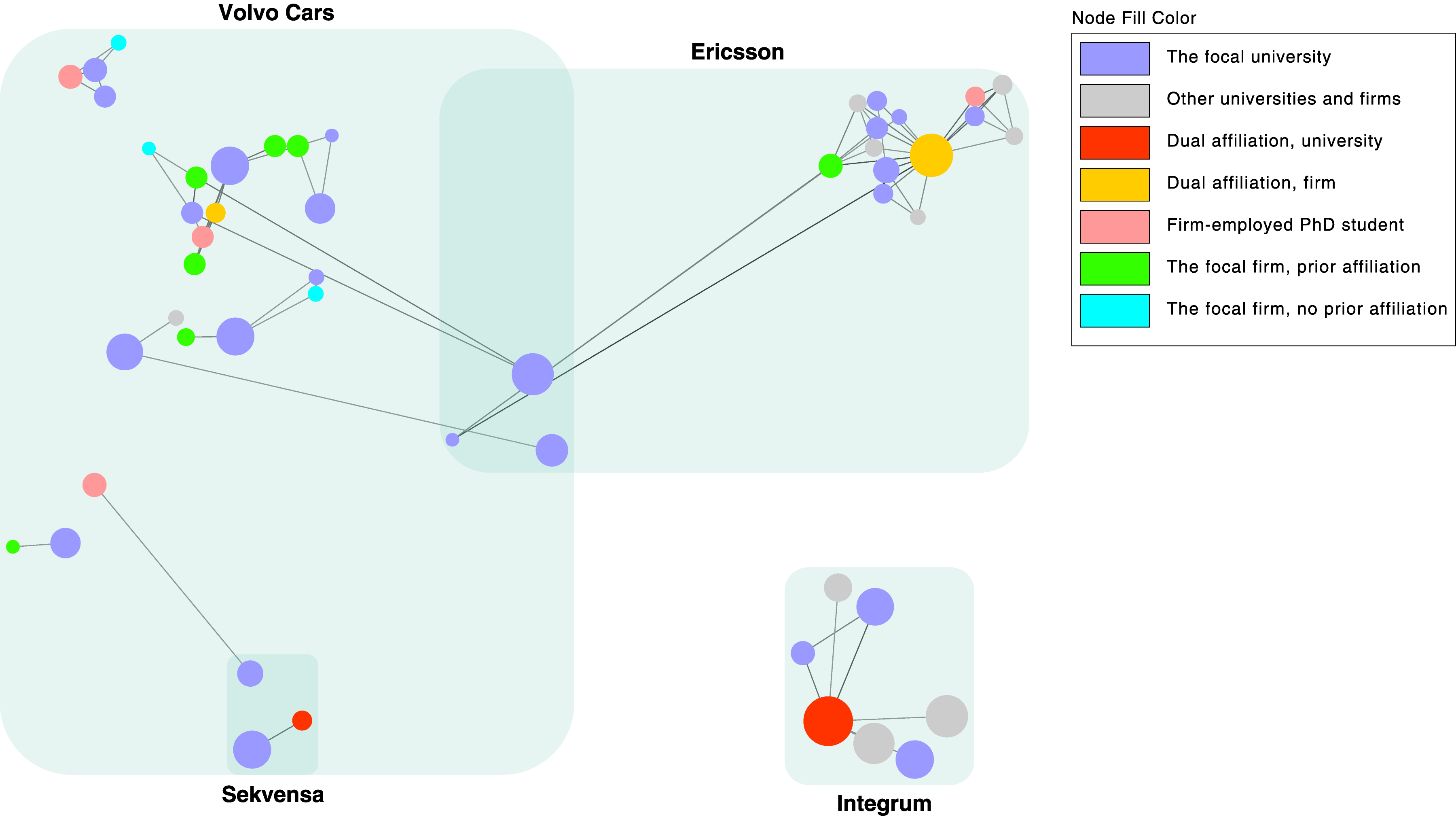
We represent the collaborative research between the sampled academic collaborators and the industry collaborators for the chosen four firms as knowledge networks, see Figures 2–4, using the typology in Table 5. (Note that basic network characteristics can be found in the Appendix.) While the differences are subtle, it is worth noting that we shift our attention from the focal department to the focal university to enhance the interpretation of the individual-level network graphs. Some brief explanation is useful for interpreting Figures 2–4: • Each node represents an individual author, regardless of where they were employed • Node size reflects the number of co-authors (i.e., larger nodes equal more collaborators) • Node color denotes the type of link to the university • Edges between nodes indicate that the connected authors have co-authored at least one publication • Edge transparency refers to the number of co-publications between the researchers (i.e., less transparent edge equals more co-publications)
Figures 2–4 differ with respect to the requirement on the number of times the collaborators have co-authored publications in our sample (i.e., different edge weights); Figure 2 includes all collaborations, Figure 3 includes all collaborations that have been repeated at least one time (edge weight >1), and Figure 4 includes all collaborations that have been repeated at least two times (edge weight >2).
By analyzing individual-level knowledge networks in Figures 2–4 using our above typology, several insights worth consideration can be obtained. First, our four chosen firms are the ones that employ the identified dual affiliated researchers. By examining the different subnetworks separately (Figure 2), one insight is that in these cases, only the MNEs employ dual affiliated researchers primarily employed at the firm, while the KIE firms employ dual affiliated researchers primarily employed at the university. Additionally, only the MNEs employ firm-employed PhD students. Our interpretation is that both dual affiliated researchers and firm-employed PhD students seem to be key individuals in bridging the organizational boundaries and creating this form of academic engagement, at least when considering more dense knowledge networks.
Second, it is observed that the MNEs studied here involve a number of different types of industry collaborators involved more often in publishing, while the KIE firms are more centered around publications related to the dual affiliated researchers, primarily employed at the university. Specifically, the publications by the KIE firm Sevensa did not involve any firm-employed co-authors, while the KIE firm Integrum also involved five firm-employed co-authors. In contrast, taken together, the two MNEs involved 41 firm-employed co-authors in publications. Moreover, another difference seems to be on links to the focal department. The firm-employed co-authors found in Integrum’s knowledge network did not have any prior links to the focal university, whereas more than half of the MNEs’ firm-employed co-authors had such as link.
When considering the two requirements for repeated collaborations, that is, collaborations that have been repeated at least once (Figure 3) respectively at least twice (Figure 4), a third insight emerges. Firm-employed co-authors who are not formally linked to the university – that is those that are not dual affiliated researchers or firm-employed PhD students – are less likely to be included in knowledge networks of repeated collaborations over time, in these four cases. This indicates that prior links between university researchers and firm collaborators are important for repeated knowledge-related collaborations. Moreover, our data show that firm-employed researchers with prior links to the university are more likely to participate in repeated collaborations with university researchers compared to those without such prior links.
All in all, the most common collaborator was MNEs, plausibly because they have the financial and human capital resources to involve firm-employed researchers to a larger extent in their publishing, including also employing dual affiliated researchers as both well-established researchers and as graduate students. In contrast to this, we find these KIE firms are highly dependent on their dual affiliated researchers with main employment at the university.
Given our perceived importance of dual affiliated researchers, especially in being part of longer-term academic engagement, we decided to try to identify more similarities and differences found amongst those visible in the four analyzed firms. Upon reviewing the applications of the dual affiliated researchers, (i.e., their CVs) at the time of applying for dual affiliation, we can observe some suggested similarities and differences between the two types. Dual affiliated researchers with primary employment in firms were previously academic PhD students before joining the firm, while those with primary employment in universities were previously firm-employed PhD students. The fact that the firm-employed PhD students eventually became dual affiliated professors with their primary employment in a university might appear counterintuitive. However, this can be explained by their continued employment with the focal firm even after obtaining their doctoral degree. Moreover, we observed that, at the time of application, individuals in both subtypes had published a similar number of scientific papers (approximately 50+/−10). Additionally, we observed that dual affiliated researchers with their main employment in firms had applied for a significantly larger number of patents, while those with their main employment in universities had obtained substantially more research grants.
Conclusions
In this article, we characterize industry collaborators in engineering, through an in-depth analysis of firm co-authors within one research environment in Sweden. We empirically derive a typology with seven categories of different types of industry collaborators, based on their level of education and type of university affiliation. We find that a clear majority of co-publications include at least one firm co-author with – at the time of publication – current or prior affiliation to the focal university department. The most common types of firm co-authors with prior and current affiliations are PhD graduates and firm-employed PhD students, respectively.
This pattern is even more pronounced when examining the knowledge networks based on repeated collaboration between the focal university researchers and their firm co-authors. Patterns range from one-off interactions with many firms to repeated interactions with only a handful of knowledge-intensive entrepreneurial firms and multinational enterprises, like Ericsson and Volvo Cars. The densest knowledge networks are built by repeated interactions over a long time period, involving industry collaborators with formal affiliations to the university, such as dual affiliated researchers.
Existing studies show that academic researchers with prior industry work experience are more likely to collaborate with external actors (see Perkmann et al., 2021). Our results add to this literature by indicating that academic collaborators commonly engage with industry collaborators having academic work experience, in terms of previously or currently being affiliated to the collaborating university department. Moreover, our results are in line with existing findings that research collaboration – in the form of co-publishing – often builds on existing relationships between collaborators (Ponomariov and Boardman, 2016), and is not based solely on the collaborators’ resource needs (e.g. Bikard et al., 2019; D’Este and Perkmann, 2011). We interpret this to suggest the long-term nature of knowledge networks in academic engagement; our proposition is that individuals with long-term links between academia and industry – and associated projects by graduate students – promote academic engagement and impact. Further studies are needed which specifically address the characteristics of industry collaborators. Our typology would be useful to identify and categorize a broader set of industry collaborators in future studies. Moreover, the importance of the individuals we refer to as ‘dual affiliated researchers’ deserve more attention.
The main implication for university management and public policy of our study is that individuals matter. Supporting and encouraging labor mobility between academia and industry is important to further develop knowledge networks between universities and firms, and thereby increase collaborative research and potential innovation. Advanced education may facilitate more university-industry collaborative research, if some individuals move to employment in industry after graduation. Specifically, we propose that Masters and PhD students play an especially important role as knowledge diffusers and brokers in university-industry knowledge networks. Initiatives by policy-makers and university managers to support and stimulate university-industry collaborations should utilize this insight.
Finally, our study has limitations. First, co-authored publications represent only one dimension of research collaboration, as it excludes collaborations that are not successful or that lead to outcomes that are not published. While publishing is an essential proxy for understanding scientific outcomes, we recognize that academic engagement also consists of many dimensions and channels of interaction. Second, our study is limited to one research environment in one country, which also entails a limited sample size. Thus, caution should be exercised when generalizing the findings beyond this specific context, and comparative studies are needed across disciplines, universities, and countries.
Footnotes
Declaration of conflicting interests
The author(s) declared no potential conflicts of interest with respect to the research, authorship, and/or publication of this article.
Funding
The author(s) disclosed receipt of the following financial support for the research, authorship, and/or publication of this article: This research was supported by the Riksbankens Jubileumsfond, in the research program “How engineering sciences can impact industry in a global world,” RJ DNR FSK15-10801; and the Swedish Research Council Distinguished Professor’s Program. Research Program: “Knowledge-intensive Entrepreneurial Ecosystems: Transforming society through knowledge, innovation and entrepreneurship,” VR DNR 2017–03360. Both research projects were led by M. McKelvey.

Notes
Appendix
Network characteristics. Authors affiliations.
Volvo cars
Ericsson
Integrum
Sekvensa
Nodes
109
54
46
19
Edges
316
195
246
65
Density
8.4%
18.9%
23.8%
38.0%
Components
5
2
1
1
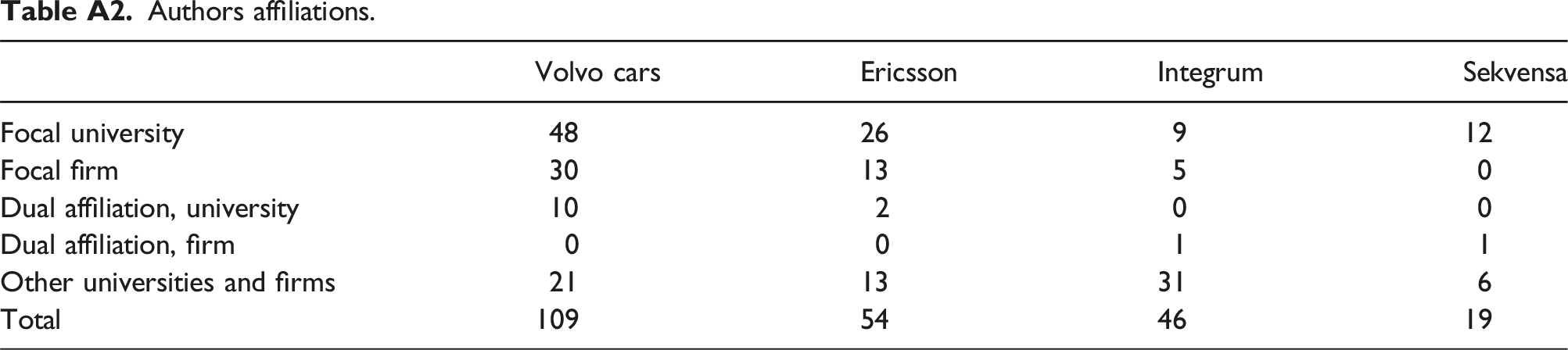
Volvo cars
Ericsson
Integrum
Sekvensa
Focal university
48
26
9
12
Focal firm
30
13
5
0
Dual affiliation, university
10
2
0
0
Dual affiliation, firm
0
0
1
1
Other universities and firms
21
13
31
6
Total
109
54
46
19