




Abstract
This study examines the corporate experience of authors behind the 200 most-cited corporate sustainability (CS) and corporate social responsibility (CSR) articles (2019–2024). Authors were categorized by professional experience: No Corporate Experience, Some Experience (<5 years), and Significant Experience (≥5 years). Findings reveal a predominance of scholars without corporate backgrounds, raising concerns about the practical applicability of their research. The study highlights the potential for practice-informed insights from scholars with corporate experience and advocates for greater academia-industry collaboration. Recommendations include embedding knowledge translation frameworks to align research with organizational realities and accelerate sustainability integration.
Keywords
Introduction
The strategic importance of corporate sustainability (CS) and corporate social responsibility (CSR) has grown exponentially, moving beyond operational and philanthropic initiatives to become central issues in corporate boardrooms (De Bakker et al., 2024). This shift reflects a response to escalating global sustainability challenges, such as climate change, which present both risks and opportunities for businesses. As corporations increasingly recognize that sustainability has a material impact on long-term performance, the demand for actionable insights that address practical challenges has grown correspondingly (Carroll and Shabana, 2010; Dyllick and Muff, 2015). Consequently, there is mounting pressure to mainstream sustainability into organizational strategies and decision-making processes (Dahlmann and Brammer, 2011; Markard et al., 2020).
While there is ongoing discourse on the nature of “mainstreaming” sustainability (Banerjee, 2003; Bansal, 2019; Meuer et al., 2019), this study demarcates the concept as integrating CS and CSR research into organizational strategy through a symbiotic relationship between practice and scholarship. Mainstreaming sustainability demands practice-informed scholarship, grounded in corporate experience or collaborative insights, to ensure research is both theoretically robust and actionable. Scholars with corporate insight are uniquely positioned to address the practical challenges of sustainability implementation, align recommendations with organizational realities, and navigate trade-offs between short- and long-term goals. This approach bridges the gap between academic frameworks and real-world applications, fostering co-creation between academia and industry to drive scalable, systemic change.
The connection between professional practice and academic research is particularly critical in fields like CS and CSR, where the complexity of real-world implementation often surpasses theoretical assumptions (Bansal and Song, 2017; Du et al., 2023; Meuer et al., 2019; Samuel et al., 2023; Shrivastava, 1995). Therefore, scholars with corporate experience may bring unique insights into the operational realities and strategic trade-offs faced by businesses, potentially enhancing the practical relevance of their work (Gladwin et al., 1995; Walls and Berrone, 2017). Conversely, the absence of such experience raises questions about the applicability of academic contributions to pressing organizational challenges. This potential disconnect underscores the urgency of systematically examining how the professional backgrounds of leading scholars in CS and CSR shape their approaches to sustainability, especially given the critical need for actionable, practice-oriented strategies to address the increasingly complex challenges faced by businesses today.
Despite the continued integration of sustainable business practices into corporate operations, the pace of sustainability integration remains inconsistent across organizations, with many efforts criticized as symbolic or incremental (Cho et al., 2015; Delmas and Burbano, 2011; Slawinski and Bansal, 2015). Accelerating sustainability mainstreaming requires insights that address tensions between short-term and long-term objectives, foster innovation, and navigate stakeholder pressures. However, barriers such as disciplinary silos and limited practitioner engagement may hinder the integration of professional practice into CS and CSR scholarship (Bocken and Geradts, 2020; Haas et al., 2021; Markard et al., 2020; Samuel et al., 2023; Starik and Kanashiro, 2013; Waddock, 2020).
To support continued mainstreaming of sustainability, this study assesses the professional backgrounds of authors contributing to the most-cited CS and CSR research published between 2019 and 2024. Specifically, it examines the extent to which these scholars possess corporate experience and explores the implications of their backgrounds for the practical applicability of their work. By categorizing authors based on the depth and focus of their corporate experience, this study provides novel insights into the practitioner-academic divide and its impact on sustainability scholarship.
The findings contribute to ongoing discussions about accelerating sustainability mainstreaming by identifying opportunities for deeper collaboration between academia and industry. By highlighting the role of corporate experience in shaping research that resonates with boardroom priorities, this study underscores the need for integrative approaches that bridge theoretical rigor with operational relevance. It is argued that integrating knowledge translation (KT) frameworks, central to public health studies, into sustainability scholarship offers a pathway to overcome the practice-scholarship divide by emphasizing the iterative and collaborative processes necessary to align academic outputs with the operational realities faced by corporations. The results also offer actionable recommendations for fostering practice-informed scholarship, thereby advancing the systemic changes necessary for sustainable development (Bai et al., 2024; Carroll and Shabana, 2010; Delbridge et al., 2024).
Context
CS and CSR are often used interchangeably but represent distinct paradigms in academic and corporate discourse. CSR emphasizes a corporation’s ethical obligations to contribute to societal well-being beyond its economic goals. Voluntary activities under CSR often include philanthropy and broader community engagement practices (Billedeau et al., 2022; Billedeau & Moreno-cruz, 2022; Campbell, 2007; Schwartz and Carroll, 2003). In contrast, CS focuses on long-term value creation by integrating environmental, social, and governance (ESG) considerations into business strategies. It aligns corporate activities with sustainable development principles, emphasizing resource efficiency, stakeholder inclusion, and resilience to environmental challenges (Bartunek et al., 2001; Dyllick and Muff, 2015; Eccles et al., 2014; Epstein et al., 2015). For example, while a CSR initiative might involve donating to environmental causes, a CS initiative could involve redesigning supply chains to minimize carbon emissions. Despite their differences, both concepts share the common goal of improving societal and environmental outcomes, which are increasingly integrated within modern corporate strategies (Carroll, 1991; Dyllick and Muff, 2015).
Understanding corporate dynamics is essential for impactful CS and CSR research. Corporations operate within complex systems that balance financial performance, stakeholder interests, and regulatory compliance (Donaldson and Preston, 1995; Epstein et al., 2015; Porter and Kramer, 2011). Scholars without corporate experience may overlook key operational realities, leading to research that is overly idealistic or disconnected from practical application. For instance, scholars may emphasize the potential for green procurement of materials like steel, whereas industry practitioners may focus on the limited willingness among customers to pay a green premium. Such misalignment can lead to scholarship and public policy recommendations that lack practical relevance or feasibility. Similarly, policy proposals that fail to account for business constraints, such as profitability and competitiveness, risk creating resistance or unintended consequences (Bansal and Song, 2017). Bridging this divide requires corporate knowledge to produce research that is both actionable and attuned to the complexities of real-world implementation.
Scholars with corporate sustainability experience bring nuanced insights into these dynamics. They can better understand trade-offs between environmental goals and cost-saving measures, enabling them to propose balanced, scalable solutions. Conversely, a lack of corporate knowledge risks producing findings that are either ignored by practitioners or result in ineffective policies or operational strategies. This interplay between theory and practice is particularly vital when addressing systemic issues like climate change, where actionable solutions depend on deep organizational understanding (Bartunek et al., 2001; Bartunek and Rynes, 2014; Porter and Kramer, 2011).
Studies in adjacent fields suggest that professional backgrounds significantly influence the relevance and applicability of academic work (Bartunek et al., 2001; Bartunek and Rynes, 2014). While practice-informed insights can enhance research impact, it can be argued that an overemphasis on immediate applicability of CS and CSR scholarship might limit theoretical innovation. Yet it can be argued that an overemphasis on immediate applicability of CS and CSR scholarship might limit theoretical innovation. At the same time, the urgent need for sustainability transitions may outweigh the value of purely theoretical advancements. Therefore, prioritizing research that delivers actionable solutions to address pressing environmental and social challenges offers an opportunity to mainstream sustainability scholarship. Collaborations with industry professionals, which have been shown to enhance the practical relevance of academic findings (Awasthy et al., 2020; Marijan and Gotlieb, 2022; Popli and Singh, 2024), can foster innovations in CS and CSR. However, the lack of empirical work systematically analysing the corporate experience of the most impactful modern CS and CSR scholars highlights a significant gap in the literature.
Therefore, this study aims to analyse the divide between practice and scholarship in CS and CSR by examining the corporate backgrounds of authors contributing to the most-cited research. It offers a novel perspective on the practitioner-academic divide and its implications for advancing impactful, practice-informed scholarship.
The concept of KT from public health research offers a valuable framework for integrating academic insights into practice. KT emphasizes transforming research into actionable strategies by bridging the practice-scholarship gap and aligning scholarly outputs with real-world priorities (Graham et al., 2006; Straus et al., 2009). Greater integration of authors with professional corporate backgrounds into sustainability scholarship can enhance KT by grounding research in practical realities, ensuring its relevance to decision-makers (Bartunek et al., 2001; Bartunek and Rynes, 2014). These scholars, with their firsthand experience, are uniquely positioned to contextualize findings, foster iterative feedback between academia and industry, and co-create knowledge that drives operational change (Van De Ven and Johnson, 2006). By embedding KT principles, such as collaboration and adaptability, into CS and CSR scholarship, sustainability transitions can be accelerated through research that is not only innovative but also more immediately implementable, advancing the mainstreaming of sustainability.
Methodology
This study explores the depth of professional experience in shaping CS and CSR scholarship by analysing the backgrounds of authors contributing to the most-cited articles in these fields of study. To ensure a focused and sound approach, a dataset was constructed using Scopus, which has been widely recognized for bibliometric analyses in management and sustainability research (Archambault et al., 2009; Falagas et al., 2008; Mongeon and Paul-Hus, 2016). The search parameters targeted articles published between 2019 and 2024. This timeframe was chosen to reflect contemporary trends and advancements in the fields, ensuring the analysis remains relevant to current discourse. The top 200 most-cited articles were selected to ensure that the analysis focused on research with the greatest impact and visibility in the field.
The search used specific keywords—“corporate sustainability” and “corporate social responsibility”—to identify relevant articles. These terms were queried within the title, abstract, and keywords fields, ensuring that the selected articles explicitly addressed the core themes of the study. Articles were then sorted by citation count, and the top 200 most-cited articles were captured for review. The authorship data of these articles was extracted, focusing on primary authors only. To analyse the professional backgrounds of these authors, publicly accessible sources such as LinkedIn profiles, institutional biographies, and professional websites were examined. Based on this data, authors were categorized into three classifications: those with no corporate experience, those with some experience (up to 5 years in corporate roles), and those with significant experience (more than 5 years). The categorization did not account for role relevance, such as seniority, scope of responsibilities, and alignment with CS or CSR objectives. However, the assessment considered the diversity of professional roles, including consulting, management, and sustainability-specific positions.
Corporate experience was defined as direct professional involvement in a for-profit, non-profit, or government organization in roles related to management, consulting, strategy, or operations. This definition encompasses positions that involve decision-making responsibilities, stakeholder engagement, or implementation of sustainability or corporate social responsibility initiatives. Government and non-profit experience were included because these roles often involve the development and implementation of policies or programs that intersect with corporate sustainability and CSR objectives, providing valuable insights into regulatory, strategic, and operational dynamics. Internships, volunteer positions, and similar short-term engagements were excluded because these roles typically do not involve sustained decision-making authority or responsibilities that significantly shape organizational strategy or operations. Excluding these roles ensures the analysis focuses on substantive professional experience likely to influence scholarship in a meaningful way.
To enhance clarity, this study further differentiates between consultants and those with managerial responsibilities. Consultants were defined as individuals providing advisory or analytical services across organizations, often through project-based or client-facing roles. Managers were defined as professionals employed within organizations with internal strategic, operational, or sustainability-related responsibilities. This distinction helps illustrate the diversity of practice-based experience represented in the dataset.
Ethical considerations were also integral to this study. All data were sourced from publicly accessible platforms, ensuring compliance with ethical research standards. The study’s focus on aggregated data further mitigates privacy concerns, as individual authors were not directly contacted or identified. By adhering to this approach, the research maintains transparency and integrity while contributing new insights into the intersection of professional experience and academic scholarship in CS and CSR.
Results
The findings revealed a diverse distribution of professional experience among the authors analysed. Of the 200 authors included in the dataset, the majority (43%) had no identifiable corporate experience. Authors with some corporate experience (<5 years) comprised 16.5% of the sample, while those with significant corporate experience (≥5 years) accounted for 14.5%. A notable proportion of authors (26%) fell into the “Not Found/Uncertain Profile” category, reflecting cases where sufficient information about their professional background could not be determined (Figure 1). Corporate experience of leading corporate sustainability scholars.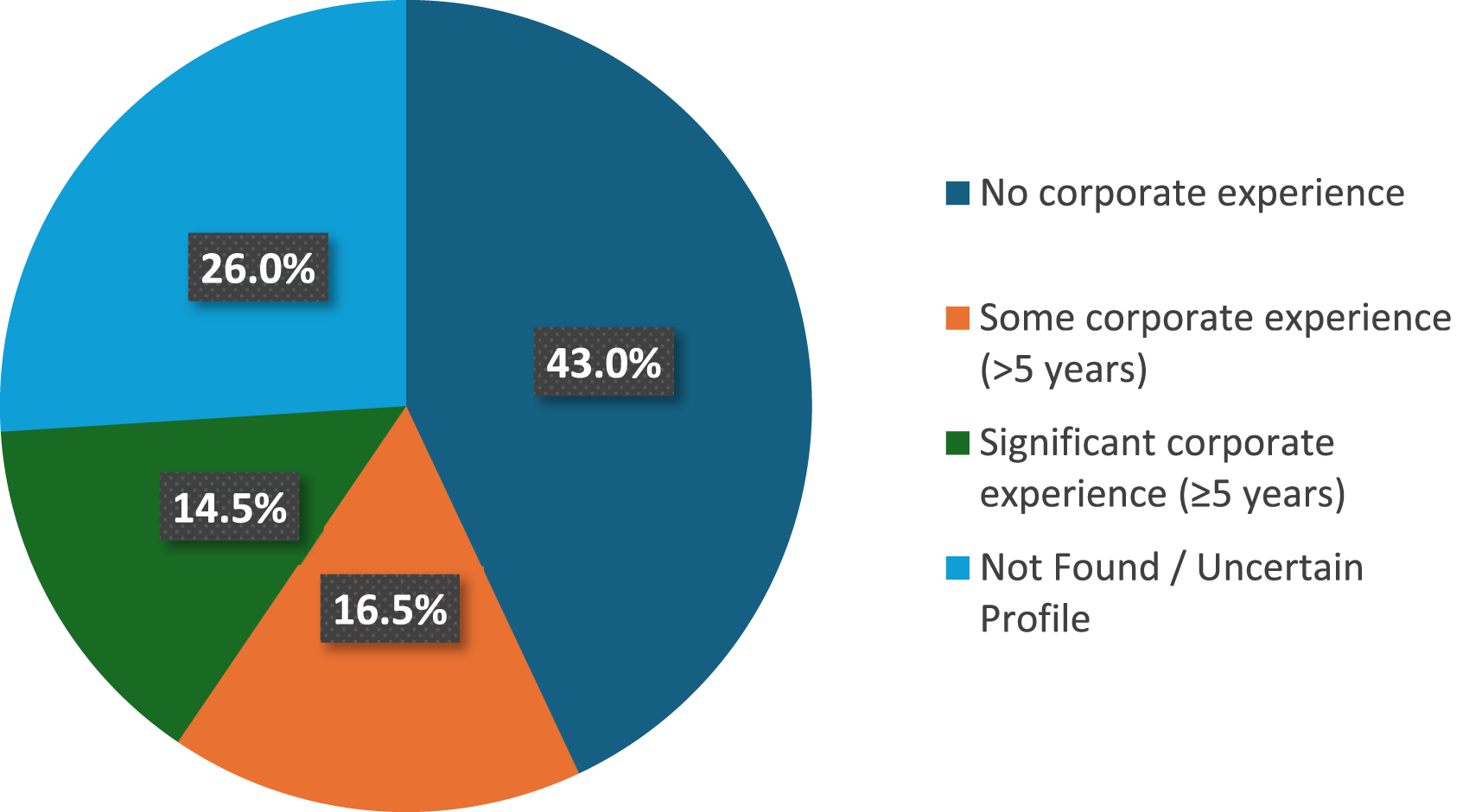
The relatively high proportion of authors without corporate experience suggests a predominant academic orientation within the fields of CS and CSR. That said, the combined 31% of authors with some level of corporate experience indicates the presence of scholars whose research may be informed by professional practice. This distribution underscores a duality in the field: while theoretical contributions dominate, a minority of scholars with corporate backgrounds bring practical insights that could bridge the practice-scholarship divide.
The analysis of professional backgrounds for authors with corporate experience revealed notable diversity in professional backgrounds. Authors had experience across a range of professional backgrounds, including consulting (various specializations), finance, engineering, government administration, marketing, and senior management. Consulting roles—particularly in accounting, business development, and sustainability—were the most frequently observed professional background among these authors. Additional backgrounds included analysts, researchers, business owners, and members of advisory boards or industry associations. A breakdown of the sectors is shown in Figure 2. Professional backgrounds of leading corporate sustainability scholars.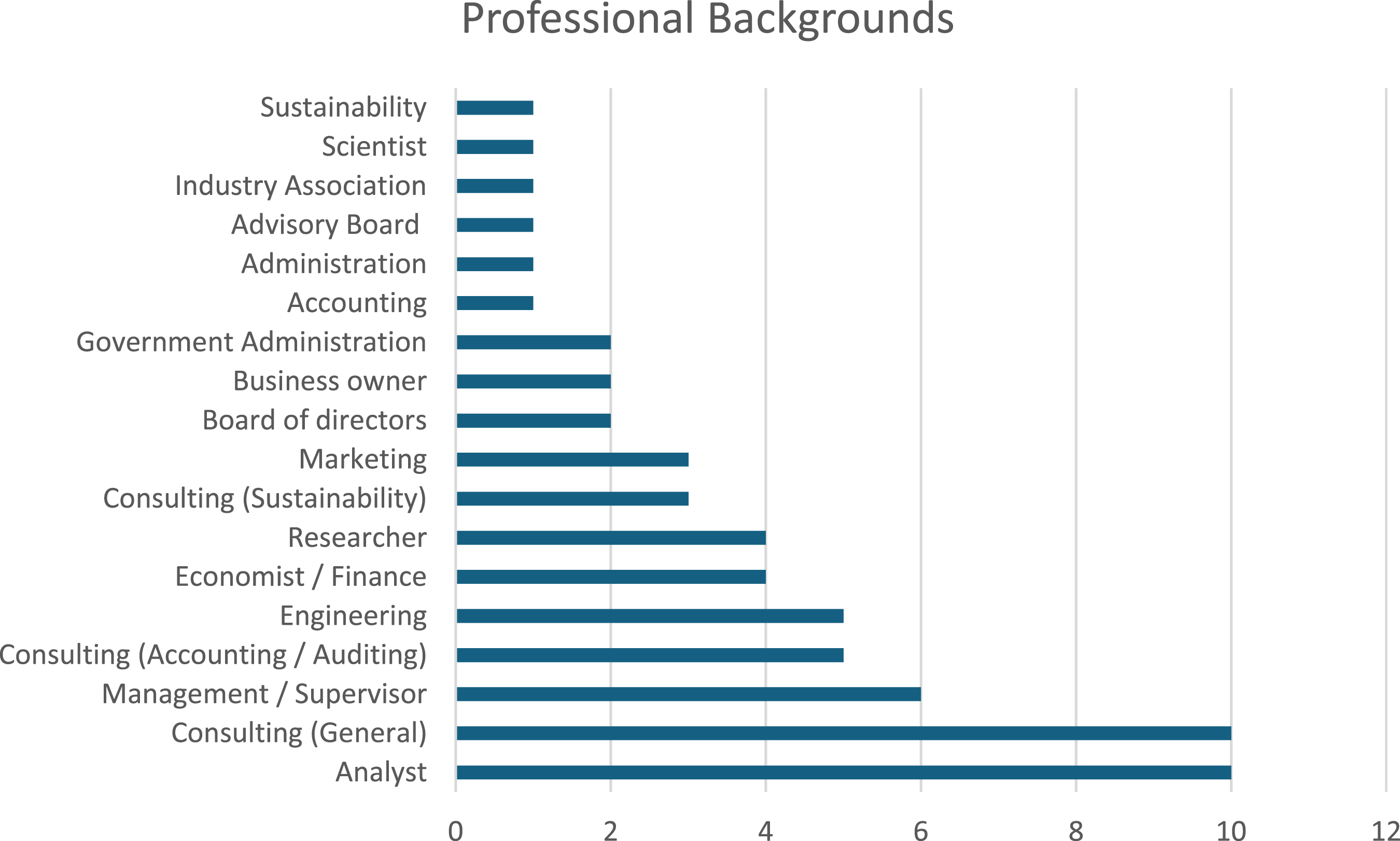
Consulting accounted for a significant share of roles, suggesting that scholars with corporate backgrounds often bring expertise from advisory and problem-solving roles that align closely with sustainability and CSR concerns. This prevalence may reflect the alignment of consulting roles with the strategic and operational challenges of implementing sustainability practices, making consulting a natural bridge between academia and industry. Additionally, several authors had experience in senior management and sustainability-focused roles, indicating a direct connection to corporate strategy and operational decision-making.
The predominance of authors without corporate experience raises important questions about the extent to which CS and CSR scholarship is informed by real-world practice. Scholars with no corporate background may rely on theoretical frameworks and secondary data, potentially limiting the practical applicability of their findings. On the other hand, the presence of a sizable subset of authors with corporate experience—particularly in consulting and sustainability-specific roles—demonstrates that practice-informed perspectives are contributing to the discourse. Further, the strong representation of consulting roles suggests that these scholars often act as intermediaries between academia and practice, leveraging their professional expertise to inform research. Similarly, the presence of authors with backgrounds in finance, engineering, and senior management indicates that their research may be grounded in operational realities, which could enhance its relevance to corporate decision-making.
The 26% of authors with uncertain profiles highlight a limitation of this analysis, as it underscores the challenges of relying on publicly available data to assess professional experience. This limitation may lead to an underrepresentation of scholars with corporate backgrounds, potentially skewing the overall distribution. Nevertheless, the findings provide valuable insights into the professional backgrounds of influential scholars in CS and CSR and highlight the need for further investigation into how corporate experience shapes research outcomes. The dual nature of academic and practice-informed contributions offers an opportunity to advance CS and CSR scholarship by fostering deeper collaborations between these domains.
Discussion
The findings of this study reveal significant insights into the role of professional experience in shaping CS and CSR scholarship. They also highlight critical patterns and challenges within the academic-practice divide.
Key findings
The analysis shows that a substantial proportion of identified leading CS and CSR scholars (43%) lack corporate experience; however, the total number of scholars in this category is likely higher, considering that 26% of surveyed authors had no professional profile available for analysis, further underscoring a persistent divide between academia and practice. This finding aligns with critiques in the literature, which emphasize that theoretical research in these fields often fails to address the operational realities of corporate environments. Scholars without corporate backgrounds may focus on abstract frameworks and secondary data, potentially limiting the practical applicability of their research (Shapiro et al., 2007; Tushman & O’Reilly, 2007). Bridging this divide remains a pressing priority, as actionable solutions to pressing sustainability challenges require research that resonates with practitioners and policymakers. It is posited that scholars with corporate experience may be better equipped to contextualize their findings in ways that resonate with practitioners and policymakers, making this gap particularly critical in CS and CSR research.
Conversely, the presence of scholars with corporate experience (31%) highlights the potential for practice-informed insights to enrich CS and CSR scholarship. Many of these scholars bring expertise from consulting, senior management, and engineering roles, indicating their ability to integrate real-world considerations into their research. These findings support prior work that underscores the value of practitioner-academic collaborations in enhancing research relevance (Van De Ven and Johnson, 2006). For example, scholars with consulting backgrounds may be better equipped to propose pragmatic strategies for corporate sustainability, while those with experience in senior management can address the organizational trade-offs inherent in balancing financial and sustainability goals.
Analysis of the authors with corporate experience reveals a notable dominance of consulting roles, particularly in accounting and business development. While this reflects the critical role of consulting in bridging theory and practice, it also raises concerns about bias emanating from professional backgrounds. The overrepresentation of consulting and certain other backgrounds, such as engineering, could also shape research agendas. This echoes prior critiques that sustainability research often reflects the priorities of dominant industries, potentially neglecting marginalized or underexplored sectors (Hannemann, 2019; Meidl & Medlock III, 2023; Shrivastava, 1995). For instance, research influenced by consulting backgrounds may prioritize short-term problem-solving over systemic, long-term sustainability transitions. Addressing this imbalance is essential to foster diverse perspectives that reflect a broader range of industry-specific challenges.
The study also highlights challenges in assessing professional backgrounds, as reflected in the 26% of authors categorized under “Not Found/Uncertain Profile.” This limitation points to the broader difficulty of relying on publicly available data to assess corporate experience. While sources such as LinkedIn and institutional biographies are valuable, they may not capture the full breadth of an author’s professional background or accurately represent the relevance of their roles to sustainability and CSR research.
Limitations and future research
Several limitations should be acknowledged in interpreting the findings. First, the reliance on publicly available data introduces potential biases and gaps. Not all authors maintain comprehensive online profiles, and information on their corporate roles may be incomplete or unavailable. This is particularly evident in the “Not Found/Uncertain Profile” category, which accounts for over a quarter of the dataset.
Second, the study focuses exclusively on the most-cited articles from 2019 to 2024, which prioritizes established authors and high-impact journals. While this approach ensures the relevance and influence of the articles analysed, it may exclude emerging scholars or less-cited works that could offer valuable insights. Additionally, citation count, while a widely used measure of scholarly impact, may not fully capture the practical relevance or quality of an article’s contributions (Podsakoff et al., 2008).
Third, the classification of corporate experience into three categories simplifies complex professional trajectories. For example, short-term roles in high-impact positions may be provide greater insights on corporate operations than longer tenures in less relevant roles, but this distinction is not captured in the analysis. Similarly, the sectoral categorization does not account for interdisciplinary roles that span multiple industries.
A further limitation relates to the theoretical scope of this study. The paper does not provide a detailed treatment of the broader theory–practice debate, as its purpose is empirical rather than conceptual. The intention was to explore how professional experience shapes sustainability scholarship, not to engage in a full theoretical analysis of how academic and practitioner knowledge interact. Expanding the discussion of this debate in depth would have shifted the focus away from the study’s core contribution. Future research could build on this work by examining how theoretical perspectives on the relationship between theory and practice can further inform empirical investigations into sustainability scholarship.
Lastly, a key limitation of this study is that it focuses exclusively on the primary authors of the most-cited articles in CS and CSR, potentially overlooking the professional experience of secondary authors. Secondary authors, who often contribute substantially to the research process, may bring valuable corporate experience that is not captured in this analysis. This limitation could lead to an underestimation of the overall presence of practice-informed insights within the scholarly community. However, the decision to focus on primary authors was intentional, as they are typically the lead contributors to the conceptual framework, research design, and overall direction of a study. By examining primary authors, this study aims to evaluate the most prominent voices in the field and their ability to bridge the academic-practice divide. Future research could address this limitation by including secondary authors in the analysis to provide a more comprehensive understanding of the professional experience within CS and CSR scholarship.
Despite these limitations, the study provides a novel and meaningful exploration of the interplay between professional experience and academic scholarship in CS and CSR. These findings establish a foundation for further investigation into this important topic. Future research could expand the dataset to include less-cited works or articles from broader timeframes, providing a more comprehensive understanding of how corporate experience influences scholarly contributions. Longitudinal studies could evaluate the evolving impact of corporate experience on research trajectories, while sector-specific analyses might uncover how different professional backgrounds shape scholarly focus and methodologies. Incorporating mixed methods, such as surveys or interviews, could address the limitations of relying solely on publicly available data, offering nuanced insights into how practice informs scholarship. Finally, comparative studies across related fields, like environmental science or public policy, could reveal similar dynamics and encourage cross-disciplinary collaboration to advance sustainability research.
Most importantly, the concept and premise of KT offers a valuable lens for addressing the academic-practice divide in CS and CSR scholarship. KT emphasizes bridging the practice-scholarship divide by synthesizing and adapting research outputs to align with the priorities of practitioners and policymakers (Graham et al., 2006; Straus et al., 2009). In the context of sustainability scholarship, KT involves more than disseminating research—it requires iterative feedback loops that engage corporate practitioners in the design, execution, and application of studies. Sustainability scholars with corporate experience are uniquely positioned to facilitate KT, as their understanding of organizational realities allows them to contextualize findings and co-create actionable strategies. Embedding KT principles, such as stakeholder collaboration and adaptability, into sustainability research can help translate theoretical insights into scalable, practice-oriented solutions, ultimately accelerating the mainstreaming of sustainability.
Despite its potential, KT as a framework and a goal remains underutilized in CS and CSR research, particularly among scholars without direct corporate experience. Limited engagement with KT frameworks risks producing research that is overly abstract or disconnected from practical applications. Incorporating KT into sustainability scholarship demands a more deliberate focus on interdisciplinary collaboration and participatory research practices. By adopting KT-driven approaches, the field can better align academic outputs with corporate needs, fostering innovations that address the operational, financial, and social complexities of sustainability transitions. Future research should further explore how KT can be operationalized to enhance the impact of sustainability scholarship, offering insights into methods for engaging diverse stakeholders and translating academic findings into meaningful organizational change.
Conclusion
The divide between practice and scholarship is particularly concerning in the context of CS and CSR, fields of study that require a nuanced understanding of how businesses operate within competitive and regulatory environments. Leading scholars without corporate backgrounds may rely heavily on theoretical frameworks, abstract models, or secondary data, potentially limiting the practical applicability of their findings. This is especially problematic as their highly cited works not only shape the academic discourse but may also influence corporate strategies and policymaking.
The intent of this paper is not to disparage ‘pure’ academics (i.e., those whose professional careers have been confined to academia, without direct corporate or industry experience) from pursuing research pertaining to CS and CSR. Theoretical advancements and abstract modelling remain essential for advancing knowledge and exploring innovative solutions to global challenges. Instead, this paper serves as a call to scholars with corporate experience to become more involved in the academic discourse on these topics. Their unique perspectives, grounded in real-world practice, are invaluable for bridging the practice-scholarship divide and ensuring that research is both rigorous and relevant, and that recommendations stemming from such scholarship are actionable. Mainstreaming sustainability requires such practice-informed contributions to address the urgent need for actionable strategies, fostering a symbiotic relationship between scholarship and corporate operations. Studies have emphasized the value of integrating practitioner insights into academia, suggesting that such collaborations foster innovation and enhance the practical impact of academic work (Tushman & O’Reilly, 2007).
The findings of this study underscore the need for greater alignment between academic scholarship and the practical realities of CS and CSR. While the presence of scholars with corporate experience highlights the potential for practice-informed insights, the dominance of academics without corporate backgrounds in shaping the discourse raises concerns about the applicability of their contributions. In fields like CS and CSR, where the challenges are inherently interdisciplinary and operational, bridging the academic-practice divide is essential to ensure that research not only advances theoretical understanding but also delivers actionable, scalable solutions. Prior work has articulated potential benefits of sustainability research embracing the complexities of corporate systems to address ecological challenges effectively (Florez-Jimenez et al., 2024; Podsakoff et al., 2008; Rébula De Oliveira et al., 2023; Shrivastava, 1995). Mainstreaming CS and CSR in this context involves creating actionable frameworks that integrate both theoretical advancements and the realities of business operations.
The integration of KT principles provides a pathway for achieving this alignment. KT emphasizes the synthesis and adaptation of research findings to ensure their accessibility and applicability to practitioners and policymakers. By embedding KT into sustainability scholarship, researchers can bridge the practice-scholarship divide, transforming theoretical insights into operational strategies that resonate with corporate realities. KT further underscores the importance of stakeholder collaboration, ensuring that diverse perspectives inform the development of actionable, scalable solutions for sustainability transitions.
In sum, to support continued mainstreaming of sustainability, a concerted effort is needed to foster stronger collaborations between academia and industry. Universities and research institutions should actively engage with corporate practitioners to co-develop research agendas, methodologies, and frameworks that are both rigorous and relevant. Programs that incorporate experiential learning, case studies, and practitioner-led initiatives can prepare future scholars to approach sustainability research with a more balanced perspective. Journals and academic conferences, too, can play a role by prioritizing research that demonstrates a clear connection to practice and operational realities. By mainstreaming sustainability research, these initiatives can ensure that academic outputs directly inform and accelerate organizational transitions toward sustainability. Bridging the gap between theory and practice requires sustained collaboration and the integration of diverse perspectives (Van De Ven and Johnson, 2006).
Ultimately, addressing the disconnect between academic scholarship and corporate practice is essential for advancing the field of corporate sustainability in meaningful ways. As businesses face increasing pressure to address complex environmental and social challenges, the alignment of academic research with corporate realities will be key to driving impactful, evidence-based solutions. Mainstreaming sustainability scholarship offers a pathway to ensure that research not only contributes to theoretical understanding but also serves as a catalyst for transformative change in corporate strategies and operations. This study serves as a critical step in identifying the gaps and opportunities for bridging the practice-scholarship divide, paving the way for a more integrated and effective approach to corporate sustainability and social responsibility.
Footnotes

Funding
The author received no financial support for the research, authorship, and/or publication of this article.
Declaration of conflicting interests
The authors declared no potential conflicts of interest with respect to the research, authorship, and/or publication of this article.