




Abstract
Enhancing graduate employability is an increasing focus within higher education, however, although part-time work is a majority experience for students the skills gained through non-professional employment are often treated as having limited value in constructions of graduate employability. This paper engages in dialogue with a series of viewpoint and research articles in this journal advocating the accreditation of this work by higher education institutions to increase its influence in graduate recruitment. Specifically, these articles challenge students to improve their employability by reflecting on and documenting their part-time work experiences in support of this accreditation approach. In doing so, it is assumed employers will value this work experience and that such accreditation will improve graduates’ employment prospects. In response, reflecting on a study of Australian business students (N = 92), this paper highlights tensions associated with students’ part-time work and the perceived employability-enhancing value of what is typically characterised by employers as non-relevant, and therefore non-valuable, work experience. The paper concludes by suggesting that shifting the challenge for recognising the value of non-professional work experience away from students and universities and toward industry and employers is more likely to yield improved graduate employment results for students transitioning from education to graduate employment.
Keywords
Introduction
In recent years, graduate employment outcomes for students continue to report significant short-term unemployment figures (>25%), compounded by a lack of suitable job availability in graduate areas of expertise (QILT, 2022). While there are ongoing debates about the drivers for this gap in graduate employment, a range of structural factors are generally acknowledged to have contributed to creating an oversupply of degree-educated workers in the labour market. These include the massification of higher education enrolments, associated in part with the success of the widening participation agenda (Pitman, 2017) but also the massification (Finnegan et al., 2019) and marketisation of higher education (Fotiadou, 2022; Tholen, 2022) and associated credential inflation (Tomlinson, 2008). The amount and types of work available for new graduates in the labour market have altered significantly, particularly in the shift from permanent positions towards more precarious forms of employment (Campbell and Price, 2016; Pennington and Stanford, 2019) and a decline in the size of the public sector which has historically been a large graduate employer (Colley and Price, 2015; Fontaine et al., 2020) resulting in few quality graduate jobs (Taylor, 2022). The result is many graduates find themselves competing in a crowded market for scarce jobs.
Despite high levels of overeducation and underemployment (Jackson, 2021) more attention has been placed on managing the supply-side characteristics of graduates than attending to demand-side impacts. In part, this is based on suggestions that poor graduate employment outcomes can be attributed to deficits in graduate skills or attitudes which have led to a burgeoning focus in higher education on introducing initiatives intended to improve graduate employability. Higher Education Institutions (HEIs) are considered the keystone connecting industry with the emerging talent pool of workers and graduate employment outcomes are a key metric against which their performance is judged (Brown et al., 2022; Divan et al., 2019, Hordósy et al., 2018). To facilitate the successful integration of graduate job seekers into the labour market HEIs are seeking to align their educational offerings with employer expectations and have invested significant resources in assisting students to enter “a relationship with capital before even necessarily being employed” (Precarious Workers Brigade, 2017: 8) through employability-enhancing initiatives such as internships, unpaid work experience and other work-integrated learning approaches (Jackson and Bridgstock, 2021; McManus and Rook, 2021).
While such initiatives have enjoyed some success in developing students’ career awareness (Du Pre and Williams, 2011; Jackson and Wilton, 2016), they have largely ignored the contribution students’ part-time non-professional workforce experience in the hospitality and retail sectors can play in shaping graduate employability. Indeed, although most models of employability include an element of work experience, the contribution of non-professional work experience to graduate employability has been underexplored. Thus, although part-time work is a majority experience for higher education students (Blackman and Benckendorff, 2017; Hordósy et al., 2018) the skills gained through part-time non-professional employment are rarely considered important contributors to graduate employability (Nghia et al., 2019).
This paper responds to the idea that non-professional work experience gained through part-time employment in retail and hospitality, referred to by Evans and Richardson as “self-initiated part-time work” (2017: 283), can be recognised as contributing to the skills profile of graduates and their graduate employability. In this paper we critically interrogate this proposition, focussing on calls advanced in a series of viewpoint and research articles in this journal that the skills developed in part-time work should be systematically recorded by student workers and that these be accredited by HEIs to facilitate entry graduate employment (see Evans and Richardson, 2017, 2018). Specifically, these articles challenge students to improve their employability by reflecting on and documenting their part-time work experiences in support of this accreditation approach. In response, this paper highlights tensions associated with students’ part-time work and the employability-enhancing value of what is typically characterised by employers as non-relevant, and therefore typically non-valuable, work experience. These tensions are considered alongside opacities within the construct of graduate employability itself and the perceived value of non-relevant work experience in graduate recruitment. The paper concludes by suggesting that shifting the challenge for recognising the value of non-professional work away from students and universities and toward industry and employers is more likely to yield improved graduate employment results for students transitioning from education to graduate employment.
A majority experience: The place of part-time work in graduate employability
High levels of participation in part-time employment while studying have been attributed to the increasing financial burden associated with increased university fees combined with a reduction in the number and value of student support such as scholarships (Hall, 2010). As a result, notwithstanding that there may be ancillary benefits for engaging in part-time work, the primary motive is the need for students to financially support themselves (Greenbank, 2014; Holmes, 2008; Marland and Dearlove, 2013); professional motives are a lesser consideration (Pasovets, 2019). Studies examining the effects of part-time work on students suggest its impact is not neutral, highlighting role conflicts between work, study and social life (Beban and Trueman, 2018). As a result, Curtis and Williams (2002: 5) have gone so far as to refer to student workers as “the reluctant workforce” due to the financial imperative and lack of choice to undertake part-time work while studying. Paid part-time work can constrain opportunities to participate in unpaid professional work and other employability-enhancing activities, resulting in unequal and classed access to employment opportunities and impact on employment outcomes (Beban and Trueman, 2018).
Suggestions that students who do not undertake unpaid work to gain the ‘relevant’ work experience employers desire (Monteiro et al., 2020) are not investing in their employability (Osborne and Grant-Smith, 2017) are problematically classist as they fail to recognise that for some students the choice is literally between choosing to accept unpaid work or being able to afford food and other necessities (Grant-Smith and Gillett-Swan, 2017; Grant-Smith and de Zwaan, 2019). The decision to undertake paid work during studies is not taken lightly by students nor one that should necessarily be promoted unconditionally as this work can contribute to high levels of stress, anxiety and role conflict in student workers (Beban and Trueman, 2018), as can pressure to forgo this paid work in place of more ‘relevant’ unpaid work experience opportunities (Grant-Smith et al., 2018). In this context, it could perhaps be argued that introducing a process that recognises prior work experience and workplace learning in place of typically unpaid WIL work placements could be worthy of exploration. For example, Nghia et al. (2019) consider how part-time work experiences in commercial English language centres contributed to the employability of Vietnamese pre-service teachers and suggest that these kinds of part-time work experiences could be credited as a type of WIL. Although for most students there is poor alignment between part-time employment and future career aspirations (Kinash et al., 2016; Munro, 2011) even part-time work which is seemingly unaligned with graduate destinations, such as in the services sector, for example, has the potential to develop communication, interpersonal and time management skills which may positively impact employability (Clark et al., 2015; Mortimer, 2010; Muldoon, 2009). Indeed, these are the very skills that employers purport to be screening for in their graduate recruitment processes (McMurry et al., 2016).
Although some studies suggest engagement in part-time work may result in reduced academic results (Curtis and Williams, 2002; Evans et al., 2014; Sanchez-Gelabert et al., 2017), other research has identified no clear relationship between part-time work and academic results, finding that study attitude exerts a greater impact on academic results than work commitments (Coates, 2015: 72). Indeed, some have found that those in paid employment self-report slightly higher grade averages compared with those not working, although the number of hours worked does influence overall academic performance (Beban and Trueman, 2018). It has also been suggested that participation in part-time work for students in certain degrees can enhance learning by providing access to a repertoire of experiences through which to understand theory and case examples presented in class (Evans, 2021). However, despite their identified benefits, many students do not believe their part-time student jobs will add any career value (Grant-Smith and McDonald 2016, 2018a) or enhance their graduate employability (Greenback, 2014). And perhaps this scepticism is justified.
What value do graduate employers place on part-time work?
Given the negative stereotypes of retail and hospitality work (Shigihara, 2018) and prevailing deficit discourses of young workers in retail and hospitality workers by employers as self-interested, lacking in self-discipline and communication skills and possessing a poor work ethic (Price and Grant-Smith, 2018) it is little wonder that such experience is not valued by graduate employers. Indeed, there is a strong parallel between these discourses and the ways that graduates are characterised by employers as lacking the skills and attributes necessary for entrance into the professional workforce (Du Pre and Williams, 2011; Kinash et al., 2016). More critically, these critiques have been internalised by students, who in describing their self-perceived employability highlight skills shortfalls in business awareness, practical skills, general communication and teamwork skills (Grant-Smith et al., 2021; Male et al., 2010).
Globally and across disciplines the core graduate attributes sought by employers are relatively consistent as is the view that graduates lack such skills (Prikshat et al., 2020; Majid et al., 2019; Stewart et al., 2016) and that it is is no longer the responsibility of employers to train graduates in basic soft skills such as communication skills (Gibbs et al., 2011; Gray, 2010; Osmani et al., 2019; Succi and Canovi, 2020; Taylor, 2016). Although much of the emphasis has been placed on the role of HEIs in developing soft skills, transferable or portable soft skills can be developed through a mix of work and life experiences (Davies, 2000).
Such soft skills are highly sought after by employers recruiting graduates and while there has been limited verification of the veracity of employer claims regarding low levels of graduate skills and work readiness the global refrain is that graduates are lacking (Bennett et al., 2016; Prikshat et al., 2020; Winterton and Turner, 2019). Work experience is believed to address the perceived graduate skills gap that exists between what employers want and what graduates are believed to possess (Tomlinson, 2012). However, while employers highly value work experience (Dacre Pool and Sewell, 2007), and skills that are best learned in and through employment (Mason, 2020), there has been a shift in recent years in employer expectations that those seeking employment within a given industry will possess ‘relevant’ occupationally specific work experience. There is limited evidence that employers perceive the skills developed in student jobs as transferable or as contributing to overall graduate employability (Tran et al., 2021). As such, what is deemed to be relevant work experience is frequently quite limited.
In their study of Australian planning students, Grant-Smith and McDonald (2016) found students believed that employers do not value the non-professional work experience gained through retail and hospitality work. As a result, unpaid professional work experience was perceived to be more valuable to students in terms of seeking and obtaining graduate employment than their semi- and low-skilled part-time work. This student perception was supported by the difficulties experienced by students in attempting to access any form of professional work experience, including unpaid work, without prior ‘relevant’ work experience (Grant-Smith and McDonald, 2016, 2018b).
Prior ‘relevant’ professional experience is likely appealing to employers because these workers represent a relatively low risk, low cost and low level of investment and will require a shorter period of professional adjustment (Gallagher, 2015; Humberg and van der Velden, 2015). In contrast to the inflated and perhaps “unrealistic expectations of new graduates” held by graduate employers (Prikshat et al., 2020: 377), Price and Grant-Smith (2018: 60) note that fast food employers recognised “that they could not realistically expect young people to come equipped with well-developed skills and knowledge about the job specifically” and accepted the need to properly train, induct and supervise new employees.
What do students think about their part-time work?
Respondent demographics.
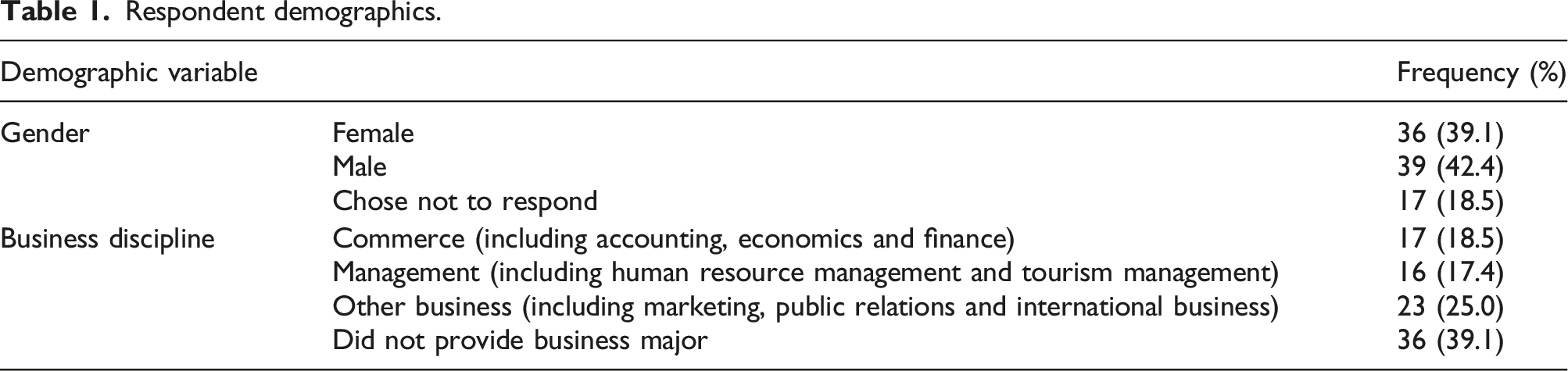
In addition to several open-ended questions regarding work experiences and career aspirations, respondents were asked to indicate their level of agreement with a series of 10 statements regarding graduate employment and work experience on a five-point Likert-type scale of strongly agree to strongly disagree with a neutral option. Because using the arithmetic or weighted mean as a measure of central tendency has been questioned for analysing ordinal data (Göb et al., 2007; Jamieson, 2004; Sullivan and Artino, 2013), such as scales based on value judgements regarding reflections of reality and feelings, the distribution of responses for each statement is presented as simple descriptive statistics, with comparisons of weighted proportions relevant to the item measured. Students were also asked two open-ended questions relating to the skills need to get a graduate job and advice they would give concerning obtaining a graduate job. This qualitative data was analysed through a phased process of thematic analysis via hand-coding (Saldaňa, 2012). Because many responses consisted of short phrases these were first deductively coded to the types of work experience they referred to: namely unpaid work experience, paid professional work experience and non-professional/part-time work experience. Within these categories, interpretive codes were applied through an analytical reading of the data focussed on its perceived value in relation to employability. These are presented in conversation with the qualitative questions to which they are broadly aligned. Where quotations are included these have been assigned pseudonyms based on a combination of gender, age and business discipline of study (e.g., F21 management would refer to a 21-year-old who identifies as female undertaking a business degree with a management major).
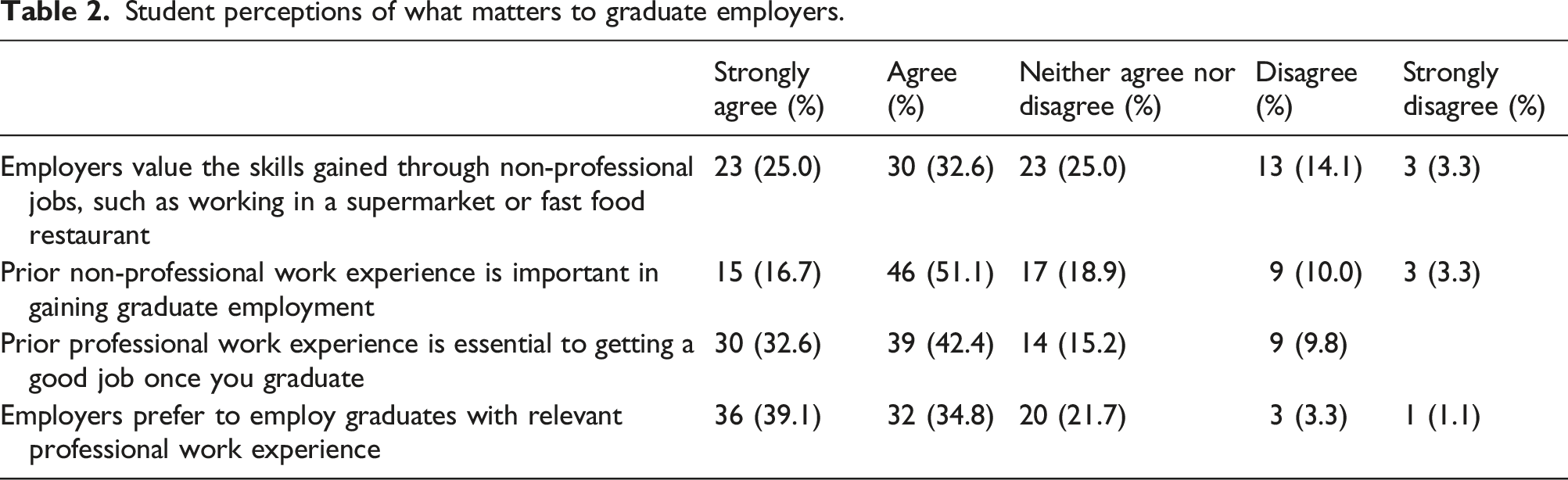
Student perceptions of what matters to graduate employers.
Student perceptions of work experience.
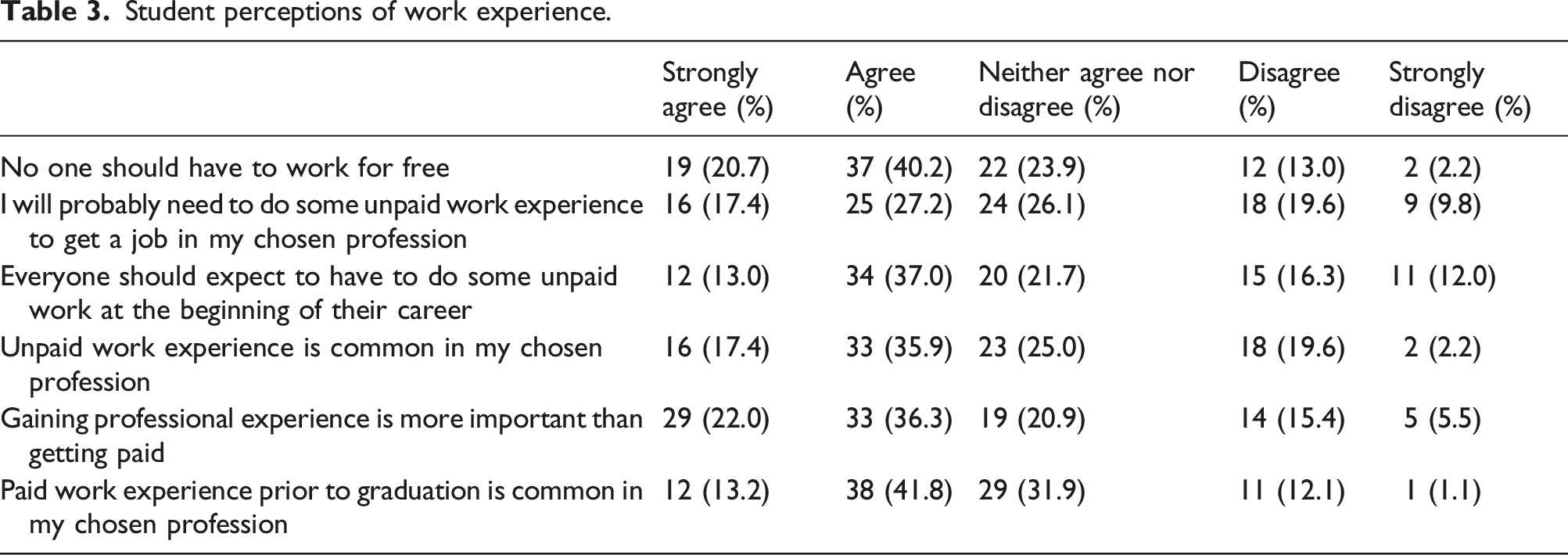
These views regarding the value of professional work experience were however presented with a degree of pragmatism by some respondents as evidenced by the following quote: “It’s better you have a job unrelated to your career where you can work part-time or casually and focus on your studies than to burn yourself out trying to do uni while working as slave labour at an unpaid internship 4 days a week in your ‘dream company.’” [M20, management major]
For all questions, there was a surprisingly high level of neutral responses ranging from one in seven respondents (15.2%) for the question relating to the importance of prior ‘relevant’ or professional work experience for getting a graduate job, and close to one-third of respondents (31.9%) for the question relating to the ubiquity of paid professional work experience in their desired future business area. This high level of non-committal response could indicate a low level of awareness regarding whether or not they should be getting paid for the work they do under the guise of WIL or work experience such as internships. For some questions, it could also be indicative of a low level of confidence in their knowledge regarding what matters to graduate employers. This is consistent with research that has called for graduate employers to be more transparent or explicit in terms of what they are recruiting for in graduates and how graduates can demonstrate desirable but ambiguous qualities such as curiosity or courage (e.g., see Handley, 2018).
Many employers and graduate recruiters consider it important that business graduates have some business work experience prior to graduating (Hodge and Burchell, 2003) and equate relevant work experience as a signal of career interest and as a “marker of employability and talent” (Pollard et al., 2015: 166). Research has found that many recruiters are influenced by the perhaps flawed assumption that the presence or absence of certain information on a CV, such as relevant work experience, is solely due to applicant dispositional factors (Cole et al., 2007). Despite this, respondents were keenly aware that employability was constructed via a variety of factors, including some beyond their control. This conflation is well expressed in the following respondent quote: “Obviously you need to be ‘employable.’ In terms of employability, I think it’s a combination of several factors. You need to have good personal skills as well as strong communication skills in terms of being clear and well spoken. Also showing the ability to work on your own and use initiative as well as having a general work ethic for the job you are completing. Personal connections I think are very valuable as that is what got me my current job.” [M19, finance major]
However, the extent to which all students can do so is not equal. Research has consistently shown students who are advantaged in terms of their social and economic status can trade on their connections to secure better employment, including graduate employment (Hossain et al., 2020). Our research participants were also aware of this, even if in a somewhat uncritical way: “Choose a course that you’re both interested in but also an industry in which you might be able to get a leg up because of your own personal connections or your parents/friends/other family members connections. For my studies…my family has extensive relationships within the property industry and that has helped me immensely in gaining work experience which I expect to assist me in gaining graduate employment.” [M19, property economics major]
Is accrediting part-time work the answer?
Employability is, in part, created through graduate skills and attributes which must be packaged in a way that is attractive and intelligible to prospective employers (Brown et al., 2004). It has been suggested that although students may have developed the skills desired by employers, part of the problem is that they are unable to articulate this to prospective employers and do not make the best of it in their applications (Evans et al., 2015). As a result, the possession of soft skills and personal qualities can be difficult to assess in a CV and are often by proxy evidenced by hard currencies such as credentials which serve as a heuristic device to simplify employer recruitment decision-making (Greenbank, 2014). In this context, accrediting part-time work is presented by Evans and Richardson (2018, 2017) as a form of credential or hard currency for graduates entering the professional employment market.
There is potential value in proposals to accredit part-time work if this approach was proven to increase access to graduate employment opportunities and increase the value of part-time non-professional work beyond the money earned. However, there are several considerations and challenges to be overcome if accreditation were to become an accepted approach. Pragmatic considerations include further discussion of the kind of processes required to assess levels of achievement accurately and fairly. For example, would students’ part-time employers in their McJobs be required to confirm skills assessments (or at least employment) or would such processes be largely self-report by the student? And if so, how would this differ from the resumes or online profiles and endorsed skills profiles that students (and recruiters) already have access to via platforms such as LinkedIn? Although it has been suggested that there is a high level of consistency in the soft skills desired in applicants for both part-time non-professional work and graduate positions as evidenced by job advertisements (Evans and Yusof, 2021), another pragmatic consideration is whether a generic approach to accreditation could be adopted or whether the accreditation would need to be more deeply connected with the expectations and ‘language’ of different disciplines and graduate destinations.
A very real concern is that formal recognition of the skills developed through paid part-time work is unlikely to compensate for the benefits accrued from participation in professional work associated with the development of professional networks (Groves et al., 2022; Naseem, 2019; Tran et al., 2021) and the identity work associated with presenting oneself as professional and employable (Ashton, 2011). As this human, social and cultural capital is highly influential in employability (Smith, 2010) it is unlikely that the accreditation of paid non-professional work can replace other forms of work experience in facilitating the transition from education to employment, particularly if changes are not made to employer expectations and understandings. As part-time work is less likely to be undertaken by students of middle-class or wealthy backgrounds, there is the potential that the presentation of these credentials may inadvertently signal class differences which could have a negative impact on employment outcomes in certain industries or with elite employers. Furthermore, given the prevalence of participation in part-time work the widespread recording and accreditation of this work is unlikely to confer any positional advantage over other job seekers, in much the same way as has occurred with rising levels of education (Tholen, 2022).
In responding to Evans and Richardson’s (2017, 2018) proposition for the accreditation of students’ part-time work, we welcome the shift away from an increasing normalisation and over-reliance on unpaid work, such as internships as the only way to demonstrate work experience and the capacity to display appropriate workplace behaviours and traits in lieu of paid professional work experience. We also welcome the attempts to make visible and valuable “an element of students’ lives that is often invisible” (Beban and Trueman, 2018: 102). However, we are less convinced that HEIs ‘accrediting’ part-time work experience is the solution to ensuring the skills developed through non-professional part-time work are appropriately considered in employability assessments, particularly when research has repeatedly shown that although students and graduates recognise its worth, part-time work is not highly valued by employers (Eriksson et al., 2017; Humberg and van der Velden, 2015; Kinash et al., 2016).
The challenge to employers
Some (justified) criticism has been levelled at employers and the perception that they are “taking advantage of significant pools of graduate recruits” (Jackson, 2021: 193) in terms of asking for degrees for recruitment to roles that previously did not require them. It could also be suggested that increasingly higher benchmarks for graduate soft skills and prior relevant professional experience for entry-level roles alongside falling investments by employers in work-based training (Mason, 2020) and an expectation that workers with higher-level qualifications make a co-contribution to training costs (Shah, 2017) also fall within this critique. If employers genuinely believe that relevant work experience must be the primary means by which graduates become employable it is beholden upon them to find ways of making such experiences accessible to all students, not just those of means. Indeed, as Jackson (2021: 193) has noted “more is needed to achieve the mind shift among employers that interweaving professional practice into degrees is also their responsibility.”
Employability is often framed as a personal responsibility (Moreau and Leathwood, 2006). Requiring students to engage in additional recording, documentation and accreditation of their skills could be perceived as part of an ongoing process of responsibilisation through which students become wholly responsible for their employment outcomes. In opposition to suggestions that students are unaware of the value their part-time work provides (Evans and Yusof, 2021) Grant-Smith and McDonald (2018a) found that the students they interviewed were very capable of identifying the transferable and soft skills developed through their part-time work experiences and could both make these connections and confidently express them. It may therefore be graduate employers, not graduates, who have a narrow understanding of the benefits this work brings to professional employment. Consequently, we suggest that rather than an issue of skills possession, articulation or accreditation, the main stumbling block to ensuring part-time work is recognised as a valuable contributor to graduate employability is employer attitudes. Perhaps employers need to be educated about the transferability (and desirability) of the skills developed through part-time work beyond simplistic assessments that they would choose a graduate with part-time work experience over one without any experience and toward recognising the value they bring (Evans et al., 2015). An example can be seen in graduate employer perceptions of hospitality-based part-time work experience. McMurray (2016: 123) report an employer view that “commercial work experience is far better than something like bar work.” The top transferrable skills identified by students that were developed through part-time hospitality work in pubs, bars, restaurants and fast food outlets were adaptability, interpersonal and team working skills, dealing with busy and stressful situations, communication skills and time management skills (Martin and McCabe, 2007). These seem highly compatible with the skills that employers are seeking in graduates (World Economic Forum, 2023) but which they claim are not being provided via participation in higher education (Archer and Davison, 2008; Pennington and Stanford, 2019; Rose and Flateby, 2022).
As noted by Prikshat et al. (2020: 379) given the diversity in graduate employment opportunities “employers cannot expect graduates to have a ‘complete’ suite of competencies that enable them the fit straight into any job” or per Atkins (1999: 267) be “oven-ready and self-basting.” Although “some employers may be seeking to transfer training and staff development costs from themselves to others (McMurray et al., 2016:113), it is not unrealistic to expect that graduate employers should exercise their shared responsibility to support graduates to succeed through suitable onboarding and induction programs, effective supervision and mentoring and allowing a reasonable period of adjustment. The employer emphasis on relevant work experience should see them driving the provision of high-quality work-integrated learning activities, however, research suggests that although “relevant work experience is highly valued by employers and is very much part of the [graduate] employability agenda” (Pollard et al., 2015: 59). Paradoxically, few provide access to placements or internships for business students (Chartered Management Institute, 2014: 8).
A key driver of the ‘job-ready’ graduate agenda, in Australia at least, has been the many mass-scale surveys of business and industry (i.e. employers) around the abilities and employability of graduates, particularly from a deficit perspective (Moore and Morton, 2017). HEIs have become increasingly complicit in facilitating employers to abrogate their responsibilities concerning employability (Osborne and Grant-Smith, 2017). Rather than adopting accreditation processes as an instinctive response to accommodate a lack of employer willingness to acknowledge the skills developments through part-time work, perhaps it is the role of HEIs to revisit the reasonableness of employer expectations and resist further claims of responsibility for student employability which fall outside their remit and responsibility. It is the obligation of HEIs to provide educational outcomes which may be beneficial across the career of a graduate rather than aligning too closely to business requirements and demands that may be short-term or focussed on the needs of specific employers rather than society (McMurray et al., 2016). Instead, universities should focus on teaching students to learn how to learn and how to think critically (Osborne and Grant-Smith, 2017), skills that will serve both graduates and employers well into the future and not on developing (or recording) job-ready skills.
Conclusion
There is scant evidence to suggest that formally recording skills development will fundamentally change employers’ perceptions of the relative value of non-professional work experience. Indeed, there is research that suggests that graduate portfolios, profiles and records of achievement are not valued by employers when making recruitment decisions (Kinash et al., 2016). Consequently, we argue that perhaps the focus on accreditation is misplaced and instead should be on (re)educating employers and those making recruitment decisions. Tran (2019) notes higher education and graduate employment are just the beginning of a complex employment trajectory. When assessing the value of proposals to accredit part-time work, it must also be considered who the beneficiaries of recording and validating the skills and attributes gained through non-professional work experience are and whether these are shared equally between students, HEIs and all employers. There must come a point where industry recognises that students are in higher education for a very small percentage of their working lives and that proposals that place additional burdens on students and HEIs to prove employability to employers could be construed as supporting industry to evade its responsibilities to the next generation of workers. Similarly, we must avoid one segment of industry, the service and hospitality sector, being responsible for training graduates in soft skills and recording and validating their achievement of such competencies, for the benefit of another, namely elite and graduate employers.
Footnotes
Declaration of conflicting interests
The author(s) declared no potential conflicts of interest with respect to the research, authorship, and/or publication of this article.
Funding
The author(s) received no financial support for the research, authorship, and/or publication of this article.
