




Abstract
Charities are facing a crisis in recruiting board trustees. Additionally, boards have been criticised for lacking diversity and being unrepresentative of society. The purpose of this paper is to propose a solution to the problem of trustee recruitment, by considering university business students as trustees. Through an analysis of advertised trustee jobs, the proposal is evaluated against degree subject benchmark statements. The findings identify some key person characteristics specified by charities when recruiting trustees. The generic criteria could be met by most students and many of the personal skills are developed by students while at university. However, to address some of the experience criteria, may require additional training and some yielding by charities. The paper offers originality in its proposition of appointing university business students as trustees and in its approach to examining the feasibility of that proposition through an analysis of trustee jobs.
Introduction
Trustees are vital to the work of charities, establishing strategic purpose for the organisation in line with its vision and ensuring its work reconciles to the needs of its beneficiaries (Charity Commission, 2018). Trustees have legal responsibility for, and control over, a charity’s management (Charity Commission, 2018), ensuring in particular, that a charity’s money is protected and properly accounted for (Charity Commission, 2020).
However, UK Charities are facing a crisis in recruiting trustees (Gilmore, 2018). For example, one survey found that 51% of charity boards were struggling to recruit new trustees (Ecclesiastical, 2022). Another source suggested that that the figure was even higher, with 74% of UK charities struggling to recruit trustees (Getting On Board 2017). While there is criticism of recruitment practices (Getting on Board, 2017), the ability to recruit and retain individuals with skills that will support and drive the aims of the charity remains a challenge (Wheakley, 2017), especially for small-medium charities (Price, 2019).
The inability to recruit trustees could possibly be worsened by the prevailing difficult economic conditions, with more people taking on paid side-lines or paid part-time jobs, rather than volunteering (Hargrave, 2022). In addition, charity boards have been criticised for lacking diversity especially in respect of age and ethnicity (Horan, 2019) and therefore, being unrepresentative of society (Pavey, 2016). In particular, Charity Commission research (Charity Commission, 2017) found that the average age of trustees was 55–64, and even older in smaller charities.
As a consequence, charities have been advised to widen their recruitment net, to move away from looking at their usual internal networks, something that has not generally helped to provide a diverse board mix (Joseph, 2013). The National Council of non profits (2023) recommends that charities consider diversity of ability, age, ethnicity, gender identity, geography, immigration background, race, religion, sexual orientation, and socioeconomic status. In addition, Muñoz (2023) also suggests diversity in thought and professional experience. If, however, charities continue utilising their own internal networks to recruit trustees, this will not potentially increase numbers or a diverse mix of persons.
The Charity Commission (2018) suggests that diversity in trustees is important to help charities be fair and open in its ideas, in order to improve decision making significantly. Syed (2019) argues that diversity encourages “rebel ideas”, that if decision makers all have the same make up and background they will come to the same answer, which may not be beneficial for the charity. Conversely however, if there are people in the decision-making process who have different backgrounds, they may see problems radically different and suggest alternative solutions. As BoardSource (2023) notes, a lack of board diversity may mean the charity is ineffective in addressing societal challenges and inequalities. Moreover, Harris (2014) finds a connection between diverse boards and organisational performance. Overall, Syed (2019) suggests that diversity is central to helping organisations be innovative and make effective strategic decisions. These are not however, UK-specific problems. Similar challenges in recruiting board members to charities have been noted in Singapore (Lamy and Akhtar, 2015). In addition, a call to diversify board composition has been echoed in the US (Taylor, 2018). The Leading with Intent Study (BoardSource, 2021) of US nonprofits indicated that 78% of board members are White/Caucasian/European and only 9% are under 35 years. As a consequence, Andrade (2021) feels that board diversity is a significant contemporary issue facing non-profit organisations.
One possible solution to widening the mix and composition of boards for charities to consider is an ‘associate board. An associate board is a body of individuals who support a non-profit organisation’s main board of trustees (Desai, 2021). Its purpose is to provide experience for those who are not yet ready for a position on the main board. Associate board members have no formal governance responsibilities, but contribute through working on committees (Blackshaw, 2022). Associate boards can provide a vehicle for individuals to ‘step up’ to full board positions and therefore, facilitate a degree of succession planning. Nonetheless, they have not yet taken-off in the UK, possibly because 96% of the UK voluntary sector comprise small charities (income<£1m) (Lloyds Bank Foundation, 2023) and so lack the resources and networks to recruit and sustain associate board activity alongside their struggle to recruit mainboard members. The focus therefore, remains on recruiting to the main board of trustees.
An ideal solution?
The Charity Commission for Northern Ireland (2014) has suggested Charities should approach local universities or colleges and their student unions, to help develop diversity in trustees. This suggestion of recruiting students as trustees potentially yields positive outcomes for all parties. Charities could particularly benefit from the appointment of business and management students, with the bringing of up-to-date knowledge and developing a more diverse board. Yet it is not only that boards would be exposed to new ideas and alternative perspectives by recruiting university students, but as Manning and Napier (2020) note, millennials have an ability to understand and engage their generation, which can help boards be more aware of changes in the operating environment, and to encourage other millennials to become doners (Gorczyca and Hartman, 2017).
For business students, a trustee position can help develop managerial and strategy skills and boost a CV (Strachan, 2016). Moreover, it offers students the chance to network with other trustees and to create contacts who may support longer-term career aspirations. The opportunity to develop appropriate work skills through workplace exposure can help develop students’ employability skills and improve work-readiness (Brooks and Youngson, 2016). With business students, charities will get a trustee with a broad range of management, marketing and financial knowledge (QAA, 2019). Being a trustee offers business students the opportunity to apply that knowledge base in practice, being tasked with developing strategic plans, committing significant resources to projects, and work at the highest organisational level (Charity Commission, 2018; Inglis et al., 1999).
Some form of work experience is now deemed to be important for university students (Highfliers, 2019), giving not only a taster, occupational orientation, but helping to develop employability skills such as team-working, communication and problem-solving, deemed vital by employers. However, securing good placements can be problematic (Hutchinson, 2009). Moreover, the situation has been made increasingly difficult by the prevailing cost of living crisis, with employers cutting back on internships and placements (Cambourne, 2022). With the demand for charity trustees high, the premise of gaining work experience at the highest organisational level that should be attractive to business students. Additionally, the development of managerial and leadership skills that volunteer organisational settings can help to cultivate (Gordon and Gordon, 2017), make it an attractive proposition for business students. Universities support the career development of students in a variety of ways, encouraging and supporting them to become charity trustees is potentially a new route.
Subject knowledge for business and management.
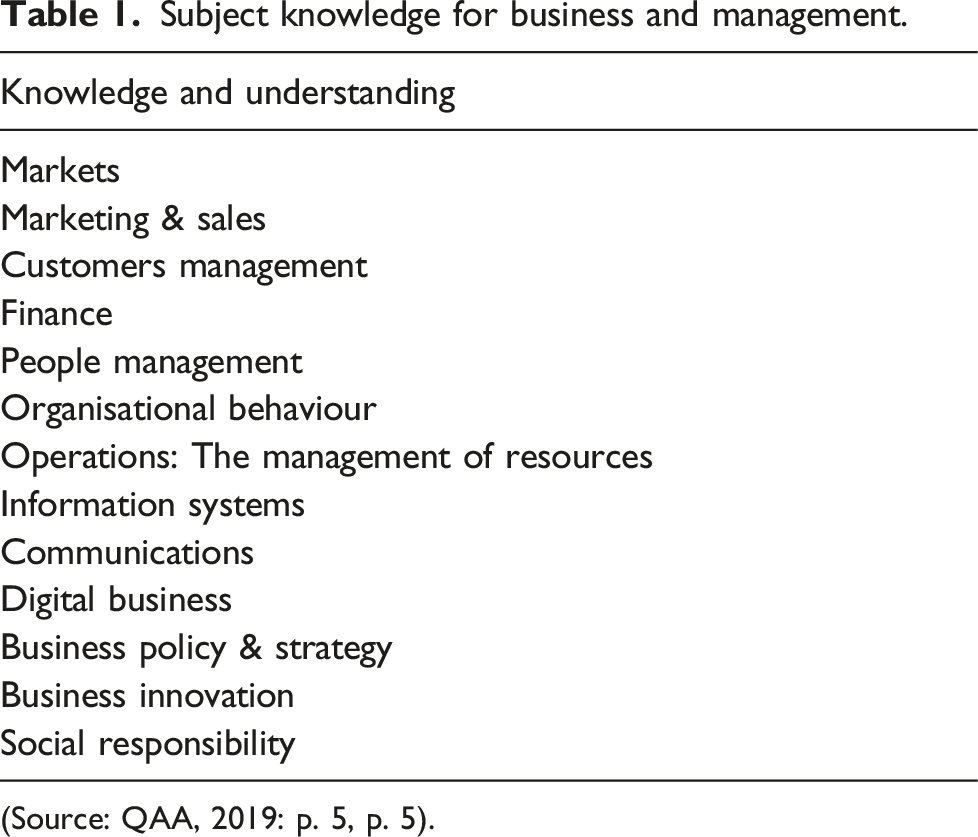
(Source: QAA, 2019: p. 5, p. 5).
Skills and practice for business and management.
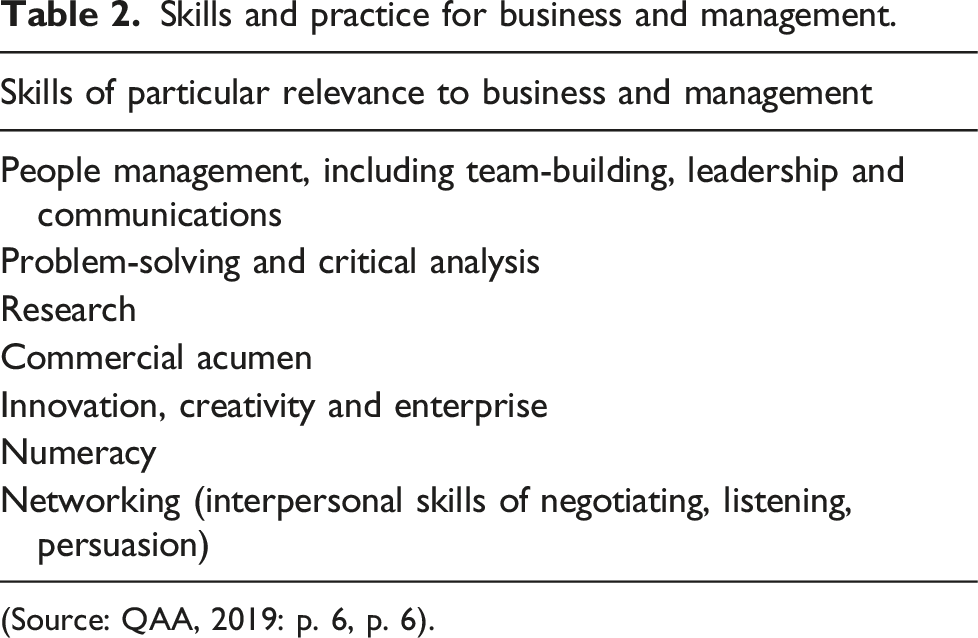
(Source: QAA, 2019: p. 6, p. 6).
Other generic skills and attributes.
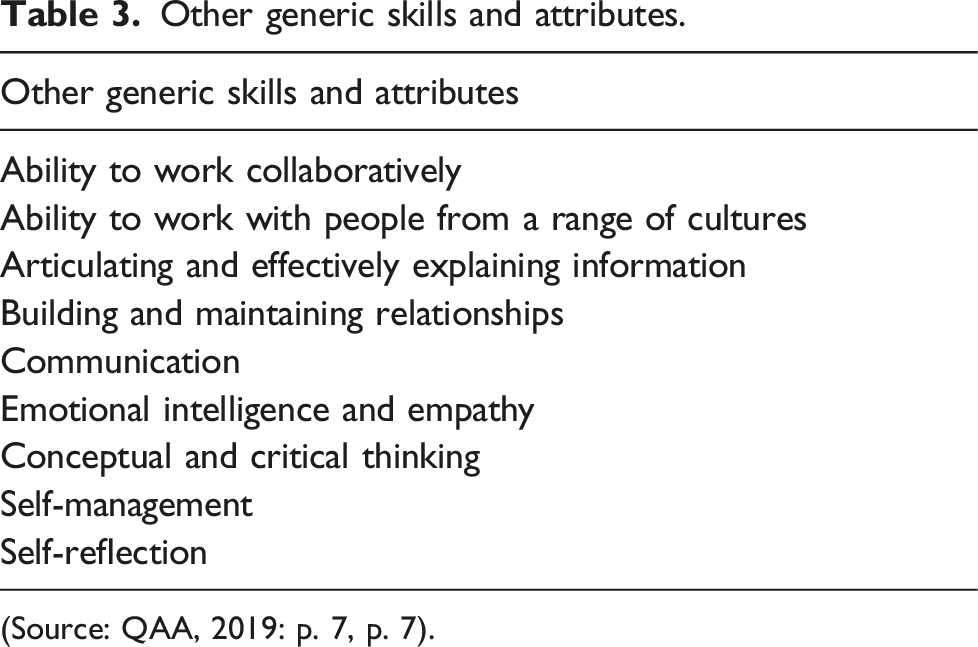
(Source: QAA, 2019: p. 7, p. 7).
QAA subject benchmark statements have however, received some academic attention, particularly their impact (Piddock, 2006), purpose (Quinlan, 2016), datedness (Morgan, 2015) and impact on learning and teaching (Yorke, 2002). Eastwood and Blumhof (2002) note that subject benchmark statements are intended to be indicative rather than prescriptive, a point emphasised by QAAs Chief Executive (Stott, 2022). This does, however, suggest a degree of flexibility in the design of courses, which could potentially result in inconsistencies or different interpretations, in the way the subject benchmarks are embedded and assessed in degree programmes. Nonetheless, as Bellingham (2008) notes, institutions are expected to consult the subject benchmark statements when designing, delivering and assessing programmes. As a result, most universities deem benchmark statements as compliance elements in their degree design, rather than using them as reference points (Harrison, 2023). A Business and Management graduate therefore, would possess a range of business knowledge and employability skills in their profile. Yet, Whetten and Cameron (2015) recognise the importance of practical application in developing management skills in addition to the more formal education. This reconciles to criticisms of employers that graduates are not adequately prepared for work (Young, 2023), particularly in softer skills (Ting and Ying, 2012). This has led Ritter et al. (2018) to recommend a redesign of business degrees to better develop softer skills, while Siddique et al. (2022) seek similar improvements in developing graduates’ communication skills.
However, developing business students’ management skills through practice and application has always been difficult to replicate in the classroom environment, although use is typically made of simulations (Alstete et al. 2019; Lohmann et al. 2019), role plays (Mercado, 2000; Shen et al., 2015) and case study exercises (Doran et al., 2011; Hodgson et al., 2014). How well these prepare students to be effective managers in the workplace has however, been questioned (Raelin, 1993) especially in terms of strategic management skills and competences (Bonn, 2001). Management skills are deemed to comprise planning, organisation, problem-solving, decision-making, commercial awareness, effective communication and inter-personal skills such as team-working (Armstrong, 2012; Smith, 2022). Griffin and Van Fleet (2008) in particular, feel that individuals need to experience the challenges and pressures associated with the workplace to develop deeper insights into the nature of managerial work. Similarly, Hirsh and Carter (2002) recognise the combination of formal training alongside personal support and work experience, as contributing to management development. Outside of a formal learning environment, management development can comprise mentoring, coaching, shadowing, secondments and communities of practice (CIPD, 2022). It is the sharing of experiences with other managers in the workplace that Becker and Bish (2017) find useful in developing managerial competences. Practical experience is therefore, deemed to be important, in developing managerial competences (Gibson, 2008).
Focus of the paper and research objectives
The benefits for students in becoming charity trustees is centred on developing employability skills, gaining valuable work experience and forming networks. However to what extent do business students meet the specified person criteria for trustee positions, or are the requirements too onerous? If the latter applies, then do charities need to reconsider what it is they are looking for, given the ongoing trustee recruitment problem? Though analysing person criteria of trustee job advertisements, this study aims to determine whether undergraduate business students would be able to apply for trustee positions. The focus here is on undergraduate business students, since they will study that discipline typically over 3 years of full-time study. Postgraduate business awards will usually be 1 year of full-time study and could be more specialised awards (e.g. supply chain management) or be business conversion-type awards, where an individual may well have studied a different discipline at undergraduate (e.g. chemistry). There are two objectives in this study: • Examine the specified person requirements of trustee posts. • Evaluate the extent to which business students comply with the person requirements of trustee posts
In addition, the implications of the findings for students, universities and charities will be discussed. Student volunteering in charities has been examined previously. For example, Holdsworth (2010) explored students’ motivations behind volunteering and found a complex interplay of factors. Williamson et al. (2018) examined the benefits of volunteering to student while Holdsworth and Quinn (2010) broadened this out to include benefits to wider communities. Nonetheless, students taking on trustee positions has received little attention. This work, therefore, offers originality in its premise by proposing a practical solution to charities who are currently struggling to recruit trustees and also for students who may have difficulty in obtaining a suitable internship or placement activity at this time of economic hardship.
Research method
Classification of advertising charities (n = 218).
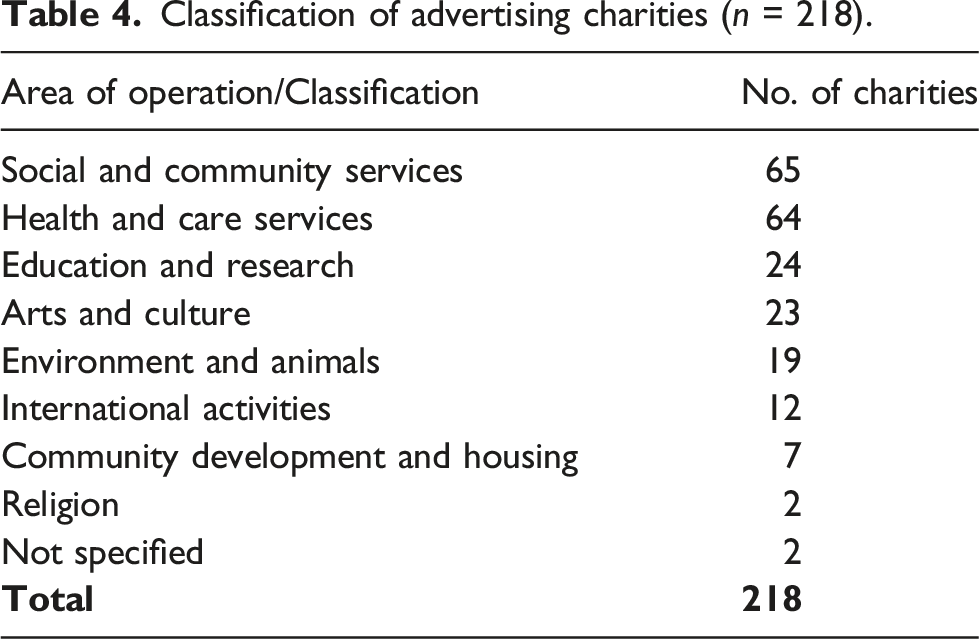
Only the person specification on the advertisement on the jobs Web site was analysed, with no further level of analysis conducted, for example, of the job description or tracing back to the organisations’ own Web site.
Only general trustee positions were analysed. Trustee jobs requiring a functional specialism such as treasurer trustee, which typically requiring a qualified accountant or law trustee, (typically requiring a lawyer, was not included. Also, chair of trustees not included, as these will require experience of board procedures, something students are assumed not to have been exposed to at this point in their careers.
The person specifications’ criteria were analysed and categorised into: • Generic – for example Time commitment, commitment to charity vision/mission/cause • Personal Skills/Qualities – for example communication, team-working. • Experience – for example sector specific, fundraising (i.e. raising funds for the charity/generating income), safeguarding • Professional Expertise/Experience – for example Accounting, HR, Marketing
The descriptive statistical data of the specified person criteria are presented in tabular format. Allowance was made for semantic differences for each skill criteria and flexibility in what might be included for each specified term, for example, communication skills could include verbal, written, telephone etc. Accompanying analysis and discussion will examine the specified trustee job criteria against the subject benchmark statement for undergraduate business and management students (see Tables 1–3).
Findings and discussion
There was a broad spectrum of person criteria specified in the trustee jobs advertisements. These ranged from charities who would consider any persons, provided typically, they were committed to the charitable aims and could manage the time commitment, through to advertisements specifying more specific professional qualities, skills or experience, specifically needed by the charity. There was, therefore, no obvious weighting of what were the most important person specifications across the sector.
Out of the 218 identified trustee positions, there were 46 charities (21%) who either did not specify any criteria or would consider appointing persons without previous experience or qualifications. However, these were not a blanket open invite since advertisements tended to require commitment to the charitable aims or to be passionate about the charity’s mission. Given there were no specified criteria, other than being committed to the charitable cause, it seems these charities would be open to receiving applications from university students
Generic specification criteria
There were two generic attributes specified in the advertisements that did not fall into the other three categories: commitment to charitable aims/mission/vision, and time commitment. 80 (37%) of advertisements specified that the prospective trustee must be committed to the charity’s mission/vision/work. This is important, since Lee and Won (2011) indicate that a charity’s mission can be a key factor in attracting appropriate individuals to posts. In addition, 47 advertisements (22%) specified the time commitment of being a trustee for the charity. This was typically attendance at four to six meetings per year, which although should not be too onerous for a student. However, as Wilson (2018) states, trustee posts may also involve working on ongoing projects or contributing to specialist sub-committees and could potentially increase a student’s required time commitment (Table 4).
Personal skills/qualities criteria
Personal skills/qualities in trustee job advertisements (n = 218).
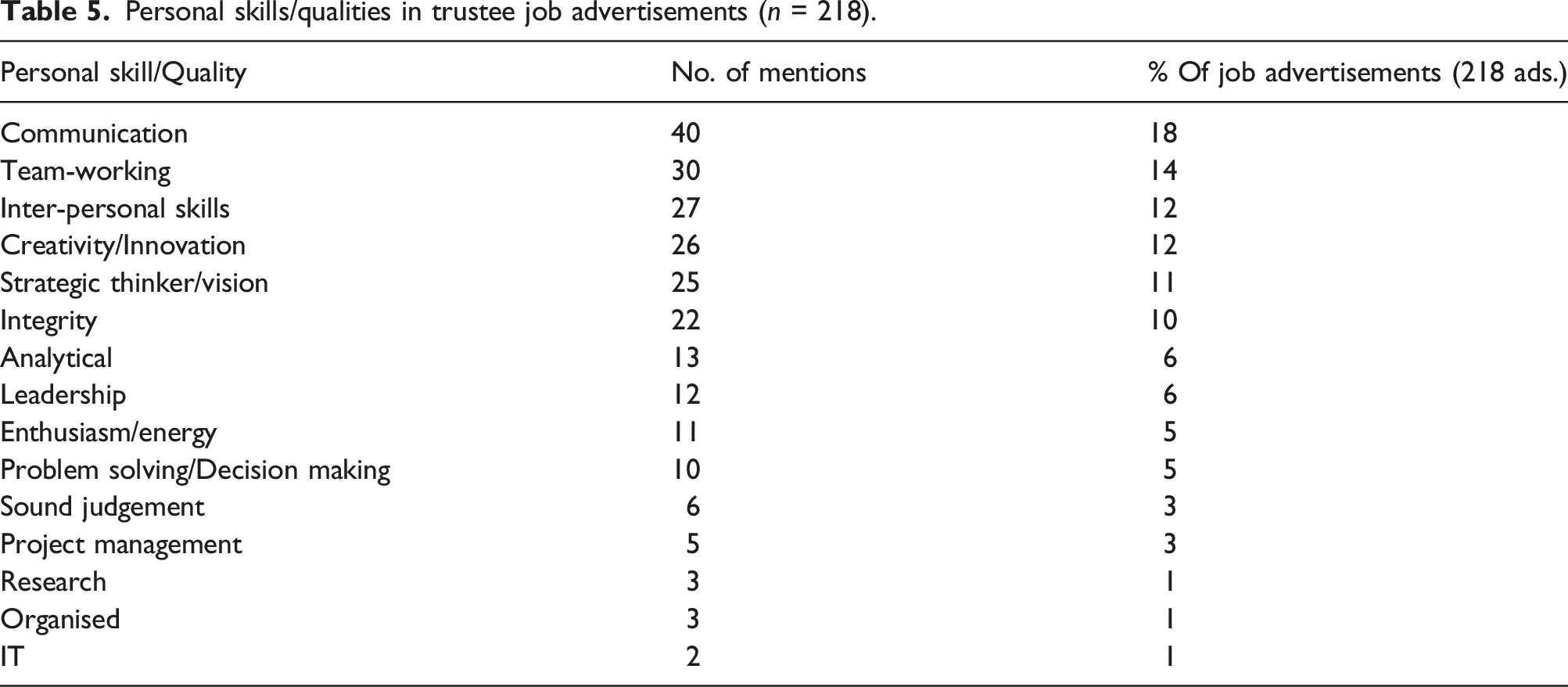
Personal skills/qualities stated in job advertisements compared to Business and Management subject benchmark skills and attributes.
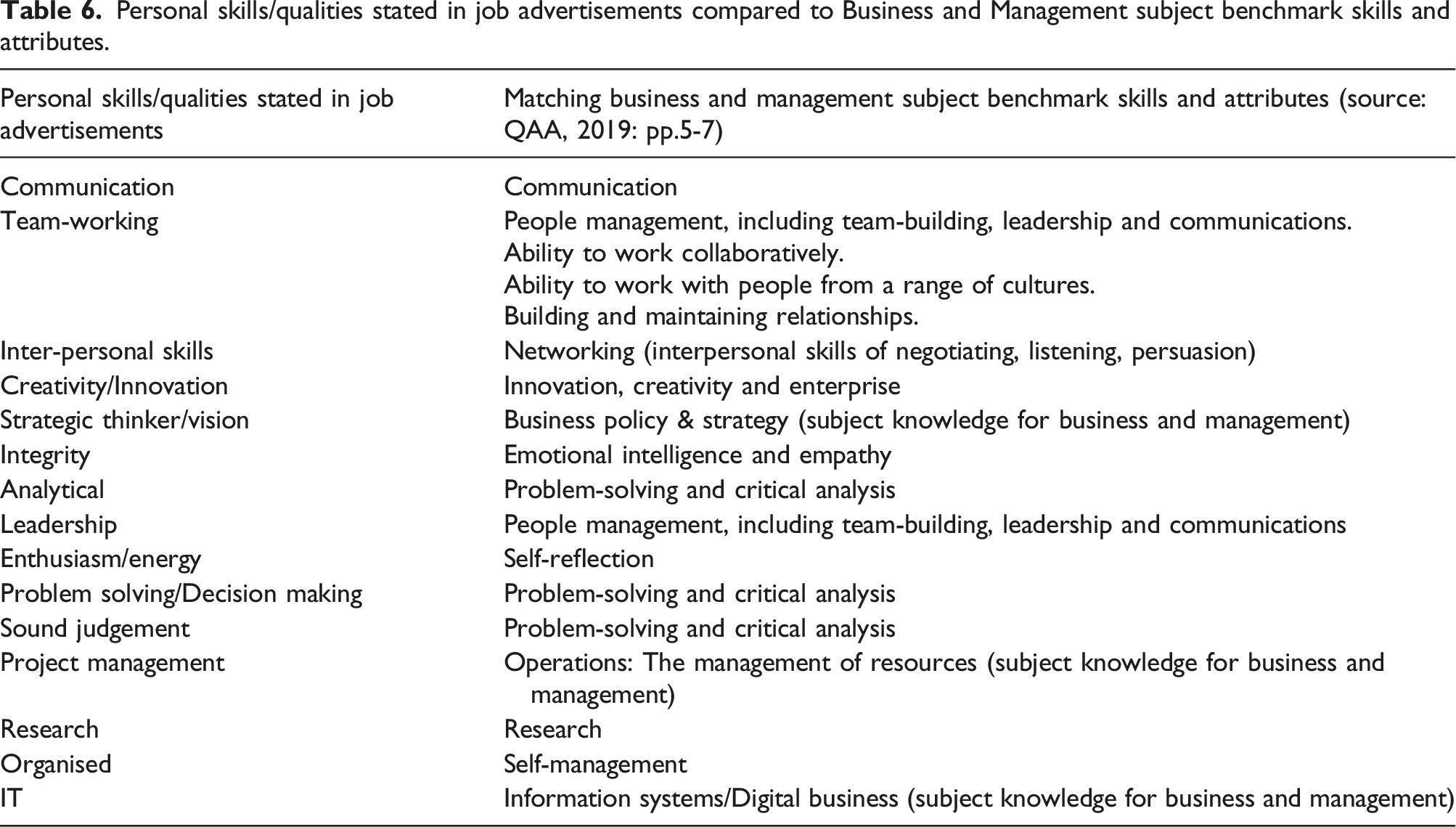
Specified experience in trustee job advertisements (n = 218).
Experience criteria
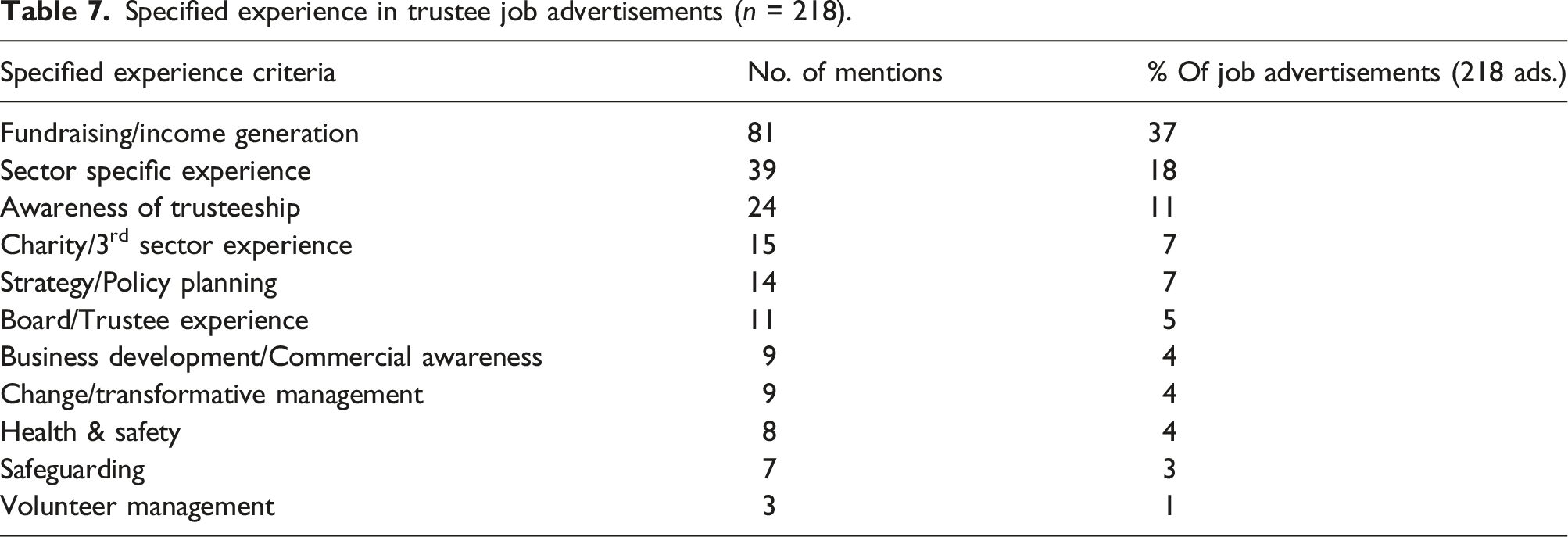
Table 7 suggests that experience is marinally more important than personal skills in the weighting of advertisements. There are 11 criteria recorded, and the most popular, fundraising/income generation experience is cited twice as much as the most popular personal skill (37% of advertisements compared to 18% for communication). Some of the specified experience detailed in the trustee job advertisements moved the jobs away from the reach of a typical business and management degree student. In particular, fundraising/income generation with the highest number of mentions with 81 (37%) of advertisements (see Table 7). This, along with business development (9 mentions) is probably to be expected at this time, with the current cost of living crisis adversely affecting charities (Henderson and Clark, 2022), driving them to seek out alternative sources of income and to maximise existing funding sources (Chan et al., 2021). While the lack of fundraising experience would indicate unsuitability of students for these Trustee positions, the skills required for effective fundraising, as stated by the Chartered Institute of Fundraising (2023) include the ability to communicate, build relationships and empathy, which are skills and attributes developed on a business degree (see Table 3). In addition, the financial hardships currently faced by students in their personal situation (Adams, 2022) could provide useful money-management and budgeting skills that could transfer into smaller businesses.
The need for prospective trustees to have either charity/third sector experience, or experience specific to the operation of the charity, such as education, healthcare etc. This experience criteria had a total of 54 mentions (25% of advertisements). In addition, 11 (5%) advertisements specified the necessity for previous board or trustee experience.
However, 24 (11%) advertisements specified the need for prospective applicants to have an awareness, rather than previous experience, of the role of a trustee, and the requirements of governance. This could prompt prior training from universities to prepare individuals for taking on trustee roles.
One of the problems associated with managing volunteers is the lack of commitment (Warburton et al., 2017), and here, three charities advertising required a trustee to take responsibility for volunteer management.
Professional expertise/experience
Professional expertise/experience specified in trustee job advertisements (n = 218).
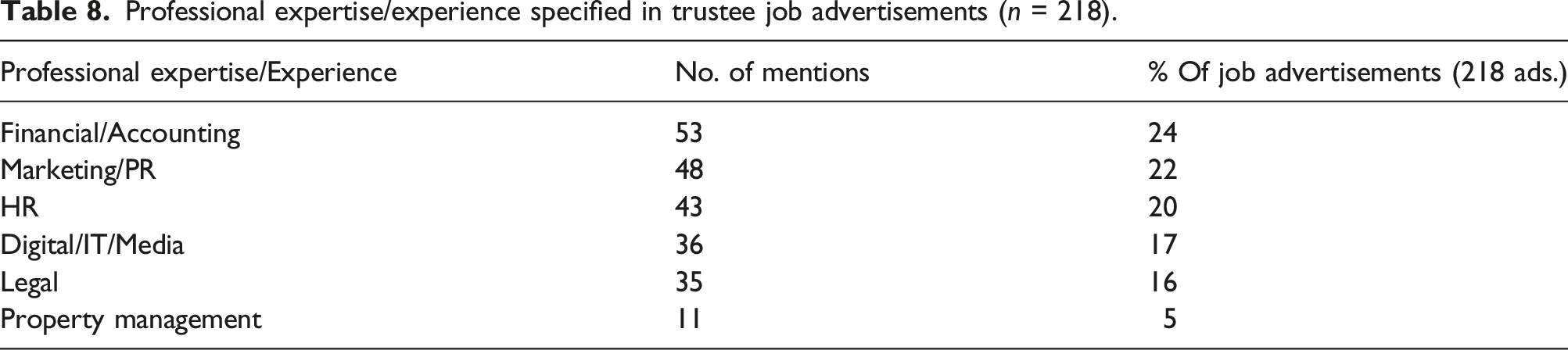
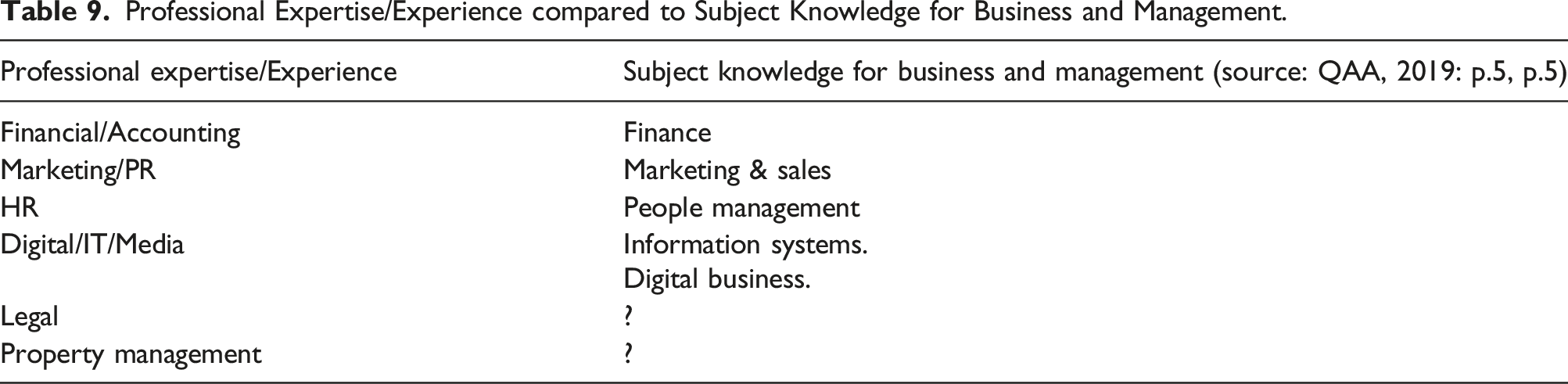
While the specifying of professional expertise/experience contained in Table 8 suggests these Trustee positions are beyond the attainment for business students, only 63% of the 86 advertisements specified that such criteria, were essential. The remaining 37% of the advertisements tended to be worded to either state or infer, that the criteria were desirable rather than mandatory. This is important for business students, who can focus on their other skills, knowledge and attributes, in securing trustee positions.
Professional Expertise/Experience compared to Subject Knowledge for Business and Management.
Conclusion
The findings identify some key characteristics of what charities are looking for when recruiting trustees. What is noticeable is that a fifth of advertisements are essentially open with no specific requirements, which does not present a barrier for interested business students. The four categories of person criteria highlight that largely, business students should not be excluded from becoming trustees. The generic criteria can be met by many interested and motivated business students, namely a commitment to the charity and having the available time. In terms of presence in the advertisements, the personal skills appear to be weighted the least important. However, they cover many of the skills and competencies which students are exposed to in their time at university. Some of the experience required, such as fundraising is very specific and might be a barrier, but several of the experiences highlighted are ones business students might already possess or acquire through suitable training. It might be expected that the professional experience required is a significant barrier, yet in fact of the most popular professional experience are ones business students are taught. Occasionally a charity may require specialists with very specific skills. However, our findings suggest much more often charities are looking for generalists, which represents a positive scenario for the recruitment of students, given the curriculum that business students are exposed to, tends to be generalist in nature. While the QAA benchmark statements are not mandatory for degree design, most universities deem them so (Harrison, 2023) and therefore, all business students will have progressed through a well defined business curriculum.
For most individuals, analysing organisations strategic context and developing corporate plans will be undertaken a long-way into their graduate careers. Yet this proposition, positions business students at board level, providing an opportunity to engage with strategic management at first hand, prior to graduation. In providing a solution to the shortage of trustees currently faced by charities, this represents a win-win for both parties.
This proposition of recruiting business management students as trustees will however, require some flexibility on behalf of both parties. While work experience is now deemed vital for students, their motivations are still largely focused on earning income (Crockford et al., 2015). Additionally, the reasons for students volunteering are typically complex Ghose and Kassam, 2014), although a personal connection with the aims of charity seems an overriding factor (Lee and Won, 2011). It will therefore, require more than merely attending four meetings per year, but a deeper commitment to drive the aims of the charity, immersing themselves fully in the charitable work. Students will also need to be aware of the legal obligations associated with being a trustee, which suggests some form of training will be needed, either from the specific charity, or from the respective university.
While charities will insist students follow established recruitment processes, Akpeki (2019) feels that charities need to be more receptive as to what individuals might be able to bring to the board rather than basing assessment on traditional themes. By targeting university students for trustee positions, moves charities away from looking at their usual internal networks. Francis (2011) suggested that non-profit organisations need to revise their recruitment strategies to attract greater numbers of university students to volunteer.
Additionally, charities may have to accept the potentially transient nature of the relationship, with students possibly resigning from the charity upon graduation to pursue their graduate careers, and therefore, after a relatively short period in post. However, from the advertisements observed in this study, remote trusteeship was permitted, attending meetings online. In addition, trustee turnover can be good thing in refreshing thinking, bringing innovation and driving a diverse mix (Fabry, 2020).
Perhaps the biggest change will need to stem from universities to support this initiative. Universities will have to re-focus away from large, commercial organisations for securing student placements, with a need for a greater working relationship between universities and charities, something that has been demanded for several years (Palmer, 2015). Moreover, the initiative may require curriculum development, to incorporate more third sector models, voluntary organisational case studies and charity finance into business students’ learning to provide context to support the trustee activity.
There are a number of alternatives to recruiting business students available to charities, not least engaging with effective succession planning to ensure continuity of skills and experience on boards and using existing networks and media to support (Froelich et al., 2011). Charities could seek to advertise for board members, although the ongoing problems highlighted by Gilmore (2018) in charities trying to recruit trustees suggests this is problematic. Nonetheless, Charity Excellence (2019) offers practical advice to charities in recruiting and advertising for board members. Perhaps targeting those retired offers a viable alternative. With an increasing aging UK population (ONS, 2021), the potential to encourage retirees to use their knowledge and experience by serving on a board seems to offer potential prospects (Volunteer Management Report, 2020). However, given that Charity Commission research (Charity Commission, 2017) found that the average age of trustees was 55–64, and even older in smaller charities, this potential solution would possibly exacerbate the issue of lack of age diversity on boards.
The concept of associate boards (Blackshaw, 2022; Desai, 2021) does perhaps offer charities an ‘interim’ solution by providing students with experience on committees and charitable projects but not on the main board. However, whether these would be as attractive to students, or whether charities have the resources to recruit and maintain such an endeavour is questionable, given charities struggles to recruit to their main board.
However, one of the criticisms aimed at charities, is that charities are typically not good at advertising trustee positions. It is noticeable that the advertisements identified in this study do not quantify experience in years, level, number of positions held, budget figure managed etc. While this flexibility does increase those applying, in could mean that the charity has to go through a number of applications that do not meet a ‘preconceived’ level. Cooman and Pepermans (2012) recognise that non-profit organisations, tend to focus more on altruistic and extrinsic values in job advertisements. However, lack of specificity possibly adds to the problem of the inability to recruit trustees within the sector.
There may be regional differences in trustee recruitment. For example, it might be easier to recruit individuals with financial expertise who work, or who have worked, in London or similar cities with financial districts. In addition, more densely populated areas will have a larger pool of individuals, than a rural area for charities to recruit from. However, if charities are increasingly utilising technology for virtual meetings, geography becomes less of a critical barrier to Trustee recruitment.
It seems that some charities are looking to fill gaps in their workforce, either because they are unable to recruit or do not have sufficient financial resources to afford professionally qualified persons, such as a qualified accountant or lawyer, and therefore attempting to acquire the requisite expertise on a voluntary basis. Several trustee advertisements referred to a ‘hands-on approach’ needed, especially where the charity was stated as small. Day-to-day management activities should be undertaken by an employed individual, not an unpaid trustee. A trustee should be overseeing the charity and ensuring its governance structures are appropriate, not to be involved in day-to-day operations, which seemed to be stated or implied in some of the job advertisements.
There is already some pressure for change in the composition of trustees. For example, the Young Trustee Movement (https://youngtrusteesmovement.org/) is already making progress in raising awareness among charities of the need to change the age demographic of boards. This provides impetus for charities to change their trustee demographic profile, especially in age and background terms.
Higher Education Institutions could individually and collectively act as further catalysts to enhancing and speeding up change in the diversity of charity boards. Universities have been criticised for neglecting the charitable sector (Palmer, 2015) and therefore the opportunity to connect and work with charitable organisations should now be prioritised.
This study was undertaken to present a potential solution for charities to overcome the problem of trustee recruitment. In doing so, it provides business and management degree students with a source of work experience at an organisational level that is not typically available through placements and internships. In short, it is a win-win for both charities and students. It therefore challenges the existing assumptions of degree students to consider alternative avenues to gaining work experience, moves charities away from their existing networks and sources of trustees and also demands that universities re-consider their relationships with charities. However, the study only kick-starts the process of reflection. It also challenges charities to think differently in terms of who and for how long they recruit, why and how they can maintain a relationship with those who may geographically move away from their location. This suggests news ways of thinking and operating for charities in terms of their trustees.
This study was limited in terms of sample size, method and generalisability, being limited to those charities advertising at that time and therefore, representing a small portion of the 168,850 charities in England and Wales (Statistica, 2023). In particular, it focused only on trustee advertisements, and therefore, further research is now needed that can confirm or modify the proposed proposition of appointing business students to trustee positions. In addition, one specific limitation which should be mentioned is that the sample was taken on only 1 day in December. It could be that taking the sample on other days of the year could have yielded different results due to seasonality factors. An important next step would also be to implement actual surveys with students and non-profit organization executives. It is suggested that such research would seek to ask students how attractive becoming a trustee might be, expand the understanding of what charities are looking for in trustees and assessing what training would be required for both students and charities to convert this proposition into actuality.
Footnotes
Declaration of conflicting interests
The author(s) declared no potential conflicts of interest with respect to the research, authorship, and/or publication of this article.
Funding
The author(s) received no financial support for the research, authorship, and/or publication of this article.
