




Abstract
While humanities graduates can aspire to many fields of work, these labour markets are mostly fragmented and relatively small. In order to be able to enter one of these potential professional fields in a targeted and successful manner, students in the humanities need to develop an individual professional profile. This profile comprises individual characteristics and competencies which include but also go beyond the qualifications from the study programme. Therefore, the authors postulate that specifically students in the humanities have to make many decisions in the course of their studies to prepare for a targeted career entry. From this background, it is important to know what factors are connected with their decision-making ability. This exploratory study examines the relationship of various individual factors with career decision-making adaptability (CDA) and thus on the decision-making competence on a sample of 872 humanities students from German and Swiss universities. A significant relationship with self-efficacy, conscientiousness, perseverance and professional information on CDA was found. The decision-making competence of teacher-training and non-teacher training students did not vary significantly. This study is based on the situation in German-speaking countries, but is also intended to be a stimulus for international comparison.
Keywords
Introduction
There is a saying in Germany that humanities graduates can do “everything and nothing”. This shows, albeit from a lay perspective, the uncertainty about which career paths are actually open to this group of graduates. And indeed, regarding the transition to the labour market and with respect to subsequent career paths, in Germany this group shows, on average, somewhat greater problems than graduates of other fields of study (Bundesagentur für Arbeit, 2020). In Germany as well as in the international context, in governmental publications as well as in research papers, the descriptions of their professional perspectives, however, are highly diverse. They range from claims that students of the humanities are “multitalented” and have available “a wide variety of work settings” (Counihan, 2015) to statements that their career transition is particularly difficult compared to graduates of other subjects (Haak and Rasner, 2009).
In Germany, traditionally and also in the expectation of employers, there is a rather close link between formal qualifications and the characteristics of a professional job. At least from the point of view of students, parents and employers, a university degree is strongly seen as a foundation for the later profession and less as a generalist qualification from where to start in various professional fields. Preparatory learning on the job has a less strong tradition here than in many English-speaking countries, for example. In this respect, the expectation among students and employers that a degree will qualify them professionally is quite high. In this respect, the humanities pose a particular challenge for students: Through them, a collective professional profile is not as clearly formed as, for example, in engineering or medicine. Rather, students must individually build a profile in order to prepare themselves for the small sub-employment markets usually targeted by humanities graduates. The basis of this individual profile is an intensive process of reflection and decision-making. In this process, individuals visualise, for example, what interests, values, goals, personality traits, professional experiences (e. g. from internships), further formal and informal qualifications etc. they bring with them in addition to their studies in the humanities. Whereas in the UK, for example, there are cross-university activities to describe the qualification profiles of various study programmes in the humanities in concrete terms (cf. The Quality Assurance Agency), in Germany this task formally lies with the individual university (mainly in accreditation processes) and is therefore dealt with very differently in terms of comprehensiveness. There are demands from higher education itself to systematically develop these subject profiles (cf. Wissenschaftsrat, 2015). However, these initiatives have not yet been taken up across the board. Thus, this task lies to a large extent with the students. In this respect, it is highly relevant, at least for German higher education research, to better understand this individual profile-building process. There has been little research on this topic to date. Therefore, the present work is dedicated to this aspect and is understood in its basic quality as an exploratory study. The focus is on factors that enable humanities students to make the decisions necessary for building an individual profile in a targeted and successful manner.
In winter term 2020/2021, more than 326,000 students in Germany were enrolled in the humanities (Statistisches Bundesamt). This makes more than 11% of all students matriculated in German universities. On closer inspection, in Germany the humanities graduates can be divided into two groups: One part experiences a difficult career entry, the other has a smooth and successful start (Briedis et al., 2008). This finding indicates that the quality of their career entry is not primarily determined by their field of study, that means it is not due to the fact that they are studying humanities. This raises the question what causes the difference between these two groups. Individual conditions and individually developed profiles with which humanities graduates obviously need to start into their professional career could be relevant here. Students of many other subjects enter fairly large and homogeneous labour markets (e.g., medical doctors, engineers, lawyers). In contrast, at least for Germany it is described that humanities students face a labour market with a broad variety of different, but quantitatively mostly small fields of employment (Konegen-Grenier, 2019). From this fact we can conclude that students of the humanities must individually set signals in order to develop a recognizable professional profile for these distinct labour markets. Profile-building internships, additionally acquired soft skills, focal points individually set during the degree programme based on intensive self-reflection or distinctive topics in the final thesis could be, to give some examples, such elements. This means that students in the humanities have to make many decisions during their studies in order to develop selected concrete avenues from a multitude of theoretically available career options. Without these decisions, they lack a concrete competence profile with which to navigate on the labour market. In other words, the ability to make decisions during and after the studies appears to be an essential factor contributing to the career success of students and graduates of the humanities in Germany. Therefore, it appears to be highly relevant to ask which individual factors contribute to the career decision-making adaptability of students of the humanities. If we know more about the factors that strengthen the decision-making adaptability, future research could investigate whether these factors vary in strength among students of the humanities. This might then be an approach to contribute to explain, why these students are differently successful in their transition to the labour market.
Konegen-Grenier (2019) describes the professional situation of humanities graduates in Germany in detail: The proportion of women in this group is above average. The unemployment rate of 4% corresponds to the average for the population as a whole, but is higher than the average for all university graduates. More often than the average of all university graduates, humanities graduates work part-time and are more frequently employed on a temporary basis. The five largest fields of employment for humanities graduates in Germany are education and training (23.5%), writing and computing (12.5%), artistic and journalistic work (10.1%), consulting and informing (9.7%), and advertising and marketing (9.2%), followed by a variety of other, smaller fields of work (Konegen-Grenier, 2019: 12). 42.7% of humanities graduates are employed in jobs that are rather atypical for their discipline (Konegen-Grenier, 2019: 15). The salary level of humanities graduates is below the average for all university graduates. In Kongen-Grenier’s study (2019), the great flexibility of humanities graduates becomes clear, as does their representation in a wide range of industries and occupations. Our study focuses the situation in Germany. Our insights, however, might be a starting point for further research in other countries.
Career adaptability and decision making
The construct “career adaptability” is based on the theory of career construction (CCT) (Savickas, 2005, 2013). CCT seems to be particularly suitable for examining the career development of students and graduates in the humanities given their specific challenges in shaping the course of their careers as described in the introduction above. According to CCT (Savickas, 2005: 43) careers “are constructed as individuals make choices” and the individual career biography “emerges from an active process of making meaning, not discovering preexisting facts”. This view fits well with the assumption that humanities students need to develop their professional profile through multiple decision-making processes. Besides the relevance of personality traits and developmental life stages as two important factors in CCT, career adaptability is the central self-regulation strategy described in that approach. Savickas (2005: 51) defines it as follows: “Career adaptability is a psychosocial construct that denotes an individual’s readiness and resources for coping with current and imminent vocational development tasks, occupational transitions, and personal traumas.” The transition from university to work can be regarded as such a particularly central and important process. Savickas himself (2005: 45) sees career adaptability as a prerequisite for successfully making a “sequence of matching decisions” to “synthesize self and society”. Career adaptability as a resource enable individuals to achieve “better career outcomes” (Savickas, 2020: 176). Building on Savickas, several researchers have focused on the decision-making aspect of career adaptability. Two of them are Gati and Levin (Gati and Levin, 2012), whose career decision-making adaptability index (CDA) we use in this paper. Career adaptability and career decision-making adaptability are considered as “similar but distinct constructs” (Levin and Lipshits-Braziler, 2021: 5).
The process of decision-making in career development in general has already been intensively researched (Di Fabio et al., 2013; Hanks, 2018; Udayar et al., 2020). The fact that and the way how individuals make decisions at career entry and in the course of their career biography have important influence on career success and well-being (Udayar et al., 2020). Therefore, difficulties in this process are an important aspect of research. In general, high career adaptability is positively associated with decision making (Leung et al., 2021; Rudolph et al., 2017). A distinction is made between indecision and indecisiveness. Career indecision is seen as a normal phase in the career decision process, which can for example be based on a lack of information. In contrast, indecisiveness is regarded as an individuals’ fundamental difficulty in making decisions. It is described as “a trait-like form of indecision that persists over time and situations” (Udayar et al., 2020: 610). In this respect, career indecisiveness is the greater hurdle in the career decision-making process and is therefore of particular importance for our study.
Individual conditions
To summarise: The successful career entry of humanities graduates seems to be closely linked to the development of an individual professional profile already during their studies as described in the introductory part above. Building up this individual profile requires repeated decisions by the students, because their individual profile is a result of opting in for some potential professional avenues (and acquiring the necessary competenices) and opting out for others. Career decision-making adaptability contributes to making qualified decisions. The aim of our study is to identify individual influencing factors that strengthen career decision-making adaptability. We investigate whether there are correlations between the independent variables self-efficacy, conscientiousness and perseverance, and labour market knowledge on the one hand and the level of career decision-making adaptability as dependent variable on the other hand. We have focused on characteristics that can be supported, developed, made aware of or changed through counselling and group offers. This is more difficult for other aspects we are not considering here, such as, for example, being a first generation student, belonging to an ethnic minority, etc. Thus, our paper gives indications of which potentials for change and development can be used to strengthen career decision-making adaptability among humanities students. In addition, we included humanities teacher-training students in our study to analyse whether they show levels of career decision-making adaptability that differ from non-teacher training students in the humanities. When we know about this, we can better decide whether teacher-training students need the same or different career decision-making support as non-teacher training students. Currently, in Germany, for example, teacher-training students often have fewer study-integrated opportunities to reflect on different career choices in order to make an informed decision for or against a career as a teacher. The need to know more about the career decision-making process of teacher-training students has repeatedly been expressed (e.g. Frazier et al., 2019; Rots et al., 2014).
Self-efficacy
Jerusalem and Schwarzer refer to Bandura (1999: 28), who defines self-efficacy as “the core belief that one has the power to produce changes by one’s actions”. Research indicates that self-efficacy is linked to career adaptability (Van der Horst et al., 2021). In addition, lack of self-efficacy contributes to career indecisiveness (Hanks, 2018), while high levels of self-efficacy are associated with objective and subjective career success (Abele and Spurk, 2009).
Against this background, we postulate:
The greater the level of self-efficacy among humanities students, the greater is their career decision-making adaptability.
Conscientiousness and perseverance
Research shows that conscientiousness is positively correlated with a rational and intuitive decision-making style and negatively correlated with decision-making avoidance (Bayran and Aydemir, 2017). In addition, perseverance “positively predicted career goal setting and career decision-making self-efficacy” (Lo Ting and Datu, 2020: 348). Therefore, we assume that the long-term task “profile building” that humanities students need to undergo is supported by conscientiousness and perseverance by strengthening their career decision-making adaptability. As instrument we chose the grit scale, because it was developed specifically for the career-related context. Originally developed to measure perseverance and passion for long-term goals and to predict success and performance (Duckworth and Quinn, 2009), for some time the grit scale has been controversially discussed concerning its construct validity (Duckworth et al., 2021). However, following the view of Credé, Tynan and Harms (Credé et al., 2017), the grit scale is appropriate to measure conscientiousness and perseverance (C&P).
We assume:
The greater the level of conscientiousness and perseverance among humanities students, the greater is their career decision-making adaptability.
Labour market knowledge
The question of what role career information plays in the process of career decision-making has been studied many times. The results show a spectrum of effects: Career information is considered to have an important function in overcoming career indecision (Kelly and Lee, 2002). On the other hand, career information is variously useful at different points in the decision-making process (Gati and Saka, 2001). In addition, too much information can lead to choice overload (Chernev et al., 2015). Against the background of the effects of career information, we expect that the positive self-assessment of having “good” career and labour market knowledge leads to greater career decision-making adaptability.
Humanities students who report their labour market knowledge as good score higher in career decision-making adaptability than humanities students who report weaker labour market knowledge.
Being in a teacher-training programme (TT)
We suspect that students in teacher-training programmes have not only made a decision concerning their subjects. Rather, we work here with the assumption that with the decision to study in a teacher-training programme, an exploration of the teaching profession has already taken place and in many cases a decision for the teaching profession has been made. In this way, students in teacher-training programmes would have already proven (themselves) that they are able to make career decisions, more so than students who are not pursuing a teaching degree. We suspect that the experience of having made a career decision strengthened teacher-training students’ career decision-making adaptability.
That is why we assume:
Humanities students in a teacher-training programme show greater career decision-making adaptability than humanities students who are not enrolled in a teacher-training programme.
Methodology
Research design
This quantitative study was conducted during June and July 2021. We contacted the career services of 66 German and Swiss universities and asked them to distribute a web link at their respective universities that led to an online questionnaire for students to complete. Finally, 18 German universities and one Swiss university participated. In total, 1359 students completed the questionnaire. A number of questionnaires from students from non-humanities disciplines were excluded as well as three questionnaires with apparently incorrect age information (0, 2, 99 years). We have included the following subjects: History, art and history of art, music and musicology, literature, theology, linguistics and philosophy. The final sample comprised 872 people. The vast majority of the questionnaires were completed in full, and only a few individual values were missing. No patterns were found that would indicate special features such as unreflective clicking through or similar.
Research participants
The sample consisted of current Bachelor and Master students from universities in Germany and Switzerland. In the introductory text, the participants were asked to complete the questionnaire anonymously. They were informed that the results of the survey would be used for a research project on the career orientation of students. Participation in the survey was anonymous and voluntary. The participants were informed about their rights.
In total, 872 persons completed the online questionnaire. 79.1% of the respondents categorised themselves as female, 19.5% as male, and 1.4% as diverse. This picture very well reflects the actual gender distribution in the humanities in German universities (Bundesministerium für Bildung und Forschung, 2021). The age range was 15–65 years, the mean being M = 24.4 years, SD = 4.70. 88.8% of all respondents ranged between the age of 19 and 29, the largest group being the 23-years olds (13.3%). The distribution between the study programmes is as follows: Linguistics 24.3%, studying in more than one humanities discipline 19.3%, Literature 16.2%, History 14.7%, Literature/Linguistics combined 8.7%, Philosophy 7.2%, Art und Art History 3.9%, Theology 3.4%, Music and Musicology 2.3%.
Measuring instruments
Career decision-making adaptability score (CDA): To calculate the dependent variable CDA we used the Career Decision Making Profile (CDMP) developed by Gati and colleagues (Gati et al., 2010; Gati and Levin, 2012) in the validated German version (Ebner et al., 2018). As described in the literature (Gadassi et al., 2012; Gati and Levin, 2012) to calculate the CDA we included only six out of the 12 original dimensions of the CDMP, namely IG (information gathering), LC (locus of control), PR (procrastination), SP (speed of making the final decision), DO (dependence on others), and DP (desire to please others). Since its introduction almost 10 years ago, the CDA score has been applied repeatedly and in different contexts and its characteristics have been described in detail only recently (Levin and Lipshits-Braziler, 2021).
The internal consistency of the CDA scales measured by Cronbach’s Alpha was 0.84 and measured by McDonald’s Omega it was 0.89.
The generalised self-efficacy scale (GSE)/(Skala zur Allgemeinen Selbstwirksamkeitserwartung): The general self-efficacy scale (GSE) (Schwarzer and Jerusalem, 1999) includes 10 items, for example “When a problem arises, I can cope with it on my own”. The internal consistency of the GSE scale measured by Cronbach’s Alpha was 0.89 and measured by McDonald’s Omega it was 0.90.
Grit Scale for perseverance and passion for long-term goals (Grit): We used the grit scale (Duckworth et al., 2007) in the German version (Breyer and Danner, 2015). The scale consists of nine items, e.g., “I finish whatever I begin.” The internal consistency measured by Cronbach’s Alpha was 0.84 and measured by McDonald’s Omega it was also 0.84.
Instruments and intercorrelations.
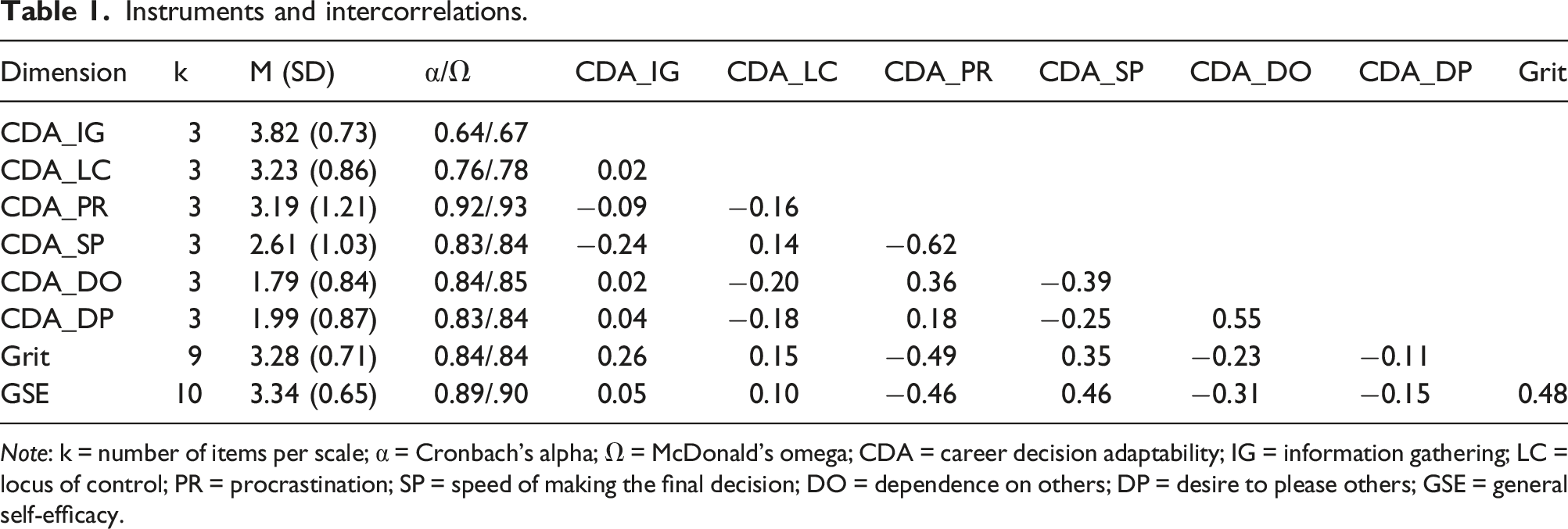
Note: k = number of items per scale; α = Cronbach’s alpha; Ω = McDonald’s omega; CDA = career decision adaptability; IG = information gathering; LC = locus of control; PR = procrastination; SP = speed of making the final decision; DO = dependence on others; DP = desire to please others; GSE = general self-efficacy.
All three scales are self-assessment instruments. For all three scales we applied a five-tiered scale: disagree strongly (1), disagree a little (2), neither agree nor disagree (3,) agree a little (4), agree strongly (5).
Labour market knowledge (“Do you have a good knowledge of the labour market and occupational fields?”) and being in a teacher-training programme (“Are you studying to become a teacher?”) were asked for by additional questions formulated by the authors.
Data analysis
All calculations were done in R. First, the assumptions on which the linear regression analysis is based (Eid et al., 2017) were checked. Furthermore, multicollinearity was checked by quantifying the variance inflation factor (VIF) and tolerance. In a next step, in order to be able to compare the values, the GSE scale and the grit scale were z-standardised. Finally, a multivariate linear regression of the CDA score with the values of the GSE scale, the Grit scale and the data on labour market knowledge and participation versus non-participation in a teacher-training programme was carried out.
Results
Summary of the multivariate regression for the prediction of the dependent variable “career decision-making adaptability” (CDA) (n = 872).
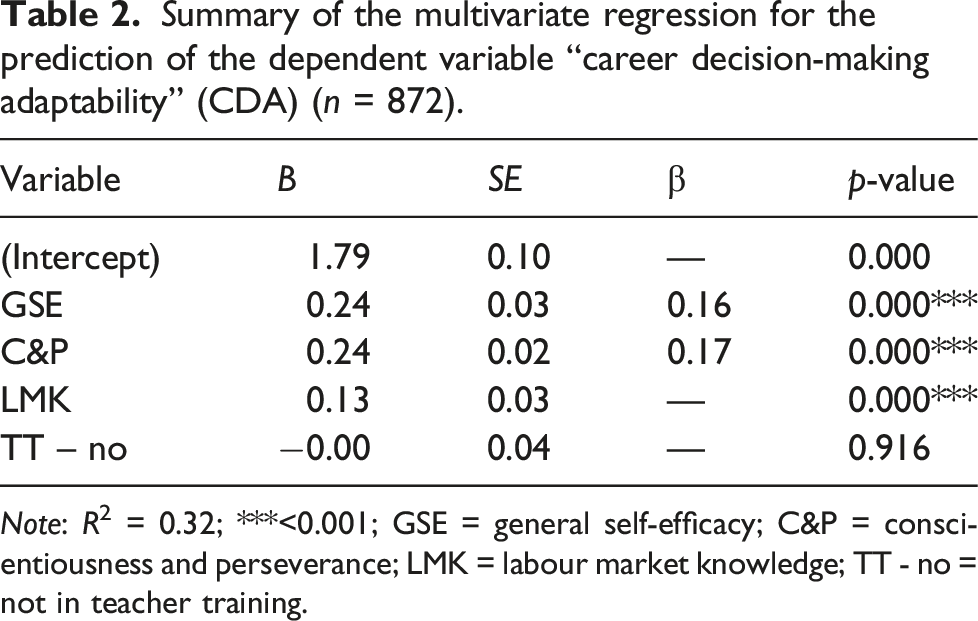
Note: R2 = 0.32; ***<0.001; GSE = general self-efficacy; C&P = conscientiousness and perseverance; LMK = labour market knowledge; TT - no = not in teacher training.
CDA score and total variance
The range of the CDA score was between min. 1.67 and max. 4.78, the mean being M = 3.45, SD = 0.55. The total variance explained for all four variables is 32%.
Self-efficacy
Our results show, that the greater the level of self-efficacy among humanities students is, the greater is their career decision-making adaptability. These findings are in line with hypothesis 1 of our study.
Conscientiousness and perseverance
In our study we found that the greater the level of conscientiousness and perseverance among humanities students is, the greater is their career decision-making adaptability. Accordingly, the hypothesis regarding conscientiousness and perseverance (H2) is in agreement with these results. Of the metric variables examined, conscientiousness and perseverance show the largest relationship to career decision-making adaptability with a coefficient 0.17.
Labour market knowledge
We found evidence that humanities students who report having good labour market knowledge score higher in career decision-making adaptability than humanities students who report not having good labour market knowledge. Accordingly, hypothesis 3 regarding the relevance of self-assessed labour market knowledge for career decision-making adaptability is supported.
Being in a teacher-training programme
Contrary to our expectation, humanities students in a teacher-training programme did not show greater career decision-making adaptability than humanities students who are not enrolled in a teacher-training programme. This result is not in line with hypothesis 4.
Discussion
The results of our study contribute to describing some of the – in our view, so far under-researched – influencing factors that are relevant on the path of humanities students from study to career entry. They can also provide initial explanations for a better understanding of why one group of humanities students is more successful than the other in entering the labour market. The ability to make profile-building decisions while studying could be a relevant important factor here. In addition, some recommendations for practice can be derived from our results: They shed light on some personality traits that humanities students should preferably have in order to make a successful start to their careers. Furthermore, we derive some indications on how the career decision-making ability of humanities students can be supported by the university.
In our study, we found that a number of individual factors have a significant relationship with the career decision-making adaptability of humanities students. Accordingly, we can assume that the decision-making ability, which seems to be particularly important for humanities students, also individually varies in strength. The total variance explained for the four variables is 32% and indicates that the individual approach to career decision-making is determined, at least in part, by variables other than the subject of study. This raises doubts of whether career prospects are determined in particular by the choice of subject, as is often assumed, especially with regard to the humanities. Individual characteristics (such as self-efficacy and conscientiousness) and prerequisites (such as being informed about the labour market) seem to play a significant role here.
As we expected, our study shows that self-efficacy and career decision-making adaptability are positively correlated among humanities students. Based on research, stronger career adaptability leads to more productive decision-making behavior (Leung et al., 2021; Rudolph et al., 2017) and prevents both, indecision and indecisiveness (Udayar et al., 2020). As described in the introduction, especially for students of humanities decision-making competence during studies and during the transition to the labour market appears as an important prerequisite for a successful career. Above that research shows that students of the humanities show the lowest confidence level compared to students of many other subjects (Schulz and Thöni, 2016). For these individuals, the lack of self-confidence and self-efficacy might hinder their career development. Therefore, the relationship between self-efficacy and career decision-making adaptability found in our study and the corresponding effects on the decision-making ability can contribute to explaining, why the career paths of some students of humanities are more successful than those of others. It also might inspire the career counselling practice. Counsellors could indicate to humanities students the relevance of their career decision-making competence and support or make aware of the factors that contribute to it.
While the construct grit is, as mentioned above, controversially discussed as an independent indicator of career success, there is consensus about the significance of the grit score for conscientiousness and perseverance (Credé et al., 2017). Our study showed that conscientiousness and perseverance correlate positively with career decision-making adaptability and thus contribute to the decision-making ability of humanities students. As we have described above, the individual profile-building process is more necessary and comprehensive for students in the humanities than for students in more profession-oriented programmes. Therefore, for these students, conscientiousness and perseverance are particularly relevant factors in order to comprehensively master this profile-building process with its necessary decisions. Since conscientiousness as a personality trait cannot simply be taught, those interested in studying the humanities should check for themselves whether they already have this prerequisite.
Our assumption was confirmed that the feeling of being well informed about the labour market and about professional fields leads to a stronger expression of career decision-making adaptability. This also confirms earlier findings that adequate career information is helpful and necessary for the career decision-making process. However, our study does not provide information on whether students who did not indicate feeling well informed received too little or too much (and thus possibly confusing) information. The possibility of career choice overload should therefore be considered in the context of information dissemination to students. In addition, the possibility of too much externalization of the career decision with simultaneous neglect of the necessary self-exploration should also be taken into account. The aim must therefore be to provide humanities students with the right amount of labour market information. At the same time, students should be informed that labour market information is only helpful in combination with reflection on personal conditions.
We had assumed that students in teacher-training programmes in the humanities had already gone through the career decision-making process once in a productive way which as a consequence potentially led to stronger career decision-making adaptability in comparison to humanities students not being in a teacher-training programme. This effect did not show in our study. This could be an indication that although students in teacher-training programmes choose their degree programme, a considerable number of them has not yet made a conscious decision to become a teacher. Therefore, contrary to our assumption they lack the experience to make an informed decision regarding their professional future, which could otherwise have led to strengthening their career decision-making adaptability. This assumption is supported by the findings of a German study (Visarius, 2019), according to which over 30% of all students in teacher-training programmes in Germany do not want to become teachers. There are similar findings from other countries (e.g. Frazier et al., 2019; Rots et al., 2014). This may indicate that students in teacher-training programmes should be encouraged and supported to make a conscious career decision in the same way as non-teacher training humanities students.
Practical implications
Three aspects should be highlighted here in particular:
Our study provides evidence that a number of factors strengthen the career decision-making adaptability of humanities students, some of which are relatively stable personality traits, while others can be easier developed and trained. Universities should therefore (e.g. in their Career services centres) offer students opportunities to develop those characteristics, which can be acquired, e.g., by counselling and workshops. For example, target group-specific information about the labour market and about occupational fields seem to be helpful here. In addition, Ozlem (2019) has shown that career-decision making self-efficacy can be effectively promoted through different kinds of career interventions. Universities should be aware of these possibilities and offer appropriate courses etc.
Pupils considering studying humanities are often strongly motivated by their interest in the subject and show low concern for career aspects (Skatova and Ferguson, 2014). It should be discussed with prospective students (e.g., in the student advisory centre) whether they also possess the personality traits to successfully study in a field like the humanities, which, as shown in our project, requires a high degree of conscientiousness and perseverance — especially with regard to the development of individual career perspectives. Since these personality traits are not easy to change, a sound self-assessment and assessment by others is necessary before the decision is made for a programme in the humanities.
Finally, students in teacher-training programmes should be encouraged to consider various professional perspectives and make a conscious decision for or against the teaching profession. This decision is presumably often not made, even if a teacher-training programme was chosen. Therefore, universities should actively support the professional decision-making process of teacher-training students as well. It is not realistic to assume that all students in teacher-training programmes have already made a career decision to become teachers. Possible uncertainties should be addressed by universities to enable these teacher-training students to make an informed decision for or against the teaching profession. Entering the teaching profession with uncertainty about one’s own attitude towards it is not a good basis for a successful career.
Limitations and need for further research
Only students from German-speaking universities were included in the study. In other countries (e.g. in the UK), the profiling and decision-making process for humanities students maybe partly different. In other educational and working contexts, the results from Germany and Switzerland should therefore be interpreted with these potential differences in mind.
In order to better understand the effect of career-decision making adaptability comparatively, it would be useful to conduct studies with students from different humanities disciplines or with students from humanities and not-humanities disciplines. Indicators of success, with which career-decision making adaptability can be put in relation, can be objective and subjective career success according to Ng et al. (2005). Our study did not investigate whether the career decision-making adaptability of teacher-training students in the humanities differs from that of teacher-training students in other fields of study. It could be interesting to address this research question in the future.
Furthermore, the direction of the correlation between self-assessed labour market knowledge and the strength of career-decision making adaptability can be discussed controversially. We assume that good labour market knowledge strengthens students’ career-decision adaptability. However, it is also conceivable that people with high career decision-making adaptability are more self-confident and therefore rate their labour-market knowledge particularly high.
From our point of view, a longitudinal study could be worthwhile to check our assumption that humanities students with a high degree of career decision-making adaptability actually have a more successful career entry than humanities students with a lower degree of career decision-making adaptability and if profile-building decisions contribute to this success.
To get a fuller picture, it could be interesting to investigate additional factors that have an impact on humanities students’ decision-making processes. In addition, it could be worthwhile to investigate whether there is a correlation between the strength of interest in the subject and career decision-making adaptability.
Footnotes
Declaration of Conflicting Interests
The author(s) declared no potential conflicts of interest with respect to the research, authorship, and/or publication of this article.
Funding
The author(s) received no financial support for the research, authorship, and/or publication of this article.
Disclosure Statement
No potential conflict of interest was reported by the author(s).
