




Abstract
It is recognized that the value of entrepreneurship education and the recruitment of practising entrepreneurs for such learning programmes can be problematic. This raises an important and challenging issue for universities when they are increasingly being asked to develop the leadership and management capabilities of entrepreneurs. In this account of practice, the authors explore the role for business simulation in the development of existing entrepreneurs’ and small business leaders’ strategic decision-making skills. The article describes and reflects on a pilot business simulation course, considering the challenges in the planning, the engagement of entrepreneurs and the delivery of the programme. It provides insights into the value of introducing this form of learning experience and exposes the significant challenges associated with engaging small business leaders.
Little is known about the practical impacts of how we teach and the effectiveness of methods used in the classroom to support the development of entrepreneurship for the traditional student population in higher education (Nabi et al., 2017). Even less is known about the effectiveness of classroom methods used to support existing entrepreneurs and small business leaders plying their trade in a volatile, uncertain and complex global economy. This is an important issue in contemporary society, with universities increasingly being asked to develop the leadership and management capabilities of entrepreneurs and small businesses in response to various societal challenges, including poor productivity and economic performance.
This account of practice explores the role for business simulation in the development of the knowledge and skills of existing entrepreneurs and small business leaders associated with business strategy. The state of strategy and planning in the small firm context is seen as a longstanding and persistent factor limiting the sustainability and growth of many small firms (Alpkan et al., 2007; Richbell et al., 2006). It is suggested that, to be proficient in strategic decision making, a high degree of critical thinking and deep learning is required, with regard to both the complexities of the business context and the interdependencies of systems and events. In addition, there is a need for great self-awareness and for an understanding of personal decision-making styles and how they can influence the way an individual evaluates strategic options and considers approaches to be pursued (Quinn et al., 2003).
Business simulation has been used in education for more than 50 years and is one of several approaches used to provide a more authentic and work-related learning experience for students (Goi, 2019). It offers the opportunity to learn about how different elements of a business influence each other and what the consequences of decisions are in a growth-oriented business without any of the risks associated with such activities in ‘real life’. More often than not, learners receive a description of an imaginary business and a fabricated environment and make decisions – on price, advertising, production targets, etc. – about how the business should be run. A business game may have an industrial, commercial or financial background, and the simulations often include decision-making tasks which pit the player against a challenging environment or competitive opponents. Many simulations introduce a strategy, decision-making and resource allocation context in which the player or players have to allocate resources to different business areas in order to produce and sell goods in competitive markets. Simulations can be a powerful tool for replicating a real-world business environment and providing a meaningful learning experience, particularly if students are given the time to reflect on their decisions and actions and their consequences (Mortais et al., 2006; Westernberger, 1999).
This account of practice draws on a form of action research to develop an understanding of the role that business simulation may play in the development of strategy skills among entrepreneurs and small business leaders. The individuals, who in other traditions might be viewed as ‘subjects’, a ‘population’ or a ‘sample’ are understood from this perspective as active, engaged and equal participants in the research process. The approach encourages the full and active involvement of participants with the expectation that critical reflection will lead to an increased self-awareness of their positions as well as their own resources (McIntyre, 2008).
Practice: a pilot course
The 2-day pilot course was part-funded by an EU Erasmus+ project (MentorCert) that sought to support the development of strategy skills among start-ups and small businesses. The EU project design required the use of a specific business simulation (CESIM Global Challenge), delivered over two interactive sessions.
The implementation of the pilot course involved four phases: planning; engagement of the entrepreneurs (i.e. learners); delivery (facilitating the business simulation); and reflections on practice (by the learners and the delivery team).
The following account represents the reflections of the business simulation delivery team on the phases of practice implementation. The team members have more than 40 years’ experience between them associated with the design of interventions to support executive (including small business leader) education and the delivery of business simulations for students in a university context. The team has drawn on those experiences and has used a semi-structured approach to inform retrospective critical reflection (Boud et al., 1985). As co-creators of the experience reported, we are writing in an auto-ethnographic style and we acknowledge that ‘naturalistic generalization’ is implicit in our reflection on the event (Stake, 1994).
Planning
The design of the workshop was informed by the EU project requirements outlined in the project proposal, which specified the use of a particular simulation package. The duration and timing of the pilot (two workshops within a month window) were prescribed by the EU project requirements. Careful consideration was given to the suitability of the Global Challenge business simulation game for entrepreneurs, the layout of the room and the facilitators to be used for the workshop. All project partners decided to remove some of the functionality embedded in the game to reflect the development of national rather than international strategies, thereby reducing the complexity of the game and the cognitive and technical demands of working with the simulation. For example, rather than requiring participants to engage with three global currencies (US Dollars, Euros and Chinese Yuan), the simulation was modified to enable Pound Sterling to be used throughout. Each local team included a facilitator with several years of experience associated with using the business simulation with students.
The focus of the simulation was to enable participants to explore and apply management thinking models to a scenario and to reflect, test and ascertain what did and did not work for them. Thus they were provided with the opportunity to gain insights into the challenges of strategic decision making, while at the same time experiencing team dynamics with like-minded peers in a novel and unthreatening environment.
Engagement of entrepreneurs
Two of our partners in the EU project had long-standing university sector networks (in agro-food and construction) that met regularly and provided a natural forum for piloting business simulation. The absence of this type of network in other areas, including our own, meant that considerable engagement activity was necessary to encourage the participation of entrepreneurs in the piloting activity. Locally, this included business engagement staff in the university and extensive promotion of the workshop through various channels, including social media, targeted emails to regional and national networks and personal contacts with intermediaries and entrepreneurs. Marketing collateral in the form of a flyer was produced for distribution indicating the nature of the event and including a call to action which involved a simple workshop registration process.
This awareness-raising activity met with some success in generating initial interest and enquiries, particularly from local business networks and LinkedIn professional networks. Social media analytics reported a lot of ‘likes’ of posts promoting the event. More than 20 entrepreneurs expressed an interest in attending the course. However, several of these subsequently declined to attend due to diary conflicts that emerged between the agreement to participate and the delivery of the workshops. On the 3 days running up to the workshop, several more gave notice of non-attendance due to a variety of pressing health, childcare and work-related issues.
General feedback obtained from both business engagement intermediaries and entrepreneurs during follow-up activity to review the engagement process suggested that there was little wrong with the promotional approach underpinning the engagement activity. However, several reasons for a lack of engagement were reported and these included: The length of the workshop (2 days) put off many entrepreneurs and small business leaders as they could not afford that amount of time out of the workplace. The 2-day duration meant considerable travel time (and cost) for those who wished to attend but were based in other areas of the country (e.g. London). The offer of a ‘free event’, even if clearly marked out as a pilot to ‘test a product’, conferred a notion of low value or quality for some and made cancellation a no-cost decision. Strategic planning was not of interest – ‘I just don’t like it’, reported one entrepreneur. There was a limited appetite among existing contacts to actively promote further within their intermediary networks given a move towards commercialization and competition in the business education market in the UK.
Delivery
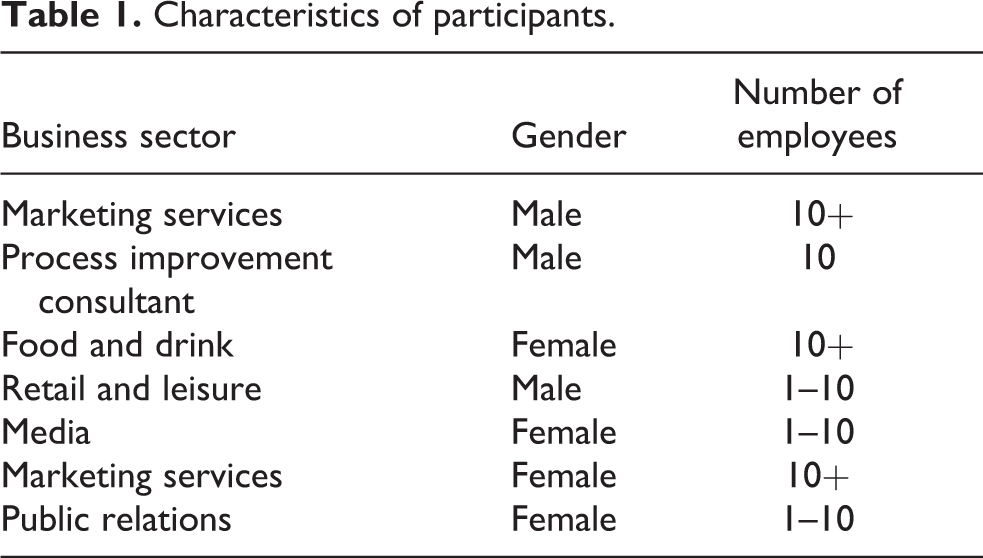
On the day, seven entrepreneurs and small business leaders participated in the workshops. Characteristics of the participants are provided in Table 1.
Characteristics of participants.
The simulation was introduced by the experienced facilitator and participants were walked through the game. Drawing on the experience of undertaking simulations with students, participants were warned that they might feel inundated by the amount of information they were being asked to process in a short time. They were informed that a key success criterion in the simulation was the return to shareholders of the business. They were also encouraged to think about the learning they might take from the game and its relevance to their own workplace context.
The group was divided into two teams and was given an hour to play a practice round. The facilitators actively supported the two teams with the technical aspects of the game. The practice round results generated a lot of interest among participants. The result of Round 1 was greeted with some enthusiasm by the ‘winning team’ and some perplexity by the other team: it clearly generated a competitive dimension and some humour (members of the ‘losing team’ were heard to say ‘Are you sure the game works properly?’ and ‘It doesn’t matter it’s only the practice round.’). At the same time, the winning team were smiling and somewhat contented. While the game produced several financial accounting measures and ratios, these appeared to be of little interest to the participants. Most focused on information associated with the product market and some of the ‘soft’ issues associated with strategic discussions.
The simulation offered a ‘safe’ environment for the entrepreneurs to practise their business strategy and decision-making skills. However, following the introduction of the business simulation game, participants variously reported ‘feeling weighed down’, ‘out of my depth’ and ‘unnerved by the complexity of it all’. Nevertheless, adopting a true entrepreneurial spirit, the majority dived into discussions and decision-making. There was an immediate bubble of activity, with participants engaging in purposeful conversations and good interaction among team members. All but one participant engaged enthusiastically with the game (one participant appeared reserved and to be at the margins of the team discussions).
Participants were encouraged to prepare to play the simulation game on an individual basis in the time between Workshop 1 and Workshop 2 so that they could then discuss their suggested approaches and arrive at a team decision in Workshop 2. Few took the opportunity to do so. The main reason for this was time pressure, although feedback suggested that some participants lacked the confidence to make individual decisions without an opportunity to discuss them in advance with teammates and were hesitant to be the first to submit data.
The simulation game stimulated a lot of analysis and discussion about options and a considerable amount of modelling ‘what if’ scenarios. The participants reflected on ‘optimistic’ and ‘pessimistic’ assumptions made by team members. A further dimension of decision-making activity involved benchmarking between members of the same team, with subsequent amendments to assumptions being made in order to move away from outlying positions towards more centralized positions (although variations between team members remained).
To encourage a more structured approach to strategizing and decision-making, two strategy models were introduced by the facilitators in Workshop 2 – The Product Life Cycle (Levitt, 1965) and the Boston Consulting Growth Market Model (Henderson, 1970). These were new to all the participants and they could immediately relate them both to the game and their working context.
Reflections on practice
Small business leaders are often viewed as ‘hard to reach’, and they can be a difficult group to engage in educational activities delivered outside the workplace (Devins et al., 2005). Unlike the traditional student learner cohort, tutors or facilitators have few levers to pull to influence attendance. While it is unwise to generalize from this account of practice, the lack of interest in business strategy exhibited by some entrepreneurs is worthy of further investigation and will be of concern to those seeking to improve the productivity and sustainability of smaller firms in the UK.
Once the group protocols had been established a distinct dialogical approach became apparent, in which amicable discourse was evident. The groups quickly began to work as collectives, demonstrating a pragmatic approach to sense-making and a clear focus on the task, initially concentrating on the financial data that had been provided with minimal consideration of the formulation of a strategy to guide decision-making. Participants appeared to try to solve problems initially from resources based within their personal experience; in part, this could be seen as addressing only those elements in the simulation that they recognized and with which they were familiar. This initial sense-making approach seemed to expose only one or two elements of the simulation; that is, they did not appear to see the whole problem and therefore could be trying to solve the wrong problem. For us, this reinforced the importance of reflecting in conversation and sharing thoughts within the group, as group dialogue can help to reframe a problem (Schon, 1983), shift and break down one’s boundaries (Jindal-Snape and Holmes, 2009) and provide new insights.
The need to adhere to a timeframe brought an element of pressure that was reflected in the teams’ activities – they both became increasingly competitive (for example, whispering so that the other team would not hear conversations underpinning decisions).
The reflections of the participants on the first round of the simulation game included: ‘It was surprising how fast the time went’. ‘Very useful to see the connections between various aspects of the business (e.g. production capacity and sales) and how they relate to one another’. ‘Challenges of estimating demand and how to do it – a lot of it was finger in the air’. ‘It was useful to be able to model different options – there was lots of use and testing of scenarios’.
At the end of the Workshop 1 most participants commented favourably on the opportunity to take the learning associated with the interconnected elements of business back into the workplace. Two participants wondered openly about the utility of the simulation when there were no real consequences arising from the decisions made. Participants acknowledged the value of the unthreatening environment provided by the simulation as a learning tool, allowing them to make mistakes and take risks without real consequence. However, the downside of this was that it was divorced from the pressures of decision-making in reality, where the consequences of incorrect decisions could be fundamental to the success of their businesses.
It was disappointing to note that no participants took the opportunity to play the simulation game in the time between Workshop 1 and Workshop 2, despite being offered considerable encouragement and online support. Most cited time pressure, but issues related to confidence in using the technology and a reluctance to be the first to submit data were also mentioned. This experience suggests that we need to know more about the factors that inhibited the use of the game outside the confines of the classroom and the steps required to improve ongoing engagement.
Workshop 2 afforded time to play another round of the game, to introduce two strategy tools and to explore participants’ views of the experience. Participants reported that the simulation was challenging and demanding, particularly in relation to time constraints and the pressure to gain an understanding of the complexity of the case and the functional working of the simulator itself. It was also noted that discussions of the case with their peers exposed gaps in their knowledge of decision-making tools and management language.
Two participants noted that in their working environment they had mixed with other practitioners who used ‘tool jargon’ in their day-to-day talk. The realization of this link to other peers appeared to give greater validity to the tools they had been introduced to, which leads us to suggest that this experience reinforced the importance of reflecting on practice linking to business success and to see ‘execution as learning’ (Edmondson, 2008: 2), helping participants to become more mindful of their intentions and actions (Pellicer, 2008). This perspective is considered highly relevant as the deeper learning and pedagogical effectiveness of the simulation was consciously recognized and appreciated by participants, reinforcing the significance of reflection on action and its potential to challenge one’s own assumptions and practices.
Participants reported that the two strategy models introduced by the facilitators were highly relevant to ‘real’ business practice, were complementary to one another and could be employed to provide a more detailed understanding of the business environment. A couple of the participants said that they would use them at work now that they were aware of them. One noted: I have the same conversation again and again with my business partner and we always get to the point of identifying the “problem child” – with this model we don’t need to rehearse the arguments time and time again – I think using the model will help take some of the emotion out of decision-making and provide a foundation for us to move on. ‘I like to engage people (employees) in decisions but in the end I’m the boss and I’ll tell them what I want and expect them to do it. I’m a go-getter and generally optimistic but playing the game has made me realise that whilst I might be bullish I do check my assumptions when I am making decisions.’
Conclusion
The business simulation had noticeable positive impacts on the ability of the participants to make connections across different dimensions of a business, to critically appraise their own decision-making and to model ‘what-if’ scenarios. All these are important factors in improving leadership and management capability with regard to business strategy. However, the pilot course did raise concerns about some adverse emotional impacts of immersion and the commitment of participants to learn through playing multiple rounds independently. Our experience suggests that there remain significant challenges in engaging small business leaders in educational interventions of this type, and that more research is required to inform development and design and to test the scalability of such approaches.
Footnotes
Declaration of conflicting interests
The author(s) declared no potential conflicts of interest with respect to the research, authorship, and/or publication of this article.
Funding
The author(s) received no financial support for the research, authorship, and/or publication of this article.
