



Abstract
Wage and benefit theft is a systemic feature of capitalist organisations, yet it remains critically under-theorised in sociology. Drawing on an in-depth case study of the Bangladeshi garment industry, this article identifies three interrelated mechanisms of wage and benefit theft—denial of the monthly attendance bonus, alternative calculations of maternity allowance and maintenance of two service books—normalised through the interplay of micro-level practices and macro-structural imperatives. This article makes two key contributions. First, it challenges discourses framing such theft as aberrant misconduct by deviant employers, exposing it instead as a routinised, industry-wide exploitation strategy. Second, it advances the theorisation of normalisation by showing how macro-structural conditions foster environments that embed exploitative micro-level practices with impunity. The systematic erosion of meso-level institutions under authoritarian regimes intensifies this normalisation. This article calls for collective resistance to empower trade unions and civil society in confronting the normalisation of wage and benefit theft.
Keywords
Introduction
Robiul (pseudonym), a thirty-year-old garment worker, exemplifies the widespread exploitation of wage and benefit theft within the Bangladeshi Garment Industry (BGI). Although he produces garments for leading UK brands, part of his agreed monthly wage of 7,800 taka (£51) is routinely withheld. Robiul’s comment reveals the deep-rooted power asymmetries that sustain such practices: They [owners] are stealing our wages. . . But we cannot do anything. They are powerful. They will fire us from the factory. . . We can change jobs, but it will not solve the problem because it is an industry-wide practice.
Robiul’s experience is not isolated: approximately four million workers within the BGI are susceptible to wage and benefit theft, which includes infractions such as unpaid hours, unpaid annual leave and unpaid overtime (Cole et al., 2022; Yea and Chok, 2018). Increasing scholarship shows that wage theft operates through violations of formal legal frameworks, as well as informal, systemic mechanisms (Ahmed, 2024; Kim and Allmang, 2021). Such practices are structurally embedded within the capitalist economic system (Cole et al., 2022). They also function as deliberate business strategies (Bornstein, 2018). This is particularly pronounced in low-wage, low-skill and minimally unionised sectors, where precarious employment (Ahmed, 2024), workplace bullying (Ahmed and Uddin, 2021), organisational violence (Ahmed, 2025) and systemic worker unfreedom (Crane et al., 2022) prevail.
However, a significant gap remains concerning how and why wage and benefit theft becomes ‘normalised’ within industries (Ashforth and Anand, 2003; Jenkins and Delbridge, 2017). Specifically, the mechanisms through which powerful actors embed exploitative practices into organisational operations—making them routine and socially acceptable—require closer examination. Such mechanisms are normalised when they are ‘routinely embedded in the matrices of already existing, socially patterned, knowledge and practices’ (May and Finch, 2009: 540). This article examines how wage and benefit theft is normalised at both micro and macro levels within the BGI.
This article identifies and critically analyses three methods of wage and benefit theft that have become normalised industry-wide: (1) denial of attendance bonuses; (2) alternative calculations of maternity allowance; and (3) two sets of service books (parallel records enabling concealment of wage discrepancies). Extending Cole et al.’s (2022: 117) conceptualisation of wage theft as ‘inherent to capitalism’, this article argues that these practices go beyond ‘exploitation’. They are systematically embedded and normalised through the interaction of micro-level organisational practices—denial, deception, manipulation and rejection—and macro-level systemic forces, including economic rationalisation, social polarisation and state-sponsored violence.
This article advances scholarly discourse in two critical ways. First, it addresses an underexplored dimension of work, employment and society research: wage and benefit theft as a systemic, industry-wide phenomenon. This approach challenges simplistic narratives that portray wage and benefit theft as isolated corporate misconduct, and situates it within the structural dynamics of capitalist production. Second, it enhances our understanding of normalisation processes by tracing how wage and benefit theft has been rationalised, socialised and institutionalised within the BGI. Such normalisation is sustained by power imbalances, deep social polarisation, regulatory reforms, the weakening of meso-level institutions and state-led violence under an authoritarian regime, which collectively make exploitative practices socially acceptable, politically enforced and legally legitimised. Crucially, the normalisation of wage and benefit theft not only fails to protect vulnerable and marginalised workers but also exposes them to additional layers of organisational control and exploitation.
The existing literature on wage theft is reviewed, examining both micro-level organisational practices and macro-level systemic forces to highlight the necessity of exploring their interplay in the process of normalisation. The research context, design and methodological approach are then outlined. Next, three principal methods of wage and benefit theft prevalent in the BGI are presented. Finally, critical insights are offered into how these practices become normalised at the industry level.
Wage and benefit theft at the organisational level
Wage theft, a widespread practice, involves employers unlawfully appropriating workers’ wages by manipulating payslips and timesheets and using arbitrary and fraudulent contracts (Kim and Allmang, 2021; Yea and Chok, 2018). Cole et al. (2022) identify three categories of wage theft: (i) unpaid labour time, involving manipulating or under-measuring working hours used to determine pay; (ii) base wages, referring to the non-payment of contractual entitlements such as annual leave or training time; and (iii) variable wages, encompassing the failure to award or pass on performance-related incentives, including gratuities. While this typology expands the conventional understanding of wage theft to include both formal and informal extraction methods, this article advocates a more nuanced understanding of the misappropriation of workers’ rightful benefits, which is a significant yet frequently overlooked facet of wage theft. For example, practices such as managers expropriating tips and withholding holiday pay entitlements, as noted by Cole et al. (2022), should be recognised as forms of wage theft, alongside the denial or misapplication of legally mandated benefits such as maternity leave. Consequently, this article employs the term ‘wage and benefit theft’ to encapsulate the diverse mechanisms through which employers expropriate both wages and benefits.
Existing literature explores the micro-level practices underpinning wage and benefit theft, which are instrumental in initiating and sustaining exploitative practices across industries in developed countries (Cole et al., 2022; Yea and Chok, 2018). Employers manipulate pay structures, enforce informal deductions and restrict access to wage records, keeping workers unaware of their rightful earnings (Hung, 2023). Once embedded within organisational practices, wage and benefit theft is perpetuated through coercion, misinformation, disciplinary measures (Tse, 2022), workplace bullying (Ahmed and Uddin, 2021) and violence (Ahmed, 2024, 2025). These entrenched practices, coupled with organisational norms and the exertion of power, systematically enable the persistence of wage and benefit theft without legal or worker-led intervention.
The role of macro-factors, including the capitalist model and precarious employment conditions, has also been recognised as contributing to wage theft (Ahmed, 2024; Cole et al., 2022). Low wages and pronounced power imbalances across industry create conditions conducive to wage and benefit theft (Kim and Allmang, 2021). However, the literature often approaches these issues through frameworks of labour control (Yea and Chok, 2018), unfreedom (Crane et al., 2022) or derealisation (Ahmed, 2024), rather than engaging wage and benefit theft as a normalised phenomenon. Economic dependency, wherein workers face scarce employment alternatives, heightens vulnerability to wage and benefit theft (Ahmed, 2024). Additionally, deficiencies in political and regulatory frameworks (Siddika et al., 2024; Yea and Chok, 2018) result in weak labour law enforcement, facilitating industry-wide wage and benefit theft. Collusion between factory owners and political actors further undermines the efficacy of state and trade union mechanisms designed to safeguard workers’ rights (Ahmed and Uddin, 2021).
Moreover, when systemic violence against workers is sanctioned by state laws and enforcement agencies (Ahmed, 2025), efforts to suppress collective bargaining (Siddika et al., 2024) may make it difficult to challenge the normalisation of wage and benefit theft. For instance, reports highlight that Bangladeshi police killed four BGI workers advocating for a living wage, exemplifying how state institutions deploy violence to protect industrial elites while suppressing worker resistance (Al Jazeera, 2023). The broader legislative landscape, characterised by limited legal recourse, restrictions on labour unions, corruption, and the absence of democracy (Ahmed, 2025; Ahmed et al., 2025), further worsens the conditions that allow wage and benefit theft to flourish.
Therefore, understanding the interplay between micro-level practices and macro-level forces is crucial for analysing the industry-wide normalisation of wage and benefit theft. Micro-level practices, such as the denial or manipulation of entitlements, are legitimised by macro-level factors, including weak legal frameworks. Similarly, extreme poverty and state-sanctioned violence cultivate precarious working conditions and workplace bullying or violence, embedding wage and benefit theft as an accepted norm. This article explores the processes through which such normalisation occurs.
The process of normalisation from organisations to industry
Building on Ashforth and Anand’s (2003) frameworks of normalisation through the prism of ‘corruption’, and Jenkins and Delbridge (2017) via the lens of ‘deception and lying’ in Western organisational contexts, this article extends the framework by examining the normalisation of wage and benefit theft beyond the confines of individual organisations to an entire industry in a non-Western context. Ashforth and Anand (2003) identify three interrelated pillars of organisational corruption: rationalisation—the process by which individuals justify and legitimise corrupt acts through socially constructed narratives; socialisation—the mechanism through which newcomers are indoctrinated into existing corrupt practices; and institutionalisation—the embedding of corruption into routine organisational practices, making it automatic and unreflective. These pillars function symbiotically, fostering an environment in which organisational actors perpetuate corruption through denial, compliance or justification, thereby normalising it at the micro-organisational level.
Jenkins and Delbridge (2017) advance the concept of normalisation by interrogating the interplay between organisational and group dynamics. They show how lying and deception become habitualised through ‘social interactions at multiple levels: between employees and their co-workers, their clients and their employers’ (Jenkins and Delbridge, 2017: 53). In these interactions, individuals derive status and enhanced self-esteem from habitual lying, which becomes routinised within organisational cultures. The normalisation of deception hinges on complex interactions across group and organisational strata, where members collectively construct rationalisation and neutralisation techniques to legitimise lies, while simultaneously socialising newcomers into the belief that deception is normative. This bidirectional dynamic between top-down organisational influences and bottom-up group practices legitimises deception within the organisational fabric, where it becomes ‘embedded, maintained and strengthened over time as a legitimate and integral part of the job’ (Jenkins and Delbridge, 2017: 53).
While Ashforth and Anand (2003) and Jenkins and Delbridge (2017) provide compelling insights into the mechanisms of normalisation within organisational and group contexts, their analyses remain confined to intra-organisational dynamics, neglecting the broader industrial context. Specifically, their frameworks insufficiently address the interaction between micro-level practices and macro-level structural forces that tacitly endorse, compel or legitimise corrupt and deceptive behaviours. Research suggests that normalisation encompasses complex interactions between individuals, organisational structures, regulatory frameworks and broader sociocultural norms (Hendy and Tucker, 2021). This complexity is further amplified in contexts of socio-political volatility, where micro-level interactions are shaped by culturally embedded practices that propagate deviant behaviours across entire industries (Anderson, 2017). In such environments, newcomers, often unaware of the underlying dynamics, are seamlessly integrated into normalised practices, perpetuating cycles of corruption (Ashforth and Anand, 2003) and deception (Jenkins and Delbridge, 2017).
Despite calls for deeper explorations into the social processes, recurring patterns and collective practices that underpin occupational behaviours over time (Torsello and Venard, 2016), empirical investigations into the nexus between micro-level practices and macro-level influences remain scarce. This is particularly evident in industry-wide analyses of normalisation, such as those facilitating wage and benefit theft. To address this gap, this article examines the interplay between micro-level organisational practices and macro-level structural forces to answer the following research question: How do micro-level practices and macro-level factors interact to normalise wage and benefit theft within the Bangladesh Garment Industry?
Research design and method
Research context
Bangladesh represents a critical context where millions of fast-fashion workers are subjected to violence (Ahmed, 2024, 2025; Siddika et al., 2024). The Multi-Fibre Arrangement (MFA), an international trade accord in effect from 1974 to 2004, governed global textile trade through export quotas on developing nations (World Trade Organization, n.d.), positioning Bangladesh as a major supplier to Western markets. Within a decade of the MFA’s implementation, the number of factories surged from nine to 600, employing 310,000 workers and generating US $116.2 million—3.89% of the nation’s total exports (Siddiqi, 2004). To regulate industry-wide wages, the Bangladeshi government established the Minimum Wage Board in 1984, setting the monthly minimum at 560 taka (US $21.57 in 1984).
Despite the sector’s expansion, global brands have persistently demanded lower prices, pressuring the industry to prioritise corporate interests over worker protections (Anner, 2015). The BGI absorbed these pressures by exploiting cheap labour and relying on state and bureaucrat support (Ahmed and Uddin, 2021). The BGI has become a cornerstone of the economy while systematically suppressing the minimum wage under the guise of attracting foreign investment and maintaining competitiveness (Anner, 2019). However, following international scrutiny and activism after the Tazreen Fashion fire in 2012 and the Rana Plaza collapse in 2013, which caused 1,261 fatalities, Western buyers, Bangladeshi manufacturers and the government initiated the Accord and Alliance to improve factory safety and worker welfare (Chowdhury, 2017).
The government amended labour laws and raised the minimum monthly wage to 5,300 taka in 2013, 8,000 in 2018 and 12,500 in 2024. Despite this, workers’ earnings relative to living wages declined from 57% in 2013 to 54% in 2024 (Medinaceli et al., 2023). Critics argue that these wage hikes served as diversions, masking systemic issues such as unsafe factories and anti-union repression, while human rights violations persisted (Anner, 2019). This exploitation is perpetuated by powerful stakeholders, including members of parliament (MPs), many of whom own factories (Ahmed and Uddin, 2021), bureaucrats and state police (some with factory partnerships).
Workforce vulnerability benefits this industry, enabling ongoing exploitation. For instance, the BGI employs approximately four million workers from low-income rural backgrounds, with women constituting 53% of the workforce (Iqbal et al., 2024). The International Labour Organisation (ILO) (2020) notes that most workers are under 30, and many are internal migrants. Educational attainment is low, with many lacking formal education or limited to primary schooling. Employment remains informal and precarious. Gender disparities are stark: while women dominate the workforce and are seen as ‘ideal workers’ (Ahmed, 2024), 95% of supervisory positions are held by men (ILO, 2020), reflecting an entrenched patriarchal society.
Data collection
Pervasive violence (Ahmed, 2025; Ahmed et al., 2025) and opaque operational practices (Ahmed, 2024) pose significant challenges for researchers investigating wage and benefit theft in the BGI. Factory owners, many of them first-generation entrepreneurs, maintain strict secrecy regarding their ‘accounting practices’ (Clark, 2022), intensifying these challenges. Nevertheless, the lead author—a Bangladeshi national with extensive professional networks and research experience—successfully navigated these barriers to collect data. Ethical approval was granted by a UK University Ethics Committee where the lead author was employed, and strict adherence to research ethics guidelines was maintained throughout the data collection process.
This study employed qualitative methods, including semi-structured interviews and focus group discussions (FGDs). In collaboration with a local non-governmental organisation (NGO) that has supported workers’ rights since 2002, interviews were conducted with 50 workers from 10 factories registered with the Bangladesh Garment Manufacturers and Exporters Association (BGMEA), which claims compliance with national labour laws, ILO conventions and buyer-led social audits. Given workers’ vulnerability (Ahmed, 2024; ILO, 2020), interviews were conducted at the NGO’s office or by phone to minimise risks of retaliation. Written and verbal consent was obtained, and participants were reminded of their right to withdraw at any time. Anonymity and confidentiality procedures were clearly explained, and continuous dialogue with the NGO ensured consistency with labour laws, cultural norms and ethical standards to safeguard participants.
Establishing trust with workers was pivotal; research objectives were clearly communicated to set transparent expectations. The lead author’s fluency in Bangla and familiarity with social and cultural norms facilitated sensitive, respectful interviews. Workers were asked about working hours, including overtime, contractual monthly wages, attendance bonuses, festival bonuses and maternity allowances. Participants provided detailed accounts of how micro-level organisational practices related to monthly wages, overtime payments, attendance bonuses, maternity allowance and other benefits were used by both current and previous employers to appropriate their earnings. They also described how owners and managers rationalised exploitative practices, institutionalised wage theft or used violence to suppress resistance. In some cases, participants became emotional, prompting breaks, and were offered the option to discontinue. NGO staff were present during interviews, providing additional support. Despite emotional distress, most participants chose to continue, driven by the desire to have their voices heard.
Factory owners and managers were interviewed in the second phase. Given the sensitive nature of wage and benefit theft, access to owners required extensive negotiation and use of the lead author’s professional and personal networks. Ultimately, 10 owners overseeing 30 factories employing approximately 50,000 workers participated. Additionally, 10 managers with a combined 120 years of industry experience across 20 factories were interviewed with employer permission. These discussions highlighted the intersections of micro- and macro-level practices shaping wage structures, work allocation, performance monitoring and labour rights within Bangladesh’s socio-economic and political framework.
To contextualise systemic determinants of factory practices, interviews were requested with the Ministry and Department of Labour, but these requests were denied. Consequently, alternative participants were recruited: 10 civil society members, NGO representatives, academics and journalists working on workers’ rights, well-being, collective bargaining, and labour issues. Many of these actors also examine Bangladesh’s historical, economic and political dynamics, highlighting the structural foundations of industrial exploitation.
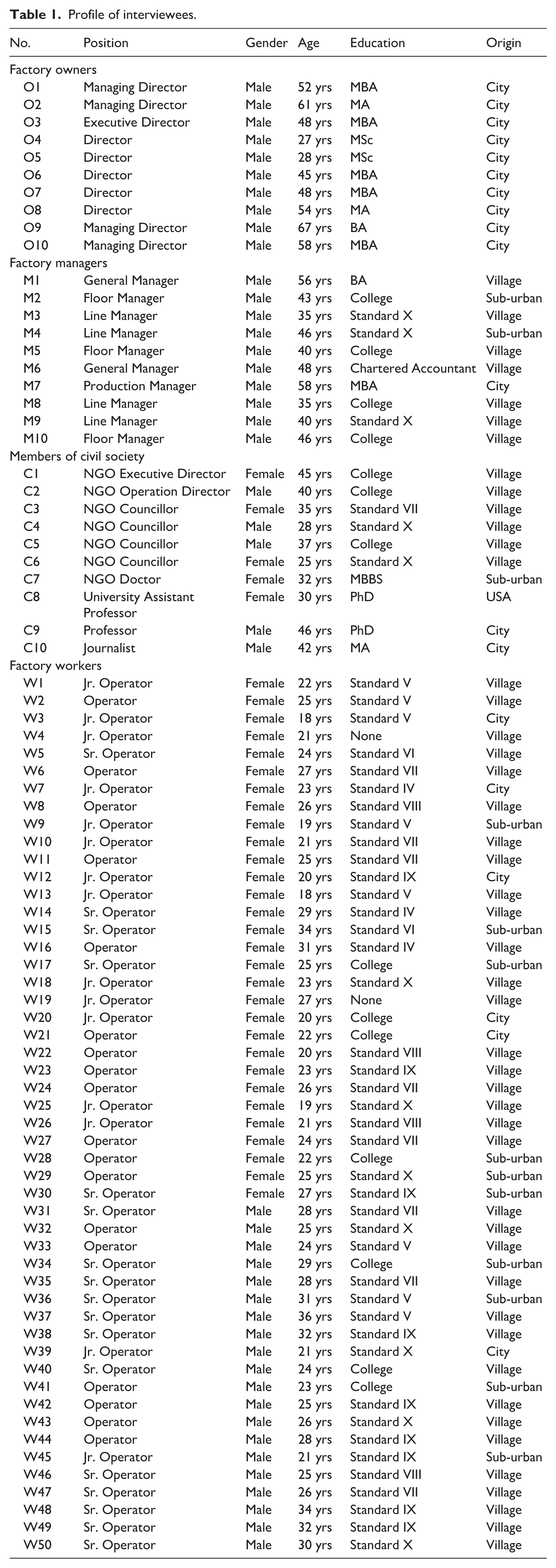
A total of 80 interviews were conducted, each lasting between 20 and 140 minutes. On average, interviews were 35 minutes for workers, 70 minutes for owners and 60 minutes for both managers and civil society representatives. Except for five, all interviews were conducted in Bangla, audio-recorded and transcribed verbatim. While translation risks semantic loss, it was essential to allow participants to express themselves in their native language. The lead author, fluent in Bangla and English, ensured consistency across translations and analysis. In the five cases where recording was declined, detailed notes were taken. Table 1 provides participant demographics.
Profile of interviewees.
Research suggests that FGDs offer insights into social and cultural interactions among participants (Rakow, 2011) and empower marginalised participants to articulate grievances while fostering mutual assurance (Namey et al., 2016). Accordingly, an FGD was convened at an NGO office to probe the intertwined dynamics of violence, exploitation and wage and benefit theft. The session included five workers (three women and two men), two managers representing seven factories, one NGO representative, one journalist and one academic researcher. The discussion interrogated how these groups interpret and experience such practices, and how blame is constructed and contested without employer participation. As first-time participants (except the academic researcher and journalist), participants offered original and critical insights. The 150-minute session was translated and transcribed verbatim for subsequent detailed analysis.
Data analysis
Data were analysed using thematic analysis (Braun and Clarke, 2006), enabling critical interrogation of micro-level practices, macro-level structures and their interconnections within Bangladeshi factories. This approach examined organisational strategies, accounting mechanisms and managerial control, alongside regulatory frameworks, economic and political discourses, social practices, cultural norms, power relations and ideological constructs shaping normalisation processes. As qualitative researchers, the authors—one Bangladeshi national and one from the UK—remained reflexive about their role in knowledge co-construction. Iterative engagement with the data prioritised theoretical insights, contextualising participants’ narratives within broader socio-political discourses (Braun and Clarke, 2006).
Reflexivity and analytical rigour facilitated the development of initial codes encompassing precarious labour conditions, violations of labour laws and human rights, oppressive regulatory frameworks, stringent disciplinary regimes, informal and opaque accounting practices, disregard for living wages and gendered exploitation strategies targeting female workers. These codes revealed patterns in the normalisation of wage and benefit theft. For instance, owners and managers systematically employed social polarisation, depicting workers as lower-class and lacking family status and education, to legitimise withholding wages and benefits. These findings were pivotal in exposing wage and benefit theft as a systematic and industry-wide phenomenon.
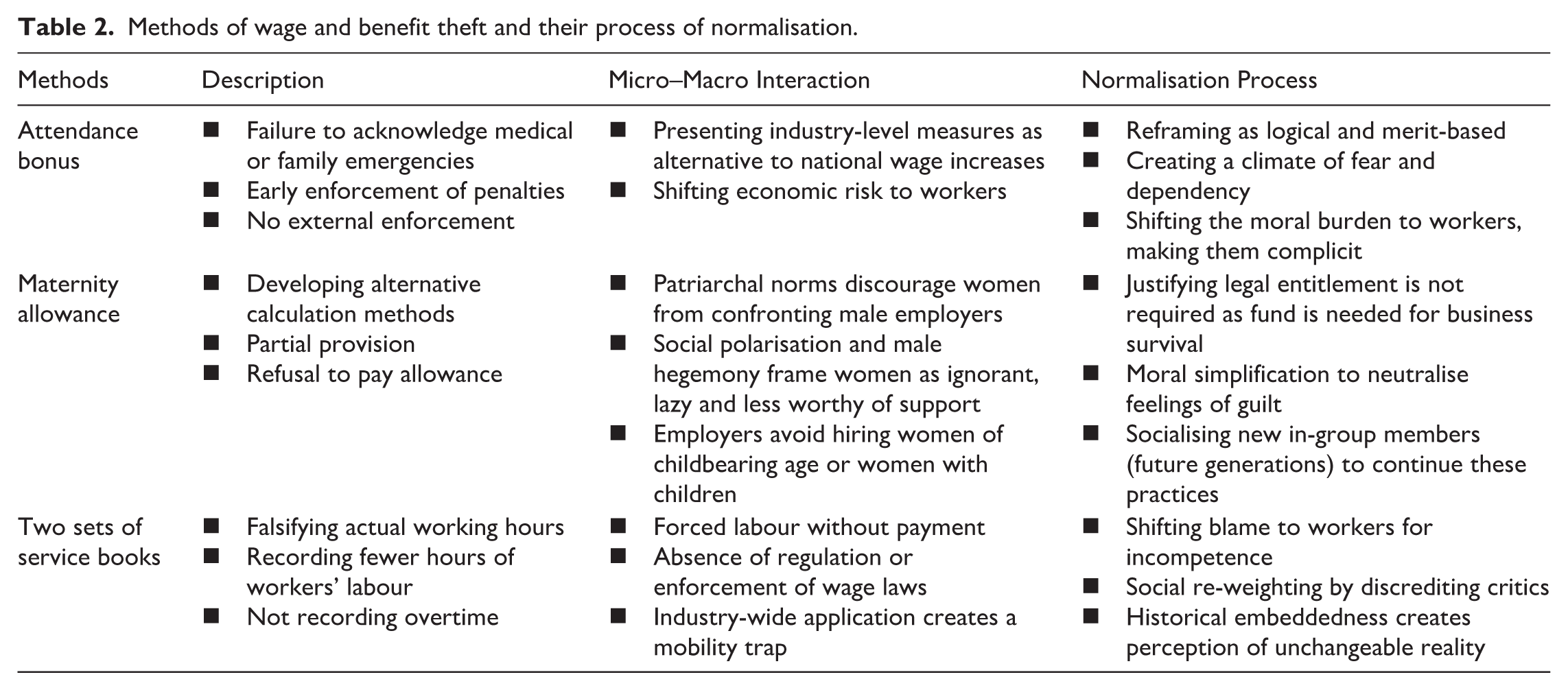
From these codes, key themes were developed: informal recruitment of vulnerable workers, coercive labour control, deceptive compliance mechanisms, devaluation of workers’ lives, rationalisation of exploitation, socialisation of corruption and normalisation of violence to silence resistance. Reflexive discussions refined these themes into three interconnected forms of wage and benefit theft: denial of attendance bonuses, manipulation of maternity allowance calculations and two sets of service books concealing wage misappropriation. Analysis further revealed how these thefts operate through micro–macro interactions, where individual, organisational and institutional actions intersect with broader economic, social and political discourses, legitimising and institutionalising exploitation. These insights, summarised in Table 2, are theorised through normalisation frameworks such as coherence, cognitive participation, collective action and reflexive monitoring (May and Finch, 2009), alongside rationalisation, socialisation and institutionalisation (Ashforth and Anand, 2003; Jenkins and Delbridge, 2017).
Methods of wage and benefit theft and their process of normalisation.
Findings
Denying attendance bonus
The BGMEA, an industry-wide owners’ association endorsed by the government, mandated that workers receive a monthly attendance bonus of 300 to 500 taka (currently £2 to £3.30). This bonus was conditional on regular attendance with deductions permitted only if a worker was absent or late three or more times within a month. However, the Bangladesh Labour Act 2006 (amended in 2013) explicitly prohibits deductions for absences, including approved or medical leave.
Empirical findings exposed two misapplications of these regulations, instrumentalising attendance bonuses as a mechanism for wage and benefit theft. First, workers reported that even a single instance of lateness or absence was treated as equivalent to a third infraction, automatically forfeiting the bonus. Second, managers withheld attendance bonuses despite workers providing legitimate medical or authorised reasons for their absence. One worker (W:17) poignantly illustrated this: I was hospitalised for 13 days with a severe kidney infection. I promptly informed my manager and sent my father to the factory to collect the medical leave form. While lying in a hospital bed, I completed the form, and my father submitted it on my behalf. Despite this, my salary was deducted, and my attendance bonus was withheld. I desperately needed that money to afford my medication [tears streaming].
Many participants reported feeling compelled to work while ill, fearing the loss of their attendance bonuses. They also avoided planned leave to prevent disqualification from this critical financial support. Testimonies from both workers and civil society members revealed an absence of government intervention in cases where employers unlawfully deducted attendance bonuses for medical absences. This lack of enforcement underscores institutional weakness and systemic failure to uphold labour laws.
Micro- and macro-level interactions in the normalisation process
While denying attendance bonuses operates as a micro-level practice, its antecedents extend to the macro level. The BGMEA dictates the terms of attendance bonuses. Factory owners—many of them government ministers, MPs and members of the Parliamentary Committee—leverage their influence within the state administration to shape labour laws, ensuring the National Wage Board maintains low minimum wages by substituting attendance bonuses. One owner (O:2) revealed: We introduced the attendance bonus after suffering heavy losses due to low worker attendance. I can’t recall the exact year, but it was early 2000. Instead of raising the minimum wage, we opted for this incentive.
This system was strategically designed to supress demands for a living wage, transferring financial risk onto workers. Owners restructured the attendance bonus as a regulatory mechanism rather than a legal entitlement; one they can control and modify at will. Notably, since its introduction, the bonus has never been adjusted for inflation, intensifying financial strain for millions of workers. The continued suppression of the living wage, coupled with the stagnant bonus, perpetuates widespread poverty, health crises, inadequate childcare and restricted educational access, among other severe societal consequences.
This condition instils a pervasive climate of fear and dependency, where workers prioritise income over health due to punitive attendance policies. These practices expose systemic power imbalances and control mechanisms that ensure worker subjugation. One worker (W:32) described: I haven’t taken a single day off in two years. I never applied for medical or emergency leave. My elderly parents live in a village, but I stopped visiting them because I can’t afford to miss work.
However, factory owners framed the attendance bonus as a logical, merit-based incentive, rewarding punctuality rather than enforcing compulsion. As one owner (O:3) explained: No one forces workers to be punctual. If they have medical issues, they don’t have to come in. The bonus rewards those who consistently show up on time. We can’t justify paying it to absentees.
Other owners provided similar rationalisations, citing economic pressures that compel them to adopt strategies to navigate normalised corruption among bureaucrats and extortion by politically connected actors who operate with near-total impunity. The state lacks both the political will and institutional capacity to address these practices, as many state actors directly benefit from them (see Ahmed et al., 2025). Owners argued that Bangladesh’s high raw material and utility costs, along with systemic corruption, raise operational expenses. In this context, portraying workers as low-skilled justifies employing them at minimal cost. Extending this logic, owners framed non-payment as a rational and fair market response rather than exploitation. By shifting ethical responsibilities, such as staying home when ill, onto vulnerable workers, they further normalised an exploitative system.
By framing illness as a personal choice, owners obscured the economic constraints limiting workers’ autonomy. Consequently, unable to absorb the financial burden, many workers are compelled to work despite risks to their physical and mental health. Such practices demonstrate how power operates to evade legal and ethical responsibility. Within this broader system of control, denying attendance bonuses becomes a subtle form of benefit theft, harming individuals while disciplining the broader workforce to accept a punitive regime of punctuality where industry and national growth override workers’ rights and well-being.
Alternative calculation of maternity allowance
While scholarship has begun to interrogate gendered labour exploitation in the Global South (Goodburn and Mishra, 2023; Khurana, 2016), first-hand accounts of wage and benefit thefts remain scarce. In Bangladesh, the Labour Act mandates 16 weeks of fully compensated maternity leave, amounting to 24,615.36 taka
1
(£161.52), accessible twice during a woman’s tenure as a permanent worker. However, empirical evidence reveals a sharp disparity between legislative provisions and lived realities: of the 16 women entitled to maternity benefits in our dataset, only two reported receiving any form of compensation. One participant from the FGD explained: When my first child was born, I received 3,500 taka [£23] as maternity allowance. However, when my second child was born, I did not receive any allowance at all. The factory only granted me three months of unpaid leave.
The structural precarity surrounding pregnancy, manifesting in job terminations, income deprivation and institutionalised economic insecurity, compels strategic reproductive choices among female workers. Some deliberately postpone childbirth, whereas others delay marriage to deflect sociocultural expectations that women conceive immediately after marriage.
Factory owners displayed striking candour in acknowledging their non-compliance with labour laws on maternity entitlements. For them, such provisions are privileges reserved for white-collar women rather than rights for ‘poor villagers’. As one owner (O:1) asserted: Many organisations in the USA do not offer maternity leave or allowances to highly educated and skilled white women. So why should we extend such privileges to these poor, illiterate and brown-coloured women?
Through such rationalisations, he and other factory owners legitimised their practice of providing either partial maternity allowances or none at all.
However, one owner instituted his own discretionary scheme, disbursing 12,444.32 taka
2
(£81.60), half the legally mandated entitlement. He justified this violation by citing the absence of overt resistance, thereby reinforcing female workers’ structural disempowerment and normalising systemic non-compliance. He (O:2) stated: Indeed, we are not strictly following the labour laws! Instead, we have developed our own method based on these laws. So far, we have not received any complaints from the workers.
Micro- and macro-level interactions in the normalisation process
Bangladesh’s persistent patriarchal norms compel women to prioritise family obligations over economic autonomy. Dominant gender ideologies and cultural practices sustain an environment that devalues women’s rights, including legal entitlements to maternity benefits. Guided by these logics, factory owners institutionalise exploitative practices that reinforce hegemonic masculinity within the industry. Their disregard for legal obligations demonstrates how misogyny intertwines with economic and social power, legitimising the defiance of labour law. Owners further invoke moral dichotomies to justify non-compliance, shifting moral authority from legislative duties to self-serving economic imperatives. As one owner (O:2) rationalised: Look, every year the government introduces thousands of laws, most of which they do not follow. But we do. I guarantee that if you go out and check, you will find that many factories do not even provide maternity leave, let alone an allowance.
His assertion proved accurate, as our findings revealed that numerous owners refuse to grant maternity allowances. For them, Bangladesh’s status as a developing country absolves any obligation to uphold women’s rights. This rationale is embedded in broader economic justifications and reinforced by deep-rooted gendered norms and sociocultural discourses that systematically devalue women’s rights. Consequently, some owners withhold maternity benefits to minimise operational costs, as one (O:3) explained: Running a factory in Bangladesh incurs the highest operating costs in Asia. Utility bills are exorbitant, transport costs are substantial, and our insurance premiums are the highest among garment-exporting countries. On top of this, workers’ wages have surged by nearly 70% in recent years. Given these pressures, how can we afford to pay maternity allowance while a worker is at home? One must be pragmatic, not sentimental!
Here, the factory owner frames benefit theft as a necessary business strategy—a pragmatic response to economic pressures. By constructing maternity benefits as an unsustainable financial burden, owners rationalise legal violations as economic imperatives rather than ethical transgressions. This belief system fosters widespread non-compliance, as echoed by another (O:6): I have instructed my managers to advise female workers not to get pregnant if they want to keep their jobs here. They are a liability. They must be fired from the factory.
Beyond their explicit disdain, owners also revealed strategic allegiances within the industry to sustain the systemic rejection of maternity benefits, ensuring that newcomers in the sector conform to these exploitative norms and preserve collective malpractice. A young owner (O:4) who inherited his father’s factory, described how his perspective evolved upon entering the family business: When I was at university in the UK, I believed my father was exploiting workers. However, after taking over the business, I now see that he did nothing wrong. Idealism has no place here. Sometimes, you must be ruthless to succeed.
This statement illustrates the socialisation process through which a newcomer, initially critical of his father’s position, gradually accepts and participates in entrenched norms of wage and benefit theft. This transformation unfolds through persistent exposure to a culture of elite entitlement, peer reinforcement among factory owners and the normalisation of exploitation across business and state institutions. Within this environment, moral boundaries are gradually redefined, enabling the rationalisation of unethical practices as pragmatic and legitimate. What begins as disapproval, dismissed as naïveté, gradually becomes acceptance of ruthless business practices as both necessary and justified.
According to the civil society members interviewed, Bangladeshi sociocultural structures internalise gendered norms that expect women to be compliant, submissive and deferential, particularly towards male authority. This conditioning suppresses resistance, discouraging female workers from challenging the exploitation imposed by factory owners and managers. State institutions have long ignored women’s calls for legal protection while safeguarding the interests of patriarchs who appropriate women workers’ entitlements. The continued failure to enforce rights further empowers these actors. An NGO participant in the FGD explained: In Bangladesh, it’s acceptable not to follow the law because the government is indifferent to these women. They [the state actors] are preoccupied with consolidating their own power and privilege. And factory owners are the important ally in this mission.
Within the BGI, factory owners wield significant economic and political influence, shaping state policies, legal frameworks and enforcement mechanisms to serve their interests. This power asymmetry enables them to neutralise any form of ‘reflexive monitoring’, including ethical reflection, remorse or accountability, thereby legitimising the systemic dispossession of female workers and their maternity rights.
Two sets of service books
Perhaps the most calculated form of wage theft documented in our research involved the use of two service books—an accounting practice that conceals the non-payment of earned wages and overtime. The service book, a 16-page ledger, records workers’ biographical and employment history, including temporal data (clock-in and clock-out times, working hours, overtime), disciplinary records (attendance, absences, wage deductions, penalties), financial transactions (monthly wages, bonuses, leave) and productivity metrics (output and performance). Under the Bangladesh Labour Act, factories must retain their original books and provide duplicates to workers. These duplicates serve as verification tools carried by workers and updated daily by managers. At the start of each month, workers return their copy for wage calculations and payments.
However, our empirical findings revealed a clear gap between the document’s appearance of transparency and its actual operation. Workers reported that duplicate service books were routinely manipulated. While the factory’s original record reflects accurate data, workers’ copies are falsified through the underreporting of hours and output. This creates two parallel and conflicting archives of labour rather than a genuine duplicate. Through this asymmetry, managers, under owners’ direction, systematically reconfigure wage theft and conceal workers’ real contributions. One FGD participant noted: I work 14 hours a day, six days a week. Yet every day, the line manager records only eight hours in my book. He and other managers do the same with the records for the other workers.
In another case, rather than receiving 580.80 taka 3 (£3.81) for a gruelling 14-hour workday, one worker reported being paid only 290.40 taka (£1.90). This discrepancy signals more than clerical error; it constitutes an institutionalised mechanism of wage theft, whereby factory management systematically extracts surplus value by withholding legally and contractually owed earnings. In effect, this worker is structurally dispossessed of half of his daily wage, amounting to a routine and calculated appropriation of labour without pay.
Micro- and macro-level interactions in the normalisation process
Most factory owners and managers denied engaging in wage and benefit theft through data manipulation. However, one young owner (O:5) admitted that maintaining two sets of service books is widespread, revealing the institutionalised nature of document falsification that sustains the illusion of compliance. He explained: We do maintain two sets of books. Every factory does it, though no one will openly admit it. This practice becomes apparent when we process workers’ payments.
Through moral justification, he further defended wage theft, asserting that, ‘Every garment factory does it. It is a common practice in our industry’.
Secondary data sources documented similar patterns across Bangladeshi factories (BBC, 2013; Human Rights Watch, 2015). In some cases, managers forced workers to labour over 20 hours a day for 14 consecutive days, yet recorded only 10 hours in official documents. The industry-wide normalisation of this practice creates a mobility trap, making factory-switching an ineffective strategy to escape exploitative wage structures.
Our findings also suggest that government agencies and oversight bodies systematically fail to intervene, allowing these violations to become legitimised. As an NGO director (C:2) explained: The practice of withholding workers’ legal wages [through two sets of books] is an open secret. Western retailers and the Bangladeshi government are all aware of it. Unfortunately, access to the original books is restricted to labour department inspectors alone. However, these inspectors are notoriously corrupt; for a mere 500 taka (£3.28), they will overlook such theft and present a favourable report about the factories.
He explained how and why this industry has become vulnerable to exploitation and violence: Under the regime of Sheikh Hasina, the Department of Labour and the Ministry of Labour, which are responsible for safeguarding workers’ rights and well-being, have become accomplices of factory owners in violating those rights.
This regime regarded meso-level institutions such as trade unions, NGOs and other civil society organisations as ‘enemies of the state’. Based on this belief, the Foreign Donations (Voluntary Activities) Regulation Act was amended in 2016, adding restrictive clauses severely limiting NGO activities, particularly those aimed at protecting workers’ human rights.
The research team also faced insults and aggression from owners, a stark departure from earlier strategies of denial over attendance bonuses and alternative calculations of maternity allowances. These confrontations were particularly memorable, as exemplified by one factory owner (O:1): There is no such thing as a secret book. It’s simply widespread propaganda. People like you [lead author], NGOs and the media are part of this propaganda. You don’t want us to prosper. You have always been undermining us. You think you are better than us, but you are not!
This tactic of attacking critics to discredit researchers and civil society exemplifies social weighting, or ‘condemning the condemners’ (Ashforth and Anand, 2003), a rhetorical defence that reframes allegations of unethical conduct as politically motivated attacks. This strategy rationalises exploitation by diverting scrutiny from the normalisation of wage and benefit theft to the credibility of those who expose it.
Although this article cannot trace the precise origins of the two-book system within the industry, one young owner (O:5) described it as a long-standing form of theft embedded in organisational routines, social norms, collective practices, power relations and ideological justifications. He noted that wage theft is often rationalised as beneficial to workers, businesses and the wider economy: I don’t see anything wrong in this [wage theft]. Because in return, more orders are coming. Workers can work more, so they earn more. We also earn more export money, we pay more tax. So, everyone is benefitting from this.
Over time, this practice has become embedded in the industry’s organisational memory—a repertoire of shared routines, informal knowledge and institutionalised behaviours sustained across generations of factory management. Corruption is also historically rooted and normalised within the BGI, shaping processes from obtaining trade licences to acquiring land, constructing factories and negotiating utilities through owner–state networks (Ahmed et al., 2025). These practices have been transmitted and institutionalised as industry norms, where regulatory subversion is viewed not as an aberration but as a defining feature of the political economy, perpetuating the conditions that normalise wage and benefit theft.
Discussion
This article critically examines the normalisation of wage and benefit theft in the BGI, a major supplier to the Western fast-fashion market. It investigates the interaction between micro-level exploitation and macro-level structural forces, an underexamined nexus in sociology and industrial relations. Drawing on a longitudinal case study from Bangladesh, this article provides empirical evidence of the systematic withholding of wages and statutory benefits. It identifies three key mechanisms enabling this theft: denial of attendance bonuses, partial or non-payment of maternity allowances and wages and overtime misappropriation through data manipulation. In doing so, the article advances scholarship on wage and benefit theft and the processes through which exploitation becomes normalised across the industry.
First, this article offers one of the most comprehensive empirical analyses of wage and benefit theft in a non-Western context. While existing research often frames wage theft as either intrinsic to capitalism (Cole et al., 2022; Yea and Chok, 2018) or as a strategic act by individual firms (Bornstein, 2018), this article demonstrates that it is a calculated and institutionalised accounting practice (Clark, 2022). These mechanisms do not arise from isolated corruption or rogue behaviour but are embedded within the industry’s operational logic, reinforced by structural power asymmetries, authoritarian management, opaque accounting and coercive discipline. Therefore, wage and benefit theft is not only tolerated but actively legitimised through regulatory neglect and systemic enforcement failure.
This study argues that the significance of these findings lies in the legally sanctioned power asymmetry between factory owners, managers and workers. This imbalance is structural within Bangladesh’s political economy, enabling owners to exercise near-total control over a precarious workforce (Ahmed, 2024; ILO, 2020). Their dominance extends beyond breaches of labour law to the systematic extraction of surplus value through wage theft (Cole et al., 2022). Prior studies document employer control strategies such as hyper-surveillance (Hung, 2023; Tse, 2022), coercive organisational tactics (Clark, 2022), workplace bullying (Ahmed and Uddin, 2021) and physical violence (Ahmed, 2024). These mechanisms reinforce employer dominance, suppress collective resistance and weaken bargaining power (Siddika et al., 2024), thereby normalising wage and benefit theft as an industry-wide practice.
By highlighting the normalisation of wages and benefit theft, this article extends scholarship on labour exploitation (Ahmed and Uddin, 2021; Ahmed, 2024, 2025; Cole et al., 2022; Siddika et al., 2024), demonstrating how the structural power of factory owners, at both organisational and industry levels, enables its broad acceptance. Employers and managers systematically manipulate, bypass or openly violate legal and regulatory frameworks to secure economic advantages. These are not isolated violations but strategic, industry-sanctioned practices maintained through regulatory complicity and structural inertia.
The second key contribution of this article is its critical examination of the normalisation process. While prior studies explore the normalisation of deviance such as corruption (Ashforth and Anand, 2003) and deception (Jenkins and Delbridge, 2017), the industry-wide normalisation of wage and benefit theft remains largely overlooked. This article addresses this gap by showing how exploitative practices become structurally embedded through the interaction of micro-level organisational and group behaviours with macro-level economic, social, cultural and legal forces. Within the BGI, wage and benefit theft is not a by-product of managerial misconduct or isolated deviance but a systemic outcome of power relations, institutionalised controls and structural imperatives. These micro-level practices are closely entwined with Bangladesh’s political economy, its dependence on the garment sector, the political influence of factory owners, systemic corruption and state protection of industrial elites (Ahmed et al., 2025), all reinforcing wage and benefit theft as a routinised, socially accepted and legally tolerated practice. Patriarchal norms, hierarchical social relations, political repression and authoritarian governance, enacted through owners, managers and state institutions, further sustain and legitimise these dynamics. Together, these interconnected forces create a regulatory vacuum in which wage and benefit theft persists with impunity, ensuring its continued industry-wide normalisation.
Existing research documents the precarious conditions, limited employment opportunities, economic vulnerability and systemic gender violence that disempower millions of workers in the BGI (Ahmed and Uddin, 2021; Ahmed, 2024; Chowdhury, 2017; Siddika et al., 2024). This article extends such insights by showing how such macro-level dynamics enable factory owners and their associations to institutionalise wage and benefit theft. These structural constraints significantly restrict workers’ agency and mobility, leaving them ‘unable to extricate themselves from exploitative situations without suffering further hardship and harm’ (Yea and Chok, 2018: 926). Within this climate of normalised violence, workers’ powerlessness—evident in their personal sacrifices and reluctance to protest—functions as a ‘moral shield’ (Torsello and Venard, 2016) for employers, legitimising wage and benefit theft through economic rationales, patriarchal narratives and culturally shaped complaint behaviours (Hendy and Tucker, 2021).
This article argues that wage and benefit theft has been normalised through the systematic weakening of meso-level institutions, including NGOs and civil society groups, under Bangladesh’s 15-year authoritarian regime (Ahmed, 2025; International Trade Union Confederation [ITUC], 2024). During this period, two of the country’s worst industrial disasters—the Tazreen Fashion fire and the Rana Plaza collapse—involved owners closely linked to the ruling elite. To suppress scrutiny and dissent, the regime enacted repressive laws, notably the Digital Security Act 2018, which severely curtailed fundamental human rights. Amendments to the Bangladesh Labour Act and the Foreign Donations (Voluntary Activities) Regulation Act further constrained trade unions, NGOs and civil society organisations, undermining their capacity to defend workers’ rights. These legislative measures served as tools of authoritarian consolidation, eroding civil society autonomy, stifling resistance and reinforcing the structural conditions that normalise wage and benefit theft across the industry.
Building on this discussion, the garment sector’s rapid expansion, coupled with intensifying pressure from global brands to reduce production costs, has further eroded profit margins and perpetuated exploitative labour practices. These include wage and benefit suppression, along with the systematic prioritisation of retailers’ and factory owners’ interests over workers’ rights and protections (Ahmed, 2025; Anner, 2015). While a detailed examination of these transnational dynamics lies beyond the scope of this study, future research should investigate the governance, policy and industry-level interventions to address these challenges.
Conclusion
Drawing on the concept of normalisation (Ashforth and Anand, 2003; Jenkins and Delbridge, 2017), this article elucidates how wage and benefit theft is normalised through the dialectical interplay between micro-level organisational logics and macro-level economic, cultural and political structures, intensified by the erosion of meso-level institutions. It highlights this normalisation as not merely an aberrant exploitative practice but a structural condition of contemporary capitalism sustained through multi-scalar processes. Despite ILO conventions, multi-stakeholder initiatives and social audits, wage and benefit theft remains largely unchallenged. This article advocates dismantling deeply embedded power asymmetries to curtail employer dominance over workers, regulatory agencies and state policies through recalibrated legal and institutional frameworks. Strengthening worker agency in organisational governance and limiting employer influence over macro-level policymaking can safeguard labour rights, promote ethical labour standards and enhance transparency. Finally, reinforcing meso-level institutions, particularly trade unions and civil society organisations, is imperative for fostering workplace and industrial democracy, disrupting the normalisation of exploitation and violence in sectors such as agriculture, coffee and tea plantations, where precarious workers remain systematically dispossessed.
Footnotes
Acknowledgements
We are grateful to the Editor-in-Chief, Marek Korczynski, and to the anonymous reviewers for their constructive and insightful comments. We also extend our thanks to Melissa Tyler and Mathew Cole for their valuable feedback on earlier drafts of this article.
Funding
The authors received no financial support for the research, authorship, and/or publication of this article.
