



Abstract
This article examines workplace bullying and the intensification of labour controls in the clothing supply chain. It appears that extreme forms of bullying are deployed to intensify labour controls, including locking workers in, frequent wage cuts, setting moveable targets and carrying out intense observations. The context of this study is surplus value-starved clothing factories in Bangladesh. Global supply chains’ production regimes and the absence of state protections and trade unions enable factory managers to systematically deploy bullying tactics to achieve production targets. Drawing on Burawoy’s works, this article advances the debate of how workplace bullying is impacted by wider structural conditions with managerial strategies of coercion in factories. It is argued here that when the state intervenes in the factory only to protect and preserve capitalists’ interests, explicitly and implicitly, coercive strategies of control turn into extreme bullying on the shopfloor.
Introduction
This article examines workplace bullying and the intensification of labour controls in the clothing supply chain. The Bangladesh garment industry has been under the spotlight since the Rana Plaza disaster in 2013, which killed nearly 1200 workers and injured 2500 workers. Workers were forced to enter the building to work, although it was declared ‘dangerous’ and required immediate evacuation. The disaster resulted in the promise of big retailers to do business with socially audited factories ensuring workers’ rights and safety. However, despite some safety improvements, long working hours, abuse of workers and workplace health and safety issues continue in the garment industry (Akhter et al., 2019; ILO, 2015, 2019).
Workplace bullying is a relatively well-studied topic, especially in Western organisational settings, where its role has been identified in managerial technologies such as the use of performance measurement to bully subordinates (Hoel and Beale, 2006). Bullying has also been linked with managerial conflict (Leymann, 1996), hostile working environments (Salin, 2009), competitive organisational situations (Hauge et al., 2007) and destructive leadership styles (Harvey et al., 2007). However, its role in labour controls is understudied (Beale and Hoel, 2011).
Previous studies find that workers at the bottom of the organisational hierarchy are victims of bullying in modern organisations (Einarsen et al., 2007). Bullying is integral to employment systems often used by managers to exert authority and control (Beale and Hoel, 2011). Akella (2016) argues that both direct and indirect controls create a culture of bullying in which top management not only neglects workers’ legal rights but also abuses and humiliates workers through coercive behaviours. Nevertheless, the use of bullying as an essential tool to intensify labour controls requires further scrutiny.
To extend this debate of workplace bullying and labour controls, Beale and Hoel (2011) call for exploration of how workplace bullying is impacted by labour and product markets and the inclusion or exclusion of trade unions and employers’ regimes, which may be endemic features of capitalist employment. This article responds by focusing on structural conditions that may give rise to and embed workplace bullying in labour controls. It explores conditions under which managers find it normal to bully shopfloor workers to intensify labour controls. The article demonstrates workplace bullying becomes extreme when workers’ protections, trade unions, democratic institutions and human rights are lacking. Existing research on workplace bullying suggests that it may be particularly extreme in Asian societies (Akella, 2016) owing to the absence of legal remedies for workers, disregard for basic human rights (Harvey et al., 2009), oppressive political regimes and disempowerment of trade unions (Beale and Hoel, 2011).
Burawoy (1979, 1983, 1985) develops the notion of ‘factory regime’ linking the wider structural conditions with managerial strategies of coercion and consent in factories. Burawoy (1979, 1985) suggests that management relies on consent or coercion, depending on the extent of state protection and the strength of trade unions. Burawoy did not study workplace bullying as a form of a coercive strategy of labour controls. This study extends Burawoy’s work and seeks to explore whether the coercive strategies of labour controls turn into extreme bullying on the shopfloor in certain conditions. Uddin and Hopper (2001) find that managers implemented coercive strategies of control in the context of diminishing state protection and puppet trade unions in Bangladesh. Peng (2011) identifies how worker consent was achieved by relying on a particular type of state–capital interrelation (a form of ‘factory regime’). Building on this, the article wishes to argue, macro processes such as the role of the state, trade unions and big retailers’ fast-fashion business model in the global supply chain play an important role in mobilising workplace bullying in labour control practices on the shopfloor.
Workplace bullying, coercion and global supply chains
Labour controls are understood to be intensified through an array of targets, dashboards of key performance indicators and various technical and managerial innovations (Bloomfield and Dale, 2015). This intensification is further accelerated by cost reductions, workforce downsizing and restrictions on unionisation (Green, 2004). However, workplace bullying as a tool to intensify labour control is poorly understood. Scholars provided attention to extreme workplaces and extreme conditions for workers in previous studies. Burrow et al. (2015) argue, drawing on the work experiences of a chef in the UK, how workers are socialised into accepting, adopting and propagating extreme workplace behaviour driven by hegemonic masculine ideals. Burrow (2015) argues that to compete against extreme competition, modern workplaces have extreme leaders who employ extreme workers under extreme conditions and pressurise workers to work extreme hours in extreme teams. Workplaces in Bangladesh, especially in supply chains of clothing giants, exhibit extreme working conditions with little or no protections for workers, with extreme pressures derived from the fast-fashion business model, oppressive political regimes and absence of trade unions’ voices (Akhter et al., 2019; Gibbs et al., 2019). Burawoy’s work on ‘factory regime’ (1983, 1985) is apt to shed light on the extreme conditions of workplaces in Bangladesh. Factory regime may provide an explanatory account of extreme working conditions linking the wider structural conditions with managerial strategies of controls in workplaces.
Previous studies reveal how managerial technologies and ‘political tactics’ give rise to workplace bullying (Beale and Hoel, 2011). In relation to the care communities in the USA, Akella (2016) argues that workplace bullying is an integral part of the employment system: ‘managers want to get work effectively done’ to ensure their authority and control because ‘effective management means complete control’ (p. 4). The adverse consequences of bullying for productivity are well noted in the literature (see Sheehan et al., 2020), yet bullying remains common in modern organisations. This is perhaps because, as Soylu and Sheehy-Skeffington (2015) suggest, bullying is a manifestation of wider economic inequality and conflict. Organisational externalities, such as cultural and historical belief systems (e.g. viewpoints, morals and customs), are also found to be significant in encouraging aggressive managerial behaviours that are ‘taken for granted’ (Lutgen-Sandvik and Tracy, 2012).
In his seminal work, Burawoy (1979) explains how capitalist organisational control veers between coercion and consent. Consent refers to ‘the necessity to elicit a willingness to co-operate in the translation of labour-power into labour’ (Burawoy, 1979: 27), and coercion is often used to supplement consent in capitalist organisations. Burawoy’s later works (1983, 1985) provide a historical analysis of factory regimes in advanced capitalist, socialist and poorer economies to explain when and why controls are based on coercion or consent. These describe how, during the early 20th century, despotic market regimes characterised by coercion were transformed into hegemonic regimes embodying consent through state interventions in advanced capitalist countries including state regulation of factory regimes and support for the reproduction of labour-power (Burawoy, 1985). Burawoy (1983) recognises that the interrelationship among state, production politics and market forces within an economy shape managerial strategies of consent and coercion. He argues that hegemonic regimes have given way to hegemonic despotism or a new despotic regime (in poorer countries) through coercive controls. Management is not interested in consent-generating behaviour in the context of diminished state protection and intense global competition. Rather, coercion is effective when: workers are presumed to be totally at the mercy of the capitalist or his agent, the overseer, who can arbitrarily intensify the work, provided that his demands are compatible with the reappearance of the worker the next day (and sometimes not even then) and that they remain within certain broad and often unenforced legal limits. (Burawoy, 1979: 27)
Coercion also thrives due to unemployment, uncertainty, shrinking trade union power, weak state laws and regulations and oppressive political regimes (Nichols et al., 2004; Peng, 2011). Weakly regulated workplaces with non-existent trade unions often found in poorer countries may create conditions for coercive strategies such as bullying in labour controls (Uddin and Hopper, 2001). Akhter et al. (2019) show how, for fear of losing their jobs, female workers suffer workplace violence in silence and lack obvious remedies. Workers’ protections are worsened when local factories become an essential part of intense global competition (Smales, 2010).
Contemporary organisations are under immense market pressure to improve performance and efficiency while reducing labour costs by forcing workers to work extreme hours, leading to labour intensification (Bloomfield and Dale, 2015). Globalisation and competition place pressure on small manufacturers in the supply chain, such as clothing factories in poorer countries, resulting in perhaps even greater labour intensification (Crane, 2013). Clothing factories in Bangladesh are particularly vulnerable, as they are mainly small manufacturers for large retailers that extract most of the surplus value from the chain. Studies demonstrate that lead firms impose various requirements on the supply chain and dictate the temporal and spatial dimensions of the chain including price, quality, speed, labour standards and working conditions through unauthorised subcontracting (Hammer and Plugor, 2019; Lloyd and James, 2008). Smales (2010) argues that large retailers misuse their power to make or break contracts with local manufacturers, as they are in constant competition with each other to fulfil consumer demand for lower prices. This has also been seen during the COVID-19 crisis, as lead firms have cancelled orders unilaterally, endangering workers’ livelihoods (Brydges and Hanlon, 2020).
Global supply chains have built-in mechanisms for bottom-up value capture, which operate through ‘adverse incorporation’ (Phillips, 2013), resulting in the expansion of insecure and exploitative work in poorer countries, performed by highly vulnerable and disenfranchised labour. In the context of weak institutional support for workers, local clothing factories often break the law in denying suitable working conditions to workers (Siddiqui and Uddin, 2016). Bullying is more likely to be associated with smaller firms in the supply chain that have very limited opportunities to extract surplus labour and where value is captured mainly upstream by larger retailers. Thus, this article investigates whether, as Burawoy envisages, unfavourable global supply chains, absence of state protections and trade unions create the necessary conditions for the deployment of workplace bullying as an effective tool to intensify labour controls.
Data collection
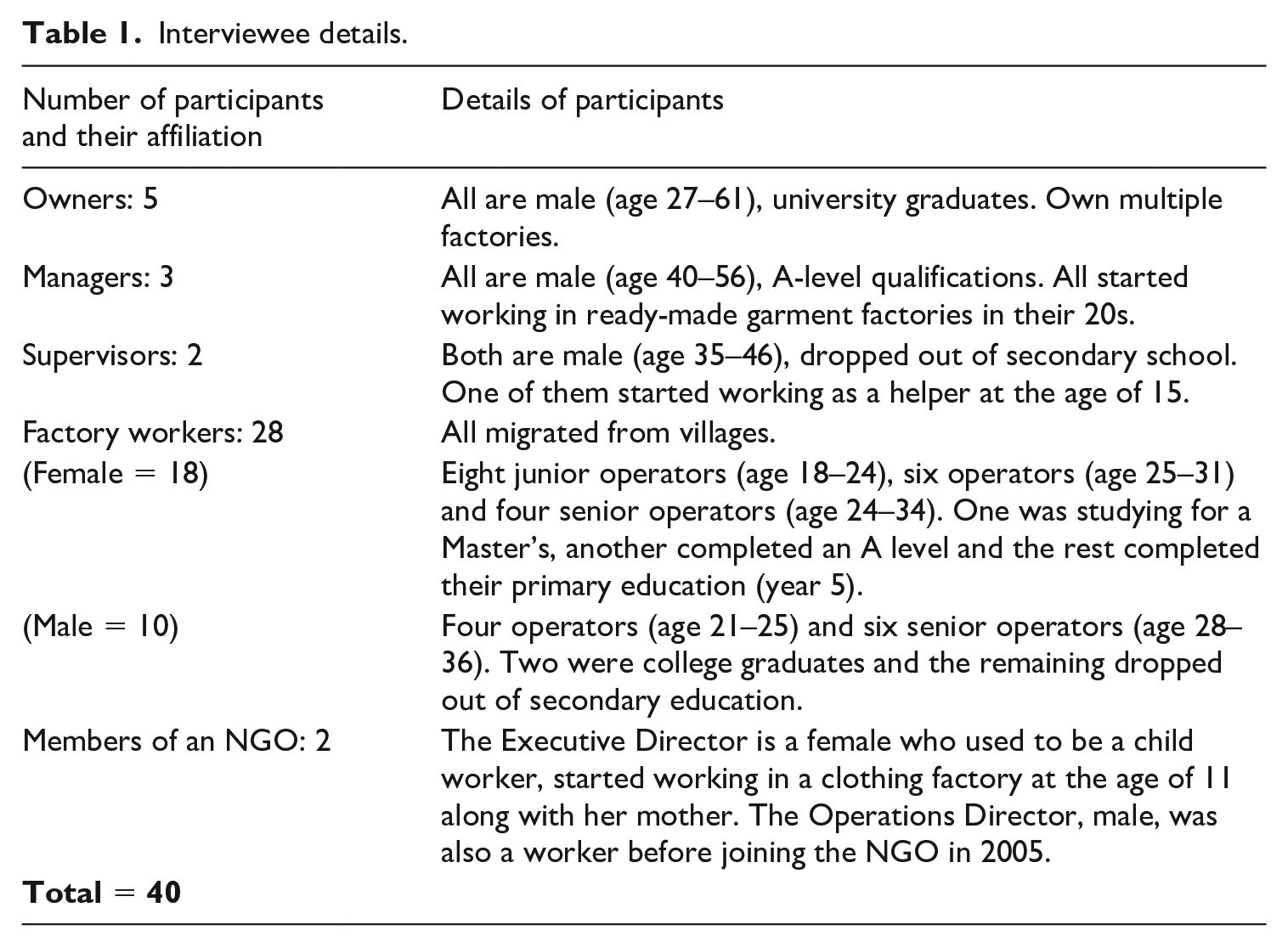
This article investigates clothing factories in Bangladesh, a major source for European and US brands and retailers, which have frequently been in the spotlight regarding human rights violations (BBC, 2013; HRW, 2015). This media attention made it difficult to gain access to these factories. However, primary data were collected through interviews, a focus group discussion, documentary evidence and observations – between April and September 2016. The first author initially secured access to the factory owners through university colleagues in Bangladesh. Having promised anonymity and built trust with the owners, the first author sought access to interview managers and observe the activities in the factories. The owners allowed access, with conditions such as neither interviewing workers on factory premises nor taking any photographs. An NGO provided office space for the first author to interview and organise a focus group meeting. The first author interviewed 40 participants, including workers, supervisors, managers, owners and NGO officials. Table 1 details the participants.
Interviewee details.
Interviews were conducted sometimes after 9 or 10 p.m. in NGO offices in Dhaka and in the suburbs of Ashulia, Tongi and Gazipur where 90% of clothing factories are located. One focus group discussion was also organised with 10 participants (five workers and two supervisors, one independent researcher, one journalist and one NGO councillor), which lasted for two and a half hours. The interviews and the focus group meeting were audio-recorded and transcribed verbatim, except for four interviews (two owners and two managers). Forty hours of non-participant observations were conducted in five factories (eight hours in each factory). The first author took as many notes as possible during the observations and wrote up the details immediately afterwards.
These data were supplemented with published documents, produced mainly by Human Rights Watch, Transparency International, International Labour Organization and Transparency International, as well as national and international news outlets. These provided an understanding of the breadth and wider nature of bullying and labour controls in the Bangladesh garments industry.
Thematic analysis was applied, using NVivo 12 (QSR International Pty Ltd), to analyse the data systematically by becoming familiar with the collected data, generating initial codes and searching, reviewing and naming themes (Braun and Clarke, 2006). A constant back-and-forth reading of the transcripts to gain familiarity with the data helped with code generation (e.g. forced working hours, abuse, punishment and targets). These generated codes that helped to develop key themes (e.g. bullying, labour control and workers’ protections), which were applied in the analysis.
New despotic regime and workplace bullying
Burawoy (1985) argues that the convergence of production and state politics and global competition causes hegemonic regimes to decline and leads to a new despotic regime. The following subsections demonstrate how bullying became a central element of work intensifications under the new despotic regime. This subsection, first, outlines the organisation of factories studied, followed by a discussion of bullying and intensification of labour controls.
The shopfloor operations of the clothing factories visited were typically headed by a general manager and involved three main functions: cutting, sewing and finishing. The general manager was assisted by a production manager who ran the day-to-day operations. A few floor managers performed administrative responsibilities, and guided the production managers and line supervisors to finish the production in time. Both the production and floor managers stayed in their offices but constantly monitored the workers via CCTV on the shopfloor.
The cutting sections were run by a few head tailors who were responsible mainly for cutting the fabrics according to the given design. Unlike other sections, the cutting sections were clean, the floors were covered with carpet and they had adequate lighting and electric fans. The head tailors were supported by helpers (mainly young men who had no previous experience of factory work) and also had supervisory responsibilities. They were well-dressed and looked composed. In contrast, the finishing sections (including washing, ironing and packaging) were smaller, with fewer workers. Around eight to 10 workers ironed the washed clothes on large tables covered with heavy garments. More male than female workers appeared to work in these sections. Immediately behind the ironing sections, fewer than 10 workers packaged the final products.
The sewing sections were the centre of the clothing factories’ activities. These were the largest, busiest and noisiest sections. They were divided into many lines (each with 20–30 workers depending on the size of the factory) and each line was supervised by a line supervisor. All the line supervisors were male, whereas most of the workers were young women (based on our interviews with owners). More than 100 workers worked in a sewing section which was hot and noisy. None of the five factories visited had adequate air circulation: the spaces had narrow windows, were illuminated by high-power electric bulbs and piled with fabrics and boxes. The use of irons increased the temperature by 2–3°C. The outside temperature was around 36°C and the average humidity was 72% but felt much higher inside the factory. The workers sweated profusely even though the ceiling fans were running. In contrast, the managers’ offices were air-conditioned and less noisy.
Moveable targets
The production target set in the clothing factories visited is like other family businesses in Bangladesh where owner-managers retain full control over the process (Uddin, 2009). However, targets are commonly achieved through bullying in clothing factories. None of the factories in this study had formal production targets for their workers. The line supervisors revised the daily production targets whenever necessary; therefore, the workers’ production targets changed several times a week, sometimes even in a day. Having no fixed targets was useful, as the line supervisors were able to increase the workers’ targets as much as they wanted. One manager commented: If we have fixed targets, then it is our loss. We cannot accept more orders. And if we do not get more orders, then we cannot earn more money. The same goes for workers as well. We must not restrict ourselves if we want to prosper.
More importantly, moveable targets provided a rationale for workplace bullying. All the workers interviewed in this study said that they were regularly verbally abused and physically assaulted if they failed to achieve the given targets. One worker described how she had been beaten when she had failed to reach a target: [crying] Normally I am asked to produce 150–180 units per hour. But since the beginning of last month, I was told to produce 200 units. On the first day, I failed [she produced 170 units]. The line supervisor started scolding me with filthy language which I cannot tell you. I shouted at him and told him to mind his language. It hurts his Mordangi [manliness]. He then slapped me in front of all the workers. He also took a hanger to beat me. Other workers protected me on that day.
Another worker said: Yesterday, I was feeling tired in the late afternoon. The floor manager came and asked me why I was working slowly. I tried to tell him that I was feeling dizzy because I was fasting. Then he said: ‘You fucking lazy Maagi [whore]; you do not find any other excuse for not working. I am fasting [he was not, as this participant had seen him eating lunch] but I am working harder than anyone else. Work hard and finish your targets. Otherwise, you will spend the night [indicating sex] with me.’
All the workers also said that the line supervisors and floor managers made them feel humiliated, helpless, unworthy and unaccepted at work.
In this study, several episodes of bullying were observed where workers were abused with filthy language (whore, pig, slut, bitch, bastard, lousy, uncultured and many other examples) if they failed to achieve the targets. The line supervisors and other managers admitted to practising verbal abuse and physical assaults but justified these as necessary to achieve the targets. Similar bullying tactics are also found in other settings (Baron and Neuman, 1996).
Intense observation
The first author was granted access to the shopfloors for observations but was told not to speak with workers or supervisors as this would interrupt the working pace. In one factory, he was asked to sit on a balcony (adjacent to the director’s office). The factory floor was designed in a way that enabled all top managers to easily monitor the floor operations from their offices. While talking to the first author, the marketing director of that factory pointed his finger towards a girl on the floor and said: Look at this girl. It looks like she is on vacation. We are having a serious problem with these Chotoloks [Barbarians]. We just move our eyes away and they stop working. Now imagine if we are not around, then what will happen!
It was also observed that workers’ every move was monitored by the managers, alongside the close physical presence of the supervisors. The impact of bullying on the workers was clear. They hesitated to ask questions, feared speaking and were too nervous to look around, as the line supervisors’ eyes were always on their activities. For instance, the floor was very hot and humid, so the workers quickly became dehydrated. However, they were not allowed to keep water with them as it might drench the fabrics. They were required to go to the corner of the shopfloor where drinking water was kept. Often workers ran to the water section, drank water and ran back to their machines. The same went for using the toilets. Line supervisors verbally and physically abused workers whom they found to be late: [crying continuously] I had a urine infection, so I drank lots of water and used the toilet more. When I was two minutes late, the line supervisor shouted at me and said, ‘whom you are fucking over there [toilet]?’. I was offended by his nasty comment and called him Chotolok. He then grabbed my hair and slapped me in front of all the workers.
Top management defended the intensity of observations on the shopfloor and praised the supervisors, calling them ‘saviours’ of the factory: Discipline is the key to success. But you know, disciplining workers is very challenging, especially when you have a group of poor and illiterate villagers. We are fortunate that we have managers who know how to make them [workers] disciplined. They completely transform our factory with their strict managerial styles. We are now doing very good.
Along with the supervisors’ physical presence, some factories intensified their observations through technology. One factory had CCTV, a sound system on each of its seven floors and large monitors in the managers’ office. The managers continuously watched the workers’ activities through these monitors. If they saw particular workers not working or talking to others, they scolded them by calling out the floor number, aisle number, gender, appearance and colour of the clothes that these particular workers were wearing. Many workers compared the shopfloor to a prison, likening themselves to criminals with the managers and supervisors as prison guards. Similar to the above, previous studies also found bullying tactics such as public humiliation, throwing things, slapping and increasing targets (Keashly et al., 1994; Lutgen-Sandvik and Tracy, 2012) are instrumental to the control strategies.
Keeping workers locked in on long shifts
According to the Bangladesh Labour Act (amended in 2013), employers should ask for workers’ consent to work an additional two hours (maximum) over and above the regular eight hours a day, which will be considered as overtime and paid at a double rate. Employers also need written consent from female workers to work between 22:00 and 06:00 hours. This study found that workers were frequently forced to work at least 12 hours a day, six days a week, contrary to the labour laws. Also, no evidence of paying the double rate for overtime and seeking written or oral consent from female workers for long or overnight shifts was found. Any refusal would invite abuse and violence, which might ultimately cost them their jobs. During the long working hours, the workers were given a one-hour lunch break but were not allowed to go out. None of the factories visited had an eating space, so the workers used the emergency staircase or the open roof. However, they rarely used the roof because it was usually too hot and too rainy during the monsoon season.
In some instances, workers were even forced to work 16 to 20 hours a day, seven days a week. During these extreme shifts, the main staircases were locked so that no workers could leave the factory. Such treatment has been well documented in reports and documentaries (BBC, 2013; HRW, 2015). Keeping workers locked in seemed to be an important control tool for the managers who regarded it as very normal behaviour. Justifying the lock-ins and long working hours, one manager stated: Look, I have been in this sector for nearly 20 years. If anyone does not like the working hours, he or she can switch profession. But if anyone wants to work in this industry, he or she must work longer hours. This is the rule here.
Such conditions have harmful consequences. According to an investigative report, clinical psychologists found many workers suffering from depression and suicidal tendencies due to work pressures. It was reported that 42 workers (all female) committed suicide in a small suburb of Dhaka between January and March 2019 (Assaduzzaman, 2019). Gibbs et al. (2019) found similar evidence of workplace violence in the Bangladesh garment industry and adverse impacts on women workers’ health and wellbeing, including work-related stress and burnout.
Frequent wage cuts
While closely monitoring the workers’ activities, the line supervisors imposed severe punishments if workers failed to arrive at work on time or meet production targets. Although the Bangladesh Labour Act (amended in 2013) states that employers can only penalise workers if they are convicted of any criminal offence and found guilty of misconduct specified under section 24, the line supervisors in this study punish workers for lesser infractions than those covered by the Act. For instance, if workers failed to achieve the specified tasks, the equivalent of one day’s wages and overtime payments would be deducted contrary to section 24. The workers complained that they never received their rightful wages as their employers frequently made deductions without providing explanations or payslips: Every single day, I work at least four to six hours of overtime, so my wages should be more than 14,000 BDT [equivalent to approx. £133] per month. But I never receive more than 7000 BDT each month. I have no idea why I always receive half of the money. And I cannot ask the managers about it. If I ask, then they would be angry, which will cost me my job.
The managers defended the wage deductions, stating that their job was to ensure the completion of tasks on time. If workers could not deliver the desired production targets, then it would slow down others, which would put the entire shipment at risk and prevent speedy delivery of products to the buyers. Thus, they claimed to have no choice but to punish the workers: When they [workers] started working in the factory, they knew that if they could not deliver the tasks, they would be penalised. They agreed to this and joined at work. It is not something that we want but we must.
This study reveals that whenever the government increases the minimum wage, workers’ production targets dramatically increase, as do deductions from workers’ wages and overtime. The local NGO official commented: The production target of a worker was between 100 and 120 pieces per hour in 2013. This target dramatically jumped to 180–200 per hour right after the announcement of the new wage scale. But workers’ capacity does not increase. On the contrary, it seriously deteriorates due to extreme work pressure and long working hours.
All participants (workers) complained that wage deductions are everyday occurrences in addition to their ‘usual’ abuse on the shopfloor. Neither were there any additional incentives for achieving the targets nor any investment in workers’ careers. None of the factories visited provided any training or bonuses to the workers for meeting targets. The workers were only too happy to receive full wages without any abuses.
Denying the right to be a worker
This study reveals that Burawoy (1979, 1985) underestimates the intensity of coercion and the extent of bullying that workers may endure under certain conditions. A factory’s first step in institutionalising bullying in labour controls is to deny the status of workers. For instance, recognition as a ‘worker’ requires a ‘formal appointment letter’, which brings various rights, including job title, job responsibilities, wages, a probation period, annual and maternity leave, a pension, gratuities and other benefits. According to the Bangladesh Labour Act, all these rights should be stated in the appointment letter. However, by not providing appointment letters, clothing factories simply deny the right to be workers. In this study, none of the worker participants had even seen an appointment letter. In the focus group discussion, one worker commented: I don’t know; what is an appointment letter? This is the first time I’ve heard of it. The only thing I have is my ID card. The factory also provided me with a copy of a book [service book]. That’s it. We do not have any other documents.
The top management of all the factories confirmed that they did not give their workers appointment letters. One owner was very candid about the reasons: See, our workers are illiterate. They came from remote villages. They can hardly read and write the basics. That’s why we do not provide them with an appointment letter. Besides, issuing appointment letters would create unnecessary restrictions for both of us. Workers cannot leave their jobs whenever they want. And we cannot terminate them when they create problems [such as strikes/walk-outs].
Of course, offering jobs without appointment letters provides fertile ground to employ tactics such as bullying. As a consequence of having no appointment letter and not being recognised as ‘workers’, workers can be locked into the factories, forced to produce more units during long shifts, verbally and physically abused for not achieving the tasks and have their wages and other benefits deducted.
The role of state and trade union
Burawoy (1985) argues that hegemonic regimes turn into hegemonic despotism or a new despotic regime characterised by coercive controls in the context of diminished state protection and intense global competition. Nevertheless, when the state’s role is designed to protect and preserve capitalists’ interests at the expense of workers, explicitly and implicitly, coercive strategies of control turn into extreme bullying on the shopfloor. This is demonstrated below.
On paper, the state machinery exerts an extraordinary presence. According to Transparency International Bangladesh (2013), 11 ministries and 17 government organisations provide services to clothing factories in Bangladesh; yet despite their strong regulatory presence on paper, they are known to be deliberately absent. Bribery, corruption, inefficiency and outdated laws are often mentioned as reasons. For instance, the Department of Labour is aware of ongoing exploitation and violations of workers’ basic human rights but turns a blind eye (HRW, 2016). The Bangladesh government’s amendment to the labour laws in 2013 supported the ‘non-unionisation’ of factories. The then Minister of Labour and Employment publicly defended this amendment: ‘The requirement of 30 per cent workers’ representation for setting up a trade union has been kept in the amended law to ensure discipline in trade unions in the ready-made garment sector’ (reported in ILO, 2015; The Daily Star, 2013). The Department of Labour has also been accused of delaying the registration of trade unions in clothing factories (HRW, 2016).
The boundaries between the state and businesses are often blurred in Bangladesh (Siddiqui and Uddin, 2016). Many owners are actively involved in state politics as members of parliament (MPs) and government ministers. For example, the Economic Advisor to the Prime Minister and the Minister of Commerce are among the largest garment manufacturers. Others are members of the parliamentary standing committees of various government ministries that provide services to the Bangladesh garments industry. This is in direct contravention of parliamentary rules and procedures (Transparency International Bangladesh, 2013: 17). Unsurprisingly, the owners’ association, known as BGMEA (Bangladesh Garment Manufacturers and Exporters Association), appears to enjoy unprecedented authority and power in fixing minimum wage regulations, amending labour law on unionisation and receiving tax reductions and cash incentives (Transparency International Bangladesh, 2013: 18). Even in the face of mounting pressure from the European Union and multilateral agencies, the Bangladesh government has continued to restrict unionisation. For instance, despite the importance given to unionisation by both the ILO and the Bangladesh Labour Act (amended in 2013), in 2015 only 500 out of 6000 registered factories allowed limited scope for workers to establish trade unions (HRW, 2015).
The factories investigated in this study had no unions and the owners revealed a strong distaste against trade unions in the garments industry. They emphasised that allowing trade unions in clothing factories would hinder progress and destroy the economy of Bangladesh. They believed that trade unions would bring chaos by encouraging workers to engage in destructive activities such as strikes, walk-outs and vandalism of factories’ resources. Thus, most used their economic, social and political power to stop the unionisation process. According to the workers’ respondents, they were forcefully and unlawfully terminated whenever they raised their voices in support of collective bargaining: A few of the workers were trying to form a union. They took my signature on the [consent] form. But somehow managers found the list. I think someone from the government [the Department of Labour] handed it to the owner. Managers and local Goonda [goons] of Awami-League [the ruling political party] attacked our leader, beat him badly and seized all the forms. All the workers including me were sacked from the factory. We did not receive our wages, overtime and attendance bonuses.
Owners have frequently used their political power to suppress unionisation through extreme forms of violence (HRW, 2015). Other sources report assaults, abuse, unlawful terminations, arrests with false accusations and even murders of workers in the Bangladesh garments industry (ILO, 2019).
The fast-fashion business model of global supply chains
This study reveals that with the convergence of state and production politics and the state’s role in protecting factory owners’ interests, workers are at the mercy of owners. This is exacerbated by the fast-fashion business model adopted by big retailers, characterised by short lead times (Akhter et al., 2019; Hammer and Plugor, 2019). Factory owners in this study rationalised the forced working hours by asserting that Bangladesh has become the second-largest exporter of fast fashion because factories are producing larger volumes more quickly than ever. One owner explained: Workers are living a decent life now. If they do not work more, then how they are going to earn more money? Again, if anyone is not happy, then he or she can leave. Plenty of people are waiting outside to get a job in garment factories.
Few of them also claimed that long, forced shifts were the only way to achieve the short lead times stipulated by customers. Successful competition for orders among clothing factories relied entirely on how fast and cheaply they could produce garments, which could not be achieved without locking the workers into long shifts. This seemed to be a common-sense strategy for them to follow: ‘lock in the workers and extract as much as possible from them’.
Being at the bottom of the value chain, clothing factories in Bangladesh are starved by big retailers’ orchestration of surplus value. The supply chain literature documents the power of lead firms in the labour process, as they impose various requirements on local factories, including low prices, low margins, large orders and quick response times (Hammer and Plugor, 2019). Thus, local factories compete with each other to lower costs, secure profits and undermine unions leading to engagement in workplace bullying. One owner justified the intensification of controls: After Rana Plaza, many buyers stop buying from Bangladesh. Often, we receive threats from the buyers to cancel their orders if anything goes against their wish. We are living in constant fear. Now if workers could not finish the target production, we cannot make the shipment in time. The consequences would be very severe including losing the buyers. We cannot afford to lose any more buyers.
Some owners also explained that factory running costs had increased significantly but buyers were reluctant to pay reasonable prices for ‘Made in Bangladesh’. This is also reflected in big retailers demanding price cuts of as much as 15% during the pandemic (Rama, 2020). Therefore, they had no other option but to increase production targets and punish the workers for failing to deliver on the promises they had made when, aware of the work pressures, they had contracted the work in the factories.
Concluding remarks
This article reveals that workplace bullying lies at the heart of labour controls in clothing factories. Several strategies enforced through workplace bullying are deployed to intensify labour controls including keeping workers locked in, frequent wage cuts, setting moveable targets and carrying out intense observations. Contrary to the country’s labour law, clothing factories coerce workers into working long hours and subject them to intense bullying. The recruitment processes, employment contracts, target-setting and performance appraisal of workers are informal, allowing space for the institutionalisation of bullying and intensified controls. Previous literature documents frequent cases of misuse of power in recruiting workers, allocating tasks, determining wages, evaluating performance and violence against female workers (Akhter et al., 2019; Gibbs et al., 2019). This article complements these previous studies by documenting the level of exploitation and embeddedness of workplace bullying in labour controls. It further reflects on how workplace bullying is impacted by wider structural conditions with managerial strategies of coercion in factories. These are elaborated below.
First, this article reveals that owners deny the rights of legitimate workers and suppress unionisation to maintain extreme controls in the workplace. Also, as in previous studies (Siddiqui and Uddin, 2016), an unethical relationship was found between capitalists/factory owners and politicians. This is a further dimension that weakens the state and trade union processes, depressing minimum wages and diminishing other forms of collective bargaining (through bullying) for the largest workforce in the private sector of Bangladesh. This gives rise to extreme workloads, unprecedented disciplining, stress and fear among the workers. Uddin and Hopper (2001) find that consent is no longer a managerial imperative in capitalist organisations in Bangladesh, where workers are unprotected because owners can exert various forms of coercive control to achieve organisational objectives through exploitation, domination and control of the labour process.
Second, this article highlights how big retailers’ fast-fashion business model forces local factories to take orders with shorter lead times to outbid local and international competitors, weakening workers’ protection, as demonstrated in previous studies (Hammer and Plugor, 2019; Smales, 2010). The clothing factories in Bangladesh are forced to keep prices low, with intense competition among local factories for cheap products (Siddiqui and Uddin, 2016). The analysis of this study demonstrates that clothing factories achieve cost recovery through intensive labour processes, making workplace bullying inevitable.
This article makes two key contributions. First, drawing on Burawoy’s (1979, 1983, 1985) works, this article advances the debate on how workplace bullying is impacted by wider structural conditions. The article offers a broader explanation of workplace bullying which plays a significant role in intensifying labour controls. The context of this study is surplus value-starved small supply chains in a weakly regulated setting where a group of economically and politically powerful owners influence the government agencies to achieve their objectives. As state agencies work under the direction of ministers and MPs, they support (willingly or unwillingly) conditions that give rise to the bullying embedded in the labour control regime in clothing factories in Bangladesh. Coupled with this, the production regimes of global supply chains and an abundant and vulnerable workforce enable factory managers to systematically deploy bullying tactics to achieve production targets. As a result, workplace bullying has become a legitimate and widely accepted mechanism for intensifying labour controls.
Second, the article demonstrates the role of a new despotic regime in enabling workplace bullying on the shopfloor. In particular, it further problematises the role of the state in enabling extreme bullying on the shopfloor. Burawoy envisages that workers must accede to coercive and unilateral management control under the threat of the relocation of capital, especially in poorer countries given the state’s dependence on capital. In this case, it is the dependence of 6000 registered factories on purchase orders from the global clothing giants which generate most of the country’s export earnings for the state. Burawoy (2013) argues that the state stays out of the factory, allowing capitalists to deploy consensual or coercive strategies for control. This article reveals the state actively intervenes in favour of factory owners, allowing them to deny the right to be a ‘worker’, suppressing unionisation and, more importantly, relinquishing power to the owners’ association to shape the labour laws. The article reveals that the boundaries between government and businesses are blurred in Bangladesh in such a way that both work in tandem against the interest of workers. All these extreme conditions turn coercive strategies of control into extreme bullying on the shopfloor.
Footnotes
Acknowledgements
We are grateful to Philip Hancock and Ian Roper for their comments on the earlier version of this article. We sincerely thank Elizabeth Cotton and three anonymous reviewers for their constructive comments. We dedicate this article to the victims of Rana Plaza.
Funding
The authors received no financial support for the research, authorship, and/or publication of this article. However, this article is developed from the PhD thesis of the first author, funded by the Essex Business School, University of Essex.
