




Abstract
Participant observation and interviews in a large community unique for enacting gender egalitarianism provide evidence that subversive, collective action at the interactional level can redo gender at the wider institutional level. A series of interdependent practices collectively designed and undertaken through member interaction effectively created sustained structural and cultural changes at the institutional level – which simultaneously created conducive conditions for gender-atypical behaviour at the interactional level. These practices include uniform working hours and ‘earnings’ for all members; communal provision of often privatised forms of domestic labour such as childcare; and a 50:50 gender quota for all representative positions underpinned by a comprehensive role rotation system. Two processes of ‘redoing’ gender proved to be mutually reinforcing: as participants become accountable to revised normative conceptions of gender-appropriate behaviour at the institutional level, gender becomes a less salient feature of how work is divided between women and men at the interactional level.
Keywords
Introduction
Divisions of paid and unpaid labour between women and men both reflect, and simultaneously inhibit or facilitate, moves towards greater equality between the genders within the domestic sphere and society at large. Therefore, determining how the gender division of labour (GDOL) is enacted remains an important avenue of exploration for those seeking a more gender-egalitarian future. Research has explored the GDOL across most conceivable contexts, from conventional male-breadwinning households through to circumstances where the GDOL may be unsettled, notably in cases of male unemployment (e.g. Van der Lippe et al., 2017) and female dual- or breadwinning families (McMunn et al., 2020; Moreno-Mínguez et al., 2023). Largely absent from this literature is an examination of the GDOL within communities explicitly guided by egalitarian principles, the dearth of which itself testifies to the need for a better understanding of how more equal divisions are accomplished. From the accounts of such communities that do exist, there is a tendency towards descriptive analyses of the gender relations in small, remote communities, as opposed to attempts to explain egalitarian divisions utilising prominent theories (e.g. Endicott and Endicott, 2008; Lewis, 2014; Safonova and Sántha, 2010).
Perhaps the most influential theory used to account for the GDOL has been West and Zimmerman’s (1987, 2009) ‘doing gender’ theorisation, given the emancipatory potential of conceptualising gender as something ‘done’ continuously through social interaction. While it is individuals who do gender and its accomplishment is an interactional endeavour, it is simultaneously of an institutional character (West and Zimmerman, 1987: 136–137). The interactional level refers to the situated conduct of social actors who engage in (gendered) behaviours in the presence of other social actors, to whom they are accountable (West and Zimmerman, 1987: 126). The institutional level represents the wider ‘arena’ within which this managed situated conduct takes place, with accountability denoting the normative conceptions of attitudes and activities deemed appropriate for one’s gender within a particular culture and historical moment (West and Zimmerman, 1987: 148).
Despite ‘doing gender’ being one of the most cited concepts in sociology and women’s work (Jurik and Siemsen, 2009), we still know relatively little about how the interactional and institutional levels intersect, particularly in terms of how subversive behaviour at the interactional level can change conditions at the institutional level (Ainsworth and Pekarek, 2022; Chesters, 2023; Fenstermaker and West, 2002; Kelan, 2010; Korvajärvi, 2021; Lietzmann and Frodermann, 2022; McMunn et al., 2020; Sánchez-Mira, 2024). This is well illustrated by ongoing conceptual debates regarding whether gender can ever be ‘undone’, or rather is ‘redone’ when social actors behave in ways that contradict normative conceptions of gender-appropriate behaviour at the institutional level (Ainsworth and Pekarek, 2022; Fenstermaker and West, 2002; Korvajärvi, 2021; Risman, 2018; West and Zimmerman, 2009). To address these knowledge gaps, the research question guiding this article is: how can collective (gendered) action at the interactional level facilitate egalitarian change at the institutional level?
Participant observation was undertaken in the ‘Marielle Vive’ community that is affiliated with the Movimento dos Trabalhadores Rurais Sem Terra, or Brazilian Landless Rural Workers’ Movement (MST). The MST is a social movement principally concerned with agrarian reform and the redistribution of land to Brazil’s rural poor, before aiding newly formed communities to establish themselves in adherence to cooperative and egalitarian principles. As a social movement, the MST is reliant on the sustained mobilisation of members like those at Marielle Vive, who can draw from the MST’s wider experience and guidance of community organising. Yet, the movement adopts a de-centralised democratic structure with individual communities collectively responsible for designing and maintaining egalitarian practices and governance structures. Egalitarianism is therefore neither automatic nor guaranteed, with Marielle Vive positioned within the MST as an exemplar of how community-level egalitarianism can be achieved through the day-to-day collaborative efforts and commitment of individual members.
This article responds to long-standing calls made by the chief architects of the ‘doing’ gender theory for a better understanding of how gendered behaviour at the interactional level can create institutional-level change (e.g. Fenstermaker and West, 2002; West and Zimmerman, 2009). Given the relative absence of large-scale, enduring egalitarian communities, analyses have typically focused on individuals behaving in gender-atypical ways, with their individual conduct called into question rather than any real destabilising of the institutional order to which they belong (Chesters, 2023: 584; West and Zimmerman, 1987: 146). The article makes an important contribution by demonstrating that practices undertaken collectively at the interactional level do create institutional change, and, crucially, illustrates how they bring about this change. Thus, current theorising is extended through the identification of practices and governance structures that community members design and sustain at the interactional level, that reshape the structural and cultural dimensions of Marielle Vive at the institutional level. This is significant as presently we know little about how communities can actively work to undermine conventional gendered behaviours (e.g. Connell, 2010; Deutsch, 2007; Kelan, 2010; Risman, 2018).
Crucially, this novel dataset evidences that, as the structural and cultural conditions of the community change, gender-atypical behaviour at the interactional level becomes more acceptable and commonplace. These insights into how the interactional and institutional levels intersect in mutually reinforcing ways are mirrored by support for both processes of redoing gender presented in the extant literature: namely, that (collective) gender-atypical behaviour can unsettle the perceived naturalness of the gender binary (Connell, 2010; Deutsch, 2007), and that gender can become a less salient feature of social interactions (Kelan, 2010; Risman, 2009; West and Zimmerman, 2009). The evidence indicates that both processes also appear to be mutually reinforcing: as gender-atypical behaviour becomes normalised, normative conceptions of gender have a diminishing influence on work allocations. This points to a ‘multiplier’ effect when gender is redone as a collective endeavour.
The emancipatory potential of ‘redoing’ gender
West and Zimmerman’s (1987, 2009) conception of gender was developed in the ethnomethodological tradition, which aims to ‘analyze situated conduct to understand how “objective” properties of social life achieve their status as such’ (West and Fenstermaker, 1995: 19). They assert that societal members perceive essential natures of manliness and womanliness as being exogenous to particular situations and contexts, and that they operate with the commonsense understanding that two genders exist (Kelan, 2010). West and Zimmerman (1987) conceived of sex categorisation to denote the ongoing process whereby people identify others as female or male in everyday life, through such things as deportment and dress, in ways taken to be indicative of an underlying sex – affirming anatomical, hormonal and chromosomal arrangements. To West and Zimmerman (1987), gender is therefore the situated accomplishment of managing one’s conduct in ways that relate to normative conceptions of appropriate behaviour for each sex category, with behaviour aligning to these conceptions confirming one’s status as a perceptibly competent member of that society.
Most of the critiques levelled at this ethnomethodological conception of gender indicate that the institutional level is under-theorised (e.g. Chesters, 2023; Grzelec, 2022; Risman, 2009; Sánchez-Mira, 2024). However, West and Zimmerman (2009: 114) argue that, in this theorisation, gender accountability is key as ‘the accomplishment of gender is at once interactional and institutional – with its idiom drawn from the institutional arena where such relationships are enacted’. This echoes earlier assertions that the interactional and institutional levels are intertwined, and each level inescapably affects – and is affected by – the other, such that ‘face-to-face interactions can interact with particular institutional histories and conditions to facilitate change in the normative standards employed by them’ (Fenstermaker and West, 2002: 219).
It is here that the emancipatory potential of ‘doing’ gender can be found: if situated social action contributes to the reproduction of social structure, rendering womanly and manly natures somewhat natural and thus tacitly legitimising the unequal fates of women within the social order (West and Fenstermaker, 1995: 21–22), divergent action at the interactional level carries the potential to disturb social structures too. In effect, because the apparently natural differences in womanly and manly natures must be continually reconstructed, taken-for-granted perceptions of feminine and masculine natures can therefore be deconstructed (i.e. gender can be ‘undone’) (Deutsch, 2007; Risman, 2018). ‘Undoing’ gender is therefore a reference to social interactions that reduce gender difference, either because women and men adopt more equitable social ‘locations’ – such as non-traditional jobs and occupations, and/or the basis for difference diminishes over time – for example, the different meanings ascribed to shared- or female-breadwinning earnings may change longitudinally (Deutsch, 2007).
However, West and Zimmerman (2009: 114) reject the conception of undoing gender as this implies that one is no longer accountable ‘to current cultural conceptions of conduct compatible with the “essential natures” of a woman or a man’. They argue that while the salience of gender may diminish in certain social interactions, perhaps muted where one’s position in terms of class or as a result of racialisation becomes pertinent, it retains a degree of omnipresence given that gender is oppressive not only because of differences between people, but the inferences from and consequences of those differences (West and Fenstermaker, 1995: 30). They assert that if these inferences change and difference is reduced, the pervasiveness of gender means that people will still be held accountable to conceptions of gender, albeit refined conceptions, reflecting ‘a shift in accountability: Gender is not undone so much as redone’ (West and Zimmerman, 2009: 118).
Criticisms of a seemingly functionalist tilt of West and Zimmerman’s (1987, 2009) conception have been numerable (e.g. Deutsch, 2007; Risman, 2009; Thorne, 1995; Weber, 1995). For example, if the gendered differences between people – and the inferences made about these differences – can be reduced, it seems logical that the purported omnipresence of gender in social interactions may subsequently be undermined (Kelan, 2010; Risman, 2009). That this is somewhat downplayed in West and Zimmerman’s (1987: 146) thinking can be illustrated by their claim that: ‘If we fail to do gender appropriately, we as individuals – not the institutional arrangements – may be called to account (for our character, motives, and predispositions)’. For them, the challenge remains to better understand how institutional change may occur and what it entails (Fenstermaker and West, 2002: 219), ideally through observing in practice how institutional forces intersect with the interactional order (West and Zimmerman, 2009: 115).
Despite ‘doing gender’ being one of the most celebrated concepts to enter the sociological lexicon, Wickes and Emmison (2007) argue the concept has been employed in a ceremonial fashion rather than fully utilised to advance our understanding of how gender can be deconstructed. From West and Zimmerman’s (1987, 2009) theorising, we can deduce that conceptions of what is commonly perceived to be gender-appropriate behaviour can be ‘redone’ in two ways. First, in line with typical conceptions of ‘undoing gender’, gender may be redone by individuals behaving in gender-atypical ways, unsettling normative conceptions of feminine and masculine behaviour at the institutional level in a manner that challenges the perceived naturalness of the gender binary (Connell, 2010). Second, the salience of gender in social interactions itself may reduce and consequently the accountability to which people are held may also diminish (Kelan, 2010; Risman, 2009).
Regarding the first reading of ‘redoing’ gender above, research has tended to show small-scale acts of gender non-conformance, for which those individuals are held to account for their non-conformant behaviour, rather than instances where the institutional level itself is challenged in any significant way (Kelan, 2010). In relation to the second reading of ‘redoing’ gender, we have little empirical insight into when and how social interactions may become less gender-salient (Deutsch, 2007: 116; Kelan, 2010: 185). By exploring the overarching research question of how collective (gendered) action at the interactional level can facilitate egalitarian change at the institutional level, the article addresses the calls of the original theorists (Fenstermaker and West, 2002; West and Zimmerman, 2009) and contemporary researchers alike (e.g. Ainsworth and Pekarek, 2022; Chesters, 2023; McMunn et al., 2020; Matteazzi and Scherer, 2021; Nentwich and Kelan, 2014; Sánchez-Mira, 2024) to examine how the interactional and institutional levels intersect in ways whereby normative conceptions of gender can be unsettled and changed.
The Landless Rural Workers Movement and its drive for egalitarianism
The MST is a social movement responsible for approximately 43,000 square miles of land redistribution and the settlement of around 1.5 million of Brazil’s poor, rural population on this land (Garcia, 2023). Though principally concerned with agrarian reform at its inception in 1984, in a bid to maintain the mobilisation of its members once land has been successfully redistributed, the MST provides guidance and support to these communities to become self-sufficient. This support began with educational opportunities relating to sustainable agricultural techniques and cooperative working practices (Schwendlera and Thompson, 2017), before expanding to include gender egalitarianism as the MST’s ambitions evolved to contribute to a fairer society based upon values such as respect, solidarity and justice.
As such, a range of measures were introduced to encourage women and men to participate equally in paid and unpaid activities, particularly housework and childcare. A national coordinator for gender issues sits on the movement’s leadership body, the National Directorate, which since 2006 has implemented a 50% gender quota to ensure that women are equally represented at the top level. This coordinator oversees a National Gender Collective, formed in 1995, that also maintains a 50% gender quota. The MST advocates these quotas within each individual community, where collectives headed by one woman and one man are responsible for each aspect of the community – food production, education, healthcare, construction of infrastructure, food preparation, sanitation and culture. The National Gender Collective and affiliated regional groups promote programmes and policies aimed at ensuring egalitarianism within the movement, including supporting women-only worker co-operatives, delivering workshops on combatting violence against women, and occupying government buildings when administrations are accused of inaction on gender inequality.
Crucially, though these supports are in place, as membership of the MST is voluntary, the movement is unable to enforce practices on community members. Indeed, perceptions that the movement acted as an authority figure, instructing rather than directing the conduct of individual communities, led to disengagement and ultimately the failure to establish egalitarian communities in many parts of Brazil initially (Garcia and McLachlan, 2025). This forced a more decentralised and autonomous approach wherein the central movement encourages and supports egalitarianism rather than imposing it ‘from above’. As such, the commitment to egalitarianism varies across communities and even within them, with members jointly responsible for the design and maintenance of egalitarian practices and governance structures within their own community.
Marielle Vive is one of the largest MST communities in the state of São Paulo, Brazil, with approximately 1000 families inhabiting over 250 acres of land. These families are of varying composition, some being sole-dwelling women or men, others are single- or two-parent families with multiple dependent children. The community was established in April 2018 when MST officials organised these families to occupy previously unused land. Adults are rural peasants who were precariously employed typically on plantations and in sugar mills from the surrounding areas, joining Marielle Vive hoping for a life of land ownership, subsistence farming and dignity. In return for the MST’s ability to coordinate such action and continued support to grow such communities, members are encouraged to be active participants in creating a society that promotes an egalitarian alternative to contemporary, neoliberal Brazilian society. Marielle Vive represents a fruitful research context given both its size and its steadfast commitment to achieving egalitarianism as a continuous project, with MST officials positioning this community as one of the most advanced across the movement, in terms of the egalitarian governance structures and practices implemented by community members.
Marielle Vive has developed its own infrastructure including a school, nursery, community kitchen, women’s rights group and a women-owned worker cooperative. The community is split into multiple iterations of the functions noted above (food production, education, healthcare, construction of infrastructure, food preparation, sanitation and culture), each comprising five or more families responsible for their geographical area of the community, and organised via daily assemblies. These functions are considered integral to the community’s sustained functioning irrespective of whether they complete market-facing tasks or otherwise. Therefore, each individual member receives an equal share of the produce grown or dividend from surplus produce sold, regardless of whether they are food producers or, as one illustration, staff the community’s school or childcare facilities. All work is attributed value and is not categorised as ‘paid’ or ‘unpaid’ as it is in more conventional capitalist societies – rather ‘community-based’ (non-domestic) labour, or ‘non-community-based’ (domestic) labour, the latter referring to household-level work such as routine housework chores.
Methods
In July 2022, the principal researcher was permitted to stay within the Marielle Vive community undertaking seven full days of participant observation. Access was facilitated by the International Relations Coordinator of the MST in Brazil, contact with whom was granted after several virtual ‘vetting’ meetings to offer background information to the research with the affiliated Friends of the MST organisation based in the USA. This fully immersive, 16-hour per day access to all parts of the community totalled 112 hours of active fieldwork, deemed sufficient by the MST leadership body to gain an understanding of the egalitarian practices and governance structures in place. Participant observation included full participation in all aspects of the day-to-day life of the community, such as attendance at daily assemblies in the mornings; engagement in a variety of voluntary working roles and communal meals during each day – including the ability to roam freely and initiate unstructured interviews and conversations with willing inhabitants ad hoc; and several hours observing how different households undertake ‘non-community’ (domestic) labour in the evenings (Table 1). The latter provided an opportunity to witness both household members’ actual respective shares of domestic labour and the decision-making processes regarding these domestic responsibilities in real time.
A summary of the main research activities undertaken during participant observation.
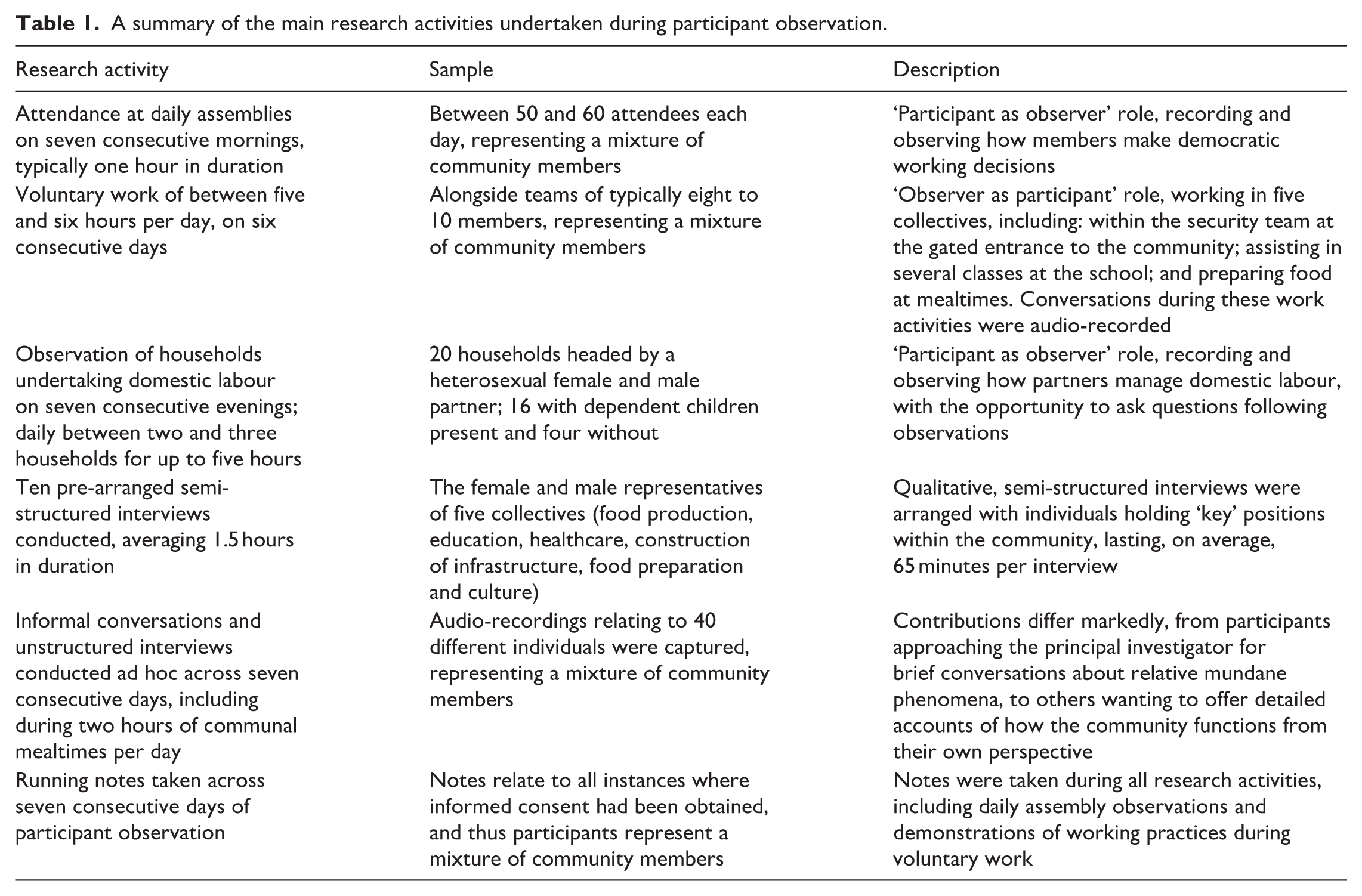
Written consent was obtained from each participant prior to the commencement of a research activity; for example, before daily assemblies began. Information sheets and consent forms were provided in Portuguese, with the International Relations Coordinator acting as the interpreter between participants and the principal investigator to ensure that all consensual matters were clear when a common language was not spoken. Information sheets detailed that the research project aimed to explore the practices underpinning a community collectively striving for gender egalitarianism, with no identifying participant information used in the publication of any findings. The principal investigator was presented to the community with cultural humility (Tervalon and Murray-Garcia, 1998); that is, as a non-expert aiming to learn about how the community operates and their perceptions of its functioning. The community and the MST movement at large recognise that they represent a social experiment of how alternative societies may function, and are committed to continuous, critical self-reflection. Access was granted with an understanding between all parties that an authentic observation of practices – rather than, as one example, an attempt to simply showcase positive features of the community – would be optimal for this research to make an effective contribution to egalitarian literature and practice.
There was a transition between ‘participant as observer’ and ‘observer as participant’ roles iteratively (Gold, 1970). Examples of the former included observing daily assembly interactions and accepting invitations to observe interactions between household members as they engaged in routine unpaid labour – without participating in these activities. Illustrations of the latter role included undertaking voluntary working responsibilities, always with the opportunity to ask questions in situ. Questions across the 10 semi-structured interviews and informal conversations were designed as open-ended to elicit responses that were lengthy, in the participants’ own words and through which participants could lead the direction of themes covered. Examples included: ‘How important a factor is gender in how work is allocated between community members?’, ‘In which ways has the community made gender less important in determining how different types of work are allocated?’ and ‘What do you consider gender egalitarianism to be?’. Participants were encouraged to reflect on their past experiences, both before joining the Marielle Vive community and as the community has evolved, to help provide a temporal dimension to how gender is redone as a continuous ‘project’. Follow-up questions during and after observations were crucial for capturing member perspectives to ensure accurate interpretations of what was being observed (Atkinson and Coffey, 2003), and to offer a more complete picture of the GDOL than simply collating self-reported hours spent on paid and unpaid labour. At all times, an interpreter was present to ensure that all questions and responses were understood.
Participants were a diverse range of ages: the youngest participants were 20 years old and the oldest 55. So too were ethnicities, with around one-third being colonos (descendants of European migrants arriving from countries like Italy, Germany and Poland) and two-thirds identifying as mestizo (those of mixed heritage, often Aboriginal and European) or descendants of African slaves. Across the 112 hours of active fieldwork, all interactions – from daily assemblies and interviews to more informal, ad hoc conversations during and after voluntary work – were audio-recorded; observations were written in the form of running notes (Lincoln and Guba, 1985). These notes were then cross-referenced with audio-recorded data and transcripts for a more complete picture of the data. For example, much can be learnt from both interviews with household members and recordings of their interactions, but research shows that what remains unspoken can be key to determining the GDOL, such as deliberate but perceptibly ‘passive’ avoidance of discussion about roles, or of engagement in particular domestic tasks (Garcia and Tomlinson, 2021). Running notes chronicled what was observed, such as possible passive avoidance techniques, to complement the audio-recorded data, which were corroborated with participants to confirm that they had not been mis-represented.
Recordings were transcribed, translated and analysed through the King and Horrocks (2010) three-stage thematic analytical framework, which prioritises interpretation of the emergent qualitative data in stages 1 and 2, before its comparison with extant theory in stage 3, in a cyclical process that followed Tracy’s (2013) phronetic iterative approach. Constituting stages 1 and 2, participants referred to collective practices at the interactional level which they felt facilitated gender egalitarianism. The data revealed that these practices encompassed both structural and cultural components at the institutional level, which proved to be mutually reinforcing (Table 2). Stage 3 represented the iterative process of comparing these emergent findings to the two conceptions of how gender is redone in the literature (i.e. understanding when traditional notions of gender-appropriate behaviour are unsettled, and when gender becomes a less salient feature of participant interactions).
Example illustrations of ‘structural’, ‘cultural’ and ‘mutually reinforcing’ coding for the two processes of ‘redoing’ gender.
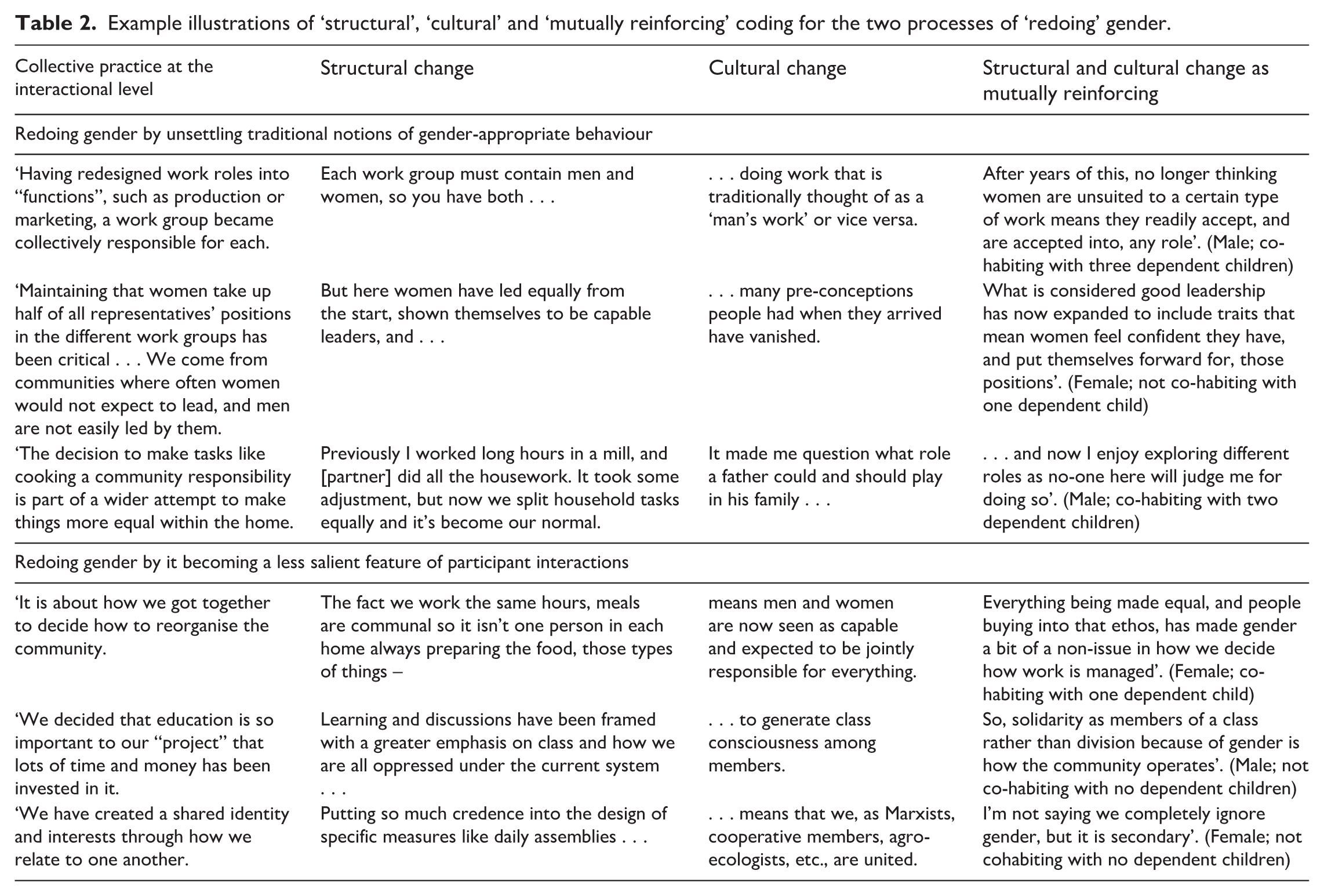
Table 2 provides six interview quotes that illustrate each of the redoing gender processes; that is, three quotes that demonstrate gender was redone by an unsettling of traditional notions of gender-appropriate behaviour, and three quotes which demonstrate how gender was redone by community members making gender a less salient feature of how they allocate paid and unpaid labour. Each of the quotes is split across four columns to show how the processes began with collective practices at the interactional level (column 1), which was the catalyst for structural change (column 2) and a corresponding cultural change (column 3), with each change seen to reinforce the other (column 4). Both these practices and the relationship between their undertaking at the interactional level with institutional change are now explored.
Findings
The findings address the research question: how can collective (gendered) action at the interactional level facilitate egalitarian change at the institutional level? This begins with an explication of the practices undertaken by the inhabitants of Marielle Vive that reflect the redoing of gender, and moves on to consider the intersection of the interactional and institutional levels.
‘Redoing’ gender through collective action at the interactional level
While participants did not talk explicitly in terms of ‘redoing’ gender, their egalitarian measures aligned with existing conceptions of it. Namely, community members sought to behave in gender-atypical ways that challenged the perceived naturalness of the gender binary (e.g. Connell, 2010), and there was evidence that the salience of gender has reduced in social interactions as a result of their actions (e.g. Kelan, 2010; Risman, 2009).
Community members continuously designed, implemented and modified practices as part of an ongoing drive to increase egalitarianism within Marielle Vive. These are distinguished here as practices at the interactional level because their conception, monitoring and the iterative attempts to improve them are the result of a fully participative form of democracy involving all members. Daily assemblies provided a forum wherein members assessed the effectiveness of extant practices and proposed either changes to existing practices or entirely new egalitarian practices. Each member could input into subsequent discussions, and plans of action were subject to vote in daily assemblies, requiring a majority vote ‘in favour’ to be actioned. The successful implementation of a new practice, or changes to existing practices, were only achievable through their continued application by all members in interaction with one another. Once members failed to engage in the necessary interactional work to uphold these practices – from active participation in daily assemblies to holding others accountable to required behaviours – the legitimacy of the practice was threatened: Ultimately, as a social movement, the MST survives only so long as its members identify with it, so they cannot force anyone to live a certain way – it has to be member-led. So, the challenge was given to the membership, how can you create a structure that minimises the potential for anyone to be disadvantaged because of their gender? It is up to us to uphold and develop this way of living collectively. (Male, co-habiting with three children; conversation following daily assembly)
The first practice introduced to increase egalitarianism within Marielle Vive was a reassessment of the community’s needs, democratically determined by all members, in order to organise work around those roles considered to have the greatest social utility. These functions included food production, education, healthcare, construction of infrastructure, food preparation, sanitation and culture. Beyond a pragmatic rationale for ensuring that essential tasks would be completed, was a desire to create parity among work roles and thus the community members fulfilling them: We know that women often take on work that is under-valued. In organising work this way it sent a clear message that everyone engages in important tasks, whatever they do. (Male, co-habiting with no children; response during interview)
However, community members initially opted into these new roles in ways that reflected traditional gendered divisions of labour; for example, men continued to orientate towards construction work and women to caring roles. Additional solutions were proposed to unsettle perceived notions of ‘women’s work’ and ‘men’s work’, beginning with mixed-gender groups of five or more families being encouraged to take joint responsibility for these functions: To avoid certain men or women being seen as responsible for a type of work that might be traditionally gendered, and for knowledge to be shared around the whole group, we made them collectively managed. That means no unilateral decisions . . . everything is decided by the group through discussion and a majority vote by hand every single morning or by emergency meeting. (Female, co-habiting with no dependent children; conversation during voluntary work) We also make sure that the gender split in each collective is more or less even. If a function is mainly made up of men, then some of those men are encouraged to try their hand at something else and women encouraged to take their place. (Female, co-habiting with two dependent children; conversation during voluntary work)
Mixed gender collectives were secured principally through two additional practices: a 50% gender quota adopted for all representative positions within each function, and a comprehensive job rotation system. Beginning with the former, each collective elected two representatives whose role was not to make decisions on their behalf, rather to fairly and accurately represent their views within daily assemblies in order to ensure meetings run efficiently. These positions were as close to a leadership-type position as is found in this community, and the 50% quota safeguarded women’s presence such that men did not dominate these positions. This proved to be an important step to enable women to showcase their leadership abilities and gain experience in such roles, while simultaneously unsettling cultural conceptions of what a competent representative or leader ‘looks’ like: We had men bypassing women representatives to speak directly to the man, because they were not used to relying on women to speak for them. Without the quota, women would not have been seen as legitimate voices for their collectives . . . It was important to begin a process of showing men that there is no natural reason for men to dominate leadership positions; more so, men have been able to dictate who is considered to be better suited to lead. (Female, co-habiting with two dependent children; during interview)
The second practice introduced to secure mixed-gender work collectives was the job rotation system, which was applied to every function and all members were expected to participate. As noted above, a collective contained five or more families who were responsible for that particular function in their geographical area of the community. At any one time, at least four members of a function joined other collectives and their original positions were fulfilled by members from other functions. The perceived time necessary to become sufficiently conversant in the tasks undertaken by a collective was eight weeks, though this was reduced or extended at members’ discretion. Once again there was a pragmatic rationale for this system, as members could only meaningfully participate in the community’s collective decision-making if they had experience and knowledge of how the different functions work, and this further helped to avoid informal hierarchies emerging. Nevertheless, participants positioned this practice as crucial to creating parity between the two genders: Everyone is invited to try any role within the community, either permanently or on rotation for a short period . . . We find that women hold their own in any role, including those often seen as quite masculine. It makes it difficult for anyone to say that they are not suited to certain types of work. (Male, not co-habiting with one dependent child; conversation following daily assembly) There were situations where men would say they simply can’t do a certain type of work. But you are expected to stay in a collective until you are competent at its different activities, so even to leave a new collective they had to first show that they were competent at it, which destroyed their original argument for not engaging in that type of work. (Female, not co-habiting with no dependent children; conversation following daily assembly)
This form of direct, participative democracy and the continuous drive for egalitarianism enabled women to agitate for a number of other critical practices that served to redo gender in Marielle Vive. One illustration of this was the attempt to ‘make public’ much of the domestic labour that inhibits the full participation of parents, particularly women, in non-domestic labour and wider decision-making entities. Alongside the multiple iterations of collectives responsible for food production, education, healthcare, construction of infrastructure, food preparation, sanitation and culture, were a small number of community-wide collectives. These were responsible for childcare and schooling – guaranteeing a place to all children under the age of 11 at no cost to the parents – and other collectives responsible for food preparation and cleaning communal areas.
This provision of lunch and dinner to all members of the community, drawn largely from that provided by the food production collectives, is one illustration of how members worked to foreclose the possibility that household members faced constrained choices about taking on disproportionately large shares of unpaid labour: A conscious effort has been made to make a good deal of what is normally unpaid labour a public matter – a shared responsibility – and not a private matter for each household, which opens the door to one person within the home being disadvantaged. This is not a coincidence – the community has been organised based upon a representative body full of women who are more attuned to caring practicalities. (Female, not co-habiting with two dependent children; conversation during mealtime)
Significantly, the encouragement of mixed-gender collectives outlined above equally applied to those responsible for childcare, schooling and meal-related activities where a comprehensive job rotation system was also in effect. Having been socialised in rural Brazilian communities characterised as gender-traditional, this was a purposeful measure to ensure that men were rotated into these more care-centred collectives, which proved to have a profound impact on their attitudes, and the cultural meanings ascribed towards such work: It was eye-opening. I didn’t realise how hard it was! It made us appreciate that we take for granted a lot of the work women have been doing, but also that there is no natural reason for us not be more involved in these things. I am a much better carer than I ever thought I would be, and it fulfils me in ways I could never have imagined. (Male, co-habiting with two children; conversation during household observation)
Creating a collective responsibility for domestic forms of labour was buttressed by the implementation of uniform work hours across all able-bodied members of the community aged between 17 and 55. Whether members performed a role relating to food production, nursery care or teaching, the working week expected of each individual was six hours per day between Monday and Thursday, and five hours on each Friday and Saturday, with members actively discouraged from working additional hours. This was a further attempt to create parity between women and men, with relative resources oft-cited in the literature as a cause of household inequality (e.g. Lietzmann and Frodermann, 2022; Matteazzi and Scherer, 2021): We were very conscious of two things. One, if some people work longer than others, they become seen as more committed and maybe then responsible for certain types of work, which is a route to inequality. Two, those people will then feel entitled to a bigger share of the produce or profits, which is the biggest risk to equality. (Male, co-habiting with one child; conversation during voluntary work)
Consequently, there was a practical shift in the expectations of the working patterns of both women and men, and also in their relative power within the community as they received an equal share of the collective rewards from these shared endeavours. Subsequently, both genders were considered to be equally responsible for all types of work – that termed ‘community based’ (non-domestic) and ‘non-community based’ (domestic) – and the gendered connotations of each diminished.
The intersection of the interactional and institutional levels
The interactional practices outlined above were positioned by Marielle Vive inhabitants as purposeful attempts to collectively create institutional change in ways that facilitated egalitarianism. Taking first the practice of reassessing the community’s needs to organise work around roles with the greatest social utility, this represented a tangible, structural change in the work community members performed, simultaneously forcing a recalibration of how work was valued – and redoing gender in a more cultural sense at the institutional level. The reassessment of roles based upon social utility brought to the fore a recognition that work often coveted as professional and prestigious, dominated by men, was much less ‘socially useful’ than work undertaken by women that is attributed less ‘skill’, remuneration and status. Consequently, the community began to strip away the perceived value attached to non-domestic labour roles that are steeped in historically informed gendered and classist perceptions of ‘useful’ and ‘skilled’ work: We went back to basics and asked what do we actually need? People debated and voted – basic health, construction, education, the ability to grow food sustainably, the essentials. Crucially, this meant re-valuing the work often done by women that is not given its due importance. (Male, co-habiting with one dependent child; during interview)
Structuring these socially useful tasks into functions to be jointly managed by mixed-gender collectives was the next step in undermining normative conceptions of ‘women’s’ and ‘men’s’ work. Recognising that different domestic and non-domestic tasks had long-standing gendered connotations and that a significant cultural shift in what is considered appropriate behaviour for one’s gender was necessary, prompted discussions on how to fully embed this mixed-gender approach to all work roles: The biggest battle was challenging people’s mindsets. You grow up in a culture that tells you there are fundamental differences between men and women, and therefore the work each does has some kind of natural basis. We had men who had taught themselves how to build a house, who argued that they didn’t know how to clean it! We needed to recalibrate how we think about gender. The representative quotas and rotation system were how we set about achieving this. (Female, not co-habiting with no dependent children; conversation during mealtime)
The corresponding shifts in the cultural conditions of the community that occurred as a consequence of these structural changes, themselves created favourable conditions that facilitated the sustained collective action that restructures the community in a more egalitarian way. For example, the Brazilian state has historically positioned the provision of childcare and meal preparation as a private household matter (i.e. domestic labour being the responsibility of individual household members – typically women). By combining uniform work hours and earnings with mixed-gender collectives jointly responsible for these tasks, not only were perceptions of them as constituting domestic duties challenged, but so too were notions of male-breadwinning and female primary-caregiving. These cultural shifts were positioned as hugely important to Marielle Vive inhabitants feeling comfortable to continue what they had previously conceived as gender-atypical behaviours: In a lot of rural families, it is unthinkable that the man would do certain household chores, and if he did it would not be made public knowledge. But this is just how things are done here, everyone engages in pretty much every task and the distinction between what is acceptable for men, or women, doesn’t apply. So everyone is comfortable doing whatever their collective needs regardless of its connotations outside of this community. (Female, co-habiting with three dependent children; conversation during household observation) Realistically, how long can you keep up a pretence that gender deciding what work people do is in any way natural, when that myth has been dispelled by both genders doing all types of work here? Over the years we have completely changed what people view as ‘normal’ for their gender, and as a result people’s behaviour is not limited to such ideals. (Female, not co-habiting with no dependent children; during interview)
Therefore, through collective action, Marielle Vive inhabitants structured ‘community-based’ (non-domestic) labour and ‘non-community-based’ (domestic) labour in shared, gender-neutral ways. Some of these changes represented tangible adjustments to governance structures and ways of organising work (structural changes) that occurred alongside corresponding changes in the symbolic meaning of such governance structures and working practices, and the collective’s normative conceptions (cultural changes). Figure 1 offers a visual representation of how gender was redone structurally and culturally at the institutional level through collective action at the interactional level.
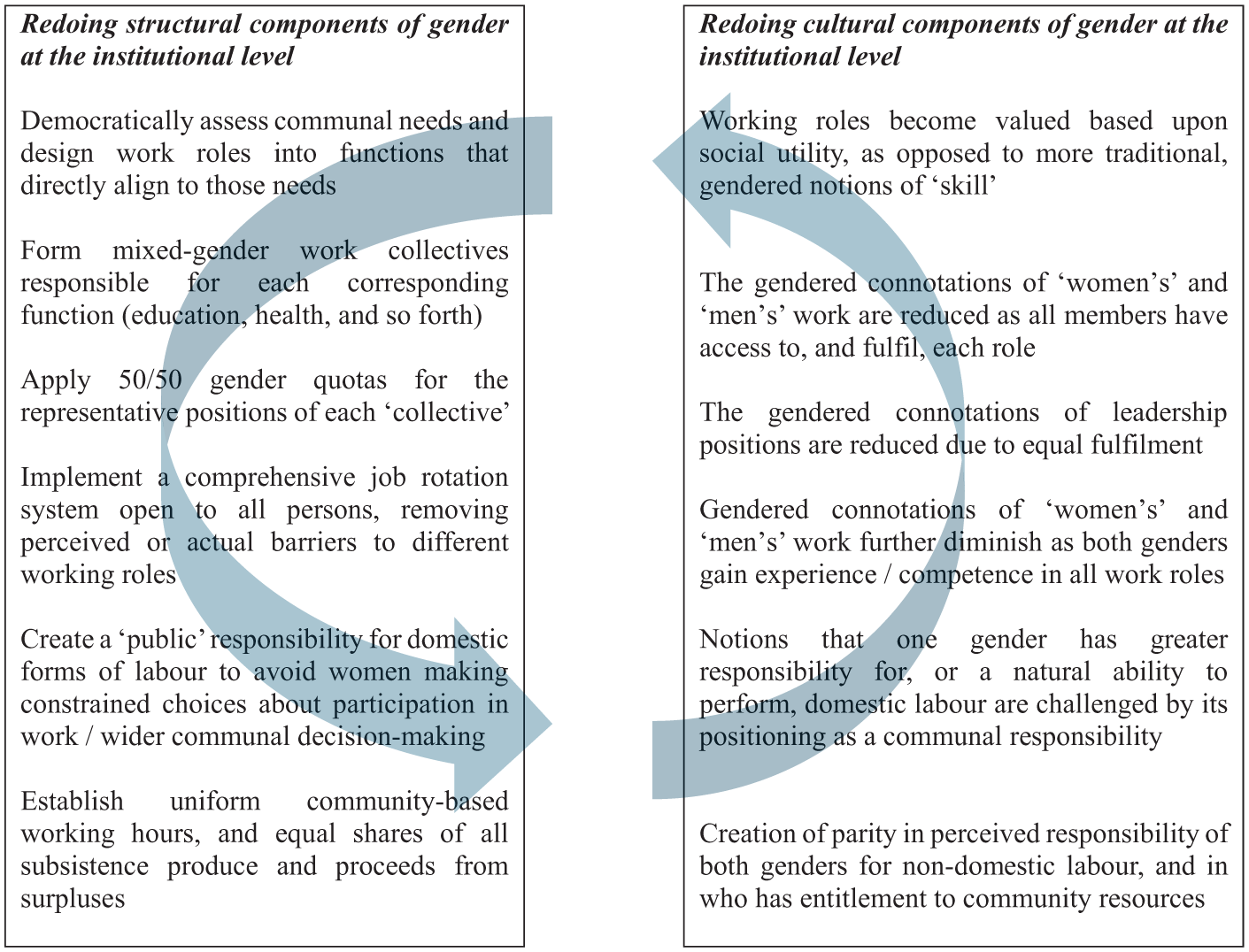
How gender is redone structurally and culturally at the institutional level through collective action at the interactional level.
The data reveal that these structural changes at the institutional level, achieved through collective action undertaken at the interactional level among community members, created corresponding cultural changes – also at the institutional level. These structural and cultural changes simultaneously created conducive conditions for sustained egalitarian behaviour at the interactional level. Thus, the findings demonstrate an interdependent and mutually reinforcing relationship between the interactional and institutional levels.
Processes of ‘redoing’ gender as mutually reinforcing
Figure 1 enables a further reflection on the relationship between the two ways in which gender may be redone; namely, the unsettling of normative conceptions of gendered behaviour through subversive practice at the interactional level (Connell, 2010), and a reduction in its salience in interactions (Kelan, 2010; Risman, 2009). Crucially, there is evidence to suggest that, over time, the two processes aligned; that is, attempts to unsettle accepted notions of gender-appropriate behaviour potentially reduced its salience in decisions taken regarding who does what work in the longer-term.
As an illustration, by undertaking roles within each collective traditionally viewed as suited to the opposite gender, women and men were collectively redoing gender at the interactional level by stretching the boundaries of normatively conceived appropriate behaviour at the institutional level. Their ability to form a valuable part of the work collectives began to change those normative conceptions, which over time resulted in one’s gender becoming marginalised in how individuals are assessed for their suitability for different roles – again at the interactional level: For people to stop viewing women as more suited to certain types of work, men had to take on those roles and women had to take on other roles. This meant accepting that what we believe about men and women is not set in stone, that both can behave in ways we feel are more customary for the other gender. As people no longer thought of work as ‘man’s’ work or ‘women’s’ work, gender itself stopped being the deciding factor in how work is organised. (Male, co-habiting with no dependent children; conversation following daily assembly) It works both ways – gender not configuring so much in work decisions means people are freer to behave how they wish, not constrained by what people would think in the wider society outside of this community, so the boundaries of our behaviour can constantly push the limits of what is seen as acceptable behaviour for a man or woman. (Female, co-habiting with one dependent child; conversation following daily assembly)
It is certainly the case that gender retained its salience in certain member interactions, one illustration being its centrality in the 50% gender quotas. Nevertheless, the data also reveal that as these practices became taken-for-granted ways of organising the community over time, gender progressively became a less significant feature of the interactions that determine divisions of labour: While I think that it was a conscious effort on my part to take a leadership role in what was considered to be men’s work, to show that women can do it and do it well, we have girls joining the collective nowadays simply because it is an interest area and gender isn’t seen as an inhibitor to them pursuing that interest. I doubt whether they even really reflect upon it. (Female, co-habiting with one dependent child; during interview)
The evidence from the Marielle Vive community is that gender can be redone both by an unsettling of the perceived naturalness ascribed to feminine and masculine behaviours, and by interactions becoming less gender-salient. Furthermore, participants recognised that these processes can be mutually reinforcing. Behaviour that unsettled normative conceptions of gender simultaneously served to reduce the salience of gender in task allocation, which in turn reduced the extent to which behaviour was viewed as gender-atypical – as the centrality of gender in those interactions diminished.
Discussion
This article asked how can collective (gendered) action at the interactional level facilitate egalitarian change at the institutional level? In addressing this, it first outlined the particular practices and governance structures that Marielle Vive members developed, with support from the MST, to ultimately ‘redo’ gender at the institutional level of their community. These insights make a novel and important addition to extant literature where collective attempts to overturn wider, traditional gender norms are rare, if they exist at all (e.g. Ainsworth and Pekarek, 2022; Korvajärvi, 2021; Risman, 2018).
As the findings demonstrate, the design of practices and governance structures began with a democratic reassessment of the community’s needs, and the creation of work roles into corresponding functions. Second came the establishment of mixed-gender work ‘collectives’ jointly responsible for these functions, including food production, education, healthcare, construction of infrastructure, food preparation, sanitation and culture. The 50:50 gender quotas were then implemented for each collective to ensure that women retained an equal share of representative positions across all functions within the community. This was bolstered by a comprehensive job rotation system that guaranteed access to all roles for any individual irrespective of gender, and simultaneously that each person gains the confidence and ability to input into all decision-making on an equal footing. Furthermore, members created a community-wide ‘public’ responsibility for many domestic forms of labour such as food preparation and childcare, with women and men positioned as equally responsible for its fulfilment. These measures were introduced alongside uniform community-based (non-domestic) work hours and shares of both the produce and the profit generated, ensuring that men did not accrue greater relative resources to bargain their way out of domestic labour.
Analysis next evidences the role of these interactional practices in supporting the redoing of gender at the institutional level. This addresses long-standing calls to better understand how these two levels intersect, especially how subversive behaviour at the interactional level may bring about change at the institutional level (Ainsworth and Pekarek, 2022; Chesters, 2023; Kelan, 2010; Lietzmann and Frodermann, 2022; McMunn et al., 2020; Sánchez-Mira, 2024), including by Fenstermaker and West (2002) and West and Zimmerman (2009) themselves. Interactional-level practices create institutional change by removing structural barriers to women’s equal participation in both decision-making regarding work allocation, and the forms of work they undertake. These structural changes, in turn, influence cultural conditions, weakening normative conceptions of ‘women’s’ and ‘men’s’ work and shifting the normative conceptions of gendered behaviour to which members are held accountable. These cultural shifts simultaneously create a more favourable environment for gender-atypical behaviour at the interactional level, such as women and men undertaking work traditionally attributed to the opposite gender, revealing that the interactional and institutional levels intersect in ways that are mutually reinforcing.
Findings support extant research that theorises gender may be redone by a reduction in its salience within social interactions, or (often conceptualised as ‘undone’) by gender-atypical behaviour challenging the perceived naturalness of the gender binary (Connell, 2010; Deutsch, 2007; Kelan, 2010; Risman, 2018; West and Zimmerman, 2009). The article makes a further theoretical contribution by extending existing research which says little about when and how social interactions become less gender-salient (Deutsch, 2007; Kelan, 2010), nor about when the institutional level itself is challenged, rather than simply individuals being held accountable for non-conformant behaviour (Connell, 2010; Kelan, 2010; Risman, 2018). It has been asserted that ‘undoing’ and ‘redoing’ gender have often been employed in a rather ceremonial fashion (Wickes and Emmison, 2007), illustrated by there often being a conflation of the two concepts (e.g. Ainsworth and Pekarek, 2022; Korvajärvi, 2021), or their positioning as mutually exclusive entities with analyses often focusing on just one (e.g. Deutsch, 2007; Kelan, 2010; West and Zimmerman, 2009).
Finding mutual reinforcement between both processes is therefore significant. As gender-atypical behaviours became part of the everyday routine interactions among inhabitants, the salience of traditional conceptions of gender in decision-making was itself reduced. Simultaneously, as the salience of traditional gender norms decreased, participants believed that the perceived naturalness of the gender binary was itself challenged and the range of behaviours that are considered atypical also reduced.
Conclusion
Bringing together approximately 1000 families with limited resources and little formal education, in a rural context characterised by traditional views on gender, the Marielle Vive community may appear to offer unlikely conditions for achieving egalitarianism. Nevertheless, analysis demonstrates that collective action at the interactional level has effectively created structural and cultural change at the institutional level that has facilitated a redoing of gender. The insights generated from this unique community offer implications for both policy and practice. In particular, participants argued that the effectiveness of interventions like gender quotas derive from their being part of a wider, integrated set of initiatives rather than as isolated attempts at egalitarianism. Staying with this example, quotas gained legitimacy because they complemented the organisation of work into mixed-gender collectives that jointly managed the different community functions. When buttressed by other measures like the comprehensive job rotation system, it was a natural progression for women to take on half of all leadership-type roles. The legitimacy afforded to the quotas was then instrumental in ensuring their effectiveness, enabling women, for example, to successfully agitate for other changes, such as the implementation of uniform work hours, further legitimising quotas as a practice.
The study also has several implications for future research. The principal limitation of this research is that it is confined to an agricultural producer community. Therefore, it would be useful to understand whether there is wider applicability of the redoing gender practices found here in other contexts, and the presence of other potential egalitarian practices not identified here. Theoretically, there is scope to develop analysis of the relationship between the interactional and institutional levels as collective attempts to redo gender are made. For example, it may be analytically useful to distinguish between changes that are ‘transgressive’ in nature, which unsettle normative conceptions during interactions but have little impact upon the wider institutional level, as opposed to measures with ‘transformative’ potential (Lorber, 1999). Longitudinal research will be crucial to mapping such changes as we bid to create a more egalitarian future.
Footnotes
Acknowledgements
We would like to thank the Research Ethics and Governance Committee in the Faculty of Business & Law, Manchester Metropolitan University, for their guidance in ensuring that this was an ethically sound piece of research. Our gratitude also to the Editors and reviewers for their valuable, substantial revisions to improve this article.
Funding
The authors received no financial support for the research, authorship, and/or publication of this article.
