




Abstract
One of the most pressing issues contributing to the persistence of gender inequality is the gendered division of domestic labour. Despite their entry into paid employment, women still carry out more domestic work than men, limiting their ability to act on an equal footing within the workplace. This qualitative research adds to the ongoing debate concerning the reasons for the persistence of the gendered nature of domestic work, by comparing working women who earn more, those who earn around the same and those who earn less than their male partners, as well as examining women’s absolute incomes. On average, men whose partners earn more than they do carry out more housework than other men, although women in these partnerships still do more. However, these women actively contest their male partner’s lack of input, simultaneously ‘doing’ and ‘undoing’ gender. The article also identifies class differences in the ‘sharing’ of domestic work.
Introduction
Although women have been entering paid work in increasing numbers, contemporary employment continues to be constructed on a full-time ‘adult worker’ model (Acker, 1990). Women’s continued responsibility for the majority of domestic work and childcare makes it difficult to meet ‘adult worker’ requirements and many women with such responsibilities scale down their employment intensity, working in a less challenging job, often on a part-time basis (e.g. Connolly and Gregory, 2008; Grant et al., 2005), even though such strategies are incompatible with career success (e.g. Thornley, 2007).
Men have increased the amount of domestic work they do (Kan et al., 2011) and spend more time with their children than before (Coltrane, 2009). These changes may in part be due to the increased time pressures on working women, but may also reflect substantial changes in attitudes to gender roles. Evidence from the US and the UK suggests, however, that women continue to do more domestic work than men (Bianchi et al., 2000; Kan et al., 2011).
Domestic work is of practical and symbolic significance and, if male partners do more, it may follow that employed women’s lives will improve considerably, allowing them to take on additional workplace responsibilities and compete on a more equal footing with men. The interactional level – at which the allocation of domestic tasks is largely worked out between partners – is an important site of potential change to both gender consciousness and practices (Sullivan, 2004). It is also a site of resistance and contestation of the gender order, particularly by women (Gatrell, 2005), but persistent conflict may also lead to a lack of accommodation and negotiation between partners. It has been argued that incremental changes in the division of domestic labour between partners (as opposed to major rapid or revolutionary change) can still effect a radical transformation over time (Sullivan, 2011). The research presented here sets out to examine why women continue to do more housework than men, if and how this is changing, and whether or not male contributions to housework are differentiated by occupational class, as well as by relative and absolute earnings. Daily interactions between men and women in the UK are explored, drawing on qualitative data from women who earn more, women who earn around the same and those who earn less than their male partners.
Theoretical explanations for the gendered division of domestic labour
There has been a long-standing debate surrounding the persistent gender gap in household work. Early ‘economistic’ explanations suggested that the spouse who brings more resources to the partnership will have the power to get the other spouse to do more housework (Becker, 1991; Blood and Wolfe, 1960). The ‘relative resource’ or ‘economic dependence’ argument is closely linked to time availability explanations, which suggest that carrying out domestic tasks is a function of the time available to both partners. As men spend more hours in market work than women, then women have more time to carry out domestic work. This suggests that, as women become ‘more like men’ and take up paid work, then men will become ‘more like women’ and undertake more domestic work.
Feminist sociologists have long argued that the prevailing sexual division of domestic and caring work reflects the construction of masculinities and femininities and that domesticity is a central element in ‘doing gender’ (West and Zimmerman, 1987: 144). Gender is produced in everyday activities and household tasks and therefore household members ‘do’ gender as they carry out gender-differentiated housework and childcare (Berk, 1985; Fenstermaker, 2002). Feminist authors, therefore, argue that the allocation of domestic work to women is constitutive of a deeply embedded set of cultural assumptions that have important (economic) consequences for women’s participation in market work (see also Fraser, 2000). These arguments suggest little room for change. In reality, the explanatory significance of relative resource and ‘doing gender’ approaches may be interactive, rather than mutually exclusive (see, for example, Pollert, 1996).
The division of domestic labour between couples has been shown to vary by class. US research found that, although working-class men express more traditional views than middle-class men, they are more likely to engage in gender egalitarian activities (Deutsch, 1999), partly because working-class couples are less able to afford domestic help (Sullivan, 2004). Research from both the UK and the US has shown that the greatest change over time in sharing housework occurred in couples from lower occupational classes (e.g. Coltrane, 2000; Sullivan, 2006). Indeed, British and US time-use data from the 1970s to the early 2000s show that, by 2000−2001, men in couples with the lowest levels of educational attainment sometimes exceeded the contributions of men from higher occupational levels (Sullivan, 2011). The mis-match between attitudes and behaviour within the home has been shown to reduce over time, with working-class men with working wives changing their attitudes and so reducing the variability between men of all classes (Kroska and Elman, 2009). Attitudinal differences by class still exist, however, and Usdansky (2011) argues that the gap separating some working-class men’s (and women’s) attitudes from their behaviour results in ‘lived egalitarianism’. At the same time, the gap between some higher-class couples’ more egalitarian attitudes and less egalitarian behaviour results in ‘spoken egalitarianism’. These issues relating to occupational class will be discussed further when exploring the ‘sharing’ of domestic labour.
Women earning more
If, as economistic arguments have suggested, men’s greater material contribution to the household relieves them of the responsibility for carrying out housework, then women who earn more than men should receive higher levels of input from their partners. In an early US qualitative study of WASP (wives as senior partners, earning more than their husbands) marriages, Atkinson and Boles (1984: 864) found that both husbands and wives were aware that their partnerships were perceived as ‘deviant’, giving rise to social stress. This was minimized through ‘deviance neutralization techniques’. Wives made special efforts to be romantic and sexually attractive and husbands reciprocated by giving their wives emotional support and by doing more housework. Although the wives still did more housework than their husbands, Atkinson and Boles (1984: 867) concluded that ‘…the WASP marital pattern can be seen as another step toward (gender) equality’.
A much later qualitative study of 30 married couples in the US, 1 however, is emphatic that ‘gender trumps money in the marital power equation…’ (Tichenor, 2005: 178). As in the earlier study, couples tended to conceal their gender-atypical household earnings pattern and downplay the wife’s economic contribution, while maintaining gender boundaries by emphasizing traditional gender roles. Rather than actively seeking gender egalitarianism, these couples focused their efforts on making their unusual marriages look and feel more comfortable and conventional.
Quantitative data analysis, on the other hand, has demonstrated that the more a woman earns, the more likely it is that her male partner will carry out domestic work, supporting the economistic model (Coltrane, 2000; Harkness, 2008). In a UK quantitative study using data from various waves of the British Household Panel Survey (1993–2003), Kan (2008) found that women with more traditional attitudes to gender roles do more housework than other women. There was no evidence, however, that those women earning much more than their partners resort to a gender-traditional domestic division of labour. Earlier quantitative research from the United States, using data from the Panel Study of Income Dynamics (PSID) from 1985 (Brines, 1994) also suggests that in dual-earner households, men progressively do more housework and, as women’s relative contribution to household income increases, their hours of housework go down. However, using the Australian Time Use Survey data from 1992, Bittman et al. (2003) argued that, as women earn more than their partner, this model breaks down, men become economically dependent, but actually carry out less housework. Using a relative, rather than absolute measure of housework hours, Greenstein (2000) analysed the National Survey of Families and Households (NSFH) data from 1987−88 and argued that both men and women neutralize their ‘deviant’ roles in housework: men do less and women do more. In other words, the relationship between women’s income contribution and their unpaid work hours is curvilinear.
On the other hand, Gupta and Ash (2008) argue that this curvilinear relationship is an artefact of the statistical techniques used and that a woman’s absolute (rather than relative) earnings are the major determinant of her housework hours. In other words, as a woman earns more, she does less housework: ‘her money, her time’ or the ‘autonomy hypothesis’ (see also Gupta, 2007: 402). Gupta argues that both the economic dependence and gender display models of the relationship between earnings and housework are flawed, and goes on to suggest that married women have ‘a substantial degree of economic autonomy in the areas of domestic life for which they are normatively responsible’ (Gupta, 2007: 399
The ‘doing gender’ argument has been debated and expanded upon in recent years, with Deutsch (2007) arguing that West and Zimmerman’s approach reinforced the inevitability of inequality, and that we need to shift the focus to how we can ‘undo’ gender (see also Butler, 2004). Sullivan’s 2011 critique of the ‘gender deviance neutralization’ or ‘compensatory gender display’ explanations for the persistence of inequalities in the division of domestic labour has stimulated further debate, with a greater focus on those women who earn more than their partners. Latest UK figures show that 31 per cent of working mothers are the main breadwinners in their households, up from 18 per cent in 1996/7 (Ben Galim and Thompson, 2013). In light of these trends and, with rising female educational achievement and labour force participation, this proportion may increase even further.
The balance of the empirical evidence suggests that men do increase their domestic contribution when their female partners earn more than they do, although women still do more. In the following sections, evidence is presented on the reported division of domestic labour, drawing on UK qualitative data. 2 By focusing on the interactional level as a site for potential change (Sullivan, 2004) and resistance (Gatrell, 2005), the relative strength and potential interaction of both economistic and normative approaches to the explanation of the division of domestic labour are explored, as well as the impact of class. The various debates surrounding the ‘doing’ or ‘undoing’ of gender, gender deviance neutralization and autonomy theories are also evaluated in light of the research findings. Drawing on these approaches, we ask the following research questions:
How do women and men negotiate the division of domestic labour at the interactional level in couples where the woman works full-time and does this lead to a more equal sharing of housework?
Do women who earn more than their male partners do less housework and do men do more, and does men’s contribution vary more according to relative and/or absolute income?
Does the proportion of hours worked by each partner in the household affect the amount of housework undertaken?
Does the division of domestic labour differ by occupational class in couples where the woman works full-time?
Methodology
Interview sample
Semi-structured, face-to-face interviews were undertaken with 36 partnered women and 12 partnered men, all of whom had at least one child under the age of 14 (only one partner per couple was interviewed to minimize the potential for both partners being present at the same time, thereby limiting the ‘honesty’ of responses, although this means that the information gathered relies on one partner’s responses only). Only those households where women worked full-time (defined as 30 hours a week or more), and those with complete data on their own and their partners’ incomes, are included (in a small number of cases, male partners did not work or worked very few hours). In this way, arguments related to time availability are minimized (e.g. if the female partner is not working or is working part-time hours, she will have more hours to devote to domestic work). There are, however, differences in what constitutes ‘full-time’ hours, reflecting the existing differences in hours worked by women from different occupational classes within the UK labour market.
Respondents were employed within four different occupational sectors: medicine, accountancy, finance and retail, and came from a variety of occupational levels. The female sample included 21 professional/managerial respondents, 11 intermediates and four routine/manual respondents, and the male sample included eight professional/managerials, one intermediate and three routine/manuals. 3 The sample, therefore, is biased towards professional and managerial employees, due to the selection of occupational sectors in the early stages of the research and the fact that many of the female respondents or female partners of respondents in lower-level occupations worked part-time. A definition of class based on occupational level is clearly not ideal but allowed us to explore some of the differences in household work between partners in couples from varied backgrounds. The inclusion of only full-time women also allowed for the analysis of a reasonable number of households in which the woman earned more than the man (Woman Earns More, or WEMs, using a relative measure of income) and earned a high salary (absolute income). In the female sample, there were 15 WEMs, 16 SINCs (Same Income Couples, using a relative measure) and 5 MEMs (Man Earns More, also using the relative measure). In the male sample, there was 1 WEM, 5 SINCs and 6 MEMs. 4 Of the 48 interviewees, only 12 of the female partners earned less than £30,000 per annum, and 15 earned £90,000 per annum or more. All of the professional/managerial male respondents were married to similarly-qualified women, and all the routine/manual men were married to similar women, except one intermediate man who was married to a routine/manual worker.
Interviews were normally conducted at the participant’s workplace in a private room, although some were conducted in participants’ homes. All interviewees were offered a gift voucher for participating. Interviews lasted around an hour, followed a semi-structured interview guide and were audiotaped and fully transcribed. The qualitative data were entered into NVivo, with both researchers involved in coding and data analysis to minimize bias, and thematic analysis was used to identify key themes emerging from the data. These were discussed and re-checked to ensure consistency and comprised: the ‘sharing’ of domestic labour, simultaneously doing and undoing gender, the myth of male incompetence (Tichenor, 2005) and the impact of paid domestic help, which will be discussed in the following section.
Results
The gendered division of domestic work: attitudes and behaviour
It was not possible to systematically test if women’s housework hours increase (and men’s decrease) after a certain income point, in accordance with gender deviance neutralization theory, but it was possible to examine qualitatively which partner had the main responsibility for housework at the time of the interview, according to their absolute and relative incomes. Firstly, respondents were asked: ‘Who would you say has the major responsibility for housework/childcare, yourself or your partner?’ These questions were followed up with probes eliciting the daily management of domestic work and childcare, if they pay for any domestic work to be done and if they had discussed the allocation of domestic work and childcare with their partners before they had children. Subsequently we asked a series of attitudinal questions, including: ‘In your view, who should have primary responsibility for housework/childcare and other domestic responsibilities, the man or the woman?’ That is, attitudinal questions were deliberately asked after respondents described their behaviour. However, in this article, attitudes are described before actual behaviour. 5
Respondents were overwhelmingly supportive of domestic sharing, reflecting the substantial shift in gender role attitudes that has taken place since the 1970s for both men and women (Crompton and Lyonette, 2008). Almost all women stated, irrespective of their relative and absolute income, that domestic chores should be shared, although many qualified their statements with reasoning that also reflected both relative resource and time availability explanations of the domestic division of labour. For example:
I think it depends on what your paid working arrangements are. We divide them up according to how much time each of us has because of our outside-the-house responsibilities, and I’m very comfortable with what we do. (A1, female WEM, earning £90K; female responsibility for housework)
Some women demonstrated relatively traditional gender role attitudes overall but nevertheless felt that if both partners were working, there should be a more equal distribution of housework:
It should be a shared thing because if the woman is going out to work I think, you know, you’re paying money. I feel it should not be just for a lady to do. I mean if, for example, I’m staying at home, I’m not going to work and my husband is going out to work and he’s coming home tired, I’ll expect him to come and find a clean house, his dinner is ready and stuff like that for him. So I wouldn’t expect him to do that much, really.
But if you’re working, it should be shared?
Equally shared, yes. (R11, female SINC, earning £23K; shared responsibility for housework)
Men, too, reported almost unanimously that housework should be shared, with similar qualifications regarding time availability. Despite the widespread support for sharing, respondents’ behaviour tended to comply with more traditional patterns of domestic labour, however. Very few couples had discussed housework and childcare before having children, but many reported a more traditional division of labour after having children, partly as a result of women taking some time out of the labour market. Only one woman reported that her partner was mainly responsible for housework and none of the men said that they were mainly responsible.
We deliberately set out to minimize ‘time availability’ explanations by focusing only on couples in which the woman works full-time. However, there were large differences in the hours worked, both between partners in couples, and also between the women in the study. Seventeen women worked 50 per cent or more of the total paid hours within their households: of these, 10 reported that the male partner shared the housework and one woman reported that her partner took the main responsibility (65 per cent of the women working more than 50 per cent of total paid hours). For those 29 women working less than 50 per cent of the total hours, only seven (24 per cent of the group) reported equal sharing (see Tables 1 and 2). These differences reflect some support for time availability explanations, although in 35 out of 46 couples with complete data (76 per cent of these couples), partners worked similar hours. 6 In only seven cases, the woman worked 60 per cent or more of the total hours of paid employment and of these, five said that housework was shared or done mainly by the man.
Female partner’s absolute and relative income, absolute and relative working hours and main responsibilities for childcare and housework (female respondents).
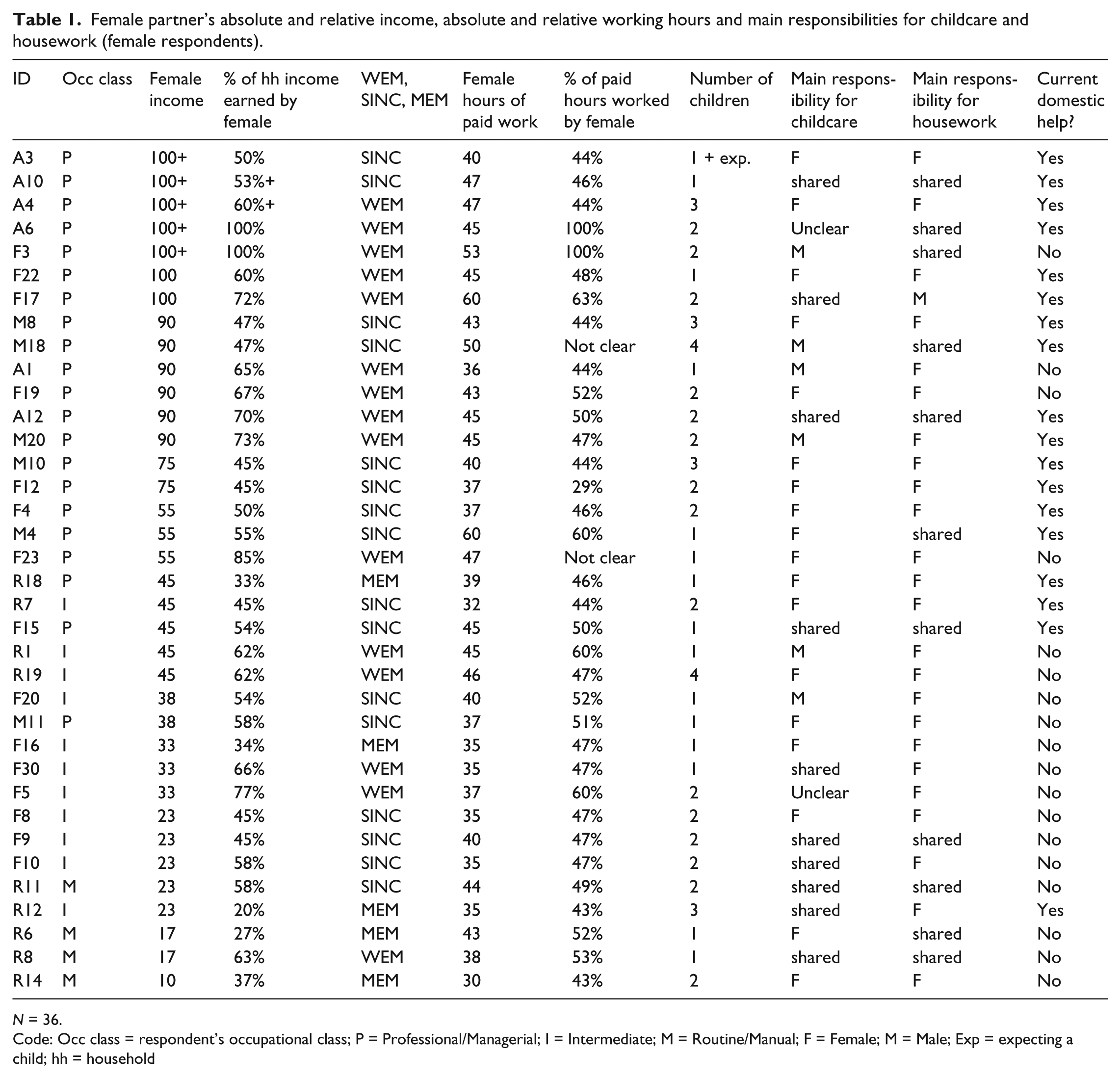
N = 36.
Code: Occ class = respondent’s occupational class; P = Professional/Managerial; I = Intermediate; M = Routine/Manual; F = Female; M = Male; Exp = expecting a child; hh = household
Female partner’s absolute and relative income, absolute and relative working hours and main responsibilities for childcare and housework (male respondents).
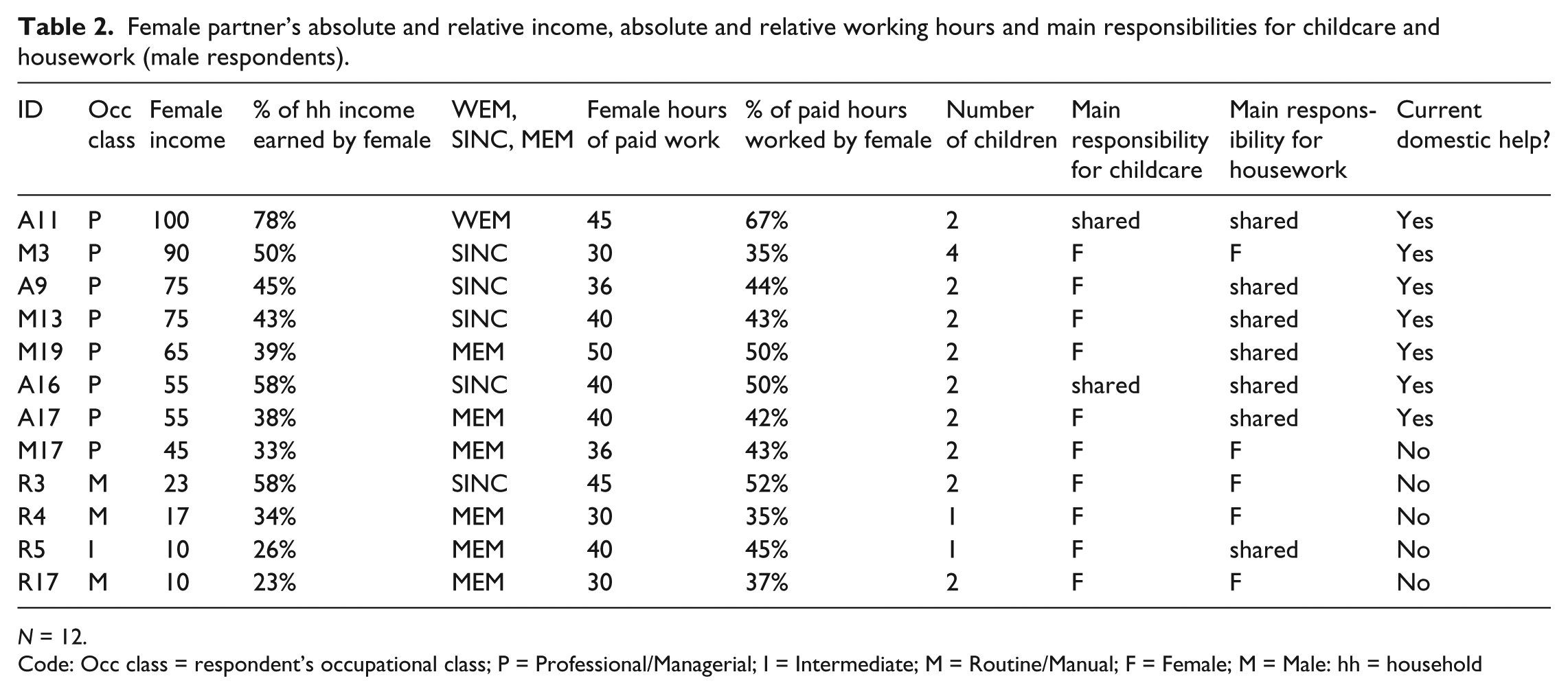
N = 12.
Code: Occ class = respondent’s occupational class; P = Professional/Managerial; I = Intermediate; M = Routine/Manual; F = Female; M = Male: hh = household
Women’s relative and absolute incomes and the distribution of domestic work
Of the 15 female WEMS, 10 reported that they had the main responsibility for housework (67 per cent), while four shared and one said that her partner did most. Similarly, 10 of the 16 female SINCs reported that they had the main responsibility (63 per cent), six said it was shared and none said their partner did most. Four of the five female MEMs reported that they had the main responsibility (80 per cent) and one said it was shared.
Gender deviance neutralization theory suggests that gender differences should reduce as women earn a similar income to their partners and then re-emerge, with greater differences apparent between the women in the ‘SINC’ and the ‘WEM’ groups, as women begin to ‘display’ their gender. There is little to support this argument, however, as WEMs who earned substantially more than their partners (between 70 and 100 per cent of the couple’s total income) were in fact more likely to report that they shared housework with their partners and one woman, earning 72 per cent of the total income, reported that her partner took the main responsibility.
The interviews also gave no indication that WEMs were assuming the major responsibility for housework in an effort to neutralize gender deviance. On the contrary, many were aware of gender issues around housework, and presented a heightened ‘gender consciousness’ (Sullivan, 2004: 208), sharpened by their enhanced material contribution to their households:
I watched my mum … was a stay-at-home mum. She did all the housework. I was brought up, little girls run around with feather dusters, don’t they? … if I had a husband who refused to do housework or thought it was beneath him or had an attitude problem because I was earning too much money, I wouldn’t be married to him anymore, let’s put it that way. (F22, female WEM, earning £100K; female responsibility for housework)
Indeed, among this group of interviewees, housework often represented a bone of contention, signifying the importance of challenges made at the interactional level, as highlighted by Sullivan (2004, 2011). In many cases efforts were being made to achieve a more gender-neutral division of domestic work, although some demonstrated greater success than others:
I’ve made it known to my husband that, listen, I know you don’t like ironing but … it would help to just shove a wash load on so that at least I can come home and whatever … but I have hinted it would be nice to come home and not have to think about dinner every night, so we share, but I mean if you ask me who does the ironing, the hoovering, the majority, then I still do it … when my husband cleans he surface cleans, when I clean, I clean. (R1 female WEM, earning £45K; female responsibility for housework)
A woman in a SINC household was making similar efforts:
… (housework) should definitely be shared. I’m a definite advocate of it not being a woman’s job. My husband might be bad at it but I make him do it. I don’t have time to do everything. He’ll do the washing; he’s very good at getting the washing in the machine, getting it out, dry. I’ll do the dusting, the cleaning and the hoovering, because he’s awful at doing that. So, you know, we kind of split it. I don’t let him get away with it. (F20 female SINC, earning £38K; female responsibility for housework)
Even the woman with the lowest relative income (20 per cent of the couple’s total income) and one of the lowest absolute incomes reported that housework should be shared, even though she went on to excuse her partner from not doing his share:
It should be both equally (laughs). It’s just that it’s an individual thing, a man, he might be not as, not house-proud but things might not … matter to him as much. I know I’m very pedantic about things and I’m a bit of a perfectionist so I want things a certain way at home. So I know that he can have his meal and say oh well the dishes can be put in the dishwasher later or tomorrow. Whereas I’m like no, get them out of the way now, so it’s that sort of detail where, because I’m pedantic … and I think it sometimes comes to a head and you think well, no this is not fair, but then it’s me wanting it to be that way, so if that’s the case, I choose to do it that way. (R12, female MEM, earning £23K; female responsibility for housework)
Based on these extracts, it may be suggested that the women, especially those earning the same or more than their partners, are simultaneously challenging or ‘undoing’ (Deutsch, 2007) as well as ‘doing’ gender. They are fully aware that their material contribution to the household should be fairly reflected in the sharing of housework, and are often frustrated at their lack of success in changing the situation. At the same time, their frustrations are to some extent mollified by the ‘myth of male incompetence’ (Tichenor, 2005: 41), echoing the previous respondent’s use of gender ‘essentialism’
7
to excuse her partner:
I tried to level it out but it didn’t work. He didn’t do it to the right standard. I think they do it on purpose, men, don’t they?… Using the cleaner, he’ll just clean round things, then all of a sudden you’ll move the sofa and you’re like, ‘What is that under there?’ … or he says, ‘Don’t clean upstairs now because no one goes up there bar us, you don’t need to hoover’ is his argument. (F30, female WEM, earning £33K; female responsibility for housework)
Gupta (2007) argues that a woman’s absolute, rather than relative, income is a better predictor of her level of housework and therefore, lower-income women do more than higher-income women (see also Gupta and Ash, 2008). However, our data did not support this argument, as there appeared to be a pattern of those earning the highest incomes (£90K or more) and those with the lowest incomes (£23K or less) reporting a more equal sharing than women in the middle income groups. There was also no clear association between women’s absolute and relative income and male contribution to housework.
The extent, form and success of women’s contestation to the gendered nature of domestic work demonstrated some interesting differences. Some have argued that higher-qualified women have higher expectations of equality and are more willing and able to engage in contesting the gender order (e.g. Crompton and Harris, 1999; Pesquera, 1997). However, the examples above suggest that women from all occupational levels expected equal sharing of domestic work with their male partners, with varying degrees of success.
Paid domestic help, class and the ‘sharing’ of housework: dissonance between attitudes and behaviour
One way in which the gendered tensions around housework can be ameliorated is to pay for another (external) person to do the work. Respondents were asked ‘Do you pay for any help with housework or other domestic work?’ In some cases, housework was done by a nanny, au pair or other relative so this was clarified before moving on to further questions. Of the 28 respondents who reported a female income of over £45,000 and a combined income of more than £80,000, 24 paid for domestic help. Of the 15 couples in which the female partner earned less than £45,000 and had a household income of less than £80,000, none had any paid domestic help. 8 These groups were clearly divided along class lines, with all but one of the higher-earning couples being professional/managerial, and all but one of the lower-earning couples being intermediates or routine/manuals.
Buying in domestic help may resolve some (but not all) of the difficulties around the issue of housework between partners at the interactional level, but it fails to resolve more fundamental issues related to the transformation of gender relations, given that it effectively removes the necessity for any change in male behaviour (Crompton, 2006). Women continue to assume the responsibility for organizing paid domestic help, even amongst the highest-earning couples:
(husband)’s solution … is we’ll get the au pair to do it or get the nanny to do it… au pairs do not pick up your filthy clothes and put them in the bin, it’s not the au pair’s responsibility …. We have frequent rows about that … (husband) always thinks we can pay the way out of it by getting someone else to do it and the idea you can’t sort of get someone else to interview your au pair and interview your nannies for you and that kind of thing. (A3, female SINC earning £100K+, paid domestic help; female responsibility for housework)
A closer analysis of those couples who reported that they shared housework, incorporating the additional information on paid domestic help, revealed a nuanced picture. The ‘sharing’ done by those men in intermediate or routine/manual couples appeared to constitute a significant amount of housework, whereas for professional/managerial couples, male ‘sharing’ was confined to what was left after both the wife and the cleaner had divided the majority of the housework between them. A male doctor, who reported the housework as shared, said:
And in the old days before we had children and before we had a cleaner, I used to do the ironing …. So it wasn’t too much of a problem but for cleaning, I’m less interested in cleaning than she is and that is the sort of stereotype view … but I do the majority of the cooking, that if we didn’t have a cleaner she would do the majority of the cleaning I’m sure, because I wouldn’t get round to it, apart from the kitchen. (M13, male SINC with wife earning £75K, paid domestic help; shared responsibility for housework)
Regardless of how couples start out, having children can lead to more traditional gender ideologies (Evertsson and Nermo, 2004), and the addition of paid domestic help seems to underline a more traditional division of labour. The presence of a cleaner in the household described above reduced both partners’ contribution to housework, although the husband reports doing more cooking, one of the more ‘visible’ household tasks. Coltrane (2000) has previously reported that men are still less likely than women to do the more mundane household chores. Another male respondent reported:
We sort of, I guess, share it fairly equally. I tend to do the cooking and the food shopping. My wife tends to do the cleaning and other bits and bobs like that, and so washing and ironing … yes, I’m much happier doing the cooking rather than the cleaning. (A16, male SINC with wife earning £55K; paid domestic help recently left but looking for another cleaner; shared responsibility for housework)
Usdansky (2011) argues that there are important class differences in what men do, even when they report that they are ‘sharing’. Our interviews also showed some evidence of a larger contribution by men in lower-earning families, in comparison with men in higher-earning families. Even in those households where the woman was reported to do more, and irrespective of the wife’s relative income, men still seemed to do substantially more than professional/managerial men who were reported as ‘sharing’:
So when it comes to major cleaning, hoovering, polishing, this, that, I do it. My wife mainly she would do it, but I do it. (R3, male SINC, with wife earning £23K, no paid domestic help; female responsibility for housework)
One woman began by saying that she was mostly responsible for housework, but added:
No, I mean he’s not, it’s shared, I’ve been very fortunate, I’ve got a husband that is not afraid of the washing up, he’s not afraid of cooking … we share the duties … it’s not my job because I’m a woman …. (F10, female SINC earning £23K, no paid domestic help; female responsibility for housework)
By no means were all the women dissatisfied with their domestic circumstances and more men took on the main responsibility for childcare than for housework. Quantitative evidence demonstrates that, in general, there has been a substantial increase in the amount of time fathers spend with their children (O’Brien and Shemilt, 2003) and that it is now considered masculine to be an involved father (Coltrane, 2009). Childcare, therefore, does not appear to be as gendered as it once was, in some contrast to domestic work.
Discussion and conclusions
For those concerned with the question of gender equality, housework remains an important topic. As long as the ‘traditional’ allocation of women to these duties endures, it is difficult for women to compete on an equal basis with men in the labour market (Lewis and Giullari, 2005). In answering our research questions, we would endorse Sullivan’s (2004, 2011) approach to the analysis of changing gender practices within the household, taking account of the ‘daily interactions’ between couples. This research has focused on interviewees’ accounts of these daily interactions and confirms that many men make some contribution to housework, although what constitutes ‘sharing’ is debatable and varies by class.
The qualitative data analysis suggests that men whose female partners earn more than they do carry out more domestic work than those whose partners earn less, giving support to gender-neutral, economistic explanations of the gendered division of domestic labour. Those men whose partners work longer hours relative to their own are also more likely to take more responsibility for housework, supporting time availability arguments. Nevertheless, as a general rule, women still carry out more housework than men, irrespective of their working hours or earnings, supporting normative arguments that emphasize the significance of domestic work in ‘doing gender’. There was, however, little support for ‘gender deviance neutralization’ arguments: rather, women expressed considerable irritation and made efforts to get more help from their men. Despite this opposition, women still felt responsible for organizing housework, a fact which supports those who argue for the persisting importance of domestic work in the construction of gender relations, and there was strong evidence that women were simultaneously doing and undoing gender. The myth of male incompetence was occasionally used to excuse men from sharing housework, even though women still expressed a belief that their male partners should do more. The findings, therefore, would suggest that economistic and normative explanations are in fact dynamic and interactive, although there is some evidence of change over time in gender relations, with women less willing to downplay their economic contribution than previously.
Our data were also evaluated in the light of Gupta’s autonomy argument, which argues for the importance of women’s absolute income. However, the data did not support this argument, and suggest that neither relative nor absolute income alone provides a full explanation for any change in the division of domestic labour. Full-time working women earning the highest incomes and the lowest incomes reported a more equal sharing of housework than women in the middle income groups. However, class differences emerged in what constituted ‘sharing’.
In spite of the more traditional attitudes of working-class men than professional/managerials, the gap between working-class men’s attitudes and behaviour can result in ‘lived egalitarianism’ (Usdansky, 2011). In the same way that attitudes influence behaviour, behaviour can also affect attitudes (Himmelweit and Sigala, 2004), and an increase in men’s responsibility for housework may lead to a longer-term positive feedback effect and to greater gender equality within the home. At the same time, the ‘spoken egalitarianism’ highlighted by some professional/managerial couples gives further cause for concern. Reliance on paid domestic help merely excuses men from sharing domestic work, while possibly resolving conflict at the interactional level by also reducing the physical domestic work done by higher-paid women. Even those men who do contribute tend to choose the more visible domestic tasks, such as shopping and cooking, creating a greater degree of gender segregation. In these cases, Sullivan’s optimism regarding the slow change which can bring about radical transformations in the gender order seems unlikely to succeed. At the same time, women are persisting in their efforts to contest the traditional gender order in their daily interactions, most particularly in those households with more limited resources, and it appears that men are responding.
Although our interviews took place with only one partner in couple relationships, analyses showed that men were at least as likely as women to say that the female partner provided the majority of domestic work (and childcare). Other research (e.g. Kan, 2008) has shown that, in general, women are more accurate in their reporting of housework hours than men. The bias in the sample towards professional/managerial respondents allowed us to examine a number of couples where the woman earned more than her partner and where she had a high absolute income. However, a larger number of respondents from routine/manual occupations would have allowed for more robust comparisons. The interesting findings from the middle income group also need to be tested with a larger sample before making any further inferences about the lack of sharing within this group.
The pressures on women to take responsibility for housework remain considerable, despite the increase in women’s ‘breadwinning’ capacities. However, the pressures of full-time employment, particularly professional and managerial occupations, are incompatible with domestic responsibilities for both men and women. If men continue to work long hours, and many women are effectively forced to work part-time, even those couples who want to share will find it impossible to do so. At the same time, until all men are willing to take on more domestic tasks, so allowing women to take on greater responsibility within the workplace, any hoped-for progress in gender equality is likely to stall.
