



Abstract
Economic theory suggests that when a primary earner within a couple loses their job, one potential response is for the secondary earner to seek additional paid work to bolster their household finances. The empirical quantitative evidence regarding any such ‘added worker effect’ is mixed, and, to investigate why this might be, the article explores processes behind couples’ responses to job loss. Drawing on in-depth qualitative interviews conducted with a purposive sample selected from the Understanding Society Innovation Panel, the analysis examines: (a) anticipation surrounding job loss and job search responses; (b) the extent to which couples adopt long- or short-term labour market perspectives; and (c) whether couples seek to preserve their established division of paid and unpaid labour or re-configure their joint labour supply. Findings indicate that the use of additional spousal labour is only one response among many alternatives and it is typically invoked in cases of serious financial hardship.
Introduction
The experience of job loss or reductions to paid working hours can pose a serious threat to the economic stability of a household. This creates an incentive for couple members to re-evaluate the way in which paid and unpaid labour is shared and adjust to their changed circumstances.
There are a number of theoretical approaches to understanding the labour supply decisions of couples. One potential response to the loss of waged work for one couple member is where the partner seeks additional paid work to protect the household from economic hardship, known as the ‘added worker effect’. This is typically conceptualized as women taking on additional paid employment when their male spouse loses their job or has a reduction in hours. While theoretically this is a rational response, empirical research into the labour market behaviour of women married to unemployed men finds somewhat mixed results. Some studies find no evidence that women increase their labour supply as a response to their spouse’s unemployment (Layard et al., 1980; Maloney, 1987) while others find significant but relatively small increases (Cullen and Gruber, 2000; Heckman and Macurdy, 1980; Lundberg, 1985). The key contribution of this analysis is in offering insights into why the added worker effect is often not found or is smaller than predicted. The findings suggest that unless job loss coincides with a desired lifestyle change, couple members appear to concentrate their efforts first on maintaining the status quo in their division of labour, forestalling any major changes in the division of labour till they become absolutely unavoidable. The findings also indicate a clear gender dimension to couples’ labour market decisions and reluctance to upset normative roles established within the relationship.
One explanation for any absence of an added worker effect centres on the ‘discouraged worker effect’. This occurs where the economic climate is perceived to be bleak with little prospect of finding suitable employment and potential job seekers are discouraged from looking for work. As these two competing effects pull in opposite directions and can offset each other, it is difficult to assess the separate contribution of each. Understanding the root processes behind couples’ labour supply decisions in response to reductions in waged work is further confounded by alternative explanations for the absence of an added worker effect. One alternative focuses on the role of public assistance. Studies of couples’ employment status have shown the importance of disincentives for the labour supply of partnered women inherent within the UK tax and benefit systems (Bingley and Walker, 2001; Layard et al., 1980; McGinnity, 2002; Moylan et al., 1984). Women partnered to unemployed men are less likely than women with employed partners to enter paid work (see Bingley and Walker, 2001; Irwin and Morris, 1993; Martin and Roberts, 1984). More recently, Harkness and Evans (2011) find that women partnered to unemployed men are still less likely to be employed than women with employed partners but the employment gap between these two groups of women is declining. Irwin and Morris (1993: 367) point out that the particular structure of a social security regime is ‘at most, a partial explanation of the coincidence of partners’ labour force statuses’, arguing that the constraints on women’s labour supply in terms of domestic commitments and available employment opportunities are both a cause and consequence of socio-economic disadvantage.
Couples assess the relative economic advantages and disadvantages of utilizing additional spousal paid labour to meet financial needs, but these assessments are rarely gender neutral (Duncan et al., 2003). Historically, the development of industrial society heralded the primacy of male earning power. Wives’ opportunities for paid work operated on less preferential terms and were seen as less important than those of their husbands. Indeed, much of the literature regarding spousal labour supply is predicated on the assumption that a woman’s earning power is secondary to that of their partner. Over recent decades this ‘male breadwinner model’ has increasingly been supplanted by the ‘dual breadwinner model’ as women’s employment and earnings have become integral to household finances (Charles and James, 2005). Recognising that women’s family caring can limit labour market participation, Crompton (2006) suggests that the modern UK family can be more aptly characterized by the male-breadwinner/female-part-time-carer model, or the 1½ earner model. Even where women do not have the same earning power as their partners, evidence suggests that the money they earn is vital to the economic survival of the household (Harkness et al., 1997). Despite this shift in the relative importance of men’s and women’s financial contributions to the household, research has consistently found that traditional ideologies of gendered labour persist (Forret et al., 2010; Legerski and Cornwall, 2010). Women’s roles may have changed substantially to include both family and work but working women tend to experience this as a ‘stalled revolution’ where men’s roles have changed relatively little, leaving women bearing the brunt of the additional work required to service family and job commitments (Hochschild, 2003). While expectations of men’s contribution to the care of their children have changed in recent generations and fathers are much more likely to be involved in child-caring (Sullivan, 2010), parenting is still primarily seen as an issue for maternal rather than paternal employment (Schober and Scott, 2012). Self-employed workers have arguably greater autonomy in setting egalitarian work schedules than employees, yet analyses of Australian Time Use Survey data suggests that self-employed mothers use this autonomy to fit around parenting while self-employed fathers pursue patterns of working unfettered by family demands (Craig et al., 2012). Furthermore, a qualitative study of working class couples in the UK finds gendered ideologies remain fundamentally important to some fathers, suggesting that a ‘guy thing’ may still be occurring (Braun et al., 2010: 26). Moreover, a study of changing gender role attitudes in Luxembourg indicates that any egalitarian shift in views regarding child-caring is not necessarily matched by similar declines in traditional views regarding homemaking and domesticity (Valentova, 2013). A key assumption of the added worker thesis is that men and women make their employment decisions without reference to embedded gender roles. In practice, couples assess their individual contributions to the household through a process of ‘socially negotiated moral understandings’, meaning that family decision making is diffused with relational commitments and social ethics, and not made solely on economic cost–benefit analyses (Duncan and Irwin, 2004).
How couples respond to job loss depends on the employment options they perceive as viable in the new set of circumstances. This is likely to depend on a complex mix of work preferences and constraints but will also reflect how long the revised set of arrangements is expected to last. Coping in times of adversity can be a time-limited process. The concept of ‘resilience’ has recently emerged in policy and academic debates, describing the process through which individuals and communities ‘bounce back’ from their difficulties (Batty and Cole, 2010). Resilience to the effects of recession is not a ‘bottomless pit that can be continually replenished’ and sub-optimal coping strategies such as moving into poorer quality or precarious work can have long-term implications on future employment prospects and total household income levels (Harrison, 2013: 109). This raises interesting questions as to how durable any new set of arrangements is likely to be, not only because the contributions of individuals are not necessarily interchangeable but also because they may not be sustainable over the long term. The prime motivation for engaging in paid work is to earn money and couples faced with a loss of waged work can potentially reallocate the share of paid and unpaid work between them, a process that embodies reference to normative ascriptions and temporal toleration thresholds. Despite a fairly extensive literature on whether wives shift their labour into the paid sphere when their husband loses a job, or whether changed schedules have an impact on the division of household labour, few studies have examined how, when and why couples reallocate in the way that they do. To examine the core mechanisms behind the ways in which couples adjust their labour supply the research questions addressed in this article are: (1) Are couples pro-active or re-active when unemployment or underemployment is a likely prospect? (2) Do couples alter the way they operate by adopting short-term measures simply to deal with their current situation or do they consider the longer-term implications of particular strategies? (3) Whether in the short or long term, do couples seek to regain their erstwhile share of paid and unpaid labour once their labour market prospects improve?
Methodology
This research is part of a wider quantitative ESRC-funded project on understanding the effects of recession on the labour market in Britain. Providing rich contextual information to illuminate couples’ labour supply decisions, qualitative interviews were carried out with 30 participants across 17 couples. A purposive sample from the Understanding Society Innovation Panel was selected to include couples where a partner had experienced a job loss, decreased working hours or changed employment status since spring 2008. The Understanding Society Innovation Panel is an annual panel survey that captures a wealth of information about the social and economic circumstances and attitudes of people living in 1500 households across Britain (https://www.understandingsociety.ac.uk/about/innovation-panel). Building on information participants provided through the survey, semi-structured interviews of approximately 45 minutes duration explored themes surrounding couples’ responses to economic uncertainty and employment ‘shocks’ for those who had experienced turbulence in their working patterns during the recession. While beyond the scope of this investigation, a future joint analysis of the qualitative and quantitative data may yield some fruitful insights.
To explore experiences of job loss in diverse contexts, the sample included participants from different regions to tap into regional labour market variations and across an age range reflecting various life stages. A characteristic of the recession that began in 2008 is the disproportionate impact it has had on young people and their employment prospects, principally those in the 16–24-year age group (Gregg and Wadsworth, 2010). As might be expected for a group heavily populated by school-leavers and students who may not yet be in a couple relationship, this was not an age category that featured in this sampling frame. Interviews were conducted with participants ranging in age from their late 20s to those in their early 60s. All respondents were White British. Other ethnic groups were represented in the sampling frame but they either could not be contacted or declined to participate. The final sample included couples with and without dependent children, in the pre-retirement phase, and from a range of occupations and labour market areas more and less affected by the recession (see Table 1).
Profiles of respondents.
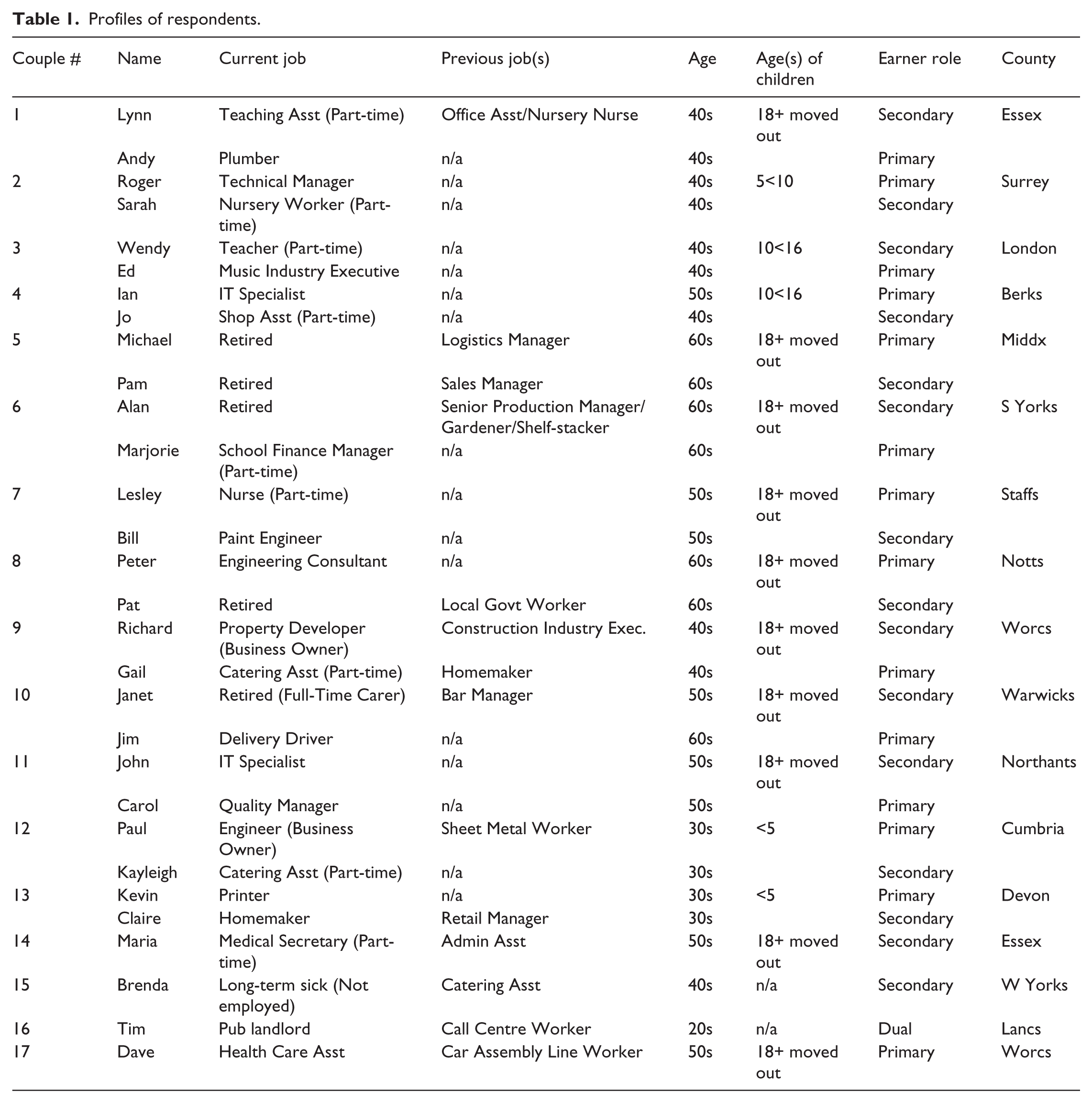
Conducting research with couples raises the question of whether to interview spouses separately or together as there are epistemological virtues and drawbacks in both approaches (see Allan, 1980; Valentine, 1999). In this research couples were interviewed separately where possible to give participants more freedom to express their personal views. Interviews were conducted face-to-face in participants’ homes and with two couples the physical layout of their homes rendered separate interviewing impracticable. In four cases only one partner was prepared to participate in the project. As a result, this research is based on two couples interviewed together, 11 couples interviewed separately and four couples where only one partner was interviewed. The fieldwork took place between October 2012 and February 2013 and interviews were recorded and transcribed using conventional qualitative techniques.
Dominant narratives were identified and subsequently coded, enabling the refinement of concepts, identification of themes and comparison between both participants’ accounts and existing literature. Care was taken not to dissociate sections of coded text from the all-important context in which they appeared. All transcripts were anonymized.
Anticipation of job loss or ‘head-in-the-sand’ ostriches?
The first research question was whether couples are pro-active or re-active when unemployment is a likely prospect. How couples respond to an employment or income ‘shock’ is likely to be influenced by whether they are aware they are likely to become unemployed or made redundant. Warning signs about potential job loss could be helpful, allowing time for contingency plans such as job search or re-organizing finances to cushion an expected financial blow. However, participants did not always see, or chose not to see, these ‘shocks’ coming despite numerous outward indicators of potential job loss: It was inevitable. They were going to sort of get rid of him … I think he sort of got an inkling it was going to happen, but of course you go on and you think, ‘Oh, it might blow over’, but you get a gut feeling … So I would say probably about four weeks, maybe a couple of months absolute, you know, before we knew. But even then, you know, we didn’t know. And when it did happen, we were absolutely gobsmacked. (Gail, 40s, Couple #9)
This theme of ‘shock’ was a recurring one in the interviews. Of the seven couples describing redundancy as a shock, all apparently ignored observable signs of an impending job loss or chose to believe that they would not be the person affected: I didn’t have any indication whatsoever … I knew that things were quiet … it was becoming more and more difficult to get paid and to get money in from companies… and you just gradually notice that things weren’t … jobs weren’t coming in … I did actually offer to reduce my five days to make a reduction … I was assured, ‘No, no. Everything’s fine.’ So it was a bit of a shock. (Lynn, 40s, Couple #1)
After many years of work as a Nursery Nurse, Lynn had taken an office job which she saw as a progressive career change. She was earning more and in a ‘grown-up’ job, no longer working with small children. Despite signals that the small company she worked for was not faring well, Lynn still found losing her job to be a shock; so much so that she was put off applying for other office jobs and found a new job as a part-time teaching assistant, working with children again. Sufficiently aware of these signals to suggest reducing her hours, Lynn seemingly discounted the threat to her job tenure and redundancy came as a surprise. Possible explanations for such responses draw on the concept of unrealistic optimism, where imagined realities are distorted to reduce anxiety, including where individuals rate their exposure to risk compared to that of others with an optimistic bias (Weinstein, 1980).
The above accounts are all post-redundancy and it could be argued that participants were seeing the signs after the fact. However, similar behaviour was evident in two cases currently observing a downward turn in their employment situation: But to go down to three people on the firm is a bit … yeah, it makes you wonder. But we still keep going. Work is still there. It’s looking a little bit better at the moment. Plus this year, we’ve had a couple of sub-contractors that are coming in, which in my mind, indicates that we’ve obviously got a bit more work coming in … he hasn’t employed any more people …we haven’t had a wage rise in the last probably three straight four years … work isn’t that good. (Andy, 40s, Couple #1)
Despite the signs of deterioration, there was hope that the situation would right itself eventually and that, crucially, bigger life changes in the form of job/business loss would not be necessary. It seems that small negative changes in employment circumstances such as a reduction in hours or a wage freeze can sometimes be endured as long as the change does not become too significant and lead to job loss. Aside from psychological explanations regarding denial and unrealistic optimism, the current context of the ‘Great Recession’ (Bell and Blanchflower, 2010; Beyers, 2013) is likely to play a part in this. Although unemployment has not increased to the levels predicted by some commentators, people may be more likely to endure unfavourable employment circumstances due to a feeling that their options for positive change (i.e. finding another secure job) were now more limited: You’ve got the choice of either hoping things are going to get better or decide there’s some better opportunities elsewhere, and to move and at the moment, I’m just hanging in there … I was put at risk redundancy-wise, I’ve just come through that and it could well be that if things don’t get better that will happen again. (Ian, 50s, Couple #4)
For Ian, part of the reason he was sticking with a precarious job was due to reduced networking opportunities as many of his industry contacts had also lost their jobs and simply did not have any job openings to offer. Ian did not focus on the perilous nature of his job situation, preferring to emphasize that his best option was to keep ‘hanging in there’.
Long-term vs short-term perspectives
The second research question was whether couples adopt short-term measures to deal with immediate circumstances or consider the longer-term implications of particular strategies. Whether an employment or income shock is perceived as being short-term and temporary or likely to be longer-term is likely to influence how couples react. Some may see the situation as a temporary set-back and have the financial resources to weather the storm, while for others replacing any loss of income from employment may be critical to maintain their standard of living. In addition, maintaining longer-term career prospects may be seen as the priority even if this means taking sub-optimal employment: If necessary, I’d have gone and worked in Tesco’s. That didn’t happen, and I was fortunate the way it turned out … it was the case of look at what was around and take the best thing even if it’s been a temporary sort of job, if you know what I mean. You know, something short-term just so one of us was working. Because my first instinct was panic, neither of us is working … neither of us were coming up to retirement age … so it was a case of, ‘Oh, dear, let’s get a job’. (Carol, 50s, Couple #11)
Carol, who had previously been earning ‘lots of money’ as a contractor, had taken time out from paid work following a period of ill-health. Her intention to return to the labour market at some point in the future was brought sharply into focus when her partner lost his job. This suggests a more fluid approach to ‘breadwinner’ roles as in this case the breadwinner role could, in the short term at least, be reversed. As Charles and James (2005: 499) note, ‘the strength of male breadwinner ideology may be waning and … definitions of who is the main breadwinner are more pragmatic than ideological’. Along with four other participants, Carol felt the need to return to work of almost any type in the short term, but for four others it was a quick return to the right kind of work that was most important: I had to take a job. I didn’t really want to go full-time … my concern, when my last school closed down was that … I’m not easy to employ because I’m more expensive. Students … [are] obviously more, a bit more desirable because they’re cheaper with no experience but nevertheless school budgets … dictate that. My job … you need to keep [up] in my job otherwise, you lose touch what’s going on. (Wendy, 40s, Couple #3)
Regardless of the financial implications of job loss on the household finances, the important dimension for Wendy was maintaining her status and competence in her chosen profession – to the extent that she took the first teaching job she was offered despite the hours being longer than she desired. Teaching was not the only profession in which ‘staying in the game’ was viewed as crucial by participants. When John was asked what he did when he was made redundant he too stressed the urgency of finding the right kind of employment as soon as possible: The fear is if you take a little bit time out, then that extends and grows and continues … any forced absence, then it comes to be seen as, by a potential future employer, oh ‘Why is he still absent? Was it, he’s been for a few interviews and nobody wants him?’ or whatever. So it’s really just a case of getting back on the horse again really as soon as you can. (John, 50s, Couple #11)
Of course, whatever the underlying reasons, a swift return to work is not always experienced in entirely positive ways. Dave had been made redundant several times in the past from working on the ‘track’ in car assembly plants, usually walking out of one job and into another. Looking back to a previous period of unemployment he regretted not taking more care over his job search at that time: I just wish that I took a little bit more time … try and find something more suited to what I want, you know, to what I would’ve enjoyed more rather than just panicking and taking the first thing that sort of came along. (Dave, 50s, Couple #17)
Expressing a deeply internalized work-ethic, being unemployed was not a situation Dave was prepared to countenance, irrespective of his financial position. Searching for work in a focused way is positively associated with satisfactory outcomes (Crossley and Highhouse, 2005). Happy in his current job as a health care assistant, Dave noted that the strategic, longer-term approach he had adopted more recently had worked out much better for him.
In summary, participants approached redundancy from different angles, with different priorities and goals. One type of response centred on sub-optimal employment positions being considered as a short-term solution, to bring money into the home or to maintain career prospects. Four couples spoke of the ‘panic’ they experienced as job seekers and how this sometimes led to taking work that was not ideal in terms of contracted hours or type. While short-term solutions were sought initially in about a quarter of cases, there are other temporal aspects at play due to an awareness that the longer one is out of work, the harder it may be to find work in the mid to long term. Certain types of occupation were characterized by anxieties about ‘falling behind’ by being out of one’s profession and as a result being less desirable as a potential employee stretched beyond the short term, indicating an acute awareness of the long-term implications for career prospects in the future.
More than an added worker effect
The final research question was the extent to which couples seek to maintain or regain the established share of paid and unpaid labour between them. Among the sample interviewed, a common pattern was for the person made redundant to be most likely to look for new paid employment, rather than their partner altering their labour-market behaviour as an immediate response to the shock. The latter occurred in only two cases. This is not to say that spouses responded passively but that their efforts were generally targeted at supporting their partner in finding a new job rather than seeking additional employment for themselves: Well, when I’m looking for a job, [my wife] is up there with me looking as well. And when I’m not at home, if I’m doing something else, she’s, she’ll spend time looking for a job for me on the Internet as well. So she was very supportive. (Dave, 50s, Couple #17)
Dave’s wife was working part-time, very locally and not inclined to adjust her work schedule, preferring to give all the support she could to help Dave find another job. It is not clear whether her ‘preference’ to remain in her current job reflects a true preference for part-time work or whether it was symptomatic of the gendered constraints she experienced in combining home and work (see Crompton, 2006; Hakim, 2000), but the corollary was that Dave sought work rather than his wife seeking to increase her hours or earnings. All couples emphasized the importance of maintaining the division of household labour that was customary for them, regardless of which couple member had lost their job and whether they were the primary or secondary earner. Male spouses generally did not want to take on additional household and care-giving work and on the whole their female partners had little expectation that they would. Couples had found a balance in their division of household labour, however gendered, and wanted to maintain it.
Part of the backdrop for this was that some spouses were already working full-time with very limited opportunities to increase their income, yet even in cases where spouses were working part-time and could theoretically increase their labour market time this was not always perceived as easy: No, I wouldn’t … well, no, I probably wouldn’t be able to [increase work hours]. It’s only a morning nursery anyway, and I do three mornings. And they wouldn’t take me on the other two days if we haven’t got, you know, the children. We’ve got enough staff, so I probably wouldn’t be able to increase my hours. (Sarah, 40s, Couple #2)
This indicates that Sarah had not tried to increase her hours despite her husband being out of work. She framed this within a very real constraint of the absence of additional work opportunities with her current employer but with two relatively young children her limitations to operate freely in the labour market extended beyond this. Whether her resistance to seek extra work, possibly with a new employer, reflected her set of lifestyle choices or the difficulties in combining motherhood and paid work, the assumption in the added worker thesis that men’s and women’s roles are largely interchangeable is not supported by participants’ accounts. To weather the loss of income, an alternative strategy involved reducing household expenditure and many spoke of being ‘careful’ and ‘watching what we spend now’. Changes in household spending ranged from cutting back on everyday items at the supermarket to forgoing meals out and takeaways, cancelling gym memberships and or/postponing other leisure activities such as holidays. Other strategies included restructuring finances by switching to cheaper mortgages, drawing on loans and inheritances from family members or ‘dipping into’ savings. It should be noted that none of the participants regarded themselves as being in serious financial difficulties, even though some had gross household incomes well below the national average. Had they been ‘struggling to put food on the table’, they all said that things would have been different and both couple members would have taken positive action to find work. This suggests that the added worker effect may represent an immediate response to job loss only in particular circumstances where finances are very tight.
A common thread was a resistance to making substantial adjustments to the existing household equilibrium. Socio-psychological understandings of why people are averse to change suggest that what we ‘have’ is generally preferable to what we ‘might have’, especially in the context of uncertainty (Eidelman et al., 2009; Samuelson and Richard, 1988). Maintenance of the status quo is seen as desirable, particularly where established patterns of behaviour have been formed (Eidelman et al., 2010).
While more than half the couple members displayed behaviours and attitudes in line with the notion that change would be unwelcome, redundancy could also act as a trigger for a lifestyle change and was not universally perceived as a negative experience. Three couples welcomed the prospect of early retirement, three embraced the chance to start a new business venture, one wanted to concentrate on starting a family and one wanted to be more involved in charitable works.
Richard, an ex-construction industry executive from Worcestershire in his 40s, became a self-employed property developer post-redundancy and considered this new venture an ‘opportunity’. While awaiting the returns from these investments and development projects his wife, Gail, returned to paid employment after 19 years as a homemaker, partly as a result of the couple’s reduced income following his job loss. Nonetheless there was more than her husband’s (then) unemployment at play here: It was a dramatic drop in what we were getting … I thought, well, a little bit of extra income as well but mostly I think it was to get me out of the house … I don’t think it’s healthy to be under each other’s feet sort of 24/7 … I just wanted something to take me out the house and something for me and to sort of start mixing with people. (Gail, 40s, Couple #9)
A trace of added worker effect was present in Gail’s explanation for returning to work to earn some extra income, even though other factors seemed to be more influential in the decision. First, she noted the temporal and proximal effects of Richard’s unemployment on their relationship. They were spending too much time in close proximity to one another, without the breaks in contact characteristic of their time when Richard was in his previous job. In essence, his unemployment and greater presence in the home was not experienced as ‘healthy’ for their relationship (Vinokur et al., 1996). Most of Richard’s earning power was tied up in property investments which had yet to be realised, leaving Gail as the main wage-earner. Despite this couple having assets such as rental incomes from their property portfolio which meant that Gail could ‘easily stop [work] tomorrow’, she liked her job in terms of content and hours (part-time). Her children had grown up, moved on and she wanted a new ‘challenge’. Social isolation and the associated lack of contact with other people outside the home (Ferree, 1976; Shehan et al., 1986) was also a theme here. Returning to work was seen by Gail as a way of making her relationship ‘healthy’ again and increasing social contact.
In a different context, Claire, who was in her 30s, saw job loss and redundancy as an opportunity for a much desired life change: It came at quite a good time because … they said, ‘Yeah, you can start [IVF] in the June’ and obviously, I got made redundant in the June … I did get offered a job just before the shop closed and I was like in two minds to take it and then we just decided, you know, just to concentrate on [the IVF]. (Claire, 30s, Couple #13)
Claire’s response to job loss was neither rooted in the added worker effect nor the discouraged worker effect (see, for example, Bingley and Walker, 2001). The response here centred on life-stage and lifestyle choice. Priorities were set in this instance around fertility treatment and starting a family rather than immediate financial concerns and an attendant return to paid employment. Her husband Kevin spoke with mixed emotions about the inheritance he received when his parents died a short time before Claire lost her job. Although devastated by bereavement, the money allowed the couple to follow their dream of starting a family without the need for Claire’s income. In the case of another couple, John and Carol, John took a job that many would find far from ideal upon being made redundant, effectively working for long periods without pay. Carol outlined the context: We’ve got a local charity … provides dogs for adults and children with disabilities, and I wanted to get involved with them and I didn’t think we could because we both work. I spoke to them and they were quite happy because [John] works at a small software house. He can take a dog to work with him. If I didn’t earn the money that I earned, then he would have to leave where he is … he gets paid now and again … if he found another job, we couldn’t look after the dogs … as long as we can cope financially, which we can at the moment, I’ve got no problem with it. (Carol, 50s, Couple #11)
For John and Carol, the ability to be able to look after dogs and to remain heavily involved with the charity work that held great meaning for them took priority over the steadier income that John might earn in a more conventional job. An echo of the added worker effect was present here inasmuch as one half of the couple (presently Carol) needed to earn a steady income in order for the other to have a less regular income, thereby providing the flexibility they needed to stay involved with the charity they saw as important to them. This arrangement saw the couple taking a short-term, reactive perspective that utilized the resources they had in such a way as to ‘draw back’ from (further) change (see McCrone, 1994). The arrangement relied on a balance, whereby one half of the partnership must make up for the financial shortfalls in the others’ work-related income, but it did not fully evoke the added worker effect.
From couples’ responses to job loss it is possible to see why the expected added worker effect is often not detected in empirical quantitative investigations. Men’s and women’s roles within the household are not as easily substitutable as the theory suggests. Gendered frictions act to dissuade couple-members from stepping into their partner’s role except in the extreme situation where the financial survival of the household is under threat. Although the added worker effect is sometimes present to a degree within participants’ accounts, it typically crosscuts with a variety of other aspects of their life. Respondents at particular life-stages spoke of wanting to start a family, embracing new challenges as their children matured and left home, spending more time with grandchildren or wanting to give something back in terms of charity work or fostering; essentially, times in their lives when they sought new goals. How couples responded to employment or income shocks varied enormously and depended on their particular circumstances, such as the extent to which their personal identity was associated with paid employment or a specific occupation, their commitment to the labour market, their personal preferences and domestic constraints and their priorities and interests, rendering straightforward explanations somewhat elusive.
Conclusion
To mitigate the financial loss associated with unemployment couples can reorganize the way in which they share paid and unpaid labour between them. To understand the extent to which such a reallocation takes place, studies have analysed the labour market participation of secondary earners when the primary earner of a couple experiences job loss, looking for an expected ‘added worker effect’. The findings from this research suggest that this may not always be an appropriate way to characterize how couples respond to employment shocks.
The evidence from these qualitative interviews sheds light on the three core research questions. First, regarding whether couples act proactively or reactively in the face of an anticipated job loss, a common reaction is to do nothing. Even where the chances of job loss are expected and appear to be quite high, more than a third of couples suggested that they were still shocked when the moment of redundancy finally came and had instigated little or no pre-emptive action in terms of job search or financial manoeuvring. This was true of participants who spoke about a previous job loss episode and for those whose current employment was experiencing a noticeable downturn. In the latter case, unfavourable changes in employment circumstances could seemingly be endured as long as the change did not become too significant and lead to job loss. Basically, for those who viewed change as unwelcome, maintaining a sense of equilibrium in the division of labour was paramount. Action would only be taken when absolutely necessary and not before.
Turning to the question of whether couples respond to job loss with a short- or long-term view of their labour market situation, there was evidence of both types of approach. Nonetheless the emphasis for finding work almost always focused on the partner losing their job, not their spouse. In one case, losing a job and being out of work was wholly incongruous with the participant’s self-identity and propelled him to take the first job that came along, being less concerned with what would happen in the future and focussing on present circumstances. Those with a longer-term perspective of their labour market prospects also took the first available job opportunity if it was seen as favouring the realization of long-term goals, such as maintaining career continuity. In either situation, household tactics were primarily to try and keep life as close to ‘normal’ as possible and avoid invoking any additional paid spousal labour unless absolutely necessary. By contrast, just under half of couples used the opportunity of job loss to re-evaluate their lives and adopt lifestyle changes that would resonate over the longer term, such as starting a family, making more time for grandchildren, becoming more involved in charity work and so on. These participants had reached some form of crossroad in their lives and opted to pursue other ambitions and futures, instigating what was seen as positive change where the employment shock operated as a catalyst.
The final question addressed in this article is whether couples seek to regain or maintain the status quo in their household arrangements for paid and unpaid work. The answer to this appears to be tied up in preferences and established gender roles. Whether households adopt an ‘all change’ or ‘carry on as usual’ reaction to job loss (or imminent job loss) depends largely on the priorities that people set themselves. Overall households tended to gravitate towards the ‘carry on as usual’ option but in the cases of Carol and Gail, work-related household changes did occur. These couples were able to take new projects on board and still stay afloat through their partner’s earnings – this of course involves change but in these cases a qualitatively different change to that which would manifest itself through the added worker effect. Couples for whom job loss was an unwelcome experience reacted quickly after the event and the redundant partner found new employment in a short space of time, retaining the established division of paid and unpaid labour. Ultimately, reactions to redundancy were intimately bound with individual preferences and constraints and overall, the couples in this study tried to carry on as usual if change could be avoided. Caring for young children might be expected to play a large part in this resistance to role-swapping but over two-thirds of the couples interviewed had no dependent children and only three of the 17 had children under the age of 10. This suggests the influence of gendered constraints and preferences extends well beyond the early childrearing years.
The analysis offers some insight as to why the expected added worker effect in quantitative studies is often not present or smaller than theory would predict. Unless a change in the share of paid and unpaid labour facilitates the realization of a long-term aim, couples seem to work very hard to retain the status quo in their division of labour and avoid making substantial household changes until absolutely necessary. Couples display remarkable resilience in finding alternative coping strategies to absorb an employment or income shock. The use of additional paid spousal labour as a response to unemployment is one response among a set of alternatives and couples may prefer to exhaust all other alternatives before invoking major changes to the way labour is shared between them.
Footnotes
Funding
This research was supported by funding from the UK Economic and Social Research Council (ESRC) under the grant ‘Understanding the impact of recession on labour market behaviour in Britain’ (award no. RES-062-23-3284).