



Abstract
This article examines whether the EGP (Erikson–Goldthorpe–Portocarero) schema and its reliance on employment relations remain relevant in today’s post-industrial labour market. Ongoing shifts in work structures and employment conditions may challenge the relationship between employment relations and class distinctions as defined by EGP. Prior studies have validated that employment relations correlate with EGP classes; however, they have not explored other class-defining factors, potentially overlooking important dimensions. Building on this, the present study employs Lasso regression – a machine learning method – and leverages indicators encompassing employment relations, work conditions, skills and socio-demographics to enable a comprehensive, albeit exploratory, analysis of factors underlying EGP class. The findings reveal that class distinctions may be shaped more by job characteristics, sector and gender than by the theoretically proposed employment relations. The results suggest a conflation of employment relations with tasks within the EGP schema, highlighting the need for re-evaluation as the labour market evolves.
Keywords
Introduction
Class is a fundamental sociological concept that provides key insights into the persistent dominance of some in social hierarchies. In both scholarly and everyday discussions, ‘class’ draws attention to the clustering of vulnerability among specific individuals, spanning a broad spectrum that includes economic status, health, well-being and life prospects. Inquiries into what constitutes class yield a multitude of responses, contingent upon theoretical perspectives. This article addresses this question through an empirical quantitative lens, dissecting the most prevalent definition of class within this realm, the EGP (Erikson–Goldthorpe–Portocarero) schema (Barone et al., 2022).
A large portion of quantitative sociological literature equates social class with the occupational classes in the EGP scheme. Class distinction within EGP relies on employment relations defined by labour and service contracts. Labour contracts, typical of the working class, involve easily supervised tasks with low skill specificity, making workers easily replaceable. Service contracts, associated with the salariat class, require specialised skills and longer training, making employers more dependent on these employees, which leads to higher rewards (Goldthorpe, 2007).
By employing latent class analysis, or other conventional statistical methods, previous research has explored the relationship between employment relations theory and empirical practice, aiming to investigate whether employment relations correlate with classes (e.g. Evans and Mills, 1998; Zou, 2015). These studies consistently emphasise the validity of the framework (Evans and Mills, 1998; Rose and Harrison, 2014; Smallenbroek et al., 2022). However, they often neglect to investigate whether employment relations are the most prominent indicator underlying the classification. This question is not irrelevant, as recent findings suggest that although employment relations vary between classes, the differences are marginal (Smallenbroek et al., 2022). To address this issue, the present article adopts an exploratory approach. This study utilises a dataset containing hundreds of variables across domains, such as employment relations, working conditions, work-related and industrial aspects, socio-demographic factors, income and more, all relevant to understanding class in a post-industrial setting. This approach allows for a comprehensive examination of class categorisation, extending beyond employment relations. This article aims to identify the key indicators that significantly contribute to the classification of individuals into different EGP class categories.
This research’s exploratory approach is particularly relevant in the context of evolving employment relations. The original scheme, designed for industrial societies, relies on data only for males (Erikson et al., 1979). In contemporary society, there are clear limitations in constructing social classes based on knowledge derived from male-dominated occupations. For instance, previous research suggests that women commonly belong to the same class across various employment relations (Barone et al., 2022; Crompton, 2008; Evans, 1996; Heath and Britten, 1984), indicating that gender, rather than employment relations, plays a significant role in shaping EGP classes. However, this cannot be tested unless multiple indicators are included in the model.
In the EGP framework, manual labourers in industrial sectors are typically classified as the sole working class (Barone et al., 2022; Crompton, 2008; Evans, 1996; Heath and Britten, 1984). Over time, the prevalence of low-wage, precarious employment has shifted from the industrial sector to the service sector (Autor and Dorn, 2013; Dwyer and Wright, 2019; Peugny, 2019), reflecting a change in employment relations. This shift is closely tied to ethnic dimensions, as occupations in the ‘post-industrial’ service sector working class are more commonly filled by foreign-born individuals (Ahrne et al., 2018; Åslund et al., 2017). There are indications that employment relations, such as low dependency or low influence in the workplace, are shifting from industrial to service sectors in a post-industrial context. All these factors underscore the need to investigate the traditional sociological equation of industrial (white/male) work with working-class employment relations in a post-industrial setting.
Ongoing technological advancements reshape employment relations. For instance, technology’s capacity to automate routine tasks increases the demand for specific, rather than routine, skills in certain sectors of the labour market. Hence, as technology changes, asset specificity, integral to the theoretical construct of social class, might become more important in some occupations (Williams, 2017).
As noted, a myriad of technological, societal and gendered transformations challenge the relationship between theory and constructed classes. This article is not the first to acknowledge this (see, e.g. Barone et al., 2022; Crompton, 2008; Evans, 1996; Heath and Britten, 1984). However, the analytical strategy in this article allows for the inclusion of both theoretically proposed employment relations and other variables not stipulated by theory, enabling an investigation of the theory while also exploring alternative factors.
Previous research
This article aims to investigate whether the EGP model captures its theoretical class concept. This section reviews previous research investigating the relationship between the underlying theoretical framework and operationalised EGP classes. Such research is commonly referred to as validation studies or criterion validity studies. These studies examine whether a latent class structure of job characteristics aligns with operationalised EGP classes, where job characteristics serve as an operationalisation of employment relations. Essentially, it examines whether the EGP framework effectively measures what it claims to measure, commonly using latent class analysis (e.g. Evans and Mills, 1998).
Job characteristics indicating employment relations can be categorised as autonomy, time horizons or types of rewards. Indicators of job autonomy include factors such as decision-making in day-to-day tasks and work pace (Evans and Mills, 1998; Katrňák, 2012), flexibility in work hours (Katrňák, 2012) and employer monitoring (Zou, 2015). Time horizon indicators involve measures of internal promotion prospects (Evans and Mills, 1998; Gil-Hernández et al., 2024; Katrňák, 2012; Zou, 2015), possibilities for pay increase schemes (Evans and Mills, 1998; Gil-Hernández et al., 2024; Katrňák, 2012; Smallenbroek et al., 2022), the time required to acquire necessary job skills (Zou, 2015) and the risk of job loss (Gil-Hernández et al., 2024). Reward type indicators encompass various aspects, such as requirements to clock in and clock out (Evans and Mills, 1998; Katrňák, 2012), paid overtime work (Evans and Mills, 1998; Katrňák, 2012; Zou, 2015), hourly payment (Evans and Mills, 1998; Katrňák, 2012), performance-based payment (Evans and Mills, 1998; Gil-Hernández et al., 2024; Smallenbroek et al., 2022) and opportunities for wage negotiation (Katrňák, 2012).
While the aforementioned indicators are commonly utilised, other approaches to operationalising employment relations exist. One approach examines the level of dependence within these relations, assessing the challenge for employers in replacing workers and for workers in finding equivalent positions (Tåhlin, 2007). Another approach is management practices (Katrňák, 2012).
Overall, these studies provide support for the relationship between EGP classes and the underlying theory (Evans and Mills, 1998; Katrňák, 2012; Smallenbroek et al., 2022; Zou, 2015). Service classes display employment relations signifying the service contract, characterised by dependence, autonomy and long-term relations. In contrast, labouring classes are characterised by the labour contract, marked by monitoring and short-term rewards (Evans and Mills, 1998; Rose and Harrison, 2014; Smallenbroek et al., 2022).
However, research also highlights deviations in the correspondence between theory and classes. For instance, routine non-manual workers (such as low-skilled sales workers or care workers) often fall within the same EGP class but exhibit greater variation when classes are derived from employment relations (Evans and Mills, 1998). This finding is consistent with previous research critiquing the EGP for its low differentiation of women’s/low-skilled, non-manual workers’ class positions (e.g. Heath and Britten, 1984). Similarly, findings point to an indicator-derived class primarily composed of females who self-identify as working class, though they are not as extensively classified as such within the EGP scheme (Evans and Mills, 1998).
Another finding indicates that higher-grade white-collar and higher-grade blue-collar positions lack the expected differences in their employment relations. Moreover, within upper-class strata, there is a debate regarding the differentiation between the lower and higher salariat to identify privileged positions more accurately (Smallenbroek et al., 2022). This may become increasingly relevant as a growing proportion of occupations require high skill demands and may be classified within either the upper or lower salariat. However, it remains unclear whether they operate under the same employment relations.
Importantly, previous studies suggest that employment relations do not significantly differ between classes. For example, Smallenbroek et al. (2022) reveal that the divergence between the upper salariat and the two intermediate classes measures below 0.3 standard deviations in indicators of employment dimensions, indicating that even though classes differ in employment relations, they do so only marginally.
Not all studies prioritise employment relations as the sole determinant of divisions within EGP classes; alternative explanations exist. Brousse et al. (2014) argue that the asset specificity dimension effectively delineates social classes. However, monitoring issues are less pronounced, suggesting that skills hold greater significance in EGP class divisions than autonomy. Similarly, Tåhlin (2007) asserts that the principal variation among EGP classes stems from disparities in skill demands. Furthermore, Gil-Hernández et al. (2024) find that tasks explain class membership better than the theorised employment relation, which closely relates to the use of digital tools.
However, research rarely focuses on alternative explanations for the structure of EGP classes. Instead, the emphasis often lies on examining whether a discernible pattern of employment relations exists. As a result, a substantial body of research adheres to the idea that employment relations form the primary foundation for the structure of classes.
Theoretical framework
EGP framework
This article investigates the relationship between theoretical classes and manifested classes following the EGP framework. At the theoretical level, EGP centres on employment relations, which give rise to two types of contracts: labour contracts, defining the working class, and service contracts, which define the salariat class. There are also mixed contracts that include elements from both.
Employment relations between classes differ because they are associated with varying levels of skill specificity and monitoring issues. Within the labour contract, a clear link exists between work and output, allowing the employer to measure productivity through work hours. Payment is directly tied to productivity. This ranges from extreme cases, such as compensation based on production quantity, to more common scenarios where hours worked show a discernible correlation with output, especially in repetitive tasks. This facilitates easy monitoring and evaluation of completed work. As a result, work is closely monitored and workers experience limited autonomy in their tasks and work pace.
The competencies required for occupations under the labour contract are quickly acquired, giving employers little incentive to invest in employee education. Instead, employers often choose to hire from a homogeneous labour pool to minimise costs, making employees easily replaceable. Employers can quickly find new hires who can learn the job with little or no training. There is nothing in this that suggests a mutual relationship between employer and worker; rather, it reflects a short-term, commodified relationship.
In contrast, the service contract demands highly specific skills, leading to longer learning periods. Many professions require specialised knowledge and extensive training in job-specific expertise. Moreover, managerial roles require competencies in both operational tasks and leadership. Overall, this increases the cost of replacing an employee and training a new hire for the position, making the employer more dependent on the employee. Owing to this dependence, employees enjoy benefits, job security and opportunities for career advancement. This relationship is therefore more long-term in nature.
In the service relationship, the employee possesses greater insight into specific work tasks than the employer, creating challenges in monitoring the work and its productivity. This dynamic results in the employer lacking visibility over the employee’s adherence to work procedures and allocated hours. As a result, incentives are required to align the employee’s interests with those of the organisation, often leading to improved working conditions (Goldthorpe, 2007).
In summary, the EGP framework categorises classes based on distinct employer–employee dynamics, characterised by skill specificity and monitoring difficulty. The working class, operating under the labour contract, is more commodified due to the easily acquired skills involved. This leads to lower employee bargaining power and employment relations that favour the employer. The service contract, on the other hand, encompasses a salaried middle class embedded in a long-term relationship, where the employer’s dependence on the employee is more pronounced than in the labour contract.
The EGP class labels are shown in Figure 1. These names do not explicitly denote the foundational assumptions of employment relations. Instead, they imply an underlying presumption of a correlation between employment relations, skills and work tasks. This suggests that individuals in certain occupations, like low-skilled manual workers, share similar employment relations.
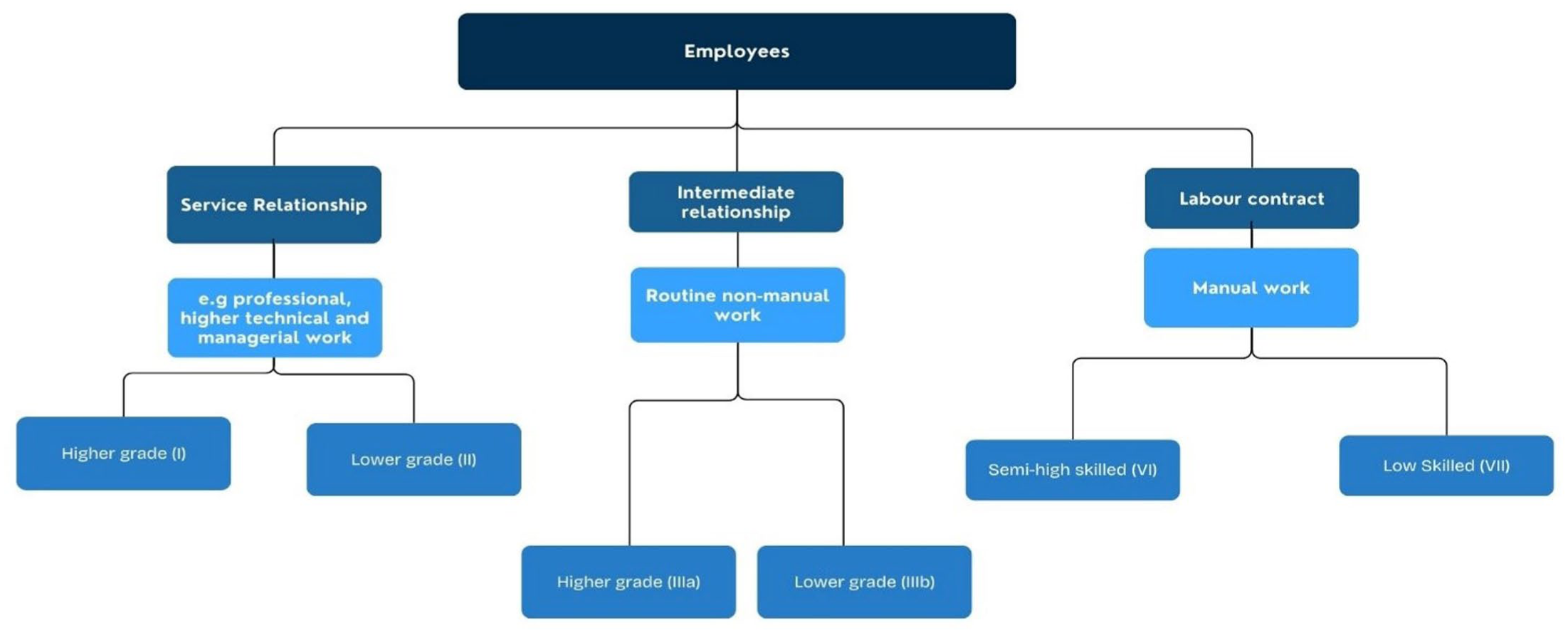
EGP classes included in this study, with their names and contract classifications, as outlined by Erikson and Goldthorpe (1992).
In the original EGP framework by Erikson et al. (1979), the routine non-manual class comprised a single category (Class III). Contemporary research, however, splits this category into two classes, IIIa and IIIb, to enhance the precision of the scheme, particularly when assessing the class of women (Birkelund et al., 1996; Oesch, 2003). Class IIIb, along with low-skilled manual workers (Class VII), is commonly regarded as a labour contract/working class. However, inconsistencies exist. Erikson and Goldthorpe (1992) propose merging Class IIIb with the working classes but still describe it as an intermediate contract (see Figure 1). In contrast, Goldthorpe (2007) refers to Class IIIb as a labour contract. This discrepancy is reflected in research, with some scholars classifying IIIb as a mixed class alongside IIIa (e.g. Zou, 2015).
In practice, occupations are linked to distinct classes using algorithmic approaches. A process that entails mapping occupations and employment statuses onto the schema’s categories (Leiulfsrud and Prieur, 2017), resulting in assigning a class to each occupational code. However, the precise details of this process are not always transparent. The construction of EGP classes, based on EGP theory, necessitates employment relations and job attribute information for each occupation, which are often lacking in survey data (Evans and Mills, 1998; Smallenbroek et al., 2022). Consequently, classifying occupations into EGP classes relies on subjective judgements driven by perceived similarities and relationships (Mitnik and Cumberworth, 2021; Rose and Harrison, 2014).
Taken together, there are many steps in the process between the theory of employment relations and the construction of analytical classes, which may result in inconsistencies between theory and practice.
The Swedish case
This article examines indicators of social class in contemporary society, using Sweden as a case. Sweden is an interesting case, but more importantly, it demonstrates labour market trends like those of many other industrialised countries. Therefore, investigating how changing labour markets challenge the concept of social class through the Swedish case is not only inherently interesting but also holds potential for generalisation.
In Sweden, there is a shift in labour market dynamics, influencing the relative composition of classes as well as the strength and interdependence of employment relations. Work in Sweden has become more complex over time (Oesch and Piccitto, 2019; Tåhlin and Westerman, 2020), leading to a skill upgrade in the workforce and a shift towards employment in middle- and upper-class occupations. This trend of skill upgrading is evident not only in Sweden but also in other countries, such as Germany (Oesch and Piccitto, 2019).
The Swedish industrial manufacturing sector is undergoing automation and globalisation, resulting in a reduced workforce (Tåhlin, 2019). The shrinking manufacturing industry primarily affects the least qualified and lowest-paid positions, leading to a skill upgrade in the remaining manufacturing jobs (Berglund et al., 2019; Tåhlin, 2019). This decline in industrial jobs is evident across several European countries (Goos et al., 2014). While labour market polarisation is contested in the Swedish case (Oesch and Piccitto, 2019; Tåhlin, 2019), arguments are made for an increasing share of low-wage service jobs (Åberg, 2013; Adermon and Gustavsson, 2015). These trends may shift the sectoral composition of low-skilled jobs and alter the structure of employment relations.
The growth in low-skilled service occupations aligns with a global pattern, observed in places like the United States. This phenomenon is tied to technological shifts, prompting low-skilled workers to transition into service occupations, which are more challenging to automate because they rely on interpersonal relations, unlike manual labour (Autor and Dorn, 2013).
In summary, these trends demonstrate how technology and deindustrialisation contribute to workforce upskilling while also increasing the share of low-skilled, low-wage workers engaged in routine non-manual labour. Each of these factors challenges the EGP framework, particularly since it presupposes disparities in employment relations between manual and non-manual occupations, with more commodified relations attributed to the manual classes. Although this distinction is not explicitly outlined in the theoretical model, it becomes evident in its practical implementation, where classes are delineated based on whether they involve manual or non-manual labour.
Data and methods
Data and sample selection
This article utilised data from three different sources from 2019, provided by Statistics Sweden. The primary data source was the Swedish Work Environment Survey (WES), a biannual survey employing a representative sample of the employed population. This survey gathered comprehensive information related to the work environment, encompassing over 100 questions that delved into various work environment factors, occupation-related factors and characteristics of employment relations and information on occupation. The second data source, the Labour Market and Labour Force Survey (LFS), provided information on contract types, an important aspect of employment relations not covered by WES. WES was conducted on a sample of LFS participants. The third data source was administrative data from the Longitudinal Integration Database for Health Insurance and Labour Market Studies (LISA), which provided information on gender, birth country, age, income and industrial affiliation for the entire Swedish population. All WES respondents responded to the LFS survey. LISA, being full-population administrative data, contained information that could be linked to respondents in the surveys. The administrative and survey data were easily merged at the individual level using Statistics Sweden’s personal identification number. All WES observations matched individuals in the LFS dataset. The administrative were was subsequently merged for all survey respondents. Ultimately, the sample included information from all three data sources but relied on the WES survey sample, as this combination provided the most exhaustive information and contained data from all three datasets.
There were several advantages to using this combination of datasets for the study. The WES dataset included extensive information commonly employed to understand employment relations, encompassing both time-related and autonomy-related aspects. Employment relations were operationalised through the ability to influence one’s work, working hours, job flexibility (autonomy-related aspects), as well as time to learn the job, risk of losing one’s job and temporary employment (time-related aspects). Furthermore, the utility of combining the datasets lies in their capacity to capture a broad range of work-related variables possibly associated with EGP class, even if not theoretically aligned with the concept of class as employment relations. Given that EGP heavily rely on the nature of work, despite its irrelevance to employment relations, variables related to the type of work were important. Additionally, the combination of datasets enabled the examination of multiple socio-demographic variables, such as gender and migration status. While gender and migration status should not theoretically relate to class, their close association with the nature of work posed a risk of influencing class. Additionally, this data combination captured various skill-related factors, which have been emphasised as possible underlying EGP classes. Such skill-related factors included task difficulty and whether the work was monotonous or repetitive. To conclude, this combination of datasets offered the opportunity not only to validate employment relations-related factors but also to explore a wide range of other relevant underlying factors.
The analytical sample in this study included all observations and questions from the WES survey, except for those questions that specifically targeted subgroups such as respondents falling within particular age categories. As well as selected variables from LISA and LFS. All included variables are accounted for in the Supplemental Material.
The number of valid responses in WES ranged from 3171 to 3223, with inconsistent patterns in missing data across units. Including all variables in the regression models and performing a full-case analysis with no missing values among the 155 variables would have resulted in a sample size of 2035. Although each unit had relatively few missing values, the cumulative effect reduced the sample by about one-third. To mitigate this substantial reduction, multiple imputation by chained equations was employed. Thus, each missing value was imputed by estimating it based on observed values in all other variables, independent of whether they contained missing values or not. Missing values were imputed for 96 variables, with varying degrees of missingness. Five imputations were specified. This produced a final sample size of 3222. As a robustness check, all analyses were conducted with a complete-case approach (without imputation), yielding similar results.
Variables
This article utilised 155 variables, all of which are documented in Supplemental Table A16. This section explicitly addresses the variables with the most theoretical and empirical significance to answer the study’s research questions.
EGP class
A key classifying occupation (Swedish ISCO (SSYK96) 3-digit) to EGP class was employed. This study utilised a six-class version of EGP, excluding farm work and self-employed. The upper salariat (I) included engineering roles, while the lower salariat (II) comprised various sales positions, such as company sellers and account managers. Within the routine non-manual class (IIIa), prevalent occupations involved preschool teaching, while assistant nursing was common in the low routine non-manual class (IIIb). Skilled manual class (VI) occupations often included electricians, and the low-skilled manual class (VII) typically included truck drivers.
Employment relations variables
Following theory and previous literature, employment relations were operationalised through specific job characteristics related to both time-related and autonomy-related aspects. Research commonly employed decision-making in daily tasks, work pace (Evans and Mills, 1998; Katrňák, 2012) and flexibility in work hours (Katrňák, 2012) as indicators of autonomy in employment relations. Consequently, this study classified flexibility in work hours, perceived influence at work and perceived influence over decisions related to working hours, tasks and pace as aspects of employment relations. Research typically used the time required to acquire necessary job skills (Zou, 2015) and the risk of job loss (Gil-Hernández et al., 2024) as indicators of time-related aspects. Therefore, this study identified the period of learning the job, the risk of losing employment and temporary employment as indicators of the temporal aspects of the employment relationship.
Analytical strategy
This article employs logistic Lasso regression to explore the manifestation of EGP classes. Lasso helps identify the relationship between theory and practice while considering alternative explanations. Unlike previous research, which typically uses methods such as latent class analysis (LCA) or principal component analysis (PCA) and includes only a limited number of indicators, Lasso regression allows for the inclusion of a broad range of indicators to explain EGP class, enabling a more exploratory approach to understanding class membership. The analysis includes 155 indicators spanning diverse domains related to the work situation, including working conditions, employment relations, nature of work, industry and income (a comprehensive list of indicator variables is provided in Appendix Table A16).
A key strength of Lasso lies in its ability to generate easily interpretable models by shrinking the coefficients of less influential variables towards zero, thereby promoting sparsity in the final model (James et al., 2021). Thus, Lasso achieves variable selection by excluding less relevant predictors. It also differs from regression models like OLS, which are vulnerable to overfitting and collinearity when using many variables. Lasso regression permits the inclusion of numerous variables without producing excessively large regression outputs, enabling more exploratory analysis. These features set the present study apart from previous research, which often lacks a diverse range of variables, thereby restricting the range of possible explanations for class categorisation.
In the analysis, each EGP class is assigned a binary response variable that categorises respondents as either belonging to that class or not. The results are generated through separate regressions for each class, examining the defining characteristics of each class relative to all others.
Since the modelling is data-driven rather than theory-driven, verifying the stability of observed relationships on new data is essential to ensure that correlations remain consistent. This is achieved by splitting the dataset into two samples – one for training and one for testing – allowing for a comparison of model performance across the two (Hastie et al., 2015).
To identify the best model fit, each of the six class regressions is performed six times using different penalty terms. Each class regression is employed using six logistic Lasso variations with distinct penalty terms and selection criteria: logit, probit, logit/probit adaptive and logit/probit BIC. This process helps determine which regression models are most suitable for the final model.
Deviance is used to assess model fit and guide model selection. However, selecting the model with the lowest deviance is not always optimal, as it may lead to overfitting, producing a model that fits the training data well but performs poorly on unseen data, thereby reducing generalisability. Therefore, the primary criterion for selecting the best model is the similarity in deviance between training and testing samples, ensuring reliable performance on new data.
The final regression models adhere to these selection criteria to determine the best fit for most classes, avoiding comparisons between models with differing penalty terms. Thus, the model that demonstrates the best fit for most of the classes is applied across the full dataset for all six class models.
The analysis uses the complete sample without separating by gender. Separate analyses based on gender are not performed, as this might prevent gender from serving as an indicator of class, despite evidence of its impact on class membership. Additionally, the relatively small number of women and men in some classes makes such analyses inadequate for drawing reliable conclusions.
In the final step, special attention is given to variables with non-zero coefficients, as these indicators contribute to predicting class positions. The Results section accounts for all variables with non-zero coefficients and specifies whether the coefficient is positive or negative. Lasso regression coefficients tend to be biased for various reasons. For instance, they shrink the size of coefficients, preventing an accurate representation of true effect sizes. Additionally, the estimates are inconsistent (Molina and Garip, 2019). Despite this bias, Lasso coefficients still provide valuable insights. Previous research has interpreted and utilised these coefficient values (e.g. Chu et al., 2024; Irvani et al., 2021), though they are rarely regarded as directly comparable to coefficients from unbiased regression models. Therefore, when referring to coefficient sizes, it is more informative to highlight predictors with substantially larger or smaller influences on class. The Results section highlights variables with non-zero effects rather than focusing on the magnitude of effect sizes. All regression outputs, including coefficients, are presented in the Supplemental Material.
To enhance the interpretability of the results, selected non-zero coefficient variables are organised under thematic headings. Informed by previous research, theory and critiques of the EGP classification, variables are grouped into clusters related to employment relations, type of work, skills and authority.
The employment relations cluster comprises variables close to the theoretical concept of employment relations, as detailed in the variable section. The type of work cluster includes industry- and occupation-specific variables, reflecting the industrial component that may be inherent in the EGP scheme. This cluster also considers gender and migrant background, given their strong association with the manual/non-manual and service/industrial divides. The skills cluster encompasses factors such as the difficulty of learning the work and whether the work is monotonous. This is especially relevant as previous research identifies skills as a potential factor underlying EGP classifications. The authority cluster focuses on the presence of subordinates, as numerous studies on social class distinguish between employers and workers.
Aside from the employment relations cluster, the thematic clusters are not grounded in employment relations theory. Instead, they are derived from themes identified in previous research as potential explanations for EGP class distinctions and broader class theory. This approach thus compares variables directly connected to the EGP’s theoretical basis, employment relations, with competing groups of variables related to skills, job tasks and authority.
Results
Model fit
The selection of the best model fit guided the choice of regression models. Overall, the BIC probit regression models showed the greatest similarity in deviance between the training and testing data. In cases where it was not the closest fit, it was very close. Consequently, all six final regression models were conducted as probit models, using the BIC selection criteria. All outcomes from the model selection process are detailed in the Supplemental Material.
Descriptive results
Descriptive results (see Table 1) showed that in the contemporary labour market, income did not perfectly correspond with EGP classes I–VII. The lowest annual income was observed in the low routine non-manual class (IIIb), followed by unskilled manual workers (VII). Interestingly, the semi-skilled manual class (VI) displayed a higher average income than the mixed and other labour contract class.
Summary statistics, by EGP class.
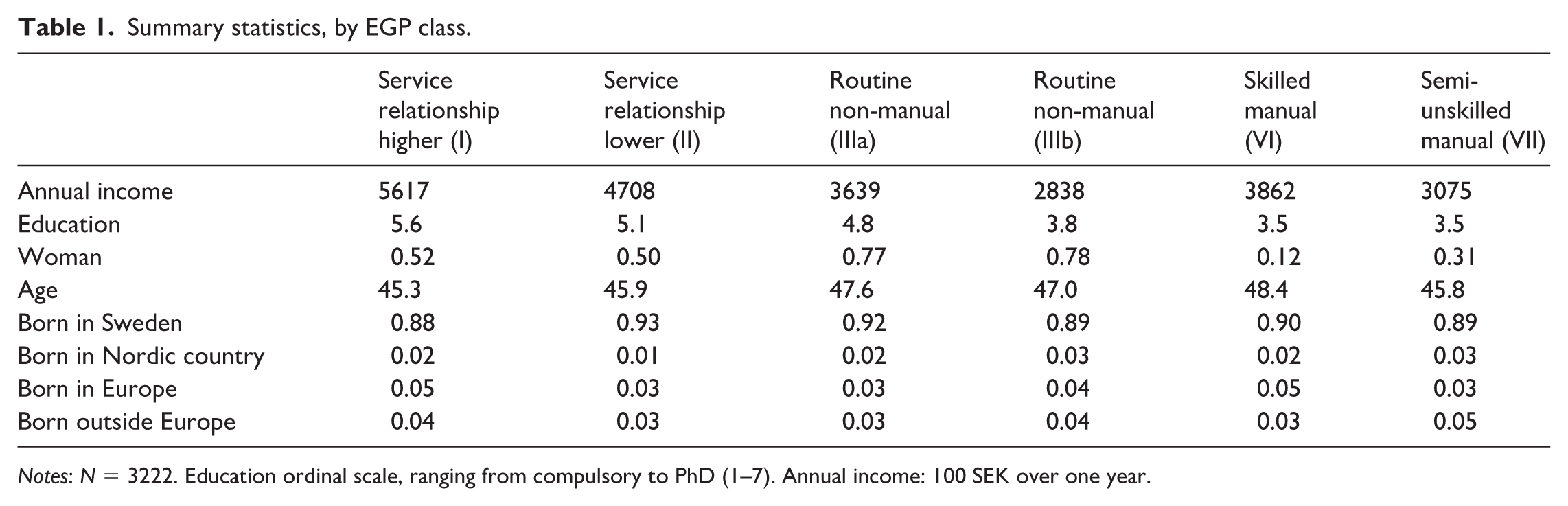
Notes: N = 3222. Education ordinal scale, ranging from compulsory to PhD (1–7). Annual income: 100 SEK over one year.
Education did not follow the same pattern as income and adhered to a more expected trajectory (see Table 1). The manual classes, particularly VI and VII, reported the lowest average levels of education. Among the routine non-manual classes, there was a distinct difference in educational attainment, with IIIa encompassing occupations that required higher levels of education than IIIb.
The EGP class scheme mainly divided classes based on manual and non-manual labour, leading to gender segregation. The proportion of women was significantly higher in the routine non-manual classes (IIIa and IIIb). At the same time, it was much lower in the skilled manual (VI) and unskilled manual (VII) classes (see Table 1). Consequently, gender and class were closely linked, even though this connection was not explicitly highlighted in the theoretical framework.
Furthermore, differences in immigrant backgrounds were observed. Most people across all classes were born in Sweden or other Nordic countries, with a smaller proportion born outside Europe. The number of immigrants born outside Europe was slightly higher in the unskilled manual class (VII), followed by the routine non-manual and upper service classes (see Table 1). These results showed heterogeneity within the immigrant group, which was more common in both higher and lower classes but less so in the middle.
Regression results
This section presents all indicator variables with non-zero coefficients. Employment relations variables represent the theoretical class concepts as defined in the variable section. Additional headings were included to aid interpretation and to reflect expectations from prior research and critiques of the EGP scheme. All analyses were conducted using Lasso probit models with BIC as the selection criterion. A negative sign indicates a negative relationship with a class, a positive sign a positive relationship, and the absence of a sign represents no relationship.
Employment relations indicators
The theory posits a correlation between employment relations and class positions. It was expected that Classes I and II would show a service contract, while Classes VI and VII (manual classes) and occasionally Class IIIb (routine non-manual) would display a labour contract (see Figure 1).
Table 2 illustrates all employment relations variables that demonstrated non-zero coefficients. Importantly, many variables related to employment relations did not manifest as non-zero coefficients in the Lasso regression. The non-zero coefficient variables demonstrated that the low routine non-manual Class IIIb was more strongly associated with employment relations than other social classes. Class IIIb was characterised by restricted flexibility in work hours and low training requirements for job proficiency, indicative of the labour contract.
Lasso regression results: Variables with non-zero coefficients, relating to employment relations. EGP class as dependent variable.
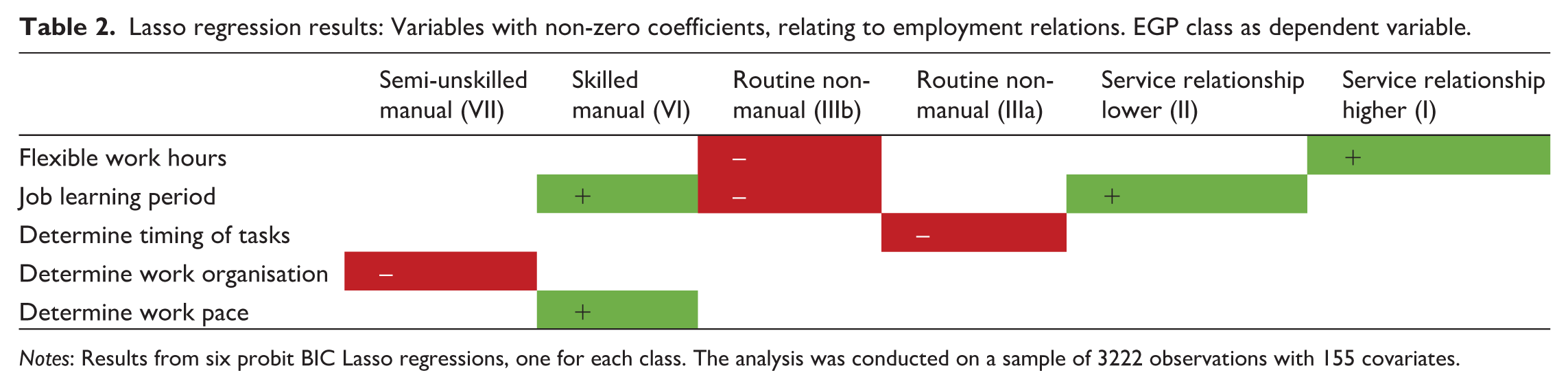
Notes: Results from six probit BIC Lasso regressions, one for each class. The analysis was conducted on a sample of 3222 observations with 155 covariates.
The other routine non-manual class, Class IIIa, exhibited a lower impact on determining when to perform tasks, a further indicator of the labour contract. Within manual classes, the lower-skilled manual Class VII displayed low capacity for deciding the layout of work, also characteristic of the labour contract (see Table 2).
By contrast, the semi-skilled manual Class VI was linked to service contract indicators. The learning period needed for job preparation tended to be longer, possibly because these roles required some form of vocational training rather than higher education (see Table 2). Furthermore, there was little evidence, not selected in the BIC logit model and very small in the BIC probit model, indicating a positive relationship between this class and decisions regarding the organisation of one’s work (see Supplemental Material for coefficient sizes).
Overall, employment relations indicators indicating a labour contract relationship were more common among routine non-manual classes than manual classes, suggesting a closer link of the former with the labour contract in the post-industrial labour market. Class IIIb is generally regarded as a labour contract/working class, and rightly so. However, findings in this article suggested that Class IIIa may also merit consideration as a labour contract.
Furthermore, the results proposed potential advantages in distinguishing between the two manual classes. The low-skilled Class VII appeared more closely tied to the labour contract, while the skilled/semi-skilled Class VI exhibited service contract characteristics.
Regarding the salariat classes (I and II), both demonstrated employment relations that theoretically align with a service relationship, thus following the expected pattern. The lower salariat (Class II) experienced extended learning periods for job proficiency, while the higher salariat (Class I) offered autonomy through flexible working hours (see Table 2).
Overall, the relationship between employment relations and EGP classes generally followed the expected pattern, with Classes I and II showing signs of the service contract, while Class IIIb and the lower-skilled manual Class VII exhibited indicators of the labour contract. However, some deviations were noted, such as the skilled manual class (VI) not showing signs of labour contract employment relations, whereas the skilled routine non-manual class (IIIa) was associated with labour contract relations. These findings suggest a possible need to re-evaluate the structure of employment relations in the post-industrial labour market.
Skill-related indicators
Individual skill levels and job skill demands are not explicitly defined within the employment relations framework, but they relate to skill specificity. Repetitive, less complex tasks suggest a lower learning curve and increased labour substitutability, while higher levels of education and knowledge indicate a potentially stronger market position. This theoretical overlap renders skill-related indicators more relevant to the framework than task-specific factors. However, neither this study nor prior research has operationalised employment relations based on skill levels.
Table 3 illustrates skill-related indicators that demonstrated non-zero coefficients. Overall, classes varied in skill-related indicators. The semi-skilled manual class (VII) was characterised by repetitive tasks, repeating the same task frequently, more monotonous work, a low share of problem-solving tasks and lower levels of individual education.
The skilled manual class (VI) was characterised by lower levels of education. Regarding complexity, the low routine non-manual class (IIIb) was marked by less complex work tasks requiring less problem-solving and by lower levels of education among incumbents. The routine non-manual class (IIIa) was similarly associated with fewer problem-solving tasks and work that offered limited opportunities for learning and development, possibly resulting in lower skill specificity in the job.
Lasso regression results: Variables with non-zero coefficients, relating to skills. EGP class as dependent variable.
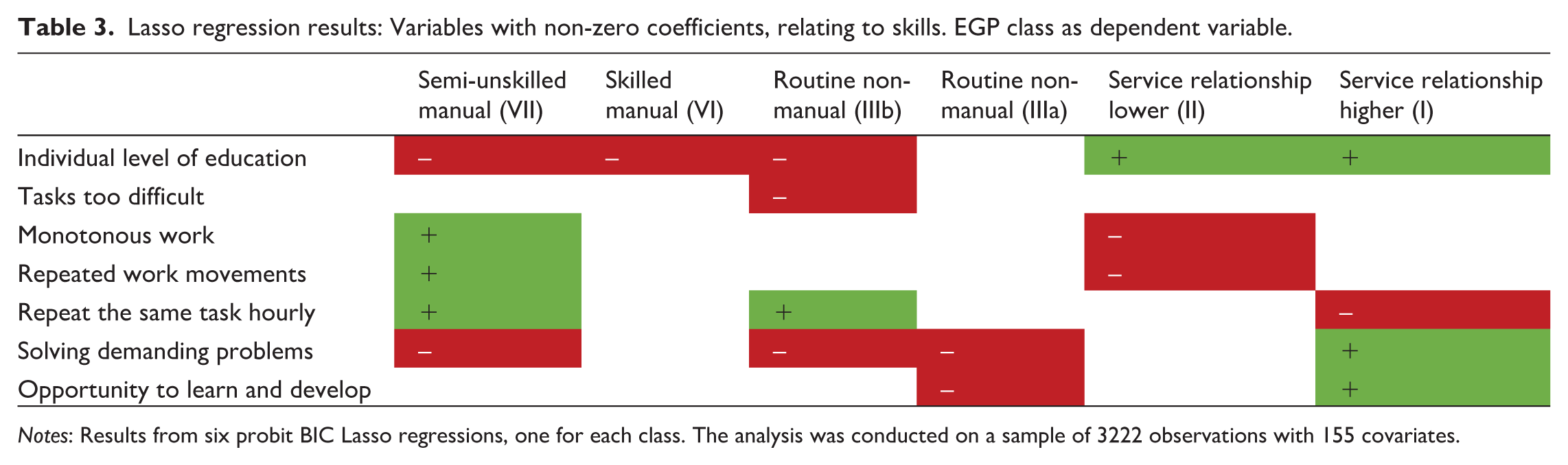
Notes: Results from six probit BIC Lasso regressions, one for each class. The analysis was conducted on a sample of 3222 observations with 155 covariates.
In contrast, the salariat classes (I and II) were characterised by tasks that required the resolution of complex problems and offered opportunities for learning and development, indicating a potential for increased skill specificity. The lower salariat class (II) was associated with less repetitive, monotonous work and higher levels of individual education.
In summary, the findings followed an expected pattern: labour-contract classes tended to involve more repetitive tasks (VII) and less complex work (VII, IIIb), while service-contract classes engaged in more complex (I), developmental (I) and less repetitive tasks (I and II). This pattern suggests that salariat classes are more closely associated with higher skill specificity, potentially yielding a stronger market position for individuals. Notably, there was not a strict division between labour and mixed classes, although skilled manual workers (Class VI) appeared to occupy a more intermediate position within the skill spectrum.
Authority-related indicators
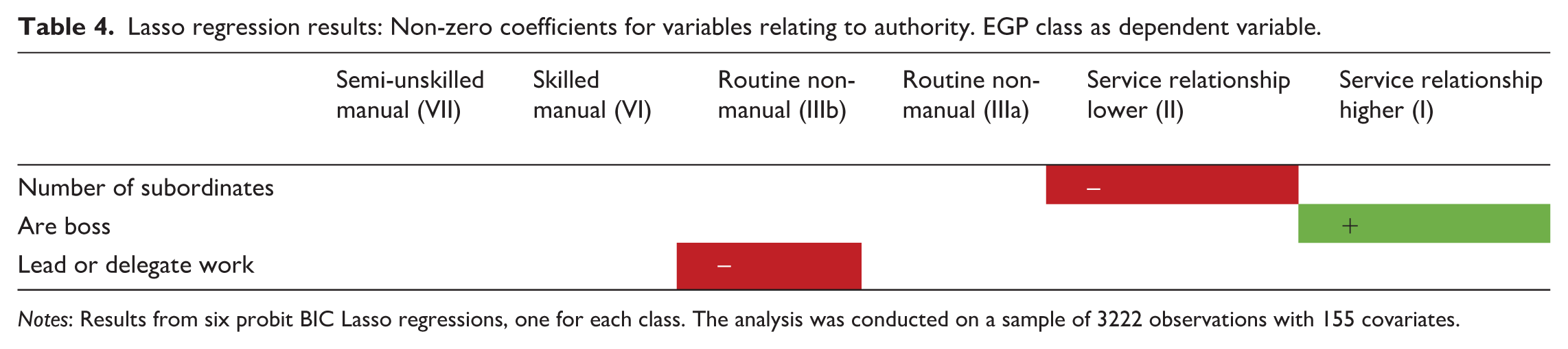
Authority can be viewed as part of employment relations, where lower levels of authority tend to offer fewer chances for autonomous decision-making and have lower asset specificity; however, this perspective has not been documented in the literature. Table 4 illustrates authority-related indicators that demonstrated non-zero coefficients. The results mostly matched expectations: the routine non-manual class (IIIb) seldom led or delegated work, while the upper salariat class (I) often occupied supervisory roles. The lower service class (II) was linked to having fewer subordinates, although the coefficient was very small (see Supplemental Material).
Lasso regression results: Non-zero coefficients for variables relating to authority. EGP class as dependent variable.
Notes: Results from six probit BIC Lasso regressions, one for each class. The analysis was conducted on a sample of 3222 observations with 155 covariates.
Task-related indicators
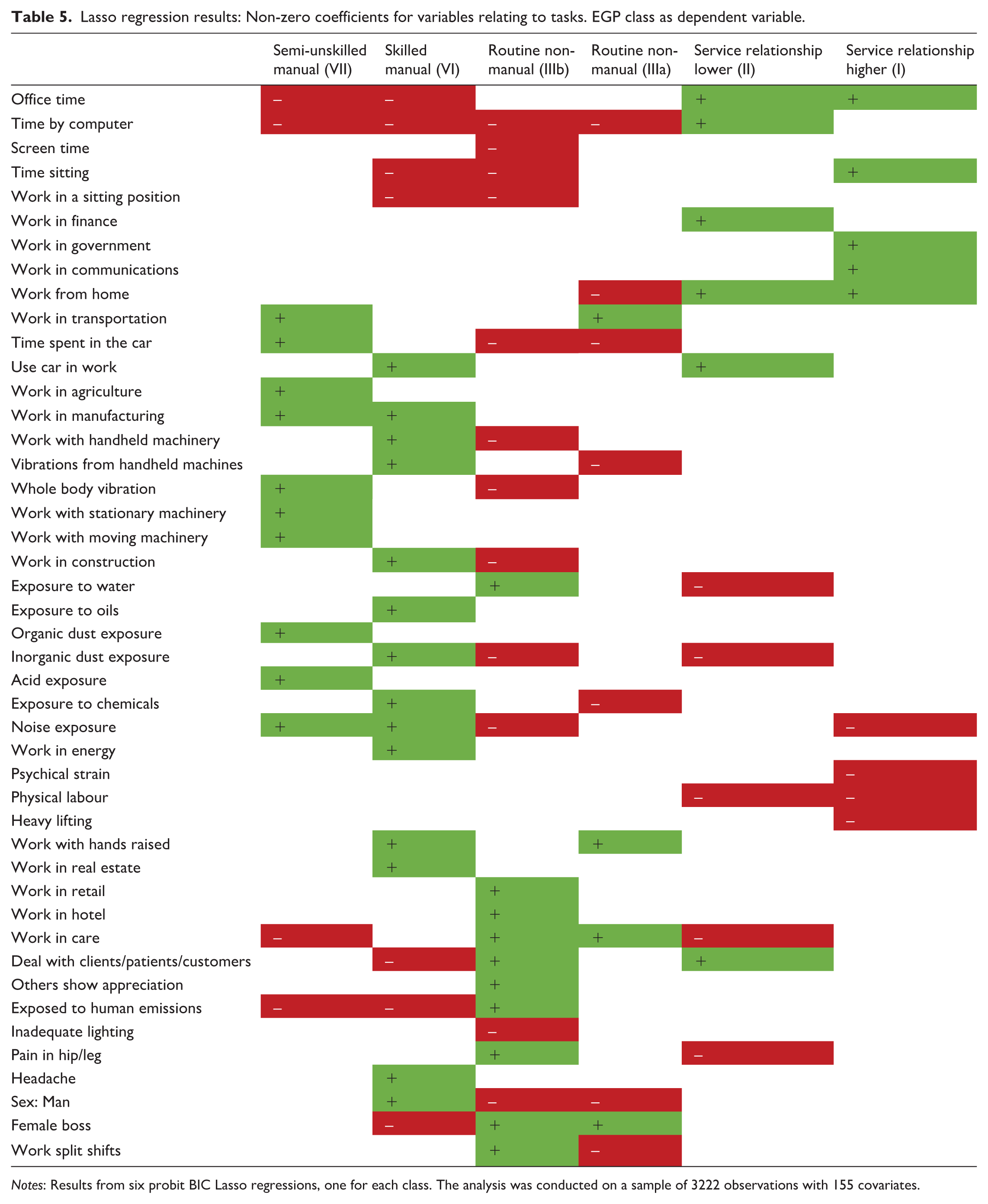
Task-specific variables most frequently appeared among the non-zero coefficients; however, they were not central to understanding class within the employment relations framework. Table 5 illustrates task-related indicators that demonstrated non-zero coefficients. These indicators primarily explained the nature of tasks. Non-zero coefficients were assigned to manual classes related to manual tasks, including exposure to noise, frequent operation of machinery and construction work, with minimal office involvement. Similarly, routine non-manual classes were associated with work in care, retail and hotel industries, involving frequent client interaction and hazards associated with care work, such as exposure to bodily fluids.
Lasso regression results: Non-zero coefficients for variables relating to tasks. EGP class as dependent variable.
Notes: Results from six probit BIC Lasso regressions, one for each class. The analysis was conducted on a sample of 3222 observations with 155 covariates.
Women primarily held routine non-manual roles, while men were more common in manual jobs, indicating that gender differences arose from the clear division between manual and non-manual work. Salariat classes generally performed office tasks with low physical effort, working with computers and were often employed in government, finance and communications sectors.
These findings emphasised the importance of the nature of work in classifying class belonging within the EGP scheme. Classes were closely aligned with the tasks performed on the job rather than with the employment relations under which those tasks were carried out.
Other indicators
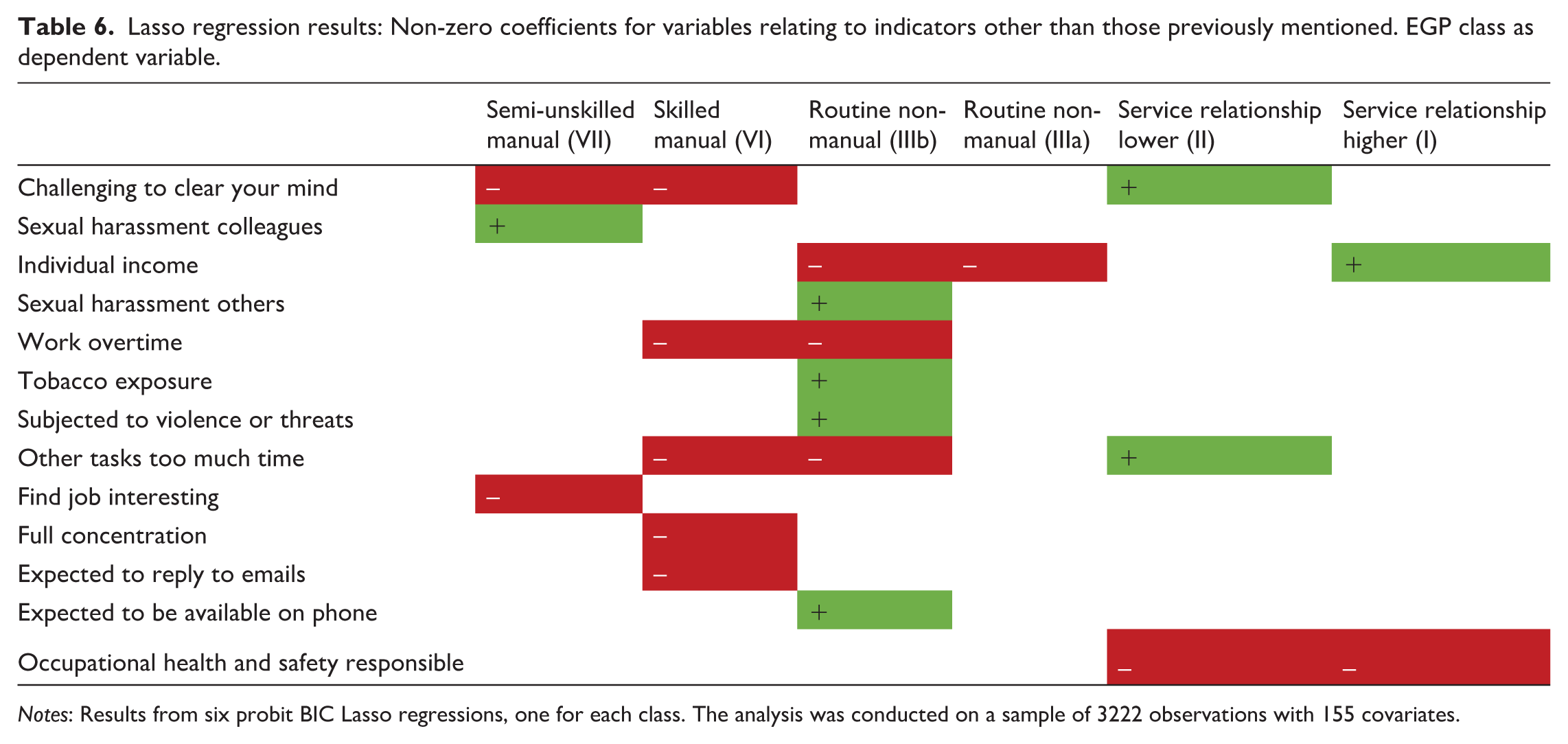
Table 6 illustrates non-zero coefficients related to ‘other’ indicators not specified above. These indicators are primarily related to the work environment and disproportionately impact Class IIIb. This group faced various risks, including violence, harassment, unemployment, low wages and exposure to tobacco smoke.
Lasso regression results: Non-zero coefficients for variables relating to indicators other than those previously mentioned. EGP class as dependent variable.
Notes: Results from six probit BIC Lasso regressions, one for each class. The analysis was conducted on a sample of 3222 observations with 155 covariates.
Robustness checks
An adaptation of EGP, the European Socio-economic Classification (ESeC), was used to validate the results. The analysis confirmed a close alignment between EGP and ESeC, with individuals often belonging to corresponding classes. Like EGP, ESeC emphasised occupation and industrial affiliation, and the results were strikingly similar. Some differences emerged, such as the low routine class encompassing traits from both manual and service occupations. However, the overall pattern remained consistent. As another robustness check, all analyses were conducted with a complete-case approach (without imputation), yielding similarly consistent results.
Discussion
Class often acts as an umbrella term, covering the ongoing dominance of certain individuals. Measures of class aim to enhance our understanding of whether societal inequalities are rooted in class. In empirical quantitative sociology, class is commonly operationalised through the EGP scheme, which theoretically defines class as employment relations. This study’s findings indicate a relatively weak relationship between the theoretical concept of employment relations and operationalised class. Instead, the nature of one’s work emerges as a more influential factor, with class partly defined by the type of employment – whether in a factory, hospital or at a computer – rather than by the relational dynamics within these roles.
To many, the findings in this article may not come as a surprise. The EGP scheme has strong task and industrial segregation, reflected in class labels such as manual, non-manual, skilled and low-skilled rather than the proposed employment relations. It appears that occupations are grouped into classes based on tasks and perceived skill levels, rather than on employment relations, with the underlying assumption that employment relations and tasks are strongly related. Given the limited information available on employment relations, this approach may indeed be optimal. However, within a changing labour market, the implied link between tasks and employment relations has shifted. The belief that hierarchies exist, with certain groups of professions being more commodified than others, is increasingly challenged by labour market developments, which could undermine the validity of this scheme.
The low routine non-manual class (IIIb), comprising low-level service workers, stands out by exhibiting a substantial correlation to the labour contract, marking itself as the most distinctive working class in this regard. This finding underscores the significance of considering structural changes. The EGP taxonomy is rooted in an industrial context, where the typical working-class image is that of a White man engaged in goods production. However, employment relations suggest that the working class is predominantly composed of routine non-manual workers, a category more frequently represented by women.
The findings in this study suggest that the appropriate analytical approach is to combine Class IIIb with the low-skilled manual class (VII) and refer to this group as the working class. While many studies have adopted this approach, inconsistencies remain in the literature. Furthermore, the semi-skilled manual class (VI) cannot be considered part of the working class based on the conclusions drawn here. Consequently, those interested in analysing class in the post-industrial labour market may benefit from avoiding the equation of the working class with manual labour alone.
Evolving skill and education levels within the workforce drive the expansion of the salariat class, potentially increasing its heterogeneity. This study shows that both salaried classes (I and II) exhibit characteristics of the service contract. However, shifts in management strategies over time may alter employment relations for salaried workers. Many white-collar workers face heightened employer control, reduced autonomy and skill degradation under management regimes such as new public management (Carey, 2007; Lundström, 2015), potentially restructuring employment relations within salaried classes. This trend is partly visible in the higher routine non-manual class, which includes highly educated individuals but still demonstrates employment relations associated with the labour contract.
Research shows that higher levels of union membership are often associated with stronger employment relations, such as increased worker autonomy (Esser and Olsen, 2012). In Sweden, historically strong trade unions may have enhanced employment relations in industrial work. However, the current labour market is marked by a growing share of jobs in the service sector, where union representation tends to be weaker, potentially shifting employment relations. Technological advancements further contribute to this trend by continuously reshaping the dynamics of employment relations.
Consequently, the Swedish context must be taken into account. Sweden’s strong trade unions in manual labour sectors may accentuate differences in employment relations. Additionally, Sweden’s large public sector and high levels of education may support the expansion of the salariat and mixed classes while simultaneously increasing the proletarianisation of certain occupations within these groups.
Education, skills, employment relations and wages have reasonable stratification between EGP classes. However, changes in the labour market pose challenges. In a post-industrial setting, non-manual classes have lower average wages than manual classes.
EGP considers employment relations as the central theoretical concept, making it essential to assess the framework in relation to it. This study reveals gaps between the theoretical understanding of class and the construction of taxonomies, which can assign outcomes to class when they are more closely tied to work tasks and/or gender. The definition of class we adopt carries implications for societal perceptions of class and may bias our understanding of how class influences inequalities.
In the context of rising right-wing populism, the working class has returned as a focus of research and media. A substantial body of literature highlights the increasing support among working-class individuals for anti-immigration policies (e.g. Oesch, 2012; Oskarson and Demker, 2012; Rydgren, 2012). This research often describes a working class of industrial workers who have lost their jobs due to structural changes, excluding women, non-manual workers and immigrants (Emery, 2019). However, the effects of working in the manual sector on outcomes may relate to factors other than employment relations (class). The nature of work, whether involving interactions with individuals or objects, may shape outcomes such as political values. The manual/non-manual distinction is linked to spatial (im)mobility opportunities and rural–urban dynamics. Additionally, structural transformations and plant closures may reflect distrust and concerns about the future, though these are not directly tied to employment relations or class in the theoretical sense.
Finally, this study is exploratory, using data to investigate the theoretical construct of the model and to examine other potential underlying class stratifiers. The variables included in the models were selected for their relevance to evaluating the EGP scheme. These variables encompass important aspects of employment relations, as well as broader theories of class and critiques of class theory. However, the data are not exhaustive and lean heavily towards work environment indicators. The exploratory approach makes the choice of data significant for the observed results. Different patterns might emerge with alternative datasets. Thus, this study does not claim to provide a definitive answer regarding class stratifiers. Future research would benefit from applying this approach with new data and incorporating additional indicators of employment relations to assess whether other patterns emerge.
Supplemental Material
sj-docx-1-wes-10.1177_09500170251403925 – Supplemental material for Social Class in the Post-Industrial Labour Market: Assessing the Contemporary Relevance of the Erikson–Goldthorpe–Portocarero Class Schema
Supplemental material, sj-docx-1-wes-10.1177_09500170251403925 for Social Class in the Post-Industrial Labour Market: Assessing the Contemporary Relevance of the Erikson–Goldthorpe–Portocarero Class Schema by Karin Kristensson in Work, Employment and Society
Footnotes
Acknowledgements
I thank the LNU group at SOFI, Stockholm University; the DIGCLASS International Workshop on Social Class Analysis in the Digital Age in Seville; and the workshop on Inequalities in Working Life held in Sigtuna for enlightening discussions and valuable feedback. For any further inquiries, please contact Karin Kristensson at
Funding
The author received no financial support for the research, authorship, and/or publication of this article.
Supplemental material
Supplemental material for this article is available online.
Ethics statement
Ethical approval for the study was granted by the Swedish Research Ethics Committee in 2021 (Dnr 2021-03096).

References
Supplementary Material
Please find the following supplemental material available below.
For Open Access articles published under a Creative Commons License, all supplemental material carries the same license as the article it is associated with.
For non-Open Access articles published, all supplemental material carries a non-exclusive license, and permission requests for re-use of supplemental material or any part of supplemental material shall be sent directly to the copyright owner as specified in the copyright notice associated with the article.
