




Abstract
Neo-Weberian occupational class schemas, rooted in industrial-age employment relations, are a standard socio-economic position measure in social stratification. Previous research highlighted Erikson-Goldthorpe-Portocarero (EGP)-based schemas’ difficulties in keeping up with changing labour markets, but few tested alternative explanations. This article explores how job tasks linked to technological change and rising economic inequality might confound the links between employment relations, classes, and life chances. Using the European Working Conditions Survey covering the European Union (EU)-27 countries, this article analyses over time and by gender: 1) the task distribution between social classes; and 2) whether tasks predict class membership and life chances. Decomposition analyses suggest that tasks explain class membership and wage inequality better than theorised employment relations. However, intellectual/routine tasks and digital tools driving income inequality are well-stratified by occupational classes. Therefore, this article does not argue for a class (schema) revolution but for fine-tuning the old instrument to portray market inequalities in the digital age.
Keywords
Introduction
After income, occupational social class is the most widespread measure of socio-economic position in social stratification research (Barone et al., 2022), partly because occupations work reasonably well as predictors of work-life earnings and life chances (Shahbazian and Bihagen, 2022), and because of its availability in survey data. As a result, the neo-Weberian Erikson-Goldthorpe-Portocarero (EGP) class schema and its revised European Socio-economic Classification (ESeC), based on social relations in labour markets, became the institutionalised standard (Erikson and Goldthorpe, 1992; Rose and Harrison, 2010). Since the late 2000s, EGP-based schemas accounted for about 75% of all scientific articles published in top-ranked sociological journals using social classes (Barone et al., 2022).
EGP-based class schemas’ popularity has to do with their satisfactory criterion and construct validity when accounting for the theorised employment relations—reward types and time horizons—or predicting unequal life chances across classes over the life course (Evans and Mills, 1998; Goldthorpe and McKnight, 2006; McGovern et al., 2007; Rose and Harrison, 2010; Shahbazian and Bihagen, 2022; Smallenbroek et al., 2022; Westhoff et al., 2021). Moreover, once a measure becomes standardised, it is more practical to keep using it for accumulating evidence and benchmarking. However, this practicality might come at the cost of unquestioning this industrial-age class measure.
Over the last thirty years, many academics have underscored several limitations of the EGP-based class approach to keep up with far-reaching structural changes in Western countries since the industrial era twilight (Barbieri, 2009; Esping-Andersen, 1993, 1999; Fernández-Macías and Bisello, 2021; McGovern et al., 2007; Oesch, 2006; Oesch and Piccitto, 2019): the rise of post-industrial economies at the expense of manufacturing in a context of intense global trade and offshoring, educational and occupational upgrading, women’s segregated labour force incorporation, declining industrial relations, precarious employment relations, new forms of work and management, and technological change.
Among these challenges, this article contributes by focusing on workplace digitalisation and automation as contemporary inequality drivers, an overlooked phenomenon by most previous research on social class stratification (Williams, 2017). It explores how unfolding vectors of technological change in post-industrial economies might jeopardise the validity of mainstream industrial-class models to depict socio-economic inequalities in the digital age. Since job tasks are the finest-grained analysis unit to describe how technological change affects employment, it tests if tasks predict class membership and life chances better than theorised employment relations.
Williams (2017) draws upon the Routine Biased Technical Change (RBTC) literature (Autor et al., 2003) to consider how changing job characteristics in the form of tasks—those most connected to growing economic inequality (routine and analytical tasks) and partially driven by technological change (Acemoglu and Restrepo, 2021)—might confound 1 the links between employment relations and class positions derived by EGP-based schemas. RBTC posits that job tasks, not skills, can be replaced or complemented by new technologies, depending on the job routine intensity.
There is ample evidence showing that recent increases in income inequality can be explained by wage differentials between occupations—occupational-mean skills, tasks, or social classes (Albertini et al., 2020; Goedemé et al., 2021; Liu and Grusky, 2013; Williams and Bol, 2018; Zhou and Wodtke, 2019), but other authors argue that wage variation within occupations or classes better captures inequality trends (Fernández-Macías and Arranz-Muñoz, 2020). Thus, studying the employment relations and job tasks outlined by the EGP model and the RBTC theory and their potential (and shifting) links could shed new light ‘on the extent to which inequality trends may be due to shifts in the task structure related to technological change, or whether class-based changes in inequality are largely unrelated’ (Williams, 2017: 5).
As Goldthorpe (2007) claimed, employment contracts will differ depending on the kinds of work tasks and work-role that employees perform. Suppose new productivity/profit-enhancing technologies allow employers to redefine work tasks, roles, and methods (Fernández-Macías and Bisello, 2021), altering the distribution of tasks, productivity and income across social classes. This scenario casts doubt on the validity of EGP-based social classes. The allocation of occupations into classes is neither time nor context-independent since a different employment relationship could regulate the same occupations in different periods and countries (Barbieri et al., 2020). Previous research hardly assessed whether the link between employment relations and social classes has changed over time or whether alternative explanations might confound this relationship. Thus, we do not know to what extent social classes are close relatives to the tasks emphasised by technology-based explanations or whether they account for different explanations because both approaches use occupational titles as proxies (Williams, 2017).
This article’s contribution is to provide an integrated and interdisciplinary theoretical framework supported by new empirical evidence. First, it looks at the distribution of job tasks between occupational classes at the individual level in the European Union (EU)-27 countries 2 over time and by gender. Second, it tests if vectors of technological change, proxied by job tasks, might compromise the foundations of EGP-based class schemas by assessing the predictive power of employment relations and job tasks to account for social classes and life chances. Third, as jobs are bundles of tasks, it focuses on a broader range of tasks, work methods and tools than previous literature building on the JRC-Eurofound task taxonomy designed to study technological change and employment (Fernández-Macías and Bisello, 2021).
Overall, the findings suggest no solid grounds for a class revolution but fine-tuning industrial class schemas to better capture labour market inequalities in the digital age. Empirical analyses indicate that tasks explain class membership and wage inequality better than employment relations. However, analytic/routine tasks and digital tools driving income inequality are still well-stratified by occupational classes.
Theoretical framework and previous findings
Revisiting EGP-based class schemas’ foundations
Relying on rational action theories and organisational economics, Goldthorpe (2007) elaborated the micro-foundations of EGP-based class schemas by clarifying how employers regulate different employment contracts and generate social classes in labour markets. According to Goldthorpe (2007), imperfect information about prospective employees’ productivity and effort at the workplace would lead employers to issue employment contracts (service relationship, mixed and labour contract) with different types of reward (specific/diffuse) and time horizons (short/long-term). Different working situations, like reward types and time horizons, are allocated to different jobs. Jobs differ inherently in their human asset specificity and monitoring difficulty, and these job characteristics are perceived as contractual hazards that employers try to minimise to avoid employees’ shirking.
Firstly, monitoring difficulty relates to the capacity of employers to track workers’ effort and productivity. While it is challenging to monitor professionals and managers, assembly line workers are easier to monitor due to the high intensity of routine tasks and standardised production. Thus, more diffuse reward types (company stocks; fringe benefits; performance bonus) are generally offered to higher managers and professionals involved in a service relationship (ESeC Classes 1 and 2) in comparison with working classes (Classes 7, 8 and 9) (Williams et al., 2020). The latter can be compensated for discrete work units on a piece- or time-rate basis with a labour or spot contract (Rose and Harrison, 2010).
Secondly, human asset specificity refers to expert knowledge or how difficult it is for employers to replace workers with similar firm-specific skills and productivity. Therefore, for those jobs with high asset specificity, both employers and employees are interested in a long-term (service) relationship formalised in a permanent contract and prospective elements like salary increments and career opportunities (Goldthorpe and McKnight, 2006). By contrast, a short-term labour contract should prevail for the working classes, involving a higher risk of unemployment and more unstable careers.
Other types of workers combining elements of the service relationship and the labour contract are considered mixed or intermediated forms of employment regulation. For instance, clerical workers with low human asset specificity but difficult to monitor (Class 3), and technical workers and lower supervisors with high human asset specificity but easy to monitor (Class 6).
Owing to data availability, previous research mixes employment relations indicators (reward types and time horizons) with theorised explanatory mechanisms (human asset specificity and monitoring difficulty) (Smallenbroek et al., 2022). However, when assessing the criterion validity of EGP-based schemas, it is most accurate to study the link between employment relations indicators and social classes. The theorised mechanisms or alternative explanations can account for this relationship. Therefore, this article uses reward types and time horizons as theoretical indicators of employment relations or work situations.
The EGP schema and its critics
Different alternative social class schemas were devised with the ambitious aim of replacing EGP-based schemas, advocating for the central role of distinct elements such as: 1) economic, social and cultural capitals (Savage et al., 2013); 2) horizontal work logics (Oesch, 2006); 3) management assets (power, authority and control) (Wright, 2005); 4) wealth and rent exploitation (Sørensen, 2000); and 5) industrial-post-industrial occupational divides (Esping-Andersen, 1993).
Nevertheless, the pertinent proposals of this first group of authors found neither comprehensive implementation nor became the new institutionalised class-schema standard in social stratification research (Barone et al., 2022). That might have to do with the lack of a direct empirical test of the accuracy of different class schemas to predict life chances, along with the sizeable empirical overlap between them (Lambert and Bihagen, 2014). In practice, advocating for one social class scheme over another is a choice driven by pragmatism or theoretical grounds.
The second group of authors does not advocate for a class (schema) revolution but a revisionist fine-tuning of the old instrument. Instead, they support disaggregating EGP-based class schemas horizontally at the top (i.e., higher and lower managers and professionals, or socio-cultural and technical professionals within the service class) (Guveli et al., 2007) and the bottom (i.e., routine workers versus lower-grade white-collar and blue-collar workers) to better capture heterogeneity in employment relations and life chances (Smallenbroek et al., 2022).
The third school of thought focuses on the inadequacy of big social class schemas, based on occupational aggregations, to keep up with increasing income inequalities or to account for political behaviour and attitudes (Weeden and Grusky, 2012). Instead, these authors advocate for a micro-class approach based on highly disaggregated occupational titles to capture better social reproduction mechanisms (i.e., licences, certifications) and action. The argument follows that recent growth in economic inequality would be better captured by wage variation in occupations within big social classes rather than by variation between them (Weeden et al., 2007).
Technological change, job tasks, and social classes
Some authors question the conceptual foundations of EGP-based class schemas centred on employment relations by arguing that alternative explanations, like productivity-based differences between occupations, job tasks or pre-market factors like skills or educational credentials (Tåhlin, 2007; Williams, 2017), might better account for the definition of social classes and life chances. In this vein, Brousse et al. (2010) argued that employment relations theories leave aside skill and qualification levels and the nature and organisation of work. They tested the validity of the ESeC schema with rich French data using clustering methods to conclude that its class categories are more accurately ordered as a function of the cognitive content of tasks than by work monitoring difficulty.
Since recent trends in rising income inequality can be partially explained by increasing returns to college education and analytical skills (Liu and Grusky, 2013; Zhou and Wodtke, 2019), these critiques are highly relevant, even when they did not find much echo. Instead, the Skill Biased Technical Change (SBTC) model became mainstream in accounting for income inequality trends by linking occupations with skills and education requirements (Bekman et al., 1998). SBTC theories predict increasing returns to college education and wage inequalities due to advanced economies’ computerisation and automation, negatively affecting low-skilled workers. As Tåhlin (2007) pointed out, educational attainment or credentials had a greater weight in defining different social classes in the original EGP class schema than in later theoretical tweaks.
Building on RBTC theories, nascent literature suggests that technological change and its impact on labour markets could undermine the theoretical foundations of industrial-age class schemas (Williams, 2017). The EGP schema builds on employment relations and occupational structures that have changed dramatically in the last decades. These changes relate to the composition of job tasks, work methods and organisation (Fernández-Macías et al., 2022), trade unions density rate (Zhou and Wodtke, 2019), labour market deregulation (Barbieri, 2009), human resources recruitment and monitoring (Moore et al., 2018), and wealth accumulation (Eeckhout, 2021).
Generally, firms and employers implement production technologies and organise work. They define job tasks, how the workers will perform them, and their monitoring. Thus, if new productivity/profit-enhancing technologies alter the distribution of job tasks, employment relations, and income returns across social classes, EGP-based class schemas’ validity might be endangered. As McGovern et al. (2007: 24) claimed, ‘it is the nature of work that determines the contractual hazards faced by employers and influences the contractual solutions that they will choose.’
Since the 1980s, two vectors of technological change, along with offshoring and international trade, have disrupted labour markets: digitalisation (digital tools and labour platforms) and automation (industrial robots and artificial intelligence [AI]) (Acemoglu and Restrepo, 2021; Fernández-Macías and Bisello, 2021; Fernández-Macías et al., 2021; Pesole et al., 2018). In addition to institutional contexts and trend-accelerating shocks such as the COVID-19 pandemic, these innovation vectors transform the nature of work, altering what people do and how they do it at work (Fernández-Macías et al., 2022).
Three general trends are unfolding in post-industrial labour markets. First, the digitalisation-automation vectors lead to a counterintuitive trend: by 2015, there were fewer routine jobs compared with the mid-1990s in the EU-15 (Oesch and Piccitto, 2019). Nevertheless, during the first decade, the remaining jobs got more repetitive and standardised—quality standards and production targets enabled by computerisation. Service workers accounted for the largest share of routinisation (Fernández-Macías et al., 2022).
Second, regarding automation, rapid advances in robotisation and AI are increasingly able to substitute job tasks not just at the bottom of the occupational structure but also at the middle and the top (Tolan et al., 2021). As these new technologies replace routine tasks and codify and store knowledge more quickly and cheaply, the type of job tasks and their replaceability by machines might be becoming a relevant factor for employers to issue employment contracts with different working conditions over and above human asset specificity (Williams, 2017)—the difficulty in substituting one worker with another human worker. In contrast, human-centred jobs involving social tasks (caring, managing, serving) and non-cognitive skills—increasingly on demand in the health, education, and social care sectors—would be more protected against automation risk (Fernández-Macías and Bisello, 2021).
Third, new digital tracking and algorithmic management technologies increase employers’ ability to monitor work (Ball, 2021). Work standardisation and digitalisation make controlling workers’ output easier and cheaper. Examples of work surveillance are most prominent in platform and warehouse work. If this process also permeates the office, facilitating productivity assessment in managers, professionals and clerks, variation in monitoring difficulty across social classes might decrease. Human resources management increasingly relies on quantitative metrics to assess workers’ performance, even in jobs not traditionally evaluated on a piece- or time-rate basis (Moore et al., 2018), especially in the context of increasing teleworking after the catalyst of the COVID-19 pandemic.
These vectors of technological change restructuring the nature of work might reshuffle (industrial age) employment relations so that the distribution of employees’ human asset specificity and work monitoring difficulty by social classes might become more homogeneous. Figure 1 illustrates how vectors of technological change and its effects on the distribution across occupations of: 1) job tasks and 2) human asset specificity (via automation) and monitoring difficulty (via digitalisation) might confound the traditional links between employment relations, social classes, and life chances in EGP-based class theories.
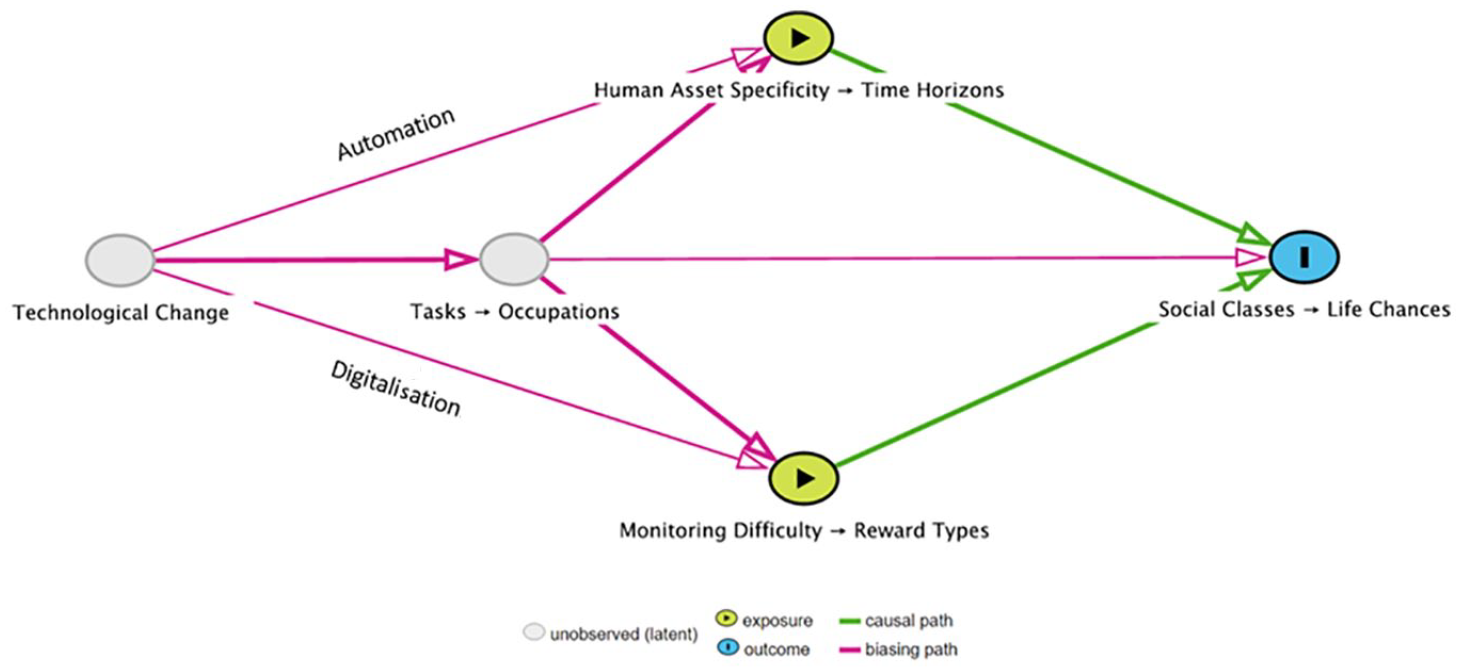
The theorised causal chain between technological change, job tasks, employment relations, social classes and life chances.
An alternative hypothesis is that new technologies and changes in work do not sizeably affect the distribution of tasks or employment relations across occupations but complement the service relationship by increasing returns to analytical tasks and mastery of information and communication technology (ICT) tools. This situation would potentially preserve or even widen the gap in employment relations and life chances compared with mixed and, especially, labour contracts. The social classes characterised by these latter types of employment contracts could suffer the most negative and substitutive impact of new technologies—digital monitoring, automation, and platform work—on working conditions.
To what extent social classes embody the job tasks emphasised by technology-based theories or whether they represent different explanations is unknown since both approaches rely on occupations (Williams, 2017). Drawing from the RBTC literature, Williams (2017) claims that technological change and job tasks (analytic/routine) might confound the association between employment relations’ mechanisms, social class membership and life chances. Williams (2017) found that analytical tasks substantially mediate the role of asset specificity in predicting class membership, but, at the same time, the EGP schema is still a sharp tool for capturing labour market inequalities. Nevertheless, this analysis only covers the UK, using a few employment relations and task indicators.
This article aims at answering the following research questions to broaden our knowledge about the relationship between job tasks, employment relations, and social classes by covering the EU-27 and analysing a broad range of tasks:
How are job tasks distributed between social classes? Are social classes increasingly capturing a task divide related to technological change?
Are job tasks more predictive of class membership than employment relations?
Are job tasks more predictive of life chances than employment relations?
Data, variables, and methods
This article pools data from three waves (2005, 2010, 2015) of the European Working Conditions Survey (EWCS) to answer the research questions. The EWCS is the only cross-national survey including individual-level job characteristics central to EGP-based class schemas and job tasks related to technology-based explanations. The following sections explain the data, variables, and methods. Besides, the online appendix provides additional information on variables’ operationalisation (A.1-A.2).
Data
This article relies on the EWCS (Eurofound, 2017). A random sample of individuals in employment during the fieldwork aged 15 or older was selected via multi-stage, stratified sampling and interviewed face-to-face, with an average response rate of over 50%. Data collection is harmonised across countries, adjusting for sampling and poststratification weights reflecting non-response, the socio-demographic and population structure. Data are pooled from three survey waves in 2005, 2010 and 2015. Owing to most countries’ small sample sizes, the EWCS is unsuitable for in-depth single-country analyses. Thus, the EU-27 is analysed while controlling for the country- and survey-fixed effects, clustering standard errors by country-wave.
Two analytical samples for the 2005-2010-2015 and 2010-2015 waves are built, as only in the former can trends over time be studied and only in the latter is detailed income information available. The EWCS 2005-2015 (2010-2015) pooled dataset comprises 95,739 (70,125) observations. Several sample filters are applied by restricting the age range to 18-65, excluding self-employed individuals to study employment relations, individuals working less than five hours per week, and the inactive. Unemployed individuals are kept if they report employment relations from their last occupation. For the 2005-2015 (2010-2015) pooled sample, out of the 76,649 (55,878) remaining respondents after applying the exclusion criteria, the analytical sample is left with 68,433 (40,377) observations after listwise deletion. Missing values in the filtered sample stand below 4%, except for time horizons (9%) and personal income (22%). Table A.3 in the Online Appendix displays the summary statistics of all variables by analytical samples.
Variables
Social classes
The measure of social class builds on the original 9-category ESeC schema (Rose and Harrison, 2010) using 2- (2005-2015) or 3-digit (2010-2015) ISCO-88 occupational codes, self-employment and number of supervised workers—excluding the unemployed (Class 10) and the self-employed Classes 4-5: Class 1. Higher-grade professional, administrative and managerial occupations; Class 2. Lower-grade professional, administrative and managerial occupations and higher-grade technician and supervisory occupations; Class 3. Intermediate occupations; Class 6. Lower supervisory and lower technician occupations; Class 7. Lower services, sales and clerical occupations; Class 8. Lower technical occupations; Class 9. Routine occupations. The ESeC class schema can be regrouped into three forms of employment regulation—service relationship (Classes 1+2), mixed/intermediate (Classes 3+6), and labour contract (Classes 7+8+9)—that, in some analyses, are used to test the theoretical schema basis.
Tasks
Job tasks are measured at the individual level relying on the JRC-Eurofound task taxonomy (Bisello et al., 2021). Eleven indices available in the EWCS (2005-2015) are operationalised to measure different job tasks, work methods, and tools highlighted by technology-based explanations: (a) Tasks: intellectual (1. Information processing, 2. Problem-solving); physical (3. Strength); social (4. Serving); (b) Work methods: autonomy (5. Latitude), routine (6. Repetitiveness, 7. Standardisation, and 8. Certainty), and 9. Teamwork; and (c) Work tools (10. Non-digital machinery, 11. Digitally-enabled machinery). Most indices are estimated by averaging different sub-indicators. The composite indices are standardised into z-scores 3 by analytical sample and survey wave.
Employment relations
We replicate the operationalisation of employment relations, time horizons and reward types, as theorised by EGP-based class schemas and implemented by Smallenbroek et al. (2022) for comparability and benchmarking.
Reward types
Reward types are measured with four dummy items based on questions that capture whether earnings from respondents’ main job include the following type of payments: “Payments based on the performance of the company where you work?”, “Payments based on the performance of your team/department?”, “Income from shares in the company you work for?”, and “Advantages of other nature (e.g., medical services, access to shops, etc.)?”. These items were recoded so that higher scores in the composite index reflect more diffuse reward types typical of the service relationship (Classes 1+2) and mixed contracts (Class 3). An average of these items was estimated and standardised into z-scores by analytical sample and survey wave.
Time horizons
Time horizons are captured with three items about respondents’ agreement with two statements on a 1-to-5 scale: “I might lose my job in the next 6 months”; “My job offers good prospects for career advancement”; and whether salary in the last year was reported to have “decreased”, “not changed” or “increased”. The first item was reversed, so higher scores in the composite index reflect long time horizons typical of the service relationship (Classes 1+2) and mixed contracts (Class 6). An average of the first two (2005-2015 sample) and all three items (2010-2015 sample) was estimated and standardised into z-scores by analytical sample and survey wave.
Permanent contract
As a positive indicator of life chances proxying for employment security and stability over the work career, a dummy discerns between workers with temporary or fixed-term contracts (0) and permanent contracts (1). As an additional life chances indicator of career stability, class gaps in seniority residualised of age are analysed in the online appendix (B.6.).
Income
As the second indicator of life chances (2010-2015), the respondents’ net monthly earnings in Euro from the main paid job are used and adjusted by the country’s purchasing power parity (PPP). This variable is transformed into its natural logarithm to adjust for its long tail and right skewness. Missing rates (22%) do not vary systematically by social class or gender.
Controls
In all models, with some exceptions explained below, the following control variables are included: age groups (18-25; 26-35; 36-45; 46-55; 56-65); household size; migration background (both respondents and parents born in survey country=1); dummies on the 1-digit sector (NACE Rev.1); full- (⩾40 weekly working hours) or part-time contracts; country and survey dummies.
Methods
To explore how job tasks are distributed between social classes, Ordinal Least Squares (OLS) regressions are estimated with social classes predicting tasks and illustrated with predictive margins. Survey wave and social classes are interacted to analyse change over time in the Online Appendix B.2.
The Karlson-Holm-Breen (KHB) (Breen et al., 2021) decomposition method using binomial logistic specifications disentangles to what extent the association between employment relations (X) and class/employment contract membership (Y) is confounded
1
by job tasks (
To assess how employment relations and tasks account for class gaps in life chances, this article relies on linear Blinder-Oaxaca decompositions (Jann, 2008) for permanent contracts and Recentred Influence Function (RIF)-Oaxaca decompositions for wages (Firpo et al., 2018). The Oaxaca decomposition method compares gaps in outcomes by two groups, mainly applied to study income inequality drivers over time or gender gaps. An innovative application of this method is testing the theoretical foundations of EGP-based class schemas. Gaps in life chances by employment contracts between the service relationship as the reference category and mixed or labour contracts are compared and decomposed.
Blinder-Oaxaca decomposition methods estimate the difference in the outcome distribution of two groups in terms of two components accounting for group means’ differences: an explained part/composition effect due to differences in the mean (observed) characteristics and an unexplained/structure effect part due to differences in the estimated coefficients in the groups, which cannot be accounted for by the observed factors. This residual component includes group differences in unobserved predictors (Firpo et al., 2018). Thus, this analysis focuses on the explained part by observed predictors.
In RIF-Oaxaca regressions, coefficients can be interpreted as partial effects of a slight location shift to the right in the distribution of regressors on the unconditional (log)wage distribution. To decompose distributional income statistics beyond the mean, RIF-Oaxaca models estimate reweighting regressions (including all model covariates) to counterfactually evaluate what would happen to the (log)wage of mixed or labour contracts if they had the predictors’ levels of the service relationship (Rios-Avila, 2020). The reweighting error yields information on the quality of the reweighting strategy and the specification error on model specification quality and the RIF approximation.
In the figures illustrating the Oaxaca decompositions, we only plot statistically significant coefficients from individual-level variables that contribute to the explained or composition effect part as a percentage of the total raw gap between the service relationship (reference category) and mixed or labour contracts in the given outcome.
All models are estimated by gender, controlling for country and survey fixed effects, household size, and age. Models decomposing permanent contracts and income also control for sectors, while migration background (available from 2010) and part-time contracts are controlled only in models estimating the class wage gap (2010-2015 subsample).
Results
Tasks and social classes
The first research question inquired about the distribution of job tasks between social classes at the individual level to assess whether occupational classes are (increasingly) capturing a task divide related to technological change and wage inequality. Figure 2 plots the mean standardised task intensity for each social class by gender resulting from OLS models. Tasks are transformed into z-scores 3 with mean = 0 and standard deviation (SD) = 1 from their original scale. For instance, in the original scale of the routine/repetitiveness task, the mean = 0.4 and SD = 0.32 in a 0-1 scale where ‘0’ means that the worker never performed the task and ‘1’ that the job is only focused on that task.
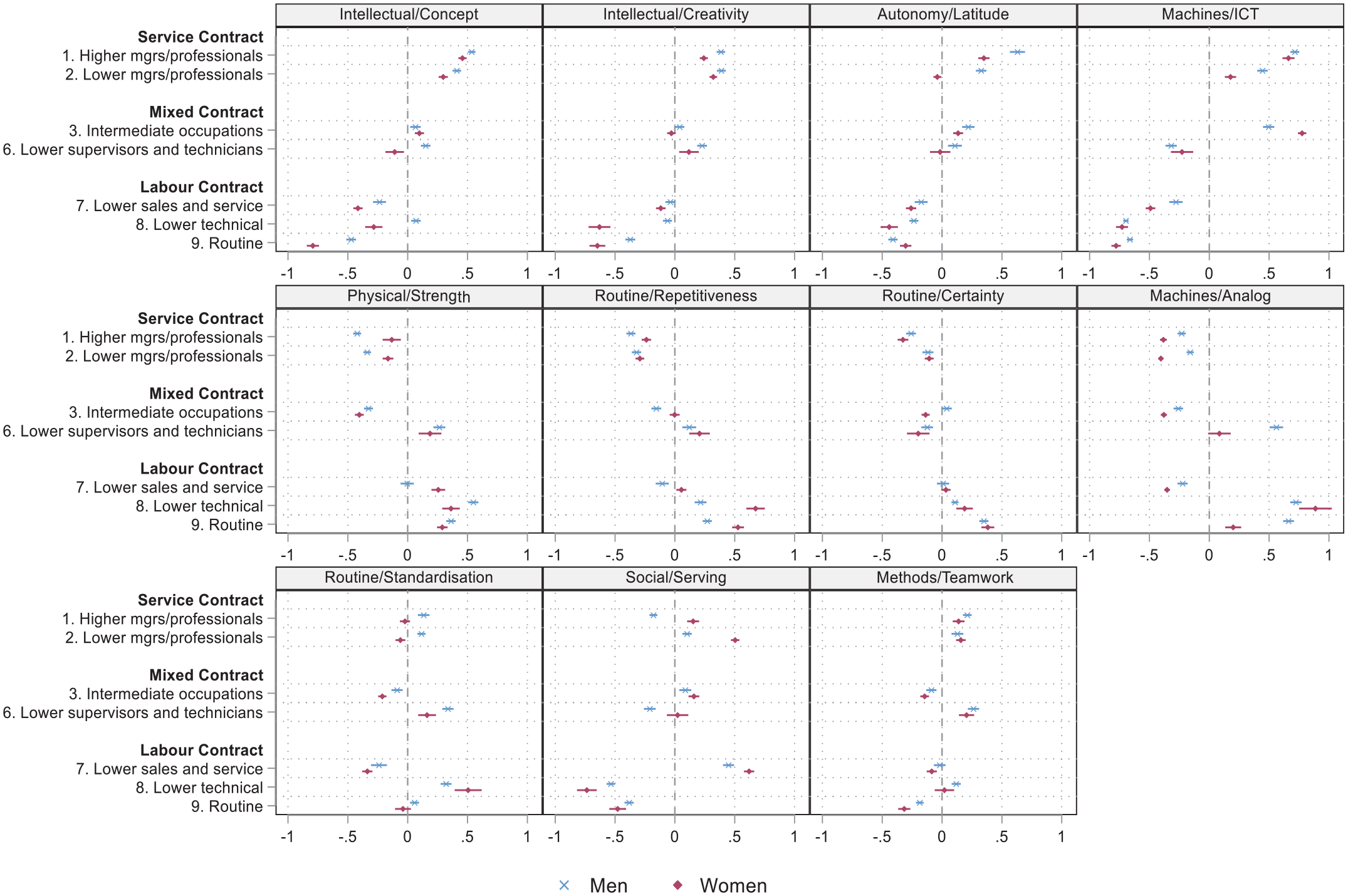
Predictive margins of social classes (ESeC) on z-tasks by gender (2005-2015) from OLS regression models (n=68,433). 95% confidence intervals.
Intellectual tasks are ranked according to the expected hierarchy of human asset specificity in EGP-based theories: Classes 1 and 2 in a service relationship score the highest; mixed contracts (Classes 3 and 6) are somewhere in the middle around the mean; and labour contracts (Classes 7, 8 and 9) display the lowest intellectual intensity below the mean. It should be noted that, within mixed contracts, differences in levels of intellectual tasks between Class 3 (intermediate occupations) and Class 6 (lower supervisors and technicians) are lower than expected by the ESeC schema.
In terms of work autonomy, there is a steep gradient across the social class hierarchy where managerial and professional classes display the highest levels of autonomy at work, followed by mixed and labour contracts. These results mirror the hierarchy found for intellectual tasks and the theorised class stratification in work monitoring difficulty. Note that, within those in a service relationship, men enjoy a higher degree of autonomy at work than women, even within the same social classes, partly due to marked women’s occupational segregation in the health and education sectors and men’s overrepresentation in higher managerial positions.
The use of computing devices is one of the sharpest dividing lines in work tools across non-manual and manual social classes, with higher and lower managers, professionals, and intermediate occupations (clerks) displaying a very high intensity of computer use. ICT use is distributed across social classes, similar to intellectual tasks and autonomy. However, there are considerable differences within mixed contract classes in this case. The use of computing devices is the most relevant difference between the two social classes that make up the mixed contract.
The skilled and unskilled manual classes (Classes 8 and 9) score high on physical strength, analogue machinery, repetitiveness, and certainty. By contrast, the prevalence of these four tasks is lower in mixed and service contracts. The index of standardisation follows a different pattern. No clear-cut gradient suggests a hierarchical ranking in this case: Classes 6 and 8 have the most standardised work procedures, while Classes 3 and 7 are the least standardised. The most considerable differences are observed within types of employment contracts rather than between, especially within labour contracts, suggesting that work procedures and outputs predefined and encoded in a formalised system are independent of the logic of employment contracts.
Unsurprisingly, lower sales and service occupations (Class 7) have the highest score for serving and attending, understood as a form of social interaction with the public or customers. Those with less need for these social interactions are skilled and unskilled manual classes (Classes 8 and 9). With standardisation and analogue machinery, social interactions add another element to the heterogeneity within the labour contract, especially between Class 7 and Classes 8 and 9, among social tasks that are hard to automatise. As with autonomy at work, within the service relationship and Classes 6 and 7, women perform more tasks related to serving and attending than men within the same social class, likely related to women’s within-class occupational segregation in the health, education and commerce sectors.
Overall, it seems that intellectual and routine tasks and digital tools partially driving income inequality in post-industrial economies, along with autonomy at work, are visibly stratified by occupational classes. Besides, these findings align with EGP-based theoretical expectations on class divides in human asset specificity/time horizons (i.e., intellectual/routine tasks) and monitoring difficulty/reward types (i.e., work autonomy). As shown in the Online Appendix (section B.4, Figure B.7, and Table A.2), the job tasks, work methods and tools that correlate most positively with longer time horizons are intellectual tasks, ICT tools and work autonomy, while ICT tools, work autonomy and standardisation positively correlate the most with more diffuse reward types.
The first research question also asked how the distribution of job tasks between classes changed over time. According to Appendix Figures B.2-B.4, there have not been sizeable changes concerning the task composition by social classes from 2005 to 2015. The general picture is one of stability due to four plausible reasons. First, the period analysed is likely too small to capture the effects of technological change. Second, only the employed population fed the analyses, leaving aside shifts in employment across occupations/classes. Third, pooling 27 EU countries might cancel out country-specific trends. Fourth, most likely, those tasks (physical; intellectual), work methods (routine; autonomy), and tools (ICT; analogue) driving income inequality and proxying for technological change are indeed still well-stratified by EGP-based occupational classes.
Tasks, employment relations, and social classes
To address the second research question on alternative explanations challenging EGP-based schema foundations, it is assessed to what extent job tasks confound the association between employment relations indicators and class membership.
Table 1 presents the KHB decomposition method with binomial logistic regressions predicting membership to mixed (ESeC Classes 3+6) or labour contracts (ESeC Classes 7+8+9), with service contracts (ESeC Classes 1+2) as the baseline. If one focuses on reward types, an SD unit 3 increase in diffuseness—about 0.2 points in the 0-to-1 index’s variables original scale with mean = 0.13—is associated with 2.2% (men) less probability of having a mixed contract or 4.7% (men) /4% (women) less probability of belonging to a labour contract in comparison with being employed in a service relationship.
Employment relations (X), job tasks (
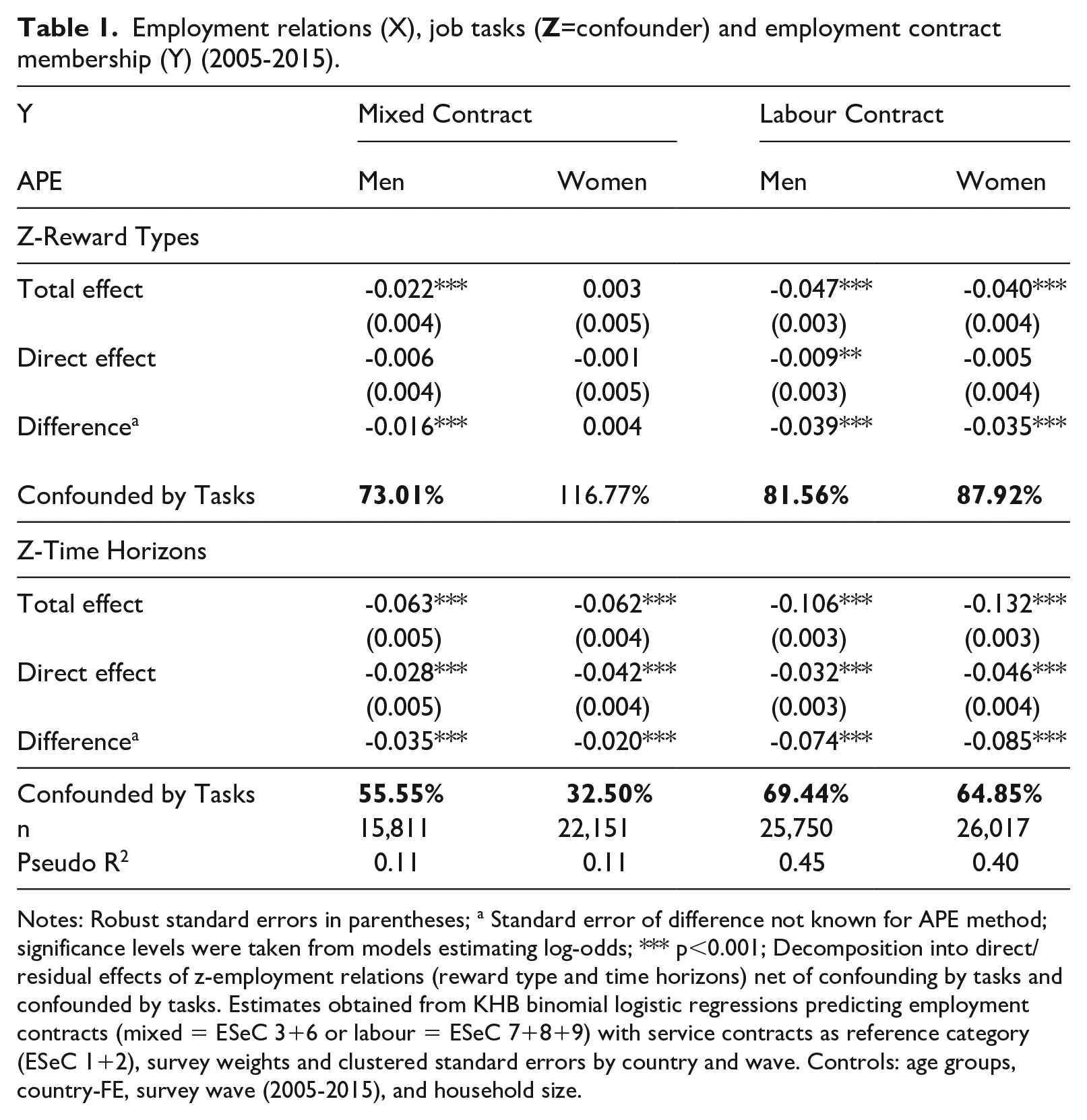
Notes: Robust standard errors in parentheses; a Standard error of difference not known for APE method; significance levels were taken from models estimating log-odds; *** p<0.001; Decomposition into direct/residual effects of z-employment relations (reward type and time horizons) net of confounding by tasks and confounded by tasks. Estimates obtained from KHB binomial logistic regressions predicting employment contracts (mixed = ESeC 3+6 or labour = ESeC 7+8+9) with service contracts as reference category (ESeC 1+2), survey weights and clustered standard errors by country and wave. Controls: age groups, country-FE, survey wave (2005-2015), and household size.
In the case of time horizons, an SD unit increase in time horizons—about 1-point in the 1-to-5 index’s variables original scale with mean = 3.3—is associated with a 6% (men and women) less probability of having a mixed contract or 10.6% (men) /13.2% (women) less probability of belonging to a labour contract in comparison with being employed in a service relationship.
Although these relationships are coherent with EGP-based theoretical foundations and previous criterion validation exercises (Smallenbroek et al., 2022), the substantive finding is that job tasks confound, on average, 66% (from 33% to 88%) of the total effect of employment relations on class membership. The confounding role of tasks is more pronounced for labour contracts (65%-88%) than for mixed contracts (33%-73%), and reward types (73%-88%) than for time horizons (33%-69%). These patterns reflect more pronounced differences in work and conditions between labour and service contracts than between mixed and service contracts. These patterns by employment relations suggest that time horizons are a more accurate indicator than reward types, as there is a substantially higher overlap between tasks and reward types, and its predictive power to differentiate class membership is lower than it is for time horizons.
Finally, the confounding role of tasks by gender is similar except for women with mixed contracts, as there is no total effect of reward types, and tasks confound the total effect of time horizons considerably less for women (33%) than for men (56%). This gendered pattern might have something to do with the marked class segregation of women within mixed contracts since most of them are employed in intermediate occupations as clerks (Class 3), while men are overrepresented as lower supervisors and technicians (Class 6) (see Appendix Figure A.1). Overall, employment relations indicators do not discriminate social classes for women as well as they do for men (see Appendix B.3 and Figures B.5-B.6).
Figure 3 is based on models in Table 1 to illustrate the contribution of each task to confound the relationship between employment relations and employment contract membership. It shows that the total effect of employment relations on class membership is larger for labour than for mixed contracts and time horizons than for reward types. Concerning the share of confounding by tasks, for reward types, irrespective of gender and contract type, ICT tools (21%-51% of total confounding) and intellectual (conceptualisation) tasks (11%-29%) contribute the most. Similarly, for time horizons, ICT tools (11%-25%) and intellectual tasks (15%-26%) contribute the most to confound the relationship between time horizons and membership to mixed or labour contracts compared with a service relationship.
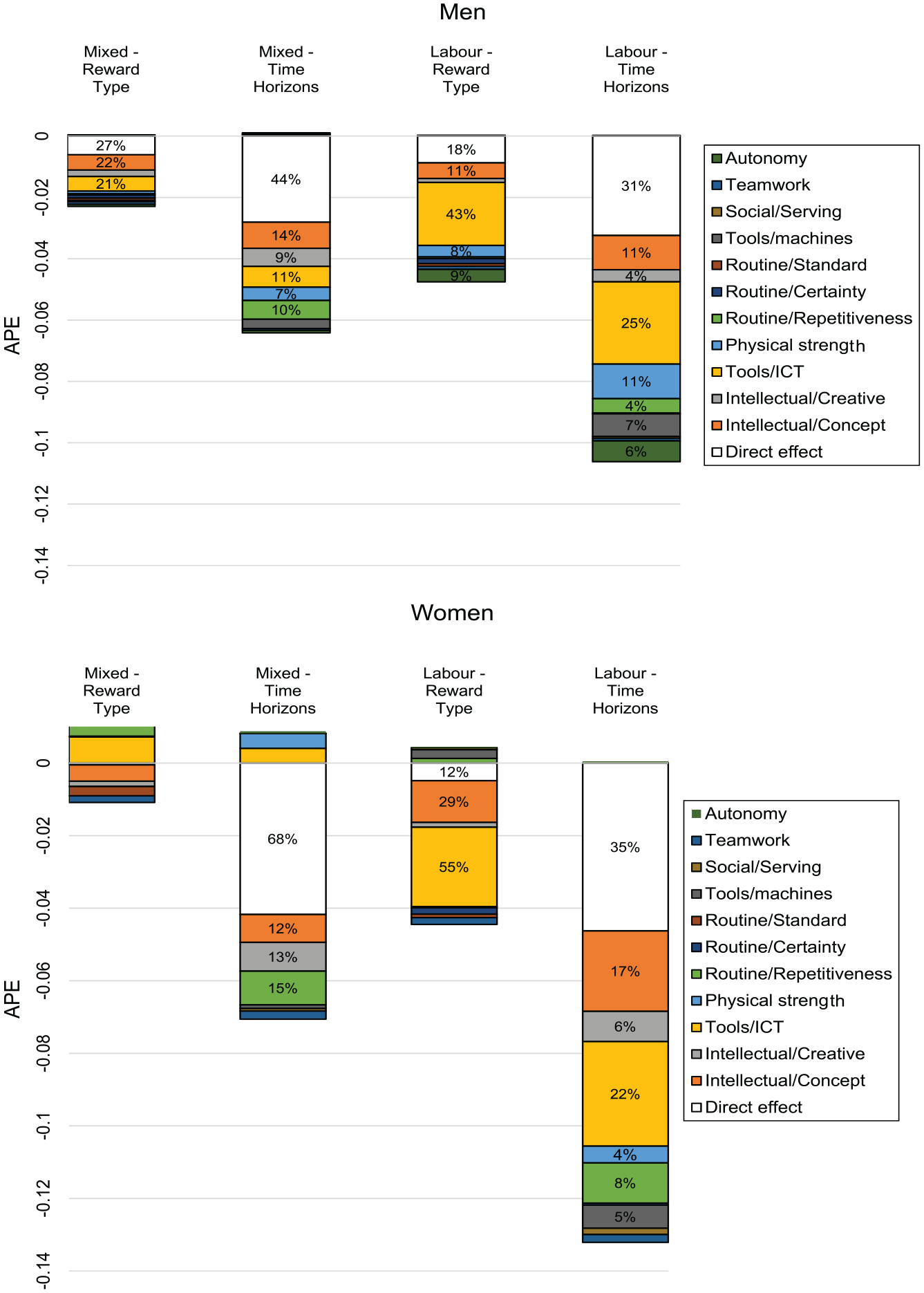
KHB model by gender: Employment relations (X), job tasks (
These findings align with the argument that job tasks related to technological change are the primary sources of labour market stratification in post-industrial societies. While some residual effects of employment relations indicators on class membership hold, in most cases, more than half of the total effects of employment relations on class membership are confounded by job tasks. This finding suggests a considerable overlap between technology and EGP-based explanations accounting for class positions. At the same time, a 66% average confounding role of job tasks questions the criterion validity of EGP-based class schemas compared with alternative explanations such as the unequal distribution—and labour market returns—of tasks across social classes.
Tasks, employment relations, and life chances
To tackle the third research question on the role of job tasks versus employment relations in predicting life chances, the Blinder-Oaxaca and RIF-Oaxaca decomposition is estimated on two outcomes: 1) permanent contract; and 2) personal income.
Firstly, as life chance indicator of career stability, class gaps in permanent contracts are analysed. As shown in Appendix Table B.4, reporting the full output, on average, men and women with mixed contracts are 3% more likely to have a fixed contract when compared with those in a service relationship. Men (women) with a labour contract are 9% (12%) less likely to be in permanent employment than those in a service relationship.
These class gaps in career stability are consistent with previous research testing the construct validity of EGP-based class schemas. This article further contributes by testing whether the building stones of EGP-based schemas, employment relations indicators like reward types and time horizons, or alternative explanations, such as job tasks, better account for these observed class gaps in life chances. The complete set of explanatory and control variables fed to the Blinder-Oaxaca model accounts for up to 70% of the class gaps in a permanent contract.
Figure 4 summarises the groups of individual-level variables—tasks, employment relations and age—that significantly (p-value<0.05) explain the observed class gaps in permanent employment. As illustrated in Figure 4, for men, job tasks and employment relations similarly account for the gap between mixed or labour contracts and the service relationship from 40% to 50%. However, a different picture emerges in the case of women since employment relations explain over 40% of the gap in permanent employment among those women with either mixed or labour contracts, and tasks only contribute to explaining the gap below 20% for women in a labour contract.
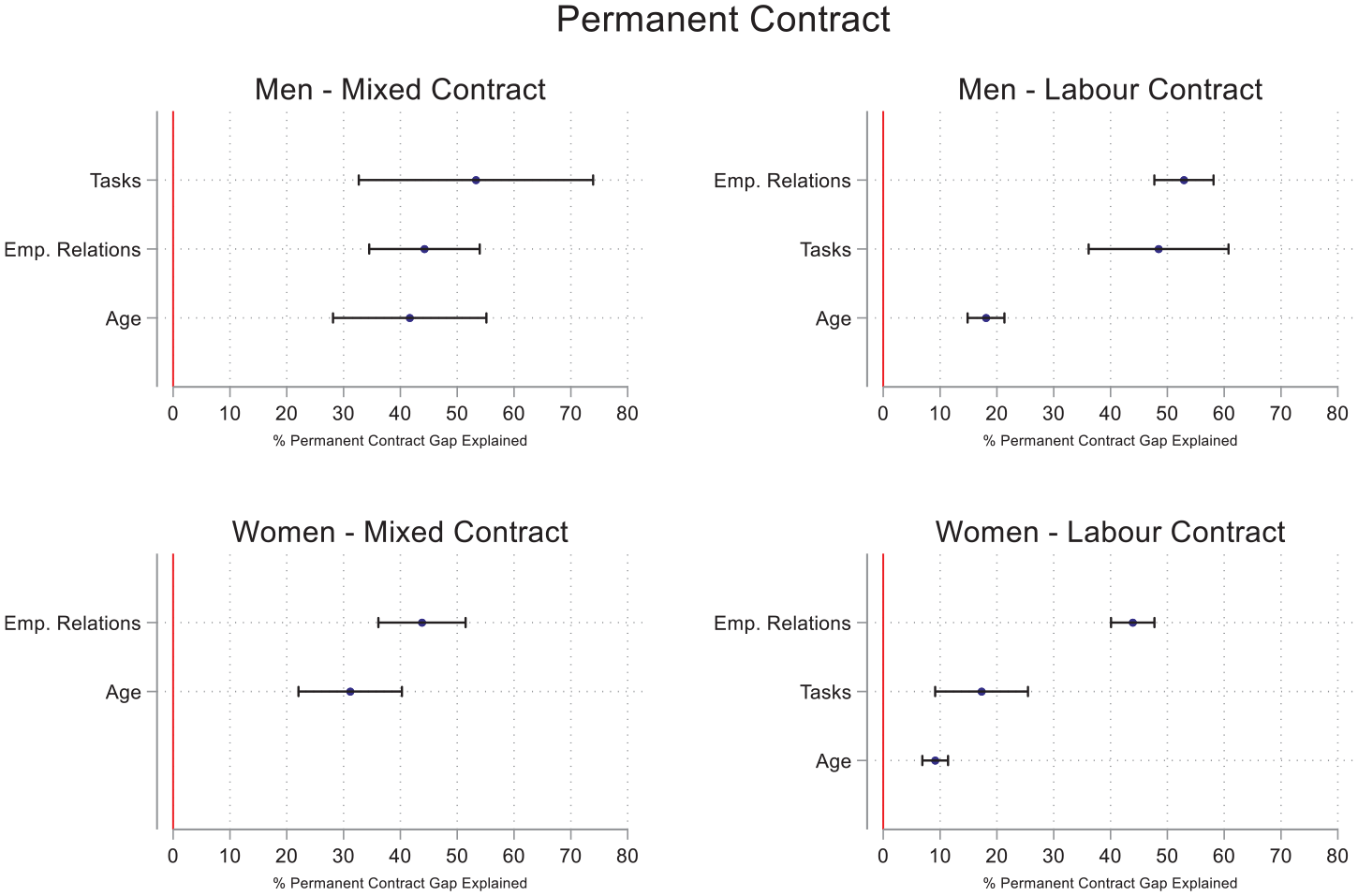
Oaxaca decomposition of permanent contract gap between service (reference category) and mixed or labour contracts by gender (2005-2015).
Secondly, to analyse the second indicator of life chances, monthly net personal income, the RIF-Oaxaca decomposition method is implemented at the median (q50) of the (log)income distribution and over quintiles (q20-q40-q60-q80). As summarised in Appendix Table B.7 reporting the full output, men and women with a mixed contract earn (log)wages about 2.5% lower than workers in a service relationship at q50. In the case of labour contracts, men (women) earn (log)wages 6.5% (9%) lower than those in a service relationship. To benchmark the effect size of these class wage gaps, the raw (log)wage gaps between mixed or labour contracts and the service relationship range from 0.18 to 0.62, and the SD of (log)wage equals 0.67.
These findings are hardly surprising and in line with EGP-based theories and previous research documenting how ESeC classes account for a substantial share of income inequalities in labour markets. Assuming no unobserved confounding, the variables in the model account for up to 57% (23%) of the men’s (women’s) (log)wage gap between mixed contracts and the service relationship and up to 58% of the gap for men and women between labour contracts and the service relationship at q50. Looking at the contribution of different factors to explain class gaps over the wage distribution in the Online Appendix (section B.7 and Figure B.10), no consistent differences over quintiles can be observed in the explanatory power of tasks or employment relations.
However, Figure 5 illustrates a novel finding. Job tasks are the factor that, largely and within the observed variables in the model, account for most of the explained class wage gaps from 35% to 50%, contributing 25%-to-40% more than employment relations in relative terms. An exception is women’s mixed contracts, where tasks also explain the most at 10%, but their contribution is not statistically distinguishable from employment relations. In Figure 5, bottom panel, the specific contributions of each task and employment relations indicators are unpacked. Those job tasks related to technology-based explanations of income inequality account for the largest chunk of class (log)wage gaps. ICT tools, intellectual tasks and, to a lesser extent, repetitiveness and autonomy are the tasks, work methods and tools accounting for most wage differences between employment contracts or social classes as defined by EGP-based schemas.
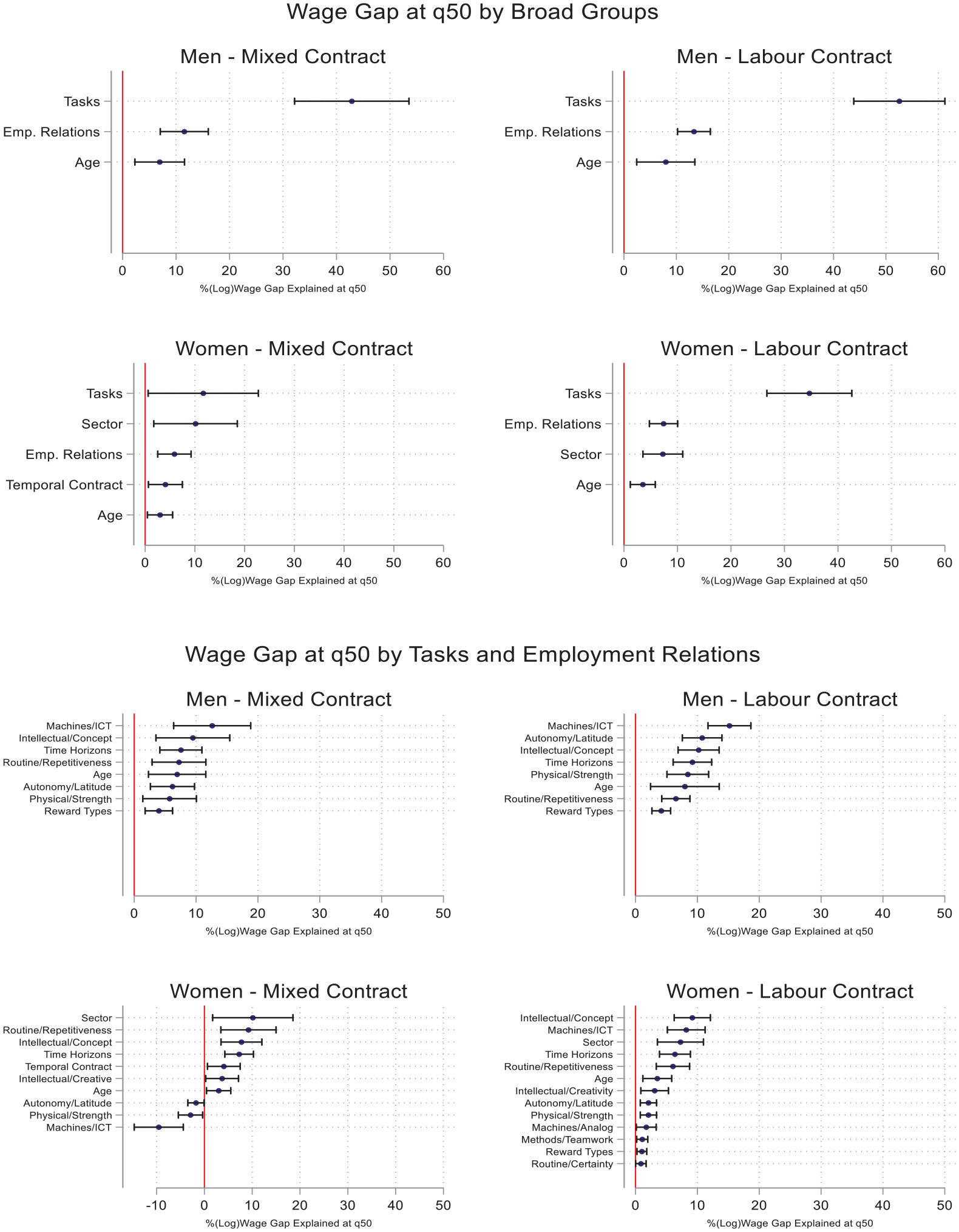
RIF-Oaxaca decomposition of the (log)wage gap between service (reference category) and mixed or labour contracts by gender at q50 (2010-2015).
Robustness checks
In the Online Supplementary Material, we carry out several robustness checks. First, we disaggregate the main analyses over time, by gender, social classes, and income quintiles (B.2; B.5-B.7). Second, in the Oaxaca decomposition analyses, we estimate models with additional outcomes (seniority) (B.6). Third, we run alternative specifications by: 1) keeping only those tasks more directly related to technology-based explanations (i.e., routine, physical, and intellectual tasks and ICT tools); 2) including several supplementary items to proxy for employment relations mechanisms; and 3) not controlling for potential mediators of employment relations’ indicators such as part-time contracts or autonomy at work. Overall, the robustness checks are highly consistent with the main findings presented in the previous sections. Fourth, additional information and analyses are provided on task variation between and within social classes (B.1), the criterion validity of the ESeC schema by gender and over time (B.3), and the relationship between tasks and employment relations by gender and over time (B.4).
Conclusion and discussion
This article focuses on how unfolding vectors of technological change, workplace automation and digitalisation, might challenge the validity of mainstream industrial-age class schemas (EGP and ESeC). This article analyses over time and by gender: 1) how job tasks related to technology-based explanations of growing economic inequality are distributed across social classes; 2) to what extent job tasks confound the links between employment relations and class positions; and 3) whether job tasks are more predictive of life chances than employment relations.
The article documents four findings. First, tasks (physical, intellectual), work methods (routine, autonomy) and tools (ICT, analogue) that partially drive income inequality and proxy for vectors of technological change are well-stratified by social classes. In the 2005-2015 period analysed, the distribution of those job tasks, work methods and tools more connected to automation risk, workplace digitalisation, and wage premium remained relatively constant across occupational classes in the EU-27. Even though this decade is possibly too short an observation window to detect long-term trends in technology or occupational change, and a pool of diverse countries was analysed, the big picture is that labour market inequalities are hardwired in occupational social classes as far as they reflect stratification by tasks, productivity, and wages.
Thus, if new technologies and work changes do not considerably affect the distribution of tasks and employment relations across occupations but are complementary to already privileged classes, stratification among occupational classes might keep constant or increase. Likewise, the more disadvantaged working classes performing more physical tasks and routine work, potentially including clerks in intermediate classes, could bear the most harmful and substitutive impact of new technologies on employment relations and life chances.
Second, mediation analyses yield that about two-thirds of the total effect of employment relations indicators on class membership is confounded by tasks. Job tasks, work methods and tools most related to technology-based explanations of wage inequality—ICT, intellectual and routine tasks—are confounding this association most. Thus, the theoretical foundations of EGP-based social class schemas are compromised by alternative explanations like job tasks or productivity-based differences between occupations. Even though employment relations still explain the class membership net of tasks and measurement error might underestimate its share, the extensive overlap between technology- and EGP-based explanations when predicting class positions suggests that the latter needs further theoretical refinements to keep up with inequality drivers in the digital age (Williams, 2017). Paradoxically, even if EGP-based schema foundations were outdated, they could still account for contemporary labour market inequalities as they build on occupational titles and aggregations instead of directly observed occupational characteristics or employment relations.
Third, decomposition analyses indicate that job tasks account for class differences in career stability slightly worse than employment relations. Different employment relations offered by employers—reward types and time horizons—better explain differences in permanent employment and seniority by social classes than job tasks. Hence, EGP-based employment relations still fairly capture the career stability dimension of life chances.
Fourth, wage decompositions by social classes suggest that job tasks are the factor that, largely and within observed variables, accounts for most explained class wage gaps up to over 50%, contributing 25%-to-40% more than employment relations in relative terms. ICT tools, intellectual, repetitiveness, and autonomy are the tasks, tools, tasks and work methods accounting for most wage differences between employment contracts. Those same tasks related to technology-based explanations of income inequality account for the biggest chunk of class wage gaps.
What are the findings’ bottom line to (re)define social classes in the digital age? This article does not argue for a class revolution but for fine-tuning the old instrument to better capture labour market inequalities. The distribution (and overtime change) of job tasks—as well as skills, wages, poverty, and unemployment (Albertini et al., 2020; Barbieri et al., 2020; Gioachin et al., 2023)—is still reasonably well stratified by big occupational classes. Thus, technological change might not be the big game-changer in cracking the building stones of the old industrial stratification system, while other national and international institutional factors might have a more substantial impact.
Job tasks—the smallest work unit—related to technology-based explanations of growing economic inequality better account for income inequalities between occupational classes than theorised employment relations indicators, in line with the neo-Durkheimian micro-class approach based on granular occupations (Weeden and Grusky, 2012). However, sticking to occupational aggregations seems more feasible regarding data availability than directly measuring job tasks, employment relations or very detailed occupations.
Income has recently replaced occupational class as the preferred indicator of social stratification scholars to measure socio-economic position (Barone et al., 2022), becoming a marginal measure in other social science disciplines and sociological fields. Meanwhile, distributive inequality in income and wealth is gaining momentum in scientific (Hällsten and Thaning, 2021), public and policy discussions parallel to the observed rise of economic inequalities (Oesch, 2022). Still, no hard evidence demonstrates the declining power of (big) social classes to capture the structure of labour market inequalities. Thus, forgoing the division of labour does not seem reassuring in the digital age.
Against the backdrop of previous research and our findings, we sketch three promising future pathways for improving class measurement to keep up with changing labour markets and inequality drivers. Firstly, horizontal disaggregation within EGP-based social classes is necessary to depict more fine-grained inequalities or polarisation in employment relations and life chances (Smallenbroek et al., 2022) across the class structure and by gender. Second, additional features to the employment relations and employer/employee backbone structuring EGP-based schemas, such as (occupational-mean) job tasks, economic sectors or the horizontal axis of work logics proposed by the Oesch class schema (Oesch, 2006), could better account for class and gender inequalities in power, authority and wage at the workplace. Third, future schemas could better represent income/wealth concentration dynamics in digital economies by integrating labour and capital sources of economic inequality (Duvoux and Papuchon, 2022) and unravelling heterogeneity within the self-employed (Fana and Villani, 2022)—overlooked in this article due to its focus on employees’ employment relations.
This investigation has two main limitations related to data constraints that also pave the way for future research. First, small samples and country-fixed effects models prevented us from depicting institutional particularities that might drive country-specific deviations. In this article, however, cross-country factors did not considerably explain job tasks’ variation, class membership or gaps in life chances on top of individual-level features. Still, we provided a novel interdisciplinary framework that future research on single- or cross-country analyses might apply to explore the role of institutions. Second, this article covered a short period (2005-2015) when the bulk of the analogue-to-digital transition had taken place while innovations in AI were burgeoning. Future studies might cover a longer-term period to causally identify technological shocks and their interaction with institutions in shaping labour market inequalities.
Supplemental Material
sj-pdf-1-wes-10.1177_09500170231155783 – Supplemental material for Technological Change, Tasks and Class Inequality in Europe
Supplemental material, sj-pdf-1-wes-10.1177_09500170231155783 for Technological Change, Tasks and Class Inequality in Europe by Carlos J Gil-Hernández, Guillem Vidal and Sergio Torrejón Perez in Work, Employment and Society
Footnotes
Acknowledgements
We thank Enrique Fernandez-Macías and Oscar Smallenbroek for their valuable comments.
Funding
The author(s) disclosed receipt of the following financial support for the research, authorship, and/or publication of this article: This project has been funded through the European Commission’s JRC Centre for Advanced Studies and the project Social Classes in the Digital Age (DIGCLASS).

Supplemental material
Supplemental material for this article is available online.
Notes
References
Supplementary Material
Please find the following supplemental material available below.
For Open Access articles published under a Creative Commons License, all supplemental material carries the same license as the article it is associated with.
For non-Open Access articles published, all supplemental material carries a non-exclusive license, and permission requests for re-use of supplemental material or any part of supplemental material shall be sent directly to the copyright owner as specified in the copyright notice associated with the article.
