



Abstract
This article investigates the intersection between precarious work and precarious lives through interviews with workers in the care, hospitality and art sectors. These revealed that workers experienced precarity as a double-edged sword of time and income uncertainty shaped by the context in which they were embedded – namely their employment, their household and their relations with state welfare and care systems. These three domains shaped both the constraints they faced and the buffers and resources available to them as they managed these time and income uncertainties. A dynamic work–life articulation framework is developed that embeds the strategies workers deploy to mitigate uncertainty within these three domains and their intersections. These strategies may still only result in the least bad and often far from sustainable outcome due to changing contexts and trade-offs between time and income uncertainty.
Keywords
Introduction
Precarious work and how it is experienced has become central to both academic and political debates. In the UK, it is often associated with the rise in non-standard work, zero-hour contracts (ZHC), employer-driven flexibility and in-work poverty. The 2024 Employment Rights Bill from the newly elected Labour government aims to improve conditions by, for example, banning ZHCs, highlighting that ‘uncertainty can affect both financial security and well-being’ (UK Government, 2024: 1). Although this may reduce precarity for some, it is more complex; precarious work is not limited to atypical work and not all standard employment protects against precarity. It is the lower quality of jobs, whether standard or non-standard, that is the story behind the statistics (Heyes et al., 2018). Workers in these jobs do not experience uncertainty in the same way due to differences in the household and state welfare contexts in which they are embedded. Research has highlighted these complexities by, for example, exploring the work–life articulation (WLA) strategies (Smith and McBride, 2021) that workers must deploy to manage their work and care responsibilities when taking multiple jobs just to make ends meet. Likewise, others have identified the UK’s state benefits system as another independent factor shaping precarious work and precarious lives as recipients are required to be active labour market participants (Greer, 2016).
The objective of this article is to take an abductive approach, informed by recent theorisations that illuminate the complexity surrounding precarious work, to understanding how workers manage precarious jobs to limit the level of uncertainty that they experience in their lives. It draws on case studies of workers employed in a range of jobs across four organisations in the care, hospitality and arts sectors, all known to have high shares of precarious work and in-work poverty (Sissons et al., 2018). This abductive approach led first to the recognition, following Heyes et al. (2018), that workers experience precarious work as a double-edged uncertainty of both time and income, and second to the development of an extended and dynamic WLA framework for exploring workers’ attempts to navigate and manage that uncertainty. Through these conceptual developments and supported by the empirical analyses, the research presented here makes three key contributions to the understanding of the intersection between precarious work and precarious lives. First, it highlights how the notion, as for example argued by Heyes et al. (2018), that uncertainty in work simply spills over into workers’ lives and underestimates workers’ agency in deploying WLA strategies to manage income and time uncertainty. Second, it extends the framework for conceptualising WLA strategies to manage uncertainty by adding the state as an equal domain to that of the household and employment. Third, the emerging framework shows how WLA strategies should be viewed as dynamic processes of continuous adjustment to manage uncertainty in contexts where strategies may at best provide only temporary or non-sustainable solutions.
From precarious work to precarious lives
To make progress in understanding the intersections between precarious jobs and precarious lives, it is necessary first to consider the burgeoning research around the nature, form and experiences of precarious work. Although this interest was sparked by the spread of atypical employment forms, in the UK context of low employment protections, precarious work may be considered a continuum with much work sharing features of precariousness. Thus, whether a job is precarious cannot necessarily be read off from objective criteria or associated with the contract or pay alone and not all precarious jobs are experienced as ‘a precarious life’ (Millar, 2017).
In this vein, Heyes et al. (2018) developed the concept of uncertainty as a defining element of what is meant by precarity, adopting Knight’s (1921) definition of uncertainty as the unknowable outcome of a situation, because ‘the odds of specific outcomes occurring cannot be determined in advance’ (Heyes et al., 2018: 421). For these authors, uncertainty in employment, for example low and unpredictable earnings, ‘spills over’ into uncertainty in workers’ personal lives and their household situation, causing many to struggle financially on a day-to-day basis and restricting access to external resources such as loans and mortgages. Organising care, holidays and family time is further complicated by uncertainty over the timing and number of working hours, especially where income is insufficient (Heyes et al., 2018: 435).
Heyes et al. (2018) attribute responsibility for uncertain lives to employer strategies and labour market demand. Employer practices in relation to staffing, scheduling and contracts play a crucial role in shaping employees’ ability to mitigate uncertainty. Those on ZHCs or minimum hours (MH) contracts depend on employers’ willingness to provide extra shifts to enable them to make ends meet (Joseph Rowntree Foundation (JRF), 2021) and can only take a second job if the two jobs have compatible time schedules. At the other end of the contract spectrum, those on salaried contracts may be expected to work long and unpredictable hours, with salaried workers increasingly at risk of being paid below the national minimum wage (Low Pay Commission, 2024). Household factors and the state welfare system may interact with and further complicate problems of addressing income insufficiency. For example, changing rotas may lead to conflicts with the work and time schedules of other household members and with non-work commitments. Expensive, inflexible childcare, or the risk of losing benefits, may extend problems of precarity, even to those on guaranteed hours or salaried contracts. All these interactions form part of the reality of how precarious employment impacts on workers’ lives.
This suggests that the metaphor of precarious work ‘spilling over’ into non-work lives (Heyes et al., 2018) does not adequately consider the agency that workers exercise when seeking to manage their lives and mitigate the effects of precarious work. This focus on agency fits with the WLA concept first developed by Crompton (2006) as a critique of the classist assumptions in work–life balance debates (Smith and McBride, 2021; Warren, 2015). The WLA concept sought to capture the challenges and complexities of women’s efforts to accommodate work and life as their involvement in wage employment increased. This issue took on particular salience in the UK where high inequality in labour markets and a lack of affordable childcare exacerbate class differences (Smith and McBride, 2021). Although women still retain most responsibility for care, the majority of households are increasingly reliant on both partners being in paid work. This creates major tensions as only high-paid women can afford to outsource care to find some work–life balance (Warren et al., 2009).
Smith and McBride (2021) develop and expand the concept of WLA in an empirical analysis of workers juggling multiple jobs to show: the interconnected economic and temporal challenges of low-pay, insufficient hours, precarious jobs and work–life articulation complexities facing these workers, meaning that many are merely working to live. (Smith and McBride, 2021: 274)
Their analysis showed that, whether dealing with eldercare or childcare, workers may need to adopt complex, interactive and dynamic strategies that are often gendered in nature. According to Ehrlich (2023: 130), women’s employment decisions are ‘shaped by a complex interplay of women’s employment patterns, the time committed to caregiving and the economic context in which the household operates’. Furthermore, as household needs and responsibilities change over time (due to children growing up, divorces, sickness, eldercare), so too do the strategies deployed with consequences for the degree of household uncertainty (JRF, 2021; Lain et al., 2019; Shildrick et al., 2012). The safety nets provided by household support networks that workers may rely on to manage precarity may prove fragile and can disappear over time. For example, one day grandparents can be caring for grandchildren but the next day may be requiring care themselves (JRF, 2021). Therefore, in considering the role of the household in shaping uncertainty, it is important to look beyond the nuclear family to the broader networks that both provide and require financial and/or care support.
While studies have explored how uncertainties at work are experienced and navigated at the household level, the influence of the state has been treated more as a background factor. Thus, although Heyes et al. (2018) show how workers’ financial uncertainty is intensified by the risk of benefits loss, and Smith and McBride (2021) report on individuals who took up multiple jobs because of benefit constraints, the relationship with the state is not a main focus in the analysis of WLA strategies. This matters particularly in the UK as the state has been identified as a ‘key manufacturer of precariousness’ (Alberti et al., 2018: 451). Lain et al.’s (2019) study of older workers does, however, introduce the state as one of the three intersecting domains shaping experiences of precarity. Here the focus is on one aspect of the state’s role in shaping precarity, namely its role in providing buffers or resources to reduce dependency on the market. This study found that by extending retirement ages and offering only low-value pensions, the state had changed the availability and generosity of this traditional buffer, thereby adding to uncertainty. In this context, older workers’ uncertainty increased as they feared job loss and problems in accessing alternative employment in their extended wait for retirement. Similar arguments can be made that the UK state’s failure to provide flexible, affordable childcare (Coleman and Cottell, 2019; Warren et al., 2009) is contributing to creating precarity as some households are even worse off after deducting childcare costs when the mother enters employment. This childcare deficit has direct implications in particular for women workers, influencing the hours women can work, the childcare costs of working and the income that can be earned – often conditional on the availability of informal care arrangements (Smith and McBride, 2021).
However, the state may not only be argued to add to precarity by failing to provide adequate buffers but may play a dual role in actively manufacturing uncertainty through the benefits system’s sanctions and even fines on those not following the complex rules on earnings and working hours (Greer, 2016; JRF, 2021; Wright and Dwyer, 2022). The UK system is designed ‘to make work pay’ and discourage benefit dependency (Wright and Dwyer, 2022). According to Greer (2016), its punitive workfare model heightens precarity by allowing the quality of jobs to decrease even without any increase in job quantity. Even when people can access benefits, their level is often insufficient to move them above the poverty line (Shildrick et al., 2012). For example, the basic payment in the UK’s unified benefits system – Universal Credit – which supports both those out of work and those in low-paid jobs, now equates to only 13% of UK average earnings, much lower than basic benefit payments at any other time in history (Trussell Trust and Joseph Rowntree Foundation, 2024).
Furthermore, the precarity experienced by benefit claimants is not just about the low level of income support but also the uncertainty associated with claiming benefits. This arises from delays and disruption to claims, unanticipated eligibility issues (for example, children’s ages rising above the child tax credit threshold or increased earnings from the claimant or other household members) and problems of not knowing if benefits have been under or overpaid. Indeed, if benefits are later found to have been overpaid (Shildrick et al., 2012), the repayment system may leave claimants even worse off. The slow transition to Universal Credit, in process throughout this study and beyond, was itself creating new anxieties. Research has found that the complexity of claiming benefits has stopped people from accessing them (Wright and Dwyer, 2022). The state’s means-tested income support thus potentially has a very strong influence on claimants’ WLA strategies to address problems of income insufficiency. Claimants are constantly under pressure to work more, yet at the same time are held responsible for ensuring their claims conform to the rules even when facing highly variable work schedules. In this context, Lain et al.’s (2019) contention that to understand experiences of precarity, the state should be a domain in its own right to be analysed alongside that of employment and household, and that each domain should receive equal focus, is particularly compelling.
These dual roles of the state as both a support buffer (even if a low-value buffer in the case of the UK) and a manufacturer of uncertainty, call for an expansion of WLA strategies to consider interactions across the three domains of the state, the household and employment. This expanded conceptualisation does not, however, assume that those in precarious work are able through their own efforts and agency to develop sustainable and long-term WLA strategies. Therefore, even if in theory workers could build, maybe with family help, the support structure or scaffolding (Beckman and Mazmanian, 2020) that Pulignano and Morgan (2023) argue is necessary in order for them to operate in precarious jobs, this may provide at best a temporary respite. The interactions and moving parts across the employment, the household and the state domains mean that resources built up in one domain may be cancelled out by losses in another domain, leading to new uncertainties.
This article draws together these insights to address an overarching research question: How do the domains of employment, the household and the state intersect to shape the ways uncertainties of precarious work are experienced by workers as the uncertainties of precarious lives?
It does so by empirically investigating the following sub-question: What work–life articulation strategies do workers use to manage these intersecting domains and attempt to mitigate their experiences of income and time uncertainty?
Methods
This study, conducted between 2017 and 2020, focused on workers in the arts, hospitality and social care sectors. These sectors, purposefully sampled to access information-rich cases (Patton, 2015) to study precarious work, were all characterised by low hourly wages combined with working time and contractual insecurity and high household poverty rates compared with other sectors (JRF, 2020; Richardson, 2023; Sissons et al., 2018). A multi-dimensional approach to defining precarious work was adopted, which recognises how features of precarity can be present across a range of jobs and contracts. Therefore, organisational gatekeepers were asked to promote participation in the research to their employees across a wide range of mainly front-line roles that also spanned a variety of employment contracts. It was not possible to predetermine each case’s sample size, but several rounds of interviews were conducted in each organisation to ensure a representative demographic and coverage of the range of contractual and employment arrangements present in the organisations. This ensured that different WLA strategies could be captured and understood and that ‘purposefully rich cases’ were accessed (Patton, 2015). In each case, this meant returning to the organisation following initial analysis of the data.
The project received ethics approval from the university. All participants gave informed consent, and transcripts were anonymised with pseudonyms to protect identities.
Interviews were undertaken with 37 workers. The interview schedules covered their work–life history, including detailed questions on their current jobs (pay, contracts, hours, work organisation, working conditions); on their household dynamics (living arrangements, financial circumstances, household members’ working patterns and the extent and organisation of their care responsibilities); and their relationship with the welfare state and childcare systems. All were found to be in jobs that were precarious, defined in the study as involving:
i) low hourly pay defined as below the Real Living Wage; 1
ii) precarious working-time arrangements, whether long, variable or unsocial and associated with divergent contractual conditions.
The first criterion was met by all in the sample except for one ZHC worker who was still paid below the UK median wage and the second by all but two who had negotiated fixed hours. In residential care, most had regular contracts so that the precarious working time stemmed from the long and unsocial hours associated with the day staff’s rigid rolling rota of 12-hour shifts over all seven days or night workers’ 12-hour shifts for up to five nights. Some had a steadier work schedule but still had to come in for extra hours. In hospitality (hotel and stadium work), five salaried workers worked highly variable long hours rotas with frequent last-minute changes. Across the arts and hospitality cases, five workers were on MH contracts and nine were on ZHCs. Of these 14 workers, only two experienced low working-time uncertainty due to negotiated fixed weekly shifts and hours. The remaining 12 had highly variable shift patterns subject to last-minute changes, variable ends to shifts and night and weekend work.
Interviews were also undertaken with 15 managers across the four organisations and nine key informants. These, together with additional data from observation and documentary analysis, enabled ‘cross-data validity checks’ (Patton, 2015: 361); for example, between workers’ accounts of pay, hours and contracts and those of managers. Key informant interviews situated employment practices in their sectoral context and workers’ interpretations of state benefits were triangulated with the perspectives of a Citizens Advice advisor and with government and policy documents. Observation in the care facility of a workers’ forum on workplace issues enabled triangulation of managers’ accounts of policies, revealing divergences in perspectives on effectiveness and impact.
The analysis process followed an abductive logic, which is characterised by moving back and forth between data and theory, remaining open to being ‘surprised’ by the data and researchers engaging in a dialogue between ‘preunderstanding and the empirical data [to allow] a new understanding of theory through an evolution of their own understanding’ (Mantere and Ketokivi, 2013: 82).
The data were analysed using NVivo11, and loosely followed Braun and Clarke’s (2006) six-stage thematic analysis process. To summarise, in the first and second stages of data familiarisation and initial code generation, the process of listening to recordings and reading transcripts revealed frequent narratives reporting feelings of uncertainty/insecurity around time and income, where the impact spread well beyond the job into many aspects of participants’ lives, requiring strategies both to adjust to and/or to limit these uncertainties/insecurities. In the initial coding, a key distinction was made between objective causes of variations and insufficiency in income and objective negative working-time conditions and the interviewees’ subjective experiences of uncertainty/insecurity beyond the job (such as the inability to plan for enough resources to live on/enough time to care, to rest and to have a life outside of work). In stage three, searching for themes, Heyes et al.’s (2018) notion of uncertainty was adopted to conceptualise precarious work and lives, with the state and the gendered household also identified as important drivers in how objective causes of income and time uncertainty were resulting in the subjective life-related uncertainty that characterises a precarious life.
Under stage four, reviewing themes, developing theory, more detailed coding and reviews of linkages between experiences of income and time uncertainty and subjective life-related uncertainty informed the development of indicators based on workers’ accounts regarding whether they were experiencing a precarious life. Life-related income uncertainty was based on reporting:
i) income insufficiency: not being able to meet basic needs, to save, to afford to go on holiday or pay for emergencies;
ii) income risks: high variation in household income and/or risks of income loss.
And life-related time uncertainty was based on reporting inadequate opportunities:
i) to rest: take a break at home and work, take annual leave or get proper sleep;
ii) to make plans: for both social and everyday life or balancing care and working hours.
However, while there were high numbers of participants reporting precarity on all four indicators, six did not face income uncertainty on either income indicator due to having a different higher-paying main job or living with others on high incomes. These participants were unlikely to be experiencing household poverty, if this was measured on objective data that were not available to us. It was decided to remove these six participants from the sample to focus on the 31 who did not have household buffers to mitigate the impact of precarious jobs. Of this final sample, all but one reported income insufficiency and 22 reported high income risk (nine only reported income insufficiency and one only income risk, but this participant was relying on savings from a previous job to make ends meet so could be considered to be facing income insufficiency). Furthermore, 28 reported inadequate opportunities to rest and 29 to plan, with most experiencing both forms of time uncertainty.
This review revealed not only how important household buffers can be in protecting against precarious lives but also how participants’ engagement with the state benefits system interacted with their employment and households. In line with an abductive logic of ‘selecting the best explanation from competing explanations’ (Mantere and Ketokivi, 2013: 81), contributions that identified the state as a driver of precarity (for example, Greer, 2016; Lain et al., 2019) and those concerned with worker agency in seeking to mitigate uncertainty, such as the WLA concept (Smith and McBride, 2021), were adopted as helpful to the analysis. These decisions led to the clarification of the research questions that inform this article, as already outlined. In stage five, defining and naming themes, concepts were narrowed down and defined: these included objective job-related income uncertainty and objective job-related time uncertainty; subjective life-related income uncertainty and subjective life-related time uncertainty; and WLA strategies, identified as a dynamic process requiring workers to navigate income and time uncertainty across the three domains of the state, household and employment and WLA outcomes as a product of uncertainty navigation (so that the navigation may mitigate one or other uncertainty, potentially increasing uncertainty on one dimension to reduce it in the prioritised dimension).
Stage six, developing the framework, involved combining existing theories in novel ways to develop, through this abductive process of iteration between theory and data, a dynamic framework (Figure 1) for understanding WLA strategies to manage uncertainty across the three domains of work, the household and the state. It is both an outcome of the analysis and a method for classifying and presenting the empirical findings. By focusing on the two dimensions of income and time uncertainty, the framework allows for the analysis of gendered differences in ‘choices’. Whoever takes the main responsibility for care (usually, but not always, the mother) can be expected to have to focus their WLA on mitigating time uncertainty, even when facing income uncertainty. The framework also captures the process of WLA as dynamic: the availability of buffers and resources may change over time along with workers’ life-stage priorities, thereby shaping their ‘choices’ between available strategies; for example, between minimising income or time uncertainty. The strategies are constantly evolving, not only because priorities and contexts change but also because the outcomes may not necessarily be sustainable, suggesting that precarious lives are far from being in balance but instead may often be in constant flux.
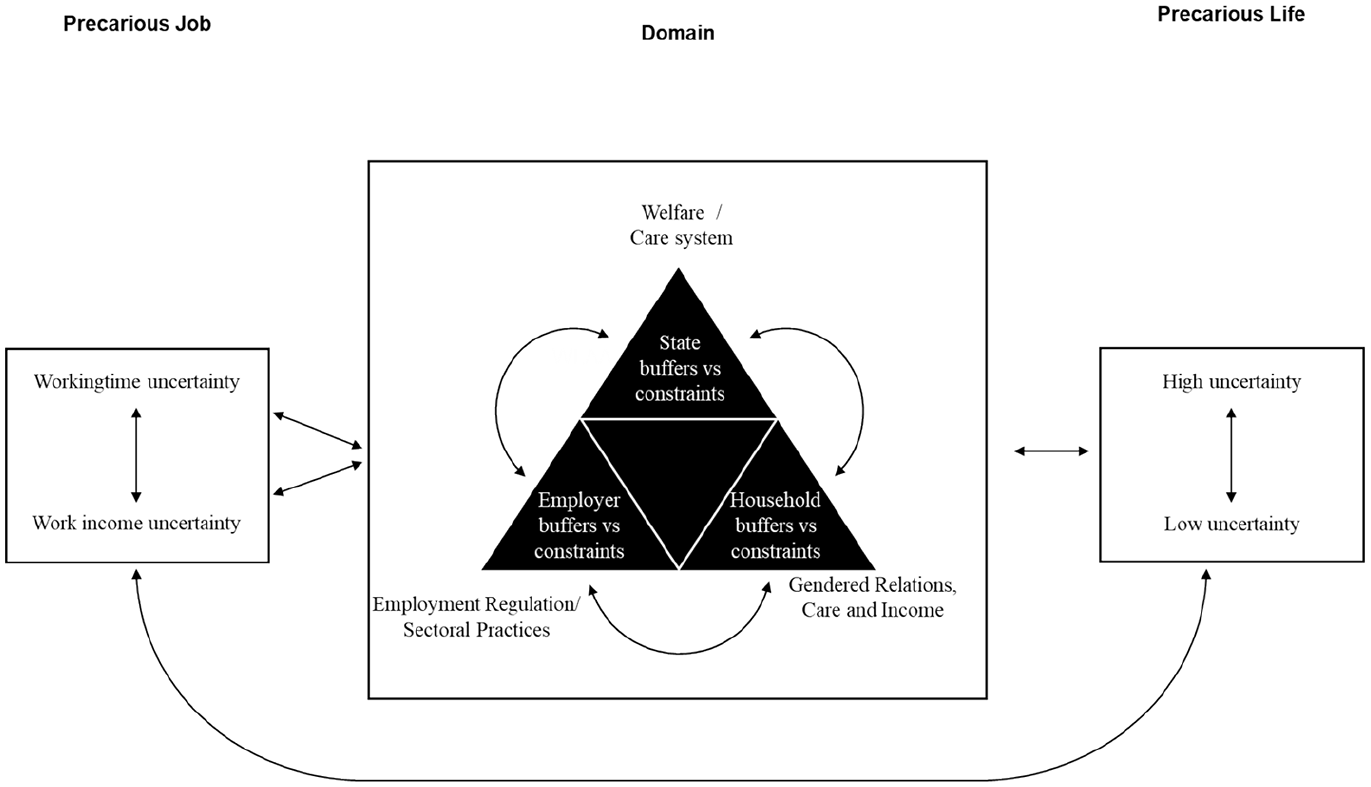
Managing uncertainties of time and income: A three-domain work–life articulation framework.
Findings
The 31 participants facing income uncertainty in their lives outside of work were all low paid (hourly wages below the Real Living Wage), except for one working nights on a ZHC. Participants in arts and hospitality in particular also faced insufficient guaranteed hours of work. All but two faced time-related uncertainty, though the form varied according to the job type and the contract: ZHC/MH workers faced variation by volume and schedule, day care home workers had predictable but rotating 12-hour shifts over 14 days (others worked up to five nights) and salaried workers were obliged to accept variable scheduling and/or unpredictable and extensive unpaid overtime. Two did not have working-time uncertainty because they negotiated fixed hours for care reasons despite being on ZHCs.
Table 1 shows that 22 of the 31 cases had WLA strategies aimed primarily at adding paid hours to reduce income uncertainty: 20 took extra shifts, five combined extra shifts with a second job, only two took a second job. Of the remaining nine, four adopted WLAs prioritising reducing time uncertainty while five were in salaried work where long and irregular schedules precluded adding paid hours. Some of these had taken salaried jobs to reduce income uncertainty at the expense of time certainty.
Breakdown of different work–life articulation strategies by gender, benefits and care across the case studies.
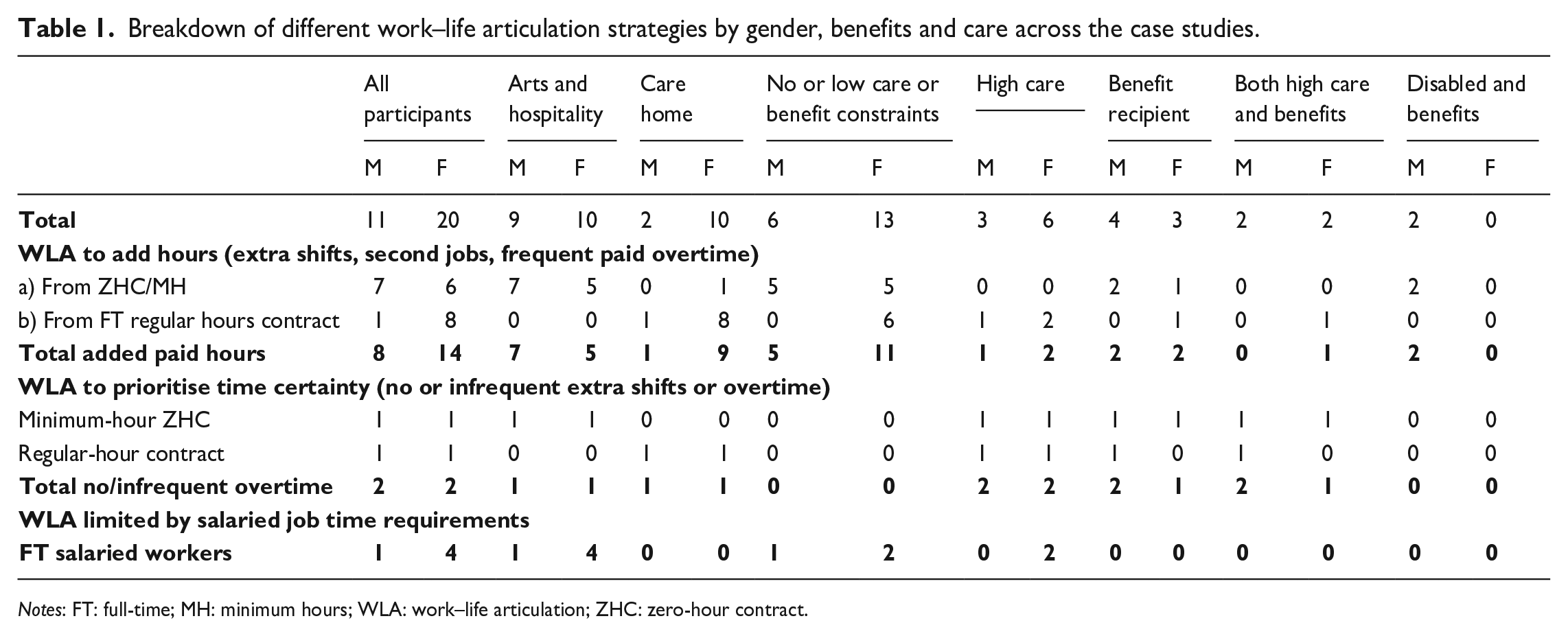
Notes: FT: full-time; MH: minimum hours; WLA: work–life articulation; ZHC: zero-hour contract.
These uncertainties and the WLA responses were shaped by care responsibilities and by the complexities and sanctions that characterised the benefits system. The extent of care responsibilities reflected in part the sample’s demographic characteristics: 13 were under 35 (only two with children), reflecting the arts and hospitality sectors’ reliance on young workers. Overall, of the sample’s 20 women and 11 men (in line with the sectors’ gender composition), only three men and six women had current high care responsibilities (defined as being the main carer or sharing the care responsibility, whether for own children, grandchildren, sick/disabled adults and/or elderly). Seven participants were current benefit claimants and, overall, six men and 13 women had neither current high care responsibilities nor were claiming benefits. However, as revealed in the accounts below, the influence on WLAs of both the state and the household, alongside the specific job and contract conditions, are wider and more complex than these figures suggest. Moreover, most participants could aim at best at partial mitigation of uncertainty, even on a temporary and fragile basis. These accounts inform the final findings section WLA strategies to mitigate income and time uncertainty across three domains that returns to the synthesis provided in Table 1, to consider the complexities and dynamic nature of the interactions across the three domains, both currently and over time, in shaping WLA strategies to mitigate uncertainties, as represented in Figure 1.
Managing uncertainties at the intersection of employment and the state
The extended influence of the state on the interviewees’ WLA strategies is indicated by the centrality of the benefits system not only in the accounts of the seven current benefit claimants but also in several of the seven who had recently lost benefits. Even some of the 16 with no recent claimant history emphasised how avoiding claiming, despite being eligible, was a key factor shaping their WLA strategies. Those who had lost benefits reported issues such as changes in family members’ disability benefit assessments, rises in the minimum wage, increased hours in their main job or in multiple jobs (even temporary upturns). This experience had exacerbated their income uncertainty, as they not only lost regular income but often had to repay overpaid benefits. Importantly, narratives revealed that, where sanctions were imposed because of income variations, interviewees often did not understand why they lost benefits or how their debts were calculated. Stephanie, who worked multiple jobs as an actor and in the art centre’s bar explained: I used to have tax credits, but then . . . I think I got overpaid in them . . . because [my income] changes so much so I think I hadn’t . . . let them know about something and then they were kind of like, ‘Oh, well, you’ve got to pay it all back’. And it got to a point where it was too late for me to go, ‘Well, actually, no I don’t think you did overpay me’ . . . They were saying I owe them £500. (Stephanie)
Stephanie had no household buffer so had to pick up extra shifts at the end of the month to ensure she could buy food. This was possible because she had no care responsibilities but came at the cost of greater time uncertainty: Getting tips really does help because . . . there’ve been times where I ran out of money very quickly in the month and then just lived off tips. (Stephanie)
For all seven current claimants, the difficulties of navigating the benefits system and the intricate calculations required to balance uncertain working hours and income dominated their accounts of their WLA strategies. Fear of losing access or of fines if they breached key hours or income thresholds embedded in the complex benefit regulations was an overriding concern for claimants, exacerbated in some cases by employers’ variable working-time schedules. Three had opted out of seeking additional paid hours and are among the four participants classified as instead seeking to minimise time uncertainty in their WLA strategies (Table 1). While all had care responsibilities, fear of benefit loss also motivated this strategy and their acceptance of low income that exacerbated the precarious nature of their lives.
For two disabled men, benefits were a necessary evil as they provided a safety net if they were physically unable to carry on working. However, their anxiety over maintaining access to that buffer became, in itself, a cause of their heightened uncertainty. Both men had been told that in order to keep receiving the Employment Support Allowance (ESA) they had to find work. Simon complied by taking all available voluntary shifts in the art centre in the hope of getting some paid work. After a few months he was given a ZHC and eventually a MH four-hour contract. Nevertheless, he still felt obliged to accept all shifts offered for fear of not being offered any in the future. If he worked over 16 hours, he had to transfer from ESA to tax credits (now Universal Credit), which provide lower benefits, thereby increasing his long-term income uncertainty if he became unwell or had insufficient shifts. However, he decided to remain being, what he termed, ‘the apple’ of his manager’s eye by never turning down a shift: I was just hovering round about . . . 16 hours, . . . and just thought . . . ‘Yeah . . . my mental health was still up and down in a big way’ . . . so I was uncertain, but I . . . sort of . . . dropped ESA and started . . . claiming tax credits and . . . I think I’ve pretty much exceeded 16 hours per week since. (Simon)
James’ story was similar: he found employment as a cleaner for a sports stadium and moved directly onto tax credits. He had just started cleaning a pub his daughter managed at the weekends. As with Simon, he had to navigate between the uncertainty of insufficient hours, his physical ability to work and his benefits: But as long as I do more than 16 hours a week I am ok . . . I can still claim Working Tax Credit because on 15 hours I couldn’t afford to do it . . . now it’s coming to Christmas it’s going to get loads of hours from me. But if I do too many hours, I lose part of [my benefits] . . . I wanted to be on 40 hours a week but I can’t . . . Because my body won’t handle it. (James)
Both interviewees faced risks in switching permanently from ESA to tax credits. Their concerns over whether they would have enough, but not too much, work heightened their precarity. Their WLA strategies had to consider not only current opportunities but also longer-term risks if their health deteriorated. These problems derived from both the specific benefits regulations and their lack of guaranteed hours. Thus, whatever WLA strategy they chose, it could prove unsustainable, with risks to income, benefits access and health.
For some claimants, benefits did provide some sort of buffer against uncertainty. Their WLA strategies were still dominated by navigating the benefits system but due to some household support, particularly over caring arrangements, their risk of income loss was lower. Furthermore, regular hours and/or predictable overtime opportunities enabled some to calculate and optimise their income potential without breaching benefit limits.
An example is Emily, a single mother on Universal Credit and a residential care worker. As the only earner, her household income was low and her income uncertainty high. However, she had recently moved from nights to day shifts with family support in caring for her son. Her 12-hour day shifts (over a two-week rolling rota including weekends) involved high time uncertainty. To manage this work, she was highly dependent on her mother who also did shift work. Thus, if her mother’s work pattern changed, she would struggle to manage.
Her move to Universal Credit and from night to day work had been positive as she was better able to balance caring for her child: I’ve been on like benefits since being 18 with me having a child and then obviously working as well and then going on to Universal Credit. It is a lot better because it’s more . . . managing your money as well ‘cause it is paid to you in like a lump sum every month. (Emily)
She took on overtime but carefully calculated how much she could work up to the Universal Credit’s work allowance: . . . but I always try and do like an extra . . . like day, just to cover . . . just to make sure I’m not losing any money. (Emily)
In these examples, the benefits system had a direct impact on her time uncertainty. Where benefits are coupled with household support or with scheduled, controllable employment, they may serve as a buffer against the degree of precarity experienced but this support is not necessarily sustainable. Thus, even when benefits provide a safety net, they can still heighten uncertainty, particularly if the worker’s future capacities are uncertain due to disability or when the conditionality built into the benefits system interacts with high variability in available paid hours. Some of the 16 interviewees without recent claimant history reported making a deliberate choice not to claim, despite potential eligibility, for fear of making a mistake. For others, their decisions were influenced by the perceived stigma attached or because they felt physically able to work. However, they were often dependent on their household providing either care or economic support or indeed accepting the long, even excessive hours of work to make ends meet. It is the household interactions with employment that are explored in the next section.
Managing uncertainties at the intersection of employment and the household
Although the WLA concept was initially developed to capture gendered and classed work–life conflicts for those with childcare responsibilities, this sample adopts employment and household WLA strategies across a wider range of contexts. In only three cases were female participants currently in households with dependent children (one partnered, two single). All three had primary responsibility for care, but their WLA strategies for supporting childcare often extended outside their immediate household and partner to grandparents and other non-household members. Only three men were living in partnerships with the mother of their dependent children: in two cases responsibility for care was passed to the mother, in one it was shared. Both men and women participants were involved in other forms of care: two men shared care for a child outside the family home while five women had a mix of other care responsibilities from grandchildren to sick or disabled relatives mainly inside the home but also including one ex-husband. Moreover, while most of the eight men without current care responsibilities had never had children (five) or had adult children (one), two depended on their partners for childcare. In contrast, six of the 12 women currently without care responsibilities had recently stopped being carers when their children became adults. Thus, despite the variety of contexts, the female participants still reported a wider and deeper experience of care.
Moreover, even the younger women were aware of care issues despite not yet having children. Amanda and Stephanie who worked as bar staff at the art centre could cope with the high working-time unpredictability and unsocial hours but, in their experience, this changed for female but not male staff once they had children: . . . the two women who’ve worked there in the bar who . . . have been pregnant and had children, like . . . they’ve both left . . . like they’ve intended to come back but they just haven’t. It seems to be all the men . . . whose partners have children who work there . . . it’s sort of easier for them I suppose to . . . stay at work, do those hours. (Stephanie)
Amanda elaborated further: I’d be scared, um, . . . like the security of it if I had a child . . . like being late nights and, uh, I don’t know if it would be enough money then. I’ve only ever had to look after myself. (Amanda)
Similar to JRF’s (2021) findings, the interviewees’ work–life histories revealed how the uncertainty they experienced and the WLAs they adopted shifted throughout their life courses, as caring responsibilities and circumstances in their extended households changed. Several female workers, like Kasia, a care worker, explained how she had worked nights when her child was younger but later moved to day shifts: Because I was on the night, . . . I was coming from work . . . like 8 o’clock in the morning, waiting on the front door, only brush her hair and [she] was going to school . . . the first few months my husband . . . wasn’t at work because he can’t find the work . . . I was working like . . . six nights a week, sometimes more . . ., because I need to have overtime to keep my house to pay the . . . rent, . . . after five and a half years . . . I moved [to days] . . . Because I don’t want to work on nights . . . it’s hard . . . it’s not a life . . . Because she was in the secondary school and she can take herself. (Kasia)
Likewise, Marysia, now also a care worker, had worked nights in a pizza factory when her son was young but had to leave after a divorce. Some older participants also spoke about ensuring their shifts allowed them to care for their grandchildren or for older relatives. In Sandra’s case, she returned to work as a kitchen porter in a stadium when her husband retired to supplement his pension while he became the full-time carer for their grandchildren, his pension enabling a reversal of gendered household roles: I am married . . . we’ve just got guardianship of two of our little grandkids . . . So, we’ve swapped roles – he stays at home and I am working. (Sandra)
The household care strategies often acted both as a buffer against uncertainty and as a major factor shaping working-time decisions. Susan, now an activities worker in the care home, explained how she negotiated her work and caring pattern in relation to both her mother’s and her husband’s working patterns. She had looked for a Monday to Friday job as her husband worked weekends and cut her hours to facilitate the school run. Importantly, it was her mother’s working hours that were critical: My mum worked here, and she always did the early shift . . ., she did eight in the morning ‘til two, . . . so then she’d go and pick my children up from the childminder or school for me, . . . and she helped me out right through having [my children], . . . I couldn’t have done it without mum. (Susan)
However, extending working hours to decrease income uncertainty led to increased time uncertainty and, in Kasia’s case, to risks to her own mental and physical health. Therefore, how working time was negotiated in the household and how caring was shared among the immediate or extended household mattered for experiences of precarious lives.
Although only a minority of women had current childcare responsibilities, their narratives about their work–life strategies were more dominated by their experience of navigating care than those of men. Household responsibilities affected both what jobs the women felt they could accept and what hours they could work. Thus, the mainly female care staff found the care home’s rolling shift rota preferable to other jobs, due to its predictable if demanding shift patterns and the opportunities both for voluntary overtime and to do school pick-ups on days off.
Three male interviewees identified themselves as having high childcare responsibilities that led them to focus on mitigating working-time uncertainty. For example, Carlos, an usher at the art centre, a divorced father with joint custody of his son, shaped his WLA around his care responsibilities. His strategy was to take a second job, a choice that is often difficult to combine with care responsibilities, but both his jobs had fixed hours that fitted around his child’s schooling and his child’s time at their mother’s house. These regular working times enabled him to manage care and work, although he continued to experience income uncertainty. Daniel in the residential care facility shared childcare with his wife who worked part time as a night cleaner. She could care for the children during the day, enabling him to be the main breadwinner and commit to the full-time rotating shifts involving unsocial hours. However, he did not take on any overtime as he prioritised caring for his children.
In two cases, the father relied on the mother for care and felt able to work extended hours and multiple jobs. For example, Abid worked two jobs: one as a weekend night hotel receptionist and the other a Monday to Friday 9 a.m. to 6 p.m. accounts job for a catering company. He described his income uncertainty as his ‘personal financial crisis’ as he was supporting his family in Pakistan. Accessing benefits was not considered an option and despite his wife working as a part-time teacher, they were unable to make ends meet. Because his wife did the childcare, he could work two 12-hour shifts as a hotel receptionist. His 24-hour stretch on a Friday when he went straight from his main job was followed by a Saturday night shift. Consequently, he experienced high time uncertainty with insufficient rest and recuperation time. He explained how, despite his wife’s support, he faced tension in the household as he felt unable to have time off and this prevented them making any plans: But I think without support, you can’t do anything. My wife supports me . . . Sometime, you, you’re tired. And then . . . little bit sometime, wife, she’s, ah, angry . . . because why you are not giving us time? (Abid)
The only case where the women relied on their partner to provide care was Sandra, as described above, where her retired husband looked after the adopted grandchildren. Nevertheless, some of the women were finding ways to maintain jobs with very irregular hours through someone else doing the care. Thus, Elizabeth, a salaried hotel reception manager, often working 12-hour shifts for up to 10 days even when her husband became unwell, relied on her 17-year-old daughter for the core caring responsibilities. Her daughter’s help enabled her to keep her job, thereby avoiding a major further increase in the household’s income uncertainty.
Where care responsibilities were shared across extended household members, everyone’s shift patterns had to work in unison. In these cases, as described above by Susan and Emily, the balancing of caring responsibilities became the central theme in their accounts of their WLAs. This calculation became even more complex when there were multigenerational caring responsibilities. For Patricia (care home front desk), overtime was essential to make ends meet but her disabled husband relied on her for personal care, especially in the evenings. As her daughter worked as a teacher part time, they could share care for both her grandchildren and her husband. Decisions over when she did overtime depended on her daughter’s schedule; likewise, her daughter’s decisions to take on certain shifts depended on her mother’s rota and her husband’s or mother-in-law’s availability: Well, my daughter . . . has got two children, one’s five, one’s two . . . and . . . we go through my rota to see . . . if I can look after them when she’s gone back to school because she’s a teacher and . . . her hours are different to theirs, so . . . then I’ll babysit as well . . . I look at my rota and if I am . . ., then I’ll have the kids . . . if not, . . . she will ask her mother-in-law or her husband ‘cause . . . he’s self-employed, so . . . it’s a bit easier for him in some respects. (Patricia)
Hence, for these interviewees, the schedules of extended household members shaped the hours they could work, thereby restricting opportunities to reduce income uncertainties. For Patricia, the negotiations appeared consensual, with household members willingly forgoing their own earnings in particular contexts. However, for Fernanda, a salaried catering supervisor in the sports stadium, there was no obvious solution. She was leaving her relatively well-paid secure job because the long and variable hours had a direct financial impact causing lost work opportunities for her husband and costly childcare that did not fit her work rhythms, as she explains: One of the reasons I am leaving is because I have got a child . . . Tomorrow is first weekend I have off in about seven weeks. Yep, and the days that I am working weekends we are losing money because . . . he [husband] needs to be off work because I don’t have my family here, only his family, so it’s quite hard to organise around. And the days . . . I am off, I take him . . . out of school because I wanna do that but . . . because it’s not their problem that I am off on a Monday . . . I am still needing to pay. (Fernanda)
Hence, lack of support from her employer, her family and the state childcare provision were all resulting in untenable income and time uncertainty for Fernanda given her caring responsibilities. As in Abid’s case, Fernanda’s work was causing household tensions with no easy resolution. In Patricia’s case, she seems to have made a voluntary choice, but at significant financial cost, to assist her daughter’s WLA as far as she could. However, many relying on family support may encounter similar problems to Fernanda and Abid, particularly where long-term buffers in time or financial support are needed from other household members.
WLA strategies to mitigate income and time uncertainties across the three domains
What emerges from the narratives of the efforts to reduce or limit uncertainties of time and income is the dynamic, fragile and complex nature of the WLA strategies. The uncertainties themselves stem not only from current but also from past and expected future experiences. Thus, the experience of precarity and the constraints on WLA strategies cannot be fully captured by a point of time picture as provided in Table 1.
Despite the specificities of the WLA strategies, the summary statistics do reveal some key patterns; for example, of the 15 on ZHC/MH contracts, 13 had a strategy to work additional hours and none of these had high care responsibilities, indicating the difficulties of combining this kind of work with care. Paid overtime in addition to demanding rotating shifts in the care home proved more feasible even for those with high care responsibilities (one man, two women), in part because the overtime was voluntary and readily available and the full-time rotating work patterns were at least predictable. Some responded to the uncertainty of the benefits system coupled with high care burdens by settling for income uncertainty while prioritising reducing time uncertainty (for care reasons in all four cases and to avoid benefits problems in three of the four).
However, as our narratives reveal, this snapshot picture does not capture the full lived experiences of these participants. Thus, the 13 participants adding hours to ZHC/MH contracts still faced problems in enacting their WLA strategies, whatever their care responsibilities or benefit position: seven regularly worked more than 40 hours on varying schedules while the remaining six faced more difficulties in securing sufficient hours and worked highly variable hours that could mean working four hours one week and 60 hours the next. The two disabled men had to both worry about getting sufficient hours to make ends meet and keeping hours always below 40 for health and benefit reasons. The narratives around care often reflected life-course journeys from childcare to fewer constraints and back to care as grandparents or for sick family members. Moreover, current arrangements were often inherently precarious; for example, where the teenage daughter currently provided the care. Where care was mainly provided by another family member, tensions still emerged around the excessive working hours that often followed. In relation to benefits, the conditionality embedded in the benefits system shaped WLA strategies across a much wider share of the sample than the seven current claimants, including several who had been forced into additional hours due to loss of benefits and faced heightened income uncertainty due to repayments and fear of insufficient work.
Discussion and conclusion
This empirically grounded analysis of the experience of precarious work in the lives of workers makes three main contributions to understanding and conceptualising the processes by which precarious work leads to precarious lives.
First, by revealing the pervasive uncertainty experienced by those in precarious work and the double-edged sword of time and income uncertainty, where offsetting uncertainty on one dimension may raise it in the other, the study demonstrates the utility of Heyes et al.’s (2018) concept of uncertainty for understanding how precarious work impacts on precarious lives with all its consequences for intra-household conflict, stress and well-being. Yet it diverges from their imagery of uncertainty in jobs ‘spilling over’ into uncertain lives as it finds that this underplays the agency of workers who frequently develop and deploy varied WLA strategies to navigate income and working-time uncertainty in their search to mitigate one or more aspects of their precarious lives. Their choices are made within the constraints of the context in which they are embedded and reflect complex negotiations to create enough resources to live on and enough time to care.
The second contribution adds to the important work by Smith and McBride (2021) in applying the WLA concept, initially developed to better conceptualise gendered work–life conflicts by replacing the dominant work–life balance framework, to understanding how those facing precarious lives navigate between the employment and household domains. The added contribution here is to integrate the state into the conceptualisation of WLA strategies, drawing on Lain et al.’s (2019) insight that precarity as a lived experience is shaped by the state alongside employment and the household as an equal third domain. Figure 1 thus conceptualises WLAs as developed to manage uncertainty across all three domains. Importantly, the state here acts not only as a buffer against precarity but also as a key driver of precarity. This goes beyond Smith and McBride’s WLA strategy analysis that focuses only on employment and household interactions, although they recognise that state benefit policies do influence who has become a multiple job holder. The state’s role in inducing precarity is also extended beyond that in Lain et al.’s study where the impact stems from a weakening of the state retirement buffer to include the state as a direct cause of uncertainty due to its sanctions-driven benefits regime that instils fear of taking action not just uncertainty among claimants (Greer, 2016). This uncertainty and fear led some not to engage at all with benefits while others sought to carefully manage the hours they worked to minimise the risks of losing benefits or in some cases faced making repayments even when they needed more hours to make ends meet. The limited state-subsidised childcare also acted as a driver of uncertainty as even those in salaried permanent jobs did not always find their employment to be sustainable because flexible childcare is not available to match required working hours.
The article’s third contribution is to identify WLA strategies as part of a dynamic process of managing uncertainty that is ever-changing and not necessarily leading to stable or viable solutions. People often have to manage a very fine balancing act, particularly where low pay and irregular hours are combined with caring responsibilities and problematic benefits. This study shows that this balancing act shapes the choices workers make, in particular between mitigating income or time uncertainty. Moreover, an individual’s WLA may always be in flux and very prone to crisis, for where buffers do exist they may be fragile, as Shildrick et al.’s (2012) identified as a cause of a low-pay/no-pay cycle. Here the need for new solutions to uncertainty occurs even within time spent in low-paid work as conditions change across the three domains, requiring, as JRF (2021) argues, new adjustments and strategies. This may require complex intra-household negotiations such that conflict may be inherent and sacrifices made by a family member at one stage may not be sustainable long term. This puts into question notions that workers can protect themselves in precarious jobs through building up resources, known as ‘scaffolding’ (Beckman and Mazmanian, 2020; Pulignano and Morgan, 2023), as buffers in one domain; for example, benefits can be cancelled out by changing household and/or employment circumstances.
The study also highlights how intersectional inequalities shape the ways in which people are in particular able to mitigate uncertainty. The disabled participants had to prioritise continued access to benefits due to health risks; thus, the conditionality in the benefits system restricted opportunities to mitigate income uncertainty that was in part caused by low benefits. Despite the limited number of participants in households with current dependent children, there was still evidence of gendered roles in responsibility for caring, mainly in relation to care for grandchildren and for sick or disabled adults. Moreover, care had influenced the whole life trajectories of many of the women. Also notable was the high share of women taking up overtime opportunities in the care home, despite demanding and long working hours, and the number of hours worked by women in salaried jobs that provided security but low hourly pay. These examples suggest that, as Warren (2015) argues, women in more working class occupations may be more focused on income insufficiency than on reducing time in paid work, except where care is too difficult to arrange.
The study has specific policy implications for the UK state, which has fostered a highly deregulated labour market allowing ZHC or MH and unpredictable hours and a punitive welfare system involving strong conditionality, low benefits and costly childcare. These combine to increase the likelihood first of more precarious work and second of it leading to precarious lives, compared with countries with more employment regulation and more generous state support. Some of these policy lessons are being taken on board in the new Employment Rights Bill (UK Government, 2024), with restrictions promised on ZHCs and new rights to predictable and guaranteed hours that could reduce earnings volatility and ease navigation of the benefits system. Measures are also in place to extend free childcare to younger ages and to limit the amount deducted from benefits for previous overpayments but notably lacking is any commitment to raise benefit support or roll back the sanctions-oriented benefits system. Thus, although these reforms may signal an end to claims that flexible labour markets promote choice and opportunity (Heyes et al., 2018), without further reform the proposed changes are unlikely to be sufficient to reverse the rise in precarious work and lives and the associated poverty.
Nevertheless, the framework developed here for exploring the WLA strategies of those in precarious work across three interconnected domains has general applicability and could be used to illuminate how far these UK policy reforms might reduce income or time uncertainty in people’s lives. It could also be used to explore how WLAs may differ across societies with, for example, more generous state buffers or different gender and household structures and traditions that shape the available support for care.
Footnotes
Acknowledgements
We would like to thank Silvia Galandini, Domestic Poverty Lead at Oxfam, for all her help supervising this work.
Funding
The authors disclosed receipt of the following financial support for the research, authorship, and/or publication of this article: Economic and Social Research Council, Grant/Award Number: ES/P000665/1.
