




Abstract
In this article, we focus on gender and class to investigate worktime domestic labour. Methodologically, we extend a novel, comparative critical realist method in which occupation-based and gendered positions in productive and reproductive labour are foregrounded. By building theoretical connections between labour process conditions and collective rule-following practices, we illustrate how inequalities are inscribed organisationally. Our analysis provides a more critical contextualisation of technological affordances to develop the literature on how technology is implicated in the reproduction of social inequality. Moreover, our analysis identifies multi-level causal processes, which combine to explain the presence and actualisation of worktime domestic labour or its absence, which is due, principally, to fear of sanction. For realist researchers interested in diversity-based challenges, absences are important because they can point towards specific discriminatory mechanisms. Our investigation thus revealed a surprising level of class-related in-work inequality within the gendered dynamics of domestic work.
The future of unpaid work
Recently, efforts to extend literature about the future of work have introduced a welcome focus on domestic technology innovations that impact paid and unpaid work in gendered ways (Lehdonvirta et al., 2023). Since many housework tasks are susceptible to being carried out remotely, a ‘domestic technological revolution appears to be underway, at least in wealthier countries’ (Hertog et al., 2023: 1). However, social aspects of this technological revolution remain under-researched, particularly in the case where domestic work intrudes into working time. To fill this lacuna, we ask whether and how occupational roles and gender interact to affect the worktime domestic labour and work-life management of those who combine paid and unpaid work. Therefore, this article studies worktime domestic labour in which individuals and households use internet technologies to combine paid and unpaid work by undertaking housework at their workplaces. Our analysis focuses on how this is related to gendered patterns in work and life, and to diverse office-based occupational roles. Arguably, these contexts will combine to leave women at a disadvantage (see Walby, 1986), as women still do more unpaid work than men (Allen and Stevenson, 2023) and work is often divided along gendered lines (Rubery and Hebson, 2018). However, we can expect that women’s experiences will vary, situationally, depending on local management styles and work organisation, which we unpack in what follows.
Our study takes inspiration from Willis (1977), who illustrated how people of different statuses become socialised into cultures with very different expectations of work (see also Friedman and Laurison, 2019), and from Warren (2015), who highlights how people from less affluent backgrounds are often neglected in work-life research. We also develop the ideas of McDonald and Thompson (2016), who explore patterns of workplace control in relation to social media applications as a new ‘frontier of control’, by exploring the implications of gendered occupational labour processes for worktime domestic labour. Finally, we build on the work of Longarela (2017), who calls for research on vertical gender segregation, and Warren and Lyonette (2018), who explore the relationship between occupational class and job quality (both in this journal), by focusing on variation in quality of work-life articulation for people of different genders and in different occupational roles.
Our theoretical contribution combines a feminist form of labour process analysis with a realist theory of structural positioning. This argues that freedom to engage in worktime domestic labour depends on workers’ positions within workplace social structures, and how these positions are relevant to aspects of gender and occupation. We then explain our methodology, which develops a qualitative comparative analysis (see Lawson, 2009) to systematically focus attention on those aspects of the labour process that are most salient to workplace domestic labour. Our empirical contribution reveals that higher skill/higher status workers, from managerial, professional and associate professional/technical occupations, are relatively free to engage with worktime domestic labour, which could result in more equal sharing of responsibilities within households. In contrast, those in lower skill/lower status occupations generally face sanctions in relation to non-work, and therefore benefit less from the more equitable distribution of household labour that appears to be driven by domestic technology innovations.
We also argue that this inequality has a greater impact on working-class women because women, on average, bear a greater responsibility for unpaid work (Allen and Stevenson, 2023; Syrda, 2023) and face multiple levels of disadvantage in the workplace (Warren and Lyonette, 2018). Moreover, working-class women experience different work-life challenges to middle-class women (Warren, 2015). Our data suggest occupational classification may be an effective proxy for class, because our analysis reveals forms of inequality related to work time domestic labour that represent lost opportunities for the relative emancipation of women in lower skill/lower status occupations. The article ends with a discussion of these findings before conclusions are drawn.
Domestic technologies and work-life articulation
Technologies have affordances (Gibson, 1986[1979]) that emerge from their possible uses and how these come together with actual uses of them (Faraj and Azad, 2012). To date, research connecting work-life boundaries with the affordances of contemporary technologies (see, for example, Derks et al., 2021) has tended to focus on whether these help or hinder engagement with domestic and/or paid work. However, access to specific technologies varies, and it would be wrong to assume that all people benefit in the same way from these affordances, so experience of technology varies. For example, the use of managerial surveillance technologies (Delfanti, 2019; Kellogg et al., 2020) varies according to occupation (e.g. Clegg and Dunkerley, 2013) and gender (e.g. Cockburn, 1983), which makes the question of who has access to the affordances of domestic technology innovations very pertinent.
Gender, the social organisation of work and work-life articulation
In the UK, and despite legislation requiring employers with 250 or more workers to publish annual gender pay gaps (Acas, 2018), women endure significant pay gaps and a wage penalty in female-dominated occupations (Hegewisch and Hartmann, 2014). It is also still the case that women are more likely to work in the care and leisure sectors, for example, and are more likely to have less well paid part-time jobs (ONS, 2017). Therefore, research and action in this area are badly needed. Even in the ‘professional occupations’, men continue to earn more than women in every occupational group (ONS, 2017). Both women and men earn less when working in female-dominated occupations (i.e. those occupations where women account for at least 75% of the workforce); for example, as preschool teachers, dental assistants, librarians and registered nurses (Hegewisch and Hartmann, 2014). Women’s entry to predominantly ‘male jobs’, such as civil engineering, may also be limited, where many occupations emphasise long hours and lack of flexible work policies (Galea et al., 2022).
Working women also typically have more fraught work-life articulation than men (Lyonette and Crompton, 2015) and so have more to gain from doing worktime domestic labour. This is because women, who most often combine paid and unpaid work, experience this as a ‘double burden’ (Tepe-Belfrage and Steans, 2016: 314). Those who have the most housework, such as parents of young children, would benefit disproportionately (Syrda, 2023), as gendered inequalities in the division of domestic labour increase when individuals become parents, and then persist into older age (Pailhé et al., 2021). The scale of this problem should not be underestimated. In the UK, research estimates that unpaid work, including cleaning, laundry, child care and adult care, has a value equivalent to approximately 56% of GDP (ONS, 2016b). Therefore, we can assume that inequity in household labour infringes women’s rights and hinders women’s economic empowerment (Sepulveda Carmona, 2013). However, it is now clear that all of the main housework activities might be automated and that more than half of the time spent on housework could be saved through using technological innovations (Hertog et al., 2023). Consequentially, a narrowing in gendered inequalities in housework is also predicted, which would result in those who do the most unpaid work (generally women) having more time available to spend, for example, in the labour market (Hertog et al., 2023).
Existing studies in this area combine to offer fragmentary and piecemeal insight. For example, Strengers et al. (2019) found gendered differences in relation to the uptake of smart home technologies. Elsewhere, Friesen et al. (2021) study the effects of gendered patterns in labour market segmentation and access to technology, noting a relationship between traditional female occupations, including service work, and declining access to the internet in work time, and we know that middle-class people have less fraught work-life articulations because they have greater autonomy at work (Warren and Lyonette, 2018). However, studies of occupational inequalities that are structured by neoliberal economic policies (Huws, 2021; Pulignano and Morgan, 2023) and which are arguably more likely to affect the work-life articulations of people in more routine occupations, are notable for their scarcity. Occupational class thus affects relative freedoms in work-life articulation (Lyonette et al., 2007), and we can expect this will spill over to affect worktime domestic labour, but this is yet to be demonstrated.
Research also reveals that domestic labour, such as caring for children, is unequally distributed between genders (Allen and Stevenson, 2023; ONS, 2016a), and that labour markets are negatively impacted by the gendered division of household labour (Ferrant et al., 2014). Causes of this include familial gender socialisation with women, historically, tending to be socialised towards reproductive labour, or unpaid work at home, and men tending to be socialised towards productive labour, in the labour market (Bradley, 2013; Longarela, 2017).
Spatiotemporal organisation and supervision of the labour process
Work organisation shapes the conditions that people operate within, with offices being temporally and spatially dynamic contexts where non-work occurs naturally during the working day (Paulsen, 2014). When the internet is used for purposes other than work, non-work problematises the organisation of work time, a traditional channel of capitalist control. While managers are concerned with defining work time and ensuring that workers are optimally productive, worker subjectivity is constituted by a complex of motivations and responsibilities beyond the realm of work, which represents an alternative, often contradictory, rationality. These potentially opposing interests demonstrate the nexus of conflict in the employment relationship, where internet technology becomes associated with the indeterminacy of labour. This type of non-work, or ‘empty labour’ (Paulsen, 2014), illustrates one aspect of effort bargaining where conflicting interests can result in various workplace sanctions. In the labour process, there are multiple frontiers of control around work time (see McDonald and Thompson, 2016), and our study explores how organisational regimes shape individual orientation towards non-work and the extent and boundaries of workers’ control (Ackroyd and Thompson, 2022).
Arguably, work time is structured to serve the interests of powerful groups, with its repetitive working patterns organised to maximise the application of labour power at work (see Marglin, 1974). However, worktime rules are not always obeyed and can be contested and revised. Much depends on the pattern and location of demand for different categories of work, and how this is organised into job roles. In this area, a heuristic distinction between direct control and relative autonomy (Friedman, 1977) is a useful framing device. In the former (i.e. direct control), managers try to reduce every worker’s task range, engage in close supervision and predefine tasks in detail. In this type of environment, we expect workers to be trusted less and their freedoms for non-work to be smaller. In the latter (i.e. relative autonomy), managers allow workers responsibility and status, use light supervision and they reward loyalty. In this type of environment, we expect higher levels of trust, and workers to have the latitude to engage in worktime domestic labour, as it is less likely to be policed or actively sanctioned.
A theoretical framing of regulative rules and workplace social relations
To reveal how occupation and gender intersect to affect worktime domestic labour, we anchor our analysis within critical realist ontology and social theory: a radical humanist philosophy of science that is concerned with human agency and how people can be relatively emancipated from oppressive social structures (Collier, 1998). In particular, we focus on social positioning Lawson, 2022; Pratten, 2022 to consider the causal power of occupational and gendered social structures, which is consonant with other critical realist social theorists, such as Porpora (2015), Archer (1995) and Elder-Vass (2010). Instead ‘social positioning theory’ argues that when social agents adopt a social position, such as becoming a ‘worker’, they become components of a broader totality, a ‘workplace’, which has emergent causal properties that are its own – such as rates of production or tendencies to employ men or women. These emergent characteristics depend on the relations of their parts and how they shift over time, but they are the property of the system and its relations rather than the parts of that system in isolation.
All social positions (such as mother-child; manager-worker; priest-congregation, etc.) within such systems (the household, workplace, or church) have position occupants, which confer rights and obligations. For example, employees have obligations to work, often at specific times, and engage with specific technological affordances, as well as rights to pay, time away from work, and such like, which are incredibly various. Employees are also subject to organisational rules, the constitution of which matters greatly because they may be contested and adapted by organisational members. Arguably, where rules continue to exist and are reproduced, there must also be some form of social structure to which they relate, the most basic of which can be seen as a ‘norm circle’ (Elder-Vass, 2010). This is a group of people who are aware of expected standards of behaviour, and who affect the behaviour of norm circle members via positive or negative incentives when rules are upheld or transgressed. Higher-level organisational entities (such as teams, production units, employers, supply chains and the other parts of economies) can be seen as emerging from and constituted of overlapping norm circles, which interact and combine to form powerful associations that impart downward causal influence on the normative practices of group members (Elder-Vass, 2010).
Porpora (1993) argues accordingly: rules (i) are culturally produced and constituted; (ii) emerge within materially anchored social relations; (iii) which situate behaviour; and (iv) enable self-understanding. In his own words: Although emergently material social relations are generated by cultural constitutive rules, those relations independently affect the ways in which situated actors think and act. In particular, the social relations generated by the constitutive rules may differentially benefit and empower certain actors, who thereby are motivated and enabled to maintain or change the rules. Thus, if we ask why the rules are what they are, we must examine the material relations generated by the current or past rules. (Porpora, 1993: 213)
Finally, for the purposes of this brief exposition of realist social theory, Archer (1995) posits that causal powers of any social structure must always precede and impinge on the social activities and choices of its members, as we must always act in specific circumstances. However, this is not to say that social structures determine what we do: we always have latitude (agency). We can choose to disobey and challenge the rules.
Critical realist social theory is not without detractors from both Marxian (see Brown et al., 2002) and social constructionist (see Al-Amoudi and Willmott, 2011) theoretical traditions. Marxian scholars highlight critical realism’s lack of attention to the historical specificity of capitalism. Social constructionists, on the other hand, suggest that critical realism’s commitment to epistemological relativism, in which we each occupy our own, always flawed, socially constructed version of reality, often becomes lost in the search for more specific and concrete objects or social totalities. Unfortunately, we do not have space here to unpack the detail of these esoteric and foundational philosophical debates. Instead, we repackage critical realism’s often used conception of social structure, as prior to and impinging on (without determining) social agency, which we use here to anchor our labour process analysis (see also, Thompson and Vincent, 2010).
Labour process analysis focuses attention on the pattern of rights and obligations that exist at work. It privileges the study of workplace relations, as sites of relative exploitation and control, and often focuses attention on objectifiable aspects of work organisation, such as technological affordances, and the relative freedoms these afford to differently gendered occupations. In a manner consonant with Lawson (2019), labour process analysis also views each employer as a ‘relatively autonomous’ organisational entity with its own properties and powers (Edwards, 1990).
In the effort to overcome critical realism’s tendency to be overfocused on objective social structures (Edwards, 1990), while we recognise that people tend to identify with others who occupy a similar social position to themselves, such as co-workers, and to privilege their own contribution to society when doing so (Sayer, 2005), subjective experiences and agential choices cannot simply be read from our social position. For example, people often believe they belong to a social class that is different from the status society attaches to their job or socioeconomic position (see Devine et al., 2004). We thus recognise and acknowledge the importance of subjectivity in explaining social action and the reproduction of social relations, which we are sensitive to in our analysis. However, we are also aware that people can only react to the social position in which they find themselves, and for this reason we take objectifiable dimensions of social structures as a valid point of departure.
We also assume that organisational rule systems will have occupation-based and gendered antecedents and implications. However, once people become employed, labour processes constitute a structured positioning device that fixes people in terms of rules and obligations in ways that organisational members may be unaware of. Social structures, such as forms of work organisation, thus have generative effects that are deep and hidden from view (O’Mahoney and Vincent, 2014), and which will impinge on our normative dispositions. They must consequently be theorised as we explain events relating to organisational rules and obligations that condition worktime domestic labour. We expect that these rule systems will shape the technological affordances available to different categories of workers, and so we now turn to demonstrating this inference.
Method
The study, which developed from a PhD about personal internet use at work, sought participants with fixed working hours, who also had routine access to the internet at work. Using the UK’s Standard Occupational Classification (SOC) as a guide, a purposive non-probability approach to sampling sought office workers from diverse but relevant occupational classifications.
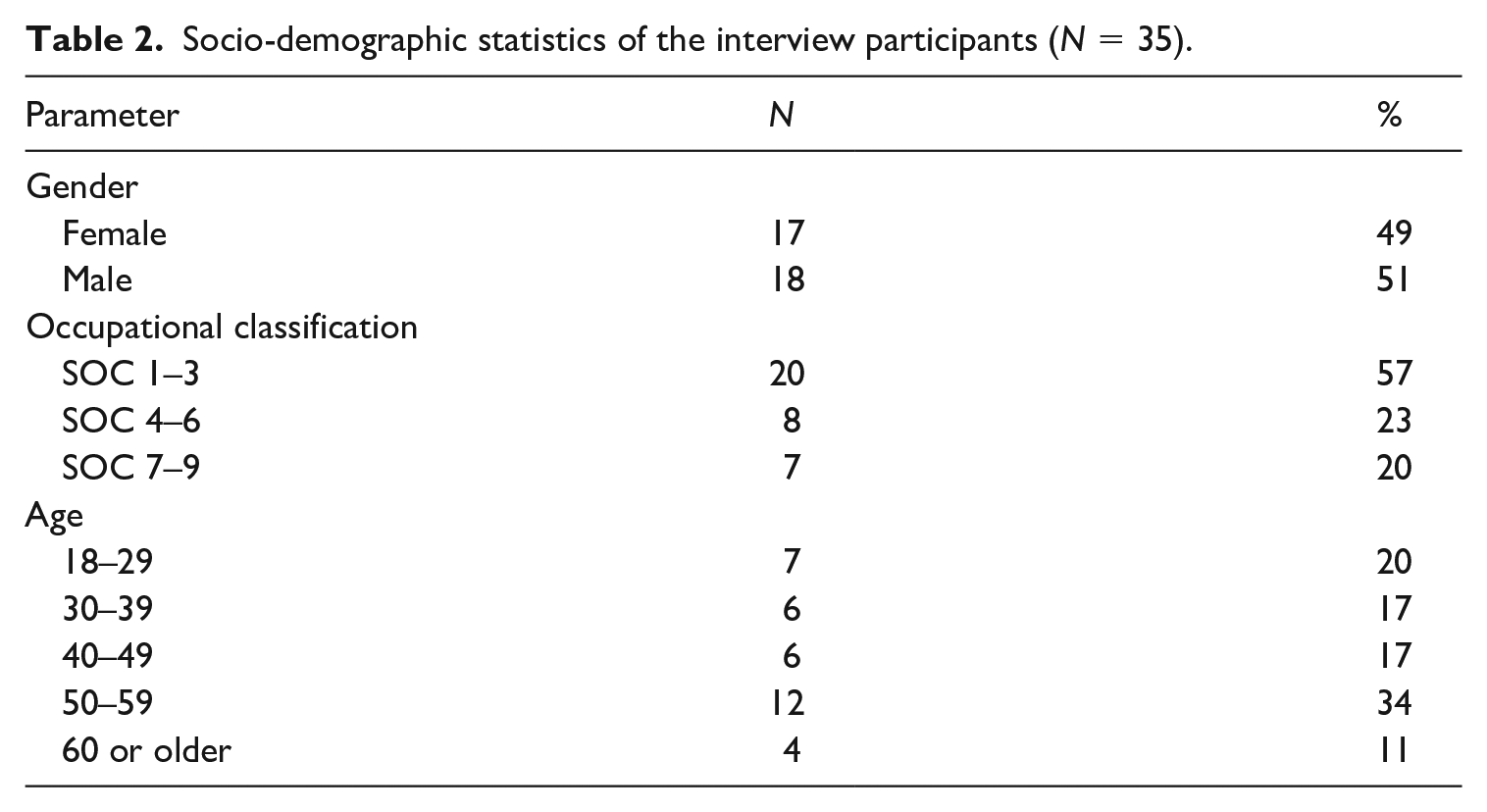
The research used a snowball sampling approach, and this resulted in interviews with 44 participants in 25 different organisations. Here, to explore gendered and occupational dynamics, we draw from 35 interviews with office workers Table 1, conducted between 2018 and 2020. The sample presented here included approximately equal numbers of women and men across seven of the nine major SOC groups (Table 2).
Participant information.
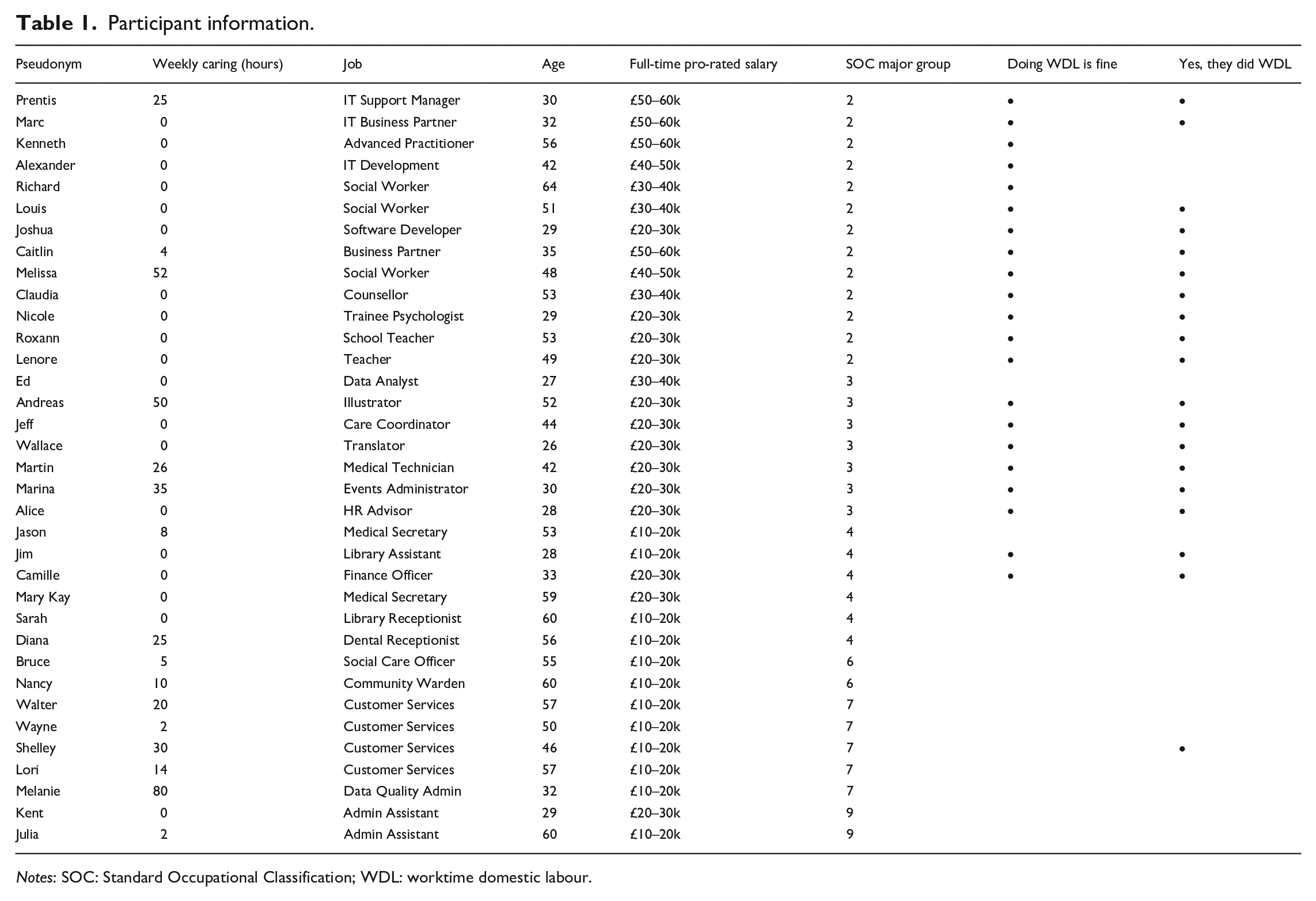
Notes: SOC: Standard Occupational Classification; WDL: worktime domestic labour.
As sampling began with the first author’s network of contacts, a higher proportion of participants work in customer services (the first author’s current job) and in adult social care (the first author’s previous job). However, a conscious effort was made to reach a demographically heterogeneous sample of workers (Ellard-Gray et al., 2015) from across the UK, from different age groups, and different sectors and occupations, including social work, teaching, healthcare, financial management and IT. Most participants (20 of 35) lived in heterosexual couples with the remainder living in single-person, single-parent or same-sex couple households. The interviews, which were anonymised and transcribed verbatim, ranged in length from 25 to 85 minutes, with an average length of 45 minutes.
Socio-demographic statistics of the interview participants (N = 35).
Narrative interviews
As worktime domestic labour involves the contested terrain of labour time (see McDonald and Thompson, 2016), we used a narrative interview technique in the effort to gain respondents’ trust and build rapport (Pascoe Leahy, 2022). Developed by Schütze (1992), this approach is characterised by efforts to create interview situations where the interviewer has minimal control over content and ordering (Slembrouk, 2015), which reflected our commitment to give participants control over how the interview process developed (Sarantakos, 2013).
Interviews started with a very open question (see Sarantakos, 2013), with workers invited to explore their social practices in their own terms, including their domestic responsibilities, divisions of domestic labour, job roles and labour market circumstances, attitudes to technologies, and their work-life articulations, as well as how these things related to their worktime domestic labour. The analysis was then undertaken abductively, via an iterative cycle in which emerging themes were redescribed ‘in an abstracted and more general sense in order to describe the sequence of causation that gives rise to observed regularities in the pattern of events’ (O’Mahoney and Vincent, 2014: 17), and using a contrastive analytical method.
Contrastive explanation
Understanding what caused variance in individual worktime domestic labour proved challenging, as it was necessary to determine, from a vast number of causes, those that were most explanatorily relevant (Tsang and Ellsaesser, 2011). The interview data were wide ranging, as was our reading of existing theory and research, which is reflected in our literature review, theoretical framework, and analysis. In the analysis, these sources were combined with the data in an effort to build stronger theoretical connections between data about technological affordances, worktime domestic labour and the office-work contexts in which they reside.
Our initial analysis highlighted the significance of gender and occupational skill level, as the evidence that gendered and occupation-based antecedents affected worktime domestic labour was overwhelming. Therefore, to explore and explain these patterns, and other salient causes, an iterative analytic process was adopted that is compatible with abduction and critical realism, and which was underpinned by contrastive explanation (Lawson, 2009). Our comparative work started with realist thematic analysis, which is suited to many types of data, and which can be used to generate significant findings (Fletcher, 2017; Lennox and Jurdi-Hage, 2017). While acknowledging that individual meaning making can be fallible, thematic analysis allows an assessment of the way individuals give meaning to experience (Maxwell, 2012).
As interviews were read and re-read, themes were developed (such as ‘Intensity’, ‘Agile’ and ‘Slack’) and using labour process theory as a theoretical anchor, it became possible to focus analytical attention on the constitution, presence and absence of worktime domestic labour for people from different genders and occupational categories. Moreover, via comparison of patterns at an aggregated level, we understood how social positioning in relations of domestic and paid labour had implications for worktime domestic labour. Ultimately, this abductive strategy focused analytical attention on those aspects of the labour process that were most salient to explaining the different work-life articulations of different types of workers.
New technology and the reproduction of social inequalities
Our findings revealed that occupational skill level was highly significant in accounting for variance in technology-mediated work-life articulation outcomes. In total, 16 out of 20 participants in higher skill/higher status jobs (SOC major groups 1–3) offered examples of worktime domestic labour, with many describing time-consuming tasks. Within this subsample, eight out of eight female participants, and eight of 12 male participants reported undertaking worktime domestic labour. This observed gendered difference is likely a manifestation of societal heteronormative expectations in the realms of both work and households (see Bradley, 2013; Syrda, 2023).
In lower skill/lower status jobs (SOC major groups 4–9), 12 out of 15 respondents said they did not do any worktime domestic labour. Of the three people who provided examples, one of these, Jim, was a library assistant, whose job included considerable ‘slack’ as he worked in a college library, where the intensity of work varied significantly. Another was Shelley, who is introduced in more detail later. By distinguishing between the presence or absence of worktime domestic labour, our comparative analysis focused analytical attention on two interrelated dimensions of the labour process: (i) spatiotemporal organisation and (ii) supervision. Next, we consider implications of patterns of difference for work-life articulations.
Spatiotemporal organisation of work
Studying spatiotemporal organisation of work involves identifying objectifiable dimensions and patterns within work activities. We inferred that, where work is geographically or temporally dispersed, this can create downtime or space between tasks, which can be used for worktime domestic labour. Alternatively, where work organisation is focused and intense, workers can struggle to find any time for non-work activities.
In our study, many of those in SOC 1–3 jobs took advantage of slack in the working day to undertake domestic tasks. One example was Claudia, who was a counsellor. Her work was split between an office in the city centre and a community-based location, in which she had a private office and where she was sometimes alone. At this location, slack created space for non-work; for example, when a client failed to turn up: What I have done recently is . . . Because you know that [partner’s] daughter has got [a medical condition]. So, I was researching that online. So, the reason I was researching it was for my own domestic, family use. (Claudia, Counsellor, SOC2 job)
Claudia was not subject to rules about smartphone use and she was not expected to use flexitime to take care of domestic tasks. Rather, she could take care of these between appointments or during a gap in her schedule. In comparison, Melissa, the parent of a school-age child, generally preferred to ‘flex out’ for non-work tasks that could not be managed remotely: ‘so sometimes I might go and do things for my parents during the day. Or I might go to the school.’ However, many domestic tasks can be managed over internet in work time: So, things like I might look onto school, if I’ve forgotten about . . . school, say a play or something like that, I might go onto the school website and see what’s there. If I’m pushed to put appointments in way ahead, I can go onto the internet and see when the school timetable is. (Melissa, Senior social worker, SOC2 job)
Melissa, who had separated from her partner, estimated 52 hours of unpaid work per week with worktime flexibility conferring considerable work-life advantages that allowed her to pause the working day when necessary. Like Melissa and Claudia, most of the workers in SOC 1–3 jobs used their relative autonomy to engage in worktime domestic labour and if they were seen to be performing in their job role, this perk was granted.
By contrast all but two of those in SOC 4–9 jobs reported a lack of slack in the working day and most suggested personal internet use could attract sanction. One account from Julia – an admin worker in a SOC 9 job – described a highly routinised labour process where non-work was limited by temporal constraints: ‘it’s like you’re on the treadmill’ and ‘the way things are there you can’t do anything else but work’. Julia’s example was typical of those in SOC 4–9 jobs who more often experienced temporal inflexibility in work organisation.
In these examples, we can begin to see occupation-based implications of organisational rule systems that disproportionately impact those with the highest burden of care for others (Syrda, 2023; Tepe-Belfrage and Steans, 2016). These impacts have patriarchal gendered antecedents that are perpetuated through, inter alia, traditional gender roles (Longarela, 2017). Yet, there is enormous potential for employers to alleviate existing structural inequalities by providing greater flexibility for worktime domestic labour. Such increased flexibility may persuade women, who have a greater caring burden than men (Allen and Stevenson, 2023), and who may therefore be at risk of leaving the labour market, to remain. This, in turn, can contribute to a more inclusive and equitable work environment.
Supervision of the labour process
Our second dimension of the labour process, supervision, is used to assess the frequency, potential and means for managers to observe and sanction the conduct of workers, such as whether workers are engaged in worktime domestic labour when they might otherwise be working. In our study, only those in lower skill/lower status jobs (the SOC 4–9 group) complained that managerial supervision formally prohibited personal internet use; for example, Melanie worked in a call centre where social media and webmail were blocked. Restrictions were justified by the work context, which involved access to sensitive data, such as bank details (client contracts included clauses about data protection). However, Melanie’s managers were not bound by the same rules: Team leaders and senior managers do as they please. They use phones, pens, the internet, and everyone can see each other. The rules shouldn’t be different as contractually no one on the floor should have pens or paper but it’s one rule for them and one for us. (Melanie, Call centre admin worker, SOC7 job)
Workers like Melanie would benefit greatly from the level of trust enjoyed by many in SOC 1–3 jobs. With two preschool children, Melanie estimated her unpaid work at 80 hours per week but she had very little opportunity to engage in non-work: We are timed for all time away from our desk [. . .] We are allowed seven minutes a day for unscheduled breaks, toilet breaks, phone checks. We get two 15-minute breaks, unpaid, and a half hour lunch, unpaid. If someone needs to contact you in the day, you have to give the office phone number of your team leader. (Melanie, Call centre admin worker, SOC7 job)
Like Melanie, others in SOC 4–9 jobs experienced significant limitations on engaging with non-work and this was associated with the potential for sanction. When organisational systems of surveillance and control limit the worktime domestic labour of those in low skill/low status jobs, such constraints differentially impact women because they already bear a disproportionate responsibility for domestic work (Allen and Stevenson, 2023; Huws, 2019).
Contrastingly, those in SOC 1–3 jobs typically could engage with worktime domestic labour. While many in SOC 1–3 jobs, such as teachers, social workers, health specialists and IT professionals, had times when their job role restricted their range of activity, their managers typically did not sanction them for engaging in non-work. An illustrative case is Prentis, an IT support manager who worked full time and had a young child. He said, ‘the first thing I do when I get in, in the morning, is open WhatsApp so I can talk to my wife all day’. He used different communication channels: ‘Facebook, Messenger, they’re all open throughout the day, so notifications are turned on and I wear headphones’.
Prentis estimated his time spent on non-work at ‘probably about 90%’ and the amount of work he had on any given day varied: ‘some days I’ll sit watching YouTube all day’. His specialist knowledge also meant there was little chance that his non-work would be monitored: Our monitoring system doesn’t work. Of course, I know that. Nobody else does. So, they’re all very careful with what they look up on the internet. I don’t care because I know fine well that it’s not getting logged anywhere. So, I guess it’s kind of an insider knowledge that lets me do what I do. I know that nobody can check the logs, check the firewall. If anybody does, it’s me, so, I’m not going to report myself. (Prentis, IT support manager, SOC2 job)
Both Melanie and Prentis have preschool children, which implies higher levels of domestic responsibility (Pailhé et al., 2021). If we compare their experience, Melanie’s labour process is closely supervised. This is not the case for Prentis. Whereas Prentis can remain connected to his domestic responsibilities throughout the working day, Melanie cannot. Therefore, our data confirm our assumption: that there is a direct relationship between quality of work-life articulation and individual placement in the occupational hierarchy. The next section considers the implications of the presence or absence of specific technological affordances related to domestic labour for wider social experiences and work-life articulation.
Rules and work-life articulation
To illustrate work-life articulation outcomes associated with higher skill/higher status jobs, we now develop the case of Prentis and introduce Camille who engaged with worktime domestic labour in a way that enabled more equitable work-life articulation. We later contrast these outcomes with the cases of Walter and Shelly, who were both in SOC7 jobs and experienced more constrained work-life articulation.
In Prentis’s case, he describes a seamless work-life interface where the internet allows his wife to delegate domestic tasks, some of which may be incorporated into the journey home: So, when I leave work, I say the catchphrase to activate the assistant: ‘let’s go home’. It turns on the Bluetooth and pairs it to the car, starts my playlist for driving home. It turns on Google Maps to show me the traffic. And then announces to my wife at home on speaker that I’m on my way and then she can reply to that saying, ‘oh, get milk’ and it’ll adjust Google Maps to the Tesco nearest my house. [. . .] So, she can sit and make a list throughout the day verbally [. . .] And I’ll get that list as I drive home. (Prentis, IT support manager, SOC2 job)
While this example falls at the work-life boundary – the commute home – rather than during work time, it illustrates how technology enables a more fluid work-life articulation. Prentis’s wife was empowered by technology to delegate domestic work, and so the technology, in enabling remote social interaction, becomes potentially empowering. However, and unfortunately, in our study, being free to engage in worktime domestic labour was limited to those in SOC 1–4 jobs like the example next of Camille: Because technology is so good, these days everything I do is online. All my bills are online, gas and energy, that’s online [. . .] If I had to do them outside of work . . . it would have to be done in, say, an hour or two, in one session. You know, a couple of times a week . . . whereas now it’s just a couple of minutes here and there at work. It’s so much easier and so much more manageable. And it makes . . . I enjoy work more as a result of it because I have that freedom and I feel like I’m trusted to do things. (Camille, Finance officer, SOC4 job)
Camille’s worktime domestic tasks included managing household budgets with her partner via an online spreadsheet, arranging car insurance, booking medical appointments and using a home security app to check on her dog. While she used lunchbreaks for more time-consuming tasks, she said: ‘I basically manage my entire life online’.
With the exception of Jim (mentioned earlier), our findings suggest men in SOC 4–9 jobs rarely engaged in worktime domestic labour; for example, Walter had limited privacy and had been subject to close scrutiny at work: Well, the same manager who told me off for using my phone, the following day I walked through her office, and she was on the phone to her son. So, I thought, ‘well, you hypocrite’, but, if anybody was to say something . . . that’s my argument . . . that somebody has to contact me if it’s [about] my mother because she’s got dementia. (Walter, Customer services assistant, SOC7 job)
Aside from responding to calls concerning his mother (for whom he was the live-in carer), Walter did no worktime domestic labour. This was very typical for those in lower skill/lower status jobs. Among this group, several participants said they had either been warned or sanctioned about workplace technology use and several others were aware of colleagues having been sanctioned. This manifested as a heightened vigilance among those in SOC 4–9 jobs, which specific and hierarchically structured roots.
Such an outcome was demonstrated by Shelley, who, like Walter, was a customer services assistant, and one of only three in the SOC 4–9 jobs sample who described undertaking worktime domestic labour. Like Walter, she had a significant caring responsibility, looking after her grandson for 30 hours each week, which she described as ‘all of my spare time’. When Shelley was asked if she did online banking, she said: Yes, I couldn’t do it any other way. I haven’t got the time. I haven’t got the time. Kids ask for a lend and I could be at work, and they are at home, so I just pop it straight in their bank, do you know what I mean? It’s really convenient. I don’t think I could do without it now. (Shelley, Customer services assistant, SOC7 job)
Shelley described her husband’s housework: ‘he doesn’t do a great deal of it; he hoovers and washes the dishes, and he irons’. When their children were younger, Shelley said ‘it used to be me doing the majority of it [–] I never expected [husband] to do it’. However, after their children left home, ‘now that it’s just me and him and it’s just our mess, I think he should clean up his own mess’.
Shelley worked across several different locations. Depending where she was working on a given day, she exercised more, or less, caution: ‘I think it all depends on who you work with, isn’t it?’. Moreover, Shelley’s non-work was constrained by rules, and she often carried out worktime domestic labour surreptitiously, in the knowledge that she could be sanctioned. However, Shelley was careful not to attract scrutiny; for example, she avoided using workplace PCs for non-work. By carrying a smartphone at work, Shelley reflexively resisted an organisational rule designed to limit smartphone use among customer service workers.
Here, our evidence demonstrates that forms of social coordination normatively acclimatise social agents to collective practices (Lawson, 2019), including norms around non-work, and workers typically respect local norms, as they wish to benefit from their employment relations, unless, as in the case of Shelly, an instrumental calling to engage in worktime domestic labour overrides the normative limitations of workplace expectations. Shelley described how a colleague had been sacked for ‘looking at wedding dresses’ online. Therefore, perceived risks meant she moderated worktime domestic labour. When asked whether she could use her phone in work time, she suggested she could use it in corridors ‘if I feel my phone buzzing in my pocket’. However, she only did short tasks in work time.
A few months before the interview, Shelley had begun to use ‘Click and Collect’ for supermarket shopping (where items are paid for online, then collected in person). Shelley used her phone to order items: ‘I’ll amend my food shop if I’m at work’. Before Click and Collect, ‘it was me doing all the shopping’. Click and Collect saves valuable time: I’m finding now that my grandson is getting older, I’ll spend more time with him, and I just don’t have the time to go and do it so [husband] does it. He finishes earlier on a Friday than me, so he goes and gets it and brings it back. (Shelley, Customer services assistant, SOC7 job)
As with the earlier example of Prentis, we can see how domestic technology innovations can contribute directly to the defeminising, or regendering, of care (Boyer et al., 2017; Longhurst, 2017) by facilitating sharing of tasks. In Shelley’s case, although she describes an uneven distribution of unpaid work that is gendered (Allen and Stevenson, 2023; ONS, 2016b), online food shopping allows her to engage in work time domestic labour and delegate collecting the food shop to her husband.
Theoretical implications
Our analysis has theoretical implications for researchers interested in the significance of absences and for those wishing to produce more complete causal accounts of social phenomena.
The analytical significance of absences
For realist researchers interested in diversity-based challenges, absences are important because they can point towards specific discriminatory mechanisms, in this case that emerge from relations among occupation-based or gendered social positions. We identify people not engaging with worktime domestic labour as an absent affordance, which was problematic for SOC 4–9 workers with caring responsibilities, regardless of gender. Moreover, we found that where the emancipatory possibilities of technological affordances are not actualised or present in local data, individuals must be constrained by deeper causes that are embedded within their subjectivities and the social setting (see Bhaskar, 2008[1975]; Martinez Dy et al., 2014). Accordingly, our data demonstrate that social coordination operates through normativity, and conformity (observable in collective practice), which is achieved when community members adhere to an accepted way of proceeding (Lawson, 2019: 47–48). Yet, rules (and even more so norms) do not constitute a direct form of control: they are held internally to subjects and are habituated over time through social relations that are generated by such rules (Al-Amoudi, 2010; Porpora, 1993). Given that those in SOC 4–9 jobs who follow rules limiting non-work occupy a more subjugated subjective status, it is important to explain why agents might choose such a course of action, beyond an immediate necessity to avoid sanction.
From this perspective, we argue that the apparent freedom of SOC 1–3 respondents to do worktime domestic labour is a ‘positioned right’ (Lawson, 2019: 61) that is limited to those in higher skill/higher status jobs. This outcome illustrates how rules are structures of power (Lawson, 2020[1999]) that relationally organise position occupants in terms of collective practices (Lawson, 2019). These practices emerge in different ways, locally, for example, because work is less intense, diverse, dispersed and/or ‘lumpy’. In these circumstances, people have latitude to use work time for non-work, and people have become used to this right – it becomes normalised. In this regard, spatiotemporal and supervisory dimensions interact. In the opposite case, where work organisation is locally focused and intense, direct control becomes both increasingly possible and likely. Yet, these outcomes are not inevitable, as managers can go to great efforts to monitor remote workers (see Greer and Payne, 2014), while they may trust in the discretion of those in their immediate work environment.
By theorising the labour process in terms of positions, rights and obligations, which we expected to have gendered and class-based antecedents and implications, we account for variance in workers’ technological affordance and absent affordances to engage with non-work. These findings extend McDonald and Thompson (2016), who explore social media use as a ‘frontier of control’ at work, as worktime domestic labour is one such frontier that was previously underexamined. Furthermore, we extend Warren and Lyonette’s (2018) work, by demonstrating significant differences in the quality of work-life articulations according to occupational positioning. We also provide empirical work that supports Longarela’s (2017) research agenda to explain the consequences of vertical gender segregation. This deepens the ongoing discourse on workforce gender inequality and encourages further exploration into how employers can foster inclusivity and gender equity. Furthermore, we develop gender equity discourse with reference to expectations that are complex, microstructural, and subjective (Al-Amoudi, 2010; Porpora, 1993). Expectations are informed by one’s position in the social fabric of workplace norms around pace of work, and prior experience of sanctions. Moreover, they are bound to shape our worktime behaviour so they are key to understanding why people tolerate workplace inequalities. As our analysis demonstrates, people of different social statuses have very different expectations of work (Willis, 1977).
A more complete causal account of worktime domestic labour
Our study asked how occupation and gender intersect in the experience of worktime domestic labour to explain positive and negative implications for work-life articulation. To answer this question, we extend a novel form of analysis in which occupation-based and gendered positions in productive and reproductive work are foregrounded through a comparative critical realist method (see Martinez Dy et al., 2018; Monroe et al., 2022; Tsang and Ellsaesser, 2011). Thus, we identify objective dimensions of work organisation that are responsible for the differential outcomes described; for example, when access to the technological affordances that enable worktime domestic labour is limited, those in SOC 4–9 jobs are less likely to experience work as an environment for personal development (Höpfl et al., 2017; Willis, 1977).
Our approach not only recognises the multifaceted nature of gender but also underscores the importance of considering occupational contexts when analysing gender-related issues. Therefore, our study provides considerable insight into how occupation shapes the structural manifestations of gender systems (Martinez Dy et al., 2014) and enables the development of an account of class-based structural mechanisms that exist across different contexts. By connecting interacting mechanisms at different strata, our analysis achieves a more complete causal account of worktime domestic labour. As such, the account represents an example of thick causality (Fleetwood, 2014: 209), in which connections are revealed between social structures (including various aspects of work organisation) and the agential responses that reproduce and transform these social structures (Martinez Dy et al., 2018).
Finally, we also contribute to critical realist theory about social agency, by revealing how normative reactions to the differently structured domains of work and life have implications both for rule-following and for rule-breaking behaviour, and how rule changes are mediated by technological affordances. Moreover, by building the theoretical connections between labour process conditions and collective rule-following practices, we illustrate how inequalities also emerge from the interactions of structure and agency and identify multi-level causal processes that explain the presence or actualisation of worktime domestic labour, as well as its absence. This is possible because our method facilitates the comparison of multiple conditions simultaneously. More specifically, where a group of participants are ostensibly similar, but with small variance in terms of occupational class or job role, in-work autonomy and domestic responsibility, differential patterns of causation can be identified revealing a surprising level of in-work inequality.
Conclusions
In this article, we develop a feminist form of labour process analysis using social positioning theory (Lawson, 2022; Pratten, 2022) in the effort to better understand how workplace inequality is structured to affect the way people enact workplaces. In doing so, we have developed a fine grained explanation of differences among workers’ engagement with non-work and how constraints, which are socially consequential, affect work-life articulation. The analysis revealed that those in lower skill/lower status jobs, who typically experience constrained or limited engagement in worktime domestic labour, experience a form of inequality that represents lost opportunities for relative emancipation. Therefore, our account adds to knowledge of how aspects of social life are constituted by the causal properties of rules that result in relationships of control, where control resides with those creating or enforcing such rules (Porpora, 1993).
By focusing on gendered and classed outcomes, we provide a more critical contextualisation of technological affordance by extending the literature on how technology is implicated in the reproduction of social inequality (Visser et al., 2019). Our article implies several lines of enquiry for future research. Firstly, in the study of class dynamics, there are potentially various areas to be explored. Where partners in dual-earner couples occupy different labour market positions or where individuals’ occupational class and natal class differ, a future study would be valuable. While we have focused on heteronormative gender positions in this article, future research should extend this by focusing on non-heteronormative positions. Incorporating diverse voices and perspectives, and exploring the nuanced dynamics of gender roles, expectations and inequalities within these groups will contribute to a more comprehensive understanding of the varied ways in which gender intersects with other aspects of identity and social structuring. Secondly, a study that focuses on age is needed as it seems likely that age would affect engagement in the technological affordances that enable worktime domestic labour. Indeed, age is likely implicated in attitudinal differences towards sharing domestic responsibility. Thirdly, studies are needed that analyse the relationship between individual technological skill and relative risk of organisational sanction. This article has begun to explore the important topic of worktime domestic labour for those who wish to empower workers and create more humane societies.
Footnotes
Acknowledgements
We are greatly indebted to Dr Knut Laaser and three anonymous reviewers at WES for their endlessly generous, thoughtful, developmental support.
Funding
The authors disclosed receipt of the following financial support for the research, authorship, and/or publication of this article: The research was entirely funded by a PhD scholarship from Newcastle University Business School.
