




Abstract
This article critically examines how low-paid workers, who need to work in more than one legitimate job to make ends meet, attempt to reconcile work and life. The concept of work–life articulation is utilised to investigate the experiences, strategies and practicalities of combining multiple employment with domestic and care duties. Based on detailed qualitative research, the findings reveal workers with two, three, four, five and even seven different jobs due to low-pay, limited working hours and employment instability. The study highlights the increasing variability of working hours, together with the dual fragmentation of working time and employment. It identifies unique dimensions of work extensification, as these workers have an amalgamation of jobs dispersed across fragmented, expansive and complex temporalities and spatialities. This research makes explicit the interconnected economic and temporal challenges of low-pay, insufficient hours and precarious employment, which creates significant challenges of juggling multiple jobs with familial responsibilities.
Keywords
Introduction
There is growing academic, social policy and political interest in issues around low-pay and precarious work, with approximately 5.19 million UK workers paid below the foundation living wage (FLW) (Moore and Fiddes, 2019), which is currently £9.30/hour (£10.75/hour in London). While there has been passing reference to low-paid workers having more than one job (see Rubery et al., 2018; Standing, 2011; Taylor, 2017), this is the first study to explicitly investigate, in depth, the working lives of low-paid workers in multiple employment in the UK. As the specific focus of this article is to examine the lived realities of juggling multiple employment with care and domestic responsibilities, the concept of work–life articulation (Crompton, 2006) is utilised. It is a multi-dimensional concept that centres on three specific dimensions that are pivotal to this study, namely: working time arrangements, employer work–life balance policies and household care arrangements. This conceptualisation is utilised, rather than the notion of work–life balance (WLB), as it critically assesses the strategies of individuals and families in attempting to combine employment with family life. Crompton argues that work–life ‘balance’ is a misleading phrase as it implies harmony; therefore, ‘articulation’ is a more neutral term to examine the practicalities of work–life arrangements, together with experiential dimensions.
The article, therefore, begins by assessing the concept of work–life articulation and specific dimensions concerning working hours, organisational WLB policies and household care arrangements. The following section critically reviews literature around work–life studies, working time and low-pay, and offers reasoning for the conceptual and analytical framework for the study. The research methods are discussed, involving in-depth interviews with 50 workers, nine trade union representatives and six senior managers. The findings are then presented, encompassing the complexities of multiple employment and expansive working time arrangements, new inequalities around the operationalisation of WLB practices, together with the challenges of juggling manifold jobs with domestic responsibilities. This research highlights fresh insights into ‘the new norm’ of precarious employment, in that it demonstrates how some low-paid workers need to have an amalgamation of jobs to make ends meet, and are ‘working to live’, as opposed to being fulfilled by work. In the conclusion, the contribution of this research to sociological debates is addressed, incorporating developments to an employer-led model of working time with the variability of working schedules, along with the dual fragmentation of working time and employment. The research advances literature on work extensification, as these workers have a multitude of jobs that are dispersed across fragmented, extended and complex temporalities and spatialities. Furthermore, this research makes explicit the interconnected economic and temporal challenges of low-pay, insufficient and non-standard hours, and precarious employment, which create new dilemmas and sacrifices around work–life articulation.
Work–life articulation, working time and low-pay
There is a plethora of academic and practitioner research into the reconciliation of work and domestic life, but this has always been a central issue for employees and their families. Galea et al. (2014) assert that progressive human resource management policies and practices can facilitate a ‘proper balance’ between work and life. However, the day-to-day reality of organisational life is often more complex, problematic and contested than such functionalist portrayals suggest. Crompton (2006: 62–88) develops the concept of work–life articulation, as families and individuals constantly juggle the multiple and often competing demands of work and home life. This conceptualisation focuses on the experiences, practicalities and decision-making strategies of workers and families attempting to navigate a range of complex and transforming issues (Crompton and Lyonette, 2011). Work–life articulation is multi-dimensional and critically considers employer WLB policies and practices, working time arrangements and the challenges and complexities of attempting to accommodate work and life. All of these dimensions are pertinent to studying the lived experiences of low-paid multiple employment.
Regarding WLB policies, Crompton (2006: 89–114) highlights the importance of the operation of practices and managerial discretion. Backett-Milburn et al. (2008) favour the use of informal practices, whereby line managers have the independence to support flexible working requests. However, research by Mountney and Reid (2012) into low-paid workers reveals that managers are often inflexible to such requests. Moreover, Wood (2018) argues that this creates a ‘capricious environment’ where workers must be obedient in order to be granted ‘flexibility’ for WLB, which further extends managerial discretionary power and control. Blyton and Jenkins (2012) endorse a more context-sensitive and multi-dimensional approach to work–life studies. In their study of workers gaining new employment after redundancy, they found that workers were ‘constrained by the precise nature of work available’, which was largely low-paid, part-time and insecure, with unpredictable working hours. This resonates with the research by Warren et al. (2009) who argue that part-time, low-paid employment creates additional WLB complexities. In contrast, Bonney (2005: 399) argues that the appeal of part-time employment is that it is ‘the solution to issues of WLB’.
However, it is important to note that UK workers only have the ‘right to request’ flexible working, but with the economic imperatives of profitability and efficiency gains, WLB is relegated to a peripheral concern (Smith, 2016). Given the asymmetries inherent in the employment relationship, Crompton and Lyonette (2011) underscore the power of certain employees who can individually negotiate favourable working time arrangements. This raises pertinent concerns around the operationalisation and management of WLB policies and practices for low-paid workers, particularly those with more than one job who work non-standard hours.
Whilst Bonney (2005: 399) contends that working hours are ‘more an issue for observers and analysts’ than workers themselves, Crompton and Lyonette (2011) argue that working time is central to work–life articulation; in particular the volume, duration and structuring of work hours. The emergence of a globalised economy has resulted in extended operating and opening times in many organisations. This erodes the notion of a ‘standard’ working week of Monday to Friday from 9 a.m. to 5 p.m., which is replaced by what Supiot (2001: 79) terms the ‘vicissitudes of working time’. Therefore, the former homogeneity of working time is being reconstructed, fragmented and individualised (Williams et al., 2008). The diversification of working time arrangements incorporates non-standard hours, covering early mornings, evenings, nights and weekends. Given these expanding temporalities, employers and managers are constantly attempting to efficiently manage working time by tailoring staffing levels to meet fluctuations in demand (Supiot, 2001). Indeed, the growth of part-time employment and ‘mini-jobs’ of under 16 hours/week offers employers additional flexibility over both the deployment of labour and costs (Rubery et al., 2005). This variability and unpredictability of working time often permeates non-standard hours (Smith, 2016), as managers can demand ‘flexibility’ from workers at short-notice (Wood, 2018). Rubery et al. (2005) argue that there is a new temporality based on an employer-led model of working time, which enhances the managerial prerogative to the detriment of employees’ work–life preferences.
The struggles around work–life outcomes are further illuminated by Williams et al. (2008) who argue that workers are constantly attempting to manage multiple temporal regimes. However, these challenges and demands blur the boundaries between work and other activities, as Supiot (2001: 81) states: ‘the shadow of work is projected on to free time’. Crompton (2006: 89–114) highlights the deleterious implications of excessive working hours on work–life articulation. Furthermore, Jarvis and Pratt (2006) define this as work extensification, with the overflowing of work across spaces and times. The causal factors of ‘making labour work longer’ are identified by Worrall and Cooper (2007) as financialisation and cost-reduction strategies, which result in endemic long hours for managers. Indeed, Moen et al. (2013) report escalating workloads for professionals that generate blurred boundaries around work/non-work times and places. However, research on work extensification is primarily focused on managerial occupations, and what is absent is critical analysis of the working time challenges of the low-paid. Reisch (2001) offers a useful conceptualisation of time, in terms of chronometric, chronological, personal time sovereignty and synchronisation dimensions. Chronometric and chronological relate to the right amount of time at the right time of day. Personal time sovereignty is around control of working hours and context, while synchronisation refers to complementing the time rhythms of family and friends. Similarly, the desynchronisation of time is illuminated in a study by Rubery et al. (2015) on care workers and they use the term ‘fragmented time’ to depict employers’ use of strict work schedules to meet peak demands. Indeed, there are inequalities of time, particularly for those working non-standard hours, which have temporal repercussions (Chatzitheochari and Arber, 2012). These workplace demands, together with limited ‘choices’ over hours, often have negative impacts on family life (Craig and Powell, 2011). Therefore, in the context of research into low-paid multiple employment, it is important to examine working time arrangements and the practical implications this has on the articulation of work and life.
The experiential dimensions of work–life articulation focus on familial strategies to accommodate employment with care duties (Crompton, 2006: 139–162), but low-paid precarious work brings fresh dilemmas. The recent Taylor Review of contemporary employment lauds the so-called ‘British way’ of a ‘vibrant, flexible labour market’ (2017: 47), claiming that atypical working arrangements are ‘usually chosen and valued by the individuals concerned’ (p. 16). However, critics point to high levels of both job tenure and job status insecurity, particularly experienced by those at lower levels in organisations (Gallie et al., 2017). Indeed, Rubery et al. (2018) argue that precarious work is ‘the new norm’ and encompasses low-pay, insufficient hours, short-term contracts and dependent self-employment. These economic and temporal issues result in particular challenges for low-income families, especially around affordable childcare (Mountney and Reid, 2012). Research by Warren et al. (2009) uncovers ‘tag team parenting’ where partners work ‘opposite’ hours to fit childcare around employment. Those in low-paid employment also face job precarity and the threat of unemployment, which Shildrick et al. (2012) term the ‘low-pay/no-pay cycle’. Similar dilemmas are illuminated by other researchers who have found that some low-paid workers have to make use of foodbanks due to low wages and insufficient hours (Garthwaite, 2016; McBride et al., 2018). Warren (2015) underscores issues of underemployment and the associated work–life challenges of too few hours. While Hochschild (1989) refers to the second shift and time squeeze of those in professional occupations, Warren raises important concerns of those at the lower end of the labour market who are often neglected. Therefore, issues of low-pay, multiple employment, working time arrangements and work–life articulation raise a number of important research questions. How are work and life articulated and experienced by low-paid workers in multiple legitimate employment? In what ways do the management and operationalisation of WLB policies and practices impact on these workers? How do working time schedules, volumes and patterns influence work and family life?
The study
Based on a qualitative research strategy, the study centred on Yorkshire and the North-East of England because at the inception of the study both were in the top three regions for underemployment (Office for National Statistics (ONS), 2012), with over 20% of workers paid below the FLW (Lawton and Pennycook, 2013). The central focus was on workers with more than one legitimate job who are paid below the FLW, to critically examine their work experiences and work–life challenges.
However, such workers constitute a ‘hard-to-reach’ group, as they are relatively hidden (see Bonevski et al., 2014). In particular, they have multiple jobs, with different employers, in varying locations, which creates complex daily lives. In order to identify potential research participants, partnerships with organisations were developed and an ‘Advisory Group’ (AG) established with key actors from trade unions, community groups and poverty organisations. Through the AG, the project was advertised widely and the research team also met with ‘lay stakeholders’, who provided unique insights on accessing hard to reach populations (see Kaiser et al., 2017). They offered useful advice on the use of ‘down to earth’ language for recruitment materials, posters and flyers.
The team built up trust with the AG and attended 10 separate union meetings with seven different unions explaining the research aims and handing out flyers. An unemployment community centre in the North-East distributed 1000 flyers with their regular postings. Some of the AG organisations advertised the project on their social media pages. The team maintained regular contact with all of these organisations and utilised both purposive and snowball sampling techniques to access low-paid workers in multiple employment. In some instances, this led to ‘respondent-driven recruitment’ (Bonevski et al., 2014) whereby some participants circulated flyers to colleagues.
Arranging research interviews was challenging owing to the complex daily schedules of these workers. Therefore, the location and timing were important and interviews were conducted in cafes, our offices, private library rooms and spaces facilitated by some AG organisations. The team also offered a £20 supermarket voucher to all interviewees as recompense for taking time out of their busy schedules to participate in the study; such incentives are permissible in Economic and Social Research Council ethical guidelines in the UK.
Between June 2015 and May 2017, the team conducted 50 semi-structured interviews with low-paid workers in multiple employment, along with six senior managers and nine trade union representatives. The interview questions focused on the experiences of work, roles, job control, low-pay, working time complexities, access to WLB policies and work–life challenges. The collated data are rich and in depth, revealing the meanings and perceptions of low-paid multiple employment. Data analysis began with close reading and re-reading of the interview transcripts, with the fragmentation of data into specific categories. This involved iterative, manual thematic analysis with open coding of transcripts to identify themes relevant to the research questions (see Lofland and Lofland, 1995). The narrative below is presented around a series of themes drawn out of the analysis of the participants’ experiences, covering working time schedules, organisational WLB practices and work–life challenges. It should be noted that all respondents’ names in the text that follows are pseudonyms.
The forgotten workers
As workers in legitimate low-paid multiple employment are largely absent from academic and policy coverage, we use the term ‘the forgotten workers’. There are Labour Force Survey and British Household Panel Survey data on those with second jobs only, but this is limited to details on industries, roles, incomes and hours worked (Atherton et al., 2016; ONS, 2019). This study contributes qualitative depth and detail to this distinctive social phenomenon. As Table 1 demonstrates, the workers interviewed were employed in cleaning, catering, bar work, the care sector, security, social services, education, retail, DIY, public services, administration, the entertainment industry, utilities and IT services. These occupations span the private, public and third sectors, but a number of public sector jobs were recently outsourced due to austerity cuts. In terms of employment contracts, these combine full-time (FT), part-time (PT), agency, temporary, seasonal, casual and zero hours contracts (ZHC). The majority of the interviewees were women, and ages range from late-teens to 60s. Regarding education, there were a minority with no qualifications, but many had NVQs, GCSEs, ‘O’ levels, ‘A’ levels, good quality degrees and even master’s degrees. The research team expected to speak to workers with two or three jobs, but were surprised and alarmed to interview a number with four, five and even seven different jobs. All of the workers interviewed had multiple jobs because they were struggling to make ends meet, some engaged in additional self-employed work and several made use of foodbanks: ‘If I didn’t do all these jobs, I wouldn’t be able to live. I wouldn’t be able to survive’ (Anna, four jobs: PT shop assistant, PT catering and two PT cleaning jobs).
Profile of worker research participants.
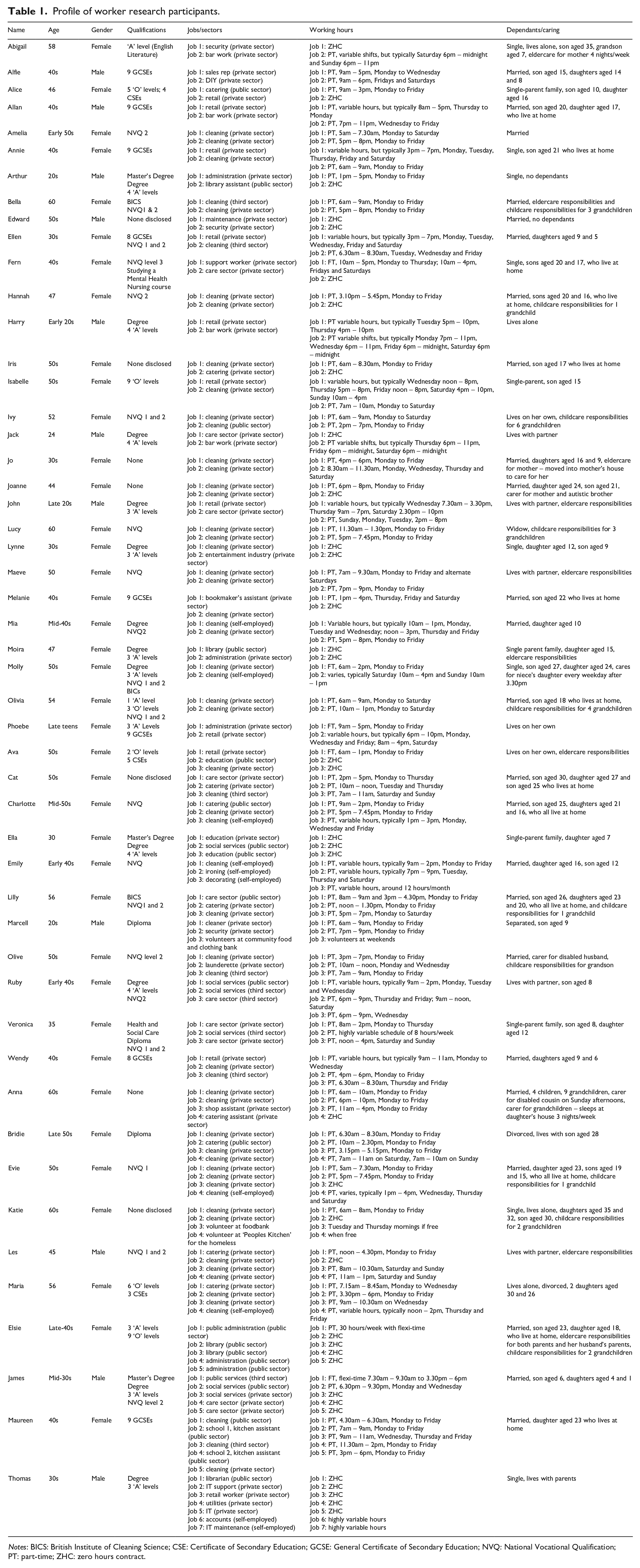
Notes: BICS: British Institute of Cleaning Science; CSE: Certificate of Secondary Education; GCSE: General Certificate of Secondary Education; NVQ: National Vocational Qualification; PT: part-time; ZHC: zero hours contract.
This article argues that the causes are related to the proliferation of low-paid, part-time, zero hours, outsourced and insecure work. Issues around precarious and non-standard employment are also highlighted by Rubery et al. (2018), Standing (2011) and Tinson et al. (2016). Indeed, research by the Trades Union Congress (TUC) found that only one in 40 jobs created since the financial crisis of 2008 is full-time (TUC, 2014). All of the trade union representatives interviewed were aware of this growing issue. Indeed, some unions were receiving enquiries from workers to ask if their union membership would cover more than one employer, to which the unions gave assurances that they would fully represent such members. These workers were struggling to earn enough to ‘keep their heads above water’ due to low-pay, job instability, constrained employment opportunities and insufficient working hours.
The extensification of work and fragmented time schedules
All of the interviewees worked fragmented and complex working time schedules, which invariably permeated non-standard hours. Many experienced what Rubery et al. (2015: 767) describe as the extreme ends of unsocial hours employment, which incorporated working early mornings, evenings and weekends. Indeed, as indicated in Table 1, 26 worked early morning shifts, 29 worked evenings and 26 worked weekends. They all had an amalgamation of jobs to make ends meet and 15 worked six days/week and five worked every day of the week. Moreover, a total of 32 interviewees had ‘mini-jobs’ – 27 of whom had multiple ‘mini-jobs’. This includes Maria with four jobs and Maureen with five jobs that are all classified as ‘mini-jobs’. Some jobs were limited to just 10, eight or six hours/week; for instance, Les worked two hours on a Saturday and Sunday, whereas Wendy had three jobs – two of which were only six and four hours/week. Moreover, many in cleaning, social care, retail and catering jobs rose very early to begin shifts at 5 and 6 a.m.:
My alarm goes off at 4.30 a.m. I get up about 4.45 a.m./5 o’clock. I leave about 5.30 a.m. and I get there, it depends how fast I pedal because I ride my bike there. It’s about 5.50 a.m. that I get to work. (Annie, two jobs: PT retail and PT cleaning)
Here, Annie cycled to work as her shift began before the commencement of public transport. As shifts are dispersed throughout the day, this can result in working days that are regularly between 12 and 15 hours in duration, which constitutes work extensification.
However, this is even more complex, fraught and unpredictable for the 21 workers who are employed on ZHC and the 15 on variable shifts, who can be called into work at any time. Owing to the nature of ZHC work, the configuration and duration of working hours could not be captured.
The workers interviewed had frantic and frenetic daily routines dominated by tight timelines, which consisted of dashing from job to job, or preparing for the next shift. Many only had time to grab a sandwich or cup of tea, before rushing back out to work again. Between intermittent work patterns, some also juggled childcare and/or eldercare duties. Depending upon time schedules, some were able to squeeze in housework and grocery shopping, while others pre-prepared their evening meal so they could re-heat it in the microwave after they had finished their evening shift.
These demanding daily schedules could be further complicated due to organisational demands for ‘flexibility’. This involved requests to cover shifts at less than 24 hours’ notice, whereby managers prioritised ‘business needs’ over the WLB plans and responsibilities of employees:
They [management] said to me: ‘Can you stay until 10 p.m.?’ I can’t just suddenly rearrange my life to give you another two hours because the line manager was too much of a dick when they did the rotas. (Isabelle, two jobs: PT retail and PT cleaning)
Indeed, some of the working hours of retail staff vary from 8 up to 40 or even 60 hours/week, often with requests to cover shifts at very short notice via phone calls, texts and even messages on Facebook.
All of the workers emphasised that low-paid multiple employment was stressful, challenging and exhausting. Along with work extensification, there is also an intensification of work which was exacerbated due to austerity cuts, organisational demands to ‘do more with less’ and staff reductions. Many found it very difficult to relax and sleep after arduous days, knowing that they had to rise early and face it all again:
Your sleep cycle gets out of whack. I’m perpetually exhausted. I’m up at either 5.30 a.m. or 6 o’clock and it just wipes me out for the entire day. (John, two jobs: PT retail and PT care sector)
All of the interviewees worked splintered and elongated working time schedules as they engaged in low-paid multiple employment, which further complicates work–life articulation.
Work–life balance policies and practices
Regarding organisational WLB policies and practices, there were many instances of inequalities and complexities. Those with part-time, agency, seasonal, casual and ZHC tended to be excluded from such policies as managers regarded them as ‘peripheral’ staff. Workers stated that line managers had never clearly explained organisational WLB policies and many workers were unaware of the legal right to request flexible working. Furthermore, if these workers request flexible hours to fulfil care responsibilities or medical appointments, as they were employed by multiple organisations they then had to seek permission from two or more different line managers who may, or may not, approve such requests. Indeed, many workers reported inconsistent and arbitrary management practices over flexible working. In one instance, a worker was allowed to change shifts, but her sister – who does exactly the same cleaning job – had her request rejected. While organisational policies were supposed to support WLB, this was typically not matched in reality:
The organisation’s work–life balance policy is supposed to start with ‘Yes’. So if I say, ‘I need this time off for a wedding’, the policy would start with, ‘Yes’. It very rarely happens. Start with ‘No’ should be the real title. (USDAW union representative)
This was reiterated by other interviewees, as the standard managerial response to WLB requests was ‘no’, and managers ‘don’t even say “leave it with us’’’. Trade union representatives reported that, in certain organisations, if you were not a union member, then managers ‘. . . will say “no” to WLB requests all day long’. Moreover, some line managers rejected requests out of hand and did not follow national management/trade union agreements to reasonably consider WLB enquiries. In some instances, both union reps and workers reported that line managers had not received training on WLB policies and procedures. Yet, as employees only have the right to request flexible hours, therefore the management prerogative predominates. Many workers and union representatives stated that ‘business needs’ always took priority over WLB, despite the ‘flexibility’ of staff to organisations, as is exemplified in this quote from a worker who had a request to change hours rejected – much to her disappointment:
I went to the management and asked to change my hours. I said: ‘I couldn’t be more flexible. I’ve been here 12 years. You know I’m a good employee. I’m never off. I’m never late.’ I had my request rejected, I just can’t understand it. It’s so humiliating. (Annie, two jobs: PT retail and PT cleaning)
Backett-Milburn et al. (2008) favour the use of informal WLB practices to generate workplace reciprocity. However, this raises questions over transparency, fairness and consistency. In some rare instances, there was management support to accommodate changes to hours. However, such empathetic understanding was typically absent from other managers, which does little to aid WLB for those with two or more jobs. Interviewees stated that supervisors offered very little flexibility around WLB, as one worker candidly put it: ‘. . . they don’t care, that’s the type of managers we’ve got’. The example below illuminates the ‘inflexibility’ of certain managers to WLB requests, but demonstrates how informal collegial support facilitated time off for an essential family event:
We have a colleague and it was his daughter’s wedding last weekend, but the managers said it was too short notice to get cover. He’s giving away his daughter! So does management sort that out? No, they don’t! It’s all the colleagues that get together and say, ‘Right, it’s Brian’s daughter’s wedding, he has to have the day off, how are we going to cover his shift between us? Because those dicks aren’t listening?’ (Isabelle, two jobs: PT retail and PT cleaning)
However, this was not an isolated incident, with examples of managers rejecting requests to change hours for important events, such as childcare, eldercare, exams, a family funeral and even a bride’s wedding. Most managers regarded WLB as the individual responsibility of staff, which is all the more complex and challenging for low-paid workers with more than one job.
Work–life challenges and complexities
All workers interviewed faced complexities and dilemmas with the practicalities of reconciling working multiple jobs with familial and caring responsibilities. In terms of articulating work and life, they all experienced challenges around low-pay and expansive work time schedules incorporating unsociable hours. Indeed, a senior union representative stated that the real predicament is ‘balancing’ family budgets:
You certainly don’t have any work–life balance. You are working in order to live. You’re not taking four jobs to do anything other than to make ends meet. Very often the only balance that a lot of low-paid workers have is can they balance the books at the end of the month? Can they feed and clothe their children?
Indeed, all workers interviewed had multiple jobs due to low wages, insufficient working hours and employment instability. Therefore, many were ‘working to live’, as they faced income pressures, and some were really struggling from month to month:
I don’t buy clothes. I don’t buy shoes. I haven’t had a holiday for 13 years. I’d like to go away. In fact, if I can, I take annual leave so I can do other work. I work to live and you should live to work. (Ava, three jobs: FT retail, ZHC education and ZHC cleaning)
Some lived a hand-to-mouth existence and had to borrow money from family and friends, but understandably ‘. . . don’t like to ask’, and struggled to afford to buy Christmas and birthday presents. Others received debt advice and used foodbanks but, as they were working, there was a tangible sense of shame, so they did not ‘. . . dare tell anybody’.
Along with financial barriers, these workers also faced time pressures and referred to being ‘exhausted’ and ‘knackered’ after arduous working days. Furthermore, many had constrained social lives due to budgetary limitations and working non-standard hours, incorporating evenings and weekends.
All workers faced challenges and difficulties with the day-to-day practicalities of trying to ‘balance’, navigate and manage work with care and domestic duties. This was particularly acute due to having a multitude of jobs across a range of locations and expansive working times, with several ending their working days between 7 p.m. and 11 p.m. and even midnight. This created particular dilemmas for those with family responsibilities, as these are peak times for care duties. Moreover, this is even more conflictual for those employed on ZHCs and variable hours who work irregular and unpredictable shifts and patterns.
Table 1 reveals the care responsibilities of these workers, and 16 had childcare and nine had eldercare duties. Furthermore, 12 had to care for grandchildren, while several had both childcare and eldercare obligations. Some interviewees had complex and demanding care responsibilities, along with multiple jobs and extended working time configurations. For instance, Olive works from 7 a.m. to 7 p.m. from Monday to Friday, was the carer for her disabled husband and has childcare responsibilities for her grandson. Anna also cares for her grandson and even stays at her daughter’s house three nights/week. She worked from 6 a.m. to 10 p.m. from Monday to Friday, had four jobs and also cared for her disabled cousin on Sunday afternoons. In the quote below, Elsie discussed the stressful and conflictual practicalities of attempting to fulfil care obligations:
I’m actually finding it really difficult because I’ve got my mother-in-law very ill at the moment. My father-in-law has just had his leg amputated, so we’re having to ferry them about. My mum’s 91 and obviously needing more care. I feel I’m just being very superficial, I’m just doing a bit here and there. No time to catch up, the house is a mess, I just feel I’m short-changing everybody at the minute. (Elsie, five jobs: PT public administration, two ZHC library jobs and two ZHC administration jobs)
Moreover, Elsie had five jobs and complex care duties, with two grandchildren and eldercare obligations for both her and her partner’s parents. Like many others, she also had an adult son and daughter who could not afford to leave home.
All of the interviewees spoke of the complex practicalities and stresses of juggling multiple jobs with familial responsibilities. Many utilised patchwork care strategies, identified by Warren et al. (2009), involving mutual networks of family and friends for support and assistance. However, others felt uneasy, at times, and did not like to ask for help with care responsibilities. This involved both care-receiving and also care-giving; for example, Molly looked after her niece’s daughter every Wednesday afternoon. Marcell travelled from Newcastle to London every few weeks to see his young son who lives with his ex-partner.
As the interviewees worked elongated and segmented hours, this had a detrimental impact on families and relationships, with one worker stating that she rarely sees her husband and they are ‘like ships that pass in the night’. Even basic activities of the family teatime meal were difficult due to many working evenings:
She [my daughter] is back from school and I’m going out to work. When I come back [at 8 p.m.] she’s very tired, so we have a quick supper and bath-time, and in the half an hour before she goes to bed we talk to each other. I miss my daughter and she misses me. (Mia, two jobs: both PT cleaning)
As workers rushed from job to job this created additional conflicts and tensions as there was no clear delineated boundary between work and family life. These intrusions of work were particularly acute and fraught for those employed on ZHCs and variable hours contracts who can be called into work at the employer’s behest.
Indeed, the interviewee below highlights the familial sacrifices and frustrations:
Mondays and Wednesdays, I’ll come home for an hour or two, and then go straight off to work again. Sometimes I get to put the kids to bed. The frustrating thing is the kids have picked up on the fact that I go back out to work again and they want me to be able to play football with them in the garden. (James, five jobs: FT public services, PT social services in the evening, ZHC social services and two ZHC care sector jobs)
Regarding the strategies and day-to-day arrangements of domestic work, this was often shared between partners; even though the reality was sometimes described in a humorous manner:
We have been [sharing housework] from day one. If I cook a meal, he’ll do the pots. If I put washing in, he’ll peg it out, or vice versa. Sometimes it works like a dream, sometimes it doesn’t! (Olivia, two jobs: both PT cleaning)
Owing to disjointed working hours, partners often completed domestic duties between jobs, before rushing out to another shift later in the day:
If I’m home [between jobs], I can bang the washing machine on and do the hoovering. We both work as a team. We both pull together and get [domestic] jobs done. (Les, four jobs: PT catering, ZHC cleaning and two PT cleaning jobs)
Notwithstanding these challenges, all of the workers did their very best for their families and loved ones. This involved making the most of limited time and income resources, as one interviewee succinctly put it, ‘my family is my life’:
Basically, everything I earn goes on my family. I take my son to his football and rugby training. I take my daughter to dancing. I want to be there for them. That’s the only reason I do all of this work. (James, five jobs: FT public services, PT social services in the evening, ZHC social services and two ZHC care sector jobs)
Despite the time pressures, two interviewees were also involved in altruistic work; for example, Katie volunteered at the local foodbank and kitchen for the homeless. Others were pursuing qualifications in further and higher education in order to pave the way to better employment.
In terms of improvements to working lives, all wanted wages to increase, more control over working time, fewer unsociable hours and better work–life ‘balance’ so that they could prioritise quality family time. Job security and stability were also central concerns, with many yearning for ‘the luxury’ of one full-time job. All sought better job quality, along with training and career development opportunities.
Discussion and conclusions
This article utilises the multi-dimensional concept of work–life articulation (Crompton, 2006; Crompton and Lyonette, 2011) to critically examine the experiences and complexities of combining work and domestic life for low-paid workers in legitimate multiple employment. This concept is useful for this analysis as it helps to critically assess, in depth, the strategies of individuals and families in attempting to combine multiple employment with family life. In considering issues of low-pay, multiple employment, working time arrangements and work–life articulation, this article raised a number of important research questions. How are work and life articulated and experienced by low-paid workers in multiple legitimate employment? In what ways do the management and operationalisation of WLB policies and practices impact on these workers? How do working time schedules, volumes and patterns influence work and family life? The article provides new empirical data to add to a set of debates building on the efficacy of using the concept of work–life articulation. It contributes to existing theoretical frameworks of work–life articulation by making explicit the interconnected economic and temporal challenges of contemporary low-paid employment. In terms of temporalities, it contributes in developing temporal and spatial dimensions both empirically and theoretically by highlighting variabilities of time, a dual fragmentation of working time and employment, and work extensification. The article also contributes to discussions on the ‘new norm’ of precarious working (Rubery et al., 2018) in critically examining in depth the experiences and work–life challenges of those who are low-paid and have multiple jobs. This is discussed in what follows.
Firstly, this research adds fresh insights to discussions around ‘the new norm’ of precarious work (Rubery et al., 2018), as this is the first UK study to explicitly investigate in detail the working lives of low-paid workers in multiple employment. Standing (2011) cites challenges of financial and job insecurity, and Rubery et al. (2018) identify issues of low-pay, limited hours and short-term contracts. The causal factors of the unique social phenomenon of low-paid multiple employment are low wages, but also limited job availability and employment insecurity with the proliferation of part-time, agency, temporary, seasonal, casual and zero hours employment. Despite the claims of Taylor (2017: 16 and 93) that employees ‘choose’ atypical employment, rather, these workers have highly constrained choices and need to acquire additional jobs, working hours and wages to attempt to make a living.
Secondly, regarding the research question of working time arrangements, this research refutes the claims of Bonney (2005: 399) that working hours are more important for ‘observers and analysts’ than workers. Rather, the arguments of Crompton and Lyonette (2011) that working time schedules are fundamentally important to work–life articulation are corroborated. The diversification of working hours and the deleterious implications for working lives are termed the ‘vicissitudes of working time’ by Supiot (2001). Indeed, Rubery et al. (2005) identify a new capitalist temporality based on an employer-led model of working time. Our study contributes further by highlighting variabilities of time and a dual fragmentation of working time and employment, which are utilised by employers to maximise productive effort and minimise costs. Regarding variabilities of working time, those on ZHCs could work from 0 up to 60 hours/week, while those on variable hours contracts could be employed from 8 up to 40+ hours/week. As highlighted in the article, both types of workers experience dynamic and transforming temporalities of work, as they have irregular and unpredictable working hours and earnings. Furthermore, many of these ‘forgotten workers’ experience a dual fragmentation of working hours and employment, with jobs limited to as few as six, eight or 10 hours/week in duration. Indeed, 32 of the 50 workers interviewed had ‘mini-jobs’ and 27 had multiple ‘mini-jobs’; therefore, they need an amalgamation of jobs to make ends meet, which creates work extensification. Jarvis and Pratt (2006) define extensification as the overflowing of work across time and space, and the contribution of this study is in developing these temporal and spatial dimensions both empirically and theoretically. The extant literature on extensification is centred on the excessive hours of managerial and professional occupations (see Jarvis and Pratt, 2006; Moen et al., 2013; Worrall and Cooper, 2007), where work extensification is portrayed as a continuum of long hours in one occupation. Yet, what is unique in this particular study is that these workers have a combination of different jobs that are dispersed across fragmented, expanded and complex temporalities and spatialities. Thus, there are expansive working time terrains of low-paid multiple employment, with splintered and individualised working time schedules in both the number and configuration of hours. This invariably covers non-standard hours and of those we interviewed 26 work early mornings, 29 have evening shifts and 26 work weekends, with 15 employed six days/week and five working all seven days/week. Research by Rubery et al. (2015) on care workers reveals many work at the extreme ends of asocial hours, but there are additional layers of complexity for the workers in this study. As they have a multitude of employers and contractual arrangements, the practicalities of work extensification mean that these workers dash from job to job at different times and locations. Hence, they are traversing multiple, fragmented and intermittent temporalities and spatialities that are spread throughout the duration of the working day. The conceptualisation of time developed by Reisch (2001) emphasises the importance of chronometric and chronological dimensions being the right amount of time at the right time of day in order to be synchronous with family and friends. This research of contemporary low-paid precarious employment reveals new temporal dimensions with the fragmentation of working time, variable and unpredictable schedules, and work extensification that encompasses non-standard hours. Strict managerial control over working hours, whereby ‘flexibility’ is at the behest of the organisation, further diminishes personal time sovereignty, which has deleterious temporal repercussions for work–life articulation.
Thirdly, this study highlights new workplace inequalities in terms of the operationalisation and management of WLB policies and practices. Functionalist accounts assert that progressive WLB policies and management discretion can be mutually beneficial to employers and employees (Backett-Milburn et al., 2008; Galea et al., 2014). Indeed, Bonney (2005: 399) claims that part-time work is ‘the solution’ to WLB. However, this research corroborates the claims of Warren et al. (2009) and Blyton and Jenkins (2012) that part-time and non-standard work with low-pay and limited hours detracts from WLB. Moreover, Mountney and Reid (2012) report managerial inflexibility to WLB requests from low-paid workers, meaning they are excluded from organisational policies. Yet what is unique and significant in this study of low-paid workers in multiple jobs is that they need approval from two, three or more different line managers to facilitate WLB, which adds even further layers of complexity. Indeed, flexibility requests for important events, such as weddings, childcare and eldercare, were rejected by unsympathetic managers. There were arbitrary and inconsistent management decisions in the operationalisation of WLB policies, as many of these workers are regarded as ‘peripheral’ staff in multiple workplaces and, therefore, further marginalised.
Finally, the concept of work–life articulation (Crompton, 2006) is utilised to examine the experiences, strategies and practicalities of workers in attempting to combine employment and familial responsibilities. While Hochschild (1989) refers to this as ‘the second shift’, this study critically explores the lived experiences of those who work, not only two, but a ‘multitude’ of different jobs, together with their additional domestic shifts. Indeed, Blyton and Jenkins (2012) call for a more context-sensitive and multi-dimensional approach to work–life research, which is particularly pertinent regarding low-paid workers and how they navigate the demands of multiple employment and care responsibilities across complex and expansive timescales. Williams et al. (2008) argue that employees continually struggle to manage work and other activities across various temporalities. Moreover, what is unique in this particular research is that there are several temporalities of work that are complex, fragmented and elongated, as these workers juggle multiple jobs with manifold domestic and care duties. The daily experience of frantically dashing from job to job across multiple temporalities and spatialities diminishes quality family time. Many workers are frustrated and stressed due to financial limitations and working unsociable hours, meaning that they could not even share the basic activities of the family evening meal or putting the kids to bed. Regarding the practicalities of care arrangements, 16 workers have childcare and nine have eldercare duties, and 12 have care responsibilities for grandchildren, including some with multiple care obligations. In order to fulfil care duties, some make use of patchwork care arrangements (see Warren et al., 2009), with reciprocal networks of care-giving and care-receiving involving family, friends and neighbours. Chatzitheochari and Arber (2012) highlight time inequalities of non-standard hours and their temporal repercussions, and this study contributes further by revealing additional complexities of variable hours, fragmented time and work extensification. This research underscores the interconnected economic and temporal challenges of low-pay, insufficient hours, precarious jobs and work–life articulation complexities facing these workers, meaning that many are merely working to live.
Footnotes
Acknowledgements
Many thanks to the editor, Eleonore Kofman, and the three anonymous referees for their helpful and insightful comments on earlier versions of this article. We are grateful to all the workers, union representatives and managers who gave up their valuable time to take part in this research project.
Funding
The authors received no financial support for the research, authorship, and/or publication of this article.
