




Abstract
Unequal sorting of men and women into higher and lower-wage firms contributes significantly to the gender wage gap according to recent analysis of national labor markets. We confirm the importance of this between-firm gender segregation in wages and examine a second outcome of hours using unique employer–employee data from the service sector. We then examine what explains the relationship between firm gender composition and wages. In contrast to prevailing economic explanations that trace between-firm differences in wages to differences in firm surplus, we find evidence consistent with devaluation and potentially a gender-specific use of “low road” employment strategies.
The gender wage gap is persistent in the U.S. labor market, but neither sociological nor economic accounts fully explain the sources of the gap. Some accounts focus on differences in human capital (Polachek, 1981; Polachek, 2004; Tam, 1997) or on compensating differentials that offset lower wages (Blau & Kahn 2016; Budig & England, 2001; Filer, 1985; Waldfogel, 1997). However, observable differences in human capital and compensating differentials are insufficient to wholly account for the wage penalty (Blau & Kahn, 2016; Levanon et al., 2009; Sorensen, 1994). Gender segregation at the occupational and industry levels accounts for a significant fraction of the wage gap, and some of the remaining gap may be partially explained by within-job discrimination (Petersen & Morgan, 1995). This article adds to a growing body of evidence that firm-level segregation—women working in lower-paying firms—play an important role in creating the contemporary gender wage gap.
The idea that between-firm segregation might play an important role in shaping the gender wage gap is not new (Bayard et al., 2003; Blau, 1977; Groshen, 1991a, 1991b; Tomaskovic-Devey, 1993) and a growing body of research has returned to employer sorting to explain the gender wage gap. Recent research in economics has used employer–employee data to investigate the contribution of between-firm segregation to the gender wage gap, but this work has used data from various settings outside the United States (Card et al., 2016; Casarico & Lattanzio, 2019; Jewell et al., 2019). Some research using Longitudinal Employer-Household Dynamics (LEHD) data indicates the salience of employers in the wage gap (Barth et al., 2021; Goldin et al., 2017; Sorkin, 2017) examining either the establishment or firm level. 1 Yet, this growing literature leaves open important questions about the sources of between-firm inequality—the fact that women are segregated into lower-paying firms does not tell us much about why these firms are lower paying. This article draws attention to an explanation little considered in the current literature on firm gender segregation: the very gender composition of firms may affect wages.
This devaluation hypothesis stands in contrast to economic accounts of firm segregation (Card et al., 2016; Li et al., 2022) in which wage differences between firms generally reflect firms’ surpluses and thus exist independent of workforce gender composition. In economic accounts, women are underrepresented at the highest paying firms, and this may reflect employers’ preference for male employees at the time of hire (allocative discrimination), but could also reflect women's self-selection into lower-paying firms, perhaps due to compensating differentials. In addition, firms contribute to the gender wage gap because women receive a smaller fraction of firm surplus—firm revenues after accounting for costs other than wages—than their male counterparts within firms, a difference in wages that sociology captures through within-job discrimination (Petersen & Morgan, 1995). This article advances knowledge of how firms affect the wage gap by adjudicating between these more specific explanations and by examining the possibility that gender composition directly influences differences in firms’ wages, interrogating the presupposition that wage differences between firms (i.e., firm pay premiums) reflect economic factors alone, such as firm surplus.
We posit that the observed relationship between gender composition at the firm level and wages reflects devaluation—a social process in which women's labor is valued less, despite being comparable with the labor of men, due to women's lower social status. At the firm level, employers may devalue their primarily female labor forces and thus offer lower wages than if workers were predominately male or employers may primarily hire women for low-quality jobs because their labor is devalued, potentially even organizing work into low-quality jobs with a female workforce in mind. Importantly, workforce gender composition shapes how work is rewarded in each of these processes.
We investigate the role of firm-level segregation in producing the gender wage gap and probe the relationship between firm gender composition and firm wages by focusing on the U.S. service sector. Our data come from The Shift Project, which collected survey data from 39,705 hourly workers employed at 125 of the largest retail and food service firms in the United States (Schneider & Harknett 2019a, 2019b). We estimate the gender wage gap and assess the contribution of differences in human capital, detailed measures of compensating differentials, and occupational segregation to the gap and we then assess the degree to which firm-level segregation explains any residual wage gap. We then use firm-level measures of surplus and gender composition to examine economic and sociological explanations of why firms with predominately female workers pay less. Finally, we supplement our analysis of the gender wage gap with an analysis of the gender hour gap, which exacerbates the earnings differential between men and women.
We find an unadjusted gender wage gap of $1.73 per hour (equivalent to 14% of the average hourly wage). Adjusting for demographics explains little of the gap but human capital differences account for 30% of the gap. Occupational segregation explains just 10% of the remaining wage gap after taking human capital into account, and none of the gap is explained by compensating differentials. We then introduce fixed effects for industry subsector, which account for 12% of the remaining gender wage gap, and, finally, employer fixed effects, which account for 42% of the remaining gap. Between-firm segregation plays a very important role in generating gender wage gaps. We then introduce firm-level measures of surplus and gender composition to test two competing explanations for the relationship between firm segregation and wages. We find that surplus explains none of the gender wage gap, but the firm gender composition explains a significant portion and is not mediated by surplus, indicating that firms pay less to predominantly female workforces in ways that are consistent both with firms purposefully assembling a predominately female labor force in order to capitalize on the devaluation of female workers and with firms who have predominately female workforces devaluing their labor by paying lower wages.
Finally, we conduct an analysis of the gender hour gap to better understand earnings differences between men and women. We find that between-firm gender segregation is the covariate with the most explanatory power for the gender hour gap, and we take this as further evidence of the importance of between-firm gender segregation in job quality. This evidence that firms with a higher concentration of male workers offer higher wages and more hours, while firms with a higher concentration of female workers offer lower wages and fewer hours, is consistent with firms taking a “low-road” approach with predominately female workforces, and consistent with the devaluation of women's work.
Bringing the Firm Back in (Again)
Much of the research on the gender wage gap has focused upon gender segregation at the occupation and industry levels, but the relationship between gender segregation at the occupation and industry levels and wages is not well tied to workplace structures and processes (Baron & Bielby, 1980; Reskin, 2003). In turn, scholars have argued for studying the relationship between gender segregation and wages at the firm level since “within firms, labor is priced and allocated, techniques of production are arranged and implemented, and power is organized and executed” (Baron & Bielby, 1980: 738) and because the variation in firm policies and workers’ experiences has real effects upon inequality (Blau and Kahn, 2016; Haveman, 2000; Reskin, 2003). A set of seminal studies on the effects of firm-level and establishment-level segregation between the 1960s and 1980s (Blau, 1977; Carrington & Troske, 1995; Bielby & Baron, 1984; Petersen & Morgan, 1995; Tomaskovic-Devey, 1993) give reason to re-examine the effects of such segregation in the contemporary U.S. wage gap especially since women have entered into a wider range of occupations.
More recently, Card et al. (2016) used employer–employee data from Portugal to estimate that approximately 15% of the gender wage gap can be explained by women sorting into lower-paying firms, in comparison to the 5% that can be explained by women being paid less within firms. Casarico and Lattanzio (2019) also analyze employer–employee data to show that firm-level sorting accounts for 30% of the Italian gender pay gap on average. Jewell et al. (2019) find firm-level sorting accounts for three times as much of the gender pay gap as occupational sorting using employer–employee data in the United Kingdom, but after adjusting for worker characteristics this was only equal to about 6% of the unexplained gap. More recently, Li et al. (2022) replicated Card et al. 2016's study design using the Canadian Employer–Employee Dynamics Database and found that about a quarter of the wage gap could be explained by firm pay premiums, with nearly half of this difference attributable to firm-level sorting. While these and other studies 2 draw attention to the importance of firm-level segregation, the varied national contexts are difficult to extrapolate to the United States given the different labor market structures. That said, the employer–employee linked data necessary for such analysis is very limited in the United States.
The LEHD is an important exception to this pronounced lack of employer–employee data in the United States, and a growing number of studies have used LEHD data to examine how sorting between employers affects the wage gap. Barth et al. (2021) examine the extent to which career advances within establishments or moves between establishments explain the widening of the gender wage gap over the course of working ages, and find that the sorting of men into higher-paying establishments is a contributing factor. Goldin et al. (2017) find that sorting into higher-paying establishments accounts for approximately 40% of the gender wage gap in early work life. Sorkin (2017) also indicates that sorting plays a sizable—albeit somewhat smaller—role in the U.S. gender wage gap. While research using the LEHD suggests that the effect of sorting between employers is larger than previously known, LEHD data have significant limitations. LEHD data represent fewer than half the states, do not capture hourly wages or hours worked, and have limited covariates for evaluating the sources of the differential sorting of men and women, which we discuss later in this article. Given the LEHD data limitations, our research using the Shift data increases the credibility of findings on the role of sorting between employers in the gender wage gap.
How do Firms Produce Gender Wage Gaps?
We draw on the broad literature on gender wage inequality as well as the international literature on firms and gender wage inequality to elaborate five mechanisms by which between-firm segregation contributes to the gender wage gap. The existing literature in the United States has yet to fully determine how selection on compensating differentials and human capital contributes to the relationship between firm gender segregation and wages, in part due to the LEHD data limitations, while the international literature has focused on allocative discrimination of women into low quality firms with less surplus to devote to wages and overlooks the possibility of devaluation.
Firm Selection on Human Capital
According to human capital theories, women have either invested less or differently in their productive capacities due to their greater familial responsibilities. Although many of the core assumptions of these theories do not hold true (see reviews by Blau & Kahn, 2016; Vallas, 2012), potentially men and women within the service sector may differ in terms of education level, labor market experience, and the degree of current labor market participation. If higher-paying firms hire workers with higher levels of human capital, the relationship between firm gender composition and wages may be spurious as men in the service sector simply offer greater amounts of human capital and thus cluster in higher-paying firms. The LEHD includes limited demographic characteristics, and while matching the LEHD with the Census data from 2000 has allowed for the inclusion of basic human capital measures such as education, occupation, and class of worker, these matched data do not capture change in human capital over time (Barth et al., 2021; Goldin et al., 2017). Still, this work indicates that after accounting for human capital differences, the concentration of women in lower-paying establishments contributes to the gender wage gap.
Sorting into Firms for Compensating Differentials
In contrast, the theory of compensating differentials argues that women may trade lower pay for job features that allow them to fulfill their greater familial responsibilities. Such jobs may provide more flexible schedules, offer family-friendly benefits, or be less demanding, all of which make it easier for women to balance their dual roles (Becker, 1991; Budig & England, 2001; Filer, 1985). While some evidence does indicate that women's familial roles limit their ability to participate in the labor market (Waldfogel, 1997; Budig & England, 2001), research also indicates female-typed jobs do not have more family-friendly characteristics than male-typed jobs and that mothers appear no more likely to work in family-friendly jobs than non-mothers with the exception of greater part-time work (Budig & England 2001; Glass, 1990; Glass & Camarigg, 1992). Within the service sector, firms generally offer few benefits to workers (Kalleberg, 2011), but potentially women could cluster in lower-paying firms that also offer more flexibility. The LEHD does not measure potential compensating differentials such as schedule flexibility or paid time off. Consequently, analyses using the LEHD cannot rule out the possibility that women select lower-paying employers that also offer compensating differentials.
Allocative Discrimination and Firm Surplus
Theories of queuing and crowding contend that wage gaps occur between sex-segregated occupations because employers favor men for well-compensated positions and thus women must enter less well-compensated positions at the back of the hiring queue (Reskin and Roos, 1990; Strober and Arnold, 1987). Considerable evidence of widespread discrimination against women in hiring, placement, and promotion provides support to this theory (Goldin & Rouse, 2000; Gorman & Jmec, 2009; Kurtulus & Tomaskovic-Devey, 2012; Noonan et al., 2005; Petersen & Saporta, 2004). While queuing appears to play a declining role in explaining the wage gap at the occupation level (England et al., 2007; Levanon et al., 2009), higher-paying firms may exhibit a preference for male workers at the time of hire, all else being equal, engaging in allocative discrimination.
Recent economic studies of firm-level segregation and the gender wage gap (e.g., Card et al., 2016) have favored allocative discrimination over differences in workers’ preferences as the mechanism to explain the concentration of women in lower-wage firms. This research suggests that net of human capital and compensating differentials, women are excluded from high-surplus/high-wage firms and thus are concentrated in firms with low surplus (that is, a low level of revenue after accounting for costs other than wages) and accordingly have a limited ability to pay higher wages.
Devaluation on the Basis of Firm Gender Composition
In contrast to the surplus argument, gender composition may have a direct effect on wage setting. Theories of valuative discrimination contend that jobs performed by women are paid less than they would be if primarily performed by men because the cultural devaluation of women affects how employers value jobs (England, 1992). Sex composition has a causal effect upon wages because devaluation occurs across classes of jobs that are either sex-typed or more predominately performed by one gender within a given workspace (Petersen & Saporta, 2004; Reskin et al., 1999). 3 Analyses of longitudinal data provide strong evidence that occupational gender composition directly affects wages (England et al., 2007; Levanon et al., 2009), wage-setting studies indicate that noneconomic factors—including gender—influence the valuation of jobs (Nelson & Bridges, 1999), and research shows that male workers employed in female-dominated fields also suffer wage penalties, albeit less strongly (Cohen et al., 2009; Cotter et al., 2004). However, Busch’s (2017) analysis of Census data indicates devaluation may be context specific and declining due to the spread of egalitarian norms.
Although generally conceptualized and studied at the occupational level, devaluation may occur beyond occupational boundaries as it is firms that actually organize work and set compensation. Indeed, historically firms have subdivided “men's work” in order to construct less demanding work suitable for women that is also paid less (Abbott, 1910; Milkman, 1982), and globally firms pursue female labor in part to reduce wage costs (McKay, 2006; Mills, 2003). Thus, one potential mechanism by which devaluation might explain the relationship between firm gender segregation and wages is firms pursuing devalued female labor as a business strategy to depress wage costs. Devaluation may also occur if the gender composition of the workforce influences the way in which employers perceive the value of labor performed. Historically, service sector work has been sex-typed as female and devalued (Glenn, 1992), and potentially firms may recast this work as requiring culturally valued skills when employing men. Other organizational processes might also lead to the devaluation of women's labor at the firm level.
The Current Study: The Service Sector as a Strategic Site for Studying the Wage Gap
Earlier studies, studies of other national labor markets, and a growing literature using the LEHD to study primarily establishment-level segregation indicate firm gender segregation may explain a substantial part of gender wage differential in the United States. However, given the scarcity of studies on the relationship between firm gender segregation and wages, and the lack of rich employer–employee data from the United States, the literature has yet to answer a foundational question: To what extent does firm segregation in the United States account for gender wage gaps net of human capital and compensating differentials? We further advance the literature by testing for the relative importance of allocative discrimination to low-surplus firms (as found by Card et al. 2016 in Portugal) versus a sociological account of firm-level devaluation.
This study examines these questions through the use of a rich data set focused upon one sector of the U.S. economy—the service sector. The Shift data's employee and workplace characteristics can account for the role of human capital differences and compensating differentials in explaining the relationship between firm gender segregation and wages and also allows for the study of the role of allocative and valuative discrimination in the firm gender wage gap, advancing the literature beyond existing studies using other data. Moreover, the focus on the service sector centers how firms affect the opportunities of workers with lower levels of education and training—a sizable part of the U.S. workforce—and also allows for the consideration of how the specific dynamics of the service sector may contribute to gender wage inequality.
The Service Sector
The service sector offers variation in both gender composition and wages. Although the service sector (i.e., retail and food services firms) is female-dominated (Kalleberg, 2011), men have increasingly entered the sector (IWPR, 2017) and make-up a significant portion of the workforce in common service sector jobs, such as cashiers (27.3%) and combined food service workers (40%) (BLS, 2017). They also dominate some types of service sector work and some service sector firms predominantly hire male employees (Foster, 2004; Korczynski, 2002, Neumark et al., 1995; Paquette, 2017). While the service sector is known for low wages (Kalleberg, 2011), data analysis shows a 14%–28% raw difference in full-time weekly earnings between male and female workers in many common service sector positions, which compares with an approximately 18% difference among all full-time workers in the economy (IWPR, 2018).
Still, the service sector is distinct from more remunerative sectors. Workers in this sector are disproportionately women with lower levels of education (Carré & Tilly, 2017). The service sector is one of the lowest paying sectors in the United States and offers few benefits (Kalleberg, 2011). Much of the work is part-time and schedules are unpredictable (Lambert, 2008; Schneider & Harknett, 2019a). Workers typically have shorter job tenures and have fewer opportunities for advancement (Carre & Tilly, 2017). Human capital, compensating differentials, and blocked opportunities for advancement may play a smaller role in the gender wage gap between firms in the service sector in comparison to other sectors that require higher levels of human capital and offer more stability, reward, and opportunity. The gender segregation between firms in the service sector, despite the sector's relatively low human capital requirements and the tenuous nature of the employment, makes this sector a strategic site for studying gender segregation and what it is about firms—rather than workers—that generates the gender wage gap.
Substantively, the sector is large, with retail trade alone comprising slightly less than 20% of total employment (BLS, 2018). Research on the gender wage gap in the service sector is particularly salient because, against a backdrop of very low wages, gender wage gaps may be more fateful in terms of women's financial well-being than in higher-paying sectors, since the wage differential potentially could be the difference between a poverty wage and a living wage. Given that 13% of working-age women live in poverty and 40.8% of children in female-headed households also live in poverty (Fontenot et al., 2018), another aim of this study is to understand how the production of the gender wage gap occurs for less privileged workers.
Data and Methods
Survey Data
The Shift Project collected survey data from 39,705 respondents employed at one of the 125 largest retail or food service firms in the country between 2017 and 2019. The survey contains detailed information on respondent's job quality including wages and work scheduling practices and demographic information. We address missing data due to item nonresponse using multiple imputation and all analyses are conducted using the mi commands in Stata. We also make use of a subsample of 64 firms and 23,583 respondents for whom we are able to assemble at least 5 years of financial firm-level data on revenues and costs from the Compustat database. 4 While this represents a subsample of the broader data, we still maintain variation across subsectors.
The data thus nest workers within firms and so constitute employer–employee data, which for the United States are very rare. Data sets commonly used to describe employees’ job conditions such as the National Longitudinal Survey of Youth (NLSY), Panel Study of Income Dynamics (PSID), or Current Population Survey (CPS) do not allow a link to identifiable employers. Studies with an employer–employee link, such as the LEHD or the BLS's Occupational Employment Statistics (OES), are limited by containing little information on demographics, human capital, or other aspects of job quality. The innovation of the Shift data is to use the sophisticated targeting capabilities of Facebook to assemble a sampling frame of workers at specific retail/food service companies. While Facebook serves as both the sampling frame and the recruitment channel, the actual survey data collection occurs outside of the Facebook platform. After users click on a targeted Facebook/Instagram advertisement, they engage with a Qualtrics survey entirely decoupled from social media platforms.
Our approach to data collection departs from traditional probability sampling, and reasonable questions about such approaches exist (Groves, 2011; Smith, 2013). One potential concern arises from our sampling frame of Facebook/Instagram users. However, approximately 80% of Americans aged 18–50 years are active on Facebook (Perrin, 2015), on par with telephone frames (Christian et al., 2010). Another potential concern is nonrandom nonresponse to the recruitment advertisement, but emerging research demonstrates that non-probability samples drawn from online platforms, in combination with statistical adjustment, yield similar distributions of outcomes and estimates of relationships as probability-based samples (Goel et al., 2015; Wang et al., 2015). All of our analyses are weighted to align the demographic attributes of our sample with the American Community Survey's probability sample. The data collection methodology and tests of bias are described in detail in Schneider and Harknett (2018, 2019b).
Key Variables
Wages: We drop respondents not paid hourly and measure respondents’ hourly wages using direct self-reports of hourly wage. 5 Notably, we use hourly wages and also examine weekly work hours, measures not available in the LEHD, which only includes quarterly earnings. These wage data have previously been compared against reports for workers in the same industries and occupations who were surveyed in the CPS and the NLSY97 (Schneider and Harknett, 2019b). That research finds that mean wages in the Shift data are between those reported in the CPS and the NLSY97. Further, the association between job tenure and wages is similar across the CPS, NLSY97, and Shift data (Schneider & Harknett, 2019b). In this primarily low-wage sample, hourly wages are not particularly skewed. (The mean value for wages is around $12 and the median is around $11). Nevertheless, we re-estimate our models with logged wages and find a consistent pattern of results. We present our results without the log transformation for ease of interpretation in Tables 2 and 4 and present the results for logged wages in Table 5.
Weekly hours: Because all workers in our sample are paid by the hour, the conjunction of their hourly wages and weekly hours determine their earnings. Therefore, we examine workers’ self-reported weekly hours as the second outcome.
Gender: We construct a dichotomous measure of gender that is coded as 1 if the respondent reports being female and 0 if the respondent reports being male. Respondents who report that their gender identity is other than male or female (less than 2% of the sample) are excluded from this analysis because this group was too small to include as a separate group (see Lagos et al. 2022 for an examination of job quality disparities experienced by transgender and nonbinary workers).
Demographics: Women may be overrepresented among workers whose other demographic characteristics are associated with wage penalties, net of their gender. To account for this sort of compositional source of the wage gap, we adjust for respondents’ race/ethnicity (white, non-Hispanic; Black, non-Hispanic; Asian, non-Hispanic; Hispanic, and other race/ethnicity), whether the respondent co-resides with children, and marital status (single, cohabiting, married).
Human capital: Since a central explanation for the gender wage gap is differences in human capital (Polachek, 1981; Polachek, 2004; Tam, 1997), we adjust for tenure at current job (less than 1 year is contrasted with 1–2 years, 3–5 years, or 6 + years), education (less than high school is contrasted with high school degree and some college), and school enrollment. We also proxy for labor force experience by controlling for the respondents’ age group. We additionally control for average weekly work hours when analyzing the gender wage gap because full-time workers often receive higher wages than part-time workers and because male employees work more hours on average than female employees in the sample. We also examine hours as a separate outcome.
Occupation: Occupational segregation can account for a large part of the gender wage gap and thus we account for occupation to isolate the effect of women and men working in distinct firms. We measure occupation using job titles provided by respondents in the survey. We coded these text responses into 11 occupational categories derived from the Census occupational codes: manager; cashier or clerk; salesperson; customer service; waiter/waitress/server; cook; baker; butcher/meat cutter; sandwich or other food preparation; delivery person; or other occupation. Fewer than 5% of the sample was coded into the “other occupation” category.
Compensating differentials: Workers may accept lower wages in return for other compensating job features, especially “family-friendly” benefits (Budig & England, 2001; Goldin, 2014). In the context of service sector work, these compensating differentials might be found in work schedules that would be less likely to conflict with care obligations (Carrillo et al., 2017). We control for this source of confounding by measuring work schedule type (regular day, regular night, regular evening, variable, and split/rotating), week-to-week variation in work hours, number of weeks of advance notice, whether the employee works on-call shifts, whether the employee has had shifts canceled, whether the employee has input into his/her work schedule, and a three-item scale measure of work–life conflict engendered by the employee's job. This is an unusually rich set of potentially compensating job features.
Firm-level variables: We exploit the employer–employee structure of the data to construct two firm-level variables to adjudicate between the role of firm-level surplus and gender composition in the wage gap observed in the sample, as well as the gender hour gap.
We measure firm-level surplus per worker as the firm's total sales minus the total cost of goods averaged over a 5-year period from 2014 to 2018. To construct this measure, we collected data from Standard and Poor's Compustat database, which provides financial data on most publicly held companies. We then divided the company surplus by the size of the workforce, derived from the Reference USA database, to yield surplus per worker. This measure reflects firms’ gross profitability to align with our evaluation of the effects of gender composition on wages which indicates that if variation in firm wages cannot be explained by variation in firms’ ability-to-pay, then it follows that the lower wages paid by some firms may be due to the gender composition of workers. Our operationalization of firm surplus aligns with economic studies that take sales per worker as a measure of potential bargaining surplus at firms (Card et al., 2016), and we also examine two alternative measures of surplus as described in the discussion of robustness checks.
We measure the gender composition of the workforce of each firm by aggregating up respondents’ reports of gender to the firm level. The risk of this approach is the possibility of differential selection into the survey by gender across firms that are correlated with wages, such that women are more likely to be overrepresented in the survey when they work at low-wage firms. Validating this measure against external benchmarks is difficult since the firms in our data do not disclose workforce gender composition and we have been unable to obtain EEOC-1 data. However, the measure has clear face validity as shown in Figure 1, which reports the share of female workers at each firm for our sample. The share of workers who are female is lowest at such firms as Dick's Sporting Goods, O’Reilly Auto Parts, and GameStop and highest at such firms as Bath & Body works, Victoria's Secret, and Ulta Beauty. In addition, we have compared the gender composition in our entire sample by industry subsector to the gender composition in the American Community Survey in 2017–2019 (Table A1) and find a correlation coefficient of 0.87, indicating a strong correspondence. Although a survey selection process is possible, efforts to validate the sample's gender composition measure have not indicated that the process is actually present.
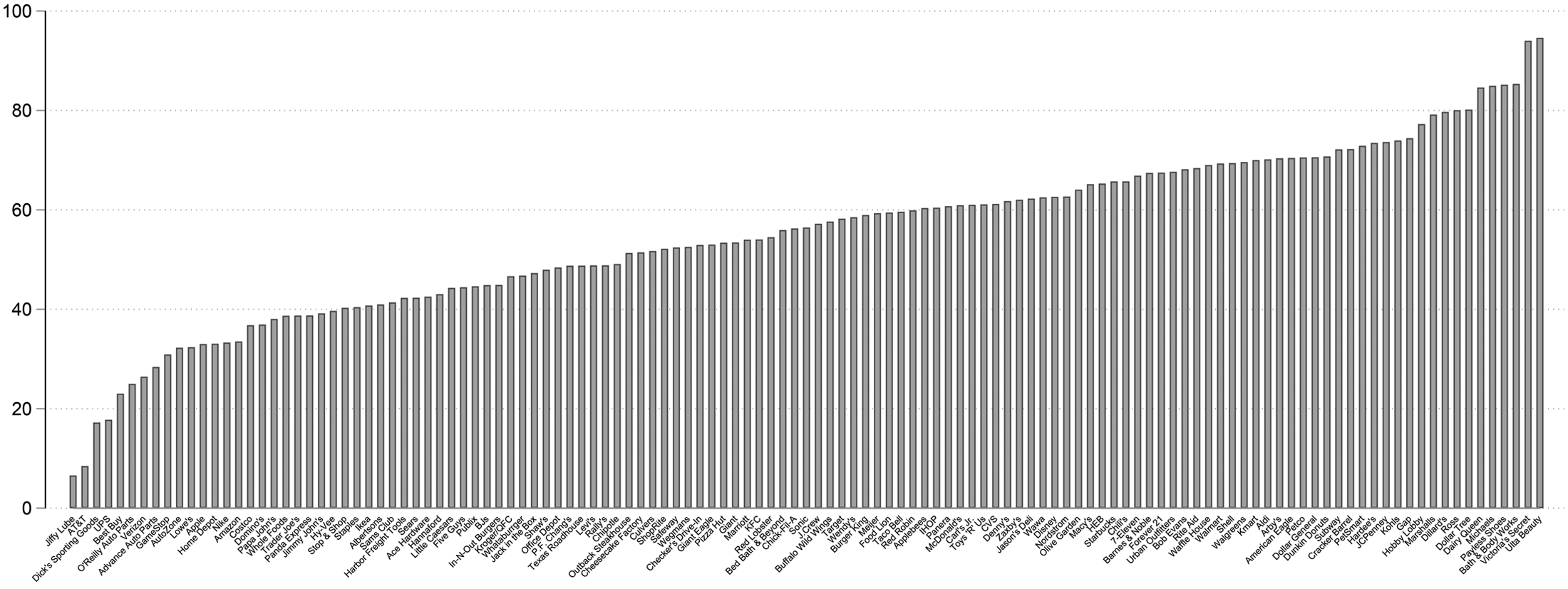
Percent female by company.
Analytical Approach
We model hourly wage as the dependent variable using an OLS model and estimate robust standard errors that account for nonindependence of observations within employer. In Model 1, we regress wages on gender alone to estimate the raw, unadjusted gender wage gap. In Model 2, we introduce our controls for demographic characteristics. In Model 3, we adjust for human capital and job characteristics. In Model 4, we adjust for occupation, and in Model 5 we add our measures of compensating differentials.
In Model 6, we introduce a set of state, year, and month fixed effects to account for potential differences in labor force participation by labor market and for time trends. In Model 7, we adjust for gender segregation due to subindustry with a fixed effect that distinguishes: retail apparel, hardware, grocery, electronics, general merchandise/department stores, fast food, and casual dining. Finally, in Model 8 we account for segregation into particular firms. We do so by including a firm fixed effect. We repeat the procedure described above using hours as the outcome variable.
We then focus on the subsample of 23,583 workers nested in 64 firms for which we have financial data. We substitute the firm fixed effects for two firm-level measures as we cannot include both the firm fixed effect and these measures in the same model. We first introduce the measure of firm-level surplus. The economic explanation of the relationship between firm gender segregation and wages is that allocative discrimination effectively excludes women from higher quality firms who are able to pay more and do so regardless of the gender composition of their workforce. We have already controlled for differences between workers as a reason for a difference in firm wages, so the addition of surplus effectively captures the economic capacity of firms to pay higher wages. If women are simply excluded from firms with greater ability-to-pay, accounting for surplus should explain a similar portion of the gender gap as the firm fixed effect. We then introduce the measure of firm-level gender composition. If workplace gender composition influences wages independent of the differences between workers and employers as suggested by other theories, we would thus expect that gender composition would explain a portion of the gender wage gap, and importantly, would not be mediated by firm surplus. While these results cannot demonstrate devaluation, they support explanations positing that workplace gender composition has an independent effect upon wages, including the devaluation explanation.
Robustness and Extensions
Wages
We re-estimate the models using log wages as the dependent variable, though the hourly wages in our sample are not particularly skewed given that wages tend to be clustered around a low mean value in the retail and food service sector. We also test the robustness of our results by omitting 1,291 respondents in our data employed in the casual dining sector because tips can be a substantial portion of compensation in this sector and our measure of wages does not specifically cue respondents to report on tips. We also estimate our models for just those 1,291 respondents.
Firm surplus
We also re-estimate the models using two alternative measures of firm surplus because of the possibility that variation in workforce size skews our primary measure of firm surplus (sales minus costs divided by number of workers). Involuntary part-time employment/insufficient work hours status appears widespread in the service-sector, part of a human resource management strategy designed to minimize labor costs through the use of just-in-time scheduling practices and the avoidance of benefit costs associated with full-time work (Golden, 2020). By treating all workers as equivalent in hours, our main measure of surplus may in fact understate the degree of firm surplus. We construct an alternative measure (Table A2) that divides surplus by the number of full-time equivalent (FTE) workers. We derive this measure by, first, in the survey data, dividing each individual respondent's report of usual weekly work hours by 35 and then taking the firm-level mean. Where this measure is less than 1 suggests that each worker is on average less than an FTE. We next multiply this ratio by the firm-level head-counts from the Reference USA data. The result is an estimate of the FTEs per firm, rather than the simple head count. The other alternative measure (Table A3) uses the ratio of sales/costs as the measure of surplus.
Results
Descriptive Statistics
Table 1 presents descriptive statistics for the 39,705 service-sector workers in our sample. By definition, all sample members are employed and paid hourly, and the average hourly wage was $12.36 (SD $5.00). In terms of sample demographics, almost 60% of the sample is female and 22% have children aged 0 to 14 years. About 40% of the sample belongs to a racial or ethnic minority group and around 60% identify as white, non-Hispanic. More than half the workers in the sample were 30 years of age or older. Job tenure tended to be fairly short with 17% of workers reporting having had the job for less than 1 year and another 28% for 1 to 2 years. A large share of workers (44%) reported working part-time with 35 or fewer hours per week. The most common occupational categories in the sample were manager (21%), cashier or clerk (25%), salesperson (25%), and customer service (18%).
Shift Sample Descriptives.
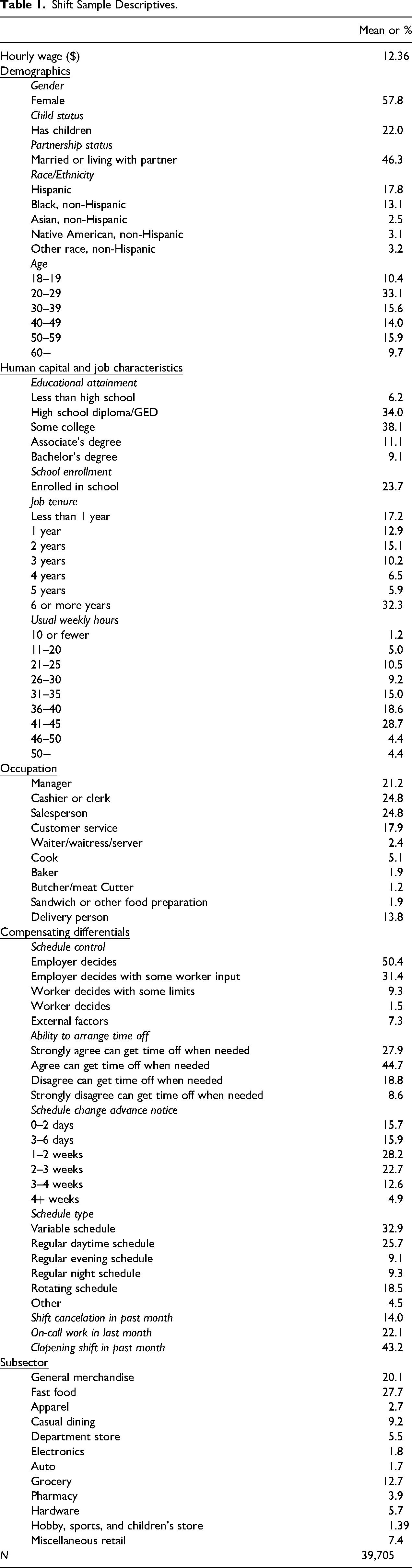
We measured a wide range of job characteristics that can be thought of as “compensating differentials” in that they are nonpecuniary features of jobs that could make a position more or less appealing to workers. Table 1 shows a great deal of variation in these job characteristics. About half of workers report some input into the timing of their work shifts and almost three-quarters report some flexibility to get time off when needed. About 40% have at least 2 weeks’ advance notice of their schedule, and one-quarter have a regular daytime schedule. Sizeable minorities report experiencing shift cancelations, on-call shifts, and working consecutive closing then opening (clopening) shifts.
Figure 1 shows the share of workers at each firm in the data who identified as female. We see evidence of substantial between-firm segregation on gender, with less than 20% of workers identifying as female at firms like Jiffy Lube, UPS, and Dick's Sporting Goods against over 80% female at firms like Dollar Tree, Victoria's Secret, and Ulta.
If between-firm segregation contributes to the gender wage gap, then we would expect that average wages would be lower at firms with larger shares of female workers. In Figure 2, we plot this descriptive association. We find that hourly wages decline with the percent female. However, this bivariate association does not adjust for demographics, human capital differences, or compensating differentials. It also does not illuminate why gender composition might be negatively related to wages. We turn to these issues below in a series of regression models.
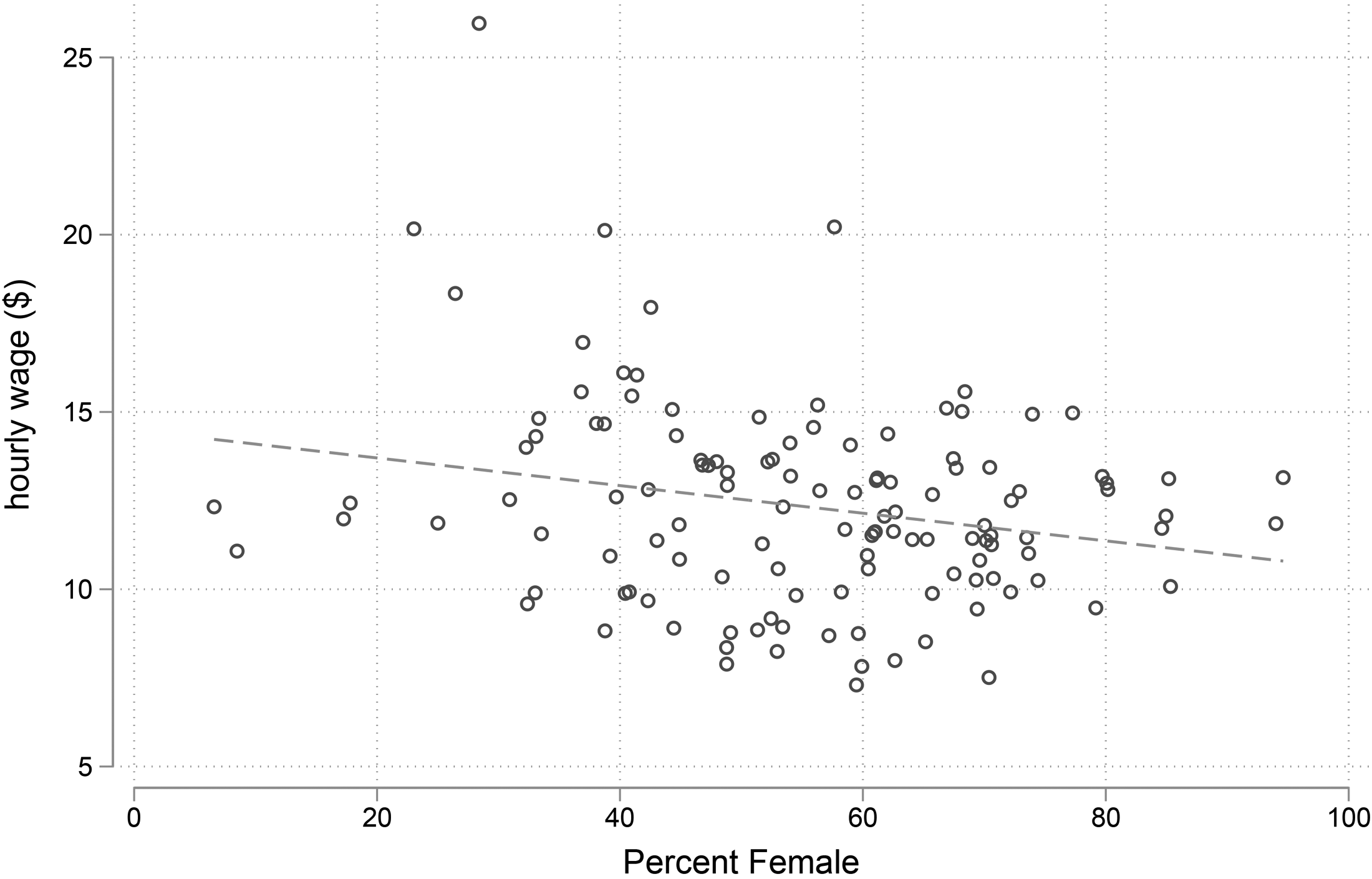
Bivariate relationship between percent female and average hourly wages at 125 companies.
Regression Results
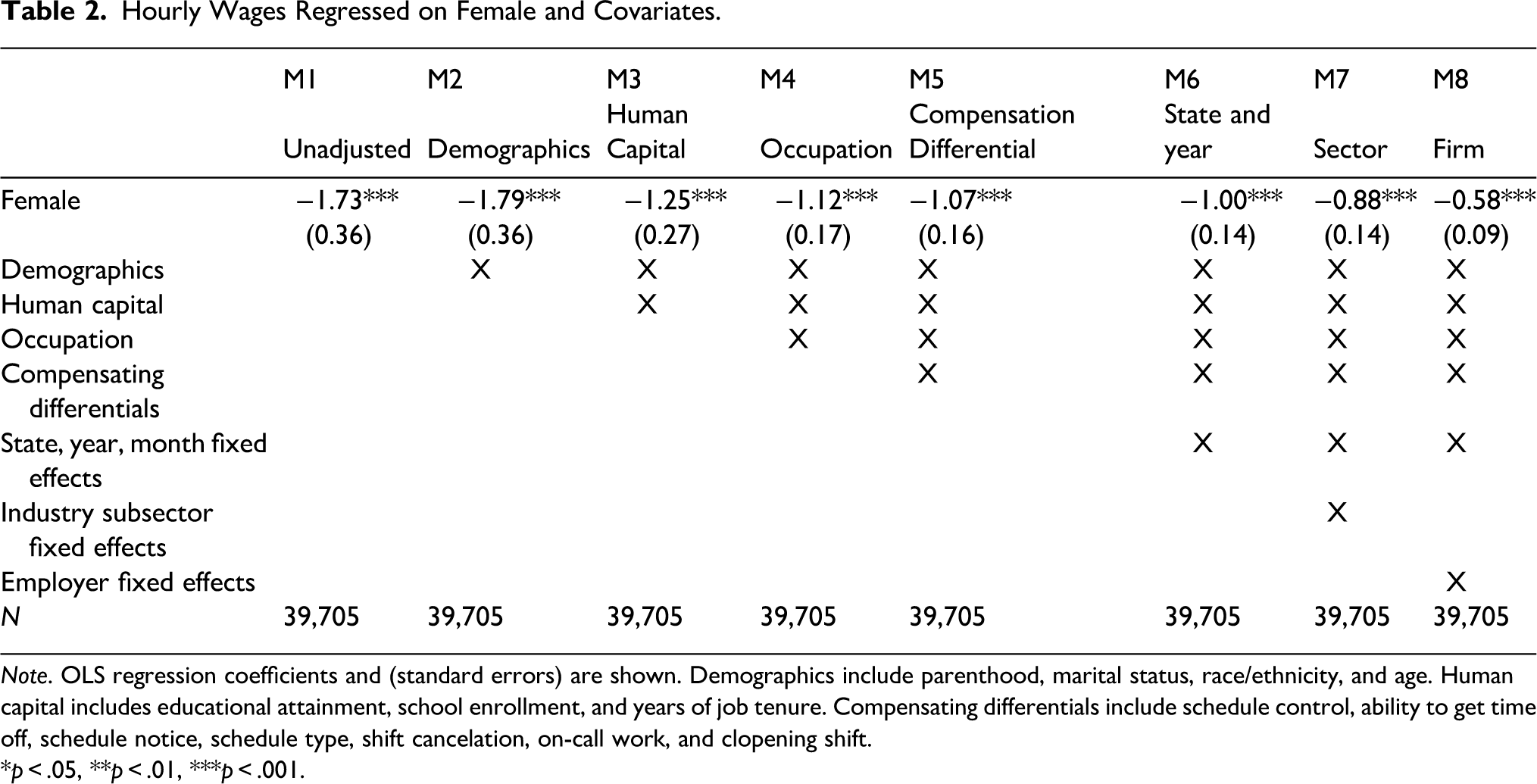
Table 2 presents results from nested regression models, which estimate the gender gap in wages. The coefficient on female represents the difference between male and female wages, on average. In all models, females earn less than males on average, but accounting for explanatory variables narrows the magnitude of the difference.
Hourly Wages Regressed on Female and Covariates.
Note. OLS regression coefficients and (standard errors) are shown. Demographics include parenthood, marital status, race/ethnicity, and age. Human capital includes educational attainment, school enrollment, and years of job tenure. Compensating differentials include schedule control, ability to get time off, schedule notice, schedule type, shift cancelation, on-call work, and clopening shift.
*p < .05, **p < .01, ***p < .001.
Model 1 shows that the unadjusted gender wage gap is $1.73. On average, men's hourly wages are $1.73 greater than women's ($13.65 and $11.91, respectively). Women earn 87% the wages of men in this sample. For a worker that works 35 hours per week for 50 weeks in a year, the average earnings for men would be $23,888 but the average earnings for women would be $20,843. This gap in expected annual earnings is exacerbated by the fact that men work more hours per week than women, on average (not shown).
In Model 2, after controlling for a set of demographic characteristics the gender wage gap grows slightly to $1.79. In further analysis (not shown), we see that marital status drives this increase. Marriage is associated with higher wages and women are more likely than men to be married in our sample. Therefore, the gender wage gap is even larger than it appears in Model 1 when we consider that women are more likely to be married and that married workers tend to earn more on average.
In Model 3, we take into account measures of human capital, including education, age, and job tenure along with weekly work hours, and the gender wage gap narrows from $1.79 to $1.25 per hour. This narrowing comes about because women have slightly shorter job tenure and lower levels of educational attainment than men in the sample. The narrowing of the wage gap in Model 3 is also in part because workers with more weekly work hours earn more, and men work more hours than women do on average (as described in greater detail below).
Model 4 adds a control for occupation, and the gender wage gap is reduced very slightly from $1.25 to $1.12. Although prior research has identified occupational sorting as an important contributor to the gender wage gap (Blau & Kahn, 2016; Goldin, 2014; Levanon et al., 2009), in our service sector sample, occupational sorting explains little of the male/female difference in hourly wages.
Next, Model 5 adds a range of compensating differentials related to autonomy, flexibility, and schedule stability. The gender wage gap remains about $1.07 per hour with the addition of these explanatory variables, suggesting that compensating differentials contribute at most only minimally to the gender wage gap. In Model 6, controlling for state, month, and year fixed effects has a very small effect on the gender wage gap, narrowing the gap by 7 cents per hour.
Model 7 adds subsector fixed effect to control for differential sorting into subsector by gender. If women earn less than men because they are disproportionately represented in lower-paying subsectors, then adding a subsector fixed effect should narrow the gender wage gap by estimating the within-subsector gender wage gap. Controlling for subsector does narrow the gender wage gap somewhat from $1.00 to 88 cents per hour.
Finally, Model 8 adds a firm fixed effect to now control for differential sorting into firms by gender. Here, we are testing whether women are paid less than men in part because they are overrepresented in lower-paying firms. We find that the firm plays a sizeable role in the gender wage gap, narrowing the gap from $1.00 to $0.58 cents per hour. Even after accounting for all explanatory variables including sorting into firms, a significant gender wage gap remains, but a substantial portion of the gap has been explained.
We repeat the above analysis with hours as the outcome measure and find a sizeable gender hour gap as shown in Table 3. We begin with an unadjusted hour gap of 3.4 hours, in which male workers received and worked about 11% more hours than female workers in the sample. Adjusting for demographics and human capital differences account for only 9% and 11% of the hour gap. Occupational segregation explains 12% of the remaining hour gap, and compensating differentials explains only another 3%, while the industry subsector fixed effects accounts for 16%. Employer fixed effects account for 33% of the remaining hour gap. Between-firm segregation plays an important role in producing the gender hour gap, especially in comparison to other factors.
Weekly Hours Regressed on Female and Covariates.
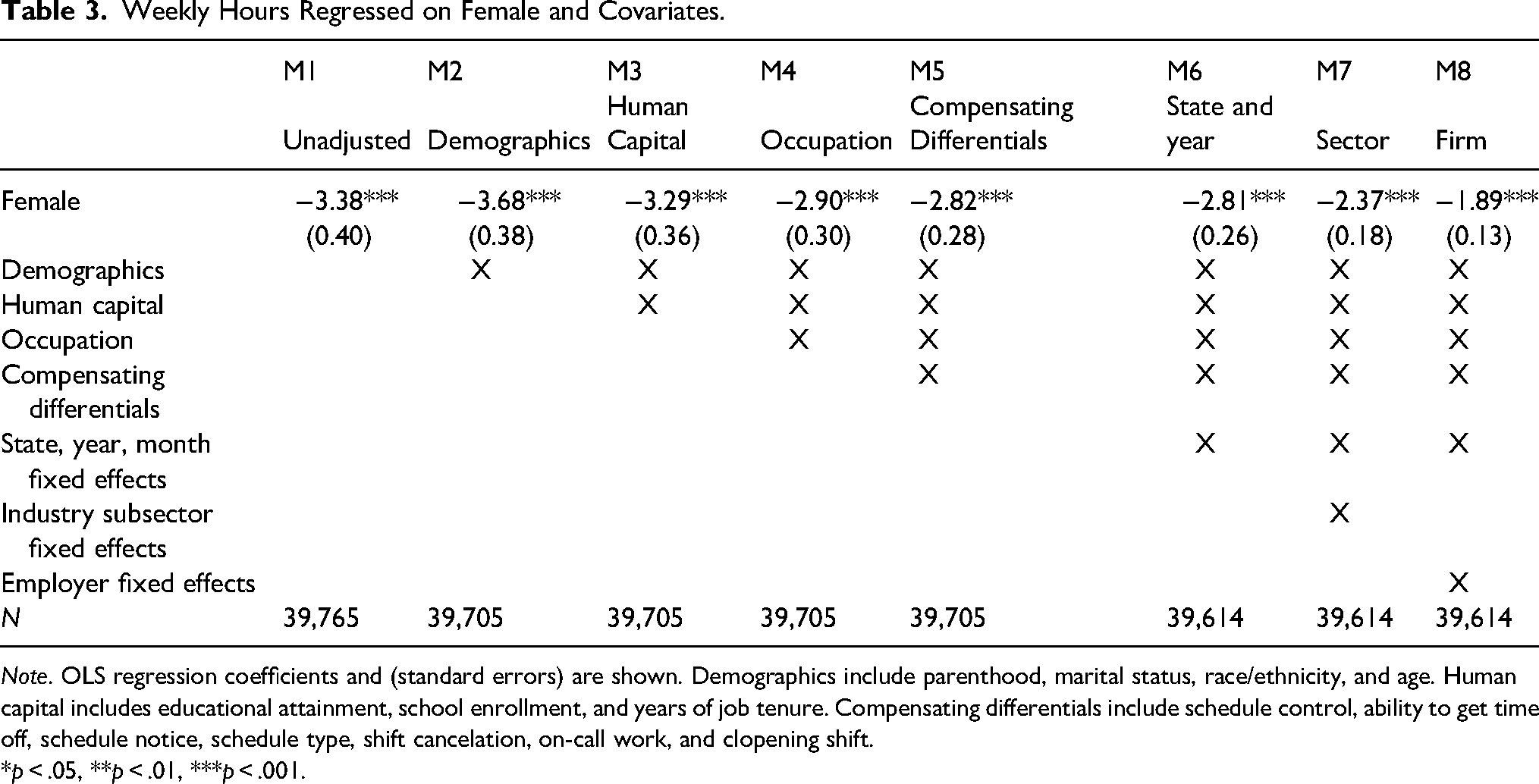
Note. OLS regression coefficients and (standard errors) are shown. Demographics include parenthood, marital status, race/ethnicity, and age. Human capital includes educational attainment, school enrollment, and years of job tenure. Compensating differentials include schedule control, ability to get time off, schedule notice, schedule type, shift cancelation, on-call work, and clopening shift.
*p < .05, **p < .01, ***p < .001.
Firm-Level Factors
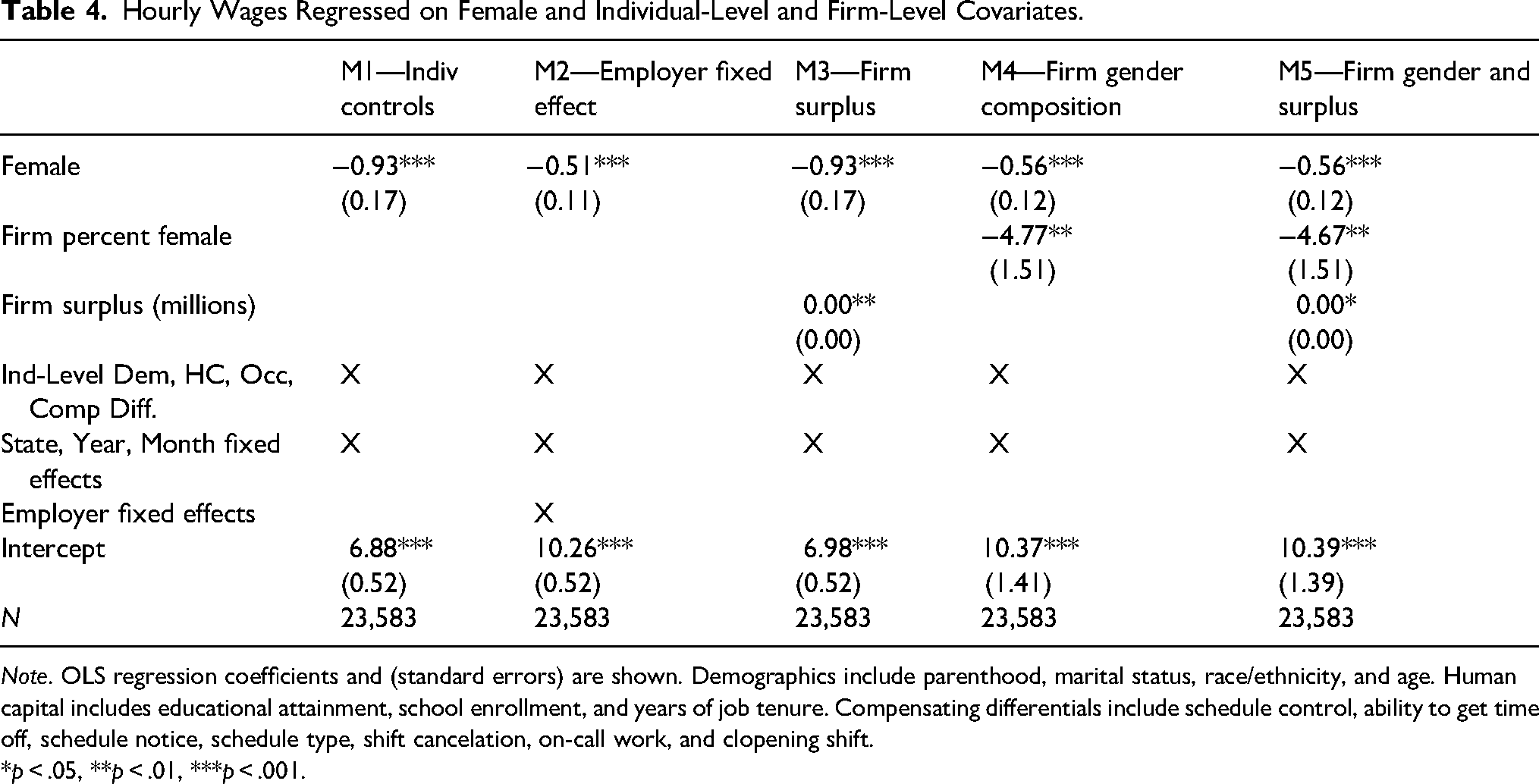
Model 1 of Table 4 re-estimates Model 6 of Table 2, the gender wage gap after controlling individual-level demographic characteristics, human capital, occupation, compensating differentials, as well as state, year, and month fixed effects on the somewhat smaller sample for which we have firm-level financial data. The estimate of $0.93 differs slightly from the estimate in M6 of Table 2 because the sample of firms is limited to those on which data on surplus per worker is available. In Model 2, we re-estimate Model 8 of Table 2, introducing the firm-level fixed effects. Doing so explains approximately 46% of the remaining gap.
Hourly Wages Regressed on Female and Individual-Level and Firm-Level Covariates.
Note. OLS regression coefficients and (standard errors) are shown. Demographics include parenthood, marital status, race/ethnicity, and age. Human capital includes educational attainment, school enrollment, and years of job tenure. Compensating differentials include schedule control, ability to get time off, schedule notice, schedule type, shift cancelation, on-call work, and clopening shift.
*p < .05, **p < .01, ***p < .001.
Model 3 presents the first key result, including a control for firm-level surplus per worker in place of the firm-level fixed effect. We find that while surplus has the expected positive sign and is significantly related to higher wages, it does not explain any of the gender wage gap. The gender gap remains exactly the same, $0.93, after controlling for firm surplus.
In contrast, in Model 4 we introduce a firm-level measure of gender composition in place of the firm-level fixed effect. Mechanically, this is statistically significant and accounts for nearly as much of the gender wage gap as the firm-level fixed effect. However, significantly, we find that in Model 5, adjusting for firm-level surplus does not significantly attenuate the coefficient on firm-level gender composition. That is, the reason why the firms in which women are clustered pay less is not because they have lower surplus. This pattern suggests that instead of crowding (i.e., allocative discrimination), devaluation is a more likely source of the between-firm pay gap.
Robustness
Table 5 presents a set of robustness checks and extensions of these models. The first panel of Table 5 repeats the estimates of the gender wage gap from Table 2 for comparison. The table includes the percent change in coefficients compared with the previous model.
Hourly Wages Regressed on Female and Covariates—Robustness and Extensions.
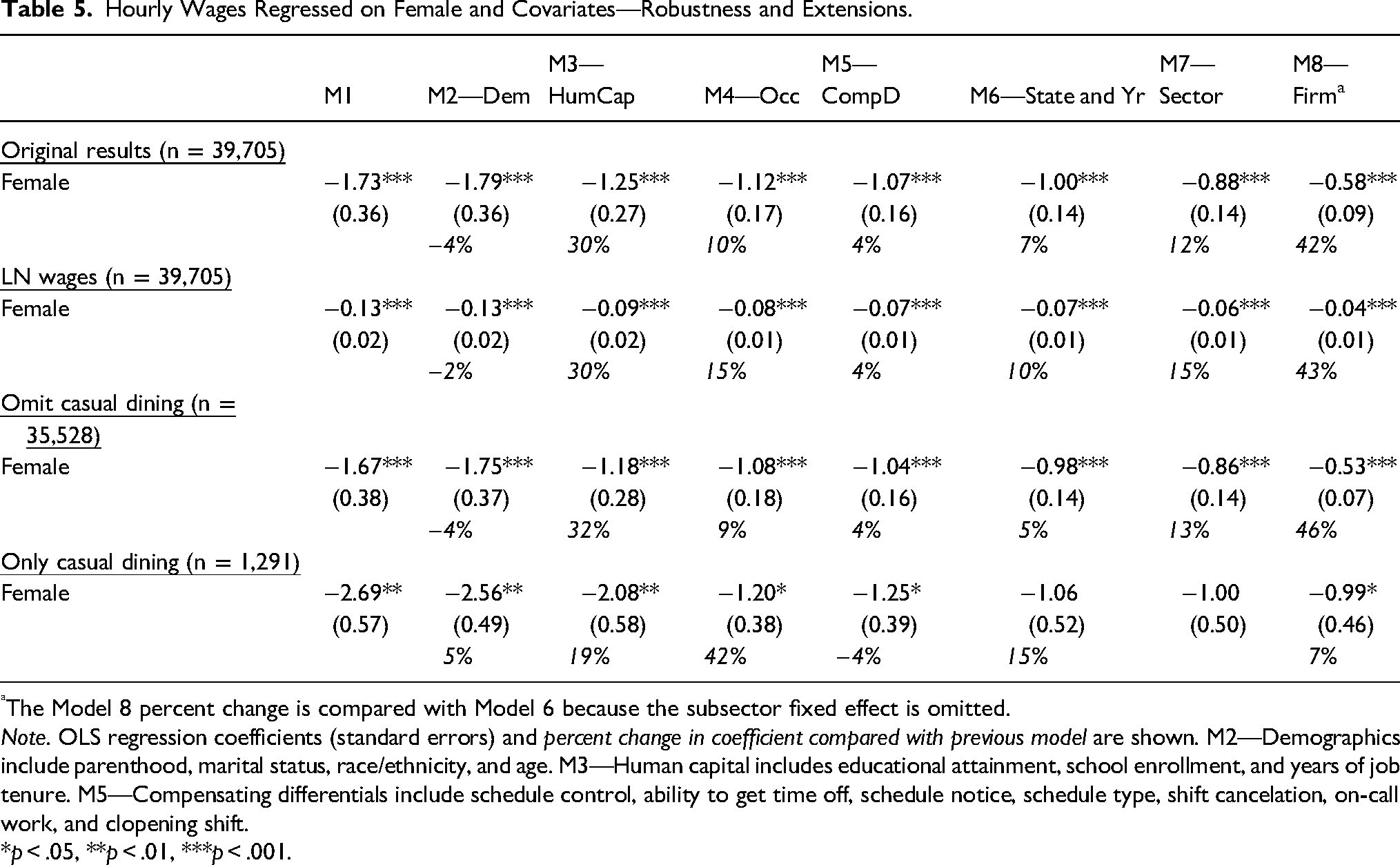
The Model 8 percent change is compared with Model 6 because the subsector fixed effect is omitted.
Note. OLS regression coefficients (standard errors) and percent change in coefficient compared with previous model are shown. M2—Demographics include parenthood, marital status, race/ethnicity, and age. M3—Human capital includes educational attainment, school enrollment, and years of job tenure. M5—Compensating differentials include schedule control, ability to get time off, schedule notice, schedule type, shift cancelation, on-call work, and clopening shift.
*p < .05, **p < .01, ***p < .001.
The second panel of Table 5 uses log wages as the dependent variable. Comparing the percent change in coefficients across nested models shows that using log wages yields a pattern of results that is largely consistent with those presented in Table 2.
Next, Table 5 tests the robustness of our results to the exclusion of casual dining because wages in this subsector may be biased by the omission of tips. For comparison, we also include estimates of the gender wage gap for the casual dining subsector only. Omitting casual dining has very little effect on the estimates of the gender wage gap compared with Table 2 results, in part because the casual dining sector is a relatively small proportion of the sample. Interestingly, the gender wage gap is much larger in the casual dining sector than in the other sectors ($2.69 compared with $1.67), but part of this could be driven by the omission of tips.
Of note, across all model specifications, firm gender segregation plays a role in contributing to the gender wage gap. Overall, gender segregation by firms seems to explain more than 40% of the remaining gender wage gap after controlling for demographics, human capital, occupation, compensating differentials, and time and state fixed effects as well as one-quarter of the raw gender wage gap from Model 1.
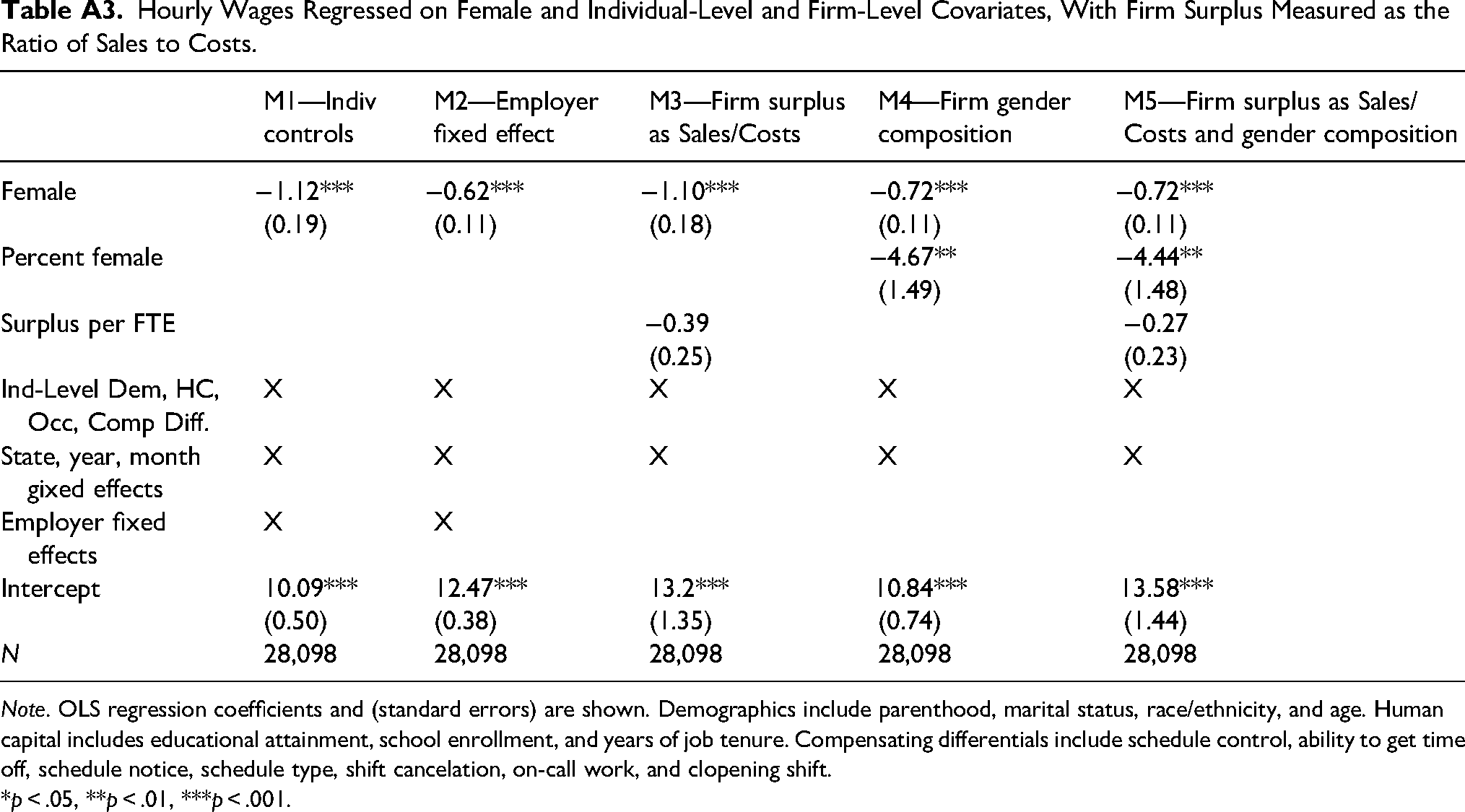
Tables A2 and A3 test the robustness of our results using alternative measures of surplus. The alternative measures insubstantially reduce the gender wage gap and support the overall finding that differences in firm surplus do not explain the difference in wages between firms. The alternative measures of surplus also show that firm surplus does not mediate the relationship between gender composition and wages.
One alternative measure (Table A2) divides surplus by the number of FTE employees at the firm (company size ˟ [usual hours/35]). The other alternative measure (Table A3) uses the ratio of sales/costs as the measure of surplus. The use of alternative surplus measures in our analysis leads to the same overall finding that surplus does not explain the gender wage gap and does not mediate the relationship between firm gender composition and wages.
Discussion and Conclusion
Research on the gender wage gap has not paid sufficient attention to how gender segregation at the firm level may contribute to pay differentials. Given that a large part of the gender wage gap remains unexplained by individual characteristics and gender differences in occupational, industry, and sector locations, this research uses a unique linked data set with highly comprehensive measures of compensating differentials, adding to a growing literature on the importance of gender segregation at the establishment and firm levels in explaining the contemporary wage gap. We also add to the literature by examining how firm-level segregation affects hours, showing the role of firm-level segregation in another important outcome for workers.
We find that firm-level segregation plays a substantial role in accounting for the gender wage gap in the service sector. Firm segregation can explain approximately 40% of the gender wage gap between workers with similar demographic and human capital characteristics. Although individual differences between workers in terms of human capital explain the largest amount of the raw hourly pay gap ($0.48), firm-level sorting of men and women explains a large portion of the remaining gap ($0.42). The effect of firm location on wages is not due to access to compensatory benefits or to differences in occupation or industry. Another way to interpret these findings is female workers would be able to gain more than an additional $735 annually if they were employed in the higher-paying firms within the service sector, roughly equivalent to pay for 2 weeks of work for workers within our sample who roughly earn $12.25/hour and work about 30 hours per week. In addition, we find that firm-level segregation also plays a substantial role in explaining the sample's gender hour gap of 3.4 hours, and the fact that men and women are concentrated in different firms accounts for 33% of the gender hour gap between similar workers. If women were employed in the firms where workers received the greatest number of weekly hours, they would work nearly 25 hours more per year and earn $306 more at $12.25/hour. While the differences in wages and hours from firm-level segregation are not sufficient to raise a struggling household above the poverty line, the total difference in income deriving from the wage and hour gaps could meaningfully help low-income households since many low-income households report facing material deprivation at some time during a given year and a lack of funds to weather even a financial emergency of a few hundred dollars (Collins & Gjertson, 2013; Karpman & Zuckérman, 2021).
We then examine likely explanations for the relationship between firm-level segregation and wages. We leverage employer–employee data to test whether firm surplus can explain the differences in wages between firms, and we find it does not explain the wage gap. In contrast, we find that firm gender composition explains $0.37 or 21% of the unadjusted gender wage gap of $1.73 and that firm surplus does not mediate the explanatory power of firm gender composition. We interpret these results as demonstrating the salience of firm gender composition in determining wages, since firm surplus does not explain the wage differential between firms. However, other features of economic wage setting not captured in our data about firms may possibly explain the differences in wages. In addition, our research focuses upon a single sector within the economy and may not be generalizable to other sectors in which firm surplus may better explain variation in wages between firms, or in which other mechanisms besides segregation may play a larger role in producing the gender pay gap (Smith-Doerr et al., 2019). Still, our findings suggest that the wage gap attributable to firm-level segregation cannot simply be attributed to differences in firms’ ability-to-pay, an important finding as the literature refocuses on the meso-level production of inequality.
In addition to finding that firm-level segregation contributes substantially to the gender pay gap, this research shows that firm-level effects are robust across model specifications. Moreover, modeling the wage gap with logged wages as the dependent variable showed similar results to models employing raw hourly wages as the independent variable. However, even after accounting for firm-level segregation, we find that a substantial portion of the gender wage gap remains unexplained, pointing to the importance of within-job discrimination in pay. While this finding is in contrast to the results of Petersen and Morgan (1995) and Petersen and Saporta (2004), it aligns with the results from Bayard et al. (2003), using a broader data set.
The first potential limitation to the research findings is the use of a non-probability sample of one sector. However, the use of Facebook provided a sampling frame containing 85% of the U.S. population and Shift data match commonly used data sets, such as NLSY97 and CPS, upon important worker characteristics. Although the findings are limited to the service sector, this sector is a large part of the U.S. economy and produces the wage gap for the most vulnerable workers, making the findings consequential.
Second, although our research accounts for clustering within firm, both by adjusting standard errors for firm clustering and by including firm fixed effects, we are not able to account for clustering of workers within specific stores or establishments. Wide variation in gender composition, wages, or hours between establishments within firms could lead us to overestimate firm effects. Our research design addresses this possibility indirectly by including a state fixed effect, which reduces the between-establishment variation founded in between-state variation.
Third, since our sample focus is limited to the service sector, we have in effect limited occupational variation although gender sorting into occupations plays a role in explaining wage or hour gaps (Blau & Kahn, 2016; Goldin, 2014; Levanon et al., 2009). Nevertheless, wage and hour gaps do appear within the service sector and occupational sorting within the service sector played a relatively small role in explaining these gaps.
This research contributes to sociological knowledge of the gender pay gap by examining the role of the firm. We show that firm-level segregation has a substantial effect upon the gender wage gap, which—in conjunction with findings from other national contexts and from other data sets—indicates that this may be true for other sectors across the U.S. economy. This research also furthers sociological knowledge of how the gender wage gap affects low-income workers and the extent to which theories of the gender wage gap explain these wage differentials. Finally, our analysis indicates women in the service sector face various forms of wage discrimination, thus contributing to a literature documenting the gender disparities women face within the service sector, which include sexual harassment (Frye, 2017), blocked advancement into leadership ranks (Skaggs, 2008), and difficulties gaining scheduling flexibility to meet parental duties in comparison to male coworkers (Luhr, 2020).
By identifying firm-level segregation as explaining a substantial part of the gender wage gap, this article points to directions for future research, including examining the processes by which firms become gender-segregated. The current research findings give little reason to believe that women self-select into lower-paying firms or that human capital differences preclude women from working in higher-paying firms, and thus what it is about the firms that causes them to hire women and to pay lower wages needs further examination, especially given the range of possible devaluation mechanisms previously discussed in this article. Both allocative and valuative discrimination may contribute to the relationship between firm gender composition and wages, and the possibility exists that other processes may depress wages at primarily female firms, including nondiscriminatory wage-setting practices (Card et al., 2016). In addition to examining the broader processes generating the relationship between gender composition and wages, future research can also leverage the fact that firms are concrete social settings to identify the specific intra-organizational policies and structures that facilitates firm-level segregation and its effects in order to find realizable interventions. For instance, recent research examines the role of gender composition of management and gender of direct supervisor to understand these intra-organizational dynamics (Abendroth et al., 2017). We echo the statement that firms are where the action is at (Baron & Bielby, 1980) and have taken a step forward in understanding how firms generate inequality through the analysis of employer–employee data.
Footnotes
Appendices
Hourly Wages Regressed on Female and Individual-Level and Firm-Level Covariates, With Firm Surplus Measured as the Ratio of Sales to Costs.
| M1—Indiv controls | M2—Employer fixed effect | M3—Firm surplus as Sales/Costs | M4—Firm gender composition | M5—Firm surplus as Sales/Costs and gender composition | |
|---|---|---|---|---|---|
| Female | −1.12*** | −0.62*** | −1.10*** | −0.72*** | −0.72*** |
| (0.19) | (0.11) | (0.18) | (0.11) | (0.11) | |
| Percent female | −4.67** | −4.44** | |||
| (1.49) | (1.48) | ||||
| Surplus per FTE | −0.39 | −0.27 | |||
| (0.25) | (0.23) | ||||
| Ind-Level Dem, HC, Occ, Comp Diff. | X | X | X | X | X |
| State, year, month gixed effects | X | X | X | X | X |
| Employer fixed effects | X | X | |||
| Intercept | 10.09*** | 12.47*** | 13.2*** | 10.84*** | 13.58*** |
| (0.50) | (0.38) | (1.35) | (0.74) | (1.44) | |
| N | 28,098 | 28,098 | 28,098 | 28,098 | 28,098 |
Note. OLS regression coefficients and (standard errors) are shown. Demographics include parenthood, marital status, race/ethnicity, and age. Human capital includes educational attainment, school enrollment, and years of job tenure. Compensating differentials include schedule control, ability to get time off, schedule notice, schedule type, shift cancelation, on-call work, and clopening shift.
*p < .05, **p < .01, ***p < .001.
Acknowledgements
The authors received excellent research assistance from Josh Choper, Paul Chung, Megan Collins, Dylan Nguyen, Annette Gailliot, Veronique Irwin, and Adam Storer. We are grateful to Annette Bernhardt, Rachel Deutsch, Dennis Feehan, Sylvia Fuller, Susan Lambert, and Jesse Rothstein for useful feedback.
Declaration of Conflicting Interests
The authors declared no potential conflicts of interest with respect to the research, authorship, and/or publication of this article.
Funding
The authors disclosed receipt of the following financial support for the research, authorship, and/or publication of this article: This work was supported by the Berkeley Population Center, the Russell Sage Foundation, the Washington Center for Equitable Growth, the Hellman Family Fund, the Ford Foundation, the National Institutes of Child Health and Human Development, the Robert Wood Johnson Foundation Center for Health Policy, the Institute for Research on Labor and Employment, UC Berkeley (grant numbers 39092, R21HD091578, and 74528).
