




Abstract
This study investigates whether female supervisors hold less traditional attitudes towards gender in business leadership than male supervisors and non-supervisors, and whether these attitudinal differences vary between countries. It uses the sociological notions of self-interest and exposure and a multilevel approach to advance and expand the investigation of gender attitudes in the domain of business leadership. Two recent waves of the World Values Survey (2005/2009; 2010/2014) for 22 OECD countries were analysed with multilevel logistic regression. Findings indicated less gender traditionalism among female supervisors and among people living in countries with a larger share of women in managerial positions and a less traditional normative climate towards working women. No such attitudinal differences between individuals were found when comparing countries with and without a national legislative gender quota policy. Finally, men’s attitudes towards gender traditionalism in business leadership appeared to be more susceptible to the country context than those of women.
Introduction
Gender inequality in leadership positions remains pervasive in contemporary societies (EIGE, 2015; Hoyt and Murphy, 2016). Men are heavily overrepresented in top leadership roles; for example, they hold four out of every five seats on the boards of large firms in OECD countries (OECD, 2017). Men are also more likely to hold jobs with supervisory responsibilities compared to employed women (Dämmrich and Blossfeld, 2017; Eurostat, 2019). Traditional gender norms are often cited to explain the underrepresentation of women in business leadership (Norris and Inglehart, 2001). Repeated studies show that people associate characteristics of successful leaders more strongly with qualities traditionally ascribed to men and masculinity (Eagly and Heilman, 2016; Koenig et al., 2011; Quadlin, 2018; Rudman and Kilianski, 2000). A better understanding of this normative explanation for the lack of women in leadership roles could help increase gender equality in business leadership.
To this end, the current study investigates gender traditionalism in business leadership among the employed populations of 22 OECD countries (World Values Survey (WVS) waves 2005/2009 and 2010/2014). Gender traditionalism regarding business leadership is defined here as an individual’s support for the view that ‘on the whole, men make better business executives than women do’.
Sociological studies argue that early socialization shapes individuals’ attitudes towards gender traditionalism, as such attitudes typically differ between cohorts, educational levels and religious groups (André et al., 2013; Bolzendahl and Myers, 2004; Thijs et al., 2019). Additionally, individual characteristics influence attitudes towards gender roles. For instance, research on gender traditionalism in the work–family domain points to the influence of employment status (Cunningham, 2008; Kraaykamp, 2012) and partner or family status (Baxter et al., 2015; Schober and Scott, 2012). Building on this literature, the current study examines the link between an individual’s supervisory position at work and attitudes of gender traditionalism regarding business leadership.
Most current knowledge on this topic is based on surveys of students; studies that do investigate actual employees do not compare supervisors with non-supervisors (e.g. Berkery et al., 2013; Duehr and Bono, 2006; Elsesser and Lever, 2011; Rudman and Kilianski, 2000). The view that men make better business leaders clearly undercuts the position of female leaders (Derks et al., 2016; Vial et al., 2016). This raises the question of whether female supervisors’ likelihood of support for this view differs from that of male supervisors and (male or female) non-supervisors. Moreover, understanding how these groups relate to each other at the workplace and their gender traditionalism regarding business leadership can advance current debates on the roles of male and female supervisors in combating gender inequality (Connell, 2005; Srivastava and Sherman, 2015; Stainback et al., 2016).
Besides focusing on men and women in supervisory positions at work, this study examines the influence of exposure to country level gender inequality in business leadership. While support for gender traditionalism is often attributed to people’s social surroundings, large-scale empirical studies on this topic are still relatively scarce (André et al., 2013; Banaszak and Plutzer, 1993; Kunovich and Kunovich, 2008; Meuleman et al., 2017; Sjöberg, 2004), especially in the domain of business leadership. Building on the theoretical notion of exposure, the current study examines national structural, policy and cultural characteristics closely related to gender inequality in leadership; respectively, the share of women in managerial positions, the presence of a national legislative gender quota policy to stimulate female appointments to company boards and the normative climate towards working women. Note, however, that this quota is a relatively new type of policy measure (Benschop and Van den Brink, 2014); this is to our knowledge the first study to investigate their association with gender traditionalism using a cross-national design.
Some evidence suggests that men are particularly affected by norms of gender traditionalism at the workplace (e.g. André et al., 2013; Meuleman et al., 2017). However, few occupational level or country level studies address the varying susceptibility of different social groups to such exposure. The current study investigates this susceptibility using the theoretical notion of self-interest, which expresses individuals’ different stakes in issues of gender inequality (Bolzendahl and Myers, 2004). Specifically, it asks whether the attitudinal differences between female and male supervisors (and non-supervisors) vary between countries with different structural, policy and cultural characteristics.
The three research questions are: (1) To what extent do female supervisors differ from male supervisors and (female and male) non-supervisors in gender traditionalism regarding business leadership? (2) To what extent are national structural, policy and cultural characteristics associated with gender traditionalism in business leadership? (3) To what extent do these country characteristics moderate the impact of holding a supervisory position (for both women and men) on gender traditionalism?
In sum, this study seeks a deeper understanding of gender traditionalism regarding business leadership by focusing on the influence of holding a supervisory position for men and women. It also examines the influence of country characteristics related to gender inequality in business leadership as well as the interaction between this contextual level and the individual level. By applying the theoretical notions of self-interest and exposure to the domain of business leadership, it makes a valuable contribution to the sociological literature on gender traditionalism.
Theoretical framework
General outline
Sociological studies stress that gender attitudes are shaped by both early socialization and one’s current position in certain life domains (e.g. Andringa et al., 2015; Bolzendahl and Myers, 2004; Corrigall and Konrad, 2007; Eagly et al., 2000; Kraaykamp, 2012; Thijs et al., 2017). To explain differences in gender traditionalism, studies generally posit two underlying mechanisms: self-interest and exposure (Bolzendahl and Myers, 2004; Cunningham, 2008; Ferber et al., 1979; Sjöberg, 2004).
First, the notion of self-interest explains support for certain gender roles by the benefits a person expects or experiences from a certain (un)equal distribution of power between women and men (Bolzendahl and Myers, 2004). A clear example is that women generally support a more gender egalitarian distribution of roles than men. This is explained by the fact that more egalitarian contexts will likely bring relative improvements in women’s positions (Connell, 2005; De Vries, 2015). In addition, both women’s and men’s gender opinions are shaped by their current social position (Bolzendahl and Myers, 2004; Kraaykamp, 2012). As such, non-working women and parents often have more traditional attitudes concerning roles in the work–family domain than working women (Baxter et al., 2015; Cunningham, 2008; Kraaykamp, 2012), as the position of the former arguably corresponds with a more traditional gender role distribution. The notion of self-interest thus captures a rational or calculative process in which an individual considers her or his own position in deciding what a preferable distribution of gender roles would be.
Second, the theoretical notion of exposure holds that familiarity with situations and attitudes representing a more (or less) traditional distribution of gender roles affects one’s gender traditionalism (Bolzendahl and Myers, 2004; Meuleman et al., 2017). Thus, one’s own attitudes are influenced by exposure to people who demonstrate more (or less) traditional gender roles, and personal contact with people who hold more (or less) traditional opinions on gender. Indeed, research shows that people generally show less support for gender traditionalism regarding work and family roles in more egalitarian environments, such as in countries with a larger share of women in leadership roles and a non-traditional normative climate (e.g. André et al., 2013; Andringa et al., 2015; Banaszak and Plutzer, 1993; Edlund and Öun, 2016; Meuleman et al., 2017; Sjöberg, 2004). Studies also indicate that individuals tend to socially interact with similar others (the homophily principle) at work and within personal networks (see McPherson et al., 2001). Consequently, people’s exposure to certain situations or attitudes likely differs, depending on their social background, as the makeup of people’s networks differs. Overall, the notion of exposure encompasses the influence of one’s social surroundings at both the individual and the contextual level.
Does having a supervisory position at work matter?
This study investigates the impact of a person’s own supervisory position on their support for gender traditionalism regarding business leadership. Compared to non-supervisors, there are several reasons to expect supervisors, especially female supervisors, to be less supportive of the view that men are better business leaders. First, following the notion of self-interest, gender traditionalism in business leadership directly undercuts female leaders’ identity and capabilities in relation to men’s. Indeed, research indicates that female supervisors may be seen as less legitimate than male counterparts because they are evaluated according to traditional masculine norms (Eagly and Heilman, 2016; Vial et al., 2016). Female supervisors thus especially benefit from opinions and norms of gender equality regarding leadership positions (Lup, 2018). Second, supervisors presumably operate more often within the higher echelons of a company or business sector than non-supervisors. They are therefore likely to be exposed to and interact socially with other female leaders. The principle of network homophily (Greguletz et al., 2018; Ibarra, 1992; McPherson et al., 2001) suggests further that female supervisors will have like-minded women in supervisory positions in their own personal and work networks, or at least more than others. In line with the notion of exposure, this will all bring female supervisors into contact with less gender traditional contexts and attitudes towards women in leadership roles. Third, female supervisors are likely to be involved in efforts to tackle gender discrimination at the workplace (Kelan and Wratil, 2018). Consequently, female supervisors may be more aware of, or exposed to, the idea that women’s underrepresentation in business leadership is a problem that warrants action (Duehr and Bono, 2006; Glass and Cook, 2018).
Like female supervisors, male supervisors will come into contact with successful female leaders, and they will also be involved in tackling gender inequality at the workplace (Kelan and Wratil, 2018). Nevertheless, male supervisors are typically assumed to be more traditionalist towards gender roles in business leadership compared to female supervisors (Humbert et al., 2018). First, following the notion of self-interest, male supervisors themselves do not directly benefit from more gender equality in leadership (Acker, 2006; Benschop and Verloo, 2006; De Vries, 2015). Men in supervisory positions may even perceive gender egalitarian workplaces as a threat to their own position, as these bring more competition for recognition and promotions (Connell, 2005). Second, male supervisors are likely to have opportunity to participate in homogeneous networks of male leaders (Greguletz et al., 2018; Ibarra, 1992; Van den Brink and Benschop, 2014). So, compared to female supervisors, they will probably be somewhat less exposed to female leadership, rendering their development of more egalitarian gender role attitudes less pronounced.
We expect non-supervisors, both male and female, to be most traditional regarding gender roles in business leadership. For female non-supervisors, the rise of female leaders introduces a greater status differential between working women (Parks-Stamm et al., 2008). Women might therefore prefer a traditional gender role distribution in leadership positions in order to avoid a negative sense of social comparison. Additionally, studies find that some women in supervisory positions distance themselves from non-supervisory women at the workplace (Derks et al., 2016). These studies suggest that female non-supervisors may be more exposed to negative examples of female supervisors than others, leading them to support gender traditionalism in business leadership. Male non-supervisors, for their part, may view the rise of female leaders as a threat to their own career opportunities and expected status (Netchaeva et al., 2015; Simpson, 2004). It would thus seem in their interest to support gender traditionalism in business leadership. Additionally, based on the idea of network homophily and the fact that men’s share in leadership roles is generally higher, male (and female) non-supervisors will likely have less contact with female leaders at the workplace compared to female supervisors.
Following the arguments discussed above, our first hypothesis reads: Female supervisors express less gender traditionalism in business leadership than male supervisors, and female and male non-supervisors. Obviously, selectivity, or reverse causality, might be a problem in investigating the relationship between holding a supervisory position and gender traditionalist attitudes. After all, women who are more supportive of men as business leaders might simply refrain from pursuing a supervisory job. This issue is addressed in several ways. First, the influence of job position is examined rather than job aspirations, which means that possible selection bias of people’s prior gender opinions is restricted by factors such as previous job performance and financial- or autonomy considerations related to higher status jobs. Second, the analysis takes into account indicators that capture previously held attitudes (birth cohort, educational level and religious service attendance) and job choices (employment and occupational sector). Third, this study takes a rather broad approach to leadership, as holding a supervisory position. It thus examines not only women at higher management levels, but also women in lower supervisory positions. Thus, the current study does not focus only on the most successful career women (whose previously held egalitarian attitudes may have been especially influential). Finally, previous research demonstrates that selection effects based on prior gender attitudes are generally weaker than adaptation effects in labour market positions (Berrington et al., 2008). Nevertheless, as this cross-sectional study cannot fully eliminate selectivity, the results should be interpreted as associations and not necessarily as indicative of causal relationships.
Do country characteristics matter and for whom?
Gender traditionalism regarding business leadership may be shaped by factors beyond individual characteristics and features related to one’s job position. From exposure theory it follows that the larger social context is important as well. Indeed, studies show that exposure to an egalitarian country context shapes people’s attitudes towards gender role divisions in household labour, raising children and women working in paid jobs (André et al., 2013; Banaszak and Plutzer, 1993; Meuleman et al., 2017; Sjöberg, 2004). Similarly, exposure to gender inequality at the country level is likely to stimulate support for the view that men are better leaders. Moreover, the impact of the country context will probably differ between male and female supervisors and non-supervisors. Various studies have argued that national structural, policy and cultural characteristics determine exposure (e.g. Bolzendahl and Myers, 2004; Norris and Inglehart, 2001). As the current study is interested in national gender inequality in business leadership, it considers the share of managerial positions held by women within a country, implementation of gender quotas and the normative climate towards working women to capture the possible structural, policy and cultural explanations of variation across countries. These indicators are discussed more elaborately below.
First, the share of managerial positions held by women is a structural characteristic of a country. In countries with a more gender egalitarian distribution of leadership positions, people will be less exposed to traditionalist gender contexts and beliefs (André et al., 2013; Meuleman et al., 2017). In such countries, business leadership will be perceived as less masculine, or gendered, as people will be more exposed to female supervisors (Rudman and Phelan, 2008). Even if female leadership is concentrated in certain occupational fields or sectors (i.e. horizontal segregation), the country’s population will still experience less gender traditionalism overall, via media coverage and personal network contacts. Presumably, this will lead to less support for the view that men are better business leaders in these countries. So, our second hypothesis reads: In countries with a larger share of women in managerial positions, people express less gender traditionalism regarding business leadership.
Second, implementation of national legislative gender quota policies reflects a critical dominant view on gender inequality within a country. Generally, quota policies require a minimum number of women in (business) positions (Benschop and Van den Brink, 2014). Such policies are usually implemented to increase the number of women on company boards (Franceschet et al., 2012). By setting a standard, gender quotas are believed to improve the position of women, while also communicating the message that women are capable business leaders. Consequently, exposure to gender quotas in a country is linked to reduced support for gender traditionalism in leadership among the general population (Sjöberg, 2004). Therefore, the third hypothesis states: In countries with national legislative gender quota policies for women on company boards, people express less gender traditionalism regarding business leadership.
Third, a country’s normative climate towards working women may shape gender traditionalism. Citizens are more exposed to gender traditionalism in countries where prevailing norms hold that men should be the providers and women the caregivers (Knight and Brinton, 2017; Pedulla and Thébaud, 2015; Thijs et al., 2019). Specifically, this traditional norm, which dictates different life roles for men and women, teaches that business leadership is not suited to women, as it conflicts with their primary caregiving role (Stam et al., 2016). In contrast, less traditional gender norms within society stimulate people to view women in supervisory positions as legitimate (Rudman and Phelan, 2008). A fourth hypothesis thus states: In countries with a more traditional normative climate towards working women, people express more gender traditionalism regarding business leadership.
Additionally, the effects of national structural, policy and cultural characteristics on gender traditionalism regarding business leadership may work differently for male and female supervisors and non-supervisors. There are several reasons to study these so-called moderation effects. First, issues of gender egalitarianism (e.g. female leadership and gender equity) may appeal more strongly to women because women have traditionally been more deprived in the labour force (André et al., 2013; Meuleman et al., 2017). Longitudinal research on gender role attitudes also indicates that especially women have become more egalitarian over the years (Crompton et al., 2005; Thijs et al., 2017). In contrast, recent cross-national studies provide evidence that predominantly men’s gender traditionalism is affected by exposure to gender egalitarian country contexts (André et al., 2013; Meuleman et al., 2017). A possible explanation for this phenomenon might be that women today are well aware of their capabilities at work, and already hold non-traditional gender opinions. Especially among female supervisors, this might produce so-called ceiling effects, implying that the attitudes of men (both supervisors and non-supervisors) have more room to be affected by exposure to a less traditional national structural, policy and cultural climate regarding gender equality. Since expectations regarding the moderation effects of national characteristics for male and female supervisors are less substantiated, this study formulates no explicit hypotheses here. Instead, its investigation of moderation effects is explorative.
Data and measurements
World Values Survey
This study employed the OECD country subsample of the World Values Survey (WVS). Two recent WVS waves (2005/2009 and 2010/2014) included a question on gender traditionalism regarding business leadership. These WVS waves were based on national samples representative of the population aged 18 years and older and residing in private households. Furthermore, the available country weights were applied. Data from US-2006 were omitted due to missing information on the control variable ‘having children’. Data from Chile-2006 and Turkey-2007/2012 were also omitted, as sensitivity analyses showed a disproportional influence of these surveys. So, our final sample consisted of 32 surveys in 22 different OECD countries between 2005 and 2014. 1
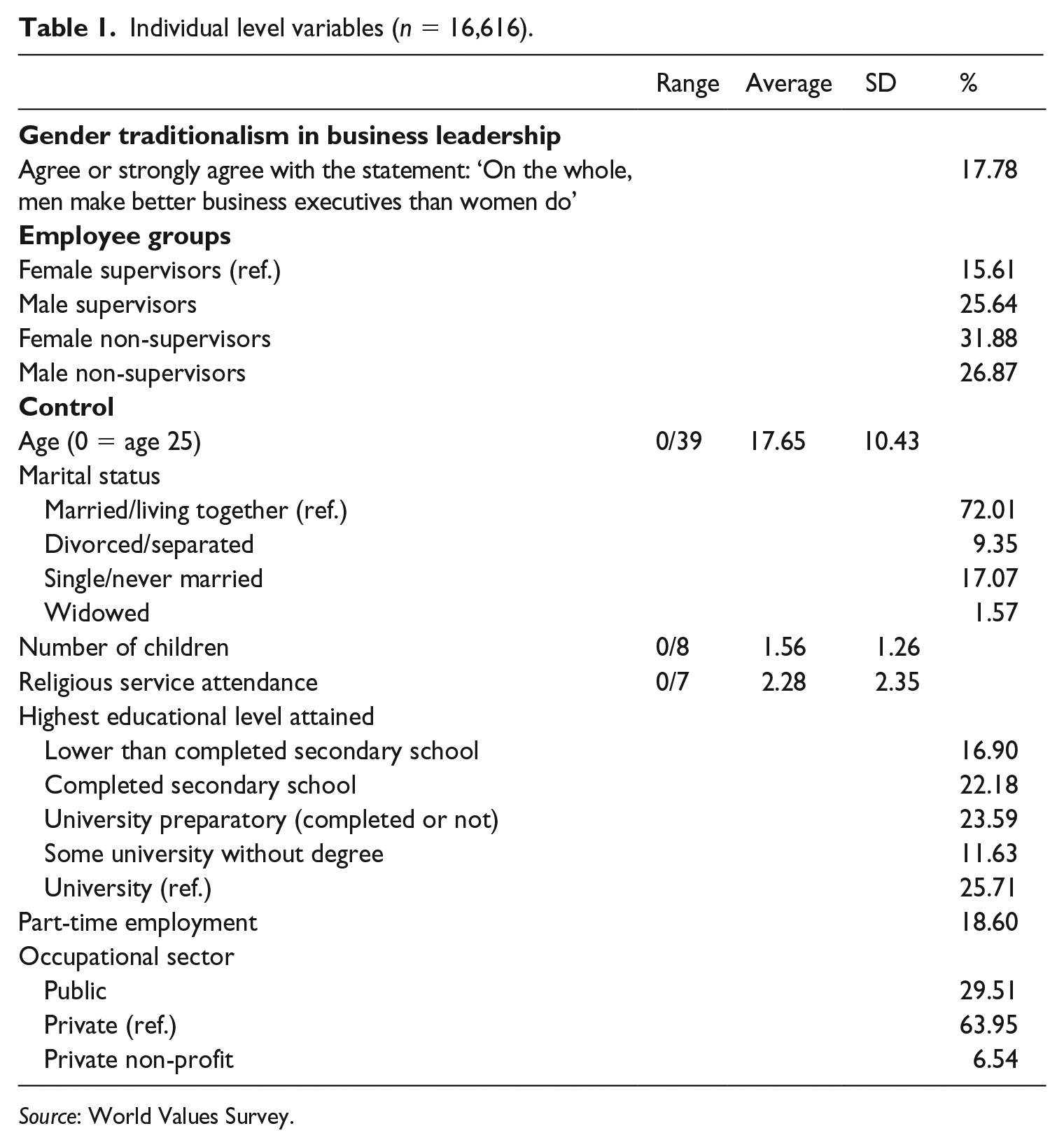
Three-level regression models were estimated to account for the nesting of respondents in surveys and surveys in countries (i.e. survey–country combinations). The selected respondents were aged 25 to 65 2 and currently employed (excl. self-employed). The final sample consisted of 16,616 respondents with complete information on all variables (10.2% was removed because of missing information). 3 Table 1 presents the individual level measurements. For information on the country level measurements per survey, see Tables A1 and A2 (online appendix).
Individual level variables (n = 16,616).
Source: World Values Survey.
Individual level measurements
Gender traditionalism regarding business leadership was measured by respondents’ support for the statement ‘on the whole, men make better business executives than women do’. Respondents indicated their level of agreement with this statement on a four-point scale ranging from ‘strongly agree’ to ‘strongly disagree’. Owing to the skewed distribution of this measure (see Figure 1), logistic multilevel regression was performed on the odds of (strongly) agreeing (1) versus (strongly) disagreeing (0) with this gender traditionalist view.
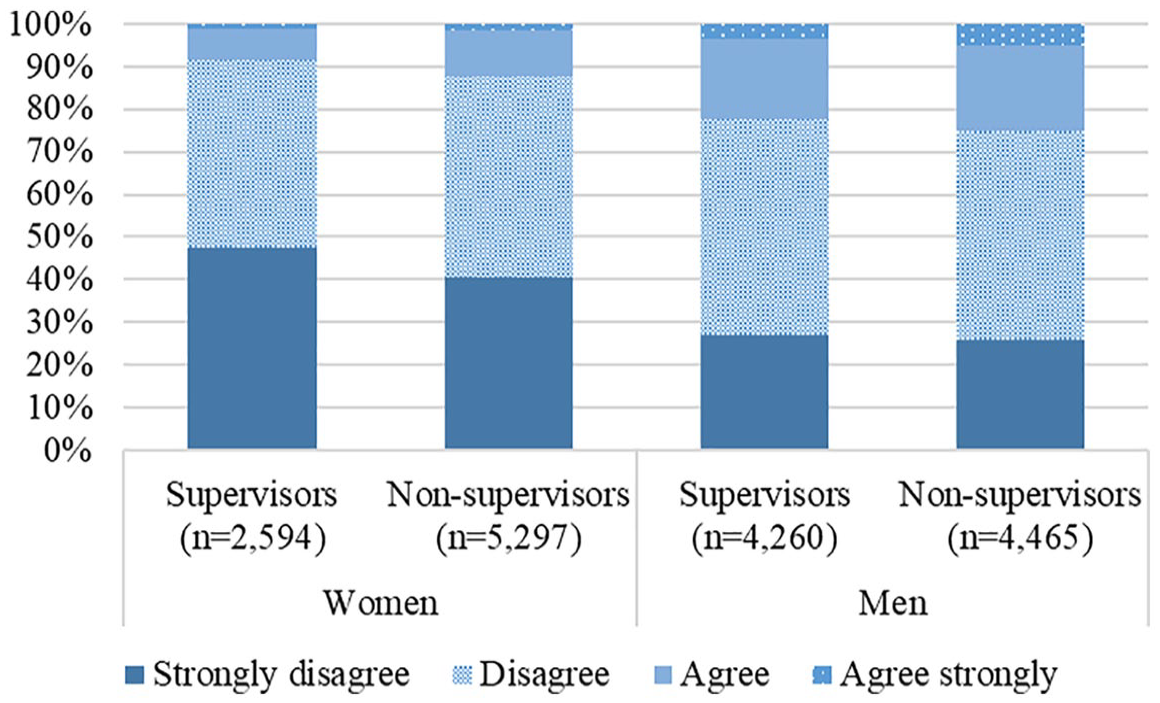
Support for the statement ‘on the whole, men make better business executives than women do’ (n = 16,616).
Supervisors and non-supervisors were distinguished using the question, ‘Do you or did you supervise other people at work?’, to which possible responses were ‘yes’ (1) or ‘no’ (0). Some 32.9% of all women and 48.8% of all men indicated having supervisory responsibilities. This measure was preferred to an indication of whether a person was a manager (or not), as the latter underrepresented leadership and showed lower cross-national comparability (Rosenfeld et al., 1998). Unfortunately, the WVS provided no information on the number of subordinates and the job type or the hierarchical position of the supervisor. For our purposes, lack of such detailed information on the group of supervisors likely led to underestimation of the difference between supervisors and non-supervisors in gender traditionalism regarding business leadership. Table A3 (online appendix) presents a breakdown of holding a supervisory position and individual characteristics. For instance, it shows that female supervisors were more likely to be higher educated than male supervisors.
Control variables included in the models were age (incl. squared), marital status, number of children, religious service attendance, highest educational level attained, type of employment and occupational sector. Religious service attendance was derived in eight categories, ranging from ‘practically never’ to ‘more than once a week’. This was included as an interval scale. Where information was missing on attendance, people known to be non-religious people were assigned to the non-attendance group. Educational attainment was measured as the highest level attained. Eight answer categories were provided. 4 For purposes of cross-national comparison, some categories were combined which resulted in five general levels, respectively: ‘lower than completed secondary school’, ‘completed secondary school’, ‘university preparatory (completed or not)’, ‘some university without degree’ and ‘university with degree’ (ref.). Employment type refers to working ‘full-time’ (ref.) or ‘part-time’. Respondents also indicated whether they worked for a ‘public institution’, ‘private business’ (ref.) or ‘private non-profit institution’. A few surveys also offered respondents the answer category ‘self-employed/informal institution’. Respondents choosing this category were assigned to the category ‘private business’.
Country level measurements
All three country characteristics were measured at the survey country level and additionally centred on the survey country mean to facilitate interpretation of the results. First, information on the share of women in managerial positions in a country was obtained from the International Labour Office (ILOSTAT, 2018). At the country level, this was the share of women in category 1 of ISCO-88 (legislators, senior officials and managers) and ISCO-08 (managers). The information employed pertained to the year prior to the survey year. If this was unavailable, information from the closest year was used. The share of women in managerial positions ranged from 6.9% in South Korea-2005 to 40.0% in New Zealand-2011 (average = 29.8, SD = 8.8).
Second, information from Terjesen et al. (2015) was used to indicate whether a country had implemented a national legislative quota policy for women on company boards. These authors reported the year in which pertinent legislations were enacted and whether these regarded a ‘hard’ quota (legally binding) or a ‘soft’ governance code with board gender recommendations (non-binding). These were represented by constructing a measure differentiating between ‘legally binding gender quota (n=5)’ (1) and ‘no gender quota’ (0). As a robustness check (detailed in ‘Robustness checks’), an extra category was added for countries with a ‘governance code (non-binding; n=6)’. It warrants mentioning that gender quotas were implemented only recently and in relatively few countries, which limits further specification of this measure. The current study therefore constitutes a first endeavour to study the association between such policies and gender traditionalism in business leadership.
Third, a country’s traditional normative climate towards working women was measured as the percentage of people agreeing with the WVS survey question, ‘when jobs are scarce, men should have more right to a job than women’ within a survey–country combination using the sample before our selections with regard to age and employment. The lowest score found was for Sweden-2011 (2.0%) whereas South Korea-2005 scored highest (36.5%) (average = 16.6, SD = 9.0).
Results
Descriptive results
Figure 1 presents a breakdown of gender traditionalism regarding business leadership for supervisors and non-supervisors, both men and women. Here again, gender traditionalism is defined as support for the view that men make better business executives than women. As theorized, female supervisors were least supportive of that view: only 8.6% of all female supervisors agreed with it. In contrast, 22.2% of male supervisors agreed. Comparing supervisors with non-supervisors, non-supervisors were generally more gender traditional regarding business leadership. Among non-supervisors, 12.5% of women and 25.1% of men supported the gender traditional view. Furthermore, gender traditionalism in business leadership ranged from 4.6% in Sweden-2006 to 49.4% in South Korea-2005 (average = 18.5, SD = 10.6). Figure A1 (online appendix) presents country-specific differences between female supervisors and others in support for the gender traditional view.
Multivariate analyses
Three-level logistic regression models were estimated in SPSS Statistics 25. All models included the survey country (intraclass correlation coefficient (ICC) = 0.02) and country variance (ICC = 0.10), as well as random coefficients for the four employee groups. The survey countries varied significantly in the differences between female and male supervisors and non-supervisors (except for the two female groups) in gender traditionalism regarding business leadership.
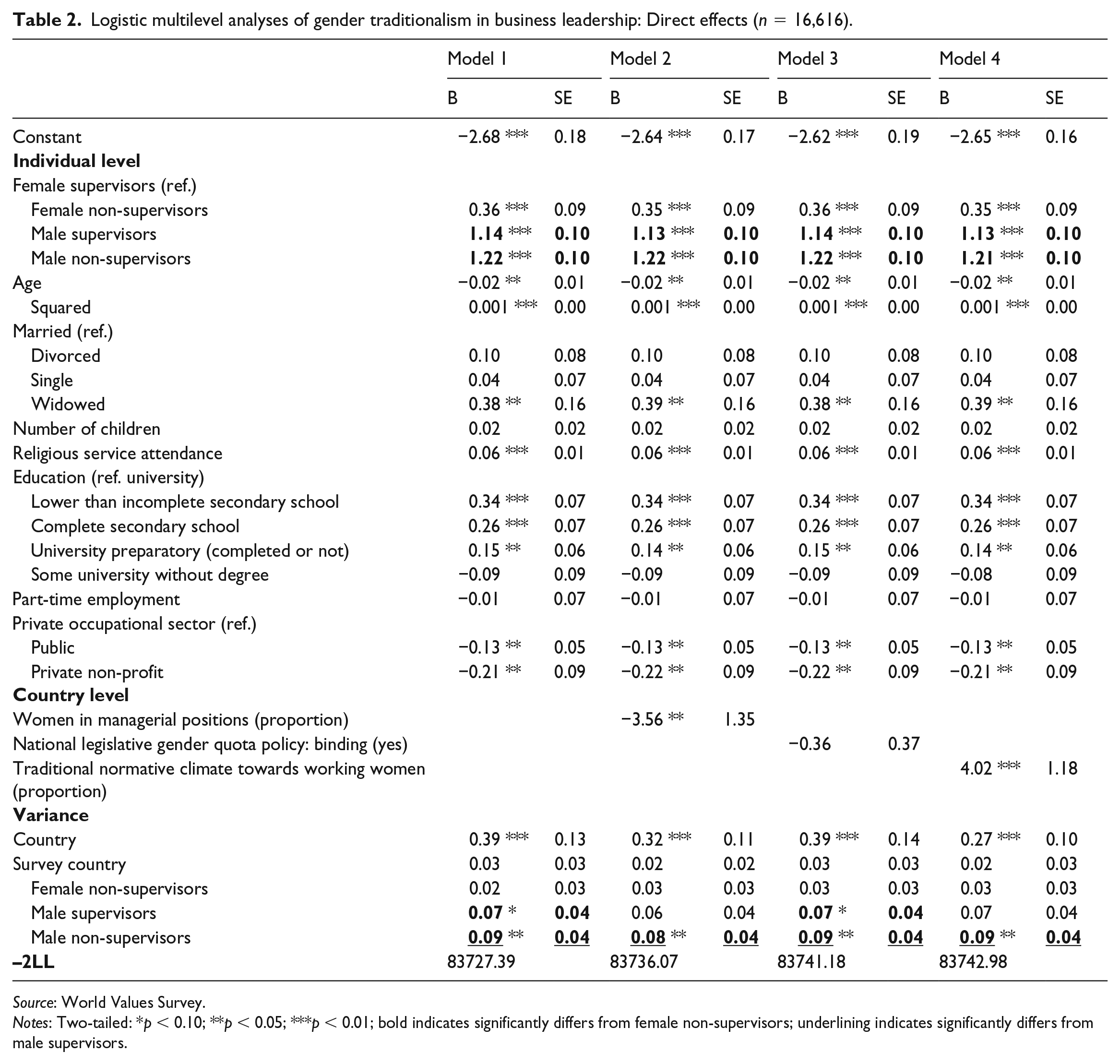
Model 1 in Table 2 presents the results for the individual level variables. Direct effects of the country level variables were added in Models 2 to 4. Controls were included in all models. The results from Model 1 demonstrate that female supervisors were the least likely to support the view that men make better business executives. They differed most from men (supervisors (b = 1.14), non-supervisors (b = 1.22)), but were also less traditional than female non-supervisors (b = 0.36). Among men, differences between supervisors and non-supervisors were not significant. Predicted probabilities of holding gender traditional views regarding business leadership were lowest for female supervisors (0.06), followed by non-supervisory women (0.09 = e−2.68+0.36/(1+e−2.68+0.36)), male supervisors (0.18) and non-supervisory men (0.19). Hypothesis 1 was thus confirmed: female supervisors expressed less gender traditionalism in business leadership than male supervisors, and female and male non-supervisors.
Logistic multilevel analyses of gender traditionalism in business leadership: Direct effects (n = 16,616).
Source: World Values Survey.
Notes: Two-tailed: *p < 0.10; **p < 0.05; ***p < 0.01; bold indicates significantly differs from female non-supervisors; underlining indicates significantly differs from male supervisors.
Looking at the controls, it first appeared that the likelihood of supporting the view that men make better business executives diminished with age (bage = −0.02), but this was only the case for the youngest respondents, as the age effect became positive for older age groups (bage2 = 0.001). This may be related to the greater competition for supervisory positions experienced by younger employees at the workplace. Marital status, number of children and type of employment were not significantly related to gender traditionalism in business leadership. Only widowers were more likely to support gender traditional views than married people (b = 0.38). Also, those who attended religious services regularly (b = 0.06), and the lower educated (b = 0.34), were more likely to hold gender traditional views regarding business leadership. Lastly, people employed in the private sector were more likely to consider men better business executives than respondents employed in the public sector (b = −0.13) or private non-profit sector (b = −0.21).
Model 2 addresses the association between gender traditionalism regarding business leadership and structural gender inequality in a country. The results indicate that a larger share of women in managerial positions (b = −3.56) was significantly negatively related to the likelihood of considering men more suited as business executives. Hypothesis 2 was thus confirmed. Although the estimate yielded the expected negative association, Model 3 indicates that the presence of binding gender quotas (b = −0.36) was not significantly related to gender traditionalism (hypothesis 3 rejected). However, a more traditional normative climate towards working women did seem to relate to a significant greater likelihood to support gender traditional views in business leadership (b = 4.02). This confirmed hypothesis 4.
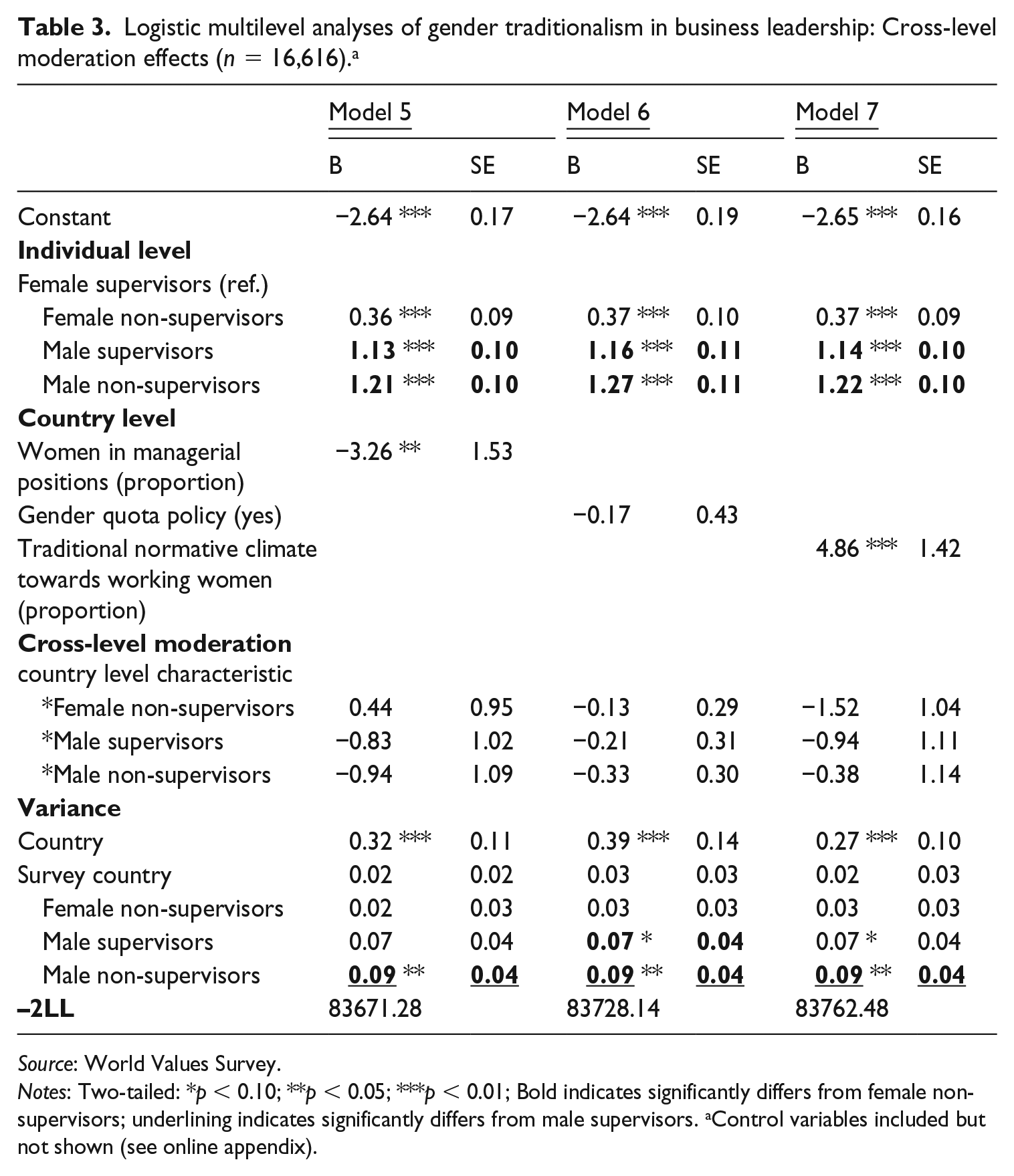
Next, this study was interested in moderation effects; specifically, whether the countries varied in attitudinal differences between female and male supervisors and non-supervisors. Table 3 presents a test of these cross-level effects (Models 5 to 7). Although all cross-level estimates were insignificant, there was some indication that negative associations between structural and policy characteristics (Models 5 and 6) and the likelihood of supporting the view that men make better business executives was stronger for male supervisors and non-supervisors than for female supervisors. Furthermore, the association between legally binding gender quotas and gender traditionalism in business leadership seemed slightly stronger for female non-supervisors compared to female supervisors. As the predicted probabilities clearly show (see Figure 2), the three country characteristics – including the normative climate towards working women – particularly affected men’s gender traditionalism regarding business leadership in our sample. These results, however, must be interpreted with caution, as they were not substantiated by significant cross-level moderations.
Logistic multilevel analyses of gender traditionalism in business leadership: Cross-level moderation effects (n = 16,616). a
Source: World Values Survey.
Notes: Two-tailed: *p < 0.10; **p < 0.05; ***p < 0.01; Bold indicates significantly differs from female non-supervisors; underlining indicates significantly differs from male supervisors. aControl variables included but not shown (see online appendix).
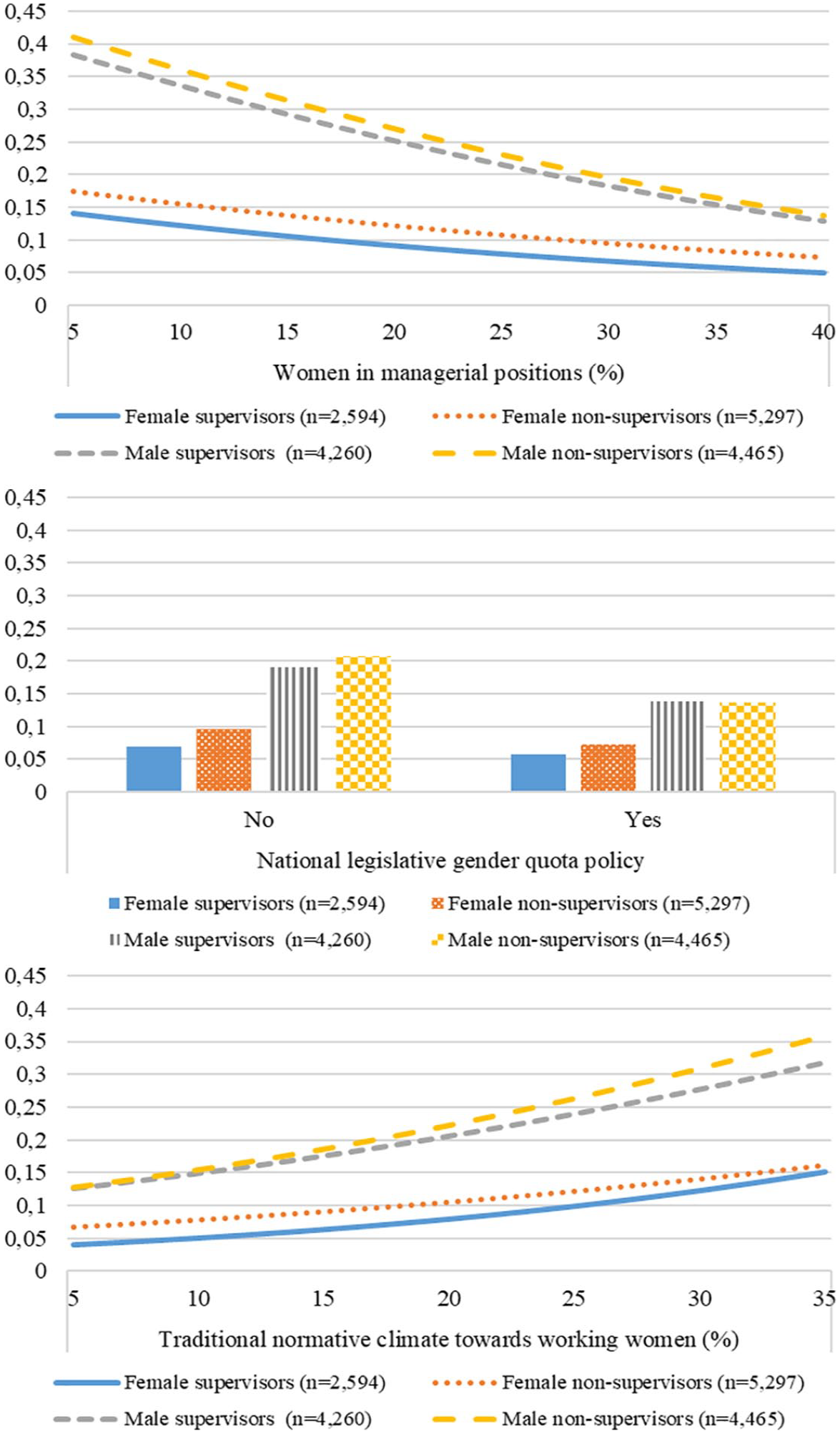
Probabilities of support for the statement ‘on the whole, men make better business executives than women do’:a Cross-level moderation influences (n = 16,616).
Robustness checks
The robustness of the results was controlled in several steps. First, multilevel linear regression analyses were performed instead of logistic regression analyses, producing similar results. Remarkably, the negative association between gender traditional views and binding gender quotas in a country was much closer to reaching significance here (plinear = 0.136). Second, the models were re-estimated, differentiating three categories of quota policies: ‘no legislation’ (ref.), ‘a governance code (non-binding)’ and ‘legally binding gender quota’. Here, the largest difference in gender traditionalism regarding business leadership was found between countries with binding quotas versus no quota policies to stimulate female appointments on boards (plinear = 0.118). Lastly, including a country’s GDP in the models as a control did not alter the conclusions of the logistic and linear analyses.
Conclusion and discussion
This cross-country study aimed to better understand the prevalence of gender traditionalism regarding business leadership. Prior studies argue that women’s underrepresentation in (top) business leadership positions has a normative foundation, which generally disadvantages women (Eagly and Heilman, 2016). The current study investigated whether female and male supervisors and non-supervisors differed in their support for the view that men make better business leaders than women. It also investigated whether national structural, policy and cultural characteristics related to gender inequality made a difference, and if so, to whom in particular.
Two contributions of this study are particularly noteworthy. The first regards the use of the theoretical notions of self-interest and exposure to link gender traditionalism in business leadership to holding a supervisory position at work. A majority from all four groups opposed the gender traditional view, but female supervisors were nevertheless convincingly found to be least likely to support the view that men make better leaders. This confirms arguments following the self-interest rationale, as traditional gender role opinions undercut female supervisors’ identities and work capabilities. Similarly, in accordance with the theoretical notion of exposure, female supervisors are expected to be exposed to more non-traditional attitudes at work and in their social network, presumably stimulating more gender egalitarian views. Surprisingly, among men, holding a supervisory position was not linked to more gender egalitarian views on leadership. This insight is especially important in light of current debates calling for the mobilization of female and male actors, such as supervisors, in combatting gender inequality at work (Connell, 2005; De Vries, 2015; Derks et al., 2016; Kelan and Wratil, 2018; Stainback et al., 2016).
Second, this study examined the influences of exposure to gender traditionalism at the country level. Specifically, it examined structural, policy and cultural characteristics related to gender inequality in 22 survey countries, and the associations of these with gender traditionalism in business leadership. The findings confirm that countries with a greater share of women in managerial positions also had less support for gender traditionalism in business leadership. Thus, having examples of women in managerial positions in the national labour market appears to shape greater acceptance of and support for women in (top) leadership positions. Moreover, the normative climate – measured as the general perception of men and women having equal rights to a paid job in times of scarcity – seems to matter. In countries where more egalitarian opinions predominated, gender traditionalism in business leadership was less prevalent. No association was found between gender quota policies and gender traditionalism in business leadership. It merits noting, however, that this policy is relatively new and not yet widespread. Perhaps more time is needed for these policies to exhibit impact, as they are still also heavily debated within societies. A valuable avenue for future research would be to elaborate on the role of gender quotas in influencing gender traditionalism in business leadership. In line with recent cross-country studies, the current study found some indications that the country context affects gender opinions, especially among men. Again, future research is recommended to investigate this cautious conclusion more thoroughly.
Despite the contributions of this cross-country study of gender traditionalism regarding business leadership, several drawbacks warrant mentioning. First, the employed measure for being a supervisor could have been more detailed. This study was unable to differentiate between hierarchical levels or occupational sectors due to limitations of the WVS data. The proposed theoretical mechanisms of self-interest and exposure might be most applicable to people working in the highest leadership echelons. If that is true, the results presented here probably underestimate the differences in gender traditionalism. Even with the rather broad measure used here, the current study found female supervisors to be less supportive of the view that men are better leaders, compared to women who did not hold a supervisory position. Future studies might wish to build upon this finding by incorporating more precise indicators of the type of supervisory position held. Second, owing to the cross-sectional design of this study, selectivity and causality issues cannot be ruled out. Women with more egalitarian gender opinions are likely to be more successful or more motivated to aspire to a supervisory role. This selectivity was addressed by including several individual characteristics in the models to capture previously held gender opinions and job choices (e.g. educational attainment and employment sector). However, it must be acknowledged that part of the association might be recursive.
In sum, this study convincingly shows that female supervisors are least supportive of the view that men make better business leaders than women, compared to male supervisors and female and male non-supervisors. It also provides evidence of the influence of national structural and cultural characteristics in determining gender traditionalism. Findings from this study suggest the value of future research zooming in on the company context. Elaborating on exposure in this more daily-life setting – with a possibly larger diversity in the three contextual indicators investigated here – could further the development of this sociological perspective on gender traditionalism in business leadership.
Supplemental Material
Manuscript_for_publication_WES_online_appendix – Supplemental material for A Cross-Country Comparison of Gender Traditionalism in Business Leadership: How Supportive Are Female Supervisors?
Supplemental material, Manuscript_for_publication_WES_online_appendix for A Cross-Country Comparison of Gender Traditionalism in Business Leadership: How Supportive Are Female Supervisors? by Carly van Mensvoort, Gerbert Kraaykamp, Roza Meuleman and Marieke van den Brink in Work, Employment and Society
Footnotes
Funding
The authors received no financial support for the research, authorship, and/or publication of this article.

Notes
References
Supplementary Material
Please find the following supplemental material available below.
For Open Access articles published under a Creative Commons License, all supplemental material carries the same license as the article it is associated with.
For non-Open Access articles published, all supplemental material carries a non-exclusive license, and permission requests for re-use of supplemental material or any part of supplemental material shall be sent directly to the copyright owner as specified in the copyright notice associated with the article.
