




Abstract
This article explores how unions can influence employer decisions to downsize – a longstanding question that has been addressed through three waves of research. Although the literature has successively identified three types of factors that influence managerial decisions to downsize, it has not fully addressed the interactions of these factors, leading to inconsistencies. This article builds on and refines the existing work through a configurational approach which qualitatively evidences six downsizing configurations through a uniquely large number of cases (n = 19). This research sheds new light on how factors combine to enhance union influence by theorizing four types of chemical-like factor interactions: catalysing, inhibiting, synthesizing and decomposing. By highlighting this interactive chemistry, this configurational approach revisits longstanding academic debates about the context–union strategy fit and the relative efficacy of union responses. From a practical perspective, it encourages unions to reject the idea that there is a single, optimal strategy for addressing downsizing.
Keywords
Introduction
In 2015, the PlastiFIN group, an automotive industry subcontractor, decided to shut one of its French production facilities. The decision, which was a repercussion of the 2008 financial crisis, intended to lay off around 100 employees. The workers, located in a rural area with few other employment prospects, were shocked by the announcement. The union leaders and workers fought fiercely to save their jobs through demonstrations, a visit to the German headquarters and a strong presence on social media. After five months, taken aback by the unexpected strength of the union response, the German group reversed its decision, opting to keep the site open. Two years later, it had become the group’s most profitable plant. While such union victories do occur, this one is more of an exception than a rule (Pulignano and Stewart, 2013). This article therefore seeks to investigate how unions can influence managerial decisions to downsize in order to mitigate the negative consequences for workers.
Three main waves of industrial relations research explore the influence of unions in redundancy processes. 1 They successively evidence three types of factors that explain the inflection of managerial decisions to downsize. The first wave focuses on factors related to the response of unions, such as their attitudes (Bacon and Blyton, 2004; Frost, 2001) and their ability to navigate the process (Lévesque and Murray, 2010). The second wave highlights the importance of relational factors, reflecting the attitudes of management and other stakeholders towards the union (Danford et al., 2002). More recently, a third and contingency-oriented set of studies also takes account of how contextual factors shape union responses and relations (Dupuis, 2018; Pulignano and Stewart, 2013).
While the existing literature has enriched knowledge, there is ambiguity about how these factors concretely influence redundancy processes. For example, researchers differ on whether unions with conflictual attitudes (Kelly, 1998) are more effective than those with cooperative attitudes (Dupuis, 2018). This article hypothesizes that these inconsistencies can be overcome by adopting a configurational approach. Thus far, the prevailing contingency approach posits that the union response is optimal when it ‘fits’ with contextual factors. The configurational approach extends and refines this prevailing contingency thinking. It encourages consideration of the interactions between factors as simultaneous and complex, rather than linear, unidirectional and causal (Van De Ven et al., 2013), conceptualizing the factors as ‘interacting parts of a whole rather than individual factors working in isolation’ (Furnari et al., 2021: 782). Following this theoretical approach, this study seeks to provide an original answer to a classical research question, namely: How do union responses influence managerial decisions to downsize? More precisely, it aims to: (1) identify configurations of factors which lead to different levels of influence on managerial decisions; and (2) conceptualize the chemistry of the interactions of factors within each of these configurations.
Noting that the contingency approach of previous studies is partly driven by the limited number of cases studied, this study is based on a qualitative investigation of 19 cases of downsizing in France undertaken through 56 interviews with unionists, management, experts and labour administration representatives, complemented by documentary analysis. Six configurations leading to three different levels of union influence emerge from this investigation. In the first two configurations, the unions succeeded in significantly reducing job cuts while, in two others, they improved the job-transition programmes offered to laid-off workers. In the remaining two configurations, the unions had no substantial influence.
This work, based on the configurational approach, adds to existing studies by more finely grasping the complex interactions of factors that occur in the downsizing configurations. It evidences four chemical-like factor interactions: catalysing, inhibiting, synthesizing and decomposing. This novel approach offers a fresh look at longstanding debates about union influence on managerial decisions to downsize. It challenges the traditional assumption that there is ‘one best contingent fit’ between union strategy and the downsizing context. It also illuminates debates about the efficacy of union responses, counter-intuitively suggesting that it may not always be essential for unions to have strong capabilities in order to influence managerial decisions to downsize.
Literature review
Three successive approaches to investigating the influence of unions in redundancy processes
Through three waves of work, the research incrementally refines understanding of the influence that unions have on managerial decisions to downsize. These successively focus on the unions’ responses, their relations with stakeholders and the context of the redundancy plans. The main findings and limitations of these research waves are detailed below.
The first wave aims to understand how the response of unions influences decisions to downsize. The initial focus is on union attitudes to management, probing the value of collaborative and adversarial strategies (Frost, 2001; Kelly, 1998). This is refined further by Bacon and Blyton (2004) who suggest that union attitudes are not merely determined by their adversarial or collaborative inclination but also by their actions, ranging from engagement to passivity. Further, this stream considers trade union capabilities in its conceptualization of union responses. Boxall and Haynes (1997) argue that irrespective of the attitude – adversarial or collaborative – the effectiveness of union response depends on the leadership’s capabilities to execute them. Lévesque and Murray (2010) deepen this idea by identifying four capabilities that enable unions to influence redundancy procedures. However, it appears that other types of factor should also be considered to illuminate the complexity of redundancy procedures (Frost, 2001).
A second stream refines the study of union influence by incorporating relational factors. This approach, which extends Kochan and Osterman’s (1994) view of the strategic behaviour of actors, notes that the attitudes of employers can be as diverse as those of unions (Danford et al., 2002). Some argue that unions can only exert influence when employers are open to collaboration (Bacon and Samuel, 2017). However, Pulignano and Stewart (2013) challenge this, suggesting that unions can only have a marginal influence on decisions when management behaves collaboratively and can significantly challenge them when employers adopt an adversarial attitude. The influence of other actors on union–management interactions is also highlighted. Labour administration is shown to play a decisive yet highly ambiguous role, as it can help to strengthen workers’ voices and balance union–management relations (Doellgast, 2010) or can stifle worker dynamics (Contu et al., 2013). While this second stream deepens understanding of the phenomenon, its decontextualized approach leads to its results being partly ambiguous.
Taking a contingency approach, the third wave integrates contextual factors to analyse how union influence is shaped by the background of redundancy plans (Dupuis, 2018; Marginson et al., 2004; Meardi et al., 2009). Following Burns and Stalker (1994[1961]), this stream assumes that there is no such thing as a universal ‘one best way’ but that the relevance of actors’ strategic behaviour depends on their ‘strategic fit’ with the context. Factors that determine the most effective union responses include workforce composition and the company’s restructuring history, financial health and type of governance (Dupuis, 2018; McLachlan et al., 2019). This third, contingency-oriented wave makes an important step forward by considering the relationships between strategic and contextual factors. However, here again, the literature displays some inconsistencies. For example, Dupuis (2018) suggests that, in the context of a firm’s poor financial performance, jobs can be saved if management and unions both have a cooperative attitude. In a contrary view, Pulignano and Stewart (2013) suggest that, in such a context, adversarial relations will maximize the effects of trade union responses.
Overall, the existing contingency-oriented literature still suffers from some conceptual and methodological shortcomings. From a conceptual point of view, it fails to grasp the complex interaction across the three types of factors, leading to inconsistencies. As most of these qualitative studies consider fewer than four cases and none study more than eight, this makes them less generalizable and these empirical limitations can lead to invalid causal links being drawn between factors. To address these limitations, this article moves away from the prevailing contingency thinking to take a configurational approach.
The configurational approach as a new way to theorize the influence of unions on managerial decisions to downsize
Rather than being considered a rupture, the configurational approach is best understood as a continuation and refinement of the contingency approach. Indeed, the two approaches have a common base: they both identify typologies by investigating bundles of factors; they suggest thinking in terms of fit; and they emphasize the importance of context in understanding social phenomena. However, the configurational approach offers an original conceptualization of factor interactions which could help to reconcile the inconsistencies in the downsizing literature. This approach ‘builds upon the conceptual richness of contingency theory and adopts a holistic view of organization context [. . .] that appears to avoid the pitfalls of early research’ (Van De Ven et al., 2013: 397). Four main conceptual differences between the contingency and configurational approaches can be highlighted.
The first relates to how they conceptualize the context. As mentioned earlier, the contingency approach considers that, to a great extent, the context determines the level of influence a union can have. For example, Marginson et al. (2004) argue that contextual factors operate like a threshold. If the contextual conditions are ‘favourable’, then union representatives cross the first threshold, meaning that they will always manage to exert a minimal level of influence on managerial decisions. By contrast, the configurational approach does not agree that contextual factors always overdetermine the level of union influence.
Another related difference between the two approaches is their understanding of the optimal combinations of factors. Contingency-oriented research, in line with the principle of unifinality, tends to assume that there is ‘one best contingent way’ that is the optimal union response in a given context to influence managerial decisions (Grandori and Furnari, 2008). Hence, existing studies may fail to evidence all the pathways that can maximize union influence (Marginson et al., 2004; Pulignano and Stewart, 2013). The configurational approach can overcome this shortcoming as it operates under the principle of equifinality, which asserts that different combinations of factors can lead to the same outcome (Miller, 2018). Moving from a ‘strategic fit’ to a more comprehensive ‘systemic fit’ (Grandori and Furnari, 2008), the configurational approach encourages researchers to identify pathways that lead to a given outcome. Related to the equifinality principle, the configurational approach invites researchers to consider the substitutability of factors. Factors are substitutable when ‘one or more factor’s configurations may be alternatives to bringing about an outcome. Substitution implies functional equivalence of these factors’ (Furnari et al., 2021: 788).
A third difference relates to assumptions about the linearity of factors. The contingency approach posits that there are unidirectional and linear relationships between factors (Meyer et al., 1993). For example, Marginson et al. (2004) consider that management with a ‘minimalist’ attitude to unions will always constrain a union’s influence, while management with a ‘proactive’ attitude will always help to increase it, regardless of the union’s response. Conversely, the configurational approach proposes that a single factor cannot be predefined as ‘favourable’ or ‘unfavourable’ for unions. Instead, following the conjunction principle, a given factor can lead to different outcomes depending on its combination with other factors (Furnari et al., 2021). When applied to downsizing, the configurational approach states that the impact of a union’s attitude – whether collaborative or adversarial – depends on its interplay with factors like the union leaders’ capabilities, management’s attitude and the social acceptability of the downsizing process. The configurational approach emphasizes factor complementarity – the idea that multiple factors can enhance each other’s contribution to an outcome (Furnari et al., 2021). In other words, factors are complementary when their synergetic combination produces more effects than the factors individually.
The fourth difference between the two approaches relates to the relative weight given to factors in a particular configuration. Unlike in the contingency approach, which treats all factors equally, Fiss (2011) delineates three types of centrality within a configuration: core, peripheral and insignificant. Core factors exhibit strong causal links with the outcome, while there is weaker evidence of peripheral factors having such relationships. Insignificant factors are those whose value does not change the configuration’s outcome.
In summary, the configurational approach can help to account for the complexity of social mechanisms by focusing on the substitutability, complementarity, relative importance and systemic fit of factors (Fiss, 2011; Furnari et al., 2021). Given the avenues that this approach opens, this article revisits the following research question: How do union responses influence managerial decisions to downsize? To do so, it first identifies the configurations that enable unions to influence decisions to downsize before conceptualizing the interactions of factors within each configuration.
Method and cases
To address the research question, we qualitatively and abductively studied the configuration of 19 redundancy plans in France. Details of the research context and methodology are provided below.
The French context and the case selection strategy
The case of Job Preservation Plans in France
The downsizing cases occurred in France, a country known for its state-centric industrial relations regime (Eurofound, 2018), particularly regarding downsizing management (Dupuis, 2018). However, since the 2013 Loi sur la Sécurisation de l’Emploi, French downsizing processes align more with North European and Anglo-Saxon models (Géa, 2015) and therefore France may be less atypical in terms of how downsizing is negotiated and managed (Dupuis, 2018). French law requires companies making 10 or more employees redundant for economic reasons to negotiate a Job Preservation Plan (Plan de Sauvegarde de l’Emploi, referred to hereafter as JPP) with unions. These negotiations relate to the number of jobs being cut and the job-transition programme (including training budgets, outplacement services or moving to another city or country). This process is supervised and controlled by the regional labour administration to ensure that the form and content of the union–management negotiations respect the minimum legal standards.
Case selection strategy
The study employed a snowball sampling strategy through the authors’ contacts with actors typically involved in JPPs: unions, union and employer experts, lawyers and the labour administration.
To align with the research question and to limit the risk of selection bias associated with the snowball sampling method, four case selection criteria were used. First, cases where the precarious financial health of the company constrained the negotiation of job preservation plans were excluded. Therefore, JPPs enforced by legal redress or court-ordered liquidation (i.e. cases where the courts had ruled that the short- to mid-term survival of the company was in danger) were excluded. Second, a balance was sought between ‘successful’ and ‘unsuccessful’ cases. In eight out of 19 cases, the unions had significantly reduced the job cuts (i.e. by at least 10%); in five, they had negotiated excellent job-transition programmes without reducing job cuts; and in six, they had no significant influence on downsizing. Third, the aim was for a diverse case selection in terms of sector, company size, ownership and downsizing type (Table 1). Lastly, to mitigate the effects of legal and institutional change, all cases took place between 2015 and 2018 (i.e. a period when there was a stable legal framework).
Case description.

Note: aLarge companies have more than 500 employees, and small and medium enterprises (SME) have fewer than 500 employees.
Data collection
In an exploratory phase, experts and unionists were consulted to exhaustively identify factors that affect managerial downsizing decisions. Semi-structured interviews were then prioritized for data collection. For each of the 19 cases, interviews were conducted with at least two stakeholder types directly involved in a JPP. In total, there were 56 interviews with employee representatives (n = 21), management (n = 8), accountants/legal experts (n = 24) and labour administration agents (n = 3).
There were fewer interviews with management. This was possibly due to the reluctance of managers who used avoidance or adversarial strategies during the JPP, as it was only possible to interview one employer who had adopted such an attitude. The interviews, which averaged 93 minutes, were recorded and transcribed and had three parts: interviewee’s background and company; the JPP details (economic rationale, organizational logic, actors’ strategies and main stages); and qualitative assessment of the JPP’s outcomes and influential factors. The interviews were supplemented with documents, including official JPP documents and other resources like news articles when available.
Data analysis
The dataset was analysed following the ‘theorizing toolkit’ of Furnari et al. (2021), which aims to aid researchers using a configurational approach. Their heuristics include three stages – scoping, linking and naming. This highly iterative process involved alternating between understanding the material, coding data and modelling results. The analytical three-stage process is presented in detail below.
The scoping stage: Identifying factors and coding cases
The ‘scoping’ stage aimed to identify factors that had an influence on the study’s chosen outcome: union influence on managerial decisions. As part of an abductive approach, this stage involved complexifying and simplifying sub-phases (Furnari et al., 2021). The former entailed identifying as many contextual, relational and union response-related factors as possible. Fifteen factors were identified using existing literature and exploratory interviews (see Appendix 2). The simplifying sub-phase reduced the number of factors by merging complementary ones and removing redundant or marginally influential ones so that six factors remained: two contextual, two relational and two union response-related factors.
The two contextual factors were ‘social acceptability’ and ‘downsizing history’. ‘Social acceptability’ was assessed by cross-tabulating three items: number of job cuts, employability of laid-off workers and employees’ perceptions of financial difficulties. JPPs were viewed as ‘socially acceptable’ when at most one item was deemed problematic. ‘Downsizing history’ was labelled ‘important’ if previous downsizing within the company or parent group had significantly influenced the actors’ bargaining strategies.
The relational factors were ‘management attitude’ and ‘labour administration attitude’. Following Walton et al.’s (2000) categorization, ‘management attitude’ was classified as collaborative (‘fostering’), adversarial (‘forcing’) or one of avoidance (‘escape’). Collaborative attitude referred to employers who viewed unions as legitimate partners and negotiated in good faith. Adversarial attitude referred to employers who viewed unions as legitimate and important opponents but also negotiated in good faith. Avoidance attitude related to employers who deemed unions unimportant or illegitimate adversaries and negotiated in bad faith (did not share information, constantly rejected proposals, had a threatening or contemptuous attitude, etc.). ‘Labour administration attitude’ was considered pro-labour when it actively supported workers and unions and neutral when it only fulfilled the minimum legal obligations. This assessment was made through interviews and by examining the frequency and nature of interactions with unions and the number of letters, observations and/or injunctions sent to management.
Union response comprises two factors: the ‘union’s attitude’ and ‘union leaders’ capabilities’. Based on Bacon and Blyton’s (2004) typology, the ‘union’s attitude’ was assessed as passive, cooperative or adversarial. Adversarial attitudes were identified when unions resorted to significant confrontational actions such as strikes or media campaigns which went beyond ‘ritualized’ or facade protests. The ‘union leaders’ capabilities’ were considered strong when they had proficiency in at least three of the four key skills related to managing downsizing, as per Lévesque and Murray (2010). These skills were technical (understanding financial data and legal context, and ability to form counterproposals), political (ability to maintain unity among union representatives), communication (ability to connect with the company’s employees) and steering (ability to draw upon competent individuals like accountants, legal experts, trade unions). They were evaluated through interviews with stakeholders (i.e. experts, management, labour administration and/or unionists).
The outcome was defined as the influence of the union’s response on the managerial decision to downsize. Following Marginson et al. (2004), the study distinguishes three levels of union influence. At the highest level, unions influence the substance of the employer’s decision. In the context of a downsizing process, this entails protecting jobs by reducing the number of job cuts initially planned (Pulignano and Stewart, 2013). The union response was considered to have a ‘substance-oriented influence’ when the number of job cuts had been reduced by at least 10% through the JPP negotiation process. This 10% was established in accordance with experts, who considered that the employers’ negotiation margin never exceeded this threshold.
At the intermediate level, unions influence the implementation process of the management decision. In the context of a downsizing process, this means altering the management’s job-transition programme. As these programmes encompass a wide range of incommensurable measures, the study relied on Pulignano and Stewart (2013), who use actors’ perceptions to assess the overall quality of job-transition programmes. Unions were deemed to exert an ‘implementation-oriented influence’ when actors perceived that the negotiated job-transition programme exceeded sectoral standards. These standards indeed frequently calibrate the negotiation expectations of all parties, including the labour administration. Typically, most job-transition programmes gravitate towards and seldom surpass these sectoral standards. Overall, 13 cases were identified where unions had an influence – either on the substance of the decision or on its implementation process. Beyond the objective measures of union influence described above, the study relied on interviews with management to confirm the decisive role of unions in five of these 13 cases. In the remaining eight cases, union influence was triangulated with other factors, such as reversal of the decision to close the plant (PlastiFIN), replacement of the lead redundancy manager due to his inability to enforce the company’s strategy (IndusELEC) or the plant manager breaking down in tears at an official meeting because of his inability to resist the pressure exerted by the union (CeramINDUS), etc.
At the lowest level, unions had no influence when they did not significantly reduce the number of job cuts or negotiate an excellent job-transition programme.
The ‘linking’ stage: Identifying configurations
The next step was to identify configurations (see Appendix 3 as an illustration), which involved grouping cases with similar factor combinations and similar outcomes. First, all cases were grouped according to one of the three outcomes. Within these groups, patterns and guiding logics were identified. As the linking stage involves asking ‘how or why the factors connect to each other to form a configuration’ (Furnari et al., 2021: 783), particular attention was paid to the potential interactions of factors. When defining configurations, consideration was given to how factors might combine or substitute for each other. This linking process also aimed to assess each factor’s relative weight within a configuration.
The ‘naming’ stage: Theorizing configurations
The final stage entailed naming configurations (i.e. finding the right label to typify them). According to Furnari et al. (2021), naming involves ‘articulat[ing] the orchestrating themes that underpin the configuration coherence’ (p. 793). In this stage, the authors brainstormed to find labels that fairly represented the complex interactions of factors and their effects. Only those labels that closely matched certain criteria were selected. These criteria were: labels reflected key combinations of factors; they reflected the outcome; and they were short and easy to understand.
Findings
Six configurations emerged from the investigation of the 19 JPPs (Figure 1). For each configuration, the article explains the central organizing themes behind its label and then details how its factors interact. Additionally, following Miller (2018), it elaborates upon the narrative potential of the configurational approach by using a typical case to illustrate each configuration (Gerring and Seawright, 2006).
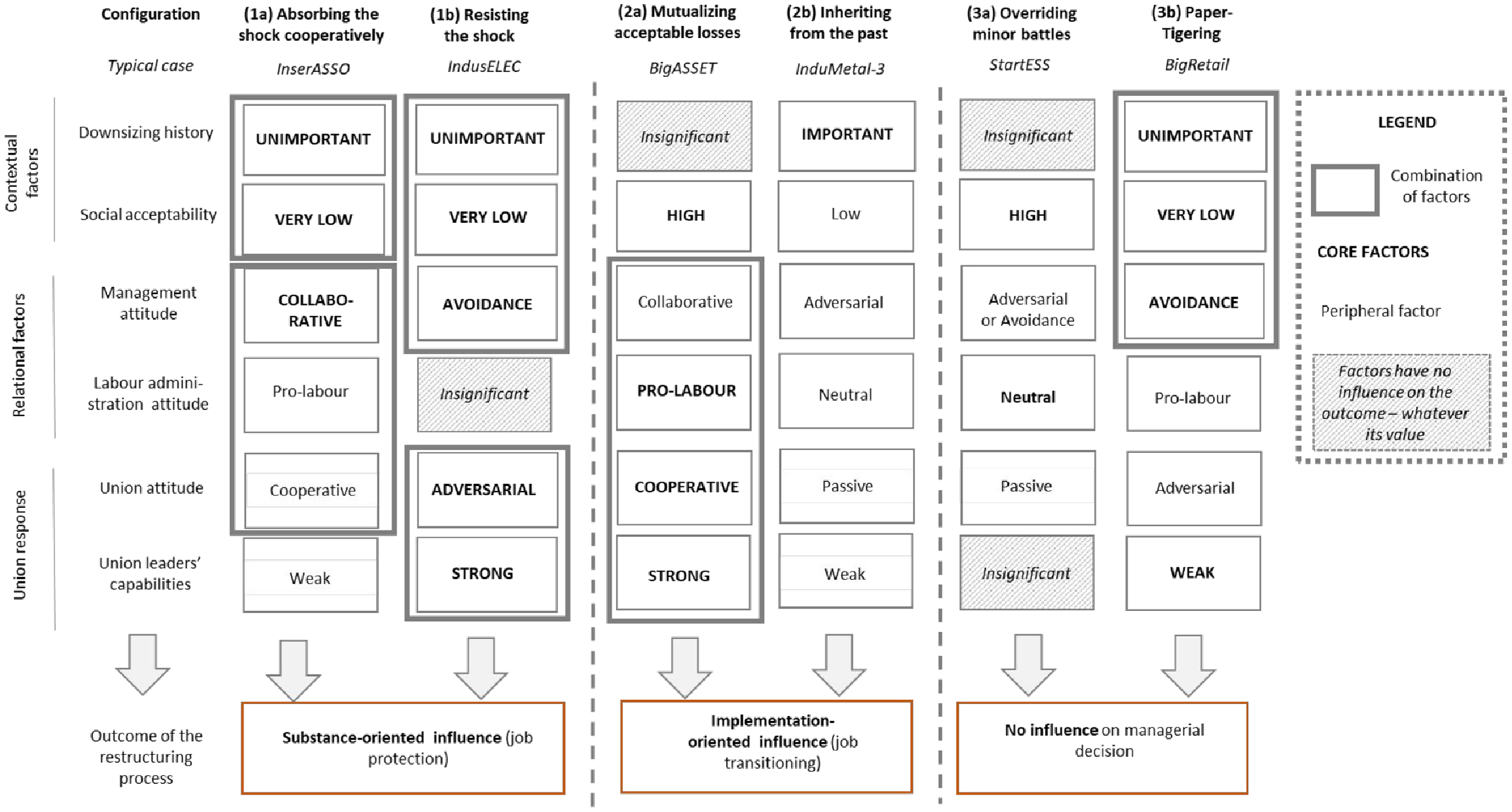
Six JPP configurations according to the type of union influence.
Configurations in which unions influence the substance of the managerial decision
‘Absorbing the shock cooperatively’ and ‘resisting the shock’ are the two configurations which had a significant influence on the substance of the managerial decision. Interestingly, these two configurations start from a similar context and reach a similar outcome despite going in almost opposite directions.
‘Absorbing the shock cooperatively’ configuration (1a)
We use the term ‘absorbing the shock cooperatively’ for the first configuration, which leads to a significant number of jobs being saved. This label underlines the shocking context of this type of JPP for workers, as its low level of social acceptability is exacerbated by the lack of any previous mass redundancies within the organization. The label also highlights that the actors cooperate to find all possible ways to limit the effects of the lay-off decision. This configuration was found in the case of InserASSO, where, according to one manager, actors ‘agreed to save the organization altogether’.
This configuration is characterized first by the context of the lay-off decision, which is considered ‘shocking’ as it is both unprecedented and socially unacceptable. Although workers were aware of the organization’s financial difficulties, they considered InserASSO’s redundancy plan to be socially unacceptable as it targeted a high number of workers (80 out of 400) whose chances of finding another job were extremely low. InserASSO is a not-for-profit organization that hires disabled people to help them access the regular labour market. As one manager confessed: ‘You can’t imagine laying off 80 disabled workers and expect them all to find work, because it’s impossible’. The workers’ and union’s shock was amplified because the downsizing process had no precedent. InserASSO had never laid people off because it contradicted its core mission. As the human resources (HR) manager explained: ‘Over the last 10 years, it was even written in black and white in my PowerPoint presentation about the organization: “InserASSO does not downsize”’. The union representative described the JPP announcement as ‘violent’ for workers: ‘an association that works with disabled workers that implements a JPP, you can imagine the impact. This is what we call a little bomb.’
The second key characteristic of this configuration is the combined collaborative attitude of all the actors (i.e. management, unions and the labour administration). According to the union leader, the open and participatory approach of InserASSO’s management was considered part of ‘the organizational DNA’. Its continued cooperative attitude during the JPP process helped the union to respond cooperatively. The union representative stated: ‘Discussions have always been open and constructive with management. We don’t always agree, and there are some tensions, as in all discussions. But it has always been constructive.’ The management’s openness gave the union leaders significant room to influence the process. As one manager stated: ‘We were working together (with the union representative) like crazy, sometimes till midnight. Because we had a common goal.’ This union–management collaboration was fostered by the labour administration, which interacted with both sides to support their efforts to save jobs and meet the requirements of the legal procedure. In the words of one manager: ‘The labour administration was very supportive. We saw them a lot before the discussions with the trade unions. The union saw them too, they were very transparent. I had a truly fantastic interlocutor.’
Interestingly, despite the limited capabilities of the union leaders, this three-sided collaboration was facilitated by all the actors being driven by the wish to limit the social cost of the JPP. At InserASSO, the inexperienced union leader confessed to being intimidated by this complex and cumbersome procedure and its potentially devastating consequences for workers. As he explained: ‘When you negotiate a JPP, you see a wall coming up. The mountain is very high, and you have to climb it . . . it is not like negotiating a 10 or 15 euros salary increase. You are negotiating jobs. And you sleep much less well.’
Despite the union leaders’ limited capabilities, the actors managed to face this challenge together, reducing the number of job cuts from 80 to 60 (−25%).
‘Resisting the shock’ configuration (1b)
The second configuration is labelled ‘resisting the shock’. Again, this highlights the shocking context of an unprecedented and socially unacceptable JPP. However, in this configuration, the shock is further aggravated by the employer’s contemptuous attitude. The label also highlights the adversarial and skilful response of the trade union, which successfully resists the employer’s plan and reduces the number of job cuts. This second configuration is illustrated by the IndusELEC case.
This configuration is first characterized by a shocking historical and social context combined with the employers having a contemptuous attitude. The JPP at IndusELEC initially targeted about 400 employees out of the 800 who worked for the multinational corporation’s R&D centre. This was the first mass-downsizing in the plant’s recent history. Valuing their company’s strong culture, the workers considered the plan unacceptable as it was too large and jeopardized the centre’s long-term survival. It was considered even more socially unacceptable as the economic reasons were very weak. One worker representative explained: ‘The justification for the JPP was that the company was losing money [. . .]. That’s what we were told in the morning in a union meeting. And in the afternoon, we went back to our office and received emails from the branch saying, “it’s great, we’re making lots of money, we’re winning lots of business, everything’s fine”.’
While ‘resisting the shock’ has the same contextual factors as ‘absorbing the shock collaboratively’, the two configurations diverge when it comes to employer attitude. Unlike in peace-making collaboration, the IndusELEC workers’ shock was exacerbated by the management’s attitude of avoidance towards the unions: ‘Management underestimated us [the trade unions]. They see us as stooges. They think unions exist only because employers are legally obliged to recognize them. Basically, they think we’re puppets who don’t do much good. They thought we’d just say OK anyway and that the JPP would go through like clockwork.’
The ‘resisting the shock’ configuration is also characterized by the union response, which efficiently combines an adversarial strategy with the strong ability of union leaders to alter the management’s plans. Unions in IndusELEC were able to scale up their resistance by immediately contacting a lawyer and an expert to help them oppose the redundancy plan. All three trade unions involved agreed to coordinate in a ‘common front’ against the employer. Having deep knowledge of their organization and being comfortable with figures, they drew up a counterproposition with the help of other workers to limit the number of job cuts to 150. The union’s adversarial attitude was supported by multiple demonstrations. In a humorous tone, a unionist said: ‘We know the demonstration route very well, we’ve taken it several times’. These mobilizations benefitted from strong coverage by local media and the support of local and national elected officials. With the support of their lawyers, the unions also managed to lengthen the procedure, which helped them to increase their power at the bargaining table.
Interestingly, the labour administration did not play any significant role in this configuration. In the IndusELEC case, the administration stayed as neutral as possible towards this plan, which was monitored by the media and the government. According to one unionist: ‘They were really afraid of making a mistake by taking a decision in one way or the other. [. . .] The labour administration is supposedly an independent entity collaborating with employees to counterbalance the power of employers . . .. But it was clearly not the case of the people we were facing.’
In the end, after a lengthy battle, the IndusELEC workers managed to save 50 of the 400 or so jobs initially targeted (a 12% reduction in job cuts).
Configurations in which unions influence implementation of the management decision
We identified two configurations in which unions significantly influence the downsizing process by negotiating excellent job-transition programmes but without significantly reducing the number of job cuts. These configurations are called ‘mutualizing acceptable losses’ and ‘inheriting from the past’.
‘Mutualizing acceptable losses’ configuration (2a)
The ‘mutualizing acceptable losses’ label underlines the relatively high level of social acceptability of this type of downsizing. It also stresses the actors’ orientation towards collaboration by aligning with Kochan and Osterman’s (1994) ‘mutual gain enterprise’ concept, with the difference that trade-offs are not about gains to be shared but about losses to be mitigated. This configuration is exemplified by the case of BigASSET.
The context of this configuration is characterized above all by the relatively high level of the plan’s social acceptability. The motives for the JPP of BigASSET, a major company in the French financial sector, were challenged only in a limited way because the plan targeted a relatively small number of workers (about 150 out of 1400), who unionists described as ‘mainly highly qualified’ and ‘young’, working in the dynamic financial district of la Défense. Quickly finding another job would not be problematic for them. As there had already been rumours about a restructuring, the unionists were not surprised by the JPP announcement. This helped to make the redundancy plan acceptable despite the robust – albeit declining – financial performance of the company.
The ‘mutualizing acceptable losses’ configuration is also characterized by the collaborative relationship between actors. Although this collaborative environment is similar to that observed in the ‘absorbing the shock collaboratively’ configuration, these two combinations of factors differ when it comes to union capabilities, which are necessary here for fruitful collaboration. The union leaders at BigASSET were all capable of managing the process. Although they had never dealt with a redundancy plan, they were highly experienced unionists, had a good understanding of the business and were used to working in close collaboration with lawyers and experts. Nevertheless, the union front was divided because of personal and ideological differences between the majority union and the two minority ones. However, rather than weakening their position, this led to a division of labour between the three skilful unions, which eventually led to a collaborative and fruitful process.
For the majority union, adopting an adversarial attitude was not an option, because trying to mobilize highly qualified finance workers ‘who are wearing cufflinks’ would have appeared incongruent. Collaboration was more natural to them as, according to an expert, this union ‘always seeks to sign agreement and always tries to gain concession through bargaining’. This case can be described as having a carrot-and-stick approach, whereby the majority union used the carrot of its collaborative attitude and the two minority unions used the stick (i.e. their legal power). Here, the minority unions were skilled enough to pressure management by activating the labour administration. A unionist described how they used the labour administration as a legal and symbolic threat to advance their interest: ‘The labour administration wrote to the employer saying: “Wait, you cannot do this. You have to revise your plan!” The labour administration became an asset for us that we used when needed.’ Faced with this dual and collaborative opposition, the employer was obliged to align its attitude to that of the unions. Adopting a collaborative stance was relatively natural for the management, which was recognized for its innovative and progressive employment relations. An expert described the management strategy as ‘an open one, based on good faith and a desire to reach an agreement without any trickery’.
Overall, the combination of the majority union’s collaborative strategy and the legal threat of the labour administration worked as a carrot and a stick to advance the negotiation collaboratively. As a representative of the majority union explained: ‘The two minority unions entered a sort of legal guerrilla from the beginning to challenge the redundancy play. [. . .] In the end, we [the majority union] were the only one to sign the agreement, but we negotiated it altogether.’ Both the expert and the union representative felt that the negotiated job-transition programme was of a higher standard than those usually negotiated in the sector.
‘Inheriting from the past’ configuration (2b)
The fourth configuration is labelled ‘inheriting from the past’ to highlight the key influence of the company’s downsizing history on JPP negotiations. Despite their limited capabilities, in these cases, union leaders manage to influence the downsizing because they have inherited from the terms of JPPs that were previously negotiated within their company or its parent group. This configuration is illustrated by the case of InduMETAL-3.
In this configuration, the company’s downsizing history is a central factor, as demonstrated by InduMETAL-3’s JPP. Its parent group – InduMETAL – found itself in a fast-moving market which required it to replace traditional products with new-generation ones. The group therefore undertook a series of redundancy plans coupled with relocation to Eastern Europe. In France, it sequentially conducted three downsizing processes in three manufacturing sites (InduMETAL-1, InduMETAL-2 and InduMETAL-3). During the first JPP, at InduMETAL-1, the unions fiercely resisted the downsizing process and eventually managed to save a significant number of jobs and achieve an excellent job-transition programme (‘resisting the shock’). In the downsizing process at InduMETAL-2, the union built on the achievements of the previous one by following a more collaborative strategy (‘mutualizing acceptable losses’).
For the third JPP (InduMETAL-3), both union leaders and management used the two previous agreements as a basis for their negotiation. Summarizing this incremental logic, a union lawyer involved in the three processes stated that, ‘JPP after JPP, we want to raise the bar a little higher’. However, these successive downsizing processes also helped to attenuate the perceived social unacceptability of the JPP at InduMETAL-3 by creating a feeling of inevitability among the workers and their union – while closure of their highly productive plant mostly impacted senior workers with limited qualifications.
This combination of contextual factors created a passive attitude among the union and the workers. The workers were reluctant to engage in an adversarial strategy as they were confident of easily achieving a high-quality job-transition programme because of the previously negotiated JPPs. The union’s lawyer summarized the InduMETAL-3 situation as follows: ‘Workers were satisfied with it. [. . .] We didn’t save any jobs at InduMETAL-3 because the employees were not willing to fight, unlike those at InduMETAL-1.’
The union’s passive attitude also stemmed from its limited capabilities. The local union representatives at InduMETAL-3 were said to be disconnected from the shopfloor, with limited credibility among the workers. An expert stated that: ‘trade union organizations were not at all up to scratch. Because of the lack of local union leadership, workers were left to their own devices. They were completely disorganized.’ The lawyer confirmed this, saying: ‘When we went to meet workers, we never saw the union representatives. The union reps were clearly not very credible in the eyes of the workers.’
Finally, the labour administration played a minimal role in this configuration. The management’s initial proposals ranked highly according to sectoral standards. The labour administration therefore had no need to push the management to make more concessions and simply checked that the legal requirements were being met throughout the process.
Overall, the company’s ‘downsizing history’ seemed to act as a substitute for the limited capabilities of the union leaders and their passive attitude. According to an expert, despite their weak and passive response, the unions at InduMETAL-3 ultimately managed to negotiate ‘a very good JPP, and even one of the best when it comes to the job-transition programme’.
Configurations in which unions do not influence managerial decisions
Finally, the empirical investigation identified two configurations in which unions had no significant influence on the decision to downsize. These are called ‘overriding minor battles’ and ‘paper tigering’.
‘Overriding minor battles’ configuration (3a)
The fifth configuration is named ‘overriding minor battles’. This label underlines the high level of social acceptability of the JPPs, as they only have minor consequences for workers. It also highlights the unions’ passivity, as they do not believe that the limited impact of the downsizing is worth the battle. This configuration is illustrated by the StartESS case.
In this configuration, managerial decisions to downsize are generally considered acceptable by the workers and their union – whatever the company’s downsizing history. Being limited in scope, these plans tend to target workers with decent employability chances. The redundancy plan is also socially acceptable because the workers tend to be convinced that the company is in financial difficulty. The JPP at StartESS, a start-up in the sharing economy based in Paris, is a typical example of this context. Despite years of significant investment, the company’s revenue had not grown as quickly as expected and had never generated a profit. The management planned to cut 10 jobs – less than 10% of the workforce – all held by highly qualified employees under the age of 30. As one union leader explained, ‘None of them was traumatized about being laid off’. For this reason, the workers’ representative thought that even more workers should be laid off in order to secure the company’s survival:
We were not against downsizing. We even pragmatically thought that 25 jobs needed to be cut (instead of 10) because we had been hiring too much and that the company was not viable financially speaking. But we wanted these people to leave with good conditions.
In ‘overriding minor battles’ cases, management is reluctant to negotiate with the unions and adopts an adversarial attitude. Because the restructuring project only has limited social consequences, it believes that it can be carried out unilaterally. For example, in the case of StartESS, the management never agreed to revise its initial offer and, according to a worker representative, ‘was really tough in the negotiations’. The management strongly opposed the union and rejected all the alternatives it suggested. According to a union representative, management typically replied: ‘Your demands are completely delusional. This is never done in companies. Our lawyers have told us that they have never seen this. You are asking for completely crazy things.’ However, according to the union, ‘these things were just a basic legal requirement’.
On the labour side, the union’s response is best defined as a form of relative passivity. Because the battle was seen as a minor one, they chose not to openly oppose the managerial decisions. One worker representative explained: ‘As we wanted to keep a good relationship with management, we said: “we will accept this and that, so that management will be cool with us afterward”. So we have been making concessions for . . . nothing.’ Importantly, the passivity in this configuration does not necessarily derive from weak capabilities, as observed in the ‘inheriting from the past’ configuration. Indeed, in the case of StartESS, the leaders’ strong capabilities were highlighted by all the actors including an HR manager who agreed that ‘they had a really good understanding of financial statement’, the labour administration which praised their ‘fine understanding of the situation’ and the worker representative who celebrated their ability to foster strong solidarity and unity among the workers.
In this situation, the labour administration plays a relatively neutral role. It has little leverage as the impact on employment is limited and the workers’ representatives tend to accept the situation. In the case of StartESS, although the labour administration was very active in helping both the workers’ representative and management to navigate this complex process, it never pushed the employer to increase its offer.
In the end, the StartESS workers’ representative noted that they ‘got almost nothing more than what was initially announced in the plan’. One can therefore conclude that the union had almost no influence on the managerial decision.
‘Paper tigering’ configuration (3b)
Finally, the sixth configuration is named ‘paper tigering’. This label, borrowed from Boxall and Haynes (1997), refers to cases where unions appear to adopt an adversarial strategy but lack the necessary capabilities to intimidate a hostile employer and ultimately fail to influence the managerial decision to downsize. The BigRETAIL case exemplifies this configuration.
This configuration is characterized by the synergistic combination of the three factors that lead to workers’ indignation which were observed in the ‘resisting the shock’ cases (i.e. a socially unacceptable decision by management, with an attitude of avoidance, in a company that has never faced such a process). This was the case with BigRETAIL, a large network of stores selling ready-to-wear products. Because of its highly demanding financial structure (leverage buy-out), BigRETAIL enforced a JPP in 2015 for the first time in its history. Although the company had serious cashflow issues, the unions relativized these difficulties, which were largely caused by the investors’ risky financial strategy. This large-scale plan was considered unacceptable as it targeted more than 1500 employees in areas with high levels of unemployment. In addition, its workforce mainly comprised women with low qualification levels and with an older age profile.
Throughout this process, the management clearly displayed an attitude of avoidance, with a mixture of contempt and bad faith. The union leaders considered the lead manager to be ‘an excellent actress who took some union negotiators where she wanted to take them’. In addition, the management left no room for actual negotiation. One union leader explained: ‘Before the downsizing process, management was not in dialogue with the unions, they didn’t even fake it. When the JPP got started, it was even worse.’ A labour administration agent confirmed this: ‘In my opinion, union leaders think that they were cheated’.
While ‘resisting the shock’ and ‘paper tigering’ have similar combinations of three factors, their union responses differ. Whereas the unions adopt an adversarial strategy in both configurations, the leaders’ capabilities are much weaker in the ‘paper tigering’ case than in the ‘resisting the shock’ cases.
In the BigRETAIL case, the unions tried to fight back through a four-day national strike. However, the inexperienced union leaders were unable to sustain the strategy efficiently. According to one unionist, they perceived this procedure ‘as a very tough one. Like an unstoppable steamroller. And we were overwhelmed by an avalanche of documents. Clearly, we made a few mistakes.’ The labour administration confirmed that ‘union organizations struggled to weigh in, because they were inexperienced and didn’t know what could be asked or not’. The union leaders were also disconnected from the workers, who were spread across the country, and the unions’ power was undermined by internal rivalries.
In this configuration, the labour administration is actively involved in the process to try to compensate for the union leaders’ inexperience and weaknesses but is not able to be a substitute for the weak capabilities of the unions. In the BigRETAIL case, labour administration agents were even portrayed as behaving ‘more as a union lawyer than our own union’s lawyer did’. Its intervention eventually helped to marginally improve the job-transition programme and to save some local shops. However, it did not manage to fully compensate for the lack of union leadership.
When looking back at the procedure, union leaders confessed that these gains were very limited and that ‘much more could have been achieved’ with more experience.
Theorizing the findings: The various types of interactions that occur in redundancy processes
Taking the view that the existing contingency literature does not sufficiently consider how factors interplay, this section conceptualizes the interactions of factors observed in the six configurations. To do so, it elaborates upon the chemistry ‘root metaphor’ (Cornelissen, 2005), which characterizes the hermeneutics of the configurational approach (Grandori and Furnari, 2008). More specifically, this work evidences four interactions of factors that occur in downsizing processes along with the complementarity and substitution effects already defined in the literature. These four ‘chemical reactions’ are (Figure 2): catalysing, inhibiting, decomposing and synthesizing.
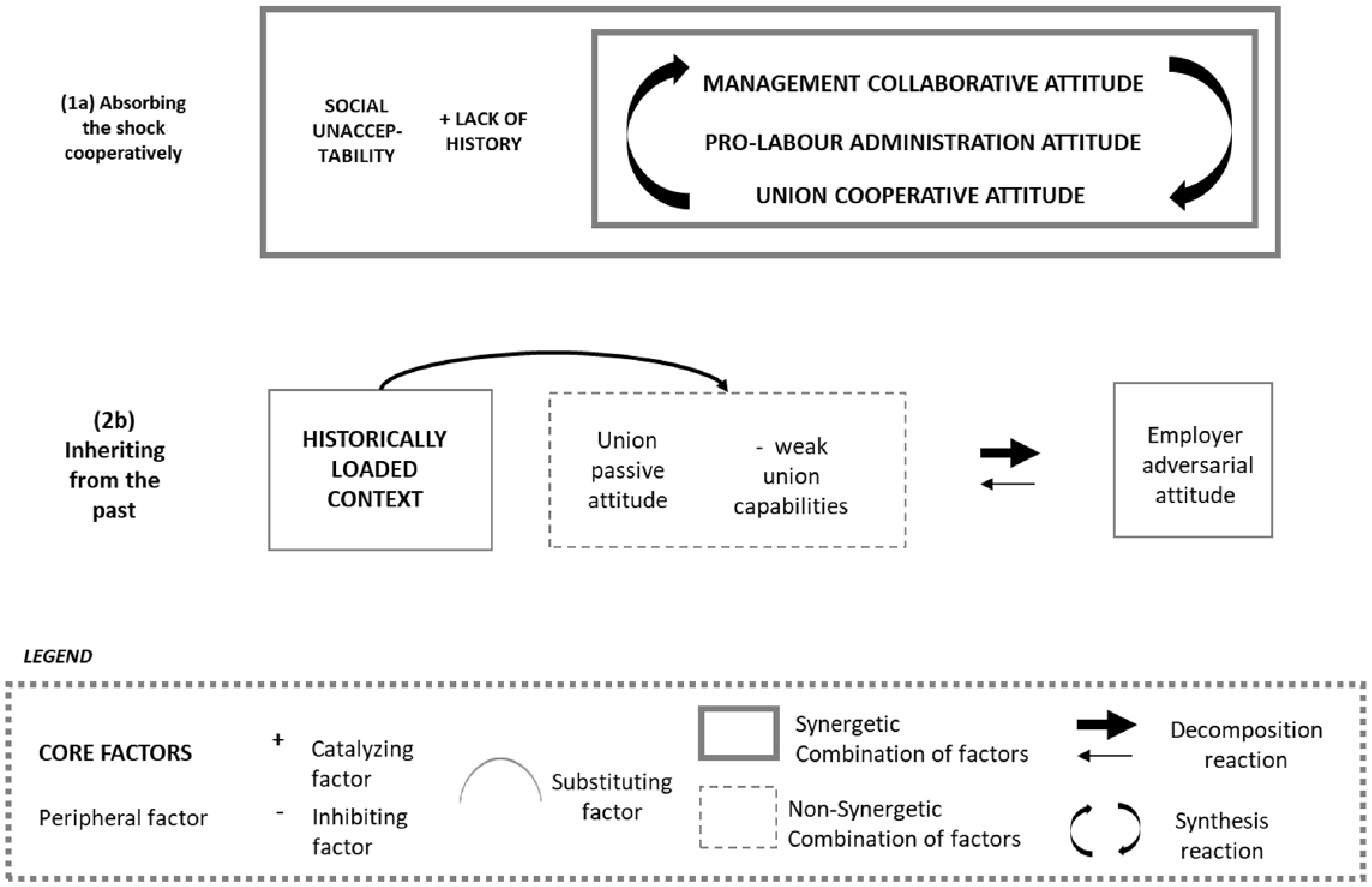
Illustration of the different ‘chemical’ interactions across factors observed in two configurations.
A
Discussion
This study began by asking how union responses can influence the management decision to downsize. Through a configurational analysis of 19 cases, six configurations that lead to varied levels of union influence were identified. The study’s typology reconciles apparent inconsistencies in the literature and enhances understanding of union influence on redundancy plans. It also extends the conceptualization of downsizing chemistry, theorizing four factor interactions. This article therefore contributes to the literature by revisiting two classical debates about the context–strategy nexus and about the efficacy of union responses.
Revisiting debates about the context–strategy nexus in the downsizing process
This study first contributes to longstanding debates about the context–strategy nexus in downsizing procedures.
Whereas the contingency approach considers that there is ‘one best contingent way’ to maximize union influence on managerial decisions to downsize in a given context, this study’s configuration-based approach contradicts this view. As demonstrated earlier, the configurational conceptual lens enables us to reconcile the previous contradictory findings by evidencing distinct pathways that lead to the same outcome. Comparison of configurations 1a (‘absorbing the shock cooperatively’) and 1b (‘resisting the shock’) shows that, in a similar context, two pathways that lead to the same outcome can co-exist, whereas existing research – implicitly or explicitly – suggests that there is one best contingent way (Dupuis, 2018; Marginson et al., 2004; Meardi et al., 2009; Pulignano and Stewart, 2013).
Building on the configurational principle of systemic fit, this study argues that context is more than a mere backdrop for strategic action. By viewing strategic and contextual factors as complexly interwoven rather than linear and one-directional, this research shows that the context of a redundancy plan is subject to different interpretations and framing by actors (Lévesque and Murray, 2013). It suggests that context can also be understood as a resource that actors can use to their advantage. Comparison of configurations 1b (‘resisting the shock’) and 3b (‘paper tigering’) shows that capable union leaders can take advantage of the shocking context but those with limited abilities cannot. Even more counter-intuitively, configuration 2b (‘inheriting from the past’) suggests that, as well as being a resource for union action, contextual factors can be a substitute for it. In this situation, the company’s downsizing history can be viewed as a self-activating resource which does not need a skilful union to be catalysed. The role of union capabilities in this study’s configurations strikingly mirrors the blurred and evolving boundaries between context and strategy in downsizing processes.
Finally, this study suggests that context does determine the level of influence a union can have, thus aligning with the findings of Pulignano and Stewart (2013) and Marginson et al. (2004). The typology shows that achieving a substantial level of influence requires a context that is highly socially unacceptable, which opens the door to unions having greater influence. In comparison, configurations where unions achieve a lower level of implementation-oriented influence are not characterized by such a high level of social unacceptability. This is because their context is considered acceptable (2a: ‘mutualizing acceptable losses’) or because the presence of a long, significant downsizing history inhibits social unacceptability (2b: ‘inheriting from the past’).
Revisiting debates about the efficacy of union responses in the context of downsizing
This research also helps to enrich conceptualization of the efficacy of union responses. It challenges the prevalent assumption that strong leadership capabilities are essential for unions to influence managerial downsizing decisions (Dupuis, 2018; Frost, 2001; Lévesque and Murray, 2010). Although this article agrees that such capabilities can bolster union influence in certain configurations, its findings suggest that this is not universally necessary. For example, when facing a hostile employer in a socially unacceptable downsizing scenario, configurations 1b (‘resisting the shock’) and 3b (‘paper tigering’) demonstrate that leaders’ capabilities play a pivotal role in union influence. Furthermore, configurations 2a (‘mutualizing acceptable losses’) and 3a (‘overriding minor battles’) suggest that these capabilities can facilitate collaboration between unions and management in socially acceptable downsizing scenarios. However, configurations 2b (‘inheriting from the past’) and 1a (‘absorbing the shock cooperatively’) present counter-examples where the influence on redundancy procedures can be attained without robust union leadership capabilities due to past downsizing history or the collaborative attitudes of the employer and labour administration.
The study also sheds new light on the role of the labour administration. Rather than simply being pro-union or neutral (Doellgast, 2010), it finds that the labour administration can significantly shape the negotiation climate, enabling synthesis (1a: ‘absorbing the shock cooperatively’; 2a: ‘mutualizing acceptable losses’) or decomposition reactions (3b: ‘paper tigering’). This suggests that the labour administration can, under certain conditions, foster peaceful industrial relations while helping to balance power dynamics, contradicting the idea that state-led pacification weakens unions (Boxall and Haynes, 1997). However, the findings also indicate that there are limits to the labour administration’s rebalancing effects. It can aid unions, but it cannot replace the need for strong leadership capabilities. Comparing configurations 1b (‘resisting the shock’) and 3b (‘paper tigering’) demonstrates that, while the labour administration can complement leader capabilities, it cannot serve as a substitute. Configuration 2a (‘mutualizing acceptable losses’) reinforces the idea that these capabilities are crucial to effectively utilize the support of the labour administration.
This research also contributes to the ongoing discussion about the relative effectiveness of adversarial and collaborative union strategies in industrial relations (Boxall and Haynes, 1997). Its findings align with Frost (2001) in suggesting that conflict-orientation alone does not fully explain union influence on managerial decisions. The study corroborates the configurational concept of equifinality, demonstrating that no single strategy is universally efficient for unions. Comparison of configurations 1b (‘resisting the shock’) and 1a (‘absorbing the shock collaboratively’) shows that no strategic choice is the most efficient for unions; rather, their choices can vary depending on both the employers’ attitude and the capabilities of the union leaders.
Conclusion
With recurrent economic crises and with ‘permanent restructuring’ now being a common managerial philosophy, this work has practical implications for unions in leveraging their influence. It suggests that, although conflict may be a favoured strategy for job preservation in adverse circumstances, there are alternative and more collaborative pathways to job protection. Furthermore, although strong union capabilities may not always be essential for influencing downsizing, they can be crucial under specific conditions. This therefore seems to be a ‘safe’ area for unions to invest resources, as this is the main factor for which they have a strong, direct lever.
This study also has some limitations. First, it focuses on a single and, in some respects, relatively atypical country – France. Second, the typology considers six factors but, according to the literature, there are also other significant factors. Third, managers are slightly under-represented in the interview sample.
These limitations open avenues for future research. Potential studies could extend the scope internationally to obtain a better understanding of the role of the institutional context. Investigating a larger number of cases could reveal the importance of other factors and uncover additional configurations. Furthermore, deeper investigation of the responses of employers to redundancy procedures could enhance understanding of the managerial capabilities employed in such processes.
In conclusion, the configurational approach could be valuable for examining the dynamic of other union–management negotiations or for reassessing other contentious issues in industrial relations. This intellectual equipment is a promising avenue for better depicting the always subtle and sometimes explosive chemistry of industrial relations.
Supplemental Material
sj-docx-1-wes-10.1177_09500170241289245 – Supplemental material for Supersizing the Impact of Unions in Downsizing Processes: A Configurational Approach Based on 19 Cases in France
Supplemental material, sj-docx-1-wes-10.1177_09500170241289245 for Supersizing the Impact of Unions in Downsizing Processes: A Configurational Approach Based on 19 Cases in France by Vincent Pasquier, Rémi Bourguignon and Géraldine Schmidt in Work, Employment and Society
Footnotes
Acknowledgements
We are grateful to the editor and reviewers for their generative and enriching collaboration throughout the process. We also extend our warmest thanks to Armelle Jaumain for her decisive help as a research assistant. Finally, we would like to thank the CFDT for being a supportive and collaborative research partner, as well as all the participants in the study, who provided us with their rich and diverse perspectives on the complex and thorny issue of corporate restructuring.
Funding
The authors disclosed receipt of the following financial support for the research, authorship, and/or publication of this article: This research has been funded by the Objective Agency of the IRES (Institut de Recherches Économiques et Sociales) for the French Trade Union Confederation CFDT (Conféderation Francaise Démocratique du Travail), through a project entitled ‘La négociation des Plans de Sauvegarde de l’Emploi, quels arbitrages?’.

Supplemental material
Supplemental material for this article is available online.
Notes
References
Supplementary Material
Please find the following supplemental material available below.
For Open Access articles published under a Creative Commons License, all supplemental material carries the same license as the article it is associated with.
For non-Open Access articles published, all supplemental material carries a non-exclusive license, and permission requests for re-use of supplemental material or any part of supplemental material shall be sent directly to the copyright owner as specified in the copyright notice associated with the article.
