




Abstract
This article investigates whether differences in trade union identity can explain local and national variations in union strategy. To do so, it compares the divergent responses of unions to healthcare privatisation initiatives across six cases in England and France. It brings together the often disparate literatures on union identity, strategy and mobilisation and presents a new conceptual model to explicate these differences by linking a union’s identity to union strategy via two core framing processes: diagnostic framing and prognostic framing. Findings reveal that unions respond differently to healthcare privatisation initiatives, irrespective of the local and national context. Union identity influenced how they framed the threats and opportunities around them, shaping their expectations in terms of effective action. Union identity not only explains divergent responses but is also responsible for path dependencies which would make it potentially more difficult for unions to overcome structural constraints and learn from other groups.
Introduction
The proliferation of neoliberal policies has played a key role in changes to public services. In healthcare, mechanisms such as privatisation and marketisation have been an integral part of reforms, aiming to improve efficiency and cut costs (Galetto et al., 2014). Both in England and in France, successive governments have introduced market-oriented reforms to encourage competition in the delivery of public health services, such as the Health and Social Care Act 2012 (HSCA) and the Plan Hôpital 2007. Yet, how unions have looked to influence the implementation of these reforms varies, ranging from negotiating with employers through existing institutional channels to campaigning and mobilisation (Krachler and Greer, 2015).
To explain variations in union responses to workplace change, industrial relations research highlights a number of external and internal factors. Among these, union identity emerges as a key factor in various frameworks seeking to explain how unions choose strategies over others (Frege and Kelly, 2003; Hodder and Edwards, 2015; Hyman, 2001; Murray et al., 2010). This is because unions cannot be understood ‘only as “rational” actors with fixed interests but as actors with distinctive logics of action, or ideological orientations’ (Benassi and Vlandas, 2016: 10). Yet, with the exception of models developed by authors such as Hyman (2001) and Hodder and Edwards (2015), theory on union identity remains limited. Moreover, the few studies in industrial relations that have taken an in-depth empirical look at union identity have often been based on either specific indicators (for example, see Houghton and Hodder (2021) on websites and social media) or union histories (for example, Hyman (2001) and Frege and Kelly (2003)) and therefore do not necessarily include collective understandings and representations of social relations.
This article furthers our understanding of union identity by investigating how differences in union identity explain variations in union responses. It compares six case studies of planned local healthcare privatisation in England and France, two countries traditionally presented as having different institutional frameworks, industrial relations frameworks and healthcare systems (Böhm et al., 2013; Connolly and Darlington, 2012). This article contributes to our understandings of union identity as one of the first in-depth empirical comparative analyses of union identity. Drawing on Kelly’s (1998) mobilisation theory, it brings together the often disparate literatures on union identity, strategy and mobilisation and presents a new conceptual model to demonstrate that union identity influences how unions perceive threats and opportunities in their environment and ultimately shape responses. The findings show that union identity, via prognostic and diagnostic framing, explains variations in local union responses to healthcare privatisation. They also show that unions tend to be path-dependent, preferring to adopt known forms of action that do not threaten their identity, which can potentially make it more difficult for them to overcome structural constraints and learn from other groups. Finally, findings show that local union identity can deviate from national union identity due to local factors.
The next section discusses the industrial relations literature on union strategy and identity before presenting the conceptual model for this study. Following the methods and context of the research, the six cases are examined using this model to compare variations in local union strategy, framing and identity. It concludes with a discussion of the findings and implications for future research.
Explaining union responses
The industrial relations literature proposes a range of factors that explain union ‘strategic choice’, or the choice of ‘concrete plans and objectives which arise from the complex interaction between the leadership and the rank and file and lead to specific actions’ (Hodder and Edwards, 2015: 847). Differences in strategic choice have often been assessed according to institutional differences (Frege and Kelly, 2003), sectoral or local specificities (Bechter et al., 2012; Greer et al., 2013) and the power resources available in varying contexts (Gumbrell-McCormick and Hyman, 2013). Generally, these explanations tend to consider unions as rational actors that choose strategies based on opportunities in their environment. Yet, similarities in terms of union responses are difficult to explain when these cut across different institutional models (Pulignano and Stewart, 2012). How unions exploit opportunities in the same context can also vary, as strategies cannot be ‘simply read off from any broad national context’ (Connolly and Darlington, 2012: 241).
To explain inter- and intra-union variations in strategic choice, some studies have therefore pointed to union identity as a key factor shaping union strategy (Frege and Kelly, 2003; Hodder and Edwards, 2015; Hyman, 2001; Tassinari et al., 2022). Union identity is considered a ‘root structure’ (Hodder and Edwards, 2015) which involves a sense of ‘we-ness’ or‘perception of a shared status or relation’ among those within the group (Polletta and Jasper, 2001: 285; see also Kelly, 1998 ). Definitions also link union identity to strategy since the purpose of a union is ‘to pursue objectives that reflect its identity’ (Hodder and Edwards, 2015: 847); activists can deploy identities strategically and strategic actions can have meaning to the groups, with collective identities developing around certain tactical ‘tastes’ (Jasper, 1997). Repertoires of action, the forms of action which union leaders consider legitimate and feasible, then form part of a union’s legacy and may have a binding effect on group members, having both a practical and a normative impact (Frege and Kelly, 2003). Thus, the concept of union identity helps to address the theoretical gaps within resource mobilisation and political process models, binding activists through a shared sense of meaning and belonging rather than through interests alone and provide criteria for choosing a strategy (Polletta and Jasper, 2001).
However, research on union identity is limited, with much of the literature relying on the use of the militant–moderate dichotomy to characterise union identity and their repertoires of action (Kelly, 1998). Notable exceptions are models put forward by Hyman (2001), Frege and Kelly (2003) and Hodder and Edwards (2015). Hyman (2001) introduces the notion of ‘geometry’ of unionism based on three distinctive identities: ‘market’, ‘class’ and ‘society’. These three ideal types form what Hyman calls an ‘eternal triangle’, with union strategies dependent on where union identities are located within the triangle. Frege and Kelly’s (2003) model of union strategic choice acknowledges the links between union identity, framing processes and structure as determinants of union action. More recently, Hodder and Edwards (2015) argue that union identity influences union ideology and, in turn, the purpose of union action and the strategies used. The overarching premise of each of these frameworks is that identity influences the way unions see opportunities and threats in their environment.
This suggests that union identity plays a crucial role in shaping strategic choice. Yet, except for those noted above, industrial relations research has rarely attempted to detail and examine empirically union identity. Moreover, few studies have demonstrated empirically the way union identity influences strategic choice. How are union identity and strategic choice linked and what processes are involved? The next section seeks to further our understanding of union identity by explaining the role of core framing processes – diagnostic and prognostic framing – in linking identity to strategic choice. It will then present the conceptual model used for this research.
Core framing processes: Connecting identity to strategic choice
Framing is considered a dynamic process which concerns the construction of meaning and implies agency (Benford and Snow, 2000). Frege and Kelly (2003) argue that framing allows unions to interpret the world around them and provides processes through which problematic situations can be transformed from a ‘misfortune’ into a ‘grievance’ which can then be acted upon. In other words, unions use different framing processes to determine the threats and opportunities in their environment and these provide the motivational impetus to take collective action (Frege and Kelly, 2003). Framing processes are also closely linked to union identity as they ‘express elements of a union’s identity and draw from familiar ideas about union action’ (Frege and Kelly, 2003: 14). Hence, the perception of an injustice or threat among people with a shared sense of identity can lead to collective action.
Within sociology, the concept of framing has been applied extensively, building on Goffman’s (1974) writing on the topic. Specific to social movement theory, Benford and Snow’s (2000) work on ‘collective action frames’ has been influential, allowing a better understanding of how social movements construct meaning. They identify three interrelated core framing tasks: ‘diagnostic’, ‘prognostic’ and ‘motivational’ framing. First, diagnostic framing refers to the identification of a situation as unjust and critical and provides causal attribution for the problem. Second, prognostic framing refers to the identification of solutions to a problem and the strategies necessary to achieve them. Last, motivational framing refers to socially constructed ‘vocabularies of motive’ used to provide a rationale for likely participants to engage in collective action. Through these framing tasks, social movements identify the ‘injustices’ which are representative of their collective values and prognoses are translated into strategy.
In the context of union strategic choice, diagnostic framing is an important first step as it motivates and directs union action. Through diagnostic framing, unions identify the ‘injustices’ which are representative of their collective values along with those responsible. Generally, a union is expected to view changes in its environment as a threat if these are inconsistent with who they are and what they believe in. Notably, if a union does not identify any threats (or opportunities), this may result in inaction. Identity is key in shaping diagnostic framing as a union will tend to pursue objectives that reflect its values and interests (Hodder and Edwards, 2015). Unions are pressured to represent different interests which involve regulating the wage–labour relationship (market interests), promoting class struggle (class interests) and representing the broader interests of society (Hyman, 2001). While this ‘triple tension’ tends to be shaped by the institutional context and the issues at stake, different unions within the same context may also prioritise different identities. Hence, a union that prioritises the ‘market’ dimension of its identity may see different injustices in its environment than a union which adopts class unionism and social partnership.
Collective action also requires unions to have a sense of efficacy: that by acting collectively, they can make a difference (Kelly, 1998). This feeling of efficacy is connected to prognostic framing as unions need to identify and choose the most appropriate solutions to the ‘threats’ and ‘injustices’ they face. Within industrial relations literature, union strategies tend to be classed as either cooperative, involving negotiations with the employer, or confrontational, including striking and campaigning (Kelly, 1998; Tapia and Turner, 2013). Polletta and Jasper (2001) argue that collective identities can provide criteria for choosing between strategies, competing with instrumental rational ones. Consequently, strategic choice is not neutral; it is an expression of identity. Unions can therefore prefer certain strategies and tactics over others, with some priding themselves in their moderate collaborative strategies while others in their militant confrontational approach (Jasper, 1997; Polletta and Jasper, 2001). These strategies may include the use of motivational framing, where unions produce narratives composed of prognostic and diagnostic understandings to increase the ‘salience of particular interests, values, identifications or concerns’ (Rule, 1989, in Kelly, 1998: 36) and move people from ‘the balcony to the barricade’ (Benford and Snow, 2000: 615).
From this, it is clear that union identity, framing processes and strategic choice are closely connected. To build on these insights and bring together these strands of literature, the following conceptual model has been developed (Figure 1). Drawing on Kelly’s mobilisation theory, for mobilisation to occur, a union needs to attribute a perceived injustice to an employer or government and have a sense of efficacy. The model links these preconditions for mobilisation to diagnostic and prognostic framing processes, which are themselves influenced by a union’s identity. A union’s identity within Hyman’s (2001) typology (market, class and society) would shape diagnostic framing and determine the ‘injustices’ representative of their collective values along with those responsible. In other words, how a union gives meaning to events in its environment and whether these translate into ‘injustices’ that are believed to threaten its interests depend on whether the union sees itself primarily as either an interest organisation with a labour market function, as an agency of class, or as a vehicle for advancing social justice. Second, a union’s identity in terms of militancy – commitment to a particular tactical approach – shapes prognostic framing and determines the selection of strategies and tactics believed to be most appropriate according to the threats and opportunities identified. Unions therefore opt for tactical options that tend to conform with ‘who we are’ in relation to their ‘tactical tastes’ (Polletta and Jasper, 2001). Together, these two core framing tasks determine union strategic choice. 1 As diagnostic and prognostic framing are closely coupled (Benford and Snow, 2000), the former may constrain the latter and thus the range of possible solutions and strategies. Notably, this process is to be understood as constant and dynamic: whenever events and conditions change, so can the framing and signifying work that unions do, which can potentially lead to shifts in strategy. This model therefore goes beyond existing conceptualisations of union identity and allows for union identity to be analysed according to two different yet complementary typologies: Hyman’s (2001) dimensions of union identity (‘market’, ‘class’ and ‘society’) and the militant–moderate dichotomy (Kelly, 1998). Combined, these two typologies of union identity offer a means to explain variations in union perceptions – diagnostic and prognostic framing – and ultimately shape strategic choice.
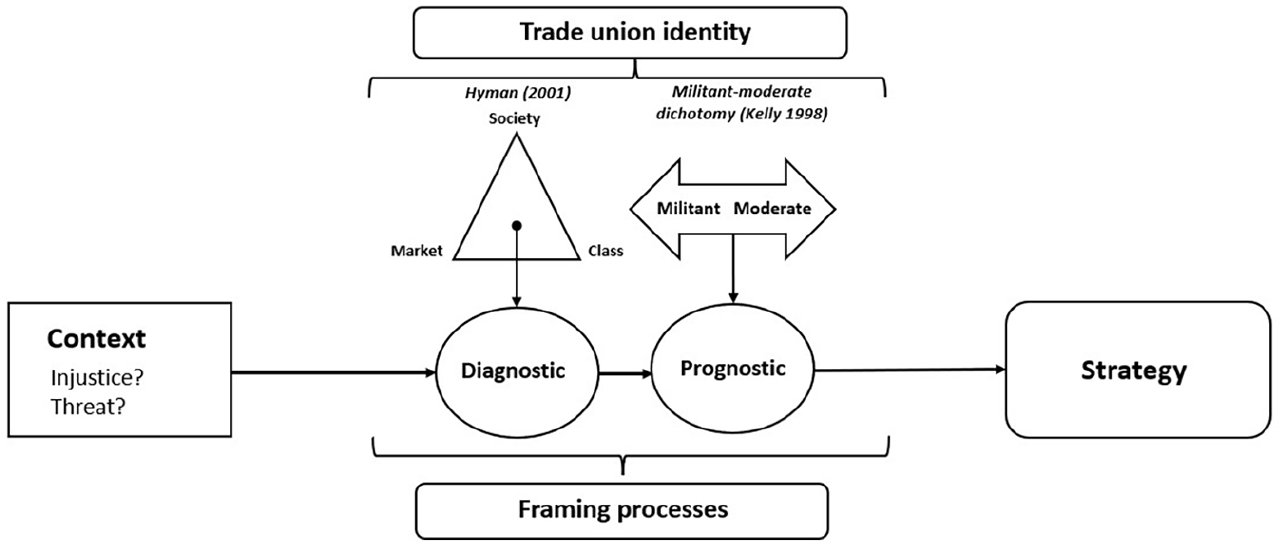
Conceptual model.
Methodology
To examine how differences in union identity lead to local and national variations in union responses to privatisation, a qualitative cross-national comparison of six case studies of local healthcare privatisation was adopted. England and France were selected for comparison as they are different from one another (de Vaus, 2008), traditionally presented as having widely different institutional frameworks, industrial relations frameworks and healthcare systems (Böhm et al., 2013; Coutrot, 1998; Connolly and Darlington, 2012). For local and national factors to be unpicked in each case, this research adopts Locke and Thelen’s (1995) contextualised comparison approach, allowing for key factors within local dynamics to be identified.
Six critical cases were purposively selected for an in-depth exploration of local union responses. They were selected based on three criteria, namely a recent local project where: (1) private takeover of public healthcare had been proposed, (2) local unions had been or had attempted to be involved in the decision process, and (3) the project had reached a conclusion, so a full analysis could take place. National unions and local activist groups were approached and internet searches were used to identify cases which fitted these criteria.
Table 1 presents the cases, each situated in a different city or town. The services open to privatisation ranged from specific functions, such as mental health or paediatric care, to the private takeover of an entire hospital. While different types of healthcare services are at stake, private sector interest is explicit in each case.
Study cases.
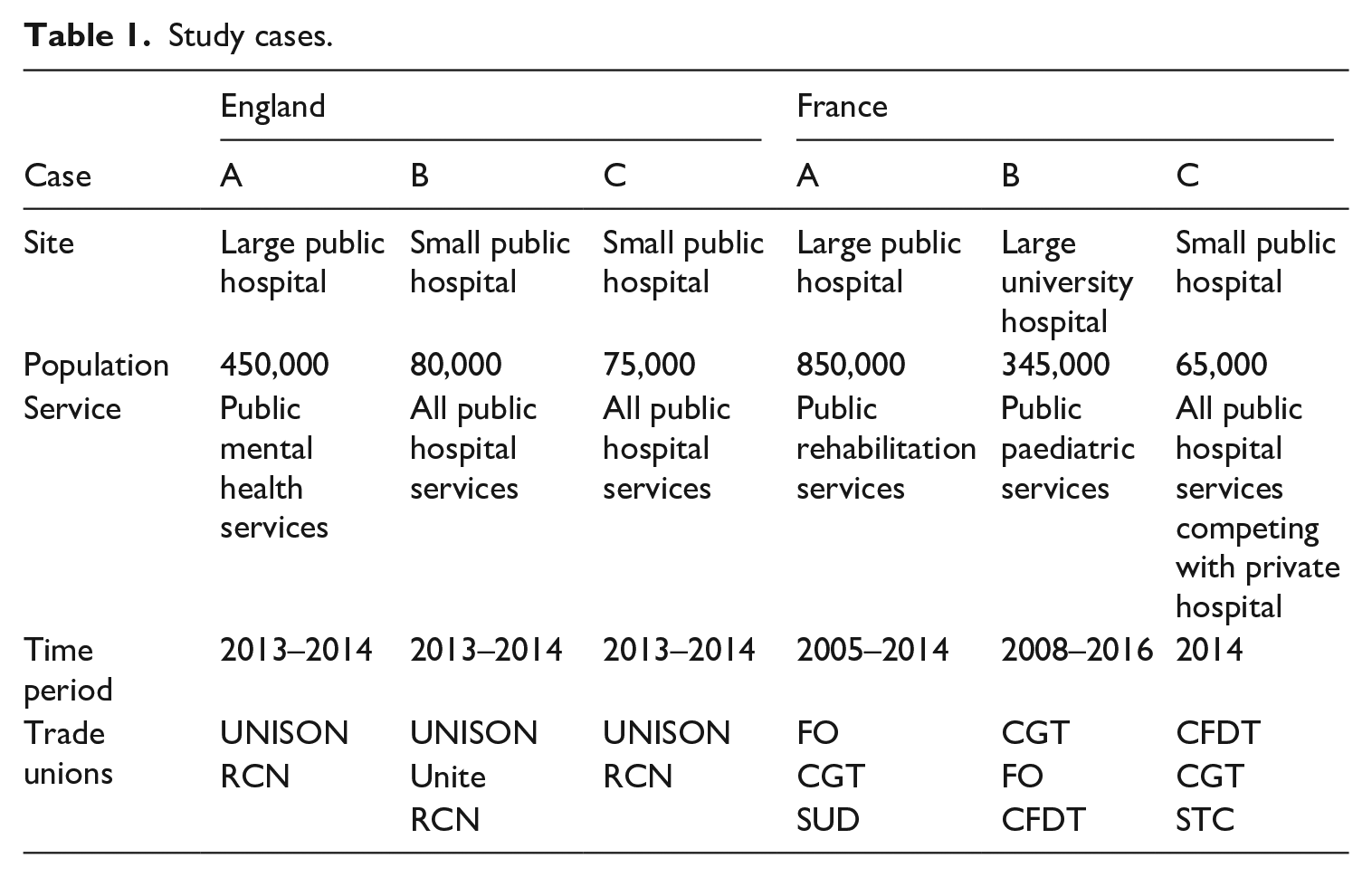
More than one union was present at each site, allowing for an intra-case comparison of union responses. In England, UNISON and the Royal College of Nursing (RCN) were the largest unions representing professional members in each case. At ‘England Hospital B’, Unite was also involved locally, representing non-professional staff such as porters and cleaners. In France, the majority union differed in each case. At ‘France Hospital A’, Force Ouvrière (FO) represented a majority of employees, with the Confederation Generale du Travail (CGT) in close second. At ‘France Hospital B’, the CGT was the majority union at the public hospital while at ‘France Hospital C’, this was the Confederation Francaise Democratique du Travail (CFDT). Although the Syndicat des Travailleurs Corses (STC) union had few members at ‘France Hospital C’, it had the largest representation of workers in the region at the time.
A total of 31 semi-structured interviews were conducted, lasting between 45 minutes and two hours. These were held with 38 key informants, including national union officials, local union leaders, local healthcare activists, local managers and academics to triangulate findings (Table 2). The key informant methodology emphasises the pursuit of specialised knowledge (Marshall, 1996) and is well suited to the aims of this research in understanding complex local dynamics. Fieldwork was undertaken first in England (March – December 2015) and then in France (January – May 2016). Two additional interviews were then conducted in England in October 2016. Recruitment generally involved ‘cold’ approaches, over telephone, email or post, but some also through ‘snowballing’. Ethical approval was obtained from the University Research Ethics Committee and participants’ written or verbal consent was obtained prior to the interviews. To preserve the anonymity of those interviewed, pseudonyms have been used for the cases and interviewees. Interviews were supplemented with documentary evidence: news articles, union pamphlets, local meeting minutes, government reports and publications, union websites and social media.
List of interviewees.
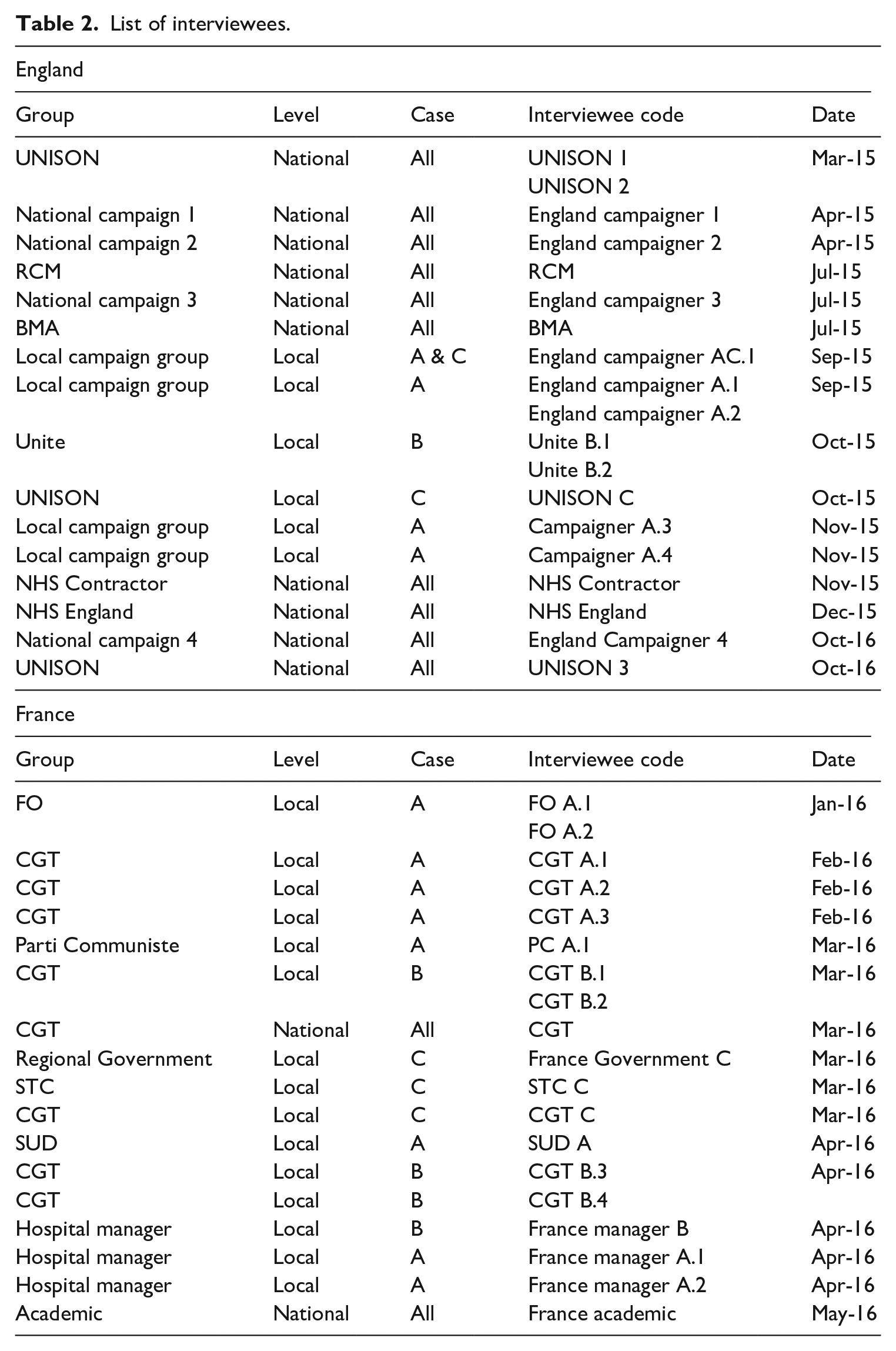
Interviews were transcribed verbatim and organised according to the general themes and typologies linked to this study’s conceptual model. The qualitative research software MaxQDA was used to code documents and interview transcripts according to the dimensions of the conceptual model (identity, diagnostic framing of privatisation plans, prognostic framing of opportunities and strategy) using literature, interview data and documentary evidence (Table 3).
Case study trade union analysis.
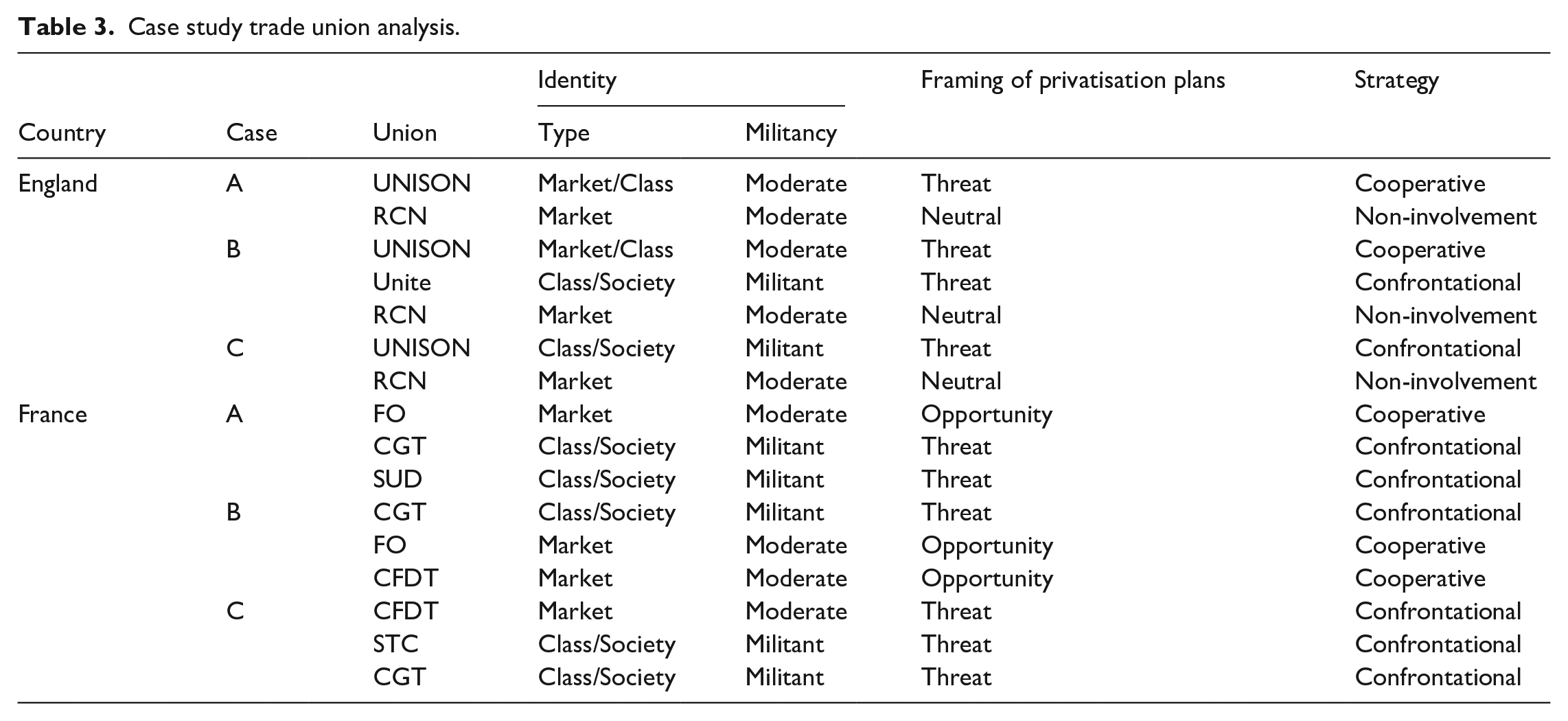
First, local unions were categorised according to two typologies of union identity (Hyman’s (2001) ‘market’, ‘class’ and ‘society’ typology and the militant–moderate dichotomy (Kelly, 1998)) using literature and research on French and English unions (see Connolly, 2010; Hyman, 2001; Parsons, 2013) and documentary analysis. These approximate classifications were then adjusted according to the interviewees’ description of their local unions, including any mention of ideologies, values, interests and beliefs. While there are limitations with classifying local unions according to Hyman’s typology (for example, see Simms, 2012: 98), such categorisation is increasingly standard practice in the industrial relations literature (see Signoretti, 2019; Tassinari et al., 2022). According to Hyman’s (2001) three ideal types, seven local unions were categorised as primarily ‘market’-oriented. Two types of hybrids, ‘market-class’ and ‘class-society’, emerged among the remaining nine local unions, with seven having an identity oriented towards ‘class-society’ and two with a ‘market-class’ identity. In terms of the ‘militant–moderate’ dichotomy, nine local unions were categorised as ‘moderate’ and seven were categorised as ‘militant’.
Interview transcripts and documents were then analysed to identify local unions’ diagnostic framing of local privatisation plans along with any explanations that informed their views. Ten local unions framed privatisation as a threat and three, all located in France, viewed privatisation as an opportunity. Three local unions remained neutral, the RCN at each English site, showing no sign of framing changes as either threats or opportunities.
Finally, data were analysed to identify and categorise each local union’s prognostic framing and strategy. Strategies were grouped as either: (1) ‘cooperative’, broadly defined as the negotiation of outcomes with decision-makers through existing consultative channels (Tapia and Turner, 2013); (2) ‘confrontational’, qualified by the use of tactics such as ‘rank-and-file mobilisation, coalition building, media attention, social justice framing, pressure on decision-makers through strikes and demonstrations, and pressure on local and national governments’ (Tapia and Turner, 2013: 602); or (3) as ‘non-involvement’, where unions choose not to be involved in the decision-making process (Greer et al., 2013). Eight local unions opted for a ‘confrontation’ approach, and five were categorised as taking a ‘cooperative’ approach. One local union across all three English sites, the RCN, was categorised as taking a position of ‘non-involvement’.
Subsequently, cross-case comparison involved sorting manually coded excerpts into tables and summaries to evaluate the links between local union identities, diagnostic and prognostic framing, and strategies, and compare research findings with the conceptual model. The next sections present the context for the cases and an in-depth analysis of the connections identified between these dimensions.
Case context: Healthcare reforms and local implementation in England and France
Healthcare systems in England and France, while both classed as universal, differ in terms of financing and provision (Böhm et al., 2013). The NHS in England is classified as a National Health Insurance system with public institutions in charge of financing, provision and regulation, and is primarily financed from general taxation and national insurance contributions. The French system is classed as a mixed type of Social Healthcare where the state is responsible for regulation, while societal actors oversee financing, with funding paid mostly by employer and employee earmarked income and payroll tax. The provider landscape is also different. Most of the provision in the English NHS is public while healthcare provision in France combines both public and private providers, with 65% of providers either private non-profit hospitals or for-profit ‘cliniques’ (Mossialos et al., 2016). Overall, private insurers and providers play a far greater role in French healthcare than in England.
Faced with similar challenges such as changes in demand and growing budgetary pressures (Galetto et al., 2014), left- and right-wing governments in both countries have responded by introducing a variety of ‘New Public Management’ mechanisms such as marketisation and privatisation to contain costs and improve efficiency. Table 4 summarises key reforms introduced since the 1990s in both countries. While these have been implemented to fit each country’s respective provider landscape, reforms have nonetheless followed a similar logic in terms of public–private competition (Greer and Umney, 2022). In France, where private providers have a considerable share of the market, this has meant creating an internal market which brings together public and private providers. In England, this has involved progressively creating a market and opportunities for a less developed private sector, with for example the 2012 HSCA encouraging commissioners to consider private provision.
Key healthcare reforms in England and France 1990–2016.
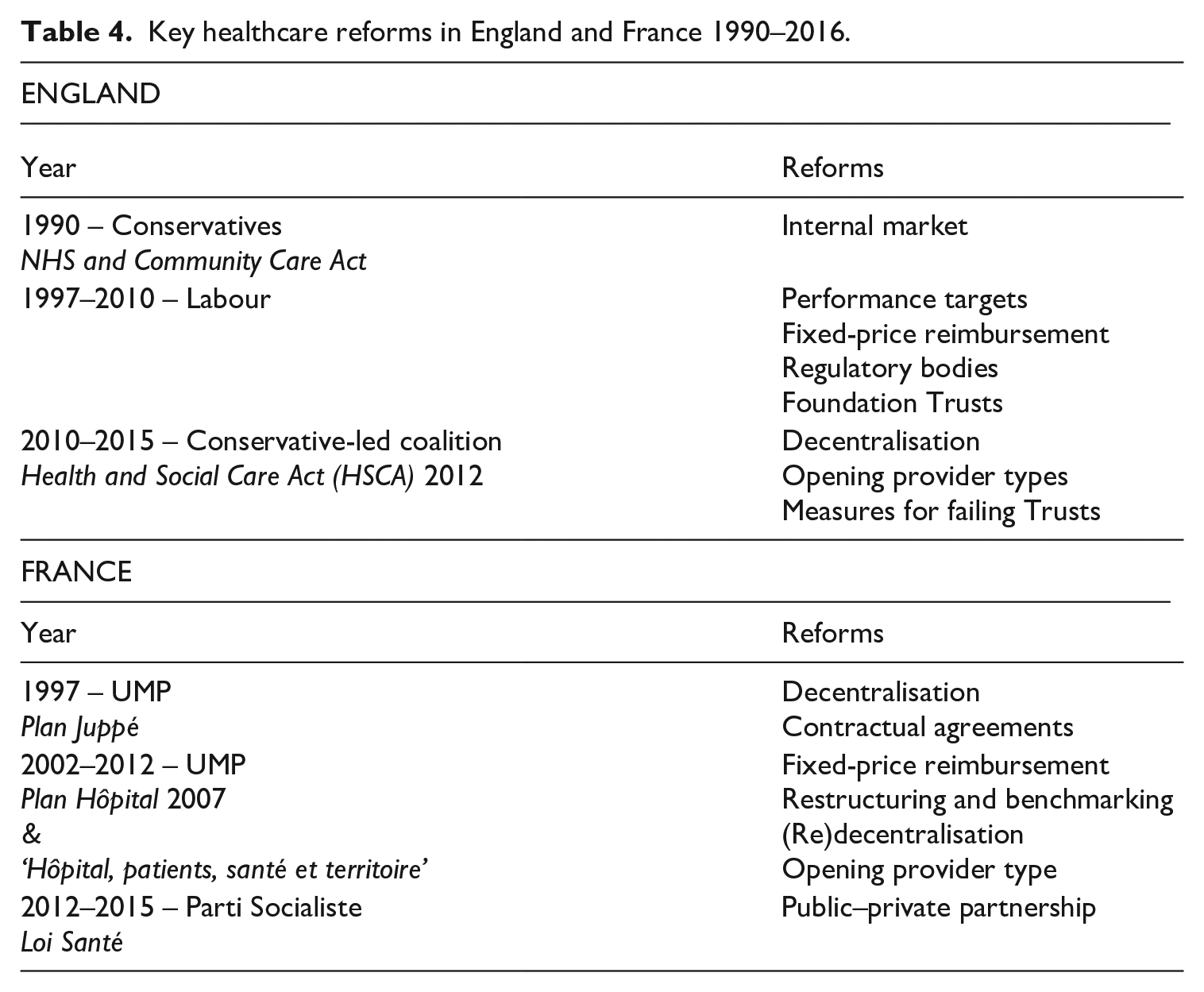
Across the six case studies, national reforms and regulation shaped local healthcare planning, with local decision-makers looking to comply with new rules and obligations. In England, the 2012 HSCA steered local decision-makers towards privatisation, either by contracting out specific services to the private sector (England A) or through the private takeover of a hospital’s day-to-day responsibilities (England B and C). In France, the Plan Hôpital 2007 led all three hospitals (France A, B and C) into forming partnerships that transferred key services to the private sector partner. Although some local decision-makers were more aligned with market ideology than others, all had pragmatic reasons for privatising services: cutting costs and complying with government guidelines. Government pressure also played an important role; all case study public hospitals were in financial difficulty, and this context was used by the centre to put pressure on local decision-makers to privatise services in line with the intended outcome of reforms.
France and England have often been contrasted in industrial relations literature, not only regarding status and structure, but also with respect to the different historical roots and traditions of their respective labour movements. French unions are generally organised on an industry basis, with unions looking to represent all workers within firms (Coutrot, 1998). Within healthcare, the main union confederations remain the most influential, representing workers across both public and private providers, although election outcomes vary locally (Sainsaulieu, 2012). In contrast, the British system is usually described as voluntarist and unions tend to organise according to occupation, although many members belong to general unions; this is also the case within the healthcare sector where certain professions such as nurses across both public and private organisations can be represented by either professional unions like the RCN, or general unions including UNISON and Unite. While numerous unions can represent different groups within the same firm, inter-union competition remains more muted in England than in France (Connolly, 2010; Hyman, 2001).
Despite these differences, similar local dynamics were observed across cases, with local decision-makers taking a unilateralist approach in handling privatisation. In both countries, decision-makers looked to impose changes without union involvement by restricting access to project information and avoiding union and public involvement. Although consultation mechanisms were in place, such as union agreements and joint negotiation and consultation committees, these were generally ineffective as unions were bypassed or marginalised. In line with Greer and Umney (2022) who argue that marketisation depoliticises policymaking, commercial interests were said to outweigh the need for public involvement, and strategic meetings were held in private. This entrenchment created an unfavourable environment for local unions, particularly those that opposed privatisation, with limited opportunities for influence within established institutional channels.
The next section presents how local unions responded to these healthcare privatisation initiatives and the role identity played in framing the threats and opportunities they identified within each case.
Findings
Linking identity to diagnostic framing: Identifying the ‘threats’
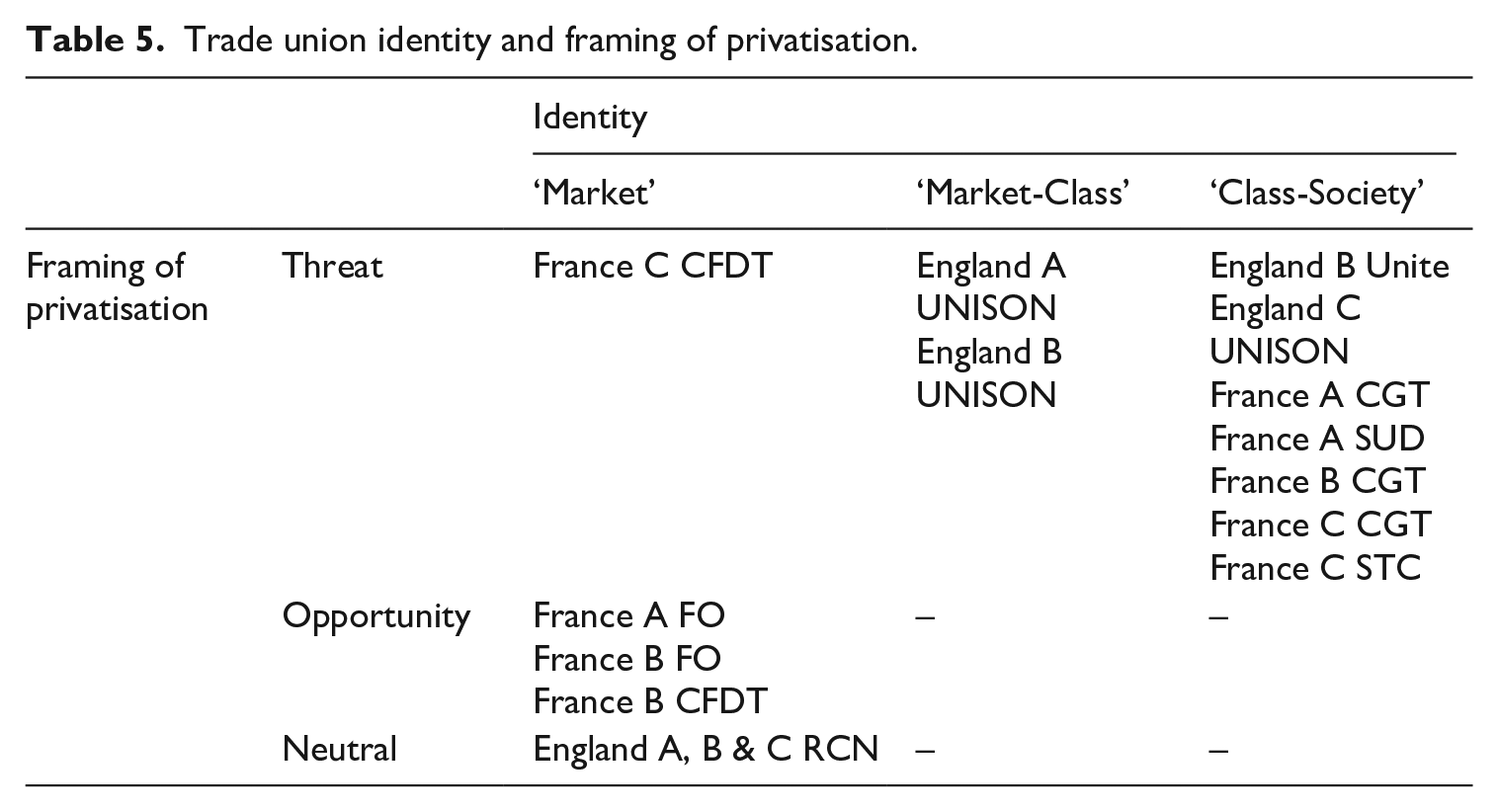
Cases showed that, with respect to diagnostic framing (the identification of a situation as unjust and critical), local unions diverged: both within and across cases, some framed privatisation as a threat while others did not (Table 5). As conceptualised in the model (Figure 1), groupings in Table 5 indicate a close link between Hyman’s (2001) typology of union identity and union diagnostic framing of local privatisation plans.
Trade union identity and framing of privatisation.
Most local unions with a primarily
Most ‘market’-oriented local unions in France framed privatisation positively. In both France A and France B, they privileged workplace issues over wider worker concerns as wages would not be affected by private sector involvement. Rather than remaining neutral, they framed plans in a similar way as management, arguing that changes would lead to improved care. For instance, FO in France A stated that: ‘We must therefore find a way to make these activities profitable. This is an experiment, in line with policies on public private partnerships’ (Manelli, 2006). This position was at odds with their national union which opposed the transfer of public sector services to private providers (La Tribune, 2009). Instead, their focus was primarily on organising employees (France A) and cooperating with management (France A and B). These priorities were linked to local union histories and identities. For example, in France A, FO had a history of working with management: ‘FO [here] . . . is practically hegemonic . . . it is part of the [city’s] system: cronyism and friends of friends’ (SUD A). As decision-makers provided assurances to unions and staff on wages and civil service status, ‘market’-oriented local unions in France A and B did not frame privatisation as a threat as it did not affect the union’s interests and values.
One union categorised as having a ‘market’ identity, the CFDT at France C, framed privatisation as a threat. Aware of the overwhelming concerns among hospital workers and the local population, union leaders argued that the plans went ‘against the interests of public healthcare provision and of service users’. It based its arguments on economic concerns, such as project costs and staff numbers. Notably, the union did not frame privatisation as a threat in itself, stating ‘we have never been against public–private partnerships’ (Bruna, 2015), but considered this particular project as problematic.
In contrast, local unions with a ‘
In England B, the primary argument used by UNISON (2013) local leaders was economic: ‘privatisation was not the option’ because of the potential negative impact this could have on members and staff. However, in an article for the Trade Union Congress, they also took a political position, qualifying those wishing to privatise the NHS as ‘enemies’ while stating: ‘government’s solution . . . is to encourage the circling private vultures hovering over . . . [hospitals] to take them over’ (UNISON, 2013). Similarly, UNISON in England A raised both political and economic concerns regarding the commissioning process. Grassroots activists reported that union representatives were especially concerned with possible redundancies should the contract be awarded to a private provider: They were terrified . . . We were being approached by union representatives and nurses who were saying ‘we must stay with [the public hospital] because otherwise it will be much worse’. (England campaigner AC.1)
The UNISON branch in England A also took a critical view of commissioning, qualifying healthcare reforms as ‘the culmination of a long-running attack on the principle of the NHS as a public provider of universal healthcare, free at the point of delivery, and helps clear the path to privatisation’ (UNISON, 2014). They also described the recommissioning of mental health services as a ‘race to the bottom’ which [the public hospital] had ‘won’.
Local unions with a
In England C, UNISON local leaders had a ‘class-society’ identity, leading them to have broader concerns regarding privatisation than in England A and B. Their perception of privatisation had been influenced not only by both UNISON’s (‘market-class’) framing of privatisation, but also by their branch’s ‘left wing’ identity, linked to their leadership’s association with other campaign groups: I personally also have moral issues with it because I think there is something unethical about giving public money to private companies who make profits and don’t invest those profits back into the service, but instead pay off shareholders. (UNISON C)
For this branch, privatisation was therefore not only framed as a threat to workers but also to equality and the welfare state. Local union identity in England C, which differed from that of the national union and those in England A and B, led them to have a broader ‘society’ framing of privatisation.
In France, local unions with a ‘class-society’ identity (CGT, SUD and STC) adopted a politicised approach. In line with national positions on protecting social insurance and fighting marketisation of public healthcare, these local unions framed privatisation by taking a broader ‘social justice’ perspective. For example, the CGT in France A explained that public hospitals were an integral part of the welfare safety net for the most vulnerable: ‘It remains that public services protect the poorest. It must remain accessible to as many people as possible’ (CGT A.2). They also considered the provision of public healthcare by the private sector as unethical, stating that: ‘In terms of our ethics, we find that it is not good to mix money with health’ (CGT A.3). Similarly, the CGT in France B, who described themselves as a ‘social change union’, believed that public services should only be handled by public hospitals: ‘Social security was never created to make profits; it was created to be redistributed. So, [privatisation] is basically theft’ (France B CGT 1). This was also the case for SUD in France A, who stated that the ‘objectives should not be to increase profits but rather to serve those suffering, regardless of their socio-economic background’ (SUD-Santé Marseille, 2006). In France C, the CGT and STC viewed privatisation plans as a threat, stating that it went ‘against the interests of public healthcare provision and of service users’ (Fanchi, 2015).
Overall, findings show that union identity shaped diagnostic framing for almost all local unions. By mediating between ‘market’, ‘class’ and ‘society’, these unions looked to build a sense of identity in terms of the interests they represent, what they fight for and why it mattered. This led them to frame their environment in different ways, even when located in the same local context, with some viewing privatisation plans as a threat and others as an opportunity. Most local unions with a ‘market’ identity (except for the CFDT in France C) framed privatisation as an opportunity for increased efficiency, relying on assurances from decision-makers that jobs and terms and conditions would not be affected. In contrast, those with a ‘class’ dimension to their identity framed changes as a threat to workers within the sector and beyond, referring to a ‘race to the bottom’. Those with a ‘society’ dimension to their identity took an even broader political view, seeing privatisation as a threat to social justice. Hence, in both countries, local unions that opposed privatisation did so for different reasons depending on their identity and diagnostic framing of the environment.
Linking identity to strategy: Identifying the ‘opportunities’ through prognostic framing
Cases showed that local union prognostic framing (the identification of solutions to a problem) diverged and unions saw different opportunities for action (Table 6). As suggested by the conceptual model of this study, groupings in Table 6 present the close link between union ‘militant’ or ‘moderate’ identities, prognostic framing and strategic choice.
Trade union identity and strategy.
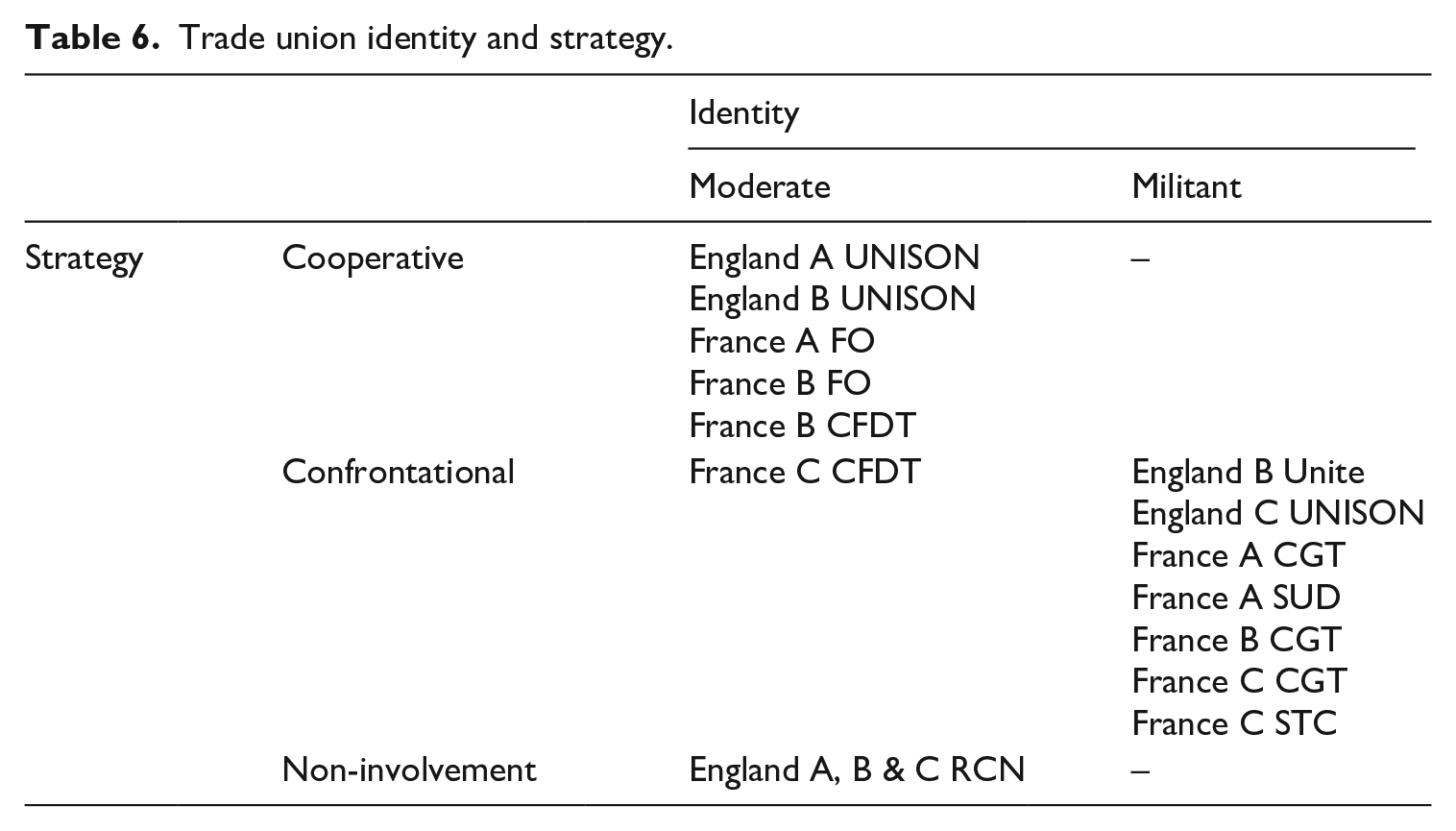
Except for the RCN and the CFDT in France C, local unions with a ‘militant’ identity opted for ‘confrontation’ while those with a ‘moderate’ identity took a ‘cooperative’ approach. Three local unions, the RCN in England A, B and C, framed privatisation neither as an opportunity nor a threat. Although a certified union, the RCN remains generally against taking industrial action despite lifting their ban on this in 1995 (Bach and Givan, 2004). Locally, as local representatives did not frame privatisation as a threat (diagnostic framing), the union saw no need to respond.
The majority of
Where local unions chose a ‘cooperative’ approach to oppose privatisation, a different dynamic emerged. In England A and B, the local branches of UNISON saw an opportunity in engaging with management to negotiate positive outcomes. These were the more ‘militant’ of the moderate unions, holding greater commitment to collective bargaining. Nonetheless, both believed in ‘partnership’ and relied on the consultation mechanisms, in line with UNISON at the national level who believe in and aim for collaborative rather than adversarial relations with management: ‘The ideal situation . . . [the] relationship between manager and the staff would be reasonable enough’ (UNISON 3). As a result, UNISON in England A chose to collaborate with hospital management on proposals to commissioners to protect the jobs of its members. The same occurred in England B where UNISON looked to be more collaborative, an approach which particularly frustrated the local Unite branch: ‘I don’t want to sound rude, but they are kind of all a bit pink and fluffy’ (Unite B.1). However, as decision-makers avoided using the consultation mechanisms in place, plans were introduced unilaterally with limited union involvement. This resulted in UNISON in England A and B having difficulty implementing joint regulation.
An interesting exception was the ‘moderate’ CFDT in France C, which opted for a ‘confrontation’ strategy. Despite believing in social dialogue, this local union was the first to publicly oppose privatisation plans. It joined the ‘militant’ unions in campaigning and organised joint press conferences and held protest events. They also had a joint campaign poster which included all local union logos; interviewees at the STC were especially proud of this joint poster – still displayed in their offices in 2016.
In contrast, all local unions with a
The French local unions CGT, SUD and STC were also keen to discuss their militant identity and used this to differentiate themselves from others. Those interviewed at the CGT in both France A and France B held similar beliefs to their national union and maintained that mobilising could restore the ‘rapport de force’ (power relations): ‘We are all linked and there is more that unites us than divides us’ (CGT A.1). In addition, those interviewed at the CGT in France A noted that they particularly enjoyed taking disruptive action. They felt that acting unlawfully, depending on the circumstances, could be justified, giving the example of a recent factory occupation. One of the strategies used they called ‘le forcing’: We would invite ourselves along to events . . . If they didn’t allow us to speak, I would find a way to do so . . . Once I took the microphone and got on stage to stop and say that [what the Vice Mayor said] wasn’t true . . . I put him in such an awkward position that he got up, lost it and left . . . sometimes, you have to use force. (CGT A.2)
In France B, the CGT explained that being militant was in line with their social change objectives: ‘We are keen to continue with our militant style of unionism. We cannot be an institutional union that only does representation’ (CGT B.1). In France C, the STC stated that they considered themselves the most militant local union and gave the example of a previous occupation as evidence: ‘We camped [in government offices] for a month and a half . . . It’s pretty efficient’ (STC C). For these local unions, militancy formed part of their sense of self: by taking militant action, unions were able to affirm their identity.
Overall, findings demonstrate that, across both countries, the ‘militancy’ dimension of union identity shaped the way local unions viewed the opportunities for action in their environment. Interviewees explicitly used this dimension to describe themselves and other unions, and to explain their chosen strategy. Divergence in prognostic framing made collaboration between some unions difficult, even when they saw privatisation as a ‘threat’. Unions adopting ‘strategic mobilisation’ in France and in England reported that, despite attempts to engage with other unions, they were usually unable to develop strong coalitions, with moderate unions unwilling to take part in ‘militant’ forms of protest. Only in France C did unions take joint action against privatisation plans.
Discussion and conclusion
This article has contributed to the growing literature on union identity by investigating how differences in union identity can explain local and national variations in union strategy. To do so, it compared the divergent responses of local unions to healthcare privatisation across six cases in England and France using a new conceptual model which bridges competing but related literatures on union identity and links these to strategic choice via two core framing processes: diagnostic framing and prognostic framing (Benford and Snow, 2000). While similar environments were noted in both countries, findings showed that local unions used different strategies in response to privatisation, even within the same case context. In addition, unions did not tend towards a particular ‘national orientation’ (Hyman, 2001). Instead, a diverse landscape emerged with local responses in both countries varying locally between confrontation, cooperation or non-involvement.
In line with this article’s conceptual model, findings showed that differences in strategic choice could be traced back to differences in union identity via diagnostic and prognostic framing processes. First, findings in Table 5 indicated that Hyman’s (2001) typology of union identity was closely linked to diagnostic framing of privatisation; differences in ‘market’, ‘class’ or ‘society’ identity shaped the way unions framed privatisation. Most local unions with a ‘market’ identity framed changes either positively or remained neutral as changes did not impact the material interests of employees. Local unions with ‘class’ as a dimension of their identity took a broader perspective of privatisation, raising concerns with respect to the potential effects of privatisation on working conditions, consequently framing changes as unjust. Local unions with a ‘society’ dimension to their identity used an even broader framing of privatisation, taking into account its impact on the local community and on universal healthcare in general. Intra-case variation is explained by differences in union identity which led local unions to interpret their environment in different ways, with some framing decision-maker plans as a threat and others viewing changes to service delivery positively. These findings indicate that diagnostic framing, influenced by union identity, can lead unions to oppose (or support) workplace change such as privatisation for different reasons.
Second, findings in Table 6 indicated that union militancy was closely linked to prognostic framing and strategic choice, also helping to explain intra-case variation. Local unions with a ‘militant’ identity tended towards ‘confrontation’ while those with a ‘moderate’ identity looked to work within existing channels of collective representation, taking a ‘cooperative’ approach. In accordance with their identity, local unions framed different opportunities in their environment for action and selected the strategies which they felt to be most representative of ‘who they are’ (Polletta and Jasper, 2001). Overall, the research findings show that, as suggested by the conceptual model of this study, these two dimensions of union identity can explain variations in local union diagnostic and prognostic framing and ultimately strategic choice.
While most unions’ strategic choices could be traced back to their identity, one local case study union, the CFDT in France C, chose a ‘confrontation’ strategy despite having a ‘market’ and ‘moderate’ identity. This strategic choice came down to the overwhelming opposition to privatisation plans among workers at the public hospital and the local population, therefore compelling the union to adopt this position. This illustrates that, while certain repertoires of action may be preferred, choosing an effective response to a particular problem still involves a calculation of the costs and benefits (Kelly, 1998) to preserve legitimacy within institutional arrangements and in the eyes of those represented (Dufour and Hege, 2010). Another example is that of the RCN who was classed as ‘moderate’ in this research but who has recently been under pressure to change its position on industrial action because of continued cuts in nurses’ pay; with 78% of members in 2017 stating they were prepared to strike over pay (Bowcott and Carrell, 2017), the RCN undertook its first ever strike action in England in 2022. Consequently, depending on the issues at stake, other configurations between dimensions of identity, resources and strategies may be possible, thus highlighting the dialectic relationship between union agency and context. This reflects what several authors have argued: unions tend to be caught in a dualism between being a social movement and a bureaucratic organisation (Herberg, 1943; Hyman, 2001) and can therefore fluctuate between direct action and institutionalised power (Fantasia and Stepan-Norris, 2004) when addressing contradictions between ideals and organised interests (Hyman, 2001). Hence, while union identities are generally viewed as stable, they are not static and tensions are made obvious when unions face strategic dilemmas.
From a cross-national comparative perspective, there was limited evidence of country-specific union identities and responses. For instance, there was little support for Hyman’s (2001) thesis which posits that unions will tend towards a particular national orientation. Instead, a diverse landscape emerged with responses in both countries varying locally between confrontation, collaboration and non-involvement, in line with Connolly and Darlington (2012) who argue that union strategies cannot simply be ‘read off’ from the national context. Cases also showed that some local union identities diverged from those of their national union, with local historical and contextual factors playing an important part in their elaboration. This was particularly evident for FO in France A, who was more market-oriented and moderate than their national union due to its local history of working with management, and UNISON in England C, who was more militant and socially oriented than the other UNISON branches because of its links with militant community campaign groups. As unions develop historically, their identities are influenced by various internal and external actors (Hodder and Edwards, 2015) and rooted at different levels of their environment. This highlights the importance of looking beyond national typologies, with sectoral and local factors also playing an important role in shaping union identities and strategies.
Overall, analysis demonstrates the dynamic yet somewhat path-dependent nature of union action. As Hyman (2007) and Frege and Kelly (2003) have noted, unions tend to be path-dependent as they prefer adopting forms of action which do not threaten their identity, with ‘organisational learning skewed towards what is already known’ (Hyman, 2007: 202). Both in England and in France, unions looked to establish distinct identities to differentiate themselves from one another and, at times, gain a certain competitive advantage when organising and mobilising. As a result, union identity and framing processes can direct unions to known modes of action instead of trying novel or alternative strategies. Consequently, finding common ground and looking for compromise appears difficult for many union leaders as they seek to avoid dissonance between union identity and union strategies. Indeed, interviewees reported that coalition building was especially difficult; union leaders appeared unwilling to work collaboratively with groups different from them, in line with other research (Tattersall, 2009). In almost all cases, unions disagreed on the best course of action, making joint campaigning difficult if not impossible. Overall, path dependencies appear to make it difficult for unions to overcome structural constraints and learn from other groups.
Murray et al. (2010) argue that, to avoid path dependency, strategic capacity is key; without it, union leaders are likely to follow trajectories that do not challenge their projects, values and habits. Hyman (2007) considers that strategic effectiveness may depend on the ability of unions to learn appropriate responses to new challenges and unlearn responses which are no longer appropriate. Hodder and Edwards (2015) have also argued that outcomes lead to organisational learning which impacts on union identity. Generally, union identity appeared to be both stable and influential in the way unions framed effectiveness of action and outcomes; if a strategy was perceived as ‘right’, other reasons were found as to why desired outcomes did not materialise, potentially to preserve union identity and existing leaderships. Yet, on some occasions, framing changed and new ways of working were adopted, thus reversing the habitual link between framing and identity, as it was the case for the ‘market’ and ‘moderate’ CFDT in France C, which mobilised and worked collaboratively with the more ‘militant’ STC and CGT. As noted by Hyman (2007), crises may drive unions to innovate, whereby traditional frames can no longer explain or cope with changes in the context. For trade unionism to innovate, unions would benefit from not only being aware but also critically reflecting on their own collective identity, particularly how it can influence strategic choice and relations with other groups. While identity reconstruction through organisational learning may require sustained efforts from leadership, it could ultimately lead to more sustainable ways of coping with external and internal challenges.
Footnotes
Acknowledgements
I would like to thank Andy Hodder, Mark Saunders and Charles Umney for their support and helpful comments on the early drafts of this article. I also wish to thank Professor Jimmy Donaghey and the three anonymous reviewers at WES for their generous advice and support.
Funding
The author disclosed receipt of the following financial support for the research, authorship, and/or publication of this article: For financial support during the various stages of the research, I would like to thank the European Research Council, which funded the research project on ‘The Effects of Marketization on Societies’ (grant # 313613) and the University of Greenwich, which provided my PhD scholarship, seed funding and logistical support.
