




Abstract
Explanations for the persistent pay disparity between similarly qualified men and women vary between women’s different and devalued work characteristics and specific processes that result in unequal wage returns to the same characteristics. This article investigates how the gender wage gap is affected by gender differences in detailed work activities among full-time, year-round, college-graduate workers in the US using decomposition analysis in the National Survey of College Graduates. Differences in men’s and women’s characteristics account for a majority of the gender wage gap. Additionally, men and women receive different returns to several characteristics: occupational composition, marriage and work activities. While men are penalized more than women for having teaching as their primary work activity, women receive lower rewards for primary work activities such as finance and computer programming. The findings suggest that even with men and women becoming more similar on several characteristics, unequal returns to those characteristics will stall progress towards equality.
Introduction
After decades of women’s increased labour market participation and educational advancement, progress towards pay equality between men and women has ‘stalled’ (England et al., 2020). Occupational segregation is a persistent dimension of work that has been found to explain much of the gender wage gap in the United States (Blau and Kahn, 2017; Charles and Grusky, 2004). A focus on occupational gender composition alone, however, can conceal both within-occupation segregation and similarities in skills across occupations. Considering pay at the level of occupation and task allows for a more robust understanding of the different dimensions of work that contribute to gender pay inequality.
Occupational segregation has persistently been associated with gender wage inequality in the US (Bielby and Baron, 1986; Charles and Grusky, 2004; England et al., 2020; Kilbourne et al., 1994). The relationship between the gender composition of an occupation and its wage level might be bidirectional (Levanon et al., 2009). Women may be channelled into low-paying, low-status occupations due to the need of flexibility for care responsibilities, gender stereotyped ideas about aptitude, or because of external discrimination in hiring (Campero, 2021; Cha and Weeden, 2014; Levanon et al., 2009). In the other direction, the pay and status of an occupation may be due to its gender composition, as work done by women is devalued and perceived to require different skills (Acker, 2010; Harris, 2022; Levanon et al., 2009).
A focus on the relationship between occupational gender composition and wages, however, may conceal similarities between male-dominated and female-dominated occupations. This is central to the argument of comparable worth, which addresses differences in wage setting of predominantly male and female-typed occupations that could be considered comparable given their required skill levels and general job demands (England, 1999, 2017). Occupational titles may also conceal inequality within gender-integrated occupations based on sector, firm or tasks (Avent-Holt et al., 2020). Indeed, wage inequality has persisted despite the inroads women have made in traditionally male-dominated fields (Cardador, 2017; Ku, 2011; Reskin, 2009). Like with occupations, the link between tasks and pay inequality may come from women performing lower-status and lower-paid tasks, or it may be the result of devaluation of the tasks most often done by women. In other words, analysing the relationship between task and pay for men and women may reveal that women perform different and lower-paid tasks relative to men, or that men and women receive different wage returns to performing the same task (Christl and Köppl-Turyna, 2020).
This article investigates occupational sorting and unequal returns to work by looking closer at the actual activities men and women are engaging in when carrying out their jobs. In addition to the gender differences across broader occupational categories, this article asks how much of the gender pay gap is attributable to the sorting of men and women across actual work activities, such as computer programming or teaching, regardless of the occupational title. Moreover, by decomposing the returns to various work activities, the study also investigates whether men and women are rewarded differently for the same work activities. The study draws on the National Survey of College Graduates, which provides data on both common occupational titles and self-reported work activities. By using a national survey of college graduates, we address the segregation and devaluation dimensions of gender inequality within a relatively similar group. It is also a group in which women have made substantial gains over the past half century, but where gender differences in pay remain. The study contributes to the sociology of work by documenting gender differences in penalties and premiums associated with primary work activities, over and above individual and job characteristics and occupational segregation. In line with previous studies, the findings show that differences in individual characteristics and labour market sorting, particularly age, occupation and sector, substantially contribute to wage differences between men and women. At the same time, different returns to the same characteristics still matter. When comparing college graduates who are similar on a range of characteristics including social background, family situation, working time, sector and firm size, the study shows that women and men receive unequal pay for the gender composition of their occupation and their primary work activities.
Characteristics and unequal returns
The gender wage gap in the US has declined substantially over time. Blau and Kahn (2017) show that women’s unadjusted wages were 62% of men’s in 1980 and that this gap has converged to 79% in 2010. Over these decades, women have also increased their labour force participation, integrated traditionally male occupations, including managerial and professional jobs, and have surpassed men in terms of completing college (Blau and Kahn, 2017). Despite these positive trends, wage inequality between men and women persists. Even among younger, college-educated men and women, women make substantially less per year than do men, even when they have the same level of education, college major, cognitive skills and selectivity of the college from which they graduated (Bobbitt-Zeher, 2007; Shauman, 2016).
Inequality between occupations
Occupational segregation, the sorting of women and men into different, and differently compensated, occupations is accepted as an important driver of contemporary gender wage inequality (Levanon and Grusky, 2016). Using decomposition methods, Blau and Kahn (2017) estimate that industry and occupation account for over half of the explained component of the gender wage gap in the United States. The mechanisms driving the association between occupational gender composition and wages are varied. One explanation emphasizes the devaluation of essentialized, female-typed tasks around which occupations are organized, such as teaching (Levanon and Grusky, 2016). Additionally, the work arrangements of an occupation, including teleworking or the ability to work part-time, differ between male and female-dominated occupations and partially explain the gender wage gap (Leuze and Strauß, 2016). These explanations centre on the sorting of men and women into different occupations that are compensated differently based on their characteristics as a driver of the gender wage gap.
The devaluation explanation emphasizes that women are less highly compensated for work than men regardless of their occupational characteristics. Worker skills and other human capital factors only partially explain the negative relationship between pay and the share of women in occupations, with cultural devaluations also playing an important role (Perales, 2013). These cultural norms, however, can not only vary across social contexts but might prove to be ‘sticky’, so that stereotypes stay with an occupation even after demographic change (Busch, 2018). Magnusson’s (2016) study of the pay gap of Swedish physicians demonstrates that integrating occupations could have very little effect on how women are paid relative to men. Moreover, countries vary regarding the vertical and horizontal dimensions of occupational gender segregation, impacting the association between overall segregation and gender gaps in pay (Jarman et al., 2012).
Another issue is that occupations are too heterogeneous to be reliable in analysis. Martin-Caughey (2021) found that the job titles and task descriptions given by respondents to the General Social Survey vary within occupations, especially for occupations with greater gender diversity. Martin-Caughey (2021) writes that ‘these findings suggest a troubling possibility, whereimprovements in occupation-level gender segregation over time may mask stagnating segregation at the job-title level’ (p. 981). Along these lines, greater attention has been paid to workplaces and organizations (Acker, 2006; Ray, 2019; Smith-Doerr et al., 2019) and jobs (Avent-Holt et al., 2020) rather than occupations.
Inequality within occupations
Within gender-integrated occupations, pay inequality between men and women can be reproduced through the same mechanisms at play in gender-segregated occupations: sorting and devaluation. Women are sorted into lower-paid, less-respected ‘sub-specialties’ within occupations at the time of hiring (Campero, 2021). Even without clear stratification by job or task, gender differences in pay can be maintained within integrated occupations through devaluation, evidenced by differential returns to the same work tasks. Auspurg et al. (2017) find evidence in survey experiments in support of ‘reward expectations theory’ that women’s lower pay than men’s will be perceived as fair, even if the man and woman do the same work. Gender bias can occur in evaluations, despite seemingly bureaucratic or neutral assessment rubrics (Correll et al., 2020; Rivera and Tilcsik, 2019).
A central question underlying the previously mentioned explanations for the gender wage gap is whether pay inequality is generated through different characteristics – men and women in different occupations, doing different types of tasks at work – or through unequal labour market returns to the same characteristics. This article takes advantage of the richness of information in the National Survey of College Graduates (NSCG), which in addition to information about occupation, sector and firm size, includes detailed information about types of tasks carried out as part of their work. Using Blinder–Oaxaca decomposition analyses, the study distinguishes between the uneven distribution of college-educated men and women across these types of activities, and the unequal returns men and women receive for carrying them out, all else equal.
Data and methods
The 2019 National Survey of College Graduates (NSCG) was used, which is a cross-sectional biennial survey of college graduates living in the United Sates. The NSCG focused on individuals in the science and engineering workforce, but surveyed college graduates across all academic disciplines in order to provide ‘data useful in understanding the relationship between college education and career opportunities’ (NCSES, n.d.). Importantly, the NSCG contained detailed codes for primary work activity in addition to occupation, allowing for the exploration of whether men and women had unequal returns to the same work tasks within occupations.
Several filters were employed to the 2019 NSCG survey data to create the analytic sample. The original data sample contained 92,537 individuals. This was limited to individuals who were employed full-time, year-round (52 weeks) during the week of 1 February 2019, between the ages of 24 and 65 years (inclusive). The dependent variable, hourly wage, was constructed by dividing annual salary by the product of usual weekly hours × 52. Subsequently, 662 individuals who made below the federal minimum hourly wage of US$7.25 were removed from the sample. Additionally, individuals with missing values for parents’ education (464 observations) and occupation (311 observations) were removed, resulting in an analytic sample of 58,691 individuals.
The Results section below begins with descriptive statistics for men and women to identify the raw gender gap in hourly wages as well as baseline differences in background and labour market characteristics for men and women. Next, ordinary least squares regression models predicting logged hourly wages are presented and briefly discussed, estimating the average association between the variables of interest and wages, including returns to various work activities. Two models are presented, where the second adds a control for share of women in the occupation. The subsequent section presents Blinder–Oaxaca decomposition (Jann, 2008) of hourly wages for college-educated men and women. This section focuses on the unexplained portion of the gap to discuss how relationships between work characteristics and wages differ for men and women.
Results
Descriptive statistics
Table 1 displays unweighted descriptive statistics, separately for men and women, for the dependent and independent variables in the models. Men earned on average US$48 per hour, 26% more than women’s average hourly wage of US$38. This is similar to other unadjusted wage gaps for US full-time workers in the literature (cf. Blau and Kahn, 2017).
Descriptive statistics.
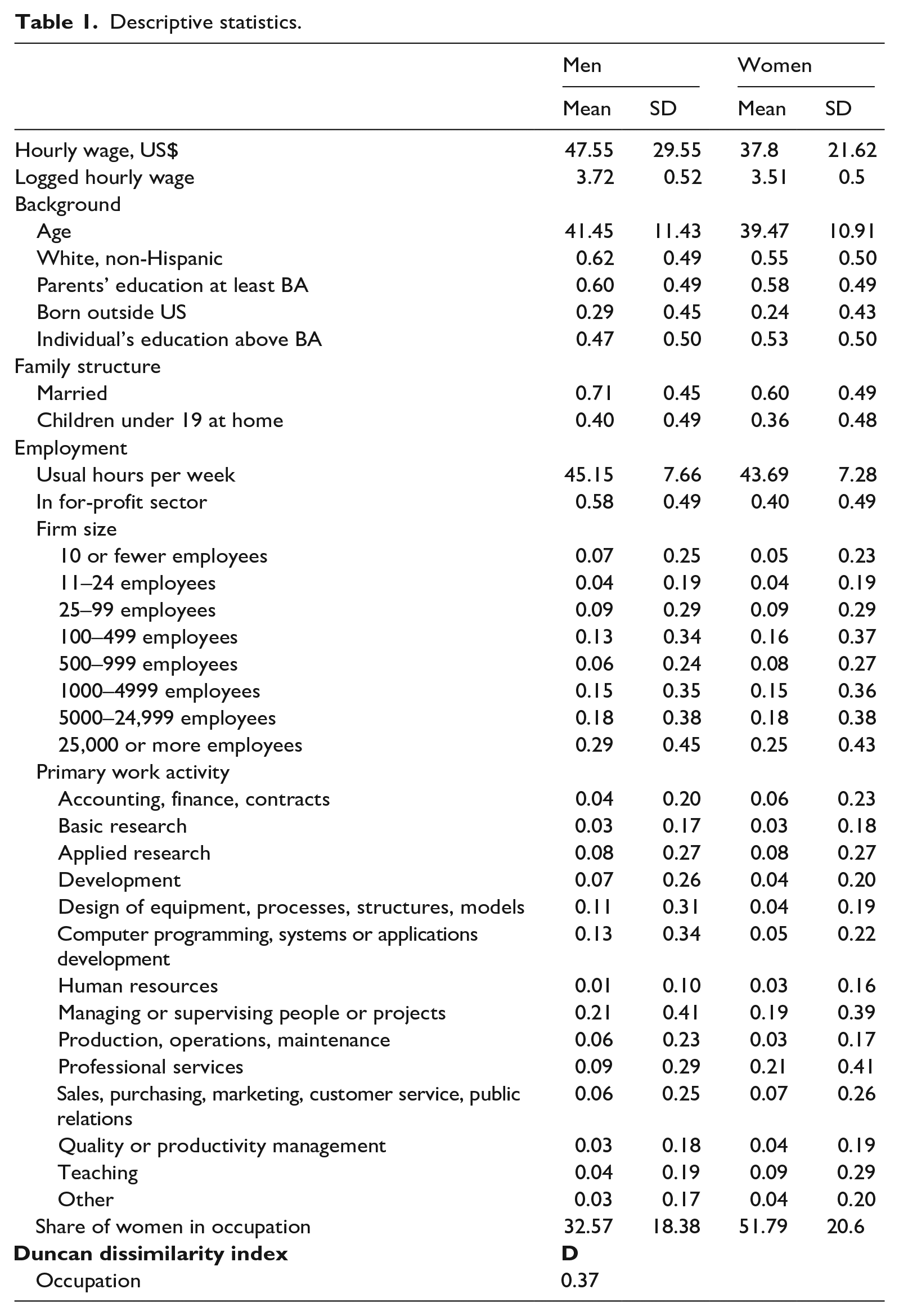
Men and women also differed on many of the independent variables. On average, in this sample of full-time workers with college degrees, men were slightly older than women. A higher percentage of men identified as White, non-Hispanic, and a higher percentage of men were born outside of the US. Parents’ highest education was similar for men and women. A higher percentage of women reported having a degree beyond a bachelor’s degree. Family structure also differed for men and women; being married and having children at home was more common for men than for women in the sample.
Among this group of full-time college graduates, men and women differed across several employment characteristics. Men on average worked slightly longer hours per week than women. Employment in the for-profit sector was also more common among men than among women. The size of the firm at which an individual was employed did not differ by gender. Primary work activity, however, showed substantial differences by gender. A larger share of women reported doing ‘professional services’ (21% compared with 9% of men) and ‘teaching’ (9% compared with 4% of men). A larger share of men reported doing ‘computer programming, systems or applications development’ (13% compared with 5% of women), ‘design of equipment, processes, structures, or models’ (11% compared with 4% of women). Men tended to work in male-dominated occupations while women tended to work in occupations with equal representation of men and women; on average, a man’s occupation was 33% female while a woman’s occupation was 52% female. Using the Duncan dissimilarity index (Duncan and Duncan, 1955) on the 124 occupational codes in the NSCG, 37% of men (or women) would need to change occupations to achieve perfect gender integration across occupations.
Ordinary least squares (OLS) regressions
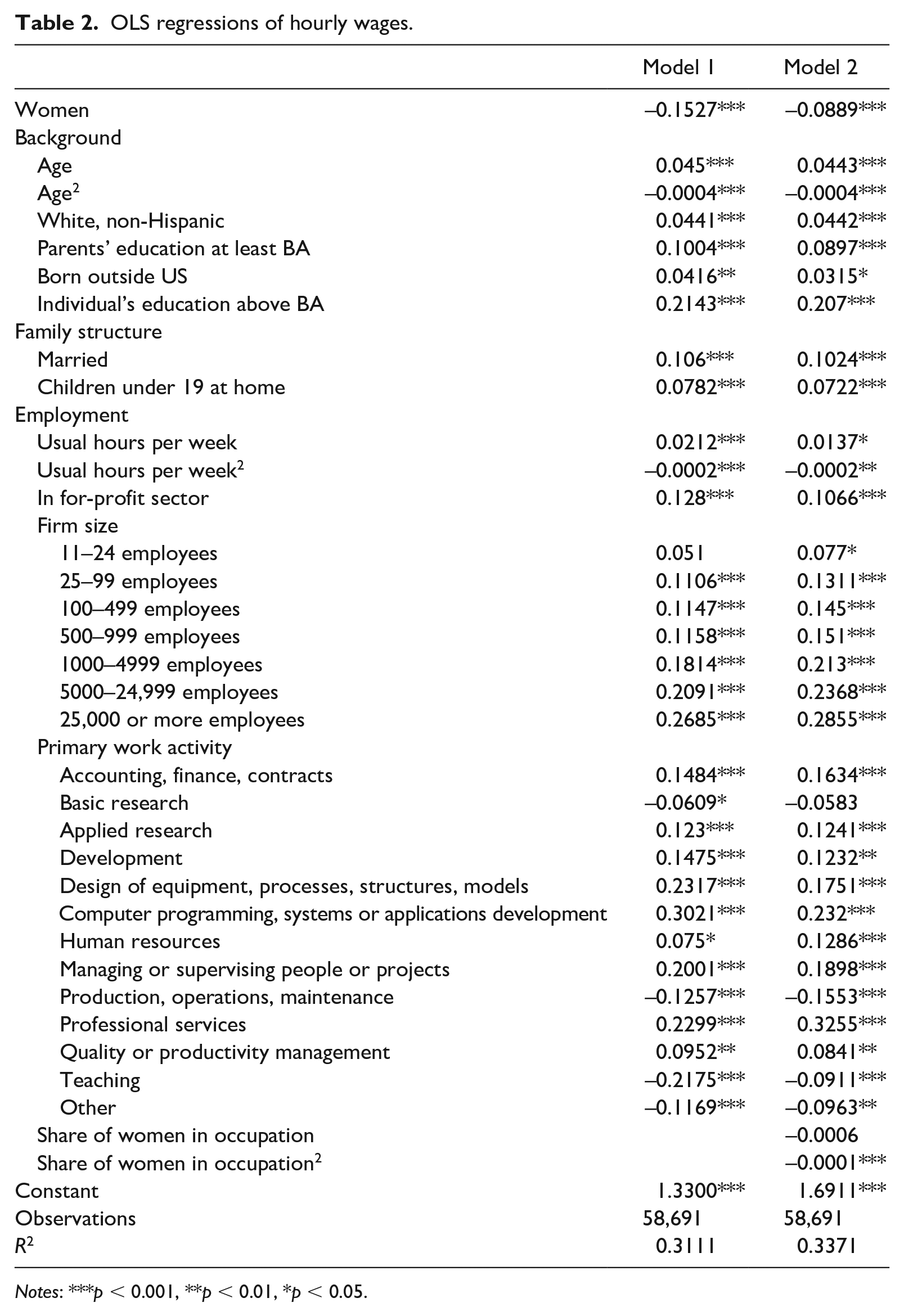
Table 2 shows the results of linear regression models of logged hourly wages. Model 1 includes only the individual-level characteristics of background, family and employment characteristics, as well as primary work activity. Model 2 introduces the share of women in the individual’s occupation, as well as a squared term for this variable.
OLS regressions of hourly wages.
Notes: ***p < 0.001, **p < 0.01, *p < 0.05.
Individual background variables behaved as expected in both models. Wages increased across the wage distribution until about age 55, when they levelled out. White, non-Hispanic individuals earned more on average than individuals of other race and ethnic groups. Individuals whose parents had a college degree or higher earned more, as did individuals who had a degree beyond a bachelor’s degree. Individuals born outside of the US were predicted to earn slightly more than US-born individuals.
Family structure variables showed average wage premiums for marriage and having children at home. This indicates that, all else being equal, those who were married and/or had children at home earned more than their single and/or childless counterparts. This could be partly explained by the unequal distribution of men and women with families in the sample, such that the fatherhood premium disproportionately influenced the average returns to family characteristics. It could also partly reflect differential selection into marriage and parenthood for both men and women in the sample, given the conditioning on college degree completion and full-time, year-round employment.
Usual hours worked per week showed a concave relationship with hourly wages, starting out as a positive relationship that eventually turned negative, so that as an individual’s weekly hours exceeded 60, their hourly wages on average decreased. The variables for sector and firm size behaved as expected, so that individuals in the for-profit sector and largest firms had higher wages on average. Primary work activity was included in the analysis through dummy variables, where a value of 1 indicated that the activity was an individual’s primary work activity. The activity ‘Sales, purchasing, marketing, customer service, public relations’ was the reference category. Most work activity variables had positive returns to wages when compared with this activity. ‘Teaching’, an activity done by a higher proportion of women than men, and ‘Production, operations, maintenance (e.g. chip production, operating lab equipment)’, an activity done by a higher proportion of men than women, were exceptions; a person whose primary work activity was either of these was expected to earn less than someone whose primary work activity was sales. Finally, as the share of women in an individual’s occupation increased, the wage premium was expected to decrease, with a steeper decline as the occupations became more female dominated, as indicated by the significant and negative second-order term (Table 2, model 2). Moreover, when female share in occupation was added to the analysis, the coefficient for female, indicating the conditional gender wage gap, was reduced by 41%.
Different returns
Tables 1 and 2 assess baseline differences in characteristics between men and women and how these characteristics relate to hourly wages. The next step in the analyses is a pooled Blinder–Oaxaca decomposition to understand how these differences in characteristics and, most importantly to the current study, how different returns to these characteristics explain the gender wage gap. Based on the results from the OLS regressions in Table 2, the full model (model 2) was decomposed to better understand the relationship between gender segregation, work activities and the gender wage gap. Separate OLS regressions by gender are presented in online supplementary Appendix Table A1.
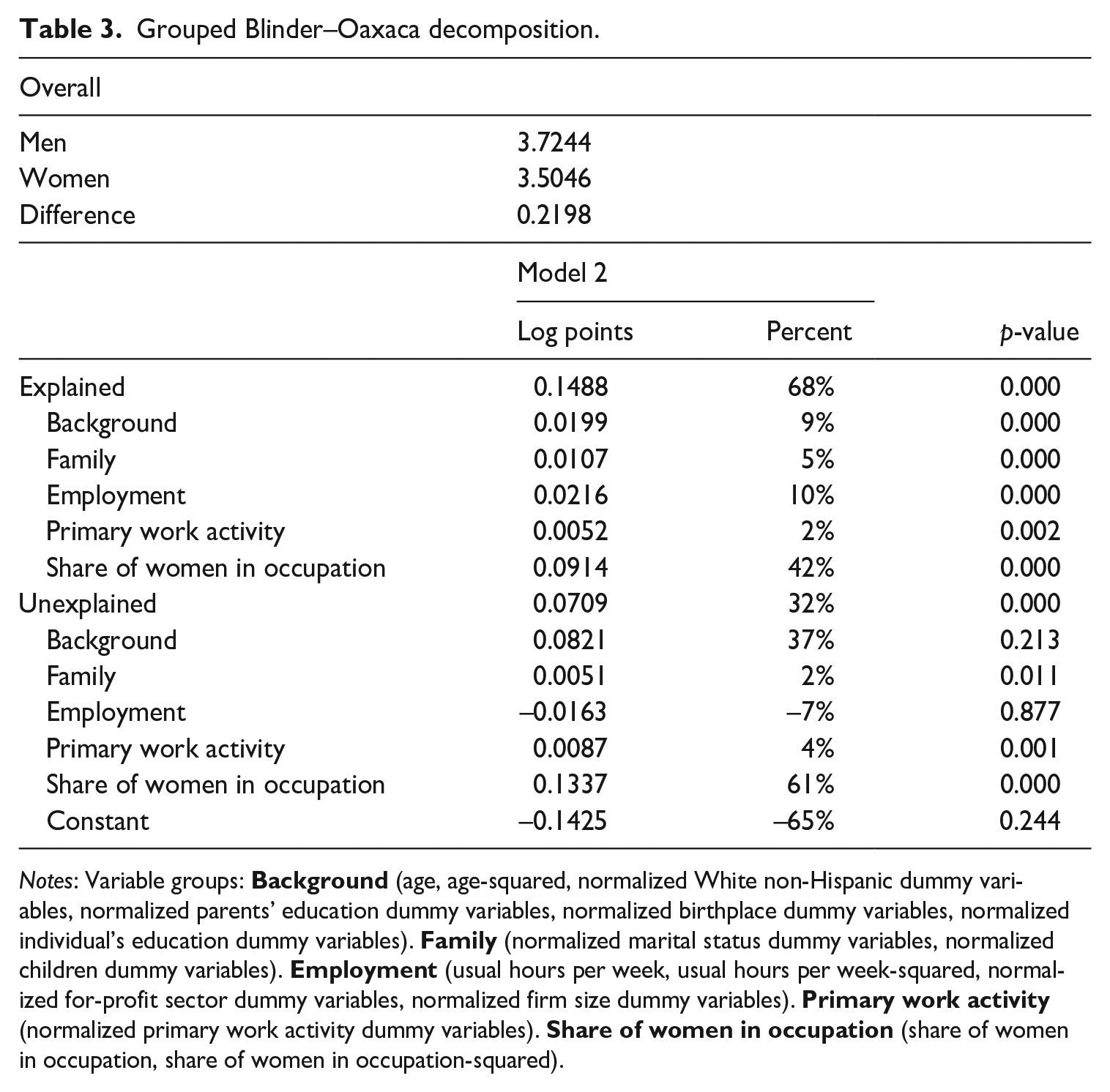
Table 3 presents the grouped results for the Blinder–Oaxaca decomposition. The adjusted mean log hourly wage was 3.72 for men and 3.51 for women, with a gap of 0.21. On an exponentiated scale, men were expected to earn 24.5% more than women; the geometric mean hourly wage was $41.45 for men and $33.27 for women. The different distributions of men and women across the independent variables explained 68% of the difference in hourly wages between men and women. The contribution of differences in primary work activities was 2%, over and above the share of women in the occupation, other job-related characteristics and individual characteristics. This partly reflects that the distribution of men and women across occupations to a large extent also captures the distribution of men and women across primary work activity types. However, men and women also received different returns to the same primary work activities, all else being equal. Family, work activities and share of women in the occupation contributed significantly to the unexplained portion of the gap. The contribution to the unexplained portion of the gender gap of different returns to primary work activity was 4%, while different returns to family characteristics contributed 2%. All else equal, the share of women in occupation contributed 61% of the unexplained part of the gender gap in hourly wages.
Grouped Blinder–Oaxaca decomposition.
Notes: Variable groups:
Table 4 presents detailed decomposition results for the unexplained portion of the gap. As the primary focus was the contribution of different returns to characteristics to the pay gap, the interpretation and analysis are limited to the unexplained portion and include the detailed decomposition results for the explained portion in online supplementary Appendix Table A2. Nine variables of interest (not including background variables) showed significant and non-zero contributions to the wage gap. Positive contribution values indicate that the different returns to this variable explain some of the wage gap between men and women; these include marriage, the activities ‘accounting, finance and contracts’, ‘computer programming’, ‘professional services’ and ‘sales’, and the share of women in occupation. Of these, share of women in occupation had the largest impact, as expected. Negative contribution values indicate that the wage gap would have been wider if women and men had received the same returns to the characteristic. In other words, women were receiving larger premiums or smaller penalties than men for these characteristics, which include firm size and the primary work activities ‘quality or productivity management’ and ‘teaching’.
Detailed decomposition results – unexplained portion of the gap.
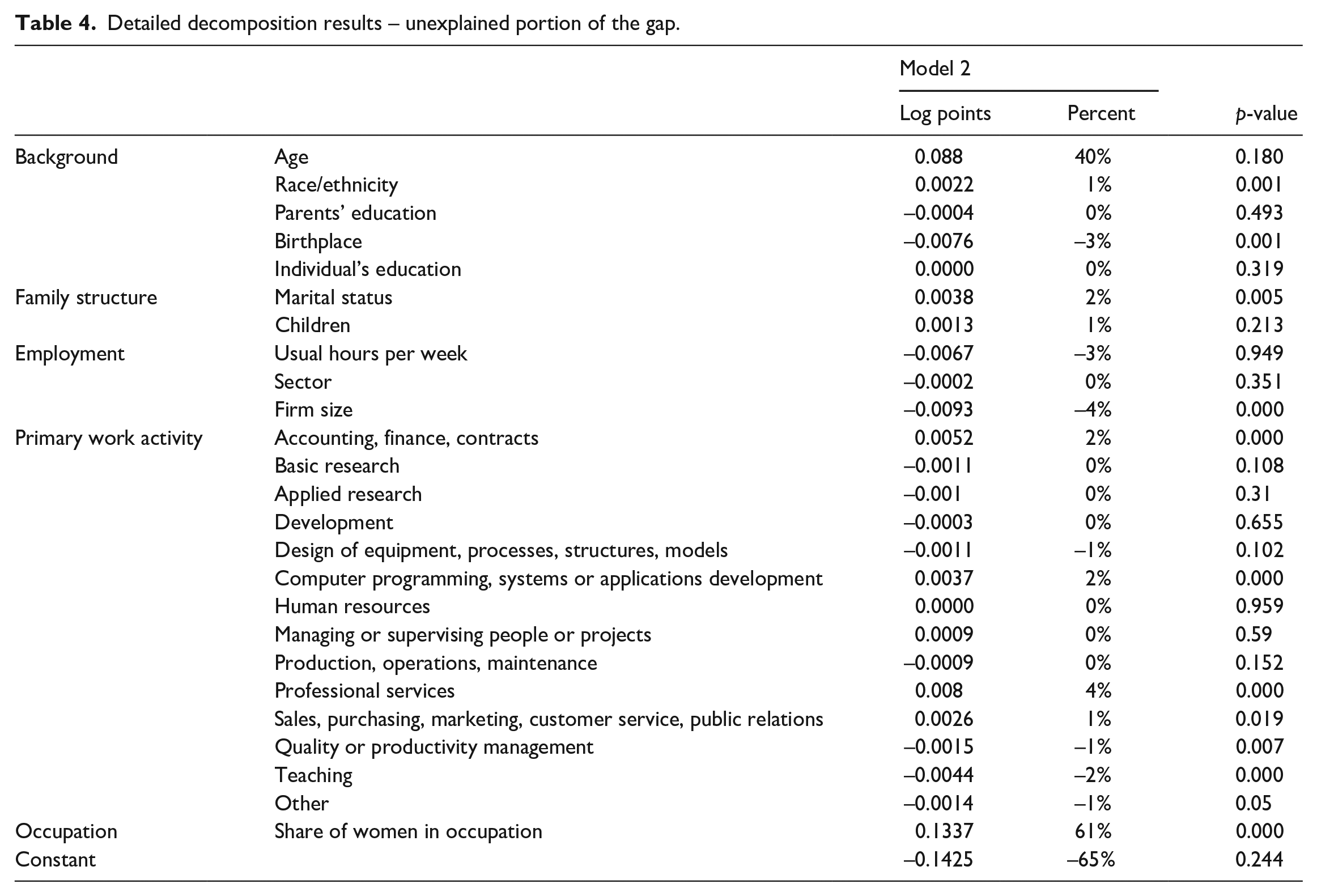
Marriage was associated with a wider wage gap through a larger marriage premium for men than for women. Performing ‘accounting, finance and contracts’, ‘computer programming’, ‘professional services’ or ‘sales’ correlated with higher wages for both men and women, but men received higher returns to performing any of these activities. Conversely, ‘quality or productivity management’ and ‘teaching’ were associated with a lower wage difference. Women received a larger wage return for performing ‘quality or productivity management’, narrowing the differences in predicted wages. Women did not receive a significant return, positive or negative, to ‘teaching’, while men received a negative return. The differences in returns to the ‘teaching’ activity therefore resulted in a lower wage gap, all else equal. In other words, men appeared to receive a wage penalty for female-typed activities and work (or women received less of a wage penalty) (online supplementary Appendix Table A1).
The relationship between gender, hourly wages and the gender composition of occupations is shown in Figure 1. Figure 1 shows predicted values of log wages across the occupation gender share distribution for men and women, based on a OLS regression where all the independent variables are interacted with gender (online supplementary Appendix Table A3). For women, as the share of women in their occupation increased, their predicted logged wages decreased linearly. Men’s predicted logged wages also declined as female occupation share increased, but the predicted decline increased in magnitude as the share of women increased, so that the largest pay gaps would be expected in the most gender-balanced occupations. At the ends of the distribution, in occupations between 10% and 20% female and 80% and 90% female, there was no longer a predicted wage gap between men and women. Like with female-typed activities, men appeared to receive a wage penalty for being in occupations where the share of women was above 50%.
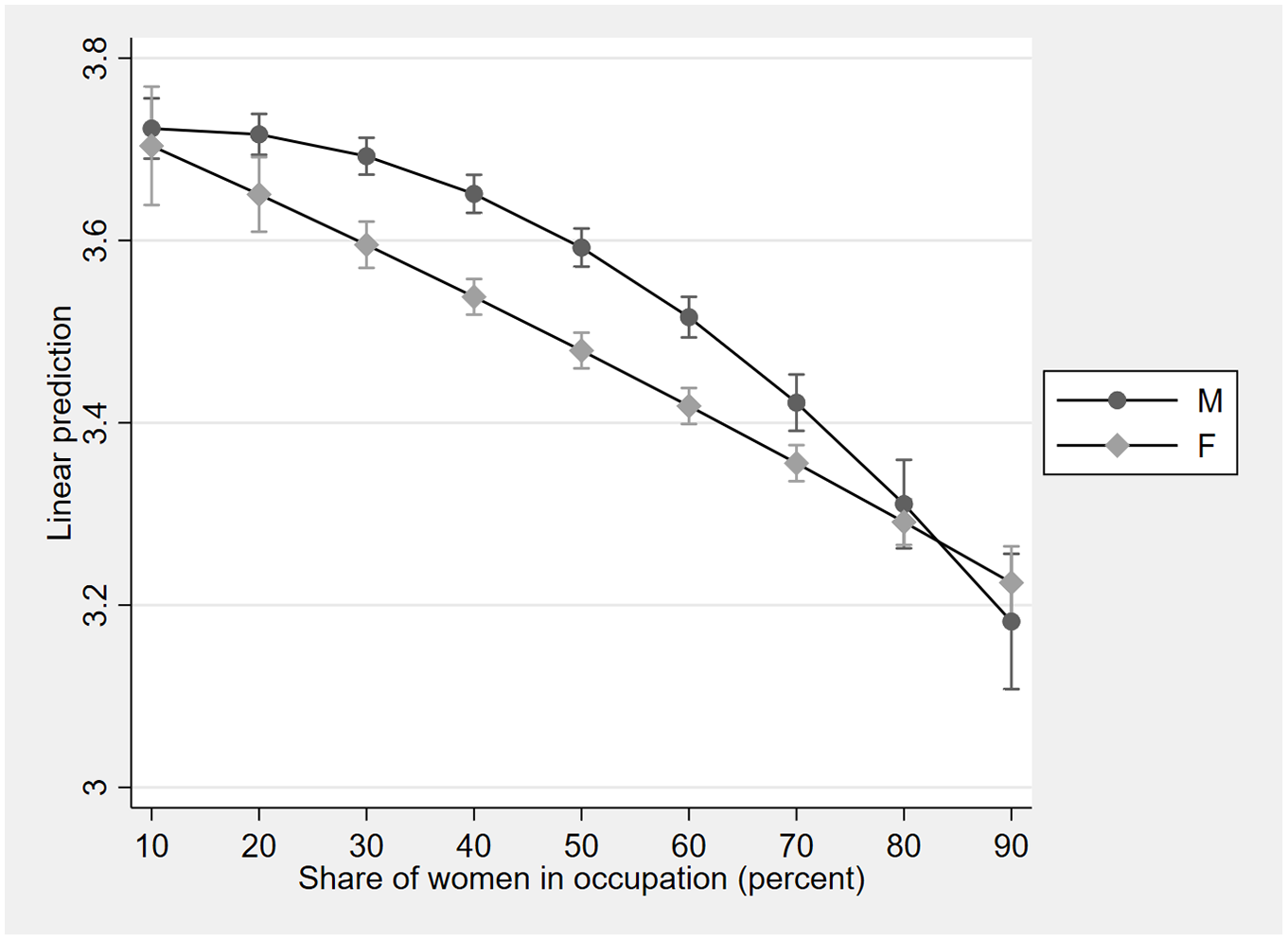
Predicted log hourly wages by share of women in occupation, by gender.
Limitations
The current study has several limitations. First, the measures of primary work activities do not capture how much of their work is made up of the primary work activity and which other important work activities they carry out in their job. If men and women systematically differ in the extent to which the combination of activities form part of their overall working time, our analyses will likely underestimate the importance of work activities for differences in pay. Second, given that the analyses focus on the gender pay gap among college-educated, full-time workers, the study does not capture the full extent of the impact of being married and having children on women’s and men’s wages. Third, the NSCG is a valuable data source because it provides information on work activities, but its sampling design may overrepresent individuals in the science and engineering workforce. Finally, the study focuses on the unexplained portion of the wage gap, which includes differences in returns to characteristics as well as the effects of unobserved predictors (Fuchs et al., 2019).
Discussion and conclusion
This article decomposes the wage gap between college-graduated, full-time employed men and women by individual and labour market characteristics and the wage returns to those characteristics. The analyses contribute to the gender pay gap literature by examining gendered wage returns to primary work tasks, over and above occupational segregation. By distinguishing between work tasks and occupations, we are able to better evaluate to what extent specific work tasks are associated with gender differences in wage penalties or premiums independently of the gender composition or gender typing of occupations. It is well established that the unequal distribution of men and women across occupations substantially contributes to wage differences. Because primary work activities and female share in occupation are interrelated, models were estimated with and without controlling for the share of women in occupation. When estimating the association between primary work activities and hourly wages, 2% of the gender wage gap is attributable to the sorting of men and women across primary work activities. However, as was documented in the changes across the two OLS-regression models in Table 2, a substantial share of the gender wage gap is absorbed in occupational segregation, once segregation is added to the model.
At the same time, the results show a more complicated story than one of simple labour market segregation, where women earn less because they are in low-paying occupations or primarily carry out different work activities than men. First, the decomposition analysis shows that while 68% of the gender gap in hourly wages can be explained by differences in individual characteristics and the differential sorting of men and women in the labour market, 32% of the gap can be attributable to differential returns to the same characteristics. Second, both men and women experience negative returns to their salaries as their occupations become more heavily female. This effect is less steep at first for men, however, so that the gap in salaries between a woman and a man in an occupation that is 40–50% female is greater than at other points in the occupation composition distribution. Integrated occupations, it seems, produce the largest gender wage gaps.
Finally, returns to work activities are also clearly dependent on gender. Some activities lower the gender wage gap by penalizing men, such as teaching. Others widen the gap by privileging men and penalizing women, such as accounting and finance, computer programming and professional services. These findings may inform our understanding, not only of the persisting wage gaps among the college educated, but also persisting gender segregation across occupations. If men have lower returns than women to teaching, and women have lower returns than men to computer programming, this may have consequences for women’s and men’s motivation to cross gender stereotypical barriers in the labour market. Moreover, differential returns to similar work tasks net of occupational segregation, indicate that pay inequality may be embedded in the gender typing of tasks, as well as occupations. Previous research has documented that cultural norms can be ‘sticky’, such that female-typed occupations remain devalued regardless of changes in occupational composition. The findings presented in this article indicate that the stickiness of cultural norms may affect the valuation of work tasks as well. In what ways work tasks are gendered and how that influences differential returns to performing those tasks for men and women should be investigated further in future research.
Given the interplay of different characteristics and unequal returns, efforts to reduce the gender wage gap need to address both the opportunity and the mechanisms of compensation. For example, succeeding in recruiting more women to pursue careers in computer programming would decrease the gender pay gap, but some gap will remain if the organizational processes that value men’s programming activities more than women’s are not addressed. This may be especially pertinent to policy geared towards occupational integration, as the most gender-integrated occupations have the largest pay gaps.
Supplemental Material
sj-docx-1-wes-10.1177_09500170241245329 – Supplemental material for Characteristics or Returns: Understanding Gender Pay Inequality among College Graduates in the USA
Supplemental material, sj-docx-1-wes-10.1177_09500170241245329 for Characteristics or Returns: Understanding Gender Pay Inequality among College Graduates in the USA by Joanna Dressel, Paul Attewell, Liza Reisel and Kjersti Misje Østbakken in Work, Employment and Society
Footnotes
Funding
The authors disclosed receipt of the following financial support for the research, authorship, and/or publication of this article: This study was supported by the Research Council of Norway, through the project ‘Determined to Succeed? Maturation, Motivation and Gender Gaps in Educational Achievement’, grant no. 283603.

Supplementary material
The supplementary material is available online with the article.
References
Supplementary Material
Please find the following supplemental material available below.
For Open Access articles published under a Creative Commons License, all supplemental material carries the same license as the article it is associated with.
For non-Open Access articles published, all supplemental material carries a non-exclusive license, and permission requests for re-use of supplemental material or any part of supplemental material shall be sent directly to the copyright owner as specified in the copyright notice associated with the article.
