




Abstract
It is often assumed that industrial sociology scarcely existed as a topic of study before the Second World War. Here, we illuminate its antecedents by showing social relations in work organisations being vigorously debated by workers and managers in the Rowntree lecture conferences, an integral part of the British interwar management movement (1918–1939). The reported debates and discussions constitute a form of ‘citizen sociology’. We explore the movement, previously examined solely from management’s viewpoint, from the workers’ perspective, accessing their lived experience through first-hand accounts provided in lectures. Our main contribution is to show how employee demands were progressively neutralised over the period, absorbed into nominally shared concerns for efficiency, as welfare provision was reconceived as labour management. We document this evolution through the lectures, expressed in participants’ own words. This was achieved not by disregarding worker representatives, but counter-intuitively by engaging with them directly and inviting them into the conferences.
Keywords
Introduction
Industrial sociology, the study of social relations in work organisations and their interactions with wider society, is thought barely to have existed in Britain before the Second World War (Brown, 1992). Few British universities recognised sociology as a topic worthy of study. Rudimentary sociological research can be detected nevertheless in studies of service personnel conducted during the First World War (McIvor, 1987), prompting the formation of the Industrial Welfare Society in 1919. In this article, we address this lacuna by focusing on the changing social organisation of work in the interwar years (1918–1939), a relatively neglected period when social relations were shifting in the aftermath of war (Croucher and Wood, 2017). Specifically, we focus on the British interwar management movement from the perspective of participating workers and their representatives, who, faced with growing job insecurity (Fervers, 2021), and with the resetting of social relations following the war strengthening worker solidarity (Rowntree, 1922), were demanding to have their say in the industries in which they worked.
The interwar management movement represented a determined effort led by a network of businesspeople, including Quaker industrialist Benjamin Seebohm Rowntree, to boost the problem-solving capabilities of British firms through peer-to-peer learning at a time of economic turmoil and industrial unrest (Maclean et al., 2023). Rowntree had been seconded in wartime to the Ministry of Munitions as its Director of Welfare (Briggs, 1961). Alongside management research groups, launched in 1926 as a vehicle for exchanging ideas (Keeble, 1981), central to the movement were the Rowntree lecture conferences. These commenced in April 1919 and ran approximately biannually until January 1940. Initially held in Blackpool, Durham, Scarborough and York, they became established from 1922 in Balliol College, Oxford, embracing a broad range of topics designed to improve work relations and industrial efficiency.
A novel feature of the conferences was that they were open to delegates from all levels of the organisational hierarchy. Inclusivity mattered, since one of their primary objectives was to enable managers to hear, at first hand, worker demands. To this end, in addition to industrialists, functional specialists, organisational theorists and consultants, speakers featured trade unionists, including Ernest Bevin, worker representatives and politicians from across the parliamentary spectrum. Scholarly research into the interwar management movement has been relatively sparse (Child, 1969; Maclean et al., 2020, 2022a; Wilson and Thomson, 2006). It has focused thus far on the perspective of managers and employers (Keeble, 1981; Tibbals, 2019), to the exclusion of workers and their representatives. Drawing on recently recovered archival material relating to the Rowntree conferences, this article corrects this imbalance by considering this material in a new light – from the workers’ perspective. Our guiding research question is thus: how does this recently recovered material enhance our understanding of worker voice in the interwar years as conveyed in their first-hand accounts, and to what extent were they being listened to by employers? To sharpen the focus of this question, we approach it through the lens of changing attitudes to welfare and its relationship to notions of efficiency.
This article makes three contributions to the literature on social relations in work organisations and their interactions with wider society. Our first contribution is to cast light on the antecedents of industrial sociology as a subject of study, showing that it was being reflected upon and vigorously debated by worker representatives and managers in the interwar years. The reported dialogues and ensuing discussions constitute a form of what we term ‘citizen sociology’, allowing us to discern ‘the dynamics of employment relations’ playing out almost in real time (Taylor et al., 2009: 7). They provide rare insight into the concerns of factory workers a century ago. Our second contribution is thus to explore the British interwar movement, hitherto investigated purely from the viewpoint of managers (Child, 1969; Wilson and Thomson, 2006), from the workers’ perspective; accessing and elucidating their lived experience of the interwar struggle for employee rights through first-hand accounts provided in lectures. This allows us to shine a light on some of the activists involved, many of whom have been unfairly forgotten by posterity. Beck et al. (2016: 218) stress that a key objective of Work, Employment and Society (WES) is to engage with the less powerful, to ensure their ‘unscripted voices’ are heard. The fact that the lectures were recorded allows us to hear worker opinions expressed in their own words. What we uncover highlights the tangible impact that increasing mechanisation was having on the working lives of employees in large factories, from which capitalism was increasingly ‘disconnected’ (Thompson, 2003). It also reveals the ebb and flow of preoccupations over the period; demonstrating how the focus of managers, initially attentive to worker voices, shifted from employee welfare to healthy profits as the union threat diminished (Donaghey et al., 2011). Our third contribution is thus to show how employee demands were progressively curbed and negated over the interwar period, absorbed into nominally shared concerns for efficiency, as employees were viewed less as individuals and more as human resources to be managed. We reveal that this was achieved not by turning a deaf ear to worker representatives, but counter-intuitively by engaging with them directly and inviting them into the conferences.
Our article proceeds as follows. We first review the literature on changing patterns of work, employment and job security leading up to and during our study period, focusing on welfare work and employee voice. We then explain the methodology on which our study is founded. We next explore worker perspectives as expressed in the Rowntree lectures, focusing on their changing attitudes to welfare provision, and illustrating how worker representatives went from being central to the conferences to more peripheral as managerial priorities shifted over time. Finally, we evaluate our findings and examine their theoretical implications for the social organisation of work.
Changing work relations in the interwar years
Brown (1987) highlights in the inaugural editorial of WES the inherent value of historical contributions in illuminating current sociological perspectives on work. Since the time of labour historians Sidney and Beatrice Webb, writing in the late 19th century, industrial sociologists have incorporated historical analysis into their explorations of contemporary trade unionism. In this way, ‘history informs our judgements on disagreements about current contexts’ (Croucher and Wood, 2017: 1016).
The late 19th and early 20th century witnessed rising union activity, with trade unions becoming permanently established from the late 1880s (Thompson, 1968; Webb and Webb, 1920), spurred on by the advent of socialism (Joyce, 1980). Following Child et al. (1973: 71), we define ‘trade union’ as ‘any organisation the officials of which attempt to enter into job regulations and collective bargaining with employers on behalf of its members’. Through mergers, general unions increased in size and strength. They owed their growing strength, Hobsbawm (1964: 184) observes, to their ability to recruit ‘a great many men [sic] who, for one reason or another, commanded that power to make themselves scarce’. He notes nevertheless that these unions were less concerned with improving conditions for women employees, noting that they ‘utterly failed to organize the genuinely weak – e.g., the women’ (p. 191).
In the years before the First World War, British trade unions expanded markedly. However, war altered the parameters of civilian and working life fundamentally, lowering expectations of deference (Joyce, 1980). Firms were compelled to staff their factories in wartime with unskilled workers, notably women, reducing skills differentials. The loss of over 800,000 soldiers (UK Parliament, 2023) meant that, with demobilisation, fewer men were available for work (Marwick, 1965). The war also enhanced worker solidarity, strengthening group loyalty among rank-and-file employees (Rowntree, 1922). Against a backdrop of the Russian revolution, rising inflation and experiments in national control of rail, coalmining and shipbuilding, labour entered the immediate post-war years in buoyant mood (Booth, 1982). Collective bargaining, which previously had occurred at district level, was now national across the leading organised industrial sectors (Adams, 1997). As Rowntree (1922: 99) insisted, ‘Whether or no [sic] we welcome the new attitude of Labor, we cannot afford to neglect it’.
Union participation cannot be fully understood without considering prevalent circumstances (Child et al., 1973). The British economy was left vulnerable by war. Diminished competitiveness in coal, iron, steel, shipbuilding and textiles had a devastating impact on employment and investment (Broadberry, 2005). As the economic context worsened, trade collapsed, and recession took hold. The economic boom of 1919–1920 gave way to the slump of 1921 (Claydon, 1987). Widespread wage reductions, temporary shutdowns and unemployment ensued, causing union membership to decline. Soon, unemployment exceeded 20% (National Archives, 2023). While government feared the effects of rising unemployment on social order, workers feared its effects on their livelihoods. Yet defeat in the general strike of 1926, and the Great Depression (1929–1933) that followed, left labour on the backfoot (Hobsbawm, 1964). In 1932, the ‘trough year’ of the depression, one in four workers was unemployed in Scotland, Wales, the Northeast and Northwest, with many experiencing lengthy periods between jobs (Booth, 1982).
Employment was often so precarious that, in the dockyards, for example, it was longstanding practice for foremen to select ‘at certain periods of the day . . . fresh gangs of men from among the crowd of applicants at the dock gates’ (Webb and Webb, [1897]2020: 433). Such precarity of employment did not necessarily benefit employers, who needed workers to be loyal. It made sense for managers to retain key workers by minimising turnover, absenteeism and discontentment, which could inflict long-term damage on firms. As Webb and Webb ([1897]2020: 433) insisted: Wherever costly and intricate machinery is used, and wherever the processes of different workmen are dovetailed one into the other, it pays the employer to retain . . . the services of the same body of men, accustomed to his business and to each other.
With the growth of industrial enterprises into large-scale concerns using mass production techniques (Braverman, 1974; Chandler, 1990), resulting in the separation of ownership from control, employers increasingly appeared to their workforces as distant abstractions answerable only to shareholders (Berle and Means, 1932). What Joyce (1980: 341) describes as the ‘long, slow and discontinuous advance of mechanisation’ was making inroads into trades once unaffected by it. The coming of the limited company severed the bonds between master and men, superseding the paternalism characteristic of the family firm with a growing rationality in work organisation (Joyce, 1980). As firms grew in complexity, an increasing number of supervisors were required to coordinate activities (Bendix, 1956), insulating employees from personal contact with owner-managers. The effect was to distance them further from management and the chance to influence workplace matters (Child, 1976). The anonymity of employers stoked worker demands for industrial democracy, the democratic right of workers to influence at plant level the conditions under which they laboured (Lauck, 1926; Rowntree, 1921). Child (1976) views the desire for participation as the cornerstone of a mature democracy. With the rising status and power of trade unions, many employers and works managers found themselves frightened into engaging with worker representatives for the first time. Perhaps the greatest fear of employers was that to deny change would be ‘to encourage the demand of the extremists for a complete recasting of the industrial system’ (Rowntree, 1922: 108). By acceding to worker demands for greater cooperation, there was thus on the part of employers ‘an assumption that any change would be incremental and would not sever continuity with the past’ (Child and Smith, 1987: 574).
Partly to offset remoteness from the workforce, employers sought to strengthen employee loyalty and retain skilled labour through welfare work. A small minority of progressive employers, often with a Quaker background, including chocolate manufacturers Cadbury, Fry and Rowntree, had long recognised the importance of organising work so as to improve standards of health among their workforces (McIvor, 1987; Tibbals, 2019). Welfare provision had been increasing in large organisations from the late 19th century (Heller, 2008; Rowlinson and Hassard, 1993), with companies developing their labour management strategies around this (Richardson, 2011). Welfare programmes, including continuing education, sports provision, medical services, holiday schemes, pension funds, convalescent homes and even additional food, flourished among large-scale industrial enterprises (Child and Smith, 1987), as ‘big businesses transformed themselves from economic agents that produced goods and services to social institutions that served the nation’ (Heller, 2016: 663). There was a strong paternalist aspect to this, allied to a fear that the monotony of mechanisation in large-scale enterprises might ‘deaden the souls’ of employees, which welfare provision could countermand (Heller, 2008: 593). Welfare programmes were supported by in-house magazines designed to cultivate a sense of belonging. By invoking an esprit de corps, magazines targeted the hearts and minds of employees, nurturing a sense of identity consonant with ideals of participation and cooperation. What is less well understood is that these welfare programmes were introduced often with an eye to greater efficiency (Child and Smith, 1987). Welfare provision was thus multi-purpose: designed to improve the health and wellbeing of the workforce, while strengthening loyalty and organisational efficiency (Knudsen et al., 2011). Profit sharing was mooted in some firms as a route to securing workforce loyalty, but was often contested by unions since it undermined collective bargaining (Richardson, 2011).
We follow Wilkinson et al. (2020: 5) in defining employee voice as ‘the ways and means through which employees attempt to have a say, formally and/or informally, collectively and/or individually, potentially to influence organizational affairs relating to issues that affect their work, their interests, and the interests of managers and owners’. Kaufman (2020: 19) argues that the historical antecedents of employee voice, grounded in the notion of union representatives voicing concerns on the part of the collectivity (Freeman and Medoff, 1984), have been neglected, such that contemporary scholars may have ‘substantially reinvented a concept well known and utilized many years ago’. For employers, the lecture conferences offered an opportunity to enhance ‘voice legitimacy’ (Wilkinson et al., 2020: 8), by voluntarily meeting with workers in open forum to debate their concerns. For worker representatives, they opened a channel of voice through which to express their demands (Willman et al., 2020). Our study of worker participation and voice as articulated through the Rowntree lectures helps to develop debate about the role of historical approaches to understanding the sociology of work; highlighting the methodological contribution that archival study can make to the field.
Workers, in summary, were becoming more vociferous. Having acquired political democracy through the 1918 Representation of the People Act, which accorded the vote to men over 21 and women over 30 (Lauck, 1926), industrial democracy was in their sights. For employers, welfare provision offered a relatively safe route through which to counter workplace demands without countenancing any real form of worker control. Adams (1997: 527) writes: ‘If labour’s contribution is to be properly understood, the aspirations and strategies of activists and members of trade unions must also be brought back into view’. In what follows, we approach worker perspective and voice from a century ago, casting light on the contributions of individuals overlooked by history.
Methodology
The present study has been accomplished by means of intensive archival research (Maclean et al., 2022b). The research team was aware that copies of the Rowntree lectures survived in different locations, often in a fragile condition. It had been a longstanding aim to track these down to ensure their preservation. Our efforts were geared towards locating the material, photographing, digitising and ordering it to create an online data repository in the belief that other scholars would use it if it was available. We succeeded in locating material from 38 of 42 conferences, amounting to 317 lectures altogether. Including introductions to the conferences equates to 365 documents, totalling 2193 transcribed pages. Alongside lectures, we collected management research groups’ annual reports (nine), bulletins (15), dinner discussions (29) and two audio-files featuring Harry Ward, management research group secretary. We assembled material pertaining to the biographies of 104 individual speakers to create a prosopographical biography of personnel; all of whom, as typical of the era, appear to have been white – one of the difficulties being that little is known about some speakers. Conference delegates came from different levels of organisational hierarchies, meaning not all were well known. Our account is therefore an attempt to set the record straight, recognising that some of those involved have been unjustly disregarded by history, to rescue them from the ‘condescension of posterity’ (Thompson, 1968: 12).
Businesspeople comprised the largest category of lecturers, presenting 133 lectures; with worker representatives giving 45 lectures; politicians and government officials giving 18; consultants and professionals giving 61; and academics, notably sociologist Sidney Webb, psychologist Elton Mayo and theorist Mary Parker Follett, presenting 60 lectures (Table 1). Women speakers like Follett were relatively rare. However, their gender was never commented on, and we encountered no evidence of sexism. The conferences included ‘forewomen’ as well as ‘foremen’ in their titles, and the lectures often referenced female employees. Speakers were recruited to address the conferences by Rowntree and his associates, with some giving multiple lectures. Lectures were typed and circulated and, from 1935, incorporated into inaugural issues of the British Management Review. Some lectures were paired as debates, contrasting workers’ and employers’ views; as in 1921, when director Max Muspratt enquired, ‘How far is increased production desirable in the interests of the workers? The employer’s standpoint’, and Labour politician Greenwood (1921) responded from the workers’ viewpoint. An open discussion would ensue, inviting questions from the floor. Open discussions were transcribed verbatim, specifying the names of those contributing to discussions, the firms or associations they represented, and where these were located. Each conference from April 1920 provides a list of companies attending (ranging from 33 firms to over 70 in difficult times), amounting to around 450 firms altogether. Firms sent around six delegates to each conference. For Clarks the shoemakers, we have obtained the company record of members of staff sent.
Rowntree lectures by period and speaker occupation. a
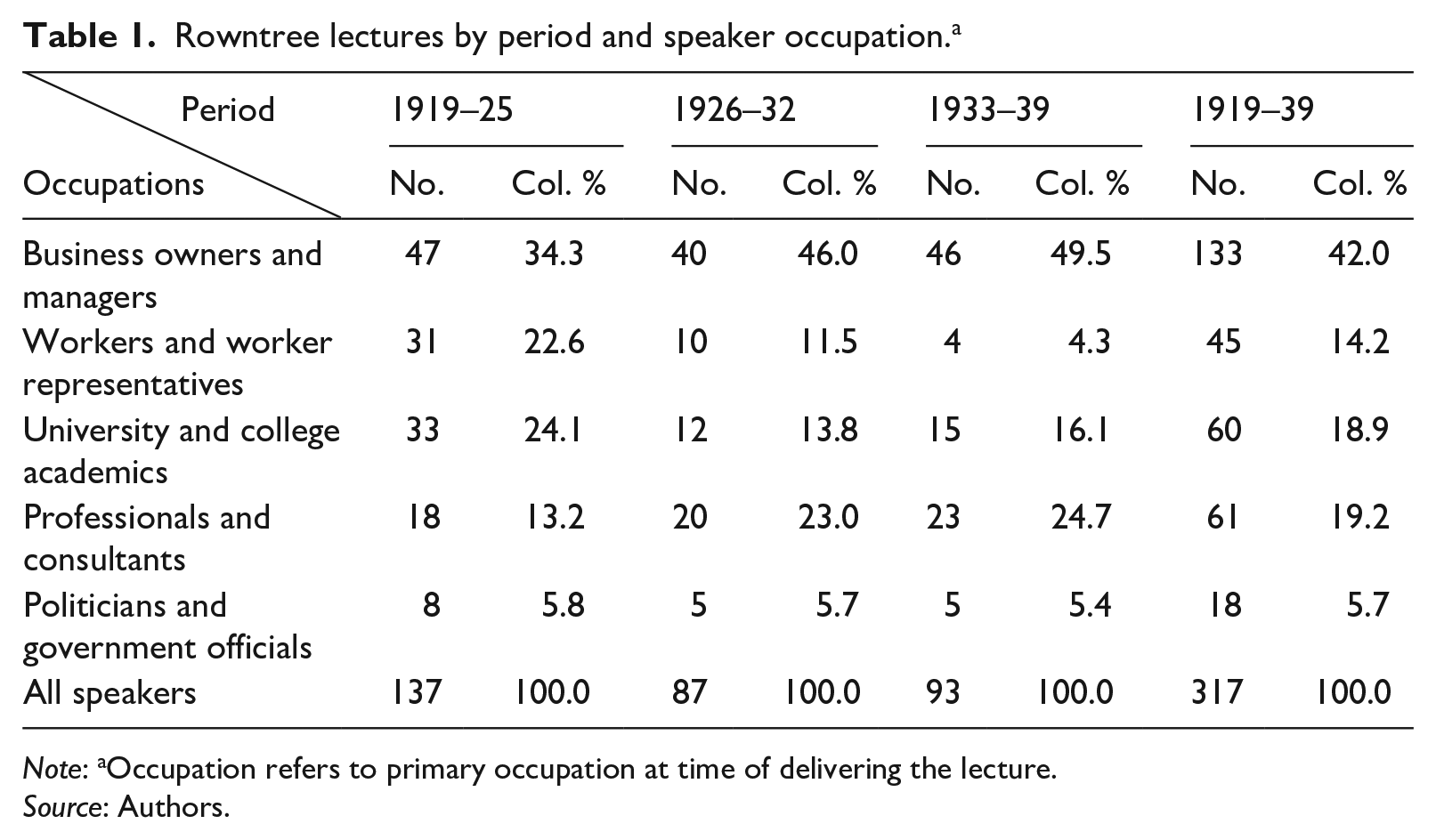
Note: aOccupation refers to primary occupation at time of delivering the lecture.
Source: Authors.
We collected material from various archives: the Alfred Gillett Trust; Bodleian Library; Borthwick Institute for Archives; Bristol Archives; British Library; London Metropolitan Archives; London School of Economics; Modern Record Office; National Archives; Nottinghamshire Archives; Suffolk Records Office; Unilever Art, Archives and Record Management; University of Reading Special Collections; and Walgreens Boots Alliance Heritage. Repeat visits were often necessary to find elusive material. Additionally, we assembled documents relating to the impact of the movement in individual firms, including Boots, British Xylonite, Clarks, Dunlop, Lever Brothers, Lyons, Rowntree’s and Imperial Tobacco. Tracking down such material depends on the preservation of relevant documents at firm level; comparable at times to looking for a needle in a haystack.
Our research was conducted over three years, from 2016 to 2019. The creation of a public-facing, free-to-use online repository (available at https://rowntree.exeter.ac.uk) took longer. We continue to add to this when material becomes available. Our online archive of the Rowntree lectures and related materials was created using the open-source content management system Omeka. This enabled us to present the material in an interactive, searchable format. Our objective is to manage the digital archive for a decade, and longer depending on usage, and to curate it in perpetuity.
Data analysis
Our early reading of the source material was informed by existing literature, as explored in our literature review. However, there was no substitute for reading and re-reading the material, to familiarise ourselves with the material we had assembled. We took an early decision in this study to focus on the lectures themselves, since no workers or worker representatives had attended management research group meetings or directors’ dinners, but were widely present in the lectures. After compiling a list of lectures and their speakers, we selected from this corpus those speeches with a stronger bearing on workers’ concerns, representing 105 lectures altogether. A worker orientation was often indicated by the speaker’s identity or explanation of their role, or from lecture titles, as exemplified by a speech by Christian socialist Irvine (1920) called, ‘What the workers want’, or one by commissioner for industrial unrest Mallon (1924) named ‘Industrial peace’. This did not mean excluding employer voices. On the contrary, businesspeople formed the largest category of speakers, and since they wanted to understand worker demands, employee issues permeated many of their talks. Employer responses to worker concerns were critical, since without employer receptivity, worker representatives risked ‘spitting in the wind’ (Wilkinson et al., 2020: 6). Given that Omeka has a searchable function, we could also search our dataset using keywords. ‘Welfare’, for example, yielded 146 documents in which this was mentioned, albeit tangentially at times, while ‘worker voice’ produced 268 documents. ‘Efficiency’, which increasingly came to preoccupy employers, produced 284 results, indicative of its rising importance over time. We used this facility as a back-up to ensure we had captured all essential lectures; the selection of themes being done manually.
We identified initial themes by re-reading this body of lectures focusing on worker concerns. Two research team members read the material separately to generate initial codes (Strauss and Corbin, 1990), discussing differences which arose. Since our objective was to capture worker voices and perspectives, our codes and themes were initially bottom-up and inductive, driven by the data, to give voice to their experience of workplace issues (Braun and Clarke, 2022). Initial codes were wide-ranging, including many which were employment-related, such as ‘strikes and industrial disputes’, ‘health and welfare’, ‘industrial democracy’, ‘mutual understanding’, ‘partnership’, ‘unemployment’, ‘worker control’, ‘worker voice’, ‘worker suspicion’, ‘worker dignity and happiness’, alongside others which were more business-related, including ‘efficiency’, ‘productivity’ and ‘profits’. From these we developed initial themes which concerned first, security of employment, informed by the post-war context; second, employment-oriented issues including attitudes to welfare and worker dignity; and third, business-related issues including mechanisation, efficiency and the separation of ownership and control, which were affecting workers’ experience in factories. As we refined our themes, however, we took the decision that to zoom in on one theme would give a better sense of the richness of our data, permitting greater depth of analysis, enabling us crucially to show its evolution, its ebb and flow, over our study period. We therefore settled on attitudes to welfare, which resonated with extant literature, featured prominently in lectures and followed a discernible trajectory, being gradually subsumed into concern for efficiency as employees were viewed increasingly as resources to be managed.
Narrated accounts, spoken and written, reflect the contexts in which they were generated. Their significance is not restricted to the individuals who authored them, but extends to the period to which they pertain. Following Langley (1999: 703), we arranged our material into three discernible ‘temporal brackets’, denoted by a ‘certain continuity . . . within each period and . . . certain discontinuities at its frontier’. These temporal brackets were: 1919–1925, when welfare featured prominently in lectures, and worker voices were heeded; 1926–1932, when welfare was relegated as union threats diminished, and employer interest in worker views declined; and 1933–1939, when welfare was rationalised as labour management, and worker voices considered less central consequently. Table 1 displays the preponderance of speakers from each group – businesspeople, worker representatives, academics, professionals and political figures – across the three periods of our data analysis. This reveals how worker voices, keenly listened to in the early period, were heard less as the interwar years progressed, their concerns side-lined as technical efficiency was prioritised.
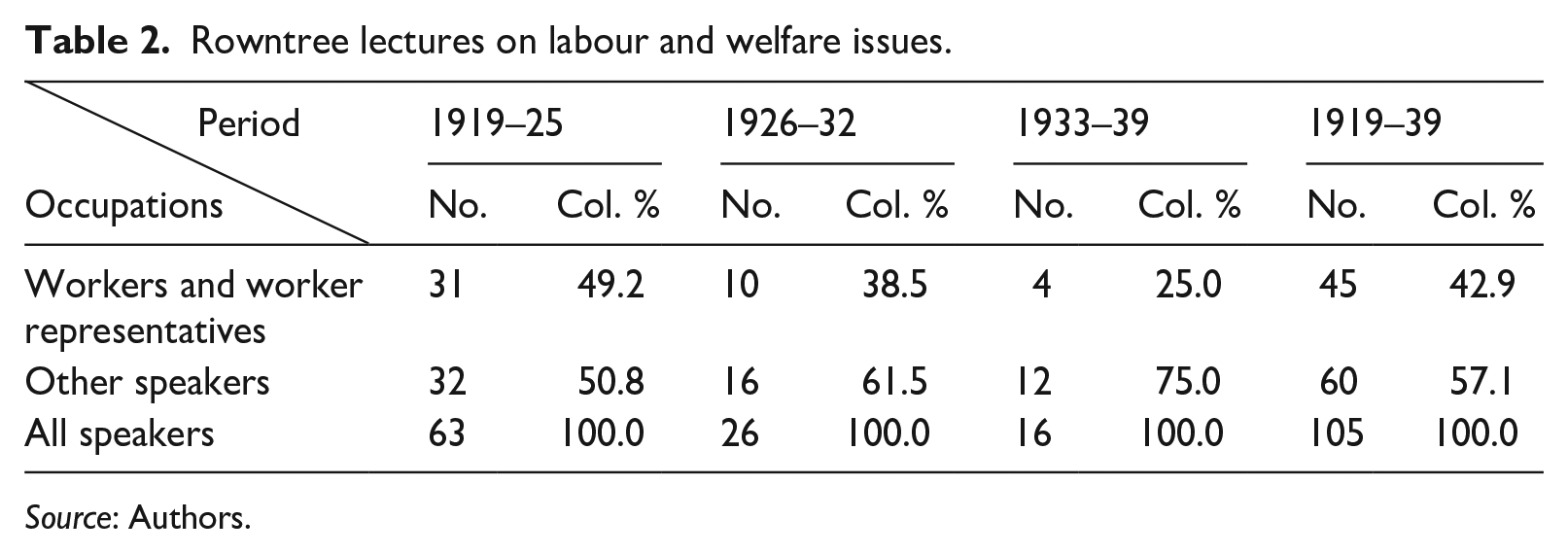
This gradual side-lining of worker concerns is confirmed by a second analysis of the 105 lectures delivered on labour and welfare issues. As Table 2 shows, in the first period, worker voices were very present in the conferences, but were more muted following the 1926 general strike. In the post-depression years, as the British economy was recovering, labour and welfare issues featured less prominently, being largely recast in the technocratic language of efficiency and personnel management in lectures delivered by industrialists and specialist managers.
Rowntree lectures on labour and welfare issues.
Source: Authors.
In what follows, after briefly introducing the conferences, we focus on each period in turn, illustrating how attitudes to welfare evolved, and what this meant for worker voice and participation. We have sought to enable the ‘voices of the field’ to tell their stories relatively freely, so the reader can, a century on, apprehend the lived experience of the worker representatives whose speeches we report (Czarniawska, 1998: 47).
Changing attitudes to welfare in the interwar years
The Rowntree conferences provided an opportunity for management and worker representatives to hear each other’s views. As Muspratt (1921: 7) stated, he had elected to attend because all organisational levels were included: ‘I only knew that industry was to be represented from every phase of its personnel’. Trade unionist Dallas (1923: 12) articulated the value of this mutual exchange of views: ‘We must get to understand each other. The employer must understand the view of the man in the shop, and the man in the shop must make a reasonable effort to understand the view of his employer’. Above all, from the workers’ perspective, the conferences enabled labour to amplify its ‘voice in determining its own conditions’ (Dallas, 1923: 14).
The speeches of worker representatives are redolent of a newfound self-assertiveness, coinciding with changing social relations and national wage-bargaining. Managers’ accounts, conversely, display a desire for corporate legitimacy, all the more necessary in a situation where growing plant size was altering the working lives of employees. There was thus a proselytising aspect to this endeavour, for both parties, recognising the value of persuasion to achieving consensus. As Muspratt elaborated: Conferences like the present one are of the most vital importance, if we can come to anything like agreement upon a few of these propositions, and then go out as missionaries to make others realise that they are members of a great community, which it is their duty to serve to the best of their ability. (Muspratt, 1921: 9)
We now turn to exploring worker participation and voice as reflected in the conferences, perceived through the lens of changing attitudes to welfare.
1919–1925: Prioritising welfare
It is often assumed that welfare programmes must have enjoyed the universal approval of employees, given their purported benefits. Interestingly, we found this was not guaranteed. While many saw welfare as ‘the cement of the industrial edifice’, not everyone was persuaded. As Reverend Hyde (1920: 19) of the Ministry of Munitions’ Welfare Department explained, it benefited employers to ‘heal a man up quickly . . . and then the process of getting profits out of him was continued’, welfare workers being regularly viewed with suspicion by employees as a ‘tame elephant’ or ‘government spy’. Mallon claimed some workers regarded welfare as an affliction imposed on them by employers instead of higher wages: At a conference of working women a delegate lamented having to endure ‘low wages and long hours and welfare’. The greatest of these evils, she seemed to think, was welfare! . . . Some of the Trade Union leaders do not agree that the employer is necessarily spending his own money on welfare. He may be spending money which should come to the worker in the form of higher wages. In such cases they say, ‘Give us the money, and let us obtain welfare for ourselves!’. (Mallon, 1925: 12)
It was higher wages, not welfare, Mallon argued, that workers needed. Trade unionist Stewart (1921: 26) agreed that ‘all the work that is done under the general name of Welfare helps to humanise industry, but it does not solve the fundamental problem of the worker’s life’.
Welfare work by employers extended to the treatment of boys. Since many employers had lost sons on the battlefield, they were keen to look after apprentices in the workplace: Many men whom I have visited have lost their own boys in the war, and realise that there is a big gap in the coming generation. They feel they must do something to give a better chance to somebody else’s boys, in their place of work. (Hyde, 1920: 16)
Describing this more caring attitude on the part of some employers, Hyde recounts how boys striking in sympathy with steelworkers requested a football from their employer to pass the time: The boys’ department decided to go out on strike sympathetically. They stayed out a day, and then, as they were feeling rather dull, they sent a deputation to the head of the firm – a man who three or four years ago had been unapproachable to the boys – and said to him, ‘It is very dull, being out here will you lend us a football, Sir?’. (Hyde, 1920: 17)
Yet employers did not always practice what they preached. When boys reached adulthood, they were regularly let go, having outlasted their usefulness. The sons of casual workers were becoming used to casualisation: The experience of all the persons who are dealing with the boys who come from families of casual workers is that the casualness inherent in the household’s mode of living has been to a great extent passed on to the lads. (Mallon, 1922: 16)
It did not help that nepotism was rife, with ‘many employers . . . carefully training their own sons, that they may later on help them to administer the industry’, as director L Massey highlighted in an Open Discussion (1921: 31). Hyde related the story of an apprentice who worked hard to become a draughtsman, only for the post to be allocated to a customer’s son: For two years, a boy tried to get into the drawing office. He studied to fit himself for it, and was admirably suited for the post he wished to fill. Yet, it was given to the son of a customer who possessed no special qualifications. Can we wonder that the boy was consumed by a sense of injustice, a rankling feeling against the world? (Hyde, 1920: 18)
For Mallon, welfare was not something for which workers should feel grateful, being intended to improve efficiency: Welfare is really part of an employer’s efficiency. He must not employ people except in seemly premises, and in conditions to which human beings are entitled. That is his duty, and it involves no special necessity for gratitude on the part of the worker. (Mallon, 1925: 12)
Underpinning managerial assertions to prioritise wellbeing was thus an unsentimental efficiency drive. Cullen (1920: 20) of the Industrial Welfare Society denied that welfare practitioners ‘were only trying to “gild the chains of labour” or to veneer or whitewash a state of things that is essentially unwholesome’. Nevertheless, he predicted that welfare would soon be harnessed more overtly in the service of industrial efficiency: ‘before long welfare work will be thoroughly organised. It will have a literature of its own, and be put on a scientific basis’ (Cullen, 1920: 20). Findings from the remainder of our study period appear to bear this out.
1926–1932: Resetting relations
From 1926, the optimism of the early post-war years that workers would have a say in the industries where they laboured was subsiding. The lectures continued to display employer interest in worker concerns, but this was diminishing as union threats receded. The 1926 general strike proved a watershed, described by Frank Hodges of the South Wales Miners’ Federation as an ‘industrial cataclysm’, changing the ‘conciliation machinery’ that had developed over time: There we had an industrial cataclysm, unprecedented in history, involving nearly all the industries of Great Britain, nearly all the workpeople, and nearly all the organisations of employers and workmen. It looked as if the best and oldest forms of conciliation machinery, that had stood the test in their particular industries, were swept aside in the great emotional wave which developed immediately before, and during the general strike. (Hodges, 1929: 22)
The failure of the 1926 general strike dealt ‘a deadly blow at the movement towards conciliation in industry’ (Hodges, 1929: 23). This enabled government to suggest that Britain was entering a new era, as Professor Jones of the Ministry of Labour clarified: The Ministry of Labour said in effect that we must get rid of the habit of regarding the present condition of industry as a problem bequeathed to us by the war and the abnormal conditions which war has created. We must regard it as a problem which belongs to a new era. (Jones, 1929: 5)
This new era, confirmed with the start of the Great Depression in 1929, implied a resetting of relations between employers and employees. Industrial welfare took a backseat as efficiency came to the fore. As foreman and Labour councillor Hackett (1929: 60) argued, the foreman’s job was ‘primarily to get efficiency out of his department . . . He must eliminate, at every stage of every process, whatever is calculated to lead to loss, or waste, or confusion, so that the maximum result may be got from the minimum of cost and effort’. Hackett (1929: 60) concluded that ‘waste of labour is just as wrong, and just as undesirable as the waste of steel, or the waste of cocoa, or any other commodity’. In other words, efficiency was rising up the agenda even for those inclined to be conciliatory.
Where wellbeing continued to feature in lectures was in ‘keeping the working force fit and vigorous’ (Lockhart, 1932: 24). What was called ‘industrial medicine’ implied that efficiency could be promoted by addressing ‘questions of nutrition, ventilation, fatigue, monotony, the prevention or treatment of specific hazards and the wide issues of industrial absenteeism’ (Lockhart, 1932: 24). Practically, this meant that welfare work was being subsumed into labour policies designed to manage human resources efficiently. EJ Fox summarises this transition: The term ‘welfare’, as applied to industrial conditions, is of modern origin, and is used with varying meanings. In its widest sense it comprises all matters affecting health, safety, comfort and general well-being of the workman . . . In the United States the term ‘personnel’ which is being adopted in preference to our word ‘welfare’ is defined as ‘the direction and co-ordination of the human relations of any organisation, with a view to getting the maximum necessary production with the minimum of effort and friction, and with proper regard for the genuine welfare of the workers. (Fox, 1930: 49)
Welfare work, Fox (1930: 50) concluded, could therefore, when viewed as personnel management, be used to maximise ‘productive capacity and efficiency’ in the workplace. Yet doing so risked stifling the souls of employees, Delisle Burns warned: A man sometimes feels – I am quoting the words of an actual worker – as if ‘his soul had no room to turn round’ . . . He has an uneasy sense of being in the grip of an unthinking ‘and unsympathetic’ automaton. The office which directs him may be at a considerable distance . . . and it may misunderstand his needs. He feels that he no longer counts as a human being. (Delisle Burns, 1930: 42)
Professor John Hilton, who served as apprentice and foreman in a Bolton cotton mill before joining Cambridge as professor of industrial relations, concurred: I have the odd belief that when we have sucked the last drop of juice out of the orange of efficiency, and brought everything to the ante-penultimate world of mechanical, electrical and chemical perfection – what will determine whether this mechanical civilisation of ours will endure, or will crash or moulder – will be just this, whether our economic order ministers to the honour and dignity of man. (Hilton, 1932: 24)
In short, sucking ‘the last drop of juice out of the orange of efficiency’, in Hilton’s words, risked dehumanising employees.
1933–1939: Repurposing welfare
As the union threat receded following defeat in the general strike, and with rising unemployment brought by the Great Depression softening union demands, the distance between workers and managers widened. As the interwar years progressed, fewer worker representatives were heard in the conferences. Caring for workers was couched increasingly in terms of managing human resources effectively. TG Rose compared personnel management to tending plants: In this country we do not lay enough stress on the immense importance of choosing, training, and looking after the employees of our businesses. It is as if we bought plants and set them out in our gardens, and then took little trouble to keep them tended . . . Only too often one finds no attempt whatever being made to keep the personnel of a business trained and efficient. The latest machines will be bought, but the staff upon whose daily work the success or failure of the place will depend are chosen with little care. (Rose, 1936: 86)
Managing employees as human resources was also a function of growing factory size and mechanisation. Mechanisation in British factories had reached such a pitch that one speaker alluded to ‘the fever of machine madness’, comparing it to Charlie Chaplin’s film, Modern Times (1936). The consequences for workers of the ‘machine age’ included ‘the menace of hopeless drudgery, creeping nearer every day . . . deadly to their self-respect’ (Hymans, 1936: 133). The ‘human factor in industry’ was increasingly something to be analysed and dissected, with psychological tests introduced for the ‘measurement of occupational fitness and . . . selection of new employees’ (Ling, 1936: 36). Such measures could reportedly discourage ‘resistance to new methods of work’, reducing sickness and absenteeism (Ling, 1936: 37). ‘Industrial hygiene’ promoting ‘health in industry’ (Collier, 1937: 83) was as likely to relate to ‘healthy competition’ as to worker wellbeing (Potter, 1936: 129).
Nevertheless, the emphasis on managing personnel effectively was accompanied by a growing fear of ‘making a god of the machine and taking little thought of the men and women engaged in industry’ (Potter, 1936: 120). He claimed (p. 120): Of what real value is it to a nation if its scientific achievements are greater than those of its neighbours, if its machines produce more and better goods with less labour, if its returns in hard cash are superabundant and its citizens are slaves of industry, fearing the loss of employment, haunted by anxiety as to the future, unable to develop the cultural side of life because industry, which should be the servant of man, has been . . . slowly strangling the youth and spiritual and cultural aspirations of mankind.
This haunting ‘anxiety as to the future’ was echoed by Isabel Sloan, included in the 1936 New Year’s Honours list for services to industrial conciliation, who warned of the dangers of being in thrall to automation in her poem ‘The Machine’. This speaks to the issues facing plant workers a century ago, while prefiguring as yet unspecified dangers in the future: I am the machine, the machine, the machine And what the future means to you or me I know not, no more do you . . . But this I do know, that if you use me for the degradation of other men, For the destruction of their bodies and souls For pride, ambition and greed I will turn on you. I will degrade you. I will destroy you. I am the machine, I can do no other. (Sloan, 1936: 147)
By 1938, FW Leggett, a specialist in industrial relations, could point to the loss of goodwill between workers and managers. By then, ‘a very large proportion of people [were] prejudiced against workers’ representatives’, with ‘optimum productivity’ the overriding objective in many firms (Leggett, 1938: 50, 59). Yet employers, he concluded, could not ‘run their businesses as philanthropic enterprises’ (p. 73). Jackson (1938: 81) confirmed that the old conception of welfare had been superseded by, and repurposed as, labour policies, considered the optimal means of extracting the maximum from employees: Every one of us has true welfare at heart . . . We are living in a wonderful age of mechanisation and have witnessed marvellous developments in industry. Within the last twenty years we have seen the machine grow in adaptability, increase in power and in efficiency . . . I do not think there is any doubt of the need for a personnel policy throughout industry . . . The time I think is now ripe for [industrialists] to broaden their outlook, if the fullest contribution from employees is to be obtained, and with it optimum productivity. (Jackson, 1938: 83–84)
The above extract reflects the distance travelled over the two interwar decades from welfare work to personnel management in the interests of optimising productivity.
Discussion and conclusion
It is often assumed that industrial sociology scarcely existed as a topic of study prior to the Second World War (Brown, 1992). Our first contribution is to show that it did, at least at grassroots level, in the form of what we characterise as ‘citizen sociology’, evidenced by the vibrant debates on social relations in work organisations taking place as part of the Rowntree business lectures. The conferences opened a channel of communication between workers and employers of which little is known. They tell us about the significant, sustained degree of interchange taking place between worker representatives and managers through unofficial channels, especially in the early post-war years, which substantially have been overlooked. Here, topics were debated in open forum so that workers and managers might become acquainted with each other’s viewpoints to address the problems facing British industry. The varied backgrounds of speakers elicited different viewpoints. Our study advances understanding of sociological enquiry of industry by extending its scope to the interwar period, elucidating the antecedents of the subject as it has evolved. We thereby contribute to the rekindling and strengthening of its collective memory as a discipline.
Kaufman (2020: 35) remarks that historical antecedents are often neglected; highlighting a ‘distressing penchant among modern scholars to ignore the contributions of our forebears’. Whereas personnel management is often assumed to have emerged in response to the Second World War (Baron et al., 1986), our findings reveal the subtle transformation of industrial welfare into labour management in Britain during the interwar years, as workers were increasingly viewed as resources to be managed effectively. We document this transition through our analysis of speakers and speeches at the conferences. We therefore challenge the received wisdom of the emergence of personnel management as a post-1945 phenomenon. This corroborates Thornthwaite’s (2012: 312) study of the Australian public sector in the 19th century, highlighting the ‘flawed chronology of developments’ that has emerged.
The British interwar management movement has not previously been explored from the perspective of employees, but only from management’s viewpoint (Child, 1969; Maclean et al., 2020a, 2022; Wilson and Thomson, 2006). Taylor et al. (2009) observe that academic interest in worker’s agency has declined as managers are viewed increasingly as the only actors that count. Thompson (1968: 12) claims that history tends to overlook ‘the agency of working people’, obscuring ‘the degree to which they contributed by conscious efforts, to the making of history’. Brown (1992: 19) likewise writes that the investigations of industrial sociologists have too often stopped ‘at the plant gate’.
Our second contribution is therefore to address that gap by focusing on the historical development of working lives at a particular time in history. By enabling workers and their representatives to tell their stories, we gain valuable insight into ‘the lived experiences of those who have laboured on the shop and office floors of British workplaces [and] of the union activists who have represented them’ (Danford, 2022: v). Accessing such lived experience is problematic. Going back in time to access first-hand accounts is harder still. Little is known about the day-to-day working lives of the early generations of British factory workers (Joyce, 1980). By reproducing the words of worker representatives verbatim, we enable their ‘lost voices’ to be recuperated, affording recognition to groups of individuals whose contribution to the advancement of employee interests in work organisations has been largely ignored. This enables us to give life and voice to otherwise ‘voiceless workers’ (Kaufman, 2020: 26), the ‘unhung, unbelaurelled, unapplauded heroes and heroines’, as Walton (1930: 60) describes them. The sentiment Walton expresses here reflects the motivation for our study. We show how articulate and sophisticated the argumentation employed by worker representatives was at the time. This contradicts the view of labour as ‘inarticulate’ propounded by some managers (Jackson, 1938: 82), used as a justification to represent employee interests on their behalf, ‘to become labour’s advocate, and state its case’ (Child, 1969: 82), preserving managerial prerogatives (Nyland et al., 2014).
The interwar years represented a time when industrial enterprises were evolving into large-scale concerns adopting mass production techniques (Braverman, 1974; Chandler, 1990). Accompanying this was a relentless process of mechanisation and rationalisation, gathering pace during our study period. Marx ([1967]2013) observes that mechanisation, propelled with irresistible force, has failed singularly to alleviate the burdens of labour. As employers’ attention to labour demands gave way to concern for technical efficiency, mechanisation exacerbated working conditions by inducing fatigue and monotony, such that, as Delisle Burns (1930: 42) observed, the ‘soul had no room to turn round’. Although intended to reduce human effort, mechanisation instigated boredom and deskilling among operatives, compounding unemployment by displacing workers.
The worker representatives we introduce here have important insights to offer that speak to the contested nature of work and the workplace in present times. Their concerns resonate with analogous concerns today, also a time of union resurgence, inflation, geo-political uncertainty and post-pandemic recovery. Struggles against job insecurity and casualisation persist (Gallie et al., 2017; Mustchin, 2012), revealing remarkable continuities with contemporary working life despite the passage of time. Jobs which replace multi-faceted skilled work are rarely of comparable quality. Mechanisation continues to displace workers, as exemplified by recent threats to close railway ticket offices. The haunting anxiety about the future highlighted by Potter (1936) resonates today with the alarm evoked by the spread of artificial intelligence (AI), the computer simulation of human intelligence processes, sparking strikes by actors, fearful it will appropriate their faces, bodies and voices, and do them out of jobs. AI threatens, some say, to imperil humanity itself if left unchecked (Stacey, 2023). In this context, Isabel Sloan’s poem, ‘The Machine’, appears ominous and prophetic.
Our third, most theoretically significant contribution is thus to lay bare, as mechanisation proceeded apace and managers prioritised efficiency over wellbeing, how worker demands were contained and neutralised over the interwar period as the union threat receded (Donaghey et al., 2011). We show that this was achieved not by disregarding worker representatives, but paradoxically by engaging with them directly and inviting them into the conferences. Here, in joint fora, concern for worker wellbeing was gradually recalibrated and repurposed into nominally shared concerns for healthy profits, in which worker and employer interests were presumed to be congruent. Through the speeches recorded at the conferences and reproduced in our online repository, we trace this transition playing out progressively in quasi-real time, albeit retrospectively. This allows us to show the evolution of concerns, their ebb and flow, as circumstances changed – demonstrating how managers over time became less interested in ‘good works’ and more interested in ‘good work’ or efficiency (Child, 1969). Contrary to extant research (Child et al., 1973; Wilson and Thomson, 2006), we have been able to document and demonstrate this evolution through the course of the lectures, and unusually, to do so expressed in participants’ own words.
Earlier we asked: how does this recently recovered material enhance our understanding of worker voice in the interwar years, as conveyed in their first-hand accounts, and to what extent were they being listened to by employers? In answer, we suggest that the conferences afforded managers a ‘degree of voice legitimacy’ (Wilkinson et al., 2020: 8), by inviting worker representatives into the lectures to hear their demands. Although dissenting voices were tolerated, recruiting union leaders as speakers enabled channels of voice to be heard in circumstances that were contained and non-threatening to managers (Willman et al., 2020), smoothing over the ‘structured antagonism’ of confrontation (Edwards, 1986). Addressing worker concerns through the lens of welfare kept discussions on relatively safe territory for managers. Rowntree himself was virulently anti-unionist (Briggs, 1961). Ultimately managers wanted to safeguard their right to manage, perceived to be under threat from encroaching state regulation (Nyland et al., 2014). Early notions of employee participation gradually gave way to consultation or communication (Donaghey et al., 2011). Pay was kept largely off the agenda, since social wellbeing was deemed to matter more (Mayo, 1930; Weatherburn, 2020). As Howard Collier remarked in 1938, ‘men strike for higher wages, when they really “need” better human relations’ (Child, 1969: 97).
With respect to whether employers listened to worker voices, we delineate here three temporal brackets which follow a discernible trajectory. Initially, employers were eager to hear worker voices, to concede enough to preserve the status quo (1919–1925). As the union threat receded, employer interest in hearing worker demands diminished, with fewer worker representatives presenting at conferences (1926–1932). Finally, communication became unidirectional from employers to workers, their voices muted in consequence, reconceived as human resources to be managed (1933–1939). Our study raises the interesting question as to whether such events could be held today, and if so, under what circumstances. We invite scholars to use our online data repository to pursue this and related interests of their own.
Footnotes
Acknowledgements
The authors would like to thank Editor Professor Jimmy Donaghey for his expert guidance and support, and the three anonymous Work, Employment and Society referees for their insightful and encouraging comments throughout the review process. We received valuable feedback on earlier versions of this article from the Human Relations conference in London in April 2023, the University of York School for Business and Society in November 2023, and the 2023 British Academy of Management (BAM) annual conference at the University of Sussex, where it won Best Full Paper in the Management and Business History division. We are grateful to the Economic and Social Research Council for funding our research (Grant Ref. ES/N009797/1).
Funding
The authors disclosed receipt of the following financial support for the research, authorship, and/or publication of this article: This work was supported by the Economic and Social Research Council [grant number ES/N009797/1].
