



Abstract
To what extent should business have an implication of service when its fundamental purpose is profit-seeking? We explore this issue through a contextually informed reappraisal of British interwar management thinking (1918–1939), drawing on rich archival material concerning the Rowntree business lectures and management research groups. Whereas existing literature is framed around scientific management versus human relations schools, we find a third pronounced, related theme: business as service. Our main contribution is to identify the origins in Britain of the discourse of corporate social responsibility in the guise of business as service. We show that this emerged earlier than commonly assumed and was imbued with an instrumental intent from its inception as a form of management control. This was a discourse emanating not from management theorists but from management practitioners, striving to put the corporate system on a sustainable footing while safeguarding the power, authority, and legitimacy of incumbent managerial elites.
Keywords
Introduction
The contribution of the interwar years (1918–1939) has been relatively neglected in the story of the changing nature of work. Yet this was a time when organizations were growing in complexity, management ideas were taking shape, and work relations were undergoing change (Bendix, 1956; Wren, 1985). Drawing on recently recovered archival material, this article reassesses the British interwar management movement. It focuses on the lecture conferences and management research groups (MRGs) introduced by social reformer and Quaker industrialist Benjamin Seebohm Rowntree, which are under-researched and overlooked. Our aim is to investigate the notion of ‘business as service’ that permeated the movement, in which the beginnings of thinking about responsible business can be discerned (Bowen, 2013[1953]). This acknowledged the need to attend to industrial democracy as a route to industrial peace, deemed essential to successful post-war reconstruction (Rowntree, 1921). To this end, our study is informed by a guiding research question: What can this previously unstudied material tell us about the authenticity of ‘business as service’? In other words, how deeply rooted was it within the interwar management movement?
The timeliness of the present study is underscored by a number of recent articles that cast interwar management in a new light (Bruce and Nyland, 2011; Hassard, 2012; Maclean et al., 2020; Muldoon et al., 2020; Nyland et al., 2014; Weatherburn, 2020). Collectively, these studies express a keen interest in the ‘human element in production’ that managers had patently neglected before the war (McIvor, 1987: 724), recognizing workers’ legitimate desire for improved conditions and status (Rowntree, 1921). Many of the ideas explored by interwar managers prefigure the human relations movement, a key milestone for which was the establishment of the present journal in 1947. Landmark articles published in the early volumes of Human Relations on organizational democracy, employee resistance, intergroup relations, and the need for cooperation, mirror preoccupations that permeated discussions in the lectures and MRGs (Festinger, 1947; Jaques, 1950; Lewin, 1947a; 1947b; Merei, 1949; Rice et al., 1950). Classic articles published in the journal over the years have advanced understanding of these issues, which remain central to its purview today (Bartell, 1976; Heller, 1998; Kelly, 1978; Mohr, 1977).
We contribute here to this evolving historiography. Whereas extant literature is framed around scientific management versus human relations schools (Bruce and Nyland, 2011; Hassard, 2012; Weatherburn, 2020), both of which loom large in our data, we also find represented there a third pronounced and related theme: business as service. British interwar management thinking was a triple helix, not a double helix. Our study is based on a wealth of new data that lend fresh perspectives, embracing the reflections of management practitioners in their own words. Unlike existing research, which focuses on the discourse of management theorists (Bruce, 2006; Muldoon et al., 2020; Nyland et al., 2014; Smith, 1998), we emphasize the discourse and actions of management practitioners. Our main contribution is to identify the origins in Britain of the discourse of corporate social responsibility in the guise of business as service. We show that this emerged decades earlier than commonly assumed (Bowen, 2013[1953]), and that it was imbued with an instrumental intent from its inception as a form of management control. This was a discourse emanating not from management theorists but from practising managers in the face of an existential threat, who were striving to put the corporate system on a fresh, sustainable track, recognizing the interests of diverse stakeholders while maintaining the power, authority and legitimacy of owners and senior managers. The seemingly altruistic foundation of social responsibility continues to obscure corporate motives behind a language of shared interest today (Desmond and Wilson, 2019; Rhodes and Pullen, 2018).
Our article unfolds as follows. The next section explores the historical context in which the concepts of interwar British management thought took shape, focusing on the development of scientific management and human relations alongside a new emphasis on business as public service. The following section is methodological, elaborating our research process, historical sources, and archival analysis. In our empirical section, we draw on rich archival material to explore preoccupations with efficiency, human relations, and ‘business as service’ that pervaded debates within the management movement, showing how these three strands were mutually constitutive. Finally, we discuss our findings, consider their implications for theory, and assess the limitations of our study together with possibilities for further research.
The British interwar management movement
Interwar management in context
Hassard (2012: 1454) writes that greater attention needs to be accorded to contextual issues in organizational research. Lippmann and Aldrich (2014: 137) argue that attention to historical-contextual factors allows theorization about ‘the interaction of organizations, on the one hand, and their complex, contingent, and often unique environments on the other’. For Tennent (2021), the strength of historical research lies in its contextual embeddedness. We subscribe to this view, considering in what follows the British interwar management movement set in the context in which the history was unfolding (Nyland et al., 2014).
The interwar period was a time of rapidly changing social relations between managers and workers. As businesses expanded and ownership became more distanced from familial control (Berle and Means, 1932), the era when ‘owners managed and managers owned’ gave way to a new demand for middle managers to orchestrate activities (Chandler, 1977: 9 cited in Wren, 1985: 314). Class consciousness continued to exert considerable sway (Wren, 1985). As McIvor (1987: 725) remarks, ‘industrialists had a vested interest in perpetuating the master and servant relationship and retained a commitment to a socially determined and loosely defined wage ceiling over which it was improper for a workman to aspire’.
The socio-historical context of the aftermath of World War I proved challenging, with economic difficulties swiftly arising (Marwick, 1965). Soldiers returned disillusioned after the war; the ‘fit country for heroes’ heralded by Prime Minister Lloyd George failing to materialize (Weatherburn, 2020). Initial post-war optimism proved fleeting. An economic downturn in April 1920 was followed by a slump in 1921, as demand for British goods declined (Tibbals, 2019). Mass unemployment and labour unrest ensued (Rowlinson and Hassard, 1993). Employment became more precarious, the fear of unemployment comprising ‘possibly the darkest cloud hanging over the heads of workers’, prompting calls for capitalism to be jettisoned (Rowntree, 1921: 182). The conjuncture, intensified by the 1926 General Strike and the Great Depression of 1929–1933, when wages and prices fell and unemployment reached 2.5 million, was one of lost confidence together with a sense of being left behind as other countries, particularly the US, recovered strongly (Broadberry, 2005; Marens, 2012).
The British interwar management movement thus originated in crisis avoidance, to which it represented in part a response. Efforts to rebuild following the war were accompanied by a concomitant philosophical reconstruction (O’Connor, 1999). In this context, Quaker employers led by Edward Cadbury and Seebohm Rowntree showed the way with three management innovations. First, they convened a conference of Quaker employers (the Cadbury conferences) to debate the post-war socio-industrial order (Burton and Turnbull, 2019; Rowlinson, 1998; Tibbals, 2019). Seebohm Rowntree (1871–1954), who had served in wartime as Director of Welfare at the Ministry of Munitions, then arranged a separate series of meetings – the Rowntree lectures – to enable employers and employees from varying levels of the organizational hierarchy, including works directors, managers, supervisors, forewomen and foremen, to explore challenges confronting industry. Finally, Rowntree returned from a visit to the US in 1921 with the idea for industrialists to meet to consider solutions to the problems before them. This initiative engendered the MRG movement in 1926–1927, when Rowntree and Lyndall Urwick, then a Rowntree employee, convened MRG 1, a group of large employers that met regularly in London.
If the original purpose of the Rowntree business lectures was crisis avoidance, Rowntree soon identified a longer-term purpose: to modernize British management thinking and practice (Wilson, 2011). The emphasis lay in finding practical solutions to employer-identified concerns to enhance the problem-solving capacities of non-competing firms, whose confidentiality was assured. The impetus for these endeavours is summarized by Rowntree in the Cocoa Works Magazine in 1923: We must acquaint ourselves as fully as possible with all the up-to-date methods of manufacture that are employed elsewhere. To act on the assumption that what was good enough for the last generation is good enough for this would be fatal. (Briggs, 1961: 185)
Rowntree’s often prominent speakers included progressive employer Henry Dennison, organizational theorist Mary Parker Follett, and industrial researcher Elton Mayo. Given Rowntree’s background as a social reformer, sociologists, psychologists, and economists were invited to present. Speakers included industrialists, economists, foremen, forewomen, historians, management theorists, politicians, social psychologists, supervisors, union leaders, artists, and musicians. Industrial ‘stars’ of the 1920s were invited to share their knowledge. Unusually, from the outset, dissenting voices were admitted, including unionists and political activists. As Briggs (1961: 161) remarks: ‘It was and remains rare in industrial experience for businessmen to invite their critics to talk to their workers.’ Lecturers included representatives of ‘the labour view’, such as Labour politician and union leader Ernest Bevin. The core, however, came from within Rowntree’s itself, with its mission to re-fashion British management in a more humanistic style. In addition to Rowntree, this group included labour manager Clarence Northcott, William Wallace, Oliver Sheldon, Lyndall Urwick, and James Wardropper (Weatherburn, 2020), several of whom became management authors (Sheldon, 1923a; Urwick, 1956; Urwick and Brech, 2002). There is thus a consistent thread of ‘the Rowntree way’ permeating the lecture series.
While the Cadbury conferences have been investigated by organizational researchers (Rowlinson, 1998; Tibbals, 2019), little is known about the Rowntree lecture series. This commenced in April 1919 and was so successful that it was recalled four times later in the year, three times in 1920, 1921 and 1922, and became established as a biannual event between the wars (with gaps only in 1931–1932 and 1939). The MRGs are as poorly researched as the Rowntree lecture series, with some work having been undertaken on structure (Brech et al., 2010; Wilson and Thomson, 2006; Tiratsoo and Tomlinson, 1993), but little on content. This article addresses this lacuna.
Management thinking in the interwar years
The welfarism for which Quaker employers Rowntree and Cadbury were renowned alongside lesser-known Quaker firms did not obstruct the circulation of Taylorist ideas in interwar Britain (Kipping, 1997). Taylor himself was from a Quaker family (Schipper, 2008). As Rowlinson (1988) notes, the extent to which scientific management, the ‘systematic application of science to production’ (Braverman, 1974: 59), was incorporated into Cadbury’s Bournville factory has been overlooked. Welfarism was selective, with supervisory and skilled male workers benefiting most (McIvor, 1987). It was soon seen as ‘inferior’ to scientific management as the latter gained ground, the Great Depression highlighting the need to lower production costs (Child, 1969). The literature on management consultancy shows that classic Taylorism was available to and adopted by many interwar British firms (Kipping and Engwall, 2003; McKenna, 2006). This was the time of the ‘cult of the expert’ or ‘efficiency engineers’ (Kipping, 1997: 68).
Rowntree himself embodied the contradictions of the day (Quail, 2000), for although he found classic Taylorism dehumanizing, he avidly embraced the pursuit of efficiency, recognizing that work study was needed to limit waste and operator fatigue. The experience of war had shone a light on long working hours (McIvor, 1987). Rowntree’s, like Cadbury’s, introduced scientific management procedures alongside a wide-ranging welfare programme, with Rowntree advocating that welfare should be a ‘paying proposition’ (Briggs, 1961: 122). Under his direction, the Cocoa Works at York became a major site of research into work measurement, examining ‘the detailed timing, measurement, and costing of production processes, and the distillation of different kinds of manual work into common denominator units’ (Weatherburn, 2020: 904). To be deemed ‘scientific’ at this time was ‘the social gold standard’ (Dent and Bozeman, 2014: 155). Taylorism, however, may be ripe for reappraisal. As Nyland et al. (2014: 1149–1150) observe, scientific management ‘expanded workers’ contact with science, broadened their interconnectedness, and in a great many cases enhanced their wellbeing’. Today, notions of efficient management introduced by Taylor (1911) so infiltrate the fabric of modern life that we are oblivious to its constant presence and intrusion.
If scientific management has been perceived negatively in this story (Braverman, 1974), the ‘human relations’ approach, which prioritized the ‘social person and his/her centrality in the workplace’, has been received much more positively (Bruce, 2006: 177; Bruce and Nyland, 2011). Mayo and Dennison, both proponents of human relations thought, were friends of Rowntree. The human relations school of thought has become inextricably linked to Mayo’s research at Western Electric (1924–1932), the Hawthorne Studies, believed to signal a paradigm shift from task-oriented scientific management to a more humanistic style of capitalism (Bruce, 2006; Bruce and Nyland, 2011; Muldoon et al., 2020). The Hawthorne Studies are widely hailed as the founding site for the human relations movement, informing the emergence of the Tavistock Institute for Human Relations in 1947 (Bartell, 1976; Weatherburn, 2020). However, they have attracted sustained critique (Bruce, 2006; Muldoon et al., 2020; Smith, 1998). In particular, commentators observe that the human relations school actually predated Mayo’s work at Western Electric (Bruce and Nyland, 2011; Wren, 1985), such that Mayo ‘did not so much turn the sociological tide at Hawthorne as swim briskly with it’ (Hassard, 2012: 1447). For Weatherburn (2020: 899), the so-called ‘pioneering’ workplace studies at Western Electric represent an ‘invented tradition’, since they were not in fact unique but mirrored by similar research conducted from 1929 at the Rowntree Cocoa Works. The National Institute of Industrial Psychology (NIIP), of which Rowntree was a founder member, was established in 1921. Although its initial interests lay in scientific management, it swiftly realigned with a human relations agenda under the influence of employers like Rowntree (Kipping, 1997).
The promise of industrial peace which the human relations approach seemed to offer was an attractive proposition for employers, who ‘resented any attempt on the part of the workers to determine, in any measure, the conditions of their working life’ (Ashton, 1924: 226, cited in Rowlinson and Hassard, 1993: 318). Paternalistic benevolence rested on the conviction that employers understood what was best for their workers (Edwards, 2010). It was comforting to employers that the Hawthorne Studies emphasized social incentives above financial gain (Bruce, 2006), turning a blind eye to the importance of pay (Jaques, 1950; Kelly, 1978). The conscious misrecognition of the importance of pay is not unusual: in 2021, National Health Service employees in Britain were awarded the George Cross for service seemingly in preference to an improved pay offer. Adopting a human relations approach, however, might offer a strong defence against union demands for a more meaningful role in organizational decision-making (Bruce and Nyland, 2011), ensuring that the goals of individual workers were consistent with those of the organization (Dennison, 1972[1931]).
Braverman (1974: 60) dismissed human relations proponents as ‘the maintenance crew for the human machinery’. While his views may seem outdated, his critique highlights important truths. Namely, that human relations and scientific management were less dissimilar than initially presented by the notion of a ‘paradigm shift’, and that attention to psychosocial needs and workplace relations could be used to enhance control of work and drive productivity (Brown, 1992). Mayo (1933) notably advocated ‘administrative elites trained in techniques of social organization and control’ (Smith, 1998: 237). As Child (1969: 58) explains, ‘the new emphasis on securing industrial cooperation via the influence of personal leadership was to some extent a compensation for the rejection of industrial democracy as a means to this co-operation’. With worker militancy on the rise and socialism gaining ground (Marwick, 1965), the human relations approach held out the promise that the conditions from which employers had benefited over many years might endure.
Business as service
To the ‘progressive’ humanistic approaches to work relations explored above, the idea of ‘business as service’ brought a fresh tenor, one that offered a new means of harnessing worker cooperation through a direct appeal to individual workers rather than the unions (Bendix, 1956: 287). It rested on the premise that both employers and employees were ‘best considered as servants of the community’ (Rowntree, cited in Briggs, 1961: 334) who should prioritize the collective interest over self-interest. In this sense, it promised a skilful yet potent means of addressing worker unrest by building on notions of communality and service emerging from wartime experience (Lauck, 1926).
Notions of social responsibility of business are commonly assumed to have developed in the 1950s, at least as a topic of academic research (Banerjee, 2008; Marens, 2008). Bowen’s (2013[1953]) landmark study is generally held to have initiated scholarly discussions of responsible business, recognized as a seminal work of ‘historical and current significance’ (Acquier et al., 2011: 607). It contributed to the building of fresh understanding of business as attuned to human values and ethical concerns. As Drucker (2007[1955]) argues, managers should take responsibility for public good rather than assume that self-interest will automatically lead to it. What was hailed as a novel attitude of US business towards its civic responsibilities signalled a new recognition of its duty to ‘the society it serves’ not merely to maximize economic performance but to balance this with attention to social wellbeing (Heald, 1957: 375). Such policies might allay worker unrest by countering demands for democracy through increased attentiveness to ethics. The philosophical reconstruction pursued by Wallace Donham, Dean of Harvard Business School (1919–1942), entailed a reassessment of socio-economic and political priorities in which the beginnings of corporate accountability may be discerned (O’Connor, 1999). Berle and Means (1932) promoted a public-service ethos in their own study, informed by their experience of national military service (Smith et al., 2018).
The historical roots of responsible business, however, run deeper than this (Acquier et al., 2011; Husted, 2015), and social responsibilities are highly dependent on context (Hannah, 2007). Prior studies have explored responsible business emerging as an academic subject in the US (Hoffman, 2007; Marens, 2008, 2012, 2013). Our study reveals notions of responsible business to be circulating amongst managers participating in the British interwar management movement as early as 1919. In this way, ‘business as service’ emerges as an antecedent to corporate social responsibility as it has evolved. This concurs with Marens’ (2013: 456) observation that the drive for responsible business was initially led by practitioners, not academics, keen to dispel suspicion by voluntarily assuming social responsibilities. As businesses grew, and greater authority was ceded to middle managers, ‘business as service’ might afford a compelling, ostensibly inclusive ideological message in a situation where a ‘new managerial ideology was needed to control and direct the activities of workers’ (Bartell, 1976: 744). In turning to account the shared understanding of disinterested national service emerging from the war (Bendix, 1956), ‘business as service’ held out the promise that profit could be allied to social good. The municipal capitalism explored by Turner and Tennent (2021) draws on this ideal. This was a potentially efficacious means of motivating employees by targeting their hearts and minds (Jocoy, 2003), offering a cost-effective alternative to wage incentives to boost productivity (Jaques, 1950; Kelly, 1978). With socialism in the ascendant, it might quell growing demands for greater regulation of industry, addressing the threat that, if industry did not self-regulate, ‘the community will ultimately make the attempt to take it over in order to operate it in its own interest’ (Gantt, 1919, cited in Hoffman, 2007: 66). Just as today calls have grown more strident to regulate or break up ‘big tech’, whose billionaire owners have grown richer and more powerful while displaying largesse through philanthropic giving, the demonstration of social responsiveness might deflect if not suppress demands for greater regulation (Giacomin and Jones, 2021). In this way, organizational elites might employ social responsibility as a ‘device for retaining power and as a justification for that power’ (Bowen, 2013[1953]: 118).
Social responsibility today is publicly endorsed by a majority of large organizations. Critical commentators argue that it has reset the relationship between business and society in ways that prioritize narrow corporate interests over those of other stakeholders, for whom there may be negative consequences (Banerjee, 2008; Matten et al., 2003). It has done so by boosting financial returns (Brammer and Millington, 2008; Waddock and Graves, 1997), strengthening management control (Costas and Kärreman, 2013), and equating capitalism with democracy (Banerjee, 2008). In emerging markets companies have been frequent ‘saboteurs of democracy’ (Friedman and Jones, 2011: 1), where ‘zones of authority can be manipulated form above and the resultant despotism then termed “democracy”’ (Mohr, 1977: 939). Importantly, the legitimacy on which social responsibility rests is discursively produced through language. Language matters to managerial elites because it is through ‘the strategic use of persuasive language, or rhetoric’ that they author rules which have societal impact (Rhodes and Pullen 2018; Suddaby and Greenwood, 2005: 35). Language is therefore a means whereby power is practised, sustained, and reinforced (Brown, 1998; Learmonth and Morrell, 2019). This is relevant to our study, in which speakers through public appearances and the dissemination of lectures sought to build value commitments to particular agendas.
Research process
In this study, we prioritize the importance of historical-contextual factors to our analysis, investigating the interwar management movement within its contingent, crisis-ridden environment (Lippmann and Aldrich, 2014). In doing so, we follow Vaara and Lamberg (2016: 634) in attending to historical embeddedness, ‘the ways in which strategic processes and practices and our conceptions of them are embedded in and defined by sociohistorical environments’. History is therefore not an ‘add on’ but inseparable from our research in the manner of ‘dual integrity’, which emphasizes the importance of both conceptual rigour and historical veracity (Maclean et al., 2016, 2017, 2021a).
A key feature of contextually informed historical research is the gathering of primary data from documents and oral histories that might cast fresh light on the power-laden processes implicated in changing societal and organizational realities (Popp and Fellman, 2020). As Cooke (1999: 83) asserts, ‘Historiographical processes, the way history comes to be written, the choices made in selecting and ignoring past events, are shaped by prevailing, albeit competing, societal power relations and their associated ideologies.’ Returning to primary archival documents allows for the possibility of their reappraisal in accordance with changing societal relations and ideologies. We sought to approach the materials informing our study reflexively, alert to the underlying power relations that generated these documents in the first place (Tennent, 2021). This approach fosters an awareness of our own role in history and, by implication, our involvement in generating particular historical narratives (Decker et al., 2021; Tennent et al., 2020). Our aim has been to take this attitude of historical reflexivity into our research on the British interwar management movement and the changing social organization of work.
The Rowntree lectures
Venues for the Rowntree lectures included Scarborough, York, Blackpool, and Oxford, before becoming established in 1922 as a regular fixture at Balliol College, Oxford. Some later conferences took place at Lady Margaret Hall and Holywell Manor, Oxford. Beginning in April 1919, the conferences brought together public policy debates alongside practical demonstrations of management approaches. The lecture series consists of about 280 articles given by approximately 200 speakers, with around 450 firms sending delegates. All lectures post April 1920 include details of companies attending (ranging from 33 firms to over 70 when times were testing). On average, six delegates attended from each firm. Their objective was to educate participating managers, foremen and forewomen about novel organizational practices and methods.
Management Research Groups
The template for the MRGs was Dennison’s Manufacturers’ Research Association established in 1922 in Boston, whereby executives from non-competing firms explored common issues with confidentiality guaranteed. The MRGs were instigated in 1926–1927, when Seebohm Rowntree, C. F. Merriam of British Xylonite and Eric Geddes of Dunlop Rubber, aided by Urwick, brought Dennison’s idea to Britain. The upshot was the large-firm London-based MRG 1 (1927–1938), encompassing large manufacturing enterprises. Dennison’s lecture in 1926 prompted other firms to jump on the bandwagon, engendering a second MRG for enterprises with 500–2000 employees (MRG 2, 1927–1938). This was followed in 1927 by a third MRG for firms with fewer than 500 employees (MRG 3, 1927–1938). A fourth group (MRG 4, 1927–1938) of small companies was formed later that year. The precise membership of groups fluctuated, with some groups closing down in one place and relocating elsewhere. Some members resigned, due to lack of management time, mergers, or bankruptcy, while others joined. Membership typically lasted four years and nine months, with 14 enterprises remaining members for the duration. As the interwar years ended, the MRGs consisted of 119 firms belonging to eight sub-sections in a range of cities. An estimated 99 firms attended MRG meetings each year throughout our study period. It is worth noting that the MRGs prospered at the height of the Great Depression (1929–1933), when there was a clear need for their activities, with membership reaching 121 companies in 1931.
Data sources
One of the aspirations informing our study is the desire to bring this material to wider attention by making it available to a new audience. This has entailed reassembling a ‘hidden history’ of interwar actors, events and management initiatives that a ‘thick crust of narrative interpretations’ has served to obscure (Rowlinson and Hassard, 1993: 302). Extensive archival searches carried out in London, York, Warwick and elsewhere over three years (2016–2019) led to the collection of copies of surviving material, often in a rather fragile state, from the Rowntree lectures and MRG gatherings. The assembled documents have been digitized and included in an interactive online data repository produced by the research team (see http://rowntree.exeter.ac.uk/ and https://reshare.ukdataservice.ac.uk/854891/). A large number of archives were consulted, namely the Alfred Gillett Trust; Bodleian Library, University of Oxford; Borthwick Institute for Archives, University of York; Bristol Archives; British Library; London Metropolitan Archives; London School of Economics (LSE) Special Collections; Modern Record Office, University of Warwick; National Archives; Nottinghamshire Archives; Suffolk Records Office; Unilever Art, Archives and Record Management; University of Reading Special Collections; and Walgreens Boots Alliance Heritage. Further visits were made to the archives of member firms where these exist, including British Xylonite, Clarks, Dunlop, Imperial Tobacco, Lyons, and Rowntree’s, to gauge the benefit they derived from their association with the movement. We also found novel archival material at the LSE, nine audio tapes comprising 18 hours of oral history interviews with Harry Ward, Secretary of MRG 1 and chief executive of the MRG national organization from 1935 (Wilson and Thomson, 2006), recorded in 1979, which we digitized and transcribed. Documents were photographed to prevent harming the original versions, after which we utilized optical character recognition (OCR) software to produce word files for inclusion in our data repository. The repository comprises copies of all Rowntree lectures identified, including MRG annual reports, annual general meetings, and bulletins (1927–1937), with examples of activities such as site and office visits and sub-committee discussions, and some accounts of debates accompanying directors’ dinners. Our aim has been to provide a freely available public-facing website housing the lectures, speaker biopics, MRG bulletins and annual reports, and accounts of directors’ dinners. Bringing this aspiration to fruition has proved challenging. Producing text files of the material we photographed involved considerable proofreading, while the expense and practical problems encountered in fashioning an online data repository were not negligible. In addressing these, external funding proved indispensable.
Data analysis
Our initial reading of the source material was informed by extant literature, as explored in our literature review. As we iterated between our data and the literature, we nevertheless sought to appraise the material on its own terms to discern more accurately the leading currents in interwar British managerial thought. As we became more familiar with the body of texts, we were drawn to signs of shared values that might point to an emergent climate of ideas in which management practitioners were becoming immersed (Bendix, 1956). Elements of this climate of ideas that appeared salient included, first, a concern for efficiency, upon which post-war recovery appeared to rest: ‘Efficiency is a duty. It is the duty of everybody to do the best he can’ (Jones, 1927: 9). Accompanying this was a preoccupation with waste, arguably presaging contemporary concerns with sustainability, for which all were deemed accountable: ‘upon us who are concerned in the management of industry, who, whether we are directors or foremen . . . rests the main responsibility for the elimination of waste’ (Sheldon, 1923b: 10). A second component spoke of concern for the human factor in management, the idea that treating workers as human beings and attending to their psychosocial needs might bring industrial peace, targeting worker ‘dissatisfaction and a sense of unfairness among the rank and file’ (Northcutt, 1923: 16). A third dimension emerging from the material was a sense of hope that managers and workers might unite in the shared endeavour of industry as service, thereby ‘changing the organisation of the machine, so as to develop and increase, perhaps even to create, its social purpose’ (Wrong, 1920: 2). Coming together in this way might allow worker views to be better aired, addressing worker discontent, and contributing to ‘mutual understanding’ (Wrong, 1919a: 9). In this way, ‘business as service’ emerged from our data as a phrase neatly encapsulating ideas then current that the ultimate purpose of business lay in serving the public.
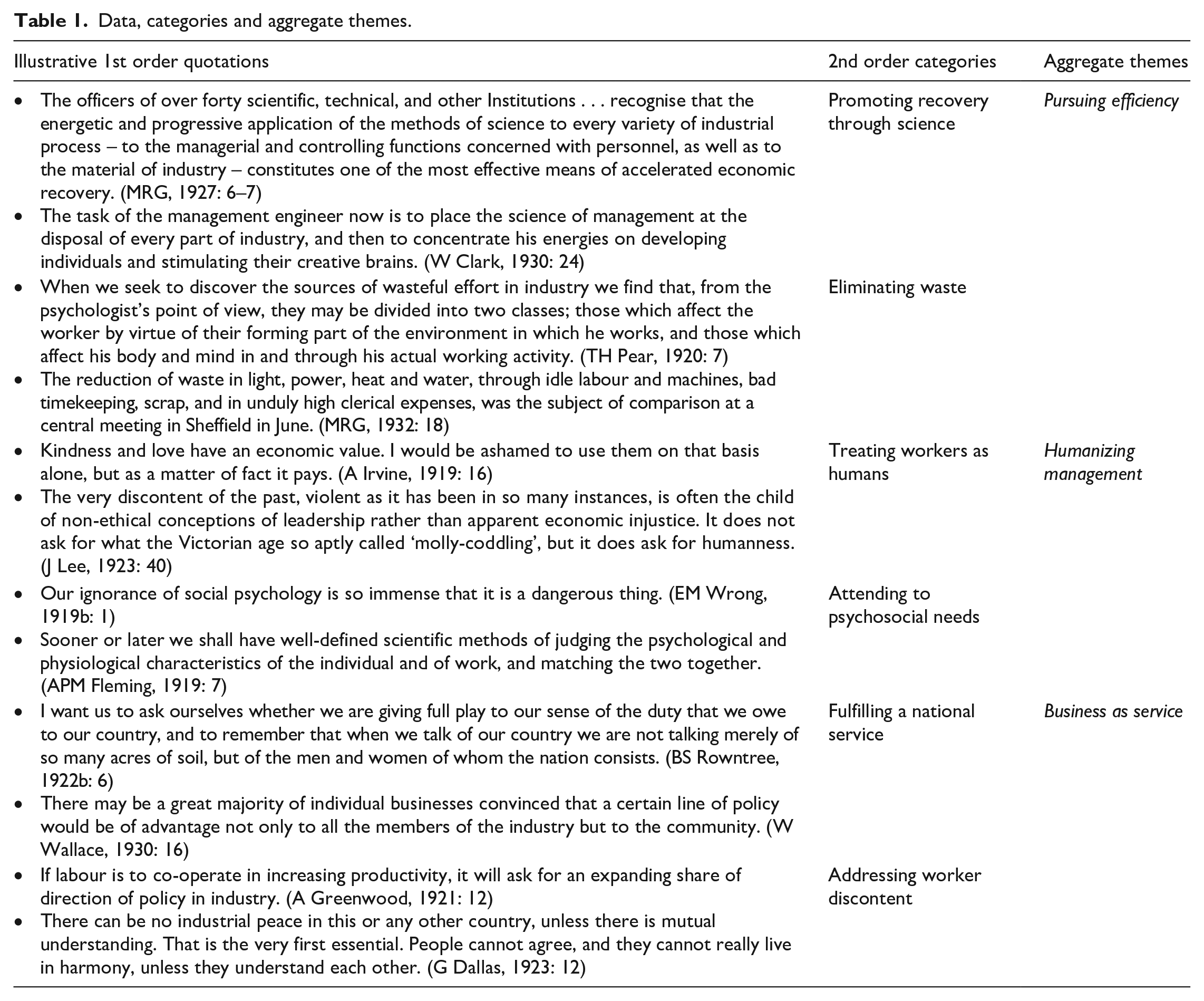
Initial themes were identified by re-reading the body of texts. Two research team members coded the material separately, with differences settled through deliberation to ensure reliability. When coding began, we gradually fine-tuned our ideas and categories, distilling first-order text segments down to six second-order concepts. These included: promoting recovery through science; eliminating waste; treating workers as humans; attending to psychosocial needs; fulfilling a national service; and addressing worker discontent. After further deliberation, these second-order concepts gave rise to three aggregate themes (Miles and Huberman, 1994), namely: pursuing efficiency, humanizing management, and business as service. Following this process, we grouped together analogous categories to produce a manageable conceptual framework (Gioia et al., 2013), as presented in Table 1.
Data, categories and aggregate themes.
The British interwar management movement revisited
Pursuing efficiency
The management movement’s stated mission was: ‘To promote the study, development and practical application through Great Britain of the science of business management’ (MRG, 1929: 4). Harry Ward insists at interview, however, that he had always disliked the word ‘scientific’: ‘The scientific management movement was launched in 1910, but I have always objected to the word ‘scientific’. I do not think it adds to the meaning of the subject in any way’ (Ward, 1979, tape 1: 1). If Taylor’s certainties about having identified ‘one best way’ to undertake a job task (Kelly, 1978: 1095) do not feature overtly in the Rowntree lecture series, the idea that a scientific approach to work study could reduce materials, time, and worker effort emerges as a recurrent strand (Pear, 1920; Whiteford, 1921). So enamoured of scientific management, ‘the energetic and progressive application of the methods of science to every variety of industrial process’ (MRG, 1927: 6), were some practitioners in the early post-war years that they believed the ‘scientific spirit’ might be applied to every aspect of business. Casson (1924: 20) argued that it could even be applied to sales: I found out that a great deal could be done scientifically to reduce the costs of selling, and to control the volume of sales. Scientific management means, to give it a short definition, securing a higher percentage of results by applying the scientific method to a business matter . . . You all realise that it is needed by foremen; it is also needed by salesmen.
The pursuit of scientific management in interwar Britain finds expression in the pursuit of efficiency, believed to hold the key to raising productivity (Renold, 1920). As Rowntree (1919) asserts, the employer should ‘have to make use of every scientific discovery to help him secure that output, and he would have to decide the number of hours which workers must contribute after due reference to all the other factors’. Applying the principles of scientific management to personnel management was believed to offer ‘one of the most effective means of accelerated economic recovery, issuing in decreased unemployment, greater security, better working conditions, and a higher standard of life for workers of all grades’ (MRG, 1927: 7).
A different facet to pursuing efficiency in personnel management, however, was provided by Rowntree’s son Julian (1924: 23), highlighting some of the movement’s inherent contradictions. Extolling the virtues of centralized planning in managing production, he argued that whereas factories without a planning office were likely to experience ‘an unduly large labour force’ with ‘frequent peak loads’, those with a planning office could eschew peaks and troughs and so reduce their workforce: ‘We shall expect a more even volume from our workrooms, and thus we may cut down, to a certain extent, the normal labour force. We shall need rather less oversight, and so forth.’ Here, the pursuit of efficiency emerges as an argument for what today we might term lean manufacturing or downsizing (Bean and Hamilton, 2006). At a time of rising unemployment, this puts a different complexion on efficiency in personnel management.
In the grip of the Great Depression, the pursuit of efficiency was seen as an exit route to Britain’s ongoing difficulties. Rowntree employee William Wallace (1930: 17) offered this advice to the audience at a conference in 1930: The real burden of increasing our national efficiency must fall upon industry itself . . . My broad suggestion is, however, that we should each approach our businesses now in the spirit of scientific research . . . We should go over the whole of the business with a critical eye, asking about each piece of equipment, about each operation, about every part of the organization, ‘How can this be improved?’
An MRG bulletin for 1935 records the efficiency savings made by a member firm, Messrs Morland & Impey Ltd, in reducing its clerical costs following an MRG initiative: During the Autumn of 1929 an enquiry was started by the Management Research Groups, into the clerical time and cost spent in handling orders. Five member companies were interested . . . This investigation showed us that our time per order was the highest . . . As a result of the investigations and discussions we found we could reduce our times and costs by . . . tightening up routine and increasing efficiency of the operators. (MRG, 1935: 3)
An integral part of pursuing efficiency in the interwar years was reducing waste of all kinds (Nyland et al., 2014). Waste reduction, whether of manpower, time, or materials, emerges as a leitmotif that permeates the lectures and MRG material, due doubtless to its cost-cutting potential, but influenced too perhaps by Quaker thinking about making resources meaningful (Kimberley, 2019). At the Scarborough conference of April 1919, APM Fleming (1919) urged that waste management be included in the training of apprentices, being ‘one of the things a boy should learn during his early working years . . . He should be made to realise that waste – whether of time, physical or mental effort, or materials – is criminal. He should be taught the importance of applied science in industry.’
Humanizing management
For Seebohm Rowntree, the greatest waste of all was the absence of cooperation between employers and their workers. As Briggs (1961: 334) reports: ‘Industry’, he said, ‘is the Atlas which bears the world on its shoulders.’ It had to be run efficiently if the world was to benefit. The greatest source of waste in industry arose from the lack of cordial cooperation between employers and employed.
To transcend the mutual antagonism characteristic of industrial relations required, first and foremost, greater acquaintance with the workers’ viewpoint. Indeed, bringing together the perspectives of employers and employed was the initial motivation for the Rowntree lectures, articulated at the 1918 Quaker Employer Conference in Birmingham (Tibbals, 2019). As Arnold Rowntree clarified: the hope was then expressed that it might be possible to arrange for Conferences with Managers and Foremen of Industrial Firms so that they should have the opportunity of becoming acquainted with both the employers’ and the workers’ point of view, and also of acquiring a broad, sane outlook on human and industrial relationships. (Arnold S Rowntree, 1919: 1)
Rowntree (1919: 17) responded by urging the unions to cooperate with management to secure industrial peace, which lay in their mutual interest, on the basis that there should be ‘good sound government and no anarchy’. Claiming the unions were his ‘friends’, he argued: As regards Trade Unions, I would, from the very outset, regard them as my friends . . . In all our negotiations, let us keep one aim in view – namely, that all our actions should be based on justice. Let us avoid mutual suspicions, and when we differ from one another, let right, not might, have the casting vote. (B.S. Rowntree, 1919: 16)
An assertion of friendship obscured the asymmetry of power intrinsic to the employment relationship. To achieve ‘reciprocal and mutual engagement’ between the relevant parties required, in lawyer Sydney Webb’s (1920: 9) eyes, a ‘transition from Autocracy to Democracy’ to allay worker discontent. Benevolence on the part of employers was insufficient, he insisted, since: ‘It is the power of the employer which the workman resents, and his philanthropy, of course, is a manifestation of his power. The fact that it is exerted on the workman’s behalf does not placate him’ (Webb, 1920: 9); philanthropy being used then as now, according to this extract, by the few to appease the many (Harvey et al., 2021).
Influenced perhaps by his friends Mayo and Dennison, Rowntree ensured that a human relations approach came before his lecture audience early and frequently, as the welfarist agenda of the early post-war years gave way to notions of personnel management (Pear, 1924; Smith, 1919). Mayo (1930), as an advocate of humanizing management, presented not only to the conferences but also to London-based MRG 1 several times. In 1930, he painted ‘a vivid account of large-scale Industrial Personnel Research’ conducted at Western Electric (MRG, 1930: 8). In 1931, he again placed his ‘expert knowledge and special experience’ at the group’s disposal (MRG, 1931: 12). The appointment in 1934 of a personnel manager at one member firm blighted by strikes in 1933 is recorded as having made a major difference by reducing turnover, leading to a more contented workforce and a better standard of work (Rice et al., 1950). As the (unnamed) member explains: It is difficult to give any financial figure for the benefits obtained from having a Personnel Manager . . . If a Personnel Manager carries out his duties in the desired manner, it must mean that labour generally is more contented. If this happens, it must, I think, be assumed that, if not more work, at all events better work is turned out. (MRG, 1936a: 1–2)
A further anonymous company likewise shared with the group its advertisement for a personnel manager, for which it sought a ‘man with strong personality and interest in human problems of management’ (MRG, 1936b: 3).
The human problems of management, allied to efficiency concerns, remained top of the agenda for large manufacturing firms in MRG 1 throughout the interwar years. The 1937 annual report concluded that: ‘It is clear from the discussions that the predominant interest of Group 1 during the year was human problems. The discussions made a considerable impression in each case, and much specific action has resulted’ (MRG, 1937: 12–13).
It is important to state that the human relations approach to management did not replace scientific management in the interwar years, but instead became enmeshed with it. In the labour policy articulated at the Cocoa Works, where Rowntree served as Labour Director, the human factor and scientific factor are blended together. In an undated memorandum from the period, the company’s labour policy is specified as: To care for the well-being of employees in all respects conducive to their efficiency as workers and to their development as individuals. (Cocoa Works Magazine, n.d.)
Despite professing to care about employees’ wellbeing, the labour policy at Rowntree’s allowed for letting youths go once they became adults. This was done on the grounds that they had outlived their usefulness. The main reasons for dismissal, as cited in the Cocoa Works’ labour policy (1935: 16), thus included ‘the attainment of adult age by youths’. Certain jobs, such as messenger, were suitable only for boys because ‘any but boy labour is uneconomical’ (1935: 13). Once they reached adulthood, it was deemed uneconomical to keep them on. Their dismissal was justified on the basis that: ‘It is better for a boy to be employed, even though it be only for one or two years, than to be unemployed’ (1935: 14). This unsentimental attitude to young adults exposes the hard-edged efficiency drive that underpinned managerial claims to treat workers with compassion. Scientific management thus informed nominally humanistic approaches to personnel management in ‘progressive’ MRG firms like Rowntree’s in the interwar years. To the pursuit of an efficient and ostensibly more humanistic style of management, ‘business as service’ was designed to lend fresh impetus and, crucially, legitimacy.
Business as service
World War I refashioned British society, leaving a deep impression on its social fabric. Unprecedented state intervention in the economy instilled a sense of communality in which the idea of national service was indelibly embedded (Marwick, 1965). The Quaker vision of an ideal society fashioned during the war featured ‘mutual service’ as a principle (Tibbals, 2019: 67). As Arnold Rowntree (1919: 1) explained at the inaugural conference in Scarborough, managers must ‘consider the best way of moulding our industrial life that all those engaged in it may feel that they are taking their part in an important piece of national service’. JN Mercer (1919: 14) underscored the need for employers to ‘forsake the idea of unqualified ownership and realise that their factories are only theirs to serve a public need’. APM Fleming (1919: 8) stressed that an economic raison d’être for industry was insufficient, since business must meet the needs of the entire community: ‘the whole must be cemented, not merely with the economic instinct, but with the spirit of service – since industry is really a vast national service, whose function is to make nature’s treasures and resources of benefit to the whole community’. Historian Murray Wrong (1920: 3–4) asserted that ‘the war finally blew away the dogma that private interests and the public good are the same’. Industry, he insisted, must have a ‘social purpose’ and should be viewed ‘not as an end in itself, but as a means to an end, which is good life’ in that ‘it exists to serve society by producing what society needs, and that it depends on cooperation between all who take a hand in it right down to the consumer’ (Wrong, 1920: 2).
The opinions voiced above and in analogous lectures contained several strands. First, that business was invested with a ‘social purpose’ (Wrong, 1920: 2), equating to a national service in which people from all backgrounds must participate. Second, business must serve the interests of the whole community (Child, 1964), not the particularistic interests of specific groups, like employers. Finally, public service must be prioritized over private gain. This underlying ethos appeared to commentators to be key to regenerating Britain after the war.
Rowntree (1919: 15) went so far as to express the view that serving society’s needs was paramount, asserting that the ‘claims of industry’ were overridden by the ‘claims of citizenship’. He explains his conversion to social responsibility in terms of an epiphany that came to him in a dream: I began to dream of the kind of factory I should like to have if I could conduct things just in my own way . . . First of all I realised that business should be a form of national service. We should not go into it merely to make money, but keep the idea of service constantly before us . . . While no business could continue unless it were run on sound economic lines, we should always strive to subordinate the claims of industry to the claims of citizenship. (B.S. Rowntree, 1919: 15)
Here, Rowntree paints a detailed Utopian vision of working life in an ideal factory. By building on such foundations, what WL Hichens (1921: 7) describes as ‘the House Beautiful’ might be fashioned. Notably, worker selection, a key feature of welfarism (McIvor, 1987), forms an integral plank of the idealized community Rowntree evokes: I should want to get hold of workers of the best type, who came from good homes and were neat and clean . . . As for managers, foremen and forewomen, I would only employ gentlefolk. I mean gentle men and gentle women. I would not care what rank of life they came from if they answered to that definition. (Rowntree, 1919: 15, 17)
Yet despite the insistence on ‘business as service’ as a solution – and antidote – to worker unrest, its deeper motivation may have been to promote worker compliance with employer authority. Selecting workers in this way might establish an acquiescent workforce receptive to managerial control, perpetuating the master-servant relationship characteristic of paternalism (McIvor, 1987). According to this logic, administrative elites were required to run British businesses because only they possessed the ‘scientific mind’ needed to do so. As Rowntree (1924: 24) claimed: ‘the man who can best tell what can be done by the workers on a particular process is the foreman. He has experience. He probably did the work himself . . . But perhaps he has not a very precise or scientific mind.’ How, it was asked, could businesses be democratized if employees ‘did not know enough?’ (Tibbals, 2019: 69). A managerial elite could therefore be endorsed as the rightful stewards of administrative control since it alone had the competence to determine what was right for workers, provided it could show itself sufficiently humanistic towards them (Rowlinson and Hassard, 1993). Social responsibility might therefore be used to buttress the market economy system and preserve the status quo (Hafenbrädl and Waeger, 2017). The seemingly altruistic notion of ‘business as service’ was also a self-serving one.
Thus, while Rowntree (1919: 17) expressed his ‘sincere belief in human brotherhood’ and recognized that the ‘slave-driving foreman and the old-time drill sergeant [were] outworn’, nevertheless there ‘had to be “order givers” and “order takers”’ (Briggs, 1961: 334). The social service that Rowntree and his associates envisioned was still supported by the master-servant relationship, now presented as being in the public interest. As Arnold Rowntree (1924: 29) stressed, what was needed was a revived ‘spirit of co-operation between master and men, a revival of the sense of social service’. Yet managerial authority no longer commanded the same respect as before the war, as Webb (1920: 13) observes: Personal autocracy has been banished from the throne, the castle and the altar, I do not think that it is going to survive in the farm, or the mine, or the factory. It may be necessary in dealing with horses, but not in dealing with men who are advancing rapidly in education and common sense.
The demand for workers to have a greater say in running the businesses where they were employed persisted.
Discussion and conclusion
The contribution of the interwar years to British management thought has tended to be neglected. Drawing on recently recovered archival material on the Rowntree business lectures and management research groups, this article reassesses the British interwar management movement, examining the ethos of ‘business as service’ which animated it and which contained early indices of responsible business (Acquier et al., 2011; Bowen, 2013[1953]; Burton and Turnbull, 2019; Husted, 2015).
Earlier in this article we posed a research question, enquiring what this previously unstudied material might tell us about the authenticity of ‘business as service’ in terms of its rootedness within the interwar management movement. It is important to state that the novelty of ‘business as service’ lay in the manner in which it reached out to all levels of the organizational hierarchy, emphasizing that in this crisis-ridden environment, employers and employees were all in this together. The ‘business as service’ initiative thus resonated with a national effort to regenerate British management and industry in a manner that reflected broader societal values, drawing on community solidarity in the face of crisis.
There is often a tension between authenticity and inauthenticity in speeches or ‘action scripts’ which seek to be somehow redemptive (Creed et al., 2014; Suchman, 1995: 574). What this signified practically was that the rhetoric of public service might be used to validate management activities before audiences of workers, politicians, and wider society. Beneath a veneer of public service lay a thinly veiled attempt to bolster managerial authority, which the experience of war had undermined. Mayo, whose influence on British management thinking was such that ‘all contributions to the journal in its first decade would have acknowledged his legendary status as a pioneer of applied social science, especially in the workplace’, favoured managerial elites to control industrial activity (Smith, 1998: 221). ‘Business as service’ exemplifies managerial attempts to find a novel means of neutralizing threats to the political and economic order at a time when public opinion had put a break on unfettered free enterprise (Dent and Bozeman, 2014). Just as the human relations approach originated in scientific management (Bruce, 2006; Bruce and Nyland, 2011; Hassard, 2012), to which it is often juxtaposed, so the interwar ‘business as service’ initiative may have emerged from anti-unionism by employers, whose activities owners often viewed as ‘acts of war’ (Briggs, 1961: 189). Fear of encroaching regulation amongst the managerial elite who had benefited from the status quo was rife. As Rowntree (1922a: 109) put it, ‘those who sit on the safety valve of a boiler while steam is being generated run the risk of being blown up’. Accompanying this was a deep-seated apprehension of creating the circumstances in which socialism and unionism might thrive. It was hoped that the rhetoric of ‘business as service’ might counteract the dissemination of communist ideas gaining ground elsewhere (Marwick, 1965; Renold, 1920). It offered a message with which the workforce might identity by purporting to build fairer, more ethical workplaces. As Heller (1998: 1428) observes, ‘participation flourishes when it suits management and when it helps to secure labor’s compliance’. It thereby sought to alter the meaning of work by reframing workers’ understanding of managerial control, obscuring an instrumental intent (Desmond and Wilson, 2019; Gill, 2018). ‘Business as service’ thus emerges as a disguise for hegemonic structures, enabling managerial elites to exercise greater control over the measure of change they were willing to countenance while preserving dynastic rights (Banerjee, 2008; Suchman, 1995).
Displaying a humanistic approach to management did not mean any lessening of efficiency. As related above, boy workers were often released at the Cocoa Works on reaching adulthood. Employees were closely monitored and dismissed if found to be poor through a process of ‘weeding’, since ‘labour management had to contribute to overall efficiency and could not be a form of indulgent philanthropy’ (Fitzgerald, 1995: 272). As automation and de-skilling have increased, the rhetoric of efficiency has intensified, including amongst personnel managers who manage ‘human resources for greater efficiency’ (Gill, 2018: 108), assimilated today as a quasi-moral value and transformed into a virtue (Gowri, 2006).
Nor did adopting a more humanistic style of management mean subverting the authority of corporate boards or family power structures. Historically embedded privilege continued to be jealously guarded. Although Rowntree championed a more democratic relationship with workers as ‘fellow-workers in a great industry’ (Briggs, 1961: 99), purveying a rhetoric of friendship, he vehemently defended proprietorial dynastic rights (Quail, 2000). Company directors had little intention of sharing power with the unions in practice, preferring consultation (Marens, 2013). Once, when it was suggested his son Julian might have secured a position in the firm through nepotism rather than talent, Rowntree (1932) responded angrily by presenting the board with a history that showed clearly how, but for his father’s generosity in forming three trusts, ‘the whole of the equity of the business belong to J.R. [Rowntree] and his children and the immediate relatives to whom he had given shares’. The original document actually states, ‘belonged to J.R. and his children’, to which someone, presumably Seebohm, has scored out two letters, ‘ed’, so that ‘belonged’ became ‘belong’, upholding the right to rule. For all senior management’s apparent progressivism, the firm remained oriented towards the interests of the founding family (Fitzgerald, 1995); displaying a deep-seated impulse to safeguard positional advantage (Maclean et al., 2012).
A further undercurrent to ‘business as service’ concerned the notion that a contented worker whose psychosocial needs were being met might be better motivated and more productive (Brown, 1992; Bruce, 2006; Mayo, 1933). A loyal workforce might also be more compliant (Rowlinson, 1988). Social responsibility is known to build emotional attachment and identification amongst employees (Pérez and del Bosque, 2015). The rhetoric of ‘business as service’ reveals organizational control being propelled into new territory, including emotions, according to which social responsibility becomes ‘part of the organizationally idealized self’ (Costas and Kärreman, 2013: 407; Hassard and Morris, 2021). Instrumental work practices might thereby be dressed up as more palatable, reframing inequities in work relations to induce consensus (Gill, 2018; Jocoy, 2003). Learmonth and Morrell (2019: 7) compare such attributed contentment to ‘“Santa’s workshop”, where everyone below the leader is imagined (against common-sense) to be a happy elf’. The Utopian image of working life in an ideal plant evoked by Rowntree fosters identification with the shared social order of the organization, recalling Anderson’s (1983) notion of ‘imagined communities’ (Heller and Rowlinson, 2020). The community thus evoked is essentially imaginary, but this need not lessen its emotional pull.
As the locus of organizational control has shifted from traditional hierarchical structures to individual employees, the capacity to persuade remains a vital skill for today’s managerial elites (Bean and Hamilton, 2006). How organizational elites purvey accounts to justify positional advantage is as relevant today, when inequalities have risen exponentially, as in the interwar years (Bapuji, 2015; Maclean et al., 2015). The strategic use of rhetoric has become more salient in organizational life, not least because it is through language that the powerful author accounts (Learmonth and Morrell, 2019). Legitimation relies on communication and especially on a ‘relationship with an audience’ (Suchman, 1995: 594). Admitting dissenting voices to the conferences spoke of seeming impartiality, enhancing legitimacy. The ‘shared platform for discourse’ (Learmonth and Morrell, 2019: 73) provided by the conferences, public appearances and meetings allowed the dissemination of legitimating accounts designed to ‘shape systems of meaning’ (Creed et al., 2002: 475). In-house magazines like the Cocoa Works Magazine were used to emphasize belongingness (Heller, 2008), so that workers might ‘feel themselves identified with various movements or ideologies or traditions’ (Festinger, 1947: 154; Jaques, 1950). The power of such platforms is illustrated more recently by the spread of disinformation by technology giants, which similarly often target people’s sense of identity and belonging.
Management is constantly seeking new ways to motivate workers and build commitment (Hassard and Morris, 2021). In emphasizing notions of ethical fairness and public service, the contents of lectures masked commercial interests while linking the values of the movement to the ‘greater good’ (Banerjee, 2008; Matten et al., 2003). This legitimation strategy proved valuable in enabling participating managers to align ‘business as service’ with a higher moral purpose while ensuring that the profit motive remained to the fore. For Rowntree (1922a: 104), an ethical approach to business had to be linked to increased productivity and financial returns: ‘it is a fundamental duty of all employers by rendering their industry more efficient to increase the output per worker’. In short, ‘it had to work and to pay’ (Briggs, 1961: 123). Scholars have shown that social responsibility is often linked to enhanced profitability (Brammer and Millington, 2008; Waddock and Graves, 1997). The rhetoric of social responsibility and collectivity which infused ‘business as service’ was called into question by wage cuts implemented at the Cocoa Works in the 1920s (Briggs, 1961). The supposedly ethical stance that underpinned ‘business as service’ disguised an instrumental intent, present from the outset.
This contradiction at the heart of ‘business as service’, which, while striving for public good sought to privilege the bottom line, is replicated across numerous domains. It is companies that have been the main instigators of environmental destruction and climate change (Friedman and Jones, 2011). Their championing of sustainable measures to address environmental problems recalls interwar attempts to keep ahead of regulation, fearful of legislation. Sustainability has become one of the most pressing grand challenges of our time, but the UN’s sustainable development goals adopted by UN member states as part of the 2030 Agenda for Sustainable Development will generate more business (United Nations Foundation, 2021). The pursuit of such goals still rests on a business case (Hafenbrädl and Waeger, 2017). Achieving them is likely to exacerbate climate change while failing to break with the neo-liberal economic model responsible for damaging vulnerable communities (Banerjee, 2008). Corporate responsibility is not enough when what is required is actual sustainable practices and real systemic change (Waddock and Rasche, 2020).
Such contradictions play themselves out in multiple fora, indicative of a common discrepancy between rhetoric and reality (Gill, 2018). Nestlé, which acquired Rowntree’s in a hostile takeover in 1986, supports cocoa farmers by promoting a ‘positive forest agenda’, yet in 2021 announced the closure of its Newcastle-based plant at a loss of 475 jobs (Nestlé, 1921). Technology giant Amazon reputedly sends thousands of unsold products to landfill every week while professing to care about the environment, its owner Jeff Bezos indulging in vanity space projects while climate change intensifies (Wood, 2021). Social responsibility is an imperative for business in present times; but as Bourdieu (1986: 257) points out, ‘the most sincerely disinterested acts may be those best corresponding to objective interest’. Viewed in this light, responsible business emerges as a ‘handmaiden to vested corporate interests’ (Rhodes and Pullen, 2018: 487).
Our study reveals that the aspirational control which ‘business as service’ aimed to achieve has characterized responsible business since these early times (Costas and Kärreman, 2013). Yet extant research on responsible business has failed to see work relations as sufficiently central to its purview (Costas and Kärreman, 2013; Marens, 2013). It has also failed to address the rise of inequality. Research on the impact of business on societal inequalities is ‘virtually nonexistent’, being largely absent from mainstream management journals (Bapuji, 2015: 1059). Philanthropists have emerged as eager proselytizers of social responsibility, ‘enabling them to hide behind emotionally charged discourses of giving at scale’ (Maclean et al., 2021b: 343). Companies can generate value through philanthropy (Brammer and Millington, 2008), which serves as a route to influence in society, promoting public tolerance of ‘unequal but legitimized power’ (Mohr, 1977: 938). Rising inequities and changes in the nature of work in the present echo strongly with the question of labour management as it played out in the interwar years, on the grounds that ‘legitimized power . . . makes equalization far less urgent a matter’ (Mohr, 1977: 938).
This article has limitations. One of the most intriguing questions in this study, and one of the most difficult to research, is the relationship between management thought and what practising managers away from the seminars and conferences actually thought and did. In testimonials, firms attributed the greatest benefit derived from involvement in the movement to the exchange of ideas and experience between non-competing firms (MRG, 1938: 1). From visiting the archives of British Xylonite, we learned that it had an industrial psychologist embedded in the organization for three years. When company employees attended a conference, they were expected to feedback afterwards. Examining the extent to which delegates attending lectures and MRG gatherings assimilated new management thinking into their own firms forms an agenda for future research. Further research might also reflect further upon the extent to which interwar concerns with waste reduction might inform contemporary debates on sustainability. Such themes remain as relevant today as a century ago (Whiteford, 1921).
This article adds to the expanding body of literature which integrates organizational research of a human relations import with historical perspectives (Hassard, 2012; Maclean et al., 2020; Perchard and MacKenzie, 2021; Weatherburn, 2020). In offering a contextually informed historical reassessment of British management thinking in the interwar years, we contribute to a re-engagement with the ideas and preoccupations of interwar management (Hassard, 2012; Nyland et al., 2014; O’Connor, 1999; Weatherburn, 2020), and demonstrate their contemporary relevance. All understandings of management thinking are fashioned by historiographical processes and power relations (Cooke, 1999). The study of human relations has its own historiography, in which this journal continues to play an integral part, which is constantly adapting in the light of new findings. As we have shown, many landmark articles published in Human Relations over the years are as relevant today as when they first appeared.
We contribute here to this evolving historiography. Whereas existing literature is framed around scientific management contrasted with a human relations approach (Bartell, 1976; Bruce and Nyland, 2011; Hassard, 2012; Weatherburn, 2020), both of which feature prominently in our study, we also find in our data a third salient and related theme, which is business as service. We demonstrate that British interwar management thinking was a triple helix, not a double helix. Our research draws on extensive new data that yield valuable insights on the deliberations and actions of management practitioners. Contrary to extant literature, which highlights the discourse of management theorists (Bruce, 2006; Muldoon et al., 2020; Nyland et al., 2014; Smith, 1998), our research illuminates the discourse and actions of practitioners. In demonstrating that responsible business developed among practitioners in the UK, we show that the story of its emergence goes beyond academic scholarship located primarily in the US (Hoffman, 2007; Marens, 2008, 2012).
Our primary contribution is to identify the origins in Britain of the discourse of corporate social responsibility among management practitioners in the interwar years, and to show that it was imbued from its inception with an instrumental intent as a novel means of management control. This was a discourse originating not from management theorists but from practising managers who, confronted with an existential threat, sought to establish the corporate system on a novel, sustainable path, recognizing the interests of different stakeholders while safeguarding the power, authority and legitimacy of owners and senior managers. The effectiveness of ‘business as service’ as a vehicle for validating the rights of organizational elites was enhanced by the appearance of disinterestedness it afforded, ‘on the hither side of calculation and in the illusion of the most “authentic” sincerity’ (Bourdieu, 1977: 214). Behaving in a nominally ethical fashion justified their status as actors ‘worthy of exercising certain types of power’ (Suchman, 1995: 579). The apparently altruistic grounding of responsible business continues to conceal corporate motives beneath a rhetoric of mutual interest. It is often assumed that rhetoric fails to exert a material influence on organizational outcomes (Suddaby and Greenwood, 2005). Adopting a historical perspective enhances understanding of the consequences of managerial intention for society and organization today, illuminating some of the grand challenges of our times.
Footnotes
Acknowledgements
The authors wish to thank Editor-in-Chief Mark Learmonth for his support and expert guidance and the three anonymous reviewers for their valuable recommendations throughout the review process. Dr Vivek Soundararajan provided helpful comments on an earlier draft. We are grateful for the assistance of Alan Booth, Johannah Duffy, Heather Makin, Rachel Pistol, Morgen Witzel, and Gary Stringer of the Digital Humanities Lab, University of Exeter. Thanks are due to the Economic and Social Research Council for funding our research (Grant Ref. ES/N009797/1). This article is dedicated to Robert Gordon MacLean (1900–1952), socialist and engineer, Rolls-Royce, Hillington, Glasgow.
Funding
The authors disclosed receipt of the following financial support for the research, authorship, and publication of this article: This work was supported by the Economic and Social Research Council [grant number ES/N009797/1].
