




Abstract
This article contributes to emerging debates about how behavioural conditionality within welfare systems influences job quality. Drawing upon analysis of unique data from three waves of qualitative longitudinal interviews with 46 UK social security recipients (133 interviews), we establish that the impact of welfare conditionality is so substantial that it is no longer adequate to discuss job quality without reference to its interconnections to the welfare system. More specifically, we identify how conditionality drives welfare recipients’ experience of four core dimensions of job quality: disempowering and propelling claimants towards inadequate pay, insecurity and poor employment terms, undermining multiple intrinsic characteristics of work and creating what we term a new ‘Work–Life–Welfare balance’. Instead of acting as a neutral arbitrator between jobseekers and employers, the welfare system is exposed as complicit in reinforcing one-sided flexibility through one-sided conditionality, by emphasising intensive job-seeking, while leaving poor-quality work provided by employers unchecked.
Introduction
For the last three decades, behavioural welfare reforms have rapidly swept across OECD countries, increasing the pressure on unemployed people to actively seek paid work with diminishing regard for disability, care commitments, employment histories, income adequacy or working conditions (Bonoli, 2013; Knotz, 2018; van Berkel et al., 2017). Welfare conditionality – whereby eligibility for state-funded welfare benefits and services is tied to behavioural requirements (Deacon, 1994) – is now ‘ubiquitous’ (Dwyer and Wright, 2014). In the UK, the scale of coercive work-related requirements is unparalleled, with approximately 20% 1 of the workforce claiming conditional benefits. Universal Credit (UC) epitomises the fundamental state repositioning of structurally disadvantaged citizens in relation to paid employment as job search requirements now apply to low-paid workers (Dwyer, 2016) as well as those out of work.
In parallel, job quality, which can broadly be defined as ‘the extent to which a job has work and employment-related factors that foster beneficial outcomes for the employee’ (Holman, 2013: 476), is a central concern for sociology of work scholars and international policymakers. Increasing in-work poverty and the spread of temporary, contingent and precarious forms of paid work are pressing policy concerns (Adamson and Roper, 2019; Osterman, 2013).
However, while labour market experiences and outcomes are shared issues, literature and policy debates on job quality and welfare conditionality have tended to develop in disciplinary silos without close attention to the connections between the two. Although the welfare system has long been recognised as ‘an active force in the ordering of social relations’ (Esping-Andersen, 1990: 23), empirical research (excepting Briken and Taylor, 2018) has tended to focus on either the ‘work’ side of job quality as an employment or industrial relations issue or the ‘welfare’ side, highlighting the harmful effects of work-first supply-side reform.
This article makes an original contribution by explicitly connecting multiple dimensions of job quality with unique evidence from the first large-scale qualitative longitudinal UK study into the efficacy and ethicality of welfare conditionality (Welfare Conditionality, 2018). Supplementary analysis of the experiences of a subset of 46 participants who engaged in ‘non-standard’ (defined here as work that is not permanent and full-time) paid work at one or more interviews over a two-year period reveals how welfare conditionality drives welfare recipients’ experience of job quality. Furthermore, through systematic analysis using Warhurst et al.’s (2017) job quality framework, it uncovers the particular aspects of job quality that welfare recipients experience as being undermined due to welfare conditionality: as individuals with varied characteristics and circumstances (including disability and caring responsibilities) are coerced into jobs with inadequate pay, insecurity and poor employment terms, where the positive intrinsic characteristics of work are lacking, and work–life balance is eroded. As such, the conditional welfare system is shown to exacerbate, rather than address, entrenched labour market inequalities, legitimising detrimental working practices, undermining labour power and reinforcing one-sided flexibility through one-sided conditionality.
The article is structured as follows. The next sections provide an overview of recent relevant UK welfare reforms, existing conceptualisations of job quality and how the two relate. The methods and analytical approach are then outlined. Key findings are then presented before our discussion and concluding remarks.
Welfare conditionality in the UK: ‘Work First, then Work More’
The principle of welfare conditionality holds that eligibility to publicly funded welfare benefits and services should be dependent on people meeting compulsory duties or patterns of behaviour (Deacon, 1994). In recent decades, and by successive UK governments, welfare conditionality has been extended to cover previously exempt groups of people; for example, people with disabilities, lone parents and, since 2013 with the introduction of UC, low-paid workers (Dwyer, 2016). UC was the flagship welfare reform of the then UK Conservative/Liberal Democrat coalition government, replacing four means-tested benefits and two tax credits with a single monthly variable benefit payment; UC adjusts automatically to a person’s pay on a monthly basis (for every £1 earned over any work allowances, UC payments are reduced by £0.55). In an ‘unprecedented’ move (Social Security Advisory Committee [SSAC], 2017), UC extends the traditional reach of behavioural conditionality beyond unemployed people to impose job-search requirements on part-time, low-paid workers for the first time (Dwyer and Wright, 2014; Millar and Bennett, 2017), bringing both out-of-work and in-work benefits into one regime. Once fully implemented, approximately one million workers could be brought within a new ‘in-work conditionality’ regime (SSAC, 2017).
In addition to this extension of conditionality within the benefits system, UC also marked its intensification (Dwyer, 2016) with the default position that claimants undertake job search and work-related activity for up to 35 hours per week. This applies to both out-of-work and in-work claimants, meaning that those working part-time may also be required to engage with a DWP Work Coach and actively seek additional work. Failure to comply with these expectations can result in the application of a benefit sanction, whereby benefits are stopped or reduced for a specified period. Sanctions-backed conditionality is not new within the UK welfare system; however, from 2010, sanctions were applied vigorously as part of the ‘great sanctions drive’ (Webster, 2016: 2) that resulted in a quarter of all jobseekers being sanctioned at its peak (National Audit Office [NAO], 2016). In 2012, a new sanctions system increased the maximum period of a benefit sanction from 28 weeks to three years 2 (Adler, 2016) and arrangements were toughened further within UC.
In recent years, UK policymakers have attributed record high levels of employment to the ‘success’ of UC; partly due to increased conditionality (Work and Pensions Committee, 2018). However, the quality of jobs that people move into, and the role the welfare system plays in influencing this, is attracting growing concern (House of Lords, 2020). Although the UK government emphasises ‘supporting progression out of low pay’ (DWP, 2021a), UC represents a significant advancement of the long established ‘Work First’ approach of Anglophone welfare systems (Fernandez-Urbano and Orton, 2020; Kowalewska, 2017), whereby ‘any job’ is considered better than no job. UC also explicitly places a newly created ‘coerced worker-claimant’ (Wright and Dwyer, 2022) at the employers’ disposal: ‘claimants will be more open to short-term work or flexible hours’ (DWP, 2018), and in-work claimants must now manage DWP expectations alongside those of their employers. Under this new ‘Work First, Work More’ approach (Jones, 2022), claimants are explicitly urged to ‘progress’ (in-work conditionality is positively framed as part of the DWP’s ‘In-Work Progression’ policy), but only according to narrow definitions; they must take on ‘more work’ via extra hours or multiple jobs (DWP, 2018) or progress through increased rates of pay (DWP, 2021b). This undermines consideration of ‘progression’ relating to skills development or other aspects of job quality (see below).
UC’s work-centric approach (Patrick, 2012), and more specifically the application of the 35-hour per week model, de-legitimises part-time and unpaid work, which impacts disproportionately on mothers (Andersen, 2020; Klein, 2021) and people with disabilities (Dwyer et al., 2020). Most future UC in-work claimants are expected to be women working part-time (77%); 51% of in-work claimants are expected to be lone parents, and 27% are disabled or limited by a health condition (DWP, 2021b). The DWP acknowledge that progression is difficult for those balancing work with caring responsibilities and health conditions (DWP, 2021b). As such, ‘easements’ can be applied at the Work Coaches’ discretion, which allow for a reduction or removal of work-related requirements depending on people’s personal circumstances; however, concerns have been raised over their inconsistent application (Jones et al., 2022).
These policy developments have played out alongside the backdrop of the UK’s ‘toxic employment mix’ (Warhurst, 2016) involving worsening conditions (Osterman, 2013), the polarisation of lovely and lousy jobs (Goos and Manning, 2007), falling real wages, rising precarity (Standing, 2009), increasing part-time and self-employment and a ‘bad jobs trap’ (Warhurst, 2016), where improving job quality is a pressing concern. In-work poverty is at a 20-year high (Bourquin et al., 2019), and low pay is a persistent problem – almost three-quarters of UK workers who were low paid in 2002, remained low paid a decade later (Whittaker and Hurrell, 2013). Low pay also means workers can be forced to work multiple jobs to make ends meet (Smith and McBride, 2021). The chances of being stuck in ‘bad jobs’ and/or of low pay are not equally distributed. Women (especially mothers), workers with disabilities, working class people and those from Black and minority ethnic (BAME) groups are constrained by enduring horizontal and vertical occupational segregation and pay gaps (Brynin, 2017; Longhi and Brynin, 2017; TUC, 2020; Wright, 2023). The rise of low-paid and precarious work has also detached workers from training or career development opportunities (Bound et al., 2018).
Additionally, underemployment is rife, with more than three million UK workers wanting more hours (Newsome and Vorley, 2020). Concerns remain over inadequate working conditions, low pay and social protection for temporary workers in demand-based services (Wood et al., 2019). Workers increasingly face one-sided flexibility, whereby unpredictable working hours have become a requirement for flexibility on the employees’ side, without equivalent regulation of employers to provide traditional protections or rights (Moore and Newsome, 2019; Rubery et al., 2018). Although it is important to consider the broader structural context within which employment policy is developed (McQuaid and Lindsay, 2005), there is an apparent disconnect between the welfare reform agenda and concerns about job quality (Jones and Kumar, 2022).
Conceptualising job quality
Conceptually, job quality is complex and multidimensional (Adamson and Roper, 2019; Findlay et al., 2013). Whereas some researchers argue analyses of job quality should focus on single objective dimensions like pay (Osterman and Shulman, 2012), for others, job quality can only be fully understood by integrating both subjective and objective dimensions (Brown et al., 2012). Recognising the nuances within debates and definitions, attempts have been made to bring together the dimensions that constitute job quality (Wright, 2015). While consensus around a single definition and measure remains elusive (Muñoz de Bustillo et al., 2011), ‘a high degree of overlap exists in the number and type of dimensions used by various researchers’ (Warhurst et al., 2017: 21). Warhurst et al. (2017, 2022) offer a useful comprehensive international and interdisciplinary overview of the definitions and measurements of job quality. They propose six core dimensions that are crucial to workers’ wellbeing (outlined in further detail in Table 1): ‘pay and other rewards; intrinsic characteristics of work; terms of employment; health and safety; work–life balance; and representation and voice’ (Warhurst et al., 2017: 4). This framework encapsulates both objective and subjective measures of job quality, and covers the varied dimensions identified in other frameworks. It has also been used to inform the construction of a job quality index for the UK (Chartered Institute for Personnel & Development [CIPD], 2018) and subsequently the measures adopted by the UK’s Office for National Statistics to periodically measure job quality. Thus, it is helpful for exploring job quality in this context and linking meaningfully to policy debates.
Six dimensions of job quality.
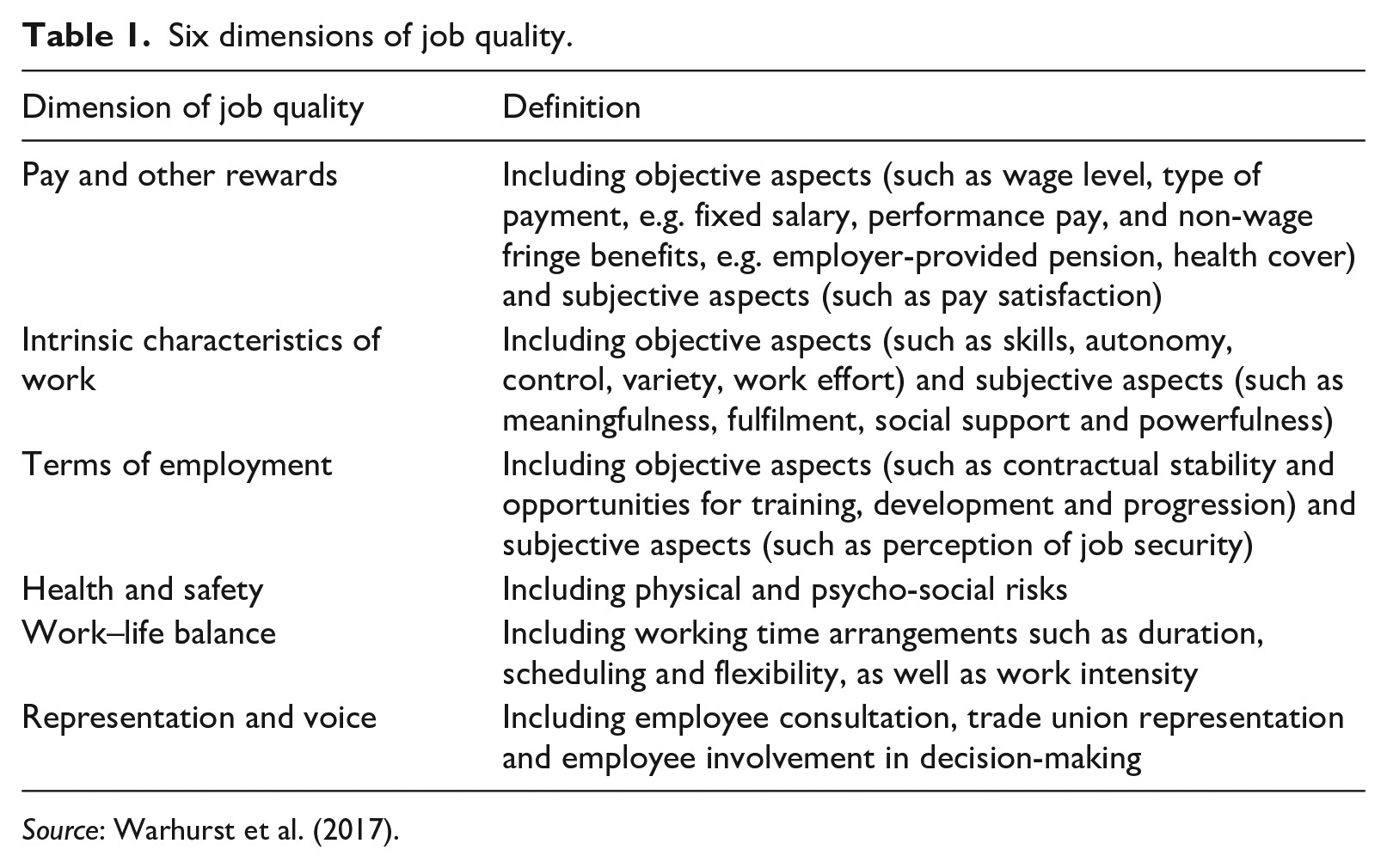
Source: Warhurst et al. (2017).
Sociological analysis of job quality has avoided simplistic binary distinctions between well-paid versus low paid, standard versus non-standard work, and has steered away from purely subjective perceptions of good/bad jobs from the worker’s perspective (Adamson and Roper, 2019; Brown et al., 2012; Hebson et al., 2015; Myhill et al., 2021). Qualitative research exploring workers’ experiences has valuably exposed some of the tensions and paradoxes inherent in understanding job quality. In Adler and Adler’s (2004) study of hotel room attendants, for example, they show that while these jobs might objectively be assessed as poor quality (e.g. in terms of pay), job satisfaction appears high. Thus, there is no straightforward relationship between objective and subjective measures of job quality, and one may indeed contradict the other.
Both objective and subjective indicators of job quality have also been shown to vary for workers with different characteristics, including gender, age and socio-economic status (Gallie, 2022; Knox et al., 2015), and is influenced by various personal and contextual factors (Holman, 2013). For example, Knox et al. (2015) draw on comparative work examining the experiences of room attendant jobs in UK and Australian cities and propose a new typology of workers and a new categorisation of job quality informed by their characteristics and preferences. They identify four different types of worker: ‘willing and trapped’, ‘willing and transient’, ‘unwilling and trapped’ and ‘unwilling and transient’. For the ‘willing and trapped’, workers were willing to undertake jobs that, while in objective terms are considered poor quality (hard work, poorly paid with limited progression opportunities), made it possible for working mothers to fit this work around their caring responsibilities – but they were trapped in these roles due to the absence of better-quality flexible job opportunities. In contrast, while the ‘unwilling and trapped’ wanted better jobs, they were trapped due to limited qualifications and experience (p. 1559). The relative importance of specific job quality dimensions can also change over the life-course. For example, Belardi et al. (2021) found that progression opportunities for chefs in Australian restaurants became less important with age compared with other job quality dimensions such as pay and work–life balance. Other work has shown how poor-quality work can be resisted; for example, through unionisation and living wage movements (Evans et al., 2021); however, also in more subtle ways: Woodcock (2016), for example, in his influential analysis of control and resistance in call centres, identifies quitting as a key form of resistance.
Conceptualising the interconnections between job quality and welfare reform
Analysts vary in their interpretations of the relationship between welfare provision and job quality. Some view welfare systems as components of national institutional contexts that influence employment norms indirectly (Gautié and Schmitt, 2010). Whereas others see welfare and employment services as neutral mediators between employers and unemployed people (Taylor, 2017). For example, the European Union (2018: 6) urges national public employment services to adapt to labour market changes driven by ‘automation, artificial intelligence, and “non-standard” forms of work’. Future-casters such as Frayne (2015) and Weeks (2018) go further, suggesting that the depopulation of the labour market in post-work and anti-work scenarios will require welfare expansion via universal basic income schemes. Alternatively, in some accounts, the direction of influence is reversed, and welfare provision appears only as an outcome of job quality; that is, ‘bad’ jobs can increase welfare spending (Eurofound, 2013).
Existing scholarship has implicitly discussed the interconnections between some forms of welfare conditionality and job quality. In relation to aspects concerning control and powerfulness, Greer (2016: 162), for example, argues that work-first welfare reforms are ‘altering the institutional constitution of the labour market by intensifying market discipline within the workforce’. Briken and Taylor’s (2018) qualitative research exploring 25 temporary work agency employees’ experiences at an Amazon warehouse shows how benefit sanctions create precarity for temporary workers, arguing that the ‘brutal, digitally enabled lean workplace regime intersects with a brutal, digitally enabled workfare regime’ (p. 438). Focusing on a single workplace, their analysis exposes the welfare system as an instigator, rather than a bystander, ‘intervening to compel unemployed claimants to take unwanted jobs on insecure contracts through agencies and other labour providers’ (p. 454). Although not explicitly engaging with the concept of job quality, their analysis uncovers multiple dimensions of it, including poor working conditions, intense performance pressure and bullying, surveillance and a lack of choice.
Engaging more explicitly with the concept of job quality, but focusing narrowly on a single objective measure (involuntary part-time employment), Haapanala (2022: 360) explores the connections quantitatively, applying random effects within-between regression analysis to data from 25 countries and finds evidence that ‘coercive, “hard” ALMP [Active Labour Market Policy] instruments incentivising rapid re-employment with the threat of withdrawing unemployment benefits are associated with higher likelihood of involuntary part-time employment’.
Overall, while existing literature has made important connections between some forms of welfare conditionality (e.g. previous generations of workfare programmes for long-term claimants) and poor employment experiences (Briken and Taylor, 2018; Greer, 2016; Wiggan, 2015), it does not engage directly with the job quality literature. Core dimensions of job quality, such as progression and work–life balance (which are increasingly relevant given the extended reach of conditionality into working lives), are unexplored. As shown above, job quality is a complex and multifaceted issue; the connections between conditional welfare reforms and multiple core dimensions of job quality therefore require further investigation. Concurrently, these interconnections are also not widely understood or acknowledged by job quality analysts (Warhurst et al., 2022). For example, although Knox et al. (2015) helpfully demonstrate the ways in which job quality is mediated by workers’ characteristics and preferences, the mediating role of the welfare state is absent from these accounts. Given the increasingly interventionist nature of the UK welfare state (Whitworth, 2016), which dictates job search behaviour and further delegitimises unpaid care (Andersen, 2020, 2023; Griffiths et al., 2022), the role of the welfare state in job quality debates is therefore a significant gap to consider.
Through much needed empirical evidence, this article elaborates systematically how conditionality within the UK welfare system interconnects with multiple dimensions of job quality on a large scale, including a wide range of employment contexts. It considers two key questions: (i) how does welfare conditionality impact welfare recipients’ experience of job quality?; and (ii) which specific dimensions of job quality do welfare recipients experience as most acutely undermined?
Methods
This article presents supplementary analysis (Heaton, 2004) of data from the Welfare Conditionality: Sanctions, Support and Behaviour Change project (Welfare Conditionality, 2018). 3 The original project explored the effectiveness and ethicality of welfare conditionality for diverse welfare recipients over time. Supplementary analysis (defined by Heaton (2004: 38) as a form of secondary analysis that is ‘a more in-depth investigation of an emergent issue or aspect of the data which was not considered or fully addressed in the primary study’) was undertaken to investigate participants’ experiences of job quality. The original research centred on a three-wave qualitative longitudinal study conducted with a large sample (n = 481 at baseline, 1081 interviews in total) of diverse groups of people subject to welfare conditionality (broadly defined, including conditions related to work and non-work-related behaviour). Purposive, non-random sampling techniques were used (Mason, 2002), drawing participants from 11 towns and cities across England and Scotland. Participants were recruited through a mix of organisations including third sector, local authorities and housing providers. Data collection spanned 2014–2017, during a crucial period of welfare reform that included the peak of the enhanced sanctions regime and the roll out of UC. Participants were interviewed up to three times at, on average, 12-month intervals across a two-year period, with intervals selected to allow experiences to be observed over an extended time-frame. The study received ethical approval from the University of York. Data are anonymised and participant names have been changed.
The analysis for this article draws on a subset of 46 participants (133 interviews across the study), who held ‘non-standard’ paid work at one or more waves of the study (see the online Appendix for an overview of employment status over the duration of the study). The non-standard subset was selected for analysis for two key reasons. First, while existing evidence suggests a relationship between the Work First ALMP and various forms of employment that can broadly be considered ‘non-standard’ including involuntary part-time work (Haapanala, 2022) and temporary work (Adams et al., 2012), the complex mechanisms behind this relationship require further qualitative investigation. Second, with the implementation of UC, part-time workers – predominantly women – are increasingly being drawn into the UK’s conditionality regime; thus, understanding their experiences of work can helpfully inform future policy development.
The subsample included 29 women and 17 men between 19 and 62 years old; 39 were White individuals and seven were Black or from minoritised ethnic groups. Most (26) were single without children; 17 were lone parents; and 14 were disabled or had a long-term health condition. The sample included people claiming Employment and Support Allowance (ESA) (including in both the Work Related Activity Group and the Support Group), Jobseeker’s Allowance (JSA) (under the legacy system) and UC, with varying degrees of conditionality, alongside some others who were engaging with other conditional elements of the UK welfare state (mainly social housing tenants subject to behavioural expectations), many of whom had experience of engaging with work-related conditionality in the past. Those in the ESA ‘Support Group’ had no work-related conditionality because of their ill-health/disability, while those in the ESA ‘Work Related Activity Group’ were expected to engage in steps to find work. Those on JSA and UC usually had job search conditions and requirements to attend Jobcentre Plus and sometimes also outsourced welfare-to-work services via the Work Programme. Several received financial support while in work (i.e. Tax Credits and Housing Benefit) without behavioural conditions. The timing of the research also provided early insights into how UC ‘in-work conditionality’ was experienced (Wright and Dwyer, 2022).
Face-to-face semi-structured interviews, lasting approximately one hour, explored participants’ experiences of welfare conditionality and work–welfare trajectories. An inductive approach to in-depth thematic analysis was used, facilitated by NVivo (12) (QSR International), to produce a descriptive account of participants’ employment experiences at each interview, including movements into, out of, or within work. The longitudinal research design enabled exploration of participants’ ‘varied and changing fortunes’ over time (Neale and Flowerdew, 2003: 194), providing insights into ‘how and in what ways people manage and adapt’ (Millar, 2007: 535) and how this is influenced by social and economic constraints (Corden and Millar, 2007).
Analysis centred on how work was experienced and the extent to which this aligned to worker preferences within the context of participants’ wider lives; how caring responsibilities, health conditions, and the availability (or unavailability) of decent work opportunities interacted to shape their position and power in the paid labour market; and the role of the UK welfare system in sustaining, improving, or hampering participants’ labour market position. Here relevant discussion of work experiences (e.g. pay, hours, variability), reasons behind employment roles (e.g. motivation, caring responsibilities, health conditions, labour market conditions), job aspirations and confidence regarding future labour market prospects and barriers to improving their position in the paid labour market (e.g. skills, experience, responsibilities, lack of opportunities, nature of work available, limited progression opportunities in current role) were identified. Throughout our analysis, we sought to identify how welfare conditionality (or its absence) impacted on these experiences. After considering findings alongside further engagement with the job quality literature, Warhurst et al.’s (2017) job quality dimensions were identified as a helpful framework for further analysis. Then, in a more deductive phase, taking all six dimensions as the starting point, analysis identified interconnections between welfare conditionality and four of the key dimensions of job quality identified by Warhurst et al., namely: (i) terms of employment; (ii) pay and rewards; (iii) intrinsic characteristics of work; and (iv) work–life balance. The absence of data relating to the other two aspects of job quality (health and safety, and representation and voice) are reflected on in the concluding section.
Findings
Terms of employment: Welfare conditionality undermines work stability, sustainability and progression
Both objective and subjective aspects of the ‘terms of employment’ dimension of job quality were poor for many in the sample. Objectively, participants described engaging in various forms of insecure work, including temporary seasonal work, agency work and zero-hours contracts. Over the course of the study, several participants cycled between temporary work and unemployment. For example, one participant described being ‘back on the Universal Credit treadmill’ (Carol, self-employed, Wave b) after the latest temporary contract came to an end.
Subjectively, perceptions of insecurity varied. Whereas cases like Carol’s demonstrate the enduring sense of instability experienced by some participants (‘I still consider myself unemployed because when I go to do temp work I know that it’s only for a few weeks’), Wave b others felt relatively more secure. Dean, for example, a 52-year-old labourer who worked full-time for the same building contractor for almost two years, was ‘happy’ with his work at his final Wave c interview ‘because I’ve been working the best part of two years now’. However, he still did not have the security of a permanent contract, remaining reliant on his employer’s goodwill for re-employment if new projects were secured: ‘my boss has promised me another two years’ work because we’ve got a big project coming up’.
Most participants did not move into better quality, more secure or full-time work over the duration of the study. On the DWP’s own terms, where progression policy emphasises engaging in full-time work, it is notable that only five of the 46 participants moved from a position of part-time employment at Wave a to full-time employment by Wave c. Many remained underemployed, engaging in part-time or precarious forms of work due to a lack of alternatives. Even those who had moved into full-time work remained insecure: Literally, they don’t have to pay me till Friday, give me a week’s notice. All they needed to do is when they called us in for a meeting on Monday was, ‘Oh, you can go home now. We’ve got no work for you.’ That would be it. That’s zero-hours contract literally meant, if there was no work, I don’t work. (Kevin, full-time, zero-hours contract, Wave c)
Additionally, discussion of training and other forms of in-work development offered by employers was notably absent across the interviews.
Welfare conditionality appeared to propel claimants into precarious employment with limited prospect of progression. Under pressure to take any job, participants felt that supporting people into sustainable work that offered prospects for progression was not prioritised by Work Coaches: ‘The job adviser’s job is to try and find you employment. Whether it suits you or not is another question’ (Kevin, self-employed, Wave a). Similarly, David had experienced a string of temporary agency jobs punctuated with periods of unemployment over the two-year fieldwork period: [For Jobcentres,] it’s about . . . getting me into any kind of work, even though I might not be suited to the work. (David, 42, temporary agency work, various jobs, zero-hours contract, Wave b) I would like more job stability . . . like a permanent job . . . there’s no problem actually finding your full-times, but it’s just finding a job . . . Which is regular. (David, 42, temporary agency work, various jobs, zero-hours contract, Wave c)
This combined with a limited supply of high-quality job opportunities to trap participants in a cycle of temporary jobs and claiming benefits.
Although there were a few cases where Jobcentres and other government contracted employment support agencies provided opportunities to engage in training – something which may improve workers’ prospects for progression, particularly where employers fail to invest in it – participants typically considered this as inappropriate. It was also often not flexible enough to fit around existing work commitments – once in work, employer demands took precedence: Well, they [Jobcentre] wanted me to go on this course for computers, but it didn’t fall right . . . because it wasn’t convenient, with my jobs. I can’t really get out, you know, because I work with cleaning companies. I couldn’t really just say, ‘Oh, I can’t come in’. (Linda, 60, cleaning, multiple jobs, Wave b)
Additionally, UC recipients subject to the new ‘in-work conditionality’ regime felt ‘pushed’ into pursuing ‘more work’ (often insecure), on top of existing commitments, even when they already had multiple jobs: ‘I’m doing 29 hours [in two cleaning jobs], but she [her Work Coach] still wants me to go and do another nine hours’ job search’ (Sarah, 42, cleaning, multiple jobs, Wave a). The ‘Work First, Work More’ (Jones, 2022) approach therefore did not appear to involve support for more secure work, more suitable positions or promotion – just additional paid hours.
Pay and rewards: Welfare conditionality limits income
The ‘pay and rewards’ dimension of job quality includes both levels and patterns of payment (Warhurst et al., 2017). Objectively, many participants experienced in-work poverty, speaking in depth across interview waves about the challenges of living on a low income, struggling to cover necessities including housing costs despite being in work: ‘I’m trying to survive on this small wage’ wave a (Joel, kitchen porter, variable hours). As noted above, the insecurity of the work that many participants were undertaking, particularly those on zero-hours contracts, resulted in highly irregular payment patterns.
Although job quality scholars focus on the pay and rewards provided through jobs, for workers engaging with the welfare system, the data show that the regularity and predictability of income depends on both their employer and the welfare system. Eligibility for in-work benefits (including UC and Tax Credits under the legacy system) is further reflective of low pay, given receipt is dependent on claimants being on a low income (albeit this may also be influenced by a range of other factors including caring responsibilities). Positively for the participants in this study, and perhaps playing into subjective assessments of this dimension of job quality (i.e. pay satisfaction), the additional income provided through legacy in-work benefits including Working Tax Credits, Child Tax Credits and Housing Benefit was often considered essential in the absence of a decent and regular wage. Although Tax Credits can be critiqued for subsidising poor-quality employment, they were nevertheless valued by participants as helping to both enhance household income and partially offset irregular payment patterns resulting from unbalanced flexibility and insecure contracts.
As the tax credit system is replaced by UC, this source of relative security may be undermined, as income subsidies adjust monthly in response to varying patterns of work. This introduces new sources of insecurity for low-income workers. Although some participants welcomed the flexibilities of UC, in that it no longer required them to sign off and on benefits when moving in and out of work, several described difficulties managing fluctuating payments from both paid work and UC, which initiated lots of ‘phone calls and running around’ (Mike, 58, removals, zero-hours contract, Wave b).
In addition to the management of fluctuating payments, the potential to lose financial support due to a benefit sanction also featured within several participants’ accounts, further impacting both the levels and the patterns of payment these workers received. This not only caused significant hardship, it also directly reduced the financial rewards of working. Several reported stress and anxiety due to the threat or experience of sanctions for failing to demonstrate sufficient job search activity, despite already being in work. This introduced new wellbeing at work risks for some workers, as they had to manage the anxiety induced by a potential loss of benefits income. Some participants sought to disengage from the ‘in-work safety net’, relinquishing their rights to in-work financial support because of excessive and unreasonable conditionality, thus reducing the income available to them through engaging in paid work and resulting in financial hardship (see below).
Intrinsic characteristics of work: Welfare conditionality undermines power, control and access to meaningful work
In relation to the ‘intrinsic characteristics of work’ dimension of job quality, the strongest themes emerging from the data centred specifically on the interrelated issues of power, control and meaningfulness. Here the impact of welfare conditionality in terms of both objective and subjective experiences of job quality appears particularly explicit. Analysis suggests that welfare conditionality drove low-quality work in this respect by undermining workers’ power and control over the quality of work they were able to engage in. As shown above, participants often felt pressured into taking low-paid insecure work through lack of choice. Once in work, a lack of control over the work they engaged in was again reinforced by the rules of the welfare system: participants were unable to leave unsuitable jobs because this would make them ineligible for financial support: ‘I felt I had no option and again I can’t make myself unemployed because they won’t give me [any benefits]. So, I’ve got to stick at it until I find something else’ (Leanne, 37, retail, short hours contract, variable hours, Wave b).
Instead of acting as a neutral arbitrator between jobseekers and employers, the welfare system thus appears complicit in reinforcing one-sided flexibility through one-sided conditionality, emphasising intensive job seeking on the part of claimants and leaving poor-quality work provided by employers unchecked. Some participants therefore felt that employers had ultimate power over the supply of work, including both its quantity and quality: It’s as if they’re all in cahoots together. [Employers] can get rid of you just like willy-nilly because they know they can get anybody else sent to them but from the Jobcentre. (Joel, 54, kitchen porter, variable hours, Wave a) I’m doing about 28 hours but I’d like to do more but I can’t, right, because I can only work [when] the employer tells me to. (Joel, 54, kitchen porter, variable hours, Wave b)
The experience of participants who at some point during the study did not face conditionality (i.e. people in the ESA Support Group) provide an important counter example. Here, having more control over work choices alongside a relatively low but secure benefit income appeared to enable people to engage in higher-quality paid work, at least in subjective terms, as descriptions of paid work were most positive among this group: ‘[ESA Support Group has] given me a bit of leeway to do [. . .] what I want to do’ (Neil, 56, hospitality, short hours contract, Wave b).
Further supporting the notion that welfare conditionality influences job quality on this dimension, were examples of resistance, where participants actively disengaged from the welfare system to take back power and control and pursue more meaningful work. Joanne, for example, became a self-employed personal tutor, signing off JSA to avoid being pushed into jobs she did not want. She maintained this position across the longitudinal study: I regard myself not as unemployed but as a personal tutor and as a prospective teacher trainee and this feels better . . . I think financially I would be better off [claiming benefits, but] . . . this kind of control I wouldn’t like that. (Joanne, 50, freelance personal tutor, variable hours, Wave a) [It’s] a professional decision; I don’t want to step back to unqualified student jobs, work. No, it’s not what I want. (Joanne, 50, freelance personal tutor, variable hours, Wave b)
However, although Joanne gained on the ‘intrinsic characteristics of work’ side of job quality, she lost out on the dimensions of ‘pay/rewards’ and ‘terms of employment’. By the time of our third and final interview, she remained in precarious work on the margins of poverty: ‘I can meet my ends but there’s actually nothing really for extra’. It is notable that while issues relating to power and control emerged as particularly pertinent for participants, broader aspects of the ‘intrinsic characteristics of work’ dimension of job quality, including skills, variety and work effort, were absent from their accounts.
Work–life–welfare balance
The ‘work–life balance’ dimension of job quality was pertinent for many participants. The ‘Work First, Work More’ welfare policy explicitly influenced the work–life balance of participants in two respects. First, options for work–life balance were undermined by benefit rules that severely reduce claimants’ abilities to self-determine their work intensity or scheduling. Within the sample, this was problematic for those with caring responsibilities, usually women, especially lone parents. Participants described needing work that fitted around caring responsibilities, typically expressing a preference for part-time work (although most wanted more hours and more regular and predictable work arrangements than they had at the time of interview). However, their experiences demonstrate how the welfare system can push people into jobs that are incompatible with unpaid care responsibilities. As a result, participants were under pressure to take jobs that were difficult to manage. Several working parents reflected on the strain of balancing work and home life, including the shortcomings and high costs of available childcare provision, and a heavy reliance on family or friends to compensate for this. One lone parent, Leanne, for example, reflected on her experience: [they] pressured [you] to apply for jobs that you didn’t want . . . [and] if you got offered them you’d have to take them otherwise your money would be stopped . . . I haven’t got set days. Again, like tonight, I’m working until six. Monday I worked until eight . . . I took a job that wasn’t beneficial to me or the children . . . My family life, my home life suffers . . . I’ve got to rely on family to have my children. (Leanne, 37, retail, short hours contract, variable hours, Wave b)
Overall, participants experiencing in-work conditionality felt that these were unreasonable and insufficiently tailored to their circumstances and needs outside of the paid labour market. Although Work Coaches have discretion to lower the number of working hours sought, participants often either did not know or felt too intimidated or disempowered to request a reduction.
Relatedly, the second – and new – way in which conditional welfare influenced work–life balance adds a unique dimension to job quality debates. The application of in-work conditionality undermined work–life balance by adding a new time demand through the requirement to search for jobs on top of existing work commitments. For example, Sarah was a UC in-work claimant employed as a cleaner. She had to spend the day before her evening shift began looking for other jobs to satisfy the conditions of her benefit claim: ‘Because I only work in the evenings on a Tuesday and a Thursday, I’ve got to do my job search on a Tuesday and a Thursday’ (Sarah, 42, cleaning, multiple jobs, Wave a). Job searching all day before working all evening meant time focused on other aspects of life beyond work were increasingly squeezed. Thus, for UK workers in receipt of conditional welfare, rather than ‘work–life balance’, this needs to be recognised as a new coercive ‘work–life–welfare balance’.
Discussion and conclusions
The above analysis shows how welfare conditionality can drive welfare recipients’ experiences of job quality. By using Warhurst et al.’s (2017) framework, it uncovers the aspects of job quality that welfare recipients experience as being particularly undermined by conditionality. More specifically, it shows how welfare conditionality disempowers claimants; propels them towards inadequate pay, insecurity and poor employment terms; undermines multiple intrinsic characteristics of work; and prevents work–life balance. Although experiences of paid work varied across the sample, compulsion to take ‘any’ job, regardless of its value, quality or desirability meant that insecure low-paid, poor-quality jobs were legitimised and labour power undermined. Overall, poor-quality work and the conditional welfare system combined to reinforce income insecurity and trap workers in poor-quality jobs with little prospects of escape. The absence of broader aspects of ‘good work’, such as training, employee voice and collective bargaining in participants’ accounts, is striking (Findlay et al., 2013; Osterman, 2013; Warhurst et al., 2017).
Rather than providing a safety net protecting workers against the uncertainties of market forces in a deregulated labour market, the above analysis demonstrates that the welfare system can create an additional source of insecurity. Not only did this encourage people to move into, and stay in, poor-quality jobs (to escape pressure exerted by the Jobcentre), but some workers also disengaged from the ‘in-work safety net’. Where participants could draw on alternative resources, enabling them to step away from the conditional welfare system, they did so – thus exposing the inadequacies of a system that should be supporting those at the sharp end of the labour market. However, although disengaging from the welfare system was identified as an act of resistance, not all were able to make this ‘choice’. Simultaneously, many of those reliant on the welfare system were unable to resist poor working practices by leaving work (identified by Woodcock, 2016 as a key form of resistance) as this would undermine their eligibility for social security payments.
Empirically, this article makes three key contributions. First, it shows how welfare conditionality impacts experiences of job quality on a national scale, contributing unique evidence to existing conceptual analyses (Greer, 2016; Wiggan, 2015) and demonstrating its relevance beyond single workplaces (Briken and Taylor, 2018) to the broader labour market context. Second, it provides insights into aspects of job quality beyond insecurity and low pay (Briken and Taylor, 2018), particularly in relation to limited progression and work–life balance. In terms of progression, longitudinal analysis of three waves of interviews over a two-year period shows this to be elusive. Although some participants did move into full-time work, and as such can be deemed a progression ‘success’ in policy terms, this continued to be on an insecure footing and highly contingent on individual access to resources such as informal childcare. Work–life balance is no longer an adequate description of the ‘work–life–welfare balance’ that many low-paid workers experience to meet intrusive time demands generated by an increasingly interventionist welfare state. Although important for all workers, issues relating to part-time work, scheduling and flexibility are particularly pertinent for those with caring responsibilities, impacting disproportionately on women who are already disadvantaged in the labour market (Wright, 2023).
Third, and relatedly, it provides important insights into the UK’s new ‘in-work conditionality’ regime. Although framed positively as the DWP’s ‘In-Work Progression’ policy (DWP, 2018), the introduction of ‘in-work conditionality’ through UC simply extends ‘Work First’ approaches (Fernandez-Urbano and Orton, 2020; Kowalewska, 2017) – promoting a ‘Work First, Work More’ ethos (Jones, 2022). The findings suggest that, rather than supporting progression, the approach further undermines job quality and exacerbates existing inequalities in the labour market. Simplistic policy goals to increase the number of hours worked de-legitimises part-time work and work outside of paid employment (Andersen, 2020, 2023; Klein, 2021; Wright, 2023) and will likely result in more people needing to balance multiple jobs (Smith and McBride, 2021). By establishing full-time paid work as the norm with little regard for ill-health, disability or caring obligations, the future direction of UC policy fails to recognise and support needs and responsibilities beyond the paid labour market. Ignoring the broader structural context (McQuaid and Lindsay, 2005) of a low–pay insecure labour market, now poor job quality – as well as unemployment – is cast by policymakers as a behavioural problem.
By focusing explicitly on job quality and its key dimensions (Warhurst et al., 2017, 2022), and systematically considering the interconnections to welfare conditionality, the article makes a theoretical contribution by extending previous analyses that have focused more broadly on the interactions between work and welfare (Briken and Taylor, 2018; Etherington, 2020; Greer, 2016; Wiggan, 2015). It also contributes to job quality debates whereby the role of the welfare system in shaping people’s experience of work has been overlooked (Holman, 2013; Knox et al., 2015; Warhurst et al., 2022; Woodcock, 2016). Returning to Knox et al. (2015), for example, many participants perceive themselves to be ‘unwilling and trapped’ in poor-quality jobs as a result of welfare conditionality and a lack of tangible support to progress.
Sociological analyses of work, including job quality and aspects of power and control in the workplace, can therefore be strengthened through examining the power that the welfare system wields over the lives of workers and the opportunities available to them, particularly as it takes an increasingly interventionist approach to engaging with both working and unemployed claimants. Instead of acting as a neutral arbitrator between jobseekers and employers, our analysis demonstrates how welfare systems can be complicit in reinforcing one-sided flexibility through one-sided conditionality; emphasising intensive job seeking on the part of claimants while leaving the poor-quality work provided by employers unchecked. An emphasis on ‘any job’, underpinned by the threat and application of benefit sanctions, propels precarity and constrains claimants’ scope to act autonomously or feel empowered to choose fulfilling work of intrinsic value.
Understanding in greater detail how welfare systems influence labour markets and job quality is increasingly critical for sociology of work scholars and international policymakers, particularly as national public employment services and welfare policies for unemployed people, people with disabilities, lone parents and low-paid workers are adapted to labour market change, which is characterised for many by increasing levels of in-work poverty and insecurity. The introduction of ‘in-work conditionality’ represents a fundamental shift in employment conditions for structurally disadvantaged workers, who are more likely to rely on UC because of pre-existing intersectional inequalities. Women, mothers, working class people, people with long-term illnesses and disabilities, and Black and minority ethnic groups face occupational segregation, alongside enduring pay gaps. UC in-work conditionality does nothing to address these inequalities and in fact may directly challenge the part-time worker–carer model, which supports high female labour market participation in comparable countries by enabling women, especially mothers, to combine paid work with unpaid care (Andersen, 2023; Wright, 2023). For sociology of work scholars, it is essential to understand how this new era of welfare reform compounds long-standing labour market disadvantages.
These findings have several implications. Further empirical research is needed to integrate more explicitly welfare conditionality and job quality. Future research could usefully develop from these insights to explore how welfare recipients experience the remaining two dimensions of job quality that did not feature in the accounts of interviewees: ‘health and safety’ and ‘representation and voice’, alongside broader aspects of the ‘intrinsic characteristics of work’ dimension including skills and work effort. This would enable the interactions between welfare systems and the labour market to be more comprehensively understood, including key priority areas of decent work identified by low-paid workers (i.e. safe working environments free from physical and mental risk or harm – see Stuart et al., 2016). Further investigation could also explore policymaker and employer perspectives on processes connecting welfare conditionality and different dimensions of job quality, how welfare regimes and employment services could support people into better quality jobs, the role unions can play in supporting working welfare claimants, and whether the impact of welfare conditionality varies in a tightening labour market.
Finally, by maintaining the supply of ‘coerced worker claimants’ (Wright and Dwyer, 2022) to poor-quality jobs, the UK’s approach to welfare conditionality conflicts with other policy aspirations centred on ‘Good Work’ (HM Government, 2018). Given that it is employers – rather than unemployed people and low-income workers – with the ultimate power over both the quantity and the quality of work (Jones, 2022; Osterman, 2013), policymakers should urgently revise their commitment to a Work First approach (and rethink the ‘Work First, Work More’ approach) and pay more attention to employer practices, robust regulation and the strengthening and enforcement of employment rights (Rubery et al., 2018).
Supplemental Material
sj-docx-1-wes-10.1177_09500170231219677 – Supplemental material for The Impact of Welfare Conditionality on Experiences of Job Quality
Supplemental material, sj-docx-1-wes-10.1177_09500170231219677 for The Impact of Welfare Conditionality on Experiences of Job Quality by Katy Jones, Sharon Wright and Lisa Scullion in Work, Employment and Society
Footnotes
Acknowledgements
Thank you to the workers who shared their stories with us. Thanks also to the WES editorial team and anonymous reviewers for their helpful guidance, to Professor Carol Atkinson and Dr Sally Jones for support and encouragement on earlier drafts, and Professor Peter Dwyer, PI of the Welfare Conditionality Project.
Data Access Statement

Funding
The authors disclosed receipt of the following financial support for the research, authorship, and/or publication of this article: The support of the Economic and Social Research Council (Grant ES/K002163/2) is gratefully acknowledged.
Supplementary material
The supplementary material is available online with the article.
Notes
References
Supplementary Material
Please find the following supplemental material available below.
For Open Access articles published under a Creative Commons License, all supplemental material carries the same license as the article it is associated with.
For non-Open Access articles published, all supplemental material carries a non-exclusive license, and permission requests for re-use of supplemental material or any part of supplemental material shall be sent directly to the copyright owner as specified in the copyright notice associated with the article.
