




Abstract
Recent studies show that many workers consider their jobs socially useless. Thus, several explanations for this phenomenon have been proposed. David Graeber’s ‘bullshit jobs theory’, for example, claims that some jobs are in fact objectively useless, and that these are found more often in certain occupations than in others. Quantitative research on Europe, however, finds little support for Graeber’s theory and claims that alienation may be better suited to explain why people consider their jobs socially useless. This study extends previous analyses by drawing on a rich, under-utilized dataset and provides new evidence for the United States specifically. Contrary to previous studies, it thus finds robust support for Graeber’s theory on bullshit jobs. At the same time, it also confirms existing evidence on the effects of various other factors, including alienation. Work perceived as socially useless is therefore a multifaceted issue that must be addressed from different angles.
Introduction
David Graeber (2013) has hit a nerve with his statement that many of today’s jobs are in fact socially useless and thus – in his words – bullshit jobs (BS jobs). His original article quickly became so popular that within weeks it was translated into more than a dozen languages and reprinted in different newspapers around the world. A few years later, Graeber followed up on this article and published a book on the same topic that continues to inspire a vivid public debate (Graeber, 2018). However, the original evidence presented by Graeber was mainly qualitative, which made it difficult to assess the magnitude of the problem. Other researchers therefore started to contribute to this debate by providing quantitative evidence on the issue.
Since the true usefulness of jobs cannot be measured directly, they all follow Graeber’s approach and ask workers whether they personally think that their jobs are useful to society. Thus, a YouGov poll finds that 37% of British working adults believe their job is not ‘making a meaningful contribution to the world’ (Dahlgreen, 2015). In a more extensive study covering 47 countries, the authors find that ‘8 percent of workers perceive their job as socially useless, while another 17 percent are doubtful about the usefulness of their job’ (Dur and van Lent, 2019: 3). Finally, while using a slightly different wording, another study finds that 4.8% of workers in the EU28 consider their jobs useless (Soffia et al., 2022). These numbers are not as high as claimed by Graeber (2018), and do not increase over time either (Soffia et al., 2022). Nevertheless, they show that millions of people consider their jobs to be socially useless. If these people are right, this would mean that a significant amount of work and resources are currently wasted. Clearly, this calls for a more detailed examination.
In consequence, these results have been analysed regarding several characteristics of the responding workers. Thus, various studies show that there are considerable differences in perceived job-usefulness between countries, economic sectors, occupations, age groups, genders and more (Dahlgreen, 2015; Dean et al., 2022; Delucchi et al., 2021; Dur and van Lent, 2019; Soffia et al., 2022). In addition, studies also show that workers who perceive their job to be socially useless tend to display low job satisfaction (Dur and van Lent, 2019) and low general well-being (Soffia et al., 2022). Various explanations have therefore been proposed as to why people find their jobs socially useless. Graeber himself, for example, claims that some jobs are in fact objectively useless to society, and that people are usually correct in assessing the usefulness of their own jobs. According to Graeber, socially useless jobs are therefore more often found in certain occupations than in others. Soffia et al. (2022), however, find that ‘there is little validity in Graeber’s prediction of BS occupations’ and suggest that alienation might be better suited to explain why people think that their jobs are useless. According to this view, the problem is not that jobs are in fact useless, but that people perceive them as such if they suffer from unfavourable working conditions.
The following article re-evaluates Graeber’s argument by using data from the 2015 American Working Conditions Survey (Maestas et al., 2017). It thus builds on previous analyses and extends them in two important ways. On the one hand, it provides new evidence for the United States specifically. This is important since Graeber’s argument may apply only to heavily financialized Anglo-Saxon countries (see Soffia et al., 2022). On the other hand, this rich dataset allows Graeber’s argument to be tested while also controlling for various other potential factors such as alienation. This is important since these factors may not affect occupations equally and therefore may distort empirical tests of Graeber’s theory if not controlled for.
Contrary to Soffia et al. (2022), this article finds robust support for Graeber’s theory on BS jobs. Thus, it finds that working in one of the occupations highlighted by Graeber significantly increases the probability that workers perceive their jobs as socially useless (compared with all others). In fact, Graeber’s occupations are most strongly associated with being socially useless when other factors are controlled for. Additionally, this article also confirms existing evidence on other factors such as alienation, social interaction and public service motivation. It thus concludes that work perceived as socially useless is a multifaceted issue that must be addressed from different angles. Furthermore, research on socially useless jobs should consider that results may differ depending on geographical context and on various methodological decisions.
Terminology
In the literature based on Graeber’s (2018) theory, several terms with similar meanings are used. Graeber himself, for example, speaks of ‘bullshit jobs’, while Dur and van Lent (2019) use the term ‘socially useless jobs’ when testing his theory. In addition, Soffia et al. (2022) also link Graeber’s theory with the literature on ‘meaningful work’. This section explains what is meant by these terms and thereby contextualizes the terminology that is used in this article.
As mentioned above, a crucial aspect of Graeber’s theory is that he considers some jobs to be inherently useless to society. He therefore defines BS jobs as: a form of paid employment that is so completely pointless, unnecessary, or pernicious that even the employee cannot justify its existence even though, as part of the conditions of employment, the employee feels obliged to pretend that this is not the case. (Graeber, 2018: 9f)
This definition highlights three important aspects of Graeber’s theory. First, Graeber argues that BS jobs are ‘a form of paid employment’. This clearly excludes self-employed work and other economic activities that cannot be considered paid employment from his definition. Second, Graeber defines BS jobs as ‘pointless, unnecessary, or pernicious’. According to him, this includes jobs that either simply do not contribute to society at all or that are in fact actively harmful to society. Third, this definition also includes that people with BS jobs feel ‘obliged to pretend that this is not the case’. Graeber argues that there are two reasons for this. On the one hand, workers would probably be dismissed if they announce the uselessness of their jobs to their superiors. On the other hand, workers often also feel obliged to hide their feelings in other contexts because it is usually not socially accepted to admit them.
Of course, this definition raises the question of how one is to decide whether a job makes a positive, a negative, or no contribution to society at all. To make such a decision, one clearly needs a theory of social value. Graeber, however, explicitly states that he does not want to impose such a theory on people’s jobs himself. Even though some researchers have tried to measure social value objectively (e.g. Lawlor et al., 2009; Lockwood et al., 2017), he argues that in any such attempt the researchers must ultimately make a choice between competing theories of social value that can only be justified on subjective grounds. For this reason, Graeber believes that the best way to measure the real social value of jobs is to ask the workers themselves for their opinion (Graeber, 2018: 10). Thus, his definition of BS jobs also includes an important subjective element by stating that ‘the employee cannot justify its existence’. It is important to note, however, that Graeber assumes workers to be correct in their assessments generally.
In practice, researchers therefore usually operationalize Graeber’s theory by asking workers whether they think that their jobs are useful to society (Dahlgreen, 2015; Dur and van Lent, 2019; Soffia et al., 2022). Assuming that workers can meaningfully assess their contribution to society, this certainly captures the most central aspect of Graeber’s definition. However, it also ignores the two other aspects since workers must not necessarily feel a need to pretend that they do not have a socially useless job even if they do, and since it allows for the inclusion of self-employed workers in the analyses. It may therefore be more precise to speak of ‘socially useless jobs’ instead of BS jobs, as Dur and van Lent (2019) do. However, since Soffia et al. (2022) emphasize that factors other than objective uselessness may cause workers to believe that their jobs are socially useless, and since this article wants to take these factors into account, it generally speaks of ‘jobs perceived as socially useless’ as its object of investigation. This way, no assumption about the objective usefulness of jobs must be made in advance. Instead, one can simply test whether the data support Graeber’s claims for objective uselessness or other factors that focus more on subjective experiences. Nevertheless, this article may occasionally use the term ‘socially useless jobs’ as an abbreviation for ‘jobs perceived as socially useless’ to facilitate readability.
Finally, the literature cited above must also be placed inside the broader context of the literature on meaningful work. In this literature, meaningfulness typically describes a certain positive significance that work holds for an individual (Rosso et al., 2010). It is therefore a concept that is rooted in the subjective experience of workers. Not surprisingly, meaningfulness can have many different sources, and perceiving one’s job as socially useful is usually considered an important one (Allan, 2017; Martela and Pessi, 2018). Other frequently mentioned factors are often summarized under the term ‘self-realization’ and cover aspects such as working autonomously, building competence, or expressing personal interests (Martela and Pessi, 2018; Steger et al., 2012). Repeatedly, studies have shown that perceiving one’s work as meaningful is an important source of motivation, productivity and well-being. Thus, a lack of meaning often leads to reduced motivation and productivity or even to serious psychological problems in workers (Allan et al., 2019; Fairlie, 2011; Hu and Hirsh, 2017). Viewing socially useless jobs in the context of meaningful work therefore further demonstrates the relevance of this topic for the economy in general and for affected workers in particular.
Graeber’s theory
Why do people consider their jobs socially useless? As shown above, this question can be answered either by claiming that some jobs are in fact socially useless, as Graeber (2018) does, or by pointing to various other factors that may affect people’s subjective perception. This section provides a broad overview of Graeber’s argument and derives several testable hypotheses.
At the centre of Graeber’s argument stands an economic system that he calls ‘managerial feudalism’. Thus, he argues that the financialization of the economy has led to a situation where powerful elites are more concerned with the appropriation of goods rather than with their production. The financial sector thus essentially only ‘creates money (by making loans) and then moves it around in extremely complicated ways, extracting another small cut with every transaction’, according to Graeber (2018: 167) (see also French, 2008; Lockwood et al., 2017). In addition, he argues that the increasing financialization of the economy pressurizes companies into profit maximization rather than a maximization of social value, which makes companies behave in ways similar to the financial sector itself. Graeber therefore claims that the role of elites and the way the economy works have changed. Thus, under classic capitalist conditions, it made no sense to hire unnecessary workers, since elites were involved in producing goods and competition forced them to be as efficient as possible. If elites are only extracting value rather than producing it, however, they must not be concerned with efficiency. Rather, Graeber argues, they can simply extract and redistribute money as they please, similar to feudal lords. This allows them to gather an entourage of followers who are paid to maintain and display their power but who contribute nothing useful to society. These are Graeber’s BS jobs.
Graeber then identifies five different types of BS jobs, three of which are linked to specific occupations. Graeber’s theory can therefore be tested by examining whether people in these occupations consider their jobs to be socially useless more often than others. The remainder of this section thus gives an overview of these three types and explains why they are considered socially useless by Graeber. The other two types are not considered here since the available data do not allow identifying them. 1
First, Graeber identifies jobs that ‘exist only or primarily to make someone else look or feel important’ (Graeber, 2018: 28). According to Graeber, these are typically employees such as administrative assistants who are hired by managers simply for the sake of feeling successful and important. Other examples given by Graeber include doormen, elevator operators and receptionists who are not primarily hired for their services but because they are a display of the wealth and power of their employers. It is important to note, however, that Graeber does not consider all jobs in these occupations to be socially useless. Thus, there may well be many administrative assistants and receptionists whose work is in fact essential for the functioning of their organizations and therefore socially useful without a doubt. Graeber merely claims that, if people are hired to make someone else look important, it is predominantly in these occupations.
Second, Graeber identifies jobs that are not only useless but actively harmful to society. Perhaps most obviously, he points out occupations typically found in the financial sector. This is not surprising, considering that he accuses the whole financial sector of being largely about creating debt and extracting money from the real economy (see above). In addition, he also considers occupations to be harmful whose goal it is to manipulate people into buying things they do not really need. These are typically advertising and marketing staff, PR specialists, telemarketers, or, more broadly speaking, anyone working in sales (see also Akerlof and Shiller, 2015; Thaler, 2018). Financial consultants therefore represent a special case for Graeber since they fall into both these categories: they sell financial products to people who do not necessarily need them (see also Inderst and Ottaviani, 2012). Finally, other types of harmful occupations identified by Graeber are corporate lobbyists and corporate lawyers. According to him, they both involve a certain aggressive element because it is their job to assert the interests of their employers against other interests. This can often mean asserting the interest of large corporations against the interests of individuals or of society at large. Jobs in the military also fall into this category if they do not serve the public good but the interests of economic and political elites, which is the case in at least some countries according to Graeber. Again, it must be noted, however, that Graeber does not consider all jobs in these occupations to be socially harmful. He only claims that socially harmful jobs are typically found in these occupations.
Finally, the third category identified by Graeber consists of only one occupation: managers. There are, however, two different reasons why managers might consider their jobs socially useless according to Graeber. On the one hand, there are some managers who are simply not needed. They may assign work to their subordinates and supervise them, but nothing would really change if they were not there anymore. On the other hand, Graeber identifies managers who are not only unnecessary but who actively generate more socially useless work for others. These are the managers who create jobs that belong to the first category described above.
Table 1 gives an overview of the three types of occupations that Graeber considers to be socially useless. The empirical part of this article will test whether working in any of these occupations is statistically associated with the perception that one’s job is socially useless. However, as some of these occupational categories are too narrow, they cannot be measured with the available data. Thus, only the occupations printed in bold in Table 1 are tested empirically in this article. This leads to the following hypotheses:
Occupations with a high share of BS jobs (according to Graeber).
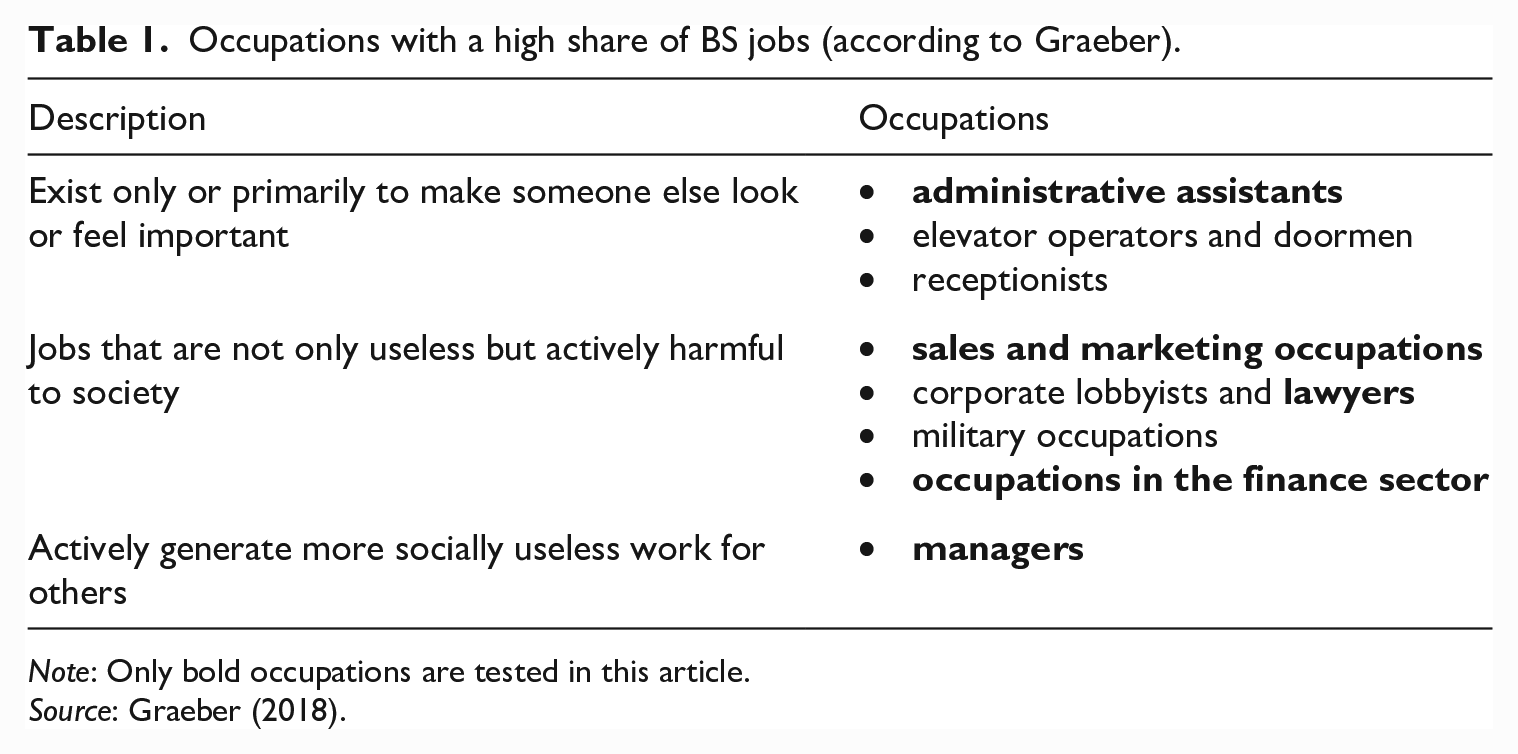
Note: Only bold occupations are tested in this article.
Source: Graeber (2018).
People consider their jobs socially useless more often than others if they work as administrative assistants (H1), in sales and marketing occupations (H2), as corporate lawyers (H3), in finance occupations (H4), or as managers (H5).
These occupations largely correspond to the occupations examined by Soffia et al. (2022) to test Graeber’s theory. As mentioned above, however, they find little support for these hypotheses in their European data. Dur and van Lent (2019), on the other hand, do not test Graeber’s occupations systematically but find that people working in sales and marketing (H2) or finance (H4) consider their jobs to be socially useless more often than others. However, both these studies use different methods and examine other countries than the present article. Results may therefore vary.
Finally, it should also be noted that these are somewhat weak hypotheses. Thus, they do not claim that all or even most jobs in these occupations are considered socially useless. Instead, they simply claim that more jobs in these occupations are considered socially useless than in others. This is in line with previous studies on the topic (Dur and van Lent, 2019; Soffia et al., 2022).
Alternative explanations
In contrast to Graeber’s theory, one does not necessarily need to claim that some jobs are objectively useless in order to explain why people think so. Thus, various alternative factors are discussed in the literature. Even though the focus of this article is on Graeber’s theory, it is useful to know the alternatives since Graeber’s theory is tested against them in the empirical part below. This section therefore briefly introduces the most important alternative approaches to explaining why people consider their jobs socially useless.
Alienation
Probably the most prominent alternative explanation is alienation. It was introduced to the debate by Dur and van Lent (2019) but discussed and tested empirically in more detail by Soffia et al. (2022). However, even though both studies directly refer to the theory of alienation by Karl Marx (1844), they emphasize different aspects of it.
Dur and van Lent (2019), on the one hand, argue that, due to an increasing division of labour, workers perform increasingly specialized tasks. These are often routine tasks that are highly repetitive and leave little room for creativity or autonomy, thus preventing the self-realization of workers. Owing to these unfavourable working conditions, it becomes increasingly difficult for workers to identify any final good as a product of their own work. In consequence, they cannot recognize their contribution to the production process anymore and feel that their work is socially useless. The division of labour can therefore ‘make meaningful work look meaningless’ (p. 11). In their empirical analyses, Dur and van Lent (2019) show that some occupations with a high share of routine tasks indeed display a relatively high share of workers who consider their jobs socially useless.
On the other hand, Soffia et al. (2022) also emphasize the importance of self-realization at work but focus more on work relations than on the division of labour. Thus, they argue that the potential for self-realization of workers may not only be frustrated by the division of labour, but also by a broader set of unfavourable working conditions caused by an unequal distribution of power at the workplace. More specifically, they argue that bad management practices can prevent self-realization and thus cause feelings of alienation among workers (see also Bailey and Madden, 2016). This can happen through various channels; for example, managers not organizing work successfully, managers not respecting workers personally, or managers not supporting workers in their development. As already mentioned above, the empirical analyses of Soffia et al. (2022) support such an argument but offer little support for Graeber’s theory. They therefore conclude that work considered socially useless is not the ‘result of managerial feudalism but rather is a symptom of bad management and toxic workplace cultures leading to alienation’.
Self-employment
Another explanation for differences in the perceived usefulness of work is given by Wolfe and Patel (2019) who examine self-employed workers. They argue that self-employed individuals perceive their jobs as more socially useful than others because of motivational factors that affect people’s decision to engage in self-employed work. Thus, self-employed individuals ‘will need to assign higher levels of usefulness to their jobs in order to achieve adequate levels of motivation to justify exposing themselves to such stressful situations’ (Wolfe and Patel, 2019: 3). Of course, however, self-employment also means that workers are not alienated from their work due to bad management (see above).
Social interaction
The literature on meaningful work introduced another factor that may be relevant for explaining why people perceive their jobs as socially useless: social interaction. Nikolova and Cnossen (2020), for example, find ‘supportive relationships with colleagues and superiors’ to be the single most important factor contributing to meaningful work. If people lack these relationships, however, they may feel like they are not an important part of the organization they work for. Similar to the effect of alienation described above, this may result in feelings of social uselessness. This argument does not only apply to social interactions between workers, however, but it can also be extended to interactions between workers and other people (Allan et al., 2018, 2020). Thus, it can be assumed that personal contact with customers, for example, makes it easier for workers to see that they are doing something useful for other people.
Public service motivation
Whether jobs are perceived as socially useless may also depend on who people work for. Studies have shown, for example, that many employees prefer to work for socially responsible organizations and are even willing to sacrifice pay to do so (Frank, 1996; Frank and Smith, 2016). Such effects are well established in the literature on public service motivation (Perry and Vandenabeele, 2015; Perry and Wise, 1990; Perry et al., 2010). Its main claim is that some people have a strong preference for working in public organizations because they consider this more useful to society than working in the private sector (Christensen and Wright, 2011; Perry and Hondeghem, 2008). The same argument is also used frequently to explain why people prefer to work for non-profit organizations rather than for-profit organizations (King and Lewis, 2017; Rose-Ackerman, 1996).
Again, the theory does not make any statements about the actual usefulness of work in public or private organizations. It only states the empirically observable fact that some people feel this way. Why exactly this is the case is usually not discussed, however. One can only assume that the different missions of public and private organizations cause this feeling. Thus, public organizations usually have a mission that is explicitly aimed at providing some public good. Private companies may also have such goals and often even state these explicitly. Nevertheless, at least part of their mission is usually also to generate profits. This may be seen as obstructive or even as contradictory to their social goals by workers.
Data and method
To test the hypotheses derived from Graeber’s theory, binary logistic regression models are estimated with perceived job-uselessness as the dependent variable, using data from the 2015 American Working Conditions Survey (AWCS) (Maestas et al., 2017). The AWCS is based on the RAND American Life Panel, which is a nationally representative sample of individuals living in the US who agreed to participate in regular online surveys. 2 From this panel, a probability-based sample was drawn for the AWCS and 3131 responses were registered in total, which accounts to a response rate of 64%. This dataset was chosen mainly for two reasons: on the one hand, it includes a wide range of work-related variables. To the author’s knowledge, it is in fact the only dataset available that allows to control for all factors mentioned above, which is a crucial part of the analyses in this article. On the other hand, it provides data from the US, which is especially interesting since Graeber’s theory may only apply to heavily financialized Anglo-Saxon countries and the US has not yet been analysed individually to date.
All analyses are limited to the working population aged 18 years or older. Further, 208 individuals must be excluded from the analyses due to missing data in relevant variables. In addition, respondents working in two occupations with very low case numbers are also excluded since they do not allow for any meaningful analyses. These are five respondents working in ‘farming, fishing, and forestry’ and nine respondents in ‘military specific occupations’. 3 Thus, 1811 respondents remain in the final sample. Compared with other studies on the same topic, this is a rather small sample, which may prevent some effects from being statistically significant despite reasonably large coefficients. Another drawback of using this dataset is that it only covers one country and therefore does not allow for a generalization of results. Nevertheless, the AWCS still provides the best data available for the purposes of this article.
The remainder of this section describes the variables that are used in the analyses in more detail.
Perceived social uselessness
To measure how workers perceive the social usefulness of their jobs, the AWCS offers two variables. One of them asks respondents how often their work provides them with ‘the feeling of making a positive impact on [their] community and society’, the other one how often it provides them with ‘the feeling of doing useful work’. Answers are given on a five-point scale ranging from ‘never’ to ‘always’. These two items correspond closely to the variables used in previous studies. Thus, Soffia et al. (2022) use a variable from the European Working Conditions Survey that is formulated identically to the second AWCS item mentioned above. Dur and van Lent (2019), on the other hand, use a variable from the International Social Survey that is similar to the first item mentioned above. For the following analyses, only the first of these two items is used as it includes the beneficiary of one’s work (society), which is an important aspect of the concept to measure. However, all analyses have also been performed using the other item and results remain largely the same (see online supplementary appendix C).
To measure jobs that are perceived as socially useless, the relevant item is transformed into a binary variable that separates workers who think their job is socially useless (value 1) from the ones who think it is useful (value 0). Thus, respondents who answer the original question with ‘never’ or ‘rarely’ belong to group 1, and all others to group 0. This corresponds closely to the method used in previous studies on the topic (Dur and van Lent, 2019; Soffia et al., 2022). All analyses have also been performed using the original five-point scale and ordered logit models. Results are robust to this methodical decision (see online supplementary appendix C).
Occupations
To describe occupations, the AWCS uses the two-digit Standard Occupational Classification (SOC). Originally, this classification encompassed 23 different groups of occupations. However, two groups are excluded from the following analyses due to the low number of respondents working in these occupations (see above). This leaves 21 groups of occupations, each with between 29 (construction and extraction) and 267 (management) respondents. Luckily, several of these occupational groups relate closely to the occupations that were hypothesized by Graeber to feature socially useless jobs. Thus, administrative assistants (H1) are represented by ‘office and administrative support occupations’, sales and marketing occupations (H2) are represented by ‘sales and related occupations’, corporate lawyers (H3) are represented by ‘legal occupations’, finance occupations (H4) by ‘business and financial occupations’ and, finally, managers (H5) are included in the data as ‘managers’. In the following analyses, these occupations will be compared with all others by including dummy variables in the regression models. The coefficients of these dummy variables then represent the variance between occupations that is not explained by the other variables. Assuming that all relevant characteristics are controlled for, the dummies can be interpreted as the effect of occupations themselves, as proposed by Graeber.
Even though the occupational categories included in the AWCS are reasonably close to Graeber’s occupations, it should be noted that some of them are broader than they would be optimally. 4 Legal occupations, for example, do not only include corporate lawyers but any type of lawyer. Similarly, business and financial occupations include not only bankers but also many types of other business specialists (e.g. HR workers and logisticians). This may potentially affect the validity of the analyses as results may be driven by different occupations included in the same category. If no effect is found for legal occupations, for example, this may be either because Graeber’s hypothesis about corporate lawyers is wrong or because there are too many other legal occupations included in the same category, which are not expected to show any effect. If an effect is observed as expected, however, there is little reason to assume that it is driven by other occupations than the hypothesized ones, especially if all other potential factors are controlled for.
Control variables
To control for the alternative explanations described above, various control variables are included in the models.
Alienation is measured by three variables: routine work, autonomy and quality of management. The frequency of routine work is measured by the mean of the variables for ‘repetitive hand or arm movements’ and ‘monotonous tasks’, both normalized to a range from 0 to 1. Accordingly, the resulting variable also ranges from 0 to 1. The degree of autonomy is measured similarly by the mean of six variables. These ask how often respondents are involved in making decisions or how often they can make decisions themselves (see online supplementary appendix A for the full list of indicators). All these variables are measured on a five-point scale, where higher values mean more autonomy. The quality of management is also measured by an index of several AWCS variables. These seven items indicate whether respondents agree (1) or disagree (0) with different statements about their superiors (see online supplementary appendix B for the full list of indicators). The index is again the mean value of these variables and higher values mean better management.
Self-employment is measured by a simple dichotomous variable where 1 means ‘self-employed’ and 0 means ‘salaried’.
Further, two variables for social interaction are included in the models. On the one hand, contact with colleagues is measured by whether people ‘work in a group or team that has common tasks and can plan its work’ (yes = 1). On the other hand, contact with non-colleagues is measured by how often respondents’ jobs involve ‘dealing directly with customers or service recipients’. This variable is measured on a seven-point scale with higher values meaning more interaction.
To account for different types of organizations, the models also include categorical variables on economic sectors and industries that respondents work in. The variable for sectors distinguishes between the private, the public and the non-profit sector. The variable for industries distinguishes between 20 different categories that correspond to the two-digit North American Industry Classification System (NAICS) codes.
Finally, variables for age, gender and education are also included. The latter is divided into three tiers: high school or lower, college education and bachelor’s degree or higher.
Results
The following section presents the results of the empirical analyses. To do so, it will first present some distributions and correlations as descriptive evidence. It will then show and discuss the results from binary logistic regression models that are used to test Graeber’s theory while controlling for other potential explanations. Finally, it will analyse the predicted probabilities of perceiving a job as socially useless in more detail for different occupations.
Descriptive evidence
In total, more than 19% of all respondents in the 2015 AWCS sample perceive their jobs as socially useless. This is a considerably larger share than Dur and van Lent (2019) found in their 47 countries (8%) and Soffia et al. (2022) found in the EU28 (4.8%). At the same time, however, it is also considerably less than the 37% that were found for the UK by Dahlgreen (2015). These differences may arise for various reasons. Thus, it has been argued, for example, that Anglo-Saxon countries are more heavily financialized than others and therefore feature a higher share of socially useless jobs (Soffia et al., 2022). Furthermore, results may vary based on the specific wording of the survey questions used. For example, people may be more likely to have a ‘feeling of doing useful work’ (Soffia et al., 2022) than to agree with the statement that their jobs are making a ‘positive impact on [their] community and society’. Thus, only the latter statement specifies who people’s work should be useful to (‘community and society’), while the former statement leaves this open. Similarly, one may argue that ‘making a meaningful contribution to the world’ (Dahlgreen, 2015) is even more demanding, which is why fewer people agree to this statement. In any case, the 19% found here clearly show that perceiving one’s job as socially useless is more than just a marginal phenomenon in the US.
Furthermore, breaking down these 19% by occupation (Figure 1) reveals that workers who believe their jobs are useless are distributed very unevenly across occupations. Shares thus vary between 4.6% (education, training and library occupations) and 31.7% (transportation and material moving). This strongly supports the notion that occupations are meaningful categories to analyse when trying to explain why workers consider their jobs socially useless. In addition, Figure 1 reveals that Graeber’s occupations do not stand out as the ones with the highest share of socially useless jobs. Even though three of them are located clearly above the average (sales and related, office and administrative support, business and financial) and the other two are only a little below (legal occupations, management), the highest share of socially useless jobs is found in other occupations. This provides only limited support to Graeber’s theory since it clearly cannot explain the observed distribution all by itself. However, this distribution may also be affected by other factors that vary across occupations. Multivariate analyses are therefore needed to estimate the effect of occupations themselves.
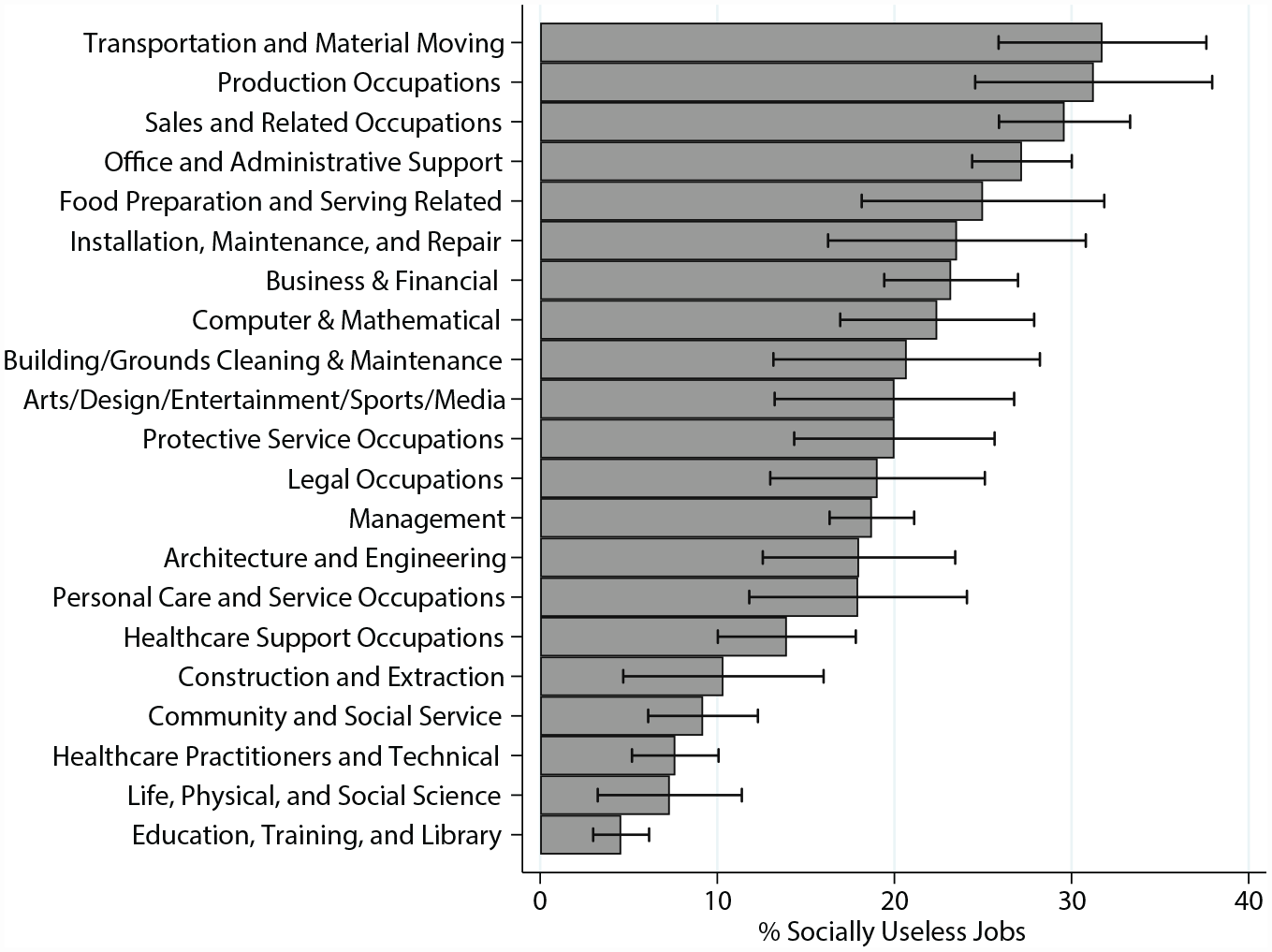
Percentage of socially useless jobs by occupation.
Similar analyses can of course be carried out for other categorical variables. This is depicted in Figure 2. First, we see that the share of workers who consider their jobs socially useless is higher in the private sector than in the non-profit or the public sector. This is in line with the theory on public service motivation. Further, jobs involving teamwork are less likely to be considered socially useless, which supports the idea that social interaction is a relevant factor. Finally, salaried workers consider their jobs socially useless more often than self-employed workers. The descriptive analyses thus also show first support for the argument of Wolfe and Patel (2019).
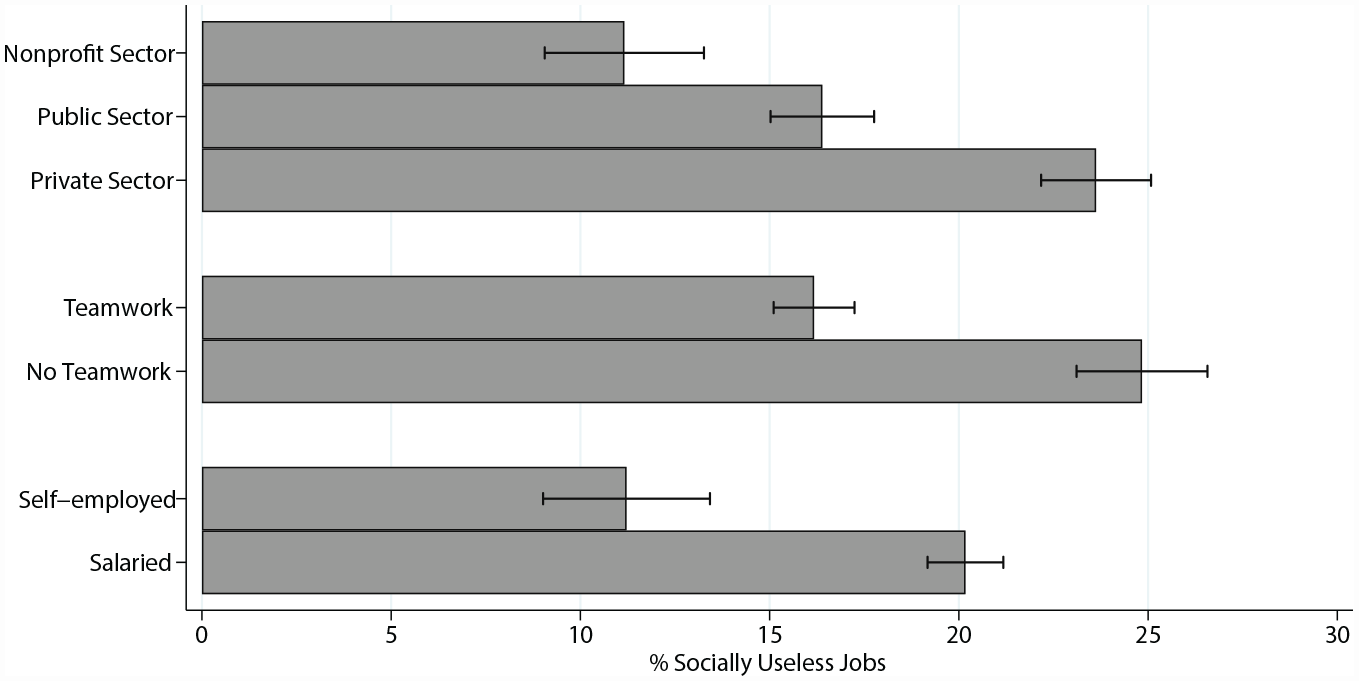
Percentage of socially useless jobs by categorical variables (with standard errors).
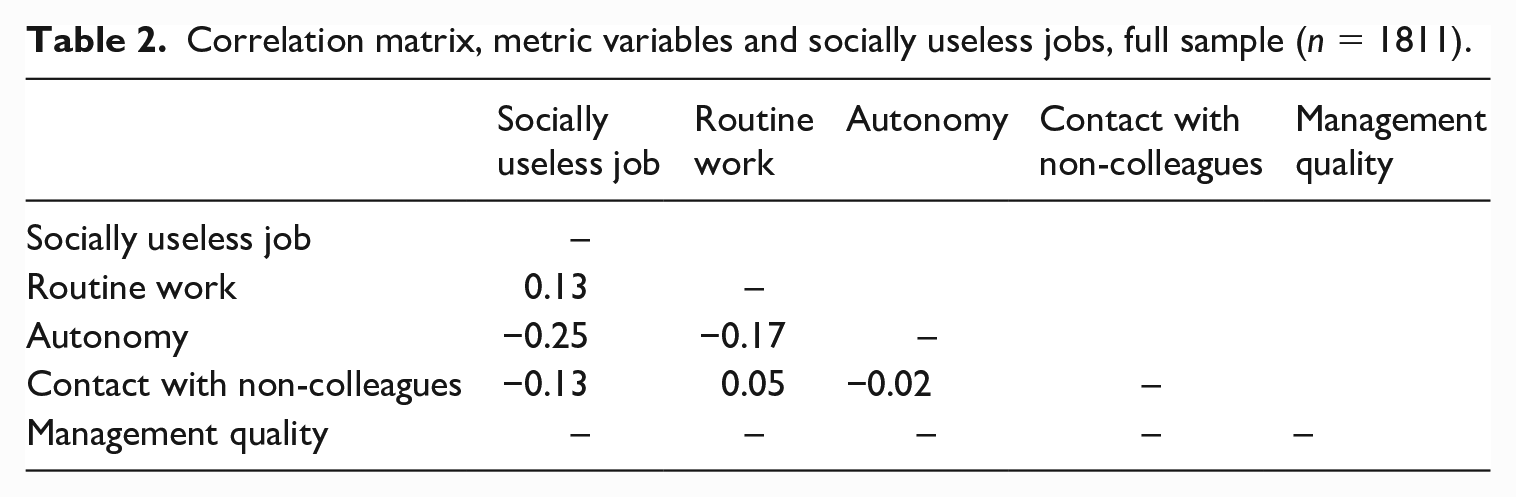
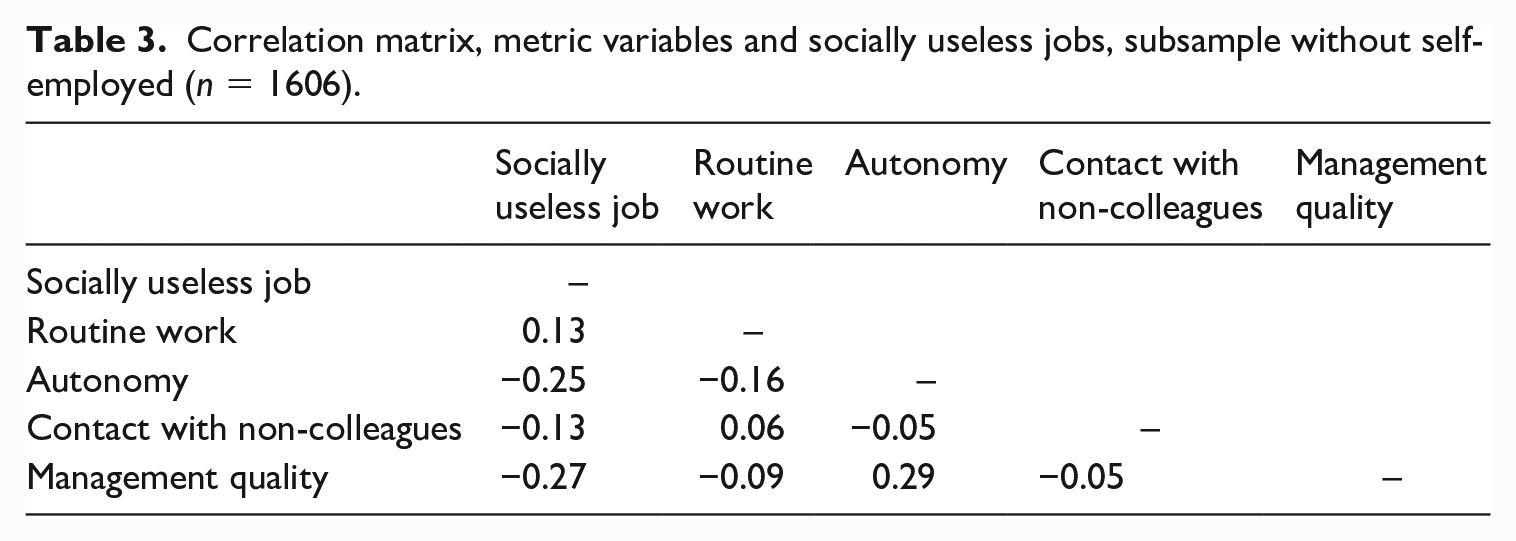
In addition to the categorical variables, Tables 2 and 3 display the correlations between all metric variables and the perceived usefulness of jobs (useful = 0, useless = 1). Table 2 contains the values for the full sample (n = 1811) but excludes the variable on management quality since self-employed workers are included in the sample who do not have superiors. Table 3 in turn excludes self-employed workers (n = 1606) and includes the variable on management quality. As both tables display clearly, however, the values for most variables do not differ much between the two samples. Thus, on the one hand, we find that jobs with a high share of routine tasks are more likely to be considered socially useless. On the other hand, we also find that jobs providing high levels of autonomy, much contact with non-colleagues and high management quality are negatively correlated with perceiving a job as socially useless. These results therefore also provide preliminary support for the effects of social interaction and alienation.
Correlation matrix, metric variables and socially useless jobs, full sample (n = 1811).
Correlation matrix, metric variables and socially useless jobs, subsample without self-employed (n = 1606).
Regression models
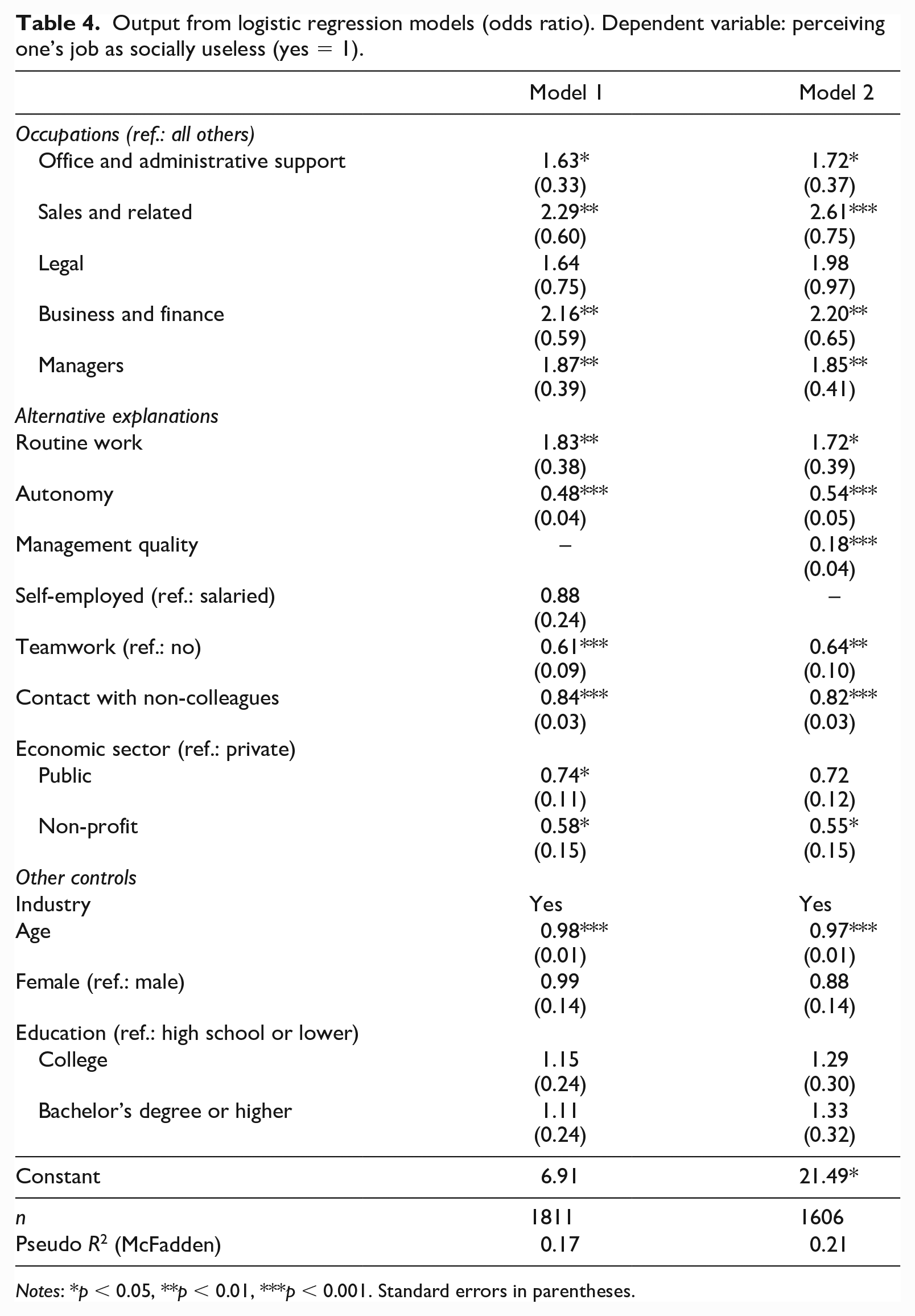
To test the hypotheses derived from Graeber’s theory, two binary logistic regression models are estimated. Both these models estimate the probability of respondents to perceive their job as socially useless (1) instead of socially useful (0). As explained above, however, management quality cannot be measured for self-employed workers. Therefore, model 1 is based on the full sample (n = 1811) but does not control for management quality. Model 2, on the other hand, controls for management quality but excludes self-employed workers in turn (n = 1606). Other than that, both models include all available explanatory and control variables. Results from these models are reported in Table 4.
Output from logistic regression models (odds ratio). Dependent variable: perceiving one’s job as socially useless (yes = 1).
Notes: *p < 0.05, **p < 0.01, ***p < 0.001. Standard errors in parentheses.
At the top of Table 4, one finds that four of the five occupations of interest display a positive coefficient that is statistically significant in both models. This means that – all else being equal – working in one of them is statistically associated with a higher probability of perceiving one’s job as socially useless when compared with other occupations. This effect is most pronounced for sales occupations. Compared with the reference group, working in sales thus increases the odds of perceiving one’s job as socially useless by a factor of 2.29 (model 1) or even 2.61 (model 2). A similarly strong effect is observed for business and finance occupations who are around 2.2 times more likely to consider their jobs socially useless than the reference group. Further significant positive effects, albeit of lesser magnitude, are observed for office and administrative assistants as well as for managers. Only for legal occupations, neither model estimates a significant effect. Despite reasonably large coefficients (1.64 and 1.98), the small number of AWCS respondents working in legal occupations (42 or 33 without self-employed) leads to relatively large standard errors for this group and thus makes it unlikely to find any significant effects. In sum, these models therefore find significant support for hypotheses H1, H2, H4 and H5, but not for H3. Graeber’s theory is therefore mostly supported by the data used in this article.
The next section in Table 4 contains all variables linked to the alternative explanations presented above. Here, again, we find that all variables except one are significantly associated with perceived job uselessness as expected. Thus, routine work is associated with a higher probability of perceiving one’s job as socially useless while more autonomy and better management decrease the probability of doing so. All aspects of alienation discussed in the literature therefore seem to be relevant, which clearly confirms previous findings (Dur and van Lent, 2019; Soffia et al., 2022). Next, both teamwork and contact with non-colleagues are significantly associated with a lower probability of perceiving one’s job as socially useless. This supports the idea that social interaction helps individuals to feel that their work is useful to other people. Further, Table 4 also shows that working in the public or the non-profit sector is associated with a lower probability for workers to perceive their jobs as socially useless compared with working in the private sector. The data used here therefore also support the explanation based on public service motivation. Self-employment, however, does not seem to have a significant effect according to these models. As additional analyses suggest, the low share of self-employed workers considering their jobs socially useless can mainly be explained by their higher autonomy relative to salaried workers. This casts some doubt on the findings of Wolfe and Patel (2019) who did not control for autonomy in their analyses.
Among the other control variables, only age displays a statistically significant effect. People therefore tend to consider their jobs more socially useful with older age. However, the data used here cannot determine whether this is in fact an age or a cohort effect. Gender and education, on the other hand, do not seem to be relevant here.
The model fit is reasonably high for both models, with pseudo R2 values (McFadden) of 0.17 and 0.21. The goodness-of-fit was also assessed using the Hosmer–Lemeshow test, indicating a good model fit for both models (model 1: χ2(8) = 5.25, p = 0.73; model 2: χ2(8) = 5.94, p = 0.65). Combining the theory on BS jobs and various alternative factors therefore seems to be a fruitful approach to explaining why people consider their jobs socially useless.
Predicted probabilities
The findings above already offer robust support for Graeber’s (2018) theory as most relevant coefficients are shown to be statistically significant. Compared with all others, working in Graeber’s occupations therefore increases the probability of perceiving one’s own job as socially useless. However, such a statement only concerns relative probabilities and does not indicate how high these probabilities really are. This section therefore also provides data on the predicted probabilities to perceive one’s job as socially useless conditional on working in a specific occupation.
Figure 3 displays the predicted probabilities obtained from the two regression models in Table 4. It shows that people working in one of Graeber’s occupations consider their jobs socially useless with a probability of between 0.17 (office and administrative support) and 0.21 (sales and related). This means that people, who work in these occupations and who have fully average characteristics otherwise, are expected to consider their jobs socially useless with a probability of between 0.17 and 0.21. Average people working in other occupations, however, only consider their jobs to be socially useless with a probability of 0.11. The 95% confidence intervals again show that these differences are statistically significant for all hypothesized occupations except for legal occupations, which are underrepresented in the AWCS sample and therefore display large standard errors.
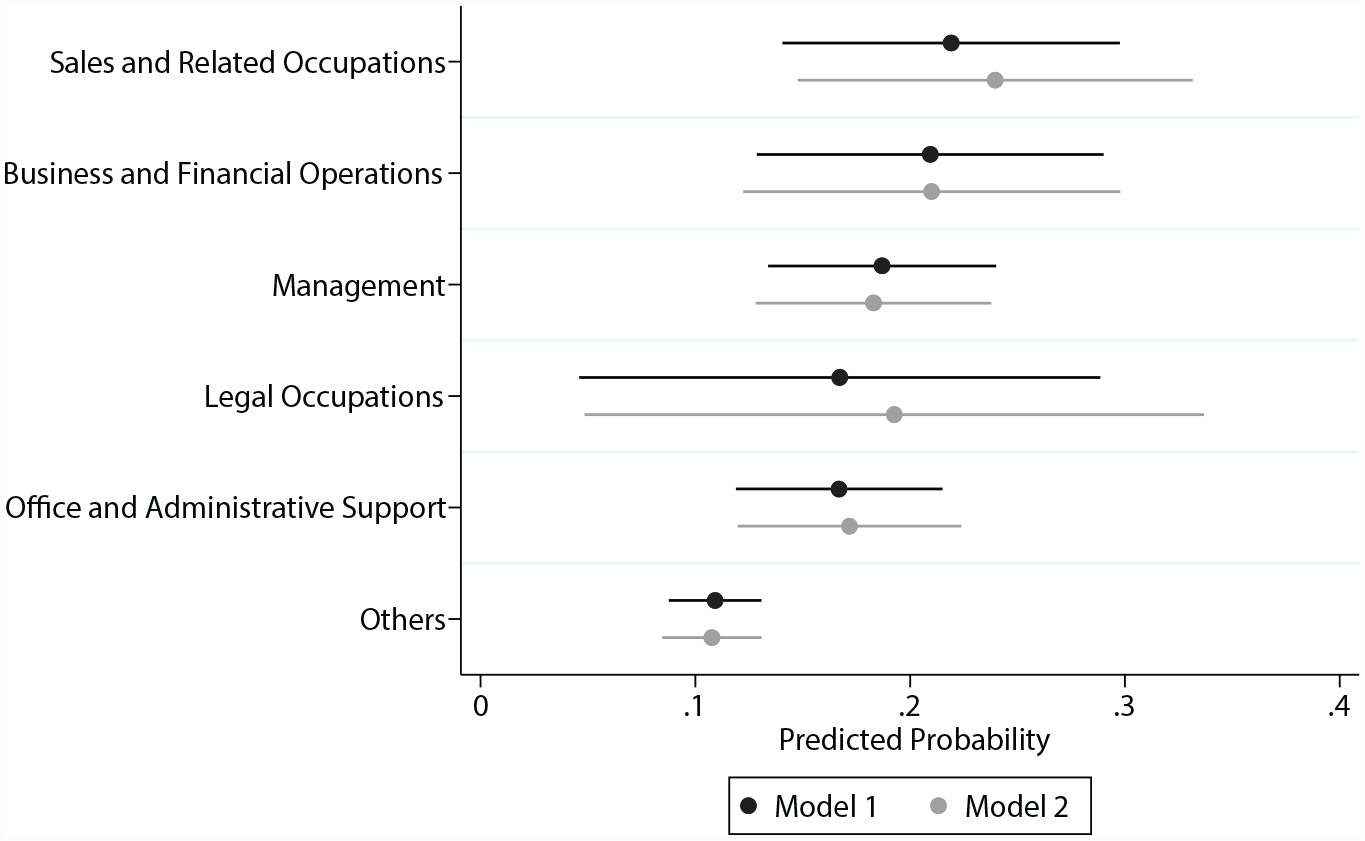
Predicted probabilities and 95% confidence interval for hypothesized occupations.
It may be even more interesting, however, to estimate and compare the predicted probabilities of Graeber’s occupations with the 16 occupations that were grouped together so far. This would allow, for example, an examination of how Graeber’s occupations perform in comparison with other occupations with a high share of socially useless jobs (see Figure 1) once other factors are controlled for. Thus, the effect of working in an occupation may become weaker or stronger than suggested by the descriptive data, depending on the effect of control variables. ‘Transportation and material moving’ occupations, for example, have the highest share of workers who perceive their jobs as socially useless. However, this could be explained by factors such as routine work or autonomy. In this case, working in these occupations would not have an effect itself.
To compare all occupations with each other, another regression model is estimated that includes the same variables as model 1 above. The only difference to model 1 is that the variable for occupations now distinguishes between all 21 occupations instead of only six. This way, it is possible to calculate predicted probabilities for all occupations and rank them based on how strongly they are associated with socially useless jobs. To compare these probabilities with the original distribution of socially useless jobs, another model is estimated using only occupations as independent variables. Figure 4 displays the predicted probabilities from both these models. Results from the fully specified model are depicted in black and those from the ‘occupations only’ model are shown in grey.
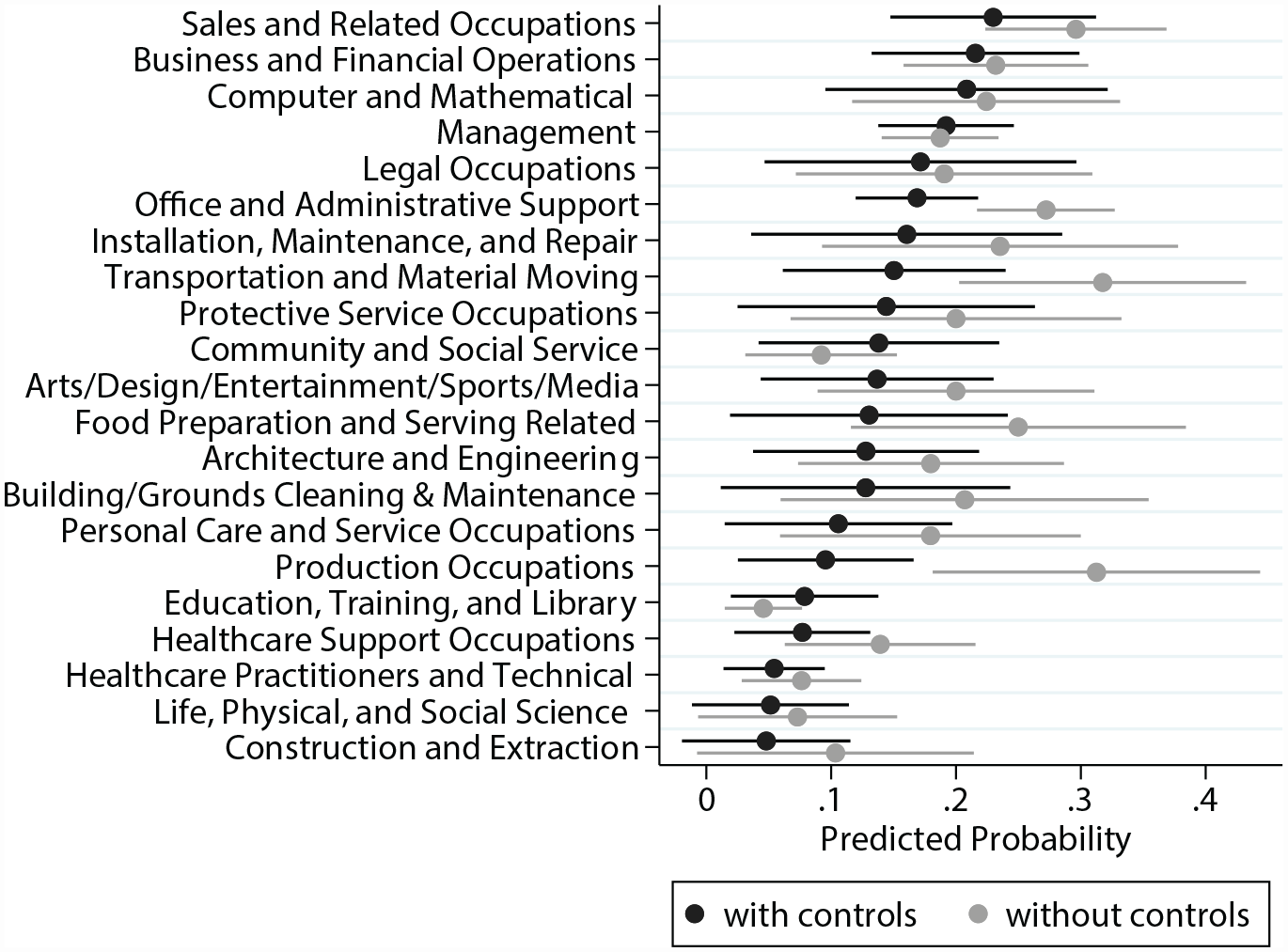
Predicted probabilities and 95% confidence interval for all occupations, with and without control variables.
Figure 4 displays several findings. First, one notices that most confidence intervals overlap and that there are no statistically significant differences between most occupations in these models. This is due to the small group sizes if all occupations are examined individually. These results should therefore be interpreted with caution. Nevertheless, they offer some valuable insights. Thus, one also notices that most predicted probabilities move closer to zero once control variables are included. This is not surprising because the control variables can explain some of the variance in the dependent variable. Thus, the remaining effect of working in an occupation represents the variance between occupations that is not explained by control variables, which also affects the predicted probabilities. This leads to different results for different occupations. ‘Transportation and material moving’ occupations, for example, display the highest value in the model without controls since they have the highest share of socially useless jobs. When control variables are included, however, the predicted probability shrinks by more than 50%. This means that the high share of socially useless jobs in this group can be explained to a large part by the control variables and the occupation itself is not that strongly associated with socially useless jobs. Interestingly, however, Graeber’s five occupations all end up on top of the list now, thus displaying the strongest association with being perceived as socially useless when control variables are included. Only ‘computer and mathematical’ occupations have a similarly high predicted probability. 5 Assuming that all relevant factors are controlled for, this further supports Graeber’s theory.
Discussion and conclusion
Using survey data from the US, this article tests Graeber’s (2018) argument that socially useless jobs are primarily found in specific occupations. Doing so, it finds that working in one of Graeber’s occupations significantly increases the probability that workers perceive their job as socially useless (compared with all others). This is true for administrative support occupations, sales occupations, business and finance occupations, and managers. Only legal occupations did not show a significant effect as predicted by Graeber’s theory. More detailed analyses even reveal that, of all 21 occupations, Graeber’s occupations are the ones that are most strongly associated with socially useless jobs when other factors are controlled for. This article is therefore the first to find quantitative evidence supporting Graeber’s argument. In addition, this article also confirms existing evidence on various other factors that can explain why people consider their jobs socially useless, including alienation, social interaction and public service motivation.
These findings may seem somewhat contradictory to the results of Soffia et al. (2022) who find that Graeber’s theory is not supported by their data. This can be explained by several differences between their study and this one. First, Soffia et al. ask people whether they ‘have the feeling of doing useful work’, while this study asks them whether they think they are making a ‘positive impact on [their] community and society’. These differently worded questions may elicit different responses. However, additional analyses show that results do not differ much between these questions (see online supplementary appendix C). Second, Soffia et al. examine data from Europe, while this study uses data from the US. This supports the notion that Graeber’s theory may only apply to heavily financialized Anglo-Saxon countries. Third, the results of Soffia et al. are based on raw distributions over occupations, while the findings presented here are mainly based on regression models that control for various other factors. If only raw distributions are analysed, however, this article also finds only limited support for Graeber’s theory.
This article therefore agrees with Soffia et al. (2022) that Graeber’s theory alone cannot explain why people perceive their jobs as socially useless. Instead of rejecting the theory altogether, however, the findings presented here suggest that it merely needs a slight modification. Thus, Graeber claims that people are usually correct in assessing the usefulness of their own jobs. This seems somewhat overstated, as results show that people’s perception is also affected by various factors unrelated to actual usefulness. People may therefore not only consider their jobs to be socially useless because they truly are (Graeber), but also because unfavourable working conditions can sometimes ‘make meaningful work look meaningless’ (Dur and van Lent, 2019: 11). Work perceived as socially useless is therefore a complex phenomenon and should be treated accordingly. By giving up the assumption that people are usually right in their assessment, however, all other aspects of Graeber’s theory can be upheld. Thus, some jobs may in fact be useless to society, even if this is only one reason among others why people perceive them as such.
If jobs can be perceived as socially useless for different reasons, this means that different measures can be taken to address the problem. Thus, some workers may benefit from improving working conditions, for example by reducing factors leading to alienation or by increasing social interaction at work. If one considers the possibility that some types of work are inherently useless to society, however, this has entirely different implications. To alleviate this problem, one would have to make adjustments in the economic system and restrict activities with little or no use to society. Graeber himself, for example, proposes a universal basic income that would allow people to decline working in a job that they consider socially useless. Alternatively, policymakers may regulate certain useless or harmful activities and attempt to align them more closely with socially desirable purposes. Frequently discussed examples are a stricter regulation of the financial sector or setting limits to sales strategies (e.g. by banning ads from public spaces) (Inderst and Ottaviani, 2012).
This article therefore also adds to a growing body of literature that challenges the dominance of purely economic reasoning often found in economic research and policymaking. As part of this literature, various prominent voices are calling for the economy to be more closely aligned with social and ecological criteria (e.g. Fioramonti et al., 2022; Hickel, 2020; Raworth, 2017; Schwab, 2021). This article shows that such a view can also be expressed with respect to work. Thus, it seems to have long been the consensus that the main goal of labour market policy is to achieve full employment and good working conditions. This is well illustrated by the European Union’s former strategic goal to create ‘more and better jobs’ (European Council, 2000). Graeber’s view, however, radically changes focus by asking whether work is actually beneficial to workers and to society at large. Work is thus recognized not only as a necessary economic activity that produces goods and provides people with an income but also as a way to contribute to society that can in itself be deeply meaningful to people. Such a perspective clearly deserves more attention.
Study limitations
Finally, as in most empirical research, the analyses in this article also have several limitations. First, all analyses conducted here are based on cross-sectional survey data. This means that they can only provide evidence of a possible causal relationship, but they cannot definitely prove causality. Thus, it may also be true, for example, that people’s attitudes towards work make them choose certain occupations instead of occupations causing the attitudes. Other methods, such as experiments, may be needed to establish a stronger causal relationship between variables. In addition, the data used in this article only cover a single country, which means that any findings may not be applicable to other contexts than the US. This is especially plausible since Graeber’s theory suggests that it only applies to highly financialized countries such as the US. Further, this article uses a relatively small sample of 1811 workers. In consequence, the number of respondents per occupation is rather low in some cases. Insignificant effects may therefore be caused by large standard errors and not by small true effect sizes. Related to this is the problem that occupational categories are not detailed enough in the AWCS dataset used here. This makes it hard to examine all the occupations that Graeber wrote about. For this reason, several occupations were not considered at all in the empirical analyses, while others were represented by more general categories (e.g. ‘legal occupations’ instead of ‘corporate lawyers’). Using a larger dataset would certainly allow the occupations to be broken down into more detailed categories and more precise analyses to be conducted. Finally, one must also consider that, even though this article supports Graeber’s argument, it cannot show that certain jobs are in fact socially useless. It merely shows that people are more likely to consider their jobs socially useless if they work in certain occupations pointed out by Graeber. Whether these jobs are in fact socially useless or not, cannot be determined here and will be left to the reader for interpretation.
Supplemental Material
sj-pdf-1-wes-10.1177_09500170231175771 – Supplemental material for ‘Bullshit’ After All? Why People Consider Their Jobs Socially Useless
Supplemental material, sj-pdf-1-wes-10.1177_09500170231175771 for ‘Bullshit’ After All? Why People Consider Their Jobs Socially Useless by Simon Walo in Work, Employment and Society
Footnotes
Acknowledgements
I would like to express my gratitude to the editor, Donald Hislop, and the three anonymous reviewers for their valuable and insightful comments, which greatly helped to improve the quality of this manuscript. I am also indebted to Jörg Rössel, Robert Dur and Max van Lent for their thoughtful feedback on earlier versions of the manuscript. Their contributions were crucial in shaping the direction and scope of this project. Finally, I would like to pay tribute to the late David Graeber, who was a prolific scholar and activist. His intellectual curiosity and passion for social justice inspired many, including myself. This work is dedicated to his memory.
Funding
The author received no financial support for the research, authorship, and/or publication of this article.

Supplementary material
The supplementary material is available online with the article.
Notes
References
Supplementary Material
Please find the following supplemental material available below.
For Open Access articles published under a Creative Commons License, all supplemental material carries the same license as the article it is associated with.
For non-Open Access articles published, all supplemental material carries a non-exclusive license, and permission requests for re-use of supplemental material or any part of supplemental material shall be sent directly to the copyright owner as specified in the copyright notice associated with the article.
