



Abstract
Why does becoming more aware of yourself and your wider work environment enable you to experience greater meaningful work? Drawing upon mindfulness-to-meaning and interpersonal sensemaking theories, we argue that in a state of awareness individuals are cognitively flexible and are able to interpret relevant interpersonal cues in ways that enable them to experience their work as meaningful. Study 1 is a quantitative diary study over a period of six weeks that tests the state-level relationships between awareness, cognitive flexibility, and meaningful work. We find that awareness is, directly and indirectly, related to three of four dimensions of meaningful work via cognitive flexibility. Study 2 qualitatively explores what individuals cognitively attend to in the social context when they reflect upon the most meaningful work events that occurred each week, over four weeks. Findings reveal that ambivalent work events are experienced as meaningful when individuals attend to interpersonal cues in their work context that convey a sense of worth, care, and/or safety. Overall, our article advances knowledge about meaningful work as a state-level experience that is facilitated by awareness, cognitive flexibility, and cues from the social context. It shows the importance of integrating meaningful work, mindfulness, and interpersonal sensemaking literatures.
Keywords
Introduction
The need for individuals to experience their work as meaningful is emphasized by researchers and practitioners alike (Fletcher and Robinson, 2016; Lysova et al., 2019; Rosso et al., 2010). Defined as an individual’s experience of work as being personally significant, worthwhile, and valued, meaningful work provides important work and career-related benefits, such as increased engagement, satisfaction, and motivation at work. It also helps contribute to organizational success as such experiences promote high-quality performance, creativity, and prosocial/citizenship behavior (for reviews, see Allan et al., 2019; Bailey et al., 2019). Given the purported benefits, significant effort has been made to better understand which factors facilitate meaningful work (for reviews, see Lysova et al., 2019; Rosso et al., 2010). However, much of the evidence draws on arguments from traditional job design literature (Hackman and Oldham, 1976), which views meaningful work as a positive job attitude and suggests a rather static view of meaningful work. This static view has recently been challenged by research acknowledging the fluctuating nature of meaningful work experiences – that is, referring to it as a state-level construct that varies within, and between, working weeks (Bailey and Madden, 2016, 2017; Fletcher, 2017; Geldenhuys et al., 2020; Mitra and Buzzanell, 2017; Vogel et al., 2020). Not only do these emerging studies support the view that meaningful work is a state-level experience, but they also empirically show that there is a difference in how meaningful work impacts other work outcomes, depending on whether it is considered a between-persons, trait-level or a within-persons, state-level construct (e.g. Fletcher et al., 2018; Vogel et al., 2020).
Meaningful work as a state-level construct resonates with the multidimensional nature of meaningful work as conceptualized by Lips-Wiersma and Morris (2009). The authors identify four ‘content’ dimensions of meaningful work that interrelate with each other, namely unity with others, serving others, expressing full potential, and developing and becoming self. Focusing on these dimensions helps capture a range of concrete, everyday experiences of meaningful work that individuals may or may not encounter during a work week, rather than treating it as a more abstract general feeling that one’s work is meaningful (Lips-Wiersma and Morris, 2009). Making a shift toward studying meaningful work as a multidimensional, state-level experience is therefore important for enriching our understanding of this phenomenon and for advancing knowledge on how meaningful work may influence fluctuations in other state-level outcomes (e.g. engagement – Fletcher et al., 2018, job performance – Geldenhuys et al., 2020, etc.). Practically, enriching a multidimensional, state-level understanding of meaningful work experience has implications for how organizations, managers, and Human Resources (HR) professionals can provide a support infrastructure that facilitates everyday experiences of meaningful work.
Despite the importance of considering meaningful work as a state-level phenomenon, research that explicitly studies it in this way remains scarce and theoretical theorizing is underdeveloped. This limits the maturation of the meaningful work field and the understanding of the factors that contribute to, and explain, fluctuations in experiences of meaningful work. To address this shortcoming, we turn to Mindfulness-to-Meaning Theory (MMT) (Garland et al., 2015a, 2015b, 2017) and related research on mindfulness at work (e.g. Bishop et al., 2004; Brown et al., 2007). Although MMT aims to explain how engagement in mindfulness practice contributes to fluid eudemonic meaning-making and, eventually, to human flourishing, it brings to the forefront the cognitive-affective processes that can also explain fluctuations in meaningful work. In this article, we particularly focus on awareness and cognitive flexibility as core elements of a specific cognitive-affective process underpinning state-level meaningful work. Awareness, defined as the state of noticing or attending to internal and external experiences (e.g. cognitions, emotions, events, sensations, etc.), occurs in the present moment with an attitude of curiosity (Baer et al., 2006; Lau et al., 2006), and is seen by MMT as the instrumental input for an adaptive reappraisal of events into positive and meaningful ones (Garland et al., 2015a, 2015b, 2017). Concurrently, meaningful work studies also point to the importance of individuals attending to their experiences in the present to reflect on their significance within a wider timescape, enabling individuals to experience their work as meaningful (Bailey and Madden, 2017). Drawing further on MMT, we argue that cognitive flexibility (i.e. a psychological state in which individuals feel able to adapt their thinking, emotions, and behaviors to a new situation; Martin and Rubin, 1995) serves as an important mediator in the positive relationship between awareness and meaningful work at the state level. We test these assumptions in Study 1 in which we conducted a quantitative weekly diary study over a period of six weeks.
We conducted Study 2 (with a different methodology and a separate set of participants) to zoom in on the nature of the socio-contextual information that individuals attend to when they become aware of themselves and their work environment in relation to their experiences of meaningful work during their working weeks (Garland et al., 2015a, 2015b, 2017). While MMT does not explicitly discuss the importance of attending to the information in the social context, it is at the core of interpersonal sensemaking theory (Wrzesniewski et al., 2003). This theory argues that different others at work (e.g. colleagues, supervisors, and beneficiaries) provide interpersonal cues, which individuals, in turn, interpret to see the value and significance of their work. Still, our knowledge remains limited about the information signaled by interpersonal cues that enable individuals to interpret and, where needed, reappraise their work as meaningful. We therefore draw on the interpersonal sensemaking perspective on meaning creation (e.g. Dutton et al., 2016; Wrzesniewski et al., 2003) to zoom in on the specific interpersonal cues that individuals attend to and utilize when reflecting on how meaningful their work experiences are. To do so, we analyze qualitative data collected from 45 individuals who reflect upon the meaningful work events that occurred for them each week over a period of four weeks. Our findings from Study 2 therefore complement Study 1 by addressing what precisely is the socio-contextual information that individuals in a state of awareness attend to that enables them to experience their work as meaningful, which was not theorized by MMT.
Taken together, Study 1 and Study 2 contribute to the much-needed development of the growing, yet scarce, research area that examines meaningful work as a state-level phenomenon (Bailey and Madden, 2017; Fletcher et al., 2018; Geldenhuys et al., 2020; Mitra and Buzzanell, 2017; Vogel et al., 2020). Our article is among the first to empirically examine the cognitive-affective antecedents of state-level meaningful work. It shows that both awareness and cognitive flexibility are important factors contributing to the understanding of meaningful work at a state level. Moreover, we utilize MMT to provide a strong theoretical ground for understanding how awareness relates to meaningful work at a state level. In line with the logic of MMT, it empirically tests the mediating role of cognitive flexibility in this state-level relationship. By so doing, our article extends a repertoire of theories that can help to explain the factors that contribute to the creation and sustenance of meaningful work. This is much needed owing to the absence of strong theoretical foundations in the literature (Bailey et al., 2019; Lysova et al., 2019). Lastly, this research contributes to the literature that examines how others at work enable an individual to experience their work as meaningful (e.g. Dutton et al., 2016; Wrzesniewski et al., 2003). We show that when individuals attend to interpersonal cues that convey a sense of worth, care, and/or safety, they experience ambivalent work events as meaningful ones.
Theoretical background
Meaningful work as a fluctuating experience
Meaningful work 1 broadly reflects an individual’s experience of their work as being personally significant, worthwhile, and valued; and as such should be differentiated from ‘meaning of work’, which concerns what work represents to people; for example, work is just a means to an end or it is a calling (Lysova et al., 2019; Rosso et al., 2010). Recent research shows that meaningful work represents a fluctuating subjective experience rather than a static positive job attitude – which is a view traditionally taken by the job design literature (Hackman and Oldham, 1976). For example, the qualitative studies by Bailey and Madden (2017) and Mitra and Buzzanell (2017) both reveal an ‘episodic’ and ‘temporal’ nature of meaningful work. Bailey and Madden (2017) focus on workers within three different occupations and explore how all jobs have the potential to be both meaningful and meaningless; they find that experiences of meaningful work arise episodically through work experiences that are shared, autonomous, and temporally complex. Mitra and Buzzanell (2017) draw on in-depth interviews with sustainability practitioners to show how experiences of meaningful work derive from circumstances and factors that are both enabling and constraining; stemming from various organizational, professional, and political structures. This fluctuating nature of meaningful work is also salient in quantitative studies where meaningful work experiences are found to fluctuate at weekly (Geldenhuys et al., 2020), daily (Vogel et al., 2020), and situational (Fletcher et al., 2018) levels. These quantitative studies show how meaningful work can be examined at the state level by incorporating within-person differences.
In conceptualizing meaningful work, we recognize the importance of acknowledging its multidimensional nature and draw on the conceptualization suggested by Lips-Wiersma and Morris (2009) as it represents a more comprehensive and holistic way of capturing meaningful work (Both-Nwabuwe et al., 2017). In particular, Lips-Wiersma and Morris (2009) conceptualize meaningful work as a subjective experience arising from its four core dimensions: (a) unity with others (i.e. a sense of shared values and a sense of belonging); (b) serving others (i.e. a sense of making a contribution to the well-being of others); (c) expressing full potential (i.e. feeling able to express one’s talents and creativity, and gain a sense of achievement); and (d) developing and becoming self (i.e. a sense of being true to one’s self and engaging in personal and moral development). These dimensions address the tension that exists in meeting the needs of the self and the needs of others; and the need for being as well as the need for doing (Lips-Wiersma and Morris, 2009). To experience work as meaningful, individuals continuously reflect on their work experiences in light of the relations between these different needs and the desire to balance them (Lips-Wiersma and Morris, 2009). Therefore, this conceptualization also supports the fluctuating nature of meaningful work experiences.
Given the limited existing theorizing of what facilitates meaningful work as a state-level experience, we draw on MMT (Garland et al., 2015a, 2015b, 2017) as it is concerned with understanding cognitive-affective processes integral to eudemonic meaning-making and human flourishing. Generally speaking, MMT argues that the practice of mindfulness (i.e. the intentional and calm attention to the flow of experience) evokes a broadened awareness, which enables adaptive reappraisal of one’s self and the world, and ultimately results in positive affect and a greater sense of meaningful work (Garland et al., 2017). In this way, MMT emphasizes the critical role of a flexible state of awareness in facilitating reappraisals of events into positive and meaningful ones. This is because awareness allows individuals to access previously unattended sensory information important for constructing these reappraisals (Garland et al., 2015a, 2015b, 2017). The importance of awareness in deepening one’s capacity to experience work as meaningful is also voiced in Bailey and Madden’s (2017: 15) work, which draws on Schutz’s notion of the ‘vivid present’, showing that meaningful work is experienced when moments in the present acquire significance in relation to their past and future. For individuals to experience their work as meaningful, they need to be aware of what is taking place in the present to be able to reflect on its significance within a wider timescape. As can be seen, both MMT and the study of Bailey and Madden (2017) emphasize the importance of being in the state of awareness in the present moment for experiencing meaningful work. This view on awareness as a state rather than a trait-level construct finds support in empirical diary studies on awareness as one of the components of mindfulness, showing it represents a fluctuating experience too (e.g. Haun et al., 2020; Hülsheger et al., 2013). Therefore, we argue that awareness is an important state-level factor contributing to meaningful experiences at work.
Awareness and meaningful work
Drawing on the logic of MMT (Garland et al., 2015a, 2015b, 2017), we define awareness as the state of noticing or attending to internal and external experiences (e.g. cognitions, emotions, events, sensations, etc.) that occur in the present moment with a quality of curiosity (Baer et al., 2006; Lau et al., 2006). Awareness allows individuals to do, feel, think, perceive, or sense something while being aware that they are doing so (Reb et al., 2015). In a state of awareness, individuals engage in continuous monitoring of stimuli in their internal and external environments (Brown and Ryan, 2003). Awareness is seen to be an essential facet of state-level mindfulness (Baer et al., 2006; Bishop et al., 2004; Brown and Ryan, 2003). Yet, it should be distinguished from decentering – the metacognitive process of psychologically distancing oneself from one’s thoughts, emotions, or physical sensations (Bernstein et al., 2015) – which according to MMT is the process by which the state of awareness emerges (Garland et al., 2015a, 2015b, 2017). Drawing on mindfulness literature more broadly, we expect that awareness may directly facilitate experiences of meaningful work because it adds ‘clarity and vividness’ to individuals’ current experiences (Brown and Ryan, 2003; Brown et al., 2007: 219). Therefore, individuals in a state of awareness have a better understanding of what is occurring both within themselves and within the wider environmental context, thus enabling them to reflect on the significance of their experiences. We proceed by discussing how awareness can contribute to each dimension of our multidimensional conceptualization of meaningful work.
First, when individuals are in a state of awareness, they are not only aware of the context they are in (external environment) but also of themselves (internal environment) (Brown and Ryan, 2003). Therefore, they can acquire a greater understanding of their ‘true’ selves and their values, allowing greater feelings of authenticity (Dietl and Reb, 2021; Leroy et al., 2013). A state of awareness also makes individuals sensitive to everyday activities that spark their interest and enjoyment (Donald et al., 2020). Having a greater understanding of their values and taking an interest in everyday activities at work enables individuals to evaluate how ‘true’ they are to themselves; thus, meaningful work can be experienced in this way through the dimension of developing and becoming self.
Second, awareness enables individuals to experience their work as meaningful by expressing their full potential. Research shows that when individuals are in a state of awareness, they are more likely to engage in values-consistent behavior; that is, a freely chosen behavior that is consistent with how individuals wish to respond within the broader context of their life and long-term goals (Smout et al., 2014), which is likely to enable talents and creativity to be expressed (Donald et al., 2016, 2020). Prior research also provides empirical support that awareness contributes to better performance (Dane and Brummel, 2014; Shao and Skarlicki, 2009) because it guards against distractions and performance blunders (Herndon, 2008), and improves problem-solving (Ostafin and Kassman, 2012).
Third, individuals who are in a state of awareness are also likely to recognize the significance of their efforts aimed at addressing the needs of others (i.e. serving others), which enhances their sense that their work is meaningful because awareness enriches a person’s understanding of their context and how it influences a situation (Dekeyser et al., 2008; Hafenbrack et al., 2020; Hölzel et al., 2011). Therefore, individuals better attune and understand the needs of others (e.g. colleagues, customers, etc.), making these others more salient in their minds and, therefore, they are more helpful toward those people (Hafenbrack et al., 2020). Indeed, prior research finds that awareness is associated with greater organizational citizenship behavior, perspective-taking, and prosocial behavior (Hafenbrack et al., 2020; Reb et al., 2015).
Fourth, awareness contributes to individuals experiencing a greater sense of unity with others as it enables them to connect better, and have more successful communication, with others (Bavelas et al., 2000; Hafenbrack et al., 2020), thereby fulfilling their needs of relatedness (Brown and Ryan, 2003). Awareness also enables individuals to align their self with the needs of others (Hafenbrack et al., 2020), which can foster stronger bonds with colleagues and members of the groups they are part of. Such bonding can also be facilitated because, when in the state of awareness, individuals engage in greater empathy – feeling others’ emotions (Dekeyser et al., 2008), which allows them to have closer emotional connections.
Taken all together, we hypothesize that awareness is directly positively related to all dimensions comprising meaningful work experiences at the state level:
Hypothesis 1: Awareness is positively related to meaningful work at the state level (its dimensions of unity with others, serving others, expressing full potential, and developing and becoming self).
The mediating role of cognitive flexibility
While awareness can directly contribute to experiences of meaningful work, MMT specifically articulates the process that explains why it happens. Namely, it suggests that awareness facilitates a greater capacity to experience the meaningfulness within one’s work owing to enabling individuals to flexibly adapt their appraisals of events and situations, where negative and stressful situations are reappraised into positive and meaningful ones (Garland et al., 2015a, 2015b, 2017). Therefore, drawing on the arguments of MMT, we propose that cognitive flexibility, which we view as a psychological state in which individuals feel able to adapt their thinking, emotions, and behaviors to a new situation (Martin and Rubin, 1995), serves as an important mediator in the positive relationship between awareness and meaningful work at the state level. While cognitive flexibility is often utilized in research as a trait, a recent review by Cherry and colleagues (2021) finds that unlike other flexibility concepts it incorporates ‘an aspect of taking action’ and can be examined by employing state-like behavioral tasks, supporting its state-level nature.
In line with MMT, we see cognitive flexibility as a ‘cognitive self-regulatory’ state-level mechanism that entails individuals feeling able to engage in meaningful adaptations of their ‘incorrect and unwholesome cognitive evaluations’ of events and experiences (Garland et al., 2017: 4; Moore and Malinowski, 2009: 184). With access to previously unattended contextual information that awareness provides, individuals can adapt how they view these events and experiences. Thus, they have more opportunities to attend to positive features of the socio-environmental context for seeing alternative options for adapting and coping with the situation (Martin and Rubin, 1995; Moore, 2013). Thereby, individuals can ‘fluidly reconstruct meaning’ from the encounter with the situation and reappraise potentially negative or stressful events and experiences into positive and meaningful ones (Garland et al., 2015b: 385; Garland et al., 2017). For example, when individuals are forced to take a challenging leadership role, they may perceive this as a stressful work event. Yet, when they are in the state of feeling able to adapt their cognitive evaluations of this event, they are likely to view the event as more positive and consider it, for example, as a personal and professional development opportunity (i.e. developing and becoming self), an opportunity to realize their creative ideas (i.e. expressing full potential), an opportunity to improve how the organization addresses customer and employees’ needs (i.e. serving others), and an opportunity to work with others (i.e. unity with others).
In line with arguments from MMT, prior research shows that state-level awareness is positively associated with a greater state-level cognitive flexibility (e.g. Feldman et al., 2007; Greenberg et al., 2012; Moore, 2013; Moore and Malinowski, 2009). Furthermore, cognitive flexibility is an important mediating mechanism explaining how individuals process their contextual environment to cope with negative or stressful events and experience greater well-being (Koesten et al., 2009; McCann and Webb, 2012), which is often studied as an outcome of meaningful work (for review, see Bailey et al., 2019). We, therefore, hypothesize the following:
Hypothesis 2: Cognitive flexibility mediates the positive relationship between awareness and meaningful work at the state level.
Although MMT notes that in a state of awareness individuals extensively attend to socio-contextual information to enable fluid and positive meaning construction (Garland et al., 2015a, 2015b, 2017), the theory does not discuss the nature of this information. In turn, the importance of attending to this information for experiencing one’s work as meaningful is at the core of interpersonal sensemaking theory (Wrzesniewski et al., 2003). This theory asserts that employees rely on interpersonal cues – ‘meaningful chunks of other’s behaviors’ they receive from colleagues, supervisors, and beneficiaries of their work – as sources of information about the value or significance of their job, role, and self in the organization (Wrzesniewski et al., 2003: 103–104). According to the theory, when employees pay attention to other people’s actions, these noticed actions serve as cues that employees begin to make sense of. After noticing the cues, employees engage in the interpretation of whether a cue is affirming, or disaffirming, of an employee’s significance, followed by the interpretation of why someone acted the way they did. These cues then allow individuals to see whether their work is meaningful or whether they need to alter the content of their job and role, or how they view themselves, to experience their work as meaningful. Complementary to this theory, Dutton et al.’s (2016) social valuing framework suggests that daily interactions with others foster an individual’s sense of felt worth – a sense of importance accorded to them by others – which is central to their experiences of meaningful work. These interpersonal cues are not only important sources for experiencing one’s work as meaningful, but they are also salient for the temporal co-creation of meaningful work experiences over time (Bailey and Madden, 2017). To better understand what contributes to interpretations of work experiences as meaningful when individuals are in a state of awareness, we aim to explore the following research question in Study 2:
RQ: To which social-contextual information do individuals attend so that they experience their work as meaningful?
Taken together, this article reports on the results of two studies, each with a different methodology and unique set of participants: Study 1 is a quantitative study that tests the above mentioned two hypotheses; Study 2 is a qualitative study that zooms in on the contextual information that individuals attend to when in a state of awareness so they can experience greater meaningful work.
Study 1
Participants
Participants were drawn from four subsamples: (a) UK National Health Service employees; (b) local governmental employees within a Dutch municipality; (c) teachers from a small private school in Dubai; and (d) fitness instructors in the Netherlands. These samples were chosen because we wanted to (a) focus on various service-oriented occupations, and (b) have individuals from a range of countries represented. This was appropriate given that the meaningful work literature highlights the relevance of these concepts to the provision of services, particularly to the public (e.g. Bailey and Madden, 2017), and to a wide range of countries/cultures (e.g. Lysova et al., 2019). A total of 120 participants were recruited, of whom 90 completed the work diary (75% response rate), whereby 49 (54%) were healthcare workers, 20 (22%) were local governmental employees, 15 were teachers (17%), and six were fitness instructors (7%). Nearly three-quarters were female, around a third had managerial responsibilities, the average age was 39.73 years (SD = 10.38), and the average tenure in the organization was 10.12 years (SD = 9.69).
Quantitative work diaries
Participants were asked to complete a weekly diary for six weeks. We focus on weekly perceptions because previous research on meaningful work highlights how these constructs fluctuate over such timeframes (e.g. Geldenhuys et al., 2020). This timeframe is salient to participants given that most of the participants’ employment contracts are in line with hours worked per week, and a general layperson’s understanding of the temporality of working life tends to focus on the concept of a ‘working week’. Participants were encouraged to jot down notes of significant events over the course of the working week so that they could reflect on these when it came to completing the diary at the end of each working week. Two-thirds of the participants completed all six weekly diaries, with the rest completing at least two.
Measures
Participants were instructed to focus on the range of work situations they had experienced over the course of the working week. All measures, unless otherwise stated, use a seven-point Likert scale (1 = strongly disagree, 7 = strongly agree), and are modified to reflect a weekly perspective; for example, ‘This week . . .’.
State-level awareness
Three items were adapted from the curiosity subscale of the Toronto Mindfulness Scale (Lau et al., 2006); for example, ‘This week, I was curious about my reactions to things that happened at work.’ Inter-item reliability ranged from α = .72 and α = .90 (mean α = .80) across the measurement occasions.
State-level cognitive flexibility
Three items were adapted from Martin and Rubin’s (1995) cognitive flexibility scale; for example, ‘This week at work, I was willing to work at creative solutions to problems.’ Inter-item reliability ranged from α = .70 and α = .85 (mean α = .79) across the measurement occasions.
State-level meaningful work
Lips-Wiersma and Wright’s (2012) four dimensions of meaningful work were captured by modifying three items for each of their respective scales: unity with others (e.g. ‘This week, my colleagues and I talked about what mattered to us’); serving others (e.g. ‘This week, I felt I truly helped our patients/customers/clients’); expressing full potential (e.g. ‘This week, I experienced a sense of achievement at work’); and developing and becoming self (e.g. ‘This week at work, my sense of what was right and wrong got blurred’ (reverse coded)). Each dimension had average reliability of between α = .74 and α = .83 across the measurement occasions. Furthermore, multilevel confirmatory factor analyses (MCFAs) confirmed that the four-dimensional factor structure was a reasonable fit of the data: χ²(96) = 198.03, p < .001; χ²/df = 2.06, RMSEA = .05, CFI = .93, SRMR between = .09, SRMR within = .04. This model was a better fit than the best fitting one-: Δχ²(12) = 267.09, p < .001; Δχ²/df = 2.25, ΔRMSEA = .04, ΔCFI = .16, ΔSRMR between = .01, ΔSRMR within = .11; two-: Δχ²(10) = 109.67, p < .001; Δχ²/df = 0.84, ΔRMSEA = .01, ΔCFI = .06, ΔSRMR between = –.03, ΔSRMR within = .08; and three-factor alternatives: Δχ²(6) = 32.48, p < .001; Δχ²/df = 0.20, ΔRMSEA = .01, ΔCFI = .01, ΔSRMR between = .00, ΔSRMR within = .01.
Control variables
We controlled for the effect of time by including a continuous variable that represented each diary entry (n) as the number of days that had passed from the first diary entry to the nth diary entry. To strengthen causality, we controlled for the lagged effects of our outcome variables in each analysis (e.g. when predicting the impact of awareness and cognitive flexibility on a meaningful work dimension, the lagged effect of that meaningful work dimension was controlled for; for predicting the impact of awareness on cognitive flexibility, the lagged effect of cognitive flexibility was controlled for). At the between-person level, we controlled for subsample by creating relevant dummy variables (healthcare 0 – no, 1 – yes; teacher 0 – no, 1 – yes; local government 0 – no, 1 – yes), gender (0 – female, 1 – male), and age (in years).
Analytical method
Multilevel modeling has been conducted using MLwiN version 3.01 (Rasbash et al., 2015). The data are hierarchically ordered at two levels: measurement occasion (N = 475 occasions over six weeks non-lagged, 385 occasions over five weeks using the lagged variables) 2 clustered within the individual (N = 90). Iterative Generalized Least Squares Estimator (IGLS) estimation is used, higher-level variables are grand-mean centered, and lower-level variables are centered on the person’s mean. Random intercept and random slope models have been conducted where slopes for awareness and cognitive flexibility are allowed to vary across individuals. The Monte Carlo Method for Assessing Multilevel Mediation (MCMAM) (Preacher and Selig, 2010) is used to verify mediation effects in our 1-1-1 multilevel models. MCMAM is a repeated simulation (20,000 repetitions) of a (relationship between predictor and mediator) x b (relationship between the mediator and dependent variable) whereby mediation should be accepted if the 95% confidence interval of the indirect effect does not contain zero. In the mediation testing, the random slopes for the a- and b-paths are specified as covarying at the individual level (i.e. level 2, where the strength of the within-person relationship is allowed to vary across individuals).
Results
Descriptive statistics
The intraclass correlations show that between 40.44% (expressing full potential) and 60.66% (unity with others) of variance in the dimensions of meaningful work, 48.25% in awareness, and 49.49% of the variance in cognitive flexibility is attributed to within-person fluctuations, thus supporting the application of multilevel analysis. Means, standard deviations, and correlations are given in Table 1.
Descriptive statistics for the variables in Study 1.
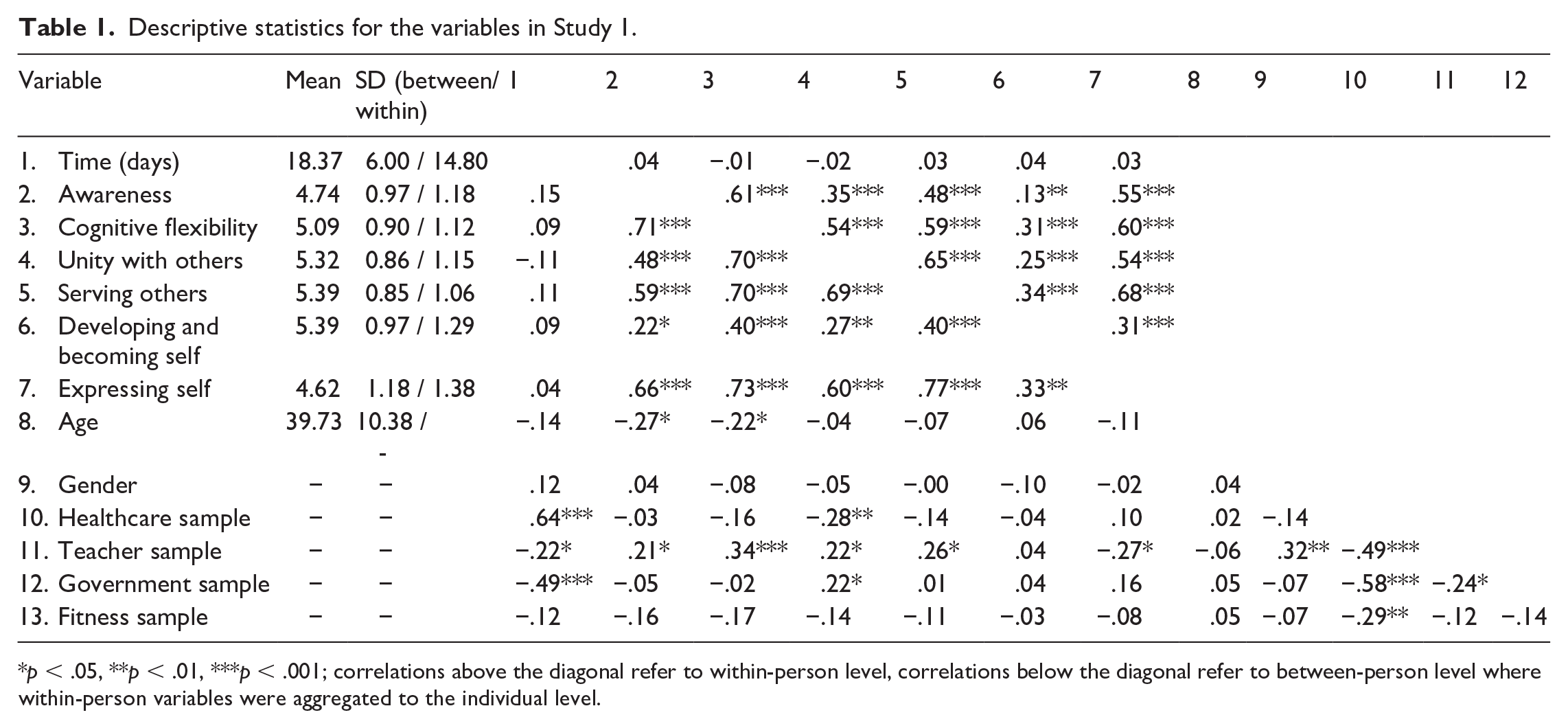
*p < .05, **p < .01, ***p < .001; correlations above the diagonal refer to within-person level, correlations below the diagonal refer to between-person level where within-person variables were aggregated to the individual level.
Measurement models
We ran MCFAs to explore the within-person factorial structures of our six core study measures (awareness, cognitive flexibility, unity with others, serving others, developing and becoming self, expressing full potential). This measurement model shows a satisfactory fit with the data: six constructs, χ²(120) = 329.73, p < .001; χ²/df = 2.74, RMSEA = .06, CFI = .91, SRMR within = .06, SRMR between = .00. We compare our measurement model with two alternative models. In Alternative Model 1, we combine awareness and cognitive flexibility into one factor: five constructs, Δχ²(5) = 77.52, p < .001; Δχ²/df = 0.52, ΔRMSEA = .01, ΔCFI = .03, ΔSRMR within = .01, ΔSRMR between = .00. In Alternative Model 2, we combine the four dimensions of meaningful work into one factor: three constructs, Δχ²(12) = 336.54, p < .001; Δχ²/df = 2.31, ΔRMSEA = .03, ΔCFI = .13, ΔSRMR within = .03, ΔSRMR between = .00. The results therefore demonstrate that our measurement model supports the discriminant validity of the study’s core state-level constructs.
Test of hypotheses
Table 2 shows the results of the multilevel models predicting the four dimensions of meaningful work. 3 Model 1 extends a baseline control model by including state-level cognitive awareness and its slope. Results show that state-level awareness is positively related with three of the four dimensions: unity with others (γ = .32, p < .001), serving others (γ = .28, p < .001), and expressing full potential (γ = .45, p < .001). However, state-level awareness is not significantly related to the dimensions of developing and becoming self (γ = .03, p > .05). Therefore, Hypothesis 1 is mostly, yet not completely, supported.
Multilevel analyses for predicting meaningful work outcomes and cognitive flexibility in Study 1.
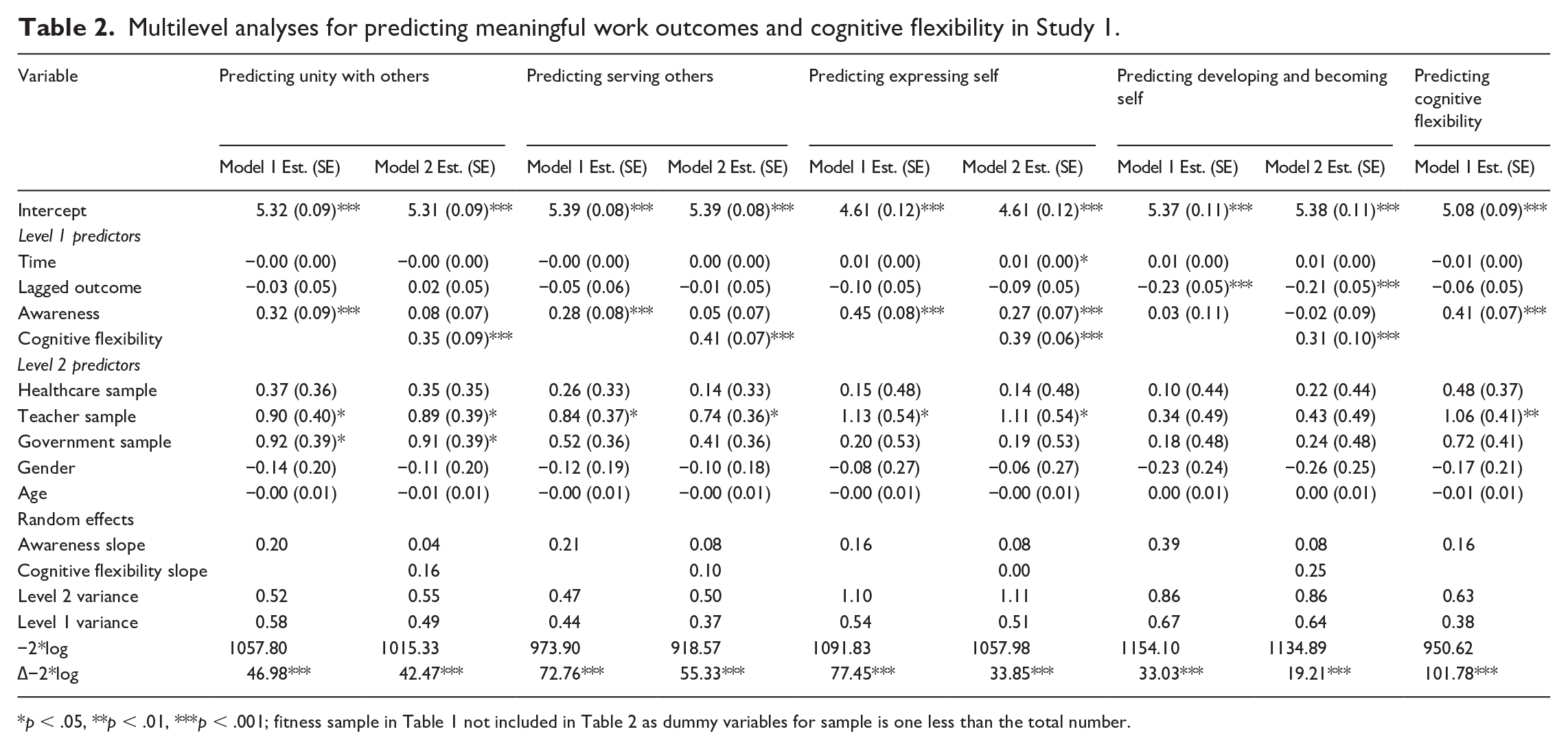
Model 2 in Table 2 extends Model 1 by including state-level cognitive flexibility and its slope. Results show that state-level cognitive flexibility is positively related with all four of the dimensions of meaningful work: unity with others (γ = .35, p < .001), serving others (γ = .41, p < .001), expressing full potential (γ = .39, p < .001), and developing and becoming self (γ = .31, p < .001). The model also shows that the relationships between state-level awareness and the dimensions of meaningful work are reduced when cognitive flexibility is included.
A separate set of multilevel analyses was undertaken, shown also in Table 2, for predicting state-level cognitive flexibility with Model 1 extending a baseline control model by including state-level awareness and its slope. Results show that awareness is positively related to cognitive flexibility (γ = .41, p < .001).
To ascertain whether cognitive flexibility mediates the relationships between awareness and the four dimensions of meaningful work at the within-person level (and to fully test Hypothesis 2), MCMAM tests have been performed (Preacher and Selig, 2010). The results of these tests show that the indirect effect between awareness and three dimensions of meaningful work via cognitive flexibility are significant: unity with others (ab = 0.15; 95% CI 0.02 to 0.25), serving others (ab = 0.17; 95% CI 0.06 to 0.23), and expressing full potential (ab = 0.16; 95% CI 0.09 to 0.23). However, the indirect effect of awareness on developing and becoming self via cognitive flexibility is not significant (ab = 0.13; 95% CI −0.09 to 0.22). Using a standardized effect size calculation (Preacher and Kelley, 2011), the largest effect is seen with serving others (0.19) followed by unity with others (0.15) and expressing full potential (0.14). Developing and becoming self dimension had the smallest effect (0.11). The pseudo R² calculations reveal that around 6% of the additional variance is explained in unity of others by cognitive flexibility, 11% in serving others, 4% in expressing full potential, and 3% in developing and becoming self. As a rule of thumb, these findings indicate that the indirect effect for serving others is relatively strong, with unity with others and expressing full potential as being relatively moderate, and developing and becoming self as not significant given the 95% CI range included zero. The results therefore mostly, yet not completely, support Hypothesis 2.
Study 2
The findings of Study 1 indicate that when individuals are in a state of awareness during a working week, they are potentially better able to experience their work during that week as meaningful. This, as Study 1 shows, may be partly owing to how being aware of one’s self and the wider work context at that time enables individuals to adapt their thoughts, feelings, and behavior in ways that foster experiences of meaningfulness. Given these findings, we were interested in furthering our understanding of this process by exploring which specific elements in the broader work environment shape individuals’ meaningful work experiences. In particular, we sought to clarify the socio-contextual information that individuals in a state of awareness attend to and utilize to make sense of their meaningful work experiences. We focus on the social context given the potential relevance, yet scarcity of knowledge regarding the role of others and interpersonal cues in facilitating the subjective experience of meaningful work (Bailey and Madden, 2017; Dutton et al., 2016; Wrzesniewski et al., 2003). Therefore, we have conducted an explorative qualitative study guided by the question: to which social-contextual information do individuals attend to so that they experience their work as meaningful?
Data collection
The qualitative data in this study used a different set of participants to Study 1 and were collected as part of a meaningful intervention study conducted by one of the authors of this article (Fletcher and Schofield, 2021). That study was concerned with testing the psychological effects of an individual-level meaningful work intervention in three organizations: (a) Public Co – a large non-ministerial department of the UK Government; (b) Engineering Co – a large multinational company within the defense and security sector with a main site in the UK; and (c) Financial Co – a large financial mutual based in the UK. For this current study, we have used weekly qualitative data collected as part of the meaningful intervention study (N = 45: Public Co = 12; Engineering Co = 17; Financial Co = 16), which were not analyzed nor were they directly used in the intervention article itself. The data were collected only from participants in the intervention. Although the wider intervention included various activities aiming to facilitate meaningfulness, the specific exercise we focus on in this current article aimed to get participants into a focused state of awareness for a period of 10 to 15 minutes each week – in particular, they were asked to think about the wider external environment and their internal thoughts and feelings in relation to specific meaningful events that happened to them that week. We wanted to understand more about what specific aspects they attended to when being more aware of themselves within the wider work context in relation to specific meaningful work situations. In this way, we purposefully sampled the respondents for our study (Patton, 1990). We asked intervention participants to reflect on the most meaningful events/situations they experienced each week during the four weeks after the initial training participants received. Each participant described these meaningful events/situations concerning (a) the nature, feelings, and emotions that they were experiencing owing to the event/situation and (b) their explanation of why this event/situation was experienced as meaningful.
Data analysis
As this qualitative study builds on the theoretical argumentation and results of Study 1, for the sake of theoretical parsimony, we have chosen not to adopt an additional theoretical perspective for making sense of our emergent findings. Instead, we rely broadly on research explaining how others at work help to create meaningful work experiences to make sense of our data (e.g. Dutton et al., 2016; Wrzesniewski et al., 2003). This allows us to focus on exploring the nature of the information in the social context that individuals attend to when in a state of awareness. We follow a well-established procedure of inductive thematic analysis, allowing the identified themes to be closely related and driven by data (Braun and Clarke, 2006).
The data analysis started with us separately reading through and familiarizing ourselves with the data. This enabled us to form ideas about what interesting insights the data provide regarding the social-contextual information that is important for experiencing work as meaningful to guide our coding. As our data collection was centered on individuals recalling meaningful work events in each week, we started by coding ‘incident by incident’ (Charmaz, 2006: 53), exploring, and comparing the reasons for experiencing these work events as meaningful. After an independent coding process, all authors in the team met to discuss and compare the codes generated. Based on the agreed coding achieved after several iterations, the following categories of reasons were identified: ‘helping others’, ‘performing’, ‘receiving positive feedback and appreciation’, ‘learning and development’, and ‘involvement and participation’. When discussing these different events, we saw that some of the events represent either situations that are characterized by positive emotions that could easily spark experiences of meaningful work or situations that are characterized by conflicting perceptions, conflicting feelings, and/or emotions or conflicting experiences that require attention to cues from the social context to experience them as meaningful. The simultaneous experience of both positive and negative emotions about situations in the workplace and the feelings of tension and conflict, as a result, are captured as emotional ambivalence in the literature (Rothman et al., 2017). However, we find that such conflicts in work events within our dataset were not solely limited to feelings and emotions, but also extended to perceptions and experiences. Therefore, we decided to not use the label ‘emotional’ but to label them broadly ‘ambivalent’. Consequently, this difference in events was captured by inductively developing the two themes, which we label as ‘unequivocal work events’ and ‘ambivalent work events’. Events captured in the latter theme particularly offered explanations about which cues from the social contexts are important for individuals to experience meaningful work when events are accompanied by conflicting feelings, emotions, perceptions, and/or experiences. Also, as the majority of research tends to associate meaningful work with positive emotions and experiences (e.g. Rosso et al., 2010) and only some argue that meaningfulness can also be associated with experiences of mixed thoughts and feelings (e.g. Bailey and Madden, 2016), we felt it was promising to zoom in on the meaning-making in these ambivalent work events.
To explore the complex meaningful events in the data further, we independently coded these specific events for factors that enabled individuals to experience work as meaningful; with particular attention to those related to the social context. After discussing, comparing, and merging similar codes, we identify three themes: others conveying a sense of worth, others conveying a sense of care, and others conveying a sense of safety. In the process of making sense of these themes and findings, we find that they reflect insights from prior research on the relational information that is important for shaping individuals’ experiences at work (Dutton et al., 2016). We proceed with discussing these themes in greater detail in the following section.
Findings
Our qualitative data show that there are many examples of ambivalent work events that arise in different forms. These events depict participants’ involvement in significant meetings or situations that are characterized by performance achievement, opportunities to help others, or opportunities to participate in decision-making processes. While these events arise in different forms, they all have in common that individuals experience either conflicting feelings and/or emotions or conflicting perceptions and/or conflicting experiences. In the illustration below, Luna describes how she had conflicting feelings about a situation in which she offered to help the director because she felt that they had let that person down. She also explains realizing that she should have never felt bad and notes that she will even work on this in the future: I felt cross that I hadn’t spotted that the director had not been kept up-to-date with developments. I felt that I had let her down. I felt that it was my responsibility. In contrast, I felt pleased that I had the courage to go and speak to the director face to face, that I had done so quickly . . . and that I had offered to help. I did what I could to help. If I’m honest, I shouldn’t have felt so bad about what happened at the meeting as it wasn’t my fault – it made me aware that I need to take less responsibility for things that aren’t to do with me and showed me that this is an area that I need to work on. (Luna, Government Co)
Another illustration describes conflicting perceptions of an individual seeing himself as knowledgeable and skillful in helping other people solve difficult work issues, yet they were often not being approached or asked to utilize their expertise to actually help someone on a daily basis: I felt I was genuinely helping someone who had found himself in a difficult situation at a very difficult time which isn’t something I get to do every day. I’ve worked hard to build up my technical knowledge and it isn’t often I get to use this to help someone solve a problem at a difficult time in their life. (Conan, Financial Co)
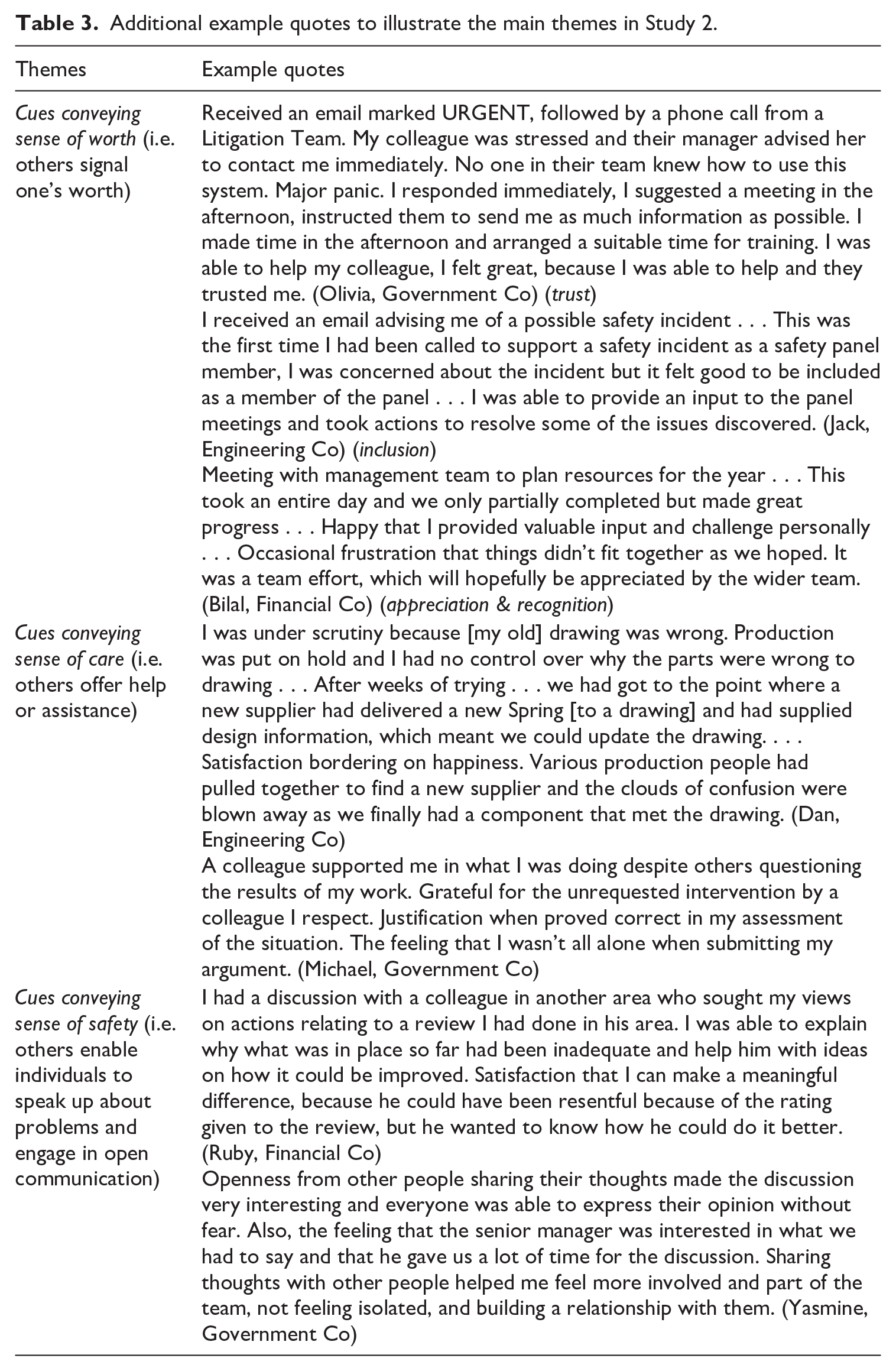
To make sense of these ambivalent work events, and to experience them as meaningful, we find that participants rely heavily on cues from the social context. These interpersonal cues are actions or behaviors provided by co-workers, managers, customers, and significant others that signal how a person is valued. By paying attention to these interpersonal ‘cues’ participants engage in a process of interpersonal sensemaking (Wrzesniewski et al., 2003). Particularly, participants describe using interpersonal cues to experience ambivalent work events as meaningful. When exploring the nature of these interpersonal cues, we identify that these are cues conveying a sense of worth, a sense of care, and a sense of safety. Table 3 provides additional exemplary quotations with fictional participants’ names for each of the three main themes. We further elaborate on our findings below.
Additional example quotes to illustrate the main themes in Study 2.
Cues conveying a sense of worth
Our analysis reveals that ambivalent work events are experienced as meaningful when participants signaled cues that convey others’ appraisals of their worth. According to the social valuing perspective, a sense of worth is ‘a fundamental gauge of social inclusion and respect from others’ (Dutton et al., 2016: 4). Participants’ worth is sensed when others provided appreciation and recognition for their work, showed them that they trusted them, or when they included them in important work activities. We further find that appreciation and recognition are conveyed as interpersonal cues in situations in which participants describe feeling insecure about their competencies or ability to achieve a performance in a stressful uncertain situation. Participants describe that when managers or co-workers informed them that they recognized and appreciated their input in such situations or when they expected others to appreciate their input, they evaluated the work event as meaningful (and positive). Trust is conveyed as an interpersonal cue in situations in which participants describe receiving requests from others to take on a challenging responsibility for the first time. Although participants were anxious to take on the responsibility, when they felt that others trusted they could succeed, participants evaluated the situation as a positive meaningful experience. Finally, inclusion is conveyed in situations in which participants felt they were heard by others, something that they had troubles experiencing in other situations. In the illustration below, Maria signals inclusion: A member of the Monitoring Team approached me about an issue where it was felt that we were breaching a rule, which resulted in customer detriment . . . Pleased that my opinion was being sought and that I would have an opportunity to improve the outcome for customers. Wary because I knew my opinion would be badly received by the business area. I felt satisfaction that I could have an impact on an issue which would significantly improve the amount of return customers received, which was what had been initially offered to customers. I sometimes feel that I am a lone voice, championing treating customers fairly over profit. (Maria, Financial Co)
Cues conveying a sense of care
In this theme, participants describe that they were involved in a stressful situation for which, for example, they had to solve a problem or simply meet an important deadline for work. Participants explain that they still evaluated such stressful situations as positive meaningful ones because others at work directly offered them help or assistance. Under this theme, interpersonal cues are also indirect non-verbal gestures (Wrzesniewski et al., 2003), but they reflect more active behaviors of others. This theme is illustrated in the example below in which Paul explains that he was relieved when a colleague supported him in finding a solution to address an urgent customer concern while Paul could not do that himself: A colleague of mine was able to progress some urgent work on my behalf that would otherwise have come to a standstill while I was working away in [another country]. . . . [it was important] to respond in a timely manner to prevent any damage to the organization’s reputation with the customer. . . . Partly relief that we would be able to address the customer’s concerns as quickly as possible but also happy that I felt able to trust someone else in my team to do as good a job as I felt I could have done. (Paul, Engineering Co)
Cues conveying a sense of safety
Participants describe signaling cues that they could openly communicate with others about specific topics or speak up about problems and raise concerns to colleagues, which helped them to experience ambivalent work events as meaningful. In this theme, interpersonal cues are indirect non-verbal gestures (Wrzesniewski et al., 2003), signaling to participants that they are part of a safe work environment. For instance, Peter describes that he had felt he could have an open and honest discussion with others at work in which he could challenge the ‘status quo’ or raise certain work-related issues. Because of this, he could experience the work event as meaningful: In a project board meeting, there was a lot of rhetoric about progress on a particular, high-profile piece of work. I challenged the rhetoric and I could set out what I knew to be the truth of the situation. This instigated a more open and honest discussion around what was actually happening and means that the problems are now out in the open and can be addressed . . . I felt a little nervous challenging the status quo but justified in doing so. I felt that I had done the right thing to call out poor practices, which were being played down by others on the board in order to push through delivery to the detriment of customers. It was meaningful to me because I knew I was doing the right thing raising issues for the ultimate benefit of customers. (Peter, Financial Co)
In sum, when we zoom in on the ‘ambivalent work events’ we find that interpersonal cues enable individuals to experience work events that are accompanied by either conflicting feelings, emotions, perceptions, and/or experiences as meaningful. We further clarify that these interpersonal cues convey a sense of worth, a sense of care, or a sense of safety to individuals.
Discussion
Although research extensively points at the importance of meaningful work for individuals and organizations (Bailey et al., 2019; Lysova et al., 2019; Rosso et al., 2010), meaningful work is often seen as a static, unidimensional positive job attitude rather than a multifaceted, experience that is subject to change. The need to make this shift in perspective is increasingly emphasized as a critical step toward the development of the meaningful work field (e.g. Bailey and Madden, 2017; Fletcher et al., 2018; Lips-Wiersma and Morris, 2009; Mitra and Buzzanell, 2017). We conducted two studies to contribute to advancing the understanding of the within-person fluctuations of meaningful work as a multidimensional phenomenon. Study 1 draws on MMT (Garland et al., 2015a, 2015b, 2017) and utilizes quantitative weekly diary data to examine how awareness relates to meaningful work at a state level, via cognitive flexibility as a mediating cognitive-affective process. Study 2 draws on the interpersonal sensemaking perspective (Dutton et al., 2016; Wrzesniewski et al., 2003) and analyzes reflective qualitative weekly data collected during a meaningfulness intervention to explore what specific information individuals attend to when in a state of awareness to experience their work as meaningful. Overall, our results support our predictions based on MMT, showing awareness to be an important antecedent of state-level meaningful work as it enables people to have greater cognitive flexibility. We also show that when individuals attend to distinct interpersonal cues in the wider work environment, they experience ambivalent work events as meaningful, which further points to the value of extending interpersonal sensemaking theory to better understand meaningful work experiences (Wrzesniewski et al., 2003). Importantly, in our study, participants benefited from attending to cues that convey a sense of worth, care, and/or safety. Therefore, our results contribute to a growing yet limited knowledge on meaningful work as a complex state-level phenomenon.
By showing that awareness positively relates to state-level meaningful work, we enrich knowledge on the antecedents of fluctuations in meaningful work experience. Although Bailey and Madden (2017) argue that individuals need to be aware of what is taking place, and be able to reflect on its significance, to experience their work as meaningful, they do not explore awareness as a factor contributing to meaningful work at the state level. Drawing on MMT (Garland et al., 2015a, 2015b, 2017) and related research on mindfulness at work (Bishop et al., 2004; Brown et al., 2007), we propose and empirically test the state-level relationship between awareness and meaningful work conceptualized as a multidimensional construct (Lips-Wiersma and Morris, 2009). Results show that state-level awareness is positively related to all dimensions of meaningful work except for the dimension of developing and becoming self. There are two possible explanations for this unexpected finding. First, conceptually, the dimension of developing and becoming self is particularly concerned with the integrity of one’s personal development (Lips-Wiersma and Morris, 2009). Being in a state of awareness is likely to have more of an impact on this dimension of meaningful work in contexts characterized by unethical practices such as lack of fairness and unworthy work as they were found to greatly impact the dimension of developing and becoming self (Lips-Wiersma et al., 2020). Our selected service-oriented sample is likely to provide less of such an ethically challenging context. Second, while the utilized multidimensional measure of meaningful work represents one of the most comprehensive measures in the current literature (Both-Nwabuwe et al., 2017), the subscale capturing the dimension of developing and becoming self seems less well integrated with the other subscales. This could point to potential measurement and/or construct-measurement alignment issues, therefore further validation studies may be needed. Moreover, there are additional conceptual elements covered by the Lips-Wiersma and Wright (2012) measure that we did not include; namely ‘existential continuums’ related to tensions when trying to fulfill all four dimensions of meaningful work and when trying to reconcile an imperfect reality with the broader aspirations of the person. These are not part of the core features that represent meaningful work, yet are interesting avenues for future research that seeks to explore how existential concerns may shape and interact with the experience of meaningful work over time.
Overall, our findings call for further research on the impact of awareness on meaningful work as a multidimensional and state-level phenomenon as well as on the role of work context or organizational factors on the state-level relationship between awareness and meaningful work. Awareness was positively related to three of four dimensions of meaningful work, whereas cognitive flexibility was positively related to all four dimensions. Although to our knowledge, we did not come across studies that examine cognitive flexibility as an antecedent of meaningful work, there is some related research in the calling literature that points to the importance of being flexible for enacting one’s calling. For instance, Lysova and Khapova (2019) show that being flexible in how one views one’s self at work helps individuals be more adaptable and see different ways of enacting their calling. Thus, cognitive flexibility appears to be a particularly promising and relevant factor to be examined by future research in relation to meaningful work.
Furthermore, by broadly supporting MMT’s proposition that cognitive flexibility serves as a mediating mechanism in the state-level relationship between awareness and meaningful work, we confirm the value of utilization of MMT for understanding the antecedents of meaningful work at the state level. As we draw on MMT (given the limited existing theorizing about state-level meaningful work), our research provides an illustrative example of how scholars can advance the field by drawing inspiration from theories in other research fields (see calls from Bailey et al., 2019; Lysova et al., 2019). Future research should test MMT more precisely by examining how mindfulness practice itself can contribute to fluctuations in meaningful work experiences. Taking this step is important not only for the theoretical advancement of MMT within the meaningful work context but also for testing the possibility of mindfulness as a practical tool for boosting awareness as well as facilitating everyday experiences of meaningful work. However, there is growing concern that mindfulness practice may be ‘sold as a panacea to fix . . . [all people-related] problems in organizations without changing potentially underlying structural problems’ (Hülsheger, 2015: 674). Critically, as Qiu and Rooney (2019) note, mindfulness interventions may carry ethical risks such as ‘soft’ work intensification and existential threats/anxiety, and so future research should consider ethical and structural factors that may distort the benefits of mindfulness for experiencing meaningful work.
Lastly, our findings reveal that when individuals reflect on meaningful work events experienced during a working week, they often attend to interpersonal cues that convey a sense of worth, care, or safety. These cues can help individuals to experience ambivalent work events as meaningful, even though initially they might not have been. By identifying and detailing these cues, we contribute to the research that acknowledges the important role others at work play in enabling individuals to experience meaningful work (e.g. Bailey and Madden, 2017; Dutton et al., 2016). We extend Wrzesniewski et al.’s (2003) theory of interpersonal sensemaking in the following ways. First, while the theory explains why interpersonal cues matter and how they help people to experience meaningful work, it does not explicitly zoom in on the information that is particularly relevant for individuals to attend to so they experience ambivalent work events as meaningful. The finding that interpersonal cues conveying a sense of worth, care, and/or safety matter for experiencing such work events as meaningful corresponds with growing attention toward the power of positive and respectful relationships at work often characterized by respect (Carmeli et al., 2015; Gerpott et al., 2020). Second, our findings suggest that receiving positive interpersonal cues can be another strategy to address tensions and emotional complexity inherent in everyday meaningful work, adding to the communicative negation strategy described in the study by Mitra and Buzzanell (2017) and the ways to address loneliness at the workplace (Wright and Silard, 2021). Taken together, our findings call for more research that zooms in on the role of relational information for understanding meaningful work as a fluctuating experience. It would be interesting to further explore the factors that can shape how impactful the information, provided by interpersonal cues, is for experiencing one’s work as meaningful. Although we utilize data from different contexts, our aim was not to compare them as separate cases but rather to develop generalized insights. However, the extent to which individuals can obtain this information from interpersonal cues may differ across occupational and organizational contexts. For example, in contexts characterized by high competition, people are less likely to be inspired by positive information provided in interactions with others (Watkins, 2021).
The findings of this article make an important first step toward connecting MMT (Garland et al., 2015a, 2015b, 2017) and interpersonal sensemaking theory (Wrzesniewski et al., 2003) in a useful way. We would like to call for more research that attempts to integrate the two theories conceptually and empirically in the following directions. First, although we identify three types of cues individuals attend to in a state of awareness, our data do not allow us to explore whether some of these cues are more important than others, whether they provide unique pathways to meaningful work, or whether they can interplay to have multiplicative effects. Related to this, although we find these cues to be particularly relevant in the context of ambivalent work events, it might be that some cues are more salient in certain contexts than in others. For example, Dutton et al. (2016) show that cues conveying worth are crucial for those working in cleaning professions. Second, although we find that cognitive flexibility influences state-level experiences of meaningful work and that it is facilitated by the attention to interpersonal cues, we could not explore with our qualitative data how this facilitation process happens. Future research could explore how individuals utilize interpersonal cues to cognitively adapt their work-related experiences. Moreover, quantitative studies could establish whether the cues hold similar practical significance, or whether one is particularly more powerful than the rest (Tonidandel et al., 2009). Lastly, future research could examine, perhaps with the help of interventions, the nature of awareness that should be developed and fostered to enable individuals to be cognitively flexible to better experience meaningful work in their everyday working lives. For example, should individuals focus on developing a general state of awareness or on developing awareness of a specific interpersonal cue or set of cues? Moreover, there may be situations where awareness has a negative impact on meaningful work as it may bring to the surface existential tensions that the individual may be trying to suppress; for example, when a person is outwardly trying hard to express meaningfulness to others, even if it is not authentically felt, in response to organizational pressures to conform to certain performance/role expectations (Bailey et al., 2017). Therefore, future research should also look at paradoxical negative effects that awareness may have, and how individuals cope and adapt in those situations so that they can reinstate a sense that their work is meaningful.
Limitations and future research directions
Although we control for lagged effects of each outcome variable in Study 1, we do not fully separate the predictor and mediator variables in time. Future research that utilizes a stronger longitudinal design would be needed to fully test causality. In Study 1, we measured awareness with a curiosity awareness scale, which may have limited the understanding of awareness to thoughts and emotions without capturing its physical aspects (e.g. bodily sensations, etc.). Future research should consider utilizing broader operationalizations of awareness as a facet of mindfulness, for example, such as the one suggested by Tanay and Bernstein (2013). Additionally, there is some debate regarding whether ‘decentring’ or ‘decentred awareness’ is aligned with the way we conceptualize awareness as a specific facet of mindfulness (Bernstein et al., 2015). We decided to focus on curiosity awareness in Study 1, but we acknowledge the need to examine both curiosity and decentred forms of awareness in future research to help address this debate within the broader mindfulness literature.
In Study 2, the qualitative data are collected via written responses to a set of questions every week for four weeks. Though we feel that the quality and range of the qualitative data are rich enough to be analyzed appropriately, there may be missed opportunities to delve deeper into the awareness and interpersonal sensemaking processes since we did not follow up with further interviews. We, therefore, encourage further work that teases out relevant contextual and individual factors that may influence which cues become most salient for different people or at specific times. For example, connecting to the wider literature on psychological safety and diversity climate, cues conveying safety may be more important for those from minority groups and particularly during periods of organizational change/restructure.
Overall, despite sampling a range of different types of workers across the two studies, we mostly focused on professional occupational groups. As blue-collar workers may differ in their experience, and perception, of meaningful work (Lips-Wiersma et al., 2016), future studies should focus on these types of workers more, such as builders, waste collectors, and machine technicians. It would be useful to understand whether awareness and interpersonal sensemaking processes may be different or may vary in their ability to facilitate meaningful work experiences across a divergent range of occupations. Related to this, the results of Study 1 are exclusively based on a sample of service-oriented workers. In such contexts, employees are more proximate to the beneficiaries of their work and, therefore, may have greater opportunities to experience meaningful work (Grant, 2007). This may also explain why state-level awareness and cognitive flexibility relate rather high to the two meaningful work dimensions related to ‘doing’ rather than ‘being’ (i.e. expressing full potential and service to others). Future research should study the hypothesized relationships between state-level awareness, cognitive flexibility, and meaningful work in less beneficiary-proximal contexts (e.g. IT professionals, accountants, etc.).
Lastly, our article focuses on meaningful work as a phenomenon that fluctuates within, and across, working weeks, depending upon specific situations and activities that the person is experiencing in their everyday working lives. This is in line with literature on within-person psychological states (e.g. McCormick et al., 2020; Xanthopoulou et al., 2012), as well as on the way meaningfulness is starting to be understood and studied (e.g. Geldenhuys et al., 2020; Vogel et al., 2020). Still, we would like to encourage future research on meaningful work that explicitly theorizes about time and different temporal frames (e.g. Vantilborgh et al., 2018).
Practical implications
Our findings indicate that developing workers’ awareness about their everyday work and working environment could be fruitful in enhancing a more holistic experience of meaningful work. As we go about our daily work activities, it is important to include self-reflective mindfulness or team-based discussion activities that stimulate individuals to engage in the state of awareness. These activities could also specifically focus on the purpose, impact, or broader meaning of what the individual or group of individuals are doing in their work. However, just stimulating awareness may not be enough on its own. Our findings show that people draw upon cues in the social context to help them interpret the situations that are ambiguous or emotionally complex as meaningful. These interpersonal cues can be direct, explicit verbal gestures, such as verbal appreciations and recognitions as emerged from our data. However, they can also be indirect non-verbal gestures, such as trusting and including others at work. Where the trend toward more flexible hybrid working is set to continue post-COVID-19, the access to social cues may be limited or more difficult to transfer and/or translate. Therefore, organizations will need to put in place a supportive and enabling infrastructure, such as utilizing interpersonal communication features within IT systems and online coaching initiatives, which can help workers transfer, attend to, and translate meaningful cues within a remote or virtual environment.
Conclusion
In this article, we highlight the need to focus on meaningful work as a fluctuating experience. To foster the development of this nascent area of research, we conducted two studies that are bridged through the utilization of MMT and interpersonal sensemaking theory. Our findings illustrate the important role of awareness and cognitive flexibility in explaining fluctuations in the experience of meaningful work. Individuals can exercise this awareness and flexibility by attending to particular types of relational information, which then renders ambivalent events as meaningful. Overall, we suggest important avenues for the theoretical development of meaningful work, such as further integrating interpersonal sensemaking and MMT explanations.
Supplemental Material
sj-pdf-1-hum-10.1177_00187267221094243 – Supplemental material for What enables us to better experience our work as meaningful? The importance of awareness and the social context
Supplemental material, sj-pdf-1-hum-10.1177_00187267221094243 for What enables us to better experience our work as meaningful? The importance of awareness and the social context by Evgenia I Lysova, Luke Fletcher and Sabrine El Baroudi in Human Relations
Footnotes
Acknowledgements
We would like to thank the participating individuals and organizations for their involvement in this research. This article draws on a wider project on meaningfulness that was seed-corn funded by the Richard Benjamin Trust (RBT 1509). We would also like to thank the Associate Editor, Dr Helena Liu, and the anonymous reviewers for their thoughtful and insightful suggestions for improvement, as well as Professor Katie Bailey who kindly provided friendly feedback to us on an earlier version of this article.
Funding
The authors disclosed receipt of the following financial support for the research, authorship, and/or publication of this article: Richard Benjamin Trust (RBT1509).

Supplemental material
Supplemental material for this article is available online.
Notes
References
Supplementary Material
Please find the following supplemental material available below.
For Open Access articles published under a Creative Commons License, all supplemental material carries the same license as the article it is associated with.
For non-Open Access articles published, all supplemental material carries a non-exclusive license, and permission requests for re-use of supplemental material or any part of supplemental material shall be sent directly to the copyright owner as specified in the copyright notice associated with the article.
