




Abstract
David Graeber’s ‘bullshit jobs theory’ has generated a great deal of academic and public interest. This theory holds that a large and rapidly increasing number of workers are undertaking jobs that they themselves recognise as being useless and of no social value. Despite generating clear testable hypotheses, this theory is not based on robust empirical research. We, therefore, use representative data from the EU to test five of its core hypotheses. Although we find that the perception of doing useless work is strongly associated with poor wellbeing, our findings contradict the main propositions of Graeber’s theory. The proportion of employees describing their jobs as useless is low and declining and bears little relationship to Graeber’s predictions. Marx’s concept of alienation and a ‘Work Relations’ approach provide inspiration for an alternative account that highlights poor management and toxic workplace environments in explaining why workers perceive paid work as useless.
Introduction
The meaningfulness of work has long been a central concern of sociology (Bailey and Madden, 2017) and other disciplines (Steger et al., 2012). Indeed, meaningful work relates to both Marx’s (1964[1844]) theory of alienation and Weber’s (1978[1922]) theory of bureaucratisation (Kalleberg, 2011). The meaningfulness of work has been investigated both directly (Bailey and Madden, 2016, 2017; Budd, 2011) and indirectly as a component of ‘intrinsic job quality’ (Kalleberg, 2011). However, Bailey and Madden (2019) point out that few studies have directly investigated meaningless work. The publication of David Graeber’s (2013, 2018) ‘bullshit jobs theory’ has generated a heightened interest among academics, the public and policymakers regarding useless jobs. In fact, Graeber’s 2013 essay and 2018 book on bullshit jobs (BS jobs) have been cited more than 900 times, according to Google Scholar, and discussed widely in the popular media. While such bibliometrics may not provide a complete picture with regards to the extent of academic influence, it is important to take seriously claims contained within non-academic publications, such as Graeber’s, and subject them to rigorous empirical examination. In fact, sociology of work has frequently been influenced by popular works published by trade publishers. In particular, few would deny the influence of the likes of Harry Braverman (1974), Naomi Klein (1999, 2007), or Guy Standing (2011, 2014). Moreover, Graeber’s (2013, 2018) arguments have been taken up uncritically by some scholars such as Frayne (2015) and Spicer (2017) whose own books have gone on to be well received both within and beyond academia.
The BS jobs theory suggests that many workers experience their jobs as being comprised of meaningless tasks in which they have to appear productive. As a result some academics writing on the future of work, and the post-work and anti-work traditions, have suggested that if, as Graeber claims, 30–60% of work is ‘bullshit’, radical reductions in the length of the working week could be easily achieved (e.g. Frayne, 2019; Susskind, 2020). It is important to recognise that Graeber is not simply stating that some people have useless jobs but is instead proposing a theory that seeks to explain why these jobs exist. This theory is premised on the existence of an economic system, that Graeber (2018) terms ‘managerial feudalism’, that produces a large and increasing number of workers with BS jobs, especially those with student debt in the finance, law and administration professions.
However, the evidence presented by Graeber (2018) in support of his ‘bullshit jobs’ thesis is largely based on qualitative data from employees who approached the author to praise him for his earlier speculative essay on the subject and to share anecdotes with him. Not only does reliance on this data source provide little empirical support for Graeber’s generalisations but it is also likely plagued by self-selection bias. Fortunately, Graeber’s book offers several clear predictions that are straightforward to test quantitatively. This article, therefore, seeks to empirically test several of Graeber’s (2018) main propositions:
that the number of employees doing useless jobs is high (i.e. 20–50%);
that useless jobs have been increasing rapidly over time;
that some occupations have very high rates of BS jobs (e.g. financial services, marketing, administration) and others very low (e.g. refuse collectors, cleaners, farmers);
that young workers with higher education qualifications are more likely to be doing BS jobs due to student debts;
that useless jobs cause ‘spiritual violence’ and poor mental health.
Our findings demonstrate that while Graeber’s (2018) specific account of BS jobs and managerial feudalism cannot be empirically sustained, his work has uncovered an important and largely unresearched social ill. The scale of the problem is far from that predicted by Graeber’s theory. Nevertheless, millions of European workers suffer from work which they feel is not useful. Moreover, this experience is strongly associated with poor wellbeing. We, therefore, finish our analyses with our own tentative explanation, inspired by Marx’s writings on alienation, for why people think their job is useless.
Since Graeber is quite emphatic that employees themselves are the most credible source of information about the true value (or otherwise) of their jobs, survey data provide an obvious opportunity to test this theory. We use the 2005–2015 European Working Conditions Surveys (EWCS) to understand the drivers of respondents answering ‘rarely’ or ‘never’ to the statement: ‘I have the feeling of doing useful work’. However, our findings offer little support for any of these specific hypotheses generated from Graeber’s theory.
Meaningless work and BS jobs
What, then, differentiates Graeber’s BS jobs theory from the established literature on the meaningfulness of work? The key difference is that the meaningfulness of work has tended to be seen as a subjective phenomenon (Bailey and Madden, 2016, 2017; Kalleberg, 2011; Rosso et al., 2010). For instance, Bailey and Madden (2016, 2017) find that the meaningfulness or otherwise of work is not static but episodic and transitory; with the meaningfulness of work altering in relation to completion of tasks and goals, and participation in the rituals that reflect on these successes. In contrast, Graeber (2018) maintains that BS jobs are not just subjectively experienced as meaningless, pointless or useless, but that this subjective assessment is actually an accurate appraisal of the job’s lack of social value. That is to say, that it does not provide a ‘good or service [that] answers a demand or otherwise improves people’s lives’ (Graeber, 2018: 201). Specifically, Graeber (2018: 2) defines a BS job as: a form of paid employment that is so completely pointless, unnecessary, or pernicious that even the employee cannot justify its existence even though, as part of the conditions of employment, the employee feels obliged to pretend that this is not the case.
This direct link between subjective assessments of usefulness and objective social value makes it possible for Graeber to distinguish between jobs which are ‘bullshit’ and those which are bad quality or (in his terminology) ‘shit’; ‘shit jobs’ being those that may be socially valuable but are poorly rewarded, whereas BS jobs provide little social value but are often highly remunerated.
The rise of ‘managerial feudalism’
Graeber’s (2018) approach further diverges from established approaches to meaningful work, in that these tend to focus on the individual and organisational characteristics that influence whether a job is meaningful (Bailey and Madden, 2016, 2017; Kalleberg, 2011; Rosso et al., 2010). Graeber posits a theory that seeks to relate the claimed existence and growth of BS jobs to macro-political economy developments: namely financialisation and managerialisation.
Graeber’s (2013) original BS jobs article took a conspiratorial tone; however, his book-length exposition (Graeber, 2018) constructs a more developed theory of ‘managerial feudalism’. Graeber’s theory holds that financialisation entails the appropriation of goods rather than making, moving and maintaining goods. The economic system which has emerged from the 1970s, therefore, more closely resembles feudalism than competitive capitalism. As in feudalism, financialisation does not require significant investment in production by the ruling class and, as their wealth is based on appropriation, they are incentivised to instead invest in an entourage of ‘lackeys’, ‘goons’ and others who can maintain their power and prestige. Moreover, these lackeys and goons are themselves argued to be rewarded for their service with retainers of their own. The result, according to Graeber (2018), is ‘managerial feudalism’, an elaborate economic hierarchy in which millions hold pointless jobs. As is illustrated in Figure 1, this transformation of industrial capitalism into managerial feudalism is held to have been made possible by two further factors: automation freeing large numbers of workers from the need to engage in useful labour and the growth of student debt ensuring an extensive supply of young workers willing to take BS jobs.
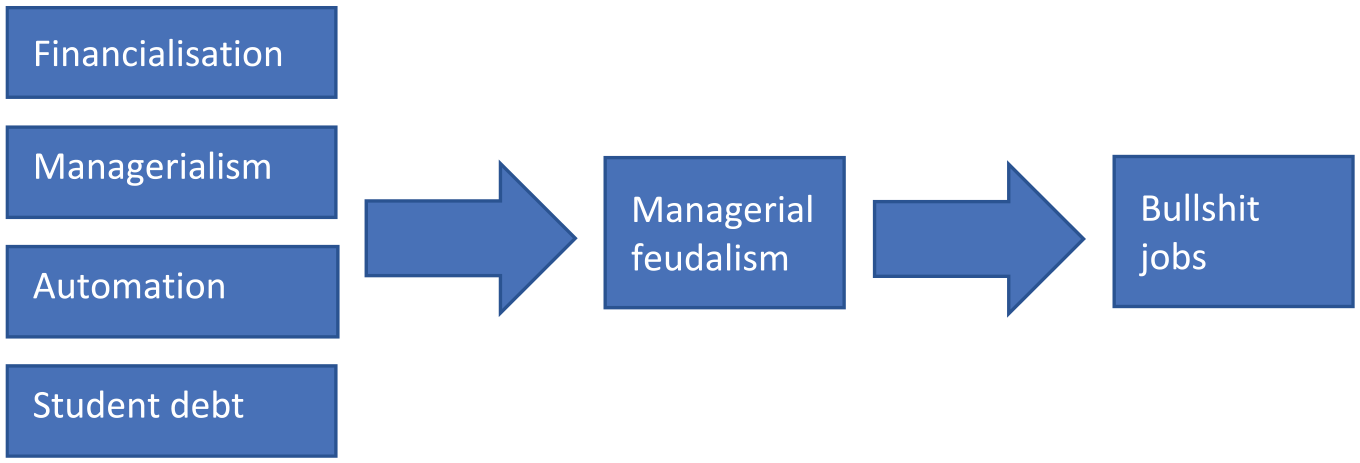
Bullshit jobs theory.
The BS jobs thesis gives rise to many clear testable outcomes, five of which we can readily examine with the EWCS:
Graeber (2018) states that the development of his theory was premised on the expectation that a high proportion, between 20% and 50%, of jobs were BS and therefore we ‘need to ask ourselves . . . how did such a large proportion of our workforce find themselves labouring at tasks which they consider pointless’ (Graeber, 2018: xxiv). At other points in the book, Graeber suggests the proportion might be much higher, but certainly not lower. Therefore, if in reality there are only relatively small numbers of workers who see their jobs as useless, then this would undermine Graeber’s thesis.
Graeber (2018: 146) argues that as a result of financialisation and managerial feudalism, the number of BS jobs has been ‘increasing rapidly in recent years’. Therefore, if the number of BS jobs is not increasing or is even declining, this would again undermine the theory.
BS jobs should be concentrated in particular occupations and industries while being largely absent in others. As Graeber (2018: 6) explains: ‘many service workers hate their jobs; but even those who do are aware that what they do does make some sort of meaningful difference in the world . . . [Whereas] we can only assume that any office worker who one might suspect secretly believes themselves to have a bullshit job does, indeed, believe this.’ Graeber (2018) provides many examples of BS jobs and those which are not (summarised in Table 1). In general, the theory asserts that BS jobs should be concentrated in industries connected to finance, among professionals, administrators and managers. In contrast, they should be generally absent in low-paying, blue-collar, hourly-paid ‘shit jobs’, as Graeber maintains that there tends to be an inverse relationship between social value and economic reward – although, as Table 1 shows, Graeber also believes that there are some low-paying BS jobs.
Since Graeber (2018) argues that the growth of student debt has been an important supply-side cause for the growth of BS jobs, these jobs should be more prevalent among young workers with higher education qualifications. If BS jobs are not, in fact, concentrated in the predicted educational and age groups, then this would invalidate this aspect of Graeber’s theory and suggest that we should look for other explanations.
Graeber (2018: 102) argues that BS jobs are a form of ‘spiritual violence’ that inflict negative states of mind on individuals, including anxiety, depression and misery. If this is the case, we should detect a clear relationship between the perception of one’s job as useless and a validated measure of psychological wellbeing.
Examples of bullshit and non-bullshit occupations.
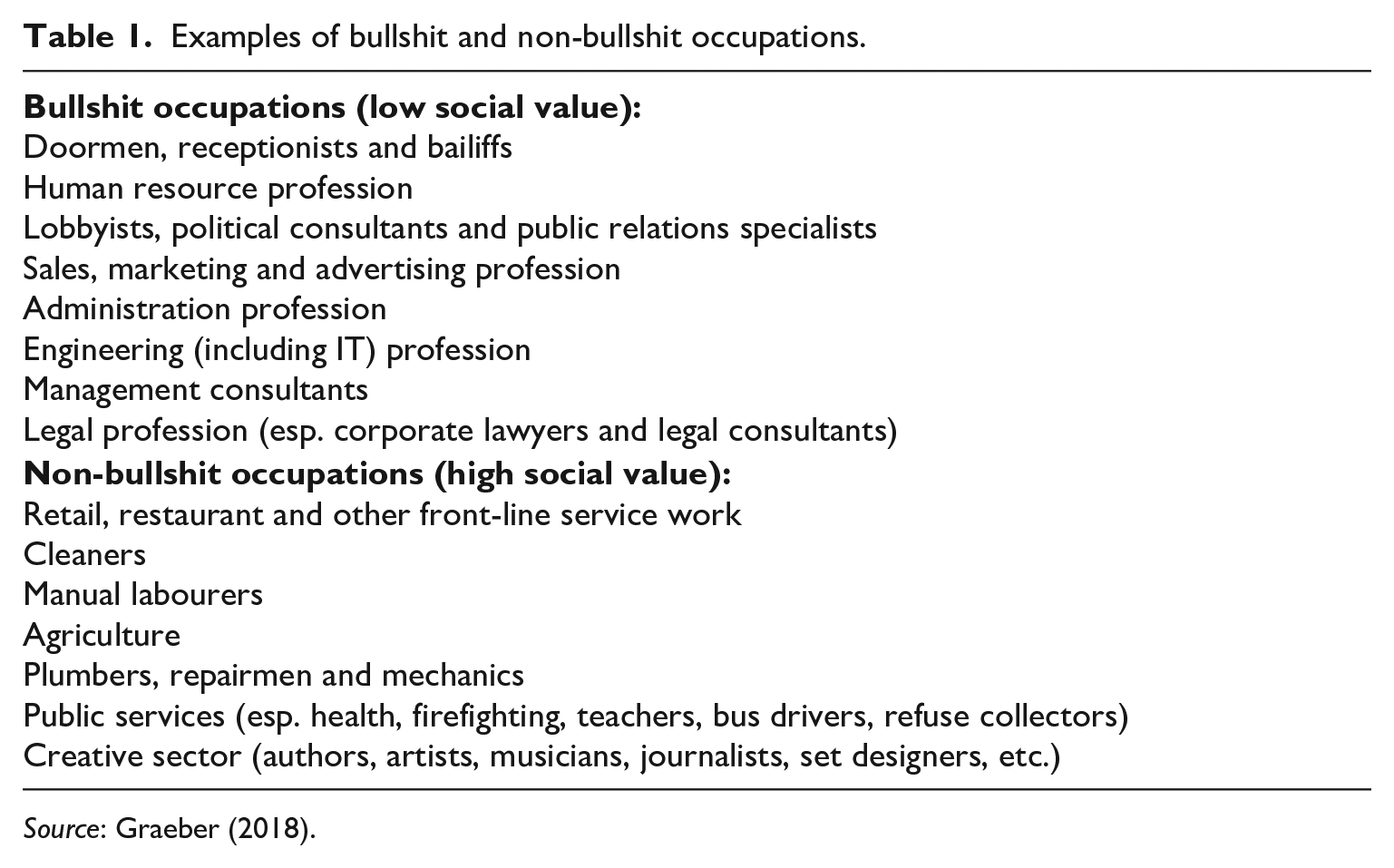
Source: Graeber (2018).
From social value to the value of work relations
As highlighted above, Graeber (2018) believes that when individuals report their jobs as being useless, this is an accurate appraisal by the individual of their job’s social value. This, Graeber goes on to argue, is harmful to an individuals’ wellbeing as it provides little identity or purpose 1 and, moreover, requires workers to pretend this is not the case. Graeber (2018: 102) states this is a source of ‘spiritual violence’ that ‘makes clear the degree to which you are entirely under another person’s power’. This is held to be a psychologically damaging experience, because humans need to conceive of ‘themselves as capable of acting on the world and others in predictable ways. Deny humans this sense of agency, and they are nothing’ (Graeber, 2018: 101).
This view of paid work as constraining essential human agency is striking in its resemblance to alienation, yet this concept is absent from Graeber’s account. Similarly, Marx argued that labour under capitalism is inherently alienating as it blocks individuals’ essential need for self-realisation. However, for Marx this was not the result of individuals being engaged in activity that was of no social value but rather because capitalist social relations frustrate the free development of human abilities in spontaneous activity. 2 The alienation of labour then focuses our attention upon the social relations under which work takes place, generally (Braverman, 1974), and the process of control that exists over work relations, specifically (Hyman, 1975). As Wood (2020) argues, it is necessary to ‘recognise that paid work is not just a simple matter of market exchange but also of power relations’. Although Marx wrote of alienation as a fairly homogenous phenomenon, more contemporary writers have highlighted the degree to which work relations ‘differ in the relative power of employers and employees to control tasks, negotiate the conditions of employment, and terminate a job’ (Kalleberg, 2011: 83). Therefore, that work relations frustrate the potential for self-realisation may offer an alternative explanation for why people experience their job as useless. Moreover, Elster (1985, 1986) argues that self-realisation entails self-externalisation in addition to self-actualisation, as self-realisation is dependent on abilities being observable to others who confirm or deny them. This understanding of alienation highlights that workers might see their work as useless and suffer reduced wellbeing when work does not provide them with the means to use and develop their skills, abilities and capacities, or because their abilities are denied by others in the workplace.
Unlike the BS jobs theory, alienation is not premised on the view that the work being undertaken is inherently pointless and of no value. Instead, it highlights the importance of the social relations under which work is undertaken and the degree to which they constrain the ability of workers to affirm their sense of self through the development and recognition of skills and abilities. Bailey and Madden (2019: 1) point out that few studies have looked to investigate ‘under what circumstances work is rendered meaningless’. However, support for the work relations approach over BS jobs is provided by Dur and Lent (2019), who analysed the International Social Survey Program data from 37 countries in 2015 and found that workers are more likely to report being in a socially useless job in occupations that are generally seen to offer workers limited opportunities for intrinsic skill use and autonomy. These industries included ‘stationary plant and machine operators’, ‘assemblers’, ‘labourers in mining, construction, manufacturing and transport performing simple and routine manual tasks’, ‘food preparation assistants’, ‘garment and related trades workers’ and ‘cleaners and helpers’.
The importance of social relations and work organisation for the meaningfulness of work is also attested to by Bailey and Madden (2016), who find managers can destroy the sense of meaningful work in a number of ways such as: disconnecting workers from their values; taking them for granted; treating them unfairly; overriding their judgement; disconnecting people from supportive relationships; and putting people at risk of physical or emotional harm. However, in their cross-national study, Dur and Lent (2019) find that the feeling that one’s job is socially useless is not associated at the national-level with quality of management. Following the empirical testing of the BS jobs theory, we move on to consider the degree to which work relations, such as the quality of management, level of participation and social support in the workplace, provide an alternative means for understanding why workers feel their jobs are not useful.
Evidence of BS jobs
Graeber (2018: xxii) states that his theory has ‘been overwhelmingly confirmed by statistical research’. This statistical research consists of a YouGov poll of UK workers (YouGov, 2015) and a similar one by human resource firm Schouten & Nelissen of Dutch workers (Graeber, 2018: 6). Graeber (2018: 10) argues that, as it is not possible to calculate social value, we must take the workers’ ‘word for it’ because ‘it’s safe to assume the worker knows best’ as to how useful their job actually is. Therefore, the YouGov and Schouten & Nelissen surveys respectively asked respondents if their job is making a meaningful contribution to the world and if their job is meaningful. The YouGov survey found that 37% of UK workers say their job does not make a meaningful contribution to the world, while the Schouten & Nelissen survey finds that 40% of Dutch workers do not experience their job as meaningful.
However, Graeber (2018) suggests that the problem of BS jobs is even greater. For instance, he combines the YouGov ‘don’t know’ (13%) responses with the ‘is not’ responses to create a new category of those ‘who are not entirely sure their job made any sort of meaningful contribution to the world’ (Graeber, 2018: 6). Graeber goes on to refer to a State of Enterprise Work Report which reports that, in 2016, US office workers spent 46% of their time dealing with emails, administrative tasks, interruptions for non-essential tasks and in wasteful meetings. These tasks are then classed as bullshit and used to argue that around 50% of non-BS jobs are actually bullshit and that, therefore, ‘we can probably conclude that at least half of all work done in our society could be eliminated without making any real difference’ (Graeber, 2018: 26). At another point, Graeber (2018: xx) introduces the concept of ‘second-order BS jobs’, which are non-BS jobs done in support of BS jobs. He then claims that ‘if 37 percent of jobs are bullshit, and 37 percent of the remaining 63 percent are in the support of bullshit, then slightly over 50 percent of all labour falls into the bullshit sector in the broadest sense of the term’. However, these calculations violate the methodological principle that workers are best placed to judge the social value of their work. Reporting that one deals with emails, administrative tasks, interruptions for non-essential tasks and wasteful meetings is not the same as saying these tasks are pointless, unnecessary or pernicious. Moreover, second-order BS jobs must by definition already be included in the 37% reporting their job as bullshit.
Therefore, Graeber’s (2018: 267) conclusion that ‘upward of 50 percent to 60 percent of the population has . . . been thrown out of [useful] work’ cannot be sustained. But the lower estimate of 37–40% that he provides is also questionable; as Thompson and Pitts (2018) point out, the YouGov survey item is loaded in that it sets a very high bar for non-BS jobs. Clearly, saying your job does not make a meaningful contribution to the world is not the same as saying one’s job is completely pointless, unnecessary or pernicious, as it could quite conceivably be felt to be useful to one’s nation, community, neighbourhood, customers or family.
We can find very little information of the methodology followed by Schouten & Nelissen but the 37–40% figure is contradicted by Dur and Lent’s (2019) findings, according to which only 8% of workers disagreed that their job is useful to society. For the UK, the figure was 10% – only half of what Graeber assumed while developing his theory. Moreover, these researchers find no BS occupations, that is, occupations where a ‘preponderance of workers feel their jobs are pointless’ (Graeber, 2018: 64). In fact, even the YouGov survey which Graeber (2018) relies on contradicts his theory, as the number who feel their job does not contribute to the world is higher among social groups C2DE than ABC1. In other words, the survey which Graeber uses to support his theory actually finds that BS jobs are more likely among lowest grade, semi-skilled and skilled manual workers than they are among supervisory, clerical, managerial, administrative and professional workers. Finally, Dur and Lent (2019) also demonstrate that the number of people who feel their job is useful to society has not increased since 1989. Despite the weak empirical support marshalled by Graeber (2018) in its favour, his BS jobs theory has been taken seriously by academics, journalists and policymakers. It therefore deserves rigorous empirical testing and below we outline how we propose to do so.
Methodology
We use data from the EWCS (available at the UK Data Archive), which gathers measures on the usefulness of the job, workers’ wellbeing and objective data on the quality of work. The EWCS is a high-quality cross-sectional representative study of the working population. It uses interviewer-administered questionnaires completed at respondents’ homes.
The data reported in this article focus mainly on the latest available EWCS (2015), but we also use the waves from 2005 and 2010 to examine trends in the rate of BS jobs over time. Our analyses are based on the subsample of EU28 countries, excluding self-employed workers. The number of respondents who satisfied the inclusion criteria were 21,536 in 2005, 29,716 in 2010 and 29,784 in 2015.
As a measure of whether workers experience their job as useless, we use the responses given to the question ‘please select the response which best describes your work situation [. . .]
EWCS survey items undergo cognitive testing before inclusion in the survey, and problematic or ambiguous items are noted in the interviewer post-survey debriefs. As different survey questions would lead to marginally different levels of BS jobs, our findings also investigate the patterns of BS jobs across occupations and time (while question wording is held constant). Therefore, our findings cannot be dismissed as artefacts of the wording of the question.
We start by comparing the 2015 rates of BS jobs across the EU28 countries. We compare rates across countries, as it is unclear whether Graeber’s (2018) theory is intended to be applied to all advanced capitalist economies or is accounting for a phenomenon specific to heavily financialised Anglo-Saxon economies (i.e. the UK and Ireland in our sample). Secondly, we examine the evolution in the rate of BS jobs from 2005 to 2015, assessing the magnitude of these changes across national, industrial, occupational, educational, age and gender categories. Thus, countries are classified into six groups: ‘Nordic’, ‘Anglo-Saxon’, ‘Continental’, ‘Mediterranean’, ‘Transition-A (Anglo-Saxon model)’ and ‘Transition-B (continental model)’ (Neesham and Tache, 2010).
Thirdly, Graeber’s assertion that BS jobs are concentrated in particular occupations, we compare the 2015 rate of BS jobs across occupations, measured at the two-digit level of the International Standard Classification of Occupations (ISCO).
Fourthly, Graeber’s theory that student loans force graduates into BS jobs in order to pay back their debts was tested by comparing rates of BS jobs among UK graduates who were aged 29 or younger to non-graduates in the same age bracket (UK university students graduate with the highest levels of student debt in Europe).
Fifthly, to examine the idea that experiencing one’s work as useless is indeed associated with workers’ mental health and wellbeing, we use mean scores of the WHO-5 index. The WHO-5 is a reliable instrument constructed by adding the scores of five items: (a) ‘I have felt cheerful and in good spirits’, (b) ‘I have felt calm and relaxed’, (c) ‘I have felt active and vigorous’, (d) ‘I woke up feeling fresh and rested’ and (e) ‘my daily life has been filled with things that interest me’. Each statement is answered in a six-point scale from ‘at no time’ through to ‘all of the time’. The final additive scale is reversed to make it a positively oriented indicator.
Finally, we attempt to derive a new (albeit tentative) explanation as to why employees describe their jobs as useless. Based on previous studies analysing the associations between job quality and wellbeing (see Eurofound, 2012, 2017; Muñoz de Bustillo et al., 2011), we extract nearly 60 indicators measuring different characteristics of the job and conduct a bivariate analysis with the five-point scale measure of work usefulness. The various job quality items selected cover aspects of wage level, job prospects, skills use, decision latitude, organisational participation, training, quantitative demands, pace determinants, emotional demands, management quality, social support, friendly or safe work environment and quality of working time, among others. The magnitude of the correlations between work usefulness and the various aspects of job quality are reported as Spearman’s rho.
The use of cross-sectional survey data does not lend itself to a formulation of a new theory as to why some individuals describe their jobs as useless, but the exploratory analyses give some pointers to insightful explanations of the phenomenon. We cannot unravel causal direction and we do not attempt model-building, but, in the spirit of EDA (Exploratory Data Analysis – see, for instance, Marsh and Elliott, 2008), we develop some fertile directions for future research. As pointed out above, few studies have looked to investigate the circumstances under which work is rendered meaningless (Bailey and Madden, 2019), meaning there are few readily available formal models that could be tested. All the estimates here reported are based on weighted data to account for varying sampling probabilities, relative country sizes and response rate differentials. Data analyses are performed using RStudio software (RStudio, PBC, Boston, MA, USA).
Findings and discussion
Hypothesis One: 20% to 50% of workers believe their jobs are useless
Graeber’s (2018) theory is premised on a very large number, if not a majority, of people being employed in BS jobs. He states that in developing the theory he assumed between 20% and 50% of jobs were bullshit but maintains that the actual figure is between 37% and 60% of all paid work. As shown in Figure 2, we find that in 2015 only 4.8% of EU28 workers responded that they did not have the feeling of doing useful work. It is unclear from Graeber’s writings whether he is positing a general theory or one that is specific to particular national types of capitalism (i.e. the UK and US). Despite his repeated reference to a Dutch survey, it might be that Graeber (2018) is particularly referring to the more financialised ‘Anglo-Saxon’ economies, such as those of the UK and Ireland, but here too only 5.6% of workers do not have the feeling of doing useful work (a slightly greater proportion than in Nordic (3%) and Continental (3.9%) countries). An advantage of our empirical investigation is that we can identify differences between national contexts. However, regardless of country, it seems that Graeber’s starting premise for the development of his theory was incorrect and the prevalence of BS jobs is only a small fraction of the proportion that Graeber claims.
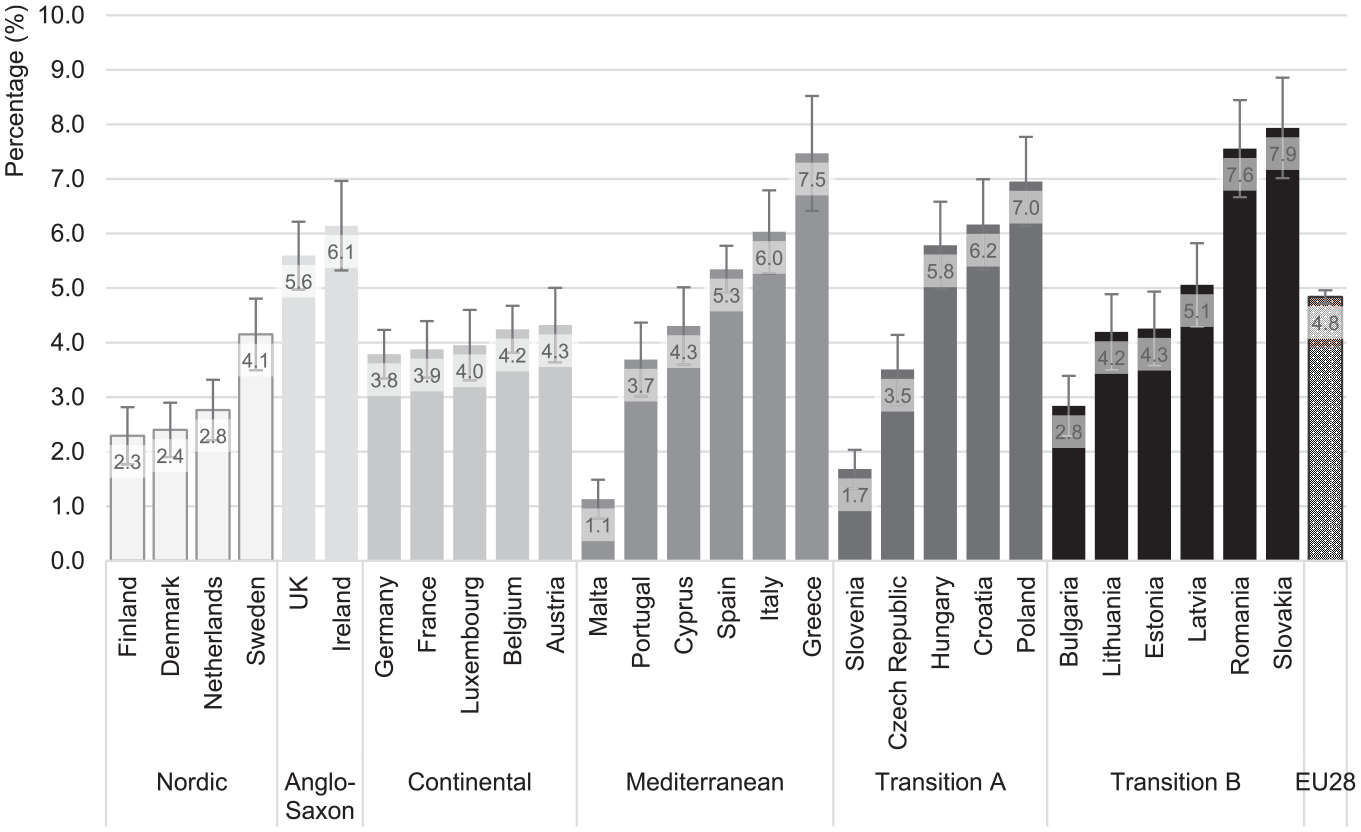
EU28, 2015: proportion of workers who reported they ‘rarely’ or ‘never’ have the feeling of doing useful work over total workers, by country (% with standard errors).
Hypothesis Two: The number of workers who believe their job is useless is increasing rapidly
While our findings suggest that the prevalence of BS jobs is relatively confined, Graeber could be correct to posit that it is, nevertheless, rapidly growing due to managerial feudalism. Although Graeber (2018) provides no empirical evidence that the number of BS jobs has increased over time, he nevertheless states ‘there is every reason to believe that the overall number of BS jobs, and, even more, the overall percentage of jobs considered bullshit by those who hold them, has been increasing rapidly in recent years’ (Graeber, 2018: 145). However, again we find no evidence to support this conjecture. The EWCS has included our measure of BS jobs in 2005, 2010 and 2015, so a rapid rise should be clearly visible. However, as Table 2 and Figure 3 demonstrate, we find in EU28 countries the percentage of BS jobs has fallen from 7.8% in 2005 to 5.5% in 2010 and to only 4.8% in 2015 – exactly the opposite of Graeber’s prediction of a rapid rise. Again, Graeber may have been referring to just the Anglo-Saxon countries but here the drop in the percentage of BS jobs has been even greater – from 8.7% in 2005 down monotonically to 5.5% in 2015.
EU28, 2005, 2010, 2015: trends in the prevalence of ‘bullshit jobs’ (number and % over total jobs), by demographic and labour market categories.
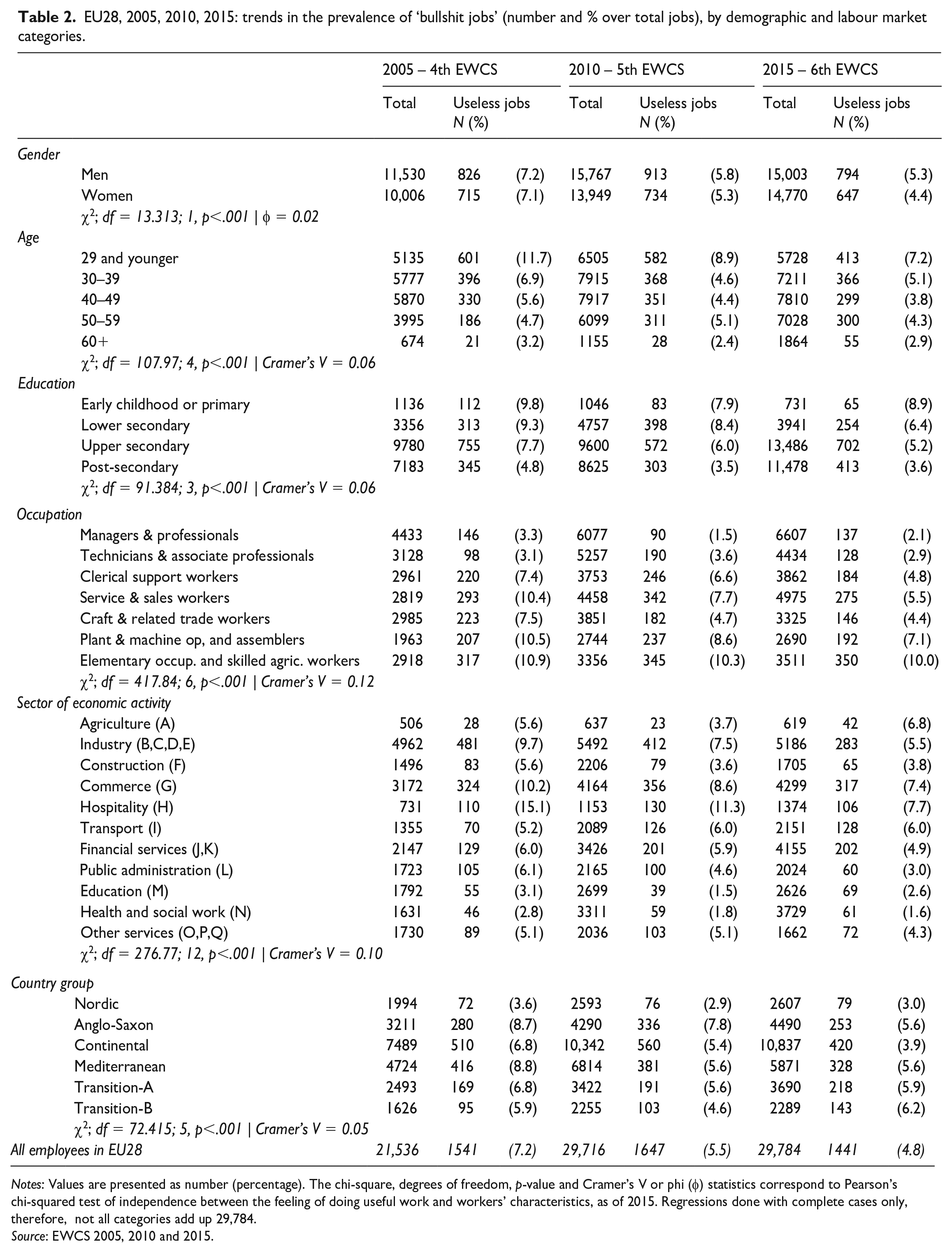
Notes: Values are presented as number (percentage). The chi-square, degrees of freedom, p-value and Cramer’s V or phi (φ) statistics correspond to Pearson’s chi-squared test of independence between the feeling of doing useful work and workers’ characteristics, as of 2015. Regressions done with complete cases only, therefore, not all categories add up 29,784.
Source: EWCS 2005, 2010 and 2015.
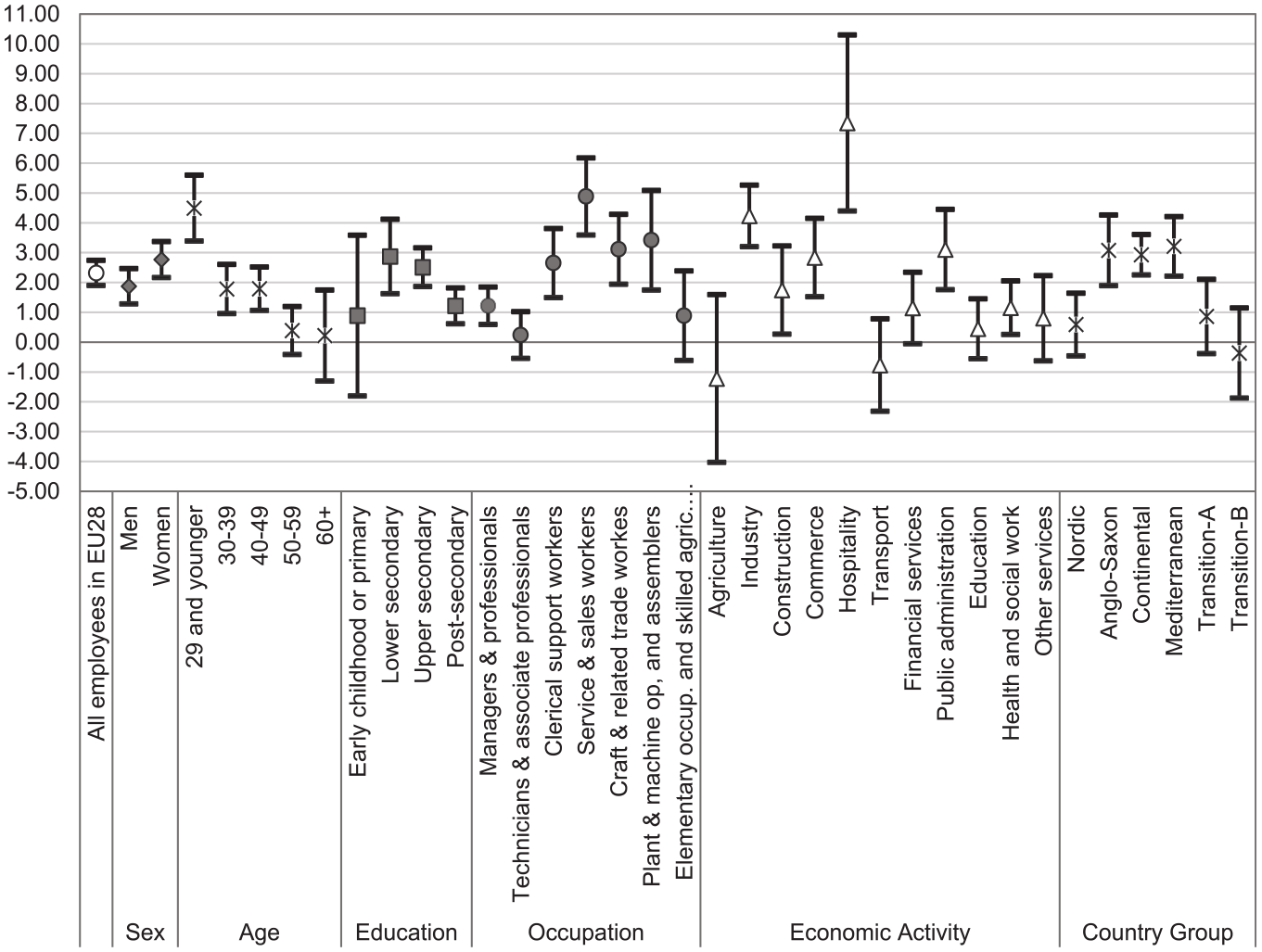
EU28: differences in the prevalence of ‘bullshit’ jobs between 2005 and 2015, by occupational and demographic groups, with 95% confidence intervals.
Hypothesis Three: BS jobs are concentrated in particular professions, such as finance, law, administration and marketing, and largely absent in others, such as those linked to public services and manual labour
It is possible that by looking at the labour market as a whole our analysis has hidden the growth of particular BS occupations. Indeed, the most entertaining and creative part of Graeber’s work is his identification of large swathes of the labour market that are characterised by BS jobs. Based on his own intuition about what is useful and what is bullshit, and backed up by some of the anecdotes sent to him, he identifies occupations where a ‘preponderance of workers feel their jobs are pointless’ (Graeber, 2018: 64). In particular, he identifies some professional jobs as the ones that are most obviously BS jobs. For instance, he points out that ‘hedge fund managers, political consultants, marketing gurus, lobbyists, corporate lawyers’ (Graeber, 2018: 209) would not be missed at all if they disappeared, though if elementary school teachers and nurses, garbage collectors, and mechanics, bus drivers, grocery store workers, firefighters, or short-order chefs were to vanish, the effects would be devastating (Graeber, 2018: 209). As explained above, BS jobs being concentrated in particular industries is of analytical importance as the theory asserts that they will be concentrated in industries connected to finance where the powerful are incentivised to invest in maintaining an entourage of lackeys as their wealth is appropriated rather than created.
Table 3 shows a list of occupations ranked by the proportion of incumbents who rate their job as rarely or never useful. This shows there is no evidence for the existence of BS occupations in which the majority of workers feel their work is not useful. However, our findings do suggest that Graeber is correct that workers in some of the occupations, such as teachers (1.7% BS jobs) and nurses (health associate professionals) (1.3%), generally see themselves as doing useful jobs, while sales workers are above average in the proportion rating their job as not useful (7.7% BS jobs). Nevertheless, most of the results contradict this aspect of Graeber’s assertion. For instance, legal professionals and associate professionals, senior officials, business and administration professionals and associate professionals are all low on this ranking, and jobs that Graeber rates as being examples of essential non-BS jobs, such as refuse collectors (9.7%) and cleaners and helpers (8.1%), are high on this scale.
EU28, 2015: two-digit ISCO occupations ranked by percentage of workers reporting they ‘rarely’ or ‘never’ have the feeling of doing useful work.
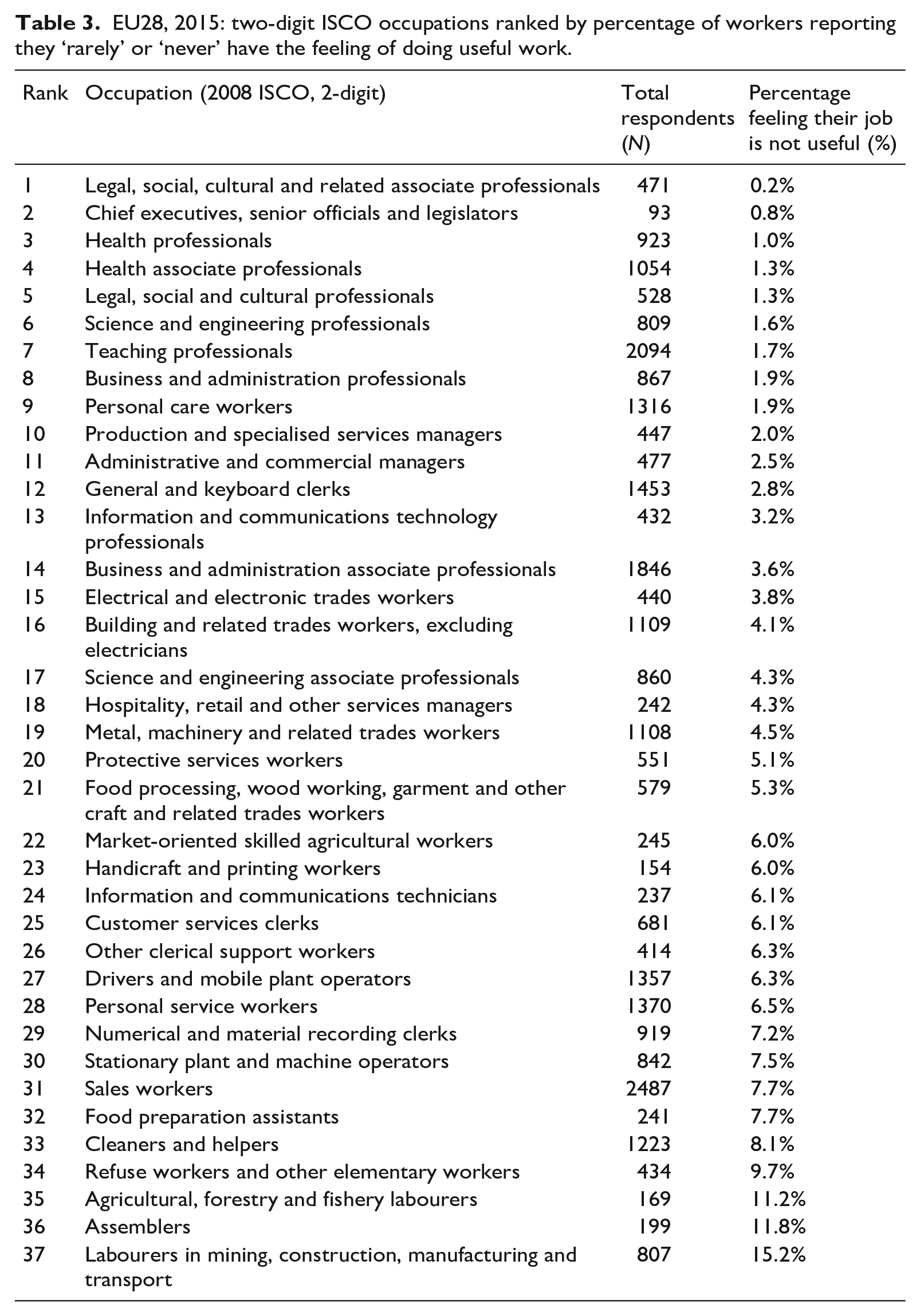
We conclude from the above that there is little validity in Graeber’s prediction of BS occupations. None of the occupations approached anywhere near the 20–50% levels Graeber’s theory is premised upon; moreover, the occupations where workers were most likely to feel their work was not useful were those Graeber maintains are not BS (i.e. refuse collectors and cleaners and helpers). Indeed, when we move from occupations to industrial sectors (shown in Table 2), we find that in 2015, financial services is only just above the average (4.9%).
Hypothesis Four: Young workers with student debt are more likely to be doing BS jobs
Since Graeber (2018) maintains that student debt is an important supply-side factor leading to the growth of BS jobs, BS jobs should be concentrated among younger workers with higher education qualifications. However, we find a strong inverse relationship with education level (i.e. the more educated a young worker is the less likely they are to have a BS job), declining from 8.9% of those with only primary education to 3.6% of those with post-secondary education (Table 2). To test the role of student debt we focused on the rate of BS jobs among young UK graduates (up to age 29), who have the highest levels of student debt in Europe. We find that BS jobs are twice as prevalent among non-graduates (14.6%) compared to graduates (7.2%) – the opposite of Graeber’s assertion. 4 In summary, we find no evidence to support these four central propositions of Graeber’s BS jobs thesis.
Hypothesis Five: BS jobs are associated with low levels of psychological wellbeing
Despite the prevalence of BS jobs being much lower than predicted by this theory, there is strong evidence that feeling that one’s job is useless is associated with poor psychological wellbeing. In the UK in 2015, workers who felt their job was not useful had WHO-5 wellbeing scores (M = 49.3, SD = 28.3) significantly lower than those who felt they were doing useful work (M = 64.5, SD = 21.7), and a similar gap was found in the EU28 sample. These results suggest that the ‘spiritual violence’ that Graeber describes as an outcome of BS jobs may indeed make workers more depressed and anxious. However, given the cross-sectional nature of the dataset, we cannot rule out the other plausible pathway – namely, that people who have poor mental health are more prone to underestimating the usefulness of their jobs. This finding is consistent with other research showing that meaningful work is one of the dimensions of job quality that is most strongly associated with wellbeing (Eurofound, 2017). Therefore, it is important to try and understand why workers might experience their job as useless work.
Work relations as an alternative explanation of useless jobs
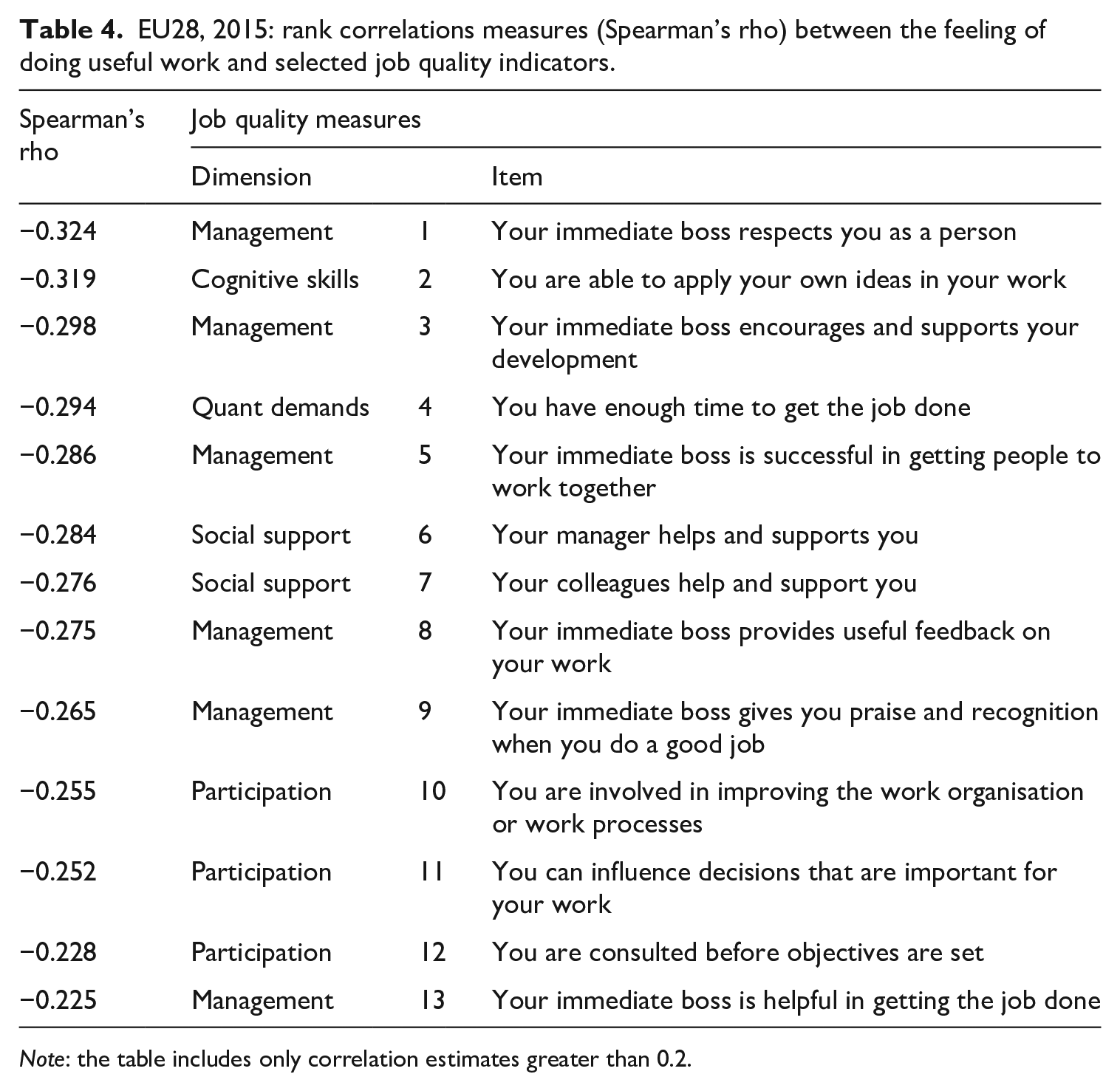
If Graeber’s characterisation of the phenomenon of BS jobs is inadequate, then is there an alternative perspective that can provide a more plausible account? The popular acclaim that Graeber’s work on BS jobs has received strongly suggests that the sense of doing something useful is of fundamental importance to people’s working life – very much in line with eudaimonic accounts of wellbeing (Ryan and Deci, 2001). Indeed, our findings above highlight that Graeber was correct to highlight the damaging effects of doing work that one feels to be useless. Therefore, simply refuting Graeber’s explanation is insufficient and it is necessary to also suggest alternative explanations that are potentially more satisfactory. As highlighted in our literature review, the far older concept of alienation might yield an alternative way of understanding why some workers feel that their job is useless. This concept focuses our attention on the social relations under which paid work is undertaken. Most of those variables are, at best, weakly related to the ‘useful work’ variable, but Table 4 lists 13 of those variables that are correlated at rho = 0.2 or higher. Interestingly, of the selected variables, six are to do with the quality of management, three relate to participation, two concern social support, one is about using one’s own ideas at work, and one concerns having enough time to get the job done well.
EU28, 2015: rank correlations measures (Spearman’s rho) between the feeling of doing useful work and selected job quality indicators.
Note: the table includes only correlation estimates greater than 0.2.
The strongest correlation was with the extent to which the employee felt respected by management (rho = .324) and there were also moderate correlations with other aspects of management style and quality (i.e. feeling encouraged and supported by management, thinking that management was successful at getting people to work together, providing useful feedback and being helpful). At the other end of the spectrum, when employees experience management that is disrespectful, inefficient and poor at giving feedback, it is more difficult to perceive the usefulness of the work. That this finding contradicts those of Dur and Lent (2019) suggests that their national level proxies for quality of management are poor substitutes for individual-level data on the quality of management.
The second strongest correlation (.319) was with an item about ability to use one’s own ideas at work – an important element for feeling that your job provides you with the ability to realise your human capacities. Moreover, there was a clear relationship between the extent to which people felt that they had enough time to do their job well and their rating of the usefulness of their job, suggesting that one source of feeling a job to be useless is the pace at which one is working, affecting the ability to realise one’s potential and capabilities. There were two measures of social support: one concerning colleagues and one concerning managers giving ‘help and support’. Both were correlated with the feeling of doing useful work. Finally, there were three items that measured participation at work (in influencing important decisions, in improving work organisation, and in being consulted about objectives), all of which predict feelings of usefulness.
These findings point to the fact that feelings of usefulness at work are not a direct indication of the social value of that work but are tied to the degree to which the social relations under which that job is undertaken enable individuals to realise their human potential. In particular, if managers are respectful, supportive and listen to workers, and if workers have the opportunities for participation, to use their own ideas and have time to do a good job, they are less likely to feel that their work is useless. Our findings, therefore, suggest that workers feeling that their job is not useful, is not due to the job itself being ‘bullshit’ and the result of managerial feudalism but rather is a symptom of bad management and toxic workplace cultures leading to alienation.
Alienation and its long-term trends were hotly debated topics in sociology during the 1960s, 1970s and 1980s (Vallas, 1988; Vallas and Yarrow, 1987). Theories surrounding the growth of the so-called ‘knowledge economy’ suggested that alienation would decline as workers were empowered by both a shift in the economy away from low-discretion routine manual jobs and towards technical and professional jobs that entail greater intrinsic skill-use and the delayering of traditional hierarchies in work organisations and the growth of teamwork (Frenkle et al., 1995; Green, 2003). In line with these more optimistic accounts, we find some good news, as suggested by writings on the knowledge economy, that this form of alienation is declining. This is seemingly due to alienation being most prevalent in declining blue-collar occupations which have traditionally been marked by hierarchical work organisation and a lack of discretion, participation and intrinsic skill-use.
Limitations
While we conclude that we provide a far more plausible account for the data than Graeber, we must recognise the limitations of our study. Here we are analysing cross-sectional data, so we need to be tentative in drawing causal conclusions. Unfortunately, we are not aware of any existing panel datasets with the range of variables that would facilitate a more rigorous testing of the causes and consequences of employees reporting that their jobs are of no social value. However, these results are sufficient to cast serious doubts on Graeber’s claim that we can take employees’ descriptions of their jobs being useless at face value. Taking inspiration from Marx’s writings on alienation, we suggest, rather, that the meaning of work is socially constructed in the workplace, and poor management and toxic workplace environments can blind employees doing valuable jobs from their true contribution.
Conclusion
This article makes three important theoretical and empirical contributions to our understanding of the world of work. Firstly, we use the EWCS to investigate four hypotheses derived from Graeber’s (2018) BS jobs theory. It is unclear whether Graeber (2018) is positing a general theory or one which relates to specific national types of capitalism (i.e. the financialised Anglo-Saxon economies); however, our approach enabled us to make an empirical contribution by identifying differing levels of useless jobs across European national contexts. Nevertheless, the empirical data do not support any of Graeber’s hypotheses. Therefore, the BS jobs theory must be rejected. Not only do our findings offer no support to this theory, they are often the exact opposite of what Graeber predicts. In particular, the proportion of workers who believe their paid work is not useful is
Secondly, although Graeber’s (2018) account of BS jobs and managerial feudalism cannot be empirically sustained, we do find that millions of European workers suffer from work which they feel is not useful. Moreover, this experience is strongly associated with poor wellbeing. Therefore, in rejecting its social scientific value we, nevertheless, welcome the fact that Graeber’s provocative style and use of amusing anecdotes has raised awareness of this serious social ill. Graeber’s contribution is especially welcome given the limited research on useless jobs and the accounts provided by Graeber (2018) are a valuable and interesting source of data on people’s critical reflections on the value of their work. Moreover, the fact that many people have worked in such jobs at some point and that they have serious consequences for wellbeing may explain why Graeber’s work resonates with so many people who can relate to the accounts he gives. Studies of job quality have tended not to include direct perceptions of useless jobs and instead focused on elements of intrinsic work quality such as skill use and discretion (see, for example, Eurofound, 2012; Muñoz de Bustillo et al., 2011), which are seen as being linked to the meaningfulness of work (Kalleberg, 2011). However, our findings suggest that whether a job is perceived as useless or useful should be included in future studies of job quality. The suffering associated with jobs that are experienced as useless also highlights the importance of policies to eradicate the conditions that give rise to such feelings – a point we return to below.
This article highlights that alternative theories grounded in empirical research are required to understand the social suffering caused by the feelings of useless work that Graeber observes. Therefore, our third major contribution is to demonstrate the value of Marx’s writings on alienation. We take inspiration from Marx’s understanding of alienation to investigate whether the social relations of work can explain why millions of workers do not feel that their work is useful. In particular, we focus on the ways in which the development of workers’ human capacities may be fettered by social relations at work. In doing so, we find that several factors related to this concept are indeed strongly associated with the degree to which an individual feels their job is useful. These factors include whether one’s managers are respectful, supportive, listen to workers and provide them with enough time to do a good job along with opportunities for participation and using their own ideas. This finding is not only theoretically consistent with Marx’s theory of alienation but also has important policy implications, as it suggests that, intrinsically, BS jobs are a rare phenomenon. Therefore, this article debunks Graeber’s (2018) claim that millions of workers are engaged in BS jobs of no social value and that the solution is that they be set free by a universal basic income. Instead, it suggests the need for unions that are willing and able to engage in what Umney and Coderre-LaPalme (2017) term ‘meaning of work conflicts’ so as to overturn those social relations in which people’s work is devalued by toxic workplace cultures that leave workers feeling their labour is pointless and of no use.
Footnotes
Acknowledgements
This article was inspired by the insightful and imaginative work of David Graeber and we are indebted to him for raising awareness of the harms of useless jobs. We are sure that David would have had strong and compelling views about this article and it is very sad that he passed away before we had the opportunity to discuss it with him. His legacy as an academic and an activist goes far beyond the body of work discussed in this article. He will be sadly missed, both within academia and by all those who strive for a better world. We would also like to thank Dr Ian Roper and Dr Elizabeth Cotton in their role as editors along with the three anonymous reviewers for their numerous comments and suggestions. Thanks are also due to Lina Dencik for helpful comments on an early draft of this article and Dr Mathijn Wilkens from Eurofound for his support and assistance.
Funding
The authors received no financial support for the research, authorship, and/or publication of this article.
