




Abstract
Gender inequalities in paid and unpaid work are well documented, but patterns of advantage or disadvantage in further job-related training have been less explored. Previous cross-sectional studies indicate gender differences in further training, with lower participation rates and shorter training sessions for women, especially mothers. Based on the National Educational Panel Study for Germany (adult cohort, 2008–2020), this study is the first to examine gendered parenthood effects on participation in non-formal further job-related training using panel analyses. The results from fixed-effects regressions provide evidence of parenthood training penalties that are particularly pronounced for mothers and in the first years after childbirth. While fatherhood training penalties are mostly explained, motherhood gaps remain robust when accounting for a large number of time-varying characteristics. The results point towards further relevant changes in mothers’ aspirations or employer support. Thus, they underline the importance of training opportunities for reducing childbirth-related inequalities later in life.
Keywords
Introduction
The birth of a child reinforces gender inequalities in paid and unpaid work, so the effect of parenthood on participation in job-related training is very likely to differ for men and women. Research shows that childbirth alters women’s employment more than men’s (Steiber and Haas, 2012), while increasing their relative share of family work (Schober and Zoch, 2019). Therefore, it is very likely that mothers are also at a greater disadvantage when it comes to training participation, especially in job-related training. First studies acknowledge gender training gaps as another potential driver of gender inequalities in employment and career trajectories (Evertsson, 2004; Havet and Sofer, 2008). In this context, training not only supports the development of additional skills that can serve as important signals for promotions, but they also promote self-confidence and thereby psychological capital, which is positively associated with higher resilience as women advance in their careers, especially in gendered workplaces (Tokbaeva and Achtenhagen, 2021).
So far, the limited evidence on parenthood differences in further training participation stems almost exclusively from cross-sectional studies (Boll and Bublitz, 2018; Dämmrich et al., 2016; Dieckhoff and Steiber, 2011). Without longitudinal data, however, these studies cannot investigate whether and how men and women change their participation in job-related training due to childbirth. Moreover, previous studies examine a wide variety of training courses with differences in length and certification (longer formal vs shorter informal training), content (job-related or personal interest) or funding (private vs employer-sponsored); hence, results are difficult to compare.
This article examines the question of whether childbirth is linked to changes in participation in non-formal job-related training and whether the effect varies for women and men. The contribution of this article to the understanding of gendered labour market inequalities is threefold. First, by drawing on panel data with annual information on training participation, it is the first study providing longitudinal evidence on the gendered effect of parenthood on job-related training participation. Therefore, this research narrows the focus on employed parents, concentrating exclusively on non-formal further education that is job-related short courses without a generally valid certificate, referred to as job-related training. 1 Second, the article exploits longitudinal data, and thus, extensive pre- and post-birth information on the individual, household, organisational and occupational levels, to show that altered training is mostly linked to changes in a parent’s paid and unpaid work and less influenced by employer or occupational changes. Third, by comparing results from pooled linear probability models (LPM), conventional linear fixed-effects (FE) and fixed-effects regressions with individual slopes (FEIS), this study highlights the methodological importance of life-course approaches examining life events with a within-estimator. This way, the article presents a more causal examination of parenthood differences in job-related training.
The following section first describes the context of Germany before presenting the theoretical background, the empirical analyses and results.
Context of Germany
In most Western societies, a rapidly ageing population and general technological change have increased the need to integrate broader population segments into the labour market, such as the low educated, the elderly and especially mothers with young children. Increasing maternal employment and promoting lifelong learning have therefore become important policy goals also in Germany. However, Germany is well known for its considerable low maternal employment rates, long family-related career breaks and high female part-time rates. In 2007, Germany introduced a shortened and income-dependent parental leave benefit of 12 months at maximum for each parent and, since 2005, has expanded public childcare for under-threes to increase maternal employment and shorten interruptions (Zoch and Hondralis, 2017). Nevertheless, East–West differences in public childcare provision and attitudes towards formal childcare and maternal employment remain relevant many years after the division and reunification of Germany (Zoch, 2021); hence, West German mothers still return to work much later and often only part-time (Zoch, 2020).
In addition, the supply of and access to job-related training opportunities is crucial to meet the increased demand for skilled labour. Of all reported further education activities in Germany, the majority is non-formal training (54% of all individuals), followed by informal learning (45%) and longer formal education (11%) (figures for 2018; Federal Ministry of Education and Research (BMBF), 2019). Non-formal further training is primarily linked to (1) employer motives that initiate training and – to a lesser extent – (2) occupational regulations requiring specific training for certain job tasks. As a result, employer-provided non-formal further training (72%) predominates individual job-related training (10%) and individual training related to private interests (18%) (BMBF, 2019).
Further training is mainly offered in the occupational context; hence, gendered labour market inequalities are likely linked to gender gaps in job-related training (Blossfeld et al., 2020). Previous and current employment strongly determine training participation, especially for women, with more frequent family-related employment interruptions and employer changes (Blossfeld et al., 2020; Havet and Sofer, 2008; Herman, 2015). According to official figures, men participate more frequently in job-related training (44% vs 36%), while women participate more in training related to private interests (15% vs 11%) (BMBF, 2019). However, these figures do not distinguish between parents and childless individuals; hence, disparities in participation by parenthood status cannot be examined.
Besides individuals’ employment status, participation in job-related training depends strongly on the position, job tasks and employer. Individuals with higher educational levels, higher wages and in good positions, or large companies with more institutionalised training support, participate more often in training (Blossfeld et al., 2020; BMBF, 2019). In a highly segmented labour market like Germany, training is crucial either for employer-specific tasks and internal labour markets or for more general tasks in occupational labour markets (Dämmrich et al., 2016). Employers are more likely to support employer-specific skill acquirement, promoting career development for internal jobs. Conversely, they are less likely to support training if the skills acquired can be used in other organisations (Blossfeld et al., 2020) and employees have a high risk of job and employer change, such as mothers (Dämmrich et al., 2016; Havet and Sofer, 2008; Tokbaeva and Achtenhagen, 2021).
Finally, differences in job-related training participation are also related to occupations providing the most important link between social stratification in educational trajectories and the labour market (Blossfeld et al., 2020). Individuals with vocational training acquire more employer-specific skills and subsequently participate less in training than those with higher educational levels but more general skills and thus high employer- and job-specific training needs (Wotschack, 2019). Female-dominated occupations are linked to state-provided general educational tracks, so demand for employer- and job-specific skills is larger than in male-dominated occupations (e.g. in the health and social services sector) (Wotschack, 2019). Accordingly, female training rates are generally higher, especially for women with general qualifications.
Background and hypotheses
Although most training is job-related and gendered inequalities remain of great relevance in most Western labour markets, evidence on gender and parental differences in further training is mixed. Various – mostly cross-sectional – studies highlight a female training disadvantage, that is, lower training rates (Burgard, 2012; Dämmrich et al., 2016; Dieckhoff and Steiber, 2011; Evertsson, 2004; Massing and Gauly, 2017), no or only small gender differences (e.g. Barry et al., 2020; Kaufmann and Widany, 2013) or even higher female training rates (Burgard, 2012; Dämmrich et al., 2016). However, only a few studies focus explicitly on gender differences in job-related training, whereas most studies only control for sex among other characteristics. The few cross-sectional studies examining parenthood gaps indicate penalties primarily for mothers and job-related training (Boll and Bublitz, 2018; Burgard, 2012; Dämmrich et al., 2016; Dieckhoff and Steiber, 2011; Massing and Gauly, 2017), with particularly pronounced disparities in contexts with few employment-oriented family policies. Moreover, evidence varies widely regarding how further training is defined (formal, non-formal or informal) or whether training is closely linked to employment or even provided by the employer.
Although empirical research is inconclusive, sociological and economic theories of the labour market suggest several reasons why women, and particularly mothers, are less likely to participate in job-related training. By applying a demand and supply perspective, these reasons can be differentiated into employee- and employer-specific factors, with discontinuous employment, family responsibilities and employer discrimination as the main barriers to parents’ – and especially mothers’ – training participation.
Parents’ demand for further training
The economic theory of the family (Becker, 1981) and bargaining theories (Lundberg and Pollak, 1996) suggest that women generally participate less often in job-related training due to a gendered division of labour. Accordingly, the partner with the higher relative income – usually the father – specialises in gainful employment, while women interrupt or reduce their employment after childbirth or change the employer to combine work and family (Herman, 2015; Steiber and Haas, 2012). In anticipation of lower returns on human capital investments, economic theory predicts women to invest less in their education and training than men, especially regarding employer-specific training (Havet and Sofer, 2008). Conversely, men who anticipate or experience fatherhood are presumed to increase training activities, assuming that they fulfil their role as main breadwinner (Dieckhoff and Steiber, 2011).
From a sociological perspective, parents do not consciously choose a specialisation, but rather because they lack the structural and normative support for an equal division of paid and unpaid work. Especially when children are young and in a comparatively traditional context, such as West Germany (Zoch, 2021), mothers are more likely to reduce their employment participation to take on larger shares of family work (Schober and Zoch, 2019). Therefore, mothers mention time constraints and family–work conflicts as the most important reason for not participating in further training (Burgard, 2012; Massing and Gauly, 2017). As fathers are now more likely to take parental leave and participate in family work than they were a few years ago (Schober and Zoch, 2019), they also state time conflicts, especially with high workloads, as a reason for lower participation in training (Massing and Gauly, 2017). However, given longer career breaks, shorter working hours and larger shares of family work, it can be assumed that mothers reduce their training participation more than fathers.
However, most studies show a moderate relevance of individual determinants for training participation, which calls into question the particular importance of human capital theory assumptions (Barry et al., 2020; Dieckhoff and Steiber, 2011; Kaufmann and Widany, 2013). Nevertheless, some studies highlight women’s larger share of unpaid work (Burgard, 2012; Massing and Gauly, 2017), increased part-time work (Boll and Bublitz, 2018; Dämmrich et al., 2016), employer or job changes due to childbirth (Burgard, 2012; Dämmrich et al., 2016; Havet and Sofer, 2008) and lower relative earnings (Boll and Bublitz, 2018) as reasons for lower female and maternal training rates. However, without repeated information on individuals’ training participation, these cross-sectional studies cannot investigate the extent to which the differences are due to childbirth-related changes in individual determinants.
The birth of a child and associated role changes may also alter work–family preferences, causing parents to prioritise family time over paid work and career development (Stets and Burke, 2000; West and Zimmerman, 1987). Accordingly, mothers, who cannot reconcile their prenatal attitudes with their postnatal employment, are likely to develop more traditional attitudes (Schober and Scott, 2012) that are negatively linked to job-related training (Dieckhoff and Steiber, 2011; Wotschack, 2019).
Overall, the different theoretical perspectives suggest that childbirth reduces individual demand for job-related training. Given the persistent gender division of paid and unpaid work, this demand reduction should be greater for women. Longer career breaks, shorter working hours upon return and reduced time resources due to more housework and childcare are likely to explain a large part of women’s reduced participation in job-related training.
Training opportunities and employers’ support
The different supply and access to training opportunities across occupations, sectors and employers account for a much larger part of the training differences than individual demand-side aspects (Barry et al., 2020; Burgard, 2012; Dieckhoff and Steiber, 2011; Kaufmann and Widany, 2013). Previous research finds smaller gender training gaps in gender-balanced occupations with larger disadvantages for women in male-dominated occupations (Dieckhoff and Steiber, 2011; Wotschack, 2019). This is illustrated by a qualitative interview study in the comparatively egalitarian context of Sweden, where training opportunities in the IT sector are not offered voluntarily to women and require more persuasion than for men (Tokbaeva and Achtenhagen, 2021). Besides occupation, position and job tasks, the type and size of the employer influences training participation (Kaufmann and Widany, 2013; Wotschack, 2019), as it is often organised directly or paid for externally in larger organisations or the public sector (BMBF, 2019; Dämmrich et al., 2016; Dieckhoff and Steiber, 2011). However, based on firm-level data from Germany, Wotschack (2019) finds lower training rates but smaller gender differences in small companies and for contexts supporting women’s employment.
Furthermore, previous studies highlight organisational and supervisors’ support for job-related training (Kaufmann and Widany, 2013). First, employers might perceive family-related employment interruptions and increased absence as a signal of lower productivity and career orientation (Havet and Sofer, 2008). Therefore, longer career breaks and shorter working hours are likely to reduce employees’ demand and employers’ supply and support for participation in external provision (Havet and Sofer, 2008), which is in line with empirical findings (Dämmrich et al., 2016; Tokbaeva and Achtenhagen, 2021). Second, according to theories of status-based discrimination, employers have imperfect information on workers’ skills and career ambitions and therefore rely on stereotypes to evaluate their productivity for job placements and promotions (Arrow, 1973; Phelps, 1972). Parents, and mothers in particular, are on average more likely to take career breaks or reduce working hours. With a gendered perception of parenthood and a persistent ideal (male) worker norm, employers may discriminate against them in job placements and, thus, job-related training – regardless of whether they interrupt their work or reduce hours after childbirth (Havet and Sofer, 2008). Experimental evidence highlights motherhood penalties in hiring for Germany (Hipp, 2020), and several studies also find gender and motherhood training gaps after controlling for many individual and job characteristics (Dieckhoff and Steiber, 2011). These studies suggest that the remaining residuals indicate employers’ discrimination against women’s training participation, particularly in larger, more anonymous firms (Wotschack, 2019) or male-dominated contexts (Tokbaeva and Achtenhagen, 2021).
While there is ample evidence that employers penalise motherhood, there seem to be career advantages for men, as fathers are often empowered in their role as male breadwinners. Accordingly, men are presumed to increase their human capital investments when experiencing or even anticipating fatherhood (e.g. in salary negotiations or also training participation) (Burgard, 2012; Dieckhoff and Steiber, 2011). However, recent research has critically examined the previously proposed fatherhood premiums but found no or only limited evidence for advantages in hiring (Hipp, 2020) or wages (Mari, 2019). Instead, previous studies seem to have overestimated the fatherhood premium by not considering that men with steeper wage growth are more likely to experience parenthood (Rüttenauer and Ludwig, 2020). These findings raise the question of whether fathers receive more support for training and career. Furthermore, men are often older at first childbirth and thus more advanced in their careers. Reduced training participation may thus also be due to lower training rates at older age (Blossfeld et al., 2020; BMBF, 2019). Overall, however, when controlling for employment experience and employers’ and occupational characteristics, the positive or negative effects of parenthood on training should be smaller for men than for women.
Hypotheses
Altogether, the few studies focusing explicitly on gender and parenthood differences suggest a training disadvantage for women and especially mothers. These differences should be partly related to altered employment participation and increased time for unpaid work as well as decreased employers’ support. However, although studies point to the critical role of childbirth, most cannot examine a gendered parenthood effect on job-related training. Moreover, no study has examined the within-effect of childbirth for altered training behaviour based on panel data. Thus, previous research has not been able to determine whether and to what extent the same respondent changes his or her participation in further job-related training due to childbirth. Therefore, the question remains of whether childbirth changes job-related training participation and to what extent the influence of children varies with gender.
Different theoretical approaches such as human capital theory, reduced time availability, altered work–care preferences and employers’ discrimination suggest that parents are less likely to participate in job-related training than childless individuals (Hypothesis 1, parenthood penalty). However, time constraints and role conflicts, altered work–care preferences and decreased employers’ support seem more likely for mothers than fathers. For this reason, the parenthood training penalties are presumed to be more substantial for mothers than fathers (Hypothesis 2, motherhood vs fatherhood penalty).
Data and analytical strategy
Data and sample
By drawing on panel data from the Adult Cohort of the National Educational Panel Study from Germany (NEPS Network, 2021), this analyses compared (1) between-results from linear models using ordinary least squares (pooled linear probability model, LPM) with within-person estimates from linear panel models with (2) conventional fixed-effects (FE) and with (3) fixed-effects and individual slopes (FEIS). The NEPS-Adult Cohort offers detailed information on about 12,000 persons of working age, born between the mid-1940s and mid-1980s (Blossfeld and Roßbach, 2019). It is currently the only German panel data set collecting detailed measures of training participation annually, which are particularly well suited for investigating changes in training behaviour due to childbirth.
The sample used all waves with comparable measures of training participation (waves 2–12, 2008–2020). It excluded respondents in same-sex couples, with incomplete first education, in higher education or vocational training, in unemployment or retirement, and no employment experience (detailed information is included in Online Supplementary Table A1). Based on observations for age 24–55 and with complete information on all relevant controls, the final LPM sample consisted of 43,026 observations (21,813 men and 21,213 women). The FE sample excluded respondents who participated in job-related training every year or never (NMen = 15,747 with 606 births and NWomen = 15,110 with 492 births) to estimate within-effects based on individuals exhibiting change on the dependent variable, thus following the textbook approach for FE and FEIS regression models. 2 Lastly, FEIS regression models with two slopes required at least four person-years, reducing the sample to NMen = 14,396 and NWomen = 13,766 observations. Group-specific observations and distinct individuals are reported in the Online Supplementary descriptive (A2–A5) and regression tables (A7–A12).
Estimation strategy
The empirical strategy was implemented in three steps. The first stage examined whether parenthood is generally associated with a lower probability for job-related training, estimating LPM with an interaction for gender and parenthood for the larger pooled sample. Hence, these models most closely resemble research designs from previous cross-sectional studies.
The second stage of this analyses estimated a within-person estimator, examining whether the transition to parenthood is linked to changes in training participation with linear probability models in a FE framework. Unobservable characteristics are likely to influence the outcome (training participation) and main explanatory variable (childbirth), so that a between-estimator might not accurately estimate the childbirth effect on training participation. The FE estimator estimates the relationship between changes in training participation

By definition, the conventional FE estimator accounts for any constant observed or unobserved heterogeneity and exploits only within-person variation in the dependent and independent variables. Clustered standard errors on the individual and occupational levels were estimated to account for the nested data.
To investigate the effect of parenthood over time and a possible anticipation effect of childbirth, the results from the conventional FE estimators with a stepwise impact function (i.e. a dummy variable for childbirth) were compared with the results from distributed FE using a continuous impact function. In the latter,
The third stage of this analyses compared the results from conventional FE and FEIS estimators. As FE requires strict exogeneity of the childbirth ‘treatment’, soon-to-be-parents and childless respondents are supposed to differ in their absolute training but presumed to experience parallel trends in their work and training trajectories over time. It is thus assumed that training participation of soon-to-be-parents and childless respondents would have developed similarly over time if there had been no childbirth. However, in the presence of heterogeneous slopes or growth curves related to training participation (i.e. when the models suffer from a selection on work and training experience into childbirth) this parallel trend assumption is likely to be violated, so that FE estimates might be biased (Rüttenauer and Ludwig, 2020). 3 For instance, individuals who have higher career aspirations or more work and training experience could also be those who have a child at an older age or remain childless, while their probability of additional training decreases with age – even without childbirth. Conventional FE would then underestimate the negative effect of childbirth on job-related training participation. Conversely, FEIS allows for heterogeneity concerning the progress of individual work experience and, thus, associated training trajectories. By accounting for these heterogeneous trajectories and thus possible associated patterns of selection into childbirth, FEIS provides an unbiased estimator compared to conventional FE estimators. Unfortunately, to estimate the individual career and training profiles (i.e. two individual slope parameters – experience and experience squared – and the individual intercept), FEIS requires at least four observations per person. Therefore, efficiency decreases and confidence intervals become larger compared to those in models with conventional FE (Rüttenauer and Ludwig, 2020).
Measures
Annually, all NEPS respondents provide information on whether they participated in any non-formal training in the past 12 months that was job-related, related to personal interests, or both. Therefore, as a dependent variable, this analysis used a binary variable indicating whether the respondent participated in any job-related training versus no participation or participation in courses related to personal interests only (see Online Supplementary Tables A2–A6).
The main independent variable indicated parenthood in all regression models. Full LPM included the following time-constant control variables (see Online Supplementary Tables A2 and A3): respondent’s educational attainment (university or college degrees vs vocational training and lower qualifications), occupation (KldB 2010, 2-digit level) and a dummy indicating whether the respondent is living in East Germany. Additionally, LPM and FE regression models included the following time-varying control variables at an individual or household level that may influence training participation and/or childbirth (see Online Supplementary Tables A2–A5): respondent’s family (partner (ref.), single) and employment status (full-time (ref.), part-time, parental leave), employment experience (in 10 years) and leave take-up (in years), childcare hours on weekdays and current log net household income (in 2015 Euros). Moreover, all models accounted for differences in employer characteristics and thus training opportunities by including information on employer size (⩽ 20 employees (ref), 21–200, 201–2000, 2001+, NA) and whether the respondent works in the public sector, as self-employed, in a leadership position, or has a fixed-term contract. Additionally, the FE models accounted for changes in access to further training by including dummy variables for employer or occupational change. To control for changes in regional labour markets and childcare opportunities, all models included the annual unemployment and childcare rate (for 0–3 and 4–6-year-olds) on a county level provided by the Federal Statistical Office. FEIS models included respondents’ labour market experience (in 10 years) as individual slope variables (linear and quadratic terms) to account for heterogeneous career trajectories and possible associated selection into parenthood.
Results
Descriptives
About one-third of the respondents in the larger sample with all available observations participated in non-formal job-related training, with only minor differences between women (32%) and men (30%). The small female training advantage is in line with some of the previous cross-sectional results not distinguishing training rates according to parenthood (e.g. BMBF, 2019). However, distinguishing men and women with and without children revealed a pronounced motherhood penalty (30% vs 38%) compared to training rates that varied less according to men’s parenthood status (31% vs 30%) (Figure 1, left panel). Furthermore, comparing training participation rates only for parents with observed childbirth (within-sample) revealed statistically significant parenthood penalties for women and men, with a more pronounced disadvantage for mothers (−16 percentage points) (Figure 1, right panel) than fathers (−4 percentage points). The descriptive results pointed towards childbirth-related changes in job-related training participation, especially for mothers. Moreover, the different parenthood training gaps in the two samples suggested that the small gender disparities in training in previous cross-sectional studies may be due to the fact that larger motherhood training penalties shortly after childbirth may have been overlaid by more intensive training participation later in life. Therefore, the particular challenges faced by parents with young children may have been underestimated.
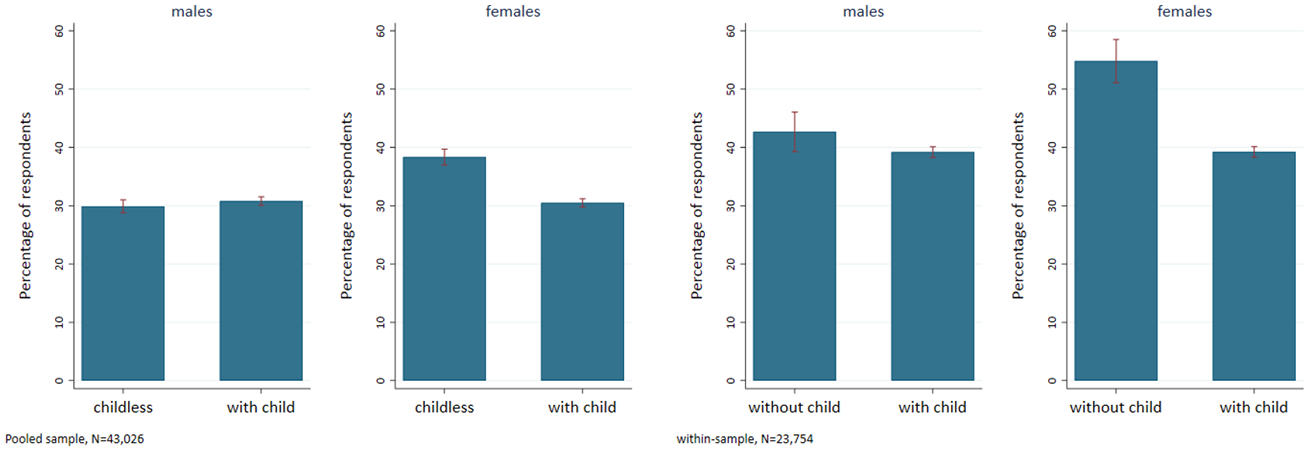
Share of respondents who participated in job-related training over the last 12 months in pooled LPM sample (left panel) and FE sample (right panel).
The parenthood training penalty for non-formal further education
Figure 2 presents the results for the relationship between parenthood and training participation graphically by plotting the point estimates and their 95% confidence intervals from adjusted and unadjusted (1) pooled LPM, (2) FE and (3) FEIS regressions. 4 Coefficients, standard errors, number of observations and unique individuals are reported in the Online Supplementary Tables A7–A11.
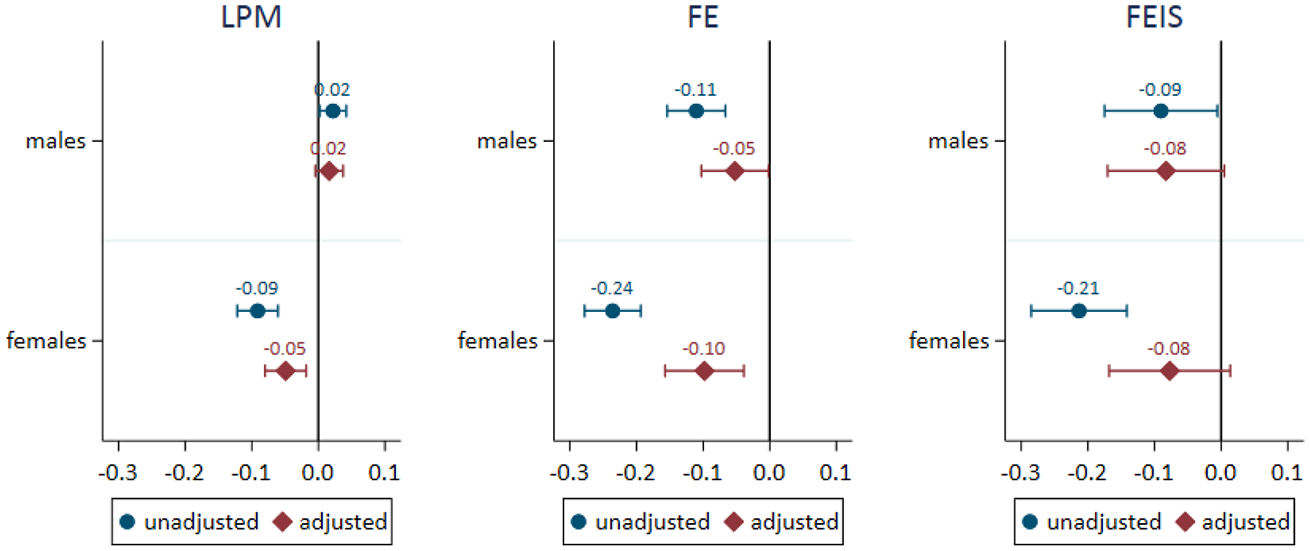
Children and parents’ job-related training (results from pooled LPM, FE and FEIS).
In line with previous literature, LPM models based on the larger sample suggested a small fatherhood premium of two percentage points for men’s job-related training participation. 5 However, using the within-samples, FE (−0.11) and FEIS (−0.09) models revealed a statistically significant training penalty also for fathers. When accounting for additional changes on the individual, household, employer and occupational levels, the coefficient from adjusted within-models decreased and lost statistical significance, suggesting a relatively small change in fathers’ job-related training participation. Nevertheless, the contrasting findings from between- and within-estimators suggest that previous cross-sectional studies may have underestimated the challenges that fathers also face in continuing their job-related training shortly after childbirth.
For women, motherhood was associated with a substantial training penalty in all three model specifications. Surprisingly, FE and FEIS estimates confirmed the existence of larger and statistically significant motherhood penalties than the between-estimator. With a child, the likelihood of mothers participating in non-formal training was about 21 (FEIS) to 24 (FE) percentage points lower. When accounting for changes on the individual, household, employer, occupational and regional levels, both within-estimates decreased in magnitude and only the FE estimate remained statistically significant. However, given the smaller FEIS sample and the similar effect sizes of the adjusted FE and FEIS estimates, accounting for heterogeneous career and training trajectories in FEIS did not change the pattern of adjusted within-results. The findings therefore mostly support the assumption of a larger training penalty for mothers than fathers.
Effect sizes of the time-varying control variables in the linear panel regressions with FE and FEIS were small and in line with theoretical considerations and previous results from other related studies. Stepwise models revealed that employment experience and leave take-up explained almost half of the fatherhood training penalty (see Online Supplementary Tables A8–A11). Although part-time work and (longer) leave take-up are not very common among fathers, changes in employment status, household income and childcare time explained their training penalty at least somewhat. Conversely, changes in the occupation, employer, workplace and regional characteristics did not further explain the remaining fatherhood penalty. Conversely, accounting for employment and leave experience barely explained the motherhood training penalty. Instead, altered employment participation as well as increased childcare time explained almost two-thirds of the gap. Additional analyses also tested a continuous measure of working hours (linear and quadratic terms) and a categorical variable (⩽ 15 hours, 16–20 hours, 21–30 hours (ref.), 31–35 hours, 36–40 hours and 40 hours or more). The variables showed no significant associations, nor did the patterns of the presented results change. Although higher household income was positively related to job-related training, changes in household income did not substantially explain mothers’ decreased training participation. Similarly, changes in employer, workplace characteristics, occupation and regional aspects were of little relevance to explain the reduced training participation of mothers.
Overall, comparing the conventional FE estimate with results from pooled LPM illustrated that training penalties even increased when accounting for constant characteristics, such as education, career aspirations, or cognitive ability. These constant characteristics are likely to be correlated with training participation, thus biasing the results of the between-estimator. Moreover, compared to the results from conventional FE, adjusted FEIS models accounting for heterogeneous individual career and training trajectories showed only slightly smaller parenthood penalties. However, considering the smaller size of the FEIS sample and similar effect sizes of both adjusted within-estimators, accounting for heterogeneous career and training trajectories models did not substantially change the pattern of the results.
Parenthood training penalty over time
Distributed FE regression models illustrated that for fathers and mothers the average training participation in each year after childbirth was lower than in any year before childbirth (Figure 3, unadjusted; see Online Supplementary Table A12). Among mothers, training participation declined sharply in the year of childbirth and the subsequent year but increased somewhat after that. However, the findings did not confirm the existence of an anticipation effect (i.e. a small reduction in training probability in the year before childbirth (t = 0)). 6 Adjusting for time-varying variables explained all of the observed within-differences for fathers (lower panel). Conversely, for mothers, observed differences remained statistically significant in the first two years after childbirth. Further analyses showed that mothers in West Germany, where childcare capacities remain low and are mostly only offered part-time (Zoch, 2020), reduced their training participation more and for longer than in East German (Figure A1 in the Online Supplementary Material). Furthermore, West German mothers showed a small anticipation effect that was statistically significant at the 5% level.
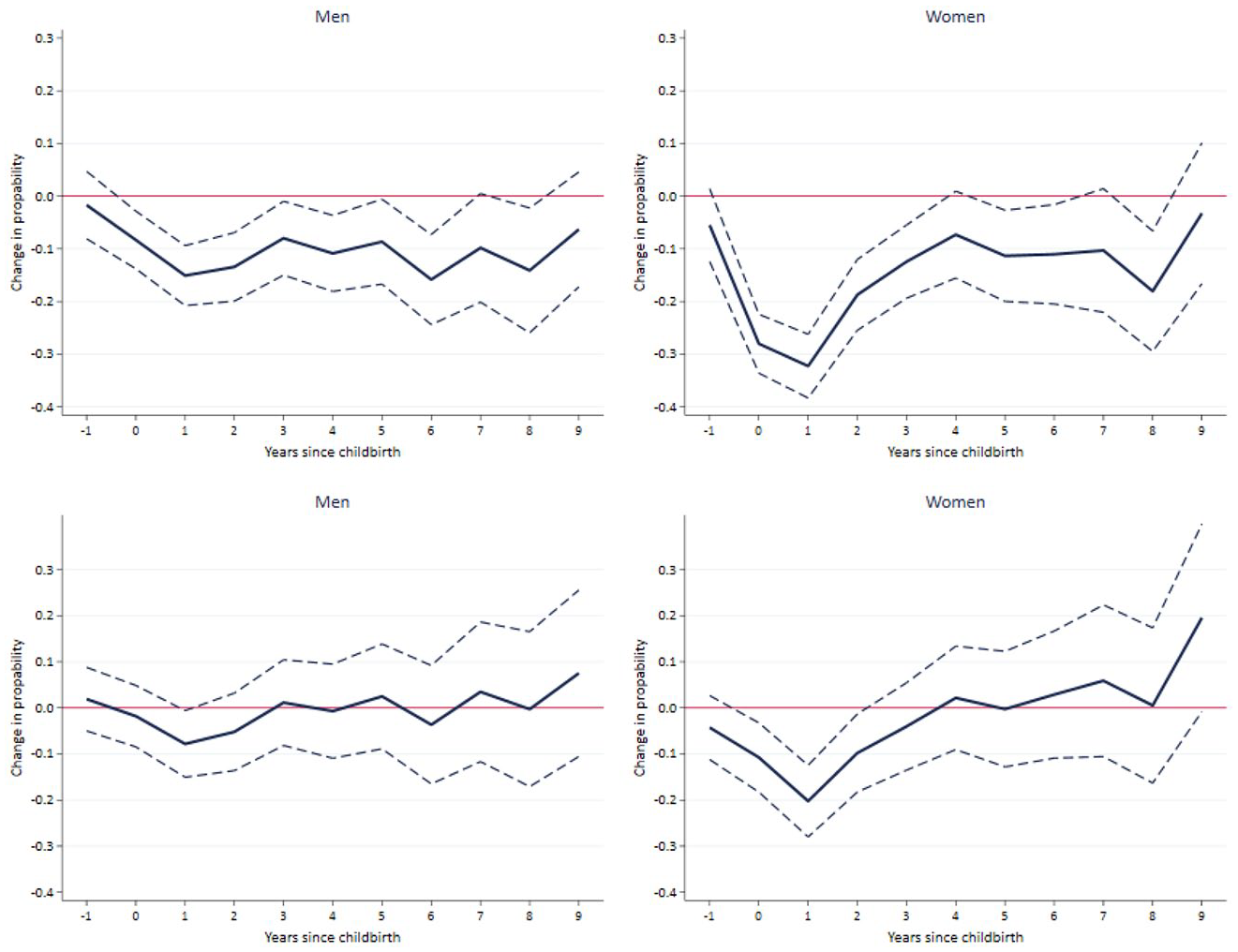
Within-changes in parents’ average training participation after childbirth over time from unadjusted (upper panel) and adjusted (lower panel) distributed FE models.
Robustness checks
To ensure that motherhood penalties were not related to educational disparities and associated labour market inequalities, all models were estimated separately for mothers with at least a college degree and those with lower educational levels (robustness checks are reported in the Online Supplementary Material). The FE results showed only minor educational differences in training penalties whereas FEIS estimates indicated smaller penalties for mothers with higher educational levels (−0.11 vs −0.03). This is notable because mothers with high levels of education are more likely to realise their less traditional prenatal employment preferences and therefore return to employment earlier and more often full-time (Zoch, 2020). Accordingly, these mothers might be less likely to reduce their demand for training or signal career aspirations more strongly and therefore receive more training opportunities than women with low educational levels.
Furthermore, FE models were re-estimated, distinguishing men and women according to male-dominated, mixed and female-dominated occupations. However, adjusted models did not reveal substantial occupational differences in parenthood penalties. If at all, parenthood penalties were smaller in female-dominated occupations than in male-dominated and mixed occupations. Although women’ effect sizes remained substantial, the results were based on small subsamples, resulting in large confidence intervals and statistically significant estimates only for women in mixed occupations.
To examine the potentially positive role of supportive workplace characteristics, FE models were re-estimated, distinguishing between respondents in organisations with or without (a) provision or financing of courses, (b) education planning on a regular basis, (c) a company agreement about further education, or (d) a unit or staff member responsible for organising training. Comparing the results for different employer contexts using separate models or an index on supportive workplace characteristics suggested that mothers working in contexts with measures to support job-related training experienced higher prenatal training levels and, thus, somewhat greater training penalties that remained robust when including relevant control variables. Corresponding comparisons showed similar patterns but less substantial penalties for men.
Discussion and conclusion
By exploiting large-scale panel data from Germany, this study is the first to examine the question of whether the birth of a child is linked to changes in non-formal job-related training participation among working women and men. The results obtained from panel analysis are noteworthy in several respects. The findings from individual FE and FEIS models demonstrate that childbirth reduces the probability of job-related training among parents, thus corresponding to the initial Hypothesis 1, assuming a negative childbirth effect on the participation in job-related training. Although men and women experience a training penalty, the disadvantages of childbirth are more than twice as large for mothers than for fathers, providing support for the second hypothesis – presuming a larger training penalty for mothers than fathers. Hence, in line with the economic specialisation theories (Becker, 1981) and bargaining theories (Lundberg and Pollak, 1996), gender inequalities in the family translate into labour market inequalities, resulting in larger training penalties for mothers.
Moreover, the results highlight that childbirth affects the supply and demand aspects influencing training participation differently for men and women, confirming previous findings on gender-specific determinants of participation in job-related training (e.g. Burgard, 2012; Dieckhoff and Steiber, 2011). In contrast to earlier findings on fatherhood premiums (Burgard, 2012; Dieckhoff and Steiber, 2011), men also show fatherhood training penalties, that were, however, smaller and mostly related to few changes in employment participation and leave take-up. This might suggest that fathers reduce their demand for further training only temporarily when the child is very young. In sum, results provide less support for a substantial fatherhood training penalty. Conversely, increased childcare time and reduced working hours explain large parts of the motherhood penalty, which corresponds to previous cross-sectional results (Boll and Bublitz, 2018; Dämmrich et al., 2016; Massing and Gauly, 2017). However, in contrast to earlier findings (Burgard, 2012; Dämmrich et al., 2016; Havet and Sofer, 2008), changes in household income, employer and occupational characteristics are of little importance in explaining the remaining parenthood penalties for men and women.
Moreover, even after adjusting for changes at the individual, household, employer, occupational and regional levels, altogether explaining large parts of the training penalties, the estimated parenthood gaps remain of substantial magnitude, particularly for mothers. These remaining differences suggest that there are further relevant but unobserved factors that reduce parents’ participation in job-related training after childbirth. First, parents might reduce their demand for further training, which is supported by the finding of a small anticipation effect for West German mothers. This could be due to various reasons, such as wanting to spend more time with family or not having the time or mental capacity to balance family and additional job responsibilities such as further education. Previous research shows that working mothers develop more family-oriented attitudes when they are unable to realise their prenatal attitudes and maternal employment goals due to a lack of support for balancing family and work (Schober and Scott, 2012). With the still inadequate formal childcare coverage levels for the under-threes, especially in West Germany (Zoch, 2020), some mothers might feel unable to pursue their original career goals and therefore might reduce their demand for job-related training. Consistent with identity theories based on roles and group attributions (Stets and Burke, 2000), the unexplained training differences may be related to identity shifts that are more severe for mothers due to stronger changes in roles. Second, supervisors and organisations might reduce training opportunities or their support for training participation by parents, especially mothers. As the models account for changes at the individual, household, employer and occupational levels, the remaining differences could indicate reduced employer support or discrimination against parents, especially mothers, which would confirm previous findings (Dieckhoff and Steiber, 2011; Hipp, 2020) and theoretical frameworks of negative signalling and discrimination (Arrow, 1973; Phelps, 1972). However, without annual information on possible changes in individual career or training aspirations, further workplace characteristics, or supervisors’ support, future studies will need to explore these potential mechanisms more thoroughly.
Overall, the findings support previous cross-sectional and comparative studies showing a female training disadvantage in several Western countries (Boll and Bublitz, 2018; Dämmrich et al., 2016; Dieckhoff and Steiber, 2011). The study is the first to examine childbirth-related changes in training participation at the individual level, exclusively focusing on job-related training and separately for men and women. The results suggest that the lower training rates of women found in cross-sectional studies are most likely related to motherhood. However, it remains to be seen to what extent participation in privately organised training that is either job-related or linked to private interests is similarly affected by childbirth, and whether studies, not distinguishing between these different forms of training, underestimate or overestimate the female training disadvantage (e.g. Boll and Bublitz, 2018). Nevertheless, by considering constant unobserved heterogeneity and a large number of control variables for the individual, household, occupational, employer and regional levels, this study highlights the importance of examining a within-estimator, providing a more causal interpretation of the childbirth effect on job-related training than cross-sectional studies. However, it should be noted: Although a large part of the training gaps can be explained by changes at the individual, employer, occupational and regional levels, these explanations do not diminish the significance of the observed training differences. In particular, the negative impact of maternal childcare time and altered employment reflects the insufficient opportunities for mothers to reconcile family and work. Against this background, it is not unlikely that mothers permanently scale back their career ambitions, work part-time, aspire to fewer leadership positions and therefore participate less often in job-related further training over their future career (Herman, 2015; Tokbaeva and Achtenhagen, 2021).
From a broader perspective, the findings extend the evidence of previous studies on the negative childbirth effects on women’s employment and wages (Hipp, 2020; Steiber and Haas, 2012) with longitudinal findings of a training disadvantage when returning to work. Therefore, also from a theoretical perspective, the results likewise provide evidence that gender inequalities in paid and unpaid work carry over to job-related training. The concern is that lower training rates further reduce mothers’ already lower chances for promotions and higher earnings, so that inequalities accumulate and result in lower career trajectories, lifetime earnings and, thus, lower wealth accumulation and pensions (e.g. Evertsson, 2004; Havet and Sofer, 2008).
Although this study is the first to estimate a within-estimator, the risk of biased estimates remains due to unobserved characteristics that may correlate with the observables, such as altered aspirations, job tasks or unobserved workplace characteristics. However, by accounting for changes in a large number of individual, household, organisational, occupational and regional characteristics, the results provide a more robust picture than previous cross-sectional studies. It is, however, important to note that, given the small number of observed births, the results should be interpreted with caution. Furthermore, this limitation did not allow comparison of within-changes in job-related training according to many other characteristics. Examining workplace inequalities in altered training as well as inequalities within the group of mothers is therefore an important avenue for future research. This research should carefully investigate direct and indirect mechanisms such as altered career orientation, household bargaining processes and potential employer discrimination to further explain the observed motherhood penalties. In addition, it should be explored whether mothers increase their training participation again when the child grows older in order to compensate for skill loss due to longer family-related employment interruptions (Tokbaeva and Achtenhagen, 2021), less training upon return when children are young (Blossfeld et al., 2020) or career changes requiring retraining (Herman, 2015).
Despite these limitations, the longitudinal NEPS data provide a great advantage to examine the relationship between childbirth and altered training and the underlying mechanism much more thoroughly than previous cross-sectional studies. In this way, the article provides the first longitudinal evidence on the negative effect of childbirth on non-formal job-related training, with larger penalties for mothers than fathers.
Supplemental Material
sj-pdf-1-wes-10.1177_09500170221128692 – Supplemental material for Participation in Job-Related Training: Is There a Parenthood Training Penalty?
Supplemental material, sj-pdf-1-wes-10.1177_09500170221128692 for Participation in Job-Related Training: Is There a Parenthood Training Penalty? by Gundula Zoch in Work, Employment and Society
Footnotes
Acknowledgements
The author is grateful for comments on an earlier version of this article from participants at the RC28 Conference 2021 and for helpful suggestions from those at invited seminars at University of Bamberg, the CSIS Brown Bag Seminar at the University of Trento and the Research Centre for Education and the Labour Market at the University of Maastricht.
Author’s note
The analysis uses data from the Adult Cohort of the National Educational Panel Study. From 2008 to 2013, NEPS data were collected as part of the Framework Program for the Promotion of Empirical Educational Research, funded by the German Federal Ministry of Education and Research (BMBF). As of 2014, NEPS is carried out by the Leibniz Institute for Educational Trajectories (LIfBi) at the University of Bamberg, Germany, in cooperation with a nationwide network. Among others, the data set contains detailed longitudinal information on individuals’ educational careers and other individual and household characteristics.
Funding
The author received no financial support for the research, authorship, and/or publication of this article.

Supplementary material
The supplementary material is available online with the article.
Notes
References
Supplementary Material
Please find the following supplemental material available below.
For Open Access articles published under a Creative Commons License, all supplemental material carries the same license as the article it is associated with.
For non-Open Access articles published, all supplemental material carries a non-exclusive license, and permission requests for re-use of supplemental material or any part of supplemental material shall be sent directly to the copyright owner as specified in the copyright notice associated with the article.
