




Abstract
Studies looking at patterns of labour market outcomes among lesbian, gay and bisexual (LGB) individuals focus mostly on earnings, while non-pecuniary outcomes of LGB individuals have remained a relatively under-researched area. Using the latest wave of the Workplace Employment Relations Study (WERS), this article investigates the job satisfaction levels of LGB individuals compared to their heterosexual peers for the first time in Britain. The results show significantly lower job satisfaction levels only for bisexual men, compared to their heterosexual counterparts. Moreover, the findings do not show a direct impact of LGB(T)-related workplace policies on job satisfaction levels.
Introduction
Research concerning sexual orientation and inequalities has been growing for several decades in Britain. Although the outcomes relating to employment and the labour market are no exception, most research investigating these at the national level looks at economic aspects of working life, such as earning differentials and, to some extent, rank and authority in the workplace (Aksoy et al., 2018; Arabsheibani et al., 2005; Bryson, 2017; Wang et al., 2018). Work is an important aspect of people’s lives; one of the defining characteristics of daily life and subjectivity, beyond having a purely economic function. Despite growing research interest, work-related outcomes of sexual minority groups remain an under-researched area and non-pecuniary outcomes at the workplace are often ignored.
This article aims to document the job satisfaction levels of lesbian, gay and bisexual (LGB) employees in Britain compared to their heterosexual counterparts and explores the impact of workplace characteristics on job satisfaction. Job satisfaction has been identified as a significant aspect of the professional and private lives of individuals, as well as an important workplace policy area (Locke, 1976). At an individual level, job satisfaction is found to be linked with better mental and physical health, general well-being and life satisfaction (Faragher et al., 2005). At an organisational level, it is associated with greater employee productivity and lower staff turnover (Wright and Bonett, 2007).
Despite an increasing interest in the experiences of sexual minorities in the labour market, research regarding their job satisfaction levels has remained underexplored. Only a limited number of studies have been conducted (Carpenter, 2008; Drydakis, 2012, 2015; Hammarstedt et al., 2018; Kuyper, 2015; Leppel, 2014). These studies differ substantially in terms of the demographic groups, countries and explanatory factors that they examine, as well as in their findings. Overall, they present a mixed set of results, indicating varying degrees of dis/advantage for LGB individuals in terms of their job satisfaction levels.
Using representative multi-level data from the Workplace Employment Relations Study (WERS), this article aims to contribute to the literature in several ways. First, it provides evidence on the job satisfaction of LGB individuals across Britain for the first time. The link between sexual orientation and job satisfaction has been explored in other contexts. However, providing evidence from Britain is important since Britain is recognised as being at the forefront of legislation and equality policies related to sexual orientation (Valfort, 2017). The findings from such a context with well-developed legislation regarding LGB employees can inform policies around the world, particularly in the European context where sexual minority rights have an essential place in the policy agenda (FRA, 2018). Second, the article adopts a multi-level design to understand the role of workplaces on job satisfaction. It uses several workplace characteristics to understand how these affect the specific needs of LGB employees. Britain stands as an excellent case to study such workplace-level effects, since workplace equality policies affecting LGB people were adopted in Britain earlier than many other countries. Third, the study does not only look at the differences between LGB and heterosexual employees, but also explores the diverse outcomes among gay, lesbian and bisexual employees. In this way, it contributes to debates about intersectionality, which aims to explore the diverse experiences of in/equality among minority groups.
Theoretical framework
Job satisfaction and its determinants
Job satisfaction is defined as a ‘positive emotional state resulting from the appraisal of one’s job or job experiences’ (Locke, 1976: 1300). It can depend on individuals’ own assessment of their opportunities, their relationships with colleagues and managers, and the rewards they receive from their job, including: pay, promotion and working conditions. However, job satisfaction is also shaped by individuals’ desires in general and expectations informed by the opportunities around them. Hence, the more the job delivers the valued aspect to the individual beyond their expectations, the more satisfaction the individual gains from their job (Clark, 1997).
Early research indicated three main factors which affect levels of job satisfaction: job characteristics, personal characteristics, and the motivations and expectations of employees (Kalleberg, 1977). Job characteristics, such as high income, full-time status and permanent work, having a supervisory role and promotion opportunities, are thought to affect individuals’ perceptions of how rewarding their work is (Clark, 1997). With regard to personal characteristics, research has found that age and good health (Clark et al., 1996), marital status, education (Grund and Sliwka, 2007; Okpara, 2004), gender, ethnicity, and having more intrinsic and human-oriented work orientations are among the factors associated with job satisfaction (Clark, 1997; Gazioglu and Tansel, 2006; Zou, 2015).
In addition to these factors, workplace characteristics are also said to affect job satisfaction levels. The perceived fairness of the workplace leads to higher levels of job satisfaction among employees (Bettencourt and Brown, 1997), along with lower levels of staff turnover (McKnight et al., 2009). While these workplace characteristics appear to increase job satisfaction across all employees, they might be particularly effective in addressing the job satisfaction levels of employees from certain social groups. Researchers find evidence for the role of positive workplace characteristics on narrowing the gap between both abled and disabled employees (Uppal, 2005) and between ethnic majority and minority employees (Shields and Price, 2002). This suggests that workplace characteristics might moderate the relationship between minority status and job satisfaction, including for sexual minorities.
Sexual orientation in the workplace and job satisfaction
Despite equality legislation, many studies have documented the negative experiences and distress of LGB individuals in the workplace stemming from discrimination, which are likely to affect their job satisfaction negatively. Heteronormativity is central here (Colgan et al., 2009) and can be defined as the beliefs, attitudes and behaviours in which heterosexuality is seen as the norm and sexual minorities are either ignored, oppressed and/or marginalised. It is argued that workplaces are environments where heteronormative practices are common and seen as natural (Hearn et al., 1989) and in which heterosexuality is accepted as the social norm and non-heterosexual identities and lives are stigmatised.
Owing to heteronormative culture and practices in workplaces (Benozzo et al., 2015; Ozduzen and Korkut, 2020) and anticipated discrimination (Prati and Pietrantoni, 2014), many LGB employees choose not to disclose their sexual orientation; a process not experienced by heterosexual employees. Stenger and Roulet (2018) described a variety of ways that concealing one’s sexuality can be damaging. Constant self-censorship and control can be exhausting, and it may feel like a betrayal to one’s true self, as well as colleagues, intimate partners and communities. As a result, employees may distance themselves from others, losing friendships and support, including strong professional networks, which may affect both their well-being and career prospects.
While disclosing one’s LGB identity can be rewarding, eliminating the emotional burden and distress caused by concealment, it may still have a negative impact on one’s well-being and job satisfaction. LGB individuals may experience prejudice and overt discrimination (Ozturk and Rumens, 2014), or face more subtle forms of discrimination (DeSouza et al., 2017). They may feel invisible (Rumens, 2012) or they may alter some aspects of their identity or hide parts of their personal life in an effort to adhere to heteronormative ideas of professionalism (Mizzi, 2013), which can be degrading as well as stressful. Some studies do show positive effects for disclosing sexual orientation on the job satisfaction levels of LGB employees, as ‘coming out’ is associated with self-acceptance and confidence (Ellis and Riggle, 1996; Griffith and Hebl, 2002). Prati and Pietrantoni (2014) argue that this association is, however, mediated by anticipated discrimination, although the causal mechanisms behind these associations should be interpreted carefully. Overall, while disclosure of sexual orientation is likely to increase job satisfaction, LGB employees are still likely to suffer from some discrimination in comparison to their heterosexual counterparts.
While the studies discussed so far suggest that LGB individuals can experience distress and discrimination in the workplace, the literature on job satisfaction levels of LGB employees presents a mixed set of findings when comparing results from different countries. Drydakis (2012, 2015) found that gay and lesbian employees in Greece have significantly lower job satisfaction levels than their heterosexual colleagues, while bisexual employees appear to have significantly lower levels than any other group. The evidence from Canada shows that while gay and lesbian employees report lower job satisfaction levels compared to their heterosexual colleagues, conversely, bisexual employees, both men and women, report the highest levels of job satisfaction (Leppel, 2014). However, a study of young women in Australia found low job satisfaction levels for both lesbian and bisexual women, the latter being the most disadvantaged (Carpenter, 2008). While Kuyper (2015), in an analysis of Dutch employees, found no difference for gay and lesbian employees, but slightly lower levels of job satisfaction for bisexual employees when compared to their heterosexual peers. Finally, Hammarstedt et al. (2018) reported higher job satisfaction levels for gay men and lower levels for lesbians when compared to their heterosexual peers in Sweden. They attribute the higher satisfaction levels of gay men to their lower expectations, while the lower satisfaction levels of lesbians were thought to stem from prejudice and discrimination. The mixed findings presented in these studies might be related to different national contexts, or they may reflect different research designs and/or different samples. The inconsistent findings in this body of literature also suggest that more empirical work is needed in this area to explore patterns of job satisfaction levels.
Intersections and job satisfaction
Regarding LGB individuals as one homogenous group can prevent an intersectional understanding of difference and diversity (Cronin and King, 2010). Some studies describe mechanisms that create differences in the experiences of lesbian, gay and bisexual employees. Barker et al. (2012) argue that bisexuality should be treated as a distinct category within sexual minority communities, as bisexual people are likely to experience heteronormativity in different ways compared to lesbian and gay individuals. Bisexual identity is ignored by some people and labelled as ‘confused’ or ‘fake’ (Köllen, 2013). Moreover, biphobia and bisexual invisibility can be exerted or reinforced by lesbian and gay individuals too. Hence, bisexual employees may have lower levels of job satisfaction than gay and lesbian employees caused by intersecting factors.
It is also possible to expect some distinct experiences at the intersection of gender and sexual orientation. Some studies report more favourable treatment of gay male employees, who are described as more ‘glamorous’ compared to lesbian employees, particularly in certain sectors such as hospitality (Willis, 2010). A perceived ‘masculinity’ among some lesbians is suggested to create an advantage in male-dominated environments (Wright, 2011), while others report that lesbians experience a double disadvantage due to their gender and sexual orientation, facing greater penalties than gay men (Stenger and Roulet, 2018).
Such stereotypes and generalisations may also lead to differences in job satisfaction between gay and lesbian individuals. Sexual minorities are less likely to adopt strong gender roles compared to their heterosexual counterparts in the workplace (Carpenter, 2008). Such patterns have been identified as having an impact on the earnings of gay and lesbian individuals (Aksoy et al., 2018), suggesting that a gender gap in earnings is less pronounced for sexual minority groups. If the same mechanism applies to job satisfaction levels, there may also be smaller gender differences between lesbians and gay men. However, some research suggests that lesbians are less willing to accept ‘less-than-ideal’ jobs compared to both gay men and heterosexual individuals (Ng et al., 2012). Having higher expectations, they are likely to have lower job satisfaction than these groups, especially if they also face discrimination. These expectations are likely to operate simultaneously, although it is unclear which of these factors is more likely to shape LGB disadvantage in the workplace.
Workplace characteristics and LGB job satisfaction
While modern corporations with performance assessments are found to discriminate less against individuals with minority status (Méon and Szafarz, 2011), recent studies regarding LGB individuals show that workplace characteristics still matter. Pink-Harper et al. (2017) found that perceiving a culture of diversity in the workplace can increase the job satisfaction levels and skill utilisation of these employees. Furthermore, the availability of inclusive workplaces, where individuals feel comfortable enough to disclose their sexual orientation, is also argued to be a potential reason for higher levels of job satisfaction, particularly for LGB employees who have lower expectations (Leppel, 2014). Studies looking at subjective evaluations of workplaces show that employees working in a heterosexist workplace environment also have lower job satisfaction levels (Prati and Pietrantoni, 2014).
These findings suggest that workplaces can be effective in realising the potential of their employees, and more so for LGB individuals. Although not specifically focused on job satisfaction, qualitative research also supports the association between the existence of equality and diversity policies and the well-being and confidence of LGB individuals at work (Wright et al., 2006). It appears that the policies promoting equality and diversity are likely to moderate the relationship between sexual orientation status and job satisfaction levels. In other words, such policies may increase job satisfaction for all employees, but more so for LGB employees, therefore narrowing the gap between these groups.
Some researchers have noted, however, that the translation of national policies into local practices are not always straightforward and policy aims can be diverted in the implementation process (van Gestel and Nyberg, 2009). Therefore, equality policies may remain ineffective in eliminating prejudice and discrimination against sexual minorities (Colgan et al., 2009). Adopting a ‘one size fits all’ approach and ignoring the complexity and diversity of LGB individuals, particularly with regard to intersections of gender, age and other social differentiations (King, 2016), can be problematic. Policies may too often focus on gay and lesbian employees and ignore bisexual and trans individuals (Barker et al., 2012; Ozturk and Tatli, 2016). Moreover, despite the positive changes brought by equality and diversity policies, individuals may still have fears over career progression, and experience relatively subtle forms of discrimination and invisibility, which may affect their job satisfaction (DeSouza et al., 2017). They can be discriminated indirectly because of heteronormative interpretations of professionalism, which valorise behaviours informed by heteronormativity as more professional than others (Rumens and Kerfoot, 2009). Such implicit or indirect forms of discrimination are as likely to happen at the workplaces where anti-discrimination laws are in effect (Mizzi, 2013).
Overall, the literature discussed in the preceding sections helps us to formulate some expectations regarding the job satisfaction levels of LGB employees in Britain. First, heteronormativity in workplaces, which prevents LGB employees expressing their identities fully, causing distress due to anticipated or experienced discrimination and affecting career prospects, is likely to cause lower job satisfaction levels. Second, job satisfaction levels are also likely to differ among lesbian, gay and bisexual employees, and bisexual employees may have the lowest levels of job satisfaction due to their unique experiences of discrimination and invisibility. Between gay and lesbian employees, several complex mechanisms are likely to be important. In a heteronormative workplace environment, gay men and lesbians may display differing characteristics that are either rewarded or devalued, again affecting overall job satisfaction. Moreover, stereotypes may be ‘rewarding’ in certain situations and sectors. For example, gay men may be seen as more ‘presentable’ and ‘glamorous’ while lesbians may be seen as more ‘professional’ and ‘authoritative’. Finally, regarding workplace characteristics, despite the literature discussing their limited impact, it is plausible that LGB-related diversity policies may increase the job satisfaction level of LGB employees.
Data and methods
Data
Our study used the latest round of WERS, which was collected in 2011 (NIESR, 2015). WERS is a national data survey, collecting information on working life and employment relations across Britain. The dataset includes information on workplace characteristics that can affect employees working in the same workplace (Charlwood et al., 2014). The data comprise information on 21,981 employees nested in 2680 workplaces. The individual-level information about employees and their family and job characteristics comes from employee questionnaires completed by employees. The workplace-level information about workplace characteristics and diversity comes from management questionnaires completed by workplace managers.
The dependent variable we are using is a composite job satisfaction measure, which has been created by combining reported satisfaction levels relating to eight different aspects of the job. The eight items were measured on a scale ranging from 1 (the lowest level) to 5 (the highest) and cover the following aspects: the sense of achievement individuals gain from work; the scope of using their own initiative; the amount of influence they have over their job; the training they receive; the opportunity to develop their skills; the amount of pay; job security; and the work itself.
Some studies only use a single item for overall job satisfaction (Zou, 2015), others utilise several aspects, either analysing them separately (Carpenter, 2008; Drydakis, 2012) or creating a composite variable (Pink-Harper et al., 2017). We opted for a composite dependent variable to cover all relevant aspects of a job. All the items were added up together and a job satisfaction score was created, ranging from 8 to 40. Our composite variable showed high correlation values with all the items ranging from 0.59 to 0.81. Our checks on measurement validity are available in online Supplemental Appendix A.
A self-identified sexual orientation variable was used to identify heterosexual, gay, lesbian and bisexual individuals. Among five options, only those who selected gay/lesbian or bisexual were included, along with the heterosexual individuals. Those who selected other or prefer not to say (78 and 800 cases, respectively, in total 4% of the total sample) were excluded, as their reasons for choosing these categories are unknown to us. Moreover, nine multi-coded cases and 858 refusals were also excluded from the analysis. These groups are likely to be heterogeneous and may include those who do not want to disclose their sexual orientation, those who may have a different gender identity, or those who identify as heterosexual but choose not to answer the questions because of their attitude towards sexual minorities. After omitting these cases and those with missing data from other variables, 1 our analyses included 15,672 employees in total, of which 357 of them identify as LGB. While gay (169) and lesbian (94) individuals form sizeable groups, bisexual individuals form relatively small groups (45 male and 49 female).
It is likely that survey datasets do not capture LGB individuals who are uncomfortable disclosing their sexual orientation, so introducing selection issues (Uhrig, 2014). The size and general characteristics of the LGB population is contentious (for a detailed discussion, please see Aspinall, 2009), therefore it is difficult to use an instrumental variable to adjust for such selection issues. We discuss the implications of a potential selection issue on our results in the discussion section.
Age was used as a categorical variable with nine age groups, as the literature shows a non-linear age effect (Clark et al., 1996). A dummy variable for ethnicity was included to control for minority ethnic background. Another dummy variable was used to identify health conditions, which limit daily activities. A measure for human capital, which separated those with a degree from those without one, was also included in the model. The job characteristics employed in this analysis were a dummy variable of position in the workplace, which identifies managerial positions in large and small companies and supervisory roles, as well as weekly pay, which identified four different pay bands. Dummy variables for part-time work and temporary contracts were included initially as they are likely to affect job satisfaction levels. However, they were removed since they did not show statistically significant effects. Finally, the model also controlled for employees’ family life with two variables: the marital status which differentiated single, married (or living with a partner) and divorced or separated individuals, and the number of children.
The remaining variables come from the management questionnaires. A size variable indicates the number of employees in a workplace and another variable shows whether it is in the private, public, or third sector. Finally, the model also included two variables measuring LGBT (lesbian, gay, bisexual and trans) inclusive workplaces: the adoption of LGBT inclusive policies and monitoring activities against LGB discrimination. The variable measuring LGB inclusive policies could have a score between 0 and 3 depending on satisfying three criteria: having a strategic plan mentioning employee diversity; having procedures to encourage job applications from LGBT individuals; and having a formal written policy on diversity which mentions sexual orientation. The variable measuring LGB inclusive monitoring activities could have a score between 0 and 5 depending on satisfying five criteria: monitoring recruitment and selection by sexual orientation; reviewing recruitment procedures for indirect discrimination by sexual orientation; monitoring promotions by sexual orientation; reviewing promotion procedures for indirect discrimination by sexual orientation; and reviewing relative pay rates by sexual orientation. 2 These variables aim to measure the existence of formal policies and procedures. While differences in the implementation of these policies can also affect the satisfaction levels of employees, the survey does not include this information, hence we limited our analysis to the effect of their existence.
Methods
First the descriptive statistics for male and female LGB individuals were examined. Subsequently, a multi-level random intercepts model was developed to analyse the job satisfaction levels of LGB individuals. Multi-level models allow us to measure between- and within-workplace variance, therefore making it possible to explore to what extent the difference is of being in a certain workplace in terms of job satisfaction. In the model-building stage, several models were run, including random-slopes models to show to what extent LGB job satisfaction levels differ by workplaces (please see online Supplemental Appendix C). Thus, these models showed whether workplaces differed significantly in terms of the job satisfaction levels of their LGB employees. In the end, we opted to present random-intercept models as they showed a better fit in likelihood ratio tests. Random-intercept models control for between-workplace variance, but they assume that the effects of independent variables do not vary across workplaces.
To examine the gendered effects on job satisfaction (Clark, 1997), we ran two separate models for men and women, as well as a pooled model. Weights were used for the descriptive statistics to give a representative picture of employees across Britain. For the regression analyses, we opted for not using weights, while the models run with weights are available in online Supplemental Appendix D.
Results
Table 1 provides descriptive statistics regarding job satisfaction and how the factors associated with it differ by gender and sexual orientation. In line with previous research, average job satisfaction was higher for heterosexual women, compared to heterosexual men. Gay men appeared to have higher job satisfaction levels than heterosexual men on average, while lesbians had lower job satisfaction levels compared to heterosexual women. Among both men and women, bisexual individuals had the lowest job satisfaction levels. While these differences needed to be confirmed in the regression analysis, they showed that, overall, there was a sexual minority penalty for all sexual minority groups, except gay men.
Descriptive statistics.
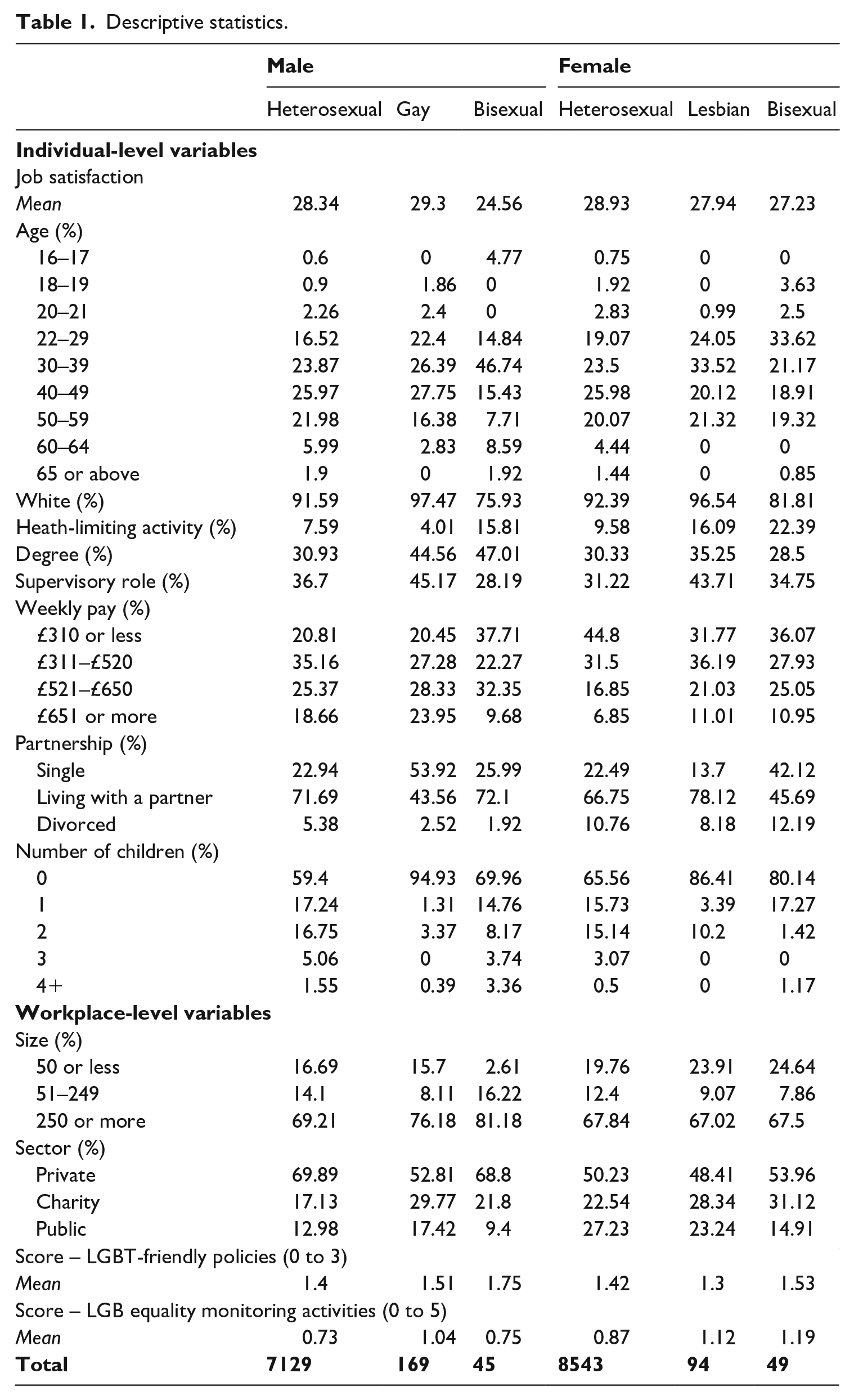
Table 1 also shows the distributions of factors which are likely to affect job satisfaction by gender and sexual orientation. In line with previous research (Aksoy et al., 2018), gay men and lesbians appeared to be more educated than their heterosexual counterparts. Lesbian employees were more likely to be in the ‘high earners’ category among women, while bisexual men and women were less likely to be in the ‘high earners’ category. Bisexual men seemed to be particularly disadvantaged as they were more likely to have a degree, but less likely to have a supervisory role when compared to their heterosexual and gay counterparts, which may suggest they have fewer job progression opportunities.
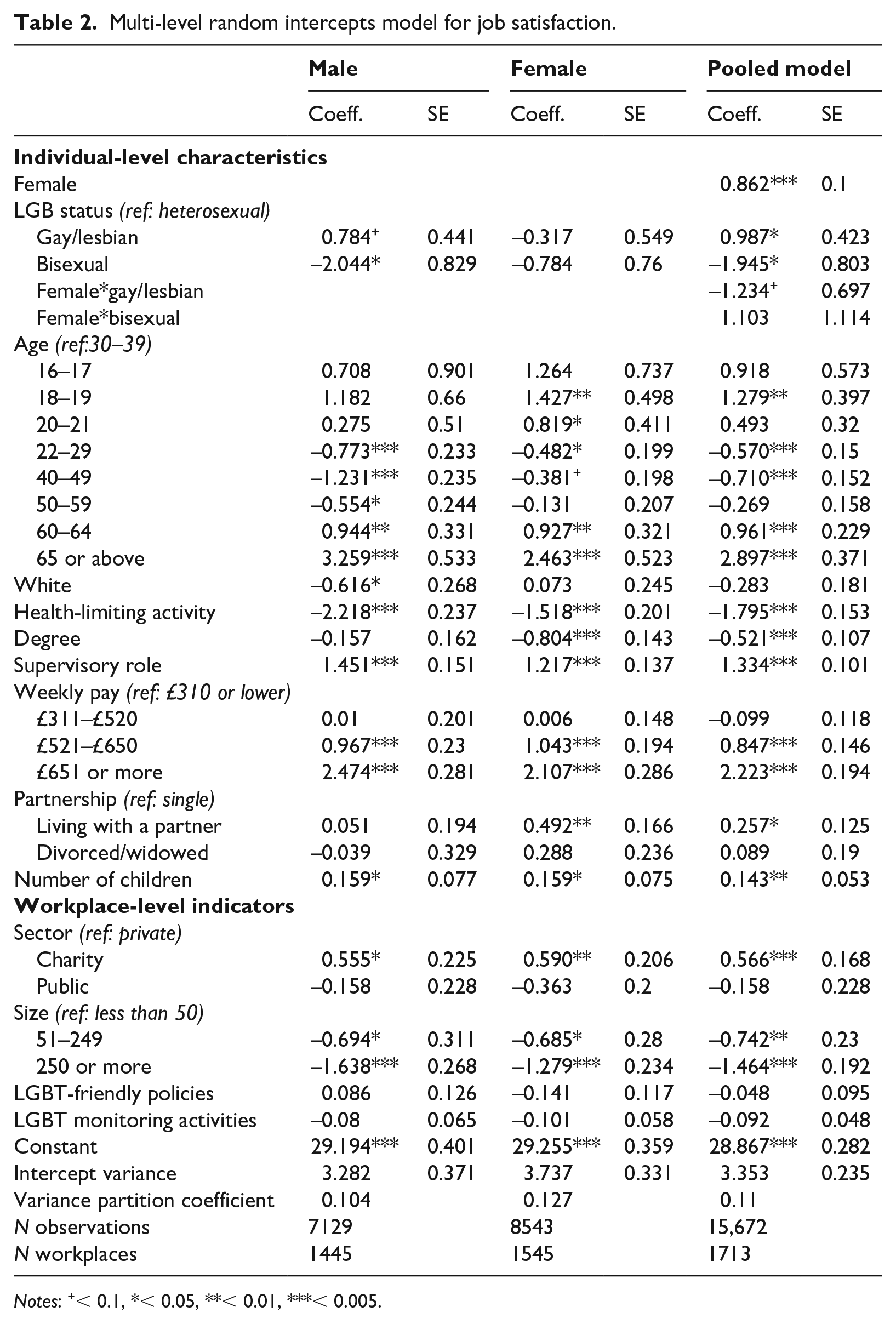
Table 2 shows the random intercepts models predicting job satisfaction levels separately for men and women, as well as a pooled model for both groups. The coefficients for LGB employees showed diverse outcomes in job satisfaction in terms of gender and sexuality. The pooled model shows that heterosexual women on average have higher job satisfaction levels than heterosexual men (0.862). There is a significant positive effect for gay (0.987) employees and a significant negative effect for male bisexual employees (–1.945) compared to heterosexual men. The effect for lesbian employees is 0.247 (0.987 – 1.234), significant only at the 0.1 confidence level, while the effect for female bisexual employees is –0.842 (–1.945 + 1.103) and not significantly different from the effect for heterosexual women.
Multi-level random intercepts model for job satisfaction.
Notes: +< 0.1, *< 0.05, **< 0.01, ***< 0.005.
Confirming the results from our pooled model, the male-only model shows a positive coefficient for gay men, indicating higher levels of job satisfaction for this group, albeit significant only at the 0.1 confidence level. Bisexual men had significantly lower levels of job satisfaction when compared to heterosexual men, suggesting a substantial male bisexual penalty (–2.044). The female-only model shows the effects for lesbian and bisexual women were also negative, but insignificant. Overall, our models suggest some evidence only for lower job satisfaction levels for bisexual men.
The other variables included in our models showed the expected effects on job satisfaction. Age had a U-shaped effect on job satisfaction, showing the lowest levels of job satisfaction for middle-aged individuals and the highest levels towards the end of working life. Being white had a negative effect only for males. Having health problems which limit physical activity had a negative effect on job satisfaction. Having a supervisory role and higher income was associated with higher levels of job satisfaction, having a degree was associated with lower levels of job satisfaction when controlled for earnings and supervisory role. Regarding family characteristics, having children was associated with higher levels of job satisfaction, as did living with a partner, but only for women, confirming previously documented gendered mechanisms behind job satisfaction differences (Hammarstedt et al., 2018).
Table 2 also shows the effects of workplace-level variables. According to our results, working in the third sector was associated with higher levels of job satisfaction, possibly due to the higher fulfilment reported in this sector (Ryan-Flood, 2004). The size of the company was associated negatively with job satisfaction levels, indicating that people working in smaller companies had higher levels. Finally, having equality and diversity policies related to sexual orientation e.g. LGBT inclusive policies and monitoring activities does not seem to have a significant effect on job satisfaction levels. Our models indicate that around 10% of the variance in job satisfaction was attributed to differences between workplaces.
Several sensitivity checks and different models were run as part of our model-building process (see online Supplemental Appendix C). First, the random-slope models were run to explore whether the job satisfaction levels between LGB and heterosexual individuals differed across workplaces. The likelihood ratio tests showed that our models were not improved by the random slope models. Second, the impact of LGBT-related workplace-level factors on the job satisfaction levels of LGB individuals were explored by adding interaction terms between those with sexual orientations. The models did not show any significant effect of LGBT-related policies and monitoring activities on LGB individuals in our data.
Finally, the regression models presented in Table 2 were rerun with individual-level and company-level weights provided with the WERS dataset. The weighted models (see online Supplemental Appendix D) did not alter the direction of the LGB coefficients. That said, the effect size for bisexual males was reduced by around 40% and not significant in the weighted models. The coefficient for bisexual women was also reduced and the negative effect was, albeit still there, almost negligible. The variables that were used to create the weights were included in our models (Winship and Radbill, 1994) and therefore the results are not likely to be biased by selection problems stemming from these variables. That said, it is possible that the effects might be not as strong as our models show.
Figure 1 uses the pooled model presented in Table 2 to predict job satisfaction levels. The figure shows how estimated job satisfaction levels changed for a hypothetical employee profile across different genders and sexual orientations. This hypothetical profile was defined as white, married or living with a partner, having one child, having no health problems, having no degree and being in the second lowest earnings quartile. The predicted values showed that heterosexual women had higher job satisfaction levels compared to heterosexual men in line with the literature looking at gender differences (Clark, 1997). Exactly the opposite was seen among the gay and lesbian individuals in which gay men appeared to have higher job satisfaction levels than lesbians. Finally, bisexual people seemed to have the lowest levels of job satisfaction, although bisexual women seemed to have higher job satisfaction levels than bisexual men.
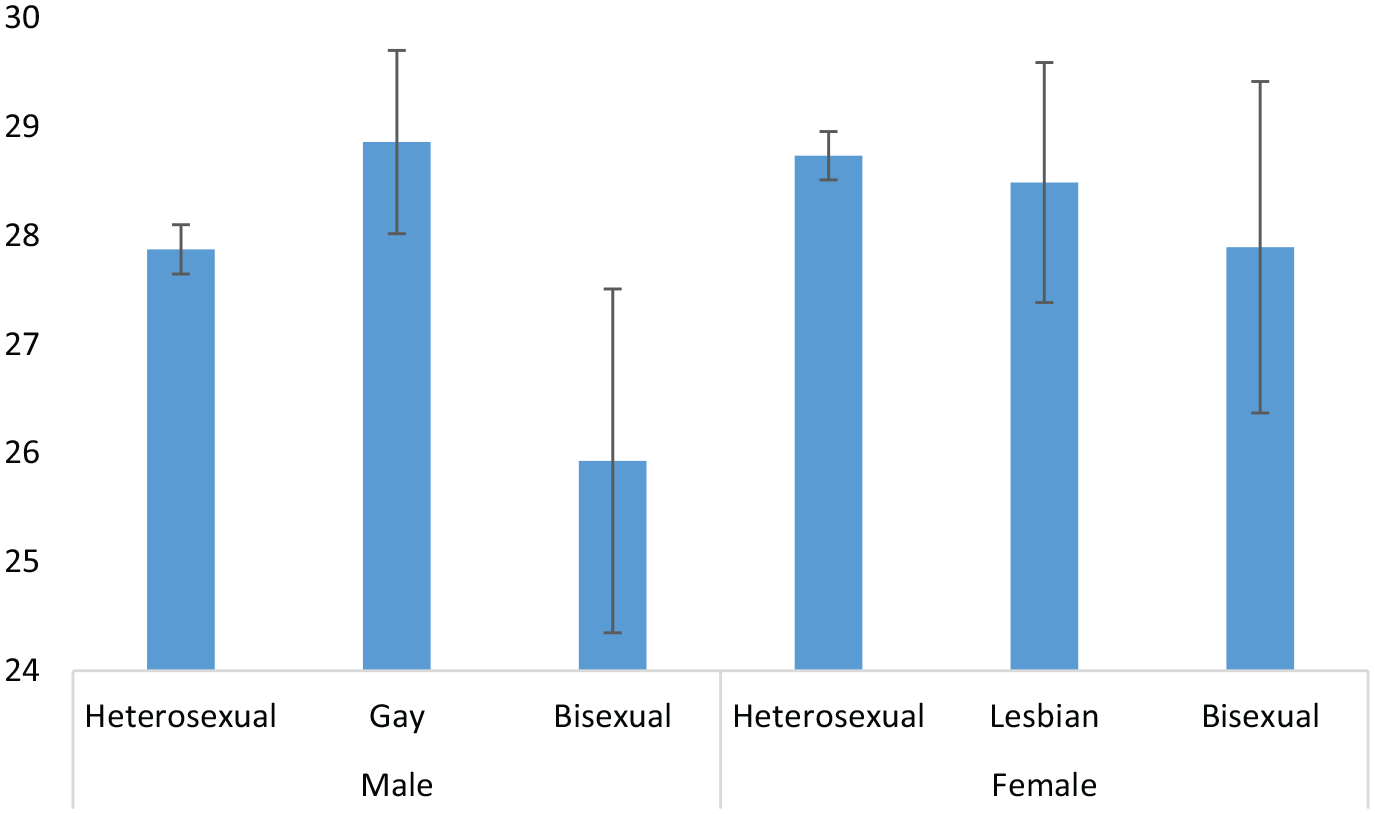
Predicted outcomes for job satisfaction.
Discussion and conclusion
This study represents the first attempt to explore inequalities in British workplaces by looking at employees’ job satisfaction levels by sexual orientation. Our results only partially support our expectations of lower job satisfaction levels for LGB individuals. The models showed evidence only for the lower satisfaction levels of bisexual men, echoing some of the earlier findings from the research on LGB job satisfaction conducted in other countries (Carpenter, 2008; Drydakis, 2015; Kuyper, 2015). While we do not test for them, some possible mechanisms behind this ‘bisexual penalty’ in job satisfaction can be deduced from the extant literature. Researchers working on the relationship between bisexuality and employment suggest that bisexual individuals face unique forms of discrimination and stigma, which are qualitatively different to those experienced by gay and lesbian individuals (Barker et al., 2012). Their bisexuality is often unrecognised, erased or may be labelled as ‘confused’ or ‘fake’. Furthermore, diversity policies, which should ameliorate this discrimination, have also been criticised for ignoring or poorly reflecting sexual minority identities, other than gay and lesbian (Ozturk and Tatli, 2016).
The fact that our results imply a ‘bisexual penalty’ only for men, calls for further attention to the intersection between bisexuality and gender for exploring workplace job satisfaction. Although it should be noted that the weighted results showed insignificant effects for bisexual men, these effects were still sizeable. In this regard, some tentative suggestions can be made for future research to explore a ‘bisexual penalty’ in job satisfaction. The models show narrower gaps for female employees than for male employees. It may be the case that differences relating to sexuality may be less amplified for women, despite an overall ‘bisexual penalty’ (evident from the pooled model). One rationale may be associated with stereotypes about gender and sexuality in different employment sectors, as others have noted (Willis, 2010; Wright, 2011). In this case, bisexual men may be more affected than other sexual minorities. Such claims are speculative, and their impact on the LGB individuals is likely to be complex, therefore further investigation, using larger samples, is required. While it is beyond the scope of this research, the results suggest the interplay between the perceptions of bisexuality in the workplace and of gender is key in understanding what is and is not valued and should be explored further in research focusing specifically on bisexuality.
While the coefficients for gay men and lesbian and bisexual women are not significant, their magnitudes suggest higher satisfaction levels for gay men and lower satisfaction levels for lesbian and bisexual women, compared to their heterosexual counterparts. The high levels of job satisfaction for gay men are surprising given the literature on discrimination against gay men in the workplace (Colgan et al., 2019). Although previous literature mentions favourable treatment of gay men and how they are valued in some sectors (Willis, 2010), it seems unlikely that this would prevail across all employment sectors. An alternative explanation might be gay men’s job satisfaction is shaped by their lower expectations from work (Hammarstedt et al., 2018; Ng et al., 2012). The nuanced differences that we have found in relation to job satisfaction not only between heterosexuals and LGB individuals, but also within and between LGB people, indicates that researchers need to further explore diversity and intersectionality within sexual minority groups in workplace settings (Cronin and King, 2010). Intersections of sexuality and gender appear to be a future path within the sociology of work and more evidence is needed to improve the policies on workplace diversity, but other intersectional sources of social difference, such as class and ethnicity, require further examination too. Although beyond the core aims of this study, our results suggest that ethnic differences in job satisfaction of LGB individuals are only present for male employees, which invites researchers to look into more complex intersections beyond gender and sexuality per se.
Britain is often regarded as being at the forefront of LGBT equality policies and there is an increasing attention to these policies given by public sector organisations, companies and employee networks. However, our results suggest that the existence of LGBT-related diversity and management policies at workplaces does not necessarily induce higher job satisfaction levels for LGB employees. We are not suggesting that these policies are therefore insignificant. They are associated with a lower gap in earnings between heterosexual and LGB employees, and they do contribute to the awareness of equality in the workplace (Wang et al., 2018). Our study, however, suggests that policymakers need to consider why policies, even in countries with pioneering LGBT equality rights legislation, do not appear to impact on job satisfaction levels among LGB employees to a greater extent.
There are several potential explanations. First, the policies themselves may not be offering strong and effective measures to overcome heteronormativity in the workplace; in effect, despite policies, heteronormativity may continue to affect how LGB people experience work and therefore impact upon job satisfaction. Second, there may be problems in translating national legislation into local policies and practices effectively (van Gestel and Nyberg, 2009). More fine-grained inclusion practices and procedures may be required, such as those inculcated by schemes such as the Stonewall Workplace Equality Index. Third, such policies may eliminate overt discrimination, but may lead to more subtle forms of discrimination that may still affect satisfaction. Fourth, it is also possible that our measurement of existence of these policies does not capture the positive impact they create. It is possible that some other operationalisation which focuses on the content of these policies may reveal a positive impact on job satisfaction levels.
While it exploits the advantages of survey data to explore LGB inequality, our study has several methodological and conceptual limitations. First, the data used were collected in 2011, and therefore our results show the effects of LGBT-related policies just after the 2010 Equality Act, although several years after the introduction of the Employment Equality (Sexual Orientation) Regulations 2003, which outlawed discrimination on the grounds of sexual orientation in the workplace. It is possible that these policies were less embedded and effective than they may be today. When newer data from WERS or other sources become available, our models should therefore be repeated with the new data. Second, we have excluded the cases who identify as ‘other’ from our analysis as we do not have enough information about this group, but we acknowledge that it may include some of the LGB employees in the sample who may not feel comfortable disclosing their sexual orientation in surveys. Individuals who identify as LGB but do not disclose this in surveys may be likely to experience more distress due to their limited power of expressing themselves but less discrimination as they hide their sexual identities. As a result, this selection may cause over/underestimation of our results. Future research is therefore needed to explore the characteristics of this group. Third, our study has been limited to the outcomes of gay, lesbian and bisexual individuals, while the spectrum of sexualities is much wider, and experiences are likely to differ from those identified in our dataset. The outcomes of such diverse identities on job satisfaction need to be explored by in-depth qualitative research, as well as in future quantitative surveys. Finally, the job satisfaction items available in the data are limited to the features of jobs and do not include any reference to one’s identity. Perhaps it is time to widen the coverage of job satisfaction items to include to what extent one feels respected and included and to what extent one’s sexual identity is recognised in the workplace.
Supplemental Material
sj-pdf-1-wes-10.1177_0950017020980997 – Supplemental material for Job Satisfaction and Sexual Orientation in Britain
Supplemental material, sj-pdf-1-wes-10.1177_0950017020980997 for Job Satisfaction and Sexual Orientation in Britain by Sait Bayrakdar and Andrew King in Work, Employment and Society
Footnotes
Acknowledgements
The authors would like to thank the three anonymous reviewers and the editors for their valuable feedback. Additionally, the authors would like to thank Gizem Arikan for technical support. The authors conducted the study as part of the Comparing Intersectional Life Course Inequalities amongst LGBTQI+ Citizens in Four European Countries (CILIA-LGBTQI+) project 
Funding
The authors disclosed receipt of the following financial support for the research, authorship, and/or publication of this article: this work was supported by NORFACE (New Opportunities for Research Funding Agency Cooperation in Europe) under the grant number 462-16-080/3724 (CILIA-LGBTQI+ Project: Comparing Intersectional Life Course Inequalities amongst LGBTQI+ Citizens in Four European Countries).
Supplementary material
The supplementary material is available online with the article.
Notes
References
Supplementary Material
Please find the following supplemental material available below.
For Open Access articles published under a Creative Commons License, all supplemental material carries the same license as the article it is associated with.
For non-Open Access articles published, all supplemental material carries a non-exclusive license, and permission requests for re-use of supplemental material or any part of supplemental material shall be sent directly to the copyright owner as specified in the copyright notice associated with the article.
