



Abstract
Previous studies highlight gender differences in job-related training participation, particularly in countries with few family policies supporting maternal employment. This study examines whether higher levels of state-subsidized childcare provision are positively linked to mothers’ participation in job-related training. It combines individual-level data from the National Educational Panel Study for Germany (NEPS-SC6 adult cohort, N = 5504, 2008–20) with annual administrative records on county-level childcare coverage. Results from fixed effects models provide evidence that higher childcare levels reduce the negative impact of childbirth on mothers’ job-related training participation. Nevertheless, motherhood training penalties exist even in contexts with higher childcare coverage levels, especially in West Germany. The findings highlight the importance of supporting family policies to reduce motherhood training penalties and associated gender inequalities in the labour market.
Keywords
Introduction
The ageing society and rapid technological advancements have prompted many western countries to extend working lives and integrate broader segments of the population into the labour market. Therefore, increasing the employment rates of groups who traditionally have lower participation, such as individuals with lower levels of education or care obligations, and promoting lifelong learning are some of the most crucial policy goals.
To foster maternal employment, EU member states have undertaken significant steps to increase childcare capacities, recognizing that access to affordable, high-quality childcare is essential to promote female employment and career advancement (Morrissey, 2017). Hence, the EU has set precise targets for member states to expand childcare services, with a specific emphasis on improving childcare for under-threes (Zoch, 2020).
Apart from increasing the labour supply of broader population segments, lifelong learning holds significant importance for all ageing societies with longer working lives and rapid technological change. Hence, also from an individual perspective, gaining new skills and knowledge is vital for maintaining a competitive edge in today's dynamic labour markets. Although the evidence for positive returns to further education is mixed, research emphasizes particularly high returns from employer-provided job-related training (Ehlert, 2017) while reducing the risk of downward mobility (Ebner and Ehlert, 2018). However, employment interruptions and care obligations may reduce mothers’ firm-specific training opportunities, while employers may have less incentive to invest in training.
The childcare expansion has increased maternal employment in many EU states (Morrissey, 2017, for an overview; and, for example, Zoch, 2020 for Germany), however, it remains uncertain to what extent greater childcare capacities promote women’s further training. Despite the growing recognition of the importance of lifelong learning, job-related training participation remains heavily stratified. Women, in particular, experience motherhood training penalties, that is, lower training participation rates due to childbirth (Burgard, 2012; Zoch, 2022). These penalties are closely linked to mothers’ larger shares of unpaid work, shorter working hours (Zoch, 2022), lower relative earnings (Boll and Bublitz, 2018), and family-related employment interruptions or employer changes that reduce incentives for firm-specific training for both employees and employers. Thus, gender training gaps appear to be more significant in employer-initiated or, the usually more expensive, external forms of employer-financed job-related training (Burgard, 2012; Dämmrich et al., 2016). Hence, research suggests that addressing these challenges requires policies that promote work–family reconciliation, mitigate employer and employee training costs.
To date, there is limited evidence on the supportive role of family policies for women’s job-related training participation. Comparative cross-sectional studies have revealed larger gender training gaps in countries with few family policies supporting maternal employment (Boll and Bublitz, 2018; Dämmrich et al., 2016; Dieckhoff and Steiber, 2011). Conversely, gender differences are smaller in Nordic countries, highlighting the importance of employment-oriented family policies. However, the studies vary considerably in terms of whether training is defined as formal, non-formal or informal training. 1 While some cannot distinguish between longer formal and shorter informal training that differ in certification or funding (private versus employer-sponsored) (Boll and Bublitz, 2018), others combine job-related training with training for personal interest (Massing and Gauly, 2017). Moreover, evidence stems exclusively from comparative studies using cross-sectional data that cannot examine whether and how women change their training participation in different policy contexts. While these studies highlight the critical role of employment-oriented family policies, none of them can directly assess the impact of specific policies. However, it is crucial not only to identify variations in female training participation across welfare states but also to determine which specific policies positively affect job-related training and how.
This study aims to examine whether state-subsidised childcare provision is positively linked to mothers’ participation in job-related training. By exploiting the case of Germany, the study uses data with repeated observations of women’s training behaviour before and after childbirth, as well as considerable variation in county-level childcare provision between and within East and West Germany. This variation in childcare provision is a result of major childcare expansion in line with EU targets. The study narrows the focus on non-formal further education, that is, job-related short courses without a generally valid certificate, such as short courses on digital skills or project management, referred to as job-related training. By linking annual training information from the NEPS, 2008–20 with county-level data on childcare availability and estimating fixed-effects panel models, this study establishes the first longitudinal evidence on whether and to what extent women alter their training participation after the transition to parenthood in contexts with higher and lower levels of childcare provision. Therefore, the study measures the provision of regional childcare directly, extending earlier comparative research that applied well-known welfare state typologies.
Studying motherhood training penalties is relevant and highly topical, as female training disadvantages are an important driver of gendered labour market inequalities (Evertsson, 2004; Havet and Sofer, 2008). Germany is particularly well suited to studying the relationship between childcare provision and job-related training as motherhood penalties are prevalent in the labour market. In response, Germany has made significant progress in expanding childcare capacities which is in line with the European childcare targets and trends in many other EU member states (Zoch, 2020). However, regional availability of childcare still varies greatly, providing a unique opportunity to examine training participation in contexts with lower and higher levels of provision. Furthermore, this study examines these relationships separately in East and West Germany, which have long-standing differences in childcare provision, maternal employment, labour market opportunities and work–care norms. This approach extends previous comparative studies that lacked adequate measures of childcare availability as well as single-country studies without considerable variation in labour market and cultural contexts.
Context of Germany
In Germany, as in most western countries, employees’ professional interests and employers influence the availability of further training opportunities. Of the three types of further education, non-formal further education, that is, short training courses, is the most prevalent (54% of all individuals in 2018), while longer formal education (11%), and informal learning without an instructor or organisation (45%) are less common (BMBF, 2019). Employer-provided training constitutes the majority of non-formal further education courses (72%) compared to individually organised training that is either job-related (10%) or linked to private interests (18%) (BMBF, 2019).
Official statistics from the Adult Education Report primarily highlight gender disparities in job-related training and do not address differences based on parenthood or family size. In 2018, men had higher participation rates in job-related training (44%) than women (36%), while women participated more frequently in non-work-related training (15 versus 11%) (BMBF, 2019). Disparities in job-related training are linked to the fact that training opportunities vary considerably based on employees’ position, employer and occupation, resulting in a so-called ‘Matthew effect’: individuals who are well-educated, in good positions, with higher wages and employed by large companies are more likely to participate in job-related training than those who would likely benefit most.
Given the highly segmented labour market in Germany, firms primarily support training to promote firm-specific tasks and are less likely to promote further education that can be used in different firms, thus increasing competitiveness and fit mostly for internal labour markets (Kaufmann and Widany, 2013). Mothers in Germany, are known for their relatively long interruption periods and high part-time rates aimed at reconciling work and family (Zoch, 2020). As a result, they are likely to have fewer training opportunities, while employers are likely to have fewer incentives to invest in female training (Burgard, 2012; Zoch, 2022).
To promote maternal employment, in 2007, Germany introduced an income-dependent and shorted parental leave benefit, lasting up to 12 months and two additional ‘daddy-months’ (Basiselterngeld). Additionally, parents receive a 3-year job guarantee, allowing for a maximum of 3 years of unpaid leave (Schober, 2014). Since 2015, parents working part-time and/or working part-time simultaneously can extend the entitlement period (ElterngeldPlus).
Furthermore, Germany has expanded public childcare provision for under-threes since 2005, which was accompanied by introducing a legal childcare entitlement of about 4 to 5 hours a day for children aged one or older from August 2013 (Schober, 2014). However, as local authorities implement capacities, the level of provision and facilities’ opening hours vary considerably across Germany. Between 2006 and 2019, childcare attendance rates increased from 40 to 52% in East Germany and 8 to 29% in West Germany (Federal Statistical Office, 2019). As for regional differences in 2019, the average county-level provision ranged from 45 to 62% in East Germany and 14 to 45% in West Germany (Federal Statistical Office, 2019). Moreover, full-time childcare continues to be more established in East Germany, where over 40% of under-threes attended childcare for more than 7 hours a day, compared to only 14% in West Germany (Federal Statistical Office, 2019).
The shift towards a more employment-oriented family policy framework has resulted in shorter interruption durations and increased maternal employment rates, particularly in West Germany (Zoch and Hondralis, 2017). However, most mothers still return to employment after parental leave benefits expire (Zoch and Hondralis, 2017) and usually in part-time work (Zoch, 2020). Despite these positive employment effects, it remains an open question whether higher levels of public childcare provision support mothers’ job-related training participation.
Theoretical framework
The availability and accessibility of training opportunities is crucial for most companies and society as a whole in order to meet the growing demand for skilled workers. However, most opportunities are provided in the occupational context, with the employer playing a key role in providing or organising training. Hence, individual training depends strongly on current and potential future employment. Considering mothers, who often leave their jobs or significantly reduce their working hours after childbirth, this insider–outsider perspective is likely to reduce training opportunities and employers’ support. In this way, gendered labour market inequalities are likely to be linked to gendered training gaps (Blossfeld et al., 2020), with mothers being less likely to participate in job-related training than men or childless women (Zoch, 2022).
In short, economic and sociological theories suggest that public childcare provision might support mothers’ participation in job-related training through three major factors: first, public childcare is likely to reduce employment interruptions and increase working hours by serving as a substitute for maternal care and reducing family–work conflicts (Morrissey, 2017); second, higher levels of public childcare are associated with less traditional work–care preferences and gender culture (Zoch and Schober, 2018) increasing demand for and supply of training opportunities. Finally, shortened interruption durations and perceived career orientation of mothers with access to childcare may increase employers’ support for training activities. These mechanisms are discussed in more detail in the following sections. Integrating these three perspectives advances earlier claims for the use of multi-level theoretical frameworks that examine the intersections of gender inequalities, which is exemplified by Risman’s (2004) gender structure model. The study therefore focuses on childbirth-related changes in individual factors in interaction with institutional and organizational frameworks, that are presumed to be defined by gendered cultural values and expectations, which lead to gender-specific institutional constraints and opportunities for job-related trainings.
Economic theories, such as the neoclassical theory of labour supply (Becker, 1981), sociological gender identity theories (Stets and Burke, 2000; West and Zimmerman, 1987), and discrimination theories (Aigner and Cain, 1977; Arrow, 1998), suggest that mothers participate less frequently in job-related training due to increased care obligations. According to economic specialisation theories (Becker, 1981), the lower-earning partner, usually the mother, specializes in family work while fathers continue with market work. Hence, women may leave their jobs or reduce working hours considerably as motherhood creates significant time constraints and family–work conflicts, with mothers taking on larger shares of family work than men (Schober and Zoch, 2019). Altogether, increased absence from work, reduced working hours (Boll and Bublitz, 2018; Dämmrich et al., 2016; Zoch, 2022), and time constraints upon returning to work (Burgard, 2012; Massing and Gauly, 2017; Zoch, 2022) are closely linked to lower training rates among mothers.
Furthermore, childbirth may cause some mothers to prioritise family time over career development and to invest less in job-related training. According to constructivist approaches and identity theories (Stets and Burke, 2000; West and Zimmerman, 1987), mothers who cannot reconcile their pre-birth work-oriented attitudes with the realities of post-birth employment may shift toward less traditional gender identities (Schober and Scott, 2012). Empirical evidence supports this argument by demonstrating a negative association between traditional attitudes and participation in job-related training (Dieckhoff and Steiber, 2011; Wotschack, 2019).
The different theoretical frameworks therefore suggest that public childcare provision can support mother’s job-related training via increased labour supply, reduced inter-role conflicts and the support of more career-oriented work–care norms. With shorter interruptions and more working hours, mothers have more opportunities to participate in further training, particularly if organised and financed by the employer. With fewer role conflicts due to external childcare mothers are likely to have more time, motivation, and mental capacity to participate in job-related training. Moreover, employment-oriented family policies are often associated with less traditional norms and expectations (Zoch, 2021), which may reduce the likelihood of shifting towards more traditional attitudes and lower career aspirations, thus positively influencing training participation after returning to work. Hence mothers with access to public childcare are presumed to be less likely to reduce their demand for job-related training after childbirth.
Furthermore, differences in training availability and accessibility across employers, occupations, and sectors contribute to training disparities (Barry et al., 2020; Burgard, 2012; Dieckhoff and Steiber, 2011; Kaufmann and Widany, 2013). First, the size and type of employer influences participation (Kaufmann and Widany, 2013; Wotschack, 2019), as large companies or those in the public sector are more likely to provide or fund training opportunities (BMBF, 2019; Dämmrich et al., 2016; Dieckhoff and Steiber, 2011). According to the theory of compensating differentials, mothers may switch jobs to better reconcile work and family demands. Moreover, job characteristics, such as flexibility and autonomy, can also affect participation, which could partially explain the motherhood training penalty (Burgard, 2012; Havet and Sofer, 2008; Dämmrich et al., 2016).
Additionally, receiving support from their organisation and supervisors is crucial for mothers to participate in job-related training (Kaufmann and Widany, 2013). However, from a cost–benefit perspective, employers may be less likely to invest in female training due to concerns about job changes, employment interruptions, and reduced work hours (Havet and Sofer, 2008). Similarly, employers may also be less likely to invest in training if altered maternal labour supply seems incompatible with job responsibilities or positions, as is often argued for managerial roles. However, given imperfect information about mothers’ skills and career ambitions, employers rely on stereotypes that evaluate productivity in light of a persistent ideal (male) worker norm and a gendered perception of motherhood (Arrow, 1998; Aigner and Cain, 1977) and view mothers as less productive and career-oriented (Havet and Sofer, 2008). As a result, statistical discrimination leads to the motherhood penalty in hiring, pay or training gaps (Dieckhoff and Steiber, 2011; Zoch, 2022), particularly in larger, more anonymous firms (Wotschack, 2019).
Mothers may benefit from higher levels of public childcare as they could use a faster return to work or increased working hours upon return as a signal of greater productivity and career orientation (Spence, 1973), which may increase their chances of receiving employer support for specific career trajectories and necessary training. Particularly in the relatively traditional context of West Germany, short interruption durations and longer working hours might signal exceptionally high career orientation, resulting in greater employer support and more frequent offers of further training for mothers, compared to those with longer leave take-up and part-time work. Furthermore, work–care norms tend to be less traditional in contexts with employment-oriented family policies (Zoch, 2021; Zoch and Schober, 2018). Thus, the devaluation of motherhood and the statistical discrimination against mothers and women by employers are likely to be lower in contexts with better care options, such as in East Germany.
Taken together, the economic and sociological approaches suggest that in any childcare policy context, women will become less likely to participate in job-related training after childbirth (H1). However, when the child grows older, training opportunities and demand are likely to increase again, as care obligations decline or are shared more equally between parents and parental leave entitlements expire – at the earliest in the second year after child’s birth – increasing the incentives to return to employment. Therefore, the motherhood training penalties are presumed to decline as the child grows older (H2).
Furthermore, higher levels of public childcare are associated with shorter employment interruptions, less marginal or part-time work, reduced inter-role conflicts, and increased employer support after mothers return to work. Based on these associations, the motherhood training penalty is expected to be less pronounced in contexts with higher levels of childcare than in contexts with low childcare provision (H3). Hence, the negative childbirth effect should also be less pronounced in East Germany than in West Germany, where childcare capacities are higher and often provided full-time (Zoch, 2020).
Moreover, the positive childcare effect is likely to be stronger as children grow older. With average leave take-up of about 12 months for mothers and the legal childcare entitlement of about 4 to 5 hours a day for children aged one or older, the current policy frameworks provide both monetary and normative orientation for a return to work as the child grows older. Thus, it is expected that higher levels of childcare increase the probability of maternal employment more strongly in the second year following childbirth. Therefore, the positive childcare effect on motherhood training penalties is presumed to be more pronounced, the older the child is (H4).
Data and analytical strategy
The analysis is based on annual individual-level data from the Adult Cohort of the NEPS (NEPS-SC 6, doi:10.5157/NEPS:SC6:12.1.0, NEPS Network, 2021) in combination with administrative records on county-level (Kreisebene) childcare coverage from 2008 to 2020. The NEPS-Adult Cohort provides detailed information on approximately 12,000 individuals born between the mid-1940s and mid-1980s (Blossfeld and Roßbach, 2019), making it the only panel dataset in Germany that collects measures of training participation each year. As a result, it is particularly well-suited for investigating the impact of childbirth on job-related training participation.
The sample consisted of women who had at least two observations and had an observed first or second childbirth, based on all NEPS waves (wave 2-12) that included comparable measures of training participation (see online supplementary Table A1). Observations were censored when the newborn child was 72 months old or when another birth was observed. To account for possible age effects on childbirth and training participation, the sample included a control group of always childless women. It excluded mothers without observed childbirth (always-treated) and women older than 45, in a same-sex relationship, with incomplete first education, in higher education or vocational training, without any work experience or retirement. The final sample consisted of 5,504 observations (West: 4580, East: 924), including 979 women (West: 835, East: 180) with 397 births in 284 counties, based on observations with complete information on all major controls.
Estimation strategy
The empirical strategy involved two steps. The first step estimated linear probability models within a fixed effects regression (FE) framework to analyse the effect of childbirth on mothers’ job-related training participation in both East and West Germany. The FE-models estimated the relationship between changes in training participation

Results from the FE-models were compared with two different impact functions: a step impact function – based on a dummy for a newborn indicating the average childbirth effect over time – and a dummy impact function estimating a fully flexible specification with a set of dummy variables for every year since childbirth. This within-estimator compares the average training participation in a particular year after childbirth with the average training participation in all years before birth. Thus, it examines whether the childbirth effect persists or declines over time.
In the second step, the effect of childbirth in different childcare contexts was investigated by including an interaction effect of childbirth

The analyses were conducted separately for East and West Germany due to their significant differences in childcare, maternal employment, work–care norms (Zoch, 2021), economic prosperity and labour markets (Blien et al., 2016). Robust standard errors were employed in all models, with clustered standard errors used on the individual level to account for the nested structure of mothers in counties.
Measures
The study’s dependent variable was based on annual self-reported participation in non-formal training, distinguishing whether the respondent had participated in job-related training since the last interview. The first key independent variable indicated motherhood, identifies using respondents’ biography information. Descriptive results confirmed a negative association between childbirth and job-related training participation, suggesting similar declines in West (37 versus 18%) and East Germany (38 versus 20%) (see supplementary online Tables A3–A5). The second key independent variable was the country-level childcare rate, measured as the annual share of under-threes in public childcare, including half-day or full-day slots in centres or with child-minders. Robustness checks examined the role of full-time childcare, considering only childcare places available for more than 7 hours a day. Both indicators are provided annually by the Federal Statistical Office. To address concerns about reverse causality between greater childcare coverage and employment related training, the childcare measure was lagged.
To adjust for time-varying confounders that could impact both childbirth and training participation, models included age dummies, relationship status using partnered as the reference category, and net household income (log, in 2015 euros). Notably, mediating characteristics such as maternal employment, leave and employment experience, or employer changes or characteristics, were not included in the main models. These variables could represent potential consequences of childcare provision or childbirth and are important mediators with observed training participation. Including them would result in overcontrol bias. However, to assess whether changes in mothers’ employment statuses (full-time/inactive/part-time) and individual labour market experience explain the positive childcare effect on training participation, robustness checks with full-models were performed.
In addition, the models also adjusted for period effects by including county-level indicators, as period dummies would result in perfect multicollinearity with mother’s age. To account for variation in regional labour markets and, thus, training opportunities, all models included the annual unemployment rate, as well as the rates of mid-size and large company branches, which are usually linked to more (regional) training opportunities. Further details on the coding of all variables are included in online supplementary Table A2.
Results
The effect of the birth of 1st and 2nd child on mothers' participation in job-related training: stepwise models with step impact functions.
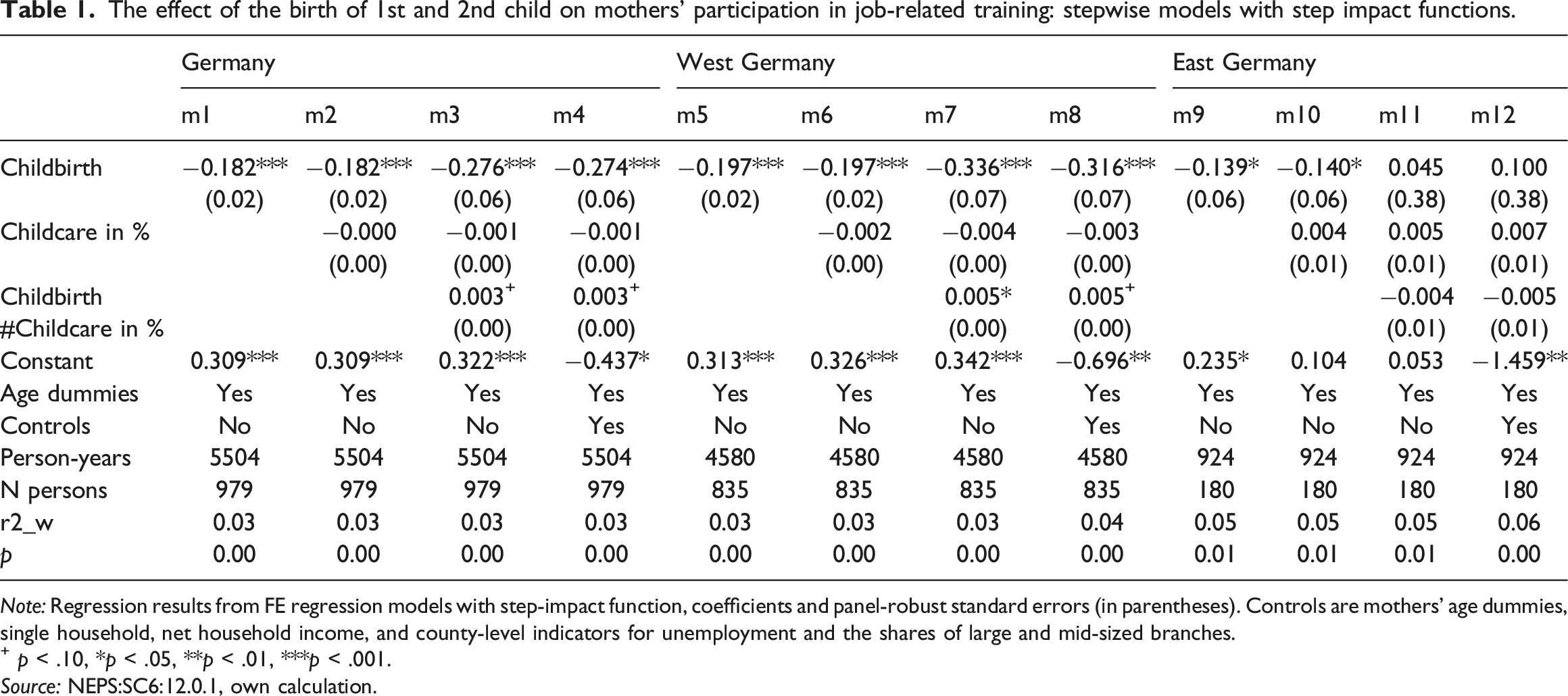
Note: Regression results from FE regression models with step-impact function, coefficients and panel-robust standard errors (in parentheses). Controls are mothers’ age dummies, single household, net household income, and county-level indicators for unemployment and the shares of large and mid-sized branches.
+ p < .10, *p < .05, **p < .01, ***p < .001.
Source: NEPS:SC6:12.0.1, own calculation.
Compared to the substantial motherhood penalties observed with the step impact function, the dummy impact function showed a shorter-lived childbirth effect on mothers’ job-related training (see Table A8). Following childbirth, mothers reported lower participation in job-related training in each of the last 12 months in the year of birth and the first year after, compared to any year before childbirth. However, in the subsequent years, the effect was of much smaller magnitude and statistically insignificant at the 5 per cent-level from year three onwards, indicating a return to pre-birth participation levels. The results supported H2 that motherhood training penalties decline as the child grows older.
Separate regression models showed that the overall effect of childbirth was primarily driven by a more substantial and persistent motherhood training penalty in West Germany (m3 to m6 in Table A7). Figure 1 illustrates the effects for East and West Germany by plotting the regression coefficients of the dummies for the years since childbirth. For West German mothers, the results demonstrated a considerable negative effect on training in the first 2 years after childbirth, which only becomes indistinguishable from zero in the third year as the job-protected leave period is about to end. In the smaller sample of East Germans, the childbirth effect was of substantial magnitude and statistically significant only in the first year. Surprisingly, mothers did not reduce participation in the year of childbirth. By the second year after birth, when the paid leave entitlements run out and children become entitled to a slot in childcare, participation in job-related training was already approaching pre-birth levels again. Therefore, the results support H2 suggesting smaller motherhood training penalties as the child grows older in both contexts but also H3, assuming less pronounced motherhood penalties in contexts with higher childcare levels. The effect of the birth of a first or second child on mothers’ training participation: dummy impact function. Notes: Regression coefficients for ‘years since childbirth dummies’ including 95% confidence intervals from FE regression models. Controls are mothers’ age dummies, single household, net household income, and county-level indicators for unemployment and the shares of large and mid-sized branches. See Appendix Table A8 for numerical results. Source: NEPS:SC6:12.0.1, own calculations.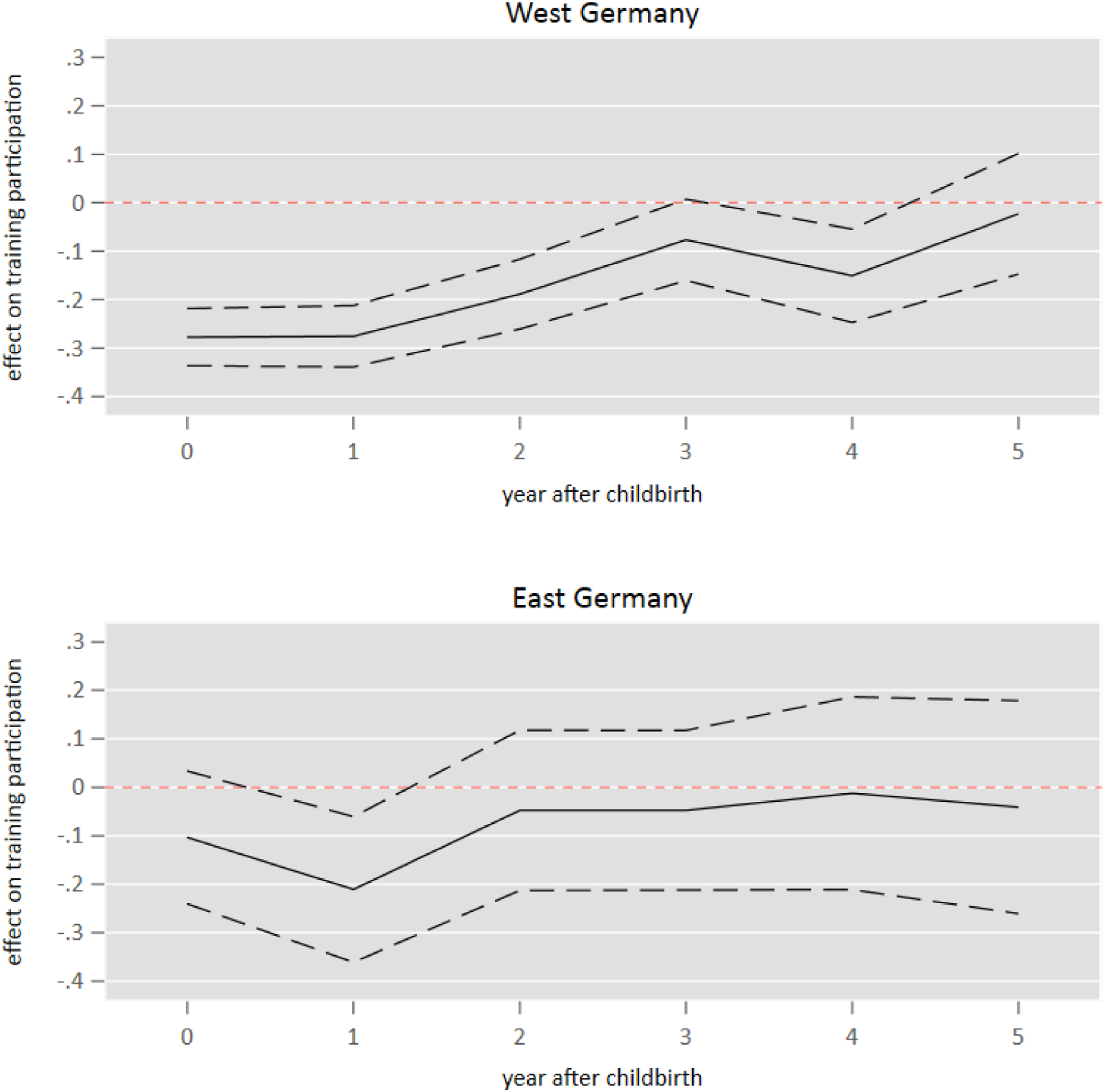
Averaging the childbirth effects of the dummy impact function provided estimates that were mostly comparable and only slightly smaller than the step impact function for the overall sample (-25 -27-17-7-13-4)/6 = −16 versus −18%) and for West Germany (−18 versus −20%). However, since the FE-estimator generally downweighs treatment effects in later periods, the step impact function overestimated the effect on training compared to the averaged period-specific effects (−14 versus −7%) for East Germany. Nevertheless, all findings supported H3, presuming less pronounced motherhood training penalties in a context with higher levels of childcare, such as in East Germany.
Table 1 presents the results from FE-models that estimate the impact of childbirth on mothers’ participation in job-related training across different childcare contexts, using the childcare coverage rate on the combined provision of part-time and full-time slots. The baseline effect of the interaction showed a significant motherhood training penalty in counties with very low childcare levels (−28%, m3). The interaction effect was positive but very small (m4), indicating that in regions with a 10-percentage point higher childcare rate, the motherhood training penalty was 3-percentage points lower. This effect size is comparable to previous studies on the employment effects of public childcare (for example, Zoch, 2020).
Separate models showed a more substantial and statistically significant effect of higher childcare levels only for West Germany (m6-m8), indicating that a 10-percentage point higher childcare rate reduced the motherhood training penalty by 5%. Surprisingly, the results for the smaller East German sample indicated a motherhood training premium that declined with higher childcare rates, but effects were statistically insignificant.
In summary, the observed East–West differences supported H3, presuming smaller motherhood training penalties in contexts with higher childcare levels. However, considering the variation within both parts, only the results for West Germany confirmed a positive childcare effect on job-related training participation.
To further examine the relationship between childcare and mothers’ participation in job-related training, the separate models were re-estimated using a set of dummy variables for the childcare measure, which allowed for a fully flexible specification of the interaction effect. Figure 2 illustrates the results by plotting the average marginal effects along with 95% confidence intervals. The findings for West Germany indicated that the negative childbirth effect decreased and was indistinguishable from zero at childcare levels of 36% and above. Conversely, for the smaller sample of East German women, training penalties were close to zero when childcare coverage was more than 44%, but became again more pronounced at substantially high levels of 60%. The effect of the birth of a first or second child on mothers’ training participation across levels of childcare provision. Notes: Regression coefficients for the interaction of childbirth and the level of childcare provision including 95% confidence intervals from FE regression models. Controls are mothers’ age dummies, single household, net household income, and county-level indicators for unemployment and the shares of large and mid-sized branches. Source: NEPS:SC6:12.0.1, own calculations.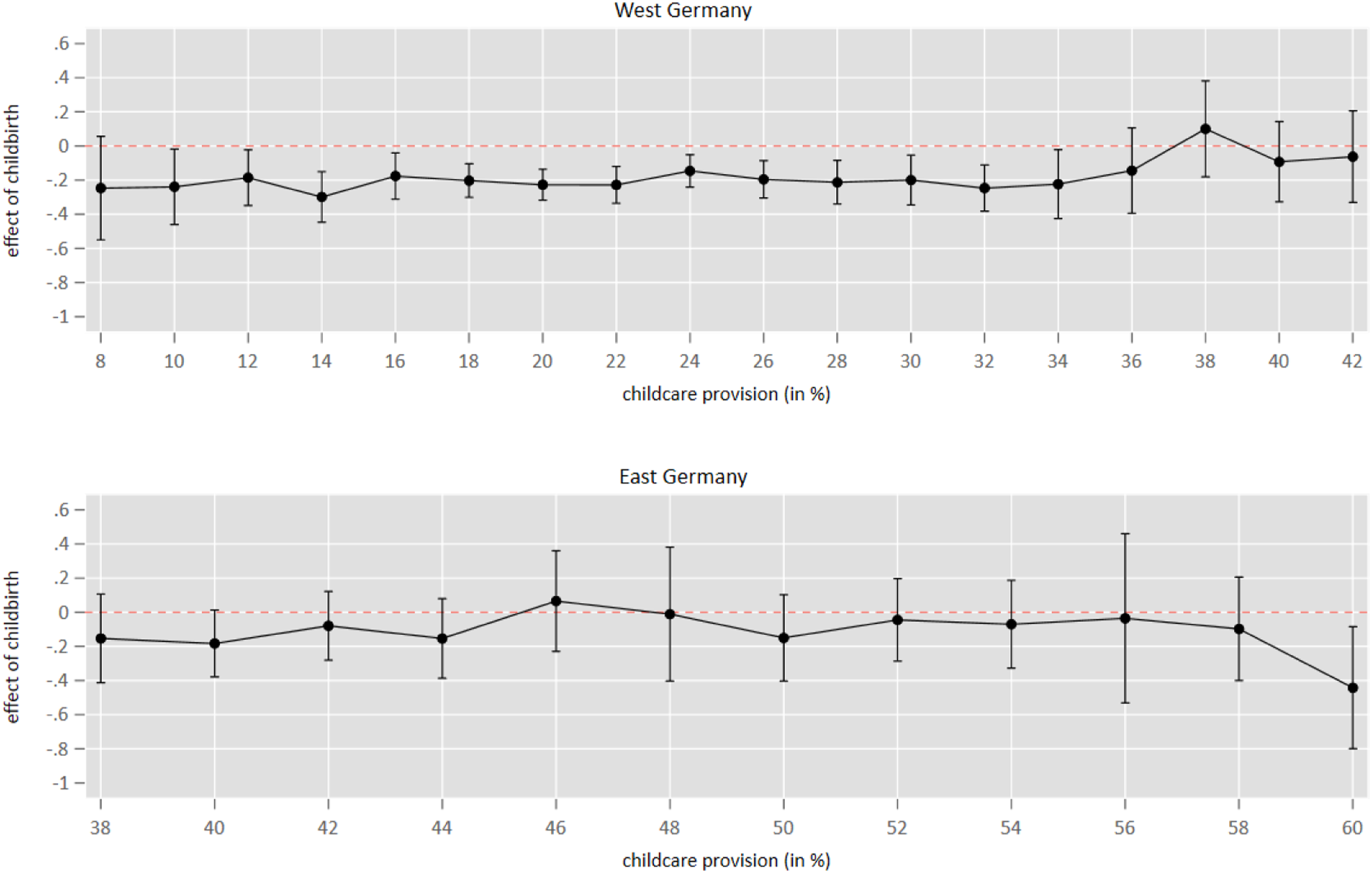
Further analyses revealed that the East German observations with exceptionally high childcare levels were only present in very rural regions of Brandenburg and Saxony-Anhalt, which drove the negative childcare effect of the step impact function. In these federal states, childcare expansion is more advanced due to lower levels of absolute demand and more favourable rents and land prices (Federal Statistical Office, 2019). At the same time, these regions have lower numbers of medium and large companies and a lower employment density (see Table A9). Consequently, models that estimated three-way interactions between childbirth, the childcare rate, and the employee-population density highlighted increasing motherhood training penalties across higher childcare levels only for the less populated and economically weaker regions (see Figure A1). Excluding the few East German cases with very high and selective childcare levels revealed a positive childcare effect of a similar magnitude to that in West Germany (6%, see Figure A2 and Table A10). However, due to the very small sample, confidence intervals were large. For West Germany, the graphical illustration confirmed that the training penalties became statistically insignificant at very high levels of more than 40%. However, given large confidence intervals at the margins, the difference between low- and high-availability contexts was statistically insignificant.
Figure 3 illustrates motherhood training penalties across child’s age in different childcare contexts distinguishing mothers with childcare levels below 33%, that is, the Barcelona targets, from those between 33% and 40%, and those with higher levels. As expected, mothers in contexts with the highest childcare rates reduced their training participation the least in the first 2 years, while participation declined more in contexts with the lowest and medium levels of provision. In all contexts, participation increased again in the second and third years after birth. However, the increase was steeper in contexts meeting the Barcelona targets, hence, in the second and third years, training participation no longer differed from pre-birth levels. Conversely, mothers’ training participation remained lower in regions providing less than 33% even in the third and fourth year after birth. In summary, the results provided support for H4, assuming that the positive effect of childcare on the motherhood training penalty is more pronounced the older the child is. The effect of the birth of a first or second child on mothers’ training participation across levels of childcare provision according to youngest child’s age. Notes: Regression coefficients for the interaction of childbirth and the level of childcare provision including 95% confidence intervals from FE regression models. Controls are mothers’ age dummies, single household, net household income, and county-level indicators for unemployment and the shares of large and mid-sized branches. Source: NEPS:SC6:12.0.1, own calculations.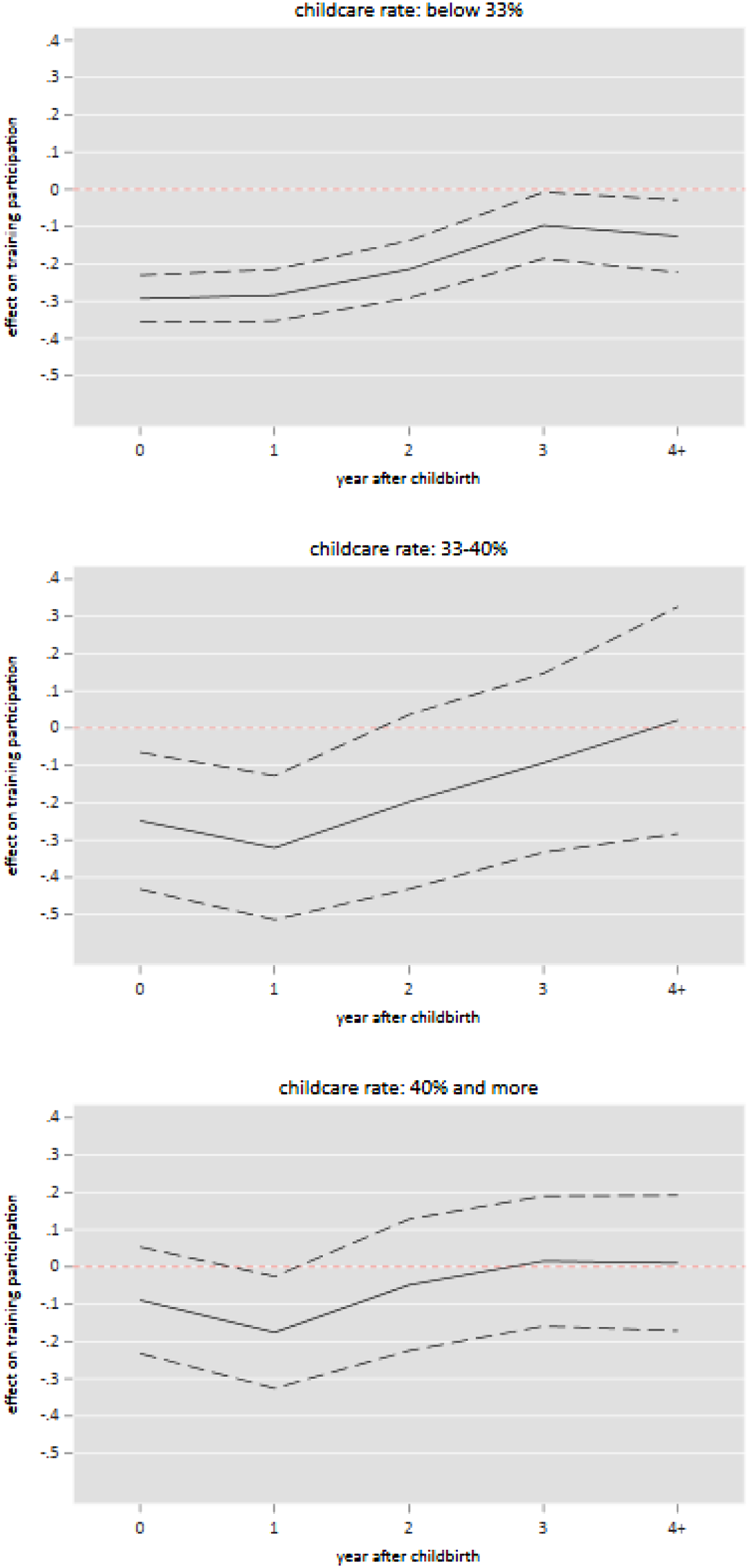
Separate stepwise FE-regression models explored the potential mediating variables that could explain the positive relationship between childcare and motherhood training participation (see Table A11). The results showed that maternal employment largely accounted for the positive childcare effect in reducing the motherhood training penalty. In addition, including controls for employment and leave experience partly explained the training penalty, whereas changes in employer characteristics did not further reduce the effects. Nonetheless, a substantial penalty remained in both East and West, with statistically significant effects observed only for the larger sample of West German mothers.
Lastly, the role of full-time childcare provision was tested. In West Germany, the results showed negative childbirth effects that were largely similar in magnitude to those observed for the combined measure of part-time and full-time slots. Similarly, the motherhood training penalties for comparable levels of general and full-time provision did not differ in East Germany, where there are few half-day places overall, resulting in smaller differences between the measures compared to West Germany. However, when comparing similar levels of full-time coverage in East Germany with the combined provision of part-time and full-time slots in West Germany, much smaller motherhood training penalties were observed for East German mothers.
Summary and discussion
This study provides evidence of the small effect of public childcare provision on mothers’ participation in job-related training. By utilizing large-scale panel data with annual measures on non-formal job-related further training from Germany, this study is the first to investigate the role of public childcare provision for motherhood training penalties. Fixed-effects models indicate motherhood training penalties that were more pronounced and persistent in West Germany than in East Germany, hence, pointing towards the important role of the institutional context. Furthermore, the results demonstrate that higher levels of childcare provision within West Germany slightly reduce the negative impact of childbirth on mothers’ training participation. Nevertheless, although motherhood training penalties were smaller when childcare provision is higher, the effects were rather small and statistically mostly insignificant.
Moreover, in line with theoretical explanations focusing on specialisation and reduced labour supply, the findings suggest that the small but positive effect of childcare provision primarily operates via shortened employment interruptions and increased working hours, enabling mothers to participate in training upon returning to work. Conversely, the length of work experience or occupational and employer changes did not further explain the remaining training disadvantage. While training penalties in East Germany could be fully explained by the change in employment and other time-varying variables, the training gap remained statistically significant for West Germany. These results suggest other sources of reduced training, such as mother’s altered work–care norms and career orientations or changes in employer support, which unfortunately could not be considered in this study.
By indicating smaller motherhood training penalties in contexts with higher levels of childcare, the results support previous cross-national comparative studies that identified smaller gender training gaps in western countries with policies supporting maternal employment (Boll and Bublitz, 2018; Dämmrich et al., 2016; Dieckhoff and Steiber, 2011). By exploiting a period of significant childcare expansion in Germany, this study identifies higher childcare capacities as a critical factor in reducing childbirth-related disparities in job-related training. Thus, the study contributes to our general understanding of the relevance of family policies for reducing gendered labour market inequalities upon childbirth-related employment interruptions. From a broader perspective, the results confirm that childbirth is not only associated with significant gender inequalities in the labour market, such as working hours or wages, but carry over to job-related further training, especially when institutional support for the reconciliation of work and family is low. However, because training on the job is less important in Germany, particularly for those with firm-specific vocational training, and mothers receive a job guarantee to return to the same employer, motherhood training penalties are most likely to be less pronounced compared to other labour market contexts. It is likely that the positive childcare effect could be even stronger in countries with greater motherhood training penalties. By distinguishing the two parts of Germany, this study provides valuable insights into how different levels of childcare are able to reduce such motherhood penalties, providing also guidance for contexts with insufficient levels or few affordable options of formal childcare. As previous research has demonstrated that job-related training forms the basis for further career and wage trajectories, particularly in closed job markets within firms (for example, Evertsson, 2004; Havet and Sofer, 2008; Ehlert, 2017), mothers’ opportunities for promotions and higher earnings are likely diminished with lower training participation. As a result, inequalities are likely to accumulate over the life course, resulting in lower career trajectories, lifetime earnings and, thus, lower wealth accumulation and pensions.
Although the study is among the first to estimate a within-estimator of altered training participation based on panel data, the risk of biased estimates remains due to unobserved characteristics. However, by accounting for constant heterogeneity and linking individual panel data with administrative information on county-level childcare provision, the results provide a more robust picture than previous cross-sectional studies. Nevertheless, it is important to note that given the small number of respondents and observed births, particularly in East Germany, the results should be interpreted with caution. Furthermore, small sample sizes did not allow for comparing within-changes in job-related training according to mothers’ characteristics such as education or occupation, thus providing future avenues for research. This research should also examine possible direct and indirect mechanisms, such as altered career orientation, household bargaining processes or potential employer discrimination as well as further aspects of the childcare context, to further explain motherhood training penalties and the role of supportive family policies.
Supplemental Material
Supplemental Material - Does the provision of childcare reduce motherhood penalties in job-related training participation? Longitudinal evidence from Germany
Supplemental Material for Does the provision of childcare reduce motherhood penalties in job-related training participation? Longitudinal evidence from Germany by Gundula Zoch in Journal of European Social Policy.
Footnotes
Acknowledgments
The author is grateful for comments on an earlier version of this article from participants at the RC28 and WFRN Conferences 2022 as well as helpful suggestions from Stefanie Heyne and those at the Distance CLIC Seminar at the European University Institute (EUI) in Florence.
This article uses data from the National Educational Panel Study (NEPS) (see Blossfeld and Roßbach, 2019). The NEPS is carried out by the Leibniz Institute for Educational Trajectories (LIfBi, Germany) in cooperation with a nationwide network.
Declaration of conflicting interests
The author declared no potential conflicts of interest with respect to the research, authorship, and/or publication of this article.
Funding
The author received no financial support for the research, authorship, and/or publication of this article.

Supplemental Material
Supplemental material for this article is available online.
Notes
References
Supplementary Material
Please find the following supplemental material available below.
For Open Access articles published under a Creative Commons License, all supplemental material carries the same license as the article it is associated with.
For non-Open Access articles published, all supplemental material carries a non-exclusive license, and permission requests for re-use of supplemental material or any part of supplemental material shall be sent directly to the copyright owner as specified in the copyright notice associated with the article.
