




Abstract
The workplace challenges faced by neuro-diverse employees are currently under-researched. This article considers how such employees experience the world of work, focusing on the demands they face to conform to established expectations around self-presentation and performance and how they utilise spatial resources in order to transcend them. Drawing on data generated from a series of in-depth interviews, it explores both their everyday experiences of frustration alongside how the mobilisation of liminal spaces can assist them in transitioning to and from the demands of the ‘neuro-typical’ workplace. The article seeks to contribute to an understanding of the lived experiences of neuro-diverse employees and how the design and practices of the workplace can contribute to feelings of marginalisation and even exclusion. It highlights the potentially empowering and emancipatory potential of embracing liminality and explores the relationship to ‘negative capability’ as a conceptual and diagnostic lens in studies of workplace diversity.
Introduction
Neuro-diversity is an umbrella term meaning that the brain functions, learns and processes information in a different way to the neuro-typical person, who processes information and functions in the way society expects. Singer (1999) describes it as a concept used for valuing minority minds in light of their difference. More recently it has been analysed both as a political idea, associated with social models of disability (discussed below) and as a scientific concept, indicating a new way of thinking about function and dysfunction (Chapman, 2020). It covers the following conditions, many of which can be combined in one individual: dyslexia, dyscalculia, attention deficit hyperactivity disorder (ADHD), autistic spectrum disorder, including Asperger syndrome and Tourette syndrome. Studies of neuro-diversity and work have largely been focused on the relatively high levels of unemployment experienced by neuro-diverse people (Taylor et al., 2015). We know little, however, about how neuro-diverse people who are successful in gaining employment experience the workplace (Krzeminska et al., 2019, is a notable exception), yet research suggests that as many as one in seven people in the UK (Wojciechowski, 2019) or somewhere between 15% and 20% worldwide (Moeller et al., 2021) has a neuro-diverse condition; hence there is more to be learned about a relatively substantial proportion of the global workforce. The types of challenges that neuro-diverse employees face within the workplace will differ, of course, depending on individual and situational variances. That said, 65% of those reporting a diagnosis of dyslexia also reported anxiety, depression or panic attacks (Kirby and Gibbon, 2018). In addition, neuro-diverse adults in the workplace may face difficulties in forming social bonds with others, difficulty with interpreting or conveying emotions, or difficulty making eye contact (Morris et al., 2015). The main conditions associated with neuro-diversity, and their common features, are shown in Table 1.
The main conditions associated with neuro-diversity and their common features.
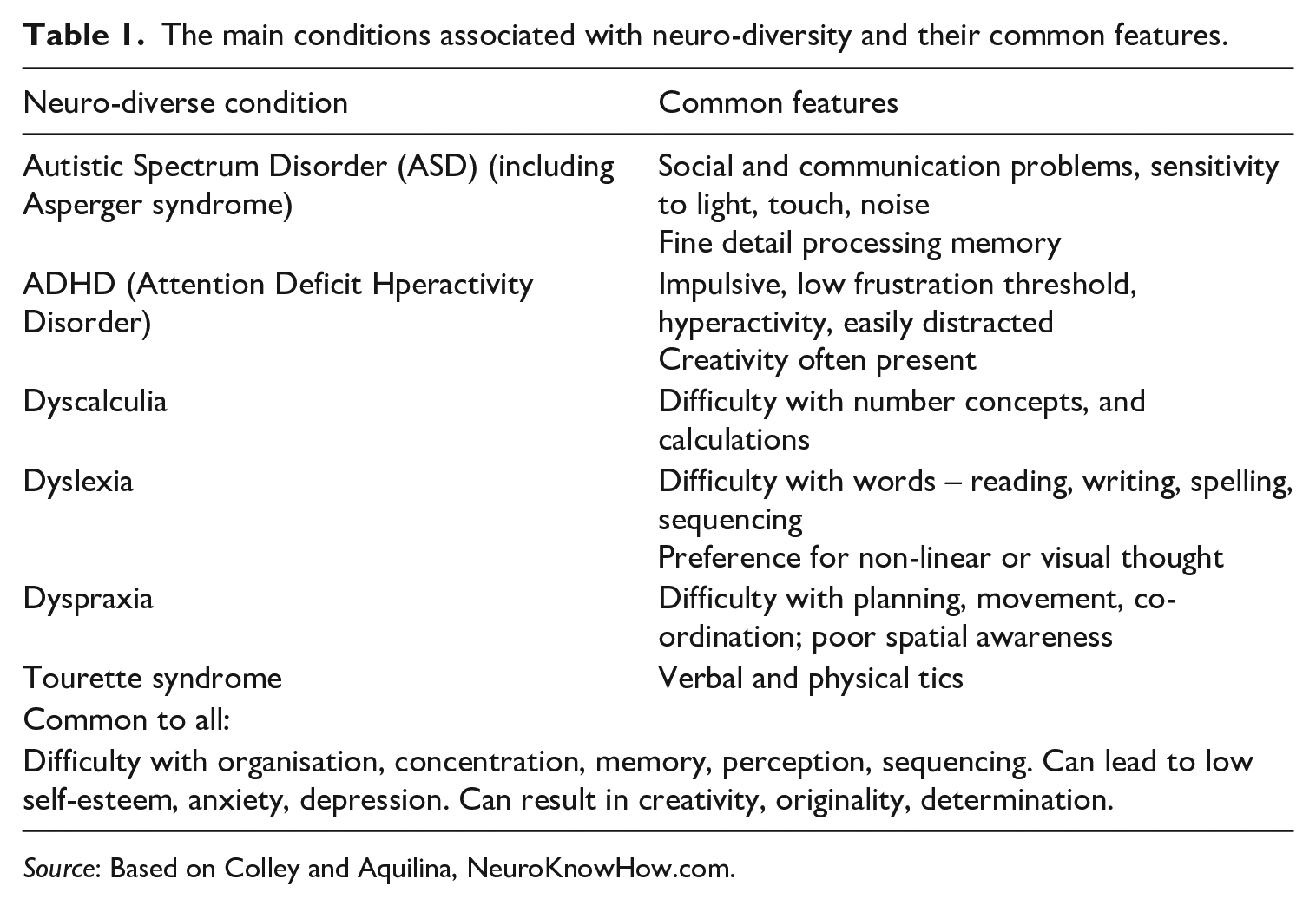
Source: Based on Colley and Aquilina, NeuroKnowHow.com.
Within the workplace, neuro-diverse people have historically tended to be incorporated within broader inclusion initiatives, where accommodations are often focused on the more visible challenges of physically disabled employees (Chartered Institute of Personnel and Development (CIPD), 2018). Arguing that there is a lack of research within organisation studies pertaining to the lived experience of neuro-diverse people, answering a call for closer collaboration between disability researchers and organisational researchers (Vogus and Taylor, 2018) and responding to a need in the broader disability studies literature for more attention to the connection between space and disability (Feely, 2016), this article enquires into the challenges of social and spatial workplace settings for neuro-diverse people, asking what are the processes through which space contributes to exclusion and how are the challenges negotiated by neuro-diverse employees? It draws on data from an ongoing study exploring the experiences of neuro-diverse people in the UK workplace. The discussion here focuses on how the participants perceived, experienced and negotiated their spatial environment, with a particular emphasis on the usage of liminal spaces (Turner, 1982) and the relationship to negative capability, a state of being where uncertainties and doubts are accepted, first conceived by the poet Keats in 1817 (Keats, 1970). The article is aimed, therefore, at scholars of workplace diversity and at practitioners who wish to understand more about how organisational space is negotiated.
The article begins with a review of the literature on neuro-diversity and work, considering in particular the norms of spatial performance that encourage social capital in a neuro-typical environment and the resulting discomfort for neuro-diverse employees. A theoretical framing of liminal space is then offered before the field study and findings are presented. The data show the importance for neuro-diverse people of withdrawing from social pressures at work, highlights the importance of liminality as both a conceptual and diagnostic concept for studies of workplace diversity and illustrates a connection between liminality and negative capability. This connection results in the creation of an ability to tolerate anxiety and ambiguity in the workplace.
Thinking differently about workspace
Most recent studies highlighting the benefits of a diverse workplace have focused on the potential competitive advantage that a neuro-diverse workplace can bring (Lorenz et al., 2017), in particular citing innovation and creativity that can result from employing people with different perspectives and abilities. There are very few studies, however, that consider the workplace environment itself. Those that do, tend to focus largely on the physical layout of the workplace (e.g. Cassidy, 2018), since it is widely reported that people with sensory processing characteristics can be adversely affected by the typically harsh office lighting and noise levels associated with open plan office space (Harnett, 2019).
In contrast to the deficit model, concerned with individuals severely limited by a disordered neurology, the neuro-diversity perspective describes neurology and personhood through the lens of human diversity, rather than as something that needs ‘fixing’ (Robertson, 2009). It is worth noting that neuro-diverse individuals are not a homogenous group, and do not necessarily consider themselves as disabled; nevertheless, the disability studies literature is a useful point of reference to explore how people with protected characteristics, who may see themselves as ‘different’ or outside the ableist norm, experience their working environments. Neuro-diverse employees in the UK who have a formal diagnosis are protected under the Equality Act of 2010, whereby workers with a mental or physical disability are entitled to adjustments to their working lives, including flexible working and taking regular breaks. It is important to note, however, that neuro-diversity is not recognised as a separate or specific category, and not all neuro-diverse people are formally diagnosed with a disability. This means that the lifelong conditions under the neuro-diversity umbrella are not always recognised for adjustments and that therefore the Equality Act is important, but necessarily limited.
The perception of impairments often relies on ableist presumptions of what disability ‘looks like’ (Calder-Dawe et al., 2020: 132). While many neuro-diverse employees will not ‘look like’ they are disabled, there is also evidence to suggest that cognitive and mental health-related disabilities are associated with more stigma in the workplace than physical disabilities (Elraz, 2018; Jans et al., 2012).
The social model of disability has been cited as the core theoretical base of the disability studies field (Van Laer et al., 2020); that is, emerging from the ways in which society is structured, rather than on individual and medical conceptualisations (Barnes, 2012). The work and organisation studies literature has built upon this theoretical base in order to consider the inequalities within power relations between disabled and non-disabled employees (Van Laer et al., 2020), the various social and environmental barriers that confront disabled people (Barnes and Mercer, 2005) and how disability labels impact on social interactions at work (Brzykcy and Boehm, 2021). An approach that focuses on how disability is produced by particular uses of space (Dolmage and Jacobs, 2016) calls for an exploration of the potentially disabling spatial practices within the specific context of the workplace. This focus on how disabled people negotiate organising contexts can be a useful lens to apply to discussions around the social categories of difference in work and organisation studies (Williams and Mavin, 2012). Neuro-diversity may not always be considered as a category of disability by neuro-diverse individuals, but it is always considered as a category of social difference, as explored below.
Social capital, neuro-diversity and the working environment
Most companies with established neuro-diversity employment programmes insist that business justifications are at the heart of their efforts (Krzeminska et al., 2019). Related to this is an increasing awareness of some of the strengths that neuro-diverse individuals are commonly understood to display in the workplace; typically, these include analytical skills, an increased ability to focus on tasks, especially repetitive tasks, pattern recognition, attention to detail and intolerance for errors. This means that there is often an assumption that neuro-diverse people are most suited for roles in sectors such as IT or in back office roles, where the requirements for face to face contact are more limited. Research has shown, however, that social capital and social ability are essential to career success (Oh et al., 2004). Social skills are commonly associated with being a good team player and include communication skills, emotional intelligence, persuasiveness and the ability to network. These criteria, while often tacit during the recruitment process, systematically screen out neuro-diverse people (Austin and Pisano, 2017). The importance of social capital to wellbeing in the workplace is well attested (Bandiera et al., 2008; Helliwell et al., 2017; Requena, 2003) as is, inversely, the detrimental effect of low social capital in the workplace (Suzuki et al., 2010). If high social capital is therefore associated with being a good team player (Prusak and Cohen, 2001), then sharing office space with team members plays to the strengths of neuro-typical employees, since, according to Requena (2003), social capital includes such aspects as: ‘submission to norms, social integration and confidence in others and in institutions’ (p. 332). Neuro-diverse employees are more likely to feel uncomfortable working in such spaces, where they typically struggle to adapt to the norms of social integration that these workspaces are designed to encourage (Lorenz et al., 2017). Sang et al. (2022), in their study of HRM practices within academia, discuss the socially constructed influences and norms that create and reinforce disabling norms. They point to the internalised ideals, based on informal, unwritten norms, which disable their research participants not from their ‘impairments’, but from these normative working practices, which need to be navigated and negotiated. Richards (2012), exploring the disproportionally high levels of exclusion from the workplace of adults with Asperger syndrome, also highlights the social relations between employers and employees. Describing the subsequent barriers to inclusion, he also describes the conflict that individuals experience with the expected organisational norms surrounding workplace sociability.
In this way, employees with impairments are spatially disabled from practices related to social inclusion and lived experiences of space are characterised by a sense of exclusion (Van Laer et al., 2020). A dominant neuro-typical workplace is characterised by norms of spatial performance that encourage social capital. A neuro-diverse workplace, in contrast, is more understanding of diverse behaviours, including uncertainty and temporary withdrawal, descriptive of ‘negative capability’, as conceptualised by Keats (1970: 43). This allows for the creation of a mental or emotional space from which new perceptions can emerge. A theoretical framing of liminality in the workplace and its relationship to negative capability will now be explored.
From out-of-place to liminal space and negative capability
Drawing on the original anthropological concept of liminality, meaning a spatial and temporal threshold or boundary proposed by Van Gennep (1960[1909]) and developed by Turner (1974, 1982), the liminal experience is experienced as a metaphorical crossing of a spatial or temporal threshold. As Söderlund and Borg (2018) point out, literature on liminality at work has broadened out to include, for example, studies on occupational careers (Bamber et al., 2017), temporary work (Garsten, 1999) and identity at work (Beech et al., 2016; Collinson, 2006; Ibarra, 2007). Originally conceived as relating to rites of passage in society, other types of social situation, particularly that of disability, have broadened the meaning of liminality by putting the accent on difference and the relationship with the norm (Willett and Deegan, 2001). Liminal events – that is, any ‘“in-between” space or period, characterised by transition and uncertainty – can be experienced as a “dreamtime”’ (Preston-Whyte, 2004: 350). This is connected to negative capability, conceived as an emancipatory mental state that allows for a change in perception and a brief moment of recuperation. This relationship is explored below.
The concept of liminal space has been given a great deal of attention in the work and organisation studies literature over the past 20 years or so (Budtz-Jørgensen et al., 2019; Cai et al., 2021; Shortt, 2015; Tempest and Starkey, 2004 , inter alia). Several studies have shifted the focus of spatial liminality towards some of the smaller, less obvious liminal spaces of everyday working life (Iedema et al., 2012; Shortt, 2015). Conceptualising organisational liminal spaces as meaningful temporary dwelling places that are situated outside of and beyond the dominant workspace, such as stairwells, toilets, corridors and so on, Shortt (2015) calls for a more nuanced understanding of liminality.
Arguing that liminality can be experienced psychologically as well as physically, this article extends Shortt’s argument to encompass the spatio-temporal events that can characterise social interactions between employees. In doing so, it draws on the relationship between liminality and the resultant negative capability that can emerge from these events. Keats described it as a state where uncertainty, mystery and doubt could be sustained without a need for logic or fact (Keats, 1970: 43). Over recent years, negative capability has emerged from poetic enquiry and entered the domain of management and organisational research (Saggurthi and Thakur, 2016; Simpson and French, 2006; Simpson et al., 2002 ). There is no moral judgement in the use of ‘negative’ capability; merely that it is a ‘mental and emotional space’ that supports reflective inaction, rather than decisive action (Simpson et al., 2002: 1211), and in this way it can characterise those moments in the workplace where neuro-diverse people withdraw from social situations into a liminal space-time.
To summarise, while organisations are aware of and keen to emphasise the benefits of a diverse workforce (Lorenz et al., 2017), little attention has been paid to the lived experience of neuro-diverse individuals themselves. Asking specifically how neuro-diverse people manage the pressures of self-presentation and lack of social capital in the workplace, the article explores the role of liminality, and the way in which this can result in negative capability, to how workspace is experienced and negotiated.
Methods
The article draws on data forming part of a wider study exploring how neuro-diverse people experience the workplace. The study began at the end of 2019, with a series of five interviews carried out with people working at a UK-based recruitment consultancy, which specialises in finding employment for people with a range of neuro-diverse conditions and which is staffed exclusively by people who are themselves neuro-diverse. Access had been granted to the company through one of the founders, who had been recommended to the author via a personal contact.
The research was designed round semi-structured qualitative interviews, to allow participants to talk freely about their experiences of the workplace. Substantive questions covered career and employment history, the experience of neuro-diversity and the experience of work in relation to this, specifically the pressures around social capital. Ethical approval was applied for and granted, with agreed protocols covering participant anonymity, protection of data and use of language (explored below). Participants were sent a brief summary of the research aims and objectives, provided via email prior to the interviews. A consent form and participation information sheet were provided on the day and discussed with the participants. The staff at the consultancy had experience of working within other settings and sectors prior to their current roles and their experience of neuro-diversity in the workplace encompasses not only their own career paths but also those of the candidates with whom they work. This means that they were able to identify and discuss some of the most pressing concerns from neuro-diverse employees that they encountered daily, which was useful for the wider study of which this article forms a part. With the aim of adding balance to the data by drawing on a broader range of neuro-diverse people working in a wider range of companies, a snowball sample was initiated from one of the author’s personal contacts and a further six interviews were carried out during early 2020, following the same ethical protocols established for the first five interviews. These interviews took place in coffee shops close to the participants’ places of work. All interviews typically lasted between 45 minutes and an hour and a half. All interviews were recorded and transcribed by the author. Initial thematic data analysis took place as soon as the interviews were transcribed and was an ongoing process throughout the data collection stage.
Rich data were emerging from the interviews, which were temporarily halted by the pandemic. Considering that it was important to the longitudinal study to understand how the original interview participants were adjusting to the changes brought, especially to their everyday working environment and the contrast between shared office workspace and private (or domestically shared) space, these participants were returned to at various stages from summer 2020 through to the beginning of 2022. The data for this particular study consist of 22 interviews, carried out with 11 participants. All participants are diagnosed and had disclosed their conditions at work, excepting one (Tony) who had not been formally diagnosed. All were aware of the Equality Act 2010 and those who had disclosed their conditions were aware of their legal protection against discrimination, including their right to breaks at work. While this means that the study is based on data from a small group of people and cannot therefore be said to be representative of the neuro-diverse community, there are nevertheless benefits to this approach. First, very rich and detailed material from the participants was able to be collected, which meant that a depth of data was able to be drawn upon for analysis. Second, the two-stage process meant that themes that had emerged during the first interview were able to be returned to, in order to check understanding and delve more deeply. Third, it helped with building relationships with participants and with gaining trust. When the approach was discussed with the participants, without exception they gave their opinion that more of an in-depth understanding of the issues and themes would be gained this way.
Table 2 illustrates the range of neuro-diverse conditions that the interviews discussed, as well as showing the range of age and genders interviewed, and whether the participant works in what they perceive as a neuro-diverse environment, or a neuro-typical one.
List of participants.
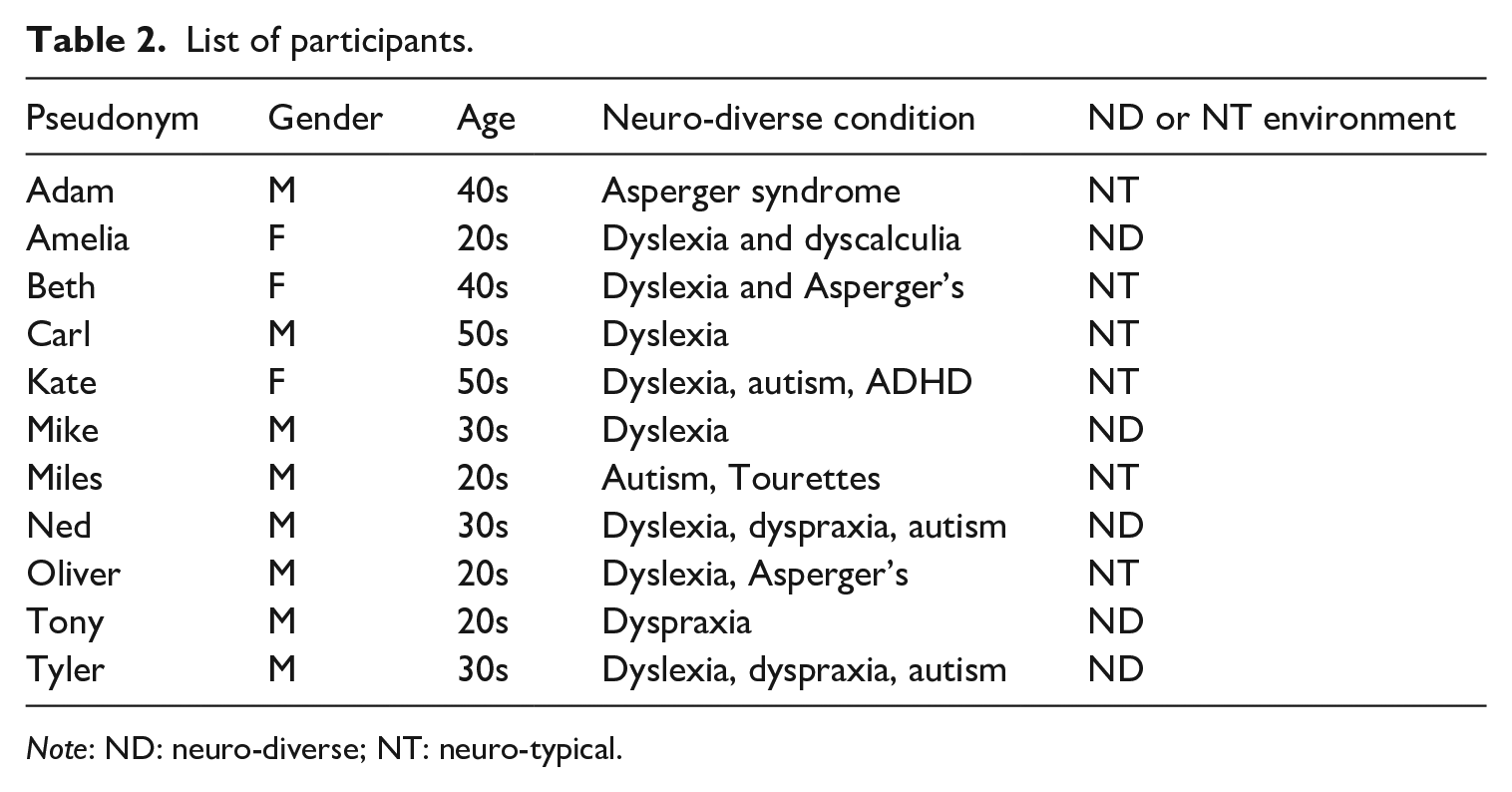
Note: ND: neuro-diverse; NT: neuro-typical.
Author’s methodological reflections
A point to be noted is that neuro-diverse conditions are spectrum conditions, which have a range of associated characteristics. The various characteristics displayed by each individual will not necessarily be the same in another person with the same ‘dominant’ condition. This was brought home to me several times during the interview process, when different people used the same phrase: ‘When you’ve met someone with autism, you’ve still just met someone with autism. You’ve not met autism.’ While I am a researcher who is not neuro-diverse, I was able to explain to the participants that I come from a perspective of a research interest in diversity and inclusion and I do have experience of neuro-diversity within the family, which enabled some common ground. I was mindful of the huge individual variances I would likely encounter, and made sure that it was made clear to participants that interviews could be adapted according to individual needs; for example, if participants had conditions including dyspraxia, ADHD or Tourette syndrome, they could let me know whenever they needed to take a break or if they would prefer the interview to take place over several sessions. I was also aware that I may need to make additional adjustments to the interview process; for example, participants on the autistic spectrum may have difficulty in interpreting idioms, irony, metaphors and words with double meaning. In these circumstances, I therefore planned to ensure that I avoided such expressions and figures of speech and strove to make my language more literal than I might otherwise have done. This was not uniformly successful; I found it hard not to respond to people’s very personal and emotive accounts of their working lives without resorting to ‘what if’ questions; for example: ‘Do you think (the situation) might have been different if you had disclosed your condition in that particular environment?’. On one or two occasions the participant was unable to understand my abstract question and I had to take care to re-phrase it in a more concrete and straightforward way. I should add that the participants were without exception extremely patient and careful to remind me that their understanding of certain abstract situations might be different from mine.
Findings: ‘It comes into the room with you’
All participants, including Tony, spoke candidly about the various accommodations they make on a daily basis, in ways that they felt they did in an almost subconscious way, just to be able to build resilience in a shared working environment. The participants who work in the recruitment agency considered themselves to work in a ‘neuro-friendly’ environment, although there were still many challenges emerging from working in a shared space. The other participants work in a range of environments, although only one, Miles, had formal support from a disability ally. Most felt that there was ‘tacit’ support from line managers, and while this was not overt in terms of staff networks and none mentioned support from a Union, all felt relatively proficient at managing their needs in the workplace, while being very aware of their exclusion from much of the normative social behaviour. This may be because the participants were all working in professional or managerial roles and had experience of managing the issues that arise from their conditions. Six mentioned having reasonable adjustments due to disability since their disclosure. Despite this, the sense of frequent isolation in shared environments was a common theme.
The data presented below are divided into three core themes: the demands of self-presentation and performance in the workplace and the resulting feelings of exclusion; the office environment as contested space; the empowering and emancipatory potential of physical and mental spaces of respite.
‘We can’t fake it to make it’
Anxiety due to an inability to conform to many of the accepted social norms of shared workspace was vividly described. Participants told of countless times when they had been expected to ‘fit into’ team working in ways that they found hard to understand. As Tyler said: ‘We just can’t fake it to make it’. What he meant by that is neuro-diverse individuals often struggle to understand metaphorical and symbolic speech and so, to someone like him, the expression translates as ‘having to lie – which is something we can’t do’. The office environment, with its emphasis on self-confidence and presentation skills, teamwork and sociability, expects employees to ‘put on a mask and slip into professional, sociable mode’ as Kate said, ‘yet that is so much harder for us, and takes so much extra effort’. This of course can apply to many neuro-typical employees as well, although the difference here is not unwillingness or difficulty in adapting to these mores, but an inability to do so. As Tyler explained: You can phrase them [these social expectations] in several ways – reading between the lines, knowing the unwritten rules – but we are very literal minded. Therefore, we can’t naturally sum up a situation or read between the lines . . . it’s simply not the way we’re wired.
Tyler works in a neuro-diverse environment, in the recruitment consultancy staffed by neuro-diverse individuals. He describes it as a very ‘forgiving’ environment, where normative social capital is far less dominant. There is still accommodation to be made, however, for a range of conditions experienced at a range of differing levels and there is always the necessity of working closely with colleagues as private space is not available for economic reasons; this can still result in anxiety. For those individuals on the autistic spectrum, or for those with Tourettes, the anxiety can result in an increase in physical tics and movements, which as Miles, who works in higher education, explained, ‘is physically so tiring. Tic control is exhausting, so stress and anxiety are physically taxing as well as mentally.’ For others, it does not manifest physically but results in deep frustration and worry. As Ned, who also works in the neuro-diverse environment said: ‘I get so anxious and then I worry – how can I possibly build up a rapport with people I work with?’. Amelia, a Recruitment Consultant, described the challenges around self-presentation in neuro-diverse people: ‘I see really high anxiety. It makes you feel alone . . . it is a real inhibitor to self-presentation.’
These anxieties and the physical and emotional labour that accompanies them are highlighted and amplified by the need to be spending the working day around other people, sharing space, as will be illustrated below.
‘Space is a series of hidden negotiations and improvisations’
Given the issues with self-presentation and social capital, sharing office space becomes problematic for neuro-diverse employees. As Tyler said, ‘just sitting in an office becomes such a huge factor. It’s bad enough when you consider sensory sensitivities, and then you have all the social codes on top of that, which you can’t decipher.’ Beth, a scientist who works in a neuro-typical environment, that is, a place where normative expectations of social capital are dominant, described how simply being around colleagues, in the sense of sitting close to them and hearing voices and chatter while she’s working, means that she makes mistakes. Harsh lighting and noise were mentioned by many participants, yet while these were certainly not helpful and best avoided where possible, they did not appear to cause as much anxiety and distress as the pressures around team working and socialisation. Miles described feeling ‘unsafe’ in environments that he is not familiar with: ‘I can’t be in an unknown space, I don’t feel safe, or comfortable. So I stay in my bubble. Stepping outside of it reminds me of the social stigma, it all comes flooding back.’
He described feeling isolated at times, which was a feeling shared by all participants to some extent, more strongly if they worked in a neuro-typical environment. He describes the spaces of everyday working life as a ‘series of negotiations and improvisations’, where he has to work hard mentally and physically to control his tics. He felt that being able to work more privately and independently would help him enormously, removing the need for this additional labour. Beth also felt that working environments just are not designed for people like her and that she has to work twice as hard as neuro-typical colleagues to cover up her intense anxiety of being around other people and her lack of social capital, amplified in the shared workplace. Kate, a designer who is the only neuro-diverse individual in her small company, also said that more flexibility around where she works would help her to become less ‘jumbled and overwhelmed’. Having to work in close contact with team members and be seen to be fitting in and ‘being a good team player’, with its connotations of sociability and cooperation, makes her ‘so full of pressure and stress’.
But what do these employees do when their anxiety threatens to become overwhelming? Oliver, an IT worker, described how an office move, which resulted in him sitting next to a door triggered a deterioration in his conditions. He found the constant coming and going so distracting and his resulting anxiety so intense that he had to find ways of leaving the environment, which he explained that he does ‘physically, sometimes – but more often, I just mentally tune out; I go into my head where it’s calm and I can shut out the overload’. Others also mentioned the need to retreat into their own private mental space when they felt excluded from the social environment around them. What they described is not just the need that all employees feel, at some time or another, to escape the environment by day-dreaming or having some time alone. It is the ways that these private times and spaces become liminal events that offer recuperation and order that is illustrated in the section below.
‘Just for a moment, I no longer have to be part of the group’
Participants discussed their various strategies that they used for retreat from the contested and overwhelming shared workspace. Often, this could be achieved simply by the use of noise cancelling headphones, which most used regularly. Tyler said that ‘the aim is to withdraw. Closing my eyes really helps, but I know that is perceived as rude because we are made to feel that eye contact is necessary when talking to someone. Yet I can’t help it.’ Likewise, Tony, a consultant, discussed how he can find colleagues distracting: ‘I take a break, mentally; I just tune out, and then everything calms down’.
All the other participants described the same thing; sometimes explaining that they use physical spaces, located on the margins of the office; for example, Kate described how she ‘goes for a walk and hides in the loos for a while’, but more often they used mental spaces of retreat in order to calm themselves and be able to ‘re-enter the fray’, as Oliver puts it. This is because using physical spaces is often a source of concern; the participants in this study are hyper-aware that they may be seen as taking too many breaks so they don’t take them at all, or if they do they ‘triple up’, as Tyler described it (going to the toilet, the kitchen and for a walk in one break, when really they should be taking three breaks). The other issue that was discussed is that neuro-diverse people can sometimes find it hard to make use of places that have been conceived as leisure spaces or private places, even in a workplace that provides designated meeting places, staff kitchens and quiet rooms and so on. As Tyler explained: The sociability of those typical rest places doesn’t work for neuro-diverse people; if we go to the kitchen we don’t expect to have a work chat in there. It’s because neuro-diverse people are very literal minded. Going to make a coffee and people starting to talk to you involves huge effort and strain.
Oliver also explained how ‘tuning out’ helps him to remain calm and resist the pressures of the shared open plan office: Just getting into that space, just closing my eyes, means that just for a moment, I no longer need to be part of the group. I’m somewhere else. I can return to it when the calmness comes . . . this way I don’t have to factor in how long it will take me to go for a walk and come back.
The respite he gets from ‘tuning out’ has enabled him to, in his words, ‘come back and be a bit different’ and so respond to the everyday needs of the shared workspace. Ned related that sometimes he will ‘run up and down the stairs to burn off energy’, but more often, he ‘drifts away into [his] head’. He described it as not being able to be part of things, ‘part of that social world – all the time; I need to come out of it, and I’m better when I “come back”’.
Many participants described the events that led up to these episodes in almost ritualistic terms; the build-up of noise, the chatter, the feelings of overload – what Kate described as a kettle coming to the boil. When I asked what the experience of these brief respites was like, phrases used were ‘almost meditative’ (Oliver), ‘a calm headspace that lets you cope with a fractured and noisy environment’ (Beth), ‘peace’ (Kate) and ‘a space when I don’t have to think about what is going on around me’ (Ned). Tuning out, therefore, means that they are better able to tolerate the anxiety and ambiguous feelings of being neuro-diverse in a workplace that is either neuro-typical, or, even if more neuro-diverse-friendly, still has the noise and distraction challenges of shared workspaces. Carl, a design director who generally does not see his dyslexia as a huge barrier to his working life, still felt that mental escape when he cannot cope with the pressure of others around him enables him to experience things from a ‘richer colour palette’; in other words, it changes his perception and adds to his creativity.
Discussion and conclusions
Being neuro-diverse in the workplace, whatever the individual condition, comes with a range of challenges, which involve daily negotiations and accommodations. The office environment therefore becomes negotiated space, where neuro-diverse employees can struggle for their needs to be met and can easily become anxious and isolated. This is particularly true of those working in an environment where their colleagues are neuro-typical, but it also happens in the more forgiving environment consisting of mainly neuro-diverse people; the social pressures arise from the sharing of space. The participants in this study, while having a diverse range of needs, all referred to the need for frequent breaks, which they took by using such spaces as stairwells or toilets – spaces that Shortt (2015) describes as liminal and meaningful dwelling places. They all also refer, however, to the temporary retreats to mental space that they make use of even more regularly, conceptualised by Oliver as ‘tuning out’. These events are considered as necessary respite for many neuro-diverse people, who find them less disruptive and problematic than taking many physical breaks throughout the working day. These mental ‘time outs’ allow them to stay calm in shared space and to manage periods of isolation and uncertainty. Why these events can be conceptualised as liminal events arising in negative capability and what this means with regard to the spatial and normative social pressures that the working environment demands, is discussed below.
Liminality in this article is not treated as a purely spatial phenomenon or as a purely temporal stage, but is instead part of a relationship with the social norm, which can be understood as a spatio-temporal event (Massey, 2005: 131). These events are described in spatial terms; participants ‘withdraw’ to them, ‘return’ from them and ‘come back’ to the dominant environment. At the same time, however, they are temporal; brief moments when they ‘drift away’ or simply go somewhere where they can be alone. They offer an escape from social structures and allow for moments of freedom. They are a space-time, which allows order to arise from the external social chaos and which is described by participants as calming and meditative. In this way, the participants are crossing a sensory threshold as well as a spatial and/or temporal one (Turner, 1982). These events do not occur on cue, they are triggered by social pressure and are a response to feelings of ‘coming to the boil’. In liminal time/space, they have been physically present but mentally absent; betwixt and between states of being. These retreats can therefore be conceived as rituals where negative capability emerges and hence social pressures are able to be tolerated.
The article conceptualises the negative capability that emerges via liminality as a temporary state that aids both recuperation and liberation and imposes internal order on external chaos (Thomassen, 2014). The participants in this study experience these events as liberatory. The article therefore re-imagines liminality as not confined spatially to places on the margins, but as space-time events that enable the management of frustration and anxiety. Negative capability is conceived as the capacity to live with, and to tolerate, ambiguity and paradox (Ward, 1963: 161). Liminal events can therefore offer the resources and capacity, through negative capability and its reflective inaction, for neuro-diverse people to manage their sense of isolation in shared space.
Of course, neuro-diverse employees are not the only ones who sometimes tune out from the social pressures around them at work. Most people will have similar needs at times. What is different for neuro-diverse people is that shared office space is designed for people who are not constantly overwhelmed by being in social spaces; in other words, it is designed for neuro-typical people. While most of us can be overwhelmed at one time or another, the experience is usually transient. That is not the case for the neuro-diverse employees in this study. It is important to mention here that there is no spatial or temporal transgression taking place here; neuro-diverse employees are not making use of forbidden spaces or severely transgressing social codes. Nor are they victims who cannot work in shared office space; every day millions of neuro-diverse people are adapting and working perhaps twice as hard as is publicly recognised in order to manage their conditions.
This article stresses the importance of sensory accommodations within a shared workplace. A broader view of social capital in the workplace might include a focus on resilience in coping with uncomfortable situations. Open communication around the challenges and pressures of shared workspace can be of benefit to neuro-diverse people who may find it easier to explain how they may be disabled by these challenges and why they sometimes need to mentally retreat from them. This may also benefit neuro-typical co-workers by enabling them to notice those momentary absences, to understand why they are occurring and how communication styles can be adapted to accommodate a wider range of needs beyond a normative model of social integration.
Although we have known for some time that shared office space can be a difficult environment for neuro-diverse people (Cassidy, 2018), there have been few studies showing how it is experienced. In response to the research questions outlined in the introduction, the article contributes to a better understanding of the experiences of neuro-diverse people in the workplace and illustrates the limits of legal frameworks such as the Equality Act (2010). While providing essential adjustments for disabled employees, the adjustments cannot always be fully materialised in social and spatial settings in the workplace, since employees may feel unwilling to be seen as taking too many breaks (as Tyler explained) or else need such momentary mental escape that it is not conceptualised as a break. The article therefore draws on the concept of the missing spatial understanding of difference in organisations (Feely, 2016; Van Laer et al., 2020), offering an analysis of the processes through which organisational spaces can contribute to social exclusion and the measures taken to transcend this. The final contribution of the article is to illustrate the spatial and temporal manifestations of liminality in the workplace and to draw attention to the emancipatory potential of negative capability for neuro-diverse people who use the reflective inaction of liminal ‘absences’ to negotiate the workplace.
The article does have limitations. It is drawn from a small study restricted to neuro-diverse people working in professional and managerial roles, all of whom had a certain degree of flexibility and control over their working lives. Future research could include the perspectives of neuro-diverse people at different phases of their working lives or at different points on the spectrum, or apply an intersectional approach to capture the diversity of experience within this population.
Footnotes
Acknowledgements
I would like to thank Philip Hancock and Ian Roper for their helpful comments and insights on earlier drafts of this article.
Funding
The author received no financial support for the research, authorship, and/or publication of this article.