




Abstract
Drawing on Marxist political economy, this article examines wage theft in hospitality work. Through a detailed, qualitative study of workers’ experiences in London hotels, a novel typology is developed that reveals how managers extract additional unpaid labour time through wage theft. The article argues that both the legal definition and existing academic formulations of wage theft fail to encompass the full range of ways that employers extract unpaid labour time. They also overlook the systemic dimension of unpaid labour time under capitalism. The article contributes new insights into the sociological dimensions of exploitation by proposing an alternative conceptualisation of wage theft that incorporates both formal violations of the law and the more subtle, informal means by which the theft of wages is secured.
Introduction
On the Trade Union Congress’ (TUC, 2019) 15th annual ‘Work Your Proper Hours Day’, TUC General Secretary Frances O’Grady asserted, ‘It’s not okay for bosses to steal their workers’ time’, pointing to the chronic theft of workers’ time and money in the United Kingdom (UK). Over five million UK workers laboured a total of two billion unpaid hours in 2018 (TUC, 2019), equivalent to 7.5 hours a week per worker, or £32.7 billion of free labour annually. To this can be added £2.6 billion annually for non-payment of holiday entitlements and non-compliance with the minimum wage (Metcalf, 2018).
Wage theft is proscribed under UK law through Part II of the Employment Rights Act 1996, which establishes statutory provisions that protect workers from unlawful wage deductions, defined as ‘any sums payable to the worker in connection with his/her employment’. Despite increasing recognition of wage theft as a problem in academic literature, it is typically analysed in terms of ‘labour market violation’ – unpaid hours, unpaid annual leave and unpaid overtime (Clarke and D’Arcy, 2016; Judge and Cominetti, 2019). We argue that both the legal definition and existing scholarship fail to capture the full range of ways that employers extract unpaid labour time, necessitating a more in-depth conceptualisation of wage theft. Our theory of wage theft incorporates both formal violations of the law and more subtle, informal mechanisms that are not necessarily unlawful, yet still represent the theft of wages via unpaid labour time.
Through an empirical analysis of the experiences of hospitality workers across different settings, the article develops a novel typology of how different types of wage theft are realised. We argue that existing research on wage theft has yet to explicitly link the expenditure of unpaid labour time to the direct theft of time and money wages. The latter should be understood as an appropriation of additional unpaid labour time. It is additional because it occurs over and above the average rate of exploitation as defined by the ratio of paid to unpaid labour time (or value to surplus-value) in a given economy. The article establishes wage theft as an integral part of the capitalist economic system. It offers conceptual originality by demonstrating how wage theft is used by employers to realise profit through the extension of the working day.
More directly, the article draws from a qualitative study of hospitality work to examine two key research questions. First, what distinct forms of wage theft occur in the hospitality setting? Second, how do employers’ practices lead to the theft of employees’ wages? In answering these questions, we can establish the pervasive and systemic nature of wage theft. Hospitality is an ideal setting for such a study, as it is not only the fourth largest sector in the UK (British Hospitality Association (BHA), 2017), but is characterised by some of the highest rates of labour market violations (Metcalf, 2018). Hospitality work is also associated with low pay (Lloyd et al., 2013), long hours (Burrow et al., 2015), migrant worker precarity (Alberti, 2014) and the normalisation of unpaid overtime (Warhurst et al., 2008).
The remainder of this article is structured into four sections. First, it situates recent developments in wage theft within a Marxist theoretical frame. Second, the methodological approach is outlined. Third, the empirical findings establish a novel typology that explains how wage theft is extracted through: (1) unpaid labour time; (2) base wages; and (3) variable wages. It then considers workers’ responses to such forms of exploitation. The article concludes with insights into how wage theft is embedded in the exploitative nature of work under capitalism, arguing that all forms of unpaid labour time constitute a form of theft and therefore contribute to the extraction of surplus-value. Certain forms of wage theft mean that workers are aware of their own exploitation, but due to the coercion of a relatively unregulated labour market, their efforts to resist are restricted.
Conceptualising unpaid labour time and wage theft
Managers have long engaged in wage theft. As Marx (1976: 352) noted, quoting the Factory Inspectors’ report of 1856: they [managers] calculate upon the chance of not being found out; and when they see the small amount of penalty and costs, which those who have been convicted have had to pay, they find that if they should be detected there will still be a considerable balance of gain . . .
While The Factory Act of 1850 placed specific regulations on the working day and week, inspectorate reports at the time detailed the persistence of ‘small thefts . . . from the workers’ meal-times and recreation times’ and ‘petty pilferings of minutes’ (Reports, etc., 31 October 1856: 34, cited in Marx, 1976: 352). For Marx (1976), struggles over working time were central to understanding capitalism. He drew extensively on reports from the Factory Acts to explain how the extension and intensification of the working day enhances the valorisation process and generates profit for employers. In employers’ own words: ‘If you allow me [. . .] [the capitalist] to work only ten minutes in the day over-time, you put one thousand a year in my pocket’ (Reports, etc., 31 October 1856: 34, cited in Marx, 1976: 352). Central to the valorisation process is the ability of employers to extract more labour time from workers than would be necessary to simply reproduce their labour-power. Indeed, the value of labour-power is determined by the average socially necessary labour time (SNLT) required to meet the needs of workers, yet workers are compelled to work an additional amount of ‘surplus-labour-time’ (Marx, 1976: 129). The wage, therefore, only covers part of the total time of the working day. This basic formulation still applies in all capitalist societies today.
The appropriation of surplus labour time is the basis for the extraction of surplus-value. From this, Marx made a distinction between two dimensions of primary exploitation. Absolute surplus-value ‘turns exclusively upon the length of the working day’ and can be seen in employers’ attempts to prolong the working day or intensify worker effort. Indeed, the nature of the valorisation process inherently drives capital ‘towards the appropriation of labour throughout the whole of the 24 hours in the day’ (Marx, 1976: 367). Yet, the length of the working day itself, along with the health of workers, sets physical limits to the appropriation of absolute surplus-value. These limits, in turn, set the basis for the production of relative surplus-value, whereby the intensity and productivity of work is increased (reducing SNLT) through the introduction of new technology and the reorganisation of the division of labour. Simply put, absolute surplus-value and relative surplus-value should be understood as different methods of extracting unpaid labour time. Marx’s central insight is that all paid work in a capitalist labour process involves unpaid labour time. If we follow Marx’s logic and conceptualise workers’ labour time as their own property, in a very general sense, the unpaid portion of the working day is a form of theft. Competitive pressures drive employers to increase this unpaid element. Wage theft should not, therefore, be seen as simply the result of the moral or ethical failings of individual capitalists, but an inherent part of the system itself.
Studies on annualised hours (Heyes, 1997) and electronic monitoring in care work (Moore and Hayes, 2017) demonstrate the contemporary relevance of the concepts of absolute and relative surplus-value for understanding the nature of struggles over paid and unpaid labour time. Heyes’ (1997) study shows how the manipulation of annualised hours contributed to an increase in the extraction of absolute surplus-value, while Moore and Hayes (2017) argue that the introduction of electronic surveillance in care work has led to an increase in the extraction of relative surplus-value. Recently, digital labour platforms have used self-employment contracting systems to circumvent minimum wage and statutory rights for workers by avoiding paying for waiting time, travel time and holidays (see Fairwork, 2021).
Resistance to wage theft has a long history. The emergence of strong trade unions and collective bargaining over the course of the 20th-century was in part an attempt to regulate wage norms more precisely (Baccaro and Howell, 2017). More recently, efforts by workers’ representatives have been undermined through successive waves of neoliberal deregulation of the labour market, weakening protections and leaving workers more exposed to exploitation (Atkinson, 2010).
Empirical research has increasingly focused on wage theft in terms of the non-payment or underpayment of employees’ legal wage entitlements (Galvin, 2016; Macdonald et al., 2018; Milkman et al., 2012). Clark and Herman (2017: 3, emphasis added) define unpaid wages as: [The] non-payment or delay of all or some of the promised wage (or legal minimum, where higher) for work which has been done (including time during which the worker was exclusively available to work).
Existing analyses of formal wage theft largely subsume unpaid wages within a wider framework of employment or labour law violations (Vosko et al., 2017), highlighting breaches of the minimum wage, non-payment for work performed either during normal hours or legal overtime, the denial of breaks and the forcing of workers to pay for damage or materials (Bernhardt et al., 2009; Milkman et al., 2012). Bernhardt et al. (2009) and Milkman et al. (2012) found that workplace violations varied significantly by industry and occupation across the US and that they were not limited to immigrant workers or other vulnerable groups, though they disproportionately impacted low-waged workers.
While the Labour Force Survey (LFS) contains reports of unpaid overtime, there is no specific dataset on unpaid wages in the UK (Papadopoulos et al., 2021). Combining an analysis of HMRC, LFS and Employment Tribunal data with sector case studies, Clark and Herman (2017) found that 28,000 claims were lodged with HM Courts and Tribunals Service (HMCTS) for ‘unauthorised deductions from wages’ in 2014/15. A further 31,000 claims were made under the Working Time Regulations, mostly related to unpaid holiday entitlement. However, most instances of unpaid wages go unreported (Clark and Herman, 2017). The Low Pay Commission (2017), for example, estimates that between 300,000 and 580,000 workers were not paid the National Minimum Wage in 2017. When multiplied by the average arrears of £177 per employee (as identified by HMRC), this totals £53 million to £100 million in unpaid wages (Clark and Herman, 2017). The Resolution Foundation estimate that at least one in 20 workers (concentrated in low-waged work) experience wage theft (Judge and Cominetti, 2019).
Based on the evidence and literature, three forms of wage theft can be identified that encompass both formal and informal categories of theft: (1) theft of labour time; (2) theft of base wages; and (3) theft of variable wages. In relation to the first, Moore and Hayes (2017) examine how the use of zero-hours contracts and new technologies allow employers to secure unpaid labour time within the normal working day. Second, the aforementioned claims for ‘unauthorised deductions from wages’ examined by Clark and Herman (2017) constitute the theft of base wages. Third, classic studies of the labour process around piece rates and bonus rates (see Burawoy, 1979: 161–177), along with the manipulation of service charges and tips in retail (Noble, 2020), are examples of the theft of variable wages.
Industries associated with low wages and low rates of unionisation such as construction, agriculture, beauticians, care/domestic work, logistics and hospitality also tend to be sites of wage theft (Metcalf, 2019). Hospitality work offers an ideal empirical case to examine the phenomenon in more depth. The first contribution of this article is therefore empirical. It reveals the underlying tensions and dynamics in the struggle over the working day relating to paid and unpaid labour time, revealing the various tactics used by employers in hospitality to achieve wage theft. In proposing a new typology of wage theft, the second contribution is conceptual, positing that wage theft should be understood as a systemic phenomenon rather than simply a violation of extant labour laws. From a Marxist perspective, a novel conceptual approach is vital if we are to understand wage theft not simply as a violation in labour law, but as an essential feature of the capitalist labour process.
Case and method
Case
The hospitality industry is characterised by informality, flexibility and fragmentation (Adam-Smith et al., 2003). Employers retain considerable control over the wage and effort bargain. The literature on hospitality work has highlighted issues that make workers vulnerable to wage theft. For example, Lloyd et al. (2013) found that hotels have paid piece-rates as low as £2.17 per room, with workers required to clean up to 25 rooms a day. Alberti (2014: 875) links the concept of ‘mobility differentials’ to the employment status of migrant workers, who become trapped in low-wage jobs and are particularly at risk of wage theft (Harkins, 2020). Knox (2010) argues that labour agencies act as a ‘shackling device’, reproducing precarious divisions in the labour market.
London hotels are uniquely positioned to represent the hospitality industry because they encapsulate the variety of labour processes required to produce hospitality as a commodified experience or service. Hospitality is defined as ‘the provision of accommodation, meals and drinks in venues outside of the home to residents and overseas visitors’ (Oxford Economics, 2015: 2–3). At the time of study, the industry ranked among the top six employers in every region of the UK (BHA, 2017), with average pay approximately half the median gross weekly earnings for full-time employees (Office for National Statistics (ONS), 2017). Six in 10 workers were classified as low-paid (the highest sectoral proportion in the UK), with nearly three-quarters (71%) paid below the National Living Wage (Clarke and D’Arcy, 2016). Union density was just 2.5% in 2016 (ONS, 2016). The UK hospitality industry has one of the highest rates of labour market violations (Metcalf, 2019) and unpaid labour time (Marti et al., 2019).
Methods
Wage theft is a difficult issue to research as accessing data requires building trust with participants and immersing oneself in the research environment, to go ‘under the clean surface’ (Lundberg and Karlsson, 2011). Methodologically, this study was informed by Burawoy’s (1998) ‘extended case method’ that is politically committed to the workers’ perspective. As such, the first author became immersed in the industry, worked alongside participants and attended union events.
Data were collected principally through the means of participant observation, including registering with and accepting assignments through three temporary work agencies. The benefits of this approach were threefold. First, access to the sector via agencies gave insight into the induction processes by which hotel workers gain employment. Second, it allowed for access to a wide variety of occupational roles in a number of different hotel settings. Third, exposure to workers inducted through the agencies facilitated recruitment of workers for interviews. The fieldwork also included regular attendance at union branch meetings and weekly surgeries, which provided further opportunities to recruit interviewees. As trust was developed, workers recommended others, generating a wider sample for interviews. This approach facilitated the collection of sensitive data that afforded revelatory findings and the critical elaboration of theory – two central aims of the extended case method (Burawoy, 1998).
In total, data were collected from 16 hotels and six staffing agencies. Observational material was collected over six months in 2016, totalling roughly 150 hours. Additionally, 35 semi-structured interviews were conducted that lasted between 45 and 90 minutes – 30 with workers (21 worked for hotels and nine for agencies) and five with managers. Theoretical sampling was used to ensure participants were spread across a variety of different occupational roles and contractual statuses characteristic of hospitality work (Table 1) to ‘maximise range’ (Weiss, 1994). While managers offered insights into the organisation of work, they were not helpful in explaining wage theft as they simply denied that it existed. Interviews were digitally recorded and transcribed before being systematically coded with NVivo (Version 11) using an inductive approach that aimed to capture an emic perspective reflecting the experiences of workers. This process began with an array of top-level codes around the labour process, commodification and conflict, and then focused down to identify patterns in the data around pay systems, grievances and forms of wage theft (Charmaz, 2006). Insights from the interviews were triangulated with data from participant observation and company documentation.
Hotels, agencies and participants.
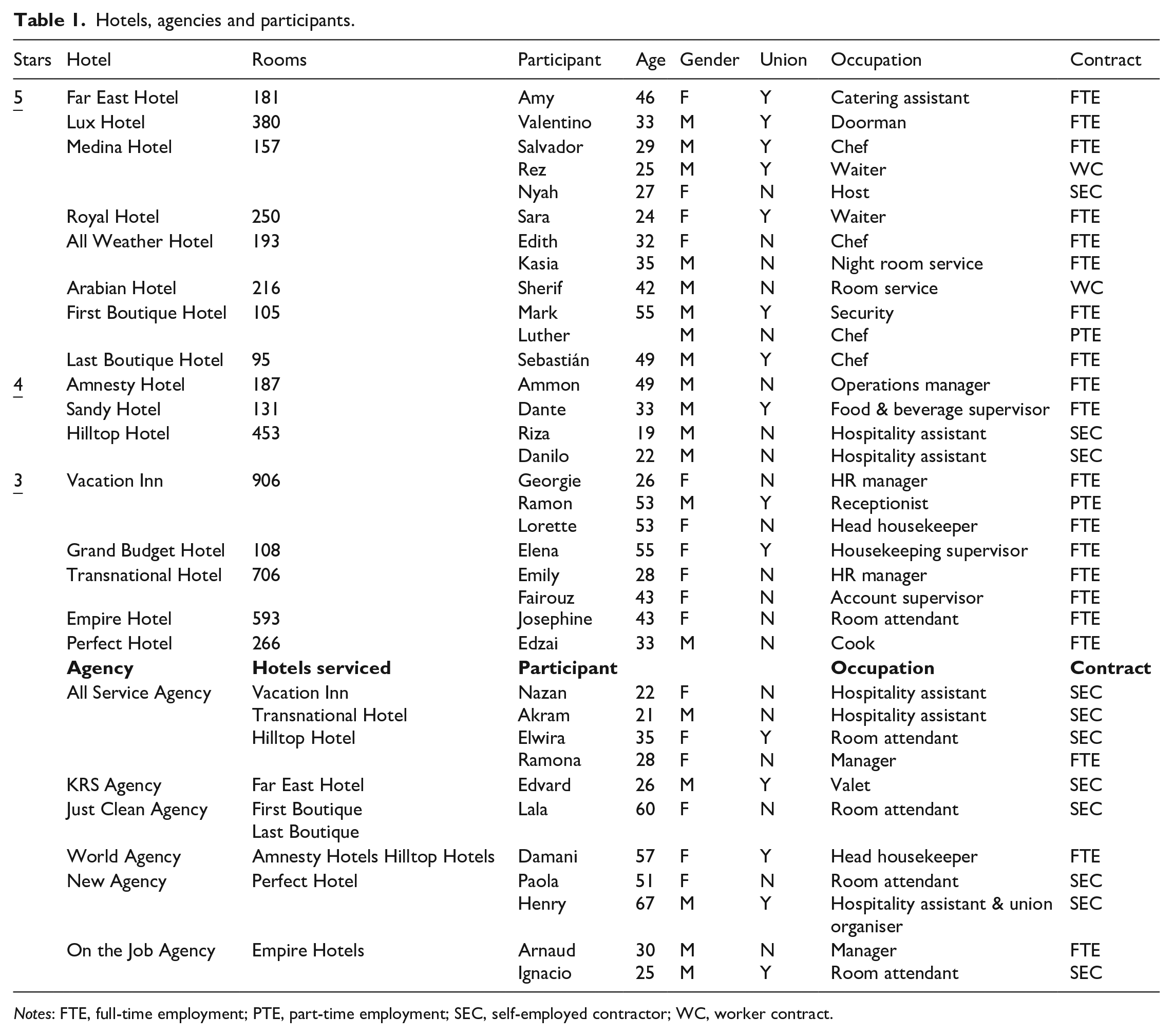
Notes: FTE, full-time employment; PTE, part-time employment; SEC, self-employed contractor; WC, worker contract.
The dynamics of wage theft in hotels: Empirical findings
Developing the threefold conceptual framework outlined above, this section presents empirical evidence to reveal the concrete ways in which wage theft occurred through the theft of labour time, base wages and variable wages. Drawing on Marxist concepts concerning the representation of labour (Elson, 1979), a typology is developed that demonstrates the ‘Form of Abstraction’ of labour (i.e. how concrete labour is represented in time and money wages); the ‘Method of Extraction’ (i.e. specific mechanisms used by managers to extract unpaid labour); the ‘Manifestation’ (i.e. how wage theft is experienced by workers); and the ‘Workers Impacted’ (i.e. which workers are affected). As Table 2 details, these categories identify six different methods of extraction across three forms of wage theft.
A typology of wage theft in hospitality.
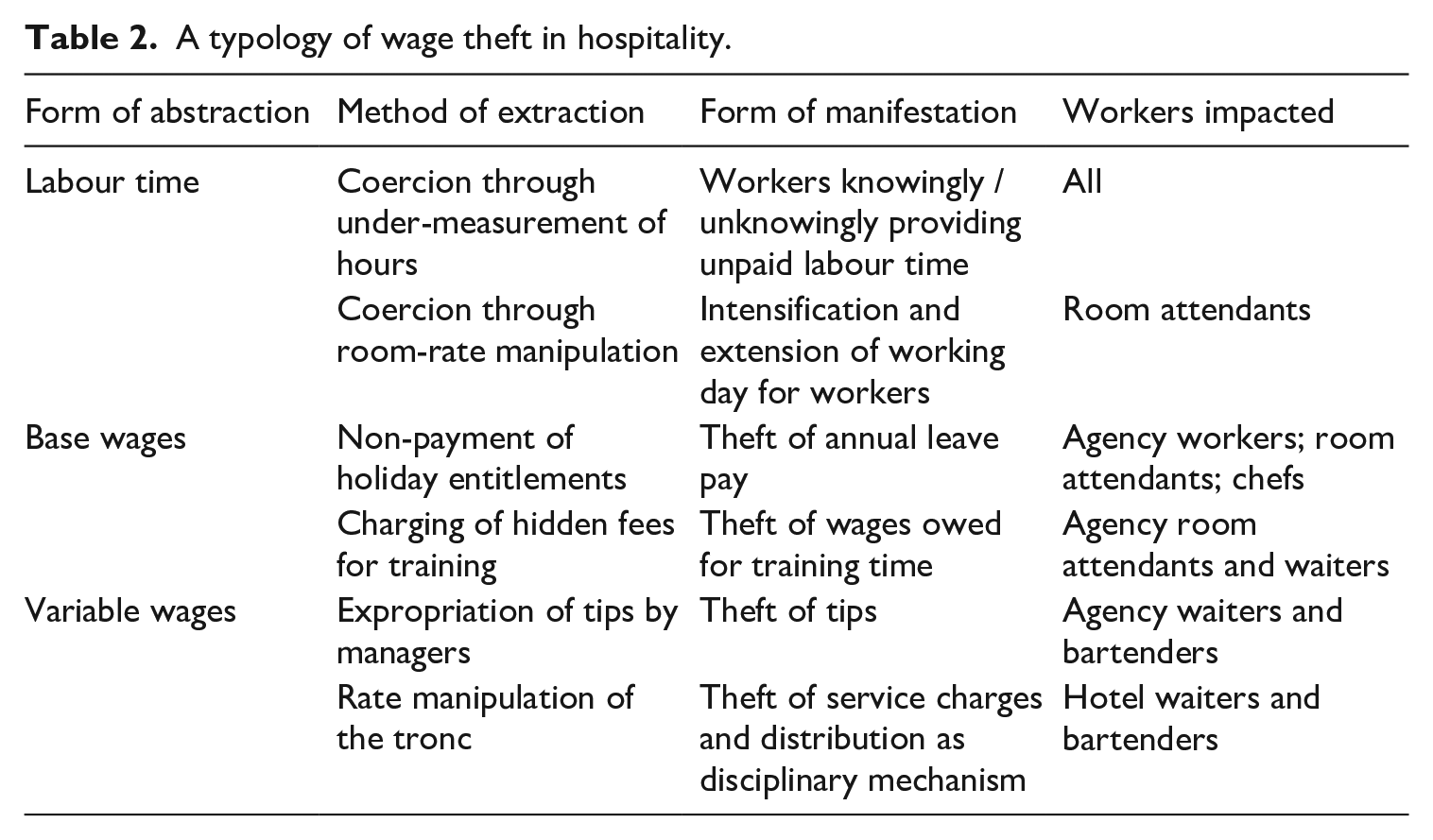
The first form of wage theft refers to the theft of labour time through managerial coercion, including the deliberate under-measurement of labour time and room-rate manipulation. This resulted in workers both knowingly and unknowingly providing unpaid labour time. The second form was the theft of base wages (comprised of hourly or salaried wages) through the non-payment of entitlements and charging of hidden fees for training. The third form was the theft of variable wages (service charges and gratuities) through withholding tips and the manipulation of the tronc system (which distributes service charges and tips). Below, we describe each of these processes in turn to evidence the claim that the appropriation of additional unpaid labour time is a normalised and systemic practice in the hospitality industry.
The theft of labour time
All 30 workers experienced some theft of labour time. This occurred by managers coercing workers into (sometimes knowingly) providing unpaid labour time through deliberately under-measuring hours worked, room-rate manipulation, or both. All workers accepted that additional unpaid labour time was a normal part of the job: In reception, they do extra time, and they never get paid for it . . . In the kitchen, they regularly do 10–15 hours and get paid for eight . . . In accounts I had a contract of 39 hours, but used to do a minimum of 50. (Valentino, doorman, Lux Hotel) If you don’t get 12 rooms finished in eight hours, you stay until you finish it, but we don’t get paid extra. (Josephine, room attendant, Empire Hotel)
According to Unite (2016), such a culture of coercive overwork was pervasive in the industry; reinforced by employment contracts that included opt-outs from the EU Working Time Directive. Contracts also commonly included the clause ‘or as business needs require’, which for Henry (union organiser, Unite) effectively ‘destroyed the normal terms of a contract’ required to fulfil duties during the working day.
Chefs provided a further example of the theft of labour time through the deliberate under-measurement of hours. Sebastián (chef, Last Boutique Hotel) explained that working additional unpaid hours was the rule rather than the exception in the industry: If someone said, ‘I’ve done my eight hours and I’m going to go home’, they would be considered unreasonable; instead, we stay there 10, 12 hours and don’t get paid for it.
Likewise, Luther (chef, First Boutique Hotel) explained that he and his colleagues normally ‘just get in early, sort things out and then often work a bit more after the shift ends’. Chefs were expected to ‘turn up at seven and get everything just about ready and then start the official work at eight’. Such expectations meant that chefs worked ‘10 to 15-hour days, sometimes six days a week’, while getting paid for only 48 hours (Edith, chef, All Weather Hotel).
When total labour time was accounted for, the real hourly wage revealed extensive violations of the National Living Wage/Minimum Wage. For example, Luther was paid £17,000 a year, but often worked 60-hour weeks – commensurate to £5.49 an hour, compared with the £7.20 NLW rate at the time. Similarly, while Sebastián’s (chef, Last Boutique Hotel) annual salary of £28,200 was higher than the average chef salary at the time (£18,640), his 70-hour week translated into an hourly rate of just £7.75, below the recommended London Living Wage of £9.75 per hour in 2015 (D’Arcy and Finch, 2016). These examples are supported by findings from a 2016 members’ survey by the trade union Unite, which found that 44% of chefs worked an average of 48 to 60 hours weekly, while 14% worked over 60 hours (Unite, 2016). Nearly half (47%) of chefs started work before their official start time and 51% finished work after their official finish time, for no extra pay.
Even when work was limited to contracted hours, managers found a way to extract additional, unpaid labour from workers through the under-measurement of labour time. Dante (food & beverage supervisor, Sandy Hotel), for example, reported that senior managers altered the accounts to reduce workers’ pay – each employee was ‘missing three hours a week from their total hours’. When Dante confronted senior management, he was informed he was responsible for checking the hours and – despite raising a grievance through the local union branch – his employment was terminated. Similar practices were common in agency work. Participant observation revealed that All Service Agency, which serviced many different London hotels, paid workers £26.80 for a four-hour catering shift (6 p.m. to 10 p.m.). At Hilltop Hotel, despite an official start time of 6 p.m., workers were instructed to turn up at 4.45 p.m. Work often continued past 10 p.m., but overtime was never paid as there was no system for clocking out or logging hours.
In housekeeping departments, the theft of labour time frequently occurred through the manipulation of room-rates, which intensified work and extended the working day without pay: ‘they make us . . . clean more rooms, but there is no time’ (Ignacio, room attendant, On the Job Agency). Damani (head housekeeper, Hilltop Hotel) explained how managers assigned 25 ‘departure rooms’ to each room attendant, even though it typically required at least 20 minutes to properly clean them. Since this constituted over eight hours of work, without a break, it was nearly impossible to complete the job within the seven-hour paid working day. Instead, workers were required to complete the allocated work unpaid. This experience was ubiquitous among housekeeping staff: ‘we’re paid until 3 p.m. and then if you have more rooms to clean, it’s your problem’ (Ignacio). Lorette, head housekeeper at Vacation Inn, agreed: ‘It’s 39 hours a week, that’s all you get paid for, for working up to 12 hours a day’ and sometimes more than five days a week. Accordingly, through the mismeasurement of hours and room-rate manipulation, managers stole additional unpaid labour time, thereby decreasing the ratio of paid to unpaid labour time and increasing the rate of exploitation.
The theft of base wages
The theft of base wages included the denial of annual leave and charging workers hidden training fees (Table 2). Annual leave entitlements are set out in the Working Time Regulations (1998), yet the non-payment of entitlements was a common experience for those working in hotels through agencies. Some managers simply denied workers their rights, under the threat of termination. Direct employees of hotels also reported being denied annual leave, but usually via covert means. For example, Luther noted that chefs were forced to take their holiday in January, which meant that, ‘if you worked 11 months and one of them didn’t include January then you wouldn’t get holiday pay’. Henry explained, ‘if they don’t pay you holiday pay and you go beyond the company holiday year, then you’ve lost it’. Chefs also lost wages and holiday pay by being intimidated and verbally abused by managers until they quit: If they harass you hard enough, you walk. If you walk you lose your wages for the month, your wages in arrears, all the holidays. I was out [by] thousands. (Sebastián, chef, Last Boutique Hotel)
The non-payment of entitlements is effectively an increase in unpaid labour time through the theft of base wages. Not taking annual leave (paid non-labour-time) provides the employer with up to 28 days of additional labour time, thereby decreasing the total annual ratio of paid to unpaid labour time.
Another method of wage theft occurred through charging hidden fees for training. Lala (room attendant, Just Clean Agency) was paid £200 for the first two weeks of full-time work because the first week’s pay was retained as a training fee. Nazan (hospitality assistant, All Service Agency) had £10 deducted for a five-minute instruction on cutlery placement. Training frequently meant being instructed to ‘watch YouTube videos on silver service’ or how to make a bed (Elwira, room attendant, All Service Agency). The training fee was explicit in the All Service Agency self-employment contract: You will be required to do our training course . . . The training process takes up to three hours, after which you will be issued with a certificate. The cost for the training course is a one-off payment of £10.
The All Service Agency also had a clause in their employee contract that guaranteed only four hours per week, stating that the company would withhold up to 75 paid hours if employees left within three months: The first two weeks of your employment are dedicated and designated ‘Training weeks’ [. . .] Payment for this training will be paid when you leave our employment [. . .] should you voluntarily leave within the first 12 weeks, the company reserves the right to charge you the equivalent cost of providing this transferable, job specific training.
While working for the agency, the training fee was indeed deducted from the researcher’s pay as he quit before 12 weeks were completed. Hotels paid All Service Agency for their services regardless of whether workers stayed for 12 weeks or 12 days. If workers quit during their probationary period, then All Service Agency directly profited from wage theft through these ‘training weeks’. Since training time is considered working time under The National Minimum Wage Regulations 2015 (33), the above wage theft is a formal violation, yet the language of the contract externalises unpaid labour time as a cost to the worker.
Under the Employment Rights Act (1996), a ‘written statement of particulars’ must be provided to an employee within two months of the start of their employment, yet withholding contracts is common practice (see also Wright and Pollert, 2006). The All Service Agency ‘hid information about their training fees in the fine print of their contracts’ (Elwira, room attendant, All Service Agency), which were also often withheld from workers. Such practices of non-disclosure have been documented in other industries, such as lap-dancing (Cruz et al., 2017), and represent a violation of workers’ rights by maintaining an asymmetry of information.
The theft of variable wages
The third form of wage theft relates to variable wages (i.e. service charges and tips). In the UK, these wages are normally managed and distributed through a tronc system (Wood, 1997), which allows them to be free of National Insurance Contributions (NICs), saving employers up to 26% in tax annually and incentivising tronc usage. Tronc systems have complicated legal rules and are run by the ‘troncmaster’, who organises distribution between employees according to a points system. The troncmaster must be independent from the employer and identified to HMRC as the person responsible for pay-as-you-earn (PAYE). A standard service charge is 12.5% of the total bill and is discretionary unless stated otherwise. Cash tips tend to be less than 10% of the bill and their inclusion in the tronc depends on the rules of the system that the employer uses (HMRC, 2022).
Participant observation allowed for detailed access to the operation of tronc at one site, the TKO restaurant at the Medina Hotel. TKO’s ‘independent’ troncmaster was the human resource manager for the restaurant, an accepted practice in the industry. Only serving staff received a share of the tronc. Each worker’s share was calculated by multiplying their official working time by an allocated number of points depending on their position (Table 3).
Tronc system for TKO restaurant at Medina Hotel.
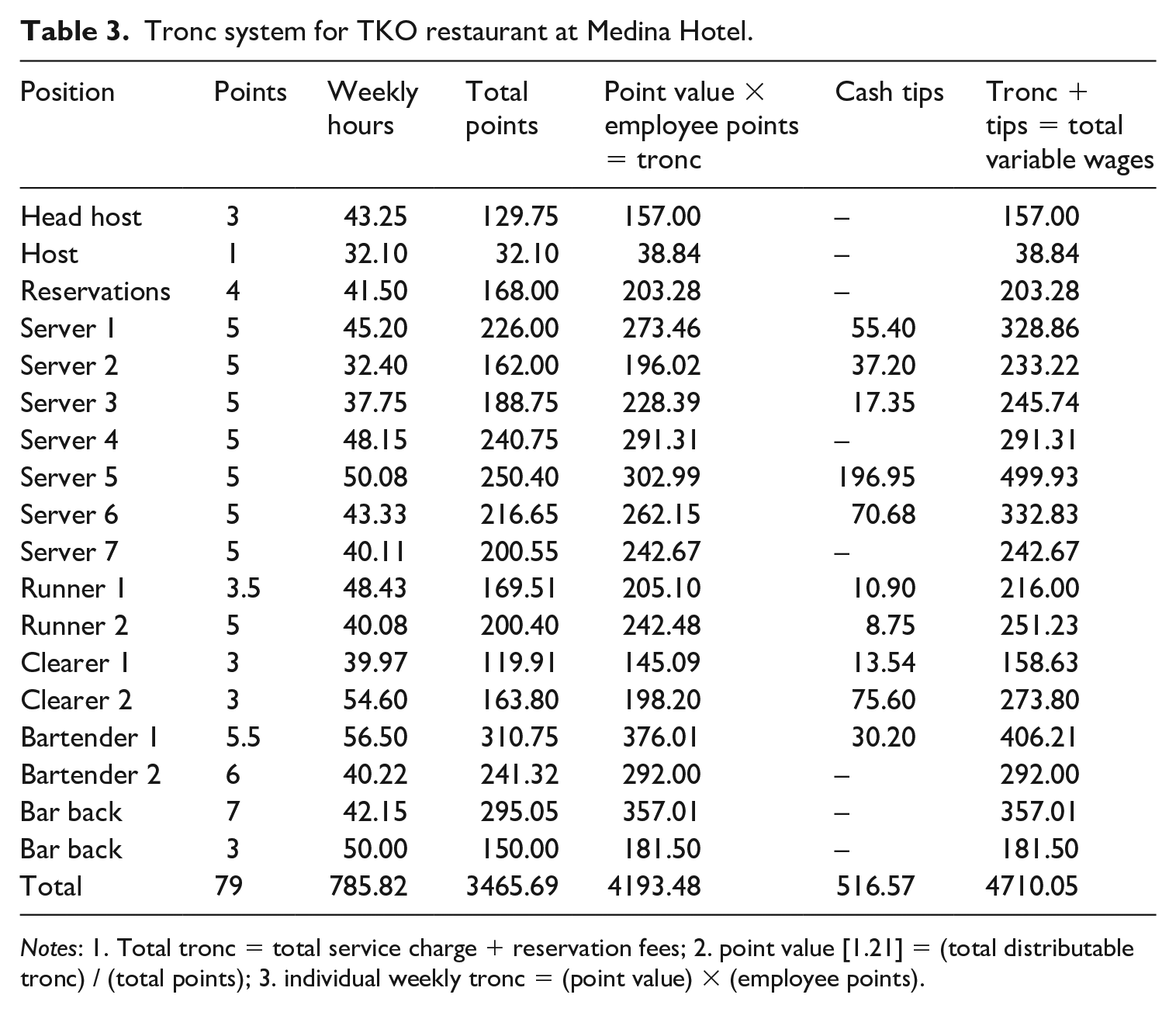
Notes: 1. Total tronc = total service charge + reservation fees; 2. point value [1.21] = (total distributable tronc) / (total points); 3. individual weekly tronc = (point value) × (employee points).
Table 3 shows significant differences in points between workers with the same or similar jobs, indicating seniority, but also favouritism towards certain workers. Along with shift allocation, the points system was leveraged by managers as a method of control. For example, Nyah (Host, TKO) suggested that attractive female servers would get more points and busier shifts based on their ‘relationship to a manager’. Favouritism bred resentment and suspicion among workers, especially since the calculation of the tronc was kept secret. Such suspicions provoked workers to organise for greater disclosure: We started comparing payslips and there was no logic behind the tronc . . . one person was working more and getting £200 less and [there were] stories like this every month. We couldn’t really figure it out, that’s why we started challenging them: ‘Show us how it works, show us the money’. (Rez, waiter, TKO)
Workers were only made aware of the tronc calculation when someone leaked an accounting spreadsheet to them, which was then shared with the Unite representative and the first author during fieldwork. It revealed that managers were ‘stealing up to 30% of the service charge before they calculated the tronc’ (Rez). They discovered that ‘all kinds of people had their hands in it’ (Salvador, chef, TKO). In one of the few active campaigns by a union, the Unite Hotel and Restaurant Workers’ branch got involved in this case. During the Unite campaign, workers discovered that managers only declared their earnings to be £13,520, which meant they officially earned ‘less than the kitchen porter’ (Henry). The rest of their £32,000 salaries were being extracted from the tronc, tax-free. As the rules state that PAYE and NICs (plus income taxes) are due in cases where the employer directly or indirectly allocates the payments from the tronc, the actions of managers constituted both tax avoidance as well as wage theft from workers.
Fighting back against wage theft
Given the pervasiveness and multimodal nature of wage theft in hospitality, it is appropriate to ask why workers continue to work under such exploitative conditions and tolerate (if often begrudgingly) wage theft. Workers indicated wide ranging reasons for persisting despite the circumstances. For Luther, the nature of the work itself explained the subservience of workers. He believed hospitality ‘will always be tied to the service of the master’, because the principles of hospitality were inherited from ‘being a service to the aristocracy’. Luther saw it as a ‘culture of martyrs’, in which chefs accepted exploitation as part of their identity, taking pride in ‘a certain amount of status and the suffering that goes with it, which they all think makes them more credible’. Sherif (room service, Arabian Hotel) tolerated it because it gave him proximity to the life he wanted to pursue: ‘I like being engaged with my customers. It keeps me close to the better life, because it’s something I aspire to’. Riza (hospitality assistant, Hilltop Hotel) derived intrinsic satisfaction from striving to make guests feel ‘overwhelmed by the service’ and enjoyed the ‘feeling of responsibility and care’, despite being on a zero-hours contract at a luxury hotel.
Evidence indicates that industry culture plays a part in encouraging unpaid labour time (Burrow et al., 2015). In London hotels, workers were coerced by managers to work additional hours of unpaid work and were often acutely aware of their own exploitation. As Valentino (doorman, Lux Hotel) noted, ‘all the extra time they are working is free labour for their employer’. Yet, worker resistance was the exception rather than the norm (Haddad, 2017), despite recent organising campaigns by Unite, BECTU and the IWGB (Kearsey, 2020). Organising campaigns have increasingly turned towards leveraging customer solidarity as a way to help workers improve their material conditions.
One notable union campaign was sparked by conflict over wage theft in the tronc system at the Medina Hotel. An escalating conflict over the disclosure and control of the tronc rules led to the targeted intimidation of one waiter (Rez), in which security guards followed him around his shift and his locker was searched without consent. Rez was ‘very sad to see really experienced staff continue to go the extra mile despite knowing that they were getting ripped off at the end of the month’. Union organisers frequently visited the hotel to protest and distribute leaflets to customers explaining that managers were ‘stealing workers’ tips’. Workers and union activists asked customers to request that managers remove the service charge from the bill and then pay workers in cash – most were happy to oblige. Nonetheless, managers refused to negotiate and escalated the conflict, removing the service charge entirely, which was ‘basically half of the wages . . . everyone was just infuriated, they wanted to just walk out and quit, but we kept on going [with the dispute]’ (Rez).
Protests continued on a weekly basis, gaining media attention, until management agreed to renegotiate the service charge policy with employees and the union. Using these methods, workers leveraged customer solidarity to fight back against the theft of wages, and, through social campaigning, took back a degree of control over the tronc system. According to Nazan (hospitality assistant, All Service Agency), who became involved in union organising through the campaign, this approach ‘breaks down that material barrier between customer and server’, and develops ‘a culture of respect and solidarity [that] could go some way into building the confidence of hospitality workers to resist’. Despite such individual victories, wage theft persists in the sector, in part due to its thinly unionised workforce. This problem is compounded by weak labour market enforcement. In 2013, an employer could expect an inspection from HMRC once every 250 years and a prosecution once in a million years (Clark and Herman, 2017). In sum, the barriers to progressive change remain formidable.
Discussion and conclusion
Wage theft is an increasingly recognised phenomenon. However, it has largely been analysed in terms of quantitative mapping (Milkman et al., 2012) or labour market violations (Clark and Herman, 2017; Macdonald et al., 2018). In contrast, this article locates wage theft as inherent to capitalism. Drawing on Marx (1976) and studies of labour informed by Marxism (Heyes, 1997; Moore and Hayes, 2017), this article offers a twofold contribution. First, the findings reveal concrete instances of wage theft in its various forms. Second, a novel conceptualisation is proposed that situates the phenomenon of wage theft within a broader system of valorisation with unpaid labour time at its core. The article therefore not only offers insights into how wage theft occurs in hospitality work but also has wider relevance for understanding how workers are exploited in other low-wage, low-unionised sectors.
The concrete instances of wage theft show how managers can extract additional unpaid labour time beyond legal boundaries, thereby increasing the production of absolute surplus-value. Our conceptual contribution locates these concrete instances in a typology that captures the legal, quasi-legal and illegal practices adopted by employers to secure unpaid labour time. In turn, these practices are linked to the broader competitive pressures of capitalism. The proposed conceptualisation illuminates the struggle over surplus-value as a fundamental structural conflict between capital and labour. Wage theft is a system-wide process incentivised by the imperatives of capitalism itself (Marx, 1976). Though, as the study of hospitality work has shown, it is intensified by the absence of unions, the lack of effective labour laws and the non-enforcement of existing labour laws.
The article’s wider significance concerns the ways that forces of appropriation and re-appropriation are inherent to the capitalist system (Granter, 2017). It highlights struggles around working time, pay-systems and wage theft at a time when exploitative practices are becoming more common in neoliberal labour markets. Our typology of wage theft can be applied to occupations and industries both in the UK and beyond. In particular, the typology has relevance for those areas of the economy where low-wage, precarious work has become more pervasive, such as in the transport and food delivery sectors, logistics, retail and work mediated by digital labour platforms (see Fairwork, 2021). In addressing the empirical concerns that animate this article, a broader set of questions arise: how might wage theft be stopped? How might alternative models of organisation and ownership be created that eliminate the imperatives of valorisation that drive wage theft? Without structural changes in the economy that support workers’ power, including increased social protections, stronger collective bargaining legislation and increased enforcement and penalties for labour market violations, wage theft will continue to be a pervasive feature of working life.
Footnotes
Funding
The authors received no financial support for the research, authorship, and/or publication of this article.
