




Abstract
This article examines the internationalisation of professions in a qualitative study of migrant academics, drawing on social closure theory to understand how professions respond to the growing numbers of migrants. While studies of closure in professions tend to focus on forms of exclusion based on ascribed characteristics, this article is concerned with how professions include migrants in their ranks. Analysis of interviews with 62 foreign-born academics working in the UK reveals differences in degree of closure towards migrant academics, indicating that inclusion and exclusion are not binary opposites. The article captures degrees of closure in a novel concept – ‘modes of incorporation’ – identifying three inclusion patterns: integration, subordination and marginalisation. ‘Modes of incorporation’ extends closure theory by showing how inclusion is controlled and designed to preserve the status quo, thereby restricting internationalisation.
Introduction
The increasing presence of migrants is a growing trend in many UK professions. Thirty-seven per cent of England’s registered doctors are educated abroad (Baker, 2018), while foreign scholars comprise 30% of the UK’s academic profession (Lenihan and Witherspoon, 2018). Explanations for this increased mobility include access to career opportunities and supportive policy frameworks such as favourable immigration policies (Richardson, 2009). As a result, professional communities are internationalising, whether that is driven by individual aspirations, government facilitation (Bauder, 2015) or professions’ strategic coordination (Muzio et al., 2011).
This article develops understanding of the internationalisation of professions by examining the nature of migrant professionals’ inclusion. Drawing on academia as a case study, it investigates the working lives of foreign-born scholars who work in the UK. The study builds on an emerging body of scholarship on migrant academics’ (MAs) experiences (e.g. Fernando and Cohen, 2016; Sang and Calvard, 2019). While instructive on international mobility patterns, individual motivations and career outcomes, this research neglects professions’ capacity to control their composition and practice. Consequently, the research question posed here is, how has the academic profession responded to the rising numbers of MAs?
Addressing this question is timely. In academia, as in other professional fields, being white, native, middle-class and male has been the ‘ideal’. Deviation from this ideal threatens the profession’s status quo and others are excluded (Ahmad, 2020; Maranto and Griffin, 2011). However, since 2005/2006 the number of EU academics in the UK has nearly tripled while the number of non-EU academics has almost doubled, hinting that internationalisation is occurring (Locke and Marini, 2021). Studies also show that MAs’ careers often progress faster than their British peers’ (Fernando and Cohen, 2016). MAs’ apparent success suggests that they are worthy of further scrutiny. Concerned with a profession’s responses to migrants, this article draws on the theory of social closure, which focuses on how groups use resources to safeguard their rewards from competitors.
Who counts as a ‘migrant’ is difficult to discern. Definitions comprise ‘someone subject to immigration control’, foreign-born individuals or foreign citizens among others (Anderson and Blinder, 2019). Here, MAs are understood as foreign-born individuals, employed on an academic contract by a university of a country different from that of their birth; ‘foreign-born’ being an accurate way to capture migrants working in British universities 1 given that citizenship and immigration status may change. This definition also covers ‘hidden’ dimensions of national background such as country of education, allowing a nuanced analysis of MAs’ absorption. ‘Profession’ prompts further definitional debate, covered in detail elsewhere (e.g. MacDonald, 1999). Consistent with a long-lasting tradition within the sociology of professions (Freidson, 2001; Larson, 1977), this article understands ‘professions’ as occupational communities characterised by occupational control of work and members’ reliance on a formal and abstract knowledge base. This conceptualisation incorporates marginal occupations such as academia where market control does not rely on professional registration, broadening studies of social closure beyond the archetypal professions such as medicine and law.
The article makes two contributions. First, the study adds national diversity to literature on social closure that has mostly differentiated on characteristics such as social class (Ashley and Empson, 2013) and gender (Bolton and Muzio, 2007, 2008). Although ethnicity, a visual aspect of national diversity, has featured in studies of social closure, a research focus on immigrant origin as a category of difference is rarer. Second, this article develops the concept of social closure by extending knowledge of how professional structures act to protect the status quo (Ashley and Empson, 2017; O’Brien and Ackroyd, 2012). While the exclusionary nature of professions is well-established, this article shifts focus to how professions include. It argues that, faced with competition from MAs, academia has adapted social closure to control inclusion, developing three closure patterns – ‘integration’, ‘subordination’ and ‘marginalisation’ – labelled ‘modes of incorporation’. 2 ‘Integration’ incorporates MAs as trusted members of a community of shared professional values. ‘Subordination’ admits MAs but treats them as socially, culturally and professionally inferior. ‘Marginalisation’ treats MAs as peripheral, allowing limited engagement with the professional community. These ‘modes of incorporation’ control growth in MA numbers in a managed way that preserves local professional norms and (re)produces inequalities.
The article begins by discussing international academic mobility, then reviews pertinent literature on closure to frame the research. A sketch of the research design is followed by analysis and discussion of data from interviews with 62 foreign-born academics working in UK universities.
International academic mobility 3
International mobility is a key mechanism through which the internationalisation of academia occurs. Growing numbers of MAs joining the UK’s academic ranks have been accompanied by the emergence of a corpus of literature documenting the motivations, patterns and challenges of pursuing an international career.
Academics mostly move abroad to seek career opportunities such as access to developed research infrastructures (Richardson, 2009). Some higher education systems meet those aspirations better than others. Thus, academia’s international mobility landscape divides into ‘centres’ that attract high numbers of MAs and ‘peripheries’ where MAs are fewer (Lee and Kuzhabekova, 2018). The UK is regarded as a ‘centre’ because of funding opportunities and high-quality research facilities. Standardised performance metrics such as Research Excellence Framework (REF) are also attractive to MAs because standardised criteria are perceived to offer transparency and meritocratic selection (Ackers and Gill, 2008). The UK’s academic labour market is considered to be ‘one of the most open academic job markets in Europe’ (Afonso, 2016: 818), implying that career freedom and merit explain why MAs’ numbers continue to increase.
However, moving to a mobility ‘centre’ has divergent effects on academics’ career development and progression. On one hand, working in a ‘centre’ brings career advantages. Indian academics, for instance, advance careers in the UK by drawing on connections in India to establish prestigious collaborations (Fernando and Cohen, 2016). Similarly, migrant women professors are relatively privileged compared with their native counterparts because belonging to multiple categories of difference diminishes the impact of gender bias said to block the career progression of British women (Sang et al., 2013). There is also evidence that Caucasian MAs earn more than their UK counterparts (Hopkins and Salvestrini, 2018).
On the other hand, moving to a mobility ‘centre’ tends only to benefit MAs with a strong research profile because publications are the main currency for accessing employment (Richardson, 2009). Experience gained abroad could also disadvantage MAs. For example, Italian and Portuguese systems are highly nepotistic so moving abroad may mean that local networks, vital to progression, are lost (Morano-Foadi, 2005). International mobility is also said to reproduce long-standing inequalities in the academic profession. While careers of Anglo-white males benefit from moving abroad, advantages are less apparent among ethnic minority academics (Sang and Calvard, 2019).
Although studies of MAs highlight important aspects of international mobility, they tend to concentrate on migration experiences and individual careers, theorising motivations, career boundaries and/or outcomes. By contrast, this article shifts the focus to a related but distinct area of MAs’ employment abroad, interrogating the shaping effects of contexts within which MAs’ careers unfold (Ackers and Gill, 2008). Specifically, the article expands the scope of enquiry from individual to profession, recognising that professions control typical career patterns and regulate entry (Freidson, 2001). The next section introduces the theory of social closure, particularly suitable to examine the profession’s responses to rising numbers of MAs.
Professions and social closure
Social closure is concerned with social structuring and the dynamics of interest among social groups (Murphy, 1988). The theory suggests that groups safeguard their limited economic and socio-cultural rewards from competitors by establishing formal or informal rules of exclusion (Weber, 1978). Overall, bases for social closure are grouped into ‘collectivist’ and ‘individualist’ (Parkin, 1979). Collectivist rules are often informal and grounded in ascribed social characteristics such as nationality or gender, whereas individualist rules tend to be objective and mean that ‘only individual attainment and personal merit could be the proper grounds for allocating honours and benefices’ (Parkin, 1979: 64).
Professions such as law and academia are examples of the successful application of objective individualist rules of closure to safeguard the profession’s market value and economic rewards (Freidson, 2001). These professions control both ‘production of producers’ (who enters the profession) and ‘production by producers’ (work and behaviour of professionals) (Abel, 1988); they have monopolised a body of knowledge and practice, established a closure regime grounded in credential-based membership and obtained occupational control of work, i.e. professionalism (Larson, 1977). Professionalism also confers a collective professional identity to members. Operationalising closure creates a culture of trust within the profession because all members share a common knowledge base and standards of work, imparted through socialisation (Freidson, 2001).
Scholarship on the professions has also established, however, that closure regimes are grounded in historically developed assumptions concerning competence, typically embodied in the white middle- or upper-class male (Parkin, 1979; Witz, 1992). Tomaskovic-Devey (1993) speaks of professions and jobs as being characterised by ‘status closure’ and ‘status composition’. ‘Status closure’ entails processes by which characteristics such as race or sex determine access to valuable employment positions. Through ‘status closure’, a particular ‘status composition’ is achieved, which influences the work done, as well as the perceived value of that work.
Central to ‘status closure’ is a struggle over power and resources between the dominant/majority and subordinate/minority groups within a profession, operationalised via two closure strategies, exclusionary closure and inclusionary usurpation (Parkin, 1979). Exclusionary closure, exercised by the dominant group, ‘seeks to secure, maintain or enhance privileged access to rewards and opportunities in the occupational labour market’ (Witz, 1992: 193) by using the institutions and structures that protect professions against the minority group(s). Minority group(s) pursue inclusionary usurpation seeking to challenge the majority group’s monopoly over competence.
Witz’s (1992) seminal work described how these two strategies played out in the medical profession, where male doctors sought to exclude aspiring women doctors. While women were not excluded from becoming registered practitioners, collectivist criteria of exclusion against women were embedded in institutions such as universities, the main approved routes to registered medical practice. Aspiring women doctors sought inclusion successfully campaigning for legislation that gave women a right to university education, but this strategy was only partially successful. Although universities (and the men who controlled them) could not legally exclude women, they could not be forced to include them and women continued to be excluded by other means.
Scholarship has since established that similar intra-professional exclusionary practices towards minority groups persist, and that the nature of exclusion alters in the face of threats to the profession’s self-governance, such as government-led public management initiatives or widened access to higher education. First, the location of closure shifts away from external, occupational mechanisms described by Witz to internal ones. For instance, Muzio and Ackroyd’s (2005) study found that, faced with a growing number of qualified entrants, partners in law firms did not raise entry criteria but defended their status and wealth by creating barriers to progression, disproportionately affecting women. Second, threats to self-governance appear to have changed ascription-based closure. Legal protection against explicit discrimination has strengthened, so that collectivist closure now operates in implicit ways. For example, women lawyers are concentrated in feminised specialisms such as family law and often excluded from the more lucrative areas such as commercial law (Bolton and Muzio, 2007). Normative conceptions of professionalism are increasingly reproduced through the practices of those who hold power over professional institutions, resulting in continuing inequalities in organisations (Bolton and Muzio, 2008).
Current theorising on closure tends to emphasise the struggle between dominant and subordinate groups and exclusion from professional practice, as examples of gender-based exclusion describe. Studies identify the structures, mechanisms and processes at play in these struggles, some of which are external to the profession and some of which develop from the actions of the profession. This article argues that there is a need for a fine-grained understanding of social closure that also pays attention to rules of inclusion (Murphy, 1988). For instance, while intra-professional struggles may limit female participation, they do not entirely exclude women, suggesting that there are mechanisms of inclusion at play which act to segment and stratify professions.
The UK’s academia has incorporated a steadily growing minority of migrants at a time where pressures on the profession have occasioned protective measures to enact and strengthen exclusion. The massification of the UK’s higher education was accompanied by the politically-motivated marketisation of the sector. As government funding decreased, universities were encouraged to compete for new revenue sources, become more responsive to industry and comply with quality assurance systems such as REF (Johnes and Virmani, 2020). These imposed pressures have impacted academics’ behaviour, triggering professional mechanisms designed to re-assert control over membership. Responding to financial constraints, senior members of the profession have become involved in game-playing, steering performance criteria towards those that are being measured, such as reliance on journal rankings for research quality or student satisfaction scores (Gunn, 2018). While this approach has resulted in financial rewards for senior management (Johnes and Virmani, 2020), it has exacerbated exclusion of women and ethnic minorities and resulted in strengthened performance management and heightened precarity (Kalfa et al., 2018). Against these trends, it is evident that the growing number and apparent success of MAs call for a better understanding of how the academic profession includes MAs (Pustelnikovaite, 2021).
Methods
This article draws on semi-structured interviews with 62 academics, using questions piloted in the first 14 interviews and subsequently developed in relevant lines of enquiry. Criteria for recruitment to the study were broad and comprised: (1) foreign-born; and (2) employed on an academic contract by a British university. Table 1 details participants’ demographic profile.
Participant characteristics.
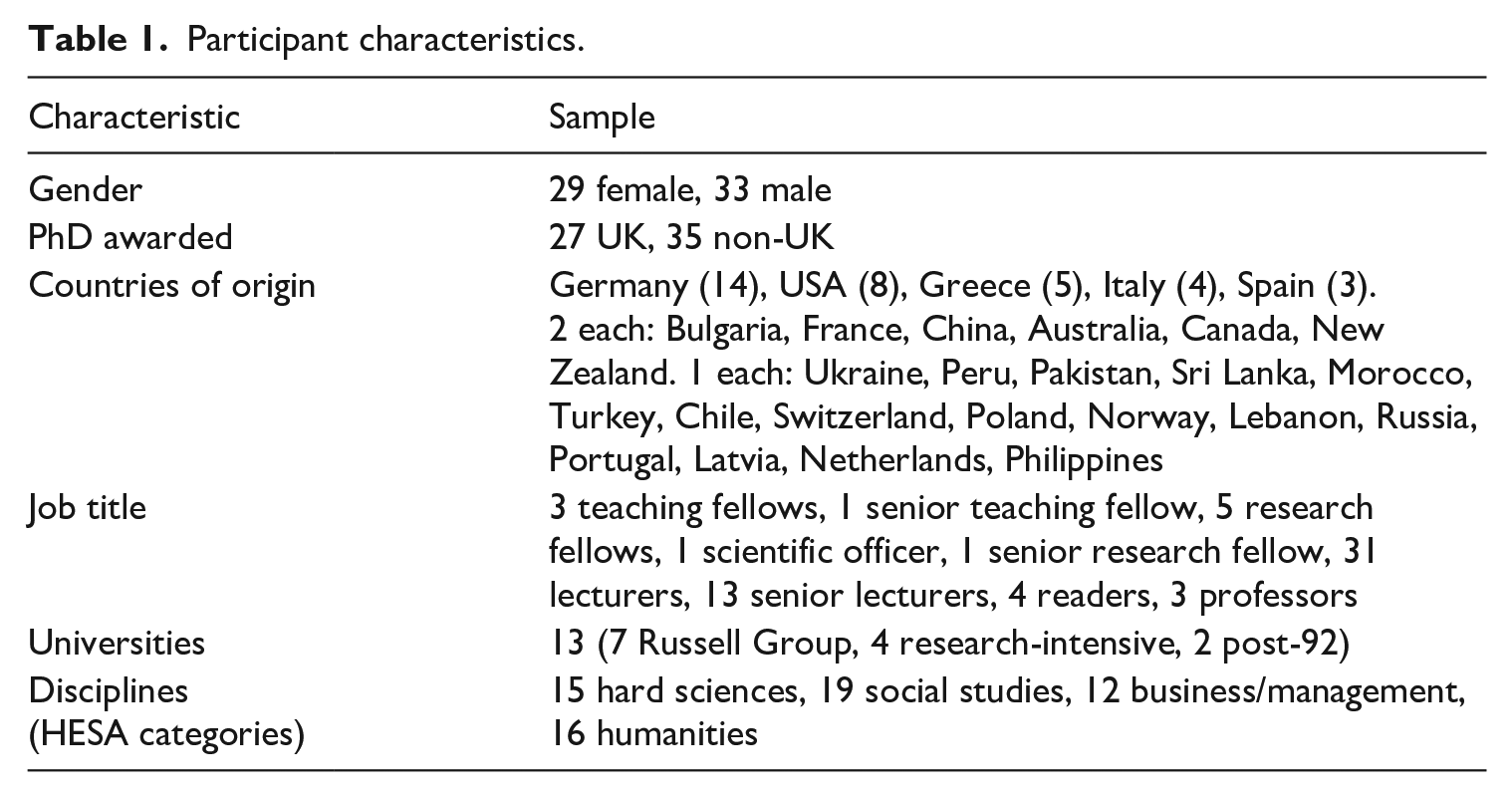
Fifty-one interviews were conducted face-to-face, with the remainder conducted via phone/Skype. Interviews lasted between 35 and 156 minutes, were recorded and fully transcribed, producing 1124 pages of data. Ethical protocols (e.g. ethical approval, anonymising data) were followed.
The research team represents a balance of insiders and outsiders to the researched community. The first author is an MA; insider status granting a nuanced understanding of lived MAs’ experiences and facilitating trust and rapport with participants (Sang and Calvard, 2019). The second author is a non-migrant academic, creating complementarity in interpreting MAs’ experiences. Researchers also constantly validated data by comparing MAs’ experiences across sub-categories (e.g. country of origin), obtaining qualitative credibility.
Interview questions covered participants’ experiences of entering the labour market and of working in the UK. These two themes represent the two pillars of professionalism (the ‘production of producers’ and the ‘production by producers’), capturing key sites where formal and informal closure operates. Transcripts were analysed using a template analysis approach (King, 2004). ‘Labour market entry’ and ‘work’ constituted higher-order themes. These themes were purposefully left broad to avoid prescription while maintaining an overall framework for interpreting data. Analysis of data relating to these main themes was largely inductive and carried out by maintaining focus on how immigrant origin influences absorption into the academic profession, ultimately leading to the identification of three closure patterns within the profession. Analysis of ‘labour market entry’ identified codes on entry currencies such as ‘credentials’, subsequently grouped into the subthemes ‘qualifications’, ‘work experience’, ‘publications’ and ‘networks’. Under ‘work’, codes were linked to performing work tasks, for instance ‘publishing approaches’. These codes were grouped into ‘researching’, ‘teaching’ and ‘coping’ subthemes. Although no comparison with UK-born academics was elicited in the interviews, data analysis identified that MAs often benchmarked themselves against the national majority, suggesting that identity regulation is key to the profession’s control of work. This emergent theme was labelled ‘professional identity’. Codes within this theme indicated varying degrees of cohesion within the profession and were grouped into subthemes ‘divisions’ (e.g. ‘isolation’, ‘stereotypes’) and ‘commonalities’ (e.g. ‘international colleagues’). These three themes and respective subthemes are used to structure the analysis.
This study, however, has limitations that could be addressed by further research. First, the analysis does not cover the impact of immigration policies on MAs’ experiences. This legal closure mechanism is not controlled by the profession and falls outside the study’s scope. Second, this article uses immigrant origin as a category of difference. It recognises that studies on the intersection of immigrant origin and other categories of difference such as class or ethnicity constitute a fruitful avenue for further research on inclusion. Finally, UK academics’ perceptions of the increasing MAs’ presence have not been sought. Instead, the study set out to understand how the profession responded to the increasing numbers of migrants by examining their experiences of entering and working in the UK’s academia. The findings presented in this article trace the patterns in barriers/enablers to equal participation in UK academia, encountered by MAs. These patterns are interpreted as indicative of the profession’s formal and informal closure or openness towards MAs (Bolton and Muzio, 2007).
Labour market entry
Qualifications
Educational credentials are the primary currency for entry to a profession and an archetypal formal closure mechanism. However, despite claims that entry to the UK’s academia is comparatively open (Afonso, 2016), informal closure became apparent in judging the value of qualifications. The data suggest that country of award is an additional criterion for assessing migrants’ qualifications. Migrants with UK qualifications signalled familiarity with UK professional norms: these MAs’ accounts of labour market entry indicated that their national background became secondary to having a UK PhD. However, migrants with foreign qualifications displayed divergent entry experiences. Those educated in North America attributed labour market success to the enhanced value of their qualifications citing wider experience, acquired during the longer doctoral programme:
I taught courses, I took courses, I was able to work on several projects that led to two papers. (. . .) I felt that’s why I got a job as easy as I did in [a Russell Group university], because of the training that I’ve done and the responsibilities I’ve had in my previous environment. (Emily)
By contrast, migrants with European PhDs commonly found that recruiters were unable, or unwilling, to comprehend doctoral and work experiences, often resulting in MAs’ underemployment. For example:
I have done a little bit more than just going through a PhD programme. So even when I negotiated these pay scales, it was always ‘Ok, when did you do your PhD?’ It was really hard to translate my research experience alongside the PhD that I had. (Beate)
These data suggest collectivist closure operates at labour market entry. MAs appear to be judged on the perceived value of their qualifications. Qualifications from countries that have a high international academic reputation, particularly the USA and Canada, make inclusion to the UK’s academia easier: those qualifications signal educational prestige and are perceived to have included highly relevant experience. Consequently, entry to UK academia is not only based on having the required educational qualifications – exclusion is also formed within the group of appropriately qualified (Chillas, 2010). Within-group exclusion is based on cultural signals (Collins, 1979) grounded in perceptions of prestige that are not necessarily linked to candidates’ competence (Rivera, 2012).
Work experience
Informal closure also operated in evaluating previous work experience. Some – particularly MAs in humanities – noted that their employers devalued, or misunderstood, experience gained in other countries privileging UK experience, which they interpreted as a proxy for familiarity with local professional norms and a way to build a sense of community in the profession:
I’ve got loads of colleagues in my department who think ‘I’m not sure I want a colleague coming from France because they are going to bring this very rigid system with them and not be able to, not be flexible enough to adapt.’ And I can see why they are saying that. If the colleague is French but has experience in the UK, you expect that they will be used to a more flexible approach. (Aurelie)
However, mobility schemes such as Marie Curie were an exception to this hidden evaluation process. These schemes ‘fast-track’ entry providing facilitated (although often temporary) inclusion of MAs without UK experience and strengthening internationalisation of the academic profession.
Several participants observed that the profession was stipulating UK-specific experience more actively than a decade ago, attributing this to an increased emphasis on performance metrics. Externally imposed demands push the academy to strengthen closure regimes to minimise the risk of employing migrants who may require prolonged socialisation or additional training to fit professional norms.
Publications
Marketisation has also prompted some universities to restrict the admission of MAs to those who can contribute to the REF portfolio, adopting a narrow view of research quality. Those with publications unlikely to be recognised in REF, such as those written in a foreign language, felt disadvantaged:
Fortunately, I targeted good journals which are very well-known in all countries. But I had some colleagues [in Spain] that targeted journals that are not recognised here. They are good journals but not included in the ABS list. This creates a big problem if you are moving abroad. (Diego)
Ostensibly meritocratic, the publications requirement for entry to an academic post reinforces the pervasiveness of journal rankings in assessing research. However, highly-ranked journals are published in English and are UK- and US-dominated in authorship and content, features that provide evidence of epistemic exclusion (Collyer, 2018). For example, out of 33 ‘world elite’ journals in the ABS list, 31 are edited by US academics (Boussebaa and Tienari, 2021). This narrowed view of research publications suggests that in the UK, academia is pursuing a particular type of internationalisation, grounded in an ‘Englishised’ conception of international scholarship.
Pursuing ‘bounded’ internationalisation shapes access to the UK profession. Many MAs educated in non-Anglophone countries, and particularly in social sciences and humanities, indeed spoke of having followed ‘a strategy of [research] internationalisation’ (Victoria) to demonstrate fit in UK universities. Victoria sought a UK/US book publisher, while others chose to publish exclusively in English, translate their work into English, or target high-ranking Anglophone journals.
Networks
Professional networks, another feature of closure evident at entry, eased access for migrants irrespective of qualification or publication record, with particular salience for early career academics. Networks not only provided MAs with information about job opportunities, but also appeared to mitigate the suspicion associated with foreign experiences, as Australian lecturer Paul notes:
I don’t think that I would have gotten anywhere without knowing someone who was involved in the [recruitment] process. Because I’d applied for places before, where I thought that on paper I am a perfect fit and just got nowhere.
Notably, no significant inter-university differences were identified for entry experiences, suggesting similar patterns of closure operate irrespective of organisation. The UK profession acts in self-interest pursuing ‘bounded internationalisation’, with inclusion and exclusion determined by the perceived degree of MAs’ ‘foreignness’.
Work
Researching
‘Bounded internationalisation’ and closure patterns became more pronounced in work settings, across core academic practices. The relatively high professional autonomy in the UK appealed to MAs, however most quickly understood that autonomy is governed by expectations set by the profession within which they have to ‘fit’:
Sometimes, it feels like you have to decide between whether you want to do what you think is good and what will be picked up as successful by whatever bizarre scheme is in place to recognise work. Very often you hear that phrase ‘you gotta play the game’, right? The problem is, some of these games have pretty peculiar rules and not playing is not an option. (Tobias)
The ‘game-playing’ discussed here is not restricted to MAs; it has become instantiated in professional practice (Kalfa et al., 2018). For migrants, however, ‘game-playing’ represents a form of closure imposed by marketisation. MAs feel compelled to comply with local standards, an observation that runs counter to claims of an internationalised profession (Afonso, 2016). While some perceived ‘fitting in’ as an opportunity to work ‘in a different league’ where people ‘think at 4* paper level’ (Anja), others described compliance as ‘a form of cultural arrogance’ (Galini). Although many understood ‘the game’, they noted curtailed discretion and a marginalised contribution; for example, local standards discouraged forging research collaborations with academics in other, particularly non-Anglophone, higher education systems. This form of closure worked to restrict MAs’ international profile:
In an ideal world, I’d now start the next big book. But I can’t because for the next REF I’ll probably need four publications. This is what I have in mind while I am on [sabbatical] leave, I now work on my four articles just so that I have these four items for the bean-counters rather than, say, a half-finished book. Even though for my international reputation a half-finished book would be much better. (Annike)
Teaching
Teaching presented MAs with similar tensions between discretion over practice and conformity with professional norms. Most MAs believed they exercised discretion over teaching content. Some also believed that their background enhanced students’ experience in the classroom. For instance, MAs could relate to international students’ linguistic challenges in speaking out. There is, however, some evidence that students who come to the UK expect to be taught by British academics. Yingying recounted that her Chinese PhD student tended to dismiss her suggestions in favour of guidance from his British supervisor, undermining her authority. Furthermore, a third of MAs expressed concerns over student evaluation as a performance metric. Most non-Anglophone academics, particularly early-career scholars and recent migrants, worried that their accented English would result in reduced student satisfaction scores:
The first time I started to do seminars, I was horrified. I was really scared by the idea of people making fun of my accent or not understanding what I was saying. (Alessandro)
Coping
The competitive environment of the UK academy put pressure on MAs to compensate for their difference(s). However, instead of overcompensating by prioritising research and increasing research productivity found among Indian academics in the UK (Fernando and Cohen, 2016), MAs in this study emphasised working harder and longer than their British peers across all tasks, suggesting the perceived need to excel all round. Pressure to perform was particularly common among women MAs, indicating a felt need to demonstrate exceptional resource mobilisation in achieving professional goals (Sang et al., 2013):
Unfortunately, we foreigners have to work twice the amount of native scholars because we have to prove a lot of things that other people do not have to. (Artemis)
Feeling obliged to work harder than colleagues is a common response to perceived performance pressures and/or marginalisation for minority professionals (Jammaers and Zanoni, 2021). In doing so, MAs craft a valued ideal-worker self, attempting to minimise their ‘difference’ in fulfilling professional expectations. MAs resemble the stereotypical ‘good migrant worker’, believed to possess a stronger work ethic compared with local workers (MacKenzie and Forde, 2009). Statistics support this observation, as MAs are more likely than British academics to be included in the REF assessment (HEFCE, 2015). Ironically, the pressure to prove competence ultimately helps to sustain the status and rewards of the (predominantly British) senior university managers who set performance standards and exert normative control. Feeling obliged to outperform local colleagues may also contribute to the subordination of MAs because it ‘could lead to universities to continue to expect more than excellent performance from future international staff’ (Fernando and Cohen, 2016: 1292).
While MA numbers are increasing, the profession has responded through actions that preserve local professional norms and reinforce closure. MAs feel pressured to integrate, and adapt their practices in a way that benefits universities, while those who cannot are further marginalised.
Professional identity
Divisions
Reminiscent of other studies of highly-skilled migrants, MAs are often discussed in terms of their ability to adapt, captured in ‘modes of acculturation’ (Hajro et al., 2019). Here, analysis of identity adjustments reveals the influence of the profession. Membership in a professional community is argued to accentuate professional identity (Freidson, 2001). However, individuals have multiple identity reference points and data exposed tensions between MAs’ professional and cultural identities, suggesting limits to their integration and further instances of closure. Often, this tension was exposed in how minority identity influenced interactions with colleagues. Some migrants felt treated as ‘token’ foreigners by colleagues (Settles et al., 2019), as representatives of their country. German academics tended to be mocked for efficiency, while, to her colleagues, Elisa became ‘the least Italian’ they knew because she arrived at meetings on time. Most migrants did not object to this stereotyping, but rather saw it as ‘a good diversity point’ (Juan). However, jokes and stereotypes mask intra-professional power inequalities, emphasising MAs’ subordinate status by reinforcing MAs’ ‘foreignness’. Elisa’s labelling as an untypical Italian elevated her status through assumed exceptionality, simultaneously reinforcing the stereotype. These accounts indicate experiences of subtle everyday discrimination which is ‘less visible, often very ambiguous for those experiencing it, not easily recognised as discrimination and often not punishable’ (Van Laer and Janssens, 2011: 1205).
MAs commonly responded to stereotyping with changed behaviour designed to blend in with UK culture. They reverse-stereotyped features of ‘a typical British academic’ which they then tried to imitate, hinting that in the UK, professional identity is class and culture-based. For Galini, imitation meant learning how to send passive-aggressive emails, while Miguel tried to be ‘as polite as possible’. Sabrina learned ‘how to hold knife and fork the British way’, while Ran considered buying an Audi so that his car ‘fits in with everybody else’s’. Most often, MAs sought to imitate the British accent:
I don’t do the New Zealander flick at the end of the sentences anymore. . . I don’t think I even consciously do it (. . .) I realised that often people are annoyed by what I was saying or they couldn’t, they didn’t know how to respond to that kind of inflection. (Emma)
Attempts to resist perceived UK professional norms were rare, highlighting MAs’ understanding of the conditions of inclusion. Participants believed that this identity work would result in becoming ‘Britishified’ (Nadia) and failure to assimilate would limit opportunities, a fear that is also supported by the tendency to employ MAs on short-term contracts, particularly in Russell Group universities (HESA, 2020):
I always wanted to adapt. Prove my English, prove my accent, know more about the Scottish culture, British culture, whatever. (. . .) I felt that I mustn’t let it [my foreignness] out too much or I won’t get a job, I’m not competitive or I just look weird. (Annike)
MAs’ attempts to align their work identity with the ideal worker identity point to the operation of informal, socio-normative identity control (Alvesson and Kärreman, 2004). Visible through regulation of an employee’s self, mindset and social relations, this form of cultural control exists alongside formal and measurable output-based control mechanisms. As academia affords relatively high levels of discretion, behaving and sounding like a (stereo)typical British academic may act as further reassurance of fit (Jammaers and Zanoni, 2021). However, aspiration to create homogeneity in membership is not the only reason to deploy cultural control. Not only do people derive identity from their work, but work also derives identity from members (Ashcraft, 2013). Organisations exercise identity control with the goal of enacting a particular form of organisational experience (Alvesson and Kärreman, 2004). By subtly enforcing a professional identity rooted in an upper-class conception of ‘Britishness’ the profession may be co-opting MAs into the creation of British higher education as a brand – inclusive because it is nationally diverse, yet still elite.
Feeling a ‘level of distance’ (Patrick) between themselves and British academics contributed to MAs’ accounts of isolation from the profession. They became ‘token’ minority professionals, only partially included (Settles et al., 2019). In the extreme, MAs found British academia to be impenetrable, a ‘very close social community’ (Yingying). The majority expressed difficulties in making friends with British colleagues. They perceived that British colleagues had longstanding social networks, often excluding recently arrived migrant colleagues from social activities. Galini felt she had to ‘start my social life from zero, from nothing’. A perceived lack of cultural sensitivity from colleagues was seen as a form of marginalisation, perhaps derived from diverse cultural expectations of socialising. However, its effect is that many MAs are unlikely to feel included when working abroad (Van Laer and Janssens, 2011). Australian lecturer Paul captures this widely-held tension between being integrated in work but marginalised socially:
I’ve gone three weeks with not a single person to speak to, except maybe when I shop. That’s been very difficult. (. . .) In my worst moments, I felt like I just don’t fit in anywhere. Apart from having a job, like I felt like the only thing I can do is be a work function. And there I fit in, but socially. . . I’m not fitting anywhere.
Commonalities
Although MAs’ collective sense of being ‘outsiders’ often seemed to override their professional identity, others felt integrated in their workplaces. Some cited professional socialisation in the UK as contributing to ‘sameness’ but, more commonly, MAs explained integration coming from employment in nationally diverse workplaces where they established a sense of ‘commonality in difference by downplaying national affiliations and cultural differences through mutual social efforts’ (Skovgaard-Smith and Poulfelt, 2018: 130):
Who is the not-foreigner? No, at work I don’t think that my nationality has impact whatsoever. (Raquel)
These findings support the claim that organisations with lower numbers of minority employees are perceived as more exclusionary than those where minority employees are numerous (Maranto and Griffin, 2011). In nationally diverse settings, profession becomes the central axis of identity and integration is more likely to occur.
As migrant numbers increase, rules of closure are enforced through socio-normative control, further fragmenting the academy. The relationship between minority and professional identity is a contested terrain. On one hand, research points at identity conflict (Slay and Smith, 2010). On the other, scholars suggest different degrees of congruence between employees’ professional and minority identities, with organisational context playing a determining role (Jammaers and Zanoni, 2021), supported in this study. Identity is a relatively recent addition to the literature on the professions and, this article contends, an important analytical tool to explain the experiences of MAs and the response of the profession to diversity in its ranks.
Discussion and conclusion
This article sought to understand the profession’s responses to rising numbers of MAs prompted by the observation that, while professional projects are characterised by power struggles between majority and minority groups with the latter tending to be excluded, the number of MAs is increasing. To date, efforts have concentrated on demonstrating how professions exclude (Ashley and Empson, 2017; Witz, 1992). This article argues for greater scrutiny of inclusion in studies of social closure. The article examined the main pillars of professionalism – the production of producers and by producers – analysing three sites where professions can exert formal or informal closure: labour market entry, work and professional identity. Focusing on MAs’ employment in the UK, the article has added to the understanding of MAs’ experiences beyond the predominant concern with individual career and migration decisions.
Findings suggest that, although academia has an established international mobility infrastructure and incentives to internationalise, immigrant origin as a category of difference affects inclusion in all three of the sites examined. Academia absorbs MAs selectively, safeguarding the profession. Even when they enter the ranks, MAs are not granted equal status. While closure in professions is often exercised through organisations (Ashley and Empson, 2017) and some differences in MAs’ reception were present, common patterns across the profession emerged, emphasising the relevance of this unit of analysis.
Extant research offers various conceptualisations of inclusion, ranging from a near-synonym of ‘being hired’ to practices that foster employee belongingness and celebrate uniqueness (Shore et al., 2018). Despite divergent perspectives, studies tend to share an assumption that inclusion and exclusion are binary opposites and concur that inclusion benefits both majority and minority groups. The study presented in this article has shown how inclusion can be appropriated by the majority group to advance a profession’s interests. Additionally, examining how academia enacts closure to control its composition revealed different degrees of status closure towards MAs, problematising the polarity between inclusion and exclusion.
To explain the degrees of closure in academia’s reaction to migrants and capture inclusion/exclusion patterns, this article proposes a novel concept – ‘modes of incorporation’. Degrees of closure depended on the extent of MAs’ ‘fit’ with the formal and informal ‘ideal worker’ standards. While there were instances where MAs were included as trusted members of the profession, in other cases they were treated as lower in rank or their engagement was curtailed. Three closure patterns emerged to explain the nuanced relationship between inclusion and exclusion; ‘integration’, ‘subordination’ and ‘marginalisation’ – encapsulated in the concept of ‘modes of incorporation’ with each mode representing an increasingly constrained degree of inclusion.
Incorporation by ‘integration’ is visible where MAs are treated as trusted members of a community of shared professional values. It also indicates some sources of relative privilege among MAs. Entering the labour market, UK doctoral training acted as a powerful source of integration, supporting claims that shared professional socialisation is an important element for cohesion in a profession (Freidson, 2001). Integration also pertained to qualifications from countries which have a high international academic reputation, later career entrants with high-ranking publications and those entering via academic exchange programmes, suggesting instrumental and selective inclusion. While migrants are excluded from some work tasks and activities in professions such as nursing (O’Brien and Ackroyd, 2012), MAs were integrated in terms of their assigned duties, signalling a relaxation of internal closure. Some nationally diverse workplaces further facilitated MAs’ integration, almost ‘neutralising’ national difference (Skovgaard-Smith and Poulfelt, 2018).
Incorporation by ‘subordination’ denotes a restricted form of inclusion. This mode is evidenced through experiences of subtle inequalities, rendering MAs lower in rank than British counterparts. Subtle inequalities were evident in the profession’s formal closure regime where MAs’ experience in non-English-speaking countries was deemed less valuable. This evidence supports studies showing that migrant professionals’ skills are treated differently, or go unrecognised (Kofman and Raghuram, 2006). It highlights a pervasive and collective distrust of different national backgrounds, particularly those perceived as culturally distant. Subordination also operates informally at work where MAs felt pressure to outperform their British colleagues. MAs also engaged in identity work to facilitate acceptance in the UK profession, strengthening professional norms. Exacerbated by the growing pressures on the UK profession, subtle inequalities seem to have become ‘a more sophisticated tool to maintain the powerful position of the majority’ (Van Laer and Janssens, 2011: 1220).
Incorporation by ‘marginalisation’ describes a tenuous degree of inclusion, indicating that MAs’ engagement in the professional community is severely curtailed. Judgements of cultural ‘fit’ related to UK-centred experience exemplifies marginalisation enacted at entry. Evidence that academics in humanities were comparatively more susceptible to marginalisation, interpreted through the lens of higher education marketisation, emphasises that the profession acts strategically to adapt inclusion practices when threatened. At work, marginalisation is evident in restriction of MAs’ research activities, for instance by de-valuing publications in certain languages (Bauder, 2015). Marginalisation also emerges in MAs’ precarious status, visible through their palpable fear that failure to assimilate would limit opportunities, and continued employment to short-term contracts. This stratification within the profession (Bolton and Muzio, 2007) suggests an attempt to extract value from an altered division of labour. Finally, marginalisation emerges from experiences of isolation and perceived cultural distance also observed among MAs in Canada and Australia, suggesting similar reactions to MAs across national academies (Richardson, 2009; Sang and Calvard, 2019).
‘Modes of incorporation’ extends the theory of social closure by showing that inclusion is bounded and controlled, and intended to safeguard the profession. The scope of ‘modes of incorporation’ must be evaluated against the backdrop of the well-documented dominance of British and American trends in teaching and research curricula (Boussebaa and Tienari, 2021). ‘Integration’ points to the profession’s openness and to a project of internationalisation. However, its main beneficiaries are MAs from favoured higher education systems, particularly North America, indicating selective multiculturalism within the academy (Berry, 2011). The increasing Englishisation of non-Anglophone universities (Boussebaa and Tienari, 2021) indicates that ‘integration’ may become more prevalent. However, this article shows that, faced with growing competition and threats to self-governance, the profession has simultaneously strengthened internal closure, subordinating and marginalising MAs on normative grounds. Through ‘modes of incorporation’, academia can regulate its status composition and (re)produce inequalities. By selectively incorporating MAs to advantage the profession and by soliciting their assimilation, UK academia benefits from Englishisation reaping the (financial, social/reputational) rewards while protecting the (normative/cultural) status quo. The internationalisation of the academy is therefore only partial because it is designed to re-assert control. Quantitative internationalisation may be evident in the growing number of migrant academics, yet qualitatively this process is far less advanced.
Footnotes
Acknowledgements
The authors are grateful for constructive reviewer comments in the development of this article.
Funding
The authors disclosed receipt of the following financial support for the research, authorship, and/or publication of this article: This work was supported by the 600th Anniversary PhD Scholarship provided by the School of Management, University of St Andrews.
