




Abstract
Managerial bias is a major source of workplace inequality and a central target of employer diversity efforts, yet we know little about the content of stereotypes and where they prevail. Stereotypes can be ambivalent, mixing negative and positive dimensions. Ambivalent stereotypes can rationalize discriminatory decision-making but they may also be more amenable to change. This article examines the prevalence of wholly negative and ambivalent age-based stereotypes across organizational contexts. Data on 551 managers reveals, first, that the modal manager holds ambivalent stereotypes about older workers, with positive perceptions of their personal attributes and negative perceptions regarding their employability. Second, both negative and ambivalent stereotypes are common in the presence of a labour union. Their prevalence declines, however, in different contexts: ambivalent stereotypes decline with increased intergroup contact and negative stereotypes decline when accountability triggers are implmented. Implications for research on work, organizations, older workers, and diversity management are discussed.
Keywords
Introduction
Sociologists of work and organizations recognize the central role of managerial bias in shaping inequality at work (Correll et al., 2007; Harris et al., 2018; Noon, 2018; Smith and Hunt, 2021). Anti-discrimination legislation in many countries requires employers to provide equal employment opportunities to all, and scholars have been hard at work, examining the ways in which workplace structures and policies may reduce bias and stereotyping (Fuertes et al., 2013; Kalev et al., 2006; Noon, 2018; Reskin, 2000). The question of bias and workplace structures has recently become all the more central in the case of older workers, as public policies extend working lives and governments pressure employers to fight age stereotypes and adapt to the employment of older workers (Egdell et al., 2020; OECD, 2019).
Little sociological attention, however, centres on the content of stereotypes. Although stereotypes are often treated as either good or bad, social psychologists find that stereotypes can be ambivalent, mixing both positive and negative appraisals (Cuddy et al., 2009; Fiske, 2018; Fiske et al., 2002). Ambivalent stereotypes are elusive and may serve to justify inequality (Fiske, 2018), but they also reflect weaker boundaries and may be more amenable to change in certain contexts (Fiske, 2012). This study asks how prevalent are ambivalent age stereotypes among managers, and what organizational contexts enhance or reduce them. If mixed stereotypes are common, they should be included in theories about the causes of inequality and about the organizational factors that mitigate it.
The study focuses on older workers, aged 55 and above, who comprise a growing group of workers that encounter bias at work, and we know almost nothing about how to remedy it. Owing to the rise in life expectancy, alongside financial and regulatory changes that encourage prolonged work, older workers have expanded their labour force participation over the last three decades in many countries, including Israel, where this study takes place (Axelrad and Mahoney, 2017; Meliou and Mallett, 2022). At the same time, however, older workers in almost all industrialized countries experience age-related stereotyping that leads to discrimination (Bowman et al., 2017; Radl, 2012) and reduced employment stability (Fraccaroli and Deller, 2015; Margalit et al., 2019). Understanding age-based bias and its remediation is especially important because public policies are becoming less and less protective of the elderly and employment is becoming more central to their wellbeing (Roscigno et al., 2022). Sociologists of organizations and inequality, however, give little attention to age bias, and research on ageism gives little attention to organizational sources of inequality (Barrett, 2022; Turek et al., 2022
Our analyses draw on an original survey of 551 managers from 302 organizations in Israel and contributes to the sociology of organizations, work and diversity and to research on older workers in several ways. First, we address the content of managers’ age stereotypes. Research by Fiske and colleagues (2002; see also, Cuddy et al., 2009), has shown that stereotypes often run along two independent dimensions, separately evaluating personality and competence. These evaluations, they show, frequently form mixed, or ambivalent, stereotypes about different demographic groups, the elderly being central among them. We therefore hypothesize that managers will tend to hold mixed perceptions of older workers. Our results show that, while a sizeable portion of decision makers report either wholly negative or positive perceptions of older workers, the modal manager holds ambivalent stereotypes, which combine positive and negative perceptions.
Second, we build on theory and research on the effects of organizational relational structures and diversity and inclusion efforts on inequality to generate hypotheses on the likelihood of holding negative or ambivalent age stereotypes across organizational contexts. We find that both fully negative and ambivalent age stereotypes are more prevalent in unionized workplaces, where group conflict and social closure pressures tend to be more common. The prevalence of negative and ambivalent stereotypes declines, however, in different contexts. Ambivalent stereotypes are less common within contexts emphasizing intergroup collaboration. Negative stereotypes, in contrast, are less prevalent in workplaces that trigger accountability by encouraging equal opportunity and inclusion. These results have important implications for scholarship on the sources and remedies of age (and other bases of) inequality at work. We discuss these contributions in the conclusion.
The content of managerial age bias
Research in the sociology of work and organizations shows that conscious and unconscious biases are prominent causes of workplace inequality (Reskin, 2000; Weber, 1978 [1922]). In-group favouritism and out-group dislikes are natural features of our cognition and often lead to attribution errors and evaluation bias in managerial decisions (Greenwald and Lai, 2020). Studies show, for example, that managers’ beliefs about Black people’s soft skills or about women’s commitment and competence affect their hiring for certain jobs, assignments to projects and pay (Correll et al., 2007; Moss and Tilly, 2001). Others find that managers’ anxieties about older workers correlate with lower willingness to hire them (Fasbender and Wang, 2017a), and that age stereotypes lead to discrimination in training, performance appraisals and layoffs of older workers as well as micro behaviours of mistreatment (Harris et al., 2018; Truxillo et al., 2015; Turek et al., 2022). Managerial stereotypes thus shape and maintain inequalities at work.
Social scientists often perceive stereotypes as unidimensional, either positive, usually toward in-group members, or negative, usually toward outgroup members (Cuddy et al., 2009). Research shows, however, that people often hold mixed, or ambivalent, perceptions about outgroup members (Bal et al., 2011; Fiske, 2018). Thus, for example, women may be perceived as both caring and not competent and Black people as both deserving help and lazy (Fiske et al., 2002). As Fiske et al. (2002: 879) explain, ‘Stereotype content may not reflect simple evaluative antipathy but instead may reflect separate dimensions of (dis)like and (dis)respect.’
According to the stereotype content model developed by Fiske and colleagues (e.g. Cuddy et al., 2009; Fiske et al., 2002), stereotypes crystallize along two independent dimensions, warmth and competence. Each dimension can receive positive or negative values. The resulting four combinations of stereotypes–fully negative, fully positive and two pairs of mixed stereotypes – correspond to different types of prejudice. Most relevant for the purposes of this study is the combination of positive perceptions of warmth and negative perceptions of competence; a combination often described as ‘paternalistic prejudice’. This commonly shows up in prejudice about older people, as well as disabled people, homemakers and young children (Fiske et al., 2002: 880).
Research on managers generally support the possibility of multiple stereotypes of older workers (Bal et al., 2011; Gordon and Arvey, 2004). Some studies show that older workers are viewed as reliable, loyal, committed, knowledgeable and experienced (Van Dalen and Henkens, 2019; Vasconcelos, 2018). Other research finds largely negative views portraying older workers as less productive (Munnell et al., 2006), unable to adapt to new technology, resistant to change and expensive to hire (Axelrad et al., 2013; Ng and Feldman, 2012; Patel et al., 2018).
A meta-analysis by Bal et al. (2011) is the first to explicitly search for evidence of managers’ multidimensional attitudes of older workers, by considering ratings on different evaluations separately rather than as an overall score. They find a significant positive effect of workers’ age on their reliability ratings, yet significant negative effects of age on the odds of recruitment and promotion, on the evaluation of interpersonal skills and on a general evaluation. This provides additional support for the stereotype content model and for the supposition that managerial perceptions of older workers will tend to be multidimensional and largely mixed, with positive attitudes regarding personal attributes and negative ones regarding productivity and adaptability. As such, we hypothesize that:
H1: Managers are more likely to express a ‘paternalistic’ mix of perceptions of older workers, including positive personal attributes and negative work-related attributes, than to express wholly negative or positive perceptions.
Organizational context and the content of managerial bias
How do managers’ negative and ambivalent stereotypes of older workers vary across organizational contexts? Research points to social closure, intergroup contact and social accountability as organizational features, associated with intergroup relations and diversity efforts that can enhance or reduce bias. Sociologists of work (Parkin, 1979; Tomaskovic-Devey, 1993; Weber, 1978 [1922]), as well as social psychologists (Caprariello et al., 2009; Cuddy et al., 2009; Pettigrew and Tropp, 2006), show that work structures that invoke conflict and social closure increase bias, while intergroup collaboration reduces it. Scholars of organizations studying employer diversity and inclusion initiatives point to social accountability as an effective mechanism for reducing inequality and bias (Castilla, 2015; Kalev et al., 2006; Shore et al., 2011).
Existing studies on organizational mechanisms of inequality do not consider, however, possible differences in the susceptibility of negative and ambivalent biases to change. The stereotype content model suggests that ambivalent biases can justify inequality (Fiske, 2018), but they may also be more amenable to change in contexts that counter their negative components (Fiske, 2012). If this is the case, effective mechanisms for reducing bias may differ for negative versus ambivalent stereotypes.
Below, we develop hypotheses regarding the prevalence of ambivalent and negative stereotypes across organizational structures that trigger intergroup conflict, encourage intergroup collaboration or generate social accountability to equality and inclusion.
Intergroup relations and age stereotypes: Conflict vs. collaboration
Unionization and age bias
Although rarely researched in relation to demographic inequalities at work, unionization may have the unintended consequences of increasing age-based inequality. Group conflict and social closure often breed bias and discrimination (Blau, 1967; Reskin, 2000; Roscigno et al., 2007; Tilly, 1998; Tomaskovic-Devey, 1993). When beneficiaries of a system try to protect access to resources, such as good jobs or positions of authority, they attempt to exclude those viewed as a threat. This is often justified by stereotyping outgroup members or reinforcing existing bias and prejudice (Fiske et al., 2002; Ridgeway, 1997).
Labour unions may trigger such social closure, with implications for aging workers. Unions can invoke a sense of conflict in managers, threatening their authority and possibly their jobs. Union members enjoy protections that limit managerial discretion on job assignments, pay, promotions and layoff decisions. Older workers often benefit most from these protections, because union rights are traditionally seniority-based (Abraham and Medoff, 1985; Axelrad et al., 2018). This association of stronger protections with older age makes it possible that unionization will elicit negative managerial perceptions of older workers’ competence that help justify their exclusion (Fiske, 2012; Roscigno et al., 2007). In support of this point, Van Dalen and Henkens (2019) find that managers who experience deterioration in the quality of relations with an older supervisee are more likely to hold negative perceptions of older workers’ skill levels. Although not all older workers are unionized, and unionization sometimes peaks among slightly younger cohorts, unionization density generally increases with age, such that older workers are more likely to be unionized and enjoy union protections (Blanchflower and Bryson, 2022). Thus, the presence of unions is expected to invoke both negative and ambivalent stereotypes of older workers. It is therefore hypothesized that:
H2: In organizations with a local union, managers will be more likely to hold negative or ambivalent perceptions of older workers.
Intergroup collaboration
In contrast to group conflict, organizational features that provide opportunities for intergroup collaboration may reduce bias. Work in modern organizations is often segregated, such that workers from different demographic groups perform different jobs, sometimes even in separate locations of the firm (Stainback and Tomaskovic-Devey, 2012). In such a division of labour, low-status groups, such as women, ethnic minorities or older workers are often relegated to marginalized and devalued jobs. This segregation perpetuates group boundaries and group stereotypes about capabilities (Reskin, 2000; Ridgeway, 1997). In contrast, according to contact theory (Allport, 1958; Pettigrew and Tropp, 2006), collaborative contact between members of different groups improves their knowledge of each other, encourages participants to use more cognitive resources when evaluating each other and reduces negative stereotypes (Fiske et al., 1999).
Sociological research supports the contact theory. Studies show that in workplaces with more intergroup contact, out-group members are afforded new opportunities to demonstrate their capabilities, leading to better evaluations and promotions (Kalev, 2009; Smith-Doerr, 2004). When it comes to older workers, studies find that intergenerational contact facilitates common identity between younger and older employees (Iweins et al., 2013), reduces age bias (Henry et al., 2015) and improves the relationship between the perceived competence of older workers and managers’ willingness to hire them (Fasbender and Wang, 2017b; but see Van Dalen and Henkens, 2019).
Existing research, however, does not examine the effect of contact on mixed stereotypes. Mixed stereotypes may be more likely to change into fully positive ones than negative stereotypes in the context of intergroup collaboration. Such collaboration provides an opportunity to counter negative stereotypes about older workers’ competence (Fiske, 2012). Fully negative stereotypes also include personal dislikes and might present stronger group boundaries that will be less amenable to change. We therefore expect that:
H3: In organizations where intergroup collaboration with older workers is more commonplace, managers will be more likely to hold positive than ambivalent perceptions of older workers.
We offer no analogous hypothesis regarding fully negative stereotypes.
Diversity and inclusion, accountability and age stereotypes
The effects of intergroup conflict or collaboration on age bias may be viewed as an unintended consequence of the relational features of work (Toamskovic-Devey and Avent-Holt, 2019). Over the last decades, many employers adopted programmes for increasing workforce diversity and inclusion to signal compliance with regulatory anti-discrimination requirements and normative expectations (Dobbin et al., 2011). Pressures for age diversity programmes have been increasing as governments press employers to adjust their workplaces to include older workers (OECD, 2019).
Despite their spread, many diversity and inclusion programmes have not been effective in reducing managerial bias and inequality (Dover et al., 2016; Fuertes et al., 2013; Kalev et al., 2006; Noon, 2018). Career opportunities are still unevenly distributed along demographic lines (Merluzzi and Sterling, 2017; Osterman, 2022). Older workers are less likely to receive advanced skill training and promotion opportunities and are vulnerable to discriminatory firing (Canduela et al., 2012; Roscigno et al., 2007; Truxillo et al., 2015). The current study addresses two gaps in research on diversity and inclusion. Research on diversity and inclusion efforts rarely considers age diversity, and no study, to our knowledge, has considered their effects on managers’ ambivalent vs. fully negative stereotypes.
The effect of organizational equality and inclusion initiatives on managerial bias can be theorized as operating through the mechanism of social accountability – that is, the desire to look good in the eyes of others (Tetlock and Lerner, 1999). An organizational environment that emphasizes equal career opportunities for all workers and an inclusive culture can induce a sense of accountability among individual managers, as biased decisions or behaviour may stand out and be questioned. Accountability can also reduce bias through unconscious cognitive processes, such as the encoding of information (Tetlock, 1992, cited in Reskin, 2000: 325; Tetlock, 1985). Research shows that accountability and the evaluation apprehension it creates reduce the use of ethnic stereotypes in evaluating writing samples (Kruglanski and Freund, 1983), and reduces bias against older job candidates (Gordon et al., 1988). Others show that when organizations enhance social accountability, inequality in personnel decisions or in workforce composition declines (Castilla, 2015; Kalev, 2014; Kalev et al., 2006).
Based on this research on accountability and inequality outcomes, we suggest that, in workplaces that promote equal opportunity and a culture of inclusion, where evaluation apprehension and accountability are triggered, individual managers will adjust to organizational norms and expectations and will be less likely to report negative perceptions of older workers. It is possible, however, that the mechanism of social accountability will be less effective in bias-reduction when it comes to managers that hold ambivalent perceptions. This is because ambivalent perceptions may seem to diverge less from organizational norms of equality and inclusion and can be more easily justified in terms of the organization’s needs (Fiske, 2018). Taken together, we propose:
H4: In organizations with a stronger emphasis on equal opportunity and culture of inclusion, managers will be less likely to hold fully negative perceptions of older workers.
We do not offer a similar hypothesis for ambivalent stereotypes.
Data and method
We test our hypotheses using original data obtained from a survey of 551 managers working in 302 medium and large organizations in Israel. The Israeli labour force resembles that of other industrialized countries in terms of employment rates, unionization rates, retirement age and anti-discrimination protections. In the period of the study the Israeli labour market was relatively strong, with rising employment rates and wages, and low unemployment (Fuchs and Weiss, 2018). During the pandemic, it remained somewhat more stable than other industrialized countries, with an unemployment rate of 4.8 in 2020, compared with 7.2 in the EU countries. The Israeli unionization rate is 22.8, compared with 24.7 in Britain and the OECD average of 17.1 (OECD, 2017).
The mandatory retirement age, 67 for men and 62 for women, applies to the public sector but sets norms for the labour market more generally. Nonetheless, the labour force participation of Israeli older workers is relatively high (Axelrad et al., 2018). As in other industrialized countries, there are regulatory protections over arbitrary firing of workers and the Israeli Equal Employment Opportunity law includes age (any age) as a protected category. Despite anti-discrimination laws, however, older workers are underrepresented in several industries, including the manufacturing and service sectors (Kalev et al., 2020).
The sample and data collection
To map managers’ perceptions of older workers and to capture variation in their prevalence across organizational contexts, we sampled organizations that represent diverse economic sectors and sizes, with over-sampling of large employers (with over 200 workers) as they represent the largest portion of employment. The sample of organizations was derived primarily from the Business Data Israel (BDI) database. It includes for-profit firms, non-profits and public sector organizations with more than 20 employees. To ensure high quality data, we surveyed managers holding different positions in the sampled organizations, who were well acquainted with the management practices of their organizations. We sampled more than one manager from each organization and examined intra-organizational reliability across respondents. Reliability tests revealed a high rate of consistency across respondents from the same workplace.
An online survey was conducted from March 2019 to September 2020, using Qualtrics survey software. Survey questions were based mostly on the Later Life Workplace Index – LLWI (Wilckens et al., 2021; Wöhrmann et al., 2015). Email invitations were sent to managers in sampled organizations, including directors, HR managers and line managers. After several email reminders, 321 questionnaires were collected from the BDI list, representing a high response rate of 79%.
To enhance the sample size, we distributed questionnaires through the mailing lists of the Manufacturers Association of Israel and the Israeli Society of Human Resource Management. Two hundred and thirty questionnaires were obtained in this phase. Aside from an over-representation of manufacturing firms in the second approach, there were no significant differences in sample characteristics between the two samples with regard to the variables included in the analysis.
Together, the dataset for this study includes data from 551 managers in 302 organizations. Respondents’ ages ranged between 27 and 81, with a mean of 50, and 48% who were men. Thirty-four percent of the sample were directors, CEOs or CFOs; 35% were line managers and another 31% were HR managers or VPs of human resources. The average tenure in the organization was 11.9 years. Ninety percent of the respondents had direct supervision responsibilities. Ninety percent had an academic education, 6% a vocational education and 4% a high school degree. In terms of economic sectors, 38.5% worked in manufacturing and construction, 39.2% in the service sector and 22.3% in the public sector. Organization size varied, with 9.4% of our interviewees working in small organizations, 37.4% in medium and 53.2% in large organizations. Owing to the sampling method, the sample over-represents manufacturing organizations; large organizations; top managers, including human resource managers; and female managers, relative to the population of managers in Israel. All these are included as control variables in the analysis. A full comparison between our sample and the population of managers in Israel is provided in Table A1 in the online appendix.
Measurement
Dependent variable
The dependent variable of interest is managers’ perceptions of older workers. The survey included five statements, variously describing older workers in the focal workplace as reliable, knowledgeable, not interested in learning new things, not working as hard as other workers and being unable to manage the speed of modern work. Respondents were asked to rate their agreement with each statement on a 7-point Likert scale, with responses ranging from ‘strongly disagree’ (1) to ‘strongly agree’ (7). The last three statements were reverse-coded, so that higher scores reflected positive perceptions. These answers are used in testing the first hypothesis about the content of managers’ stereotypes and accordingly, in constructing the measures of managers’ perceptions of older workers. We discuss these further in the Results section.
Key independent variables
Four variables are used for measuring organizational features: local labour union, intergroup work contact, provision of equal career opportunity, and inclusive culture. Local labour union is a binary variable based on the question: ‘Is there a workers’ committee or a workers’ representative in your organization?’ It receives the value 1 if yes and 0 otherwise. Intergroup contact is measured with a 5-point scale based on the question: ‘How often do you have work contact with older employees?’ with answers ranging between (1) ‘less than once a month’ and (5) ‘all the time’. Equal career opportunity (based on the Equality of Opportunity Scale, Wilckens et al., 2021) is measured as the average of respondents’ answers to three survey items: (1) ‘all employees have the same opportunities for advanced training, regardless of age’; (2) ‘regardless of age, all employees have the same opportunities for career development’ ; and (3) ‘older employees participate in organizational planning in the same ways as younger employees’. Each statement is followed by a 7-point Likert scale with responses ranging from ‘strongly disagree’ (1) to ‘strongly agree’ (7). For these three statements, we estimate a Cronbach’s alpha of 0.79, which indicates a good level of internal consistency. Finally, the variable inclusive culture (based on the Open and Target Group-Oriented Communication Scale, Wilckens et al., 2021) is calculated as the average of three statements: (1) ‘the options for working in old (post-pension) age are openly communicated’; (2) ‘employees can openly discuss age-related challenges and issues such as performance limitations, speed of digital tool handling and short-term memory’; and (3) ‘there is a lot of understanding of the challenges of aging’, with the same response scale as above. For these three statements, a Cronbach’s alpha of 0.77 is estimated, indicating a good level of internal consistency. Together, the two measures of equal opportunity and inclusion capture the two dimensions of diversity and inclusion, full participation and unique contribution (Roberson, 2006).
Control variables
A set of additional variables that might affect respondents’ perceptions of older workers is included. Previous research finds that younger employers are more likely than older employers to believe that older workers are less productive and adaptable. They also find that men are less likely than women to perceive older workers as reliable (Axelrad et al., 2013). The analysis thus includes a continuous measure of respondents’ age and a binary measure of gender, coded 1 if male.
Human resources (HR) managers are uniquely positioned; aware of legal anti-discrimination requirements, but also pressured to reduce the costs of wages and benefits associated with older workers. They may therefore be more likely to hold ambivalent perceptions of older workers, which tend to justify inequality. If a respondent is a human resources manager, this is coded 1 and 0 otherwise, with the latter including the positions of director, CEO, CFO, or line management.
Past research finds that appreciation of older workers’ productivity is higher in medium-sized workplaces than in smaller or larger organizations (Munnell et al., 2006). Organizational size is measured as a categorical variable, coded 1 for 20 to 49 employees (small), 2 for 50 to 200 employees (medium, which is the omitted category), and 3 for 201 employees or more (large). The industrial sector of the organization is a categorical variable with three categories: (1) manufacturing and construction, (2) services and (3) the public and non-profit sectors, comprising the omitted category. Descriptive statistics of variables for organizational features as well as control variables are presented in Table 1.
Means and standard deviations of independent variables in the analysis of managers’ perceptions of older workers.
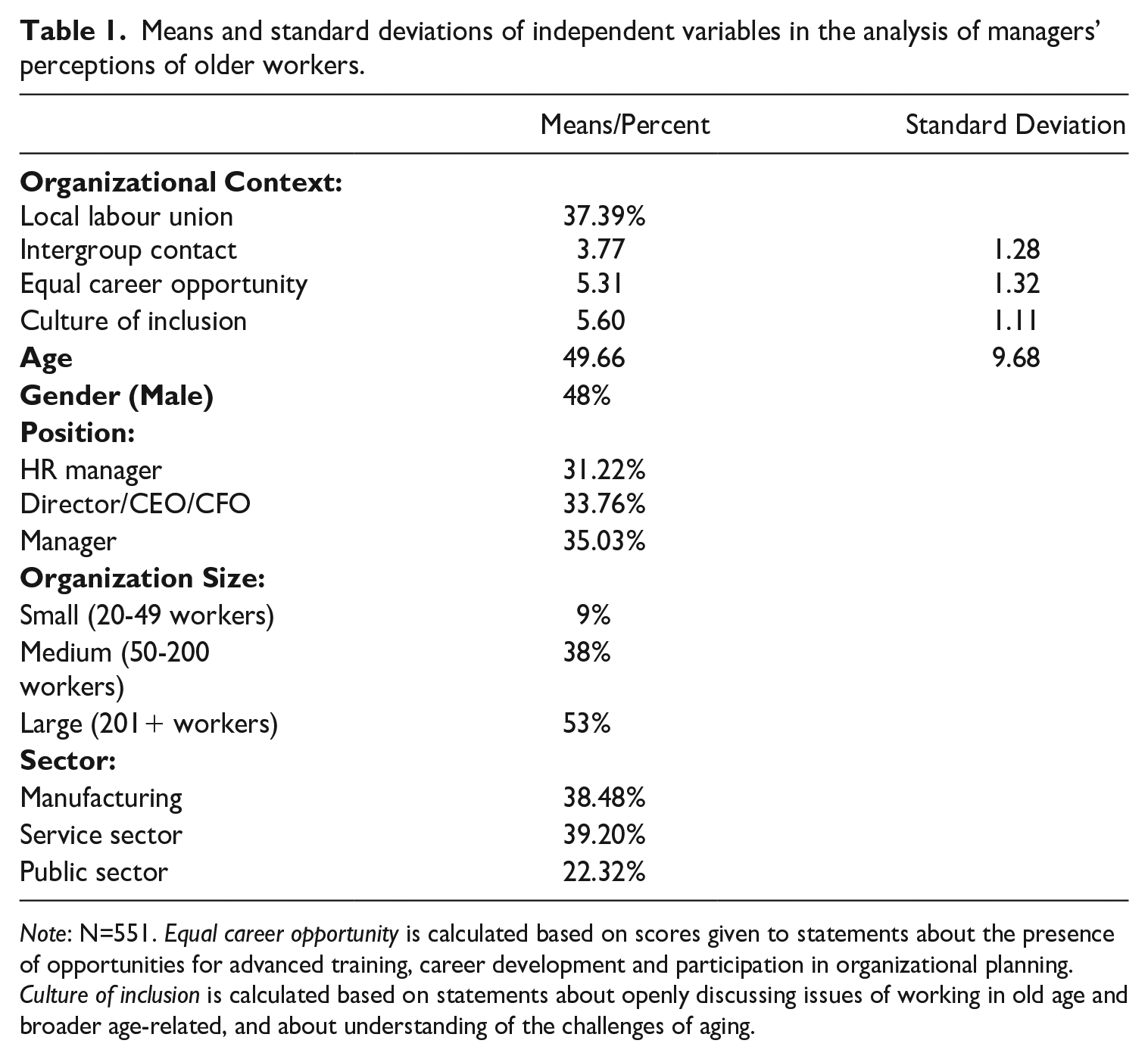
Note: N=551. Equal career opportunity is calculated based on scores given to statements about the presence of opportunities for advanced training, career development and participation in organizational planning. Culture of inclusion is calculated based on statements about openly discussing issues of working in old age and broader age-related, and about understanding of the challenges of aging.
Analytic strategy
We test Hypothesis 1 using exploratory factor analysis. We analyse managers’ statements about older workers to identify distinct dimensions of stereotypes and to construct indicators of managerial perceptions of older workers. Factor analysis is a multivariate statistical method that attempts to identify the smallest number of hypothetical constructs that explain the order and structure among measured variables (Watkins, 2018). Exploratory factor analysis (Yang, 2005) has been used in the past to examine factors related to managers’ perception of older workers (Furunes and Mykletun, 2011).
For Hypotheses 2, 3 and 4, which pertain to intergroup relations and diversity and inclusion accountability and their ties to managerial perceptions, we use one-way analysis of variance (ANOVA) tests and multinomial logistic regression. ANOVA is used to determine whether there are statistically significant differences between organizational contexts in managers’ negative, mixed or positive perceptions about older workers (Kim, 2015). Multinomial regression is an extension of logistic regression that is generalizable to problems with more than two possible discrete outcomes (Prasad and Vaidya, 2016), as in the case of managers’ perceptions of older workers. By using this model, we can estimate the odds that managers hold negative or mixed perceptions of older workers relative to the odds of holding fully positive perceptions, as a function of their organization’s features, and controlling for managers’ age, gender, position, organization size and industrial sector (for similar uses, see Mulders, 2020). Standard errors are clustered at the organizational level to account for differences in error variance across organizations.
Results
Our analyses map the content of managers’ stereotypes of older workers and examine the organizational contexts in which managers are more or less likely to hold them. In a nutshell, we find that the modal manager held ambivalent ‘paternalistic’ stereotypes of older workers. The odds of both negative and ambivalent perceptions were higher in unionized workplaces than in nonunionized workplaces. Ambivalent stereotypes were less prevalent where there were more opportunities for intergroup contact, but negative stereotypes were not altered by this. In contrast, the odds of negative stereotypes declined more than the odds of ambivalent ones in organizations with equal career opportunities and a culture of inclusion.
Mapping managers’ perceptions
We start by exploring managers’ perceptions of older workers. The first two columns of Table 2 present descriptive statistics of managers’ reported perceptions of older workers covered by the survey. Notably, the mean scores of the first two items, which refer to older workers’ personal attributes (reliable and knowledgeable), were higher than the mean of the last three items, which pertain to their work dispositions (motivated to learn, hard workers and adaptable). A correlation matrix (online Appendix Table A2) shows a similar pattern, with high correlations between the first two items and between the last three items, and low negative correlations between the two groups. We employed exploratory factor analysis (Yang, 2005) to identify the smallest number of constructs represented by the five items (Watkins, 2018).
Managers’ reported perceptions of older workers: Descriptive statistics, rotated factor loadings (pattern matrix) and unique variances.
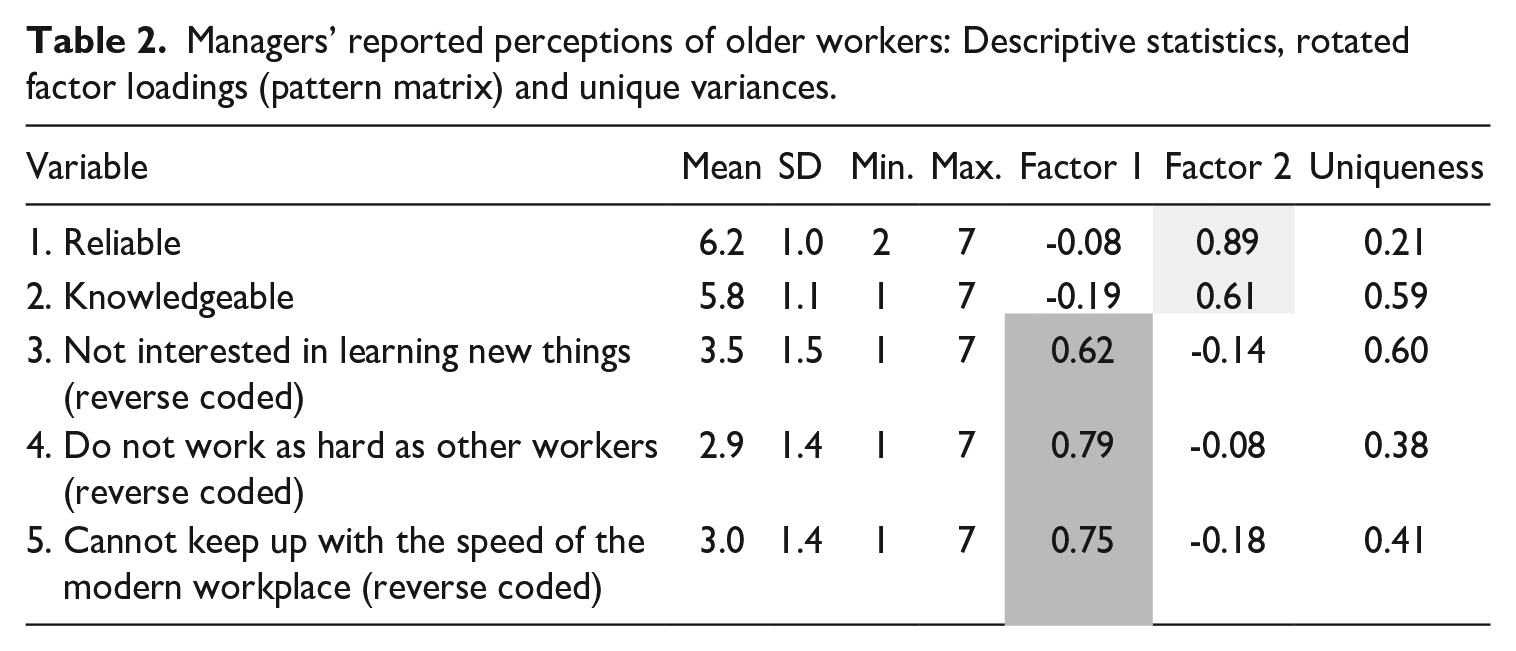
The exploratory factor analysis resulted in two clearly identifiable independent constructs, each with factor loadings above 0.6 (marked in shades of grey in Table 2). One factor captures perceptions of older workers’ personal attributes, and the other pertains to perceptions of their employability (see Bandalos, 2018). These are akin to the warmth and competence dimensions proposed by the stereotype content model and confirm that managers’ perceptions of older workers have more than one dimension and may mix positive and negative perceptions (Fiske, 2018). The Cronbach’s alpha statistics of the two measures indicated a good level of internal consistency (0.73 and 0.78, respectively).
To construct the outcome variables, each of the two dimensions of managers’ perceptions was dichotomized, so that high scores (answers six or seven, ‘agree’ and ‘strongly agree’) received a value of one (positive perception) and low scores (answers 5 and below) received a value of 0 (negative perception). These two dichotomies yielded a four-fold outcome variable, as presented in Table 3.
Number and proportion of managers with different combinations of positive and negative perceptions of personal attributes and employability of older workers.
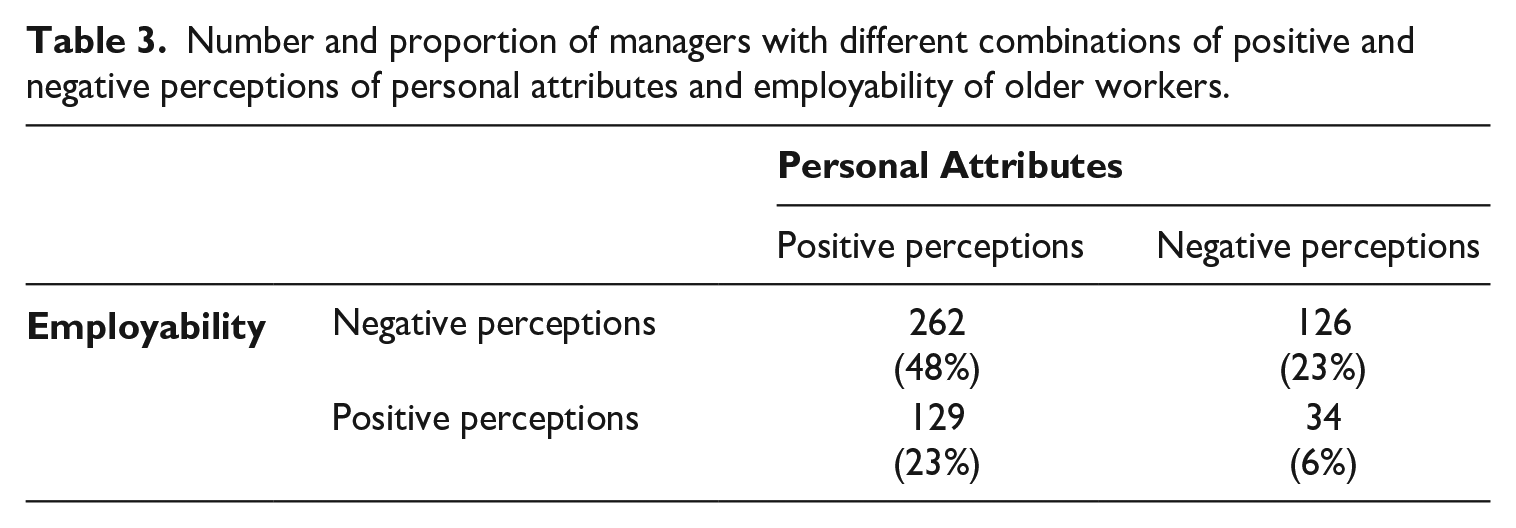
Supporting our first hypothesis, we find that the most common perception set held by managers combined positive views of older workers’ personal attributes with negative views of their employability. Almost half of the sample (48%) was under this category, which, in Fiske et al.’s (2002) typology corresponds to paternalistic prejudice about low-status groups. Fully positive or fully negative stereotypes were each espoused by 23% of our managers, while a mix of negative views of older workers’ personal attributes and positive views on their employability were only found among 6% of our sample. The latter is not surprising, given Fiske et al.’s (2002) finding that this type of mixed perception is common in envious prejudice directed at high-status groups, a category that largely does not describe older workers in contemporary workplaces. Owing to its small presence in our sample, which also led to large standard errors, this outcomes category was controlled for in the multinomial analysis but was omitted from additional discussion.
Organizational features and managerial perceptions of older workers
Hypotheses 2, 3 and 4 predict that managers’ negative and ambivalent perceptions of older workers will vary across organizational contexts. We first used one-way analysis of variance (ANOVA) to examine whether the workplace characteristics of managers reporting disparate perceptions are significantly different from each other in our data (Kim, 2015). Table 4 includes the means and standard deviations of the organizational characteristics of managers holding each of the three perception combinations and shows tests of the differences.
Means (standard deviations) and F tests of organizational relational and diversity and inclusion characteristics by managers’ perception of older workers.
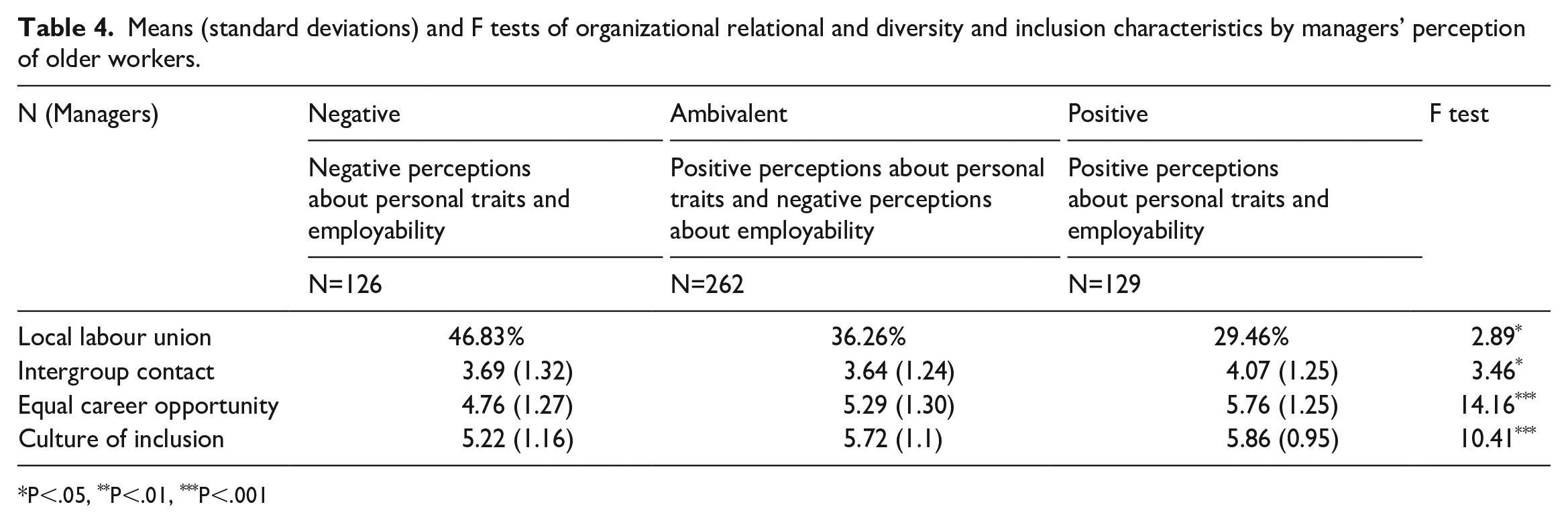
P<.05, **P<.01, ***P<.001
On average, managers who reported negative and ambivalent perceptions of older workers were more likely to work in organizations with a local union, compared with managers with positive perceptions (share of unionized workplaces, 47%, 36% and 30%, respectively). They are also less likely to work in organizations with opportunities for contact with older workers (contact scores 3.69, 3.64 and 4.07, respectively), equal career opportunities (4.76, 5.29 and 5.76, respectively) and inclusive cultures (5.22, 5.72 and 5.86, respectively). Although these results reveal a statistically significant bivariate relationship, the ANOVA procedure does not indicate which means are significantly different from one another. Nor does it take into account possible alternative explanations. We therefore turn to multivariate modelling.
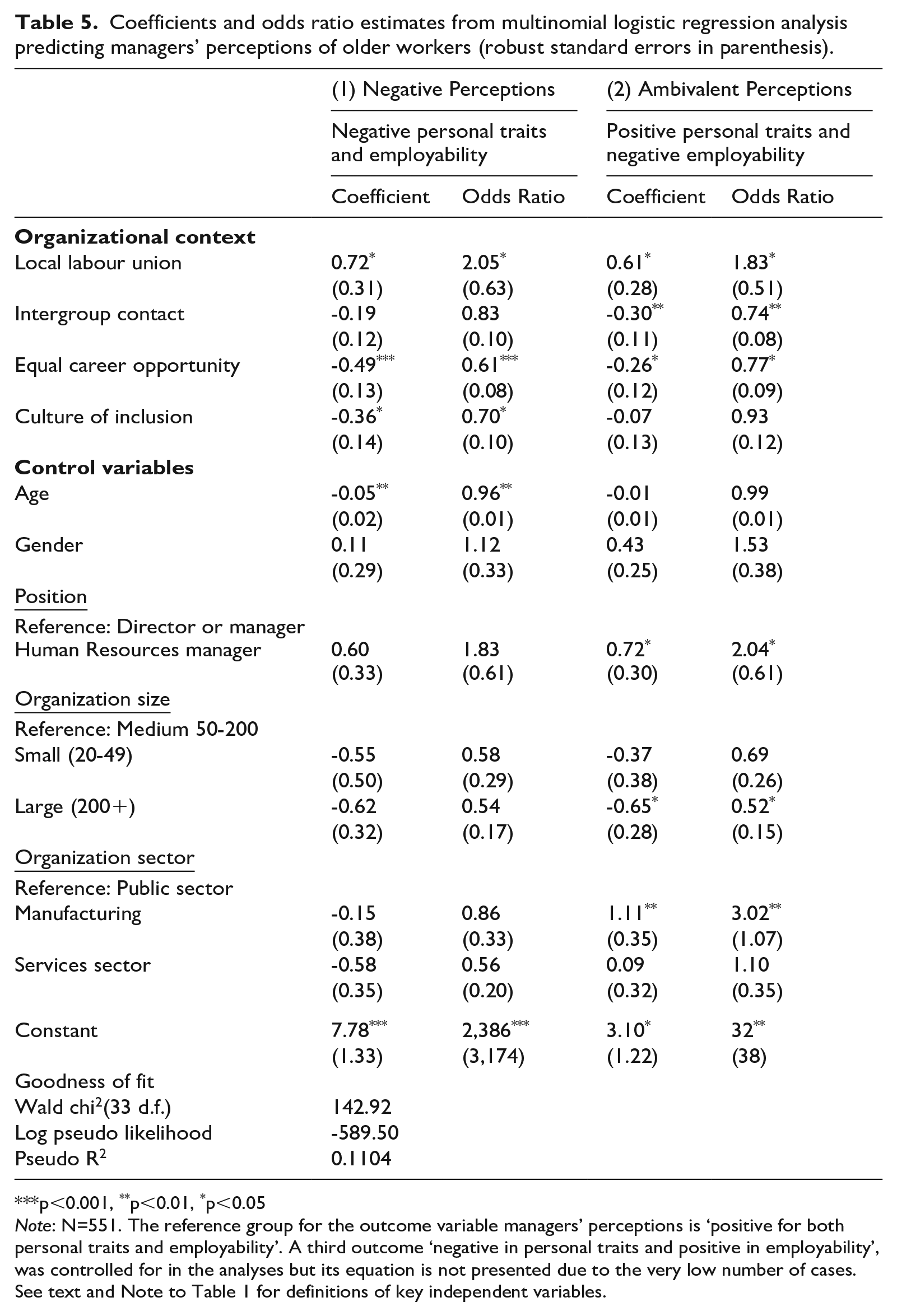
Table 5 presents coefficients and odds ratios (OR) from a multinomial logistic regression analysis. This statistical model simultaneously estimates two equations predicting the odds of espousing negative or mixed perceptions, each contrasted with positive perceptions. As these two equations derive from a single model, they produce only one set of goodness of fit statistics. An odds ratio coefficient larger than 1 indicates the magnitude of the increase in odds of the focal perception compared with the odds of a positive perception that is associated with an increase in the independent variable. When lower than 1, calculating 1-OR gives us the magnitude of the decline in odds. All models include the control variables discussed above. The results support our postulates that managers’ perceptions of older workers vary significantly across organizational contexts and that ambivalent perceptions vary differently from negative ones.
Coefficients and odds ratio estimates from multinomial logistic regression analysis predicting managers’ perceptions of older workers (robust standard errors in parenthesis).
p<0.001, **p<0.01, *p<0.05
Note: N=551. The reference group for the outcome variable managers’ perceptions is ‘positive for both personal traits and employability’. A third outcome ‘negative in personal traits and positive in employability’, was controlled for in the analyses but its equation is not presented due to the very low number of cases. See text and Note to Table 1 for definitions of key independent variables.
We first look at how managers’ perceptions vary with respect to labour unions and intergroup collaboration at the workplace. As predicted in Hypothesis 2, in workplaces with a labour union, managers were significantly more likely to report either negative or ambivalent perceptions of older workers than they were to report positive perceptions. Specifically, in unionized workplaces, managers were twice as likely to hold negative perceptions and 1.8 times more likely to hold ambivalent perceptions than positive ones. We theorize that the threat triggered by the presence of a labour union would lead to managers’ negative or ambivalent perceptions of older workers, who are the most senior and protected group among union members. These findings support our theoretical expectation.
As predicted in Hypothesis 3, in workplaces with more intergroup collaboration, managers were significantly less likely to report ambivalent than positive perceptions of older workers. The coefficient for negative perceptions is negative as well, but it is not statistically significant. These results suggest that, other things being equal, frequent intergroup contact reduces managers’ ambivalent perceptions of older workers. This was not the case for fully negative views.
Regarding organizations’ efforts to increase diversity and inclusion, the results in Table 5 show that, in workplaces with more equal career opportunities, managers were less likely to report both negative and ambivalent perceptions of older workers than they were to report fully positive perceptions. The odds ratio coefficients indicate that, for every increase of one unit on the scale of equal career opportunity, the odds of holding negative views of older workers decreased by 40% (1-0.6) and the odds of holding mixed views declined by 23% (1-0.77). Notably, and consistent with our prediction, the decline in the odds of negative perceptions was significantly larger than the decline for mixed perceptions (t=-6.32, p<.001).
The findings similarly show that managers in organizations ranking higher on inclusive culture were 30% less likely to hold negative perceptions of older workers compared with positive perceptions. There was no significant difference, however, in the likelihood of mixed perceptions. Taken together, the results support Hypothesis 4, which predicted that in organizations offering equal career opportunity and a culture of inclusion, the prevalence of negative perceptions of older workers will decline, more so than ambivalent perceptions. We theorize that, because ambivalent perceptions tend to justify inequality, holders of such stereotypes might be less susceptible to organizational contexts that could trigger social accountability to equality.
Turning to the control variables, older managers were, as expected, significantly less likely to hold negative perceptions of older workers (Axelrad et al., 2013). The odds ratio coefficient indicates a 5% reduction, on average, in the odds of having fully negative perceptions of older workers for every additional year of age. The odds of mixed perceptions, however, seem to be unrelated to a manager’s age. Human resources managers were significantly more likely than other managers to hold ambivalent perceptions compared with positive ones, but they were not more likely to hold negative perceptions. This is potentially important because human resources are central gatekeepers in organizations.
Managers in large organizations are more likely to hold ambivalent stereotypes than they are to hold positive ones, in comparison with mid-sized organizations. This is consistent with past findings (Munnell et al., 2006). The coefficient for fully negative stereotypes is also negative, but not significant. Finally, managers in manufacturing organizations were more likely to hold ambivalent than positive stereotypes of older workers than were managers in the public sector. This may be explained by the fact that work in this sector is often more physical and strenuous, which leads to lower evaluations of older workers’ employability (Turek and Henkens, 2020).
Discussion
This article explores the content of managers’ stereotypes of older workers and the organizational context in which different stereotypes prevail. We find that mixed, or ambivalent, age stereotypes are common among almost half of our sample of 551 managers and fully negative stereotypes among a quarter of the sample. We show, first, that both negative and ambivalent stereotypes of older workers are more prevalent in unionized workplaces. Unions may trigger group conflict, but they have not been examined for their effect on older workers and on diversity in general. Second, we find that ambivalent age stereotypes decline mainly in the context of intergroup collaboration, where stereotypes about older workers’ low competence can be counteracted, while fully negative age stereotypes decline only in contexts that trigger social accountability through climates of equality and inclusion.
This is the first study to examine the prevalence of negative and ambivalent age stereotypes across organizational contexts, and it makes significant contributions to several lines of research on workplace age (and general) inequality, and on the remediation of inequality, contributions to which we now turn.
Research on workforce inequality, diversity and inclusion rarely considers the effect of organized labour. Although group conflict and social closure are recognized as catalysts for negative stereotypes, there is little research on how the presence of union representation might affect decision makers stereotypes. This is an especially important question for research on age inequality because union density rises with age and the age at which membership peaks continues to rise (Blanchflower and Bryson, 2022). Our findings suggest that the perceived threat of unions to managerial prerogatives may enhance managers’ exclusion of older workers from good jobs, rather than inclusion and improved labour relations (Dhal and Srivastava, 2002). In the presence of labour unions, managers, labour leaders and human resources managers may thus need to work harder to assure that efforts to achieve workers’ rights do not worsen age bias.
The finding that ambivalent and wholly negative stereotypes decline in different organizational contexts, is important for understanding how diversity and inclusion efforts can reduce inequality (Fiske, 2018; Fuertes et al., 2013; Reskin, 2000; Turek et al., 2022). While the literature on bias often emphasizes unconscious bias and implicit associations (Greenwald and Lai, 2020), ambivalent stereotypes join other types of conscious biases, such as symbolic racism or laissez-faire racism that masquerade as socially acceptable views. Such biases are not recognized as discriminatory; rather, they serve to rationalize inequality (Bowman et al., 2017; Cuddy et al., 2009; Moss and Tilly, 2001: 119–124; Noon, 2018). Indeed, our findings suggest that managers who hold ambivalent age stereotypes are less constrained by social accountability than those who hold fully negative stereotypes; they may not recognize their attitudes toward older workers (or another group) as inconsistent with norms of equity and inclusion. Social accountability then seems less effective in reducing ambivalent bias than negative bias. This pattern may hold for other diversity initiatives that presume a biased individual. Diversity training, the most popular diversity program, which is also used for fighting age bias, can be a case in point. Some studies have shown that diversity training is ineffective and that managers feel victimized and angry, rather than mobilized, after training sessions that discuss their biases (Plant and Devine, 2001). These findings may be at least partially explained by ambivalent biases. It is possible that managers who hold ambivalent bias do not react positively to diversity training, as with social accountability, because they do not view it as relevant for them.
Opportunities for intergroup contact seem to present the opposite pattern; ambivalent bias is more likely to decline in this context than wholly negative ones. Fiske (2012) suggests that interventions that target a group’s specific challenge may turn ambivalent stereotypes to positive. Working together does just that; it helps older workers to demonstrate their competence. Group contact theory predicts that intergroup collaboration will lead to familiarity and reduce anxiety and bias (Pettigrew and Tropp, 2006). Our findings suggest that this is more likely to be the case with ambivalent stereotypes than with fully negative ones. This has important implications for age diversity efforts and age management, a topic we know very little about (Fuertes et al., 2013). The conclusion from our findings is clear: organizational structures and diversity initiatives that counteract managers’ ambivalent stereotypes about older workers’ competence should be more effective than initiatives that come to trigger accountability to norms of equality. The broader conclusion is clear as well: distinguishing between ambivalent and fully negative stereotypes is key for developing effective bias-reducing structures.
These findings call inequality and diversity scholars to attend to the content of stereotypes more broadly. Just as researchers mostly view stereotypes as either fully negative or fully positive, diversity scholars often do not differentiate between the barriers that different groups face (Shore et al., 2011). But if groups face unique stereotypes that may grow or decline in different organizational contexts, diversity and inclusion researchers need to devote more attention to the content of stereotype (Fiske, 2012). Most prominently, the content of bias may change across intersectional categories. Older men and older women workers face different sets of stereotypes, and these too may react differently to remediation attempts (Meliou and Mallett, 2022).
Finally, the prevalence of ambivalent perceptions might help in understanding the discrepancy between what managers say and what they do. Pager and Quillian (2005) find a discrepancy between employers’ self-reported perceptions in surveys and their actual behaviour. Managers may hold positive perceptions of older workers’ personal traits alongside negative perceptions of their ability to adjust to the workplace environment. This can explain the paradox according to which, notwithstanding the positive views of older workers’ traits, managers sometimes prefer to recruit younger employees (Steinberg et al., 1996).
Conclusion
Management bias is a key source of age and other forms of inequality in the distribution of opportunities and resources at work. Research on diversity at work rarely refers to age inequality, while studies on older workers rarely examine effective organization structures for reducing age inequality. This study connects these two literatures and contributes to scholarship on organizational inequality, diversity and inclusion as well as to research on the content of stereotypes. We explore the content of managers’ stereotypes about older workers along two independent constructs (personal attributes and employability) and present an organizational approach to understanding the prevalence of negative and ambivalent age stereotypes. Our inquiry supports and expands arguments made by researchers of the stereotype content model, namely that fully negative and mixed stereotypes are differently susceptible to change. Our findings show that both negative and mixed stereotypes are heightened where there is group conflict, but there are important differences in the kinds of workplaces where negative and mixed stereotypes decline. Ambivalent stereotypes are more responsive to intergroup contact and fully negative stereotypes are more responsive to accountability structures.
Given that mixed stereotypes are probably the most common managerial stereotypes about older workers, the findings on organizational structures where age bias intensifies or declines, make a significant advance in research on age diversity and workplace diversity more generally. In a world where work in old age is an economic necessity for many, and employability has become a justification for exclusion, understanding the content of managers’ perceptions of older workers and the organizational structures that may affect them is key for advancing workforce age diversity as well as social justice.
Supplemental Material
sj-pdf-1-wes-10.1177_09500170231175790 – Supplemental material for Ambivalent Bias at Work: Managers’ Perceptions of Older Workers across Organizational Contexts
Supplemental material, sj-pdf-1-wes-10.1177_09500170231175790 for Ambivalent Bias at Work: Managers’ Perceptions of Older Workers across Organizational Contexts by Hila Axelrad, Alexandra Kalev and Noah Lewin-Epstein in Work, Employment and Society
Footnotes
Acknowledgements
The authors would like to thank Vincent Roscigno and Joshua Guetzkow for comments.
Funding
The authors disclosed receipt of the following financial support for the research, authorship, and/or publication of this article: The research was supported by Yitzhak Shamir Scholarship to Returning Scientists given to Hila Axelrad by the Israeli Ministry of Science & Technology; by The National Insurance Institute of Israel; by research grant 3755/20 from the Israel Science Foundation to Noah Lewin-Epstein; and by grant (2013-10-26, G-2019-12369) from the Alfred Sloan Foundation to Alexandra Kalev.

Supplemental material
Supplemental material for this article is available online.
References
Supplementary Material
Please find the following supplemental material available below.
For Open Access articles published under a Creative Commons License, all supplemental material carries the same license as the article it is associated with.
For non-Open Access articles published, all supplemental material carries a non-exclusive license, and permission requests for re-use of supplemental material or any part of supplemental material shall be sent directly to the copyright owner as specified in the copyright notice associated with the article.
