




Abstract
This article aims to understand how social and gender norms affect child labour in India, which is mainly defined by a work-hours threshold. It develops a regression model using two datasets – the Indian Human Development Survey 2011/2012 and the World Value Survey India 2012 – to predict child-labour risks based on such norms. The gender and development approach provides a theoretical foundation for applying norms in association with social and gender relations. The results of the regression model have revealed that a norm supportive of women’s work and a benevolent attitude norm help reduce the risk of child labour. In contrast, seclusion norms show an opposite association with child labour. Child-labour practices are varied because agents accept or deny norms as part of the social structure. Our findings confirm that the transformation of restricted norms on gender could help reduce child labour in India.
Keywords
Introduction
Child labour is regarded as employment that is harmful to children, especially as it lowers school attendance and increases dropout numbers. Despite the trend of child labour appearing to decrease in India, children from the lower social classes are still employed as agricultural labourers, construction workers and low-skilled production workers. Diverse forms of child labour occur not only as a result of an unequal social hierarchy but also as an outcome of the embedded roles and expectations assigned to children’s gender and social status. Social norms play a key role for the children, parents and families who make decisions regarding child labour. While plenty of research has focused on economic reasons for child labour, less attention has been paid to the role of institutions, such as norms and values, in attitudes to child labour.
The aim of this study is to establish a clear link between norms and child labour in economic activities across the regions of India. There are two strong trends in studies on child labour: one is child labour as a result of exploitation (Phillips et al., 2014; Venkateshwarlu and Da Corta, 2001), and the other is child labour resulting from cultural diversity (Bessell, 2011; Liebel, 2004). Those views do not necessarily contradict each other but suggest that children’s lives are differentiated by a social construct, such as norms and traditions, in a given social structure. The gender and development (GAD) approach explains how gender relations are decided by power relations and this, combined with institutions, leads to practices. Based on this approach, we develop norm models to show the role of gender and social norms in affecting agents’ (children and parents) decision-making regarding children’s participation in labour.
This study also suggests how to measure working hours for the purpose of defining child labour accurately. In general, the time threshold used to define child labour has relied on international standards, therefore, it does not reflect the differences between countries. The question of how many working hours are harmful to children is not a simple one; it depends on the relationship between the potential harm caused and children’s labour hours. This study uses a model to measure the educational harms caused by children working long hours, which also generates a best-time threshold: a certain time point at which the harm to children’s education increases to a significant level. This is a novel method which does not rely on a conventional threshold.
This study answers four research questions regarding the situation in India:
How do gender norms affect the incidence of child labour?
How does the benevolence norm affect these risks, in comparison with the effect of the gender norm?
How are norms related to social relations such as social groups and class?
How does the analysis of alternative working-hours thresholds help obtain an accurate child-labour rate estimate?
The next section provides a theoretical background for this study, explaining the relevance of the gender and development approach to the study of child labour. A methodological framework follows, whereby the study estimates a time threshold and applies it to define child labour. Next, the incidence of child labour is regressed on norms as well as other structural and institutional variables, using a Bayesian Poisson model to predict the most precise child-labour risks. A risk map shows the predicted rate of child labour among types of household occupation, gender and state. Ultimately, based on our analysis of child-labour risks in India, some policy suggestions are provided.
Operationalisation of child labour
This article defines child labour as the economic activity of children aged between 5 and 17 that deprives them of a primary or secondary education. In operationalising this definition, we need to apply two criteria – working hours and occupations. Child labour requires a considerable amount of time and thus potentially harms children’s education. This study employs a statistical model to estimate harmful working hours for Indian children according to their age groups (see Section Data and models). The model estimates a time threshold over which labour can bring significant harm to children, thereby removing the reliance on the conventional time thresholds that typically assumed labour is harmful to children in India. Accordingly, one hour or more work per week among children aged 5–11 and 38.5 hours or more work per week among children aged 12–17 are considered child labour (see Section Results). Also, this study uses the International Labour Organization’s (ILO, 2017) definition of hazardous occupations to separate child labour from accepted child work. Children aged 5 to 17 who are involved in hazardous occupations or industries are categorised as child labourers regardless of the working hours.
Notably, this study considers children working in economic activities (e.g. market work and family farming/business) only as child labour because of data limitation. Children’s unpaid household work is a considerable part of child labour, and it is especially relevant for girls. Although the Indian Human Development Survey (IHDS) 2011/2012 (Desai and Vanneman, 2018) provides an accurate number of working hours, it lacks the information documenting the working hours of children in unpaid household services (Kim et al., 2020). Furthermore, economic activity is taken to mean working more than 30 days a year in an attempt to exclude short-term seasonal work from the category of child labour.
Theories around child labour
The political economy approach understands child labour as exploitation of children in an unequal power relation. Child labour is incorporated into global production networks in forms of subsistence production, such as outsourcing and subcontracting work (Bhaskaran et al., 2014; Phillips et al., 2014). Thus, in political economy, the key is ‘how production networks are embedded in particular kinds of social and power relations’ (Phillips et al., 2014: 431). Nieuwenhuys (2007: 153) notes that ‘global child labour’ is concentrated in the reproductive realm of the Global South, e.g., care-work and subsistence production, as ‘new forms of labour control’. Bonded labour due to debt, forced labour, and trafficking are the worst forms of child labour related to the marginalisation of households in the global economy. Haythornthwaite and Olsen (2018) define bonded child labour as children who cannot depart from employment owing to bondage due to debt or other obligations, and they are trapped, constrained and deprived of their rights. LeBaron (2014) argues that debt bondage occurs as marginalised people sell their labour into coercive labour markets, regardless of wages or conditions, and operates as a class-based form of power that generates debtor dependency. There are substantial implications from the bonded characteristics of child labour. Households in debt might use child labour to overcome the limited resources and power available to them. In this case, child labour shows a clear pattern within which social inequality is reproduced and structured.
While political economy explains the worst forms of child labour, the diversity of agents’ decisions and children’s autonomy receive less focus. Many studies consider child labour as a socially constructed phenomenon. In fact, socially constructed childhood has become a crucial sociological concept (James et al., 1998; James and James, 2004; James and Prout, 1997). The institutions of childhood vary across cultures and are not separated from other aspects such as class, gender and ethnicity (James and Prout, 1997). In this sense, child-labour rates rely on the social, cultural and economic context, which should be understood within a life-course perspective (James et al., 1998). Abebe and Bessell (2011) suggest ‘socio-cultural discourse’, such as gender analysis and children’s point of view, enhance understanding of the complexities of child labour.
Seeing ‘gender and development’ and child labour
The gender and development (GAD) approach is an interdisciplinary approach, placing gender at the middle of the process of development and discerning gender inequality rooted in social structures (Kabeer, 1994; Young, 1993). While Marxist feminists place a clear focus on the class relations of gender, the GAD approach has broad interests in social and gender relations. Kabeer (1994: 64–67) insists on treating gender as one aspect of social relations. Gender relations extend the concept of social relations beyond the production of objects and into the production of everyday life (Kabeer, 1994). Gender is interwoven with other social inequalities such as caste and class, which should be understood in a holistic framework (Kabeer, 1994). Child labour is surely a complex result related to children and their family’s socio-economic position, adult male and female relations, and expectations according to children’s gender. Gender inequality, such as women’s subordination in the labour market and division of labour and resources, becomes a critical aspect of understanding the persistent child labour problem.
Nieuwenhuys (1994) asserts that assumptions should be avoided regarding the universalities of capitalist forms of child labour by looking at children’s work routines in their everyday lives. Child labour is exploitation happening in a capitalistic structure, through families and kinship in which boys and girls perform different economic roles (Nieuwenhuys, 1994). Another example is found in rural Northern Nigeria where Hausa children spend considerable working hours in domestic reproduction and trading and replace secluded female adults who are affected by seclusion norms (Robson, 2004). The findings of that study show how material gender relations are ‘socially constructed and rooted in structures’ (Robson, 2004: 195).
Besides, there are diverse definitions and attributions associated with norms from different academic disciplines. Norms are invisible, however, they help to shape the beliefs and values of agents, influence behaviours and construct a ‘habitus’ (Bourdieu, 1977). According to Bourdieu (1977: 86), habitus is a ‘subjective but not individual system’, as it generates perceptions and actions common to all members of groups. Bicchieri (2014) defines norms as social constructs that are supported by people’s beliefs. López and Scott (2000: 25–26) describe them as ‘a rule of conduct that is shared by a particular set of people’.
Understanding norms is an important theme of the GAD approach. Kabeer (1994: 309) emphasises the role of institutions, including rules, norms and customs. She (Kabeer, 1999: 441) points out that agents’ choices are derived from a ‘deeper reality’, which is ‘inscribed in the taken-for-granted rules, norms and customs within which everyday life is conducted’. Child labour is not solely the exploitation of children in the labour market but is driven by agents’ norms and beliefs, which are generated by their diverse experiences and positions within social and gender relations. Furthermore, norms are subject to gradual changes. While Kandiyoti (1998) insists that ‘patriarchal negotiation’ occurs, Olsen and Morgan (2010) explain that variations of norms are essential because agents can reproduce and change them. Norms make institutional changes in the informal sector; for example, ‘be a dignified permanent labourer’ or ‘be an honourable rural casual labouring wife’ are the norms associated with employed children and their parents (Olsen and Morgan, 2010: 540).
Norms and child labour in India
This study is interested in revealing the roots and effects of three different social norms in India. First, it focuses on different expectations regarding women’s economic roles in society (‘norms of women’s work’). Females are often recognised as housewives or secondary income earners in India. Male and female division of labour in India relates to cultural norms at a deep level (Garikipati, 2009). Increased access to assets or land can help women’s agency, but this is not always the case (Garikipati, 2009; Jejeebhoy and Sathar, 2001). Low levels of support for women’s economic empowerment can be related to women’s high levels of participation in informal activities, their reproductive labour and the inaccessibility of paid work for them (Mezzadri, 2016; Olsen and Mehta, 2006).
This study assumes that norms supportive of women’s economic participation can help reduce child-labour risks. This seemingly contradicts previous findings that higher employment among women increases the incidence of child labour, including both market and domestic work (Bhalotra and Heady, 2003; Francavilla and Giannelli, 2007). Some considerations address how this contradiction can be resolved. First, this study is not examining women’s economic participation but cultural norms regarding supporting women’s work. Norms are sometimes different from practices. Indian women in some cultural groups are considered housewives despite their participation in farming and domestic work (Olsen and Mehta, 2006), implying that norms and practices are not aligned. This study supports the view that if women’s work is less valued, despite women’s high economic participation rate, then child labour could arise from a lack of resources and is additionally affected by unequal gender norms. A similar hypothesis is found in the work of Kambhampati (2009), which proves the effect of mothers’ autonomy (a mother’s expenditure contribution) on the level of gender equity. For another example, in households where a mother’s education level was high, the probability of child labour was reduced, while the mother’s labour force participation increased the risk of child labour outside the home (Self, 2011). Both of these studies examine the effects of norms indirectly via monetary contribution or education.
Parents adopting gender-equality norms could raise awareness of children’s rights in a broad sense. Burra (2001: 484) has explained that child labour among girls can be a result of long-standing ‘beliefs, traditions and mind-sets’. Burra’s study implies that an agent’s decisions may change, i.e., parents try to seek help with labour from others rather than their children. Bhat (2010) has also found that cultural entities, such as gender roles and expectations, play a key role in lowering the educational level of girls, thereby resulting in gender biases in the organisation of child labour. In these regards, the impact of gender-equality norms might play a key role in reducing child labour.
The second consideration is that seclusion norms can bring about the opposite result in children’s labour participation. In northern areas, such as Rajasthan, Uttar Pradesh and Bihar, women live under severe seclusion, whereas in southern areas, seclusion is less common. Seclusion norms restrict women to work in locations inside the home (Kantor, 2003), and the role of female seclusion in increasing child labour has been discussed in studies of other countries (Delap, 2001; Robson, 2004). Under the female seclusion norms, both boys and girls may take part in economic activities when their mothers are not allowed to work outside. As girls are subjected to seclusion when they reach puberty, age could be an important factor. Girls are expected to work in limited areas; i.e., in rural areas, boys can work in both agricultural and non-agricultural sectors, while girls work only in the agricultural sector. Although women’s outside activities are culturally inhibited, girls can be sent to work as domestic workers in other households (Chakravarty and Chakravarty, 2012).
Finally, while this study focuses on the effects of gender norms on child labour, the benevolence norm (‘doing good for society’) might possibly be associated with a reduced incidence of child labour. The World Value Survey 2012 (Inglehart et al., 2014) shows that India has a robust benevolence norm compared to other countries. When the question is asked whether people value ‘doing something for the good of society’, more than 42% of people very much agree with that benevolent idea, and 33% answer that they somewhat agree with it. A ‘benevolent parent’ is a strong assumption, which supports the view that parents decide to send their children to work only if adults’ wages are too low (Basu and Van, 1998). Although this study does not employ benevolence norms among parents towards their children as an indicator, it takes a norm of benevolence at state level into account. Benevolence tends to generate a strong form of social capital as well as a parental moral obligation, therefore, it might reduce the incidence of child labour.
Figure 1 shows the conceptual framework of this study. The three norms mentioned above are supposed to affect agents’ decision-making regarding child labour. The process of child labour occurs within a broad social structure. Class and other social relations significantly impact whether agents accept or reject norms. Thus, this study is interested in revealing how norms are formed through individuals’ class, social group and location. This framework is grounded in gender relations that are defined by Kabeer (1994: 61, 309), who explains that gender is interwoven with institutions and structure. Gender and norms reflect one another, therefore, the role of gender appears in all agents’ decision-making processes regarding child labour.
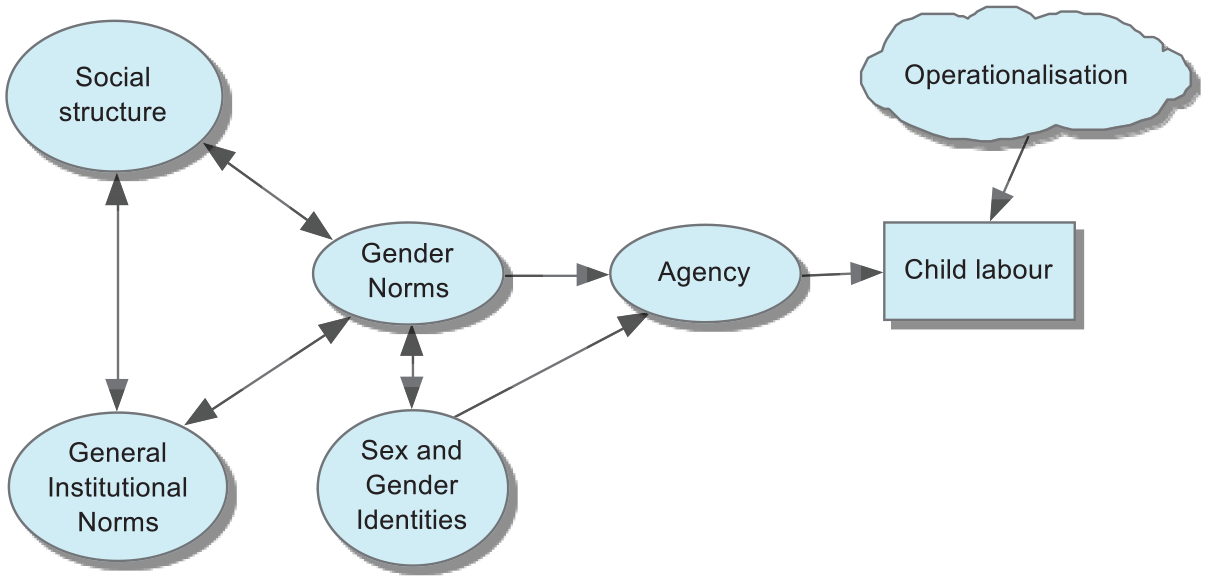
Conceptual framework: Norms, structure, and gender model on child labour.
Data and models
Data
This study combines two datasets from the same year: the Indian Human Development Survey (IHDS) 2011/2012 and the World Value Survey (WVS) India in 2012. Some norm variables are available in the WVS India, therefore, this study takes the norm variables from WVS at the state level and incorporates them into the models. The IHDS is a longitudinal survey covering multiple topics in 33 states 1 and 384 districts (Desai and Vanneman, 2018). It provides detailed information on child labour, such as working hours, industries or occupations, and individual and family backgrounds. The IHDS 2011/2012 was conducted in 42,152 households, including 40,018 households who were surveyed in the IHDS 2005 (Desai and Vanneman, 2018).
The WVS India (2012) provided information on norms and values as part of World Value Survey Wave 6 (2010–2014; Inglehart et al., 2014), including data from 4,078 cases randomly selected from 17 states. The 17 states were Andhra Pradesh, Bihar, Chhattisgarh, Delhi, Gujarat, Haryana, Jharkhand, Karnataka, Kerala, Madhya Pradesh, Maharashtra, Orrisa, Punjab, Rajasthan, Uttar Pradesh, Uttarakhand, and West Bengal. The indicators of norms and values were the averages of cases in each selected state.
The key task of this study is the measurement of social norms, and Table 1 presents the three selected for this study. People were asked two questions to assess to what degree they agreed with norms: 1) doing good for society (WVS 2012 question no. V74) 2 and 2) norms supportive of women’s work (WVS 2012, a latent variable). This showed the degree to which people think that women’s work is a way to be independent. The other social norm was obtained from the IHDS 2011/12, which was a seclusion norm indicating the proportion of women who practise ghungat/burkha/purdah/pallu: 3 the customs and traditions intended to keep women unseen by men outside their own family.
Descriptive summary of variables.
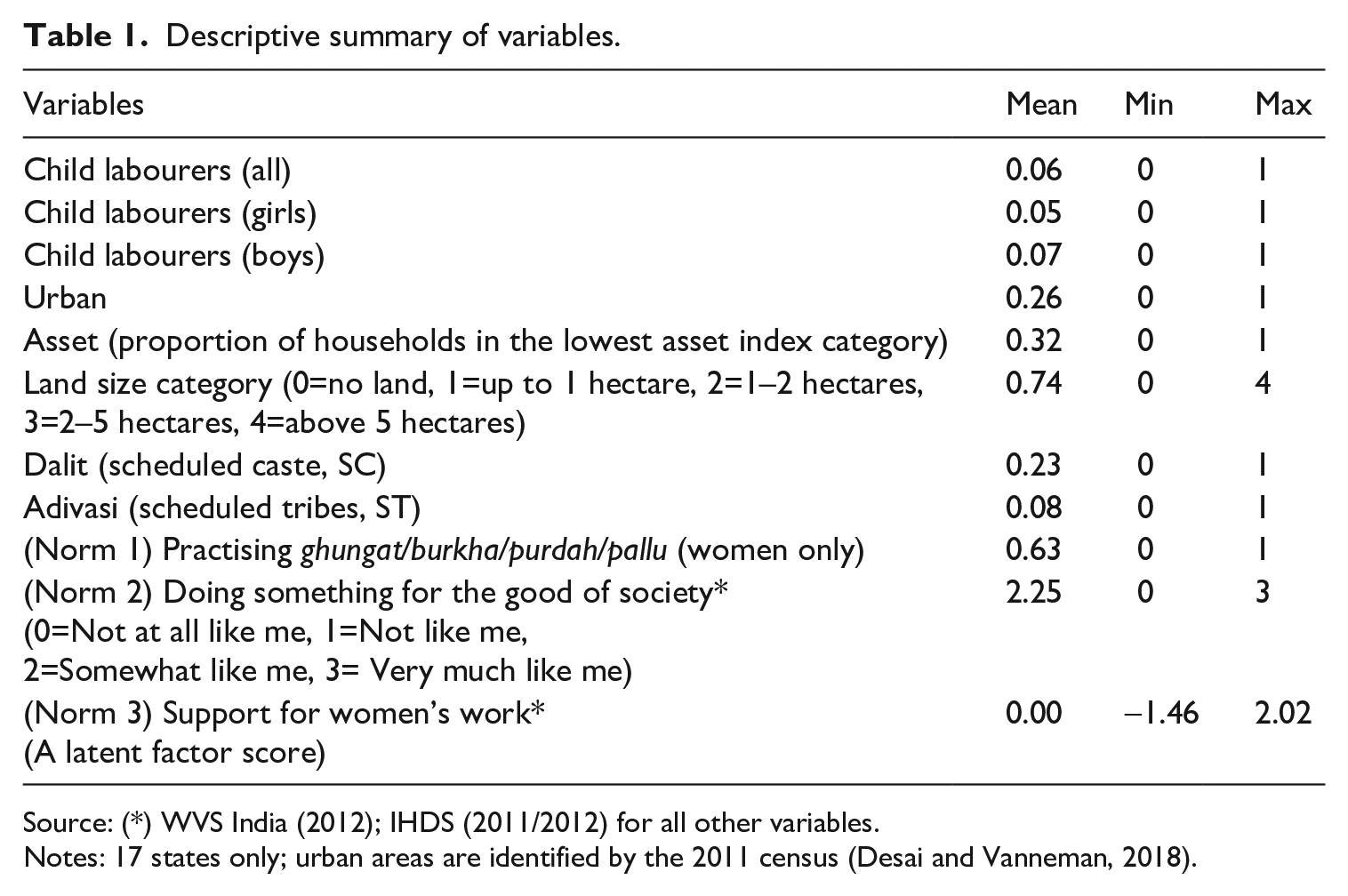
Source: (*) WVS India (2012); IHDS (2011/2012) for all other variables.
Notes: 17 states only; urban areas are identified by the 2011 census (Desai and Vanneman, 2018).
Defining child labour by hours of work
As was mentioned, this study used a model to estimate critical points (time thresholds) related to the prevalence of out-of-school children. Our proposed model (a threshold model) 4 allows the incorporation and prediction of an unknown change point of working hours, based on the assumption that educational harm, such as becoming out-of-school children, sharply increases after a certain number of working hours per week. Out-of-school children indicate children who never attended (Has [Name] ever attended school=0, IHDS 2011/12 question ED4), or were not enrolled in schools at the time of the survey (Is [Name] currently enrolled in school or college=0, IHDS 2011/12 question ED5). The numbers of these children in India in 2011/12 and their observed working hours are available in online Appendix Table A.1. This model was a Bayesian Poisson regression with an endogenous time-index parameter. It regressed the count of children who were out of school at each hourly point, estimating the time-index. The estimates of the time index were then used as thresholds to count child labour as per the main models presented in the next section. Details of the threshold model are shown in online Appendix Table A.2.
Statistical model
The purpose of the main model was to predict a state-level child-labour risk by household- and state-level covariates. The dependent variables were the counts of child labourers (



The sample size of each group
Explanatory variables
Household-level aggregates (
Results
Revealing working hours that potentially cause harm to children
The threshold models indicated that out-of-school risk values sharply increased when children worked more than 5.5 hours a day, which was equivalent to 38.5 (95% prediction intervals = [35, 42]) hours per week for children aged 12 to 17 (Figure 2).
6
In particular, the estimated proportion of out-of-school children (
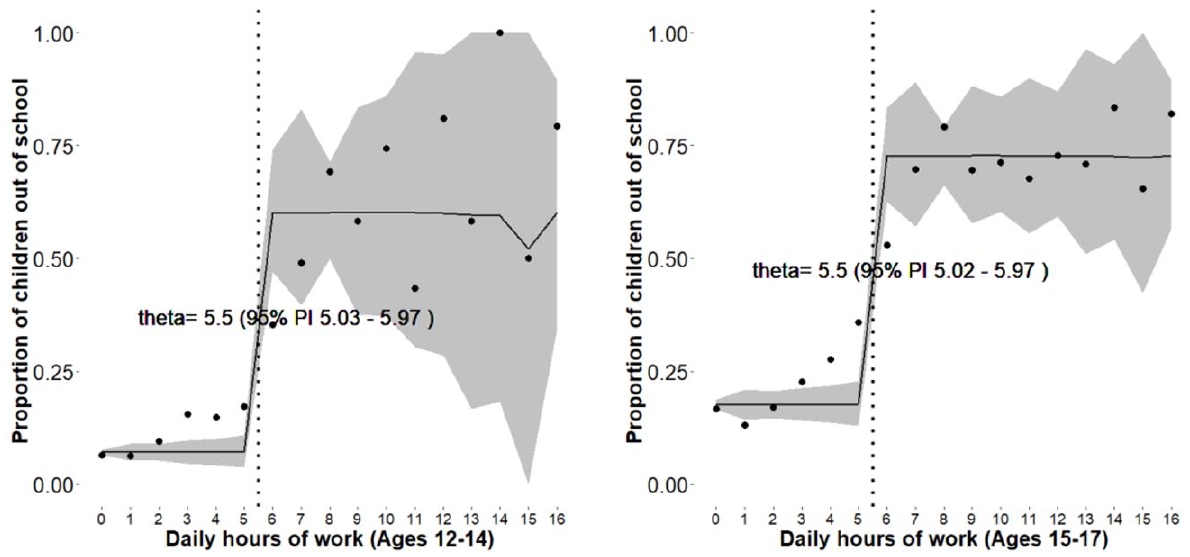
Potential educational harm by daily working hours.
Therefore, our suggested time thresholds for Indian child labour are as follows: for ages 5–11, one hour of economic activity a week, and for ages 12–17, 38.5 hours a week. Further study is required to reveal the diverse harmful aspects relating to the length of children’s working hours. While the ILO (2017) suggest a time threshold of at least 43 hours a week when defining child labour, 7 our estimates indicated that it should be lower than that in India.
Results of the child labour incidence model
The results of Models 1–3 with child-labour risks regressed on social norms are shown in Table 2. 8 Regression results showed that norms strongly affected decisions regarding child labour, and norm variables explained a large part of the variance. A norm supporting women’s work reduced the child-labour risk, while female seclusion norms increased it. The coefficient of norms on women’s work was negative (β= −0.42, Model 2), implying that child-labour risks recede as more people support women’s employment. In particular, a norm supporting women’s work showed a strong interaction with girls’ participation in the labour force, indicated by the negative interaction effect between them in Model 3 (β= −0.42 in Model 3). This implied that norms supporting women’s work are more relevant to the incidence of child labour by girls. On the other hand, female seclusion increased the risks of child labour (β=0.51 in Model 1 and β=0.37 in Model 2). When more women are restricted from outside activities because of tradition or religion, children take more roles in economic activities in their stead. There was no evidence that this was the case with girls more than boys; if women were secluded, there was a high risk that not only girls but also boys would participate in child labour.
The characteristics of the posterior distribution estimated from the norm models.
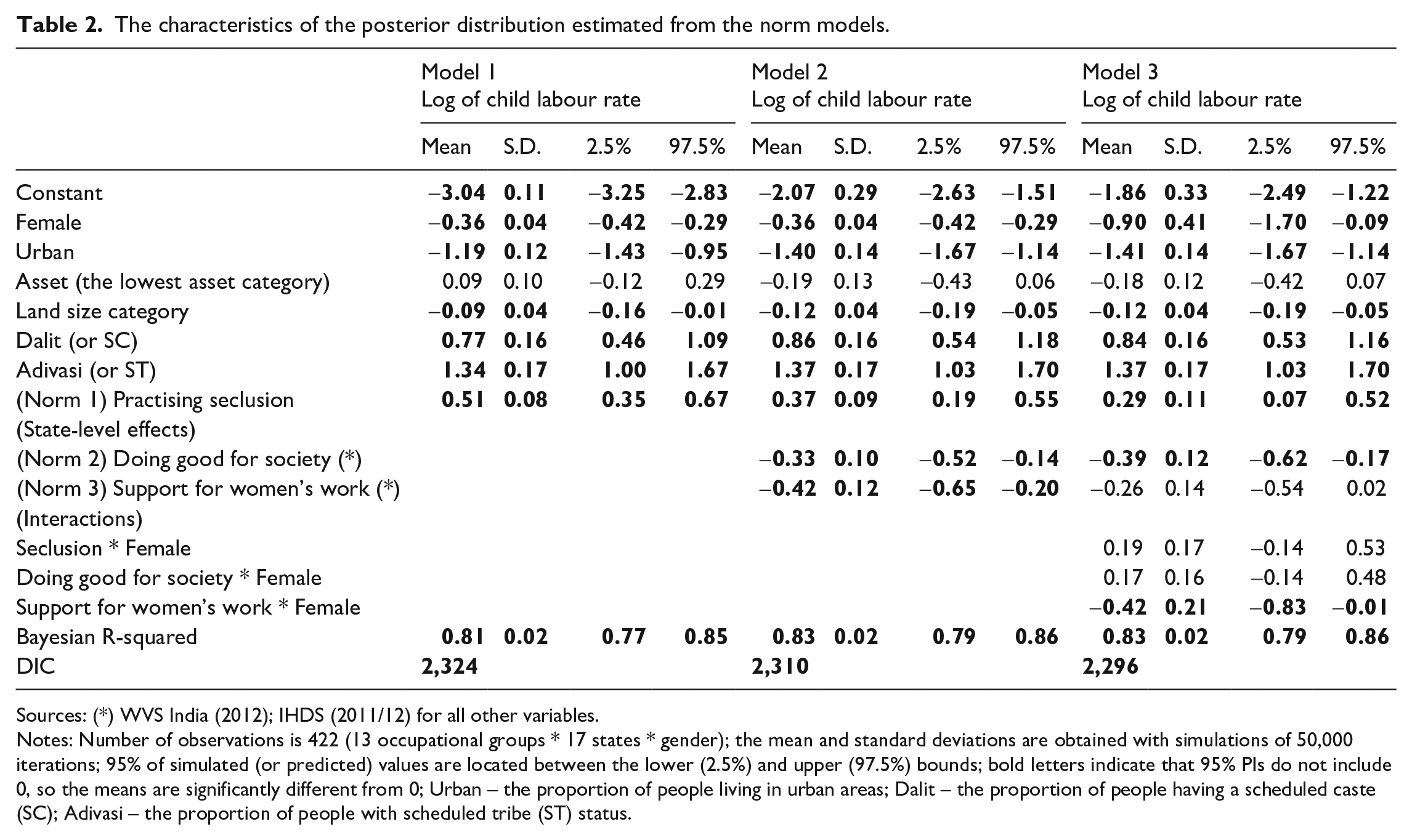
Sources: (*) WVS India (2012); IHDS (2011/12) for all other variables.
Notes: Number of observations is 422 (13 occupational groups * 17 states * gender); the mean and standard deviations are obtained with simulations of 50,000 iterations; 95% of simulated (or predicted) values are located between the lower (2.5%) and upper (97.5%) bounds; bold letters indicate that 95% PIs do not include 0, so the means are significantly different from 0; Urban – the proportion of people living in urban areas; Dalit – the proportion of people having a scheduled caste (SC); Adivasi – the proportion of people with scheduled tribe (ST) status.
Meanwhile, the coefficient of the benevolence norm was negatively related to the incidence of child labour (β= −0.33 for Model 2 and β= −0.39 for Model 3). The norm of ‘doing good for society’ decreased the incidence of child labour among both girls and boys, and there was no clear interaction between females and the benevolence norm. The benevolence norm was relevant, then, as it seemingly controlled child-labour risks. Concerning this result, however, a benevolence norm requires careful appreciation as it might be too diverse to be linked to specific groups or classes.
Alongside those norms, a higher urban population in a group was associated with decreased child-labour risks for both girls and boys. This finding confirmed that child labour is more likely to occur in rural areas. Yet, the effect of the asset index was confounding. The lowest asset-index category was correlated with other variables (see online Appendix Table A.4) and did not indicate a strong relationship with the incidence of child labour. Conversely, land size demonstrated an impact on child labour; as households owned more land, the risk of child labour decreased. This finding confirmed that the prevalence of child labour was related to the socio-economic status of households.
Furthermore, social group membership demonstrated a strong impact on the incidence of child labour. A high proportion of Dalits in a group was related to a higher incidence of child labour. Likewise, larger Adivasi populations within groups increased the incidence of child labour. Particularly, among Adivasi households, labour force participation rate of girls was as high as the rate for boys. These results supported the conclusion that social-group norms also relate to the persistence of child labour.
The predicted proportion of child labour in the 17 states was 0.06 (mean, 95% PI [0.057, 0.063]), using the time threshold obtained through the model. This was much higher than the estimate of child labour using the international threshold of working hours, which was 0.04 of the child population in India in the same year (Kim et al., 2020). In addition, boys appeared more likely to participate in the labour force (0.07, 95% PI [0.066, 0.074]) than girls (0.05 [0.046, 0.053]). Children from agricultural and casual labour households were found to be at high risk of being involved in child labour. According to the modelled outcome, in households that were headed by agricultural labourers, the risks of their children becoming child labourers increased sharply. In those households, the child-labour rate among boys reached up to 0.1 ([0.09, 0.11]), the rate among girls, 0.07 ([0.06, 0.08]). Casual construction-labourer households demonstrated child-labour risks as high as 0.09 ([0.08, 0.1]) for boys and 0.07 ([0.06, 0.08]) for girls. Households headed by marginal or small farmers and casual manufacturing labourers also involved a high risk of child labour.
Social groups, class and norms
The previous sub-section established an association between norms and child labour in India. This sub-section elaborates how norms are related to social groups or the class membership of children’s households. Figure 3 shows the relationship between social groups, class and female seclusion. The practice of seclusion was stronger among Brahmin or Non-Hindu (mostly Muslim) households. Dalit households also demonstrated a comparatively high degree of female seclusion, indicating that Dalit women are subjected to seclusion or segregation in their economic activities. Moreover, seclusion norms were stronger among households headed by farmers or casual labourers in the non-agricultural sector, e.g., construction (Figure 3b). Thus, the assumption that more upper-class women than lower-class women experience seclusion might be inappropriate. In rural and traditional households, women’s roles in household production are significant, but their roles are limited and restrained as they adhere strongly to the norm of seclusion. As a result, children could be led to work to help family economy.
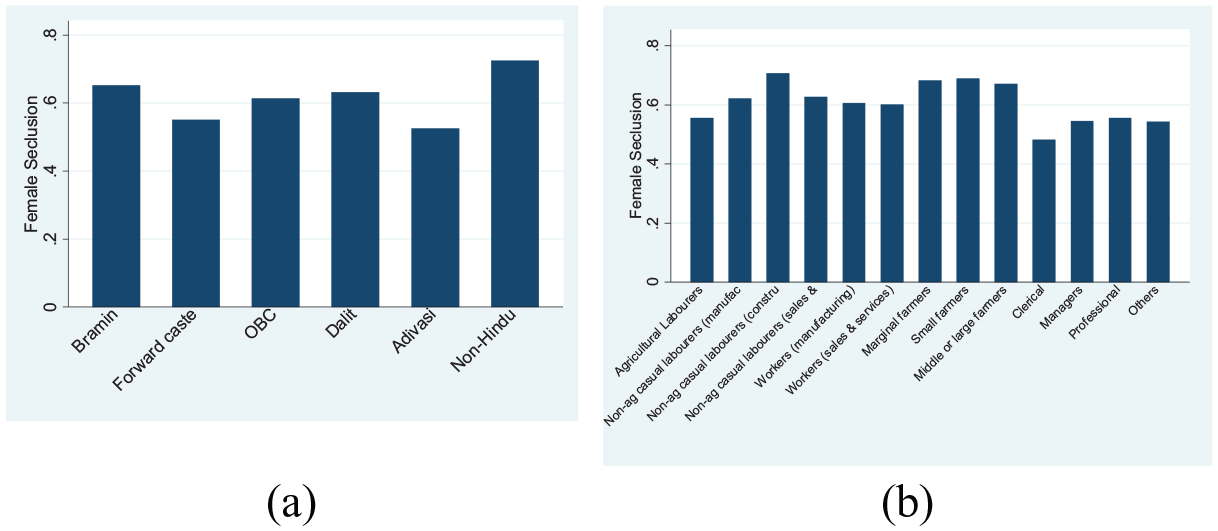
Descriptive information of seclusion by social group and class. (a) Female seclusion by social group. (b) Female seclusion by occupational class.
Moreover, a norm supporting women’s work appeared relatively frequently within the lower-middle class (Figure 4b). As mentioned, people’s attitudes to women’s work underpin decision-making regarding child labour. In this regard, less supportive attitudes regarding the work of women from lower-class groups can cause higher incidence of child labour. Working- or lower-class women must participate in work, but, in actuality, their employment is a way to meet needs rather than to be independent. In such cases, women’s workforce participation did not necessarily reduce child labour among the lower classes. An egalitarian gender norm was stronger among Adivasi households which usually had both boys and girls participating in labour (Figure 4a). Adivasi households demonstrated the highest proportion of child labourers, but compared to other socio-economic motivations, gender norms had a limited impact on reducing child labour among them.
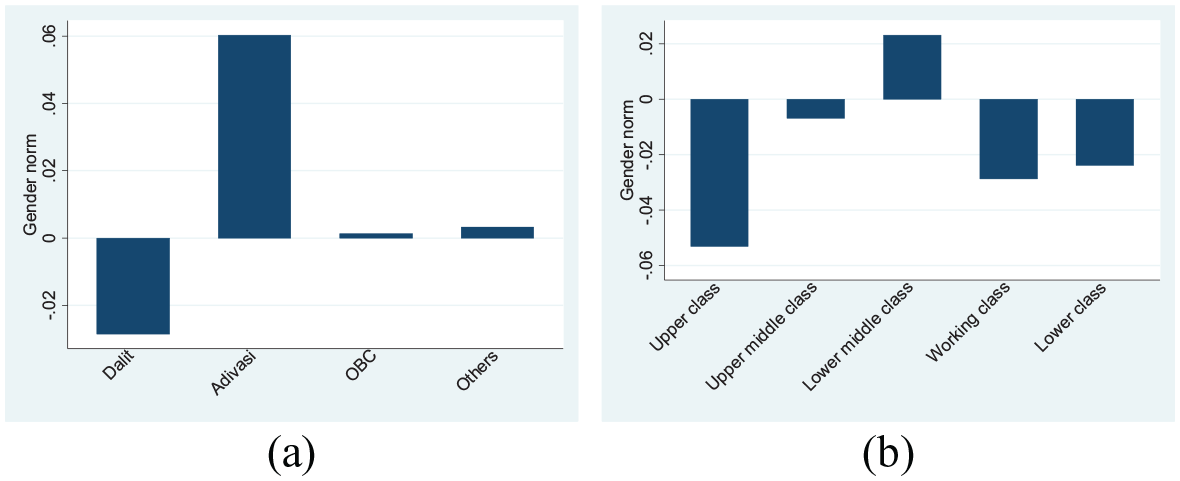
Descriptive information of gender norms by social group and class. (a) Norms supportive of women’s work by social group. (b) Norms supportive of women’s work by subjective class.
State-level analysis of child labour
This sub-section explains the structural and institutional characteristics of the key Indian states where the level of child-labour risk was highest. According to the predicted rates of child labour (Model 3), the states of Madhya Pradesh, Odisha, Jharkhand, West Bengal, Uttar Pradesh, and Rajasthan had the highest levels of child-labour risk (Figure 5). They are located in the Northern, Central and Eastern regions of India. The norm patterns of each state showed a relevance regarding the incidence of child labour (Figures 5 and 6). For example, Rajasthan had the most robust seclusion norms and Odisha had the lowest levels of support for women’s work. These reasons contributed to the high incidence of child labour in these states. Odisha showed the highest level of child labour by girls, in particular. In contrast, states in the Southern region showed lower child-labour risks. Andhra Pradesh, Karnataka and Kerala showed the lowest levels of child labour. In these states, women were less subject to seclusion, and the norm supporting women’s labour participation was stronger than that in other states. Moreover, the benevolence norm was found to be stronger in Uttarakhand and Haryana, which helped reduce child labour in those states.
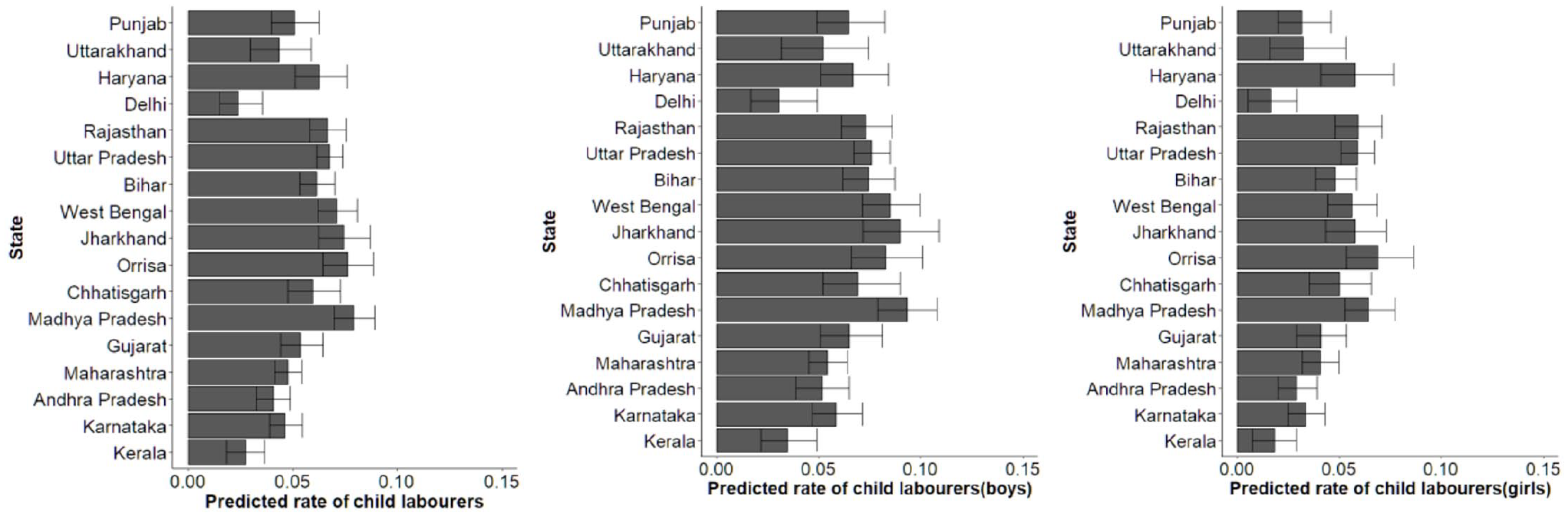
Predicted rates of child labourers.
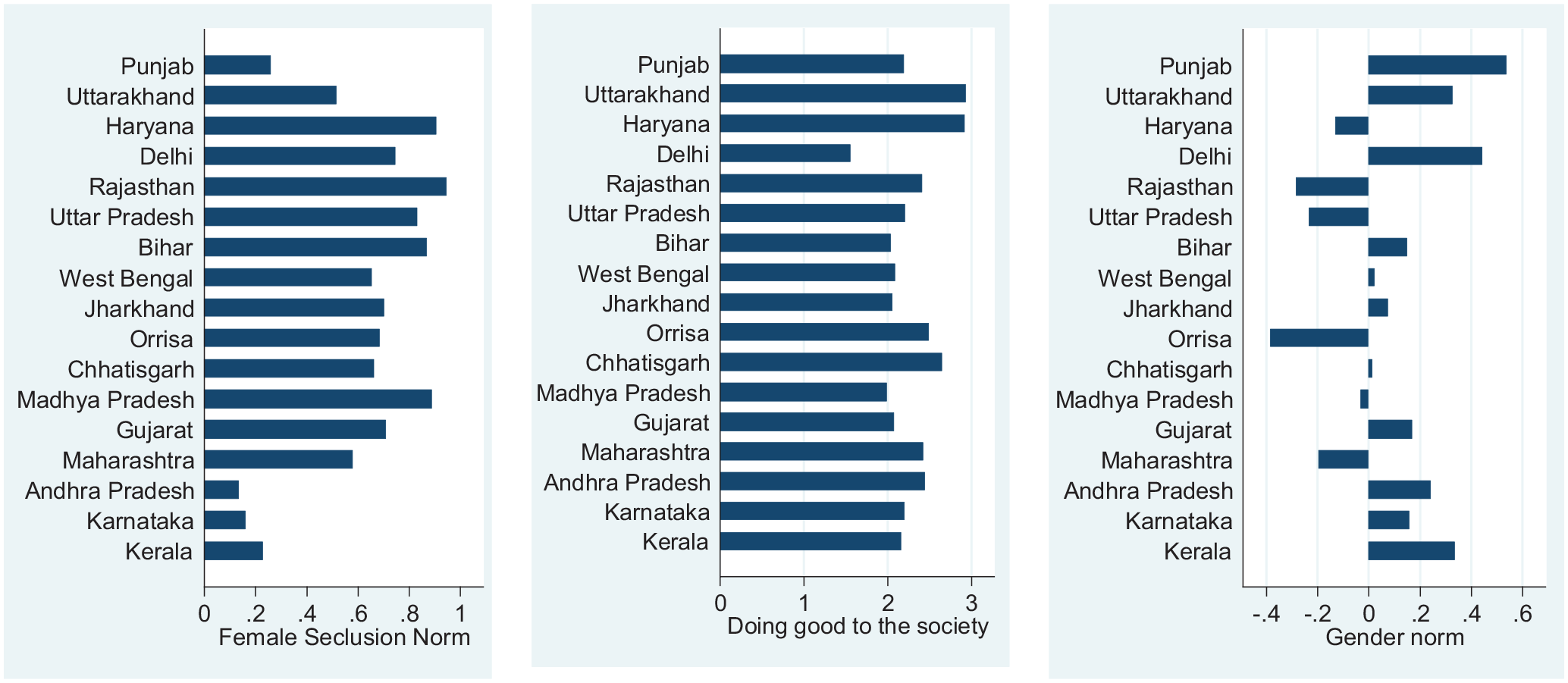
Comparisons of norms in the key states.
Figure 7 indicates the states with high child-labour risk in households in major industrial sectors: agriculture, manufacturing, construction, and sales and service. Madhya Pradesh had the highest level of male and female child labour in the construction and agricultural sectors. More than half of the indigenous population is concentrated in Central India, and Madhya Pradesh has the highest tribal population in India (14.7% in 2011, Ministry of Tribal Affairs, 2013), and poverty, unemployment and illiteracy are related to the incidence of child labour among indigenous people. In addition, widespread Purdah practices, as well as little support for women’s work, increased the risks of child labour for both boys and girls (Figure 6).
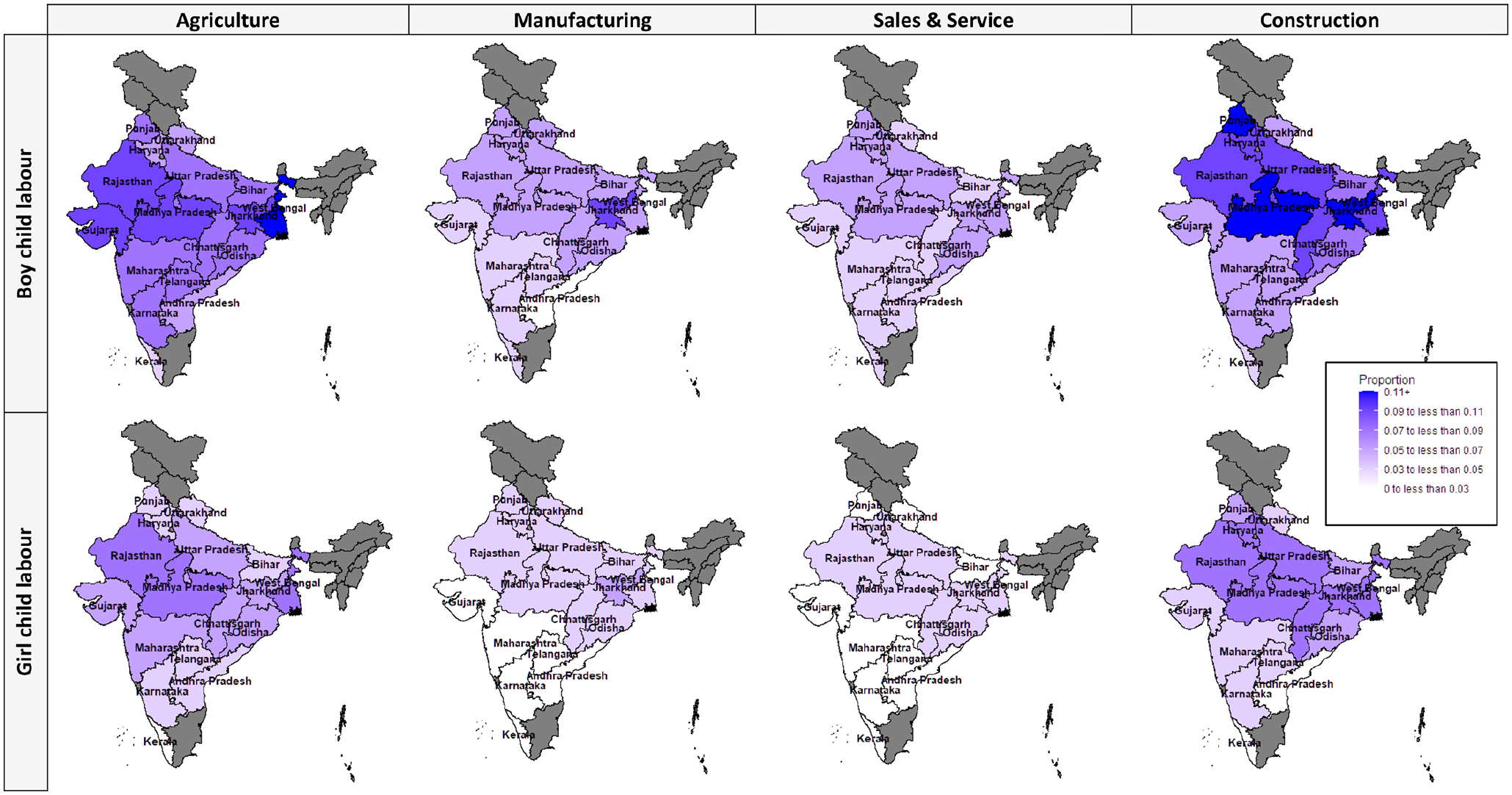
Child-labour risk predicted by household industries and gender.
The states of Jharkhand and Chhattisgarh showed a large prevalence of child labour among households headed by casual workers in the low-skilled manufacturing industry (see Figure 7). Haryana showed a high rate of child labour in the construction industry as it absorbs many migrant workers. Migrant workers bring their families, and so the risk of children becoming labourers increases. Meanwhile, the highest proportion of child labourers occurs in the agricultural households in West Bengal. As Das et al. (2013) explained, many children in West Bengal are involved in agricultural work, such as potato cultivation, owing to their families’ low socio-economic status.
Discussion
Child labour is driven by agents’ norms and values generated by their diverse experiences and positions within social and gender relations. Norms are closely related to structure but are changeable according to people’s agency. In this sense, it is difficult to say that structure is universal or deterministic. Therefore, any isolated solution that focuses on one aspect is not suitable for achieving the goal of ending child labour. It is essential to look at every relationship surrounding children, including gender relations, and the normative patterns governing individuals’ decisions in any society. Our suggested norm models are useful in revealing the impact of norms on child labour. However, some norm variables were applied at the state level only due to limited individual data, which should be overcome in further studies.
To be specific, this study finds a few norms that are relevant to child labour incidences or work intensity, which should be further investigated in order to address the problem of child labour in India. A norm supportive of female workforce participation can make a positive impact on the prevention of child labour. This norm could be related more to an egalitarian perception of gender roles and stereotypes. Thus, this result does not contradict the previous studies that stated mothers’ work participation increases children’s labour market participation. On the other hand, the result supports the hypothesis that children’s wellbeing is improved if women’s work is valued as much as men’s. Meanwhile, female seclusion increases children’s labour force participation. This study estimated the unknown time threshold beyond which child labourers’ risk of harm from being out of school increased, supporting the idea that a time threshold for measuring child labour should be set at country level.
This study shows that unequal class relations are also reflected in the distribution of gender norms; for example, India’s working-class women have to work, although women’s work is less supported. This situation increases the risk of child labour, as their mothers work in less-valued sectors and the family’s economic needs must be met. Another example is the practice of seclusion among farming or construction households where those households require family members to work, as those families might rely on child labour as women should be secluded. These findings show that households’ socio-economic conditions may worsen children’s lives in a combination of unequal gender relations. India is a patriarchal society, in which gender norms limit women’s outside activities, but to some degree, child labour is accepted. This aspect supports our view that households’ socio-economic and cultural positions as well as geographical locations, in which norms and values are grounded, are important factors that shape children’s life experiences.
There should be an inclusive and long-term intervention to reduce structural barriers and change norms regarding child labour in society. There are policy implications to reducing child labour. First, a gender-based strategy is necessary; perceptions of women’s limited economic roles are driven by a lack of childcare support and a gap in women’s and men’s position in the labour market. Addressing issues related to women’s empowerment is essential in order to resolve the child-labour problem. Second, the national scheme should be based on a rigorous understanding of cultural behaviours leading to child labour. A strategic approach targeting particular sectors and gender- or culture-based groups is necessary. More investment is required in the awareness and training of parents, teachers and communities. Third, an increased effort is required to help children in high-risk areas, as there might be a mismatch between states where many child-labour rescues take place and states with a high risk of child labour. For example, in 2018, Bihar and Rajasthan did not report any children rescued through the National Child Labour Project Scheme. 9 A priority should be given to states where there are high risks of child labour, in consideration of industrial, social and cultural characteristics of each state.
Supplemental Material
sj-pdf-1-wes-10.1177_09500170221091886 – Supplemental material for Predicting Child-Labour Risks by Norms in India
Supplemental material, sj-pdf-1-wes-10.1177_09500170221091886 for Predicting Child-Labour Risks by Norms in India by Jihye Kim, Wendy Olsen and Arkadiusz Wiśniowski in Work, Employment and Society
Footnotes
Acknowledgements
The authors would like to thank the anonymous reviewers and Prof. Eleonore Kofman, for their valuable comments. Jihye Kim would like to thank Prof. Yaojun Li and Dr Supriya Garikipati for their very helpful comments and support in improving the manuscript.
Funding
The authors received no financial support for the research, authorship, and/or publication of this article.

Supplemental material
Notes
References
Supplementary Material
Please find the following supplemental material available below.
For Open Access articles published under a Creative Commons License, all supplemental material carries the same license as the article it is associated with.
For non-Open Access articles published, all supplemental material carries a non-exclusive license, and permission requests for re-use of supplemental material or any part of supplemental material shall be sent directly to the copyright owner as specified in the copyright notice associated with the article.
