




Abstract
This study takes a cross-domain identity transition perspective to explore the development of work-related identities by trailing wives in Dubai, United Arab Emirates. Biographical-narrative interviews with 28 expatriate wives were conducted and analysed using thematic analysis. The findings indicated that these women approached their cross-domain identity transition sequentially through a process of work identity pause and reactivation. Gendered family demands and contextual constraints led them to temporarily pause their work identity while adjusting to non-work domain changes. The reactivation of the work identity domain prompted them to redevelop a work identity aligned to their new reality. Four manifestations of identity redevelopment status emerged: hobbyists, adaptors, explorers and re-inventors. For some women, their emerging work identity was just a way to escape the ‘expat wife’ stigma, for others it was an opportunity to develop a new career. This article introduces the concepts of identity pause and reactivation.
Keywords
Introduction
Expatriate families tend to reinforce traditional gender roles of a male breadwinner and a female homemaker (Känsälä et al., 2015; Rusconi et al., 2013). Despite the increasing number of female expatriates (Rodriguez and Ridgway, 2019), the expatriate workers are usually the husbands and their accompanying wives are often referred to as ‘trailing wives’ (Cooke, 2008; Harvey, 1998). Trailing wives play a significant role in the success of expatriate assignments and their adjustment to the host country has been a subject of interest for International Human Resources Management (IHRM) researchers (Cooke, 2008; Harvey, 1998; McNulty, 2012). Our emphasis on trailing wives is in line with other researchers who draw attention to gender inequalities among expatriate couples. The prioritisation of the husbands’ careers over those of trailing wives (Cole, 2011; Harvey, 1998; Känsälä et al., 2015; Rusconi et al., 2013) puts women in the disadvantaged position of economic dependence (Suutari and Brewster, 1998). This gendered phenomenon appears to still be the case when these expatriate couples come from egalitarian societies (Känsälä et al., 2015), and when the expatriate assignment is in an egalitarian country (Cooke, 2007; McNulty, 2012; Rusconi et al., 2013; Slobodin, 2019).
Expatriation disrupts the lives of trailing wives (Harvey et al., 2009; Känsälä et al., 2015), affecting their work and non-work identity domains. Trailing wives may appreciate the benefits of living abroad for the family and they may also initially enjoy playing a greater role in the family domain (Rodriguez and Ridgway, 2019). However, many women find it difficult to continue their occupations in a foreign cultural and social context (McNulty, 2012; Rusconi et al., 2013). Those who are unable to maintain their role of being a working person in the host country, or to enact their work identities, are likely to experience a sense of identity loss (Collins and Bertone, 2017; McNulty, 2012; Shaffer and Harrison, 2001; Slobodin, 2019).
This study recognises the importance of understanding the identity transitions of trailing wives (Collins and Bertone, 2017; McNulty, 2012; Shaffer and Harrison, 2001; Slobodin, 2019). It also acknowledges that changes that occur to their work identities within a new host country can be initiated by changes unrelated to work. An example of this is a woman who exits the labour market because, in her role of being a wife, she agrees to accompany her husband abroad. Ladge et al. (2012) suggest that when work identity transitions are influenced by changes in another domain, a cross-domain identity perspective is a better approach to capturing the complex and interrelated changes in the work and the non-work identity domains. However, their definition of cross-domain identity transitions implies a stable working role, which tends not to be the case for trailing wives. Therefore, this study operationalises cross-domain identity transitions more broadly as: work or non-work identity domain transitions that are triggered and shaped by changes in another identity domain.
Although previous studies consider how changes in different domains broadly contribute to identity changes of trailing wives (Collins and Bertone, 2017; Shaffer and Harrison, 2001; Slobodin, 2019), they do not explore the dynamics between different domains in the development of a work identity in the host country. This is particularly important in the case of trailing wives who may feel pressured to comply with the stereotypical gender roles common among expatriate families (Känsälä et al., 2015). Such roles may be exacerbated by the cultural and social norms of a host country, which perpetuate gender inequalities.
This research aims to gain greater clarity in this under-researched topic of the identity adjustment of the trailing wife. It focuses on the experiences of women who have ceded their work identity to support their husband’s expatriate assignment in the context of Dubai, United Arab Emirates. The study uses a cross-domain identity transition perspective to answer the question: How do trailing wives navigate the work and non-work identity domain changes as they develop a work-related identity abroad? This article contributes to the literature on trailing wives by considering the influences of non-work domains, expatriate gender norms and expectations, and contextual constraints as these women redevelop their work identities. It also contributes to the literature of identity by introducing the concepts of identity pause and reactivation as it explores the dynamics of cross-domain identity transitions for trailing wives.
Cross-domain identity transitions of trailing wives
An individual’s identity comprises the various meanings attached to them (Brown, 2015; Gecas, 1982), including relevant social identities such as race, gender, sexual orientation, class and social position. One person may simultaneously hold more sub-identities than others or have them more highly integrated than others. Identity does not necessarily indicate a stable core self; instead, identities are ad hoc and positional (Brown, 2015). Identities constantly evolve and are shaped by changing personal circumstances and life events (Ashforth, 2001). In the case of trailing wives, identity transitions are an expected consequence of the many changes inherent to expatriation (Collins and Bertone, 2017; Shaffer and Harrison, 2001), such as a new cultural context requiring role adjustments in the family and work domains. Therefore, their experiences of identity disruption and reconstruction are a feature of their adjustment abroad (Collins and Bertone, 2017; Shaffer and Harrison, 2001). These experiences affect their work and non-work domains and are likely to prompt identity work processes (Brown, 2015) in both domains.
Identity work is defined as ‘the range of activities individuals engage in to create, present, and sustain personal identities that are congruent with and supportive of the self-concept’ (Snow and Anderson, 1987: 1348). Identity work involves self-reflection and active exploration of possible selves (Ibarra, 1999, 2007; Watson, 2008) before a redeveloped identity can be achieved and integrated (Ibarra and Obodaru, 2016; Marcia, 1966). This process can be emotional and disorientating (Ybema et al., 2009), reflecting the tension between individuals’ efforts to redevelop their identity and external constraints from their context and other social roles (Brown, 2015; Ladge et al., 2012; Watson, 2008). Women who give up their job or career to support the expatriate assignment face multiple identity transitions as part of their adjustment (Collins and Bertone, 2017; Rusconi et al., 2013). The outcomes of these transitions are interdependent and can only be understood from a cross-domain identity perspective (Ladge et al., 2012).
Ladge et al. (2012: 1449) propose that cross-domain identity transitions are ‘intertwined and recursive’. In their study of first-time working mothers, they found that work and non-work identity transitions happened in tandem over a prolonged time. These reconstructed identities, although based on their initial preconceptions around motherhood and work, are shaped by the social context and relationships. Ladge et al. (2012) suggest that a change in a work role triggered by a non-work role does not necessarily lead to the end of a work identity. In the case of trailing wives, who may have discontinued their work activities as part of the move abroad, the impact of cross-domain transitions on their work-related identity needs further investigation.
Trailing wives, adjustment and gender expectations
Models of expatriate adjustment in the early IHRM literature (see Black et al., 1991) failed to account for life adjustments that trailing wives might experience, such as becoming a non-working partner. Harvey et al. (2009) argue that the extent to which the partner’s career disruption affects the family’s adjustment to the host country is dependent on the career stage of the wife, the family as a unit and the age of any children. Their argument implies a cross-domain identity adjustment by suggesting that, for trailing wives, a shift in focus to parental roles can fill the void of not having a work identity. Moreover, it reflects gendered beliefs about family and work domains (Känsälä et al., 2015; Rusconi et al., 2013).
Trailing wives who hold work roles in their home countries, experience the non-working status as a loss (Collins and Bertone, 2017; McNulty, 2012; Shaffer and Harrison, 2001; Slobodin, 2019). The adjustment for these individuals is not as smooth as it is for trailing wives who continue working in the host country (McNulty, 2012; Shaffer and Harrison, 2001). Practitioners’ surveys indicate that only a minority of trailing spouses experience occupational continuity, and these are seldom women (GMAC, 2008; ORC Worldwide, 2005; Permits Foundation, 2009). The expatriate worker is usually fully engaged at work (Mayes and Koshy, 2018), leaving their wife, whose career is perceived as secondary, to take a bigger role in the family domain (Känsälä et al., 2015; Mayes and Koshy, 2018; Rodriguez and Ridgway, 2019; Rusconi et al., 2013). This division of domains may exacerbate identity issues of trailing wives (McNulty, 2012), even when they seem to have accepted their condition as accompanying wives and have adapted to the host country (Känsälä et al., 2015; McNulty, 2012; Slobodin, 2019).
Gender norms and expectations placed on expatriate couples can reinforce gender inequalities (Rusconi et al., 2013). Trailing wives who previously had their own career are also likely to experience frustration at being a housewife as they find themselves in a position of economic dependence (Suutari and Brewster, 1998). This situation may put them in a precarious position, especially if their marriage is to break down (McNulty, 2014). The impact of going abroad on their work prospects and earnings of the trailing wives may take years to disappear (Cooke, 2008; McKinnish, 2008). Nevertheless, many women decide to quit their job in their home country to support the career of their expatriate partner (Rodriguez and Ridgway, 2019), perhaps without carefully evaluating the implications for their own sense of self and work identity.
Research site: The Dubai context
This study focuses on the experiences of trailing wives based in Dubai, United Arab Emirates (UAE) in the Gulf region. Gulf Cooperation Council (GCC) countries are highly reliant on expatriate workers (Tahir and Ertek, 2018) and in the UAE 88.5% of the total population are expatriates (Gulf Labour Markets and Migration, 2017). The workforce is largely male and, despite the increase of female labour force participation in the region (Metcalfe, 2008), they still have lower status at work (UN Women, 2017).
Like many GCC nations, the UAE is a patriarchal society (Sholkamy, 2010), where the acceptable norm is that a man’s role is to support the family financially, operating in the public domain of work, while the woman’s priority is on the domestic domain looking after the family and the home (Elamin and Omair, 2010; Metcalfe, 2008). This expectation is not only placed on local families but also on expatriate families, where women are expected to take the traditional gender roles of homemaker and primary carer (Hutchings et al., 2013: 304). This is reflected by how, by law, trailing wives are sponsored by their husbands and receive a ‘housewife’ visa, which only allows them to work if their husbands authorise them to do so through a ‘non-objection’ letter (Stalker and Mavin, 2011).
Gender expectations placed on expatriate couples make maintaining a work-related identity challenging for trailing wives, who often find themselves offered jobs beneath their qualifications and experience (Cooke, 2007; Taylor and Napier, 1996). Even when relocating to egalitarian societies, occupational continuity can be difficult (Cooke, 2007; McNulty, 2012; Rusconi et al., 2013; Slobodin, 2019). In patriarchal cultures, the disadvantages of trailing wives are exacerbated by being a woman in labour markets that favour male workers (Rodriguez and Ridgway, 2019). Among GCC countries, expatriate working women in Qatar report that they have fewer opportunities for development and career progression than male counterparts (Rodriguez and Scurry, 2014). In the UAE, it is suggested that women arriving as trailing wives are more vulnerable to discriminatory working practices than organisation-assigned expatriate women (Stalker and Mavin, 2011). The initial status of ‘housewife’ is also perceived by working women as a barrier to inserting themselves in the local workforce (Rodriguez and Ridgway, 2019). A paradox in this context is that while women are expected to focus on the roles of wife and mother, they also face a stigma related to a stereotype of expatriate women living hedonistic and easy lives (Rodriguez and Ridgway, 2019; Walsh, 2007). An example of this is the term ‘Jumeirah Jane’, a mildly pejorative term which refers to women who live in the district of Jumeirah, in Dubai, and spend their days shopping, socialising and driving their children around (Walsh, 2007).
Methodology
A qualitative approach (Creswell, 2013) in the form of narrative research was taken to explore in-depth how women navigate changes in non-work domains to develop a work-related identity as trailing wives. This is a suitable strategy to understand experiences that cannot be accessed directly, such as identity transitions, while ensuring individuals’ experiences are understood the way they construe them (Riessman, 1993). Narratives allow individuals to connect previous and current experiences (Ibarra and Barbulescu, 2010) while making sense of their identities (McAdams and McLean, 2013). A biographical-narrative approach adapted from Rosenthal (2004) was taken in this study. The interview schedule started with the most structured version of Rosenthal’s initial biographical-narrative question, referred to as thematic focused. The aim was to focus the theme of the interviewee’s account of the experience of expatriation without necessarily directing the conversation. The question was phrased as: We are interested in your experiences as an expatriate wife. You may start by telling us your experiences from before your relocation until today. You may start as early in your life as you like and take as much time as you like. Interview prompts were prepared and introduced, if necessary, after the main narrative was completed. These included: Tell me about your life and work before moving abroad; Tell me more about the decision to move abroad; How was the adjustment to the new environment?
Sample
This study adopted a purposive sample strategy to recruit ‘a group of people that can best inform the researcher about the research problem under examination’ (Creswell, 2013: 147). The criteria used to select the participants were: trailing wives, caring for children under the age of 16 and living in Dubai for at least 18 months. The participants should also have had a working background, either employed or working independently, before the family moved abroad. In order to give a greater emphasis on identity transitions, this study particularly focused on women who developed their work identity as a trailing wife through self-employment or a small business; hence, independent of an organisation or employment. The 28 participants were found through social media groups for women entrepreneurs and networking events. They were aged between 30 and 51 years old and were all based in similar gated communities, where most residents tended to be western expatriates or sharing similar lifestyles (Table 1). Names were replaced to ensure anonymity.
Sample.

Data collection and analysis
The interviews were face-to-face and lasted approximately one hour. The interviews were audio-recorded and transcribed verbatim (Riessman, 1993). The narrative analysis followed a categorical-content approach (Lieblich et al., 1998) and used thematic analysis to explore the data due to its flexibility (Braun and Clarke, 2006).
The first level of coding was conducted by the first and second authors independently on NVivo 11 (QSR International) and the results, assumptions and potential biases were discussed. Each interview transcript was coded in its entirety before the codes from each interview were compared and contrasted (Corbin and Strauss, 1990) and themes generated. The themes were inductively generated by the first and second authors collaboratively following the thematic analysis guidelines described by Braun and Clarke (2006). The third author audited the analysis. These themes were aggregated in broad dimensions, using an interpretative approach which was developed collaboratively by the three authors. To further ensure trustworthiness (Morrow, 2005), once the analysis was completed, the research participants were invited to provide feedback on the aggregated interpretation and analysis results.
Findings
The cross-domain identity transition process of trailing spouses is characterised by each domain being dealt with sequentially as the focus of their developmental processes shifts from the non-work to the work identity domain over time. A process of work identity pause and reactivation emerged, indicating the prioritisation of domestic roles. A temporal representation of this process is summarised in Figure 1. The move abroad or the arrival of a first child abroad triggered a cross-domain identity transition process (Time 1). Trailing wives in this study started their cross-domain identity transition by prioritising the adjustment to changes in the non-work domain. While focused on resolving identity uncertainties in their domestic lives, the development of a work-related identity as a trailing wife was paused and left on hold (Time 2). Once non-work roles became clearer and a domestic routine more established, the attention of trailing wives turned to addressing their work-related identity needs. Thus, informed by domestic roles, their work identity was reactivated and started developing (Time 3). Four manifestations of work-related identity development status emerged from this process. Some women in this study realised the end of their cross-domain transition with their work and non-work identities achieved and integrated (Time 4).
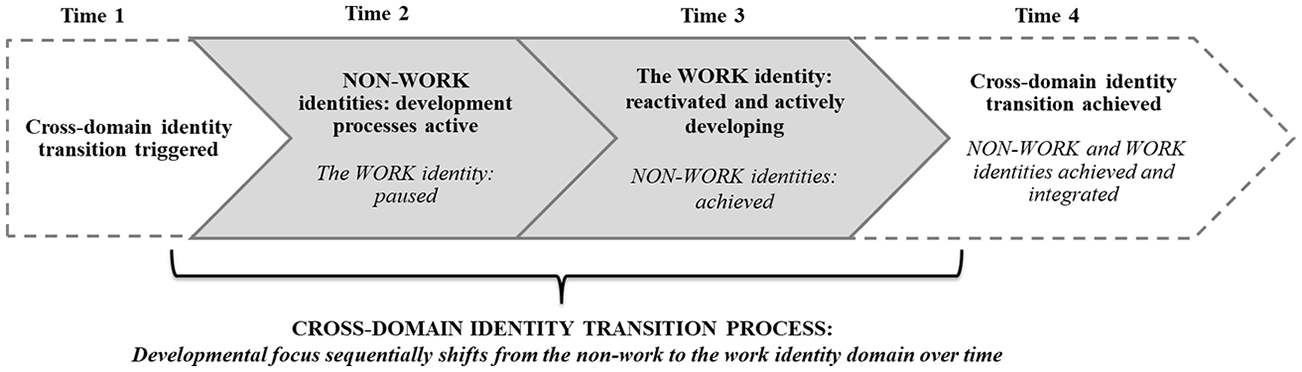
Cross-domain identity transition process of trailing wives.
The initial prioritisation of domestic roles was influenced by these women’s traditional gender orientation towards family roles (e.g. breadwinners, primary carers). This orientation, which preceded moving abroad and often justified the decision to support their husbands’ expatriate assignment, also shaped choices and strategies employed in the development of their work-related identity abroad. Lucia explained: I’ve been, always, this kind of person that wanted to get married and have children. Support the family and worry about the environment for the family.
The findings are organised under two themes: work identity pause and reactivation, emphasising this study’s focus on work-related identities and the sequential flow of the cross-domain identity transition process of training wives (Times 2 and 3). These are explored in detail, taking in consideration personal and contextual factors.
The pause of the work identity
The women in this study did not start their experiences as an expatriate at the same point and while most worked full-time, some were on maternity break when the opportunity to move abroad emerged. Two women moved abroad with their husbands before having children and had the chance to be fully engaged in work in the host country. Despite these differences, all women experienced a change in their family roles and increased levels of caring responsibilities in a foreign country that coincided with a work role discontinuity. The husband’s absence and distance from the extended family that could have acted as a network of support was often mentioned. For the two women who started their families in Dubai, parenting was the major change: I realised that I couldn’t balance everything that I have to do as a mother and as a wife whose husband is away 75% of the time. And work these long hours ‘cause then I won’t be able to fulfil my motherly duties, and the most important thing is that the children are raised properly. (Julie)
At the same time, they found themselves in a work context that was unappealing for foreign working mothers. While some women experienced barriers common to trailing wives (e.g. non-equivalence of qualifications and lack of language proficiency), others mentioned that the long working-hours culture of Dubai made it difficult for them and their husbands to balance parenting and work without the help of an extended family. The short maternity leave entitlement of 45 days and the lack of flexible work opportunities discouraged the new mothers from continuing their employment. A few women mentioned that expatriate wives are perceived negatively, with many jobs being low paid. For most, the jobs available were unappealing: I have done part-time work here and full-time work here and the salary just isn’t enough, and that plays a big role in it [. . .] It wasn’t enough for me to be driven to do what I was asked and the hours were . . . very difficult. (Claire)
The uninviting labour market, combined with the greater family demands, led their work-related identity to be de-emphasised. Instead, they concentrated on helping their families to adapt, finding their own expatriate identity and adjusting to life away from extended family support. The complexity of adjusting to significant changes and uncertainties that co-concur in different domains meant that these women paused their work-related identity to have cognitive availability to adjust to changes in non-work domains. The term identity pause is adopted to capture the sense that although the women were not currently enacting or trying to resolve their work-related identity, they remained conscious of its existence. This identity pause may not have been anticipated pre-expatriation and in all cases was not intended as being permanent: When we came to Dubai [. . .] The girls were small, needing support, adapting, so we stayed a year, I stayed at home for a year and a half taking care of them, having a break, right? To be able to take care of life. (Laura)
The priority given to their role in the family was consistent with their traditional gender orientation and the expected role of trailing wives; however, it did not mean that being a working person was not important. For these women, work was a source of pride and self-esteem, holding a greater social value than being exclusively a housewife or a ‘Jumeirah Jane’. During their work identity pause, the women felt incomplete, unable to recognise themselves. Andrea, who had worked since the age of 17, explained: From night-to-day I had to be at home being a mum and a housewife . . . I stayed at home taking care of the kids and the adaptation of everyone. But that’s not me . . . Sometimes I got upset, irritated and sad. But I don’t let it come into me like depression.
Most women took a few years before reactivating their work-related identity. This time lag might be related to how long they took to adjust to Dubai and to adapt to changes in their non-work identity domains. Angela described that ‘It took me two years before I integrated, before I felt at home’. Their readiness to restore a work-related identity may also have been influenced by the possibility they could be in Dubai for many more years. All husbands were either employed by local companies or were in roles that did not involve frequent relocation. Therefore, the open-ended nature of their life as an expatriate wife may have forced them to address the emotional discomfort of having their work-related identities paused and unresolved: Because, to be honest, I was getting depressed [. . .] and then since I’ve started this [business], I’m a different person. Definitely. (Soraya)
All interviewees had the support of their husbands to redevelop a work identity. Nevertheless, any work activities had to fit around their role as a mother and wife, indicating the gender inequality implied in traditional expatriate gender norms and expectations. Tessa, whose husband initially complained that her business idea would impinge on their family lives when she did not ‘need’ financially to work, explained how she reacted to his objections: I scream and shouted. You [husband] know, you are not supporting me, you are making me feel stupid, like I shouldn’t, you know, ‘cause it takes confidence to . . . It’s so good having an idea but to actually follow it through and do it, takes, you know, you gotta keep focus and to someone, like that can, can stop that.
For all other women, the support of their husbands, largely communicated in terms of approval, encouragement or a willingness to help out or provide financial investment, allowed them to feel psychologically safe to try possible selves without carrying the burden of the risk alone. Claire reflected on her experience: He thinks it’s excellent, it’s the best thing I’ve done. It was a hard decision to start with because we had to . . . outlay money, but now that he sees just how successful is it, he is very happy and it has changed me because I’m busy with something I needed, not just something that he needed.
The reactivation and development of the work identity
Distinct manifestations of work-related identity development status emerged from the participants’ accounts of work-related experiences following this period of pause. These reflected how they employed two key dynamic identity work processes: exploration of possible selves and commitment to an identity (Ibarra and Obodaru, 2016; Marcia, 1966). The combination of these two dimensions led to four groups: hobbyists (minimal exploration and low commitment), adaptors (exploration informed by prior commitment), explorers (active exploration but not yet committed) and re-inventors (commitment achieved after active exploration). Not all women were clearly identified in one or another group at the time of the interview, perhaps due to the dynamic nature of identity development processes. Nevertheless, all groups were clearly represented by more than one participant. The experiences of these women were influenced by: (1) the importance of their previous identity, particularly in the case of the adaptors; (2) their openness to explore and try new work identities; and (3) the level of commitment and emotional investment in developing an integrated work identity as a trailing wife.
Hobbyists
The women in this group were comfortable in a state akin to identity diffusion status (Marcia, 1966), hence there was little exploration and commitment. They benefited from the situation of psychological and financial safety to try something without being concerned about the financial cost or emotional risks of failing, or even the self-imposed pressure to achieve a more aspirational future self: My kitchen table, at home and when my daughter is at school, I have all day. Yeah. I don’t see it as a big business at the moment. It’s more like a hobby [. . .] I think I feel, get more satisfied now, things. (Becki)
Some described how eventually they would like to continue developing their work identity to achieve an integrated self. Nevertheless, they did not put a lot of effort into expanding their activities further or in finding any other possible identity. This low investment may indicate that they did not feel settled enough in Dubai or were not confident to commit to a work-related identity. Their hobby-like work enabled them to escape the housewife stigma and brought them satisfaction and opportunities to socialise without a major threat to their central identities: Once a month I get together with my friend J and a few other friends and we do a coffee morning and we all sell our products in a house and we invite everybody round. (Yvonne)
Adaptors
Women identified as adaptors, arrived in the host country with a strong previous work identity. Their commitment to this identity before the move abroad resembles foreclosure status (Marcia, 1966). These women, however, were not necessarily aware of this commitment when they started to explore possible selves. They were prepared to try other identities even though these alternatives were not suitable for them and could not be integrated. Mila shared her experience before training as a ballet teacher: I was working in an office and although I am a good organiser, I was good at what I was doing, I didn’t really enjoy it. I wasn’t getting any real satisfaction out of this. I could do it. That’s fine and my bosses were happy, and I wasn’t, yeah – I wasn’t really feeling like that was my life . . . goal.
The commitment to their original work identity, either because they had invested years building their professionalism or viewed themselves as having a vocation, drove their exploration to achieve a compromised version of their desired self. Nadia explained that by working in landscape gardening she could continue engaging in her profession area despite the lack of qualification equivalence: Because I have a profession, it’s not good to stop [. . .] As an architect . . . I decided to look for architecture fields or which, what I could do here.
Explorers
This was the most diverse group. Women were at different stages of their identity development and were all actively exploring possible work identities. All women in this group invested time and money to develop their business ideas. Some were still in the early stage of their business: I’ve been doing this [catering] since January last year, so it’s going to be a year, so I now, from the results that I have, I can see that, okay, I can do something with this, but now it’s getting momentum to go and do the next step, yeah, and do the next step because I’d love to have my own restaurant. I’d love to have that. A small one, I don’t need a big thing. (Leonor)
Other women, whose businesses were starting to get established, were closer to committing to a redeveloped work identity. Their new identities were in a moratorium state (Marcia, 1966); hence, not fully formed or integrated. Elena described this process: We’ve [she and her husband] actually only got our first sale stand at the market this weekend. So, we are very excited about that, but in the meantime, we’ve got a huge amount of work to do. And working at business cards, and flyers, and posters and all that kind of thing too.
Re-inventors
This group comprised women who were settled in their new work-related identity. Many of the women in this group already intended to change careers before expatriation. They were prepared to invest money and time to develop and integrate this new identity. Because of this investment they were no longer engaged in exploring possible selves. Unlike the explorers, these women were content and committed to their new work-related identities and their efforts were focused on enacting their redeveloped work selves. Their circumstances resembled the identity achievement status (Marcia, 1966) or identity growth (Ibarra and Obodaru, 2016). While all these women expressed that work made them feel productive and fulfilled, a few mentioned the importance of the additional income for their family and for themselves: Then came the return, the, the good part of that is also the financial return, right? Although it is a little bit like, comparing with others who earn much more, but so . . . it makes me happy and satisfied. (Fabiana)
Discussion and conclusion
The findings indicate that changes to the non-work and work domains are connected. As summarised in Figure 1, the transition process was sequential and involved a period of work identity pause before reactivation and development. This is an important novel finding and differs from previous conceptualisations of cross-domain identity transitions as an iterative process (Ladge et al., 2012). The non-work domain changes, particularly related to caring responsibilities, took priority and influenced changes to the work-related identities of trailing wives. Although Ladge et al. (2012) argue that cross-domain influences on work identity are not necessarily gendered, it emerged that for trailing wives, traditional gender roles (Rusconi et al., 2013) significantly influenced all stages of the transition process. This is illustrated by the fact that they take on a greater role in their family domain in a foreign social context, having discontinued their work activities as part of the move abroad (or maternity leave). This raises questions as to whether they would have approached their cross-domain identity transition process differently if traditional gender roles were not influential.
The work identity pause provided the women with the cognitive space to manage the changes in their non-work domain. It enabled them to make sense of who they were as an individual, wife and mother in the context of the host country before they could explore possible work-related identities. The concept of identity pause means not thinking about or enacting their former identity or role, leaving it provisionally on hold and unresolved in the background, until such a time that it becomes possible to engage with it once again. As such, this process is distinct from identity suspension (Schmid and Jones, 1991), which implies temporarily using a false identity to protect an authentic identity, or identity parking (Chen and Reay, 2020), which refers to suspending preconceptions to be in a state of cognitive liminality needed for identity work (Ibarra and Obodaru, 2016). However, similarly to these processes, identity pause is a mechanism to cope with uncertainty and change.
For the women in this study, identity pause did not stop the emotional response to the unresolved work-related identity. The increasing level of emotional discomfort they described indicates that they experienced a level of identity threat (Collins and Bertone, 2017; Petriglieri, 2011; Shaffer and Harrison, 2001). Some trailing wives may cope with their identity threat by framing their time abroad as temporary (Slobodin, 2019). The women in this study, however, seemed aware that their stay in Dubai was not short term. This may have contributed to their desire to resolve the dissonance between how they see themselves (as a working person) and their lives as non-working trailing wives. The reactivation of their work-related identity tended to coincide with a feeling of having achieved a degree of sufficient adjustment to non-work domain changes. It can be inferred that up to that point in time these women did not have the cognitive capacity to cope with the uncertainty of identity work in their non-work and work domain simultaneously (Ybema et al., 2009). Although they focused exclusively on their role as wife and mother for a while, their work-related identities continued to exist. Once their work domain was reactivated, they were ready to explore possible work-related identities as a trailing wife.
The four manifestations of work identity development status identified – hobbyists, adaptors, explorers and re-inventors – represent a snapshot of identity work processes of exploration and commitment these trailing wives were engaged in at the time of the interview (Ibarra and Obodaru, 2016; Marcia, 1966). Their identity development efforts were influenced by internal aspects such as their traditional gender role orientation, their expectations about their work identity, their openness to explore possible selves and the level of emotional investment they were prepared to make. External aspects, however, were also influential. Their work activities needed to fit around the heightened family responsibilities they had assumed since moving to the host country. Also, they relied on their husbands’ financial support and encouragement to pursue their new occupation. Moreover, it can be noted that for most women in our study, their redeveloped work identity was based on typically ‘female’ work activities, perhaps reflecting the patriarchal society of the host country. Hence, their work identity development as a trailing wife was bounded by personal, self-imposed and contextual gender constraints. These gendered experiences seem to continue to contribute to inequalities among expatriate couples (Rusconi et al., 2013). The reactivation of a work-related identity did not change the role of trailing wives in the domestic domain, nor the prioritisation of their husbands’ career as the primary source of income for the family. However, it did allow them to escape the ‘housewife’ or ‘expat-wife’ stigma (Rodriguez and Ridgway, 2019; Walsh, 2007) and to some extent ameliorate their precarious position of economic dependence (Cooke, 2008; McKinnish, 2008; McNulty, 2014).
The reactivation of their work identity domain, following a period of identity pause, led these women to explore establishing their own businesses (Lewis et al., 2015) as a possible strategy to develop a work-related identity. Nevertheless, a minimum level of sustained business success was required for them to be able to claim their redeveloped work-related identity. For the re-inventors, expatriation also offered a low-risk opportunity to try a new career not previously possible. This suggests that the impact of expatriation on the identity of a trailing wife is not necessarily negative (Shaffer and Harrison, 2001), despite the potential economic risks for most women (McNulty, 2014; Rusconi et al., 2013). While the prospects of the re-inventors and even the adaptors were promising, it is unclear if their work identities would be strong enough or portable enough (Cole, 2011) to be transferred to a new destination. Future international relocations could disrupt their lives again.
This study has several limitations. The sample was relatively small and although an effort was made to include women from a variety of cultural backgrounds, the women in this study cannot be considered to be representative of every community of expatriate women living in Dubai, where the span of cultures is vast (Harrison and Michailova, 2012). Although thematic, focused, biographical-narratives design is an appropriate strategy to investigate identity development processes (Riessman, 1993; Rosenthal, 2004), some groups are still in transition and their identity construction process ongoing.
More ongoing work is required to fully understand the process of identity pause and reactivation within the cross-domain identity transitions, not only for trailing wives but for other groups too. Further studies should also explore the interplay between contextual and personal factors in the process of work identity construction and the gendered experiences of women. Moreover, studies should investigate gender-specific aspects of cross-domain identity transitions, including the impact of egalitarian or traditional gender role orientations and the influence of different cultural contexts. The implications of the move abroad for the economic activity and future career of trailing wives should also be given more attention. A longitudinal research design would be beneficial to gain a greater understanding of how the work-related identities of trailing wives evolve as they move on to their next destination. This is particularly relevant for the re-inventors and adaptors groups.
This article takes a cross-domain identity transition perspective (Ladge et al., 2012), exploring how trailing wives develop a work-related identity abroad, as they adjust to life changes in their domestic domain (Cole, 2011; Collins and Bertone, 2017; McNulty, 2012; Shaffer and Harrison, 2001). The experiences of trailing wives are influenced by self-imposed and contextual traditional gender norms and expectations. In constructing a work-related identity as a trailing wife, the women address the changes to their non-work identity domain before attending to their work identity needs. This study contributes to the literature by introducing the concepts of the work identity pause and reactivation as women approach their cross-domain identity changes sequentially. The work identity pause period allows trailing wives space to adapt to changes in their domestic domain. Work identity reactivation leads them to explore different possible selves to preserve the existence of a work-related identity when being a trailing wife. The four groups identified in this study – hobbyists, adaptors, explorers and re-inventors – provide a useful framework for counselling and the orientation of expatriate families.
Footnotes
Acknowledgements
The authors are grateful to Karen Jansen and three anonymous reviewers for their feedback and constructive comments on earlier versions of this article.
Funding
The authors received no financial support for the research, authorship, and/or publication of this article.
