




Abstract
There is an emergent identity work perspective that draws on multiple intertwined streams of established identities theorizing and identities-related research. This perspective is characterized loosely by five broad sets of assumptions: (i) selves are reflexive and identities actively worked on, both in soliloquy and social interaction; (ii) identities are multiple, fluid and rarely fully coherent; (iii) identities are constructed within relations of power; (iv) identities are not helpfully described as either positive or authentic; and (v) identities are both interesting per se and integral to processes of organizing. Recognition of an emergent identity work perspective is valuable in part because this may act as a counterbalance to centrifugal tendencies – fed by myopia, insularity and ethnocentrism – which might otherwise lead to blinkered research and fragmentation. The contribution of this article is to provide a baseline for identity work scholars, and to promote collective critical reflection on identities in and around organizations.
We who study organizational behavior constitute an assortment of communities, built around an assortment of perspectives. (Weick, 2017: 13)
Introduction
There is an emergent identity work perspective in organization and management studies (OMS) that draws on multiple intertwined streams of established identities theorizing, a perspective being ‘a way of regarding a matter’ (Oxford English Dictionary), what Weick (1995: ix) describes as ‘a set of ideas with explanatory possibilities’. From Snow and Anderson’s (1987: 1348) original formulation of identity work as ‘[t]he range of activities individuals engage in to create, present, and sustain personal identities that are congruent with and supportive of the self-concept’, has emerged a stream of theorizing and research characterized loosely by five broad sets of assumptions relating to issues of: (i) reflexivity and agency; (ii) multiplicity, dynamism and coherence; (iii) relations of power; (iv) positivity and authenticity; and (v) processes of organizing. The contribution of this article is to provide a reference point for identity work scholars, and its rationale is to encourage critical reflection on identities issues both in and around organizations.
The ‘self’, and ‘identity’ are contested concepts that have recently been the subject of considerable scrutiny in OMS (Alvesson, 2010; Alvesson et al., 2008; Ashforth and Schinoff, 2016; Brown, 2017, 2019, 2020; Caza et al., 2018b; Miscenko and Day, 2016; Schwalbe and Mason-Schrock, 1996; Ybema et al., 2009) and across the social sciences (Baumeister, 1986; Callero, 2003; Cerulo, 1997; Swann and Bosson, 2010). Most often, and in this article, subjectively construed identities are conceived as ‘the meanings that individuals attach reflexively to themselves’ (Brown, 2015: 23), and may be understood as individuals’ answers to fundamental existential questions such as ‘who am I?’, ‘who do I want to become?’ and ‘how should I act?’ Identities are important not just because they ‘make people’s inner and social worlds intelligible and manageable’ (Petriglieri et al., 2019) but because, more significantly, they are a means by which we render our lives meaningful (Frankl, 1959; Jung, 1916). Unless otherwise specified, the disputed term self (Olson, 1999) is employed here to describe a capacity for reflexive thinking that is associated with a personal awareness of continuity (Giddens, 1991; MacIntyre, 1981).
Reviews and other theoretical explorations have established that contemporary identities scholarship has deep intellectual roots in systems of thought such as Buddhism, Islam and Christianity, the writings of Plato, and more recently the Enlightenment philosophies of Descartes, Locke, Hume, Leibnitz, Berkeley and Kant (Baumeister, 1986; Brown, 2015; Leary and Tangney, 2003). This said, OMS scholars have shown noticeably little interest in the historical development of identity discourses generally referencing as points of origin the systematic psychological interest in the self that began with James (1890) and Freud (1933), and to take sociological inspiration from 19th and 20th century figures ranging from Marx (1932), Durkheim (1933) and Weber (1922) to Cooley (1902), Mead (1934) and Blumer (1969). This has led to the charge that much of our research is myopic and amnesic (Knights and Clarke, 2017). To an extent, my theorizing is also open to this critique as my intention here is critically to interrogate and reimagine mostly recent literature on identities in order to generate new ways of thinking and stimulate fresh conversations (see Alvesson and Sandberg, 2020).
Today, the study of identity ‘forms a critical cornerstone within modern sociological thought’ (Cerulo, 1997: 385) and, more generally, occupies the centre ground ‘of intellectual debate in the social sciences and the humanities’ (Callero, 2003: 115). Indeed, not only is ‘[t]he language of “identity” . . . ubiquitous in contemporary social science’ (Stryker and Burke, 2000: 284) but outside of academia such that identity ‘is a keyword of contemporary society’ (Howard, 2000: 367). These claims are often predicated on analyses that suggest we live in an age characterized by a clash of multiple modernities (Lee, 2006), a culture of narcissism (Lasch, 1979), or ‘liquid modernity’ (Bauman, 2000) in which identities are ‘irreparably fluid, ambivalent and otherwise unreliable’ (Bauman, 1993: 234). For some, individuals are now more empowered and more sensitive to diverse experiences and ways of being (Beck, 1992; Giddens, 1991), though often these claims are accompanied by recognition that in neoliberalism notionally choice-making subjects may also be regarded as effects of power (Foucault, 1977; Rose, 1991). In such times it is suggested, people are embarked variously on existential identity quests not just for self-esteem (Baumeister, 1997) or belonging (Tajfel and Turner, 1979), but, inter alia, uniqueness (Brewer and Gardner, 1996), authenticity (Erickson, 1995), celebrity (Lasch, 1979), fulfilment (Baumeister, 1986), success (Luckmann and Berger, 1964) and achievement (Offe, 1976). Recognition of the diversity of identity quests people in and around organizations are engaged has been accompanied by a fascination with those processes of identity work by which people signal, label and define who they are, and how they maintain, strengthen, protect, revise and repair these constructions in social interactions (e.g. Alvesson and Willmott, 2002; Brown, 2017; Caza et al., 2018b; Schwalbe and Mason-Schrock, 1996; Watson, 2008).
While some will (legitimately) question the need for another consideration of the identities literature, my arguments align with those who see value in a continuing stream of reflective interpretations of this body of knowledge, which ‘can substantially contribute to theory development by exposing and espousing an emergent perspective’ (Post et al., 2020: 358). This is valuable in the context of previous considerations that have mostly insisted that identity work is best regarded in a more limited fashion as either a metaphor (Brown, 2015) or construct (Caza et al., 2018b). The objectives of this article are threefold. First, it provides thumbnail sketches of the key literatures (resources) that have been drawn on and informed a nascent identity work perspective. One goal in presenting this work is to offer a broad provisional synopsis with an emphasis on foundations rather than specifics, and inevitably this necessitates brevity and simplification. Second, I consider some of the principal sets of assumptions that underpin scholarship within the identity work perspective, and how these draw on and relate both to long-standing traditions of identity research and other perspectives within OMS that have inflected it. While my theorizing inevitably imposes boundaries on the identity work perspective, I regard these as, to some extent, permeable (so as to allow new ideas in and the otiose out), malleable (and thus able to be re-shaped to fit new exigencies) and temporally dynamic (to flex, flux and evolve to meet future challenges). An identity work perspective that functions to dissolve disciplinary silos should not be a straitjacket on high quality innovative identity research but a facilitator and nurturer of it. Finally, I discuss the merits of delineating an identity work perspective and its prospects.
Resources for contemporary identities theorizing
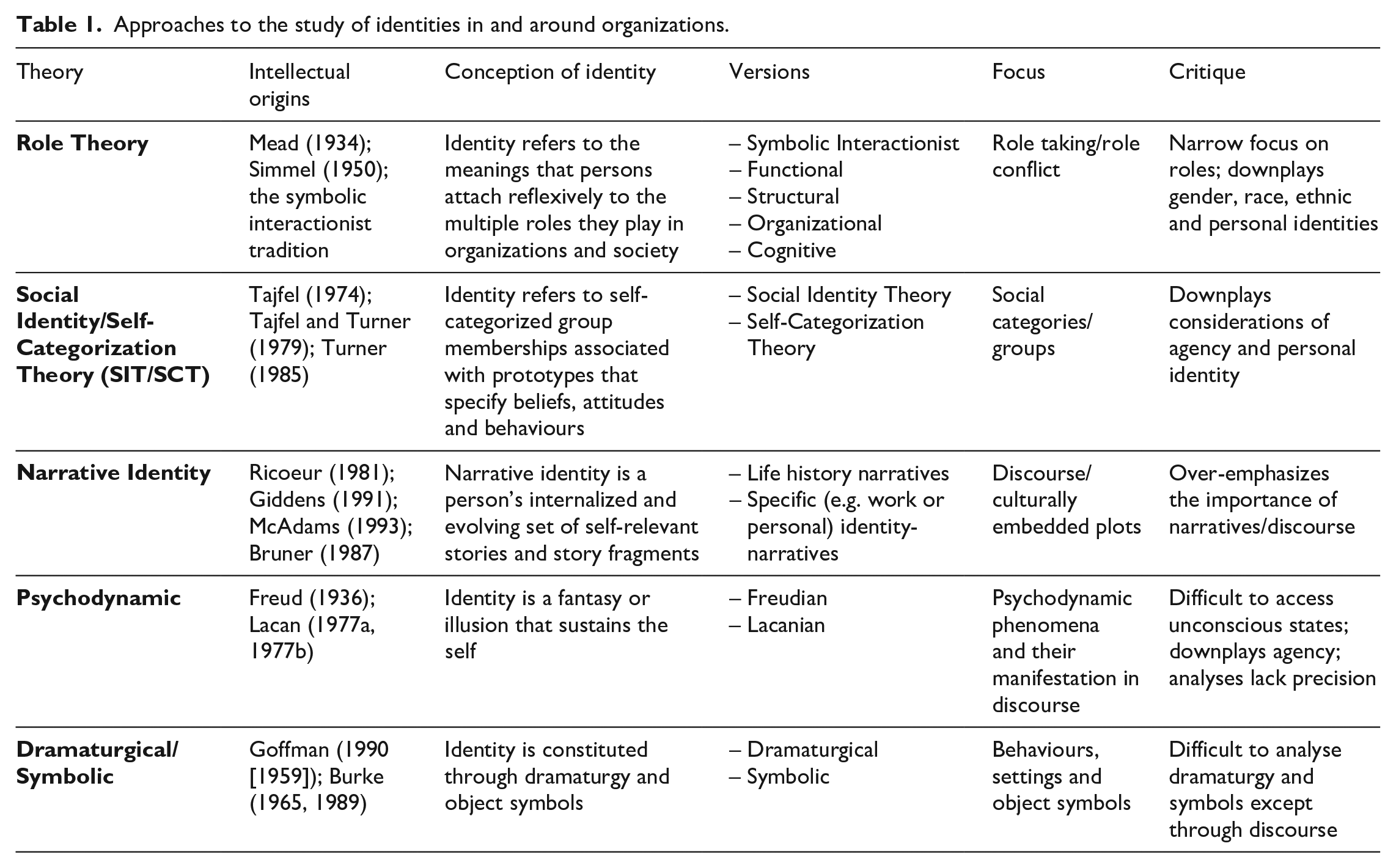
The identity work perspective has emerged from multiple streams of extant identities theorizing and research, the most prominent of which are: identity (role) theory, social identity/self-categorization theory (SIT/SCT), narrative theory, psychodynamic theory and dramaturgical/symbolic theory (see Table 1). It has been shaped also by a multiplicity of conversations taking place within other OMS perspectives, most notably those relating to sensemaking, discourse and critical management studies (CMS). The identity work perspective has, to an extent, drawn on and drawn together these streams of theorizing.
Approaches to the study of identities in and around organizations.
Identities theorizing
Role theory
With its origins in the symbolic interactionist tradition (see Blumer, 1969; Mead, 1934; Simmel, 1950), the ‘identity theory’ developed by, for example, Stryker (1968), Stryker and Serpe (1982) Stryker and Burke (2000), Stets and Burke (2000), Burke and Tulley (1977) and McCall and Simmons (1966) focuses specifically on the concept of ‘role’ (Ashforth, 2001; Biddle, 1986). 1 Embedded in Mead’s (1934) dictum that ‘self reflects society’, in this approach ‘the core of an identity is the categorization of the self as an occupant of a role, and the incorporation, into the self, of the meanings and expectations associated with that role and its performance’ (Stets and Burke, 2000: 225). Roles, though, are not ‘fixed’ but negotiated through processes of reciprocity and exchange in social interactions with other role holders (Mead, 1934; Stryker and Statham, 1985). 2 While the aims of scholars working in this tradition are diverse, one major thrust is ‘to translate the central tenets of symbolic interactionism into an empirically testable set of propositions’ (Hogg et al., 1995: 256) associated with ‘reliable’ measurements (Stryker and Burke, 2000) that lead to accurate predictions of people’s role behaviour (Simon, 1992; Thoits, 2003).
Social Identity Theory
Social Identity Theory (SIT) is a ‘social psychological theory of intergroup relations, group processes, and the social self’ (Hogg et al., 1995: 259) formulated originally by Tajfel (1974) to examine issues of racism, prejudice and discrimination and developed fully with Turner (see Tajfel and Turner, 1979; Turner, 1985). Self-Categorization Theory (SCT) is a later development of this approach, though one that shares its key underlying principles (Oakes et al., 1994; Turner, 1985, 1991; Turner et al., 1987). SIT/SCT is today ‘one of psychology’s pre-eminent theoretical perspectives’ (Brown, 2000: 745; see Ashforth and Mael, 1989; Ellemers et al., 1988; Hogg and Abrams, 1988). It suggests that people have repertoires of discrete category memberships (e.g. nationalities, sports team affiliations) that vary in importance in the self-concept, i.e. ‘a dynamic system of affective-cognitive structures, which consists of and organizes a person’s identities’ (Brown, 2015: 23; see also Baumeister, 1986; Gecas, 1982). Social identities develop and are maintained by a variety of underlying socio-cognitive processes, 3 most notably categorization, stereotyping and depersonalization, by which people assign themselves and others to social groups. Each category membership is associated with a different social identity that provides a definition of who one is; namely, they are descriptive, prescriptive and evaluative (of other social categories and of the self).
Narrative theory
Interest in narrative identities spans both philosophy and the social sciences (e.g. McAdams, 1993; MacIntyre, 1981; Maines, 1993; Ricoeur, 1981; Riessman, 1993). Influential figures across disciplines maintain that ‘a person’s identity is . . . to be found in the capacity to keep a particular narrative going’ (Giddens, 1991: 54, emphasis in original), and that the ‘self is a perpetually rewritten story’ (Bruner, 1987: 15). Much narrative identity terrain is contested, and while there is also consensus on some key issues, this community of scholars is more differentiated than others. For example, those with objectivist inclinations tend to emphasize the extent to which identity-narratives are empirically grounded, while others, often following Ricoeur (1981), regard narrative identities as fabrications, and as such quasi-fictions. There is agreement that a self-narrative is one that makes a point about the narrator (Linde, 1993), yet scholars are split between those concerned with single identity-narratives and those interested in people’s entire set of life-stories and relationships between them. Perhaps the most important centripetal force that binds this community is the attention scholars devote to the culturally derived plots (Ezzy, 1998), literary traditions (Ricoeur, 1981) and ‘historical narrative structures’ (Evans and Mains, 1995: 303; Singer, 2004) on which people draw in the construction of their self-narratives.
Psychodynamic theory
Psychodynamic theorizing in relation to identities has its origins in the work of Freud (Gabriel, 2016; Klein, 1933; Marcia, 1966; Petrigleiri, 2020), though a distinctive thread takes its lead from Lacan (1977a, 1977b; see Driver, 2015; Harding, 2007; Hoedemaekers and Keegan, 2010). In this approach, ‘conflict is unavoidable and constitutive of the subject’ (Gabriel, 2016: 214), and people defend against anxiety through unconscious defence mechanisms such as repression, denial, rationalization, sublimation and projection (Freud, 1936; Petriglieri and Petriglieri, 2020). The idea of a stable and unified self is regarded as a defensive fiction and identity an illusion that sustains us and maintains self-esteem but is ‘akin to a dream or a neurotic symptom. Concealing and revealing us at once’ (Petriglieri, 2020: 170). The Lacanian tradition similarly emphasizes how people’s efforts to produce coherent, ‘whole’ selves are continually thwarted fantasies (Driver, 2013), and that our fate is to remain ‘locked in a relentless search’ (Kenny, 2020: 187) for a ‘completeness that is forever lost’ (Arnaud and Vidaillet, 2018: 74). The objective for psychodynamic scholars is to account full-bloodedly for subjects’ conflicted wishes, irrationality and emotionality (Epstein, 1994; Gabriel and Carr, 2002; Hoyer and Steyaert, 2015; Petriglieri and Petriglieri, 2020; Petriglieri and Stein, 2012) as they engage in identity fantasies that mask ‘the inevitable failure of symbolization from the subjects engaged in it’ (Kenny, 2020: 187; see also Driver, 2013).
Dramaturgical/Symbolic theory
Dramaturgical/symbolic research on identities in organizations, often influenced by Goffman (1990 [1959]) and Burke (1965, 1989), focuses on how people ‘announce and enact’ who they are in social interactions and the adoption, display and manipulation of object symbols, i.e. tangible entities that are infused with meaning (Callero, 2003; Cerulo, 1997; Down and Reveley, 2009). Predicated on the argument that ‘it is only through repeated enactment that identity is sustained’ (Thatcher and Zhu, 2006: 1085), researchers have analysed the rituals and other learned repertoires of behaviour associated with the identity performances of various workers (Beech et al., 2016; Courpasson and Monties, 2016; Grey, 1994), and how individuals’ identities are constructed in their choices of settings for formal meetings and informal encounters, who they interact with, their physical postures, emotion work and facial expressions (Hochschild, 1983; Mangham, 1990). Considerable attention has centred on how gendered identities are performed through specific modes of etiquette, manners, comportment, gestures, walking, sitting and working (Butler, 2004; Corlett and Mavin, 2014; Patriotta and Spedale, 2009; Trethewey, 1999). Other studies have examined how people claim identities through attire, choice of personal possessions, commodities, corporate paraphernalia, anthems and flags, or by shaping, marking and colouring their bodies through their use of cosmetics, gender reassignment surgery, tattoos and piercings and by wearing specific hairstyles, beards and moustaches (Johansson et al., 2017; Norton, 1997; Phelan and Hunt, 1998; Pratt and Rafaeli, 1997).
These approaches to identities research have been hugely influential and attracted substantial numbers of adherents but have also sometimes been subject to criticism. Role theory has been censured for its ‘simple assumptions [which] are not always valid’ (Biddle, 1986: 86), and for largely ignoring personal – not to mention ethnic, national and gender – identities (Stets and Burke, 2000: 228). Although SIT/SCT theorists maintain that social identities are dynamic, negotiated and responsive, they mostly have little apparent interest in issues of personal identity or agency. There is, moreover, a preoccupation with uniformity/similarity of perception and action as the basis for social identity formation, and a somewhat un-nuanced fixation with how identities are ‘activated’ and ‘the mechanics of stimulus-category fit’ (Hogg et al., 1995: 262). Narrative identity theory is ‘too positivist and reductionist for the social constructionists . . . and too literary and diffuse for the trait enthusiasts’ (Singer, 2004: 445), and is open to the charge of ‘narrative imperialism’, that is, of reducing ‘the numerous and complex relations between the self and one’s narratives about the self to a single model’ (Phelan, 2005: 210; Watson, 2009: 428). Psychodynamic theorizing has been critiqued for sacrificing ‘precision at the altar of poetics’ (Petrigleiri et al., 2019: 159) and for de-emphasizing issues of agency. Interestingly, while there is less specific criticism of dramaturgical/symbolic approaches, it is noticeable that identities researchers have tended to employ them in conjunction with others, generally narrative or more broadly discursive traditions, perhaps in part because of inherent difficulties associated with collecting and analysing dramaturgical and symbolic data.
Sensemaking, discourse and critical management studies
Three further sets of – to an extent interconnected – resources for contemporary identities theorizing that have shaped profoundly the identity work perspective (and in turn been influenced by it) are the OMS literatures on sensemaking, discourse and CMS.
Sensemaking
The different ways in which the literatures on sensemaking and identities intersect have been investigated systematically by Vough et al. (2020). At its most general, sensemaking is a generic term that refers to diverse processes of interpretation, action and meaning production, grounded in identity construction, whereby people ‘structure the unknown’ (Waterman, 1990: 41), reduce equivocality and (re)produce their worlds (Weick, 1995). Drawing on the sensemaking literature, identity work scholars often regard identity construction as a form of sensemaking (Conroy and O’Leary-Kelly, 2014; Moore and Koning, 2016: 41) and the self as its primary target (Fernando and Patriotta, 2020). As Vough et al. (2020: 253) have argued, identity and sensemaking are mutually enactive, existing ‘in the form of a double interact . . . as two intertwined processes that have a recursive effect on one another’. Sensemaking scholarship has fed an understanding of identities as works in progress with cognitive (e.g. frames, cues, connections), linguistic (e.g. story, narrative) and behavioural (‘People learn about their identities by projecting them into an environment and observing the consequences’ (Weick, 1995: 23) aspects.
Discourse
The linguistic turn in OMS has focused attention on how identities are created through ‘practices of talking and writing (as well as a wide variety of visual representations and cultural artefacts)’ (Grant et al., 2004: 3; Kuhn and Simpson, 2020). A concern with discourse and discursive approaches has exercised considerable influence over contemporary identities studies, ‘allowing organizational researchers to examine the complexity of processes of construction of identity’ (Ainsworth and Hardy, 2004: 155). Building on diverse sources including Derrida (1979, 1981), Foucault (1972) and Garfinkel (1967), scholars have analysed how identities are constructed by individuals drawing on both local and macro discourses in ‘seemingly limitless possibilities of creativity in discursive practice’ (Fairclough, 1995: 134). The discourse movement has been particularly important in the context of identities research, not only broadening interest from narrow concerns with narrative and storytelling to language and indeed symbol use generally, but also by emphasizing that identities are authored through dialogical/inter-relational processes, and often by connecting identity issues explicitly to notions of power (Alvesson and Karreman, 2000; Ashcraft, 2007; Wieland, 2010).
Critical Management Studies
A third source of inspiration for identities scholarship has been CMS, a loosely coupled movement dating from the 1990s incorporating ideas from radical humanism, poststructuralism, queer theory, feminism and postcolonialism (among others) and bound by a concern to document asymmetric relations of power and challenge oppression (Alvesson and Deetz, 2006; Fournier and Grey, 2000; Thomas, 2009). Associated with ‘a collapse of certainty and self-confidence’ among managers and scepticism regarding ‘the position of positivism and functionalism in social science’ (Fournier and Grey, 2000: 13) the CMS movement, while theoretically plural, has placed special emphasis on non-performative, denaturalizing and methodologically reflexive studies (Cabantous et al., 2016). This tradition contends that questions of identity are not simply matters of choice or determination, and that answers to them are always contextual and dynamic and require consideration in relation to societal and historical trajectories. While identities studies have been shaped by CMS, concomitantly identity has come to occupy an increasingly central place for CMS scholars concerned with control, resistance and agency/structure issues. Drawing in particular on the work of Foucault, the CMS community has produced an extensive array of studies of how the identities – or often ‘subjectivities’ – of people in organizations are prone to normative controls, surveillance and disciplinary techniques, and how individuals may accept but also appropriate, modify and resist them (Fleming and Sewell, 2002; Thomas and Davies, 2005).
The identity work perspective
Often drawing eclectically on these streams of theorizing, since the mid-1980s, and particularly from 2000, a nascent identity work perspective has developed (Brown, 2019). This perspective is typified by five broad sets of – overlapping and intertwined – assumptions: (i) selves are reflexive and identities are actively worked on, both in soliloquy and in social interaction; (ii) people have multiple identities that are generally fluid and rarely fully coherent; (iii) identities are fabricated within relations of power; (iv) identities are not helpfully analysed as either positive or authentic; and (v) identities are both of interest per se and also integral to processes of organizing and our understanding of them. As such, the identity work perspective is not a radical break from previous research and theorizing; rather, it is a distinctive arrogation of often long-established frames and concepts. ‘Perspective’ has multiple meanings, and here I use it to refer to a general view on a specific set of identity-related matters. A perspective in this sense is broader than a single theory and may in principle include scholarship that spans paradigms. Constantly in flux, being continuously edited, updated and abridged by its contributors, a perspective is a loose confederation of ideas that ‘serves as the basis for systematic reflection’ (Weick, 2017: 13) or, more succinctly, and ambitiously, ‘a search for wisdom’ (Weick, 2017: 14).
While I refer in this article to an identity work perspective, this embraces a sizable number of cognates, perhaps most notably ‘identity construction’, which is generally regarded as a synonym or near-synonym for ‘identity work’ (Cerulo, 1997; DeRue and Ashford, 2010). In addition, in seeking to refine our understanding of individuals’ identity work, a range of complementary concepts have been proposed, including ‘identity jujitsu’ (Kreiner and Sheep, 2009), ‘identity practicing’ (Pratt, 2012) and ‘teflonic identity manoeuvring’ (Alvesson and Robertson, 2016), though these have not (yet) gained much traction. A closely related concept to identity work is that of ‘identity play’, which Ibarra and Petriglieri (2010: 11) dp that emphasizes how idefine as ‘people’s engagement in provisional but active trial of possible future selves’ and emphasizes the extent to which identities are made through processes of spontaneity, enjoyment, discovery and intuition (Pratt, 2012). Drawing on the work of Levi-Strauss (1966), others refer to identity work as a form of bricolage in which identities are crafted through processes of improvisation from a stock or repertoire of cultural materials to meet situational requirements (e.g. Visscher et al., 2018). All these, and other similar conceptions that focus on how people fabricate their identities, I regard as falling within the broad ambit of an emergent identity work perspective.
The evolution of the identity work perspective has accompanied the expansion of the literature on identity and identification that has had a growth rate in publications of over 600% over the last 20 years (Miscenko and Day, 2016: 221). A search 4 of the Thomson Reuters Web of Science database using ‘identity work’ across all indexed fields showed 1476 items employed this phrase. While just one paper published in 1987 mentioned ‘identity work’, this had grown steadily to 192 papers published in 2019. The largest number of papers (547) were published by authors from North America (USA/Canada), followed by authors with UK (483), Scandinavian (219) and Australian/New Zealand (161) affiliations. A total of 480 items were designated as being in the field ‘business economics’, with sizable numbers also in ‘education’ (303), ‘sociology’ (231), ‘other social sciences’ (156), ‘psychology’ (150) and ‘linguistics’ (94). Although principally prevalent in European OMS journals, the range of outlets in which these items were published was extremely broad and diverse, with only one journal (Human Relations) accounting for more than 50 papers. In the more comprehensive Elsevier Scopus database, a search using ‘identity work’ across all indexed fields revealed a very similar pattern of publication to Web of Science, merely on a larger scale. Evidently, ‘identity work’ is a concept whose time has come (Brown, 2017: 298).
The reflexive, actively worked-on self
Scholars aligned with the identity work perspective regard the self as a reflexive process ‘that regulates the acting, agentic organism’ (Callero, 2003: 120). Influential in this regard has been Mead’s (1934: 134) oft-quoted statement that ‘[i]t is by means of reflexiveness – the turning back of the experience of the individual upon himself [sic] – that the whole social process is thus brought into the experience of the individuals involved in it’. Similarly well-referenced is Giddens (1991: 53) formulation that ‘[s]elf-identity . . . is the self as reflexively understood by the person . . . self-identity is continuity (across time and space) as interpreted reflexively by the agent’. In this respect, the identity work perspective is indebted to several established streams of identities theorizing. For example, most narrative approaches assume an agentic narrator, role theory ‘presumes a thoughtful, socially aware human actor’ (Biddle, 1986: 69), and in SIT ‘the self is reflexive in that it can take itself as an object and can categorize, classify, or name itself in particular ways in relation to other social categories or classifications’ (Stets and Burke, 2000: 224). 5 In today’s organizations, all participants, from CEOs to shop floor workers, are recognized to be self-aware, practical authors of social realities and identities (Alvesson and Deetz, 2000; Hardy et al., 2001).
Analyses of people’s ascriptions of meaning to themselves and to others, together with processes of repair, maintenance and revision, have most often implicated interlocking discursive, dramaturgical, symbolic, socio-cognitive and psychodynamic processes (Brown, 2017; Caza et al., 2018b). These forms of identity work occur both intra-personally, i.e. in soliloquy, and with others in social interaction. While the most famous statement of the self as soliloquy is Descartes’ argument cogito ergo sum, it is Mead’s (1934) conception of the self as a conversation between an ‘I’ and a ‘me’ that is most often referenced by OMS scholars and sociologists generally. Blumer (1969: 13), for example, writes that ‘the human being has a self . . . in the form of interaction . . . the interaction is social – a form of communication, with the person addressing himself as a person and responding thereto’. More recent is Athens’ (1994) contention that ‘[s]oliloquizing is the key to the self. Soliloquies supply the vital sustenance without which the self can not live.’ People, Athens (1994) contends, converse with their selves both alone and in social interactions, and in so doing make use of phantom others – what Sampson (1993) refers to as the ‘serviceable other’ – with whom we dialogue both consciously and subconsciously as we author our identities (Skovgaard-Smith et al., 2019). 6
Identities, of course, are not constituted by individuals in isolation, rather identity work is profoundly social and not infrequently contested. As has frequently been stated, ‘identity formation involves processes of negotiation between social actors and institutions, between self and others’ (Ybema et al., 2009: 303) and ‘[i]t is in the meeting of internal and external definition that identity . . . is created’ (Jenkins, 1994: 199). 7 This strand within the identity work perspective has been influenced both by role theory and most especially dramaturgical/symbolic scholarship that emphasizes how identities are ‘staged’ or ‘performed’ (Goffman, 1990 [1959]). Studies have shown how identities are constituted behaviourally through the consumption of different kinds of food (Kenny, 2010), prayer (Giorgi and Palmisano, 2017; Gutierrez et al., 2010), refraining from actions such as swearing, speeding and both playful and overbearing conduct (Kreiner et al., 2006), and through celibacy, abstinence and engaging in purifying rituals such as singing hymns and communalistic labour (Kanter, 1968). These identity performances often involve the use of object symbols, especially various forms of attire, which take on significance in the context of sociality (see Patriotta and Spedale, 2009; Pratt and Rafaeli, 1997). In sum, ‘the self is . . . a product of social interaction’ (Callero, 2003: 121), and in processes of identity work ‘relational and individualistic discourses and practices are interwoven’ (Mason, 2004: 163).
Identities are multiple, fluid and fractured
Drawing on established traditions, and most often the work of James (1890) and Mead (1934), identity work scholarship has explored people’s adoption (and performance) of multiple role and social/group identities (Caza et al., 2018b; Cooley, 1902; Gergen, 1991; Ramarajan, 2014). These are not just personal and social or connected to specific attributes such as ethnicity, nationality and gender, but embrace diverse types, templates and scripts. Identities may, inter alia, be past, present or future (McAdams, 1993), possible (Markus and Nurius, 1986), ideal/ought (Gecas, 1982), provisional (Ibarra, 1999), aspirational (Thornborrow and Brown, 2009), alternate (Obodaru, 2012), preferred (Brown et al., 2019), threatened (Petriglieri, 2011), paradoxical (Cuganesan, 2017) and lingering (Wittman, 2019). Although well-recognized in principle for many years, as recently as 2014 Ramarajan argued that there is a surprising ‘scarcity of multiple identity research’ (2014: 591; see also Stryker and Burke, 2000: 291). It has, however, become progressively evident that, when it comes to organizational participants, severe limitations may attach to studies of a single identity, and that there are often good reasons to focus on the intersectionality of individuals’ multiple identities (Atewologun et al., 2020; Caza et al., 2018b).
While acknowledging that selves are generally sufficiently continuous that we do not every day embark on novel forms of identity construction on entirely new identities, identity work scholars often emphasize how even apparently stable sets of cultural meanings ‘can never be permanent or unchanging’ (Callero, 2003: 127). For some, temporary stability of identities is possible, with identity work associated mainly with major life events such as transitioning into a new professional role (Ibarra, 1999; Pratt et al., 2006) or organization (Beyer and Hannah, 2002), exiting a role (Ebaugh and Ebaugh, 1988) and experiencing identity threat (Schwalbe and Mason-Schrock, 1996; Snow and Anderson, 1987). Most, though, agree that identities are ongoing accomplishments (Creed et al., 2010: 1341) ‘constantly “under construction”’ and that apparent identity stability is ‘either a momentary achievement or a resilient fiction’ (Ybema et al., 2009: 301). For those with postmodern inclinations, identity is little more than a convenient label that refers to ‘an assembly of fragmented, perpetually shifting discursive positions and performativity effects’ (Webb, 2006: 18; see Gergen, 1991). From this vantage, identities are not merely fluid and migratory, destabilized and displaced (e.g. Bauman, 2000), but continuously liminal (Beech, 2011), ‘a collage of fragments’ (Sennett, 1998: 133), or ‘points of temporary attachments’ (Hall, 1996: 6).
Those working within the identity work perspective most often reject the notion that identities are generally unified, integrated or coherent and that successful identity work reduces inconsistencies (Down and Reveley, 2009; Sveningsson and Alvesson, 2003: 1187). Recognition that people may describe their identities as internally coherent and indeed that western thinking has ‘traditionally viewed human beings as unitary’ (Collinson, 2003: 527) is complemented by understanding that these symbolic structures are best regarded as ‘multidimensional and diverse’ (Callero, 2003: 127). Research demonstrates that people avow identities that are loosely coupled (Ashforth and Mael, 1989), tensional (Beech, 2008), contradictory (Antaki et al., 1996), antagonistic (Clarke et al., 2009), hybrid (Lam, 2020) and hypocritical (Brunsson, 1989). Such analyses are most often accompanied by recognition that identities are generally far from neatly integrated, being ‘cracked and fissured’ and ‘tenuous, fragile and elastic’ (Brown, 2015: 28). Moreover, these are not temporary states but permanent, intrinsic and defining characteristics of identities that may be anxiety provoking but which also afford people scope to cope with the often discontinuous, ambiguous and conflicting demands of work organizations.
Constructed within relations of power
Overwhelmingly, identity work scholarship, taking its lead from narrative and more broadly discursive traditions, and the CMS agenda, is sensitive to the ways in which identities are construed and performed within relations of power (Alvesson and Willmott, 2002; Webb, 2006; Ybema et al., 2009). One stream of theorizing emphasizes the extent to which people are subject to ‘forces of domination and control’ (Callero, 2003: 120), their subjectivity ‘manufactured’ and identities regulated (Deetz, 1992). A substantial corpus explores how people’s identity work is manipulated, reprogrammed and subject to concertive controls through totalizing discourses associated with culture management, team working, training and coaching that colonize them from the inside (Barker, 1993; Boussebaa and Brown, 2017; Casey, 1995; Covaleski et al., 1998; Kunda, 1992). Much of this literature is influenced by Foucault’s (1972, 1977) analyses, which represent individuals as inventions of power constructed by discourses of power/knowledge and related practices ‘that systematically form the objects of which they speak’ (Foucault, 1972: 49). Relatedly, there is a substantial literature on how ‘women’s bodies are controlled and ordered’ by ‘disciplinary regimes of femininity’ (Trethewey, 1999: 424). At the extreme, some have argued that, so effective are the regimes of truth constructed by elites, almost all dissent is silenced, and employees disarmed and entrapped so that ‘the institutional organization of our lives is total’ (Burrell, 1988: 232; Fleming, 2014; Rose, 1991).
Most analyses, however, acknowledge that identity work is an effect not just of power but individual agency, and reject the idea that identities can be ‘engineered’ (Kunda, 1992) to produce ‘designer’ selves (Casey, 1995). Webb (2006: 33), for example, criticizes applications of Foucault’s work that accept without challenge a deterministic view of identities, arguing that while a person’s biography is made in organizational circumstances they did not choose, ‘people may make very different biographies out of those circumstances’. Alvesson and Willmott (2002: 621) accompanied their arguments on how organizations seek to regulate the identities of members, with the statement: ‘We reject any suggestion that management is omnipotent in its definition of employee identity.’ Indeed, much theorizing centres on the ways ‘resistance is always on the horizon of the possible’ (Callero, 2003: 120), how organizational prescriptions are generally only partially effective and always prone to contest, adaptation and reversal (Fleming and Spicer, 2003). These assertions are supported by a plethora of empirical studies that analyse how attempts to regulate identity are often counter-productive and may be creatively appropriated by individuals or lead merely to cynicism, scepticism, dissent and distrust (Bardon et al., 2017; Ezzamel et al., 2001).
Unfashionable too are ‘postmodern pick ‘n mix’ conceptions that sometimes seem to suggest that people have unfettered agency to (re)create themselves in any way they choose (Gergen, 1991). Most scholars adopt an under-specified and equivocal stance that positions social identities ‘as the refracted articulation of agency and structure, playing out in different forms in different discursive domains and temporal spaces’ (Ybema et al., 2009: 303). These are accompanied by pleas to recognize the diversity of institutional settings, the existence of multiple and often competing identity discourses, the tensions, gaps and looseness inherent in them that permit multiple interpretations, and the scope that individuals have to blend, borrow, deform, corrupt and appropriate creatively distinct discourses for their own ends. Resistance in this sense ‘is understood as a constant process of adaptation, subversion and reinscription of dominant discourses’ by individuals intent on ‘knowing ourselves’ (Thomas and Davies, 2005: 687; see also Moonesirust and Brown, 2019). Identities, in the main, are regarded as imposed upon but not defined, shaped but not determined; continuously improvised and crafted by agile practitioners, they are accommodations negotiated within relations of power (Coupland and Spedale, 2020).
Identities, positivity and authenticity
Identity work scholars, often drawing on dramaturgical identities theorizing that focuses on impression management (Beech, 2008; Down and Reveley, 2009; Ibarra and Barbulescu, 2010), and the CMS agenda, tend to be sceptical of the use of the epithets ‘positive’ and ‘authentic’ to characterize identities, and of the claims made regarding them. Assertions that individuals are motivated by the desire for positive meaning and to construct positive identities are widely made by scholars; a positive identity being defined as one that is ‘favourable or valuable in some way’ (Dutton et al., 2010: 266) and thus ‘beneficial, good, or generative’ (Dutton et al., 2009: 3; Gecas, 1982; Kreiner et al., 2006). Often these identities are associated with traits such as competence and resilience (Kreiner and Sheep, 2009) and correlated with notionally felicitous ‘outcomes’ in the form of the capability to deal better with adversity and stress (Caza and Wilson, 2009), greater creativity (Cheng et al., 2008), an ability to adapt to new settings (Beyer and Hannah, 2002) and satisfaction and enjoyment (Wrzesniewski et al., 2003). Sometimes linked with positivity is a concern for authenticity, defined variously as ‘the loyalty of one’s self to its own past, heritage and ethos’ (Heidegger, 1962: 117), and as a person’s ‘true’ or ‘real’ or ‘inner’ core self (Caza et al., 2018a; Ybema et al., 2009).
While not denying that individuals in general seek to work on desired or preferred identities (Ashforth and Kreiner, 1999), there is considerable doubt as to whether these are best described as ‘positive’ (Brown, 2015; Learmonth and Humphreys, 2011). Identity work researchers often take their lead instead from long-established theorizing that regards people as suffused with uncertainties, insecurities and anxieties (e.g. Becker, 1969; Durkheim, 1951 [1897]), and gnawed at by a fear of freedom (Fromm, 1942), the dread of death (Freud, 1922) and other existential concerns (Sartre, 1956). They point out that for all the various ways in which stigmatized individuals seek to repair their spoiled identities they may nevertheless feel viscerally the force of their disqualification from full social acceptance (Goffman, 1963; Toyoki and Brown, 2014). This scholarship references also the notionally meritocratic, while actually stratified and class-ridden nature of western society, which cultivates self-doubt among working-class people and deprives them and others of dignity and respect, replacing them with neoliberal imperatives to be ‘competitive’ and to prove themselves (Luckmann and Berger, 1964; Sennett and Cobb, 1977). Threats to identity are ‘ubiquitous’ (Petriglieri, 2011: 641), none survive an entire career ‘without loss of a cherished sense of self’ (Conroy and O’Leary-Kelly, 2014: 67), and unemployment, illness, injuries, changes in occupational structures and other traumas can lead to chaotic, unfulfilling or otherwise unsatisfactory identities (Gabriel et al., 2010).
Relatedly, although identity work scholars acknowledge that many individuals speak about themselves as possessing an authentic identity or self (Ybema et al., 2009: 305; see also Creed et al., 2010; Watson, 2009), they mostly question its utility as an analytic concept. Claims to authentic identities are accounted for as responses to ‘crises’ of modernity and the stretching of people simultaneously across multiple relationships that place competing burdens on them that they seek to reconcile through the fiction of a fundamentally ‘true’ identity (Erickson, 1995; Howard, 2000). Tracy and Trethewey (2005) and Tracy and Town (2020) deconstruct what they refer to as the real/fake self-dichotomy perpetuated by an emphasis on ‘authenticity’, and show how it can lead people to subordinate themselves to others’ (especially organizational leaders’) definitions of who they ‘ought’ to be. Scholars point out also that the idea of a single authentic identity jars with well-established theorizing and research demonstrating that people have multiple identities and that these are fluid constructions (Gergen, 1991; Ramarajan, 2014). For most, if authenticity, in the sense of being true to one version of the self (one identity) is a useful notion, then it refers to transient, context-dependent claims that may be accepted or rejected by others (Erickson, 1995). For the identity work community, ‘authenticity’, perhaps, is best considered as a discursive resource that people may employ to construct ideal or desired versions of their selves.
Identities are both per se interesting and consequential
Identity work research has taken as its focus both the nature of identities per se and how identities are implicated in individual and collective (mostly group and organizational but also sometimes network and societal) processes and outcomes. There is a vast literature that explores the nature of selves and identities (Callero, 2003; Cerulo, 1997; Ybema et al., 2009). Researchers interested squarely in identities have often focused on the ‘toolkits’ (Swidler, 2001) or ‘resources’ (Callero, 2003: 125) on which individuals draw in the context of specific forms of identity work (see Learmonth and Griffin, 2020). In so doing, particular attention has been devoted to different forms of identity work; for example, as people experience identity transitions (Ibarra, 1999; Ibarra and Barbulescu, 2010; Reay et al., 2017) and cope with identity threats (Brown and Coupland, 2015; Petriglieri, 2011). A renewed appreciation that selves are not just historically, politically, culturally and spatially but also organizationally and professionally located has led to the development of a similarly impressive oeuvre on different kinds of identities (Alvesson, 2010; Knights and Clarke, 2014; Wright et al., 2012). While some of these are associated with specific individuals (Watson, 2009), or types of person (Maclean and Harvey, 2020; Maclean et al., 2015), groups (Wright et al., 2012) or industry sectors (Knights and Clarke, 2017), others are designated as having more general applicability for example, identities that are portable (Petriglieri et al., 2018), forgone (Obodaru, 2017), agile (Coupland and Spedale, 2020) and preferred (Brown et al., 2019).
Much research by those interested in how identities are consequential has focused on micro or individual-level identity work in relation to domains with a palpable identity component such as gender (Trethewey, 1999), identification (Webb, 2006), impression management (Foley, 2005), socialization (Pratt, 2000), well-being (Kreiner et al., 2006), humour (Huber and Brown, 2017) and fatherhood (Eräranta and Moisander, 2011). However, there is a discernible trend towards connecting identity work with a broader group of key topics in OMS. Increasingly, researchers are concerned to widen the aperture of identities research and to investigate the significance of identity work for understanding and theorizing processes of organizing. Schwalbe and Mason-Schrock (1996: 122) argue that ‘Identity work is . . . a requirement for social life’ and that ‘[t]here is simply no maintaining any activity system without identity work . . . identity formation is . . . the cornerstone of social life’. These sentiments have been echoed in different ways by Karreman and Alvesson (2001: 80) who assert that ‘organizing can be seen as constructing and maintaining identities to facilitate collective action’ and Coupland and Brown (2012: 2, emphasis in original) who maintain that there is a continuing need ‘to expand our understanding of how identities are tied to organizational processes and specific outcomes’.
In an early statement of this enthusiasm, Sveningsson and Alvesson (2003: 1163–1164) suggested that identity is ‘central for issues of meaning and motivation, commitment, loyalty, logics of action and decision-making, stability and change, leadership, group and intergroup relations, organizational collaborations, etc.’. There are now many empirical studies that connect identity issues to knowledge management (Kamoche et al., 2014), organizational routines (Brown and Lewis, 2011), power relations and organizational politics (Koveshnikov et al., 2016), morality/ethics (Weaver, 2006), entrepreneurship (Essers and Benschop, 2009), boundary spanning (Ellis and Ybema, 2010), leadership (Zheng et al., 2020), issues of temporality (Kuhn, 2006) and legitimacy (Brown and Toyoki, 2013) among many others. One rich vein of empirical research analyses how the identity work engaged in by individuals and groups is also a form of institutional work (Creed et al., 2010; Lok, 2010; Seo and Creed, 2002). Scholars working at the intersection of institutional theory and the identity work perspective have shown how as people construct their identities they also engage in various forms of purposive institutional entrepreneurship, effecting, blocking, institutionalizing and legitimating change (Creed et al., 2002; Leung et al., 2014).
Discussion
With this article, I have sought to provide a reference point for understanding how much of the contemporary literature on identities in and around organizations may be conceived as a developing set of intertwined conversations that contribute to a distinctive identity work perspective. This appropriation of the identities literature has involved positioning parts to suggest proximities and overlaps that permit ‘a more complex but meaningful collage or conceptual scheme’ (Weick, 2017: 15) that is, I hope, particularly useful in what some still regard as a low-consensus domain. It is a response to the many claims made that identity is ‘a field ripe for synthesis’ (Cerulo, 1997: 400), that ‘[a] more fine-tuned overview of . . . alternative [identity] positions is . . . called for’ (Alvesson, 2010: 195) and that ‘The identities in organizations field is . . . nascent, emergent, and pluri-paradigmatic’ (Brown, 2020: 22, emphasis in original). Complementing a wealth of recent identities reviews (e.g. Ashforth and Schinoff, 2016; Brown, 2015, 2017; Caza et al., 2018b), it is predicated on an understanding that when it comes to matters of identity and the self there is, as Cushman (1990: 599) asserts, ‘no universal theory . . . only local theories’ but that these often have commonalities and adjacencies worthy of exploration.
These ‘local theories’ currently exert significant influence on contemporary research centred on identity work. Role theorists have established firmly the concept of ‘role’ and it is often the primary target for identity work scholars interested in job changes, redefinitions and transitions (Kulkarni, 2019; Pratt et al., 2006; Reay et al., 2017). SIT/SCT continues to be a distinctive branch of identities scholarship but has also fed identity work researchers interests in collective affiliations, processes of categorization, stereotyping and depersonalization, and the formation of in- and out-groups (Ashforth and Mael, 1989; Brown, 2017). Identity work theorists draw heavily on the idea of ‘narrative’ and the theorizing that connects narrative and identity across the social sciences (Bloom et al., 2020; Watson, 2009). From psychodynamic theorizing, identity work scholars have often adopted a view of the self as conflicted and as questing for elusive, stable, desired (fantasized) identities that can never be fully achieved (Petriglieri, 2020; Sveningsson and Larsson, 2006). Dramaturgical and symbolic approaches have led identity work researchers to attend to how identities are performed in organizations, the settings for these performances and the attire and other accoutrements people use to define who they are (Humphreys and Brown, 2002; Pratt and Rafaeli, 1997; Schwartz and Halegoua, 2015).
The identity work perspective continues to be nurtured and modulated by a range of other conversations within OMS. Of these, those relating to sensemaking, discourse and CMS are among the most significant. Weick’s (1995: 21) insistence that sensemaking is grounded in identity such that ‘[d]epending on who I am, my definition of what is “out there” will also change’ has drawn identity work scholars’ attention to the sensemaking perspective, and this has assisted their efforts ‘to understand and articulate the dynamic, narrative, and enacted aspects of identity and identity processes in organization[s]’ (Vough et al., 2020: 255). The turn to discourse, which has touched most fields and topics in OMS, has been especially influential in shaping both empirical and theoretical explorations of identity work, helping to broaden consideration of identities in relation to all forms of language and more generally symbol use (Kuhn and Simpson, 2020; Sveningsson and Alvesson, 2003). The distinctive critique and capacious kitbag of conceptual tools and techniques associated with the CMS movement has usefully focused identity work scholars’ attention on issues of reflexivity, power, control, resistance and emancipation, often in the context of agency/structure debates (Bardon and Pezé, 2020; Thomas, 2009).
One question that may reasonably be asked is: what are the parameters of the identity work perspective? There is a vast and seemingly ever-expanding literature on identities in and around organizations, not all of which is focally concerned with issues of identity construction. However, there are no ‘hard and fast’ boundaries on a perspective, merely work that is ‘more’ and ‘less’ central to its most prominent conversations. In general, the less reflexive, less concerned with issues of agency and relations of power, more ‘positivistic’ in conception and/or managerialist and prescriptive in its orientation, the more marginal a study is likely to be to the identity work mainstream. Those studies that take an ‘essentializing’ position and that assume people have fixed, intrinsic, single, unified, relatively simple, or wholly prescribed identities are also probably not going to gain much traction. The converse is also likely true. A paper that is interpretive in its epistemology and critical in its positioning, reflexively sophisticated and focused on considerations of agency exercised within frameworks of power will more probably attract positive attention, especially if it embraces notions of identity fluidity and multiplicity.
However, these are broad and somewhat speculative guidelines only, and there are many notable exceptions. Much research using SIT/SCT frameworks exists at the margins of the identity work perspective, with relatively few studies making much impact on its core discourses, but Ashforth and Mael (1989) has been extraordinarily significant. Many papers that have appeared in American journals have little interest in power but are nevertheless widely cited (e.g. DeRue and Ashford, 2010; Ibarra and Barbulescu, 2010; Pratt, 2000) and identity work scholars have evidently found them inspirational. Some studies that apparently fit the ‘template’ to be well regarded by the identity work community are largely ignored. In short, it is not possible a priori to specify what ‘will’ and ‘will not’ be a key text in what is an ever-evolving fuzzy set of conversations. As Hegel famously observed, the owl of Minerva only takes flight at dusk. In principle, any well-conceived identities study, theoretical or empirical, may come to occupy an esteemed central position in debates within the identity work perspective; indeed, a paper deemed errant or flawed may also become an important resource, though, perhaps, not an honoured one.
To my critics, lest they should feel ignored
In his introductory notes to the play Saint Joan, Shaw (2003 [1924]) wrote directly ‘[t]o the critics, lest they should feel ignored’ in which he recognized that his work may not have an ‘aphrodisiac effect’ on all who watch it. Critics of my theorizing, especially those whose preferences are for unity, coherence and specificity, will complain that a perspective that incorporates influences from so many distinct research traditions, often with quite different research agendas and preferred methods, is no perspective at all, or if it is, then one that is unhelpfully muddled and confusing. An alternative ‘take’ on contemporary identities research is that rather than a single identity work perspective there are multiple such perspectives that are best regarded separately and not in combination. Others may agree that there is an identity work perspective but complain that this has already been observed (see Brown, 2015, 2017; Caza et al., 2018b), that the perspective is in fact well-established, not embryonic, and perhaps even a little past its prime. These, and a wealth of alternative readings of the identities and identity work literature may be made. Although I believe my appropriation and representation of this still burgeoning literature is reasonable and utilitarian, I am not claiming that it is the only or indeed the ‘best possible’ framing of it. As Shaw observed with regard to Saint Joan, not everyone will choose to read it or to read it in-depth, and many who do will disagree with it, perhaps profoundly, and maybe rightly so.
Of note also are the many ‘broadside’ criticisms of identities research in general, many of which have been launched by scholars who have devoted much of their careers adding (not always un-illustriously), to it. A particularly trenchant critique of identities scholarship has been made by Brubaker and Cooper (2000: 1) who argue that ‘the social sciences and humanities have surrendered to the word “identity”’, which ‘tends to mean too much (when understood in a strong sense), too little (when understood in a weak sense), or nothing at all (because of its sheer ambiguity)’. Such sentiments are echoed by Alvesson and Gjerde (2020: 35) who admonish those who ‘use identity in increasingly broad and vague ways’. These and other scholars have sometimes taken aim at the identities literature to argue that the ‘great theoretical promise’ (Alvesson et al., 2008: 7) of the concept ‘identity’ and its cognates such as ‘identity work’ and ‘identity construction’ is yet to be fully realized (Caza et al., 2018b; Knights and Clarke, 2017). These critiques, while not always entirely misplaced, tend often to over-emphasize the problematic origins of identities theorizing rather than contemporary achievements, and to downplay or ignore the insightful analyses into processes of organizing that identity research offers.
Towards an identity work perspective
Recognition of an emergent identity work perspective is valuable because it serves an integrative function and to counterbalance centrifugal tendencies within the identities field – fed by short-sightedness, narrow-mindedness and amnesia – which might otherwise result in blinkered thinking and fragmentation. Another aspect of the value of this delineation of an identity work perspective lies in recognizing that specific intellectual resources both facilitate understanding and are also constraints on our comprehension, what Burke (1965: 49) refers to as ‘terministic screens’ that mean ‘every way of seeing is also a way of not seeing’. This raises the question of whether it is a sufficiently well-stocked perspective, one that affords the requisite variety required for researchers to tackle relevant issues with sensitivity, depth and nuance and offer multiple plausible and generative (perhaps sometimes complementary, at other times competing) explanations for phenomena. The rich and diverse output of the identity work community over several decades is suggestive that it is for many a perspective that provides an adequately lavish repertoire from which to bricolage felicitous analyses that offer novel ways of seeing and understanding (Brown, 2020).
My arguments for acknowledging the emergence of an identity work perspective may be understood as a plea to recognize the folly of engaging unthinkingly in what Freud (1930) refers to as the ‘narcissism of minor differences’. The phrase refers to the tendency for individuals and groups to differentiate themselves on the basis of small, often seemingly (to a third party) insignificant details. While Freud regarded this as a relatively harmless way of satisfying aggressive inclinations, others have suggested that it is a less benign tendency, one that may mitigate empathy and discourage meaningful dialogue. I am not suggesting that identity work scholarship is undifferentiated or homogeneous, and a large portion of this article has been devoted to describing the many variances in orientation, emphasis, tone and texture between distinct strands of theorizing. Nor is it to overlook the valuable lesson of Schopenhauer’s allegory of the porcupines who discover that a comfortable relationship with each other involves maintaining a moderate distance from one another. 8 This article has sought merely to demonstrate what a large and heterogeneous community of scholars have in common, and as such is an argument against ‘clinging to the margins of difference that remain’ (Ignatieff, 1988: 58).
Understanding of the shared assumptions that bind identity work scholarship is valuable in part because it may help foster acceptance that we are a community with some shared aims. Perhaps it will result in symbiotic or commensalistic learning and adaptation. More modestly, it may lead to increased mutual reading and appreciation of the efforts of a larger range of scholars. Greater appreciation of the commonalties, overlaps and synergies between distinctive strands of identity work theorizing may be generative and lead to more combinative and integrative studies. Role theorists might be encouraged to peek beyond a narrow focus on role identities and look afresh at those they study in the context of broader social categories. SIT/SCT scholars could usefully expand their horizons to consider more wholeheartedly issues of agency and its limits. Narrative identity enthusiasts could deepen their analyses by considering the depersonalization, categorization and psychodynamic processes that underpin people’s narrativization of their selves and how these narratives are ‘performed’ dramaturgically. Psychodynamics specialists offer a particular set of explanations for identities and identity work, and these may often benefit from being complemented by other interpretations using other frameworks. Dramaturgical and symbolic analyses are generally more interesting and more insightful when informed by understandings drawn from other (e.g. psychodynamic and/or role theory) approaches.
Increasingly, it should be recognized that it is often best not to take uncompromising stands on identities issues but instead to luxuriate in the wealth of opportunities for theorizing available. Indeed, it is noticeable that scholars in OMS are now more willing to draw on and to meld ideas from approaches inspired by different strands of sociology, psychology, anthropology and philosophy in their pursuit of a unique ‘signature’ blend. Of course, not all communities of identities scholars are equally open to alternatives. SIT/SCT scholars in particular are notoriously insular, preferring in the main to elaborate, test and refine their existing frameworks than engage in cross-border conversations. Yet, when it comes to identities research, creative combinations, simultaneity and concomitant thinking are often more valuable and more prized than narrowly conceived, intellectually parochial theorizing that is less able to capture identities’ always contextual, dynamic and nuanced, often confused and ambiguous, generally tensional, and sometimes contradictory or even paradoxical nature. Perhaps indicative of the future direction of travel for identities theorizing in OMS are works such as DeRue and Ashford (2010), which combines insights from role theory, symbolic interactionism and SIT, Bataille and Vough (2020), which connects theorizing on both multiple identities and identity threat, and Hoyer and Steyaert (2015), which draws on both narrative and psychodynamic theory. There are, of course, many more examples.
In researching identities, it is paramount that we as researchers attend to ‘our own positions and interests’ that influence ‘the questions we ask, the ones we don’t, who we interview and who we don’t, how we interview, how we listen and how we don’t, and ultimately how we understand’ (Phillips and Earle, 2010: 362). My theorizing is open to the charge not just of partiality but of being a ‘struggle for attention, status and power’ using the ‘identity work’ label as a rhetorical device in ways that are ‘potentially harmful’ (Alvesson and Sandberg, 2020: 1296). I am primarily a qualitative, interpretive researcher with critical and postmodern inclinations, and an identities and identity work enthusiast. My prejudices undoubtedly have shaped my arguments. It has meant that I have been much less concerned with issues of ‘construct clarity’, empirical testing, theoretical precision, prediction, generalizability, replicability, the development of propositions and the production of actionable ‘knowledge’. My preference, rather, has been to revel in the ambiguities, uncertainties, indeterminacies, equivocalities, contradictions, plurality, contingencies and antagonisms, appreciation of and sensitivity to which are crucial to an adequately nuanced understanding of literatures and the worlds to which they relate. This article has also been informed by my sense that if the identity work perspective has a long and vibrant future then it will be by encouraging work that is bold rather than cautious, imaginative not conservative, inspirational as opposed to literal.
Conclusions
In this article, I have attempted to sketch some of the key research traditions that inform contemporary identities research and some of the principal assumptions that underpin it, perhaps most notably that ‘[t]he choosing, deciding, shaping human being who aspires to be the author of his or her own life, the creator of an individual identity, is the central character of our time’ (Beck and Beck-Gernsheim, 2002: 22–23). Though, as Baumeister (1986: 149) points out, ‘[t]he modern dilemma of identity only applies to those who seriously confront the plurality of options available in modern life’. Not everyone, and certainly not every scholar, is an identity enthusiast. While the ‘self’, ‘identity’, ‘identity work’ and their cognates feature extensively as analytical concepts across the arts, humanities and social sciences, they figure in only a small fraction of the total published output in any discipline. Always we need to recall that despite the protestations of optimists that contemporary theorizing represents ‘a deeper appreciation . . . of selfhood’ and ‘a more sophisticated understanding of the relationship between the self and social action’ (Callero, 2003: 128), nevertheless our assumptions regarding self and identity are ‘a function of a historically limited mode of self-interpretation’ (Taylor, 1989: 111).
A review such as this one, which seeks to appraise, integrate and connect ideas but also to make a persuasive argument and to problematize, is neither a neutral nor a passive text (Patriotta, 2020). It is an example of what Elsbach and Van Knippenberg (2020: 1278) refer to as ‘reviews with an attitude’, and as such will not be to everyone’s taste. Other selections, combinations and assessments of the identities literature are possible, and indeed desirable. Much like Pirandello’s characters in search of an author, the identities literature is a mélange of meanings in need of informed and authoritative interpretations. As the identity work literature continues to broaden its horizons and deepen its insights into processes of organizing, so there will be an enduring need for critically informed syntheses that allow us ‘more to maximise what we see than to summarise what we have already seen’ (Weick, 1987: 122).
Footnotes
Acknowledgements
I gratefully acknowledge the insightful comments of the Editor, Mark Learmonth, and the four anonymous reviewers, on earlier versions of this article.
Funding
The author received no financial support for the research, authorship, and/or publication of this article.
