




Abstract
This article explores variations in job quality for young workers by analysing six employers across three industrial sectors of Greater Manchester, an English city-region. Four aspects of job quality are examined because of their centrality in shaping how youth labour-power is deployed in the labour process: technological utilisation, work-rate, autonomy and discretion, and opportunities for training and career progression. Primary data were collected from 30 semi-structured interviews with business owners, managers, young workers and from workplace observations. Findings reveal job quality is high in advanced manufacturing and creative and digital sectors, but low in business services. Job quality is shaped by the nature of commodity production and accompanying labour process. Development or degradation of young workers in the labour process depends largely on the requirements of the employer, as few countervailing pressures exist. Training provision improves job quality, but demand-side interventions are required to generate sustainable good jobs for young workers.
Keywords
Introduction
This article explores how variations in job quality for young workers (aged 18–24 years) are shaped by the business strategies and labour processes of employers across different industrial sectors in England. The article presents findings from a comparative thematic analysis of six employers across three different industrial sectors – advanced manufacturing (AM), business services (BS) and the creative and digital sector (CD) in the English city-region of Greater Manchester in order to better understand job quality for young people. These sectors have been selected for analysis as they capture the range of good and bad work available to young people in contemporary labour markets. Four aspects of job quality are focused on – technological utilisation, work-rate, autonomy and discretion, and opportunities for training and career progression – as these are identified by existing research as central to shaping how young workers have their labour-power either developed or degraded in the labour process.
It is important to interrogate variations in job quality for young workers as existing research reveals they are disproportionately employed in poor-quality jobs (Yates, 2017; Yates and Clark, 2018). Work and employment conditions for young workers are typified by stagnant real wages (TUC, 2019), job insecurity (Gallie et al., 2017), and skills- and time-based underemployment (Rafferty, 2020). High levels of workplace churn (Standing, 2011), work intensification (Gallie et al., 2017) and labour market polarisation (Furlong et al., 2017; Grimshaw et al., 2017) also impact young workers, which is compounded by their limited possession of job-specific skills (Simms, 2017). When workplace training is provided by employers it is often of a poor quality (Green et al., 2016). These problems are compounded by lawful pay discrimination based on age-stratified National Minimum Wage rates, and unfounded stereotyping of young workers as lazy and uncommitted to their jobs (Brant and Castro, 2019).
The concept of job quality is useful for understanding the multiple work and employment issues facing young workers as it allows them to be theorised in relation to business strategy and the labour process. The term business strategy is used in this article to refer specifically to the manner in which employers pursue ‘high-road’ or ‘low-road’ approaches towards increasing productivity. High-road strategies entail the sustained development of workers’ skills and capacities in conjunction with investment in, and utilisation of, new technology to increase productivity in relative terms. Low-road strategies involve the expansion, extension and/or intensification of existing labour processes to increase productivity in absolute terms.
Existing research illustrates how employers’ business strategies can affect job quality, including complexity of work tasks (Hyman, 1987), levels of technological utilisation, discretion and autonomy (Thompson and Newsome, 2004), and opportunities for training and career progression (Lloyd and Payne, 2016). Recent studies also illustrate the diverse range of conditions workers experience due to ‘good’ and ‘bad’ employer behaviour which originate from prevailing business strategy, rather than simply being the result of the actions of rogue employers (Adamson and Roper, 2019; Holman, 2013; Veen et al., 2020). Research on young workers has, however, been characterised by a focus on transitions from education into work, while the way in which labour-power is developed or degraded depending on the strategic decisions of employers is under-explored. O’Reilly et al. (2019) note that certain sectors of the economy can become more ‘youth friendly’ than others while highlighting the need to explore how business strategies influence job quality for young workers (2019: 505).
An analytical focus on individual employers contributes to existing research by generating new empirical data which allow greater understanding of how job quality is shaped by the business strategy and labour process of an employer. This analytical focus is appropriate as the prevailing liberal market economy in the UK1 means individual employers can exert a great deal of control over their workers relative to other stakeholders. This article offers new theoretical contributions by examining how variations in job quality stem from underlying contradictions endemic to capitalist accumulation (Harvey et al., 2019), chiefly the tendency to develop or degrade labour in the labour process through adoption of high or low-road business strategies, which are themselves historically shaped and variegated across time and place (Thompson, 1983; Vidal, 2013). The article moves beyond using the notion of job quality as a descriptive typology and instead explains the root causes of why job quality for young workers varies by connecting it to the fundamentals of capitalist accumulation and the commodity form (Dinerstein et al., 2019). This approach can help explain why job quality within a locality can vary depending on the prevalence of different forms of commodity production and associated variations in employer strategy. A predominance of high value-added production requiring skilled labour and extensive use of technology will generally lead to the development of youth labour-power and improved job quality, whereas low value-added production predicated on low levels of technological or skill utilisation is more likely to degrade job quality for young workers (Appelbaum and Schmitt, 2009). Precisely how these tendencies play out in a locality is further shaped by the composition of local labour markets, state regulation of both work and production, and the historic and present-day form which capital accumulation takes, as well as a range of other socio-cultural, political and economic factors (Gough, 2013; Peck, 1996).
Two questions guide the research: first, what are the variations in job quality for young workers within and across different industrial sectors, and why? Second, what are the opportunities for – and limits to – improving job quality in these sectors for young workers? To answer these questions, the article adopts a novel methodological approach which grounds and operationalises abstract processes of capitalist accumulation through a rigorous empirical comparative case study of employers. In doing so, the article reveals the multifaceted pressures on job quality for young workers while simultaneously identifying progressive opportunities for improving work and employment. The remainder of the article comprises three sections. Section one theorises job quality and business strategy and describes the methodology and research design. Section two presents thematically organised empirical findings from the six case studies. Section three discusses the findings and offers concluding remarks.
Theorising job quality for young workers
This section draws together existing literature on job quality and business strategy as a precursor to examining how young workers have their skills and capabilities developed or degraded in the labour process.
A range of literature exists which seeks to categorise and define job quality. Features of job quality shared by most definitions include: pay and remuneration, work-rate and work intensity, job content and job difficulty, autonomy and discretion, job satisfaction, skills and training provision, career development, and levels of worker voice and representation (Adamson and Roper, 2019; Clark, 2015; Findlay et al., 2017; Green, 2006; Kalleberg, 2011; Osterman, 2013; Sengupta et al., 2009). These primarily typological accounts of job quality are helpful in framing a research agenda, although the concept can be developed further by understanding job quality not as static, but as a dynamic process wherein good jobs can become bad and vice versa (Adamson and Roper, 2019). This process-based conceptualisation of job quality has implications for young workers, which can be extended by incorporating differences within and across time and place, including sectors (O’Reilly et al., 2019), occupations (Williams et al., 2020) and local labour markets (Gough, 2013). It is also necessary to situate job quality within broader social forces (Kalleberg, 2011) and engage with what Findlay et al. (2017) describe as the ‘multidimensional, multileveled, multidisciplinary and heavily contextual’ nature of job quality (p. 441). This point can only be fully realised through exploration of how job quality is shaped by the prevailing mode of capitalist production, the social relations which emerge from it and how these are mediated by the state across multiple scales (Peck, 2017).
Vidal’s (2013) conceptualisation of job quality foregrounds shifts in global political economy which have maintained ‘structural demand for low-autonomy jobs’ (p. 588) in the continually growing service sector, where labour costs remain low due to structural underemployment (Blanchflower, 2019), low levels of trade union membership and collective bargaining agreements, and monetary policies favouring low inflation and promoting indebtedness among workers (Evemy et al., 2021). Vidal notes that there remains a research gap regarding why firms pursue low-road business strategies when high-road strategies are available and profitable (2013: 588); for instance, when high- and low-road strategies exist alongside one another in a locality. This research gap is addressed in this article by exploring four aspects of job quality: levels of technological utilisation, work-rate, autonomy and discretion, and opportunities for skills, training and career progression. These components of job quality have been selected because of the key role they play in determining whether a job is of high or low quality for young workers. Levels of technological utilisation are deeply interconnected with the nature of commodity production itself; the ability of a firm to enhance production in relative terms is shaped by its ability to deploy new productive technologies which require a skilled workforce. Work-rate and levels of autonomy and discretion relate to technology, as – in workplaces where productivity increases cannot come from new technological innovations – productivity increases are more likely to come from sweating labour through monitoring and speed-up.
High- and low-road business strategies and the labour process
Capitalist firms are compelled to remain profitable in competitive markets (and competitive, marketised pressures also affect public and third sector organisations). This compulsion leads to employers adopting different business strategies with regards to deployment of their labour force, which can lead to the developing or degrading of young workers in the labour process (Appelbaum and Schmitt, 2009; Hyman, 1987). Low-road strategies seek absolute productivity increases through extending or intensifying the working day, thereby reducing worker discretion or autonomy (Thompson, 2010). When technology is deployed in the labour process it is often to monitor workers, a phenomenon observed by labour process theorists (Taylor and Bain, 1999) and in the concept of effort-biased technological change (Green, 2004). Low-road strategies are often reliant on undifferentiated workers and have a simple division of labour requiring minimal levels of skill and training provision. High-road strategies attempt relative productivity gains by combining technological innovations with a skilled workforce, resulting in generally higher levels of worker autonomy – often team-based in nature (Felstead et al., 2019) – and potentially involving lower-intensity work when compared with low-road strategies. High-road strategy relies on a regular supply of skilled workers and is therefore accompanied by in-house training provision (Marsden, 2010), particularly if there are skills shortages in local labour markets. The notion of skills-biased technological change (Autor et al., 2003) suggests this ongoing shift is creating high-quality jobs at the top of labour markets, while mid-level jobs are becoming automated and degraded, exacerbating labour market polarisation. Non-routine manual jobs – such as face-to-face affective or emotional service sector work – cannot be easily automated and account for much of the recent growth in jobs at the bottom of labour markets (Nolan and Slater, 2010).
Employer decisions to develop or degrade labour exist in tension as contradictory pressures exert in both directions (Gough, 2014). Shifts in price or availability of labour within a locality may lead to an employer which once adopted high-road strategies becoming compelled to adopt low-road strategies to remain competitive, while state regulation or the opening up of new sites of profitable accumulation can foster high-road strategies (Foden, 2020; Yates et al., 2021). Economic compulsion can also be countervailed by business ethics which may lead managers to change work practices because of moral convictions (Bolton and Laaser, 2013). A key shift in Western economies over the last four decades has been declining employment in sectors favouring relative surplus value production (in particular manufacturing) and service sector growth (in particular business services) predicated on cheap labour and strategies of absolute surplus value production. The growth of sectors such as creative and digital can offer opportunities for good work as well as potentially being sites for continued labour exploitation and degradation (Hodgson and Briand, 2013). The extent to which these changes impact young workers in specific localities can, however, only be revealed via detailed empirical study. It is also important to situate work and employment conditions in the specific historical contexts of a locality to understand the interplay of sectoral and occupational change, regulation and social conflict. It is for these reasons that a comparative sectoral study is especially useful in exploring the interlinked factors shaping job quality for young workers, which is now detailed in the methodology and research design.
Methodology and research design
The research adopted a multi-year (2016–2019) comparative sectoral approach – focusing on the advanced manufacturing, business services, and creative and digital sectors – to examine job quality for young workers. This methodology facilitates detailed exploration of variations in job quality for young workers within and across sectors through rich qualitative empirical study. The approach also allows for certain factors which shape decisions on business strategy – such as local labour supply, land and rental costs, and regulatory environment – to remain constant. Greater Manchester was selected for a case study due to historic processes of deindustrialisation and subsequent growth of a service sector economy which occurred in the city-region, mirroring similar trends across the UK (Peck and Ward, 2002).
The three sectors were selected as they encapsulate traditional sites of good work, potential sites of bad work and new opportunities to create good work for young workers. Advanced manufacturing continues to exist in Greater Manchester, despite historical decline, and is a source of good jobs for young workers due to commodity production taking a form requiring skilled labour, which necessitates training provision and facilitates career progression (Marsden, 2004). The business services sector has grown rapidly in the city-region since the 1980s as employment in manufacturing declined. Job quality for young workers in this sector is, however, characterised by low pay and horizontal internal labour markets with limited opportunities for career progression when compared to manufacturing (Harding et al., 2010). The creative and digital sector is growing rapidly in the city-region due to interventions by local planners who perceive it as a driver of urban renewal and a site of good work (Association of Greater Manchester Authorities (AGMA), 2014). The sector is also interesting as disproportionate numbers of younger workers are employed in it because of UK national curricula focusing on the development of Information Technology (IT) skills among young people since the 2000s (Ellis and Loveless, 2013). The main features of each sector are detailed in Table 1.
Overview of sectors in Greater Manchester.
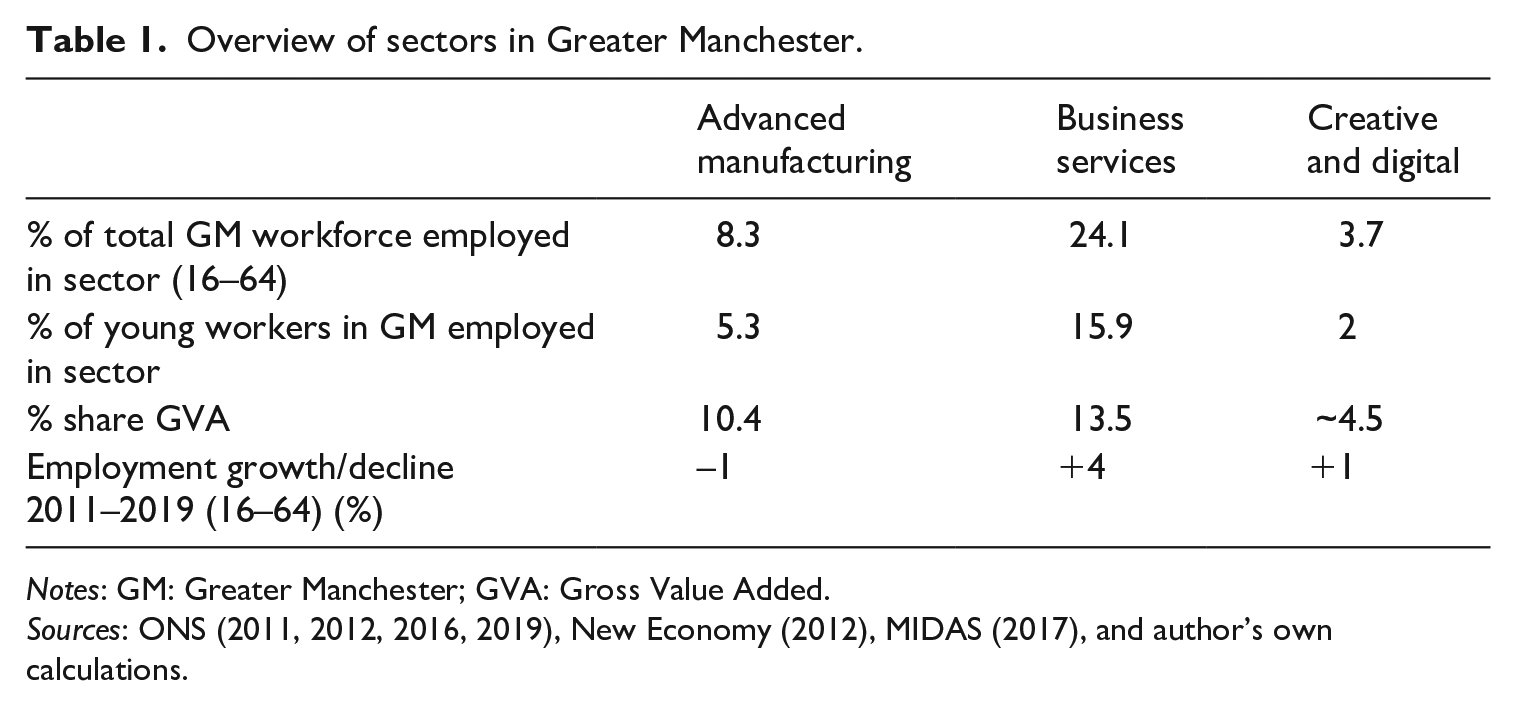
Notes: GM: Greater Manchester; GVA: Gross Value Added.
Sources: ONS (2011, 2012, 2016, 2019), New Economy (2012), MIDAS (2017), and author’s own calculations.
Two firms were purposively selected in each sector and all six firms shared a range of characteristics. All were market-leaders (or close to market-leaders) in their respective sub-sectors and had been operating long enough to develop HR strategies towards young workers (even if minimal). Firms ranged in size from small to large and comprised of UK- and foreign-owned firms. A detailed overview of each employer is presented in Table 2.
Overview of each employer.
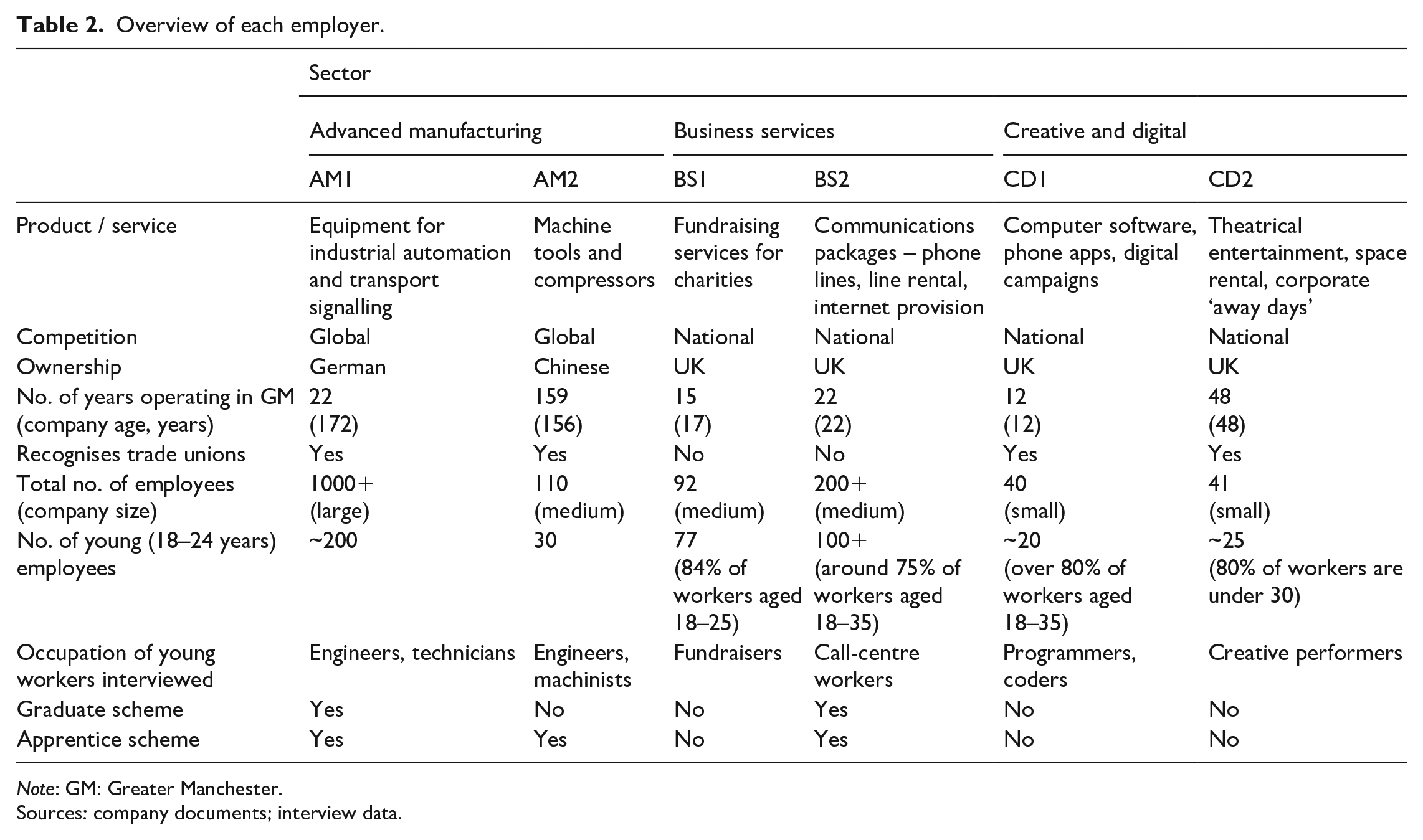
Note: GM: Greater Manchester.
Sources: company documents; interview data.
Thirty semi-structured interviews were conducted for the research. Interview distribution was: AM1: 7, AM2: 5, BS1: 5, BS2: 4, CD1: 4, CD2: 5. Interviews were transcribed and thematically coded using NVivo 11 software to allow systematic analysis. Purposive sampling was used to select participants whose knowledge and expertise would be relevant to the research. Interviewees included: owners of firms, CEOs, finance and HR managers, office and team managers, and young workers employed in various occupations at each employer. Interviewing senior figures (16 interviews) provided insights into strategic and operational decisions, while interviewing younger workers (14 interviews) illuminated working conditions. The choice was made to interview both managers and young workers because – while young workers can describe their own working conditions in detail – they are less likely to be able to identify the underlying reasons why particular managerial and strategic decisions were made. Interviewing managers and young workers also increased data reliability and allowed claims made by interviewees to be better verified.
Interviews were conducted only with young workers who were employed for their task-specific – rather than general – skills. At both AM firms, for example, young workers who were interviewed were young engineering graduates and apprentice technicians. This approach was not meant to detract from the importance of support staff, but rather to focus analysis on the core productive labour process of each workplace. Most interviews were conducted in the workplace, facilitating site tours of each employer that provided opportunities to record observations about how the labour process was organised. The interview schedule comprised questions which allowed interrogation of the extent to which technology was used by workers, the rate at which they work and the degree of discretion they had in their work, and also the levels of training which were provided in the workplace. Responses to these questions allowed a picture to be constructed of whether a firm pursued a high or low-road approach to productivity increases.
Data were also collected and analysed from secondary sources, including company documentation and reports. The purpose of data collection was to generate evidence to answer the two research questions of what are the variations in job quality for young workers within and across different industrial sectors, and why? And, what are the opportunities for – and limits to – improving job quality in these sectors for young workers? It was therefore necessary to triangulate findings from multiple sources to facilitate this process. In order to generate suitably rich and rigorous data and ensure sufficient analytical focus, the data collection and coding of interview data focused on the four main themes of technological utilisation, work-rate, autonomy and discretion, and skills and training provision across the three sectors, which were derived from a sustained literature review. These findings are analysed in section three, wherein systematic comparison of the different case studies is undertaken in reference to the concepts of job quality and high- and low-road productivity strategies. Section two presents thematically organised empirical findings from each of the case studies.
Deploying young workers in each sector
This section presents empirical findings pertaining to the four aspects of job quality for young workers in each of the six case studies. An overview of these findings is presented in Table 3.
Features of the labour process and training and skills provision at each employer.
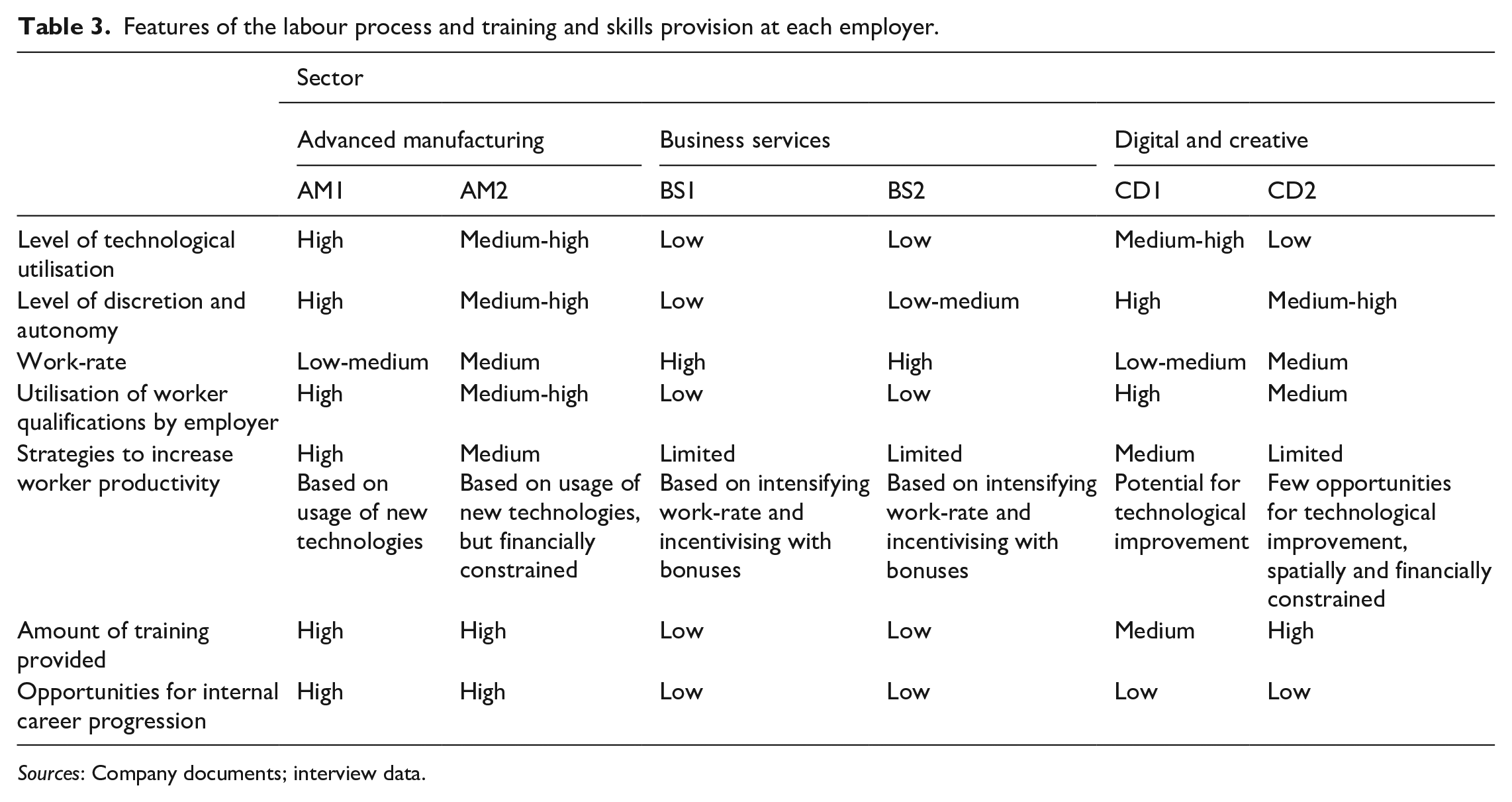
Sources: Company documents; interview data.
Technological utilisation
High levels of technological utilisation in the labour process of both AM firms were beneficial for young workers as it contributed to productivity increases in relative terms. AM1 and AM2 both used a variety of complex industrial machinery and related industrial processes to increase productivity. Production at AM1 involved integrated design and manufacture alongside continuous product testing and communication with other parts of the enterprise, including close communication with R&D (Senior Engineer, AM1). AM1’s market position as a world-leader in several sub-sectors in which it operated allowed it to invest heavily in cutting-edge machinery, thereby ‘reducing time invested in manual processes and meaning [the firm] work[s] more productively, more lean’ (Team Leader, AM1). Production was organised similarly at AM2, although there were limits to the extent production could be automated because of the nature of commodity production: [AM2] produce machinery used by NASA and Rolls Royce [. . .] if [they] need to have a +/– 5 micron tolerance then our work needs to be five times better to achieve that [. . .] You get to a stage where you almost can’t be five times better, there are diminishing returns and technological issues. (CEO, AM2)
Production therefore necessitated that workers engaged in some manual, labour-intensive activities, which the CEO commented on: We can never fully automate as [our production process] is very labour intensive [. . .] we use older machines to get close, then hand fashion parts. That is a very labour-intensive process . . . it will come [in the future], more automation instead of more intensification of labour. (CEO, AM2)
Technology was deployed at both BS firms to monitor the workforce and facilitate work intensification, thereby degrading job quality for young workers. BS1 used GPS monitoring to track worker location, which was reported to: stop people finishing [their shift] early and going to the pub . . . it has [led to more customer sign-ups], but through force. (Administrator, BS1)
Pervasive surveillance was also evident at BS2: [The whole job is] monitored – [it’s] constant. What calls you’re making, when you’re making them, how long for, [managers] don’t even need to be looking at a screen to see this – the system is set up so that if you’re not doing what you’re meant to be doing then it will be flagged, and the manager will be made aware. (Call-Centre Worker 2, BS2)
Technology was used very differently at both CD firms. The nature of the labour process at CD1 was heavily dependent upon workers applying job-specific skills – chiefly programming and coding – to produce new software and web design. CD2 made little use of technology – other than basic ICT packages – to improve worker productivity; this was due to the limited applicability of technology to the production of theatrical and artistic performances.
Work-rate
No evidence was found at AM1 of attempts by managers to speed-up production. Young workers found the pace of work to be manageable and commented on how it helped improve production standards: the [work] environment feels quite progressive . . . you can be working on something knowing that it is going to have some use in society, and isn’t going to get just [thrown] away . . . it makes me want to aim [for zero-fault work]. (Graduate Engineer 3, AM1)
Managers at AM2 intervened in the production process more frequently than at AM1, often resulting in a quickened pace of work. Interventions occurred because the occasionally labour-intensive production process could lead to mistakes being made which ‘cost a fortune [and] could set [whole teams back]’ (Engineer, AM2), resulting in lost time having to be caught up. Young workers were generally positive about working conditions at AM2, despite the occasionally fast pace of work: you know what [work] you’re meant to be doing, because you’re working on different processes with supervision [. . .] [AM2] also recruit locally so I’m working with lads I know from [school]. (Apprentice, AM2)
Young workers also mentioned that opportunities for internal career progression were available (Graduate Designer, AM2).
The work-rate at both BS firms was characterised by intensification, overwork and unpaid travel time. Young workers at BS1 were required to work excessively long hours, which they viewed as the result of poor planning by senior managers: . . . my hours [are] 9 a.m. – 9 p.m. every week [. . .] and it is intense working conditions, [and] the company doesn’t have an overriding aim, decisions seem to be made without much thought . . . I don’t think there is any strategy. (Office and Recruitment Manager, BS1)
The normal shift duration for fundraising teams was 3:30 p.m. – 9 p.m., although ‘staff need[ed] to be available from 1:30 [p.m.] each day’ as fundraising occurred in residential areas that were often long distances from the central office, leading to young workers being ‘out the house about nine hours a day [including] travelling’ (Office and Recruitment Manager, BS1). The working day for fundraising teams at BS1 was structured around achieving sign-up targets and failure to meet targets led to a policy where: [in] any [BS1] office [that’s] not hitting shift targets every manager has to go out and get three sign-ups per week. This takes quite a bit of time, and managers, they think [sign-ups] isn’t their job and that they’re being punished for the fundraisers not doing their job properly. (Office and Recruitment Manager, BS1)
The labour process for call-centre workers at BS2 was based on the repetition of a limited number of basic tasks broken down so they could be easily learnt. The repetitive nature of work was described by one young worker: You get in [to work] . . . there’s a brief team meeting to get you pumped for the day . . . then it’s straight on the phones to try and hit targets. (Call-Centre Worker 1, BS2)
Other young workers emphasised the lack of variety in the working day, which was dominated by the need to meet targets for calls made, received and successful sales. Excessively high work-rates contributed to severe turnover problems at both BS firms. Turnover rates were 20% per annum at BS2 (Call-Centre Manager, BS2) and 30% per annum at BS1, with an administrator noting: I’ve never known staff turnover like it [anywhere I’ve worked]. Thirty per cent of those [employed as fundraisers] only do a day – they get out there, hate it and leave. Most managers do about six months . . . and that’s actual managers, not team leaders! (Administrator, BS1)
There was little evidence of work intensification at CD1, despite their being staff shortages when the research was conducted. Workers were in fact given time off to engage in voluntary work and there was a well-developed flexible working scheme in place, along with high rates of remuneration (relative to the city-region average) and other benefits to attract staff (Co-Founder, CD1). These features of high job quality work were in part the result of the progressive political and moral beliefs of CD1’s co-founders. Young workers at CD2 also regarded their pace of work as reasonable and there were no attempts by management to try and speed-up the labour process for creative workers (Creative Worker, CD2).
Autonomy and discretion
The labour process at AM1 necessitated high levels of autonomy due to the complex nature of production. Workers were organised into teams which had control over how they used time in the working day to complete their tasks; these decisions were often made autonomously from senior managers (Graduate Engineer 1, AM1). Young workers were able to contribute to their team’s output while learning, offering their own input when possible (Graduate Engineer 2, AM1). Several interviewees said that work was organised ‘non-hierarchically’, with a vertical system of workforce organisation in operation (Team Leader, AM1). This organisational structure was beneficial for younger workers as it facilitated their ability to engage in work while learning without the pervasive pressure of managers looming ‘over their shoulders’ (Graduate Engineer 1, AM1), thereby reducing work pressure and allowing young workers to ‘get on with work [. . .] which is a change from school’ (Apprentice Technician, AM1). Staff at AM1 felt that they were able to use their ‘. . . knowledge [to decide] what work needs to be done, when, and at what rate’ (Senior Engineer, AM1). High levels of autonomy also manifested in flexible working time arrangements: ‘you can get flex[ible] working [arrangements] if you’ve been [employed] here a while’ (Graduate Engineer 1, AM1). Organisation of the labour process at AM1 resulted in high levels of job satisfaction among young workers, positively affecting job commitment. AM2 also operated team-based production processes, with teams composed of older experienced staff and younger graduates or apprentices. Aside from more frequent interventions by managers, which were justified as necessary to oversee the manual finishing of certain components, there were few other significant differences in levels of autonomy between AM1 and AM2.
Work autonomy was limited at BS1 and BS2 due to pervasive technological monitoring and the fragmentation of the labour process into simple repetitive tasks. The unstimulating nature of work itself facilitated further work intensification, as commented on by one worker: It’s not the sort of place that I want to be sitting around doing nothing – [the] day goes quicker if you’re working. I just want to go in there, do my work and get out again as quick as possible. (Call-Centre Worker 2, BS2)
The lack of autonomy or respite from monitoring was reflected in BS2’s office design, which was laid out so a manager could walk on a raised level above the call-centre floor to observe the workforce.
There was little evidence of work monitoring at CD1; staff had high levels of autonomy so long as work was completed. The labour process was individualised; staff worked on different aspects of code for a project independently, coming together in meetings and to join elements of work together. This environment contributed to the workplace having a ‘family-feel’ in which young workers were supported, and could ‘ask questions of anyone, anytime, without worrying about having made an error’ (Front-end Coder, CD1). The nature of creative, theatrical work at CD2 meant young workers had high levels of autonomy over how they went about their work and discussed ‘deeply enjoying’ the work they did (Performer, CD2). Young workers at CD2 were, however, not always involved in creative projects due to limited funding and employment opportunities. Many young creative workers at CD2 therefore also worked in administrative or support roles at CD2 to supplement their income. The labour process in these roles was characterised by the need to regularly complete standardised clerical duties and there was little scope for innovation or autonomy. Positive features of work at CD2 were buttressed by a unique decision-making structure wherein a rotating panel of young workers was empowered to make spending and recruitment decisions which senior managers were compelled to act on. This approach had the aim of ‘put[ting] young people at the heart of all we do’ and had the impact of moderating managerial excesses, while facilitating the recruitment of more young workers (Finance Manager, CD2).
Skills, training and career progression
Both AM firms produced high value-added commodities and thus required a highly skilled workforce. Workers with appropriate skills were, however, not always readily available from local labour markets and both AM firms therefore provided in-house training. Training for young workers at AM1 took the form of a graduate scheme and apprentice scheme. Apprenticeships at AM1 were rated outstanding in every category by external inspectors (Ofsted, 2016) and over 90% of apprenticeships were at an Advanced level, equivalent to an NVQ level three qualification. There were also opportunities for young workers to progress internally through AM1’s ‘global labour market’ (HR Manager, AM1; company documentation, AM1). AM2 had no graduate scheme but offered young workers fully-funded opportunities to progress from an apprenticeship through to postgraduate study. AM2’s CEO was committed to this approach: I’ve sacrificed salary and asked senior managers to [do the same] so we can continue to bring apprentices in [. . .] most of the engineers here [have] been sponsored right through. (CEO, AM2)
Training provision at BS1 and BS2 was limited due to the simple nature of the labour process, and it was delivered in a manner which sought to minimise overall labour costs. BS1’s training consisted of a ‘weekly session in the office, which is mandatory but unpaid . . . there’s little bits of training here and there, but nothing structured’ (Office and Recruitment Manager, BS1). Cost minimisation at BS2 took the form of exploitation of the apprentice scheme, wherein 16- and 17-year-olds worked in the call-centre ‘doing the exact same work as 18-year-old [workers]’ while being paid apprentice wages, and without any extra training being provided for them (Call-Centre Worker, BS2). Internal career progression was limited at both firms by their horizontal structure. Both BS firms’ workforce comprised large numbers of predominantly young, entry-level staff, smaller numbers of team-leaders and a very small senior management team.
CD1 provided few training opportunities due to the already highly skilled nature of the workforce. CD1 did, however, run a scheme allowing 16–18-year-olds to use CD1’s computers at weekends to practise coding under the supervision of staff. The aim was to identify potential future employees as a way of overcoming the shortage of skilled coders in the city-region. The co-founder noted that this ‘pipeline’ system was not an apprentice scheme as new starters were paid a full wage (Co-Founder, CD1). Internal career progression was limited at CD1 due to the small size of the firm; some young workers had moved from more junior roles to become senior developers, but further career progression necessitated moving to a larger employer. CD2 offered a wide range of training and skills development programmes for young workers, despite limited resources: [Employees] get something every six months [where we] discuss skills shortages and training needs [. . .] lots of our training is delivered in-house [. . .] our employees think [our training] is useful [. . .] the budget is small but what we squeeze out is excellent. (HR Manager, CD2)
CD2’s small size also limited opportunities for internal career progression, leading to high levels of turnover: We can’t retain good staff, staff move on, we get a lot of churn. There’s a huge cost behind that. You get people trained up so they are delivering above cost level, then they leave, so we’re right back at the bottom again. (HR Manager, CD2)
Discussion and conclusion
Data generated from the six case studies provides scope to answer the two research questions posed at the beginning of the article, namely: what are the variations in job quality for young workers, and why? And, what are the opportunities for – and limits to – improving job quality in these sectors for young workers? Findings reveal that variations in job quality for young workers stem from the particular needs of commodity production at each employer, which compels employers to oversee business strategies where the labour-power of young workers is either developed or degraded. While there were minor variations in job quality found within sectors, it was far more pronounced between sectors. The findings also reveal both opportunities for – and inherent limits to – improving job quality, which are now considered in relation to extant literature, and to answer the research questions.
The research focused on four aspects of job quality for young workers – levels of technological utilisation, work-rate, levels of autonomy and discretion, and opportunities for skills, training and career progression. Research findings illustrate the continued importance of technology in the labour process for shaping job quality for young workers. A crucial distinction is whether technology is used by skilled young workers to engage in work (as occurred at AM1, AM2 and CD1), or whether it is imposed on young workers by managers to intensify work (as occurred at BS1 and BS2). These findings support both skills- and effort-biased notions of technological change (Felstead et al., 2004, 2019), revealing how high-road strategies of relative surplus value generation and low-road strategies of absolute surplus generation can co-exist alongside one another within a locality. This finding illustrates the limits of positing an exclusively technological solution for poor job quality; while technology is sometimes a necessary factor for high-quality work, it is not by itself a sufficient factor. What is important is how technology is combined with the skills and capacities of young workers in the labour process. This research shows BS firms in particular operated profitable strategies predicated on using cheap, undifferentiated labour rather than engaging in higher value-added commodity production.
The case studies also illustrate the close relationship between levels of technological utilisation and levels of autonomy and work intensification. High valued-added production predicated on high levels of technological uptake generates a complex labour process which inculcates higher levels of workplace autonomy that can be team-based (as it was at AM1 and AM2) or individualised (as it was at CD1 and CD2). Team-based autonomy also facilitates the training and development of young workers, while individualised autonomy can give greater freedom and job satisfaction to young workers. These strategies contrast with BS firms which engaged in sweated production that degraded the labour-power of the young workforce employed in the sector. The labour process at CD2 was particularly interesting as low levels of technology did not lead to degradation of job quality. This was again due to the specifics of the commodity produced – theatrical performances – whose production cannot readily be fragmented or sped-up. Although creative and digital is classed by policymakers as a ‘new’ sector of the economy, both CD firms had labour processes which resembled craft production as workers were responsible for creating a commodity from inception to completion.
Levels of technological utilisation are also found to be closely related to provision of workplace training and accompanying opportunities for career progression. Firms whose strategic approach necessitates combining skilled labour with high levels of technology to produce commodities are far more likely to develop in-house training provision to ensure continued supply of skilled labour (as illustrated at AM1, AM2 and CD1). This business strategy benefits young workers – who are less likely to possess job-specific skills and experience than older workers – by facilitating skills development and progression within a firm, leading to higher job quality. Firms whose business strategy is based on employing cheap unskilled labour will, by contrast, do all they can to reduce labour costs, which seriously impacts job quality for young workers because of their increased likelihood of being on the periphery of labour markets.
Opportunities for and limits to improving job quality for young workers
Research findings reveal the importance of examining the relationship between high-road and low-road strategies and the labour process to understand the forces shaping job quality for young workers. This contribution illuminates how it is necessary to not focus exclusively and narrowly on young workers themselves in order to understand job quality, but rather to situate young workers within the context of a firm’s commodity production strategy. Adopting this approach allows for the theorising of young people in terms of the value of their labour-power to a firm, and how a firm either develops or degrades young workers in its production processes.
The research shows that while job quality can potentially be improved by pro-social or ethical managerial practices (AM2, CD1, CD2), these are by themselves insufficient for generating sustainable and lasting improvements in job quality for young workers because the economic compulsion for firms to remain profitable means that such strategies will likely be abandoned if they become an impediment to profitability. Improving job quality for young workers will only come from changes to the form commodity production takes, wherein it becomes more profitable and sustainable to engage in high-road strategies of relative rather than absolute surplus value generation. Until this point is achieved, there will always be contradictory tensions between developing or degrading labour, which manifest in the labour process in the areas of technological utilisation, autonomy, work-rate and training. These issues – while varying significantly by sector – are ultimately beyond the control of individual firms, or indeed industrial entire sectors, and structural change will likely only be the result of sustained government interventions in the form of long-term changes to fiscal, monetary and industrial policy, or major changes to the sectoral composition of the economy, which result in low-road strategies no longer being profitable for capital or acceptable to workers.
Despite the prevalence of structural constraints on improving job quality, the findings reveal areas where more immediate improvements to job quality can occur. In order to prevent young workers continuing to exist as a marginalised segment of the labour force due to their limited skills and experience, there needs to be a renewed focus on the provision of high-quality, relevant skills and training which can allow workers to undertake more complex forms of commodity production. Evidence from CD2, in particular, demonstrated that training provision can help young workers to advance in wider occupational labour markets if opportunities are not available in internal labour markets. Training and skills provision must, however, be externally accredited to ensure it is of a high standard; the failings of apprentice provision and the use of training as a form of unpaid labour worsens job quality for young workers, rather than improving it. Improving supply of skilled labour must also be matched by increased demand, something which has so far been lacking in UK industrial strategy, resulting in persistent issues of underemployment (Keep and Mayhew, 2010). Interventions could specifically target sectors which are sites of good work for young workers and provide them with financial and technical support to facilitate growth and development. This intervention could improve overall job quality in a manner which avoids generating extra government regulation of work and employment, something which successive UK governments have been loath to do (Taylor, 2017). ‘Picking winners’, by contrast, resonates with existing government policy and can be effective (Andreoni and Chang, 2016).
To conclude, this article set out to answer two research questions: what are the variations in job quality for young workers within and across different industrial sectors, and why? And, what are the opportunities for – and limits of – improving job quality in these sectors for young workers? The article has answered the first question by illustrating that variations exist because of intrinsic differences in commodity production across employers, which shapes their respective labour process. At the core of these differences is how the labour-power of young workers is either developed through combination with technology and accompanying training, or degraded through work intensification and monitoring. These variations are most marked between sectors, but variations also exist within sectors due to the nature of product markets. The article answers the second question by noting that immediate improvements to training and skills provision can act as a starting point for increased job quality, but this is a necessary and not a sufficient condition; it must be matched by demand for skilled labour which can be the result of changed economic conditions, state regulation or intervention, or worker pressure. The article ends by noting that low-road strategies which degrade young workers will persist while it is profitable for them to exist. Ultimately, the forces which act to degrade job quality are systemic rather than agential.
Footnotes
Acknowledgements
The author would like to thank Pauline Dibben, Katy Fox-Hodess, Jason Heyes, Richard Saundry, Adrian Wilkinson, Stefanie Williamson, the editorial and administrative team at WES, and two anonymous reviewers for their comments and feedback on earlier iterations of this article.
Funding
The author received no financial support for the research, authorship, and/or publication of this article.
