




Abstract
Experiences of work and employment continue to change but the concepts of job quality, job satisfaction and quality of working life remain compartmentalised and contextually disconnected due to entrenched disciplinary divisions, which hinder multi-level work quality theorisation. This article contributes to research on the sociology of work by integrating divergent streams of literature on these concepts with labour process theory to offer a more holistic and integrated perspective on work quality. Our multidisciplinary systematic review (n = 345) reveals the conceptual challenges and dynamics work quality researchers face within and between analytical levels, which we synthesise in this article in Figure 1. Three interrelated research agendas are proposed to bridge the gaps between different disciplines, work quality models and contexts. We argue that research combining objective and subjective features of work quality with wider labour process considerations can lead to richer interdisciplinary understandings and support improvements to working lives.
Keywords
Introduction
This article contributes to research on the sociology of work by systematically integrating multidisciplinary work quality literature with labour process theory to enable a more holistic, multi-level perspective on work quality. The article addresses the limitations of existing research by integrating the concepts of job satisfaction (JS), job quality (JQ) and quality of working life (QWL). JQ research mainly, but not exclusively, uses objective measures to evaluate various job aspects (Findlay et al., 2013), while JS research typically focuses on workers’ subjective job evaluations (Judge et al., 2017). Neither concept adequately conveys the complexity of lived experiences of work: JQ is often framed in terms of organisational perspectives and priorities, describing jobs in terms of objective tasks and rewards (Budd and Spencer, 2015), while psychologically oriented JS research typically focuses on conceptual antecedents, models and subjective measures rather than explicitly situating JS within its broader context. Despite previous calls in this and other journals for more research incorporating subjective experiences and objective measures (e.g. Brown et al., 2012), these streams of literature have rarely been integrated.
The concept of QWL offers the scope to extend sociological understandings by combining objective and subjective dimensions to work quality (Butler and Hammer, 2019), but neither of the two main QWL approaches provides a means of examining the broader context of work (e.g. political, geographic, economic or socio-cultural). Furthermore, while QWL is a normative concept encouraging organisational practices to support worker well-being, it does not necessarily capture the dynamic multi-level tensions impacting work quality.
The first conceptualisation of QWL was a psychological needs-based model (Porter, 1961), which was later updated to incorporate needs satisfaction and spillover theories (Sirgy et al., 2001). The second conceptualisation of QWL (Walton, 1973, 1974) was more political and captured the emancipatory ethos of the 1960s and 1970s. It generated tangible improvements to worker welfare but eventually fell out of favour due to the neoliberal turn emphasising financialised organisational interests (Guest, 2022). Noting the detrimental effects of this philosophical shift on contemporary workers, Grote and Guest (2017) reinvigorated interest in QWL by building on Walton’s (1973, 1974) framework to highlight what procedural elements of work (e.g. pay) and more communal work elements (e.g. organisational climate) should be present to contribute to workers’ emancipation. The dimensions in their framework resemble those studied by JQ researchers, but Grote and Guest also argue that QWL is a subjective concept reflecting how work is experienced. Their framework focuses on advancing high-quality work at meso and micro levels but does not extend to the macro level.
Grote and Guest (2017) propose that part of their model’s value lies ‘in stimulating research and provoking debate’ (p. 163). Warhurst and Knox (2022) answer this provocation in their manifesto, arguing that contemporary QWL frameworks should acknowledge and address challenges introduced with the rise of non-standard employment. Rather than proposing an alternative model, they suggest legislative interventions through the introduction of statutory minimum standards along with seven commonly accepted dimensions to JQ (e.g. representation and pay). In arguing for what could be, Warhurst and Knox focus their QWL article on urgent issues shaping our lived experiences of work. Yet beyond focusing on what should or could be, we need a more holistic and dynamic multi-level perspective to help researchers examine how work quality is experienced and how this can change over time.
To this end, we conduct a multidisciplinary review integrating research on JQ, JS and QWL with labour process theory (LPT). This is because LPT offers the scope to connect micro-level experiences to broader, shifting factors (Braverman, 1974; Edwards and Hodder, 2022; Laaser and Karlsson, 2021; Smith, 2015; Thompson and Vincent, 2010). Hence, it provides a theoretical basis to bridge the conceptual gaps between JQ, JS and QWL and enable more impactful multi-level research.
The article proceeds as follows. First, we provide a more detailed account of LPT’s links with the concept of ‘work quality’ and explain our aims and research questions. Next, we outline our systematic review process and findings. Based on our integrative review, we develop a multi-level framework to illustrate the inter-level and inter-disciplinary challenges work quality researchers face and outline promising future research agendas. Finally, we expand these debates by focusing on the diverse disciplinary perspectives and challenges underpinning work quality research to help academics from different disciplines engage with more comprehensive sociological understandings of work quality.
Labour process theory and work quality
JS, JQ and QWL are directly related to dynamic inter-level tensions over labour process control (Edwards, 1990). LPT can advance understandings of JQ, JS and QWL by offering a critical lens to examine how ongoing struggles over work quality at the point of production or service delivery are linked to broader shifts in capitalist systems (e.g. developments in technology, financialisaton, globalisation, labour markets and social factors). LPT assumes that employment relationships are underpinned by enduring tensions between managerial control (e.g. direct, technological, bureaucratic) and worker autonomy (e.g. decision-making power, discretion, locational flexibility).
Changing labour processes over the past 40 years (Wegman et al., 2018) have created or exacerbated problems such as work intensification (Adăscăliței et al., 2022), digital surveillance and algorithmic control (Wood et al., 2019), job polarisation (Visser, 2019) and casualisation (Olding et al., 2021). These changes have serious sociological implications for work and employment because post-Fordist institutional regimes drive the spread of low-autonomy, low-skill work that fails to ‘provide decent living standards for the workers who fill these positions’ (Vidal, 2013: 605) and can adversely impact their physical and mental health (Cottini and Lucifora, 2013; Van Aerden et al., 2016). Empirical studies examining work quality and explicitly discussing LPT mainly engage with the concept of job quality and are surprisingly rare (Vidal, 2013; Wood et al., 2019; Yates, 2022).
We adopt Cooke et al.’s (2013: 504) concept of ‘work quality’ to align with LPT’s multi-level approach. ‘Work quality’ encompasses non-waged variants of work such as entrepreneurship and ‘places the job against its wider socio-economic context’. We extend this concept to include the micro-level personal context of work. While our sociological objectives align with Cooke et al. (2013), we are not implying that future research should abandon JS, JQ and QWL for a new conceptualisation of work quality as a distinct phenomenon. Instead, we primarily use the phrase ‘work quality’ to refer to the integration of JS, JQ and QWL literatures for the sake of clarity and to reflect our engagement with LPT (Vincent et al., 2020). Going forward, the QWL concept has the potential to explicitly integrate JS and JQ streams of literature given its aim of combining subjective and objective dimensions, but it currently lacks a focus on broader contexts.
Accordingly, this article has two aims: first, to consolidate JQ, JS and QWL literature to evaluate the breadth and limitations of these concepts; second, to develop a more holistic framework, which captures the challenges work quality researchers face and illustrates multi-level future research agendas. Consequently, we pose the following questions: how are the concepts of JS, JQ and QWL applied in work quality research? And how can existing inter-disciplinary and inter-level challenges be addressed in future research? In the following section, we explain the method adopted to identify and analyse articles about JS, JQ and QWL.
Method
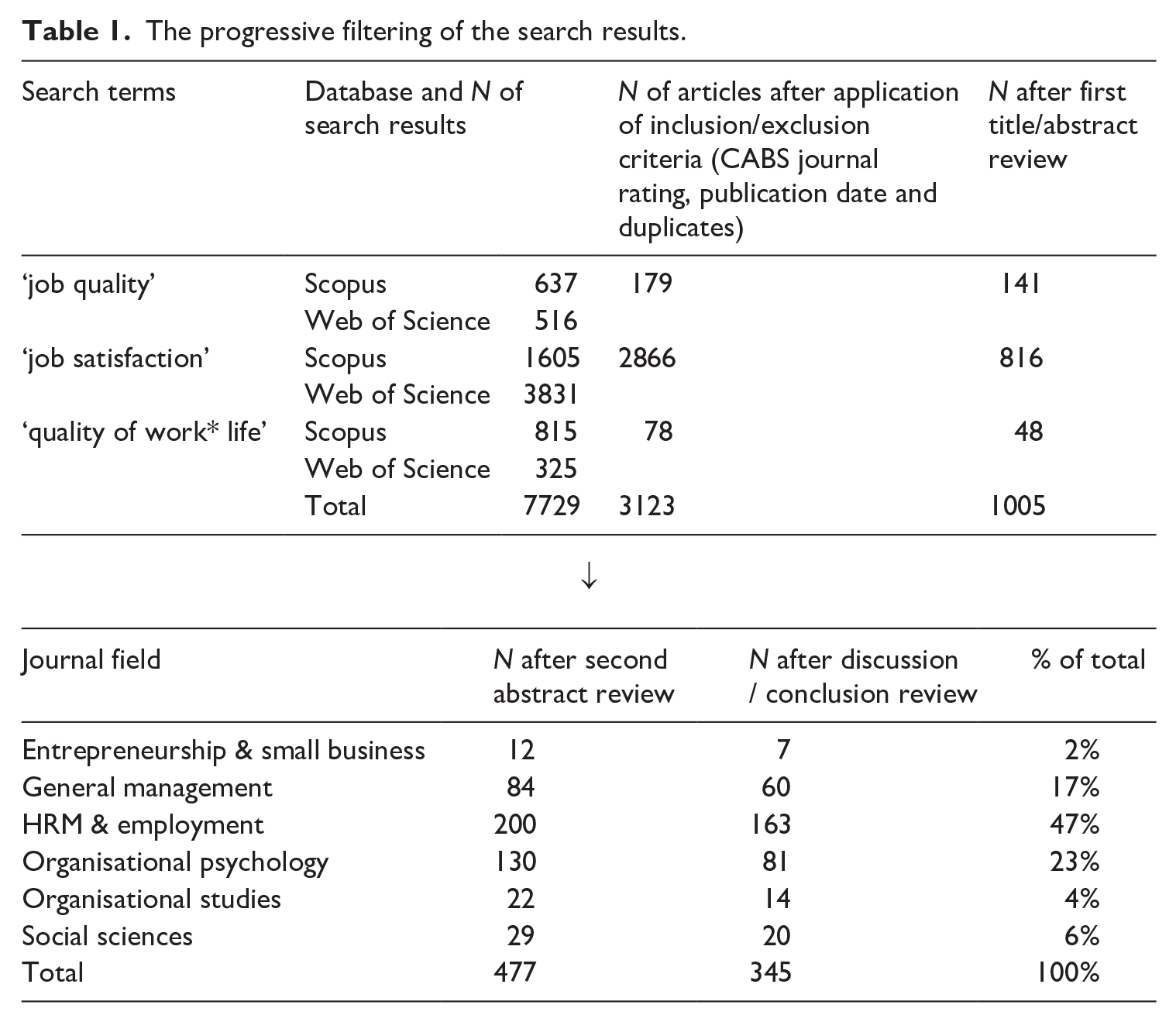
To add to our existing knowledge of significant and highly cited texts on work quality we conducted a systematic literature review; this approach offered comprehensiveness within the boundaries of the inclusion criteria and enabled transparent reporting of the review process (Hiebl, 2023; Petticrew and Roberts, 2006). First, a scoping exercise identified key terms used in work quality articles from different disciplines. The first author then conducted searches for empirical articles on JQ, JS and QWL through two extensive databases (Scopus and Web of Science) using broad search terms reflecting the focus of the research questions, namely ‘job quality’, ‘job satisfaction’ and ‘quality of work* life’. Combined, the searches generated 7729 results.
We applied the timeframe of January 2007 to March 2022 for online publication as an inclusion/exclusion criterion (some articles appeared in print after March 2022). We selected this period because it was bracketed by two major incidents that generated significant challenges to good-quality work. First, the global financial crisis resulted in widespread austerity measures (Ayudhya et al., 2019; Cunningham et al., 2021) and accelerated structural changes to work (Richards and Sang, 2019). Second, COVID-19 widely disrupted working life and led to measurable impacts on individuals (Venkatesh et al., 2021), organisations (Hadjielias et al., 2022) and economies (Probst et al., 2020).
Next, we applied quality and discipline filters as further inclusion/exclusion criteria to facilitate a more manageable number of high-quality search results. We focused on articles published in journals from the disciplines of social sciences, human resource management (HRM), management, organisational studies, entrepreneurship and organisational psychology rated 4*, 4 and 3 by the Chartered Association of Business Schools’ (2021) Academic Journal Guide.
Applying these exclusion criteria and removing duplicates reduced the number of articles to 3123. The articles were then screened for relevance by title and abstract, leaving 1005 articles. As Table 1 indicates, these articles were grouped by journal subject. Articles in which JQ, JS and/or QWL were of secondary or incidental interest were excluded from the literature base (n = 528) via a second review of abstracts. The discussion and conclusion sections of the remaining 477 articles were reviewed, leading to the retention of 345 empirical articles focusing on the analysis of JQ, JS and/or QWL.
The progressive filtering of the search results.
The 345 articles were read in full and key theories, approaches, settings and contributions were recorded and discussed repeatedly among the project team. We also noted the appearance of key texts (e.g. Kalleberg, 2011) and included these to facilitate a comprehensive integration of the literature. The next section provides an overview of the work quality literature.
Findings
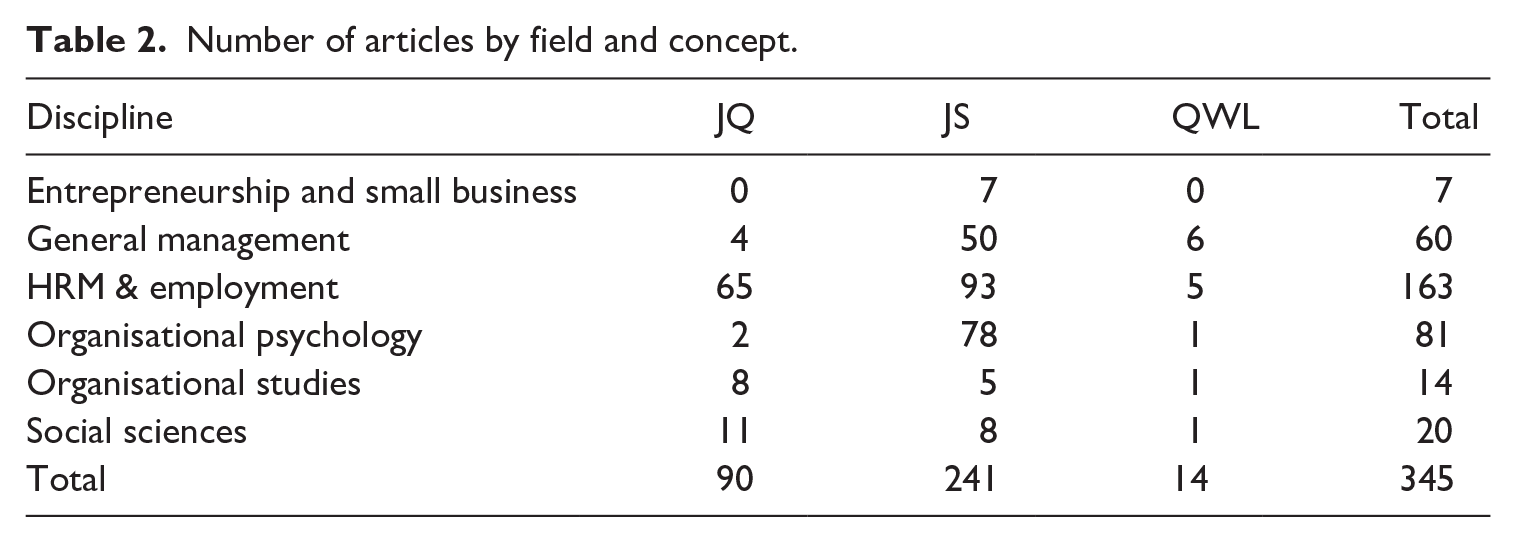
Grouping the articles (n = 345) in our final sample by journal subject facilitated an understanding of the major concerns and perspectives by field. Our final sample of articles highlighted disciplinary divisions, with the majority of work quality research adopting either organisational psychology perspectives or HRM and employment perspectives. Table 2 shows that JS is by far the largest of the three streams of literature, and as expected organisational psychology research has overwhelmingly focused on JS. This was also the case for general management, entrepreneurship and small business research. HRM and employment, organisation studies and social science literature has been more balanced between JS and JQ research. We found only 14 articles using QWL frameworks, supporting Grote and Guest’s (2017) assertion that QWL has been overlooked in the recent past.
Number of articles by field and concept.
We identified three dominant levels of analysis in the work quality literature: micro-level individual, meso-level organisational and macro-level social/institutional. However, conceptual and empirical interconnections meant we could not exclusively discuss JS at the micro level, QWL at the meso level and JQ at the macro level as we had expected.
Micro-level findings and limitations
Micro-level research explored individuals with identifiable internal and external characteristics such as personality types (Templer, 2012) and disabilities (Haile, 2022). While most micro-level research has explored JS from a psychological perspective, some JQ and QWL scholars adopting sociological or managerial perspectives have focused on the micro level. Researchers have tended to use psychological approaches to explore how dispositional factors such as personality traits influence work experiences, or sociological and managerial approaches to study situational factors such as life stage and disability status. While scholars broadly agree that dispositional and situational factors influence work quality experiences, a core micro-level debate is the relative strength of these factors (Keller and Semmer, 2013).
Dispositional research demonstrates that individual factors such as self-esteem influence JS (Judge et al., 2008), and some personality traits have been shown to have a positive relationship with JS in Western and Asian contexts (Templer, 2012). Intrinsic preferences also shape JS (Boezeman and Ellemers, 2009). For instance, an individual’s calling orientation (perceiving work as intrinsically meaningful and socially beneficial) can impact JS, especially for workers who feel unable to adequately fulfil their calling through their work (Duffy et al., 2022).
Situational research often explores work quality for people with culturally meaningful socio-demographic traits such as gender, race and disability. For example, non-White and ethnic minority workers in the US are more likely to experience poor JQ as inequities in shift assignments, shift cancellations and working hours push them towards more precarious employment (Storer et al., 2020). Milner et al. (2015) show that disability status modifies the relationship between JQ and mental health outcomes, with disabled workers more likely to experience low-quality work and more likely to have negative health outcomes in low-quality work. While much of this research focuses on single traits, some articles (e.g. Lundquist, 2008; Smyth et al., 2021) adopt intersectional perspectives. Salter et al. (2021) explore intersectional impacts of age, race, gender, sexual orientation and disability on JS, demonstrating that certain groupings of demographic characteristics result in stronger negative effects depending on an individual’s social context.
Micro-level debates often fail to consider the situation and disposition of individuals in tandem. Person–environment fit (Chen et al., 2016; Gabriel et al., 2014; Yu, 2016) and life stage research (Keller and Semmer, 2013) are notable exceptions. For example, life stage research affirms that core self-evaluation (disposition) and level of job control (situation) work together to affect JS longitudinally (Keller and Semmer, 2013). However, more problematically, studying individual characteristics such as gender, ethnicity or personality as discrete phenomena overlooks broader factors emphasised in LPT, including meso-level organisational practices, power relations between actors and wider socio-economic and political contexts.
Meso-level findings and limitations
Meso-level work quality research is primarily concerned with phenomena directly impacting working life such as HRM practices, working relationships, and specific professions and workplaces; it attempts to determine which factors are important (and to what degree) in terms of JS, JQ and QWL. Research at this level often adopts managerial organisation-centric approaches (Snyder et al., 2021) or sociological workforce-centric (Jones et al., 2017) approaches, which contributes to a more-or-less implicit debate regarding the chief beneficiaries of work quality and the degree to which organisations are responsible for facilitating good-quality work.
Some workforce-centric research focuses on work quality in regard to specific professions and occupations, including agricultural work (Fabry et al., 2022), cleaning (Lene, 2019), the judiciary (Anleu and Mack, 2014) and IT (Trusson et al., 2018). Such research demonstrates that occupational pressures and opportunities influence work quality across as well as within organisations. For example, frontline healthcare workers describe the intrinsic satisfaction that comes from interactions with patients and peers, but also report how dissatisfaction with extrinsic aspects of their job, such as low pay, can cause them to leave (Morgan et al., 2013).
Other workforce-centric research explores relational work aspects, such as Artz et al.’s (2017: 419) longitudinal research, which found ‘a boss’s technical competence is the single strongest predictor of a worker’s JS’. Beyond this first-line relationship, Dalal et al. (2011) found that employees’ satisfaction with upper and middle management has measurable impacts on other types of satisfaction (e.g. pay) and overall JS.
Organisation-centric research is sometimes sympathetic to worker experiences and outcomes but theorises about organisations and/or from organisational perspectives. For instance, Abasabanye et al. (2018) show how perceived JQ is higher among office cleaning workers when they are seen (literally and metaphorically) by service recipients and conclude that contact leads to more socially responsible behaviour by organisations.
HRM research adopts organisation-centric approaches to describe work quality’s influence on organisational commitment and turnover (Rajabi et al., 2021): an intention to leave is strongly linked to low JS (Chen et al., 2011; do Monte, 2012; Staelens et al., 2018), and JS can be a strong predictor of organisational commitment (Dirani and Kuchinke, 2011; Saridakis et al., 2020; Top and Gider, 2013). This stream of research also explores the performance and productivity implications of work quality, typically in terms of JS (Alessandri et al., 2017; Bockerman and Ilmakunnas, 2012; Netemeyer et al., 2010).
Despite offering insights into workplace interactions and how they are subject to management practices, meso-level research (like micro-level research) usually neglects the relationship between control, autonomy and power emphasised by LPT and the socio-economic, institutional and political factors shaping JS, JQ and QWL. Moreover, meso-level research usually overlooks micro-level dispositional and situational factors, which may provide more refined conceptualisations of how work quality is experienced in organisations.
Macro-level findings and limitations
At the macro level, scholars position workers as living in geographically specific places, subject to cultural and politico-economic influences. The main conceptual divide at this level is between sociological research adopting institutional perspectives (e.g. Kalleberg, 2011) and sociological research taking a more socio-cultural focus (e.g. Pacheco et al., 2016; Shoss and Kueny, 2022).
Trade unions and other collective organisations (e.g. works councils) operate at multiple levels, but research into trade unions is usually framed by macro-institutional perspectives. Industrial relations scholars use both cross-national (Hipp and Givan, 2015) and country-specific research (Garcia-Serrano, 2009) to demonstrate how the nature and strength of the trade union–JS relationship varies by national context, suggesting that socio-political identity, or citizenship, is a key factor shaping work quality experiences. Collective voice is a vital mechanism linking trade unions and JQ; union members with an on-site representative reported higher JQ than those without (Hoque et al., 2017). However, Wood’s (2016) study of a retail company illustrated issues around power and influence by revealing how the recognised union was unable to influence management decisions regarding flexible working policies, even when these were detrimental to workers’ JQ.
Institutional research also shows how legislative environments can cause variation in work quality outcomes across nations. Holman (2013) found the presence and quality of job types (e.g. high-strain or passive) in the EU differed by institutional regime (e.g. continental or transitional). Frege and Godard (2014) compared JQ in Germany and America using a novel conceptualisation of JQ as a composite of civic principles (e.g. fulfilment, empowerment). They contend Germany’s more institutionalised environment supports higher JQ than America’s liberal market approach, but it is important to acknowledge within-country variation in such national-level assessments.
While institutions clearly influence work quality, scholars have shown that less explicit socio-cultural systems also impact work experiences. For instance, Wu and Chiang (2007) tested the relationship between Chinese cultural values and JS for Chinese and Taiwanese employees, finding moral discipline to be the only dimension with an equally strong effect for the two groups. Brazilian hotel workers’ JS was influenced more by intrinsic factors (e.g. achievement, responsibility) than extrinsic factors, which Sledge et al. (2008) attribute to Brazilian cultural values celebrating hard workers. In the EU, older workers’ internalised national stereotypes about age influenced how they interpreted their working life and in turn impacted their JS (Shiu et al., 2015).
Macro-level research provides important insights into external actors and their power, and how economic, institutional and socio-cultural systems influence work quality. However, research at this level tends to neglect micro-individual and meso-organisational variation within wider contexts. Relatedly, macro-level research usually lacks a focus on workplace control regimes and how they link to broader political economy contexts as highlighted in LPT.
The next section builds on the above overview of JS, JQ and QWL literatures and presents a multi-level work quality framework. This more holistic and dynamic framework can be used to guide future research, policy and practice.
A multi-level work quality framework
Our findings demonstrate that work quality theorisation is often fragmented, focusing on JS, JQ or QWL at selected micro, meso or macro level(s). Consequently, Figure 1 advances a multi-level framework drawing on LPT. The framework bridges work quality perspectives by capturing the conceptual challenges researchers need to navigate between and within analytical levels. We do not suggest that scholars must resolve these conceptual challenges to produce impactful research, but we do argue that understanding key debates outside one’s immediate discipline, research interest and onto-epistemology enables more refined and compelling theorisation.
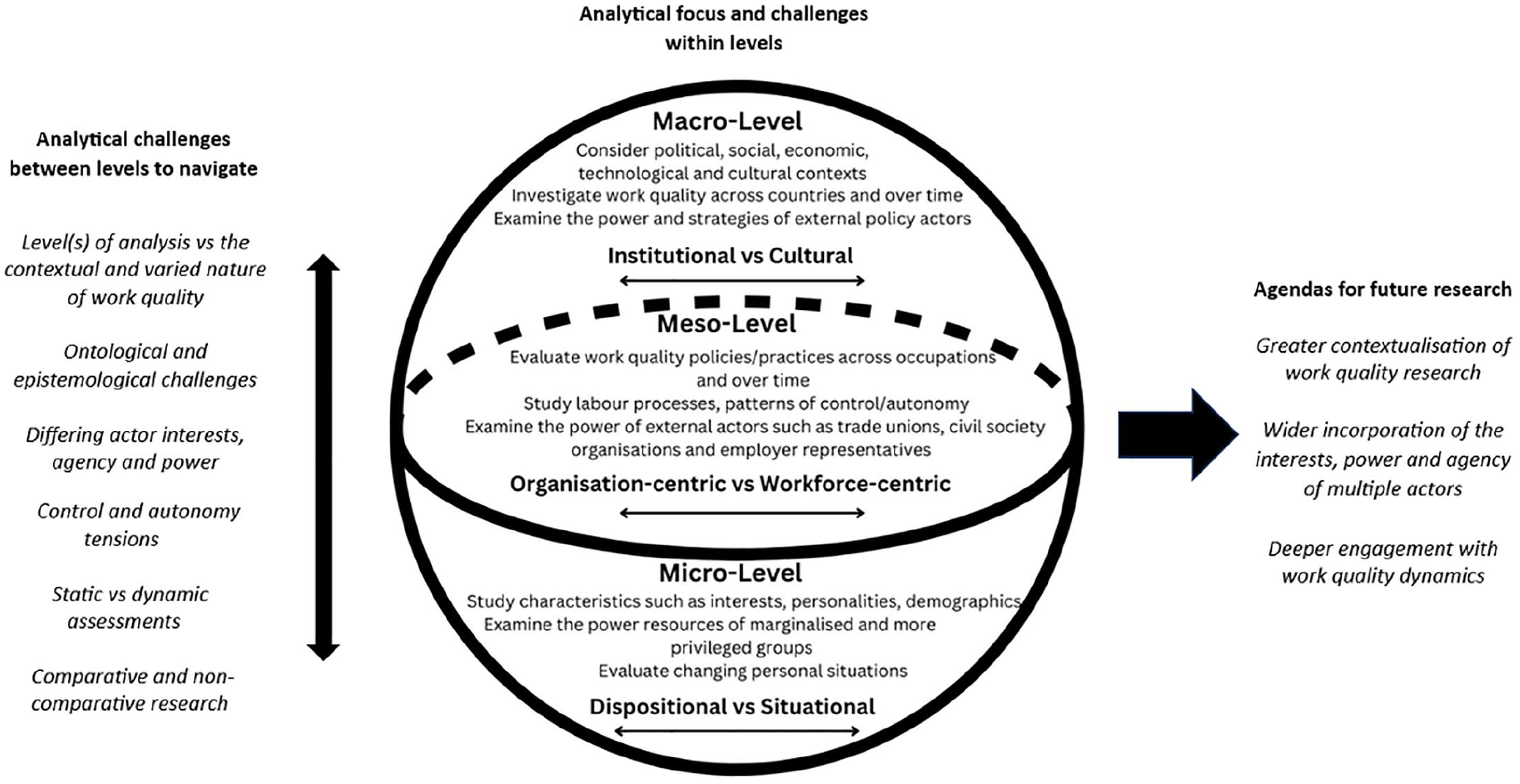
A multi-level perspective for future work quality research.
Based on the challenges illustrated in the framework, we identify three interrelated agendas for future research that can facilitate more holistic, nuanced and sociologically relevant understandings: ‘Greater contextualisation of work quality research’, ‘Wider incorporation of the interests, power and agency of multiple actors’ and ‘Deeper engagement with work quality dynamics’.
Greater contextualisation of work quality research
As Figure 1 shows, our review of existing work quality literature highlights the challenge of balancing ‘foci of analysis and context’ across micro-, meso- and macro-level perspectives. While LPT encourages linking micro-level experiences to broader meso and macro contexts, few work quality studies have been multi-level; those that do exist make strong and nuanced contributions. For example, Cunningham et al. (2021) focus on HRM capacities and priorities in care work at the meso level but contextualise how these priorities were impacted by macro-level austerity measures in Scotland. Likewise, Benton and Kim (2022) illustrate how economic policies can encourage industry-wide dependency structures leading to market concentration; the resulting surpluses or deficits at the firm (meso) level impact JQ for individuals. Multi-level studies on job satisfaction are even rarer, but Liu et al.’s (2012) longitudinal research shows that mismatches between individual and unit-level JS changes turnover intentions, and that both levels of JS change over time.
QWL may lend itself more readily to multi-level research than JQ and JS because it promotes studying objective and subjective factors in tandem. For instance, Danford et al. (2009) explore how climatologists at a government-owned British research institute experienced declining QWL, especially in terms of autonomy, as the macro-level turn towards science as a commercial enterprise led to further bureaucratisation of meso-level structures and practices. The scientists’ experience of QWL included tensions between their desire to ‘do science’ and the need to ‘perform’ according to bureaucratic diktats; unfortunately, climatologists also reported a loss of voice and influence over their working environment.
Micro-level work quality research can contribute to meso- and macro-level research by providing valuable insights into how individual characteristics and personal contexts shape perceptions and experiences of work quality. However, meso-level research adds to micro and macro research a focus on organisational policies, practices and how they are experienced by workers and managers. Moreover, in line with LPT assumptions, macro-level research can help situate micro and meso factors within broader political, economic and social conditions; for example, to understand how manager and worker choices are constrained (Thompson, 2013). However, although LPT encourages researching individual experiences, LPT research tends to overlook individual characteristics shaping those experiences. Additionally, while LPT highlights the need to situate work experiences within broader political economy contexts, LPT research could focus more on socio-cultural factors.
To provide an example of how multi-level research can contribute to current debates, life stage studies are rare examples of micro-level research considering dispositional and situational factors in tandem (as noted in the findings section). However, in line with LPT assumptions, the situational concept of ‘job control’ needs contextualising beyond the micro level to consider organisational voice practices (Wilkinson et al., 2020), power relations and broader conditions impacting organisational strategies.
To further illustrate, micro-level research on disabilities would benefit from insights into how individual and organisational factors interact to shape work quality. For example, Haile (2022) found that although disabled employees’ JS was higher in organisations with robust inclusion policies, their non-disabled peers had lower levels of JS, emphasising the varied nature of work quality experiences. To extend our understanding, the impact of broader factors such as labour markets and societal perceptions of disability and mental health should also be evaluated.
Furthermore, more multi-level research is needed on how unions influence workers’ JS, JQ, QWL and the micro-, meso- and macro-contextual conditions shaping their impact. Green and Heywood (2015) affirm dissatisfaction among union members, suggesting that satisfaction peaks at the beginning of their membership, then typically diminishes over time. Bessa et al. (2021) agree that union members have higher levels of dissatisfaction than non-union members but argue that membership is a consequence rather than a cause. Moreover, Blanchflower et al. (2022) claim that union members in Europe and the US have higher JS than their non-union peers, which they suggest may be due to collectively agreed higher wages and stronger institutional protections for employees. Given that union effectiveness is partially dependent upon employers’ behaviour (Simms, 2017), researchers should examine how management styles (Artz et al., 2017; Dalal et al., 2011) and micro-level personality traits (e.g. narcissism) impact management–worker relations as situated within their broader political, economic, institutional and cultural contexts.
As Figure 1 shows, ‘onto-epistemological challenges’ can emerge when integrating analytical levels and philosophical assumptions. Yet the disciplinary compartmentalisation of knowledge poses greater risks for individuals, organisations and society because addressing complex and interconnected work quality issues requires multi-level perspectives. Researchers could adopt materialist sociological approaches that ontologically and epistemologically accommodate multi-level research (Dundon and Dobbins, 2015; Edwards, 2017). Future studies may continue to contribute to knowledge at a specific level but engage with multi-level influences in the analysis undertaken. Researchers can also acknowledge relevant literatures and suggest future research avenues that extend beyond their own interests, onto-epistemologies and methodological preferences.
Wider incorporation of the interests, power and agency of multiple actors
Our consolidation of work quality articles identified a third challenge of incorporating ‘differing actor interests, agency and power’, which spans micro-, meso- and macro-level perspectives. We support Grote and Guest’s (2017) assertion that work quality research considering the perspectives and interests of workers and managers is relatively rare, especially at the meso level and outside industrial relations literature. Our framework encourages expanding analyses to acknowledge micro- and macro-level influences. For example, as indicated in Figure 1, evaluations of individual power resources and agency are crucial in examining work quality variations between and among worker groups.
As an illustration, suppose we wanted to conduct a sociological study of workers in manufacturing, combining the analysis of worker- and organisation-centric approaches and examining the experiences of marginalised migrant workers. We might begin by conducting ethnographic observations and interviewing workers to better understand their day-to-day labour process and working lives. We could then collect employer survey data about a range of QWL dimensions and organisational outcomes. Using our framework as a guide, we may be more likely to ask workers specific questions about power and influence at work. We could include questions about micro- and macro-level influences in our employer survey, perhaps by incorporating life stage factors or asking about perceived community and state support. Later, analysis of our rich, multi-level data could support novel theorisation at the nexus of workforce- and organisation-centric approaches.
Relatedly, understanding how ‘control and autonomy tensions’ within the employment relationship cut across micro, meso and macro levels and impact work quality is a key challenge. For work quality researchers focusing on the micro or meso level, incorporating analyses of broader contextual conditions would encourage examining how a wide range of external actors such as the state, unions, civil society organisations, employer representatives and transnational bodies shape these control–autonomy tensions. For example, external actors can support workers to challenge managerial control over work quality. Control–autonomy tensions are highlighted in LPT but are rarely explicitly incorporated into work quality research. However, we extend LPT research because external actors like the state and unions have received far more attention in broader industrial relations literature (Nechanska et al., 2020).
Koumenta and Williams (2019) demonstrate why a multi-stakeholder perspective on work quality is essential. They attribute the prevalence of zero-hours contracts to enhanced employer power, the lack of institutional labour protections and trade union involvement in organisational governance structures. They demonstrate that zero-hours contracts are not evenly distributed across occupations but mainly clustered in low-skilled and semi-skilled work, arguing that this concentration is due to power imbalances between employers and workers in largely labour-intensive service sectors such as hospitality and care work. Their study facilitates debate over who benefits from and who is responsible for work quality by considering the implications of zero-hours contracts for workers and organisations, while also assessing the role of the state and trade unions.
Deeper engagement with work quality dynamics
The fifth challenge included in our framework is navigating between ‘static and dynamic assessments’ of work quality, which is again relevant across micro-, meso- and macro-level perspectives. Integrating insights from research at each analytical level can help embed temporal and methodological dynamism into future work quality studies. LPT encourages a temporal focus on how socio-political transformations impact workplace relationships and control patterns over time. However, LPT research could focus more on situating micro-level temporality within wider contexts.
At the micro level, JS and JQ change as people gain work experience (Li et al., 2016) and move through different life stages (Georgellis et al., 2012). For instance, Belardi et al. (2021) demonstrate that chefs’ subjective assessments of objective JQ dimensions vary by life stage. The physical strain of restaurant work is objectively and steadily high, but its impact on subjectively experienced JQ tends to increase as chefs age. JQ also changes alongside meso-level HRM practices (Lindsay et al., 2014) and shifting ethical climates influence JS (Itani et al., 2019). Process studies naturally foreground dynamism and can highlight changes to work quality, as in Van der Borg et al.’s (2017) nuanced description of how meso-level changes intended to improve service quality in care homes also improved workers’ QWL. Likewise, macro-level changes to the economic climate (Visser, 2019) and cultural values (Huang and Gamble, 2015) dynamically shape JQ and JS, respectively. For example, austerity measures taken after the 2010 Greek economic crisis substantially degraded working conditions in Greece (e.g. by reducing the availability of basic supplies and support personnel), leading to a lower-QWL for high-skilled workers (Ayudhya et al., 2019).
A related challenge illustrated in Figure 1 is navigating between ‘comparative and non-comparative research’. While overly broad research designs may lack depth, incorporating dynamism could involve undertaking more comparative research over time, a more common feature of macro-level research (across countries, e.g. Greenan et al., 2014) or meso-level research (across occupations in a national setting, e.g. Anleu and Mack, 2014; Danford et al., 2009; Lene, 2019). Institutional perspectives often show that work quality is dynamic over time through comparative studies of international trends. For instance, Bisello et al. (2022) show that the relationship between the 2008 recession, employment mobility and JQ in Europe was substantially different on a by-country basis due to national socio-economic contexts. Moreover, longitudinal institutional research has stimulated debates over the relationship between low- and high-quality jobs, which can be extended further by future research. For example, Greenan et al. (2014) argue that QWL in the EU declined from 1995 to 2005, and the increased use of temporary contracts from 2000 to 2005 contributed to declining QWL across member nations (Wagenaar et al., 2012). In contrast, Oesch and Piccitto (2019) argue that polarisation is overstated, demonstrating that between 1992 and 2015 the number of low-quality jobs (in terms of wages, education, prestige and JS) decreased alongside a larger increase in higher-quality jobs in Germany, Spain, Sweden and the UK.
Cultural expectations also change over time. Shoss and Kueny (2022: 1205) take a macro-level approach to study the ‘socio-cultural-economic-temporal context’ of JS in the US from 1989 to 2016. They found a negative trend whereby mismatches between employees’ desired and actual job characteristics resulted in lower JS in 2016 than in 1989. Shoss and Kueny argue this was due to changes in the nature of work over the period, and in the more recent past, employees’ increased desire for meaningful work. Comparative research adopting institutional and cultural perspectives could add to micro-level studies. For example, race and ethnicity are popular topics for micro-level work quality research. Surprisingly, this research overwhelmingly focused on the US, which is far from the only nation with a complex racial and ethnic environment. Moreover, changes to institutional contexts and cultural values over time impact how individual characteristics shape work quality.
Deeper engagement with work quality in future research designs includes potentially re-visiting widely used models and methodological approaches and assessing whether they need further development to better account for changing work contexts. Work quality research at the macro level predominately uses JQ frameworks and often utilises secondary data sets such as the European Working Conditions Survey (e.g. Holman, 2013) and European Labour Force Survey (e.g. Oesch and Piccitto, 2019), which can sometimes limit scholars to blunt proxy measures of JQ (typically wages) rather than more nuanced and dynamic multidimensional JQ constructs. Additionally, non-standard work arrangements are a pressing concern in workforce-centric scholarship. Dunn (2020) accounts for new forms of employment, finding workers’ subjective assessments of JQ resulted in varied work experiences. However, Myhill et al. (2021) and Dunn (2020) argue that current JQ models have limited relevance for new forms of employment because they are based on standard employment relationships, suggesting that traditional JQ models may need adapting over time.
Having presented a holistic work quality framework and three interrelated research agendas, we now explain the implications for work quality theory and policy.
Discussion and conclusion
This article offers four main contributions. First, our multidisciplinary review contributes to JQ, JS and QWL research by highlighting the value of integrating these streams of literature. Work quality as a lived phenomenon is messy, dynamic and sometimes confusing, but JS, JQ and QWL theorising often fragments the world beyond the point of pragmatism into siloed debates that cannot meaningfully contribute to practice or policy because they do not account for complexity or offer sufficient nuance. We found that most articles on work quality focus on JS and adopt psychological micro-level perspectives. These findings echo broader debates in work and employment literature around the psychologisation of HRM (Dundon and Rafferty, 2018; Vincent et al., 2020) and employee voice (Barry and Wilkinson, 2016; Nechanska et al., 2020). JS research can offer insights into how human factors influence work quality; for example, researchers can examine work quality contradictions that potentially constrain improvements in JQ, such as individual satisfaction with low-quality jobs (Lene, 2019). However, work quality is situated within institutional and socio-cultural contexts. Therefore, holistic JS research must include these factors to provide sociologically relevant theorising. The concept of QWL implicitly encourages studying objective and subjective factors in tandem and therefore could integrate JQ and JS literatures in the future. We join Warhurst and Knox (2022) and Grote and Guest (2017) in advocating for increased use of QWL as a sociologically relevant and potentially emancipatory framework for understanding and improving work quality. However, at this stage of its (re)development, key QWL conceptualisations operate at either micro (Sirgy et al., 2001), meso (Grote and Guest, 2017) or macro (Warhurst and Knox, 2022) levels.
As a second contribution, we develop a more holistic and multi-level framework based on our integrative literature review that work quality researchers can use to guide research designs and foci of analysis. The framework adds to existing QWL literature because where Grote and Guest (2017) normatively describe what should be at the meso level and Warhurst and Knox (2022) argue for what could be at the macro level, our framework illustrates the challenges of integrating diverse perspectives and encourages researchers to evaluate how work quality is shaped by micro, meso and macro factors. By operating mainly at the meso level, Grote and Guest’s (2017) QWL model misses the implications of micro-level dispositional and situational influences on individuals’ QWL. For instance, the model encourages organisations to ‘accommodate diversity’, presumably through HRM practices, but the experience of social integration is rooted in individuals’ dispositions and situations (which change over time). However, individuals’ QWL is also subject to dynamic political, economic and cultural influences, which current QWL frameworks struggle to account for. Grote and Guest (2017: 157) acknowledge that effective QWL theorising should ‘take into consideration needs and interests stemming from living in different social, political and economic contexts’, implying that part of the scholarly ‘reinvigoration’ of QWL should address this concern. Situating QWL theorising in its wider context allows researchers to position the ‘voice’ of individuals within institutional and socio-cultural influences and facilitate more nuanced and realistic arguments about the model. This is especially pertinent for criteria such as Social Relevance (adherence to socially responsible practices in the organisation) and Constitutionalism (respect for and protection of employees’ rights and mechanisms for employee representation).
The integration of different levels and concepts will elicit further challenges that require careful reflection and reconciliation by scholars for coherence and consistency to be achieved and sustained. However, to overcome existing limitations in work quality research, these challenges need navigating rather than avoiding. Thus, we encourage scholars in the field to embark on the future research agendas outlined and meet growing calls for more multidisciplinary and contextualised work quality research (e.g. Brown et al., 2012; Findlay et al., 2013; Shoss and Kueny, 2022; Spencer, 2013).
Relatedly, as a third contribution, our integrative review demonstrates that work quality research needs to place more emphasis on different forms of dynamism. Work quality inevitably changes over time as an individualised, subjective experience and as an objectively measured phenomenon, yet the majority of work quality research is cross-sectional and therefore obscures temporal changes, which even secondary analysis of longitudinal waves of assessment may not fully capture. We encourage researchers to consider the impact of complex changes to work quality within and across levels. Researchers should foster methodological dynamism by reassessing taken-for-granted models, systems and contexts in light of significant changes to the structure and meaning of work in the 21st century. A greater willingness to update, adapt, or discard extant theory may help bridge the research/practice gap by generating more dynamic understandings of relevant theories and by exposing areas where truly novel theorisation is required.
Finally, the article extends LPT research, which to date has rarely explicitly investigated work quality (Vidal, 2013; Wood et al., 2019; Yates, 2022). LPT provides a solid theoretical foundation to embed work experiences and workplace control patterns within broader political economy factors and constraints (Thompson and Vincent, 2010). However, more focus on situating dispositional micro-level factors within broader contexts would advance LPT research and provide new insights into workplace struggles, including those over work quality. For example, LPT research has generally disregarded how overt and covert narcissists in the workplace impact power relations. In addition, while LPT focuses on political economy contexts, social-cultural forces and institutional factors (e.g. collective bargaining) can be overlooked and so our more holistic perspective encourages an expanded view on broader contexts.
Policy implications
Our review suggests that multi-level theorising can help researchers meaningfully contribute to ongoing debate around individual, organisational and policymaker responses to work quality challenges and offer sociologically sound theorising to support mutually beneficial interventions. While one aim of QWL is to bridge ‘the widening gap between academia and practice’ (Grote and Guest, 2017: 154), a lack of focus on broader context hampers QWL’s utility outside the academy. Equally, while we strongly concur with Warhurst and Knox’s (2022) argument that a lack of macro-level legislative action has clear negative implications for meso-level QWL, our multidisciplinary review illustrates the pressing need for simultaneous meso-level organisational actions as suggested by Grote and Guest’s (2017) model. More holistic work quality debates at the legislative level would affirm the importance of the individual voice in policymaking and would help politicians and civil servants develop targeted interventions to address specific influential factors at the micro and meso levels, such as individual life stage (Georgellis et al., 2012) and worker voice and representation (Warhurst and Knox, 2022; Wilkinson et al., 2020).
Limitations
We focused on articles published in highly rated journals and included additional works that these articles indicated were significant. Although we emphatically acknowledge that impactful research exists beyond our search parameters (Ramani et al., 2022), our choice was practical rather than ideological and made our expansive approach more manageable. Likewise, we excluded related but informative concepts including decent work, meaningful work, work–life balance and well-being. Future research could more fully explore how these concepts relate to work quality.
Footnotes
Acknowledgements
We wish to thank Dr Elizabeth Cotton, Professor Irena Grugulis and the three anonymous reviewers for their feedback and support. We also wish to thank Professor Caroline Gatrell, Professor Joep Cornelissen and Professor Roy Suddaby for their guidance on earlier drafts of this article.
Funding
The authors received no financial support for the research, authorship, and/or publication of this article.
