




Abstract
This article examines the legitimising frames young workers in England and Germany apply to precarious work. Through 63 qualitative biographical interviews, the article shows that most young precarious workers saw work insecurity as an unavoidable fact of life whose legitimacy could not realistically be challenged. Four frames are identified that led to precarious work being seen as legitimate: precarious work as a driver of entrepreneurialism; as inevitable due to repeated exposure; as a stage within the life course; and as the price paid for the pursuit of autonomy and meaningful work. The article advances the literature on precarious workers’ subjectivity by identifying the frames through which it is legitimised, and by underlining the importance of frames that are currently underexamined. The prevalence of the pursuit of meaningful, non-alienating work as a frame is a particularly striking finding.
Keywords
Introduction
While ‘precarity’ is widely discussed in the sociology of work (Alberti et al., 2018), understandings of the subjectivity of insecure workers remain underdeveloped. There is considerable interest in what leads workers to contest insecure working conditions (Manky, 2018; Manolchev, 2020). However, equally pressing is the inverse: what leads people to see insecure work as legitimate? While precarious work has been ‘normalised’ as a material reality and policy outcome (Rubery et al., 2018), the more subjective question of how individuals legitimise precarious working conditions is less understood. This article asks: what frames do precarious workers apply to make sense of their experiences of insecure jobs? Research has argued that there is a need for more forceful contestation of precarious working conditions (Doellgast et al., 2018; Manky, 2018; Murgia and Pulignano, 2019). Potentially, precarity and ‘the shared experience of casualisation’ (Vanni and Tarì, 2005) could provide a powerful platform from which to mobilise new labour movements, particularly among the young (Waite, 2009). Our research offers a novel perspective on the obstacles to realising this aspiration, strengthening our understanding of the scale and nature of the task. In particular, the study focuses on young workers who are often considered to be a challenging group to mobilise against precarity, despite their higher propensity to hold precarious contracts compared with older workers (Mrozowicki and Trappmann, 2021).
While research has emphasised how employers and other actors have mobilised symbolic capital to reframe precarious work as desirable (Chan, 2013; Samaluk, 2016), there is an important gap regarding the frames constructed and adopted by precarious workers themselves. There are various possible explanations for why individuals may see precarious working conditions as legitimate. Existing research has rarely addressed it directly, although inferences can be made from different lines of argument in the literature. Work on neoliberal institutional change has highlighted processes such as punitive welfare reforms and the retrenchment of employment protections that have effectively disempowered workers, reducing their ability to challenge insecurity (Baccaro and Howell, 2011; Greer, 2016; Greer and Umney, 2022). Thus, precarious work may be legitimised insofar as workers perceive a lack of agency to realistically challenge it. Other theories referencing Foucauldian thought provide an alternative explanation: neoliberal ideology has led people towards an individualised mindset, where insecurity is seen as a natural, even desirable, part of an ‘entrepreneurial’ career (Moisander et al., 2018; Tirapani and Willmott, 2020; Vallas and Christin, 2018). Other literature emphasises how young people contextualise precarious work in their life course, viewing it as a part of the journey to adulthood (Arnett, 2000; Bynner, 2005). However, these fragmented literatures provide partial and conflicting insights into precarious workers’ subjectivity, suggesting the need for a more systematic focus on this question.
This article draws on 63 biographical interviews with precarious workers aged 18–35 in England and Germany. These two countries provide contrasting ‘models’ of European capitalism (Hall and Soskice, 2001), ensuring that our data were not limited to particular institutional contexts. Germany has experienced some liberalisation of labour market institutions, raising the dangers of entrenched labour market ‘dualism’ (Palier and Thelen, 2010). However, a relatively more generous welfare state, and stronger stigmatisation of insecure work, persists, which one may expect to influence responses to precarious work. The data reveal complex views of precarious work. Many participants were profoundly worried by insecurity and underlined its negative aspects. However, most participants developed narratives that helped them re-interpret insecurity as a legitimate, often inevitable, part of working life. For many, the ‘standard employment relationship’ was seen as irrelevant or distant, rather than an attainable norm. Four legitimising frames are identified, which participants applied to precarious work. The first three reflect theoretical currents in the literature: precarious work as a spur to entrepreneurialism; as a temporary phase in the life course; as inescapable due to repeated exposure. However, the findings also identified another frame that is under-appreciated in the literature: precarious work as the price of the pursuit of meaningful work, and escaping the alienation of organisational life. Hence, the central empirical and theoretical contribution is to provide a novel understanding of the frames adopted by precarious workers that legitimise insecure work, complementing recent literature that looks at the structural development of precarity as the new normal (Rubery et al., 2018). The ‘pursuit of meaningful work’ as an important and overlooked theme is also underlined.
The article proceeds as follows. First, a literature review considers theoretical currents that provide a basis for examining the subjectivity of precarious workers. A discussion of methods follows, before identifying four legitimising frames in the findings. The article concludes by reflecting on the implications of these findings, and the relationship between these legitimising frames and national, institutional and class differences.
How might precarious work be legitimised?
We follow Vosko (2010: 2) in defining precarious work as ‘work for remuneration characterised by uncertainty, low income and limited social benefits and statutory entitlements’. Precarious work has been increasingly scrutinised both as a source of injustice and insecurity, and also as a site of contestation in the sociology of work (Alberti et al., 2018). However, there has been little examination of the subjective processes through which precarious workers interpret and potentially legitimise their situation. Certain exceptions include Bove et al. (2017), who contrast the dominant critical view of precariousness as an ingrained problem of neoliberalism, with a rich but less prominent tradition that sees the breaking down of the standard employment relationship as an opportunity for a less alienating and more human model of working life. Petriglieri et al. (2019) focus on the subjectivity of individuals in precarious work, examining the connections between work insecurity and their sense of self and purpose. Taking a similar emphasis on the individual subjectivity of precarious workers, we will develop a more systematic understanding of individuals’ subjective responses to precarious work. To do so, we will utilise the concept of ‘legitimising frames’.
‘Legitimising frames’ are defined here as particular ideas or assumptions that individuals adopt, which lead them to see precarious work as something that cannot or should not be contested. This contrasts with a more critical view of precarity as illegitimate: a ‘non-standard’ deviation from the ‘standard employment relationship’, which should be actively contested. Frame analysis is influential in communication studies or social movement studies, often analysing news or discourses (Gamson, 1992; Vliegenthart and van Zoonen, 2011). However, we draw on Goffman’s (1974) sociological understanding of frames as a struggle for meaning, developing social frameworks by interpreting and contextualising. It thus differs from frame analysis by assuming individuals do not respond solely to frames evoked by governments, media or businesses but rely on their experience to build interpreting frames (Gamson, 1992). Frames may ‘accentuate certain things, hides others, and borders off reality in a certain way’ (Linkedilde, 2014: 200). Analysing frames thus helps understand how individuals may select aspects of a perceived reality as more salient than others (Entman, 1993). Our study of legitimising frames goes beyond other lines of inquiry that have been influential in recent research, such as analysis of precarious workers’ coping strategies (Chafe and Kaida, 2020; Mrozowicki and Trappmann, 2021). Instead, we pose slightly different questions: how do precarious workers interpret their situation, and how might these interpretations lead people to see precarious work as something to be tolerated or embraced? There is limited discussion of these questions in the literature. Often, discussion of the legitimacy of precarious work centres on the discourses and narratives generated by enterprises that may vaunt individualism, or mobilise symbolic capital to reframe insecure jobs as desirable (Chan, 2013; Samaluk, 2016; Vallas and Prener, 2012). However, there is considerably less literature on the frames that workers themselves adopt, which may legitimise precarious work, and which cannot be reduced to corporate or state-promoted discourses. Nonetheless, potential explanations, while generally not explicit, can be inferred. Specifically, three currents can be identified in the literature that may help identify which legitimising frames we might anticipate finding among precarious workers.
Change in industrial relations systems and worker disempowerment
Institutional and industrial relations literatures analyse precarious work as reflecting shifts in the balance of power between labour and capital, stimulated by government policy (Baccaro and Howell, 2011; Rubery et al., 2018) and firm strategy (Greer and Doellgast, 2017; Kalleberg, 2009). Baccaro and Howell (2011) argue that institutional change across Europe has followed a ‘common neoliberal trajectory’. Specifically, collective bargaining institutions are being reshaped to increase employers’ ability to make rapid decisions about pay and staffing in response to market pressures, while reducing workers’ capacity to contest these decisions. Rubery et al. (2018) argue that multiple European states have implemented regulatory changes encouraging forms of employment that deviate from the ‘standard’ (i.e. permanent full-time work). Meanwhile, vertical disintegration and marketisation have made it harder for workers to defend employment security through collective bargaining (Greer and Doellgast, 2017; Greer and Umney, 2022).
These arguments provide a material explanation for proliferating insecure work but say less about the subjectivity of precarious workers. There is an emphasis on the need for a renewed sense of solidarity to counteract insecurity (Doellgast et al., 2018), but also recognition of the difficulties involved. One concept that helps explain this difficulty is the notion of worker discipline (Dörre et al., 2004; Umney et al., 2018). That is, changes in industrial relations systems have disempowered workers, making them more pessimistic, indeed more fearful, about challenging working conditions. This is evident in the labour market effects of ‘workfarist’ welfare state reform, where a ‘reserve army’ mechanism increases the fear of unemployment, consequently forcing people to be more accepting of poor-quality jobs (Greer, 2016).
For these writers it is not the case that workers have been ‘individualised’; in fact, there remains a desire to fight collectively to improve job security (Alberti et al., 2018; Doellgast et al., 2018). However, where unions do not support workers in fighting their status as precarious ‘outsiders’, there may be a vicious cycle of fragmentation and fatalism where change appears out of reach (Doellgast et al., 2018; Schmalz and Sommer, 2019). Hence, the absence of institutional or organisational resources to challenge precarious work may function as a legitimising frame: some workers may perceive it as legitimate (though not desirable) insofar as the agency to fight it appears beyond reach.
Insecurity and the life course
An alternative explanation relates to how individuals contextualise insecure work within their life course. Research on the life course has focused on insecure work as a specific problem disproportionately facing young people (Furlong and Cartmel, 2006). Job insecurity could be read as a feature of the early years of working life: even those with relatively high skill levels may need to experience periods of insecurity before breaking into established career paths (Umney and Kretsos, 2014; 2015). Insecure work might conceivably be framed as a ‘stage’: to some extent a legitimate, transitional part of ‘emerging adulthood’ (Arnett, 2000). The concept of emerging adulthood denotes an ‘exploratory’ period, where fluctuating identities and work patterns are inevitable before life choices solidify. However, this is increasingly nuanced by the realisation that different socio-economic resources enable some to transition at greater leisure than others (Bynner, 2005). Moreover, transitions to adulthood are frequently shaped by experiences of gendered and other intersecting inequalities (Han et al., 2016; Wong, 2018), with domestic pressures placed disproportionately on women making their transitions particularly complex (Thomson and Holland, 2002).
This argument is complicated further by labour market conditions. Increasing difficulties for young people in finding secure work has ramifications for the life course and transitions to adulthood (Krämer, 2014). The periods for which young workers depend on parental support are extending (Bynner, 2005), manifested in phenomena such as more frequent periods of living with parents (Stone et al., 2014), as the coverage of the ‘standard employment relationship’ retrenches. Hence, wider labour market shifts may make insecurity in ‘emerging adulthood’ less temporary than previously. Despite this, the way young precarious workers conceive their own biography can shape their subjectivity, with its supposed transitional nature potentially acting as a legitimising frame.
The entrepreneurial subject
A third relevant literature examines the entrepreneurial subject as an aspect of neoliberal change. This literature, influenced by Foucauldian thought, argues that neoliberalism should be understood as a shift in rationality where people are encouraged to think of themselves as individual, competitive micro-entrepreneurs (Dardot and Laval, 2010; Lorey, 2006). This shift is reinforced through mechanisms such as emerging business and self-help literature vaunting concepts like ‘personal branding’ (Bröckling, 2015; Vallas and Christin, 2018). It is also supported through the valorisation of self-employment and ‘independence’ at work, and the way elites may present individualisation as ‘empowering’ (Moisander et al., 2018). For Lorey (2006), the creative industries are a paradigmatic example where workers freely buy into insecurity because they perceive a greater possibility of rewards; a model that Lorey argues has pertained more widely under neoliberalism. Moreover, the emergence of the platform economy has also highlighted the dissemination of entrepreneurial identities as a way of framing insecure work (Kuhn and Maleki, 2017; Peticca-Harris et al., 2020).
These arguments raise important questions, and arguably conflict with other theoretical currents surveyed above. The focus of this approach has often been on how elite discourses re-shape the subjectivity of precarious workers. For instance, Moisander et al. (2018) emphasise how managers develop ‘technologies of government’ to deepen the individualisation of workers. Tirapani and Willmott (2020) push this argument further: neoliberal subjects are seen as unwittingly buying into a ‘beatific fantasy’ of ‘being your own boss’. By contrast, the industrial relations literature discussed above eschews arguments about individualisation, emphasising continued (but unfulfilled) desire for collective agency among precarious workers. Hence, an alternative legitimising frame for precarious work can be inferred, which contrasts with those identified previously: precarious work as a manifestation of entrepreneurialism.
Before concluding our review of the literature, it is vital to note that factors of class and gender are likely to influence the relative prevalence of different legitimising frames; as underlined by research showing that people in comparatively marginalised groups tend to experience the problems of precarious work more acutely (Baines et al., 2017; Dyer et al., 2011). In this article, our main objective is to inductively identify the frames themselves, rather than comment on their gendered or classed aspects. A more thorough exploration of these themes would require additional research and a separate article. However, where the data permit, we offer reflections on the relevance of these factors.
Methods
We adopted a qualitative research strategy in order to reconstruct how individuals perceived and evaluated their precarious working lives. We combined biographical narrative interviews with semi-structured interview questions to gain deeper insights into the nature of different legitimising frames. Our dataset comprises 63 biographical interviews (see Table 1). Our selection criteria included anyone between 18 and 35 who was working in ‘precarious’ employment, which was operationalised as low-paid self-employment; fixed-term contracts; and other ‘irregular’ forms of work, specifically hourly paid, zero hours and ‘mini-jobs’. Mini-jobs refer to a form of employment in Germany whereby individuals earn a maximum of €450 per month or are employed on a short-term basis with limited weekly hours, typically less than three months. While usually young adulthood is defined as between 18 and 30 (Cote, 2006), we found that, particularly in Germany, many young adults had not yet finished their education by 30; hence our inclusion of participants up to 35. Where participants met these criteria, an interview was arranged at a time and location of their choosing. Besides age and employment form being restrictive selection criteria, it was important that our sample included variation according to characteristics that, according to existing research, might affect young people’s early labour market experiences. These factors include gender (Thomson and Holland, 2002; Wong, 2018), class background (Bynner, 2005) and education (Allmendinger, 1989). Hence we sampled equally for gender and class background (defined by social origin, specifically parents’ occupation); broad bands regarding educational levels (low – no or aborted qualification; middle – apprenticeships; high – BA, MA or PhD level); and the occupations and sectors people worked in.
Sampling of interviews.
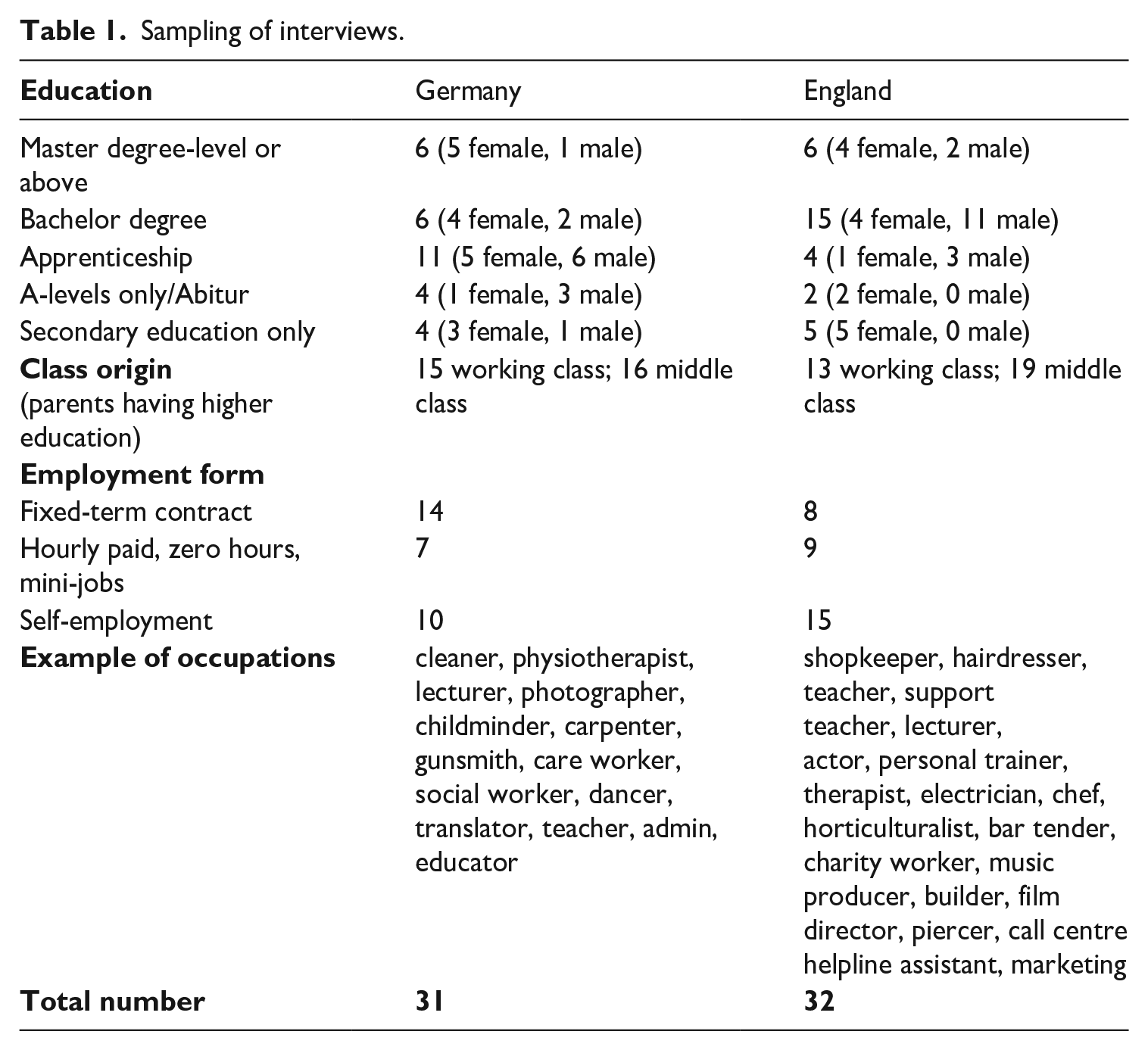
The interview schedule included three parts. First, following the autobiographical tradition (Schütze, 1983), an open question prompted participants to spontaneously narrate their own life stories from childhood to present; second, follow-up questions probed important biographical threads emerging from the initial spontaneous narrative; third, specific questions asked about precarious work, including the experience of work and ideas of decent work, a good life, social relations, precarity and class identification. This approach of combining narrative interviews with semi-structured interviews has proved successful at generating novel insights (Mrozowicki and Trappmann, 2021; Trappmann et al., 2021), providing a richness and depth of insight from individual life stories.
The sample encompasses England and Germany because these are generally identified as exemplars of contrasting models of European capitalism (Hall and Soskice, 2001). England was chosen rather than the UK for reasons of access due to the location of the research team. However, as welfare and employment policy remains centralised at Westminster level in the UK, we anticipate comparable interviews in Scotland, Wales and Northern Ireland would yield similar results. In England, employment institutions are presumed to be more liberal, with a thinner, more generalist welfare state, weaker protective employment regulations and weaker collective bargaining (Hall and Soskice, 2001). Germany has witnessed liberalisation trends in recent decades (Holst, 2014), and increased precarity (Allmendinger et al., 2018), but comparatively speaking remains an example of a stronger welfare state and more comprehensive labour protections. This permits consideration of what differences national institutional settings contribute to precarious workers’ subjectivity.
German interviews were collected in 2017–2018 and English interviews were collected in 2020–2021. The informants were recruited through personal networks, mailing, social media adverts, adverts in various labour market institutions (including Voluntary Labour Corps and job centres) and through spontaneous acquisition in pedestrian zones. Owing to COVID-19 lockdown restrictions, some English interviews were conducted via phone or video. One German interview was conducted over Skype but the remaining 30 were face-to-face in public locations. Interviews were conducted in German and in English, and lasted from 80 minutes to five hours. All were recorded and transcribed verbatim with consent from participants. Strict confidentiality was maintained and ethical approval was obtained prior to the research. Given the interviews were with precarious young people, vouchers were issued as compensation for participation.
Analysis of interview data employed techniques borrowed from grounded theory methodology, including open coding, memo writing, selective coding and theoretical sampling. Based on discussions among the research team about codes and findings, participants’ views on the legitimacy of precarious work were examined; whether they perceived it as an unavoidable, justifiable or even desirable part of working life; and the extent to which they felt it might be challenged. Where participants viewed precarious work as legitimate, the research team considered the frames that facilitated this legitimisation – asking how they interpreted particular situations and which aspects they sought to emphasise (Entman, 1993). An inductive process identified four legitimising frames: three corresponded with themes examined in the literature and one was unexpected. The research team analysed these frames in relation to each interview, wrote analytical summaries for each participant, and refined the dimensions and qualities of the legitimising frames. These were then used for a final coding of the transcripts. In some cases, more than one frame was applicable. In such cases the dominant frame was identified, and the less prominent noted as a secondary frame. The research team also reflected on how biographical characteristics such as gender, educational level, employment form and class background influenced the frames used by participants, as well as institutional differences between England and Germany.
Findings
Prevalence of legitimising frames
As detailed in Table 2, the majority of the sample (52 out of 63 participants) legitimised precarious work to some degree. This legitimisation had various inflections – ranging from acceptance based on a deep pessimism about the possibility of change, to a more enthusiastic embracing of risk. A minority (11) did not view precarious work as legitimate, all of whom were German. Five were critical of precarious work and were taking steps to counter it through union campaigning. Four were not currently involved in mobilising against precarious work but were well-acquainted with left-wing authors critical of precarious work and spoke about class consciousness (Trappmann et al., 2021). Moreover, the ‘repeated exposure’ frame was notably less prevalent in Germany, as discussed below. These differences likely reflect national institutional contexts (Kalleberg, 2018). Despite shifts in the German labour market that have engendered more precarious work (Allmendinger et al., 2018; Brzinsky-Fay and Solga, 2016), the relatively more supportive and less stigmatising welfare state arguably still contributes to a more widespread belief among German participants that job insecurity can and should be resisted. A stronger safety net may give individuals more leverage to contest the terms of work, and less reason to legitimise it. There is less stigma around reliance on the welfare state, which German participants appeared to recognise. Marcel (German (DE), 23), for example, saw no stigma in using food banks as he considered it normal to end up in vulnerable situations where help was needed. Similarly, Beate (DE, 30) asserted she would often live on social aid when she felt she had little energy to navigate the labour market.
Legitimising frames across the sample.
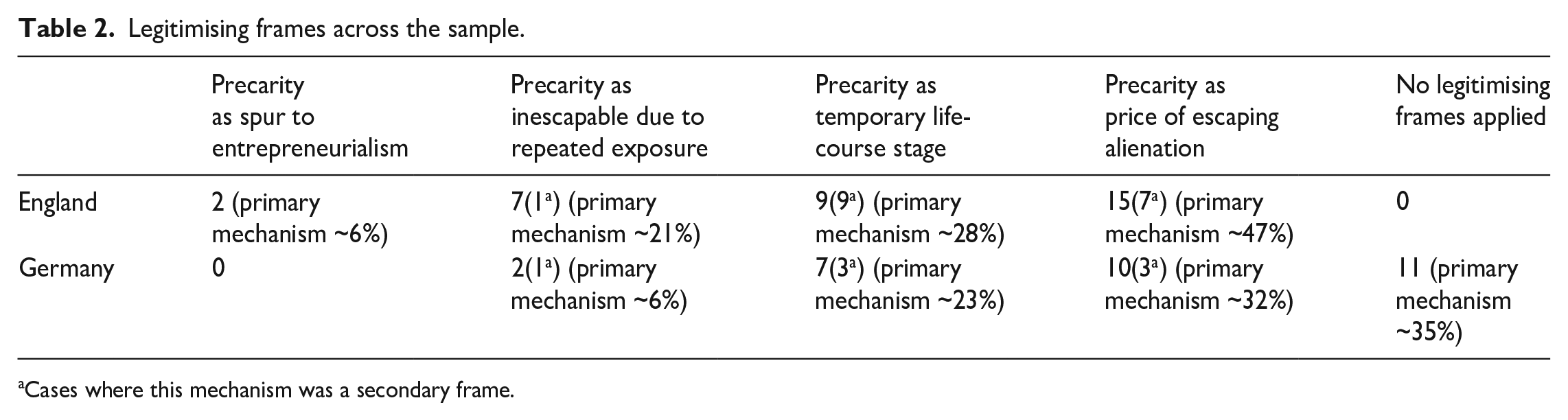
Cases where this mechanism was a secondary frame.
Interestingly, age and gender did not generate significant differences in the kinds of legitimising frames applied. This is not to downplay gender differences, as previous research shows that young (low qualified) men are more affected by precarious employment than women, and they are less able to translate precarious employment into successful employment trajectories (Stuth and Jahn, 2019) and that biographical context can have an impact on dealing with precarity (Schieck, 2010). However, these factors did not map clearly onto the variation we found in the adoption of legitimising frames. Class and educational level appear more relevant in explaining variation, which are discussed below. Broadly, participants who felt precarious work was inescapable and beyond agentic challenge tended to have fewer educational qualifications. Middle-class participants were more likely to legitimise precarity as temporary and be confident they could eventually escape it, and were also more likely to see it as a price worth paying for escaping the alienation of stable organisational life. The four frames will now be addressed in turn.
Entrepreneurial subjectivity
Despite entrepreneurial subjectivity being a pronounced theme of recent literature, only two participants (both English) legitimised precarious work with reference to entrepreneurial frames. For these participants, precarity was viewed as a spur to adaptability, innovation and a ‘work ethic’. Michael (England (E), 35) generated low income through an events business yet saw positives in his employment insecurity as an encouragement to identify new opportunities: Well, I’ve tried to make something positive out of things. Some people would feel like if something hadn’t gone the way they wanted it, they’d just think in a really negative way and sort of lose hope and things like that. But I try not to do that, try and think of how I can turn this into something, like a new opportunity or I can turn it into something positive because that’s a better way of looking at it.
Insecurity was something he could overcome with perseverance and an attitude emphasising embrace the opportunity.
Holly (E, 23) worked on multiple zero hours contracts simultaneously in a bar and a school, and saw it as an opportunity for increased reward. She emphasised that the harder and longer she worked, the more she gained. Thus, the individualised ‘flexibility’ of precarious employment was seen as legitimate on acquisitive grounds: I always had other zero hours contracts so I could add up extra time because I like having money . . . like everyone says that but I hate having a day off. If I have a day off, I’ll always pick up an extra shift. It’s just the drive I get when I pick up an extra shift, I’m always ‘Oh yeah, I’ll get some more money’ and I can save it.
These individuals perceived stable jobs as limiting their opportunities and their motivations for self-development. However, a significant insight here is the overall weakness of this frame across the sample, despite much literature emphasising entrepreneurial ideology when discussing precarious workers’ subjectivity. Despite the growing literature on entrepreneurial subjectivity, our data show that other legitimising frames were more prevalent.
Precarious work as inescapable due to repeated exposure
More common among participants was the perception, gained through multiple experiences of precarious work, that they had little agency to meaningfully challenge precarious work. As such, precarious work was ‘legitimised’ insofar as its absence could not be envisioned. These participants reflected explicitly on their sense of disempowerment and tended to downgrade expectations for their quality of working life. This was a primary legitimising frame for seven English participants and one German, and was a secondary frame for one participant in each country. Participants without advanced educational qualifications were more likely to exhibit this frame.
Individuals’ application of this frame was not informed solely by their own experiences, but also through observations of peers and family members. Bee (E, 26) says: I’ve watched all my friends go to uni and come back and not do anything to do with that subject. And some of them have worked so hard and I think they’re . . . way smarter than me, so I think in a way it has made me more un-confident to even give it a go, because I’ve watched people come back and do nowt, who were really good at what they were doing . . . got massive results and everything. They still ended up doing nowt. Because I’ve always known crap work and my dad and my mam and everybody has always known crap work, I think I’ve just gone with it.
For some, disempowerment was deepened by a sense that participants were repeating their parents’ experience. Ashley (E, 29) described how her mother had urged her to seek a better working life than she had had as a pub worker; but Ashley was now performing the job herself. Another, Alexis (E, 18), had recently been fired from an insecure job following an argument with a manager. This experience had a profound effect on her expectations about working life: It’s just trying . . . it was like one minute you can be working, the next minute, it’s all gone. It was just like . . . I’ve only just started thinking about getting back on my feet now because it’s just been, like, well, there’s no point, they’re just going to fire me again . . . I’ve just been feeling really down and low because of what happened with my previous employer. I’m thinking, well, what if I have another job and they do that to me again? So . . . it’s been quite tough.
There was an evident lowering of expectations, which made participants feel their agency could not enable an escape from precarious work. This was put succinctly by Hannah (E, 29), whose working-class background shaped her feelings of insecurity: ‘It’s not fair . . . but it’s always been the same’. The objective fact of working in multiple precarious jobs throughout their lives, and of observing the same among those around them, created a legitimising frame based on the sense that precarious work was simply beyond agentic challenge. These observations also illuminate a connection to class background: working-class background, as well as a perceived lack of human capital owing to weaker educational opportunities, seemed to increase the sense that respondents had little chance of realistically contesting or escaping precarity.
Precarious work contextualised in the life course
More widespread was the sense that precarity was a finite stage in the life course; thus, in contrast to the previous frame, it was legitimate insofar as it was temporary. This was the dominant frame for 16 participants, and a secondary frame for 12, and was a significant presence in both countries. Precarious work here was not usually seen as unproblematic, but was considered to provide flexibility or an opportunity to explore different career options before giving way to something more secure. Surprisingly, even older participants (those in their early or mid-30s) applied this frame. The analysis distinguished three variations within this frame: ‘searching’, ‘probation’ and ‘bridging’.
Searching refers to individuals trying different occupations to determine what they want from their future. They thus accept precarious employment as a convenience that suits their low degree of commitment. An example of the eight (nine secondary frame cases) participants who were ‘searching’ was Anna (DE, 30). She had two master’s degrees, completed several internships, worked in various fixed-term jobs in university administration and embraced her arrangement as an opportunity to find the ‘right job’: And then I did a three-month internship at a radio station. Which is pretty nuts somehow in hindsight, because as an intern you take a lot of pretty weird stuff. The night shift started at 4 a.m. Anyway, it was funny I realised that I don’t want to continue in that direction. [Then] I started . . . as coordinator for a Graduate School. And I did that for a year and eight months and, well, those were of course already from the start temporary contracts and in the end it turned out so that in agreement on both sides it was not extended anymore because it just wasn’t what I really wanted.
Probation meant precarious employment was considered a trial period where a person needed to prove themselves to gain the privilege of a more stable position. An example of the five (six secondary frame cases) participants applying this frame is Manuela (DE, 27) who started an apprenticeship in retail, and believed there would eventually be secure work available. She felt she was placed on fixed-term contracts until she proved herself. Precarious work was legitimate since it was finite, depending on her success in the position.
Bridging refers to circumstances where people perceive themselves to be in precarious work while they wait to enter the job or employment situation they actually desire. This applied to three (two secondary frame cases) participants. For example, for Mona (DE, 29) bridging was due to caring responsibilities. Mona had three young children and was a teacher without any work experience and currently worked as a domestic cleaner on a mini-job. She remained confident the arrangement was temporary until her children were old enough and she could then work in a school: We are used to living in poverty. But we didn’t perceive it like that because we are sure it will be better. It will be over at some point. And we muddle through . . . And we knew our education will help us find something, if we don’t go off the rails.
Temporariness was also felt by those in their late 20s and early 30s. These older workers’ experience underlines that the expectation of precarious work as a temporary stage of the life course may be illusory. Some older workers still applied the ‘contextualisation within the life course’ frame but were less patient and more worried. They were thus more likely to make concessions for a permanent job. However, they continued to legitimise precarity as temporary: Daniel (E, 29) held a PhD while on a fixed-term teaching contract, was politically engaged and participated in strike action against precarity in the sector, yet still believed his arrangement was only temporary: I certainly would identify as that [precarious] because obviously at the moment we’re on strike and a big part of the strike is precarious work and I am on a precarious contract. So, in that very immediate sense I reactively identify as that. But would I say I’m part of a precariat in a kind of more broader structural sense? No, because I’m kind of hoping to get a job that isn’t precarious.
Again, we did not observe differences based on gender. While certain experiences, such as Mona’s, may suggest gendered aspects (as her emphasis on ‘bridging’ reflected caring responsibilities, which disproportionately accrue to women), overall, both men and women could be found legitimising precarity by contextualising it within the life course. However, in contrast with the previous frame, middle-class respondents with higher educational qualifications were more likely to invoke temporariness as a legitimising frame for precarious work.
Pursuit of meaningful work
The frame that was observed most frequently was unexpected. This was the view of precarious work as a price to pay in the pursuit of work that participants felt enabled them to escape alienating organisational hierarchies, and to act more autonomously. This frame was evident among 25 (10 secondary frame cases) participants, meaning over half the sample applied it as either a primary or secondary frame. This frame was found across national, gender, education and class differences, though it was somewhat more prevalent among middle-class respondents. In most cases, participants applying this frame had previous alienating experiences of more ‘secure’ work. For them, precarity was not seen as positive (and they did not appear to endorse values of individual entrepreneurialism), nor were they pessimistic about their own agency. Rather, these participants felt that insecurity at work was detrimental but, on balance, a valid or necessary trade-off, generally entered into knowingly.
This frame sometimes manifested in a desire for individual autonomy over working arrangements, and escaping organisational hierarchies that were seen as dictatorial; but also in a desire to perform work that was more beneficial to society or communities than bureaucratic organisations allowed. In this sense, this frame is associated with the pursuit of meaningful work, denoting work that enables individuals to feel a sense of authentic connection with their work, and provides a sense of purpose beyond the self (Bailey and Madden, 2017) (‘alienating’ here denotes the opposite: work that gives participants a sense of being severed from their own objectives, performing tasks imposed by others, which provide little sense of purpose). Large, hierarchical workplaces were seen to engender values or ways of working that were inconsistent with those of participants, and thus this negative reaction became a legitimising frame for precarious work.
Some participants currently working in low-paid self-employment recalled excessive control from managers in previous, more ‘secure’ jobs, including problems such as being unable to shape their own working day and work intensity, or injustices borne from organisational hierarchy. The decision to take on precarious work was hence framed as a corrective to these adverse experiences. Angela (E, 27), a self-employed hairdresser, described the challenges she faced working within a traditional organisational structure: So, at the time, I was obviously in my mid-20s, so I was out on the weekends wanting to have some fun, go on girls’ holidays, you only get four [weekends] off a year. So, I went to her [manager] and I said is there any chance I could have more Saturdays off so more weekends as perks for how busy I am? [. . .] I was thinking, I’m not gonna be a little monkey earning all the money for the salon and not even getting any perks for it. That’s how I felt towards the end.
Participants also reacted against the restrictions organisations imposed regarding the content of work. Numerous participants described wanting to work in ways they felt were responsible or socially beneficial, but which were impossible in organisations where they had worked previously. This experience led them towards more precarious, often self-employed, arrangements. The opportunity to reclaim a sense of freedom or social purpose through precarious self-employment thus acted as a legitimising frame for participants. Simon (DE, 28) opened his own sound engineering business after he dropped out of his physics and industrial engineering studies. The fact he earnt below the minimum wage, less than €700, was irrelevant to him, but he enjoyed his work and the freedom to only accept jobs he liked: What I don’t do during working hours, I’ll do at another point. I do not have to work less, on the contrary. Because I do things that I enjoy and most of the time pay is only of secondary importance, I even have to work more.
Similarly, Toni (DE, 23) experienced a fragmented trajectory moving between different jobs. This included being an au-pair in France, full-time work in a warehouse, a porter, a door-to-door salesman for an energy company and customer service in a call centre. Such variety meant he perceived stable employment as alienating and a barrier to self-fulfilment. He now creates his own projects on social and political education: The experience of real, genuine work, real wage labour with a 40-hour week and two-shift system and getting up every morning, somehow ‘Uh, I’m not up for it’. The experience was quite valuable because after that, or I still know that, now. I know very well why I want to study. I would like to have a little bit of self-fulfilment, self-realisation at work as well.
The search for purpose often reflected participants’ ethical, social or political commitments. Patricia (E, 30), a freelance mental health practitioner, felt alienated when working in the NHS. This was because she perceived deficiencies in its mental health provision caused by its bureaucratic nature. She stated that her self-employed psychotherapy combined with part-time charity work enabled her to provide the kind of care to which she aspired: So, one of the things I was doing there [NHS] was implementing mindfulness and support groups for the nurses to talk about stress and stuff. I just got a sense from things there that it’s just like . . . a career in the NHS is like saying I’m okay with the life of stress. I just don’t think I could cope with that to be honest. It’s actually, like, not a very person-centred environment, it’s so vast and, yeah, so faceless . . .. And the kind of things that I can do now, you could never do in the NHS.
Organisational life in stable employment was also seen as alienating in some cases due to a disjuncture between institutional goals and their personal political outlook. For some participants, established organisations were seen as unable to accommodate their beliefs and values. Fred (E, 26) was a self-employed horticulturist and stressed how seemingly competing values, along with a relatively prescribed labour process, made him feel ‘trapped’ by his previous organisation. His key motivation for becoming self-employed was the organisation’s apparent lack of commitment to ecological values that were central to his worldview. He described how the economic rationalisation of parts of the organisation’s operation came at the expense of more environmental concerns, which did not sit easily with him: That’s one of the dangers of bigger organisations. When you try and streamline horticulture and streamline the creative instinct of horticulture, you kind of self-inflict the harm a lot of the time . . . I guess a lot of my values as a horticulturist are not strictly horticulture . . . But in that sense I can appreciate [being self-employed] a kind of like human desire to be in a kind or nurturing, peaceful environment. I totally respect that. But at the same time in how I want to work is I want to try and work in like an ecological way as much as possible. But I don’t want to work where I’m creating more harm than good.
Overall, this section shows how precarious work can be framed as a trade-off in the pursuit of a less alienating and more autonomous and meaningful kind of working life, while also underlining the empirical prevalence of this frame. Participants adopting this frame were more likely to be middle class, but not exclusively, and its prevalence across other differences within the sample (transcending both gender and national boundaries) is noteworthy.
Discussion and conclusion
This article examined the legitimising frames young workers apply to precarious work. The central contribution is the identification of four frames that lead individuals to conceive of precarious work as legitimate: through entrepreneurial subjectivity; through repeated exposure and disempowerment; by contextualising as temporary in the life course; and as a price to pay for escaping from alienating organisational life and pursuing work that is perceived as meaningful. These findings are important because amid the vast research on precarious work and resistance to it, questions of precarious workers’ subjectivity and how such work can be seen as legitimate or unchallengeable remain underdeveloped. This is significant in a context where precarious work is expanding but without a sustained resurgence in collective contestation by workers (e.g. measured through union membership or strike figures). There is a conceptual claim that precarious work is becoming ‘normalised’ (Lorey, 2012), but there is not yet enough empirical research scrutinising this claim.
The findings here make important contributions to existing theoretical literature. They prompt scepticism of accounts that link precarious workers’ subjectivity to an ideology of entrepreneurialism and the glorification of individualised ‘flexibility’ (Moisander et al., 2018; Tirapani and Willmott, 2020; Vallas and Christin, 2018). These ideas suggest that many precarious workers will legitimise job insecurity as a spur to entrepreneurialism and hard work. However, this applied to only two participants and both were English. Institutional and cultural differences between England and Germany may have traction here, since the ideological vaunting of market competition is more prevalent in England (Peters, 2001). However, the small presence of this frame overall is more striking than the difference between countries, suggesting that literature emphasising the significance of entrepreneurial subjectivity among insecure workers may need qualification. Consequently, this article emphasises the limits of focusing on entrepreneurial ideology in explaining the legitimisation of precarious work.
The frame of precarious work as ‘inescapable due to repeated exposure’ overlaps with themes of discipline and institutional disempowerment drawn from industrial relations literature (Dörre et al., 2004; Greer, 2016; Umney et al., 2018). These themes were prominent in some cases though this was a minority of the sample. It was less common than the life course frame, with which it is mutually exclusive (since in one case precarious work is legitimised because it is inescapable, and in the other it is legitimised by its temporariness). Certainly, institutional and political-economic changes have in many cases disempowered European workforces, but this argument only partially addresses the question of how precarious workers may subjectively legitimise their working experiences. An overriding sense of disempowerment was observable among some participants, particularly those with lower educational qualifications, but the majority did not appear to think in these terms.
By contrast, framing precarity as the price of escaping organisation alienation and pursuing meaningful work was surprisingly widespread in both countries. The notion that workers may tolerate or embrace insecure conditions as a price to pay for undertaking work they perceive as meaningful, or of social value, is relatively well-established in certain areas of scholarship, particularly on cultural and creative work (Banks, 2006; Coulson, 2012; Umney and Kretsos, 2014, 2015), and to a degree in research on social care and charitable work (Baines, 2004; Venter et al., 2019). However, these findings show the wider applicability of these themes, supporting currents of thought (often under-emphasised in the sociology of work) that read the standard employment relationship as a source of security but also as constraining and alienating (Bove et al., 2017). This underlines the extent to which 21st-century capitalism has created workers who value individual thriving and self-fulfilment through meaningful work, and who do not believe they can find it in stable organisational careers. This phenomenon is vital in understanding the subjectivity of precarious workers and deserves more prominence in future research. The large number of workers who sought self-employment as a means to pursue meaningful, non-alienated work resonates with some of the more recent findings on solo self-employment (Murgia and Pulignano, 2019); that passion and desire for autonomy are a driver into self-employment, and that control by others creates a feeling of meaningless work (Bailey and Madden, 2017). Nonetheless, middle-class participants with higher educational opportunities appeared to apply this frame more frequently than participants from working-class backgrounds.
These emerging themes also resonate with the work of Boltanski and Chiapello (2005). Their seminal work identified the notion of an ‘artistic critique of capitalism’, which referred to the belief that capitalist societies engendered working lives that were boring and unfulfilling, leaving little scope for individual expression. They showed how management literature co-opted this critique by reframing the experience of work as a career or project, though their study was not related to precarious workers. However, these findings suggest that many participants applying the ‘meaningful work’ frame in many cases had an ‘artistic critique’ of work in capitalist organisations: they found it unfulfilling and lacking in purpose. The intriguing difference is that this critique had not been co-opted by employers. Instead, participants had sought to exit their previous experiences of stable organisational life. Thus, while this frame may legitimise insecure working conditions, it also underlines the failure of many organisations to provide a sense (or even a convincing illusion) of meaning or autonomy.
This article’s discussion of the ‘pursuit of meaningful work’ frame should not be interpreted as a justification for the precarisation of working life. Participants may consciously pursue precarious jobs as a means of discovering less alienating conditions, for example, but in many cases this appears to be a case of ‘out of the frying pan, into the fire’. Participants applying this frame often experienced severe stress and worry as a result of their insecure working conditions, including mental health problems. Hence, these data do not present precarity as a refuge, but speak to the extent to which many people were dissatisfied, even repelled, by the alienating conditions of organisational life, and sought something else even if it was risky. Choonara (2020) posits an under-examined ‘curse of stability’, where long periods in ostensibly stable but poor quality and alienating work is seen as just as severe a problem as insecurity itself. Hence, rather than justifying precarity, our emphasis on the importance of the pursuit of meaningful work prompts questions over alternative futures for the welfare states. Could measures such as Universal Basic Income schemes be an important innovation – allowing individuals to more freely pursue work that is individually and socially meaningful, without the associated risk of precarity? While a full engagement with these debates is beyond this article, our findings provide relevant context when considering the merits of different models of welfare state transformation.
The findings therefore make an important contribution to the precarity literature. The omnipresence of objectively precarious forms of employment (Rubery et al., 2018) has not been widely and sustainedly contested by workers, which underscores the importance of understanding legitimising frames. Our analysis of legitimising frames among precarious workers helps explain the absence of collective action.
The variation in these frames demonstrates how entrenched and multifaceted precarious work is in the younger generation, with the ‘standard employment relationship’ far from their experiences and expectations. The article has drawn on existing theory, which deals, in partial ways, with the subjectivity of precarious workers, and inferred a set of legitimising frames. We have already noted variation according to country, which suggests that institutional context does make a difference, but within limits. For example, we have suggested that German workers were more likely to be explicitly critical of precarious work, and less likely to see it as inescapable due to a more supportive welfare state. In addition, we stressed how other frames (notably the pursuit of meaningful work) were important in both countries. Factors such as age and gender did not account for differences in participants’ application of particular frames. We acknowledge that experiences of the ‘transition to adulthood’ and labour market entry are often profoundly gendered (Thomson and Holland, 2002; Wong, 2018), but this did not appear to translate into substantial differences in the kinds of legitimising frames male and female participants adopted. However, the role of class and educational level seemed more significant. Working-class participants were more likely to see precarity as inescapable, while middle-class ones were more likely to consider it a transitional stage or an escape from alienation. These classed effects contradict more optimistic discourses, which may frame insecure work experiences as a means of human capital accrual and hence social mobility; indeed, as Kalleberg and Vallas (2018) suggest, precarious work may embed profound inequalities in individuals’ ability to accumulate human capital. Further research is needed to systematically analyse this class dimension as well as the broader prevalence of those frames among precarious workers. We tentatively argue that, while the different degree of acceptance and legitimisation of precarity does not undermine arguments about its prevalence (Alberti et al., 2018), its legitimisation seems to differ by class: as endurance for the working class and as an escape from alienation for the middle class. None of these frames seem to be a fertile soil for contestation or class conflict.
There are some limitations to our study. First, our interviews in England began shortly before, and continued through the first months of, the COVID-19 pandemic, which dramatically changed the situation facing young precarious workers and might have influenced their outlook. However, given that our analysis revealed frames that prevailed in both English and German datasets, there is nonetheless a high degree of salience in the results of the comparative analysis. We therefore anticipate that such frames will have continued relevance in the post-COVID-19 landscape. Second, the qualitative focus does not permit us to say decisively how explanatory factors correlated with different frames, nor how the frames may be distributed across a larger quantitative sample. This is an important topic for future study, potentially necessitating the use of quantitative methods. In our view, setting out four such frames lays essential groundwork for others to undertake future investigation.
There are three implications for future research. First, this article opens new lines of enquiry around the subjectivity of precarious workers: specifically, the frames through which they legitimise precarious work. This improves existing understandings of precarious work. In particular, it helps underline how legitimising frames may be a powerful obstacle preventing more widespread and forceful contestation of insecure working conditions, particularly by young workers. This is a particularly pressing intellectual task, since the need to mobilise precarious workers, and the potential power and innovation of such mobilisations, has been compellingly highlighted by a wide range of scholars in many different contexts (Doellgast et al., 2018; Manky, 2018; Vanni and Tarì, 2005; Waite, 2009). Second, it warns against broad narratives around precarious work and individuals’ experience of it. Such experiences are complex and heterogeneous and cannot be adequately understood by encompassing lines of argument around concepts such as neoliberal subjectivity or worker discipline – however vital these ideas are in explaining wider institutional and political-economic change. Third, more work is needed to understand what factors in the context of legitimising precarious work nevertheless leads to contestation of the latter when it occurs.
Footnotes
Acknowledgements
The authors are grateful to the anonymous reviewers and Paul Adler for their comments, which were helpful to improve the article. We would also like to thank our informants for sharing their stories.
Funding
The authors disclosed receipt of the following financial support for the research, authorship, and/or publication of this article: this article was prepared within the project PREWORK (‘Young precarious workers in Poland and Germany: a comparative sociological study on working and living conditions, social consciousness and civic engagement’) funded by the National Science Centre (NCN; UMO-2014/15/G/HS4/04476) in Poland and the German Research Foundation (DFG; TR1378/1-1), as well as funding from the Leeds University Business School.
 ). Her current research analyses the consequences of decarbonisation on work and employment, comparing Just Transition in 12 countries.