



Abstract
Using a labour process approach, this article examines how workers in three factories in China learnt about the workplace-level pay systems governing their employment relationships. By outlining the processes through which workers learnt about pay at work, this article sheds light on how workers, faced with a perplexing variable pay system and managerial control over pay disclosure, can overcome the pathways towards ignorance and ultimately challenge the workplace-level pay communication regime. It is shown that pay transparency, rather than being merely an outcome of managerial practices to improve employee motivation and organisational performance, is an outcome of dynamic and contested social interactions between management and labour.
Introduction
Various national governments, recognising that pay transparency may help eliminate gender and ethnicity pay gaps (Conley and Torbus, 2019), have in recent years introduced regulations on the disclosure of pay information. In the US, for instance, an executive order that came into effect in 2016 requires contractors and subcontractors of federal agencies to make pay information publicly available. Since 2019, the European Parliament pressed for greater transparency and predictability of working conditions, including pay. In the UK, the Equality Act 2010 does not bar employers from practising pay non-disclosure measures in the workplace, but it does bar them from firing workers who reveal or discuss pay among themselves (Advisory, Conciliation and Arbitration Service, n.d.).
To complement the existing research on pay transparency, which is part of a wider body of pay communication literature, this article examines the process by which workers accumulate pay knowledge in three workplaces in China, where independent worker representation is largely absent and managers enjoy more discretionary power in developing workplace-level pay communication regimes without the constraints of collective bargaining. Approaching managerial pay communication practices from a labour process perspective, this article argues that pay transparency emerges in the course of day-to-day contested social interactions between management and labour (Edwards, 2010), a process through which workers learn to comply with managerial control over one-directional pay communication practices, or to identify alternative channels of knowledge accumulation beyond managerial control via misbehaviour (Ackroyd and Thompson, 1999). Through this process, workers overcome the feeling of perplexity that can act as a deterrent to challenging the legitimacy of the workplace-level pay communication regime.
In the following sections, taking the pay communication literature as a point of departure, this article discusses why a labour process perspective is useful in terms of tracing how workers accumulate pay knowledge by navigating social relations in the workplace. This is followed by a discussion of the research context and methodology and a description of the pay communication practices adopted by management in three factories (H, F and D). Various ‘pathways towards ignorance’ are then aggregated to illustrate the hurdles that workers had to overcome to accumulate knowledge of the pay system and identify the extent of pay opacity in the workplace. Finally, from a labour process perspective, this article discusses how control mechanisms related to pay information and pay strategies affect workers’ compliance with and resistance to existing pay communication regimes.
The limitations of taking pay communication as an employer prerogative
Where pay is transparent, employees are allowed to share pay information with individuals within and outside the workforce, and organisations proactively disclose pay information (Marasi and Bennett, 2016). Transparency is achieved through organisations’ decisions regarding ‘if, when, how and which pay information (such as pay range, pay raises, pay averages, individual pay levels, and/or the entire pay structure) is communicated’ (Marasi and Bennett, 2016: 51). These practices enable employees to understand the ‘pay structure, pay policies and how decisions are made’ within the organisation (Scott, 2018: 4), as well as the degree of fairness and equity of how work at different levels is rewarded (Jacques, 1967). The breadth of workers’ knowledge thus reflects the level of openness or transparency of an organisation’s pay system, which can improve workers’ ability to identify potential incidents of wage theft (Clark and Herman, 2017).
Studies of pay communication focus on the outcomes of management-led pay communication practices, such as employee performance (e.g. Greiner et al., 2011; Marasi et al., 2018), employee behaviour (e.g. Danziger and Katz, 1997; Nosenzo, 2013) and employee motivation and satisfaction (e.g. Brown and Huber, 1992; Hartmann and Slapničar, 2012; Lee et al., 1999). Schuster and Colletti (1973) and Smit and Montag-Smit (2018) examine the willingness of individual employees to have pay information made transparent. These studies rely primarily on questionnaire surveys (e.g. Brown and Huber, 1992; Hartmann and Slapničar, 2012; Lee et al., 1999) in which respondents report their understanding of pay and the level of pay transparency in their organisations, and some also use laboratory-based experiments (e.g. Greiner et al., 2011; Nosenzo, 2013) involving student participants or participants recruited online.
A key limitation of studying pay communication using the above methods is that they begin with the volume of pay information that the participants already had, without delving into where, when and how participants obtained the information initially, as well as how the information possessed helps the participants develop an opinion on the extent to which pay transparency is in their favour. There has yet to emerge a comprehensive picture of what kind of pay information employees receive and how such information is delivered to achieve employees’ claimed degree of transparency. Moreover, in experimental settings, research subjects recruited as individuals rather than employees are assumed to be capable of making judgements that may be subject to specific organisational and social contexts.
The use of surveys and experiments to study pay transparency also takes for granted employers’ dominant role in making pay communication decisions, as such methodologies are underpinned by a unitarist perspective of employment relations. From this perspective, issues arising from a lack of pay transparency are manifestations of managerial failure that must be remedied by more delegated human resource management (HRM) practices (Budd, 2020). Traditionally, therefore, pay communication research investigates pay transparency in an effort to establish how purposeful control over the circulation of pay information may help employers manage their organisations and workforces in terms of promoting employee performance, satisfaction and well-being. Such research is largely directed towards justifying managerial efforts to control pay communication while retaining and motivating employees by improving their satisfaction.
Challenging the validity of the unitarist approach is beyond the remit of this article. Rather, this article seeks to extend the notion of pay transparency by regarding it as a ‘socially situated and communicatively contested’ (Albu and Flyverbom, 2019: 289) product of social interactions within organisations (Costas and Grey, 2014), rather than as an outcome relating directly to the efficacy of HRM practices. The study of pay communication should not be confined to answering what and how information should be conveyed and offering solutions to organisational conflicts arising from pay secrecy; it should also recognise that the availability of pay information is a point of contention in its own right. The extent to which different actors in an employment relationship contribute to pay transparency, organisational decision-making processes relating to pay communication practices and potential backlashes against these practices should be further explored.
Besides identifying ‘good’ and ‘bad’ practices in pay communication, embracing alternative frames of reference for employment relations enables the recognition of pay transparency as a source of organisational conflict. Specifically, adopting a pluralist or radical frame of reference that regards conflicts in management–labour relations as inevitable (Edwards, 2003) helps to unpack the process through which pay opacity emerges at the organisational level. By taking the inherent power imbalance between management and labour into account, the scope of pay communication studies can be extended to areas such as alternative sources of pay information for employees (e.g. the state and unions) and how different social actors are empowered by possessing and circulating pay information.
Understanding pay communication from a labour process perspective
In recent years, many countries have introduced measures to regulate employers’ behaviours related to pay communication, causing them to become more proactive in improving pay transparency. In countries such as the US, the UK, Singapore, Hong Kong and Thailand, legal regulations and governance codes requiring the disclosure of executive pay, particularly in listed companies, are already in place (Ganu, 2014), serving shareholders’ interests from a corporate governance perspective. However, as observed in the US and Europe, regulatory regimes on pay disclosure have recently been extended to lower-ranking employees, compelling employers to report pay information and barring action against employees for discussing pay.
In addition to the role played by employers in terms of compliance, employees, both individually and collectively, play a key role in striving for pay transparency at the organisational level, as they are the ones who are being paid and are in a position to share information about their pay. Therefore, greater effort should be devoted to understanding the scope of pay information that employees may accumulate beyond what their employers provide voluntarily; how they interpret and base their pay demands on this information, both formally (through trade unions and other voice mechanisms) and informally (through interpersonal channels for questioning and pressuring employers); and any hindrances that they encounter due to the inevitable management–labour conflicts. In essence, given employers’ pay communication practices, the central question is, how do employees learn about pay at work?
A labour process approach, which focuses on the organisation of work, in which ‘a frontier of control is created and sustained’ between management and labour (Edwards, 2010: 33), enables us to examine the accumulation of employees’ pay knowledge. Labour process research investigates the formation of different types of control regimes, including the nature of managerial control, employee consent and resistance, and the conditions under which they occur (Burawoy, 1985; Nichols et al., 2004; Thompson and van den Broek, 2010). Managerial control practices are identified and situated within the wider structure of ever-changing occupational structures and work relations (Frenkel et al., 1995). In this regard, pay transparency can be viewed as an outcome of two forces in the workplace. First, it is driven by managerial control over the availability of pay information, which the pay communication literature acknowledges as an employer prerogative. Aside from determining what pay information to disclose or circulate, employers may also cultivate silence (Donaghey et al., 2011) and delineate the boundaries of knowledge and non-knowledge (Gross, 2007) regarding pay within the workforce. Therefore, adopting a labour process approach to trace how pay knowledge takes shape problematises silence about pay, management’s role in shaping these workplace processes and the institutions that enable management to do so.
The second key insight of the labour process perspective concerns employees’ reactions to such managerial control. Workers’ responses to managerial control practices can be categorised along a spectrum of acceptance, from resistance to accommodation, compliance and finally consent (Thompson and Vincent, 2010). Workers may simply be content with the level of pay information fed to them by management. However, they may be unsatisfied with pay opacity, which can be accompanied by pay injustices (Moriarty, 2018), and such dissatisfaction may lead to forms of resistance ranging from informal efforts to unblock managerial control over pay communication to more organised protests and strikes. Even workers without an explicit grievance may simply ‘misbehave’ by acting in ways that, although not intentionally confrontational, deviate from management’s expectations (Ackroyd and Thompson, 1999); this can also undermine the pay communication regime imposed on them by management.
A workplace-level examination of managerial control over pay communication and workers’ reactions to such practices enables us to trace the pathways by which workers learn or are deterred from learning about pay on a day-to-day basis. First, this approach identifies managerial strategies to retain control over the availability of pay information, along with workers’ methods of navigating the pay system under which they are governed. Second, it investigates how workers are driven to comply with the management-led pay communication regime. This can be achieved either through coercion, such as explicitly blocking the circulation of information and keeping employees in the ‘fragmenting and individuating life on the factory floor’ (Burawoy, 1985: 33) so that informal channels of pay knowledge exchange are disabled, or through hegemony, which drives workers to accept that the pay information disclosed to them is relevant and sufficient or to simply be content with pay ignorance. Third, it examines how workers react to these control strategies both individually and collectively, from tacitly delegitimising or challenging an opaque pay system to actively demanding greater information disclosure.
The Chinese context of pay communication
This study was conducted in China, an intriguing context for examining both structural and agential factors in the legitimatisation of workplace-level pay systems. Although state intervention in industrial relations remains strong in China (as shown in the state’s tight grip on collective labour rights), the relationship between the state, capital and labour is dynamic (Witt and Redding, 2014), accommodating a diversity of control mechanisms (Smith and Liu, 2016) and ‘contested’ labour regimes (Chan, 2010). In recent decades, further commodification of labour has led to more acute pay-related labour resistance (Smith and Pun, 2018). Documented cases of labour activists going on the offensive to make pay demands (Elfstrom and Kuruvilla, 2014) and engaging in bottom-up, workplace-level collective wage negotiation, especially in the automobile industry (Deng, 2016), signify a certain degree of pay transparency among workers, which accommodates pay comparison and the aggregation of pay grievances and demands. However, how such pay transparency first emerged remains underexplored. Having such knowledge would aid in understanding not only the emergence of workers’ pay grievances but also how the unavailability of information constrains workers’ challenges to management and what accounts for this situation in the Chinese context.
Current labour laws and regulations require employers to communicate pay terms to workers in tangible forms, namely labour contracts and payslips. The Labour Contract Law requires employers to issue labour contracts stating the terms of remuneration to workers. In addition, under the Tentative Provisions on Payment of Wages, employers are required to issue payslips every payday specifying the pay components on which pay is based and to keep a written record of the payroll for at least two years. Workers also have the right to cross-check their payslips with their own pay records in the company payroll. However, such regulations are confined to one-to-one communication between individual employees and their employers. Workers are also expected to proactively report employer non-compliance, but research suggests that those who are less educated and less socially connected find it difficult to request written documents from employers for fear of being perceived as troublemakers (He et al., 2013). The extent to which legal regulations strengthen workers’ pay understanding may depend on dynamics at the organisational and individual levels.
Legal regulations in China mandate that employers inform workers of their own earnings, but apart from executive pay in listed companies and wage bills in the public sector, there is no mandate for employers to publicly disclose pay information. Wage guidelines, published annually by provincial and municipal governments, are compiled by aggregating pay figures that employers from a range of sectors, ownership types and localities provide voluntarily. Rather than specifying the pay levels of individual organisations, these guidelines provide suggested pay levels for individual jobs and positions in each sector. In recent years, some local governments, job-search/review platforms and human resource (HR) consultancy firms have also published annual reports covering pay trends in industries and sectors, which are then reported by the media. These reports seldom pinpoint pay levels in individual companies, except for large, high-profile ones.
Research design
This study examined the pay systems and pay communication practices in three auto parts factories – Factories H, F and D – all located in Town S in southern China. Unlike the centrally designed pay system commonly adopted by enterprises throughout the country during the socialist era (Meng, 2000), employers, especially those in the private sector, are now generally free to design company-specific pay strategies. Chiu et al. (2001) suggest that the diversification in company-level pay practices relates to the introduction of western HRM practices that adapt pay components to emphasise organisational HR strategies. The opening up of markets in China since the late 1970s has encouraged foreign direct investment, and the resulting companies, which form a dominant part of the private sector, tend to adopt more individualised reward strategies, emphasising individual performance over collective concerns (Ding et al., 1997). This is in contrast to the traditional, more straightforward pay systems based on seniority and age (Meng, 2012) commonly found in Chinese state-owned enterprises. The increasing adoption of more individualised pay strategies has led to the emergence of performance appraisals and greater pay differences related to personal attributes (Yueh, 2004).
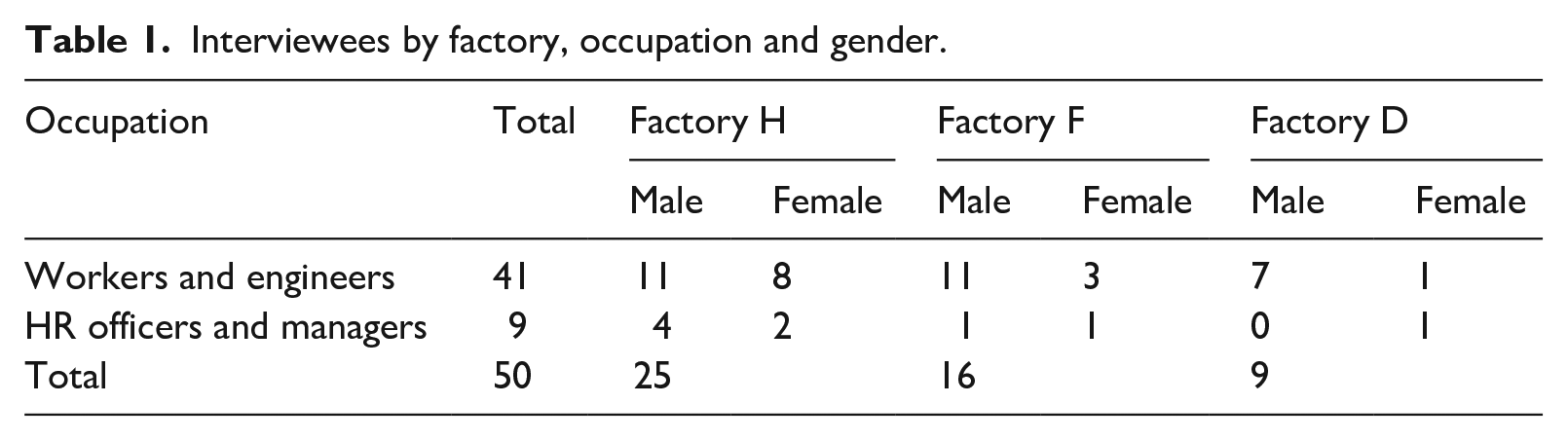
Fieldwork was conducted in Town S between 2016 and 2017 to understand how the three factories’ pay systems were designed, implemented and communicated. First, semi-structured interviews were conducted with 50 individuals from the three factories, including production workers, engineers, HR officers and managers. Owing to access limitations, individual interviews in Factories F and D were arranged by factory management (but without management presence) and conducted on-site and off-site, respectively. At Factory H, however, the researcher was given access to the shop floor, factory dormitory and canteen, and thus was permitted to approach employees freely. Spontaneous interviews were conducted on-site over the course of a month. A breakdown of the number of interviewees by occupation and gender is shown in Table 1.
Interviewees by factory, occupation and gender.
Second, participant observation was undertaken in Factory H for three weeks, during which the researcher carried out manual tasks on the production line, ate in the factory canteen and stayed with workers in the dormitory. In this way, the researcher was able to observe the labour process on the shop floor. Third, documentary research, covering government reports, news reports, official statistics and online job advertisements, was conducted to gain a better understanding of how the social context of industrialisation and urbanisation in Town S may have shaped workers’ responses to different reward strategies, pay communication practices and changes in the local labour market.
Case selection was driven by contingency, owing to the difficult social and political conditions for industrial relations research in China (Fuchs et al., 2019). Measures were thus taken to enable the diversification of data sources and triangulation of accounts from different industrial relations actors. For example, in light of restricted access to official statistical data, secondary sources on town-level developments were used, including news reports from 2000 to 2018.
Learning about pay on the shop floor
Before going into the pay strategies and communication practices in Factories H, F and D, some background and contextual information may be helpful for understanding the implications of the diversification in their pay practices. All of the factories were subsidiaries of their respective domestic-invested parent companies, which had long-established relationships with their common client, a Sino-European carmaker. The factories, which produced various parts almost exclusively for the carmaker, had been established due to their common client’s commencement of production on the Town S greenfield with strong backing from the central and local governments since the 2010s. Despite varying levels of automation, work on the shop floors of the three factories remained labour-intensive. The workers were relatively young, aged between 18 and 40, and most were internal migrants from both within and outside the province. Few workers had sector-specific qualifications or work experience.
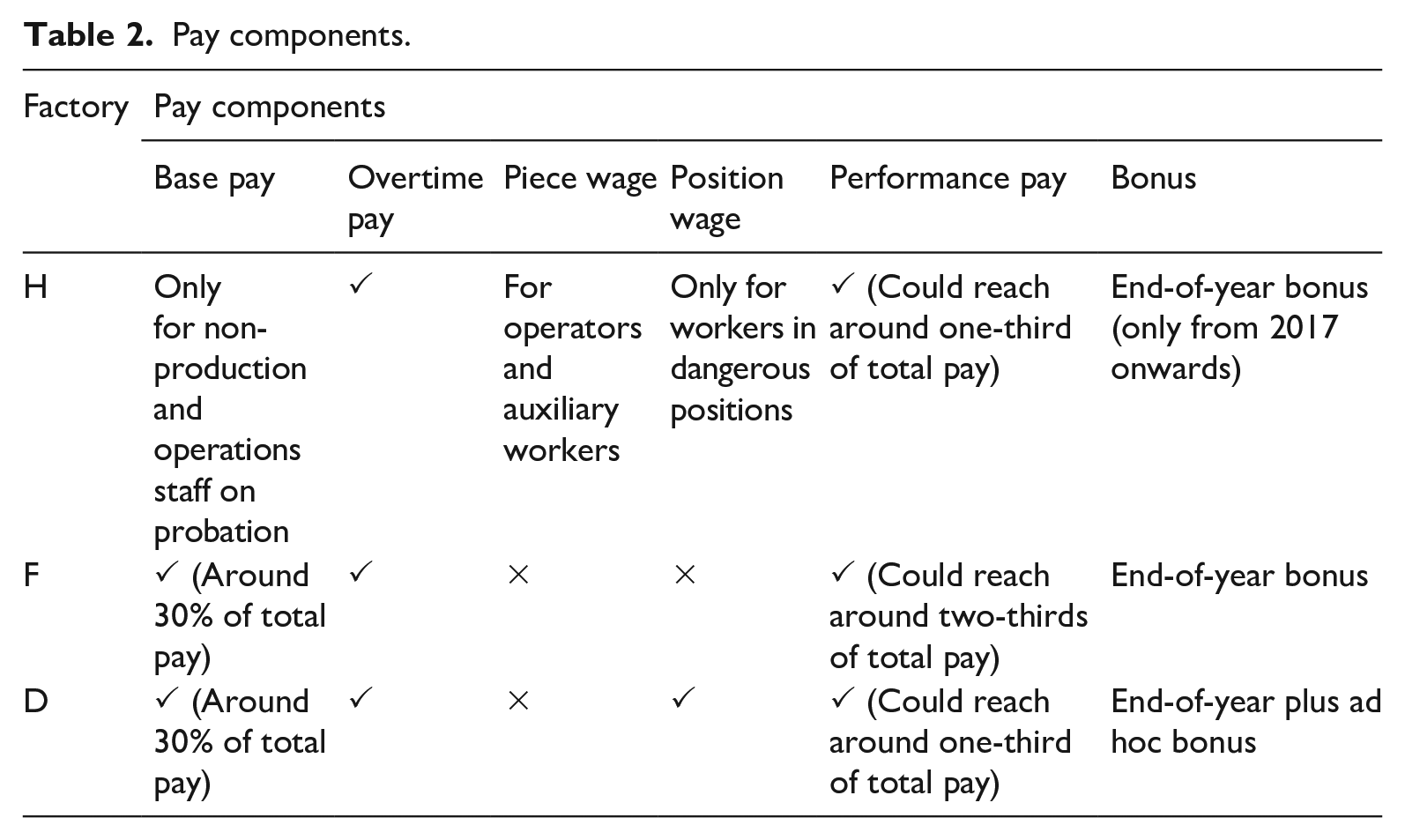
Despite having similar backgrounds and being in the same industry and locality, the three factories adopted pay systems that differed significantly. Pay in Factories H and F leaned towards a payment-by-results system, whereas that in Factory D combined time rates and competency-based pay. All of the factories paid workers a mixture of fixed and variable pay components, as shown in Table 2. Fringe benefits such as on-site accommodation, high-temperature subsidies and social insurance (which were common among factories in the local parts supplier network) were also available in the three factories. However, each factory had a distinctive pay package, particularly in terms of the composition and proportion of variable pay and the level of emphasis on individual and collective performance. Workers from all three factories received variable monthly pay. The fluctuation in pay was primarily a result of changes in working hours, productivity, performance and cash penalty reductions.
Pay components.
The diversity of pay systems across factories sharing a number of exogenous commonalities had a number of implications for workers. First, workers often had to navigate a new pay system for any new job, no matter how similar the jobs were. Second, what workers learnt about pay in their previous workplaces was not necessarily universal or transferrable, as different organisations adopted different parameters for pay components that went by the same names elsewhere. Third, workers could not make an informed judgement of pay strategies (or how well they were being paid) through cross-factory comparisons of monthly pay levels without knowledge of the parameters of each pay component.
One-directional pay communication practices
In Factories H, F and D, pay communication was one-directional: management informed workers only of pay information relevant to their own circumstances, such as their individual pay package, pay level and the policies from which these outcomes were derived. Before entering the factories, workers had gained some idea of the monthly pay level they could expect from job advertisements and pre-job orientations. A typical job advertisement for these factories (and several others in the locality), available both online and offline, included a list of pay components and fringe benefits and a broad range of pay levels rounded to the nearest 500 RMB concerning each job. Some employers also specifically mentioned the base pay amount. Given the tight local labour market in Town S, both employers and recruitment agencies were incentivised to overstate pay ranges. Workers had the opportunity to gain more concrete details regarding pay policies and to ask questions during their orientations or pre-job training. Some workers, who were mostly from Factory F, also mentioned that the labour contracts they had signed included a description of the composition of their monthly pay, but the descriptions on these initial contracts could be brief, with just the titles of the pay components and no details on how they were calculated. Workers often had vague recollections of what they had been told at the time of signing: one worker who had spent almost three years in Factory F said: ‘The HR officer explained the pay system to us, but no one could remember it after a while’ (LYZ, Factory F, January 2017).
The monthly payday was the regular occasion when all workers were disclosed some pay information. Some workers recalled how in previous jobs, they had been summoned to the HR office in turn and handed cash in envelopes. This practice had been widely replaced with bank transfers, in which workers literally received pay individually in private. Of note, in Factory D, payment for agency workers was regularly delayed; although this was partly due to extra administrative procedures related to labour dispatch agencies, the HR officer explained that the discriminatory practice also served a disciplinary function by ‘reinforcing the difference between formal and agency workers, so that agency workers would work harder to make sure that they will be converted to formal workers in the future’ (HQM, Factory D, February 2017).
Although employers were legally required to issue payslips to workers, compliance was not guaranteed. Factory H issued payslips in paper form, but the HR officer explained that ‘the payslips only showed rough figures, as we could not afford to make payslips as rigorously as our Japanese counterparts do’ (LKX, Factory H, April 2017). Factories F and D did not issue payslips, not even electronically; workers could only check the payroll entries upon request, and they had to be physically present at the HR department to do so. To see a breakdown of their pay, workers had to look at a spreadsheet on the computer screen of the HR officer in charge (or the factory director in the case of Factory F), and they were not allowed to take photos or screenshots. Similarly, in an online forum for workers in the Sino-European carmaker’s assembly plant, workers mentioned that the plant did not issue payslips regularly. At a gathering of HR professionals in Town S, an HR officer from another factory supplying to the assembly plant said that workers had to check their own pay via a telephone hotline: ‘They have to key in their employee ID first, and then their pay breakdown will be read to them by a chatbot’ (NU, January 2017).
In auto parts factories in neighbouring localities, especially Japanese-invested ones, HR practitioners and workers said that they viewed collective wage negotiations as an opportunity to negotiate or at least openly discuss pay policies and decisions. However, such a platform for pay communication did not formally exist in Factories H, F and D. Collective wage negotiations, whether union-led or employer-led, had never been conducted in these factories. The role of factory-level trade unions was also insignificant: Factory H was the only one with a factory-level trade union branch, but this was largely inactive, according to the union chair, who was also the HR manager. In Factory F, workers were covered by a union branch based at the regional headquarters, and no one in the factory was known to be officially involved in it. The same was true of Factory D, although two non-HR-related managers who had been dispatched to Town S from their parent company served as representatives of Factory D in the company-level union committee.
The manner in which management controlled pay information disclosure had the following consequences for workers. First, workers often felt perplexed by unexplained fluctuations in monthly pay, as the breakdown of variable components in their pay packages was by default not disclosed, and shortfalls could have been caused by variable components both directly related and irrelevant to their individual performance. Suspicion of wage theft was common, especially among workers from Factories H and D, but most episodes were unverified. Second, one-directional communication of pay involving variable payment-by-results components complicated pay comparison between workers, even for those working alongside each other on similar tasks, making it hard for workers to determine whether their pay was equitable.
Pay knowledge accumulation in everyday working life
Factory management retained control over pay information disclosure, including what information to disclose and the manner of disclosure, and a collective platform for sharing pay information and articulating pay demands was absent. Therefore, workers were left to their own devices to accumulate knowledge of the pay system so that they could judge whether their pay level was fair and what had been promised.
Workers accumulated pay knowledge in their everyday working lives, where they had the chance to collect information in a piecemeal fashion and identify power resources for future negotiations over information access. If information was not available via official channels, they had to either seek unofficial channels or continuously challenge the official channels until access to information was negotiated. However, workers’ strategies were shaped by their individual circumstances and the power resources that they were able to mobilise at work. The following section focuses on these dimensions of workers’ actions and the hurdles they faced.
Seeking unofficial information sources
Because workers could only obtain information about their own pay, they shared information among themselves to cross-check pay levels (especially between those who worked alongside each other for a similar number of hours), identify unexplained discrepancies in pay levels, or simply have a fuller picture of management’s pay strategies.
Despite being informed of the factories’ pay non-disclosure requirements, pay discussions among workers still took place as nobody in these factories had been penalised for breaking the rule to date. However, there were instances of workers being dismissed for ‘breaking factory rules’ by discussing pay with colleagues in other factories, as covered by the media before and afterwards. These pay discussions thus remained understandably discreet, having some appearance of impropriety. To avoid trouble, workers had to identify the right circumstances and the right people with whom to discuss pay. For instance, it was observed from workers’ daily conversations on the shop floor that they were fine with sharing rough figures of their pay levels if one of their peers initiated the topic, and they showed a certain willingness to disclose their own details. Once they sensed that such discussions were acceptable among themselves and attracted no unwanted attention from line management, opening up became easier.
Knowledge of the social dynamics on the shop floor was key to identifying the appropriate timing and circumstances for such conversations to occur. As such, the way that work and life was organised in the factories shaped how workers engaged in such behaviour. In Factory F, which had a small workforce and relatively low labour turnover, rapport was more easily established among workers. This factory also had married couples working together and sharing units in the dormitory. According to the HR officer, ‘[The married couples] live together behind closed doors; how can you intervene into what they tell each other? [. . .] There is no way to stop them from doing so’ (GF, Factory F, January 2017).
In contrast, in Factory H, where, according to the HR officer, the labour turnover rate was at times as high as 50%, the majority of operators stayed in their jobs for less than six months. Given this short period, workers might have become acquainted only with fellow workers in the same shop or of the same rank or social status. Furthermore, during their 12-hour shifts, workers felt the need to maximise their earnings under the piecework system, and line supervisors walked around the shop constantly to check on their progress; these factors likely limited the time available for incidental conversation. In addition, as staying in the factory dormitory was not compulsory, a portion of the workers returned to their respective accommodations after work. Even those who shared a room with five other people in the dormitory were too exhausted to socialise: ‘Everyone just looks at their phones, or watches DVDs. [. . .] After a long shift, no one has the energy to talk to each other and share thoughts’ (XT, Factory H, November 2016). There were drawbacks to relationships established on this basis: in good times, the information exchanged tended to be rather homogeneous, and in bad times, workers mostly discussed their common ignorance about pay.
A notable feature of Factory H is that workers could presumably work out their total pay by keeping vigilant track of their volume of work and the unit price of each item they were assigned to work on. As Factory H supplied over 80 parts for the carmaker, workers could be assigned to work on products bearing different unit prices every day. In principle, the unit price of each product was made known to them by the shop supervisor during daily pre-shift meetings in the shop. Some workers paid attention to these announcements and kept daily records of the number of products that they made. This served as a basis for projecting their piece wage, which they cross-checked with their actual pay and compared among themselves. Yet it was also common for workers to report that staying vigilant every day was difficult due to the exhaustion from long working hours. Moreover, it was up to the individual line leaders to inform workers of the unit prices, which they sometimes failed to do.
Attempts to unblock official channels
In addition to looking for alternative means of accumulating pay knowledge, workers also attempted to extract pay information from official channels. Those who had been born and bred in Town S and had worked in the factories long enough to establish social networks and occupy higher ranks felt more comfortable doing so. For example, a Factory D worker considered himself to have a relatively clear idea of the pay system because he had been in the factory for almost four years. He had worked as a line leader and befriended an HR officer with whom he often chatted. The fact that they were both native to Town S made it easier for them to become acquainted. He also recognised the HR officer as a trustworthy source of information on rules and regulations, as well as of ‘insider news’ in the factory (LJM, Factory D, April 2017).
For the others, repeated attempts to unblock official channels resulted in more frustration than success due to two reasons. First, even if workers managed to access pay information upon request, they did not find it useful for making sense of the pay system. In Factory F, although workers could request to check their payroll entries on a computer screen with essentially no hurdles, they often found the information unhelpful for comparison: There are times when we should go and check it out. For example, if someone earned ¥100 less than another person who works on the same line, he or she would go to HR and check it. However, everyone knows that this wouldn’t clarify their doubts anyway. [. . .] We all work together, but I can’t find out how much people in each department earn, or how the earnings at different jobs and ranks differ. I can only see my own payroll. After checking the payroll a few times, I just feel . . . [Sigh]. (LDJ, Factory F, March 2017)
Second, in Factory D, workers encountered frustrating bureaucratic hurdles to reach the HR department. For those who eventually made it, the experience was not pleasant, as the HR department was likely to dismiss their concerns. As a former worker in Factory D recalled: HR had all sorts of excuses for us to dismiss accusations of underpayment, whether it be the cost of uniforms, unpaid leave, or ongoing probation periods. [. . .] Sometimes we would make fun of each other: ‘Guess what excuse you are going to get from the HR this time?’. (DJW, Factory D, April 2017)
Responses to pay opacity
From what has been described, workers’ pay knowledge was limited to their own pay level and the potential reasons for its fluctuation, as well as limited understanding of the pay components in a pay package. A general sentiment of perplexity was observed among workers from all factories in terms of how their pay was directly correlated to their competence and effort.
For workers in Factories H and D, the perplexity regarding pay became a key source of discontent. The way that pay communication was handled in these factories engendered negative sentiment towards management, which contributed to a belief that it was futile to hope for higher pay simply by complying with what they were told to do. This was especially true in Factory H, where workers considered wage payments to be indicative of how poorly the factory was managed. A worker in Factory D mentioned that pay was the major reason workers left the factory: ‘I am not saying that [the factory] can’t pay us just this much, but being dishonest is even worse’ (DJW, Factory D, April 2017).
In contrast, despite being perplexed, workers in Factory F showed less discontent regarding pay opacity. Rather, they tended to internalise pay differentials by attributing them to differences in individual competencies rather than management’s mishandling of pay. In comparison with Factories H and D, Factory F’s pay packages emphasised individual performance appraisal and corporate-level performance to a greater extent. The calculation of individual- and group-based performance pay was also subject to competency-based parameters such as seniority and education qualifications. The correlation between pay levels and day-to-day work intensity was not as explicit. One worker said: What if you know about someone else who is earning more than you do? You start working in the factory at different times with different qualifications, you work in different ways. [. . .] Everything counts. How can you compare? (LDJ, Factory F, March 2017)
Another worker disagreed with how Factory F rewarded education qualifications. However, rather than challenging the rationale behind the pay system, he believed that it was only his own problem: When a university graduate starts working here, they know nothing, and is taught by middle school graduates like me. I know more and work tenaciously but earn less than they do. That’s why we always blame ourselves for not having studied hard enough before. (LSH, Factory F, January 2017)
Discussion
The experiences of workers in Factories H, F and D demonstrate that the degree to which they could accumulate pay knowledge, ranging from their own pay to information suggestive of potential wage theft, was an outcome of their day-to-day contested relations with management. To learn about pay, workers had to continually challenge the pathways towards ignorance resulting from managerial attempts to obscure pay and hinder flows of pay information, as summarised in Figure 1. The findings reveal how workers’ ability to accumulate pay knowledge depended on the effectiveness of various managerial control mechanisms in the labour process. Such control mechanisms not only determined workers’ access to pay information but also put workers in a subjugated position in management–labour relations, leading them to comply with or consent to their employers’ domination over reward on the shop floor.
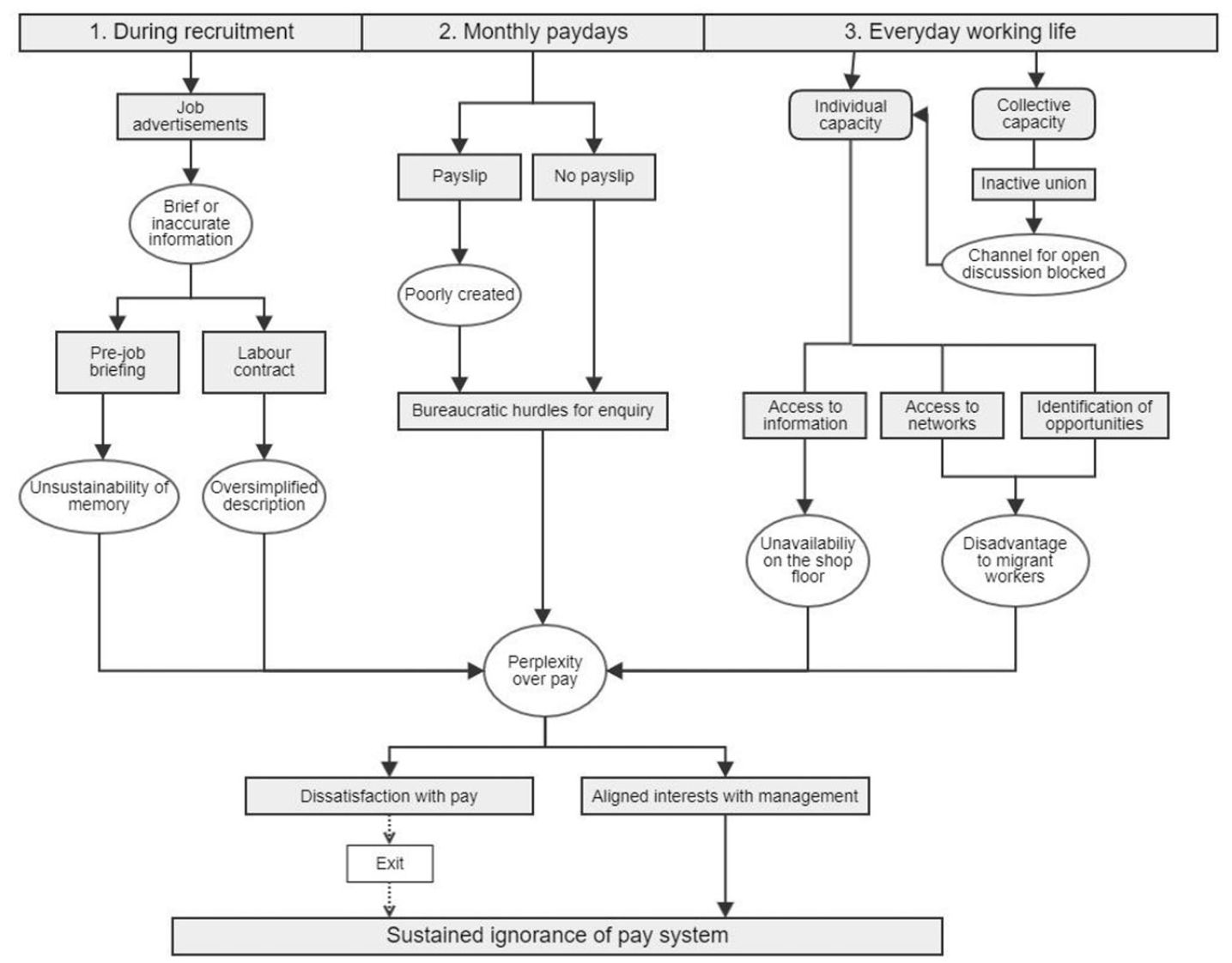
Pathways to ignorance of the pay system for factory workers throughout the employment relationship.
There were two facets to managerial control over pay communication in these factories. First, amid the absence of a collective platform for pay negotiation, one-directional and one-on-one pay communication from management set the scene in which workers in all three factories were by default given only pay information concerning themselves individually. Direct and bureaucratic control mechanisms for pay disclosure, including withholding information and creating bureaucratic procedures for making pay-related enquiries, were the primary steps taken by management to deter workers from accessing pay information that might cause them to doubt the accuracy of their own pay and pay equality among themselves. Second, the strategic alignment of pay with individual competencies and determinants beyond workers’ direct jurisdiction, such as corporate-level performance, further fragmented workers’ attempts to make sense of the pay system. By using strategic pay, management not only nurtured workers’ loyalty but also safeguarded the legitimacy of the pay system, regardless of how well workers actually understood its practicalities. Across the three workplaces, the individualisation of pay systems and one-directional pay communication practices gradually led to perplexity over pay among workers, albeit to varying degrees. This became an interim stage of the pay knowledge accumulation process, with workers subsequently choosing to either challenge the pay communication regime or simply accept the perplexity. How workers coped with the perplexity depended on the extent to which the pay system governing them aligned their interests with those of management.
Even with one-directional pay communication practices, managerial control over pay information can be undermined by workers’ organisational misbehaviour (Ackroyd and Thompson, 1999). In this study, such misbehaviour manifested in workers bypassing pay confidentiality guidance and circulating pay information among themselves. Workers with more confined social networks generally had less capacity to engage in such behaviour, limiting information transparency, but those who were more resourceful in terms of social capital managed to identify credible information sources from the managerial class, who were willing to disclose pay information and interpret the implications of pay strategies for workers. Workers who experience sustained perplexity over pay may eventually manifest discontent and resistance against pay opacity and perceived pay injustices by quitting and delegitimising the pay communication regime or the pay system as a whole. Workers who remain may not necessarily learn more about pay, but may grasp the boundaries of knowledge and non-knowledge concerning pay (Gross, 2007).
Concluding remarks
This article used a labour process approach to examine how pay transparency, rather than being a mere outcome of managerial practices and regulatory regimes, emerges from dynamic and contested social interactions (Albu and Flyverbom, 2019; Costas and Grey, 2014) at the organisational level. With the absence of a collective platform for pay articulation, workers’ capacity to resist the pay communication regime is subject to their understanding of workplace dynamics, which enable them to bypass managerial control over pay information. In this way, it complements prior research on the effectiveness of top-down and deliberate managerial pay disclosure practices. The approach adopted here also acknowledges the inherent power imbalance between management and labour, recognising that pay obfuscation is to employers’ advantage as a means of dominating workers in the process of capitalist production. Although this article focuses on conventional, spatially fixed workplaces in which face-to-face interactions between workers and management are allowed, future research may explore new forms of managerial control and management–labour dynamics in the age of digitalisation (Moore et al., 2018) and how pay communication and the sustenance of the ‘frontier of control’ manifest in the digital context.
Footnotes
Acknowledgements
This article is part of the author’s PhD thesis completed at the University of Warwick in 2019. She would like to thank Guglielmo Meardi and Jimmy Donaghey for their supervision throughout her PhD and for further comments on this manuscript despite having relocated to other institutions. She also acknowledges invaluable comments from the Editor and three anonymous reviewers.
Funding
The author disclosed receipt of the following financial support for the research, authorship, and/or publication of this article: support was received from Warwick Business School and the Great Britain–China Education Trust in the forms of scholarship and bursary.
