




Abstract
A culture of well-communicated pay transparency drives better workforce outcomes and will enable the organization to achieve and sustain a competitive advantage over its competitors. This white paper discusses how organizations can prepare for the legal requirements related to The Pay Transparency Act, as well as ways to properly communicate pay in a transparent manner with employees.
Keywords
Introduction
Pay transparency laws are regulations that require employers to disclose information about employee compensation, either to employees or to the public. These laws may require employers to disclose the pay range, a description of non-discretionary incentive compensation and benefits offered, and other perks of each position. This information must be disclosed either in postings, during hiring, or upon request.
This white paper discusses how organizations can prepare for the legal requirements related to The Pay Transparency Act, which is a law that establishes requirements for the disclosure of information about the compensation of employees and prospective employees.
The stated goal of this legislation is to help reduce discrimination-based pay gaps. Each particular state or city has unique requirements detailing what organizations need to do to comply with the law. Employers should become familiar with state and city pay transparency laws, as it is up to each employer to comply with the laws. However, employers may define how transparent they are within their organization as long as they meet the legal requirements for their jurisdiction (Brian Nordi, 2023). Some organizations may choose to be more transparent than others even when pay transparency is not required by law.
Communicating pay practices that help employees and prospects understand how their salary is set will vary depending on the company and industry (Amy Stewart, 2020). The level of transparency an organization chooses will depend on its goals, objectives, and factors such as the size of the organization, the industry in which they operate, and the culture. An open salary model is not right for every organization, but employers may want to think beyond meeting the bare-minimum requirements.
To date, 10 states have enacted pay transparency legislation that includes a salary history ban as part of the sweeping amendments.
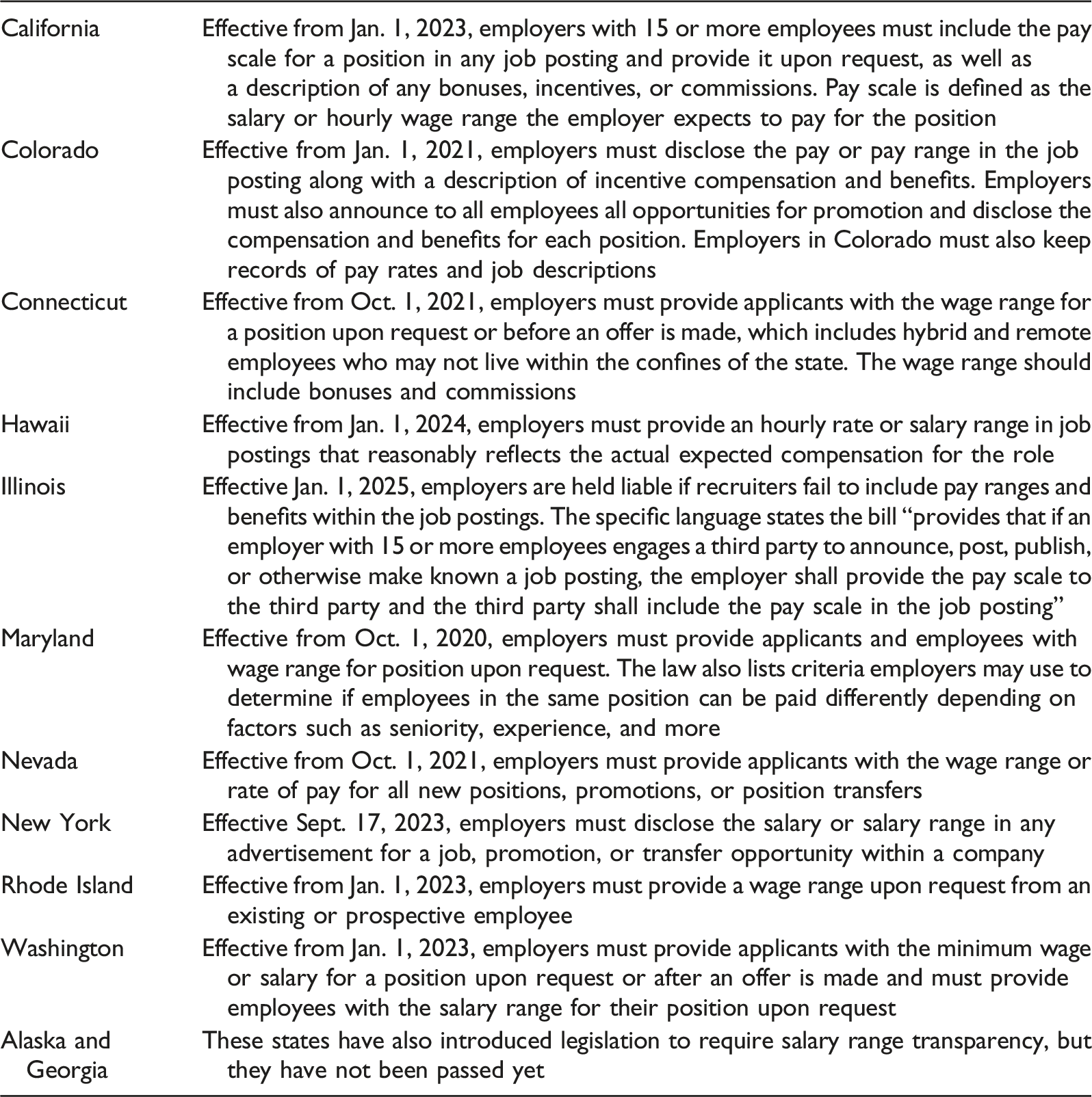
As more cities and states enact pay transparency laws, it is important to understand what pay transparency is, the advantages of pay transparency, and how to implement it.
What is Pay Transparency?
Pay transparency, also known as salary transparency or wage transparency, is the practice of openly sharing information about compensation with employees and job candidates (Brian Nordi, 2023). It refers to the degree to which employers are open about what, why, how, and how much employees are compensated and can extend beyond base pay to include variable pay and other rewards (Mercer).
The Pay Transparency Act is gaining traction throughout the United States and the legal landscape is changing rapidly. Due to the Equal Pay Act, employers cannot prevent workers from talking about their pay. Organizations that have a cultural commitment to compensating employees appropriately and embrace pay transparency will be better equipped to comply with this legislation (Expert Panel, Forbes Human Resources Council, 2020).
Organizations may interpret pay transparency simply as communicating pay practices to employees and explaining how pay is determined, while other organizations may provide the salary range for the role or may provide the salary range for every role in the organization (Sally Percy, 2022). Should organizations disclose more or less of their pay information to workers beyond the legal requirements? According to BetterUp, there are three different types of pay transparency (BetterUp): 1. 2. 3.
Organizations that practice making pay information available to employees demonstrate higher levels of engagement, trust, a commitment to diversity, a commitment to fairness and transparency, promoting gender pay equity, and have improved employee satisfaction by fostering a culture of openness and accountability.
Advantages of Pay Transparency
Pay transparency is an essential component in preventing wage discrimination. • It promotes fairness and equity in the workplace by ensuring that employees are paid according to the value of their role, competence relative to the role requirements, and performance in the role (Greene). • It fosters trust and collaboration among employees and managers by reducing the uncertainty and speculation about pay decisions and practices. • It enhances employee engagement and retention by increasing the satisfaction and motivation of employees who feel valued and recognized for their work. • It supports diversity and inclusion by addressing pay gaps and disparities that may exist among different groups of employees based on gender, race, ethnicity, disability, etc. • It improves the reputation and attractiveness of the organization by demonstrating its commitment to ethical and responsible business conduct.
Transparency has other advantages. Women are better able to negotiate their salaries and ensure they are paid fairly. When employees know they are paid fairly, they are more likely to be satisfied with their jobs.
How to Implement Pay Transparency
Pay transparency can be conceptualized by establishing and communicating pay practices. This can be achieved by ensuring the organization has a compensation strategy, compensation philosophy, and corresponding pay practices and policies that are fair and equitable. Support from senior leadership is critical for the success of pay transparency policies.
Before disclosing pay information, auditing your existing compensation strategy is the most important step toward achieving greater pay transparency. This important internal audit helps identify gaps in compensation practices and ensures all compensation data is accurate and up to date. Then organizations can establish policies around the disclosure of pay information, including who can access this information and how it will be used.
Developing a compensation strategy will help organizations prepare for pay transparency and the disclosure of pay information. A strong compensation strategy has the following objectives: • A transparent compensation system accessible to all employees with objective metrics around recruitment, performance, advancement, and compensation to ensure consistent application across the organization (Lisa Nagele-Piazza, J.D. SHRM-SCP, 2020). • A compensation philosophy that supports your goals and objectives and defines why and how you plan to pay your employees. • Up-to-date job descriptions that accurately reflect the work being done to ensure employees are being paid fairly for their work. • Labor market comparisons to help your organization attract, retain, and reward employees. Consider your competitive positioning and percentile standings for salary pay levels, variable pay ratios, and appropriate type and level of incentive pay eligibility. • A job leveling map of all employee jobs to a hierarchical level in the organization focusing on the job, not the individual (Han, 2023). • Salary structures that allow management to reward performance while controlling overall base salary costs (Culpepper and Associates, 2010). • A documented process on how the organization determines starting pay, merit increases, promotions, and other factors that impact pay equity (Lisa Nagele-Piazza, J.D. SHRM-SCP, 2020). • Wage range disclosure guidelines regarding the publication of external job postings, internal promotions, and transfer opportunities. • Recruitment and talent management pay transparency tactics to ensure equitable hiring practices that attract and retain the best candidates. • Internal systems for handling employee requests for salary reviews ensuring records are kept on pay decisions to defend against any pay equity claims. • Annual compensation review of employee salaries to ensure pay equity with others doing the same or similar work. Model out and budget cash needed for pay adjustments, promotions, merit, etc. • Pay equity analysis using the compa-ratio as a starting point for comparisons to find gaps by job family and job level. • Incentive plan design review to ensure you are encouraging the desired behaviors. • An effective way of communicating that is simple, brief, and honest so workers know the reasons for their compensation and can get answers to their probable questions. • Compensation training for managers that covers topics such as compensation philosophy, pay transparency, salary ranges, market data, pay equity, merit, performance, and how to have effective compensation discussions with employees (Live Virtual Seminars). • Annual review of your compensation strategy to ensure you remain competitive in the marketplace.
Wage Range Disclosure Guidelines
A pay communication strategy does not mean total pay transparency. Different states have different requirements for what employers must include in their job postings regarding pay ranges, commissions, bonuses, and other forms of compensation. A holistic approach to compensation and a unified message to all employees and prospective employees are the first steps to becoming pay transparent.
A pay communication strategy means being intentional about what you share and how you communicate compensation to your internal employees and external applicants (Amy Stewart, 2020). Becoming a pay transparent organization isn’t as simple as assigning a salary range to a job posting. You don’t have to post employee salaries, or the full salary ranges publicly for all to see and discuss to become legally compliant.
Focus on avoiding false advertising around the pay range. Employers must disclose a wage range in which the employer anticipates setting wages and can do so using any of the following methods: • Any applicable pay scales. • Any previously determined wage range for the position. • Actual range of wages for current employees holding comparable positions. • The amount budgeted by the employer for the position.
Employers should do the following: • Notify hiring personnel (including third-party recruiters) about your wage range disclosure guidelines. • Create wage ranges for positions you plan to fill and consider preparing wage ranges in anticipation of requests. • Consider the internal value of the job along with the external market value when developing wage ranges. Wage ranges are the anticipated salary you are willing to pay for a job within your organization that is fair and equitable. This does not mean posting the entire salary range. • Review remote positions to determine whether the Act applies to any employees residing outside of your headquarters’ jurisdiction. • Consider developing a nationwide approach that covers all your state requirements by using the most stringent pay transparency law for your multi-state organization (Brett Christie, 2022).
Solution
While managers are not solely responsible for communication about compensation with employees, they do play a significant role. Communications from human resources also play a role in the employee’s understanding and acceptance of their total compensation package (Heathfield, 2020).
The current trend is to use total compensation statements that list the employee salary, bonuses, paid time off, and all short- and long-term benefits along with the financial value of each one (figures, 2023). This can show the employees the true cost of the entire compensation package, which represents the investment the organization is making in the individual and is a visual guide that may help employees feel more engaged.
But for employees and managers to fully understand how pay is set, the communication must broadly educate them about the company’s compensation philosophy and pay practices (Heathfield, 2020). To be effective, managers must be educated in these pay practices so that they are consistently applied throughout the organization. Then managers can establish a process for addressing employee concerns related to pay before taking action.
Main Points
Point 1
Pay inequities exist and disproportionately impact women, especially those who are Black, Indigenous, and people of color (BIPOC). According to U.S. Census 2020 data, women earned 83 cents to every dollar a white man earned. Black women are only paid 63 cents and Latinx women earn 57 cents for every dollar paid to a white man (Miles, Understanding pay transparency and its importance, 2023).
Studies show that the gender gap narrows with pay transparency because it helps identify and address pay disparities in employee compensation based on gender, race, or other factors. To ensure greater pay transparency, conduct a pay audit based on your pay practices so that you understand where you may have gaps in pay and correct any pay inequities as soon as possible.
To conduct a pay equity audit, follow these steps (Pinarchick, 2019): 1. 2. 3. 4. 5. 6. 7. 8. 9.
Point 2
While managers and recruiters do not create compensation programs, they do execute them. Organizations need to ensure that managers are well prepared to face a compensation conversation or else they may risk employee attrition, loss of productivity, and employee dissatisfaction. It also means preparing your recruiters to discuss compensation with applicants during the interview process (Pave Team, 2022). The role of managers and recruiters is to carry out compensation programs, not to develop them.
To improve the relationship between employees and management, your organization should consider developing compensation training modules that educate managers on the importance of pay transparency in the organization. There are many ways to share compensation educational programs. Some companies use online training courses while other companies may use in-person training sessions or workshops.
Some important training topics include: 1. 2. 3.
Managers should also understand the benefits of pay transparency for promoting fairness, trust, and diversity in the workplace. The goal of educating managers is to prepare them to handle difficult or sensitive situations such as pay disparities, complaints, or requests for raises. To be ready, managers must understand how factors like budget, performance, and employee pay and benefits contribute to their total compensation package (Brett Christie, 2022).
Point 3
Pay transparency may not suit every organization or culture and it requires careful implementation and communication. Pay transparency can have unintended or complicated consequences, such as envy or the perception of inequity as employees compare their pay with others (Samra, 2021). Before beginning a dialog around pay with employees, organizations must be confident that their compensation strategy aligns with company culture.
To prevent employees from learning their pay range from external applicants, organizations should consider sharing the relevant pay information with them. This can help mitigate some of the potential or complex drawbacks of pay transparency, such as resentment or the feeling of unfairness when employees compare their pay with others.
The goal of pay transparency is to increase employee confidence in the fairness of the compensation process (BetterUp). One of the most important results of pay transparency is an increase in pay equity. Pay transparency, when coupled with robust analytics, can support fair pay equity outcomes.
Conclusion
When managers understand how compensation works, they become better at making informed pay decisions. When employees understand how compensation works, they are well equipped to make decisions about their careers (Enrique Esclusa, 2023).
There are several theories (Miles, Understanding pay transparency and its importance, 2023) that relate to the importance of an effective and strategic pay transparency program: 1. 2. 3.
Based on these theories, organizations that develop effective and strategic pay transparency policies will help with motivating employees and improving job satisfaction.
Pay transparency does not always lead to true pay equity. Systemic change only happens when company leaders can champion change from the top down. Create a plan to maintain your compensation strategy even as your organization changes, grows, and responds to external forces like inflation or a recession.
Compensation varies according to experience levels. When this information is divulged properly, pay increases are clearly defined and explained, which in turn makes it easier for employees to work toward specific goals and aspirations (Joanna Fragopoulos, 2019). Practices like regular pay audits and equity analyses are key to identifying discrepancies around privilege, and proactively budgeting to correct for pay discrepancies ensures that leaders can move quickly to make salary adjustments that correct pay inequities.
A culture of well-communicated pay transparency drives better workforce outcomes and will enable the organization to achieve and sustain a competitive advantage over its competitors.
Footnotes
Declaration of Conflicting Interests
The author(s) declared no potential conflicts of interest with respect to the research, authorship, and/or publication of this article.
Funding
The author(s) received no financial support for the research, authorship, and/or publication of this article.
