



Abstract
Given the steady interest in corporate social responsibility (CSR), this study explores the process of professionalization of CSR. Drawing upon the literature on ‘organizational’ professionals, explicit and implicit CSR, as well as varieties of capitalism, professionalization of CSR is explored in order to trace processes of explicitization and potential cross-national differences between the United States and Germany. In a comparative longitudinal study, we analyse job announcements in the field of CSR and find that although the hybridity of explicit and implicit CSR between the US and Germany is starting to unfold, job characteristics and job requirements in CSR in Germany and the US are still not the same. Our results suggest there is a more distinct trend in professionalization in the US than in Germany in terms of the manifestation of explicit CSR and that the institutional context is linked to how employers drive professionalization processes in non-traditional professions.
Keywords
Introduction
Sustainability in the form of pursuing economic, environmental and social objectives has gained momentum in research and practices over the past decades (Aust et al., 2020). Because of stricter regulations by governments and political climates, many companies have increasingly committed themselves to sustainable development (Williams et al., 2019). More and more corporations participate in the Global Reporting Initiative (GRI) (Kolk and Perego, 2010) and especially large multinational companies (MNCs) have invested in social and ecological policies and projects such as employees’ volunteering and the training of subcontractors’ employees to secure labour standards along the supply chain (Ramirez and Rainbird, 2010). The commitment to, and reorganization towards sustainability and corporate social responsibility (CSR) implies that firms need to create and design jobs for pursuing, implementing, communicating and evaluating their sustainable business practices. Therefore, large corporations in recent years have established entire interdisciplinary and interdivisional CSR units, while others created single positions they often located within their human resources (HR) departments (De Stefano et al., 2018). Recent research focuses on the activities and challenges of CSR practitioners in enforcing CSR issues within firms (Jones and Rupp, 2018; Wang et al., 2016). Part of this individual-based research is studies that have explored the evolution of the nascent occupation of CSR by focusing on the challenges for CSR practitioners arising from their search for legitimacy because they do not meet the requisite criteria of a ‘true’ profession and therefore need to elaborate alternative strategies to become recognized as a ‘corporate’ profession (Brès et al., 2019; Furusten et al., 2013).
This debate on the dynamics in the occupational field of CSR, however, is hampered by our fragmented understanding about how the ‘occupational project’ of professionalization (Abbott, 1988) in CSR is driven on the macro-level – that is, by institutions, states and their educational systems, and corporations. As employers, companies play a central role in the professionalization of corporate professions (Muzio et al., 2011). Nevertheless, it is unclear whether – and if so, how – corporations contribute to professionalizing the occupational field of CSR by relying, for example, on professional, highly educated staff when filling their CSR vacancies just as they do in occupations such as accounting or law (Carter and Spence, 2014). There is a lack of research into what firms require from CSR practitioners in terms of education, job experience, skills, abilities and CSR expertise – for instance, in the form of specific certifications. Moreover, although scholars have extensively explored the role of institutions as determinants of CSR practices and policies (Bondy et al., 2012), our understanding of potential differences in the professionalization processes in CSR across institutional backgrounds remains limited.
This lack of research into the roles of employers in the professionalization of CSR practitioners, as well as related international differences, is worrisome for at least two reasons. First, as Dutton et al. (2001) showed, CSR managers operate in environments shaped by heterogenous and even contradictory interests and beliefs that do not always align with the social issues of CSR. Therefore, managers working in CSR face various challenges and barriers and act as ‘sellers’, promoting CSR issues to organizational decision makers (‘buyers’) who are expected to pay attention to these topics (Wickert and de Bakker, 2018). Managers of CSR who are perceived as professionals might be able to overcome such hurdles quicker because of more expertise and status linked to professionalization – hence, helping organizations to implement CSR policies and practices more smoothly (Abbott, 1988).
Second, many companies will need to professionalize their CSR in the future because pressures within their institutional contexts will force them to elaborate more and more overt and advanced CSR strategies, policies and practices. This becomes especially evident in findings of comparative CSR research. Drawing on Matten and Moon’s framework of explicit and implicit CSR (2008), research points to a trend towards CSR explicitization and hybridity (e.g. Midttun et al., 2015). It also suggests that because of a growing active societal issue focus on CSR and more official regulations on reporting and increasing pressure from stakeholders, corporations adopt more explicit CSR through innovation as well as the redefinition of traditional implicit CSR expectations in explicit CSR terms (Matten and Moon, 2020). Thus, although explicit forms of CSR have been originally identified in national contexts that in terms of Hall and Soskice’s (2001) scheme of varieties of capitalism (VoC) represent liberal market economies (LMEs), the adaption of explicit CSR in coordinated market economies (CMEs) apparently has occurred as well (e.g. Jamali and Karam, 2018). The growing explicit engagement in CSR worldwide aligns with research in the field of political economy that debates the stability and hybridization of current economic systems. Given increasing globalization, this literature challenges the long-prevailing VoC model and describes tendencies of a worldwide convergence of economies ‘on something similar to an American model’ (Hall, 2015: 3). From this ‘model’ CSR has not only emerged but also remains deeply embedded in it today as a means of maintaining legitimacy and competitiveness. Its global spread illustrates the importance of developing and communicating substantive CSR policies and practices to stakeholders and, thus, a similar need to obtain the professional staff to do so.
Drawing on the literature on the evolution of corporate professions, on explicit and implicit CSR, and on the debate on global trends of liberalization, this study explores the corporation-driven trends of professionalization in CSR. By examining longitudinal data from the US and Germany, we analyse the cross-national differences in CSR job requirements and their changes over time, thus exploring CSR explicitization via the lens of CSR professionalization. We choose a comparison of US and German data because these countries represent the historically grown, divergent institutional frameworks of LMEs and CMEs. This leads to differences in how firms manage their relationships to key stakeholders, including industrial relations, interfirm relations that govern technology transfer and markets for corporate governance that secure finance (Hall and Soskice, 2001). Because CSR is an important example of such stakeholder relations, it is likely that trends towards an explicitization of CSR can be traced by comparing these two countries over time.
Professionalization and CSR
The ‘market for virtue’ has been growing fast since the 1990s (Vogel, 2005). Firms have long been discovering that the increasing institutionalization of socially responsible corporate behaviour within society (Bondy et al., 2012) is not just a financial burden they need to adapt to, but that there is a business case to be made for CSR. Taking CSR seriously is supposed to lead to better reputations (Brammer and Pavelin, 2006), better access to highly qualified job applicants (Jones et al., 2014) and to financial success (Vishwanathan et al., 2020). Nevertheless, to take advantage of these benefits as well as to respond to the increasing national and international laws, regulations, standards and reporting requirements, companies need to develop sophisticated and modern CSR policies, programmes and activities.
A prerequisite for realizing this is the selection and deployment of professional employees, highly qualified for and educated in CSR. Professions are characterized by high-level qualifications, a delineated knowledge base, a shared professional identity, and a code of conduct policed by professional bodies that recommend best practices and inspect the conduct of members of the profession (Abbott, 1988; Ackroyd, 2016). This dominant form of organizing and controlling expert knowledge and skill that is established through closure has been scrutinized critically in recent years (e.g. Anteby et al., 2016). Scholars have challenged traditional conceptualizations of professions and professionalization, alleging their incompatibility with modern work realities such as deregulation, marketization and that today occupations act in large-scale workplaces (Švarc, 2016; Vallas and Christin, 2018). This research emphasizes the largely changing landscape of professions in which numerous new occupational fields emerge while older ones are integrated or redefined, resulting in blurred boundaries between old professions and new ‘organizational professionals’, also named ‘corporate professions’ (cf. Heusinkveld et al., 2018; Risi and Wickert, 2017). The latter have been found to differ from traditional professions in having more fragmented knowledge bases and a broader variety of services, roles and methodologies that impede the development of a sense of community and a shared professional identity (Brès et al., 2019; Muzio et al., 2011).
These new forms of expert labour and knowledge-based occupations such as IT, advertising and management consultancy have evolved new tactics and paths of professionalization (Reed and Thomas, 2021). For instance, Muzio et al. (2011) proposed four features of ‘corporate’ professionalization by which such knowledge-based occupations strive to imitate key characteristics of traditional professions. First, in contrast to traditional and more independent professions, corporate professions are characterized by organizational memberships through which firms, as well as, or instead of, individuals may join institutes and associations, hence assigning organizations a crucial role in the professionalization process (Heusinkveld et al., 2018). Second, these occupational fields search for legitimization not via public benefit, but by a focus on close client engagement – that is, by promoting and proving to clients and markets the (commercial) value delivered by their professional service providers. Third, because of their fluid, inconclusive and relational forms of knowledge bases, new occupations have established alternative forms of credentials that emphasize not an abstract body of knowledge and its possession, but (generic) competences and skills by which this knowledge is put into practice. Finally, Muzio et al. (2011) showed that corporate occupations differ from traditional professions in their jurisdictions because they involve an international focus instead of a national one, especially by membership in umbrella associations that coordinate global initiatives for the given profession.
However, despite the differences on how professionalization takes place in traditional versus new corporate professions, the objectives of this process – that is, what constitutes professionalization – remain similar. In both traditional as well as new managerial professions, professionalization still is centred around legitimization, contests for jurisdictions, closure on the basis of knowledge and expertise, as well as membership in professional associations. Thus, both new just like old professionals are linked and seek to be linked to high status, power and presumed effectiveness (Abbott, 1988; Ackroyd, 2016).
Although new management occupations and the efforts of their members in becoming professionals have been studied in various fields such as consultancy, accounting, project management and human resource management (HRM) (e.g. Carnegie and Edwards, 2001; Kipping and Kirkpatrick, 2013; Lengnick-Hall and Aguinis, 2012), knowledge about the professionalization project in CSR is, with some exceptions, still scant (Brès et al., 2019). Research so far has mainly focused on a micro-level, which is on CSR practitioners and their strategies in finding legitimacy as non-traditional professionals (Furusten et al., 2013; Gond et al., 2018; Risi and Wickert, 2017). However, studies on professionalization in CSR at a more macro-level are scarce. In particular, literature on the role of corporations in the professionalization of ‘new’ professionals such as CSR practitioners is largely underrepresented (Muzio et al., 2011). This is quite surprising, given that organizations employ these individuals and, hence, actively shape and regulate professionalization processes by their corporate policies and practices such as performance management and customer relationship management, imposing professionalization from above rather than from within (Evetts, 2011). They represent key sites and vehicles for controlling and driving large-scale professionalization projects (Suddaby et al., 2007). Therefore, our study focuses on the role of employers in the professionalization of CSR practitioners by exploring the corporate practices of employee recruitment in this occupational field. Moreover, given that organizational structures, policies and practices mirror the norms and values of their societal and political environments, our research embraces cross-national differences in the attempts of firms to promote this professionalization because of their different institutional contexts. This we will examine in the next section.
Institutional forces and cross-national differences in CSR professionalization
External factors located in an organization’s environment have been found to affect CSR significantly. Drawing on institutional theory, scholars have discussed that the rise in socially responsible corporate behaviour mainly originates in changing organizational environments in terms of institutional pressures (DiMaggio and Powell, 1983), especially from core stakeholders such as consumers, employees, investors and communities (e.g. El Akremi et al., 2018). According to this research, CSR is developed for the purpose of gaining, maintaining and repairing legitimacy – that is, by establishing a fit between regulatory, cognitive and normative institutions and their corporate policies, strategies and practices (Boon et al., 2009). As Matten and Moon (2020) elaborate, institutional forces like societal interests, norms and expectations as well as regulations at the local, national and international levels, therefore shape the extent and the types of CSR activities firms choose to implement. Given the considerable increase in these institutional pressures (e.g. Flammer, 2013; Reid and Toffel, 2009), firms will soon need to intensify their CSR practices and policies and their communications. In turn, this necessitates the recruitment of highly qualified people with specialized university degrees, certified skills in CSR and appropriate international job experience.
However, CSR stakeholder identities and interests vary cross-nationally (Marano and Kostova, 2015), reflecting different institutional contexts across countries. As Hall and Soskice (2001) have elaborated in their VoC approach, the competitive advantages of firms and countries are strongly intertwined with historically shaped, country-specific institutions (Lundvall, 2007). Drawing on this research, Matten and Moon (2008, 2020) exemplified that corporational engagement in CSR varies between LMEs and CMEs. They suggested that because of institutions’ encouragement of individualism and discretion in private economic actors in LMEs, ‘expectations of corporate responsibility are more overt and focused not only on business in general but also on individual corporations’ (Matten and Moon, 2020: 16), resulting in ‘explicit’ CSR that rests mainly on voluntary corporate policies, programmes and strategies. In contrast, they labelled the type of CSR in CMEs as ‘implicit’ because expectations of socially responsible corporate behaviour in these economies are more embedded in and centred on firms in general, as initiated by (historically grounded) formal and informal institutions consisting of societal values, norms and rules that firms adapt to. Several studies found support for these differences in the type of CSR practised by firms in LMEs and CMEs (e.g. Kang and Moon, 2012; Silberhorn and Warren, 2007), but recent ones also have found evidence for a shift in CMEs to a more explicit CSR termed explicitization (Knudsen et al., 2015; Matten and Moon, 2020). Explicitization involves a more active societal focus on CSR attributed to stricter governmental regulations for reporting, and demands of stakeholders for reassurance about CSR activities as responsible investments and sourcing. In response, ‘corporations not only adopt more explicit CSR through innovation but also redefine traditional implicit CSR expectations in explicit CSR terms and, thus, develop more explicit CSR policies, strategies, and practices’ (Matten and Moon, 2020: 18). Explicitization has led to a hybridity of explicit and implicit CSR in the US and Europe with an ongoing trend towards more explicit CSR in the European context (Knudsen et al., 2015). These changes mirror a global trend of liberalization that has led some scholars to question if capitalism still comes in varieties (e.g. Hay, 2020).
Drawing upon Matten and Moon’s framework, our study explores potential cross-national differences in CSR through the lens of professionalization, especially between the US and Germany. At first glance it could be argued that because of a more explicit CSR in the US and a historically grounded more implicit CSR in Germany, professionalization of CSR in the US context would be stronger than in the European context. However, trends of explicitization may have narrowed this gap. To explore both the so-far neglected role of corporations and their practices in the professionalization of CSR practitioners (e.g. Suddaby et al., 2007), as well as potential trends in explicitization, job requirements announced in US and German CSR job postings were compared longitudinally. According to Spence (1973), employers base their hiring decisions on signals for applicants’ competence – that is, on information about applicants’ job achievements such as degrees and certifications. It is assumed here that the more explicit firms’ CSR is, the more these corporations will require this kind of information in job advertisements that signal professionalism – that is, the more they will ask for specific university degrees, certifications, knowledge (e.g. on specific CSR reporting issues) and vice versa. Demanding and emphasizing distinctive training and (academic) education in the field of CSR in job postings can also be seen as a part of explicit CSR because it signals that firms take distinctive responsibility for issues related to their stakeholders, such as employees, consumers and members of their community. Moreover, highly qualified staff represent a pivotal means to establish more explicit CSR policies, strategies and practices, and, thus, to better meet the expectations of key actors.
Methods
Selection of job announcements
Individual capabilities in terms of qualifications, certifications and knowledge are defined as one major element of professionalization (Farndale, 2005). According to Evetts (2013), this is especially true for ‘younger’ occupations such as IT consulting and HRM as they seek status and recognition for the significance of their work by standardizing their education, training and qualifications in a manner equal to traditional professions. Nevertheless, given the rather broad definitions of a profession in the literature, its measurement varies significantly. For instance, in the debate on the weak status of the HRM function, the measurement of professional HR ranges from whether HR representatives are members of the firms’ board (e.g. Guest and King, 2004) to the use of evidence-based HR practices (Farndale, 2005). Several studies have assessed professionalization by drawing upon Hodson and Sullivan’s (2012) dimension of ‘specialized knowledge’ and analysed HR professionalization via examining HR job announcements. For instance, Aguinis et al. (2005) as well as Bayer and Lyons (2020) selected job advertisements in HR via the largest US job search websites and tested if employers require and prefer HR professionals holding HR certifications.
In line with these studies, we collected job announcements in the field of CSR from the most visited career and job websites in Germany and the US and analysed the required qualifications, skills and experiences of CSR practitioners as well as required certifications in CSR. The collection of data in 2014 and in 2020 allowed us to examine possible changes in the professionalization of CSR and, thus, in processes of explicitization. For Germany, we included job announcements posted on https://www.stepstone.de, https://www.monster.de, https://jobrobot.de and https://linkedin.de. The US postings came from https://www.monster.com, https://www.indeed.com and https://linkedin.com. We chose these job boards because they are among the top platforms in terms of number of unique visitors (e.g. Forbes, 2017; Statista, 2019). These platforms were analysed for CSR job postings by using keywords such as corporate social responsibility, CSR, corporate responsibility, social impact and (community) engagement. The jobs resulting from the keywords ‘sustainability’ and ‘environment, social and governance’ (ESG) were only included if they showed a clear CSR focus. Because our goal was to investigate professionalization trends in CSR work in an explorative way, we did not leave out internships. These positions may be a signal of how relevant companies consider CSR work and how complex the examined jobs are designed.
We gathered the data in 2014 from February to March and again in 2020 from June to July. In 2014, we had internal university funding for this project that did not allow for a longer collection of data. However, it turned out that in both periods after two months we achieved data saturation (Guest et al., 2006) because after that time frame, new job postings did not offer any newer insights and circled around the trends already captured in our data set. During both periods, we had to search daily for suitable job advertisements because only 5 to 10 advertisements per country were published per day. However, it was not possible to include all of these advertisements in our sample because the job descriptions did not relate sufficiently to CSR. Ultimately, our search resulted in 541 job announcements: 121 in the US and 190 in Germany in 2014 and 113 in the US and 117 in Germany in 2020.
Content analysis procedure
In the first step, we selected a random set of 10 US and 10 German job announcements, discussed the content of each advertisement and found consensus on both overlapping features that indicated the professionalization of CSR practitioners in the sense of high-level qualifications, a delineated knowledge base and a shared professional identity (Abbott, 1988; Ackroyd, 2016) as well as the coding of these features in the context of a quantitative and qualitative content analysis (Miles and Huberman, 1994). In a second step, these characteristics were transformed into a coding matrix. This included – apart from characteristics of the given organization in terms of size and industry sector – variables such as job status (e.g. type of work contract, duration of the employment), job description (e.g. tasks, duties, responsibilities) and job requirements in terms of level and field of education (e.g. undergraduate, graduate, field of studies), type and level of work experience, type of CSR expertise (e.g. life-cycle thinking and tools, GRI reporting) as well as required CSR certifications. Finally, we coded random and separate sets of five US and five German announcements with similar variables. Only a few discrepancies appeared and were resolved during a subsequent discussion to arrive at calibration and a common frame of reference in the coding procedure of the remaining advertisements.
Results
We begin the examination of the results with an overview of the firm size and industry sector covered, and focus then on the status of posted CSR jobs and the educational and professional requirements they contain.
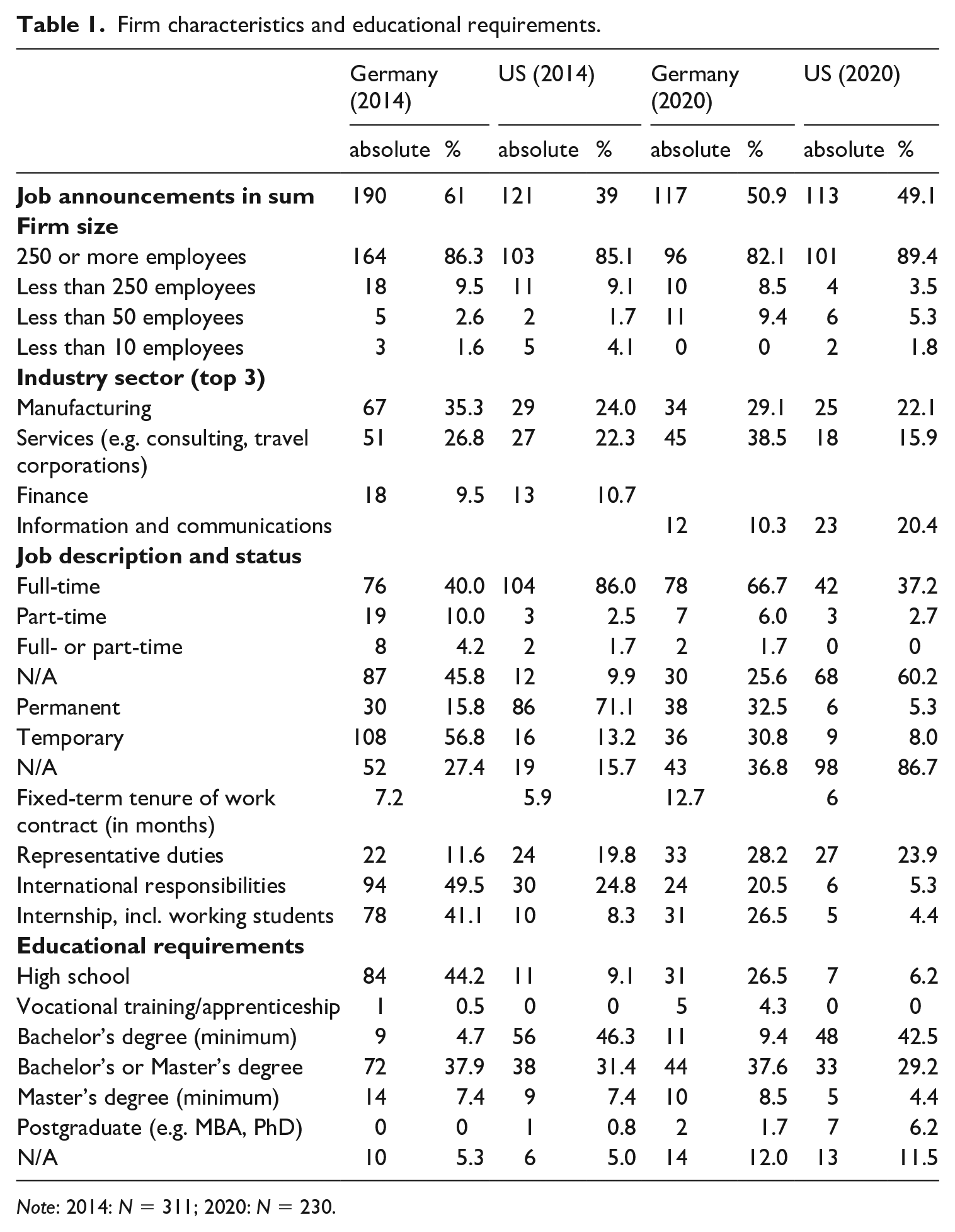
As Table 1 shows, in the two samples from 2014 and 2020, the majority of the job announcements were posted by large companies. More than 80% of the German and US firms had more than 250 employees. Regarding industries, the sample consisted of firms from manufacturing, services (e.g. consulting industry, travel corporations), information and communication, finance, health and social services, energy, trade, hospitality, recreation, as well as arts and entertainment.
Firm characteristics and educational requirements.
Note: 2014: N = 311; 2020: N = 230.
Status of posted CSR jobs
In 2014, only 40% of the German job announcements were for full-time jobs; in contrast, 86% of the US postings involved full-time jobs. In 2020, many firms in the US sample did not specify whether the job was full- or part-time; however, in Germany the proportion of full-time postings in CSR was higher than in 2014. Similarly, in Germany in 2014, 57% of the firms posted temporary jobs, but this proportion decreased in 2020 to 31%. The tenure of the German temporary work contracts increased from 7 months in 2014 to 13 months on average in 2020, but for the US no changes could be detected. In addition, in 2020, German firms in the sample seem to have looked more for permanent employees in CSR than in 2014. In the US sample, most of the firms looked in 2014 for permanent CSR practitioners as well, but because the majority of the US job postings in 2020 did not include information on this variable, no comments can be made on any changes in this area.
As for the duties and responsibilities linked to CSR jobs, the analysis revealed similar developments in both countries. Compared with 2014, in 2020 both the German and the US job postings showed fewer international responsibilities (e.g. organizing international CSR conferences with internal and external stakeholders and determining its issues). On the other hand, CSR jobs in both countries in 2020 encompassed more representative duties than in 2014 – for instance, representing the firm and CSR priorities at meetings, conferences and other events, both internal and external – but this increase was comparatively greater in the German sample. In addition, in both countries, the proportion of CSR postings that involved internships decreased from 2014 to 2020. For Germany, the decline by 14 percentage points between 2014 and 2020 is especially striking. Nevertheless, despite this drop, the share of internships in the German CSR job advertisements was still far higher than in the US. However, with regard to the educational and professional requirements of CSR jobs, clearer differences between Germany and the US emerged.
Educational and professional requirements
The most remarkable difference between what German and US firms required from CSR practitioners in terms of professionalization was that, unlike in the US, many of the German CSR jobs required only a high-school degree – which may have been because many of the German firms looked for interns. In 2014 this search for interns accounted for more than 40% of the German CSR job postings. In 2020, this proportion decreased to 27%, but was still higher than in the US. In both US samples, not more than 10% of the job postings required only a high-school degree. Instead, around 80% of the US companies in the sample demanded in 2014, as well as in 2020, at least an undergraduate degree. In contrast, in 2014, only 50% of the German firms required an academic degree for CSR jobs. Nevertheless, this proportion increased in 2020 to 57%, indicating German employers demanded more graduates when filling their CSR vacancies than in 2014.
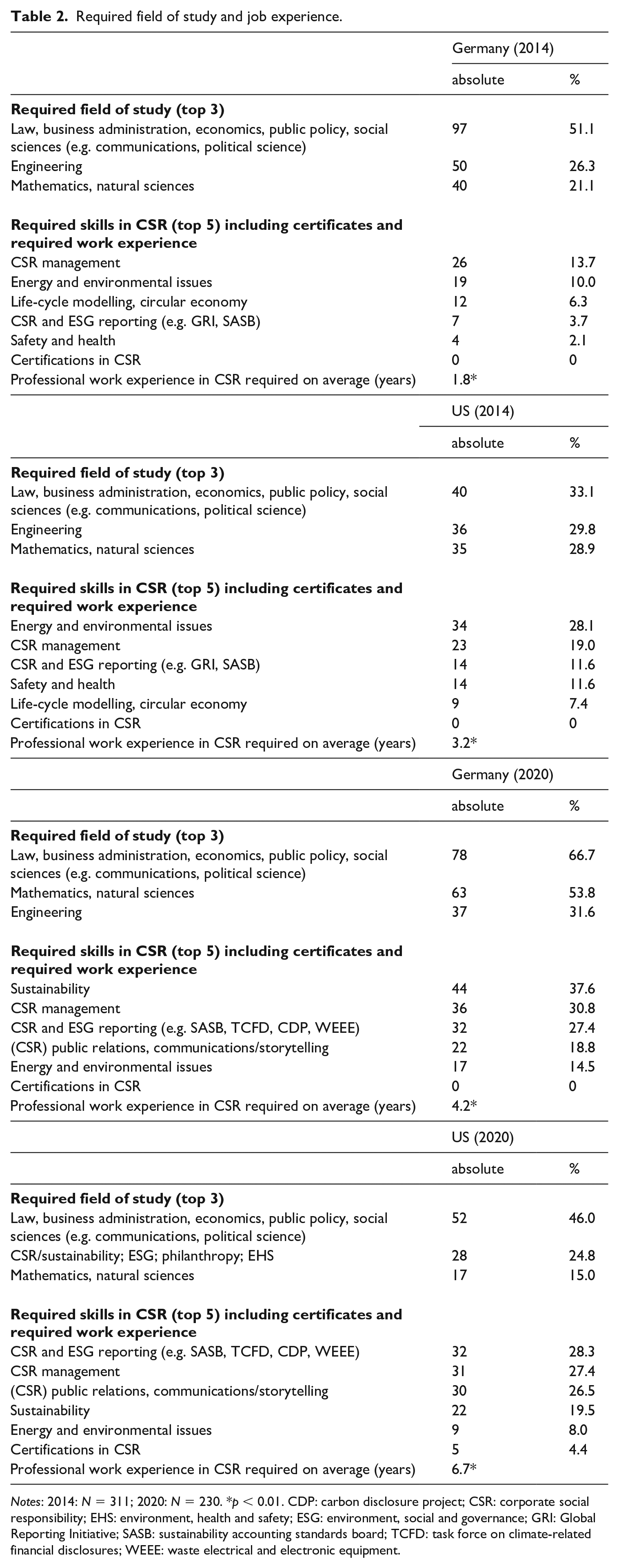
As Table 2 shows, in both countries, firms looked in 2014 primarily for graduates in law and management, followed by graduates in engineering, mathematics and natural sciences. Although this did not change in the German sample over time, US firms looked for slightly different applicants in 2020. Apart from graduates in law, management and mathematics, as well as natural sciences, they also looked for applicants holding degrees in CSR or related fields such as sustainability or environment, social and governance (ESG).
Required field of study and job experience.
Notes: 2014: N = 311; 2020: N = 230. *p < 0.01. CDP: carbon disclosure project; CSR: corporate social responsibility; EHS: environment, health and safety; ESG: environment, social and governance; GRI: Global Reporting Initiative; SASB: sustainability accounting standards board; TCFD: task force on climate-related financial disclosures; WEEE: waste electrical and electronic equipment.
Moreover, a two-sample t-test revealed that in 2014, as well as in 2020, US firms required significantly more work experience for CSR jobs than German firms (2014: 3.23 years vs 1.83 years [t = −7851, p < 0.01]; 2020: 6.7 years vs 4.2 years [t = −7742, p < 0.01]). Yet, in both countries, the required CSR work experience in years doubled over time. This change is also reflected in the CSR fields in which firms asked applicants to have experience in. In 2014, employers in both countries looked primarily for staff experienced in CSR management as well as in issues such as energy and environment, life-cycle modelling and safety and health, but these topics had shifted slightly six years later. In 2020, in both countries, firms searched increasingly for job applicants familiar with the issue of CSR and ESG reporting. In the US sample, this requirement increased from Rank 4 in 2014 to Rank 1 in 2020. In addition, a requirement missing in 2014 job postings in terms of CSR expert knowledge appeared in 2020 in both countries: firms in both countries in the sample of 2020 searched for CSR practitioners who had work experience in CSR communication and PR (CSR ‘storytelling’). Finally, although acknowledged CSR certifications such as the certificates of the Responsible Business Alliance (RBA) and the SA8000 Standard have been in place for several years, none of the companies, neither in Germany nor in the US, were looking for employees certified in CSR in 2014. However, in 2020, 4% of US employers wanted applicants to be certified, but, again, none of the German job postings included this requirement.
Discussion
The present study examined professionalization processes of CSR practitioners and used them as a lens to trace cross-national differences. Our assumption was that explicit CSR in LMEs is more strongly associated with the recruitment of highly qualified, well-trained CSR practitioners than implicit CSR in CMEs. Hence, we conducted a comparative longitudinal analysis to examine whether firms in the US pay more attention to finding highly skilled CSR employees than German firms and whether this changes in the wake of CSR explicitation (Matten and Moon, 2020).
The descriptive analysis of the data revealed differences, but also parallel developments, in the characteristics and requirements of CSR jobs in Germany and the US. In Germany, the number of full-time jobs in CSR increased over time while the number of both temporary jobs and internships decreased significantly in favour of permanent jobs. Because of the many missing references, it is not possible to make any statements in this regard for the US sample, but for Germany this shift of CSR jobs from the marginal to the permanent workforce might indicate that in recent years CSR has gained status in German companies. Changes that emerged over the years in the characteristics of CSR jobs in Germany compared with those in the US underline that heightened status. For example, the proportion of representative tasks in CSR jobs increased in both countries, but significantly more in Germany than in the US, where this indicator remained largely stable. For Germany, this indicates a qualitative enrichment of CSR jobs over time, which also reflects that, in 2020, German companies were filling fewer CSR vacancies with interns than in 2014. However, this figure was still significantly higher than in the US, where interns seem to play a much lesser role in CSR than in Germany. Instead, US firms recruited more graduates by far to work in CSR than German firms, again pointing to the more important role that American companies obviously lend to CSR practices for their long-term success. Nevertheless, German companies seem to be catching up because they too were looking for significantly more graduates to support them in CSR over time.
The fact that American companies, in comparison to German companies, put more emphasis on professionalized employees in CSR is further indicated by the emphasis in US job advertisements in 2020 on more specialized academic degrees and majors in the field of CSR, along with significantly more professional work experience, especially in CSR and ESG reporting. Despite a discernible trend that German companies also expect more professional experience in CSR from job applicants, US companies’ requirements were more demanding. This recruitment of more highly skilled CSR practitioners in the US is finally reflected in the fact that in contrast to German firms, some US firms in 2020 began to look for CSR managers holding acknowledged certifications.
In sum, our findings indicate that US firms drive the professionalization of CSR practitioners more intensively than German firms. American companies place higher demands on applicants in CSR because the jobs involved are more sophisticated than in Germany and, therefore, are more located in the core workforce. At first glance, the higher proportion of tertiary educated people in the US (OECD, 2019) may explain this finding. Nevertheless, combined with our results that US firms were looking more intensively for staff who were specialized in CSR, either through majors or certifications, our data suggest that professionalization of CSR practitioners is more advanced and more expected by employers in the US than in Germany. This observation supports Matten and Moon’s (2008) distinction between explicit CSR in LMEs and more implicit CSR in CMEs, because the more overt CSR strategies and practices US firms have to exert prompt them to search more intensively for professionally trained CSR employees. However, our findings also suggest that these cross-national divergences are dynamic because German companies have raised their requirements for CSR applicants in recent years as well, employed CSR staff more often on a long-term basis and designed more complex jobs in the field of CSR. Although these trends did not eliminate the distinctive differences found in CSR job postings between the US and Germany in 2014, they became markedly less in 2020, indicating a tendency towards the explicitization of CSR in Germany. Probably because of the strong export orientation of the German economy and the various institutional contexts in which German firms increasingly operate and must adapt to, German firms thus seem to shape CSR more and more like companies in LMEs.
Study limitations
Our study has limitations stemming from its method and its context. The analysis is based solely on job announcements, and it cannot be ruled out that this had some effect on the results. For instance, the CME Germany is characterized by stricter labour regulations and stronger internal labour markets than the US (Hall and Thelen, 2008; Streeck, 2010). Thus, positions for external candidates recruited through public job announcements are often lower in the hierarchy and generally have lesser requirements for education and skills (Doeringer and Piore, 1971). These structural differences might have influenced the findings. However, because the clearest differences in CSR jobs were found in Germany in the more extensive use of internships – which are not classic entry-level positions – this may not have a significant distorting effect on our results. Nevertheless, future studies should explore the professionalization of CSR by going beyond job announcements to also examine the curriculum vitae and biographies of CSR practitioners. Further, because most of the companies in both samples were large enterprises, future studies should also expand research to small and medium-sized companies. Because smaller enterprises have been found to be more responsive to stakeholders’ demands (Darnall et al., 2010), the cross-national differences in the professionalization in the occupational field of CSR found in this study may be even bigger.
Another possible path for future research is to explore whether the increased use of more professionalized CSR staff as part of a spreading explicit CSR may help companies to gain more social legitimacy. With regard to the ongoing debate on issues such as ‘greenwashing’ and the interplay of CSR ‘walk and talk’ (Laufer, 2003; Schoeneborn et al., 2020), it would be interesting to examine whether the recruitment of CSR employees deeply qualified in CSR can help to bring more authenticity to corporate CSR practices. If that were the case, it is conceivable that companies would exploit this effect and use highly qualified CSR managers to gain a better reputation as a socially responsible employer than they would actually be entitled to. 1 In this context, the recruitment of employees holding CSR certifications that has emerged in the US and other countries such as Switzerland in recent years (Brès et al., 2019) will play a special role. Therefore, future studies should examine in more detail whether and to what extent there are links between the recruitment of certified CSR employees and CSR walk and talk.
Conclusion
Our study makes a twofold contribution. On the one hand, it contributes to the current discussion concerning the global spread of explicit CSR along with the ‘American model’. On the other hand, by focusing on the recruitment of CSR personnel and the associated demands on applicants, it provides insights to whether and to what extent organizations as employers are driving the professionalization of CSR practitioners as corporate professionals – especially if the institutional context in which they are embedded more or less forces them to do so.
Footnotes
Funding
The authors received no financial support for the research, authorship, and/or publication of this article.
