



Abstract
How can we make sense of the range of organizational dynamics that emerge when managers of multi-national enterprises (MNEs) seek to serve their interests as they perceive multiple demands in relation to corporate social responsibility (CSR)? In this article, I conceptualize this situation as a case of CSR institutional plurality. Drawing from the literature on MNE micro-politics, which I connect to the CSR literature, I analyze qualitative data gathered from five subsidiaries of a UK MNE to which their HQ transferred CSR reporting: a global norm with a typical explicit CSR mode. My analysis reveals that subsidiary managers responded to CSR institutional plurality by developing aligned or contested versions of the global CSR norm, that were then promoted through the deployment of discursive and symbolic tactics. I develop a grounded model that improves understanding of three power capabilities of subsidiary actors, that is, their socialization to explicit CSR norms, the exercise of employee voice and their political capital that can be deployed to support or curb the advancement of the managerial tactics. In doing so, I reveal the complex pathways through which lower-status subsidiary actors can take part in the reconfiguration of a global CSR norm.
Keywords
Introduction
As multi-national enterprises (MNEs) and their subsidiaries span various institutional settings, they experience institutional plurality (Saka-Helmhout et al., 2016). Myriad research shows how various MNEs’ structural and strategic choices, including the transfer of certain practices, are shaped by a specific form of plurality known as “institutional duality” (Kostova and Roth, 2002). In the domain of corporate social responsibility (CSR), institutional duality presumes that subsidiaries are confronted with two sets of rival demands stemming from the parent MNE and the host country from which they need to maintain legitimacy. Research informed by this perspective contends that subsidiaries might give in to whichever CSR pressure is greater (Durand and Jacqueminet, 2015), disguise non-conformity (Tashman et al., 2019), or balance both sets of pressures (Kim et al., 2021).
Such an approach to the understanding of institutional plurality in the CSR domain and associated subsidiary responses is problematic on two fronts: first, “institutional duality” bounds the range of pulls into two dominant referents but ignores the fact that CSR is in permanent contestation and flux (Matten and Moon, 2020) and that subsidiaries are embedded in settings where transnational, national, and MNE pressures toward distinctive modes of CSR (implicit versus explicit) increasingly intertwine (Brammer et al., 2012). For instance, subsidiaries are exposed to the diffusion of CSR reporting 1 (i.e. the disclosure of a firm’s social and environmental activities and impacts through the publication of stand-alone reports or inclusion in annual reports) according to international standards such as the Global Reporting Initiative (GRI). National governments are also progressively intervening, both independently and collectively (e.g. through the OECD, EU, and UN) in soft law mandating non-financial disclosure, as exemplified by Directive 2014/95/EU. To produce these disclosures, subsidiaries are subject to having norms with an explicit CSR mode transferred by their MNE parents. Yet, subsidiaries are also embedded in host country institutional environments where firms’ responsibility to communicate and account for their impacts has been grounded historically in long-standing ideas of institutionalized social solidarity (i.e. implicit CSR) (Matten and Moon, 2008). Second, the roots of the concept of “institutional duality” are in new institutionalism, so the focus has been on pressure to become similar and obtain legitimacy, overlooking the socio-political dimension associated with the experience of institutional plurality. Another caveat is that subsidiaries are seen as monoliths whose responses are determined by institutions. This assumption undermines what is at stake for local managers and employee collectives (Ferner et al., 2012) confronting multiple institutional demands and their ability to change and negotiate the meaning and enactment of CSR (Acosta et al., 2021; Kourula and Delalieux, 2016).
To advance research on the representation of institutional plurality in the CSR domain and the actions of subsidiary actors hitherto, I draw on the MNE micro-politics approach (Becker-Ritterspach et al., 2016; Morgan and Kristensen, 2006). This perspective relaxes the assumption of a “coherent” subsidiary (Edwards et al., 2022; Ferner et al., 2012) by conceptualizing the MNE as a “contested terrain” (Edwards and Bélanger, 2009), stressing the diversity of individual and collective actors who structure their interests, identities, and power within the fabric of MNE interactions (Clegg et al., 2018; Geppert and Dörrenbächer, 2014). Without denying the importance of institutions, the MNE micro-political lens is helpful to understand how subsidiary actors can act beyond structural constraints (Jackson, 2010). The agency dynamics in political processes are seen as the result of the interplay of actors’ contextual rationalities and their ability to mobilize power resources to promote their interests (Edwards et al., 2007) rather than just an effect of stable and coherent institutional features (Geppert and Dörrenbächer, 2014).
I view the CSR literature through this lens, seeking to understand how subsidiary managers who have an influential role in CSR global norm-making (Almond et al., 2021; Kern et al., 2019) respond to an instance of institutional plurality prompting micro-political dynamics. I define this instance of CSR institutional plurality as the situation in which institutional streams from the transnational field, national environment, and the MNE organizational context intersect (Delmestri, 2006), as illustrated above, and give rise to diverse individual and collective contextual rationalities in relation to the meaning and purpose of CSR (Brammer et al., 2012). I submit that, if the intersection of multiple institutional streams opens opportunities for actors’ agency (Battilana and D’Aunno, 2009; Thelen and Mahoney, 2009), CSR institutional plurality would constitute a juncture for subsidiary managers to push their way forward in the rollout of a global CSR norm, which may trigger contestation from less powerful actors who implement the norm. Thus, my research questions are as follows:
What are the responses of subsidiary managers within an MNE to a situation of CSR institutional plurality?
How do the new micro-politics come about?
Investigating these questions is highly pertinent. Scholarship increasingly cautions against CSR activities by subsidiary managers that facilitate the exercise of MNE power, thereby reproducing and stabilizing business as usual (e.g. Bondy, 2008; Girschik et al., 2022; Kourula and Delalieux, 2016), and debates the participation prospects of less-powerful actors in the recalibration of global CSR norms (e.g. Acosta et al., 2021; Alamgir and Banerjee, 2018; Reinecke and Donaghey, 2021). The challenge that remains in this body of research is the absence of a contextualized understanding of the instances in which actors can challenge dominant constructions of global CSR norms.
To address the research questions, I apply a comparative case study of five subsidiaries of a UK MNE, which shall be referred to by the pseudonym “AnalyticsCo”. Subsidiary actors at AnalyticsCo experienced an instance of CSR plurality prompted by the headquarters’ (HQ) rollout of CSR reporting (CSRR), a global norm with a typical explicit CSR mode (i.e. the discretionary enactment of transparency and accountability responsibilities pre-empting state regulation, primarily subscribing to instrumental motivations) (Matten and Moon, 2008; Morsing and Spence, 2019). I focus on three objectives: first, to contextualize managers’ responses to CSR plurality by mapping their interests and identities; second, to reveal the managerial tactics deployed to sustain their interests and identities and the reactions of other subsidiary actors; and third, to expose the power capabilities mobilized by subsidiary managers and other coalitions to advance their interests.
This article contributes to CSR studies on political dynamics at the micro level and brings context and actors back into focus in the study of global norm-making for CSR within MNEs. Capitalizing on the comparative design of this study, I unravel why micro-political dynamics turned out differently in the five cases, including those with similar institutional structures, thus offering a more nuanced interpretation of new and comparative institutionalist explanations. My study improves understanding of the three power capabilities that support or curb the advancement of the managerial tactics in an episode of CSR institutional plurality, and thus reveals the complex pathways through which lower-status subsidiary actors are able to take part in the reconfiguration of a global CSR norm. As micro-politics remains central in the study of various MNE cross-border episodes but is little studied in the field of CSR, this article should contribute to the dialogue between both streams of research.
Theoretical background
Institutional plurality and managerial agency in CSR global norm-making
For several years, the sociological stream of the literature under the banner of micro-CSR (Gond and Moser, 2021) has focused on understanding how CSR professionals, including managers of MNEs and their subsidiaries, experience, develop, and implement CSR-related practices. Drawing attention to individual interactions and intra-organizational dynamics, studies have investigated how these agents grapple with the selection (Kourula and Delalieux, 2016), translation (Gutierrez-Huerter O et al., 2020; Vigneau et al., 2015), and implementation of CSR (Risi and Wickert, 2017) and the selling of social issues (Wickert and de Bakker, 2018) within MNEs. A common thread in this scholarship is that subsidiary managers are pivotal in fulfilling global CSR promises, but to do so they have to maneuver around constraints and navigate various tensions, including balancing operational efficiency with local responsiveness (Bondy and Starkey, 2014; Miska et al., 2016) and coping with rival CSR demands from their MNE parent and their host countries (Durand and Jacqueminet, 2015; Kim et al., 2021). The latter dilemma has been widely acknowledged by international management scholarship under the concept of institutional duality (Kostova and Roth, 2002).
Because CSR subsidiary managers substantially influence global norm-making (Kern et al., 2019), more critical scholarship is preoccupied with the agendas and activities of these individuals (Bondy, 2008; Girschik et al., 2022; Kourula and Delalieux, 2016). Scholars contend that the work of these managers may enable MNEs to instrumentalize CSR to serve the status quo and exercise power while preventing the participation of less powerful actors in the deliberative processes of global norm-making (Alamgir and Banerjee, 2018; Reinecke and Donaghey, 2021). These concerns have sparked academic debate. On the one hand, scholars show that the provisions of global CSR norms give local actors a sense of collective agency to participate in the implementation of agreements stipulated by these norms. Allowing employees to join unions is one such example, but these gestures remain tokenistic because actors are unable to exercise their rights owing to power asymmetries (Alamgir and Banerjee, 2018; Munir et al., 2018) and are barred from the negotiation of the content of the norms. On the other hand, other scholars argue that relatively marginalized actors may gain influence through micro-politics and reshape global CSR programs. Specifically, Acosta et al. (2021) noted the ability of MNE actors who, despite lacking formal power, construct organizational identities and build coalitions that defend local understandings of responsibility through active reframing of CSR. Yet, because empirical micro-political CSR research remains scant (Frynas and Stephens, 2015; Girschik et al., 2022; Gond and Moser, 2021), we are still lacking contextual insights into the instances in which subsidiary actors are able to participate in CSR global norm-making and recalibrate these norms.
To shed light on these contextualities and contribute to ongoing debates, I focus on CSR institutional plurality, a situation experienced by subsidiary actors in which streams intersect from the transnational field, national environment, and the MNE organizational context (Delmestri, 2006), generating individual and collective contextual rationalities in relation to the meaning and purpose of CSR (Brammer et al., 2012). This conceptualization advances upon the mainstream representation of institutional pressures and actor responses captured in the concept of institutional duality and more accurately reflects the fluid nature of CSR in the subsidiary context.
Building from the theoretical assertion that the intersection of multiple institutional streams triggers actors’ reflexive capacity and reinterpretation (Battilana and D’Aunno, 2009; Thelen and Mahoney, 2009), it follows that CSR institutional plurality creates a juncture that heightens the agency of subsidiary managers in CSR global norm-making and thus provides an ideal case to generate contextual insights of whether, how, and why less powerful subsidiary actors can take part in this process. Toward this end, I consider this phenomenon through the MNE micro-political lens, which provides a relatively novel perspective in the CSR field to investigate the political dynamics within cross-border decision-making episodes in which institutionally embedded actors can circumvent structural forces and instigate change (Geppert et al., 2016). The next section provides an overview of this perspective and its contributions.
The MNE micro-political lens
The agency-versus-structure debate is ongoing in the social sciences and is inherent in theories of institutionalism research (Battilana and D’Aunno, 2009; Hall and Taylor, 1996). The micro-political MNE approach escapes the two extreme perspectives: an oversocialized view of action (i.e. institutions determine the conduct of actors) and the hypermuscular view of agency (i.e. agents pursue lines of conduct in a solipsistic manner), offering a distinctive perspective that accounts for the more complex interplay between structure and agency recognizing that both are mutually interdependent and reflexively intertwined with one another. 2
By conceptualizing MNEs as a contested terrain (Edwards and Bélanger, 2009) full of actors with distinct sets of interests and who are assumed to relate in complex and contradictory ways, the MNE micro-politics perspective goes beyond the monolithic view of subsidiaries—associated with the neo-institutionalist notion of institutional duality—toward a more detailed processual and political understanding of the strategizing of subsidiary actors (managerial and non-managerial). This perspective stresses that actors’ contextual rationalities reflect their different, often contradictory, interests (i.e. the personal and biographical considerations related to their career ambitions and orientations) (Dörrenbächer and Geppert, 2009; Ferner et al., 2012) and their identities (i.e. distinctive enduring features attributed to their subsidiary) (Clark and Geppert, 2011; Morgan and Kristensen, 2006). It thus differs from comparative institutionalist approaches that identify and understand interests as being ingrained as features of national business systems (NBSs) (Geppert and Dörrenbächer, 2014).
The MNE micro-political perspective has informed scholarship on how actors secure options that further their personal interests in various episodes of MNE cross-border activity, such as restructuring (Contu et al., 2013; Hopkinson and Aman, 2019), post-merger integration (Clark and Geppert, 2011), and charter losses (Dörrenbächer and Gammelgaard, 2010). In employment and human-resource (HR) relations, where the MNE micro-politics approach has been most adopted, it has contributed to the understanding of resistance and negotiation in the transfer of employment practices (Aguzzoli and Geary, 2014; Ferner et al., 2005).
Drawing on Hardy’s (1996) application of Lukes’ (2005) three-dimensional model of power, scholars have conceptually (e.g. Ferner et al., 2012) and empirically (e.g. Geary and Aguzzoli, 2016) analyzed the MNE micro-politics in episodes such as those detailed above. The first dimension, the power of resources, refers to the nature of decisions that are made and the deployment of resources to implement them. Research has elucidated how subsidiary actors acquire and mobilize power capabilities, 3 for example, in the degree of discretion over policy decision-making that emerges from their subsidiary’s position in global value chains (Bélanger et al., 2013) and the subsidiary’s links to knowledge and skill networks (Almond, 2011). Recently, Bourguignon and Coron (2021) showed that employees’ ability to mobilize learning capabilities supported the form taken by the bargained policy in a French MNE and the construction of a coalition between management and unions around gender equality, demonstrating that coalitions may develop in unintended ways to resist specific interests (Kristensen and Zeitlin, 2005). Scholars have also shown that power capabilities operate through personality traits and social interpersonal skills (Conroy et al., 2019; Delmestri, 2006).
The second dimension is the power of processes, and relates to conflicts around non-decisions, reflecting the ability of powerful actors to shape the agenda by determining which issues are included or excluded in the negotiation and by what means and under what rules. Scholarship shows that HQ actors can impose decision-making through budgeting and management control (Ferner and Edwards, 1995) as well as through managerial hierarchy aided by the codification of formal policies outlining expected behavior (Aguzzoli and Geary, 2014). The means by which subsidiary actors influence HQ management can include a diverse range of processes ranging from covert acts of impairment (Bjerregaard and Klitmøller, 2016) to strike actions (Aguzzoli and Geary, 2014).
Finally, the third dimension is the power of meaning and refers to the way in which powerful actors shape the preferences of actors through the management of meaning and symbolic actions. Research has elucidated the strategic use of narratives and discourses to legitimate or contest change (Vaara and Tienari, 2011). Given that institutions are beset with ambiguities (Ferner et al., 2012; Jackson, 2010) and a gap always exists between ideal rule and the real pattern (Streeck and Thelen, 2005), actors can idiosyncratically reinterpret institutions and enact them in different directions through active framing (Bourguignon and Coron, 2021). By defining authorized narratives (Hopkinson and Aman, 2019), HQs privilege certain MNE relationships. Subsidiary managers’ perceptions of these relationships foster the construction of specific identities for themselves (Delmestri, 2006) and of their subsidiary’s role. Some may develop strategic-partner identities (Clark and Geppert, 2011) to demonstrate their commitment to HQs, some may adopt “boy scout” identities (i.e. doing what they are told by HQs, which undermines their locally distinctive capabilities), and others will exploit opportunities to construct their own distinctive route and seek extensions of their mandate (Morgan and Kristensen, 2006).
Recognizing the usefulness of Lukes’ framework to organize the analysis of micro-politics, I integrate two of the dimensions of power in the scaffolding of my empirical examination. I focus on three objectives: first, I contextualize managers’ responses to CSR institutional plurality by mapping their different interests and identities that influence their contextual rationalities in relation to the meaning and purpose attributed to CSR. Second, I compare the managerial tactics (i.e. the sustained discursive and symbolic activities to influence other actors’ perceptions of CSR), which corresponds to Lukes’ third dimension, the power of meaning, and its effect on other subsidiary actors. Third, I expose the power capabilities, which corresponds to Lukes’ second dimension of power, mobilized by subsidiary managers and other coalitions.
Method
I use a comparative case study of five subsidiaries of a UK MNE covering the period 2008–2015. I use the method of contextualized explanation underpinned by a configurational approach to theorizing (Welch et al., 2022). This method emphasizes the analysis of multiple and complex interacting contextual influences.
Research setting
The case study here involves AnalyticsCo, which is a UK MNE listed on the FTSE 100 Index that is a global leader in the information systems market providing credit services, decision analytics, and marketing assistance to businesses. AnalyticsCo was created by a US–UK merger in the mid-1990s. In 2006, the UK branch de-merged from the parent company and became an independent company listed on the London Stock Exchange. It operates in 39 countries, with approximately 16,000 employees. It published its first CSR report in 2007. In 2008, owing to pressures from shareholders and global competitors, AnalyticsCo created and transferred its CSRR, a global norm stipulating standards for the CSR reporting process to its 39 subsidiaries worldwide. The norm aimed to standardize the processes of collecting and aggregating data and to communicate the social and environmental impact of its operations. AnalyticsCo adopted a staggered approach to the transfer of CSRR. It was first transferred to selected subsidiaries that were institutionally closest to HQs, such as the American subsidiary from which it drew existing social and environmental accounting processes. AnalyticsCo developed methods to support the reporting process and principles for reporting that defined standard disclosures and relevant key performance indicators, having eschewed the adoption of international standards (e.g. the GRI). The norm included two documents: CSR Reporting References and the Manual for Social and Environmental Indicators, with specific guidelines on how to collect and record data. The norm also comprised a centralized policy prohibiting subsidiary CSR reports, which deprived subsidiaries of the United Nations Global Compact (UNGC) signatory status (which carries a reporting requirement) and required subsidiaries to obtain HQ approval for any external CSR communications (e.g. social media posts). The global CSR report was mainly addressed to the responsible investment community as a way to attract capital but was also used for risk management and recruitment. AnalyticsCo envisaged that the diffusion of CSRR would enhance the reliability and completeness of the information collected, given the absence of independent assurance, and provide the basis to assess its corporate social performance. All these features underlie the explicit mode of the global norm (see Table 1).
Explicit and implicit CSR reporting.
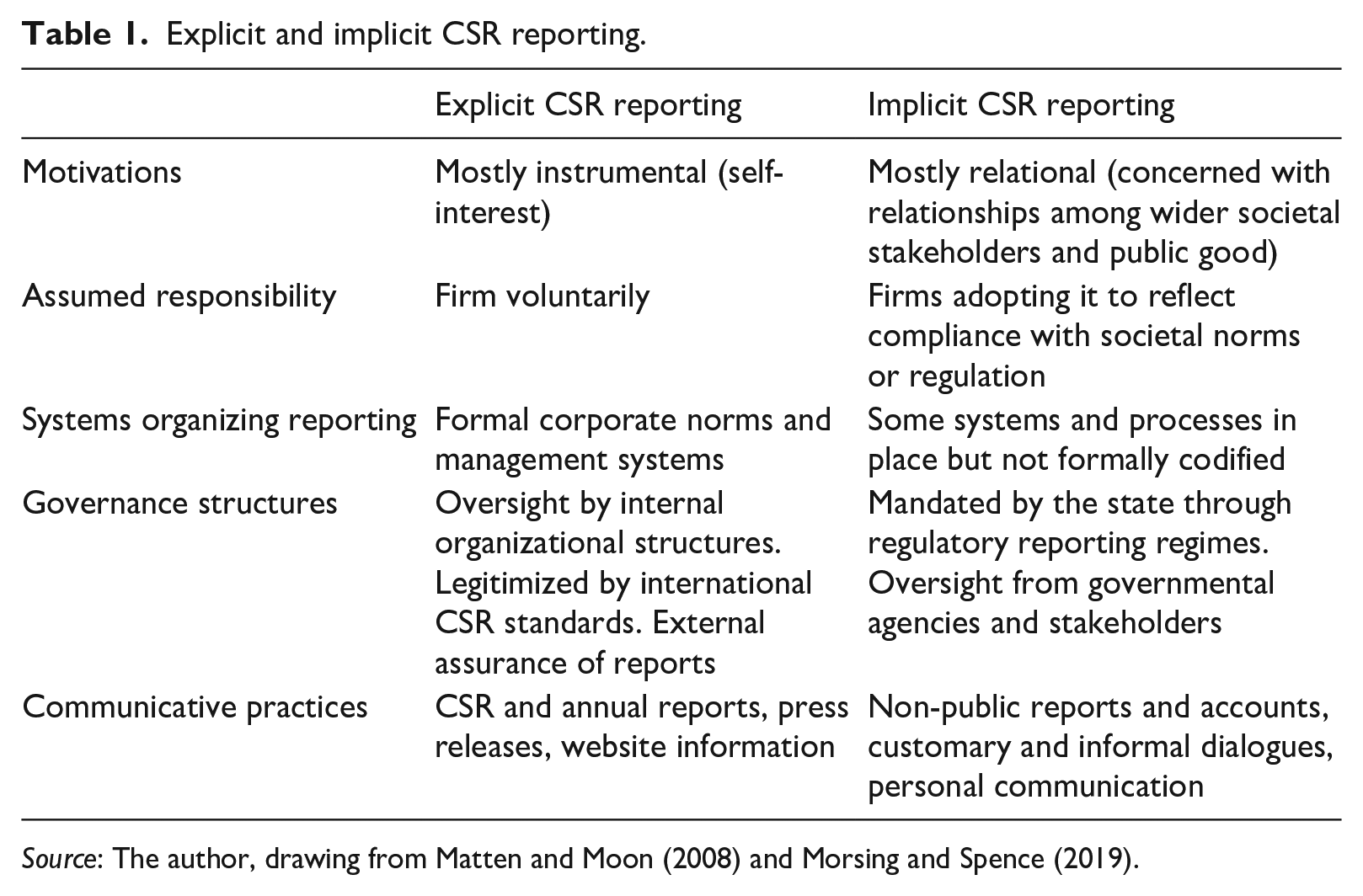
Source: The author, drawing from Matten and Moon (2008) and Morsing and Spence (2019).
Data sources
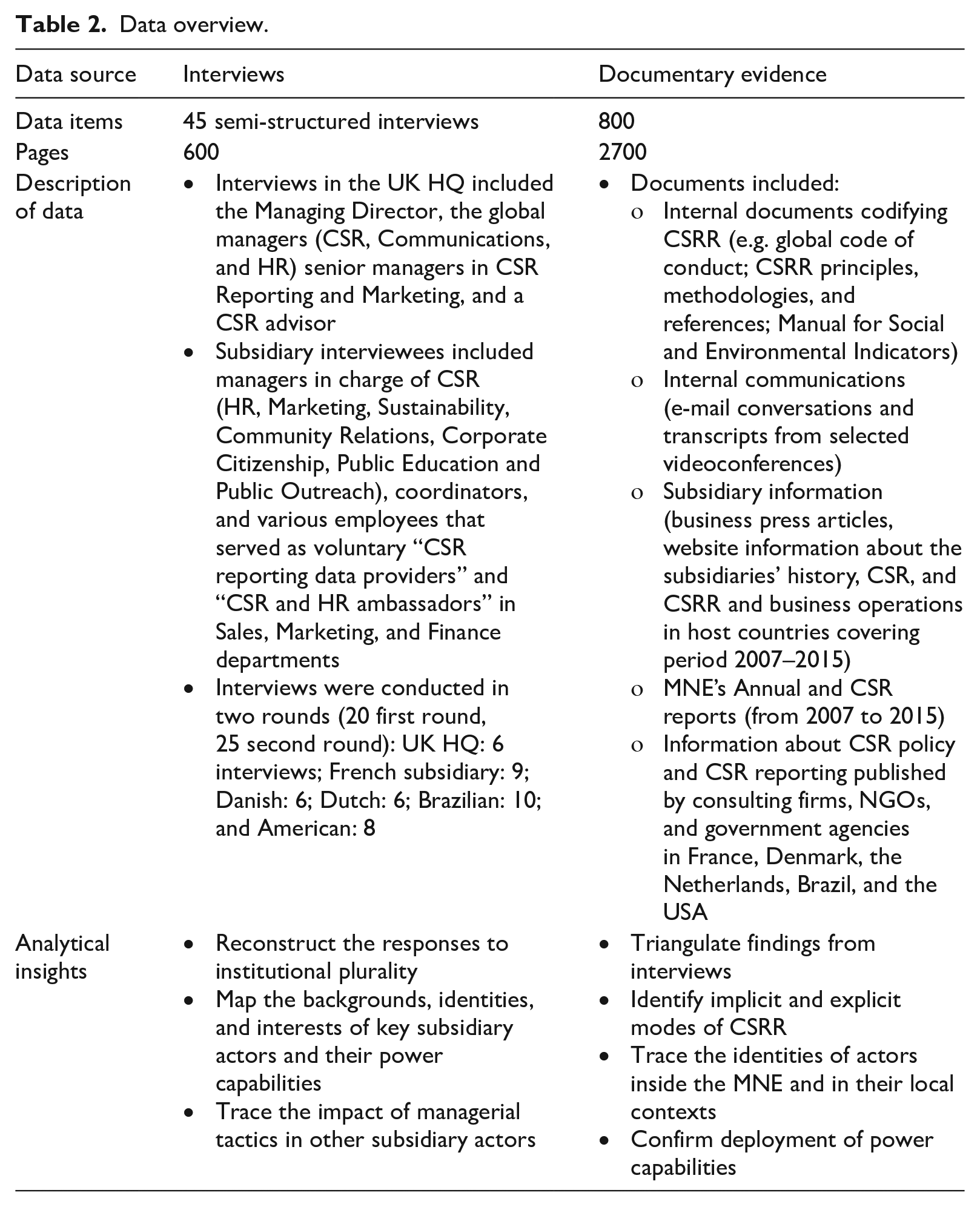
Data were collected from in-depth semi-structured interviews and documentary sources. I traced part of the dynamics in real time. Preliminary interviews were conducted in September 2013 with managers at the MNE’s HQ. Between November 2013 and February 2015, a further 45 interviews were undertaken at HQ and at the five subsidiaries. First-round interviews lasted approximately one hour and were audio-recorded. Interviews in the UK were conducted face to face and those with subsidiary actors via telephone. The participants were re-interviewed in a second round via email to clarify issues, expand on certain topics, and confirm emerging insights.
AnalyticsCo’s global head of CSR briefed me on which subsidiary managers among those interviewed were responsible for rolling out CSRR. To capture accounts “from above” as well as those “from below” (Edwards et al., 2022), my sample included employees across hierarchical levels (top, senior, and middle management and in non-managerial roles). Most subsidiary interviewees were involved in CSRR or related roles (with and without a formal brief to do so) and from various functions (HR, marketing, CSR, and finance). Interviewees were asked to provide biographical accounts of their professional background before working for AnalyticsCo and since joining AnalyticsCo. I asked participants to discuss their experiences with the transfer of CSRR and to elucidate the challenges and new political dynamics that this triggered for them and others in the subsidiary. I asked them to recount their subsidiary’s pre-transfer history of CSRR and other social and environmental accountability practices.
Extensive secondary data were gathered to substantiate and triangulate the findings, revealing the interactions among various actors. AnalyticsCo’s global CSR and annual reports from 2007 to 2015 and information from the subsidiaries’ websites were collected and complemented with internal reporting manuals, memos, presentations, newsletters, and meeting minutes provided by the interviewees. Business press articles mentioning AnalyticsCo and its subsidiaries (2007–2015) were collected using LexisNexis. For each case subsidiary, I also collected information concerning CSRR published by national and regional governments and civil organizations to build a thick contextual description. The data were entered as project documents into NVivo 10, using a case database for each subsidiary to improve reliability. Table 2 summarizes the data sources.
Data overview.
Case selection
Following a theoretical sampling approach (Eisenhardt and Graebner, 2007), I selected the US, French, Dutch, Danish, and Brazilian subsidiaries, which had all been acquired to fill gaps in AnalyticsCo’s product portfolio and expand its markets. 4 The five selected subsidiaries brought different configurations of overlapping exposure to transnational pressures, embeddedness in NBSs, and structural characteristics. The French and Dutch acquisitions were part of the MNE’s 1980s wave of acquisitions of software companies with products that filled the gaps in the MNE’s existing portfolio (e.g. marketing business). The Danish acquisition was the first step in expanding to the Nordic region. A subsequent acquisition of a leading consumer and business credit information provider in the early 2000s consolidated AnalyticsCo position in the Nordic market. The US acquisition enabled the MNE to enter its largest and most mature market, and acquiring the largest credit bureau in Brazil in 2007 provided strategic entry into the Latin American market. Four subsidiaries are embedded in NBSs that differ from the MNE’s home country (i.e. the UK): France has a state-organized business system (Whitley, 1992); Denmark has a Nordic system combining characteristics of compartmentalized and collaborative types (Hotho, 2014); the Netherlands has a collaborative business system (Van Iterson and Olie, 1992); and Brazil has been conceptualized as a hierarchical market economy (Schneider, 2013). The US subsidiary, like the UK HQ, operates in a compartmentalized business system (Whitley, 1992). The sample also contains variations in structural features such as size, age, and strategic importance. The three European subsidiaries are smaller (75–200 employees) and relatively young versus the Brazilian and US subsidiaries (2600 and 6000 employees, respectively).
None of the European subsidiaries published CSR reports or communicated CSR progress publicly; instead, they had stakeholder dialogues influenced by national institutions and traditions consistent with the implicit mode (Table 1). The US subsidiary systematically provided online CSR disclosures and press releases. The Brazilian subsidiary published a report following the GRI standard. During case selection, I identified relevant European national laws: the 1995 Danish Green Accounts Act; the 2008 Financial Statements Act; the 1977 French Law of the Social Bilan; the 2010 Law Grenelle II; and the 1999 Dutch Environmental Reporting Decree. The US and Brazilian governments had not mandated CSRR. Instead, the Brazilian Securities and Exchange Commission required non-financial information in the annual report, a form of reporting that its US counterpart also promoted.
Data analysis
To address my first objective—to contextualize managers’ responses to CSR plurality—I wrote a thick case description of the responses of subsidiary managers from the time that they were tasked to roll out CSRR in their subsidiaries. Considering the potential influence of timing (i.e. some subsidiaries rolling out CSRR earlier than others), I relied on process-tracing techniques (Langley, 1999). To uncover their political maneuvering, I mapped the interests and identities of these actors. I followed prior work in identifying CSR and subsidiary management identities (Clark and Geppert, 2011; Costas and Kärreman, 2013; Morgan and Kristensen, 2006), which I inferred from a close reading of participants’ accounts of their actions. To identify the managers’ interests, I coded their career ambitions (Dörrenbächer and Geppert, 2009), distinguishing bureaucratic, professional, and entrepreneurial orientations by relying on their biographical accounts. I thus estimated their political standing in relation to HQ, both internally in their subsidiaries and externally in their local networks. At this point, I noticed that subsidiary managers attributed different meanings and purposes to CSRR that were constructed in relation to the interests and identities I had initially mapped. I used in vivo techniques (Corbin and Strauss, 2008) to develop inductive codes. These data points (items A to D) clustered into two patterns forming second-order themes: aligned or contested. To reveal the micro-politics—my second objective—I developed inductive codes in the case database for “tactics” drawing on Lukes’ third dimension: power of meaning. I constantly compared theory with data (Gioia et al., 2013) and distilled first-order categories (items E to J) into three second-order themes. The categories to label these themes were derived from terms that emerged from the data (used by participants and/or from the literature): storytelling, blending, and issue-selling. To capture the reactions generated by these tactics, I compared how other subsidiary actors reconstructed the same events, focusing on the dynamics of consensus and contestation and the formation of coalitions with interests that clashed with those of the subsidiary managers. I then repeated a similar coding process but this time I focused on the power capabilities, Lukes’ first dimension of power, mobilized by the subsidiary managers to support their tactics and those used by other actors to challenge them. I noticed that some capabilities originated from different sources (e.g. the MNE, NBSs, individuals). Nine first-order codes (items K to S) were collapsed into three second-order themes: socialization to explicit CSR norms, employee voice, and political capital. Figure 1 shows the resulting data structure.
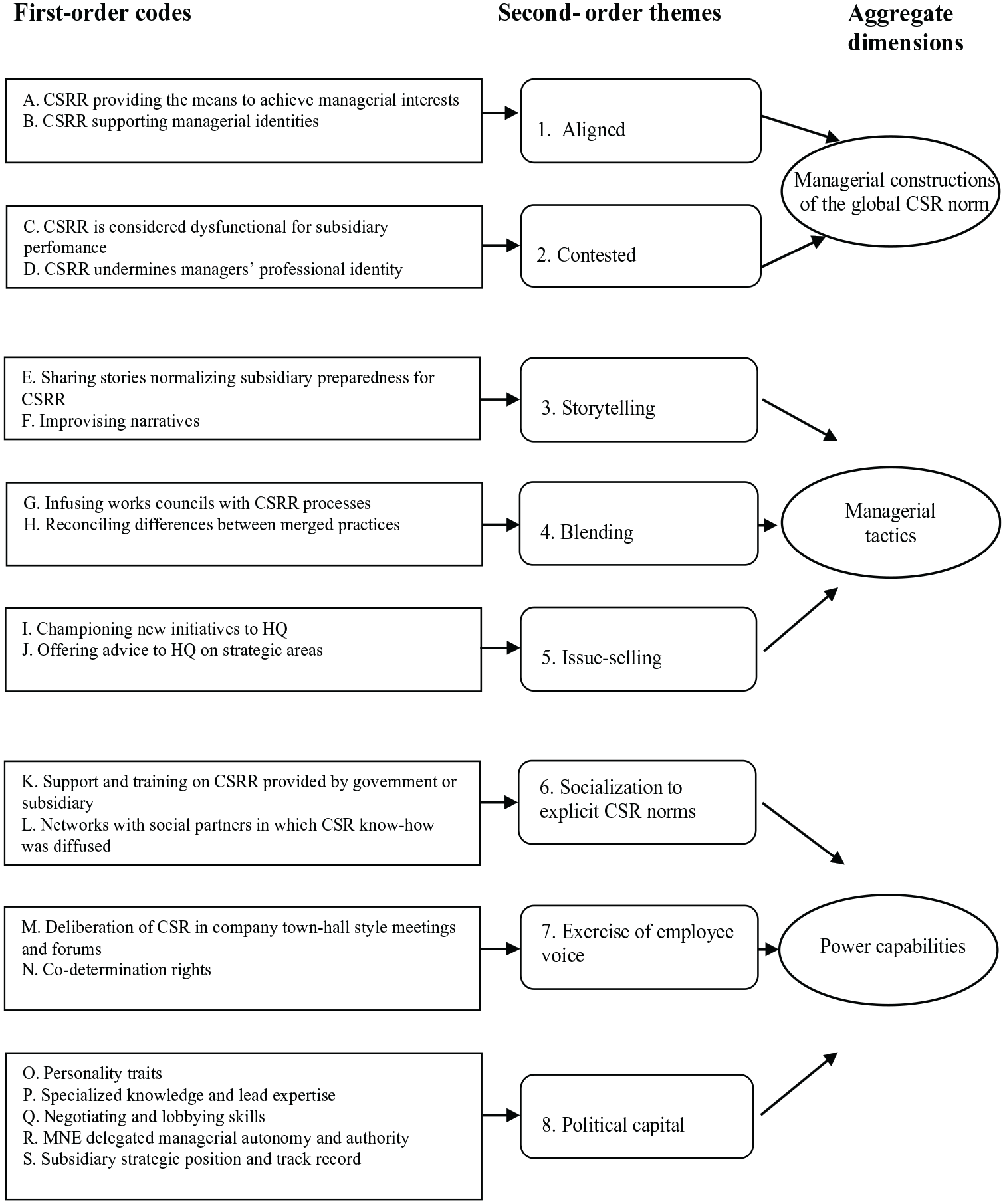
Data structure.
The final stage of the analysis focused on a cross-case examination of the micro-political dynamics and associated outcomes in each of the five subsidiaries. I adopted a configurational theorizing approach. This approach considers causality as conjunctural (i.e. multiple attributes combine to produce an outcome) and equifinal (i.e. different combinations of attributes may produce the same outcome). My cross-case comparison identified the presence and absence of the three power capabilities across the cases. I was thus able to distill the empirical pathways through which some lower-power actors were able to participate in the recalibration of CSRR while others were not.
Findings
CSR institutional plurality is triggered: AnalyticsCo transfers CSRR
HQ, aided by the global head of CSR, initially speculated that attitudinal differences existed toward CSRR in contexts where explicit CSR was less developed and strategically selected managers whose profiles were attuned to it and who would “make CSRR happen” (Interview, global head of CSR). In subsidiaries with established CSR functions, CSR managers were given the responsibility to roll out the CSRR global norm and oversee its implementation, whereas in subsidiaries without such a function, HQ appointed managers in HR, marketing, and public relations (PR). Some of these managers were also regional coordinators for their roles. The global head of CSR briefed each of these managers on the formal expectations codified in the manuals and documents of reference but also conveyed HQ expectations on less codified aspects of the norm, such as the extent to which subsidiaries could organize forums and panels with external stakeholders. To ensure that the norm was implemented effectively in their subsidiary, designated managers selected “data providers” (DPs) (CSRR Reference Manual, 2011) who would submit data monthly to the management system and collect evidence to support the data. Additionally, subsidiary managers were supported by a network of “ambassadors” (CSR Report, 2010) who, on a voluntary basis, implemented various CSR activities.
It was through these initial interactions that AnalyticsCo’s subsidiary managers interpreted HQ’s stance on the transfer and were confronted with a new stream of prescriptions that intersected with their existing contextual rationalities shaped by national CSR traditions and transnational pressures. The transfer of the new norm offered an opportunity for subsidiary managers to politically respond by altering it and advance specific agendas. These responses triggered various micro-political dynamics across the subsidiaries. The findings are organized as follows: for each subsidiary, I first offer a personalized account of the subsidiary managers by revealing their contextual rationalities that influenced how they constructed the meaning and purpose of CSRR, then I report the micro-politics by focusing on the managerial tactics and reactions by other subsidiary actors, and finally I unveil the power capabilities mobilized by subsidiary managers and other actors to sustain their tactics and to back or contest the dominant managerial tactic. I integrate authentic voices into the presentation of the findings to illustrate their views. Table S1 (Supplemental Material) provides additional illustrative quotes.
The Dutch subsidiary
Managerial contextual rationalities and the construction of CSRR
HQ designated the HR manager to roll out global CSRR and coordinate the employee ambassador program not only in the Dutch subsidiary but also across Europe, the Middle East, and Africa (EMEA). This manager, a Dutch national with a law background, had been working for AnalyticsCo since the acquisition and shared HQ’s concern that CSR effectiveness required employees to buy into the activities and feel fulfilled by them. She believed CSR was less about the “commercial effect” (Interview) and more about the “engagement feeling with the team” (Interview). For her, CSR was seen as core to AnalyticsCo’s value proposition to employees and a tool for internal marketing: “In my view, CSR is important because it motivates employees at all levels” (Interview, Dutch HR manager). She identified her subsidiary as a strategic partner to HQ in building synergies between HR and CSRR and considered CSR engagement as a necessary step in climbing the corporate ladder at AnalyticsCo.
With the transfer, the Dutch manager constructed CSRR that aligned with HQ’s long-term vision of the CSR employee program and believed that the new norm would contribute to subsidiary performance, thereby sustaining the instrumental drivers of explicit CSRR. She thus framed CSRR as a means to improve engagement with the employee CSR program and explored ways of quantifying positive employee engagement. She also saw it as an opportunity to signal AnalyticsCo’s international CSR competitiveness in the Netherlands and as a way of inspiring employees to participate more in CSR by increasing curiosity from a cosmopolitan segment of Dutch society in the CSR of businesses, despite “welfare provisions being well organized by the Dutch government” (Interview, Dutch HR manager).
Managerial tactics and subsidiary reactions
To support her construction of CSRR as beneficial to the subsidiary and to advance her agenda, the HR manager deployed a blending tactic—that is, the symbolic action of integrating two different functions. She used the works council (a firm-level representative forum for employee-related matters) as a space to integrate processes of CSRR and demonstrate that they were aligned. She was herself a member of the council and thus could introduce CSRR into the forum. Subsidiary actors participating in such councils understood the distinction between the Anglo-Saxon culture associated with explicit CSRR and the “European way” (Interview, Dutch CSR ambassador) of addressing social and environmental accountability. For example, they noticed the tensions between the private approach in “American CSR” (Interview, Dutch business analyst) versus the more collective approach to addressing social responsibility in Europe. Nevertheless, they were optimistic about reconciling those differences and expressed few reservations about the tactic of the HR manager as articulated by a member of the works council, who was also a CSRR DP: The law on works councils shows what subjects you have to discuss, that are mandatory, but if we have some interesting CSR topics [emerging from the report] to share with employees that need to be discussed or they have questions in that respect, they are always welcomed. (Interview, Dutch sales support representative)
Presuming that any HQ-transferred CSR norm would have to be negotiated collectively rather than simply accepted by the HR manager, on behalf of the subsidiary, works council participants welcomed the blending and did not consider it a threat to the council’s traditional role. As they voiced their views on employment-related motions, employees had a prominent role and record in making, amending, and withdrawing HQ policy proposals, including those related to CSR, as illustrated by another works council member: During the works council . . . we can reject proposals. When different subjects come up, like CSR, or AnalyticsCo wants to change something in our rulebook that impacts us we look into it; we gather employees’ feedback and see if we are OK with it, approve it or make some changes, revise it and then send it back to voting. (Interview, Dutch business analyst)
Post-transfer, the works council became a forum to discuss CSR performance based on the results of the reporting process and to deliberate on adjustments to the rules stipulated by the norm. For example, it recommended a white paper linking AnalyticsCo’s stance on transnational labor standards and the commitment of the subsidiary to the United Nations Guiding Principles on Business and Human Rights (UNGPs), which was not stipulated in the scope of the norm but was a prevalent priority for subsidiary employees, and endorsed the employee ambassador program to be rolled out in the EMEA region. Despite not always getting support for her proposals, the HR manager had preferential access to a powerful group of employees to whom she channeled her CSR and HR proposals, which were negotiated collectively. The works council thus operated as a home-front coalition, defending the subsidiary’s interests by re-orientating AnalyticsCo’s top–down CSRR norm championed by the HR manager.
Power capabilities
The works council’s faculty to alter aspects of CSRR was obtained through the exercise of employee voice—that is, participation of employees in influencing organizational decision-making—granted by the Dutch system of industrial relations. This system gives works councils competencies that go beyond consultation to include codetermination rights. The Dutch manager’s blending of works councils and CSRR was facilitated by a robust political capital—that is, assets and skills accumulated by an individual to gain support for their tactics and remove obstacles. Her political capital had been fostered by significant delegated MNE autonomy. The employees’ “open-minded approach to the [blending] experiment” (Interview, Dutch HR manager) was shaped by the subsidiary embeddedness in a system of collective skills formation through which explicit CSR know-how was diffused. I discovered that, since the founding of the subsidiary in 1960, it had engaged in customary government-organized dialogues to report on its social and environmental programs. These covered a spectrum of stakeholders, including communities, non-governmental organizations (NGOs), local businesses, and clients. By participating in these networks as part of their traditional implicit mode to CSRR, the Dutch subsidiary actors had been socialized—that is, acquainted—to explicit CSRR and transnational pressures. Respondents elaborated on their participation in these networks and the learnings they had derived, for example in relation to the GRI reporting principles. My analysis suggests that they had developed more accepting attitudes toward the explicit approach to CSRR and thus were more receptive to the tactic of the HR manager than might otherwise be expected.
The Danish subsidiary
Managerial contextual rationalities and the construction of CSRR
HQ designated the Marketing & Communications (M&C) manager to roll out CSRR in the Danish subsidiary, the first European subsidiary in which the norm was piloted. One year later, the M&C manager was tasked to roll it out across the EMEA region, an opportunity that she decidedly seized. With a bureaucratic career orientation, this manager, a Danish national with a background in Media and Communications, considered CSR and CSRR good for the business and for her career at AnalyticsCo. She evaluated her role as “crucial in getting all EMEA managers on board” (Interview) with the strategic value of CSRR and expressed appreciation in the confidence HQ showed her by giving her this role. These views indicated the enactment of a strategic-partner identity. The M&C manager believed the international expertise of the Danish subsidiary, AnalyticsCo’s oldest firm, could contribute significantly to the success of the global rollout of CSRR. In her own words, she stressed the maturity of CSRR in Denmark: “Here in Denmark, we are very, very far ahead; these practices are inherent to doing business in Denmark and date back to the 19th century” (Newsletter, Danish M&C manager).
With the transfer, the M&C manager constructed CSRR aligned with her interests and identity. She portrayed the new norm as beneficial for the subsidiary and the EMEA region. Like the Dutch HR manager, introducing new standards was construed as a means to an end. She focused on establishing consonance between the reporting processes and positive organizational outputs, in alignment with the instrumental character of explicit CSRR: I was telling employees: if you do this [referring to CSRR] you will have better stories to sell, you can tell them to your customers, you can use some in sales presentations, you can use some of them when you hire new people, you can use them for reputation and brand management. (Interview, Danish M&C manager)
For this manager, the processes of measuring and quantifying CSR would produce compelling evidence to showcase good performance and the optimal use of resources to HQ, particularly in the aftermath of the financial crisis, which had significantly affected the subsidiary’s financial performance.
Managerial tactics and subsidiary reactions
To instill confidence that CSRR benefited the subsidiary, the manager deployed storytelling, that is, the discursive tactic of sharing narratives and stories, sometimes with improvisation and embellishment. Interestingly, storytelling was also a legacy of the implicit approach to CSRR through which Danish corporate actors negotiated their CSR focus with stakeholders and communicated the organization’s social and environmental performance. Danish participants revealed that it was common Danish practice to hold company “town-hall-style” (Internal PowerPoint presentation) meetings and government-organized stakeholder forums to report progress and discuss cooperation on social initiatives: We started cooperating with the government and the Danish Tax Authority about expanding a financial education program . . . We took broader responsibility, together with the Danish authorities, and we produced some educational materials. We needed to report on the outcomes of this program in these forums. (Interview, Danish finance assistant and DP)
The manager mimicked similar interactions in the subsidiary. Storytelling was deployed through internal company communications forums, quarterly meetings, and social gatherings at which CSR was discussed. The stories evoked pride in the government’s endorsement of CSR transnational governance initiatives, its ambition to promote transparency, and the international competitiveness of Danish firms. They stressed the subsidiary’s preparedness for a norm such as CSRR and its compatibility with Nordic institutional traditions and suppressed any sign of disruption with existing practices: In Denmark, there is a lot of focus in general on the environment . . . CSR such as on the UNGC, Ruggie’s framework for business and human rights. It’s a big thing here in Denmark. Green technology, going green, it’s something that the Nordic and the Scandinavian countries are very good at, something that we want to export to the world. (Video conference transcript, Danish M&C manager)
The data indicate that storytelling was an effective discursive tactic for prompting consensus in the subsidiary. Non-managerial respondents described that, just like in the town-hall-style meetings, the M&C manager would deliberately allow some time at the end of the storytelling to hear feedback from participants. I found that, other than some occasional inquiring on technical specificities of CSRR and updates on what other subsidiaries were achieving, Danish subsidiary actors were remarkably open to the strategic nature of explicit CSRR and highly conformant to the prescriptions of the CSRR norm. They supported the M&C’s manager portrayal of CSRR and identified with her discourse highlighting the intersectionality between transnational trends and the strengths of the Danish approach. The core strategic elements underpinning CSRR (to improve CSR performance, attract capital, and enhance the MNE’s reputation) were retained. Employees were encouraged to retell these stories and to use them as tools when meeting clients and other stakeholders. Instead of contention from other subsidiary actors in the use of these stories, employees indicated that they, too, used them.
Power capabilities
The M&C manager possessed a robust political capital that included considerable MNE delegated autonomy given her regional responsibility and a portfolio of personality traits and social skills. Descriptors used by subsidiary and HQ actors such as “persuasive” (Danish HR analyst), “credible” (HQ CSR advisor), and “charismatic” (Danish finance assistant) to refer to the M&C manager testify to this. She mobilized her strong political capital to make her storytelling convincing. Subsidiary actors had acquired extensive knowledge of CSRR before the rollout of the global norm, including through government-organized forums that provided opportunities for skills development. Here, representatives of social partners (public and private actors including competitors) channeled transnational pressures for CSRR and shared and provided information about CSRR legislation, international standards, and best CSR practices. Tracing the origin of these forums, I found they were a legacy of the inclusive Danish training system that reinforced socialization opportunities into explicit CSR beyond the formal acquisition of skills, which supported the processes of sensemaking of transnational pressures for explicit CSRR well before the transfer. The socialization of subsidiary actors to explicit CSR in addition to the ability of subsidiary actors to exercise their voice (via deliberations connected to implicit traditions) facilitated the formation of a shared meaning of CSRR through the storytelling of the M&C manager, who did not have to resort to other political tactics to enact her own construction.
The French subsidiary
Managerial contextualities and the construction of CSRR
HQ appointed the CSR manager to roll out CSRR in the French subsidiary. This manager, a young French national with a background in international humanitarian aid, strongly believed in CSR and embraced the ideal of the responsible corporation as reflected in her career orientation, which she described as a “calling to do the right thing” (Interview). She had recently completed a Master’s degree at a UK university, after being granted an unpaid study leave at AnalyticsCo, which had strengthened her identification with CSR and the vision of HQ. Reflecting her motivation to import the explicit understanding of CSRR to her subsidiary, she committed herself to uphold HQ’s agenda, thus embodying the identity of a “boy scout” (Morgan and Kristensen, 2006) subsidiary manager. Like her European counterparts, the French manager aligned the new norm with her interests and identity. However, instead of stressing the business case, she appealed to normative arguments in relation to business accountability, mirroring her interpretation of consonance between the role of corporations and CSRR: For me, all enterprises have a social role in society, that’s what gives sense to the business; corporations have been criticized for not giving back to society, so [with CSRR] we can demonstrate our social commitment. I think it puts facts on what we say because I think it’s very easy to say we are a responsible company. (Interview, French CSR manager)
Managerial tactic and subsidiary reactions
To persuade other subsidiary actors that the new norm contributed to the subsidiary’s social purpose, the French CSR manager deployed a blending tactic similar to that of the Dutch manager and sought to bring the new CSRR processes stipulated in the norm within the works council’s scope. She expected this to facilitate the cross-fertilization of old and new routines given the absence of an established CSR structure but was dubious about the impressions of other employees: “We don’t have any solid you know . . . we are not following GRI nor ISO 26000, so it demonstrates local initiative, it shows we are aligned with AnalyticsCo’s strategy but this may be only my personal perception” (Interview, French CSR manager).
The tactic prompted a defensive stance from some employees, including the senior HR manager, a French national with a background in employment law, who perceived a fundamental clash between the purposes of the forum and the norm and undertook a campaign of delegitimization against the actions of the young CSR manager. The HR manager portrayed the blending as an attempt to turn a worker consultation mechanism into a “business-driven strategic tool” (Interview). She saw the works council as an ill-suited forum for introducing explicit CSRR. In the following quote, she explained the strictly mandated areas in the Labor Code that did not cover CSRR: [Works councils] do not have any CSRR function; rather, their function is to discuss the organization of the company, the impact of company decisions on employment and all that touches the HR part, the employees, the information, health and safety. (Interview, French senior HR manager)
I learned that, since its foundation in the 1980s, the subsidiary complied with the Law of the Social Bilan (1977) and produced social bilans (reports) on employee-related matters. The reports were prepared in consultation with the works council and were submitted to a government agency, reflecting an implicit approach to CSRR. Anticipating a display of resistance from the works council participants, I was surprised when various participants expressed their interest in integrating CSRR into their councils to be able to shape it. The senior HR manager’s position prevailed in the French subsidiary, precluding employees from participating in the adaptation of CSRR. Post-transfer, the CSR manager reported ongoing difficulties in getting employees “on board” (Interview) with the purpose of CSRR: People compare CSRR to a mechanistic task reduced to fill in a spreadsheet. The problem is that people do not understand what these figures are for, and if they do not understand, they are not very motivated to engage with it. (Interview, CSR manager)
Power capabilities
The senior HR manager’s ability to contest the proposed blending and enforce her resolution was enabled by the mobilization of her comprehensive knowledge of French employment law and the absence of strong political capital of the junior CSR manager. The latter was less experienced and lacked the skills to politically maneuver the dispute and counteract the rival position of the HR manager. The CSR manager intentionally kept this conflict under HQ’s radar and avoided escalation by conceding certain issues. The failure of works council members to challenge the HR manager’s authority was partly owing to her seniority, which granted her greater authority among subsidiary actors. Most council members were non-unionized and unconnected to other local networks or business associations from which they could seek support. Without any linkages to potential allies outside the subsidiary, within the MNE (other CSR managers) or inside the subsidiary (local senior managers), they lacked the leverage to ally with the CSR manager and counteract the senior HR manager. The CSR manager’s authority stemmed from HQ’s mandate to roll out CSRR, but in the subsidiary her function was seen as a facade for importing an Anglo-Saxonized conception of social responsibility that surrendered local understandings and traditions of CSR.
The Brazilian subsidiary
Managerial contextual rationalities and the construction of CSRR
The sustainability manager, a Brazilian national with a business management background and 10 years’ experience in the company, was designated to roll out CSRR in his subsidiary. He brought wider experience, having held positions in the UN and in the Brazilian non-profit sector. He had supported the creation of a thinktank to raise CSR awareness in Brazil, established the organization of CSR in the subsidiary, and led various CSRR developments. Since 2004, the subsidiary had published a Communication on Progress (CoP) as a signatory to the UNGC and held CSR forums with stakeholders. Its CoP followed the GRI B+ standard and was aligned to relevant national reporting guidelines (National Quality Foundation, Brazilian Association of Publicly Held Companies). Familiar with issues such as corruption, unemployment, deterioration of public services, and social exclusion in Brazil, the sustainability manager considered CSR as a “vehicle to alleviate social ills” (Interview). Under his leadership, the subsidiary had received industry and national prizes. In the Brazilian market, the firm was seen as a beacon of CSR and CSRR best practice.
The sustainability manager was determined to expand the subsidiary’s CSR mandate and embodied the identity of a subversive subsidiary strategist unwilling to surrender to HQ’s impositions. He had professional ambitions in the context of sustainability but, unlike his European counterparts, he expressed an entrepreneurial career orientation, manifested by his focus on developing local CSR innovations and deepening the subsidiary’s connection to its local and transnational networks. These interests are illustrated in the following quote: I was hired 10 years ago to build what we used to call the social responsibility process. My key achievement has been the ability to influence the approach to CSR in Brazil through the activities of the company. In 2006 we won recognition for the best sustainability report in the country for a company that is not listed on the stock exchange. We also changed the social responsibility area to a sustainable department dedicated to the social investment of the company and tried to interact with other Brazilian and international businesses to provoke them and think about our shared problems, the business strategy, and governance. (Interview, Brazilian sustainability manager)
Unexpectedly, for the sustainability manager, the rollout of CSRR entailed a restrictive approach to existing practices and processes in his subsidiary. He portrayed the new norm as contested. He constructed CSRR in confrontation with his interests and identity and dysfunctional for subsidiary performance by damaging key subsidiary capabilities (i.e. CSR reputation and know-how). In his view, HQ’s intention to roll out explicit CSRR was an attempt to restrict the subsidiary’s opportunities for national and international CSR engagement: I know that a global report is important, but it’s not the same thing; it’s the MNE’s global initiatives, it’s not our initiatives—it’s different. It’s more basic, what can I say about Brazil in this global document? This document doesn’t explain everything that we did here, so it’s not enough. Of course, it helps, but it’s not enough. Here in Brazil, if you stop communicating that information, you will lose places in the international rankings. (Interview, Brazilian sustainability manager)
The new norm entailed prescriptions including the cancellation of the subsidiary’s UNGC signatory status and the associated reporting mechanism, the suspension of its stakeholder panels, and the CSR team’s disbandment. For the sustainability manager, the key point of contention was not the purpose of explicit CSRR per se; indeed, he very much aligned with these motivations, but he was concerned about the scope of the norm, which constrained the subsidiary’s CSR independence and undermined his professional identity vis-a-vis sustainability and achievements in the Brazilian context.
Managerial tactic and subsidiary reactions
Unlike his European counterparts, the Brazilian sustainability manager’s tactics for defending his construction of CSRR were primarily directed at HQ actors rather than in the subsidiary. He used an issue-selling tactic—that is, the promotion and advocacy of specific issues and initiatives to bargain managerial interests with HQ. He was interested in negotiating with HQ the reversal of its restrictive approach to CSRR and safeguard local CSR engagements. He promoted the introduction of a materiality assessment as the backbone of the CSRR process and championed the adoption of the Integrated Reporting (IR) Framework, two areas in which the knowledge of the Brazilian subsidiary was superior to that of HQ. The sustainability manager offered to lead these developments in exchange for a return to local engagements. The following quote describes his tactic: We were pushed to withdraw from the Global Compact, because it doesn’t make sense that just one affiliate of the MNE is part of something that is global but having just a global report is not enough for our local stakeholders. To enhance the brand, with respect to social responsibility, we will try to find ways to make it work with the HQ and keep engaging with them through our panels. We are trying to get the global CSR team on board with our materiality process and our vision of integrated reporting so they are implemented for the whole company. (Interview, Brazilian Sustainability Manager)
He undertook a calculative campaign. His promotion of the materiality approach and adoption of the IR was channeled through the global CSR manager, who in 2009 had invited him to a senior leadership meeting to discuss global CSR strategy. He used this event to promote his two issues through a keynote presentation. The event also provided opportunities to meet with potential allies.
The Brazilian employees I spoke to unanimously supported the tactics of the sustainability manager. One of them described the norm as an “insensitive demand” (Brazilian financial education ambassador), while another considered it crucial “to build these strategies together” (CSR coordinator). They diligently enacted the new norm’s prescriptions, for example, by submitting data monthly through the system, and had no intention of bypassing the reporting process and were keen to have case studies featured in the global CSR report to demonstrate the value of their local initiatives. During HQ’s quarterly meetings, key actors in the subsidiary, including the corporate citizenship manager and the CSR coordinator, made concerted efforts to echo the reputational risks to AnalyticsCo in pursuing a minimalistic approach to CSRR in Brazil. To maintain HQ’s attention and persuade it to reinstate local engagements, the corporate citizenship manager regularly invited HQ’s CSRR coordinator to visit the subsidiary to better understand its local CSR engagements. Evidence from the Brazilian subsidiary’s website and from the interviews suggests that some local engagements were reinstated between 2010 and 2012 (e.g. stakeholder panels with the Central Bank of Brazil and the Brazilian Federation of Banks, as well as CSR online communications), which demonstrates the success of these tactics. In 2013, the sustainability manager took up a role on the MNE’s sustainability executive committee (a key governance body) to bring, in his words, “more strategic thinking into sustainability communications” (Interview).
Power capabilities
The sustainability manager was able to push his issue-selling tactics, exploiting solid political capital. He used his status as a leading sustainability expert in Brazil and capitalized on the subsidiary’s strategic position as the MNE’s first Latin American acquisition. He focused on demonstrating that this was the most advanced subsidiary in terms of CSR development. His negotiating skills and ability to frame the perils of dismissing local capabilities for AnalyticsCo were essential in the adaptation of the norm. His awards and strong ties with international associations and local networks gave him significant reputational power for bargaining with HQ. Moreover, his issue-selling tactics were strengthened by authority associated with the control of the local CSR budget. These capabilities and well-orchestrated collective efforts from his subsidiary provided a strong base for the sustainability manager to press his issue-selling tactics and reinstate local engagements.
The American subsidiary
Managerial contextual rationalities and the construction of CSRR
HQ designated the director of public education and consumer outreach (PE&CO), who had 17 years’ experience in AnalyticsCo, to roll out CSRR. He had extensive knowledge of US consumer advocacy groups and lobbying experience. Like his Brazilian counterpart, he expressed an entrepreneurial career orientation. He strongly supported improved financial literacy among marginalized demographic groups and had developed the industry’s first dedicated consumer education program, for which he had won accolades (including Educator of the Year from the US Institute of Financial Education). He viewed CSR as a “force for social good” (Interview) and believed that communicating and reporting about it was good for the corporate reputation. In the early stages of the creation of the norm, HQ drew upon processes established by this director’s team. The American subsidiary was the first subsidiary in which CSRR was rolled out. These events contributed to the PE&CO’s embodiment of a strategic partner to HQ identity. The PE&CO director constructed CSRR aligned with his interests and identity. He framed the reporting as a means to an end to enhance media releases and online engagement, thereby supporting the prioritization of PR and communications in the American market. He considered the rollout of CSRR as an opportunity to support further the MNE through knowledge innovation and thereby enhance the subsidiary strategic position.
Managerial tactic and reactions
As in the Brazilian case, the PE&CO director’s tactics were directed at HQ rather than at subsidiary actors. The PE&CO director used an issue-selling tactic and sought to advise HQ on the management of two issues deemed strategic for the MNE: consumer advocacy relationships and personal data regulation. CSRR and communications were seen by this manager as a way to influence the perceptions of the MNE of legislators and advocacy groups. The following remarks encapsulate his concerns surrounding these two issues: The big impact of our industry is all about transparency and how do you take care of all the data that we use because it’s sensitive, especially if you think about consumers’ data. So, there is a big discussion right now about the credit score and consumer advocates saying that it’s not legitimate, and we need to show how we operate. There is a wave of debate about big data right now; there is society’s perception that we are becoming something like a Big Brother and that we invade the privacy of everybody, so it’s a challenge for AnalyticsCo to show that this is not the way we operate. (Interview, American PE&CO director)
I found that CSRR processes had reached a taken-for-granted status among US employees. The introduction of the norm was seen as an extension of what was set up in the subsidiary years before as a response to strong competitive pressures from MNEs listed on the New York Stock Exchange with well-developed CSR programs and CSRR. For instance, participants focused on explaining that their established methodologies for measuring community involvement and employee volunteering served as a blueprint for the platform later adopted by HQ to structure the CSRR reporting process. These processes were carried by the largest concentration of CSR employee ambassadors at AnalyticsCo. US ambassadors had been socialized toward explicit CSRR by the subsidiary through an in-house CSR training program, unique of its kind, at AnalyticsCo.
Subsidiary actors supported the manager’s agenda for promoting knowledge innovations to HQ and his leadership role in advancing the position of the subsidiary: As the largest market of AnalyticsCo, we want to be better and want to be involved more effectively in those processes. We want to share our successes and our successful approaches so they can be implemented in the same way or perhaps in a modified from one country to the other. (Interview, consultancy business analyst and CSR ambassador)
Subsidiary actors recalled an example of these tactics during a visit by AnalyticsCo CEO to the US subsidiary when the PE&CO director pitched these CSR initiatives as part of an event about public and consumer education in which he managed to gain attention from HQ. One of the PE&CO director’s key proposals was to formalize engagement, in his own words, with “adversarial” (Interview) consumer advocacy groups and engage in constructive dialogues to minimize these groups’ potential criticism of the company’s policies. Initially, HQ considered that this proposal posed a reputational risk because it departed from the uncodified but conveyed guideline on the centralized organization of stakeholder engagement. I learned that the PE&CO director orchestrated support from a coalition of managers in the Australian subsidiary with whom the US subsidiary had shared best practices for financial literacy programs. His Australian counterpart had some experience dealing with similar consumer advocacy groups and faced similar bottlenecks when proposing his initiatives to HQ and was thus keen to help. In the following year, HQ approved the initiative of the PE&CO director. In exchange, top management bargained for oversight on the organization of forums with adversarial stakeholders. A key achievement of the issue-selling strategy was the creation of a consumer advocacy council of industry experts, advocacy group members in the USA, and top management.
Power capabilities
The success of the PE&CO directors’ issue-selling strategy stemmed from his managerial authority informed by his ability to exploit the subsidiary’s lobbying capabilities and the track record of his subsidiary as AnalyticsCo’s source of knowledge. He leveraged the status of lobbying as a de facto activity in the US market, showcasing HQ past accomplishments such as the ability to avoid “unnecessary regulation” (Interview, PE&CO director) by handling relationships with legislators, strengthening the subsidiary CSR work, and targeting CSR communications to regulators. His ability to forge ties with allies with similar interests and his extensive expertise in diffusing CSR knowledge to HQ had set an important precedent in the MNE. Capitalizing on this extensive political capital, he was able to build support for his tactics and strengthen his position. The American political environment also played a significant role in the garnering of local support for his issue-selling agenda. Calls for greater regulation of the commercial use of personal data had intensified, and increased scrutiny from media and consumers resonated with the proposals of the PE&CO director.
Discussion and conclusions
The study of the rollout of a global CSR norm across five subsidiaries has enabled me to develop a fine-grained account of the managerial responses to CSR institutional plurality, as well as the new micro-political dynamics triggered by this episode. Before discussing the theoretical contributions of my study, I integrate the key insights in a grounded model that portrays the micro-politics at play in the managerial responses to CSR institutional plurality. Figure 2 shows that managers responded to CSR institutional plurality by constructing aligned or contested forms of the global CSR norm rolled out. To legitimize these constructions, managers deployed discursive (storytelling and issue-selling) and symbolic (blending) political tactics. The model captures the interplay between the managerial tactics and the mobilization of three power capabilities‚ namely, the socialization of subsidiary actors to explicit CSR norms, the exercise of employee voice, and the political capital of subsidiary actors. It shows that the advancement of these managerial tactics is facilitated or prevented by the subsidiary actors’ ability to marshal these power capabilities. For the sake of simplicity, the model depicts these three capabilities concurrently; however, as illustrated in the preceding sections, each of the five subsidiaries displays different configurations of the power capabilities (i.e. a combination of the absence or presence of the three capabilities) in which the micro-political episode is embedded. The configuration of these power capabilities accounts for the variance in the micro-politics observed across the five cases and allows me to explain why similar responses to CSR institutional plurality became possible only in some subsidiaries but not in others and brought about different outcomes.
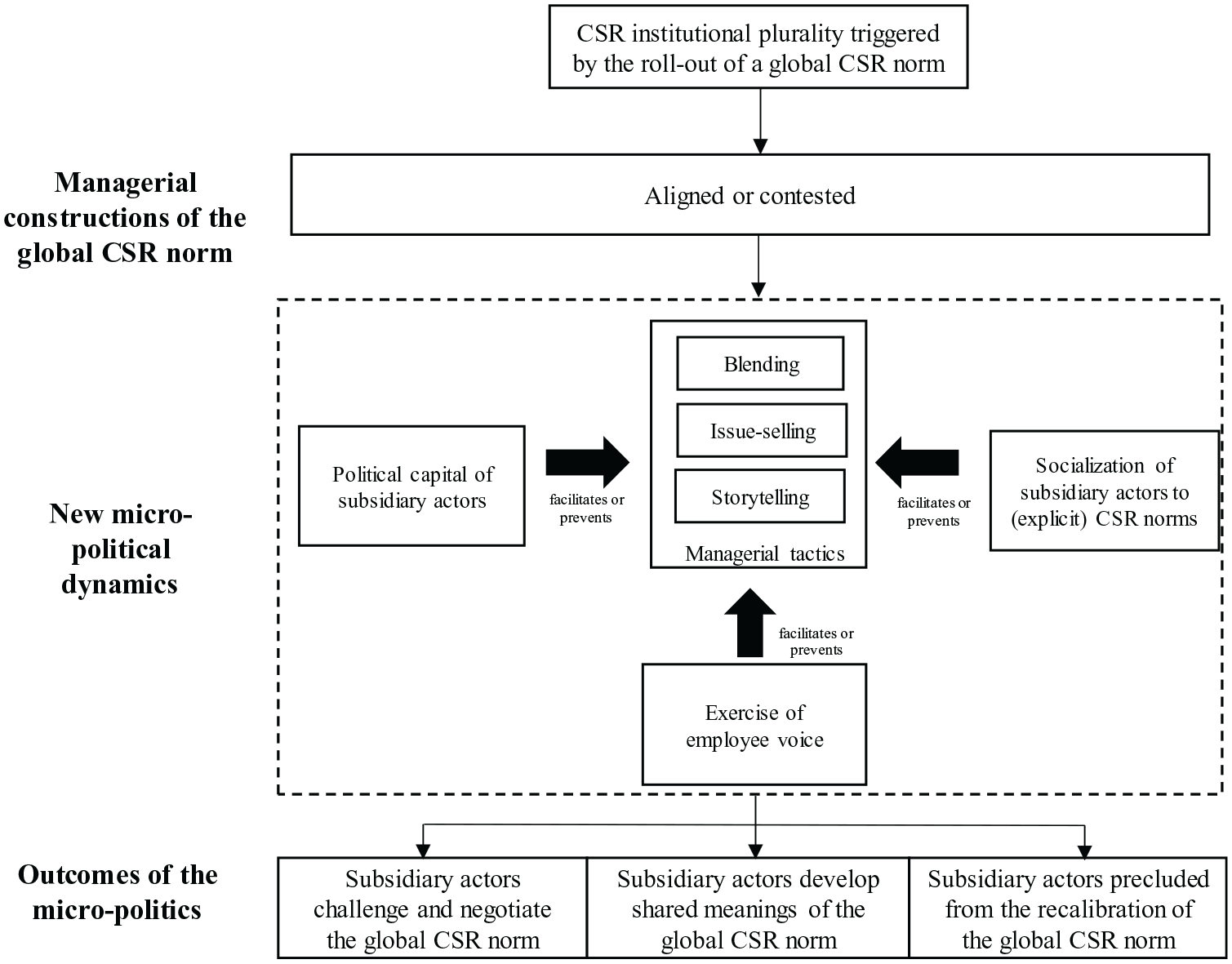
A grounded model of the managerial responses to CSR institutional plurality and the new micro-political dynamics.
The comparative analysis suggests that the socialization of subsidiary actors to explicit CSR norms was an important factor orientating the micro-political dynamics in subsidiaries where actors negotiated the global CSR norm and developed shared meanings of it. Managers in these subsidiaries marshalled this institutional resource, which prompted employee receptiveness to their managerial constructions. In the European subsidiaries, the socialization was facilitated by the government’s involvement in CSR filtering transnational pressures on behalf of private actors in complement with CSRR national regulation and the systems of collective skills formation through which explicit CSRR know-how was diffused. Brazilian and American employees too had been socialized to explicit CSRR but via corporate provision. Owing to the decentralized character of their NBSs, Brazilian and American subsidiaries were incentivized to develop competitive CSR knowledge and innovation—independently from government and social partners—which managers used, as part of their political capital, to harness support for their issue-selling agendas.
Some contexts (i.e. Dutch and Danish) gave subsidiary actors access to a distinctive capability: the exercise of employee voice that had been institutionalized through codetermination legislation and dialogic traditions of implicit CSR. This capability enabled lower-status employees to collectively reshape dominant CSRR managerial constructions by amending and negotiating the meaning and purpose of the norm.
The findings suggest that HQ deliberately fostered the political capital of preferred managers through delegated autonomy and authority, thus contributing to the asymmetrical distribution of power across subsidiaries. In contrast, lower-level actors had scant access to resources. When rival views of CSR coexisted in a subsidiary, the compounded effect of an uneven distribution of political capital and the lack of access to distinctive institutional capabilities left lower-level actors in a disadvantaged position to participate in the recalibration of the global CSR norm (e.g. French case). Under those circumstances, I can only speculate that lower-status actors must deploy more effective discursive tactics to shift dominant perceptions of the CSR norm to gain support. They must also cultivate and draw upon their own professional and personal skills, personal track record, specialized knowledge and expertise, and even their own personality traits to expand their political capital and create opportunities for negotiation with more powerful actors.
The dynamics unearthed at the Brazilian subsidiary are unique. Altogether the subsidiary had been marginalized by AnalyticsCo and denied continuation of their local CSRR engagements through the imposition of the new restrictions of the global norm. This was the only case where managerial and non-managerial actors politicized against HQ in a subsidiary-wide coalition seeking to reverse the fate of their subsidiary so that conflict was not directly observable, resembling Lukes’ (2005) power of non-decision-making.
Interestingly, although American and Danish subsidiary actors developed shared meanings of CSRR, they appeared the least interested in participating in its reconfiguration. This outcome can be partly attributed to the successful imprinting of the discursive managerial tactics re-constructing HQ–subsidiary power relationships and portraying subsidiaries on the winner side of the making of CSRR and its taken-for-granted status.
My aim with this article was to foster dialogue between the MNE micro-politics stream and CSR scholarship. In the remainder of this section, I discuss the implications of my observations for these streams.
This article enriches CSR studies on political dynamics at the micro level (Frynas and Stephens, 2015; Gond and Moser, 2021) and brings context and actors back into focus in processes of global norm-making (Almond et al., 2021; Kern et al., 2019) for CSR within MNEs. I make two important contributions to these research streams. First, I provide nuanced insights on the contextual sources of heterogeneity of the political dynamics of an episode of CSR institutional plurality. My study improves understanding of three power capabilities that support or curb the advancement of managerial tactics and thus disenfranchise or empower subsidiary actors’ participation in the recalibration of a CSR global norm. In comparing the micro-political dynamics that these managerial tactics engendered across subsidiaries, the results indicate that the instances in which less powerful subsidiary actors wanted—and indeed were able to participate in—the recalibration of CSRR were limited, even in western contexts. In those few instances, subsidiary actors’ ability to build political capital and adroitly deploy it, as well as the access to structures safeguarding their capacity to exert employee voice, were consequential to enact their agency, counterbalance managerial constructions of CSRR, and take part in its reconfiguration. This study thus re-joins the debate on how local actors might participate in recalibrating global CSR norms (Acosta et al., 2021; Alamgir and Banerjee, 2018) offering a middle-ground explanation. The ability of lower-status actors to take action and recalibrate global CSR norms cannot be specified ex ante but needs to be understood as the result of the complex interplay of subsidiary actors’ differential access to power resources and the constellation of political preferences at the subsidiary (what is at stake for dominant actors) in a situation of CSR institutional plurality. The article empirically illuminates the inextricable link between agency and structure in this episode. In some contexts, institutional structures empowered employees to participate in the recalibration of CSR, thus orientating the micro-political dynamics played out—though not in a deterministic way, since these structures had to be enacted by actors. Still, in the case where regulation potentially constrained the ability of French subsidiary actors to introduce CSRR into the works council, this had to be invoked by the senior HR manager.
Second, this study breaks with the monolithic view of CSR inside subsidiaries (Girschik et al., 2022) by providing a personalized understanding of the rollout of CSRR that altered the process of global norm-making (Almond et al., 2021; Kern et al., 2019). The study recognizes the range of actors involved but also those relegated, their often-competing rationalities and the unexpected coalitions between them, for example, between works councils and CSR management contesting and supporting explicit CSRR. It offers a nuanced account of the interests and identities of dominant managerial actors and their reflection on CSRR constructions. In doing so, the results cast doubt on ubiquitous portrayals of managers as benign advancers of responsible agendas in their organizations and whose activities are genuine (Bondy, 2008; Girschik et al., 2022; Kourula and Delalieux, 2016). I found ample signs of the commodification of CSRR, whereby non-specialist subsidiary managers from the marketing, HR, and PR departments opportunistically hijacked it to bring gains in their functions and improve their own position. Most managerial tactics were confined to resolve the episode of institutional plurality by strategically refocusing explicit CSRR and reinstating business as usual. Critically, one of the most expansive issue-selling strategies advised HQ to use CSRR as a smokescreen to avoid unnecessary regulation, a tactic that safeguarded foremost AnalyticsCo’s interests.
Finally, this article makes a more general contribution to the cross-national comparative analysis of implicit and explicit CSR at the subsidiary level. By including various subsidiaries embedded in different NBSs in the analysis, in contrast with the dichotomy of liberal and coordinated types, I enhance the understanding of various implicit CSRR practices that can precede or complement explicit CSRR in different contexts. This study shows that practices such as storytelling, institutionalized dialogues and works councils embody dialogical forms of social and environmental accountability in Nordic, state-organized and collaborative NBSs, which managers connected with motivations of explicit CSRR. In some contexts, implicit CSRR persists and is not supplanted by explicit CSRR; in most other contexts, explicit and implicit forms of responsibility prove not to be mutually exclusive (Morsing and Spence, 2019).
Limitations, future research, and implications
First, I caution against generalization. In this case study of a single MNE, I sacrificed the opportunity to study many MNEs in favor of achieving comparative depth. Future studies should consider adopting designs that include MNEs and subsidiaries operating in the Global South, as well as actors upstream in the global supply chains who are subject to CSR norms. Second, although I collected data in real time, some data were derived from retrospective accounts and may be subject to recall errors. I mitigated this by interviewing various informants, allowing their plausibility to be evaluated.
In the sample I studied, HQ strategically selected managers who would uphold HQ’s agenda but treated the rest of the subsidiary as clean slates, disregarding the complex constellations of interests regarding CSR in creating the norm. The variability of these interests only became evident as CSRR was rolled out. The procedural model through which the MNE designed CSRR only allowed for the participation of a select group of actors at the top while dissuading democratic participation from “activist” employees (Girschik et al., 2022) (e.g. the works council participants who did not work under the CSR banner). As the CSRR oversight continues to gain momentum, so does the scrutiny of the procedural mechanisms that underpin those efforts. MNEs should consider how to locate and integrate the voices of those actors, particularly when these individuals do not operate within the boundaries of subsidiaries (Edwards et al., 2022). Other actors interested in infusing CSRR with alternative ideas and values may have gone unnoticed in the study partly owing to the research design. Thus, I echo the call of Girschik et al. (2022) to redirect the scope of micro-CSR inquiry and push the envelope in several important areas. For instance, future work should consider how MNE internal activists shape processes of global norm-making in other issues such as climate change and modern slavery where contextual rationalities of social responsibility are contested (e.g. Gutierrez-Huerter O et al., 2023). Considering that the power associated with CSR increases over time, as does that of individuals with those responsibilities (Bondy, 2008), longitudinal work is required to uncover what happens after an episode of disruption. Finally, the model provided has laid some groundwork for future work using qualitive comparative analysis (QCA) to examine a larger number of cases.
Supplemental Material
sj-pdf-1-hum-10.1177_00187267231176671 – Supplemental material for Responding to institutional plurality: Micro-politics in the rollout of a global corporate social responsibility norm in a multi-national enterprise
Supplemental material, sj-pdf-1-hum-10.1177_00187267231176671 for Responding to institutional plurality: Micro-politics in the rollout of a global corporate social responsibility norm in a multi-national enterprise by Gabriela Gutierrez-Huerter O in Human Relations
Footnotes
Acknowledgements
I thank the Associate Editor Olga Tregaskis and three anonymous reviewers for their close and uplifting engagement with the manuscript. I discussed my ideas with colleagues at King’s Business School, and in the CSR/actor-centered institutionalism community at EGOS. I am grateful for their insights and encouragements.
Funding
The author received no financial support for the research, authorship, and/or publication of this article.

Supplemental material
Supplemental material for this article is available online.
Notes
References
Supplementary Material
Please find the following supplemental material available below.
For Open Access articles published under a Creative Commons License, all supplemental material carries the same license as the article it is associated with.
For non-Open Access articles published, all supplemental material carries a non-exclusive license, and permission requests for re-use of supplemental material or any part of supplemental material shall be sent directly to the copyright owner as specified in the copyright notice associated with the article.
